Here’s a possibly controversial theory: Lawyers are just specialized PR people.
I can hear my lawyer friends clenching their jaws, but hear me out. Contracts are communication. Courtrooms and arbitration hearings are communication. Demand letters are communication. And class action lawsuits are definitely communication, often written both to advance a legal argument and to generate press attention.
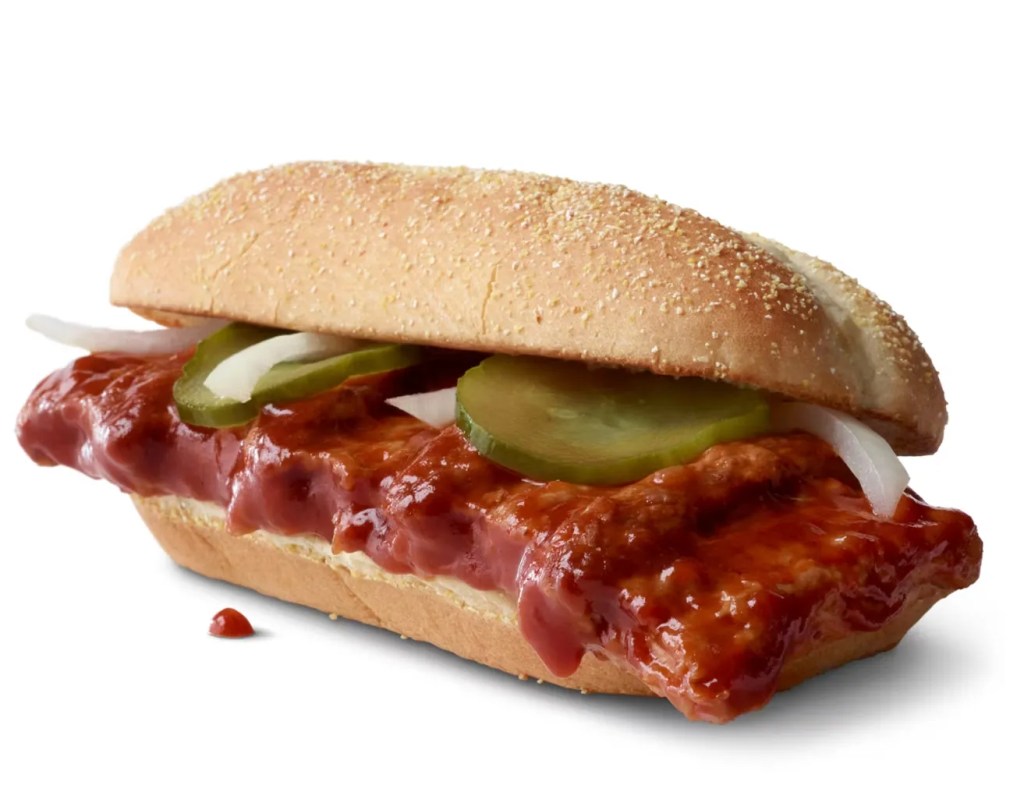
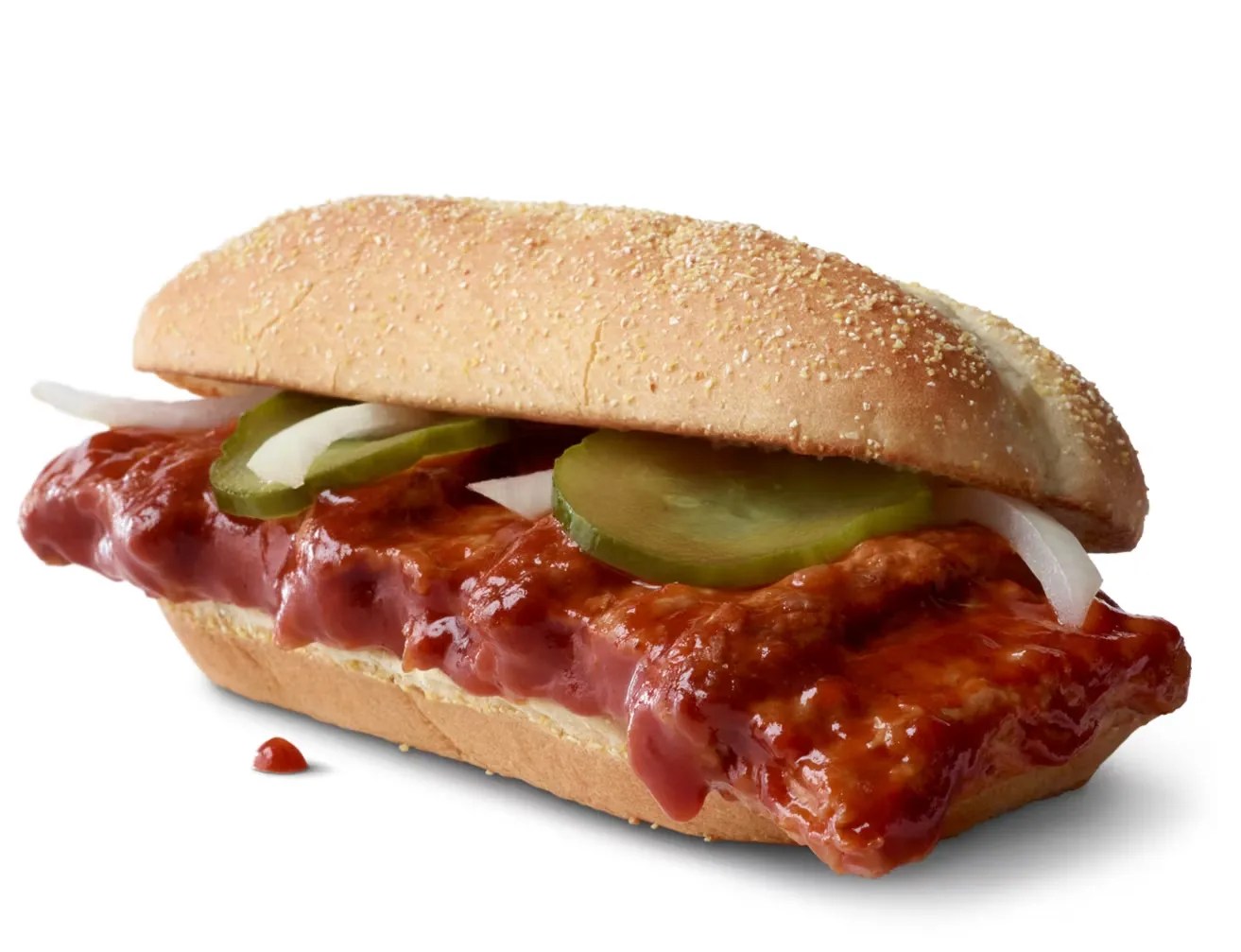
“The McRib is back!” is a phrase recognized across the United States, stirring excitement among McDonald’s customers eager for the limited-time sandwich offering. For decades, McDonald’s has cultivated a sense of anticipation around the McRib, leveraging its scarcity to drive sales across its many locations. Fans eagerly await each return, trusting that the sandwich they’re biting into is exactly what the name implies: a sandwich crafted using pork “rib” meat, which is prized by consumers for its high fat content and rich flavor.
The reality, however, is far from what McDonald’s advertising and branding suggest. Despite its name and distinctive shape—its meat patty has been deliberately crafted to resemble a rack of pork ribs—the McRib does not contain any actual pork rib meat at all.
The italics are in the original, just to make sure you get it.
If the McRib isn’t rib meat, what is it? I’m glad you asked, and so are the lawyers who filed the suit!
Instead, [the McRib’s] meat patty is reconstructed using ground-up portions of lower-grade pork products such as, interalia, pork shoulder, heart, tripe, and scalded stomach.
“You sold people a sandwich marketed as a ‘McRib’ that contained no rib meat” isn’t Love Canal-level on the harm-o-meter, so the gross-out line is there as a lure for the press and social media posters. Did it work? You bet it did! Here’s the New York Post:
The alleged ingredients also get repeated by CBS Chicago, NBC Chicago, USA Today, MSN and Newsweek, among others. I love that the Newsweek article has a breathless, Axios-style “Why It Matters” section for a sandwich lawsuit. But why settle for that when you can read the actual Axios article? Naturally, someone on Bluesky invoked Upton Sinclair’s gross-out labor classic, The Jungle…
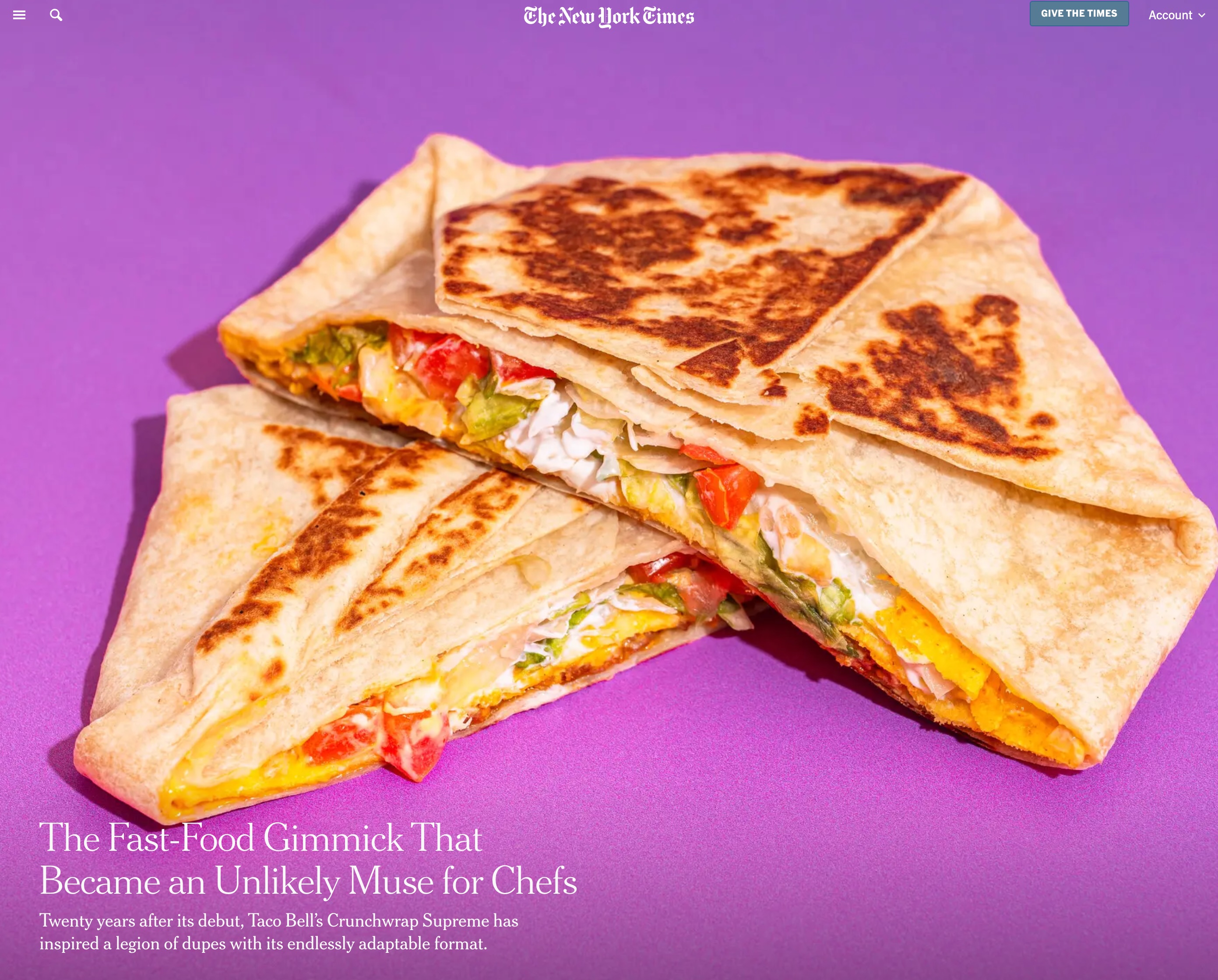
The art of getting your stoner snack into the New York Times
The last time I remember being in a Taco Bell was in the late eighties, when I was a student at U.C. Santa Cruz. My buddy Darren and I had just completed a round of epic late-night bong rips at an off-campus house and the munchies had arrived as inevitably as the tide. The Taco Bell on Mission Street, around the corner, was open until the wee hours. As we waited in line, Darren slowly read the menu out loud:
“Nachos.
Nachos Bel Grande.
Burrito.
Burrito Supreme.
Burrito Supreme…with hair.”
I don’t remember if we actually ordered anything. Or, if we did, what it was. But it says something that the image of a Burrito Supreme with hair has been stuck in my head since 1989.
A lot of my college experience lay at the intersection of my friendship with Darren, our youthful love of the herb, and snacks. There was the time we dried some leaves from the plant in Darren’s room in an electric kettle (not recommended!), smoked it all and then bought every cookie in Sluggo’s, the dorm coffee shop. After dividing the cookies, we slunk back to our respective dorm rooms to devour our prey in solitude, like stoned leopards.
An unexpected lecture on the politics of European immigration
I went to Amsterdam for two days last week. This was a classic of hallucinatory, placeless business travel, more time on planes than in country, mostly a prisoner of the Airport Hilton Schiphol. All airport hotels are liminal, but at least I had an outside-facing room with sunlight rather than one looking into the atrium, which was a sort of luxury panopticon. I believe Nietzsche wrote, “When you look long into an atrium, the atrium also looks into you.”
The Dutch have splendid cheeses, but don’t otherwise seem to be a big cuisine culture. I recognize this is dangerous turf for an American who was there for all of two days, but when you factor out cheese what are you left with? Stroopwaffels? Bitterballen? Hagelslag? When was the last time you went to a Dutch restaurant? Was it Rijsttafel? Thank the Indonesians!
Even Germany has managed a certain amount of cuisine and we go to our local German place periodically for beer and sausage. Admittedly, beer and sausage is a layup. But the Dutch had a spanning Southeast Asian empire, invented the global spice trade and fought a brutal war with the English over it. All that history, and the condiment hill they’ve chosen to die on is mayonnaise. That’s commitment!
This is one of the greatest things I have ever read in a press statement:
First and foremost, our investigation has identified the root cause of the contamination as a specific production process that only existed at the Jarratt facility and was used only for liverwurst. With this discovery, we have decided to permanently discontinue liverwurst.
The emphasis is in the original and it sells the paragraph.
This comms masterpiece is from a statement released yesterday by the food company Boar’s Head, which is dealing with a crisis regarding listeria contamination of liverwurst manufactured at a facility in Virginia.
One general rule in crisis communications is that you should clearly explain the actions you will take to remediate the problem. “We have decided to permanently discontinue liverwurst.” That’s an action! This step was so important that it was the first of three remedial steps covered in that press release. The second was that they are permanently closing the facility and apparently laying off several hundred people. Naturally, that’s the headline the press went with. Still, if you’re going to bury the lede, bury it under liverwurst!
In my years here, I have participated in passionate and heated debates on virtually all aspects of Chinese politics and society. What is the true nature of the government? Can the Chinese educational system produce creativity? Is the country rising or falling? All of these topics are capable of rending friendships, dividing rooms and spoiling a perfectly good dinner party. And yet none produces the same level of incandescent conflict as the question of whether or not China can do desserts.
China has an evident sweet-tooth. A walk down the candy aisle of any Chinese supermarket is trip to a tinsel-wrapped wonderland of waxy treats of infinite variety. True, I’m occasionally sucker-punched by spicy dried beef, which is often wrapped like candy, but a lot of it actually is candy, at least loosely defined. And what Chinese restaurant meal is complete without the fruit plate? If you’re lucky, the fruit plate might even be spouting dry-ice fog. Dinner and a show – what could be sweeter? One of the very first gifts I was given after starting work in China was a box of tangyuan. (I learned an important lesson:tangyuan are meant to be cooked. Hence the “tang“.) And the price people in this town will pay for Häagen-Dazs is second only to the price they will pay for ridiculous luxury watches, a phenomenon I’ve been able to study since our overheated local Häagen-Dazs shop is just around the corner from our local ridiculous-luxury-watch boutique.
It’s not just urban. The meanest, most wretched outhouse of a rural provision shop will somehow manage an ice-cream cooler, even if the refrigeration is powered by a mule on a treadmill or local orphans trudging around a giant “wheel-of-pain” like the one that turned a skinny waif into Arnold Schwarzenegger in “Conan the Barbarian.” I once had fresh made ice cream in a one-donkey town in Xinjiang in the foothills of the Pamir Mountains. It was awesome. Possibly because I was on the verge of heatstroke at the time.
Which raises a question: Does one need to be under some kind of physical duress to appreciate desserts in China? Admittedly, I have a roaring sweet tooth, apparently inherited from my father. I might my strap my own son into the wheel of pain if Häagen-Dazs Rum Raisin ice cream came out of the far end, especially given that it costs $13 a pint here. But ultimately, I’m open minded when it comes to Chinese desserts. I don’t just mean desserts obtained in China, but also desserts drawn from Chinese cuisine. Deep fried pumpkin bisuits. Red bean buns. Glutinous rice confections. Hot walnut soup. I’m pretty much OK with all of them. I still get bricks of blown honey when I walk through Qianmen, despite their proven ability to epoxy my jaws together for hours.
And yet the derision I’ve come in for from western friends is shocking. I could tell foreigners that my hobby is driving two-inch galvanized roofing nails through the skulls of live ferrets and they’d get less worked than they do when I tell them I like Chinese desserts. This leads me to ask: Is it them, or is it me? Are they right? Is that I’ve finally gone native and this is how its expressed itself? Instead of fleeing into the mountains of Yunnan to start a sustainable flax farm I’ve simply decided that its OK to eat black sesame paste? Or are they narrow minded conventionalists whose eyes are fogged with a lethal mix of Oreo dust and crème brûlée?
I won’t stand for that kind of cultural dessert imperialism myself. A century of hardship inculcates flexibility in confectionery. Just as almost anything can be food in China (especially southern China), so can nearly anything be dessert. If all you have is mutton and molasses, by god you’re having molasses sweetened mutton floss for dessert.
But these ethnic treats take you only so far. Perhaps the most fertile ground lies in fusion desserts, where Chinese (or Asian) sensibilities collide with western ingredients or traditions. It’s unfair, but some places were blessed more by dessert providence than others. The French, at least after the enlightenment, had butter and flour and invented European pâtisserie. The Indonesians had palm sugar and coconut milk and invented cendol (and you haven’t lived until you’ve had a really good cendol). And China had…well, China had pluck. And legumes. But it’s been willing to recombine, which goes a long way. After all, what better illustrates the potential of modern China than the shaping of foreign ideas to suit Chinese circumstances? Hence the entirely respectable red-bean ice-cream stick. (Although the less said about the phallic corn-dildo ice cream stick the better.)
This trait reaches its zenith is in its ability to take components that under other circumstances I’d be utterly contemptuous of and fashion them into miracles. I experienced this during a recent dinner with my colleagues at a restaurant called Green Tea, a sort of upper-middlebrow Hangzhou place with pretensions. Dinner was fine. But when they got to dessert they earned a place in my heart forever.
When I moved to Singapore in 1995 I discovered the phenomenon that I came to think of as “Japanese-style” bakeries. If you live anywhere in Asia, you’ll recognize this genre of store as offering a range of vaguely sweet, soft white breads, sausage rolls and alarming-looking combinations of cheese and sugar. I’m expansive about desserts, but I’m a bread snob so I’ve always been completely disdainful of the entire genre. Seriously: My standards are high. I wept when the Fauchon in Shin Kong Place went out of business. They were priced and stocked for Marie Antoinette’s snottier cousin, but their breads were the best in Beijing as long as they were in business – and were the only thing I ever bought, which was symptomatic of their problem, I guess. Respectable French pâtisserie Comptoirs de France opened in Beijing four years ago and it took them until last month to come up with a loaf of bread I like (the sourdough).
I’m also reasonably discerning about Ice Cream. Longtime readers will know that Mrs. Imagethief is a nutritionist. Among the many things I’ve learned from her is this: if you must indulge, do it right and don’t fart around with the small-time stuff. If you’re going to have ice cream and suffer the attendant guilt, you might as well have good ice cream. Bi-Rite salted caramel*, for example, or Strauss Mint Chip. Who wants to pound out the extra kilometers just because you caved on a pint of Baxy? No one, that’s who. So, like Nancy Reagan, I just say no to the soft bread and flavorless ice cream.
Or, I did. Until that dinner at Green Tea.
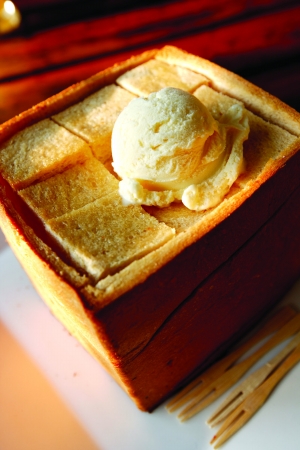
My colleagues ordered the house specialty dessert, 面包诱惑, which means something like “bread temptation,” though I think “bread seduction” would be better. This is a cube of warm, freshly-baked, soft white bread, sliced into twenty-seven smaller cubes (three cubed – think about the geometry) with a scoop of generic vanilla ice cream melting on top. The heat from the bread melts the ice cream, which runs down into the cracks between the bread cubes and soaks into the crumb and, well, it’s just alchemy, dammit, because the result is gustatory lead transformed into dessert gold. I swear when the waitress carried the first one in the world turned to slow motion while “Thus Spoke Zarathustra” played in my head. You’ll know that as the music that Stanley Kubrick used at the beginning of “2001: A Space Odyssey” to introduce us to a twenty-minute segment of a featureless monolith teaching apes to beat each other to death, which says something important, though I’m not sure what.
It is the call of the Sirens rendered into cheap bread and ice cream because, speaking of monoliths and ape-like behavior, we ate three of these things. By which I mostly mean thatI ate three of them. I am told that other restaurants have cribbed the idea, but that so far they all lack some…je ne sais quois. Worryingly, I’ve also learned that there is a branch of Green Tea around the corner from my house.
So, is it a Chinese dessert? Well, not really, I suppose. But it’s Chinese ingenuity applied to Western components with bang-up results. And if that isn’t domestic innovation, well then, what the hell is? The government should be proud.
I’ll say this for Korea: Recently I’ve had reason to evaluate, and at a national level they have by far the nicest, softest bathroom paper towels I have encountered. Fluffy, soft and absorbent, neither the splinter-bearing roughage nor the instantly-disintegrating tissue we usually get in China. I suppose this is a sign of development. Or tender skin. Or who knows what, but you take the small comforts as you can when you’re traveling.
After fifteen years in Asia it was my first-ever trip to Korea this week. This doesn’t count numerous stopovers at the old Kimpo Airport on the way from Singapore to the US back in the mid nineties. These flights always connected through just after all the snack shops at Kimpo closed, which is to say at about 4:30PM. Kimpo was not an advertisement for visiting Korea. It was kind of like the abandoned parts of the future city in “Logan’s Run” except with fewer homicidal children and a slightly worse selection of food. I also once got trapped in Seoul overnight and got bussed into a hotel, but pride, and the fact that I never saw much more than the inside of the bus and the hotel room, keeps me from listing that as a “visit.”
Eventually I switched from Singapore Airlines to EVA, which meant my transits switched to the more modern but (at least then) equally amenity-poor Chiang Kai Shek International in Taipei. CKS is now called Taoyuan airport, which is just as well unless the heirs of the Generalissimo wish for the chief impression of him to be that he endorsed the sale of only tea leaves and museum-piece replicas.
In the years since my Seoul transit stopvers Kimpo has been relegated to the domestic airport and Korea has opened the glittering Incheon International Airport. Incheon is fine as airports go, well appointed with snacks and coffee. It’s only disadvantage is that it’s actually in China. Or at least that’s what the drive from downtown feels like. It’s not one of those urban airports that you stroll right out of and into downtown wherever (like, say, the old Kai Tak). If you stroll out of Incheon, you’d better have a tent and a rifle to hunt with. Although I’m not sure what there is to hunt in the Han river delta. Egrets, maybe. I’ve never had egret, but if egret tastes like what egrets eat, then it probably tastes like frog. This, to my mind, is not an advertisement for egret meat.
I’m preoccupied with weird foods because I arrived in Korea with something of a culinary agenda. I mean, I also had a work agenda, but a man’s got to have priorities. I enjoy Korean food but I’d never had it actually in Korea, so I was looking forward to having the real thing even if that meant spicy egret meat or whatever. I did not, as it turns out, have spicy egret meat, although I had something almost as weird. More on that later.
After getting to the hotel, stowing our stuff and doing a hectic hour’s worth of actual work, my traveling companion David Wolf and I struck out in search of dinner. We were staying at the Grand Intercontinental, which is attached to the Ko-Ex exposition center and glitzy hypermall. I should have known that this meant our chance of finding good Korean food was zero. The first restaurant we encountered upon walking out of the hotel was a TGI Friday’s. A circuit of the mall also yielded an Irish pub, a mass-market pizza place, a couple of Italianoid places, Japanese food, Coldstone-freaking-Creamery, and a range of food-court insults including, yes, a Sbarro. But no Korean restaurant.
So this is the face of globalization. I built a career in Asia so I could have the option of eating at a Sbarro in a mall food court in Seoul. Either the Koreans are desperate to escape their own cuisine, or they’re catering to foreigners and (with some justifcation) have the lowest possible expectations of what we eat. Given the shocking number of coffee shops and Dunkin’ Donuts I saw in Seoul I tend to favor the latter. This is no exaggeration: There is a main street near the Grand Intercontinental that has a Starbucks and a Dunkin’ Donuts on literally every block for a good two kilometers, not even counting outlets of the local and completely ubiquitous Hollys (sic) coffee chain. This from a country that thinks American beef is crime against humanity. Somewhere in the far distance Tom “The World is Flat” Friedman is laughing his ass off.
Finally, near the threshold of surrendering to what I like to call the cheeseburger gravity-well, we found a Korean place. This place satisfied all my cliche, preconceived ideas of Korean cuisine by serving me a dish called “chicken ribs” which, despite the name, was 10 percent chicken (no ribs), 10 percent rice cake, and eighty percent cabbage and chili paste.
Cabbage and chili paste is my image of Korean food, thanks probably to the large amounts of kimchi I have eaten over the years. It’s pretty much the front-to-back of what I thought Korean food was, as though the early Koreans stumbled on this frigid, windswept peninsula where nothing but cabbage and hot chilis grew. Well, and egrets. In the dim recesses of my imagination I pictured some kind of Reese’s Peanut Butter Cup moment where two Korean farmers collided: “You got your cabbage in my chili paste!” “You got your chili paste on my cabbage!” And thus a cuisine was born.
And so I ate a big whack of cabbage and chili paste. And it was good. I happen to like both cabbage and chili paste.
Here I should explain something: I have some kind of learning impairment when it comes to spicy food. I love spicy food and chili of every sort. Unfortunately, it has a pronounced effect on me. How can I best describe this? Perhaps a military metaphor. For me, eating any really spicy dish is two battles. There is the initial assault on the palate and then, about twelve hours later, what might be best described as a brutal rearguard action. I know that this will happen and, as a result, one of the things I try to avoid is eating really spicy things when I travel. But, you know, I was in Korea and what the hell.
What an ass. And I mean that in every conceivable sense of the phrase.
The next morning, after spending an awkward amount of time in the bathroom (the Kindle app on your phone means never being out of reading material) we headed out to the office to spend a day training CJ, our new head of Korea. After a long day in the conference room drilling on messages and scenarios CJ kindly took to us to dinner at a little, family-run restaurant near our office. It was called something like “A ladle full of moonlight”, but the business card is all in Korean so I can’t really verify this.
It was here that I got my real education in Korean food. Sixteen courses worth. Sure, there was cabbage and chili paste, but there was also pickled cabbage without chili paste, raw fish, grilled fish, grilled vegetables and bean cakes, awesome mushrooms, beef wrapped around vegetables, miso soup (a fair amount of Japanese influence at the high end, it seems), and some kind of porridge made from the burnt rice scraped from an iron cooking pot that my wife has now made it her life’s mission to taste.
Most of this food was perfectly straightforward to someone who has been in the region for many years. However there was one dish that earned a place near the top of my list of bizarre stuff I have eaten. This list already included most of the usual Asian roadside organ-meat and insect delicacies and, among other things, black market flying fox served in Singapore of all places. I do not recommend flying fox. I tastes fine but it is extremely fiddly to eat and is likely to be frustrating to anyone who doesn’t have an ancient Roman’s patience for winnowing microscopic morsels of flesh from miniscule carcasses.
The dish that stood out in Seoul was not fiddly at all, and consisted of large chunks of fermented stingray meat that carried a very distinct whiff of ammonia. (At least, I recall that it was stingray, or skate or some other flat elasmobranch.*) Had Wolf and I not been the guest of a Korean I might have thought that the restaurant staff was unloading the old fish on the foreigners. Or in Korea, maybe unloading old fish on people is considered a courtesy. You are our honored guest. Here is a rotten trout. Would you like to marry my daughter? I’m man enough to admit my ignorance about this kind of thing. CJ described the stingray as being “about 20% of the way toward lutefisk”, which, if you know what lutefisk is and unless you have a fetish for both decay and traditional Scandinavian foods, is not really a plus. There is a reason why lutefisk is not among the delicacies offered at Ikea lunch counters.
The way to eat the fermented stingray is to set a sushi-sized hunk on a similarly-sized piece of fatty pork, and then wrap the whole thing in a kimchi leaf and pop the works into your mouth. Doctrinally-speaking, at any rate. The real way to eat this dish is to have three shots of shochu beforehand and then chase the whole thing with beer. Lots of beer. In this sense, it’s kind of like a Korean boilermaker with fermented stingray where you might place a lemon twist or a maraschino cherry in the sequence of a normal cocktail. Thinking about it, three shots of shochu –or arak or baijiu or whatever your local equivalent is– and a beer chaser will get you through most nasty foods.
I had two of the fermented stingray things. The fact that I was willing to go for number two suggests a couple of things: First, like many western idiots, I will go to extreme lengths to prove my manliness to foreign hosts. Second, the stingray was a long way from the nastiest thing I have ever eaten.
Since you asked, the nastiest thing I have ever eaten was balut, or fertilized duck egg, which I had in Ho Chi Minh city (nee Saigon) in 1998 during a night on the town as a guest of the Tiger Beer company. Balut is approximately three orders of magnitude nastier than fermented stingray in all three culinary dimensions: looks, texture and taste. A Googleimage search for balut is only for those of iron constitution. I chased my balut with a lot of beer which, under the circumstances, was not a hard thing to do. So everything in perspective.
The next morning I paid for my sins. We were taking a taxi from the Grand Intercontinental to the Shilla Hotel, where our product launch was being held. This meant crossing one of the congested bridges over the Han river during rush hour. As we were crawling along, my entire descending colon suddenly filled up with what felt like a combination of magma and caltrops. ”Urgent” is completely inadequate word to describe how it felt. If you were to use a rusty needle to tattoo the word “URGENT” across your forehead in flaming capital letters and then rub a mix of soot and Rebel Yell bourbon into the raw, bleeding skin you might come close.
If there is a feeling worse than sitting in a traffic jam on a bridge in an unfamiliar city an unknown distance from your destination with a rectum full of molten sulfur and the previous day’s fermented stingray remains, I have yet to encounter it, and I’ve had two surgeries, a major car accident and extensive dental work (not all at once). Uncertainty in this situation creates a surprising amount of anxiety. My heart was literally pounding and adrenaline was pumping through my pores. This makes sense, since I’m sure if I’d let go in the taxi, wet breeches or no I’d have had to run like Jim Brown to escape a mighty beating at the hands of the driver. I’m pretty sure I speak for everyone when I say that an enraged Korean taxi driver with a tire iron chasing a balding PR man with soiled trousers across a bridge in downtown Seoul rush hour traffic is a sight much of the world would actually like to see, but I don’t wish to be the person to indulge the world’s prurient fascinations. Except in writing.
To spare you the details, I made it. Once we cleared the bridge I was going to tell the driver to pleasefortheloveofgodstopatthefirstavailablelocation! but the traffic eased up almost immediately and it was only another five minutes to the hotel. I guess the thought of being arrested for public easing on the side of a Seoul bridge on my way to a press conference gave me just enough fortitude to tough it out.
Anyway, it was in most ways a good trip and I was happy to finally make it to Korea. There is no greater moral to this story other than the obvious: Be a little cautious about the stingray and try to stay away from morning transit after spicy dinners. These rules evolve for a reason, and one forgets them at his peril.
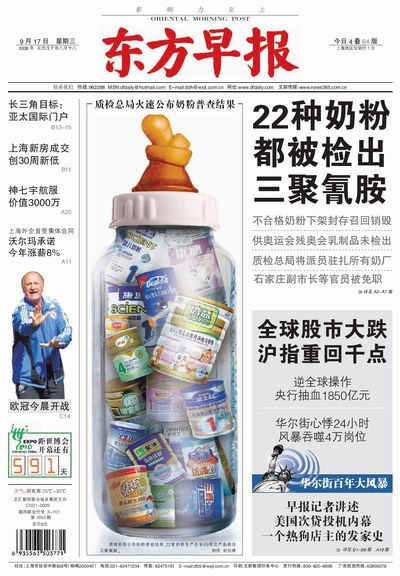
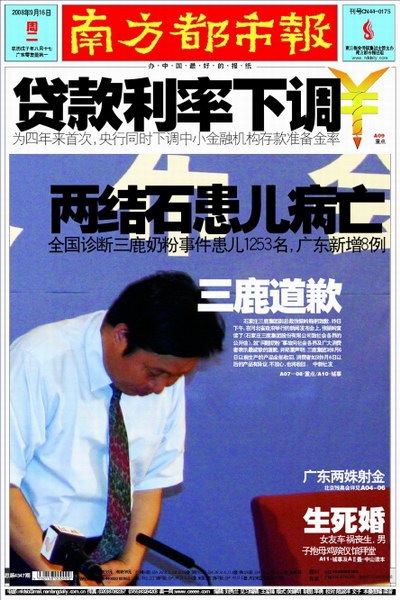
Like on the top-forty radio show Imagethief used to listen to as a thirteen-year old, the hits keep coming in the Sanlu milk powder crisis. Over the past thirty-six hours the situation has evolved from a company-specific Sanlu crisis to a nationwide dairy-industry crisis reminiscent of the glory days of last summer’s product quality crisis.
Here is the latest: Products from 175 dairy companies have been tested (中). Twenty-two of them tested positive. Sanlu is still the champ in terms of micrograms per kilo of product, but some other famous (and not-so-famous) brands are now implicated, including Mengniu and Yili. I bet Yang Liwei didn’t know about this when he decided to endorse Mengniu. But astronauts should be able to digest melamine, which anyway seems like kind of a futuristic substance. Imagethief used to have melamine coasters. No joke. Very “Jetsons”.
Also not a joke is that over 6000 children are now reported to have been affected and three are dead. The Internet is seething. Collars at the State Food and Drug Administration haven’t felt this tight since Zheng Xiaoyu was frogmarched away and shot for corruptionjust over a year ago.
So here are the PR implications:
Winner: Sanlu (sort of)
For Sanlu this is actually good news. All of a sudden what looked like their problem is a nationwide problem in which they are just one of many companies caught in the riptide. In PR we teach an interview technique called broadening. When confronted by an interviewer with a problem or challenge that cannot be refuted you respond by “broadening” the issue to include the rest of the industry, your rivals or whomever. It works like this:
Maria Bartiromo: Your stock price is down by 50% this month? Does your company suck?
You: Well, Maria, market conditions are tough and many companies in our industry have had similar declines but we are key message, key message, key message, yadda yadda yadda.
Sanlu doesn’t need to broaden the issue. It has broadened itself. This doesn’t make Sanlu’s problem go away. They’re still the worst affected, the most apparently negligent and most closely associated with the issue. In the past day or so, the chicken of accountability (a really big chicken in this case) has come home to roost and heads have justly started rolling. But misery loves company, especially in PR, and now the spotlight of attention has spread out a bit. It buys Sanlu some small breathing space at the trade-off of kindling a hotter but more diffuse groundswell of national anger.
Losers: Everyone else
While this broadening might be good news for Sanlu, it’s bad news for everyone else. Consumers have no idea which domestic manufacturers they can trust. Even ice cream bars (sob!) look suspect. Foreign manufacturers such as Nestle may benefit for a while, assuming resentment doesn’t turn on them later, which is possible. Also, Fonterra is now recalling its own Anmum branded milk in China. On top of its involvement in Sanlu, this may be wearing the foreign gloss a touch thin.
The Chinese dairy industry looks like a hopeless swamp incapable of quality control. Production and upstream wholesaling are completely fragmented and obviously subject to only the most featherlight of regulatory scrutiny or inspection regimes. The job of applying quality control nominally lies with the brands that sit between green fields and cow dung and supermarkets aisles and consumers, but they appear to have dropped the ball completely. Honestly: Twenty-two companies and 66 products? You’d sooner trust the Three Stooges with your dairy factory than this bunch of clowns.
The SFDA looks about as wired as it did in July, 2007. AQSIQ, which is separate from SFDA, is also scrambling. Regulatory involvement seems conspicuously after-the-fact in this situation. Sanlu was exempted from inspection because it was recognized to be such a fabulously well-run company. Lesson: No one should be exempted from inspection. More inspections for everyone, in fact, seems like part of the prescription for this situation.
And China in general reminds everyone else in the world of why they are just a touch suspicious of Chinese food products. There are apparently some export products involved in the current situation, although they are apparently exported primarily to the kind of no-hope client-states (think Myanmar) that are unlikely to make too many waves lest they have to start paving their own roads. But the rest of the world is watching.
As, incidentally, are the (ahem) China-based expatriate parents of small children. I am happier than ever that Imagethief Jr. is breast-fed. Mrs. Imagethief may be made of stern stuff, but it’s almost certainly not melamine.
Now what?
Aside from the fact that Imagethief will sadly never look at an Yili ice cream bar the same way again, what happens now?
Unfortunately, the whole situation has got much trickier. For individual companies PR issues can be managed because it is relatively easy to speak with a single voice. Situations that involve entire industries are trickier, because getting a bunch of competing companies to speak with a single voice about anything is like herding giant cats with tens of thousands of employees each. Cats that often want to blame each other. Try doing PR for an industry association someday and you’ll get a taste of this.
The cat-wrangling hat now passes to the Chinese government, which has just inherited the stage from Sanlu. The Chinese government needs to explain why there is a pervasive problem in the dairy industry and what it is doing to solve the situation. (It would be nice to talk about a plan for structural changes in the industry.) It needs to make sure that the dairy brands themselves are singing the same song with one voice arranged to church-choir perfection. It also needs to keep on letting consumers know which products are safe and which aren’t and ensure that people have enough real and timely information that gossip and suspicion don’t become the main drivers of the public response. It needs to vigorously punish offenders who have been sloppy and do its best to convince people that the companies, regulators and local governments are all entwined in one sloppy, corrupt ball. I know that executions will look tempting, but executions alone probably won’t solve the problem of restoring consumer confidence, so let’s think more creatively than that.
Importantly, if there are more melamine skeletons in the closet it is best that they come out soon rather than creep out over the coming weeks and months. The situation has already deteriorated. The sooner it moves into recovery phase the better. More bad news dribbling out over weeks and months will delay the start of the recovery and stoke the fires of suspicion and anger. This is one reason why it’s important to make sure people have enough real information to forestall the worst of the gossip and conspiracy theorizing. For that reason, AQSIQ’s public round of testing was a good thing, even if the news was bad.
But the whole process will be difficult. In yesterday’s post I mentioned all the entrenched and institutional problems that retard the development of public communication in China. Many of them also serve to slow the development of effective commercial enforcement. In a sense the larger challenge for China is not just to prove that it can clean up the dairy industry, but to prove that its commercial environment can evolve into something other than a cozy swamp where insiders get rich and outsiders get kidney stones.
But that’s been the challenge for a long time now.
Suppressing the news is not a PR solution Hop on over to ChinaSmack and read the new post “Kidney Stone Gate: Baidu denies censoring search results“, which cites a 21st Century Business Herald report on Baidu’s possible involvement in suppressing negative search results for Sanlu:
Soon after the Sanlu poisonous milk powder news came out, a copy of letter from the Teller public relations firm to the Sanlu Group began spreading on the internet. In the letter, Teller advised Sanlu to pay Baidu 3 million RMB to have Baidu manage search results containing negative news about Sanlu (supposedly not all news could be censored but most results coming from smaller websites could be deleted). When Baidu heard the rumors, they quickly denied working with Sanlu. A representative from Teller also said the letter was fake.
Sanlu Group logo: Sanlu is suspected of paying Baidu 3 million RMB to censor negative search results.On September 13th, “21st Century Economic Report” reported that Baidu admitted receiving a “Sanlu Public Relations Crisis Proposal” letter from a public relations firm, but Baidu could not confirm that it was the Teller firm.
There’s more in the post, including a partial translation of the 21st Century Business Herald article. Some evidence is presented in the story to support the allegation that Baidu was complicit, although Baidu denies it. The jury is still out.
However, the basic PR rule is this: Supressing bad news is almost never a viable PR solution. Bad news tends to leak. It tends to percolate through the pores. It tends to squirt around to wherever your grip is weakest, like the air inside a balloon animal. This is particularly true in the era of the Internet, regardless of what Baidu (or even the government) does.
Only an irresponsible PR agency proposes suppressing bad news as the core of a PR strategy. That’s not rebuilding or defending a reputation. That’s admitting you can’t help. But suppressing news is an old tradition here, handed down from the highest levels. It will be a long time before that kind of recommendation stops coming.
Baidu’s statement (中), also partially translated, includes the following:
Baidu’s most important value is to seek truth from facts. (百度价值观中最重要的一条就是实事求是)
One would hope so. But I recall that somebody else in Chinese history used to talk emptily about seeking truth from facts.
If you want to get people mad –I mean fired-up, torch-and-pitchfork enraged– screw with their pets or their babies. That’s what we’ve learned over the past year thanks to the unfortunate tendency of the plastic melamine to pop up in the strangest places, most recently in infant formula from Sanlu, a mighty Chinese dairy firm.
You would think that after last year’s long-running product quality fiasco people would have learned. Those of you who have brushed the last of the Olympic rings from your eyes will recall that the product quality crisis began with American pet food tainted with melamine thanks to contaminated ingredients from China. It then rippled into lead-tainted toys (repeatedly), antibiotic-laden fish and various other hysterias that collectively managed to knock Dream for Darfur (remember them?) off the front pages. Man, what a summer that was, especially for PR nerds. I get all misty just thinking back on it.
But there will be time for nostalgia later. I want to spend a moment on the word “crisis”, which I used in both the headline and the paragraph above. Like the phrase “mission critical”, beloved of jargon-head business types, “crisis” is a word that is often misused to describe any situation where a company is wrestling with a spot of PR trouble. Chinese nationalist youth are insulting our company on the Internet! We’ve got a crisis! No you don’t. You have an “issue.”
What’s the difference? An easy if somewhat oversimplified way to think of this is chronic and debilitating vs. acute and life threatening. Being morbidly obese with high blood-pressure and diabetes is an issue. But your doctor can prescribe a program that will over time mitigate it. Going into cardiac arrest is a crisis in which the options are immediate treatment or death. In corporate terms this means a situation so bad it threatens the reputation of the company in a way that could rapidly and substantially damage business or shareholder value. Crisis is life-and-limb, billions-of-dollars or fate-of-the-company territory. Cyanide in Tylenol, the Exxon Valdez, Singapore Airlines flight 006; those are crises. Lehman Brothers is was having a crisis (it is now over in the same way that the cardiac-arrest crisis will be over if you don’t get immediate treatment).
Apply the “life-and-limb” test and I think we can agree that Sanlu is having a crisis. Fonterra, their foreign part-owner to the tune of a significant 43%, is having an issue, although it could get worse. More on that below.
Here is the story so far. On September 11th, almost a week ago, initial reports emerged that an unusual outbreak of kidney stones in about sixty infants had been linked to tainted milk power. Naturally the first assumption was counterfeit product, as happened in the tragic Anhui milk powder episode of 2004 and in countless food scandals in China. Since then the story has spread, blob like, in a fashion that reeks heavily of a coverup unravelling. There are now over 1000 affected babies and two fatalities. Genuine Sanlu product has been revealed to be the culprit. There’ll be no palming it off on counterfeiters. A recall of over 8000 tons of product is under way. Sanlu apologized in a news conference yesterday. Heads are rolling, but only at a suitably low and distant level in the great chain of scamming and incompetence.
Deliciously (unless you’re a formula-fed baby), Sanlu and provincial authorities from Hebei, where Sanlu is based, allegedly knew about the problem possibly as far back as early this year, and at the very least in early August, well before the Olympics. We know this because Fonterra execs are now telling anyone who will listen that they told Sanlu and the Hebei authorities that there was a problem but got no action until they got the New Zealand government to tell the Chinese central government. So everyone involved knew the formula was dodgy except for parents merrily feeding it to their babies. The irony of this situation is that foreign involvement is often seen as an indicator of quality thanks to the well documented quality problems of domestic brands.
The New York Timeshas this quote from Gao Qiang, Vice-Minister of Health, which is solid gold by the leadenly unquotable standards of Chinese officials:
“This is a severe food safety accident.”
You think?
Now the conspiracy theories are boiling to the surface like worms after summer rain (we’ve had a lot of rain in Beijing recently, so this image is fresh in my head).
Some think leading Chinese search engine Baidu may have had an agreement with Sanlu to filter negative search results. I don’t really buy this one, but as a student of the Internet I find the supposition interesting. It says a lot about how people feel about the power of search engines as gateways for information. If it was true it would be really interesting. Note to search engines: The time to come clean about how you will and won’t help advertisers is now.
Others wonder if the story was suppressed because of the Olympics, and invoke the Central Propaganda Bureau’s alleged 21-point reporting guidance for the Olympic period. I find this one pretty credible, and it stokes my belief that in addition to bringing out some of the best about China the games also brought out some of the worst. The post linked to above, from China Digital Times, also has a translation of apparent Propaganda Bureau guidance on how to report the current situation, suggesting that the cogs of harmonization are already grinding through comment on this situation even if they’ve not yet clamped down on it completely.
And then there are claims that Sanlu not only knew about the issue but has also beenpaying off afflicted consumers to buy their silence. This one is also pretty credible, and goes along with established Chinese practice of privately arranged compensation for the families of people injured in industrial accidents and such, often in return for an agreement not to make waves. Coal mines are past masters of this tactic.
Uncoverup The PR rules for situations involving the endangerment of human life are simple: The company’s priority is to take all steps possible to mitigate danger, and communication should be centered around ensuring that the public is completely and rapidly informed in a way that minimizes the risk of injury or death. If you concede that the contaminated product is fait accompli and that some damage control will be necessary, then such an approach, funnily enough, often pays the best dividends in terms of repairing a damaged reputation. This is because it demonstrates clearly that the company prioritizes customers and human welfare over a grimy buck. In troubled times this a critical message to send, and it helps to remind customers of why they placed their trust in the company in the first place. See the Tylenol-cyanide crisis for the textbook example.
On this count, everybody involved in the current situation fails. They’ve prevaricated their way into disrepute. There were some shockingly basic steps ignored along the way. As of Sunday, for instance, when the formula recall was in full swing, there was nothing on Sanlu’s website to suggest anything odd was going on. No announcement. No recall information. No advisory to customers. Not hotline. No news since August 14th. Zilch. As of yesterday and into today their website has been unreachable.
This is not a surprise. It is perhaps unfair to judge Sanlu by my imperialist western standards of public communication given that the company is the product of an environment in which the relevant authorities have not always led by example. Sweeping scandal under the rug is a favorite institutional pastime here. Read up on SARS if you need a refresher on this, or the Songhua river benzene crisis, or the Xifeng county journalist scandal, and so on. But SARS was blown wide open, and if this was a cover-up it is now blown wide open too.
While acting vigorously in the interests of the public helps to repair reputational damage from a tainted or defective product and rebuild trust, covering it up compounds the problem. Remember when you broke the dining room window and then lied to your mom and said it was the dog? And she didn’t mind the window so much but was gravely disappointed about the lie? And you didn’t even have a dog? You learned an important lesson then (I hope). This is the same thing, only bigger and with the public instead of your mother. And no imaginary dog.
A blown cover-up demonstrates convincingly to the public that you don’t give a crap about them and that you were willing to let them (and their babies) twist in the wind to save your own hide. Now you have two problems instead of one: Your product is poisonous and your company is run by untrustworthy bastards as far as the public is concerned. The natural conclusion is that you now have at least twice as much work to do to repair your reputation, although Imagethief thinks that the repair work actually goes up as the square of the number of self-inflicted wounds, if not the cube (modern media being three-dimensional).
In addition to simply being ethical, coming clean is a good approach because it shortens the time-frame for bad news. Scandals often don’t bust all at once, but drag out over days or sometimes weeks as bad news bubbles to surface in bits and pieces. This can feel a like a very long time when you’re on the pointy end of bad press and public scorn, and can leave a very deep impression on the public. As noted above, the CEO of Sanlu has apologized, but once the story has gone this far it looks like an apology under duress. That simply doesn’t have the power of pre-emptive contrition. (Lawyers take note: I am not suggesting pre-emptively admitting liability.)
While it’s hard by definition to know how many cover-ups succeed, Imagethief expects that most are busted, especially when there is a large public impact. The old mob aphorism holds that two people can keep a secret if one of them is dead. If a lot of people know about your crisis, better for you that you resist the coverup temptation. Own-up and be seen to get cracking on solving the problem and helping the victims. Or hope that your crisis is so thermonuclear that it wipes out all witnesses and all evidence.
But exhorting transparency is almost certainly pissing into the wind. The problem here isn’t just one of the occasional irresponsible company. And it’s not a problem that one or two or a dozen PR agencies or crazy PR bloggers are going to solve. It’s a problem of endemic business and regulatory culture. There are several factors at work. First, the Chinese government doesn’t have a history of encouraging transparency. Second, the relationship between media and business is often too cozy for the good of anyone but media and business (this is especially true at the local level, which is why the government’s restrictions on all but national news organizations reporting outside of their home areas are so damaging). Third, the government still maintains explicit control over the media and to a degree the Internet, which means that stifling coverage by fiat consistently presents itself as a path of least resistance. Fourth, the government still maintains tight links with major businesses. Sanlu’s majority owner as near as I can determine is the Hebei provincial government, who’s PR philosophy is probably pretty old-school.
The Kiwi’s aren’t off the hook either
But what of Fonterra? They’re not a Chinese company. They come from a different media, PR and regulatory tradition. How has their performance been? From the Financial Times:
The Sanlu board, which has three Fonterra directors, was told of contamination on August 2 when a trade recall began, said Andrew Ferrier, Fonterra’s chief executive,yesterday. A public recall did not start until nearly six weeks later.
“[Fonterra] have been trying for weeks to get an official recall and the local authorities in China would not do it,” Helen Clark, New Zealand’s prime minister, said on television yesterday. “At a local level . . . I think the first inclination was to try and put a towel over it and deal with it without an official recall.”
***
Sanlu could not be reached for comment yesterday, but Mr Ferrier defended Fonterra’s role, saying “as a minority shareholder [the company] had to continue to push Sanlu. Sanlu had to work with their own government to follow the procedures that they were given.”
Not so good, I’d say.
Here’s the million-RMB question: Did Fonterra have a responsibility to go public in China based on what they knew? To someone not directly involved (such as me) it looks an awful lot like Fonterra sat on its hands despite knowing that customers were at risk, possibly to protect its business and relationships in China. Minority shareholder they may be, but 43% is a big minority and they have three board seats. Their reputation is hostage to the behavior of their partners and right now they look complicit in a sketchy situation.
I am sure it was hard decision considering the prickliness of Chinese authorities and regulators and the likely fallout of ratting on their Chinese partners (see Danone vs. Wahaha for an example of what can happen when sino-foreign business relationships disintegrate). But I wonder how their noisy stakeholders back home in New Zealand, who won’t care so much about the idiosyncrasies of the China market, will react. Several nasty questions present themselves. How bad would the problem have to be before Fonterra blew the whistle? Do they prioritize their China business over the safety of customers? Is China an appropriate market for them to be in under the circumstances? At times like this you’re happy to be a privately held cooperative.
Fonterra has no official statement on the situation that I can find as yet, although I’ve seen references to press releases. Private or not, I think they have some explaining to do.
Lessons from the great milk-powder fiasco of ’08
It has been heartening to see both the Chinese press and the Internet go to town on Sanlu, especially since they’re not my client. While I don’t envy them their PR miseries, the willingness of the Chinese press to take on big Chinese companies that do wrong by their customers is an important development for civil society. While the coverage will follow the Central Propaganda Department guidelines referred to above, the whack of big, negative headlines may still have a salutory effect on other companies. That’s as it should be. People trust brands. The tradeoff is that brands are accountable and the media is an important part of the mechanism for making them so.
It’s also interesting to see that even Chinese companies can have quality problems with their suppliers. At the height of the product quality crisis much was written about the importance for foreign companies of vetting and monitoring suppliers rigorously and continuously. It is reassuring in some small way to see that it’s not just foreign dupes who have trouble managing these problems. Local dupes can have them too. It is, on the other hand, a reminder of how much room for development there is in the Chinese commercial environment.
Finally, as bad as this situation is, it shows that there is an opportunity. Chinese companies do understand the value of a powerful brand and a good reputation. That’s a good first step, but more is needed. Many clearly also learn the value of communicating transparently and aggressively in crisis situations in order to defend the brand and reputation. Nobody wants a crisis, but the lessons learned this way can help prepare the best managed and most progressive of China’s big consumer goods companies to succeed internationally, where the old cozy approach won’t work as well.
An ancient and time-worn chestnut of China journalism is that the word for “crisis”–危机, or weiji–contains the characters for “danger” and “opportunity”, which is sorta-true-but-not-really. As a piece of popular wisdom, it has the unfortunate consequence of trivializing the concept of a crisis. Sure, “crisis” in the classic sense means an inflection point from which multiple outcomes, including perhaps opportunity, may arise. But in the colloquial PR sense it means a grave situation with unpleasant and possibly catastrophic consequences. Thus, Imagethief has always felt that it would be much more accurate if the Chinese word for crisis combined the characters for “shit” and “fan”. I’m sure that right about now executives from both Sanlu and Fonterra would agree.
Still, I’m an optimist by nature, and I do like to look for the upside. Let’s hope some lessons are learned.
A very interesting story from Peter Ford of the Christian Science Monitor on the systemic problems in China that have made situations like this so depressingly regular.H/T China Law Blog:
Some observers see a silver lining in the scandal. “One positive result is that people will become more aware of food safety,” says Ren Fazheng, a professor at China Agriculture University in Beijing. “Government and society will pay more attention to this issue … and more inspection agencies will use more methods, so the level of inspection will improve.”
Yet public opinion, even outrage, has limited impact, as evidenced by the stunted efforts by angry parents who lost children in the Sichuan earthquake in May to demand government accountability. While officials are still investigating why so many schools in the quake area collapsed, protests have been curtailed and media coverage on the issue banned.
Still, with Sanlu closed by government decree and its future in doubt, two men charged with crimes that can carry the death penalty, and a government investigation widening, “this serves as an extremely strong cautionary tale for the whole industry,” says Professor Yang.
“Lawsuits have not worked well in China, but the costs are escalating” for companies that cheat, he argues. “Producers realize now how precious their brand name is.”
Perhaps. But as long as some companies feel their brands can be protected through means other than sound ethics and transparency I’d suggest channelling the Gipper: Trust but verify.
Disclosures:
Imagethief once worked for Fonterra’s PR firm in Singapore. Fonterra was not my client.
The founder of Imagethief’s current employer advised Tylenol during their 1982 crisis. Imagethief was 15 at the time, and was too busy watching “Get Smart” reruns and not doing his homework to be involved.
Imagethief likes the Mid-Autumn Festival. I like it because even though it actually comes in late summer, it reminds me of autumn, and autumn is famously the nicest time of year in Beijing. In any year devoid of Olympic rigging, late summer in Beijing is intolerably hot, muggy and polluted. This year it was merely hot.
Over the years many people have told Imagethief that the Chinese Mid-Autumn Festival falls in summer because of inconsistency between the Chinese lunar and western Gregorian calendars. This is total BS and I see no reason why I should accept obviously finagled explanations from people just because they are “Chinese”. The real reason is that without some reminder of imminent autumn and its much improved climate, half the population of Beijing would commit suicide in late August and early September, in the dregs of the Venusian summer atmosphere. In Scandinavia it’s the lightless winters that do it. In Beijing it’s the airless summers.
If you assume that Beijing has fourteen million people (and don’t bother controlling for migrant labor, tourists, etc.) a one year half-life would leave Beijing with a population of just thirteen people in a mere twenty years. This would obviously be totally unacceptable to government mandarins, who would no longer be able to feel the satisfaction of clearing out an entire lane on Chang’an Ave. and making millions of gridlocked commuters watch them roar past in a motorcade. Roaring past one peasant and his donkey cart on an otherwise completely deserted twelve lane boulevard just doesn’t have the same effect, and anyway the same effect can be had in the new Burmese capital-cum-supervillain hideout of Naypyidaw.
So Mid-Autumn Festival is a good thing. We all agree on that. However, just as the miracle of a Tex-Mex dinner comes with the heartbreak of punishing day-after flatulence, the miracle of Mid-Autumn Festival comes with its own curse: Mooncakes.
Mooncakes are the Chinese fruitcake: Cloying pastries that appears once a year for traditional reasons that everyone has forgotten, generally as gifts, and which, cockroach-like, resist all attempts at eradication. If you must know the history, it’s on Wikipedia. Scroll right to the bottom, since most of the entry is devoted to the culinary characteristics.
Many people complain to Imagethief about mooncakes. Inedible. Gross. Heavy. Burn longer than a tin of Sterno. And so on. To direct all this anger at the innocent and humble mooncake itself is to miss the point. First, Imagethief likes mooncake, albeit in small doses (it’s best cut with Chinese tea on the side). Of course, Imagethief also likes fruitcake. In fact, Imagethief pretty much likes anything sweet. I’d eat gravel if you mixed it with brown sugar.
But the other thing is that is that the main problem with the mooncake is not the cake itself. It’s the packaging, which could be the least green consumer item since the Hummer.
I was reminded of this when the translation company delivered a palletload of mooncake boxes to me and my team as part of the obligatory upward mooncake flow from vendor to client. Each of us received a heavy, embossed and foil stamped bag with rope handles. In the bag was a heavy cardboard box with a tri-fold faux-embroidery lid with faux-embroidery dragon applique. Within the box was a cardboard frame wrapped in a faux-silk shroud and lovingly cradling eight mooncakes. Each mooncake was in an individual cardboard box, a sealed plastic wrap and a plastic cup. Two pairs of wooden chopsticks in a fabric envelope were included for good measure. The theme throughout was tasteful and subdued imperial yellow garnished with dragons.
Gross weight: About two and a half kilos. Net weight: About 640 grams. Multiply by a nation of 1.3 billion people. Sure, not everybody gets mooncakes. But some of us get lots of mooncakes. You can see where the environmental toll will start to add up.
Fortunately, the picture is not as grim as it seems. Like fruitcakes, mooncakes are, if not an infinitely renewable resource, at least an infinitely recyclable one. Every year at this time the hand-lettered “recycle mooncakes” signs go up outside neighborhood shops and on curbside stands. Like overpackaged Chinese brandy sets, mooncakes are infinitely re-giftable. Shanghai, ever the city of commerce, has brought the mooncake recycling market to unprecedented levels of trading sophistication. Rather than give physical mooncakes, it’s common to give a coupon that can be redeemed for mooncakes. These coupons are then traded on an informal exchange of office ladies and household ahyis that offers NYMEX-like liquidity. Like the oil futures market, it seems that the actual mooncakes rarely enter into the final equation. However there is some risk as, like a bank run, its unclear if the system could actually withstand a mass-redemption event.
The upshot is that while approximately four billion tons of mooncakes are gifted every mid-autumn, only about ten pounds are actually consumed. This means that the packaging situation is perhaps not as bleak as it first appeared.
Imagethief sees this as yet another sign of Chinese technological advancement. Like an MRE a mooncake has a nearly infinite shelf life, allowing for century after century of suck-up regifting on a highly leveraged environmental footprint. Surely this is a system worthy of the inventors of moveable type, the compass, paper money, rhinestone dog collars, the Slinky, aerosol breath freshener, etc. etc.
The mooncake tradition traces its history back to the fourteenth century. How charming and ecologically sensible that the mooncake you are now slicing into may also date back to that same century.
Imagethief went for a hike with some good friends on Sunday. Hiking is one of the things that I was sorry to give up when I moved to Shanghai, and that I’ve been most eager to rediscover upon my return. In Shanghai you can drive for days through the industrial sprawl of the Yangzi delta before you find anything that looks remotely appealing for a stroll. Unless you like walking through cement plants, paint factories and valve workshops.
This isn’t a joke. I recently went with my Shanghai colleagues to Jiangsu’s fabled Yangcheng Lake, home of the world’s most legendary hairy crabs. I was picturing someplace out of a Chinese fantasy. Limpid waters. Verdant banks shaded by drooping willow trees. Graceful pavilions on which maidens in silk gowns would pluck pipas for my pleasure (it’s not as dirty as it sounds) while I feasted on plump crab hoisted fresh from pure spring-fed pools.
Wrong. Yangcheng lake is a suspiciously turbid expanse of water with concrete and rapple banks and ringed by cement plants, paint factories and valve workshops. It’s connected to a labyrinth of local canals that look like they supply the drinking water to Mogadishu. I’d be wary of eating of anything pulled from Yangcheng’s dubious depths, let alone a creature that lives in the heavy-metal sludge and eats the carrion of whatever couldn’t survive in the lake, died and sank to the bottom.
So much for the hairy crabs. They’re overrated anyway. It turns out the Chinese idea of what constitutes damn good crab is something you can easily suck the innards out of. I grew up in San Francisco, eating fat Dungeness crabs. We discarded the innards so we could get to the meat. Better yet, we had the fishmonger discard the innards so we didn’t need to be reminded they ever existed. Nothing but meat and a hollow space in the middle that, as far as you know, was always full of fresh lemon slices. That’s good crab.
A hairy crab has no meat. It’s all innards. And hair. Hence the bliss of my Chinese colleagues, who gleefully explained to me every organ they were eating. Except when the girl sitting next to me got to the testes of a male crab. “You don’t want to know what this is,” she gracefully suggested. Doing my best to ignore the gusto with which crab ‘nads were being consumed at my elbow, I was reduced to trying to squeeze miniscule fragments of meat out of legs the size of toothpick envelopes. You could starve to death doing this.
But this has nothing to do with hiking. Or massage touts.
Shanghai is all industrial wasteland and toxic lakes infested with carrion-eating vermin that somehow got rebranded as a delicacy, probably during one of the many famines. But in Beijing you only need an hour on clear roads and you’re back in the dongbei in all its rural, dustbowl splendor. This is fine for me because, as it happens, I like rural dustbowl splendor. There is something about Northeast China that evokes loneliness, resilience and endurance honed in an endless arid wasteland. The ghost of hard times still lingers over these lands.
Plus there are mountains. We climbed into the remote hills somewhere north of Beijing where there are desolate stretches of unrestored Wall traversing peaks with panoramic views stretching from Beijing’s smoky basin to the Kangxi grasslands. I am told this is where the Mongols fed and watered their horses before riding through the pass at Badaling (where the famous touristy section of wall is) to assault the capital.
I nearly didn’t manage the climb. I run three times a week when I’m being good and can go on flat ground more or less indefinitely. But hill-climbing fitness is different, and I was contemplating the pros and cons of a good vomit within about twenty minutes of setting off. It didn’t help that my hiking companion leaped up the mountain like a goat on speed. To add insult to injury, he smoked his way up and down. The road to true fitness apparently leads through Marlboro country.
Outside of the embrace of Beijing’s heat island it was also cold enough to freeze the water in our bottles. A ripping wind peeled the skin from our lips and reminded us all why living in a porous, brick hut in the dongbei is not, perhaps, an ideal lifestyle. And why this is the land that gave birth to the kang, a traditional bed warmed by the exhaust of a fire.
But the worst penance of the trip came the next day. Sometime during the night someone secretly replaced the fine thigh muscles I normally use with bags of broken glass soaked in vinegar and cat urine. Or that’s what it felt like when I tried to walk. This is what happens when you let moving blow up your workout schedule for a month and them climb a mountain with smoking gazelle-man. I spent the next forty-eight hours doing an extremely good impression of an eighty year old man with crippling arthritis. I also experimented with every variation of the standing up and sitting down groans.
On Monday evening I worked a bit late. Knowing that by the time I got home it would be so late that I would blow off the gym yet again, I decided to walk from my office in Oriental Plaza back to my apartment at China Central Place. I figured this would give me some exercise while also enabling me work some of the devastating soreness out of my legs.
I have no idea why we always think the solution to exercise pain is more exercise. This is total BS and should be resisted. Nevertheless, I enjoyed the walk. This was unexpected, because it was an hour and fifteen minute slog down Chang’an Jie and Jianguomen, past the world’s champion assortment of dour, institutional looking buildings and vaguely seedy hotels. I put it down to the odd euphoria that returning to Beijing has generated in me. This could be because I am deeply affectionate for this sprawling, funky city. Or it could be some kind of toxicological effect from all the pollutants in the air. Either way, it’s a good feeling and I’m nursing it.
In addition to enabling me to survey at leisure what an architectural wasteland Beijing’s central artery has turned into (Wanda Plaza, anyone?), it gave me a chance to sample some of the city’s finest massage pitches. By which I mean prostitution pitches. You can always tell when you cross from an office’s or institutional building’s frontage to one of the hotels because you immediately get hit with, “Hello? Massage? Girl?” And, to up the ante, “Pretty girl?”
In the course of my walk I got it from singles, tag-team pairs, men and women. But the all time winner was a girl who glided past me on one of those preposterous, little folding bicycles with wheels the size of salad plates. She had long, black hair and was painted unnaturally pail, so her face leaped out in the darkness. She had false eyelashes so big it looked like she could have propelled herself along by flapping them.
“Helloooo,” she cooed in a singsong as she carved out graceful turns in front of me. “Massage?” And then, “Hellooooo! I love you!” And then, with a final flap of those absurd, batwing eyelashes, “Hellooooo! Sex?”
On the bicycle? I wondered. But it was too late to ask. She had given up on me and was pedaling off down the sidewalk. While I was still writing down her pitch in my notebook a rough looking man in a leather jacket came up to me and said, “Hey, massage?”