Tag: Environment

  • I’ll Be the Judge of the Air Quality in These Parts

    When I was young, lithe* and had elastic knees I studied the Japanese martial art Aikido. Aikido is interesting for a couple of reasons. First, despite what you saw in all those Steven Segal movies, it is very much bound with a philosophy of acting in defense only. Second, in keeping with that philosophy, much of Aikido is designed around using an attacker’s energy against him. The harder you swing, the more you give an Aikido master to work with.

    The Vice-Minister of Environmental Protection swung hard two days ago when he called out the US Embassy for monitoring air quality and publishing the results through its well-known @BeijingAir Twitter feed. The Vice-Minister said:

    “Some foreign embassies and consulates in China are monitoring air quality and publishing the results themselves. It is not in accordance with the Vienna Convention on Diplomatic Relations and the Vienna Convention on Consular Relations, as well as environmental protection regulations of China.”

    For “some foreign embassies” you may read, “The Embassy of the United States of America,” which launched its Twitter feed back in 2008, that marvellous Olympic year when everything seemed possible.

    The Chinese government first complained about @BeijingAir in 2009, so this isn’t a new issue. The latest demand seemed like a classic soft-power own-goal: a prickly and legalistic attack on a service many people, foreigners and locals alike, rely upon. Journalist James Fallows, who has written at length on China’s soft power challenges, summed it up: “The country is better than this.” But leave it to the US State Department, which runs the embassy, to take the Ministry’s mighty swing and apply a little soft-power Aikido:

    [State Department spokesman Mark Toner] denied on Tuesday that publishing US air quality readings was in violation of the Vienna Convention as far as he was aware. He also said that Washington would have no problem if Chinese embassies wanted to start monitoring air quality in the US capital and sending out their own reports.

    That’s a nice bit of work, not only rejecting the legal argument but also reinforcing the relative openness of American society by extending a reciprocal invitation to the Chinese. Naturally, the Chinese wasted no time in declining the invitation and reiterating their argument:

    The Chinese government has no interest in monitoring and releasing air-quality readings for US cities, Foreign Ministry spokesman Liu Weimin said at the ministry’s regular news conference on Wednesday.

    “Foreign embassies and consulates are not legally qualified to conduct environmental monitoring and release this sort of data in China, nor do they have the professional capacity and conditions to do so,” Liu said. “

    There is a less charitable reading of the US comments, which could be interpreted as rubbing in the faces of the Chinese that the US is fully developed and has awesome air. (I have no idea what the air in DC is like, but it’s undoubtedly better than here.) But given the expressed interests of the Chinese people in better air and better information, Mr. Toner’s invitation seems ultimately an effective and graceful way to redirect the energy of the Ministry’s attack.

    What’s the Ministry’s main beef here? Is it legalistic? The Ministry claims that US monitoring is illegal under the convention that governs the establishment of diplomatic missions. Is it the publication of the data? Is it the application of international standards to the categorization of the data? Is it all of the above? Despite my admiration for the State Department response, the Chinese government does have some legitimate complaints. The US Embassy has only one monitor for an immense city. The Chinese have improved and expanded their own monitoring, including publishing hourly readings of PM2.5 information (see the second tab). And it is unfair to expect China to achieve today the same level of quality that the US had to implement the Clean Air Act to achieve. That was a 27year process.

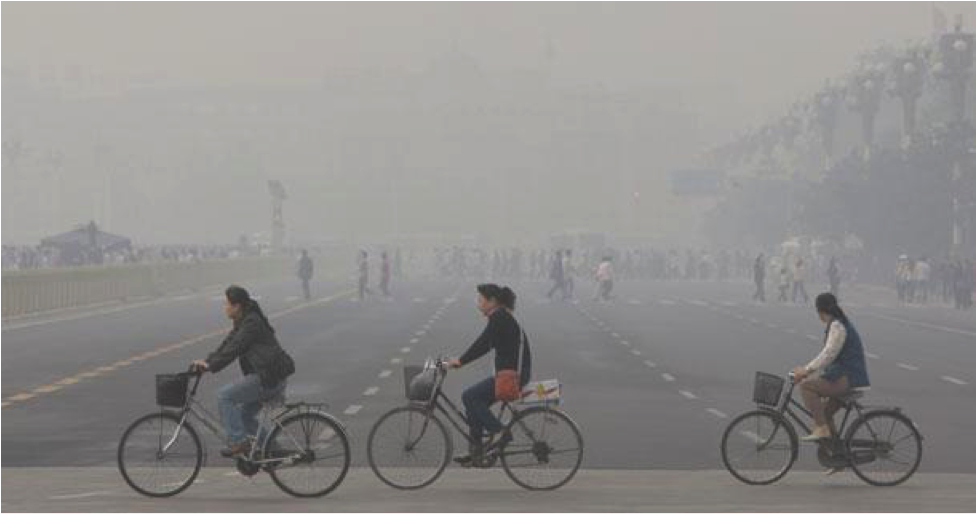
    But air pollution in Beijing isn’t just bad, it’s Ben Hur chariot race epic. And it isn’t just pampered foreigners that care about the air, as a burst of Chinese outrage demonstrated last year. Despite a certain amount of desensitization, the air pollution issue in Beijing encroaches on two of the most sensitive areas of public communication: public health and your kids. For a public health risk communication program, trust and interpretation are critical. And they’re both at the heart of the reaction to @BeijingAir.

    Trust is in short supply these days, as we’ve seen from the rumor campaigns, and anything that calls into question the level of trust invested in official government information is likely to be considered sensitive. I’d guess that the biggest thorn in the Ministry of Environmental Protection’s side is not just that the US government is tweeting its own air quality readings, but that its readings appear to be more trusted than MEP’s own. There have been several instances of divergence between the Chinese and US readings, and this is a country where data have a history of being suborned to politics, even in air quality. Every time the US results are conspicuously worse than the Chinese results, it’s a slap in the face.

    Interpretation is what enables you to act on data. AQI numbers and “micrograms per cubic meter” are pretty abstract without some kind of framework for interpretation. The Chinese framework (bottom of the first tab) is conspicuously more liberal than the US one. The Chinese “acceptable” limit for micrograms per cubic meter of PM2.5 is up in territory that the US considers “unhealthy.” The Chinese AQI band for “moderately polluted” covers territory that any normal person considers awful. As for the bad days, the less said the better.

    People will drive without seatbelts, drink themselves into the gutter and smoke a carton of Zhongnanhai Lights a day, and still get bent about the air quality. But air quality is an imposed risk, and people always react more forcefully to imposed risks than risks of choice. Especially when those risks are imposed on their children and aged parents. (At least air pollution isn’t exotic. You want to have a major crisis? Have an imposed exotic risk like a nuclear power plant disaster or pandemic.) In such situations, a conservative framework seems much more appropriate, but it is politically more dangerous because you spend more time with the needle in the outrage-generating red zone. It’s telling that although the Chinese government now reports hourly PM2.5 data there is no framework for interpreting it on the page. All you get is raw milligrams-per-cubic meter and an unexplained “limit” of .075 mg/m3 in the fine print at the bottom. Pretty binary. Meanwhile, @BeijingAir merrily tells you how you should feel about the air from hour to hour, using unfortunate words like “hazardous” when things get thick. And let us not forget the infamous and murky “crazy bad” episode.

    Given that @BeijingAir is apparently both more trusted and painting a darker picture of the situation in Beijing, it seems likely that it will continue being a sore spot with the Chinese government. Maybe this is the real reason Twitter was blocked, although the rise of dozens of Chinese smartphone applications that relay proxied versions of the Twitter feed has rendered the block moot as far as @BeijingAir goes.

    As for me, if I could pick one thing to change in Beijing, I’d fix the air quality. Beijing on a clear day is a genuinely nice city. The colors pop, the parks look beautiful and you can see a huge stretch of the mountains from my office. Also, I long ago gave up the martial arts for running, which I find similarly meditative and a lot less bruising. When I get up at 6AM the first thing I do is check the Chinese Android appthat relays the latest @BeijingAir information to my phone in a very easy-to-interpret graphical format (it has a handy homescreen widget, too!). The information has to be hourly, and it has to be accurate. I have very strict rules: If AQI is below 100, I run. If it’s between 100 and 150 it depends on how long my planned run is and how long since my last run (the less running I have been able to do and the shorter my planned run, the more liberal I am). If it’s above 150, I go to the gym and lift weights instead.

    I go to the gym a lot more than I used to, and I run a lot less. This sucks for my running and peace of mind, but on the bright side, check out the shoulders on me.

    Another moderate day!
    Another moderate day!

    *OK, I was never really “lithe.”

    Note: Originally published on the defunct group blog Rectified.name.

  • In defense of the fuzz

    For many years I lived in Singapore, which is right on the equator and has roughly two seasons: slightly more rainy, and slightly less rainy. Otherwise, it was pretty much hot and humid throughout, which always used to freak me out a bit at Christmas. To an American, encountering Santa Claus in 30C heat is unexpected, like finding a live rattlesnake in your refrigerator. It’s always struck me as somewhat unnatural that Australians see Christmas as a summer phenomenon. What else do they do backwards? Maybe on Christmas morning, they randomly steal things and slap people.

    One of the things I enjoyed about moving to Beijing, besides being further away from the antipodes, was clearly demarcated seasons. Winter was a genuine novelty. Summer was like Singapore, except with air that could delaminate plywood. Spring and autumn were glorious interludes, as long as you didn’t mind having the Gobi Desert airmailed to you from time to time. Seasons are the demarcations on the great clock of the year, the way you internalize the passage of time. So are television shows, the National People’s Conference and the ebb and flow of denim hot-pants on the teenage girls of Beijing, of course, but seasons are a more poetic way of doing it.

    Since moving to Beijing I’ve found myself thinking in terms of how many winters and summers I’ve seen here. How many sandstorm seasons, and piling up of the throngs at Xiangshan. And how many times I’ve experienced the fuzz.

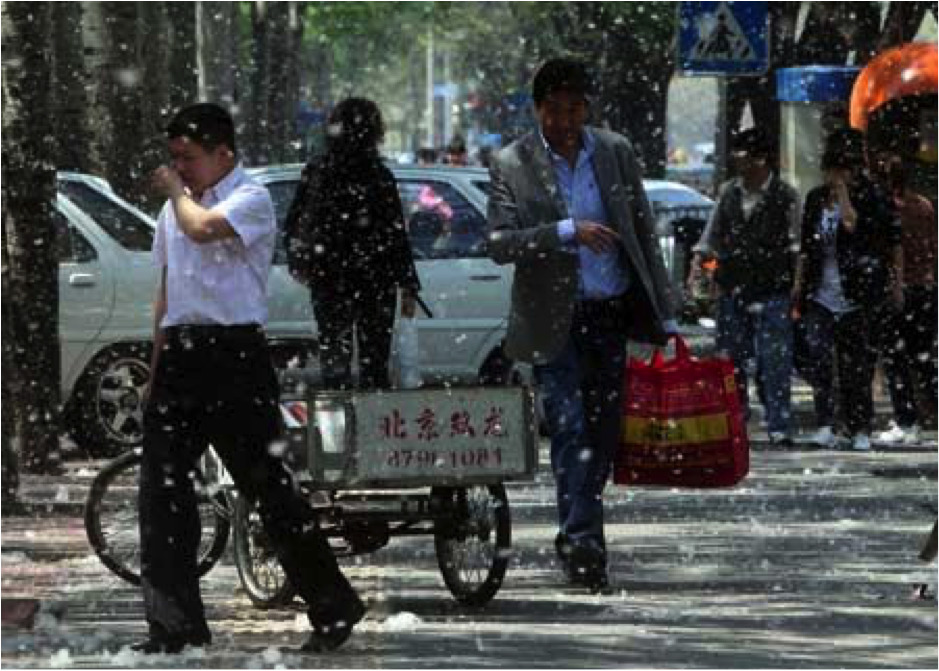
    If you have ever been in Beijing in spring, you will know the fuzz. This is the floating shroud of gauzy puffs that blankets the city every April, thanks to Beijing’s large population of poplar and willow trees. It’s not a problem exclusive to Beijing. The offending species of poplars are widespread (you might know them as cottonwoods in the US), and where there are poplars there are poplar catkins and, thus, poplar fuzz.

    And poplars are Beijing’s municipal tree, planted in rows along every median strip, bike lane and windbreak in the city, in great shivering ranks. A 1992 paper on the forestry of urban Beijing identifies two species of poplars as accounting for about 25 percent of the surveyed stock of trees, far outstripping the Chinese juniper trees in second place. It’s hard to imagine that their share has dwindled since then. Apparently, Beijing Forestry University even has an institute devoted to the study of Chinese white poplars, which confirms either the importance of the species, or all your worst fears about the treacherous vortex where the navel gazing currents of academia and municipal bureaucracy swirl together.

    Willows aren’t as common as poplars, but based on my own observation what they lack in numbers they make up for in sheer fuzzogenic enthusiasm. In fact, it took me a long time to catch up to the fact that the willows were contributing. Years ago, when I asked a local what he called the trees that made the fuzz, he said “yangshu.” This confused me because I thought he meant willow, and I was pretty sure he was wrong. Fortunately I bit my tongue, or I’d have made an ass of myself on at least two counts. The problem comes from the similar names of the trees in Chinese. The white poplars are baiyang (白杨) or yangshu (杨树), the willows are yangliu ( 杨柳). The trees are not of the same genera, so perhaps in the antiquity of the Chinese language there is some lost etymological connection between 杨 and fuzz.

    A further search of the literature reveals that ours are not the first generations to dwell upon the fuzz. A poem from the Six Dynasties period, in the first millennium AD, invokes the inherent eroticism of the poplar catkin thus:

    We break off a branch of poplar catkins.
    A hundred birds sing in the tree.
    Lying beneath it in the garden,
    We talk to each other,
    Tongues in each other’s mouths.

    Fuzz in their mouths, too, and any other orifices exposed during this little episode, but somehow that doesn’t make it into the poem.

    Erotic charms aside notwithstanding, it is easy to hate on the fuzz. Apparently, it can entrap airborne pollen from other species, and become something of a little, allergenic bomb. I don’t have allergies, but I have to admit that, while I find the fuzz pleasant enough while it’s wafting in the air, it tends to collect into stodgy, grey piles the moment it hits ground. In this way it is rather like Beijing’s snow, which can blanket the city in a dreamy, white veil for a vanishingly brief moment before collapsing into verminous, sooty piles that skulk in the shade for weeks while collecting suspicious, yellow pockmarks.

    A couple of years ago I took my son to play on the rides at Tuanjiehu Park, which are shaded by a particularly vigorous stand of white poplars. He and I both a good time watching the aunties use cigarette lighters to set great drifts of fuzz alight. It combusts like rocket fuel, so perhaps this wasn’t the best thing to be doing around dozens of toddlers, but it was entertaining. I have heard (though never confirmed) that the fuzz has been implicated in automobile fires after collecting in radiators. It has definitely contributed to yard and household fires, and the Internet has plenty ofearnest warnings urging homeowners to diligently police the fuzz.

    To address Beijing’s share of these fuzzborne woes, the city government in 2007hatched a scheme to convert the offending, female poplars into docile, fuzz-free male poplars. Apparently, this has been a semi-regular endeavor. They should have consulted with me first as I have my own experience with quixotic nature-control plans. When I was in college I spent two years as part of my university’s ultra-secret ground squirrel control program. We used air rifles, traps and poison in an attempt to control a ground squirrel population that had exploded because, in a triumph of natural selection, ground squirrels have a much higher tolerance for drunk college students and acid rock than all of their natural predators. This program was an utter failure and in the end we signed articles of surrender and turned over our weapons. The ground squirrels are still there, 25 years later. We who dared take them on are all long gone. Poplar trees don’t move as fast as ground squirrels, but on the evidence of Beijing’s obvious failure to control the fuzz, they are equally crafty.

    Personally, I like the fuzz. True, it catches on my head-stubble, gets all over the house and lurks under the couch, where it collects into dust-bunnies the size of Saint Bernards. But while airborne it’s cheery, and transient and a damn sight more congenial than the other harbinger of spring, the sand storms. It has also become one of the ways I mark time in Beijing. Another April of fuzz, another year gone by. A few more crows-feet around the eyes. Another sweaty, corrosive summer to grit my teeth for.

    A few years ago I was driving to the airport for an early morning flight. Just outside the Fourth Ring Road, deep stands of white poplar line both sides of the airport expressway. It was the height of fuzz season, and a breeze was carrying dense flurries of the stuff across the road. The morning sun from the east backlit the fuzz, endowing it with a luminous, warm corona. For a moment I forgot all the anticipated miseries of economy-class domestic travel and just watched the fuzz. The moment it hit the ground it was dirt, but while it was in the air, it was magic. And anything that can bring a touch of magic to that benighted road is worth at least a little appreciation, isn’t it?

    A little bit of magic.
    A little bit of magic.

    See also:

    Note: Originally published on the defunct group blog Rectified.name.

  • Is Wal-Mart’s eco-consciousness in China more than PR?

    Sunday is shopping day in the Imagethief household, so this morning Mrs. Imagethief, Zachary and I bundled ourselves up and headed out to Wal-Mart.

    Before you gasp in a fit of effete surprise, let me explain. As a card-carrying Bay Area intellectual snob, my pedigree is more Whole Foods than Wal-Mart, even if Whole Foods is basically just Wal Mart for Prius-driving gourmets (well, and my mom). But in my neighborhood in Beijing  walking-distance supermarket options are limited to the eye-wateringly expensive import-barn in the basement of Shin Kong Place (RMB35 for four kiwi fruits? Sure!); the fast-declining Bonjour, in the basement of the equally fast-declining Sunshine 100 (like Carrefour without the lingering veneer of French-ness and, in winter, heated like hell’s supermarket); and the Wal-Mart at Wanda Plaza.

    OK, we have a Jingkelong, too, but it’s not much use if your shopping needs extend beyond soft drinks, instant noodles and strawberry-flavored UHT milk. Once upon a time we had a Jenny Lou, but Jenny apparently decided our neighborhood was for losers and moved down to the accursed Jianwai Soho instead. So Wal-Mart it is. Plus, they deliver, which is essential when your shopping needs include kitty litter for two.

    With Wal-Mart fresh in my head, and fresh kitty litter in my guest bathroom (for the cats, not for the guests, although there have been some parties…), I was therefore interested to see a Washington Post article covering in mostly positive terms Wal-Mart’s efforts to get its Chinese Suppliers to improve their environmental and labor standards (part of a special report called, “The Climate Agenda.”):

    As a result [of Wal-Mart’s urging, Hong Kong-based soap and cosmetic manufacturer] Lutex has been paying attention to more efficient light bulbs, better ventilation and less packaging. It switched from Styrofoam to recycled paper and saved enough Styrofoam to cover four football fields. And Lutex, which has been here since 1991, says it treats four tons of wastewater that it used to dump into the municipal sewage line. That water was supposed to be treated by the city, but like three-quarters or more of China’s wastewater, it almost certainly wasn’t.

    “We heard that in the future, to become a Wal-Mart supplier, you have to be an environmentally friendly company,” [CEO Benny] Fung said. “So we switched some of our products and the way we produced them.”

    Wal-Mart has more than 10,000 suppliers in China. In addition, about a million farmers supply produce to the company’s 281 stores in China. If Wal-Mart were a sovereign nation, it would be China’s fifth- or sixth-largest export market. So the company hopes that small measures taken by all suppliers start to add up. Its 200 biggest suppliers in China have already trimmed 5 percent of their energy use.

    ***

    In October 2008, Wal-Mart held a conference in Beijing for a thousand of its biggest suppliers to urge them to pay attention not only to price but also to “sustainability,” which has become a touchstone for many companies.

    “For those who may still be on the sidelines, I want to be direct,” Wal-Mart chief executive Lee Scott said sternly. “Meeting social and environmental standards is not optional. I firmly believe that a company that cheats on overtime and on the age of its labor, that dumps its scraps and its chemicals in our rivers, that does not pay its taxes or honor its contracts will ultimately cheat on the quality of its products. And cheating on the quality of products is the same as cheating on customers. We will not tolerate that at Wal-Mart.”

    Well, if he says so.

    My first reaction to this story was, “What a PR score!” Cynical me wasn’t really prepared to consider if there might actually be something to this. But might there be real business motivations for moves that seem antithetical to a company with a mission to drive costs to the absolute lowest level?

    One possible answer to that question can be found in a post at the well-known “Naked Capitalism” economics blog. Yves Smith suggests three factors that could motivate Wal-Mart to put real effort into pressuring its Chinese suppliers to improve. They are:

    • Creating an “insurance policy” against possible American trade restrictions that might be based upon setting minimum environmental and labor standards.
    • An effort to differentiate itself in the Chinese market by demonstrating attention to food quality standards and environmental issues.
    • A move to appease evangelical Christians who increasingly see earth-stewardship as part of their religious duty.

    In fact, two out of those three things (see if you can spot which two) are still essentially public relations. Personally, I have a hard time believing the third is anything close to being a sufficient motivation for a serious revamp of Wal-Mart’s Chinese supplier relationships, but, then, I live a long way from the American heartland and am thus not well attuned to its priorities.

    The second point seems plausible, but as a regular Wal-Mart China shopper I can attest that Chinese shoppers seem perfectly enthusiastic about Wal-Mart already. Wal-Mart also does a brisk trade in allegedly organic Chinese produce (we buy it, but I’m really not sure how far to trust the “organic” claims). At any rate, as an approach it sure couldn’t hurt, unless it starts leading to significant job losses at Wal-Mart suppliers in China, in which case, all bets are off.

    Ultimately, although the impact is in China, I still see this as primarily a move to influence the customers and activists back home in the US who have the greatest ability to influence Wal-Mart’s business. China environmental and labor issues are important in China, of course, but arguably not as important as they are in the US. (Next up for trouble: Apple? Don’t miss the bizarre fanboy comments.)

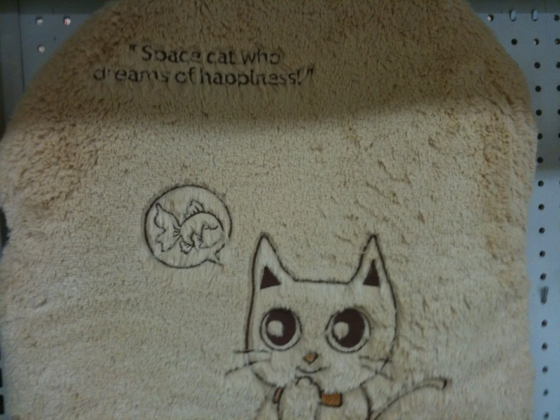
    As for me, I’ll take a pass on the live soft-shelled turtles (where are the PETA people?), but the produce section isn’t bad and you can’t beat a fuzzy car-seat cover that carries the inscription, “Space cat who dreams of happiness!” If only I had a car.

    Space cat who dreams of happiness.
    Space cat who dreams of happiness.
  • Will we all burn in a fire made of mooncake packaging?

    Imagethief likes the Mid-Autumn Festival. I like it because even though it actually comes in late summer, it reminds me of autumn, and autumn is famously the nicest time of year in Beijing. In any year devoid of Olympic rigging, late summer in Beijing is intolerably hot, muggy and polluted. This year it was merely hot.

    Over the years many people have told Imagethief that the Chinese Mid-Autumn Festival falls in summer because of inconsistency between the Chinese lunar and western Gregorian calendars. This is total BS and I see no reason why I should accept obviously finagled explanations from people just because they are “Chinese”. The real reason is that without some reminder of imminent autumn and its much improved climate, half the population of Beijing would commit suicide in late August and early September, in the dregs of the Venusian summer atmosphere. In Scandinavia it’s the lightless winters that do it. In Beijing it’s the airless summers.

    If you assume that Beijing has fourteen million people (and don’t bother controlling for migrant labor, tourists, etc.) a one year half-life would leave Beijing with a population of just thirteen people in a mere twenty years. This would obviously be totally unacceptable to government mandarins, who would no longer be able to feel the satisfaction of clearing out an entire lane on Chang’an Ave. and making millions of gridlocked commuters watch them roar past in a motorcade. Roaring past one peasant and his donkey cart on an otherwise completely deserted twelve lane boulevard just doesn’t have the same effect, and anyway the same effect can be had in the new Burmese capital-cum-supervillain hideout of Naypyidaw.

    So Mid-Autumn Festival is a good thing. We all agree on that. However, just as the miracle of a Tex-Mex dinner comes with the heartbreak of punishing day-after flatulence, the miracle of Mid-Autumn Festival comes with its own curse: Mooncakes.

    Mooncakes are the Chinese fruitcake: Cloying pastries that appears once a year for traditional reasons that everyone has forgotten, generally as gifts, and which, cockroach-like, resist all attempts at eradication. If you must know the history, it’s on Wikipedia. Scroll right to the bottom, since most of the entry is devoted to the culinary characteristics.

    Many people complain to Imagethief about mooncakes. Inedible. Gross. Heavy. Burn longer than a tin of Sterno. And so on. To direct all this anger at the innocent and humble mooncake itself is to miss the point. First, Imagethief likes mooncake, albeit in small doses (it’s best cut with Chinese tea on the side). Of course, Imagethief also likes fruitcake. In fact, Imagethief pretty much likes anything sweet. I’d eat gravel if you mixed it with brown sugar.

    But the other thing is that is that the main problem with the mooncake is not the cake itself. It’s the packaging, which could be the least green consumer item since the Hummer.

    I was reminded of this when the translation company delivered a palletload of mooncake boxes to me and my team as part of the obligatory upward mooncake flow from vendor to client. Each of us received a heavy, embossed and foil stamped bag with rope handles. In the bag was a heavy cardboard box with a tri-fold faux-embroidery lid with faux-embroidery dragon applique. Within the box was a cardboard frame wrapped in a faux-silk shroud and lovingly cradling eight mooncakes. Each mooncake was in an individual cardboard box, a sealed plastic wrap and a plastic cup. Two pairs of wooden chopsticks in a fabric envelope were included for good measure. The theme throughout was tasteful and subdued imperial yellow garnished with dragons.

    Gross weight: About two and a half kilos. Net weight: About 640 grams. Multiply by a nation of 1.3 billion people. Sure, not everybody gets mooncakes. But some of us get lots of mooncakes. You can see where the environmental toll will start to add up.

    Fortunately, the picture is not as grim as it seems. Like fruitcakes, mooncakes are, if not an infinitely renewable resource, at least an infinitely recyclable one. Every year at this time the hand-lettered “recycle mooncakes” signs go up outside neighborhood shops and on curbside stands. Like overpackaged Chinese brandy sets, mooncakes are infinitely re-giftable. Shanghai, ever the city of commerce, has brought the mooncake recycling market to unprecedented levels of trading sophistication. Rather than give physical mooncakes, it’s common to give a coupon that can be redeemed for mooncakes. These coupons are then traded on an informal exchange of office ladies and household ahyis that offers NYMEX-like liquidity. Like the oil futures market, it seems that the actual mooncakes rarely enter into the final equation. However there is some risk as, like a bank run, its unclear if the system could actually withstand a mass-redemption event.

    The upshot is that while approximately four billion tons of mooncakes are gifted every mid-autumn, only about ten pounds are actually consumed. This means that the packaging situation is perhaps not as bleak as it first appeared.

    Imagethief sees this as yet another sign of Chinese technological advancement. Like an MRE a mooncake has a nearly infinite shelf life, allowing for century after century of suck-up regifting on a highly leveraged environmental footprint. Surely this is a system worthy of the inventors of moveable type, the compass, paper money, rhinestone dog collars, the Slinky, aerosol breath freshener, etc. etc.

    The mooncake tradition traces its history back to the fourteenth century. How charming and ecologically sensible that the mooncake you are now slicing into may also date back to that same century.

  • Fly the feces-free skies of China Southern

    Few things have provided more grist for Imagethief’s gripemill than Chinese airlines. A simple search of this website for various permutations of China+Airline+Travel will make that abundantly clear. In part this hostility is unfair. Chinese airlines are every bit as good as American carriers –although I have heaped scorn on those as well– and in some ways they are distinctly better. For instance, I would recommend Chinese carriers to anyone with a fetish for being waited upon by attractive Asian women as opposed to a fetish for being snarled at by hostile, matronly Americans. Not that no one has that particular fetish, its just that its somewhat more eccentric and self-destructive, like a fetish for self-mutilation, blender worship or Paris Hilton.

    And of course, Chinese carriers are every bit as successful as their American counterparts, which is to say they are losing money hand over fist. That’s why I was constipated to readin a Reuters news story (quoting Xinhua) about some of the money-saving steps recently suggested by China Southern Airlines:

    A Chinese airline has calculated that it takes a litre of fuel to flush the toilet at 30,000 feet and is urging passengers to go to the bathroom before they board.

    As Chinese airlines come under increasing pressure to cut fuel expenditures, China Southern’s latest strategy is to encourage passengers “to spend their pennies before boarding the aircraft”, Xinhua news agency reported on Thursday.

    “The energy used in one flush is enough for an economical car to run at least 10 kilometres,” Captain Liu Zhiyuan, who flies regularly between Hangzhou and Beijing, was quoted as saying.

    Citing a survey by the company’s logistics department, Liu said carrying one kilogram of items such as blankets and pillows by air for one hour uses 0.2 kg of fuel.

    “This means the blankets and pillows on board the aircraft eat up 60 tonnes of fuel every day. If each seat is loaded with three 450-gram magazines, another 60 tonnes will be consumed,” Liu explained.

    Well, having taken many flights on China Southern over the past few years, I can tell you that many passengers already consider flushing optional, so it’s debatable how much value such a program might have. I also think that the focus on flushing perhaps ignores the root of the problem, which is that according to this article, airplane toilets are some of the least energy efficient devices on the planet, on a part with M1-Abrams tanks and arc lights. Airplane manufacturers may want to get cracking on this (so to speak). After all, if my home toilet required a liter of kerosene for every flush, I’d just use half the kerosene to burn our daily household quota of excreta in our apartment building’s courtyard (everyone loves a bonfire) and sell the rest on the aviation fuel black market for cold, hard cashola.

    But as the article makes clear, cracking down (again, so to speak) on online flushing is really only part of the solution. The real triumph would be to encourage people not to carry any bodily wastes on board the airplane at all. In fact, I think the “pillows and magazines” in this article are really offered as a gentle metaphor for the collection of excreta sloshing around inside of each of us. After all, to the airline, the accumulated fecal matter fermenting in your bowel is just another form of carry-on luggage, and one that they have no control over. And nothing chafes an airline more than the thought that you might be gaming their system. Turds are just the beginning. Next thing you know people will be wrapping their duty free purchases in condoms and swallowing them to evade carry on limits.

    Let’s look at this scientifically. Doing some quick research, I note from a highly credible source, the movie Beverly Hills Cop, that the gut of the average American fifty-year-old contains about five pounds (2.25 kilos) of undigested red meat. Chinese are not Americans, but they are eating an increasing amount of red meat so let’s use American fifty-year-olds as proxies for the entire Chinese population and go with that number. It’s this spirit of daring scientific inquiry that led to such breakthroughs as cold fusion and Dr. Hang Woo-suk’s cloning program at Seoul National University. Going further I also note that China Southern is one of the airlines that has ordered A380s, which can carry up to 500 passengers. After performing some complex and rigorous calculations far beyond the reach of lesser cortexes, I discover that a single planeload may be hauling around up to 2500 pounds (1,136 kilos) of turds.

    Shocking. If the fuel consumption figures in the article above are accurate, that means that China Southern’s A380s could burn up to 227 extra liters of fuel an hour just dragging around surplus shit. On a twelve-hour long-haul to San Francisco that could mean almost 3000 extra liters of fuel consumed in the name of turd-haulage. Add on another three flushes (conservatively) per person on that same flight and you are looking at another 1500 liters of fuel consumed, for a total of 4500 kilos of fossil fuels –1.5% of the aircraft’stotal fuel capacity– flushed away in the name of airborne waste management. My god, people, haven’t you heard of global warming?

    Looked at this way, you can see that China Southern might be onto something. In fact, they might taking too conservative an approach to managing this situation. In the interest of safeguarding this planet that we all share, Imagethief proposes that, like hair gel and toothpaste in the US, human fecal matter be banned from all Chinese flights. Passengers should be required to consume a heavy dose of laxatives the day before flying and to purge thoroughly before boarding. Enema lounges could be installed in all Chinese airports, helping passengers to unburden themselves their ungreen load before boarding. I find a pre-flight high colonic highly refreshing myself, and imagine that it could become quite the fad. Naturally, pre-boarding security questions should be amended:

    • Did you pack your bags yourself?
    • Has anyone else handled your luggage since you packed it?
    • Did you have a nice, big shit this morning?

    With a few simple steps like this we can help China Southern to claw its way into profitability and reduce the global warming threat posed by air transportation. China could establish itself as environmental leader and revolutionize the entire approach to air travel. Dependency upon oil imports would also be reduced. Just think: if every airline in the world was to implement a program like this, we would live on greener, cleaner, more peaceful planet. Considering the benefits, an enema at a Chinese airport seems like a small price to pay.

    Note: Thanks to Gordon at The Horse’s Mouth for sending this article to me. Dude, when are you coming back to China? This country needs you.

    Related: Shanghai closed flights into and out of Pudong for several hours yesterday due to “air traffic volume”. Foreign flight crews ascribed the delays to military exercises. Anyone who travels in China regularly knows that the all-too-common flight delays and cancellations often get dubious official explanations, and the military’s fiat over Chinese airspace is widely and credibly blamed. In this case it seems likely. No one closes an airport to all traffic because of congestion. You might divert some traffic or delay some flights, but close the airport? The flagship airport at your glamourous international business city? The military explanation sounds a lot more credible in that case. Or some other similarly conspiratorial explanation. At any rate, you coudn’t get much more bush-league, especially considering the government’s usual appalling communication, which extends to what looks to me like a complete absence of any press coverage of the incident.

  • Dear lord, why not Paul Hogan?

    Or Yahoo Serious, for that matter?

    I was raised never to speak ill of the dead. Unfortunately that lesson, like so many others, didn’t really stick. So I thought I’d take a moment to reflect upon the early passing of Steve “The Crocodile Hunter” Irwin. I realize this is neither a China nor, strictly speaking, a PR story. But I do scuba dive a lot –and in some particularly risky circumstances– and I am always interested in situations where people meet a nasty end while in the ocean. I am also interested in how Irwin’s death is being described in the media.

    I was never a big Crocodile Hunter fan. I am a product of the Marlin Perkins era; an age of more restrained approaches to nature documentaries. (Ironically, Perkins’ show, The Wild Kingdom, was sponsored by Mutual of Omaha, an insurance company. Perhaps they were onto something.) Irwin’s shtick, on the other hand, seemed to consist of a lot of molesting of animals and insightful commentary along the lines of, “Wow, look at that [insert dangerous wild creature here]! He’s a whopper! Crikey! I’m just gonna grab his tail. If he gets those fangs into me, I’m a goner. Look at that! You’re alright, fella, you’re alright.”

    It’s like knowledge pouring into my head. If they’d known I’d someday be able to get that kind of information from the Discovery Channel, my parents probably wouldn’t have bothered spending all that money on my biology degree.

    My personal disregard for Irwin’s pedagogical style aside, any early death is a tragedy. Irwin leaves behind a young daughter and a toddler son who will only ever know his father through reruns (and who, you may recall, was once dangled perilously close to the snapping jaws of death in what, after his execrable “movie”, was Irwins’ biggest PR blunder). But my real interest in Irwin’s demise isn’t the circumstances per se, although they are somewhat unusual. Rather, it is that Irwin’s passing is being described as shocking, both by a random sample of Australians interviewed by CNN yesterday (indeed, the headline on the CNN web video story is “Australians Shocked“) and, most notably by Australian Prime Minister, John Howard, who said…

    …he was “shocked and distressed at Steve Irwin’s sudden, untimely and freakish death,” according to AP. “It’s a huge loss to Australia.”

    Untimely, yes. Shocking or freakish? No.

    Well, maybe it’s statistically freakish. From reports last night, I gather that there are approximately three confirmed stingray deaths in Australia since World War II. But it’s still not shocking. If Steve Irwin had died leading a hostage rescue mission on a plane full of tourists being held at gunpoint at Entebbe Airport in Uganda, or in a botched stage dive during a drag revue in Zagreb, that would have been shocking. Being killed by a wild animal was, well, predictable. Just like Roy Horn being mauled by a white tiger and Layne Staley dying of a drug overdose were predictable (my brother, gifted with a sense for such things, once described the then still performing Staley as, “clinging to life by his fingertips”). As Time noted of Irwin:

    He leapt fearlessly on to the backs of man-eating crocodiles, wrestled Komodo Dragons and deftly juggled snakes as they sought to plunge their venomous fangs into his arm or face, all the while keeping up a lively commentary for the cameras of his multimillion-dollar documentary operation. Scratched, bitten and bruised, he would display his wounds like trophies, casually using gaffer tape to bind up a severe bite from a large saltwater crocodile that he had been wrestling in a mangrove swamp.

    Yep, sounds like a man who stood a much higher chance of being killed by a wild animal than by, say, a Pushtun militia during a botched heroin deal on the Khyber Pass. Admittedly the animal involved was a bit of a surprise, but to be killed by a large stingray is not beyond the pale in the way that being killed by a hummingbird or a tree shrew might be. Big stingrays can be two meters across and have tail spines like those nasty, cheap serrated steak knives. The ocean is strange and wonderful, if slightly dangerous. Almost everything in it is pointy, venomous or both. In Southeast Asia people are periodically impaled by pointy, leaping trumpetfish or longtoms. That’s life. Or death, as the case might be.

    In fact, it’s not unusual for adventurers to be killed while adventuring. And, presumably, the rush of cheating death, or at least pushing the limits, is part of the motivation. Cave diver Sheck Exley died while trying to set a scuba depth record. Climber George Mallory died while trying to summit Everest (or Qomolongma if you’re not into colonial names). Test pilot Scott Crossfield died in an air crash. And the Crocodile Hunter died screwing with wild animals. He did, as they say, know the risks. And it’s a good bet his insurance company did too.

    So, RIP, Steve Irwin. I’m sure generations of children will see you in reruns. Unless, of course, the world simply shifts its attention to Austin Stevens, Jeff Corwin or the dangrously named “Shark Gordon”.

  • Harbin aftermath: Government vows to thoroughly scape all goats

    Catastrophes are fun to watch, but not nearly so much fun as the aftermath of kicking, screaming and recriminations as blame is liberally heaped and fingers pointed. Katrina lasted only a day, after all, but the operatic fallout has reverberated for weeks, although less loudly now than it did at first. Chinese post-disaster convulsions are, perhaps, a bit more cryptic and mysterious than the American version, but interesting nonetheless. The aftermath of the Songhua River poisoning is just getting going, and, as it unfolds, the Chinese government and US government are notable for some of their similarities as well as some of their differences.

    The Chinese are following the US precedent by eagerly shoveling blame down onto lower levels of government. The better to distract people’s attention from the fact that the central government, if not directly responsible for the explosion, was apparently directly involved in the subsequent ten-day coverup. But at the same time, they are indulging in the classic central goverment pastime of erasing the inconvenient bits of the story in a way that the US government only wishes it could do.

    My attention was drawn back to this issue by an article that ran on Xinhua’s website today, hopefully titled, “China vows to “sternly” punish those responsible for river pollution“. (I’ve taken the liberty of correcting the spelling of the word “river”.) The article is interesting because it’s a classic bit of PR misdirection. Read this:

    The head of national work safety watchdog vowed Tuesday to “sternly” punish those responsible for a chemical plant explosion in northeast China’s Jilin Province, which caused toxic leakage into the Songhua River, a main water supply source in the area.

    Li Yizhong, director of the National Bureau of Production Safety Supervision Administration, pledged a thorough investigation in the explosion and the ensuing toxic spill in the river.

    Li, who headed an investigation team set up by the State Council on Tuesday to probe the accident, promised to seriously deal with those enterprises, departments and individuals held responsible for the accident.

    “Anyone, who were found guilty of dereliction of duty, will be harshly dealt with,” he said, “those who break the law will be handed over to the judicial departments.”

    “People who are found to have provided false information to investigators will also be punished severely,” the official said. “Any move trying to cover up the cause of the accident and any passive attitude toward the probe are deemed deception and a defiance of law.”

    ***

    The investigation team will probe the cause of the blast and why there were no preventative measures in place to prevent the benzene from being discharged into the Songhua River.

    An earlier report said that Yu Li, head of the Jilin branch of China National Petroleum Corporation (CNPC), was removed from his post.

    Two other officials, who allegedly held direct responsibility for the plant explosion, were also dismissed.

    Besides, Xie Zhenhua, head of the State Environmental Protection Administration (SEPA), China’s environmental watchdog, resigned after the accident, becoming the highest-ranking Chinese official to resign for an environmental incident.

    Ask yourself two questions. 1) What do you see in this article? 2) What do you not see in this article? My answers:

    What I see in this article:

    • A resolute central government taking action
    • An investigation team created by the State Council to probe the accident
    • Rolling of heads involved in the explosion (and one central government head)
    • Stern threats of punishment for those found to have caused the article through dereliction or negligence
    • Stern threats of punishment for those found to have “provided false information to investigators”
    • This last one is important: stern threats of punishment for those found to have covered up the cause of the accident (my emphasis)

    What I do not see in this article:

    • Any acknowledgment of the coverup of the release of Benzene (as opposed to the cause of the explosion)
    • Any suggestion that the central government was complicit in any way in that coverup (although the resignation of Xie Zhenhua suggests some acknowledgment of responsibility for the initial accident)
    • Any suggestion that a general climate of lax central regulation and control might have played a role creating conditions conducive to the explosion

    This is not surprising in the least, but it lets you see how the story is going to be spun. The accident was bad, and if negligence was involved, it is appropriate to punish the people involved. And this makes a handy flash-bang for catching people’s attention and making them feel that Something is Being Done. But it ignores the fact that the coverup of the benzene release was arguably an equally (or even more) serious crime to any negligence that might have precipitated the original explosion. After all, it was the coverup that exposed everyone living along the Songhua River between the chemical plant and whatever point the Benzene had reached when the coverup was blown to potential poisoning. If anything is going to be investigated, it’s the coverup and the decisions made around it that should come under scrutiny.

    But there is, of course, faint hope of that. The coverup is joining the lengthening list of catastrophic un-events in recent Chinese history.

    I realize this is a deconstruction of a translation, which is dangerous territory. But everything I see is consistent with how I would expect the government here to respond.

    In what looks like another consequence of the disaster, it was reported by the AFP today that a Jilin City vice mayor and environmental chief has died in apparently mysterious circumstances:

    The vice mayor and environment chief for China’s Jilin city has been found dead, the city’s Communist Party press office said, amid accusations he was involved in last month’s toxic disaster cover-up there.

    “He died yesterday,” a spokesman for the Jilin city party press office told AFP, without giving any details as to the cause of death.

    “The police are investigating. We don’t know any more about it. I think the police will make a public announcement after they finish their investigation.”

    Wang Wei, the vice mayor who was also in charge of environment protection, took a high-profile role after a blast at the PetroChina chemical plant in Jilin on November 13 that killed eight people and injured 60 others.

    The accident led to the spillage of 100 tonnes of the carcinogens benzene and nitrobenzene into the Songhua River, one of China’s longest waterways and a source of water for millions of people.

    However officials said nothing of the contamination of the Songhua for nearly 10 days.

    “It will not cause large scale pollution. We have decided not to have a large scale evacuation,” the China Business News quoted Wang on November 15 as saying.

    If the police are investigating, one must assume that Wang Wei did not pass away peacefully in his sleep. A Japanese-style shame suicide, perhaps? Conspiracy buffs may supply their theories in the comment space.

    Update: The Associated Press interprets the story a little differently than I did.

  • The Harbin water crisis

    A couple of days ago, in response to a link I posted to his roundup of articles on the Harbin water crisis ESWN put this comment up on my site:

    As you are the PR expert, how would you have managed the situation? Would you have own up to the benzene problem way up front? Alternately, how would you handle the ‘clean-up’ afterwards? This is a serious matter because they were clearly way, way out of their depth in terms of what they believe that they could get away with.

    Well it’s always flattering to be considered a “PR expert”, although it’s probably closer to the truth to say I play a PR expert on TV. But the Chinese government’s response to the Harbin crisis has been a case study in bad PR management, and, with ESWN’s prodding, I’d like to explain why.

    But first the disclaimers: I am not a crisis specialist. We have hard-core people in my company who do that sort of thing. However, I’ve been doing PR for a while and there are some generally applicable rules of crisis PR that most of us in the industry know. Also, I am basing my analysis on China’s English language press coverage and on foreign press coverage. My Chinese isn’t good enough to get past headlines most of the time, so I can’t comb through Chinese-language press in any depth. Finally, I was not directly involved in this event and, therefore, do not have full information. Bear all of that in mind.

    With that out of the way, let’s have some fun.

    The Event and Coverage
    There are some basic facts that should be reviewed first, along with the history of the press coverage. The explosion in Jilin first happened on Sunday, November 13th. While there was some agonizing about the immediate casualties and the potential for major toxic events posed by shoddy chemical plant construction, there was no hint that this event had resulted in a severe toxic release.

    A China Daily report from November 14, the day after the explosion, said this:

    The local government has kept monitoring the air and water quality in the area, and further investigation into the blast is being made.

    So from nearly immediately after the explosion, representations were being made that the potential toxic fallout from the explosion was being monitored.

    A China Daily search for Jilin + Explosion, which I will use as an inexact proxy for press coverage as it should catch most articles, yields zero results from November 15 through November 22, when the announcement of Harbin’s water cutoff was made. A Xinhua search turns up a similar gap over those dates, except for one story from November 16, which carries the following headline:

    Chemical plant blasts releases no toxic substances [sic]

    The headline is based on an assertion by the Jilin provincial government that there is no problem with air quality. The story makes no mention of water. With the benefit of hindsight, this omission looks suspicious.

    So that’s a one-week gap –at least in English press– when there are no newsworthy public announcements about the potential aftermath of a chemical plant explosion next to a major river that flows through densely populated urban areas and into a neighboring country, except for a patently incorrect or deceptive one.

    On November 22, the announcement of the interruption of Harbin’s water supply is made. Initial reports specifically deny any link between the shut off and the Jilin explosion, as is clear from this China Daily article, the first in English language press to report on the stoppage. The article implausibly cites “maintenance and repair” as the official reasons for a previously unannounced stoppage. Although there is vague mention of the Jilin explosions in official statements cited in the article, any connection is vociferously denied by the authorities:

    The common refrain was that the explosion at Jilin city of neighbouring Jilin Province on the upper reaches of Songhua River may have caused a leakage of poisonous substances into the river as it is only a few hundred metres away from the plant. Harbin is located at the middle reaches of the river.

    But an official with the Harbin municipal government, who did not want to be named, dismissed the assumption as “just a rumour.”

    Harbin Water Supply Company refused to comment but sources at the municipal environment bureau said that there was nothing abnormal with the quality of water in the river.

    In corroboration, Jilin said that the local environment bureau found that the water quality was barely affected after the blast.

    In the absence of hard information, rumors flew through Harbin, stoking public anxiety and leading to a run on stores, as reported in that same article. As reported in foreign press, there was a large, voluntary evacuation of the city. Wells had to be dug quickly in Harbin and massive amounts of water shipped in rapidly.

    Only on the next day was there a Xinhua report confirming that the explosion had polluted the river. Interestingly, the admission is made by a central government agency, the State Environmental Protection Agency (SEPA). This article makes several interesting statements:

    “After the explosion at the Jilin Petrochemical Company under China National Petroleum Corporation, our observation showed pollutants containing benzene had flown into the Songhua River and caused water pollution,” said an official with SEPA.

    Benzene is a substance harmful to human health.

    The official said upon receiving the report, the administration immediately sent experts to Heilongjiang Province to assist local pollution-control efforts. Quality of the river water is under close observation for 24 hours every day.

    The Jilin and Heilongjiang provincial governments have activated their contingency programs for environmental incidents, and have taken measures to ensure the safety of potable water, said the official.

    He said Jilin had quickly blocked entry of the pollutants into the river and discharged water from a reservoir to dilute pollutants in the river. It also organized environmental, water conservancy and chemical experts to discuss pollution control plans, and beefed up monitoring work.

    Most interesting is the assertion that Jilin had “quickly blocked entry of the pollutants into the river and discharged water from a reservoir to dilute pollutants in the river”. This suggests that the Jilin government knew exactly what was going on. Bear that in mind for later.

    Then the inevitable consequences began to unfold. Public erosion of trust in government was one casualty, as reported by the Financial Times:

    “I am fleeing,” said Pang Shijun, a 50-year-old man among the crowds at the central railway station. He said his wife had already left the night before to go to the nearby city of Jixi. “I just do not trust the government to provide true information on this.”

    Whoops. More from Reuters:

    “It’s worrying, because it may not have a strong smell or colour, so you can’t tell when it’s gone,” said Hong Shan, a retired official exercising beside the river. “It’s up to the government to keep us informed. We can’t tell ourselves.”

    Commentators in Beijing and further afield condemned the “lies” told before the authorities revealed what had really happened. A paper in Harbin itself tried to play down the crisis.

    And, of course, there were recriminations. CNPC and the Jilin provincial government have emerged as the principle villains for running the plant and covering up the benzene release, respectively. Here the New York Times reports:

    “We will be very clear about who’s responsible,” said Zhang Lijun, deputy director of the State Environmental Protection Administration, at a news conference in Beijing. “It is the chemical plant of the C.N.P.C. in Jilin Province,” he said, referring to China National Petroleum.

    Mr. Zhang said the investigation would consider whether there was any criminal liability for the spill.

    PetroChina Company, a subsidiary of the state-owned China National Petroleum listed in New York and Hong Kong, is responsible for the company’s domestic petrochemical production, the China National Petroleum Web site says. China National Petroleum holds 90 percent of PetroChina’s shares.

    The official New China News Agency reported that China National Petroleum had apologized. The company “deeply regrets” the spill and will take responsibility for handling the consequences, the deputy general manager, Zeng Yukang, was quoted as saying. The vice governor of Jilin Province, Jiao Zhengzhong, also apologized to the people of Harbin, The Beijing News reported Thursday.

    Zhang Lijun is no champion of transparency, as we’ll see later. Even the China Dailyweighed in, with an editorial yesterday condemning the actions of the Jilin government. They noticed the same thing I did; that the Jilin government has essentially admitted that it knew all along that there was a problem:

    A spokesman from the State Environmental Protection Administration said yesterday at a news conference that Jilin Province and Jilin Petrochemical Corporation had adopted timely measures to stop the toxic spill from being discharged into the river immediately after the explosion.

    This shows that the corporation knew very clearly about the contamination and its possible result but still wanted to keep the secret to itself.

    Leaders from the Jilin provincial government and Daqing Petroleum Administration apologized for the contamination of river water and for the inconvenience and losses the pollution has inflicted on Harbin’s residents. But they never apologized for the hiding of truth.

    We do not know what is behind the cover-up. It might be because they were afraid that they would have to pay money for the losses the pollution has incurred in Harbin, and it might be because they were afraid of losing face.

    But the fact is they have brought shame on themselves by covering up the truth.

    So there is the chronology. Now the fun bit.

    Where They Went Wrong
    No matter how much you prepare and plan, shit happens. That the Jilin chemical plant exploded and released tons of benzene was bad. It could have been incompetence or it could have been plain bad luck. But the actions of CNPC and the Jilin and Harbin governments after the disaster have tarred them with the stink of incompetence and untrustworthiness regardless of the reasons for the original disaster. They were caught in an enormous lie, and that makes everything else they have to say about the disaster untrustworthy. And people will remember.

    Without having been in the boardroom, it is hard to say why the decision to cover up the disaster was made. It may be that Chinese doesn’t provide and incentive for openness about these sorts of things; this is an area where I don’t have enough information to make an informed judgment. Certainly neither the Chinese government nor Chinese business has a great reputation for transparency. The explosion would already be subjecting the plant to scrutiny for safety and operational standards. Perhaps a toxic release would have brought a different level of scrutiny, say from central government as opposed to malleable provincial authorities. And perhaps that level of scrutiny would have turned up some unpleasant truths surrounding CNPC, the plant and the Jilin government.

    All of this is complete speculation. But, of course, that is kind of speculation a cover-up provokes, and why cover-ups are almost always bad PR decisions. I use the phrase “spin doctor” in gentle self-mockery in the subtitle of my blog. Perhaps that’s a mistake, because it perpetuates a myth about PR, which is that it is all about twisting the truth about these kinds of situations. It’s a shame people see PR that way, because a surprising amount of the time, our advice in crises is to be completely honest. And when lives are at stake there is simply no other choice.

    Lives were at stake in this case. The moment CNPC and the Jilin government knew they had a chemical release on their hands they should have first informed the central government (which, scarily, perhaps they did) in order to motivate the appropriate support, and then informed the public. Harbin isn’t the only city along the Songhua river, and every other town along the same way deserved to know what was flowing past their riverbanks.

    How much benzene was released? What are the potential effects? How long will it take to reach key population centers, and how diluted will it be at each stage? What will need to be done to protect those population centers? What help is being offered?

    No doubt people would have panicked anyway, just as they did in Harbin. But after the supermarket shelves emptied out, there still would have been several days in which to prepare alternative water supplies and take other protective measures before the taps had to be turned off in Harbin. And the Jilin provincial government and CNPC, a major government-owned corporation (and, to a lesser extent, the Harbin and Heilongjiang governments), would not have squandered whatever trust people had in them.

    Now, I am applying western PR standards to China, which has a completely different tradition of openness and public communication than developed, western countries. As ESWN pointed out in his comment, the Jilin authorities were clearly way out of their depth in dealing with the crisis and in evaluating what they could get away with. That’s true. And it is a serious problem that the Chinese government needs to solve if it wants development to continue smoothly.

    Government is a Brand, Whether You Like it or Not
    Let’s think of the Chinese government as a brand. This is an oversimplification, but the comparison holds true in many ways. Like all brands, government, in this case Chinese Government (new and improved!), possesses or seeks certain attributes that it believes will help it in the execution of its business. Competence, compassion, pragmatism, security, and so on. For most governments, trust is an essential attribute. The job of governing is easier when people trust what the government tells them and trust that the government will provide essential services and intervene in times of stress or disaster.

    To see how erosion of trust can affect a government badly, look at the current US administration, which has two trust serious issues right now. First, many people saw Katrina as a huge abrogation of trust, and it severely damaged government credibility at municipal, state and federal levels by undermining the compact that the government will help to mitigate severe crisis. Second, a majority of the US public now believes that it was misled about the reasons for launching the war in Iraq. That is eroding public support and making it much harder for the administration to prosecute its plans in Iraq.

    With regards to China, the foreign knee-jerk reaction is to say, “The Chinese government is authoritarian! Why should they give a damn about trust?” But I would wager that most Chinese people trust their government on a fundamental level, or at least want to trust it, and that the Chinese central government places a fairly high priority on maintaining that trust. You can see aspects of this in many of the initiatives the CCP is prioritizing right now. Programs to control corruption and help the rural poor to climb out of miserable poverties are all part of building and maintaining trust. Even propaganda is designed to foster trust in the government. Power may flow from the barrel of a gun, but it is significantly easier to hold onto that power and exercise it effectively when people trust you. The Chinese government is executing several simultaneous, tricky balancing acts. I think they realize that their jobs will be much easier the more people trust them. Unfortunately, they seem unable to break their bad, Stalinist habits.

    Credibility engenders trust, and goes hand-in-hand with it. And credibility is a really serious issue for the Chinese government. Just today, the Chinese government was busyrefuting a report in New Scientist that bird flu deaths in China total over 300. (The Horse’s Mouth blogged the Boxun report that also covered this a couple of days ago – it’s blocked in China.) But people will continue to be suspicious of Chinese government protestations because the track record is bad. If the Chinese government expects to maintain credibility and trust it has to come up with the goods. Statements like this,reported in today’s FT in a good story on Chinese media reaction to the disaster, will not help:

    “There are many ways to release information. Making it public is one way and only informing the local governments and enterprises along the route of the contamination is another,” said Zhang Lijun, a vice-director of the State Environmental Protection Agency.

    The South China Morning Post summed up the Chinese government’s credibility gap (via Howard French’s “A Glimpse of the World”) blog:

    The way in which the affair has been handled raises fresh concerns about the willingness of mainland officials to disclose bad news.

    The PR aphorism is that trust is easy to lose and, once lost, fiendishly hard to regain. That’s why we so often counsel honesty and direct action in crisis situations. So here is Imagethief’s free PR advice to the Chinese government: what works in a closed, Stalinist state does not fly in a modern, open economy. There is no having it both ways. CNPC is a publicly listed company traded in Hong Kong and New York and need to behave like one, even with regards to its operations in China.  The expectations upon you are changing. That is the inevitable price of success, development and integration with the rest of the world. If you expect to continue that success, you will have to learn how you want to communicate around these kinds of events. In the long run, whatever you it is you think you are achieving by trying to hide your disasters, missteps and calamities, you are almost certainly achieving the exact opposite. Honesty in times of crisis can build your credibility. Infinite successful cover-ups add nothing to it. Every failed cover-up destroys it that much more.

    You can only get caught in so many lies before people stop listening.

    Update: Two good roundups of foreign press articles from the Peking Duck, here andhere.

    Also, tough luck if you live in the small villages along the Songhua, as reported by the New York Times here.

    Update 2: This, in particular, is  a good story to read. From the Washington Post’s Philip Pan, it discusses how local journalists broke the coverup story. That’s Chinese media doing its job well. What will be telling is how the Chinese government –especially the central government– reacts. If it is used as an excuse to crack down further on the ability of media to report such things, or if the journalists responsible are punished, it will be a very bad sign indeed.