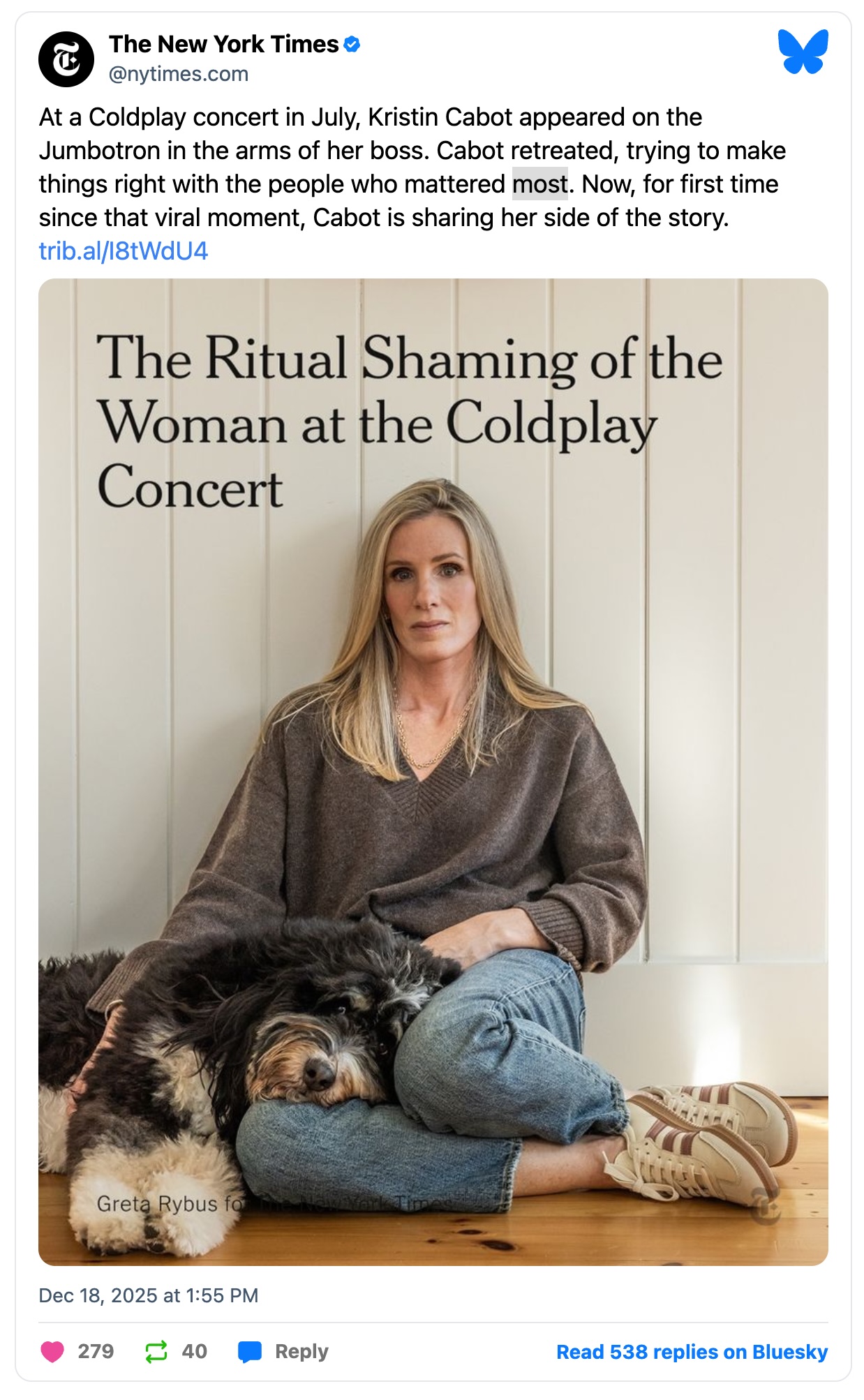
Remember the Coldplay concert kiss-cam disaster of last July?
The CEO of software company Astronomer, Andy Byron, and the head of human resources, Kristin Cabot, were caught in a suggestive embrace by the “kiss cam” at a Coldplay concert. Both of them radiated such instantaneous and intense shame that the video became a TikTok sensation and both subsequently left the company.
I wrote about the PR implications in a post called “The Kiss-Cam of Annihilation.” This was about why the implied affair was a reputational problem for Astronomer, and also an opportunity to have a go at Coldplay because I am a hater. No regrets. I have my own musical shame.
Once upon a time, if you’d been disgraced, you might have re-emerged with a soulful TED talk that you’d deliver right after Malcom Gladwell explained something counterintuitive about spaghetti sauce. Today, the New York Times, America’s sole surviving general-interest daily, is platform of choice for post-crisis reputation laundering. Wait a graceful interval, and then make yourself available for a (hopefully) soft-focus profile.
Former New York Magazine political journalist Olivia Nuzzi took this approach last September, with a 3000 word Style section profile that was one part rehabilitation for her sexting affair with RFK, Jr. and one part memoir launch. Nuzzi’s campaign incinerated after jilted fiancé Ryan Lizza—2025 finalist for the Nobel prize for being That Fucking Guy—nuked her with a tell-all Substack on the eve of her book release. Lesson: for a rehabilitation campaign, there needs to be no more dirty laundry left to air. Especially if there is someone out there who is motivated to air it. Also, it helps if the memoir is not apparently 100,000 words of weapons-grade cringe.
Way back in the early nineties, there was a popular sitcom called “Murphy Brown” set in a TV newsroom. The plot device of the lead character’s single motherhood offended then vice president Dan Quayle1, and he gave a speech in which he criticized the character by name, almost as if she were a real person.
Delighted by the gift they had been handed, the writers duly wrote the remarks into the next season opener and nuked the vice president from orbit. Weeks later, America elected Bill Clinton2 president.
Look, there are lots of reasons why the Bush/Quayle ticket went down. Among them were that Bill Clinton radiated white-hot sex (too much for his own good, tbh) while George H.W. Bush radiated Yalie barbershop quartet and surplus initials. But Quayle linking the recent LA riots to a sitcom didn’t help, and it enshrined a truism of modern public relations: don’t go to war with a TV show.
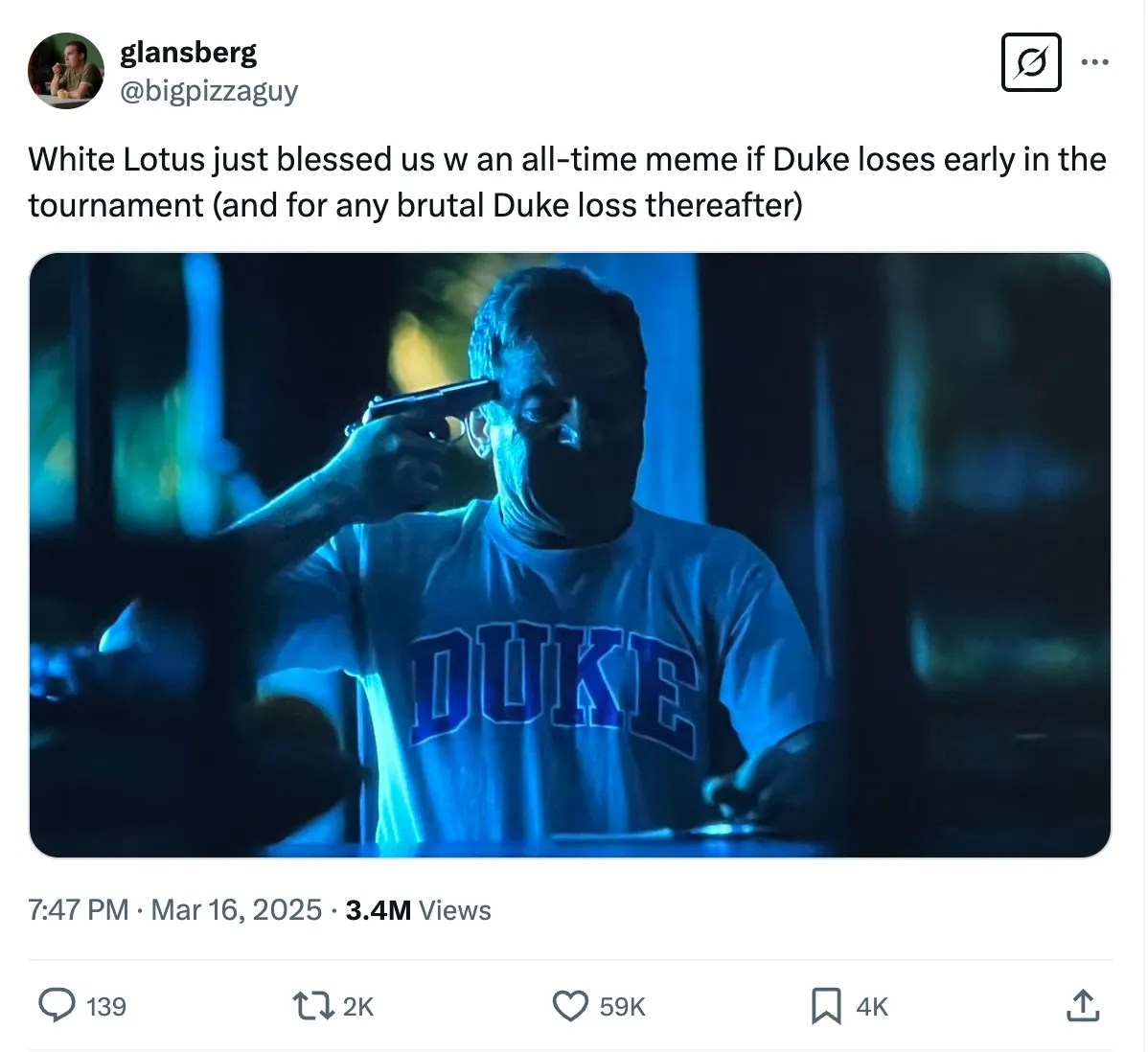
We live in a different media era. Network sitcoms aren’t the vanguard of culture they were back in the nineties (the era of Seinfeld, Friends3, etc.), and the modern equivalent of that truism might be, “don’t go to war with a meme.”
And, whatever you do, don’t go to war with a meme based on a popular TV show!
When do the old rules of political communication become obsolete?
Note: There are two things that have been on my mind as I observe everything happening in U.S. politics right now. I am using this space to think through them out loud. This is the first topic. Second to follow when time permits. I am not sure how well this holds together. Feel free to debate!
On January 28th, 1986, the space shuttle Challenger exploded just over a minute after lift-off. This was one of the defining, “where were you when…?” moments of my youth. I remember stapling my eyes to the television in a common area at my dorm at UC Santa Cruz.
Later that day, President Reagan addressed the nation from the Oval Office. I’ve never been what you’d call a big Reagan fan—he wasn’t popular in the bong-littered halls of Porter College—but it’s good. A classic of public solace, delivered to a traumatized nation. Go watch it if you have five minutes.
When I was young, lithe* and had elastic knees I studied the Japanese martial art Aikido. Aikido is interesting for a couple of reasons. First, despite what you saw in all those Steven Segal movies, it is very much bound with a philosophy of acting in defense only. Second, in keeping with that philosophy, much of Aikido is designed around using an attacker’s energy against him. The harder you swing, the more you give an Aikido master to work with.
The Vice-Minister of Environmental Protection swung hard two days ago when he called out the US Embassy for monitoring air quality and publishing the results through its well-known @BeijingAir Twitter feed. The Vice-Minister said:
“Some foreign embassies and consulates in China are monitoring air quality and publishing the results themselves. It is not in accordance with the Vienna Convention on Diplomatic Relations and the Vienna Convention on Consular Relations, as well as environmental protection regulations of China.”
For “some foreign embassies” you may read, “The Embassy of the United States of America,” which launched its Twitter feed back in 2008, that marvellous Olympic year when everything seemed possible.
The Chinese government first complained about @BeijingAir in 2009, so this isn’t a new issue. The latest demand seemed like a classic soft-power own-goal: a prickly and legalistic attack on a service many people, foreigners and locals alike, rely upon. Journalist James Fallows, who has written at length on China’s soft power challenges, summed it up: “The country is better than this.” But leave it to the US State Department, which runs the embassy, to take the Ministry’s mighty swing and apply a little soft-power Aikido:
[State Department spokesman Mark Toner] denied on Tuesday that publishing US air quality readings was in violation of the Vienna Convention as far as he was aware. He also said that Washington would have no problem if Chinese embassies wanted to start monitoring air quality in the US capital and sending out their own reports.
That’s a nice bit of work, not only rejecting the legal argument but also reinforcing the relative openness of American society by extending a reciprocal invitation to the Chinese. Naturally, the Chinese wasted no time in declining the invitation and reiterating their argument:
The Chinese government has no interest in monitoring and releasing air-quality readings for US cities, Foreign Ministry spokesman Liu Weimin said at the ministry’s regular news conference on Wednesday.
“Foreign embassies and consulates are not legally qualified to conduct environmental monitoring and release this sort of data in China, nor do they have the professional capacity and conditions to do so,” Liu said. “
There is a less charitable reading of the US comments, which could be interpreted as rubbing in the faces of the Chinese that the US is fully developed and has awesome air. (I have no idea what the air in DC is like, but it’s undoubtedly better than here.) But given the expressed interests of the Chinese people in better air and better information, Mr. Toner’s invitation seems ultimately an effective and graceful way to redirect the energy of the Ministry’s attack.
What’s the Ministry’s main beef here? Is it legalistic? The Ministry claims that US monitoring is illegal under the convention that governs the establishment of diplomatic missions. Is it the publication of the data? Is it the application of international standards to the categorization of the data? Is it all of the above? Despite my admiration for the State Department response, the Chinese government does have some legitimate complaints. The US Embassy has only one monitor for an immense city. The Chinese have improved and expanded their own monitoring, including publishing hourly readings of PM2.5 information (see the second tab). And it is unfair to expect China to achieve today the same level of quality that the US had to implement the Clean Air Act to achieve. That was a 27year process.
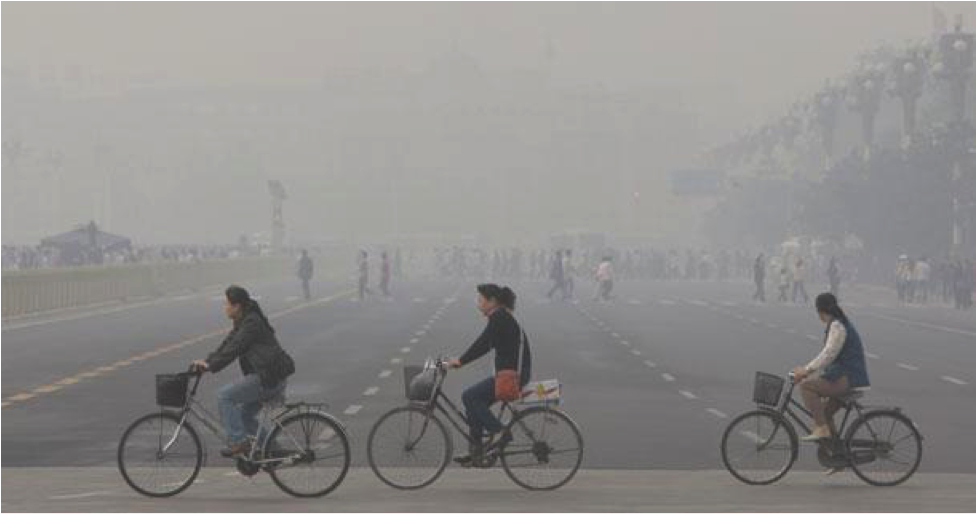
But air pollution in Beijing isn’t just bad, it’s Ben Hur chariot race epic. And it isn’t just pampered foreigners that care about the air, as a burst of Chinese outrage demonstrated last year. Despite a certain amount of desensitization, the air pollution issue in Beijing encroaches on two of the most sensitive areas of public communication: public health and your kids. For a public health risk communication program, trust and interpretation are critical. And they’re both at the heart of the reaction to @BeijingAir.
Trust is in short supply these days, as we’ve seen from the rumor campaigns, and anything that calls into question the level of trust invested in official government information is likely to be considered sensitive. I’d guess that the biggest thorn in the Ministry of Environmental Protection’s side is not just that the US government is tweeting its own air quality readings, but that its readings appear to be more trusted than MEP’s own. There have been several instances of divergence between the Chinese and US readings, and this is a country where data have a history of being suborned to politics, even in air quality. Every time the US results are conspicuously worse than the Chinese results, it’s a slap in the face.
Interpretation is what enables you to act on data. AQI numbers and “micrograms per cubic meter” are pretty abstract without some kind of framework for interpretation. The Chinese framework (bottom of the first tab) is conspicuously more liberal than the US one. The Chinese “acceptable” limit for micrograms per cubic meter of PM2.5 is up in territory that the US considers “unhealthy.” The Chinese AQI band for “moderately polluted” covers territory that any normal person considers awful. As for the bad days, the less said the better.
People will drive without seatbelts, drink themselves into the gutter and smoke a carton of Zhongnanhai Lights a day, and still get bent about the air quality. But air quality is an imposed risk, and people always react more forcefully to imposed risks than risks of choice. Especially when those risks are imposed on their children and aged parents. (At least air pollution isn’t exotic. You want to have a major crisis? Have an imposed exotic risk like a nuclear power plant disaster or pandemic.) In such situations, a conservative framework seems much more appropriate, but it is politically more dangerous because you spend more time with the needle in the outrage-generating red zone. It’s telling that although the Chinese government now reports hourly PM2.5 data there is no framework for interpreting it on the page. All you get is raw milligrams-per-cubic meter and an unexplained “limit” of .075 mg/m3 in the fine print at the bottom. Pretty binary. Meanwhile, @BeijingAir merrily tells you how you should feel about the air from hour to hour, using unfortunate words like “hazardous” when things get thick. And let us not forget the infamous and murky “crazy bad” episode.
Given that @BeijingAir is apparently both more trusted and painting a darker picture of the situation in Beijing, it seems likely that it will continue being a sore spot with the Chinese government. Maybe this is the real reason Twitter was blocked, although the rise of dozens of Chinese smartphone applications that relay proxied versions of the Twitter feed has rendered the block moot as far as @BeijingAir goes.
As for me, if I could pick one thing to change in Beijing, I’d fix the air quality. Beijing on a clear day is a genuinely nice city. The colors pop, the parks look beautiful and you can see a huge stretch of the mountains from my office. Also, I long ago gave up the martial arts for running, which I find similarly meditative and a lot less bruising. When I get up at 6AM the first thing I do is check the Chinese Android appthat relays the latest @BeijingAir information to my phone in a very easy-to-interpret graphical format (it has a handy homescreen widget, too!). The information has to be hourly, and it has to be accurate. I have very strict rules: If AQI is below 100, I run. If it’s between 100 and 150 it depends on how long my planned run is and how long since my last run (the less running I have been able to do and the shorter my planned run, the more liberal I am). If it’s above 150, I go to the gym and lift weights instead.
I go to the gym a lot more than I used to, and I run a lot less. This sucks for my running and peace of mind, but on the bright side, check out the shoulders on me.
Another moderate day!
*OK, I was never really “lithe.”
Note: Originally published on the defunct group blog Rectified.name.
So, Facebook bought Instagram for a billion bucks. Awesome for those guys. I, alas, did not get rich in either of the Internet startups I participated in. But you can’t put a price on experience, right?
Deep sigh.
Anyway, Instagram is freely accessible here in China, at least for the moment, and apparently has a small but growing user base. It’s been limited to a certain slice of the China market by being an iOS-only app until last week. It may get picked up more now that it’s on Android as well, especially given Android’s whomping share of the smartphone market in China.
Because Instagram is accessible from China there has been some speculation that it might provide a back-door into the market for Facebook. Well, color me embarrassed, because when I looked at how Facebook might get into China a couple of weeks ago, one scenario I didn’t explore was Facebook buying another, unblocked western social network.
Instagram certainly functions as a posting back-door to both Facebook and Twitter. Instagram posts route to Facebook, Twitter and other social networks through Instagram’s unblocked servers (actually, Amazon’s cloud servers for the moment). There are similar middleman workarounds for posting on blocked social networks, such as Ping.fm, but none come close to providing full access to Twitter or Facebook. And, from what I can see, neither does Instagram. That’s important.
The question that wins you the brand new car is: Will Instagram now be blocked in China? The reason why you don’t have the car yet is that the answer is complicated. China doesn’t block all foreign social networks. It does block the established, heavy-hitting, horizontal sites like Facebook, Twitter and Google Plus. But many vertical social networks and newer sites are unblocked. I can get on LinkedIn, Quora, Path,Flickr and Pinterest just fine, without a VPN (your mileage may vary). I can even get on MySpace.
I cannot read the minds of the bureaucrats who decide what gets blocked and what doesn’t, and if I could I’d probably be in a position to be less wistful about the fates of the startups I joined. But there do seem to be a few key factors in determining who stays safely outside the firewall. These include size, perceived influence, how closely the network has been associated with political movements, power to function as tool of mass organization, and whether or not the network has been explicitly associated with content or activities that the Chinese government considers sensitive. On all three counts, I’d rate Facebook and Twitter considerably higher than the rest of the pack. As for Google Plus, I trust this audience doesn’t needmuch explanation.
So, what happens with Instagram now that it is part of planet Facebook?
It depends. Assuming people don’t suddenly start posting pictures that annoy the Chinese government, maybe nothing. At the moment, Instagram seems pretty harmless, and its one-way posting features to other social networks don’t look like a big red flag. Posts to Chinese social networks like Sina Weibo essentially outsource the content monitoring and censorship. Of course, Twitter once looked pretty harmless. In 2007 I even wrote a short article mocking its triviality, possibly betraying the lack of vision responsible for my current un-billionaire status. Twitter has been blocked for a while now. So much for harmless. The fact that Instagram is essentially mobile only has also probably helped keep it under the radar.
But if Instagram is integrated more tightly into Facebook’s core service and stops looking and feeling like an independent platform, then the risks go up fast. Everything hinges on where Facebook sees the value in Instagram, and whether or not it pulls Instagram into the mothership. The more integrated Instagram is, the more powerful it is as “back door into China” for Facebook, but the more likely it is to be blocked. And if Instagram is suddenly used to post a lot of pictures of a sensitive event in China, it might not even matter if Facebook doesn’t change a thing.
Meanwhile, local photo-sharing clones have been blossoming for a while. Early enthusiasm for foreign social networks in China does not reliably translate into long-term success, while mainstream success in China often does translate into closer scrutiny. Instagram may indeed be a back door into China for Facebook, but if it wants to stay open, it might have to stay a rather small door indeed.
As you have undoubtedly heard by now, Facebook CEO Mark Zuckerberg and his girlfriend* were spotted in Shanghai on Wednesday. This has lead to a completelypredictableroundofspeculation as to whether this signals some new development in Facebook + China. This sort of navel gazing takes off whenever Zuck comes to China, or looks in the direction of China, or gets lunch at P.F. Chang’s, or whatever. And why not? Facebook is the biggest social network in the world. China has the biggest population of Internet users in the world. Facebook is going public soon. Zuck is learning Chinese, etc. So a Zuck sighting in China is, to invoke the memory of Arsenio Hall, one of the things that make you go, hmm…
Despite all of that, leave to our friends at the excellent Tech in Asia blog to have the most sensible take, “Zuckerberg is in China…Who cares?” Indeed.
Obviously, we don’t know a thing about Facebook’s designs on China. But to make sense of the speculation it’s helpful to consider the actual scenarios by which Facebook or Twitter or indeed any foreign social network might enter China, and to look at how different stakeholder groups will react to the possible scenarios. This is different than analyzing business strategy or financial implications, but ultimately it’s all connected.
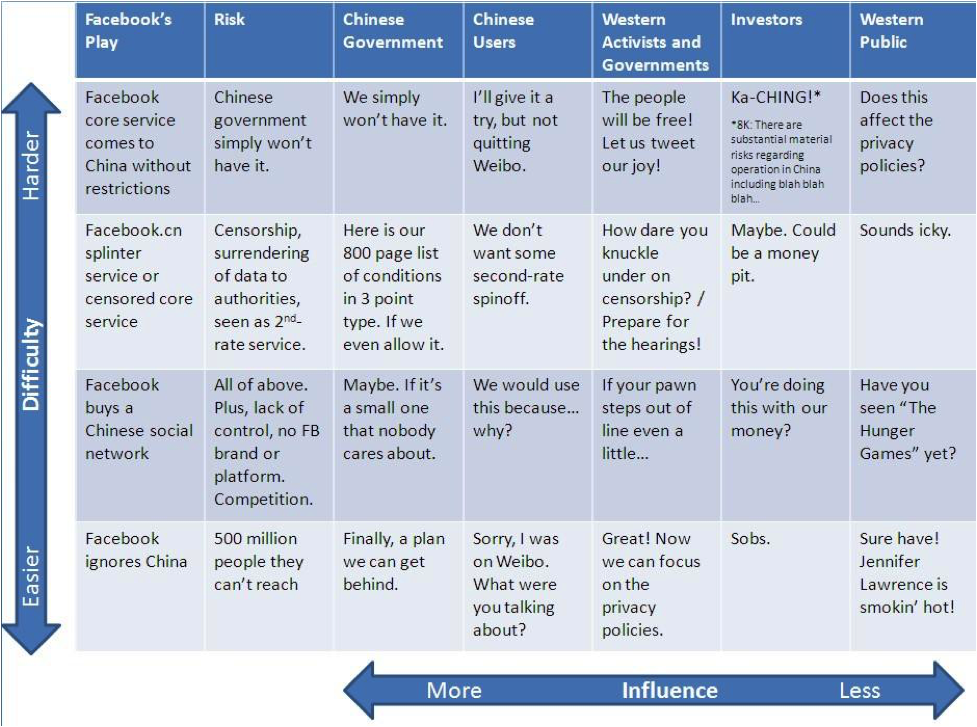
At the risk of oversimplifying, there are four major scenarios that we can envision: extending the mothership service to China; developing a separate “splinter” service for China under the original brand (this could be disconnected from the main service, or just enforce dramatically different policies); buying an existing Chinese social network; and doing nothing. Obviously, they’re not all immediately practical. Facebook is blocked in China, which makes extending the mothership difficult. There are also intermediate possibilities that blend aspects of these scenarios, but that’s a deep rabbit hole to go down. Along with these scenarios there are five major stakeholder groups, not including Facebook themselves: the Chinese government; Chinese Internet users (potential customers); Western activists and governments; investors; and the Western public (aka Facebook’s current users).
The easiest way to look at all these moving parts is to simply throw the whole thing in a table that considers for each scenario the risks and how each of the stakeholder groups is likely to react (click the table for a larger, EZ-reading version):
Admittedly this format throws a lot of nuance overboard, but nevertheless there’s a clear three-way conflict that emerges. The approaches that are more acceptable to the Chinese authorities are both riskier with regards to Western activists and regulators and, importantly, less relevant to Chinese users. The approaches that are most relevant to Chinese users and have the highest potential return to the business are unacceptable to the Chinese government. Ultimately the Chinese government calls the shots.
The basic math is that to even have a chance of operating here Facebook would have to apply the mandated censorship policies either just to users of its core service in China or to a spinoff service that is kept separate from the core service. It would also have to be prepared to surrender Chinese user information to the authorities if requested. That will raise eyebrows as Facebook knows a ton about its users by design.
The risks of these approaches are clear to anyone who has studied the history of Yahoo in China and followed the congressional grilling of US Internet firms operating in China back in 2006. That was the stone age of social networking (Rupert Murdoch bought MySpace, Facebook turned 2, Twitter was hatched), and the political atmosphere around such things has not become any less sensitive since then. If anything, the messianic aura that clings to social networks and of which Chinese authorities have always been so distrustful has been exacerbated by last year’s political events in the Middle East. And let’s not forget recent events here in China and the leadership transition later this year.
There are ways to create distance between the core Facebook brand and service and the Chinese government’s likely requirements, but those ways don’t eliminate political risk at home, and they all make the service less appealing to Chinese users. These same users are already being wooed away from traditional social networks by microblogs and have a colorful history of rejecting foreign online services as irrelevant even when they’ve been allowed to operate here without restriction. Remember MySpace China? Me neither, and a friend of mine helped launch it. Owning a local social network would provide a layer of insulation from the risk of Western backlash, but at the expense of sacrificing much of the point of entering China.
None of this predicts whether Facebook will enter China, or how they might attempt such a thing. They’re probably playing a very long game. Whatever path they choose, it won’t be easy, either in China or at home. Bear that in mind next time Zuck is spotted in China and the tongues start wagging.
*Note to editors: Can we get over the fact that Zuck’s girlfriend is Chinese American? Everyone is compelled to point this out, but net impact on the Facebook-in-China story is zero-point-zero.
Note: This post was originally published on the defunct group blog Rectified.name.
A lot has changed in the China blogosphere since I first put (virtual) pen to paper for Imagethief in June, 2004. I can’t think of many blogs that are still around from those days in anything like their original form. The Peking Duck and John Pasden’s Sinosplice come to mind. Even the venerable Danwei has undergone a transformation. In general, the renewal is good. Jeremy Goldkorn (of Danwei), Kaiser Kuo and I talked about this on Sinica in July 2010, when we celebrated the death –and rebirth– of the China blog.
But I thought it was worth revisiting China blog history today because it is, to the best of my knowledge, the fifth anniversary of the shuttering of Talk Talk China. This was the brain-droppings of three anonymous, long-time China expats who went by the nommes-du-snark of Dan, Dawanr and DD (no, I don’t know who they were). For about a year and a half, in 2005 and 2006 it was consistently the funniest, angriest China blog out there, and a wicked channel for the collected frustrations and gripes of the China expat community. This being the days before Twitter vacuumed up “the conversation”, it also had thermonuclear comment threads, as you’d expect.
I remember Talk Talk China not just because of the anniversary of its closing, but because of one post in particular, called “The Cycle of Funk.” It may be to this day the truest thing I have ever read regarding the experience of being a foreigner in China. While many of the rough edges of expat life here have been whittled away by the transformation of Beijing into fairly cosmopolitan city, enough remain so that I find myself thinking of this post pretty regularly.
But also, there has been a general shift in mood among much of the expat community in the past two years, as many foreigners I thought were here for the duration have started talking openly about life beyond China. This is purely anecdotal, and I have no data to back it up, but it’s enough of a trend that several other people I know have picked up on it. Rich Brubaker of the long running “All Roads Lead to China” business blog wrote a post touching on this just yesterday. It would seem that the “cycle of funk” is not just a personal thing, but perhaps a social one.
Talk Talk China is off the air, but thanks to the Internet Archive’s “Wayback Machine” much of the oeuvre, including the Cycle of Funk is still online. However, it is a pain to nut out. As a public service, and totally without permission, I am going to take the liberty of reposting the Cycle of Funk here. If Dan, Dawanr or DD want to send me a cease-and-desist, they know where to find me:
The Cycle of Funk May 24th, 2006 by Dan
Y’know, not every day is a bad China day. Sure, at TTC this is the case but for most people, a bad China day occurs only every now and then. However, for my entire time in China, I have noticed a particular trend among all laowai that I call “The cycle of funk”. No matter how much you love China, the little things that bother you will start to gather in a little ball of rage deep within you and sooner or later that ball of hate and spite needs to be released (often obnoxiously). That’s fine. It’s understandable. When it gets to that point no one can tell you whether or not your rage is justified. What is important to note is that this clearly comes and goes in a cycle. I imagine for most people the frequency and intensity of maximum funk decreases with time however the length of maximum funk and the intensity of said funk will likely vary widely for each person.
It is important to note that, in most cases, maximum funk is initiated not by some massive occurrence but usually by some small innocuous thing. Basically, you’re already at the edge and it is the very next thing that sets you off.
Remember, when you’re having a supremely awful bad China day and you are trying to tear the roof off the sucker, try to find where you are in your funk cycle. If you have obtained maximum funk you can relax knowing that it ain’t getting any worse and it will only get better…at least until the next funk hits.
After running less than two years Talk Talk China wound up pretty suddenly for reasons I don’t recall. Sinocidal tried to carry the snark-bucket for a while, but never played at the same level and it has long since gone by the wayside. These days I seem to carry the burden of being the “funny” China blogger (although George Ding of The Hypermodern and now The Beijinger’s back page is giving me a run for my money). Anyway, I’ve thoroughly shirked this burden, as any glance at post count for the past year or two demonstrates. But when they were at their best, the guys behind Talk Talk China were funnier and definitely more succinct than I was. And let’s face it, we need all the humor we can get.
So I commemorate five years since the end of Talk Talk China. For what it’s worth, I’m not in danger of leaving China any time soon. It’s been pretty good to me and my family. Nor am I particularly grouchy about it at this moment. But as anyone who has read Imagethief for any length of time knows, I’d be lying if I told you I was immune to the cycle of funk. And so would you.
Reports have been percolating for a couple of weeks that Facebook will partner with Chinese search engine Baidu to launch Facebook China, or something similar. Anyone who has followed the history of foreign Internet firms in China knows that this is fraught territory. Chinese competitors are well established, and while many successful Chinese Internet firms have foreign backing of some kind (even Baidu once claimed Google as an investor), marquee marriages between Chinese and Foreign Internet companies have often been troubled.
There are others better placed than me to speculate on the likely business fortunes of a Facebook China (cf. Epstein, Bishop), but what really interests me are the communication challenge and reputational consequences. Some glimpse of those possible consequences came in a Wall Street Journal article about Facebook’s lobbying efforts that ran yesterday. It included the following:
[Facebook] is talking with potential Chinese partners about entering the huge China market, where the government has been cracking down on dissidents. That crackdown has come in response to the uprisings shaking authoritarian Middle Eastern regimes, movements that have used U.S.-based social-media sites like Facebook and Twitter as organizing tools.
“Maybe we will block content in some countries, but not others,” Adam Conner, a Facebook lobbyist, told the Journal. “We are occasionally held in uncomfortable positions because now we’re allowing too much, maybe, free speech in countries that haven’t experienced it before,” he said.
Yowza! Better work on those talking points and come up with something that doesn’t sound quite so paternalistic. Read as generously as possible, this is one quote from what one presumes was a larger discussion on the issues of running transnational social networks in countries with different approaches to censorship and freedom of speech. Read less generously, it sounds like a lobbyist for Facebook arrogating to his client the responsibility to decide what constitutes an appropriate amount of free speech in any given country. Risky territory.
From a business point of view deciding an appropriate amount of free speech might be a practical necessity. From a public communication point of view it’s dangerous. Five years ago, when Facebook was still a plucky upstart too trivial to be noticed, Yahoo, Google, Cisco and Microsoft were hauled in front of a congressional hearing to testify on their activities in China and their willingness to accommodate governments with illiberal approaches to free speech. It was not a banner moment for the American Internet industry. “Moral pygmies!” declared Tom Lantos, the principal congressional antagonist. Much of the cast has changed and Tom Lantos has since died, but the issue remains sensitive. (Not all the cast has changed. Facebook’s current head of communication, Elliott Schrage, represented Google in the 2007 hearings.)
Facebook itself has not committed publicly to anything in China. They also haven’t yet committed any of the blunders that those four firms did (most notoriously Yahoo, with the Shi Tao affair). Finally, Facebook hasn’t made nobility a part of their brand in the way that Google conspicuously did in its early days, something that was used against Google in its China engagement. In fact, if anything Facebook is known for a kind of calculating amorality that may be useful in the ruthlessly sharp-elbowed Chinese Internet world.
But what’s important here is not how Facebook sees itself, but rather how people at large see it, and how activists and politicians think they can use it to drive their own agendas. Whether Facebook likes it or not, it has been publicly associated with recent events in the Middle East and is widely seen as a force for enabling dissidents and protestors whose causes resonate with western publics and politicians. See for example New York Timesstories here, here and here. Evgeny Morozov and Malcolm Gladwell might ridicule the notion of social media as democracy tools, but that won’t necessarily dispel a belief that was made clear in the 2007 hearings: American Internet firms should represent American values.
Companies’ decisions about China are revealing. Facebook’s decision on whether or not to formally enter China will be especially interesting. It will establish something fundamental about the identity of one of the two most powerful Internet companies on the planet. Is Facebook, as some have supposed, the great enabler of democracy? Or is it a company of business pragmatists willing to censor (or delegate censorship) in order to open a potentially lucrative market? The reality is probably more nuanced than either of those positions, but as far as public perception goes it will be difficult to have it both ways. How does one balance groups of stakeholders with completely incompatible views on what constitutes a responsible and conscientious Internet firm?
The nut of the problem is that, right or wrong, democracy activists, American politicians and the Chinese authorities all tend to see American Internet firms as standard bearers for western values. Facebook’s task is to convince the Chinese authorities otherwise while not making activists or western users in general feel betrayed. I can think of few more precarious communication challenges. The quote above is an unpromising start.
Update:
Obama hosted a town hall at Facebook HQ yesterday. Interesting. And likely to be noticed here in Beijing.
The milk business in China just can’t seem to stay out of trouble.
A couple of months ago baby formula maker Synutra found itself the victim of allegationsthat its product was linked to early puberty in girls. Its shares ate a big one on the NASDAQ and the company spent much time defending itself furiously. So furiously, in fact, that I was moved to ding them on Twitter for a CEO quote blaming the situation on “certain parties in the media.” Don’t blame the media was the gist of my message.
As true as I still think that is in general, Synutra’s CEO may have had a point. Chinese media reported yesterday (and the China Daily relayed in English today) that executives from giant dairy company Mengniu and one of their PR firms, BossePR, have been detained on suspicion of stoking rumors against both Synutra and Mengniu’s chief rival, Yili. Mengniu is denying the allegations.
Who knows what really happened. As one analyst points out in the China Daily story, baby formula isn’t really a huge part of Mengniu’s business, so why go after Synutra? This is probably true at the board level. I find it hard to believe that the senior management of Mengniu were sitting around the conference table and came up with a plan to slander Synutra. It’s just a touch too Snidely Whiplash for me.
On the other hand, while the baby formula business may only be a small part of Mengniu’s business, I’m sure it’s damned important to whomever manages it at Mengniu (and is, presumably, judged on its success). There are two reasons why the allegations are at least plausible. First, as anyone living here knows, despite its brand images of purity and healthy, angelic children, the milk business in China is capable of complete sordidness. One need only read up on the now legendary melamine scandals of 2008 to be reminded of that. And there is more where that came from. In our family all the milk comes from one of the expensive organic farms near Beijing. It costs about triple what regular local milk costs, but when it’s your kid you err on the side of less melamine if you have the means. The milk industry in China is like the finance industry in the US now: Trust is so damaged that people are primed to believe the worst of just about any company, and it’s not hard to get the rumors flying.
The second factor is that using PR agencies and Internet firms to run sock-puppet campaigns attacking rivals is a time-honored tactic here. (BusinessWeek has written a bit about this here, although this story lumps some companies I respect together with some I don’t.) I’ve run into it in both the car and consumer electronics industries. It’s not always incendiary child health stuff like the Synutra allegations. Sometimes it’s just garden-variety griping about products. Even that can be extremely difficult to defend against. On the Internet, criticism is forever and anonymous rumors or allegations can take on a life of their own, at warp speed if they’re salacious or involve the health of children. And it’s generally pretty cheap to do, so the temptation to stoop to such tactics can be powerful, especially in a competitive consumer business.
I’m a fan of transparency online. When I was on the agency side my advice to clients was straightforward: Don’t astroturf, don’t sock puppet. The long-term benefits are small and the risks to reputation are high (as may be the legal risks). I expect that most international agencies would give similar advice and that most PR managers, especially at international firms operating in China, would agree. At least to your face.
Nevertheless, when push comes to shove, it seems some companies still take the easy path, and many agencies will do what they need to do to keep a client happy. Also, many large companies use a range of international and local agencies, often reporting to different managers facing different pressures and having different points of view about what constitutes ethical PR. A company without a clear policy or tight management of such things may find that not every department is equally scrupulous in its approach. I wonder if that’s what happened to Mengniu.
Note:
After this post was published I also appeared on Blue Ocean Network’s “Chinalogue” program along with Alistair Nicholas of AC Capital Consulting [Note – now of Weber Shandwick – WM] to discuss…PR slime! By which the producers of the show meant the recent Mengniu vs. Yili vs. Synutra PR sockpuppet slagfest. The heavy-breathing title of the segment aside, most of the show was a fairly sober discussion of PR ethics in general. The video is here.
I just read a post from Forbes’ Hana Alberts on Alizila, a homegrown company news site for the Alibaba Group. Alibaba has hired an experienced journalist, Time Magazine veteran Jim Erickson, to develop the articles for the site:
Erickson isn’t “selling out” in the traditional sense of the word, that is, he’s not morphing into a press release writer or a corporate communications executive. He will instead remain a reporter — just one who’s getting a paycheck from the only company on his beat. Call him a corporate journalist.
…
Erickson, who co-wrote a biography of Bill Gates, is the managing editor of the site — and, at the moment, its only writer. Alibaba, which believes this initiative is the first of its kind, say it’s not a marketing tool but rather a “quasi-independent news outlet.”
“All my life I’ve known journalists who have gone over to what we call ‘the dark side,’” Erickson says. After 25 years in journalism and a brutal layoff, he felt Alibaba offered him a middle ground: “I could still be a journalist, but I wouldn’t be subject to the same constant financial pressures.”
I’ll give this to Alibaba Group: I think they’re one of the few Chinese firms that gets international PR. Granted Alibaba is not cut from the same cultural cloth as the big SOEs and red-chip firms, but even controlling for that they’ve done a good job telling their story.
Although it still feels like a work-in-progress (and is labeled “beta”), Alizila is a good idea. This is the digital age, and as mainstream media are stretched ever more thinly companies need to get better at telling their own stories directly to the audiences that matter to them.
But I wonder about two things. First is the effort taken to stress that Mr. Erickson remains a journalist and not a PR person. As a PR person, when I look at this site I see PR: A house platform for telling stories about the company and making the company more visible.
In the end, can you be a journalist in the sense most of us understand it and report impartially on a daily basis on the company cutting your paycheck? What will happen when there’s a real crisis or serious problem that demands coverage or investigation? What will happen the first time someone in an executive suite wants to kill or amend one of Mr. Erickson’s stories?
Some of the stories on Alizila do delve into Alibaba’s challenges, but none of them is what I would call confrontational. Ms. Alberts quotes Mr. Erickson remarking on an Alizila article he wrote on Alibaba’s efforts to tackle counterfeits on the site, saying, “I’m certainly not going for the jugular, but if you’re in PR it goes against every instinct in your body, because you are drawing attention to the fact that there are fakes on the website.”
I’m in PR, and as an outside observer it doesn’t go against every instinct in my body. The availability of pirate goods on Alibaba isn’t a secret that’s being suddenly revealed. Personally, I’d see a post on steps the company is taking to control a known problem, even one that embeds some criticisms or discusses past problems, as generally positive. If that story had been on a third-party news site, I’d grade it as positive with regards to Alibaba because of the emphasis on the company’s actions to resolve the problems and the positioning of the piracy problem as a widespread issue afflicting the entire industry (a classic PR technique, “broadening”). If it had been a story earned through PR, it’d be good PR.
The second question is why jump through hoops to make this look like a news site rather than harnessing Mr. Erickson’s talent and experience as a straightforward company blogger? He could cover the same topics, dig into general industry news, use a more engaging voice, and probably achieve similar visibility results for the company, without having to maintain what to me seems like an unsustainable air of impartiality. He could be an advocate in the best possible way.
Perhaps it has to do with how the audience they’re trying to reach will perceive a blog as against something that looks like a news site (although they’re also active on several conspicuously American social media networks). Or perhaps it’s simply the approach that everyone is comfortable with. There is a blog on Alizila, but although the posts seem shorter than the “news” articles, the voice is similar.
Ultimately, Alizila is PR. There’s nothing wrong with that. They should embrace it and be proud. Get past the “dark side” stuff. Good, honest communication and good storytelling are both part of good PR. And there is certainly a role for journalistic skills in good PR, nutting out the stories and telling them well (which is why our industry is full of ex-journalists, although Imagethief is not among them). But trying to distance such efforts from PR strikes me as disservice to PR and journalism alike.
With all that in mind, I think Alizila is interesting, especially coming from a Chinese company. I’m curious to see where they take it and if they launch a Chinese version.