Tag: Nationalism

  • What I learned from Dashan

    I don’t have much time for social Q&A site Quora, I confess. It seems to combine the narcissism of blogging (I should know!) with the politics of Wikipedia editing in all sorts of odd ways. I signed up early, lurked for a while, and then more or less forgot about it despite its popularity among several of my friends. But this morning I read a very good post on Quora by longtime Canadian China resident Mark Rowswell, aka TV performer “Dashan.” The question he was answering was: Why do so many Chinese learners seem to hate Dashan?

    And a good question it is.

    I myself have heard the outrageous lie, “Your Chinese is as good as Dashan’s!” often enough over the years to have had to suppress a gag reflex on many occasions. But I find both the comparison and Dashan-hate in general to be much less prevalent than they were six or seven years ago. I am not sure if this because there is actually less of them, or simply because I now move in circles that have graduated to other concerns. When one is a parent, one spends less time pondering Dashan and more time pondering how to keep one’s children from developing silicosis from the air. Or, at least, I do. Just writing about Dashan feels a bit like turning the clock back a few years.

    But for a long time, Dashan was a guaranteed conversation starter. As you can see in the Quora entry, my old friend Kaiser Kuo actually wrote a That’s Beijing column in 2006 in praise of Dashan (he called me, among others, in researching it). It’s not worth recapping all of the pro- and con-Dashan arguments here. Rowswell gets into most of them in his Quora answer. But I would touch on one factor that I think is important. Rowswell writes about what he calls “stereotyping”:

    This even borders on racism in more extreme cases. The logic seems to go like this: white guy – speaks Chinese – Chinese people laugh – he must be making an ass of himself. Of course, the only way a white guy could possibly entertain a Chinese audience would be to be a complete buffoon.

    It’s the “race traitor” syndrome, and it’s always been a huge part of expat perceptions of Dashan. We all like to think we’re enlightened, but there are things that push deeply buried emotional buttons, including the notion that a compatriot (or, for Americans, near compatriot) might be demeaning us racially in front of –pardon my language– the natives. This is, of course, a completely colonial, racist and unworthy attitude, but that doesn’t mean it isn’t there. And it says something about how, deep down, many of us view our relationship with our Chinese hosts.

    When the media is involved I think there is also a political reaction, where we see participants as selling out to or somehow collaborating with the regime in a way that crosses some imaginary line of decorum that the rest of us have respected. Both of these reactions also had a great deal to do with a bout of hate directed at CCTV 9 news anchor Edwin Maher a few years back, following an LA Times profile.

    Rowswell’s entire Quora response is thoughtful and worth a read. There was, however, one other part that stood out to me, and is particularly relevant to anyone who communicates in China on behalf of a foreign entity (such as PR people, just to name a random example):

    …I work within Chinese cultural norms – the limits of what is culturally acceptable to a Chinese audience. That doesn’t necessarily mean you pander. You can challenge the norms and push limits here and there, and I believe I have done and continue to do that, but in large part you work within a cultural acceptable limit. Chinese don’t go for shock humour, nor do they tend to accept what is commonly accepted in the West – that it’s OK to be offensive as long as you are offensive on an equal opportunity basis. That’s just not part of the Chinese comedy or media scenes.

    Also, in many instances what would be acceptable for a Chinese performer to say is not considered acceptable for a foreign performer, especially when it comes to social or political satire. Even in a comedic exchange between individuals, you have to be aware that the audience may not perceive this as Character A making fun of Character B, but instead as Foreign Character making fun of Chinese Character, which goes over like a ton of bricks.

    So I work within cultural norms. This spills over into the political realm, because, to be honest, Chinese cultural acceptance of foreign political criticism is almost nil. In short, I don’t have to worry about what government censors might say because Chinese audiences would never let me get that far anyway.

    So, I could make a short public statement like that of Christian Bale recently or Björk a few years ago. It’s very easy to do and ensures you get very good coverage in the Western media. You go home and everyone thinks you are a person of moral conviction who stood up to the great Chinese monster. But the fact is that these kinds of statements elicit almost no sympathy whatsoever from ordinary Chinese citizens. They simply are not culturally acceptable to the broad Chinese audience. And it’s very difficult to see what impact they have other than to further convince ordinary Chinese people that China is misunderstood and that the Western world is antagonistic towards China and resentful of China’s development. What use is that?

    Indeed. Whatever you think of Dashan, there are broader lessons in there for those who care to look.

    Update:

    In retrospect, and after hearing from some friends who feel differently, it occurs to me that I should have called this post, “Excuse me while I refuse to hate on Dashan.”
  • Seriously? They blocked IMDB?

    Imagethief is as annoyed by the Great Firewall (or Net Nanny or what-have-you) as anyone who lives in China and uses overseas social networks. One of the great joys of mypox-afflicted Christmas vacation was having one of my annual bursts of unfettered Internet use. After months of sipping my Internet through the narrow and frequently blocked swizzle-stick of Chinese “broadband” it’s always refreshing to turn the VPN off and draw my Internet through the big-bore bubble tea straw of an American or Singaporean ISP.

    Still, say what you will about the GFW, it does provide those of us who live in China with one of our most enduring parlor games: Who’s blocked? Why? Who goes down next? What’s accessible again? What does it all mean? Buy? Sell? Hold? Stockpile turnips? Trying to read the tea leaves of the GFW is the Kreminology of  21st Century Beijing, especially for us nerdy blogging types.

    Most of the time, as misguided as it might appear to us bourgeois foreigners, we can at least discern the rationale for GFW decisions. Apple highlights an album dedicated to Tibet on iTunes, so they get slapped for a while. Yeeyan starts translating foreign news a little too freely so the great, sweaty thumb comes down on them like the Monty Python foot of censorship. Microblogs outside the control of the big media groups looking a little too much like group organizing tools? Adios, muchachos. Sorry about all those venture capital deals. In its own way, the GFW is a window into the fever dreams of the Chinese government, albeit a small window in serious need of a spritz of Windex and a roll of “Brawny” paper towls.

    But I have to confess I am totally mystified as to why this week the Chinese authorities decided to block the Internet Movie Database (IMDb). Yes, there are most certainly entries in IMDb that are counter to Chinese doctrine (“Seven Years in Tibet”, etc.), but you’d struggle to find them through the updates on development of the sequel to “The Hangover” and such. All of that “hurt-the-feelings-of-the-Chinese-people” stuff is also available in more practical and influential form on any number of other sites such as iTunes, Google and Amazon.

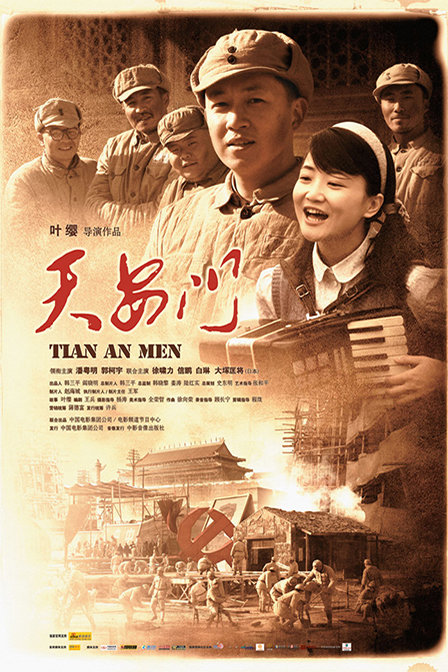
    If anyone has a good explanation for why this happened, I’d love to hear it. Is it personal? Perhaps it’s because a search for “Tiananmen” yields plenty of misguided Western propaganda while shamefully omitting China Film Corporation’s feel-good National Day picture of the same name*? Who knows. Simply by virtue of its impenetrability and apparent capriciousness, this move puts the GFW dangerously close to self-parody territory. What’s next to be blocked in the interest of the correct guidance of public opinion? Hello Kitty? ESPN? Funny-or-die? The mind reels.

    *This was last year’s lightweight counterpart to the more serious but less watchable “Founding of a Republic.” Imagethief really wants to know what the deal with the girl with the accordion was. She’s on the poster foreground, but in the film for all of about ninety seconds, thus constituting the sum-total of the sex appeal as far as Imagethief is concerned. This, although scant, was admittedly ninety seconds more sex-appeal than “Founding of a Republic” had.

    Update:

    Also blocked, for the first time as far as I know, is Imagethief. Puts me in good company, along with Danwei.

    Update 2:

    Apparently blocked only in Beijing. Imagethief, it seems, is suitable for the decadent financiers of Pudong, but not for the refined sensibilities of Zhongnanhai. I don’t know what to think.

    Think,
    Think, “Die Hard”, only communist, funnier and with an accordion girl.
  • Consultants say hardened Chinese death-nerds are coming for your daughters

    Yes, it’s true. Those Chinese death-nerds are everywhere. They’re in your bank account. They’re in the Pentagon. They’re sending naked pictures of themselves to your daughter. And they’re completely invulnerable to all known countermeasures!

    Or at least that’s the terrifying conclusion one might draw if one was to read a long article from the Washington Times with the chilling headline, “China blocks US from cyber warfare.” Now, the Washington Times and this journalist in particular have–how shall I put it?–a distinct point of view on China, and it’s perhaps just a tad darker than my own. But I find this story interesting less on its own (thin) merits and more because it represents the latest installment in what seems to be something of a fad in hair-raising stories on the Chinese cyber-security threat. My heavens, are we having a meme?

    You may recall that this idea began rolling in its most recent incarnation with a report about Ghost Net, in which the link to the Chinese government was unclear but widely assumed. It gathered steam with a rather vague Wall Street Journal article about Chinese “spies” hacking into the US electricity grid. With this Washington Times article, which has been picked up by AFP and thus relayed to Yahoo and other portals, it’s reached something of a loony crescendo. You’d think bureaucracies in Washington were competing over turf and budgets and thus doing their best to dial up the general anxiety level in order to exert political leverage. Because, you know, what with the economy, two wars, the Taliban destabilizing Pakistan and Swine A/H1N1 flu we so desperately need one more thing to be afraid of.

    The Washington Times article really is in a class all by itself, though. It focuses on the devastating implications of a “hardened” Chinese operating system that, to read this article, makes Chinese government computers essentially hack-proof. It is based largely on the testimony (PDF) of Mr. Kevin Coleman, one of nine witnesses speaking before the US-China Economic and Security Review Commission on April 30th. (The USCC makes periodic recommendations to congress on the national security implications of trade with China.)  There is no one part of the article can single out for an excerpt, so I’ll instead give you a rundown of the highlights. The article features:

    • An IT security consultant (Mr. Coleman) who “advises the government on cybersecurity” telling us that the Chinese are outplaying us badly. Because what do you expect him to say? “It’s all good. I’m done here.”
    • Terrifying absolutes, such as this quote on the effect of China “hardening” it’s servers with this new operating system:

    “This action also made our offensive cybercapabilities ineffective against them, given the cyberweapons were designed to be used against Linux, UNIX and Windows,” he said.

    • The suggestion that the revelation of this operating system is somehow an intelligence coup, on par with the cracking of Enigma:

    The secure operating system was disclosed as computer hackers in China – some of them sponsored by the communist government and military – are engaged in aggressive attacks against the United States, said officials and experts who disclosed new details of what was described as a growing war in cyberspace.

    • Further vague but terrifying details designed to emphasize our inferiority:

    Additionally, Mr. Coleman said, the Chinese have developed a secure microprocessor that, unlike U.S.-made chips, is known to be hardened against external access by a hacker or automated malicious software. “If you add a hardened microchip and a hardened operating system, that makes a really good solid platform for defending infrastructure [from external attack],” Mr. Coleman said.

    • Hopeless over-generalizations of dubious technical soundness:

    U.S. operating system software, including Microsoft, used open-source and offshore code that makes it less secure and vulnerable to software “trap doors” that could allow access in wartime, he explained.

    • Quotable quotes:

    “What’s so interesting from a strategic standpoint is that in the cyberarena, China is playing chess while we’re playing checkers,” he said.

    • The devastating revelation that the Chinese government is hiring hackers!

    A third computer specialist, Alan Paller, told the Senate Committee on Homeland Security and Governmental Affairs on April 29 that China’s military in 2005 recruited Tan Dailin, a graduate student at Sichuan University, after he showed off his hacker skills at an annual contest.

    Mr. Paller, a computer security specialist with the SANS Institute, said the Chinese military put the hacker through a 30-day, 16-hour-a-day workshop “where he learned to develop really high-end attacks and honed his skills.”

    • Meaningless statistics:

    Mr. Coleman said one indication of the problem was identified by Solutionary, a computer security company that in March detected 128 “acts of cyberagression” per minute tied to Internet addresses in China.

    “These acts should serve as a warning that clearly indicates just how far along China’s cyberintelligence collection capabilities are,” Mr. Coleman said.

    •  Just plain goofyness:

    Mr. [Joel] Brenner [national counterintelligence executive] said there are minimal concerns about a Chinese cyberattack to shut down U.S. banking networks because “they have too much money invested here.”

    Well, thank god for that!

    It’s hard to know where to start with this article, but perhaps I should begin by saying, of course the Chinese government is conducting cyber-espionage against the US. They’d be stupid not to. And of course they are concerned with securing their own critical systems against the United States’ equally inevitable cyber-espionage. Again, they’d be stupid not to. And certainly the US government needs to take information security seriously. And so do businesses. And so does your grandmother. Especially if she’s using Windows. All granted.

    And it’s nice that various American government bureaucracies are having a pissing match about who should oversee American cyber-security at a government level (the end of the article hints at that a bit). I hope somebody wins someday. But, really, do we need to frame all of this in such Michael Bay terms? Let’s take a closer look at this super-secure operating system, “Kylin”. It’s hardly a secret, having been in the press since at least 2004. You can even download the ISO files, which suggests security somewhat shy of, say, the Manhattan Project. I’m thinking Langley may have a copy. A fairly sketchy DIY site promisingly called “Cheapest-computer-hardware-software.com” has the skinny (all Chinglish is sic):

    The Kylin operating system focuses on high performance, reliability and security. The development program was first funded by the Chinese government sponsored R&D program during 2002. The operating system developed in a hierarchical model, in which, the kernel layer is based on Mach, the system service layer is based on FreeBSD and the desktop environment is similar to that of Windows. The operating system standards are similar to UNIX standards, and are highly compatible with Linux binaries.

    ***

    The operating system was on development at the National University of Defense Technology. The operating system was designated as the document processing operating system. It can now turn China into super power in IT product development. The powerfulness, stronger security of the operating system may make Chinese people to replace the foreign operating systems. In China, Kylin was listed among the best 10 scientific and Technological Progresses News of Higher Learning Institutes during 2005.

    ***

    The dominance of IT product by the foreigners in China will get reduced, once this operating system made popular among Chinese population. The security of data will be stronger, because, it is being developed by the Chinese government and people themselves.

    So, the indestructible Chinese operating system is FreeBSD + Mach. Yes, that’s right, the operating system that frees them from foreign innovation and with which China will conquer the world is a less slick version of Mac OS X. Well, I hate to break that to the scare-mongers Washington, but we have that technology also. As for the secure microprocessor, I hope he’s not talking about Godson, the domestic chip project that languishes in the same commercial phantom zone as the domestic video disk project (EVD) and the domestic WiFi standard project (WAPI).

    Why would I trust some half-assed and likely Chinese no-name site over the best and brightest of Washington DC?  Well, for one reason, the language in the extract above rings absolutely true. Second, let’s just say I’m getting agenda sensitivity on this issue. Sure, it’s possible this is all part of some huge Chinese disinformation campaign and I’m just another useful idiot, talking down the crowbar that the Chinese state will someday use to pry open the secret folder where I keep the naughty photos of Mrs. Imagethief. Maybe there are two Kylins, and I’ve got the wrong one. Maybe Kylin + Godson is the shit, and I should trade in my MacBook Pro.

    Or, just conceivably, people with their noses in the Washington trough are blowing smoke up my ass. Let’s face it, it wouldn’t be the first time.

  • Chinese cyberspies? Sheer lies and heinous fabrications!

    Alright, I confess I made up the “heinous fabrications” bit. But the “sheer lies” sound bite comes straight from China’s Ministry of Foreign Affairs, which has clearly worked hard to make sure that its representatives around the world are working from the same talking points.

    China has found itself accused of a lot of hacking recently. A March 28 New York Timesarticle covered the dreaded “GhostNet”; innocent computers ruthlessly compelled to do the bidding of alleged shadowy overlords in Beijing (which bidding was, apparently, to screw with Tibetan exile organizations). More recently, a story in the Wall Street Journalreported on attempts to hack into the systems controlling America’s power grid, some of which apparently originated from China and Russia.

    The Chinese government had chances to rebut both stories. Here is a Beijing-based Ministry of Foreign Affairs spokesman responding to a “GhostNet” question in a regular media Q&A the day after John Markoff’s story broke in the Times:

    “I have noted before that the Chinese Government has always taken cyber-safety very seriously. We resolutely oppose any crime including hacking that destroys the internet or computer network, which is stipulated in relevant Chinese laws and regulations. The current problem is, some people overseas are indulged in fabricating the sheer lies of the so-called cyber-spies in China. What I have seen is a ghost of “Cold War” and a virus of “the China Threat” mentality. The China Threat virus on those haunted by the Cold War ghost strikes from time to time. Their attempt to defame China will get nowhere.”

    And here is Chinese Embassy spokesman in Washington DC responding to the electric grid issue in the Journal (responding in writing, I would guess):

    [The Chinese government] “resolutely oppose[s] any crime, including hacking, that destroys the Internet or computer network” and has laws barring the practice. China was ready to cooperate with other countries to counter such attacks, he said, and added that “some people overseas with Cold War mentality are indulged in fabricating the sheer lies of the so-called cyberspies in China.”

    Well, that’s message discipline for you. And it would be admirable discipline indeed, were the talking points not the usual throwback language that always sounds better coming off of a red-ink woodcut with a picture of Mao in a sunburst than off of the pages of, say, theWall Street Journal. The only thing reminiscent of the Cold War here are those quotes.

    Of course the Chinese government, like all governments with access to electricity, is probably involved in computer-espionage and computer-warfare programs. But it obviously has to deny any involvement in polite company. That’s a given, and no-one can blame them. There are even some good bits and pieces in both responses above: “Always taken cyber-safety very seriously”, “oppose [activities] that destroy the Internet”, and “ready to cooperate with other countries”. Unfortunately, the usual, overly scandalized language wrapped around those bits and pieces does nothing to help. It makes the spokespeople sound, to abuse Shakespeare’s Queen Gertrude, like they are protesting too much. The good stuff gets lost.

    If I was rewriting their talking points, I would take a classic broadening approach where you turn the accusation everyone’s problem. You can see the beginnings of this in the embassy spokesman’s quote. I might suggest something like this, which takes the good bits from both responses and loses the righteous anger:

    “The Chinese government takes Internet security very seriously, and is opposed to any activities, including hacking, that make the Internet less secure or less useful. Internet security is a concern for everyone who uses a computer. As you know, internet use has been growing rapidly in China. This year we passed 300 million users, and now have more people online than any other country. The Internet has been a great contributor to growth and innovation in China, so no one takes these issues more seriously than we do.”

    If you wanted to be extra-saucy, you could build a bit on the embassy spokesman’s cooperation statement and say,

    “We stand ready to cooperate with the governments of other Internet using nations to find ways to improve global Internet security for all users.”

    Less quotable, perhaps (short of a threat to kill the questioner’s pets, what wouldn’t be?), but also much less of that how dare you? tone that comes off so defensively. As we say in PR, you can’t control the questions you get asked, but you can always control the answer you give. Why not take the opportunity to say something positive instead of just reeling off an angry denunciation of the charges?

    And if you read the responses above carefully, denunciations is what they are. There is no outright denial in either of them. I doubt that’s a legal maneuver (after all, what are you going to do, sue them?) so much as a chosen rhetorical technique: Attack the credibility of the charge rather than denying it. If so, it’s shrewd on a certain level. Denials always look terrible in print. “I never stole those panties!” has “cover pull quote” written all over it. That’s why we always tell spokespeople not to “repeat the negative” in a question. But there are many things that could better replace an outright denial than straw men fabricating sheer lies.

    See also:

    James Fallows: What should we make of this Chinese cyber-spy story?

    Schneier on Security: US power grid hacked, everyone panic! Welcome perspective:

    Honestly, I am much more worried about random errors and undirected worms in the computers running our infrastructure than I am about the Chinese military. I am much more worried about criminal hackers than I am about government hackers.

    Nart Villeneuve of the Internet Censorship Explorer on the hype-factor in the article.

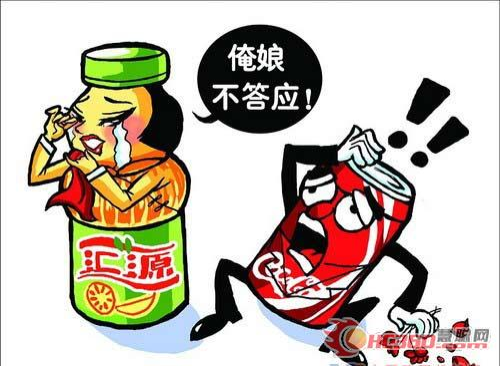
  • Coke, Huiyuan and the audiences that matter

    Nothing as timely as the blogs, I tell you. As everyone on the planet now knows, the Coke-Huiyuan deal has fallen through. It retrospect, it wasn’t particularly surprising. It broke new ground in size, and public sentiment was never behind the deal. David Wolf and Dan Harris have both written good posts about this, and I recommend taking the time to check out both.

    I have been trying to find finely-parsed and academic way of stating a basic truth, and it hasn’t worked out. So here it is in plain language: If you’re a large foreign firm taking over a Chinese firm, prepare to be flogged in public. And prepare for it before you announce your acquisition.

    Here is a basic PR lesson to go along with that: Part of selling any acquisition is convincing stakeholders of the value that the acquisition will bring in terms that make sense to them. That last part is the detail that often gets lost. In a perfect capitalist world (if you don’t see that as oxymoronic) it would be easy to explain the value of an acquisition to the key stakeholders on all sides of the deal. “Dollars” and a business case would do the trick.

    However the real world is messy, not every stakeholder is interested in the share price premium, and I think we can all agree that China is a long way from being a perfect capitalist world. Some of its complexities are nicely captured in a summary of the unwritten rules guiding foreign acquisitions assembled by Dan and Steve at China Law Blog and included in the post linked above:

    Foreigners are permitted to purchase large, state-owned enterprises that suffer from financial difficulty, provided the foreign investor agrees to restructure the purchased company.

    Foreigners are permitted to purchase non-majority interests in strong, successful Chinese companies, but only if there is some added benefit, such as transfer of technology, advanced management or access to foreign markets.

    Foreigners are not permitted to purchase a majority interest in a large and financially successful Chinese company. Even smaller companies are off the table if they are financially sound and work in a core technology field or have created a strong or historically important brand.

    I’m a PR man, so I am compelled by some mystical force to reduce these rules to something I can work with: Perception. When you understand how you are perceived by different audiences, you can begin to figure how to communicate and act in way that will reinforce those perceptions if they are good, or change them if they are bad. So here is what China Law Blog’s rules say to me about how foreign companies and foreign acquisitions are perceived in China:

    • The government and a loud and influential slice of the grass roots automatically perceives the motives of foreign companies as suspect
    • The state perceives foreign acquisitions of Chinese companies as value-destroying by default, even if they’re good for shareholders, therefore it perceives value differently than shareholders do
    • A foreign acquisition can be perceived to add value if there is explicit upside with regard to national priorities

    This lays out the difficult communication challenge for any company in Coke’s position. Note the really small role of “what’s good for shareholders” in the above. Therefore, in communicating about a major planned acquisition in China, and knowing that both government and popular backlash are likely, leading with shareholder value might not be the ideal approach. But here is Coke’s statement of September 3rd (it’s the same inChinese):

    “This acquisition will deliver value to our shareholders and provide a unique opportunity to strengthen our business in China, especially since the juice segment is so dynamic and fast growing in China. It is also further evidence of our deep commitment to China and to providing Chinese consumers with the beverage choices that meet their needs,” Mr Kent said.

    If successful with the offers, the Company will use its expertise as a global beverage company to further develop the Huiyuan brand to address the evolving needs of consumers. There are anticipated synergies that will drive operational efficiencies, particularly in the Huiyuan business’ production footprint and in Coca-Cola’s distribution and raw material purchasing capabilities.

    When I read that, here is the order of priorities I see in the messaging:

    1. Coke shareholders
    2. Coke’s business in China
    3. Chinese consumers
    4. Huiyuan’s success

    That’s a perfectly good set of messages for Coke’s investors and stakeholders back home. But I might reverse that list if I was writing this for Chinese audiences. I also see a message on how Coke’s global experience will benefit Huiyuan. Viewed one way, that seems wonderful and constructive. Viewed through a nationalist looking-glass, which is how many foreign acquisitions are seen, it could seem paternalistic.

    This statement was just the initial announcement and one slice of all the communication that took place, and by most measures it is fine (although “commitment to China” messages are such a pro-forma recitation as to have become essentially meaningless). But it’s an interesting glimpse into the formula that often guides MNC communication in these situations.

    Huiyuan didn’t post a statement of their own on the day the deal was announced, but two days later they published on their site a congratulatory note from the government of Wanrong county, where they are headquartered. This is also formulaic, but in a locally relevant way. The fact that it’s a local government statement — a third-party endorsement — is a bit of communication in itself. The first two paragraphs are congratulations and a recap of Huiyuan’s history. The last paragraph reads (in loose translation):

    The successful merger of Coca Cola, the world’s largest beverage company, with Huiyuan Group will inevitably foster a win-win situation and create more excellent social and economic benefits. We will create an excellent environment for the development of business creativity and promote the common progress of both sides.

    There’s plenty of pro-forma recitation in this statement as well, but it’s recitation that speaks directly to local priorities. Coke’s statement, on the other hand, reads like a communique primarily to Coke’s shareholders, who were probably the one stakeholder group that was on-board with the plan from the beginning.

    But other stakeholder groups were driving the outcome. Just a day or so before the deal was spiked a further glimpse into the process was afforded by a Reuters article optimistically titled, “Coke expected to get OK for China Huiyuan deal“. The lede is interesting, because it ties Coke’s prospects for success directly to a fortuitously-timed package of new China investments announced earlier this month:

    Chinese authorities are expected to grant a conditional approval soon to Coca-Cola Co (KO.N) for its $2.5 billion purchase of Huiyuan Juice after the world’s largest soft drinks maker pledged to invest another $2 billion in China over the next three years.

    But the telling stuff is further down in the article:

    Beijing’s influential Caijing magazine reported last month the MOC held a closed-door hearing on December 26 to seek advice and hear from Huiyuan’s domestic rivals and drinks industry groups.

    Some participants objected to the deal, citing protection of Huiyuan as a national brand as well as concerns about Coca-Cola’s growing monopoly power in China’s soft drink markets where small local juice makers may be hurt.

    ***

    Lawyers and bankers close to the process say the political pressures on the government over this deal have been significant.

    While Beijing wants to signal that China is open to foreign investment, it does not want to be seen as easily surrendering national interests and brands, said the sources.

    ***

    “Beijing decided to give the deal a serious and tough review after it saw growing concerns and objections from Huiyuan’s local rivals and some pro-nationalism marketwatchers,” said [an anonymous source].

    Again, it’s not the individual statements themselves that are important, but more the overall approaches and priorities they suggest. In the end, only Coke and Huiyan know exactly what steps they took to communicate about the deal to the public and to regulators and other people in the government with an interest in the outcome. Coke has been doing business globally since forever and in China since 1979, and I have no doubt they worked multiple channels very hard. But they still seemed surprised by the backlash.

    A friend of Imagethief’s who follows these things reports that Coke PR people at a recent conference had the point of view that they were acting within the law, and that China’s netizens thus had nothing to complain about (this is second-hand, so take it as such). This might be true at a strictly rational level. But rationality is relative, especially in matters of national pride. And, as any parent knows, not having anything to complain about has never stopped anyone from complaining.

    If I boil all of the above down into one rule for such situations, this is what ends up stuck to the bottom of the pot: Foreign companies making significant acquisitions in China should assume that the default starting communications position is “in trouble”, and plan appropriately. In fairness, Chinese companies making major acquisitions in the US should probably make the same assumption. In his post linked above, David Wolf writes:

    Any acquisition of a local firm by a foreign company demands a communications effort directed at both the general public and the policy making elite that makes a logical, intelligent, and sensitive case for the purchase. The bigger the buy, the better you need to be at the communications.

    So true. And this was the biggest buy of all, so far.

    See also:

    And several posts from the Wall Street Journal’s “China Journal” blog, which followed the deal closely:

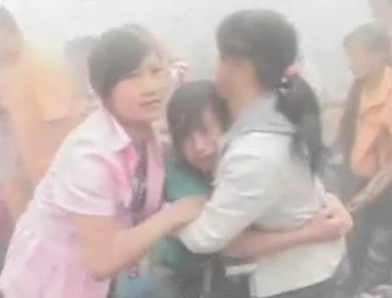
    "Mother doesn't consent."
    “Mother doesn’t consent.”
  • Why I don’t care about the opening ceremony’s fraudulent footprints

    Or so you would start to believe from the press reports over the last day. Some have dwelt upon the lip-synched singing of hyper-precious Lin Miaoke, the impossibly apple-cheeked munchkin girl who “sang” the laudatory and self-referentially titled “I sing for my motherland” without toppling over in shock at the thought of being watched live by 90,000 people and countless millions on live television. She must have been on ketamine, because I would have frozen like fudge in Fargo. And I generally have no problem with public speaking.

    More reports have focused on the somewhat more scandalous replacement of the “giant footprints” fireworks display with a computer-generated special effect.

    Here is what Imagethief thinks of both of these revelations: So what?

    I got news for you: Li Ning wasn’t really flying either. If they’d really wanted him to fly they would have shot him out of an air cannon in a flaming suit and he could have lit the torch as he sailed over it and out of the stadium into the Great Beyond of the Olympic Green.

    Damn, forget Zhang Yimou. With ideas like that, I oughtta plan these events.

    The Olympic opening ceremony may have represented many things, but “veracity” was not among them. I thought it was a pretty good show. But let’s face it: it packaged Chinese culture as vulgar burlesque and reduced the legendary 5000 years of history to arena-rock light show. The whole thing was one giant special effect from beginning to end. But I don’t care. I like vulgar burlesque and arena-rock light shows. This was my kinda show!

    In fact, arguably Olympic Beijing, tarted up, hyper-sanitized, stripped of automobiles and resolutely micro-managed for two weeks, is something of a colossal special effect in and of itself. Among all this surely one digital process shot can be forgiven.

    Even the Olympics themselves can be thought of the same way. Overmarketed, pompous, awash in idiotic pseudo-religious symbolism (remenber the “priestess”-infested torch lighting ceremony?), and rife with doping and age scandals, they’re certainly a yard or two from what most of us would consider “reality”. It’s well off the deep-end of showbiz, and showbiz is all about illusion. And I write all of this as someone who’s relatively excited about the games! But you have to be clear-eyed about these things.

    The only grudge I hold about the footsteps is that it was a particularly cool idea. I even said, “That’s cool!” to Mrs. Imagethief while we were watching it on the immense TV that my landlord so graciously installed in my apartment. So, yes, I was fooled. My bad. But I was still entertained by the shot, which is more than can be said for the oxygen-destroying tedium of the totally un-retouched parade of national teams. If anything, I could have used a little less veracity there. (On that note, NBC denies editing the parade to make the US team come out later in the US broadcast. Imagethief suggests that the turgid pace of the parade simply made it seem like eternity before the US team came out.)

    As for munchkin girl, of course she was lip synching. While we were watching her I turned to Mrs. Imagethief and said, “The munchkin is lip synching.” This doesn’t make me a genius. It simply makes me someone who grew up watching Superbowl halftime shows, the Grammy Awards, and other lip-synch classics.

    In fact, on that note, and overlooking the two hour Grand March of Tedium and my various bitchy comments above, I give the opening ceremony pretty high marks. The first part was legitimately spectacular, and I enjoyed the finale as well. Yes, I think Zhang and the Gang could have done themselves a favor and left out the footprints if they didn’t think it would work. Or simply taken their chances on the helicopter chase. But I’m sure they were all biting their nails to quick during the entire four hour extravaganza already. Has anybody tracked sales of Tums (or the Chinese equivalent) in Beijing over the past month?

    In fact, the soporific parade aside, the only other things I’d have voted to remove from the ceremony were the absurd hand-doves of peace, the goose-stepping soldiers and slow march of the Olympic flag around the entire circumference of the field in the statium. The soldiers kindled unpleasant associations for many foreigners, and the flag march simply came way too late in the show for such draggy self-indulgence.

    But good marks on the whole. I’d say that the London 2012 crew (remember, there will be another Olympics after this one, assuming the sun doesn’t explode) has its work cut out for them. Imagethief has just one bit of advice for them: Keep it under two hours. At four hours, the Beijing ceremony was longer than the Oscars (speaking of fraudulent). Keep it short, leave ‘em wanting more. Everyone will love you for it. Or at least I will.

    And that’s gotta be worth something, right?

    What? Me? Sing?
    What? Me? Sing?
  • 5/12, 9/11 and three minutes on Monday afternoon

    On Monday, May 12th, Imagethief was on the 27th floor of the Kerry Center for a meeting at 2:28PM. We all spent a couple of spooky minutes at the window watching Kerry and Fortune Plaza sway alarmingly, not knowing that it was just the faintest echo of a far-away unfolding catastrophe. As a San Franciscan who has been through countless little quakes and one whopper (1989′s Loma Prieta quake, during which I was living in heavily-hit Santa Cruz), I was at first convinced that our tedious and sweaty walk down endless flights of stairs was an overreaction to a trifling local quake. Only when my colleagues began getting SMS messages from friends in Shenzhen and Chengdu did I realize we’d been at the extremity of something terrible and distant.

    An amazing and heart-wrenching story has unfolded in the ten days since. Some of the images that have circulated are still stuck in my head. A journalist acquaintance that I bumped into on Saturday had spent time in devastated Beichuan. He said, simply and soberly, that it would stay with him for a while.

    My office is in Oriental Plaza, just about half a kilometer up the road from Tian’anmen Square. Since I had a bit of free time during the afternoon I decided to walk down to the square for last Monday afternoon’s three minute remembrance of the victims, held exactly one week after the quake. I thought it would be a nice way to book-end a sad week and, to be honest, I was interested to see the scene. I’d had lunch that afternoon with Chinese propaganda expert Stefan Landsberger, who had told me he felt that day’s ceremony was an historic public acknowledgment of a domestic tragedy (an opinion also argued by Paul Denlinger at The China Vortex). One only gets so many chances to witness history, especially when it’s unfolding just up the road.

    There was a big crowd flowing toward the square. I’d cut the timing close, and people were anxious to be out on the square when the ceremony began. In the final moments people were running through the underpasses that lead onto the square, hoping the beat the announcement and defying the police offers trying valiantly to maintain order in the tunnels. Even I, conspicuously overdressed in a jacket and tie, broke into a jog at the last few steps as I watched the time tick toward 2:18.

    There were thousands of people already gathered, with the crowd thickening toward around a roped off area that encompassed the main flagpole. I couldn’t see what or who else might have been there. It wasn’t any of the senior leaders, all of whom observed the ceremony from the fastness of Zhongnanhai. There were also several CCTV satellite trucks and many camera crews roaming about, including one camera high up on a crane, overlooking the crowd.

    That wasn’t surprising. The event had a made-for-TV feel about it. An abundance of the little, red, plastic Chinese flags that I associate with National Day made the mood seem at once reflective and oddly festive. Hundreds of people were holding camera phones above their heads, trying to capture the moment. I don’t doubt the sincerity or depth of feeling of the people there, or anywhere in China, but it occurred to me as I watched a camera crews scanning the crowd that I was participating in a moment of crafted post-quake propaganda.

    At 2:28PM an sonorous voice intoned Beijing time. The crowd fell silent and horns all around started blaring. There in the gaze of Mao’s portrait we all stood for three minutes with our heads bowed.

    At the end of the observance the crowd shifted into life. Some people started drifting back toward the underpasses. From the front of the crowd came a chant of “Go, China!” (中国加油!). In fact, what I heard near me initially was “Long live China!” (中国万岁!). It started scattered but gained strength, ebbing and flowing through the crowd. After a few moments the crowd was pumping fists into the air in unison. A photographer standing on the base of a lamp post nearby was particularly vigorous, rousing the people around him into the chant. Amidst the display of national pride I became acutely aware of my foreignness and decided to move out of the thickest part of the crowd. The chant was still going as I walked back toward the underpass. A video can be found here (H/T China Digital Times).

    Honestly, I was surprised. The fist-pumping chant seemed somehow inappropriate for the occasion. Not that the Chinese shouldn’t be proud of their nation and the response it has mustered to the quake. But a solemn remembrance had shifted in moments into a vigorous nationalist rally. I had expected something more restrained, along the lines of a candlelight vigil. But this is the first time the Chinese have had such a public memorial in the wake of a civilian tragedy. There is no template for how something like this should go here.

    The scene made me think that Twitter comments, articles and blog posts from earlier this week describing the quake as “China’s 9/11″ might be on to something. (For a spooky, visual 9/11 parallel, go to the NBC News site and watch the May 18 clip “First images of the quake”, showing the immediate aftermath in destroyed Beichuan). 9/11 was a devastating blow to American national pride and self confidence. Could this event reverberate similarly strongly through the Chinese national consciousness?

    Looking at the reaction across the country, it is easy to imagine so. The covers of the memorial newspapers, nicely collected in collage by Chinese blogger Hecaitou (H/TDanwei), are reminiscent of the stark and shocked reporting that followed 9/11. The nationwide outpouring of solidarity (also here) and charity and the celebration of heroic rescue workers is also reminiscent of 9/11.

    There are other parallels as well. China is no stranger to sweeping catastrophe and mass fatality, but this is the first disaster of this scope of China’s post-reform period. That makes it China’s first true mass-media disaster and, in parallel with 9/11 in the US, China’s first Internet disaster, shared in real-time across the entire country and around the world. In fact, considering technological developments since 2001, the Internet plays a much more important role in the public experience of China’s quake than it did for 9/11, which was largely defined by television images.

    The prospect of this being “China’s 9/11″ is perhaps a little worrying. In some ways, 9/11 drew America together. It even briefly brought America closer to much of the rest of the world, including some perennial rivals. But, as traumas will, it also unleashed pathologies. In the US those included the prosecution of a war of choice; elevation of security to national ideology; public justification of torture; a surge of angry nationalism (the Chinese don’t have a monopoly on it) that made questioning of government less acceptable even as fundamental freedoms and balances were eroded; an obsession with shallow symbols of patriotism such as lapel flags; and so on.

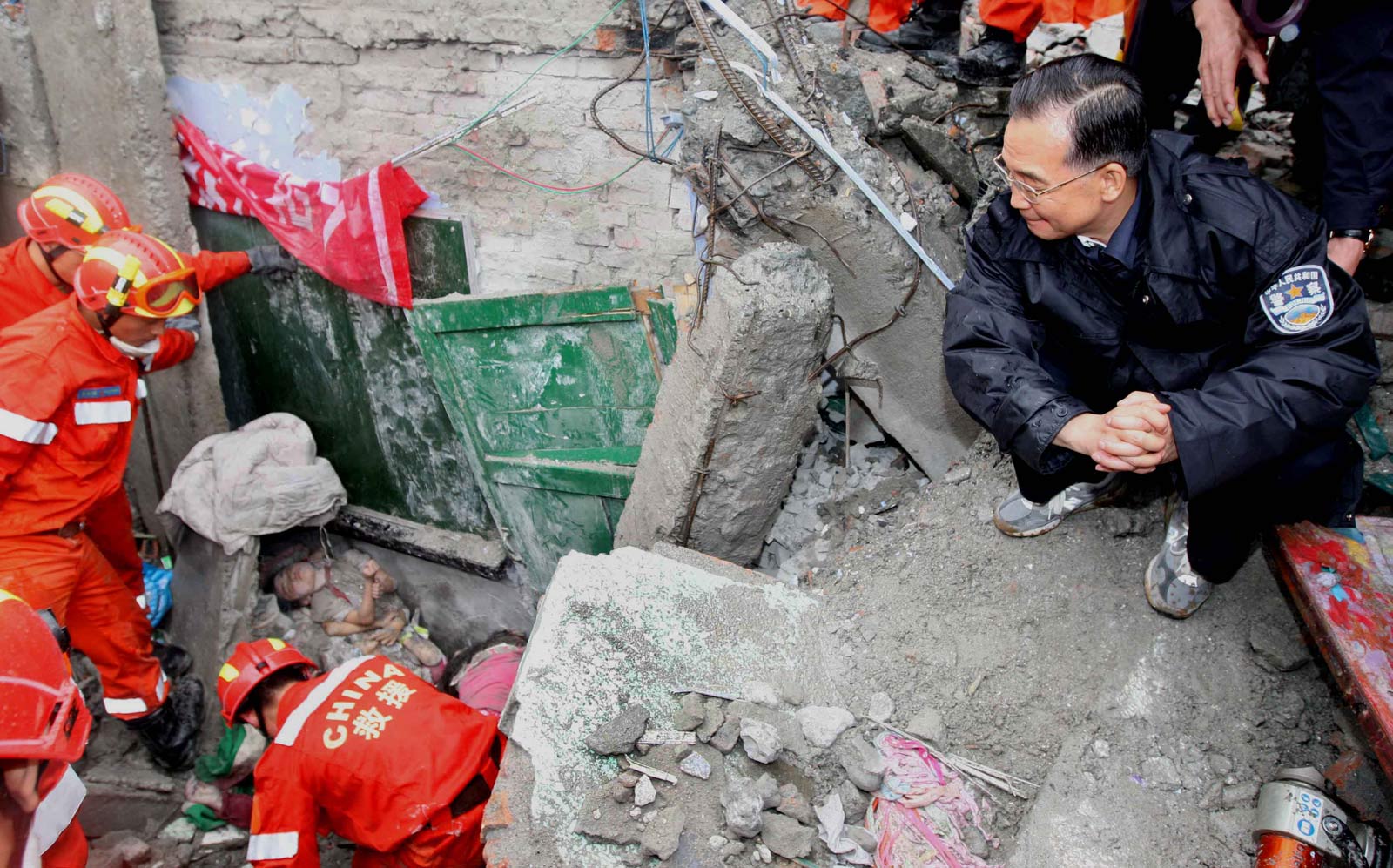
    9/11 was an external event that allowed much, though not all, of America’s anger and grief to be directed outward. China’s earthquake is an internal event. There are no plausible outside forces to blame. The burning questions being asked now are about why a reported 7000 schools collapsed. These questions are given urgency by the pathetic and politically powerful photos (warning: not for the sensitive) of the bodies of primary school students huddled in wreckage. Interestingly, that image was effectively co-opted by Premier Wen Jiabao when he was photographed amid the wreckage, looking at the bodies of students (also not for the faint of heart). An American president would almost certainly not be allowed by his communications team to be photographed in such graphic circumstances.

    So if this is China’s 9/11, where will the Chinese direct their anger and grief as shock begins to wear off? It occurs to me that the earthquake, a true national trauma, might have two possible effects on the current prevailing mood of prickly nationalism. Either it could feed into the nationalist sentiment, and possibly provide fresh impetus for it. Or it might make the nation take a breath and perhaps refocus its energies more constructively. With the Olympics less than three months off, I rather hope for the latter, but the reaction I saw on the square makes me wonder if the former is more likely. So does the degeneration of the nationwide charity drive into a competition in which job threats, Internet floggings and angry SMS campaigns are directed against individuals and companies, especially foreign ones, seen to have been slow or miserly in their contributions.

    One pocket of a nationwide observance is hardly representative, and a poor basis on which to draw sweeping conclusions. A chant is just a chant. Extreme Internet comments are notvox populi. China is not America, and 5/12 was a in the end a very different event than 9/11. The comparison can be easily overblown. Nevertheless, I wonder what place the quake will occupy in the Chinese national consciousness as we slog the rest of the way through this troubled year.

    Shrouded in dust: China's 9/11?
    Shrouded in dust: China’s 9/11?
  • Tibet and the trouble with unassailable national myths

    Outside of Young Frankenstein there isn’t really any such thing as a “good time” for rioting, but this might be an especially bad time for China to have a bout of punishing ethnic unrest. It hasn’t really been a banner start to the Olympic year so far, what with the worst storms anyone can remember, the Darfur activists on a tear, the bizarre Uighur terrorism story, and now this. Commentators are already linking this episode to China’s Olympic fortunes (see also the LA Times, Time, Asia Sentinel and Newsweek), and the French foreign minister has already been spotted talking about a partial boycott. Even Wen Jiabao has suggested that the riots were calculated to damage the games.

    Things seem to have quietened down in the last couple of days, although that may simply be because reporting has been stifled. Certainly the flow of news has dwindled a bit, and many publications have shifted into context and analysis mode. But we can probably expect bits and pieces of information to dribble out over the next few weeks, as refugees leave Tibet and a few intrepid journalists break the cone of silence that that the Chinese government has dropped over the troubled areas. In the past few days many of our favorite local correspondents have made a run for the Tibet border, but blog posts, such as fromTim Johnson and Richard Spencer (and again here), suggest it’s tricky getting any reporting done.

    The Foreign Correspondents Club of China has already petitioned the government for better access to the affected areas and circulated a list of incidents in which journalists and camera crews have been detained or hassled by the authorities. It would seem that Olympic pledges of greater openness were tested in the breach and found wanting. This, I suppose, shouldn’t surprise anyone. Old instincts die hard. The Chinese government has also reverted to its common tactic of belittling foreign coverage as intentionally biased. If this happens during the Olympics then, to borrow a line from Gerry Anderson, stand by for action.

    Over the past few days, China’s communication strategy with regard to the Tibet riots has become clear. It has consisted roughly of the following:

    • Ban all international access so that Chinese media can monopolize images and on-site reporting
    • Cinch down on the Internet (here too) and international news sources so that messaging to domestic audiences can be tightly controlled
    • Demonize the Dalai Lama as the black hand behind the rioting in throwback, Cultural Revolution language, and drive the point home with images of rioting monks

    These three are all true to type. But then it gets more interesting:

    For a good overview of the Chinese approach to all of this, see Mark Magnier’s interesting article on China’s PR efforts around the Tibet riots. It includes this damning quote from Chinese blogger and journalist Michael Anti:

    “The [Chinese] government is showing more confidence and learning more about spin,” said Michael Anti, a well-known Chinese blogger on a Nieman fellowship this year at Harvard. “They’ve learned more PR tactics from Western people. They see the way the White House and the Pentagon do it.”

    In some ways China’s strategy has been effective. They’ve certainly done a good job back-footing the Dalai Lama, who made the mistake of not condemning the violence forcefully and immediately. Domestically it’s been gangbusters as usual. But the Chinese government shouldn’t be too proud of itself yet, because there remains one substantial problem: China has invested so much in its narrative of Tibetan development and growth that it is reluctant take any actions that undermine this story. This prevents them from communicating internationally in a way that foreign audiences will be receptive to, and it stores up serious ethnic problems for the future.

    China’s prevailing narrative about Tibet is that China liberated it from feudal brutality and gave it all the wonders of development. The great mass of Tibetan people understands this and is duly grateful. This narrative has been thoroughly sold domestically, but it has never been widely accepted in the West.

    While there are elements of truth to China’s version, China’s ability to sell it internationally has always been hampered by the government’s time-honed credibility gap with western audiences. This is exacerbated by the difficulty of getting independent points of view. Reporting from Tibet was heavily controlled even before the riots. Furthermore, International opinion is subject to an effective PR campaign run by Tibetan exile groups and the charismatic Dalai Lama. It’s safe to say that International audiences will never be entirely convinced by a Chinese state narrative that doesn’t even allow for the possibility that there might be genuine discontent in Tibet. China is much better at dictating ideas to a captive audience than at selling them to an open one.

    Historically, it hasn’t really mattered to China’s government what International audiences think about Chinese domestic issues. But 2007 was the year in which China discovered the importance of International stakeholders. This began with the product quality crisis that erupted last summer, and it has gained strength over the Olympics in the past few months. The reality is that a global, economically integrated China that has invested hugely in hosting the world’s biggest sporting event is vulnerable to foreign public opinion. That’s why it stung so much when Steven Spielberg (who must be feeling pretty good about this right about now) withdrew from official participation in the Olympics. If it hadn’t stung, you’d have seen a lot less indignant Chinese press coverage about it.

    If foreign stakeholders can boycott your products, screw up your outbound investment or trash the most glamorous event you’ve ever hosted, you need to develop some PR game. Unfortunately the mechanisms that have served China’s government so well over the years, a combination of explicit control over domestic media and pervasive state propaganda, don’t translate well to International audiences, and it has yet to learn a new approach. The need to defend the national narrative at all costs means that foreign media have to be kept away from Tibet, lest they reveal the cracks in the edifice. Heaven forbid that those inconsistencies make their way back to domestic audiences and undermine the national myth of Tibetan success and perhaps even government legitimacy. Tibetan integration –or suppression depending on your point of view– is part of Hu Jintao’s personal legacy as former Tibetan party chief and author of the crackdown on the 1989 demonstration. Unfortunately, nothing says, “We have terrible things to hide” to a foreign audience like detained or harassed journalists.

    China’s growing international exposure aside, it must be tempting to wave away international concern as interference in China’s internal affairs. Unfortunately, another problem with defending the myth at all costs is that this approach seems calculated to inflame ethnic tensions rather than dispel them. Coverage of the riots suggests that much of the violence was Tibetans taking out their frustrations on Han who simply had the bad luck to be in Lhasa. That’s a shame, and the Chinese authorities are justified in seeking out and punishing those who have committed crimes against people and property. But the job of government is to ameliorate ethnic tensions within the country, not exacerbate them. Xinhua’s heavily spun coverage of the disturbances seems calculated to stoke outrage among the Han majority, and the Internet comment that has been allowed to stand echoes with that outrage, if not universally at least widely. Much of the Han comment reflects common colonial sentiment toward natives: Tibetans are lazy, ungrateful, intractable. Worrying signs for a country that disavows any colonial inclinations and preaches integration.

    This is where the “cost” element of maintaining the myth at all costs really becomes clear. If the national narrative leaves no room for entertaining the notion that regular Tibetans might have legitimate grievances, then there is no hope of recourse for Tibetans and no alternative for non-Tibetan Chinese but to see the unrest as pure betrayal and thuggery. It becomes impossible to even acknowledge underlying problems in any constructive way. All that is left is ruthless crackdown and an ever-widening gulf between the two peoples.

    Unfortunately, the more the Han majority sees Tibetans as ungrateful, violent dupes in the thrall of a sinister Dalai Lama, the harder any kind of real reconciliation will be. Mutual suspicion, hatred and racism-without-end loom. One wonders what will happen if Dalai Lama dies and there is still unrest in Tibet. Who will they blame then? There is a harder-line coterie of Tibetan exile leaders waiting in the wings, but none of them will fill the role of China’s “Goldstein” as well as the Dalai Lama does.

    The best thing China can hope for now is that things stay quiet and the episode fades from view over the next few weeks. But that isn’t a long-term solution. In the end the situation is a tragedy not just because it was violent and ugly, but because it was a wasted opportunity. China could have introduced some transparency, allowed foreign reporters in, and started earning itself greater international credibility at a time when it desperately needs it. China could also have used this as an opportunity to move beyond its propagandistic approach to the problem of Tibetan integration, and to kindle a real national discussion on how to address the concerns of Tibetans in a way that might make integration a reality rather than a propaganda slogan. Done correctly, this need not have looked like succumbing to foreign pressure.

    But that’s not how things are done here. That’s a shame, because no matter what wishful thinkers overseas want, Tibet will be a part of China for the foreseeable future. That will lead to continued problems. And as everyone knows, its hard to solve problems if you can’t admit to them.

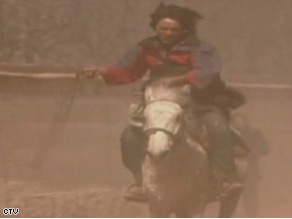
    Horseman of the apocalypse.
    Horseman of the apocalypse.

    See also:

  • The abstraction of diplomacy and the reality of rocks through windows

    From my blog reading, some of the widespread conclusions about the ongoing stream of anti-Japanese protests in China are:

    1. The nominal grievances, Japan’s textbooks that gloss over culpability for wartime atrocities and generally insufficient post-war contrition, are, in reality, minor.
    2. The protests were sanctioned by the state, which is tacitly condoning broad, anti-Japanese sentiment.
    3. There is a whiff of hypocrisy about the whole affair.

    So, rather than a spontaneous outpouring of grassroots sentiment in response to a profound, historical grievance, the facile textbook row is just theatrically blunt diplomacy rooted in grubby, contemporary issues, such as competition over East China Sea gas deposits and Japan’s bid for permanent representation on the UN Security Council.

    Stripping the lingering romance of the heroic Anti Fascist War reduces the protests to messaging, and the protestors to manipulated patsies. The government has decided to send an implicit threat: We have not forgotten and we are still angry. (It’s only implicit at the state level. In published vox populi quotes it’s explicit.) The dismal subtext of the message is that the legacy of the War, six decades later and counting, may still be future retribution.

    Pardon my Outraged Masses
    To engineer its message, the government is indulging in a timeworn bit of political sleight-of-hand. Stoking nationalist fury at Them (in this case, the Japanese) amplifies the diplomatic message, fills an ideological void and deflects activism that might otherwise be focused inconveniently inward. This old chestnut seems to fare particularly well in places where the state has a functional monopoly on public discourse. The refrain is familiar from other times and places: All your miseries are caused by the Catholics, Protestants, Jews, Tutsis, Blacks, Irish, Latin Americans, etc.

    The Chinese government has been careful to stress that its complaint is with the Japanese government, not the Japanese people, but news coverage and official statements are loaded with charged language. (Unfortunately, my language limitations mean that I have to use Xinhua and the China Daily, which are for foreign consumption, as proxies for broader press coverage. I would be interested in hearing if the Chinese language press is the same, better or worse.) Some of the language that has caught my eye in the China Daily in just the past three days:

    “Japan Told to Face Up to Past” (April 13)

    “…whitewashing of its wartime atrocities…”
    “…bad practice and attitude…”
    “…history of aggression…”

    “Japan’s textbook revisions cause for concern” (April 14)

    “… all its killings of civilians, exploiting, especially sexually, of women, brutalities…”
    “… orgy of atrocity…”
    “…the three bloodiest massacres…”

    “Schroeder to Japan: Be self critical of history” (April 14)

    “…heinous crimes…”
    “…wanton slaughtering…”
    “…germ wars…”

    I’ve deliberately pulled these phrases out of context because that is how they work. It doesn’t matter how measured or balanced the language around them is. These are “villain words” that, repeated often enough (the essence of propaganda) will leave a deep impression regardless of efforts to balance coverage or to mitigate the impact by distinguishing between Japanese “rightists” or the government and the population-at-large. Charged words stick. When passions are sufficiently inflamed, the ultimate result becomes the following: Japanese historical crimes + you are Japanese = your crimes.

    Also worth a look are the China Daily editorial cartoons of the past six weeks, several of which invoke Japan. I pulled them together on one web page here [link now dead, see original pages below -WM]. Samurai outfits and Tojo moustaches are caricatures of Japanese militarism (the cartoon featuring Koizumi being notable for its artistic restraint). The depicted attempt to “buy” a Security Council seat reminds me of anti-Semitic propaganda. The thread began on March 9th, well before the demonstrations got going. (The original pages are here: March 9, March 16, March 28, March 30, April 7, April 12.)

    Speaking of anti-Semitism, one sadly recurring outcome of this kind of propaganda is a pogrom. Charged language and imagery can be read as state-sanctioned contempt and, thus, as a license to violence. The Chinese should be sensitive to this situation, as their diaspora has been on the receiving end of this very tactic, most recently in the Indonesian riots of 1999. There is a reason why ethnic Chinese across much of Southeast Asia, who are often the backbone of merchant class, take local names and try very hard to assimilate and keep low profiles.

    This may all sound a bit hysterical, and I don’t think that an actual anti-Japanese pogrom is going to erupt in China, but threats to people and property are escalating on both sides. Furthermore, the attitudes and prejudices that this kind of propaganda teaches do not go away. They just go out of view, to be expressed later as racism, violence and, if we’re particularly unlucky, future policy as another indoctrinated generation assumes power.

    My xenophobes can lick your xenophobes
    Of course the long-term consequences of this will be to drive Japan towards the US and further empower the Japanese right, the very element of Japanese society most likely aggravate Chinese fears. Thus the great circle of self-fulfillment might roll on.

    None of this exonerates the Japanese government, which regularly seems to find ways to irritate neighbors who still remember the war. The Koreans, fellow victims of the Co-Prosperity Sphere and no slouches at nationalism themselves, are also fond of good anti-Japanese demonstration. In the years I lived in Singapore, I encountered many bad memories of the Japanese occupation and much lingering ill will. But no one is guilty of their father’s crime, even if they don’t apologize sufficiently for it, and a regional cycle of nationalism and escalating tension won’t do anyone any good.

    I like to think of myself as an optimist, and I don’t expect a full-scale crisis. But it’s sad that the Japanese foreign ministry has to advise Japanese citizens against travel to China, and it’s worse that the abstraction of diplomacy has already become the reality of rocks through windows. My neighbors are Japanese. They have a three-year-old daughter who is infatuated with my cats and giggles so loudly that I can hear her through the walls. I wonder how they are feeling right now.

    One final China Daily quote, from an editorial published on March 28:

    “It is the young, after all, who urgently need to learn about the falseness of promises offered by nationalism and its romanticization of national glory.

    The truth is, the past never disappears. In fact, it often returns to haunt one.

    It is an unforgivable sin to turn one’s face away from past atrocities while many of the victims are still suffering from the abuse they endured.”

    I couldn’t agree more.