When I cradled my newborn son, Zachary, in a daze in Beijing in 2008, the idea of him as a young man seemed as remote as the planet Neptune. Babies are all-consuming in their baby-ness and it’s hard to imagine someone as an adult when they’re the size of a pineapple, can’t hold their own head up and merrily shit themselves. There is so much growing-up to come! Jesus, when he’s eighteen I’ll be…well, best to not think about that.
A thing about time is that if you wait long enough, even the remotest of deadlines will eventually arrive. Zach turned eighteen in March, which makes me…well, still best to not think about that. He graduated from high school two weeks ago and I am all the things you’d expect: proud, a little sad, mystified at how the years of his childhood seem to have compressed into a heartbeat. Relieved that I don’t have to change diapers at 2AM anymore.
Despite mostly growing up in California, Zach is obligated to return to Singapore for 22 months of national service starting this August. When he was born, my wife and I didn’t know whether we would return to Singapore, where she is from, or to the US. We hedged our bets and got him both passports. The Singapore passport was hand-delivered to our apartment by two young embassy staffers along with a national service obligation and, to cushion the blow, a delightful gift basket. A reasonable trade, I thought, as I ate the butter cookies in the basket. Somebody had to eat them, and Zach didn’t have any teeth yet.
Friends have asked me over the years if I couldn’t get Zach out of national service, but this misunderstands my feelings. I am fully NS-pilled and excited for him to do it! This is easy for me to say since I’m definitely not the one doing it. But, in hindsight, a couple of years of discipline before I showed up for university would have done me good. I sacrificed my freshman year on the altar of monster bong rips and two-liter Sapporo mini-kegs before my parents gave me The Talk.
Fortunately, Zach is a better student than I was and has no discernible interest in monster bong rips, which are frowned upon in Singapore, or Sapporo mini-kegs, which start good but finish flat, warm and pungent, like a road-killed tanuki in a Hokkaido summer. He’s grown up knowing that NS was coming and seems to accept it as the price of being half-Singaporean.
My wife and I have always planned to return to Asia while Zach is in NS. For a long time this was a distantly appealing prospect that we chatted about with other parents at playdates full of six year olds. It was a thing that would happen, you know, someday, like AARP membership or a prescription for statins.
Well, motherfucker, someday is here and now we have to move back across the Pacific. I also get regular AARP membership pitches in the mail, which makes me…honestly, best not to think about that.
Evaluating a New York media scandal on the international beer metric
Twenty years ago last March, I wrote my first blog post about PR in China. I had been living and blogging in China for nine months, but my early posts focused on daily life and had titles like, “I successfully speak Chinese to people,” and “I shop,” and so on. These are real titles, not jokes. I was delirious with culture shock.1
When I finally wrote about work, I started with a post on a China PR practice that I found deeply weird. This was the “transportation claim,” the practice of giving every reporter who attended a press event an envelope of cash. Coming from obsessively Windexed Singapore, where I had started my PR career, this seemed sketchy. But my colleagues assured me that it was standard practice.
In those days the going rate was 200RMB (then about US$25) for a Beijing print reporter who had come from in town. There were different rates for television crews and out-of-town reporters.
Was giving a modest envelope of cash to a reporter who worked for state-owned media a violation of the U.S. Foreign Corrupt Practices Act? I didn’t know! But the leadership of the Beijing office of the big U.S. PR firm I worked at didn’t seem concerned, so, 🤷.
I jokingly titled that old post, “A scholarly analysis of the economics of PR in China.” In it, I used beer, the PR pro’s favorite commodity, as a unit to assess the value of the transportation claim on a purchasing-power parity basis. In 2005 you could get a tall Yanjing or a pint of Beijing Asahi for RMB3 if you knew where to drink. Deducting the average cost of two typical Beijing taxi rides from the transportation claim, I calculated you’d have about RMB150 left over, or enough for up to fifty beers.
In Singapore, which was my frame of reference, I calculated you’d need an envelope with a minimum of SGD$270 (about USD$180 at the time) to achieve the same thing.2 Hand a lot of those out and you would be at real risk of a sweaty afternoon in the basement of the Corrupt Practices Bureau.
That time we tried to make the Moto X in the U.S.A.
I’d been working for Burson-Marsteller in China for nearly six years when I got poached away by our client, Motorola. Jumping from agencies to clients can be tricky, but my boss at Burson gave me her blessings. Maybe she thought it would be good to have an alum as the client. Or maybe she was just happy to be rid of me and my obnoxious blog.
This was 2010 and the iPhone was popular, but not yet the Greatest Consumer Product of All Time. Smartphones hadn’t changed the world, but you could feel the change coming and everyone wanted in on the action.
I’d been smitten the first time I handled an iPhone, in 2008, and I’d bought a first-generation model shortly thereafter, on a work trip to San Diego. At the time, all iPhones were U.S. only and locked to AT&T. I had to jailbreak mine when I got it back to China so I could use it on China Mobile. This was terrifying, like performing brain surgery on your child with kitchen implements. I was sure I was going to lobotomize my new $600 superphone.1
Amazingly, the patient lived. I promptly abandoned both my Motorola Razr V3 flip phone and my Burson-issued China Mobile Blackberry, which looked like a prop from the old Adam West “Batman” TV show. This lasted until I got a nastygram from Burson’s IT department scolding me for using an “unauthorized client.” Reluctantly, I shifted my work email back to the Bat-Berry. But I used the iPhone for everything else.
No regrets! As small and slow as early models were, touchscreen smartphones were obviously going to revolutionize mobile computing and change our experience of the world. I’d known that the moment I saw the New York Times home page microscopically rendered on a 3 1/2 inch display, and again the first time I saw the map application tracking our location in real time while in a car. The only thing I regretted was losing the tactile snap! of slamming the Razr shut. Hanging up on someone would never be as satisfying again.
I was in love with smartphones and when Motorola came calling, I was ready. Motorola was still a behemoth in 2010, but activist investor Carl Icahn was cleaving the company in two. Motorola Mobility, the new smartphone-focused business, had lured Sanjay Jha away from Qualcomm to be CEO. Jha was all-in on Android, and Motorola had launched the first Android smartphone in China, the lozenge-shaped XT800. I shelved my iPhone for an Android-powered handset, a goony Motorola Milestone with a slide-out keyboard. The future was wide open and the smartphone market was there for anyone to seize!
So I’m back in the US of A for Christmas and based on a sample size of two (my parents), I can report that the political mood here is bleak. My mom’s dog of many years died a week or two ago and one of the pressing post-mortem issues is what to do with the now faintly embarrassing “Obama” dog leash. Two years ago this was the shizznet. Today, like the word shizznet, it pretty much just annoys people.
When you only come home occasionally, you notice strange things. Tonight I noticed that mom’s new oven, part of her recent kitchen renovations, displays not just the time, but also the day and date. Today, the oven announces, is Tuesday, December 21st, 2010. Why the hell does an oven need to know the date? It’s not like you’re going to put a turkey in and then program the thing to start it three weeks hence, right before you get back from London. I mean, you could, but no matter how you dress that turkey, it’s coming out stew.
Still, it’s always nice to be back for Christmas. But now that we have a child it’s a much more fraught exercise. There’s nothing wrong with the child himself. He’s handsome, charming and funny — at least, inasmuch as any three year old can be. But he is also, like any three year old, the Amazing Human Vector, capable of introducing disease into any population anywhere. If we dropped him out of a B-2 over Afghanistan, our problems there would be over. Indiscriminate use of biological weapons is technically a violation of the Geneva Conventions, but that kind of thing doesn’t seem to bother us so much any more, so the US Air Force can contact me care of this blog if they’re interested in picking him up for, oh, let’s say 200 million bucks. It seems like a lot for a small boy, but is totally reasonable when you consider the strategic impact and the $2.2 billion sticker on the B2.
Anyway, speaking of coming out stew, last year the Human Vector gave my entire family some kind of awful stomach illness that destroyed Christmas as thoroughly as if I’d filled the stockings with an emulsion of dogshit and gasoline and set them alight, presents and all. On one particularly bleak night Imagethief read all of Nathaniel Philbrick’s “Mayflower” in the bathroom, and that is not a svelte read. So we were pretty sure that by comparison this Christmas would be candy canes and cinnamon pixie-farts.
With cinnamon pixie-farts in mind, we went over to the little-league field where the Sea Scouts run their Christmas tree lot. My mom’s current tenant had actually left an artificial Christmas tree, but I think artificial Christmas trees are like fat-free ice cream: unnatural simulacra of things that should be by nature joyous and indulgent. If you described a Christmas tree to a police sketch artist from Mars, you might get something that looked like this artificial tree.
The Sea Scouts were in high spirits, busy dragging one of the volunteer clerks through the ring-like device they use to “net” Christmas trees so they are more compact for driving home. “It’s a boy!” yelled one, capturing in a nutshell what the scene was spookily reminiscent of. But it’s Christmas, so you have to celebrate a virgin birth, even if it’s the simulated virgin birth of an eighteen year old man being passed through a hoop of disposable red-and white netting. While they were cutting him out of the net we found a suitable tree: a six foot noble fir for $51. “Would you like the stand with that?” asked our clerk, who had not been run through the netting machine and was therefore still able to serve us.
All the Sea Scouts trees come already mounted on broad stands made of green rebar and plastic buckets. The stands cost an extra twenty bucks, but make the tree “ready to trim”, as it were. My mom already has a Christmas tree stand that dates approximately from the Lyndon Johnson administration (really), but which has always been serviceable if a bit fiddly. It seemed excessive to me to pay an extra twenty bucks for a big hunk of rebar that would just get heaved into the recycling along with the tree two weeks hence, so I declined.
Dumbest mistake ever.
Here’s a bit of straightforward advice: get the stand. Just swallow the environmental consequences and the measly two bills and get the goddamned included stand. The tree will come in the front door and be ready for trimming and presents. No hassle. And no back problems.
Ah, the back problems. Part of Imagethief’s genetic inheritance, along with a big schnozz, sweet tooth and tendency to wordy rants, is a gimpy back passed down from my father and exacerbated by years of sloppy gym technique and poor work posture. I am, it must be confessed, a sloucher. This has been my year of back problems. At 43, I should probably be grateful. My father blew his back out like a discount whitewall when he was ten years younger than I am now, and I’ve never found myself laid out on a living room floor for three days like he was. But I did have several spells of pain and stiffness culminating in a stinging pinched nerve that popped up a month ago after an ill-advised encounter with a leg-press machine (never again) and a weekend of vigorous walking, of all things. This made it impossible to run for two weeks.
I like to run. With my eye on taking advantage of the pristine Bay Area air for some running (while I write this in fragrant Palo Alto, Beijing’s air is once again “hazardous”), I spent the last month carrying myself like an octogenarian grandmother in a Venetian glass factory. I bent from the knees to pick up lint. I even managed to preserve my back while handling my son, who is probably the single biggest factor in its recent deterioration. Three year olds, unlike dumbbells, are prone to suddenly squirm and throw you off balance in ways that can cause discs to rocket out of your spine like ninja throwing stars. They think this is funny and they learn interesting new words when it happens.
I was rewarded for my care with a pain free back and more or less full range of motion. I even managed to get our two 23 kilo suitcases into PEK out of SFO without re-injuring myself, a feat roughly on par with creating cold fusion using two glasses of flat Dr. Pepper, some kidney beans and a soiled fork.
But then I had to set up the Christmas tree.
When you think about it, a Christmas tree is a really ungainly thing. It’s heavy, asymmetrical and the best handholds are buried deep inside, especially when you pay extra for a lush noble fir instead of some threadbare, piece-of-crap douglas fir. I lugged the thing awkwardly from the garage to the living room, only to find that the trunk was too short to fit into the LBJ retro-stand. This meant laying the tree down, going into the garage to dig the hacksaw out from behind the stack of plastic tubs in which my mom’s tenant is apparently storing his collection of lead ingots and anvils, and then getting on my hands and knees to saw the bottom ring of branches off of the tree so it would fit in the stand. Then a little more time on my hands and knees tightening the little collar bolts that hold the tree upright.
When I was done with this, the tree stood proudly erect but I looked like the hunchback of Notre Dame after a night of rejection and a vicious beating by dockworkers drunk on mezcal shooters. An ill-advised attempt to take an afternoon run lasted exactly one half a block before I had to stop because every step felt like I was driving lemon-zest tent pegs into my hips. With fitness clearly out of the picture, I’ve pretty much been confined to an armchair and living on a diet of chocolate and ibuprofen ever since. I really, really wish I’d just paid the twenty bucks and got the tree with its included stand.
But the good news is that it’s Christmas and my son, for all his proven lethality, was old enough to enjoy helping with the trimming of the tree and appears to have not imported some terrifying Chinese nursery school pathogen this year. Tomorrow my brothers arrive and the whole family will be together for the first time since last Christmas. In the face of so much good cheer, pissing and moaning about not having a working spine just seems like so much crabbiness. And we won’t be having any of that, will we?
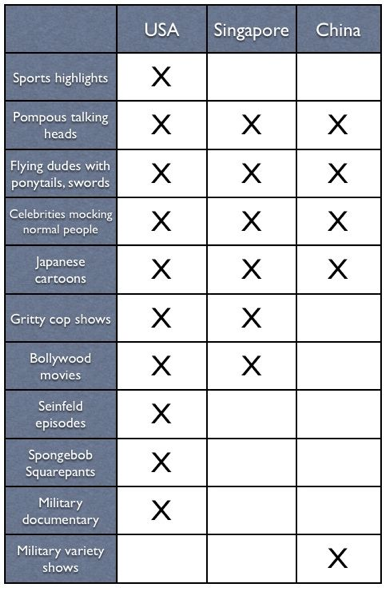
Imagethief has a theory that at any given time, any given American cable TV system will be broadcasting an episode of “Seinfeld.” Admittedly, I tend to cruise the channels late, but that’s what I see.
Recent travels have given me an opportunity to surf not only the channels on offer at my mom’s house in Palo Alto, but also those at my in-laws’ apartment in Singapore, and on my own system here in Beijing. (I’ve recently been watching more Chinese television, as my wife and I let the satellite package expire through a combination of disappointment with the offering and garden-variety laziness.) From what I can see, every culture has it’s “Seinfelds”, those shows or genres that are always on some channel somewhere, day or night. For what it’s worth, here’s what I observe:
Seinfeld’s Law: Shows being broadcast at any given moment.
Make of that what you will.
I’ve also observed that the available amount of quality programming on offer does not increase in proportion to the number of available channels. There is, in fact, a sharply diminishing return. This appears to be some kind of power-law relationship, and whoever works out the actual math will, I am sure, earn themselves a Nobel Prize.
An interesting discussion broke out today on The Peking Duck, in Richard’s post on a Wall Street Journal article on the travails of an American expatriate family living in Chongqing. There was a fair bout of criticism of the family for insulating themselves from Chongqing and China and for moaning about the difficulty of living in Chongqing even as they live all-expenses-paid luxury.
It’s worth reading the article, posted here on Howard French’s “A Glimpse of the World Blog”. You can also go read the extract on Richard’s blog.
It made me think a bit about how I perceive “expats” and the expat lifestyle. I spent nine years in Singapore, where only my first job, which lasted for one year, was on an “expat package”. I was pretty well localized by the end of my stay (married to a Singaporean with more Singaporean than foreign friends). In Singapore I became completely contemptuous of foreigners who isolated themselves. But Singapore is a completely accessible city: wealthy, modern, English-speaking and with all the Western comforts you could ever hope to find. (In fact, Singapore often comes in for the opposite criticism, that it isn’t Asian enough, although I think only people who don’t know where to look make that claim.)
But when I think back to my arrival in Singapore, even it was difficult enough at the time. I remember how thrilled my business partner and I were when we discovered a mass-market Italian restaurant. I remember how akward I felt on public transportation for many weeks. I remember how long it took me to feel like I knew my way around the city. I remember how many dumb mistakes I made managing my staff, and how long it took before I started having good, Singaporean friends.
And that’s the thing about culture shock. It doesn’t really matter what the amenities are, or if the language is the same. There are degrees. You could be an American moving to England and still be culture shocked. You could move from California to New York and be culture shocked. You could damn well move from San Francisco to Iowa and be culture shocked. It might be less severe than coming to Asia, but it would still happen. And different people with different motivations will react differently to the experience.
I came to China because I wanted to engage with it. I wanted to feel what it was like, and talk to Chinese people and “have a cultural experience”. I specifically sought out the feeling of discomfort and displacement that I first had when I got to Singapore because I missed the thrill and challenge of discovering someplace new. It has been tremendously rewarding, but also difficult. I invested two years in learning Mandarin before I arrived. I quit a good job to come here and arrived with no guarantee of work. My long-term future will be in Asia, and I will need to have some experience in China. I had every incentive to get into China.
And yet, even as an Asiaphile with nine years in the region, it was difficult when I arrived. Classroom Mandarin got me almost nowhere on the street. I was scared of the bus, scared of the supermarket, intimidated at the thought of trying to speak to people and generally completely overwhelmed. And I was in a language program surrounded by other Westerners.
Even today I still seek my Western comforts. I live in an international apartment with cable TV. The Internet is my lifeline. I damned well beat a path to the local Jenny Lou’s because I am incapable of giving up Western breakfasts. And I consider myself pretty culturally resilient.
Now, what if I had no experience in Asia and no emotional investment in getting under the skin of China? What if I was here solely for professional reasons and knew I was going to leave in two years? And what if I was in Chongqing, a city far less accessible to foreigners than relatively cosmopolitan Beijing? And what if I was desperate to socialize my young Children as Americans?
I’d probably grow a bunker mentality as well, and concentrate on emerging unscathed. And that’s why I find it hard to criticize the woman in the story.
Sure, I think it’s a wasted opportunity to come to China and not engage with it as deeply as possible. I love it here. But not everyone seeks the same opportunities and experiences as me. And I can’t be too critical of that.