Tag: Weird

  • Godzilla vs. the SARFT Monster

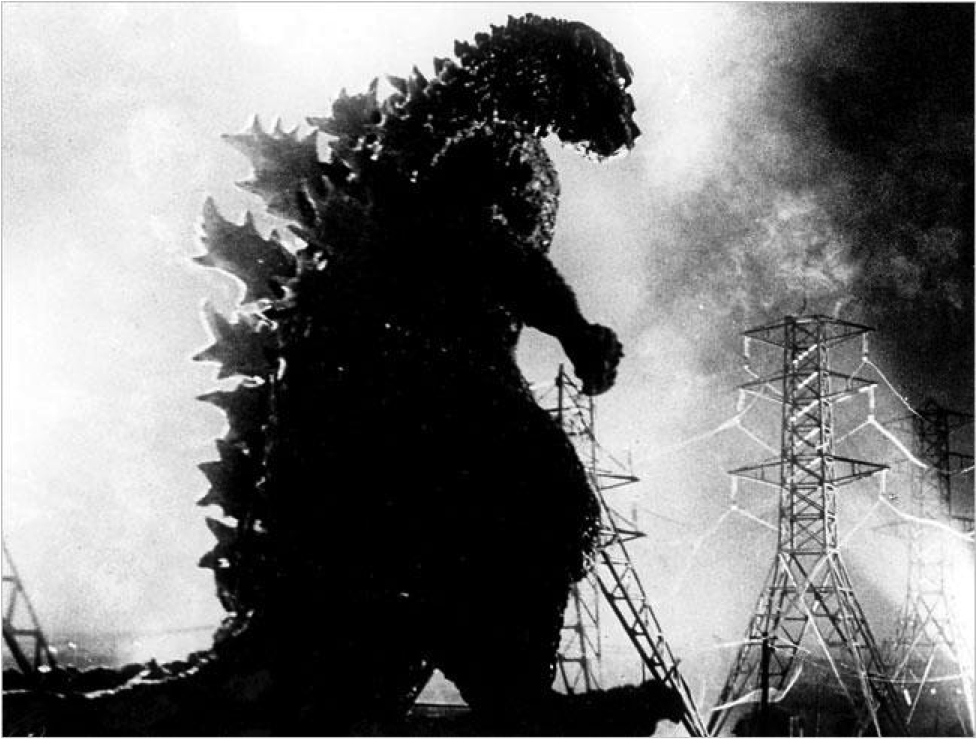
    I’ve been watching a lot of Godzilla movies recently. This isn’t some kind of weird Cable TV accident, like stumbling onto “Barbarella, Queen of the Galaxy” at 2AM when you have a microwave burrito in one hand and a vodka cranberry in the other, and thus, tragically, no ability to change channels. It’s on purpose. I’ve loved Godzilla ever since I discovered him on the afternoon sci-fi serials as a small boy. They spoke directly to the primitive part of the small-boy brain stem that wants desperately to rampage through a model city with a flame thrower. That part sometimes survives into adulthood.

    I’m mostly nostalgic for the “classic” Godzilla movies, from the 1954 original up to about the late 70′s, when I was in my tweens. I haven’t seen many of the modern films from the 80’s, 90’s and naughties, and the 1998 Matthew Broderick Hollywood obscenity is history’s second most flagrant case of pissing indifferently on a beloved piece of popular culture, after the new Star Wars movies. To this day I can’t watch “Ferris Bueller’s Day Off” without weeping.

    Back in the early 90’s I had a well-worn VHS tape of the Americanized version of the 1954 original, “Godzilla: King of the Monsters,” in which the Japanese footage is intercut with shots of “journalist” Raymond Burr calling the destruction from nonspecific locations like a sportscaster: Godzilla has just incinerated Yokohama. Three and two with the bases loaded. Looks like the Japan Self Defense Forces are going to make a change on the mound… But, with an eye on my own son’s cultural indoctrination, I figured it was time to refresh the collection and to finally see Ishiro Honda’s original, Burr-free version of the first movie. It turns out that Amazon sells most of the classic Godzilla oeuvre at knockdown prices. I ordered eight DVDs and I’ve been watching them about one a week for the last couple of months.

    Godzilla movies are still good fun. The joy of watching grown men in rubber suits going all WWF on fabulously intricate model cities never goes away. But watching the movies as an adult is a very different experience than it was when I was young. First, they are, as you’d expect, spectacularly cheesy in virtually all respects: set design, special effects, writing, acting, you name it. In the age of “Avatar” there’s something charming about the pre-digital, in-camera crudeness of the latex, cycloramas, piano wire, little model tanks, and such. It’s a dated look that invokes the 60′s and 70′s like Ray Harryhausen’s stop-motion creatures invoke the 50′s.

    The series also evolves quickly. The 1954 original was released less than a decade after the Second World War and the same year that Japan experienced radioactive rain from American nuclear tests in the Pacific. Fittingly, it is a moody metaphor for nuclear annihilation and human powerlessness. But the geniuses at Toho figured out approximately instantaneously that the future was in monster-on-monster action. By the second movie, 1955’s “Gozilla Raids Again,” Godzilla is fighting a giant, spiky turtle. The pattern is thus set for the next fifty years.

    Godzilla himself rapidly goes from truly sinister to googly-eyed and almost huggable, as though Cookie Monster suddenly grew 400 feet and traded chocolate chips for infrastructure. As Godzilla moves into hero status he’s replaced as villain-in-chief by a motley assortment of other monsters, evil property developers, gangsters, robots, and disco aliens featuring some of the most awesome space-couture since Sean Connery wore a red bikini for “Zardoz.”

    Nobody seemed to care much about this curious transition in Godzilla’s motivations. I guess it was a bit like sports free agency in the US. When Deion Sanders was an Atlanta Falcon, he was a gigawatt hate-magnet that sucked bile out of my pores and toward the Georgia Dome. But when he came to the Forty Niners and started running punts back for us I would have airmailed him my sister, if I’d had one. Of course, just as Deion slid back into villain status when he moved on to the hated Dallas Cowboys, Godzilla himself was reborn as a menace in his modern filmography, but that’s outside the scope of this essay.

    The other thing that struck me upon watching the movies was that there is no way in hell that similar ones could have been made in China, or would be now.

    As I wrote in 2005, no city has ascended the Olympian heights of popular culture until it has been ravaged by a giant monster. Tokyo is clearly way out in front in this regard. It’s taken for granted that monsters are drawn to Tokyo like frat boys to Jaeger shots. Monsters have also afflicted New York, London, San Francisco, Seoul, Paris, Rome, Los Angeles and even Bangkok (look it up). But as far as I can tell, Beijing has been blissfully free of giant monsters. Mothra was reported to be attacking Beijing in “Destroy All Monsters,” but it was never shown on screen, so it doesn’t count. Neither does “Mighty Peking Man,” which was made by the Shaw Brothers while Hong Kong was still British and, despite the name, had no action in Peking (the Chinese name was “Gorilla King”).

    Why hasn’t there been a Chinese giant-monster film with a Chinese giant monster? While armies, police forces and parliaments have crumbled before Godzilla and his brethren, there is one bureaucracy that is apparently entirely impervious to giant monsters: the State Administration for Radio, Film and Television. SARFT has apparently erected a monster-proof shield around Beijing and indeed around all Chinese cities. This is not because giant monsters are particularly scary, obscene or conducive to social unrest. It is because they are politically unacceptable.

    To understand why China never had a giant monster phase you have to understand something about SARFT itself. SARFT administers all of the state-owned media organizations in China and it sets the guidelines for broadcast and film censorship, ensuring that morals, political ideology and good taste are upheld. It takes the latter mission very seriously, as anyone who watches television or goes to the movies in China knows. This mandate includes approving the screenplays for all films to be produced in China, as well as approving films for distribution and exhibition.

    I’m not aware of any official list of SARFT’s decisions, which is too bad because I’m sure it would be fun and educational. You can, however, get an idea of what rings their bell by reviewing their decisions concerning domestic television shows over the last few years and referring to this handy list of foreign films that have been banned or edited for Chinese release. Some recent edits are especially illustrative: removing scenes of ethnic Chinese “space aliens” from “Men in Black III”; culling Chow Yun Fat’s Chinese pirate from “Pirates of the Caribbean III”; garbling references to Shanghai in “Transformers II”; and so on (maybe they just don’t like sequels). Similarly, you can get a pretty good idea of what passes muster simply by going to the cineplex, or, god help you, channel surfing. A few generalizations:

    • The police are incorruptible
    • The People’s Liberation Army is heroic and, ultimately, invincible
    • The modern government is composed of benevolent technocrats who want the best for you
    • No one in China ever gets away with any kind of wrongdoing in the long term
    • There are no superstitions (or they end badly)
    • No one has any sex, though chaste kissing and longing gazes are OK
    • All of history is either dudes with swords and ponytails, famous PLA victories, or the Monkey King (whoever can combine all three without breaking the “no time travel” restriction will do well)
    • Everyone is ultimately happy, and doesn’t complain about news, politics, housing, infrastructure, inflation, rural migrants, pollution or the poor state of television
    • Chinese people are not “space aliens”

    So what does this have to do with giant monsters? Everything. Think about what Japan’s giant monsters perpetrated. They stomped every famous Japanese landmark. They crushed ageless castles and temples. They smashed the Diet (possibly while it was in session). They nested in Tokyo Tower. They repeatedly incinerated the capital. They dug huge, nasty burrows into the flanks of sacred Mount Fuji.

    Japanese monsters also rendered the Japan Self Defense Forces totally impotent. Is there a movie in which the JSDF doesn’t get its ass handed to it on a radioactive plate? Actually, that’s a trick question. In 1955’s “Godzilla Raids Again,” the second in the series, the JSDF has its one and only significant triumph against Godzilla, using fighter planes to bury him in ice (at least until the third movie). But rival monster Anguirus had already done the heavy lifting. Otherwise, it’s a total wash. In the first Godzilla movie, the government and army are completely trampled and Godzilla is ultimately vanquished by an iconoclastic, reclusive scientist so tortured by the weapon he has created that he commits suicide rather than entrust the government with it. Not exactly the communist hero archetype (except maybe for the suicide part, a la Dong Cunrui).

    By the mid 1970’s the JSDF has traded F-86 Sabres for laser tanks (laser tanks!) and rocket ships, but it’s still getting owned by every monster that heaves itself out of Tokyo bay. In fact, the main job of humans in most of the movies is to flee in panic, be appalled by the destruction or supply Raymond Burr-style color commentary:Look! It’s a flying saucer! Is it? I didn’t know. Oh no! It’s Godzilla! Really? I hadn’t noticed.

    Now envision a Chinese monster movie that goes by the classic Godzilla formula. Something scaly and awful emerges from, let’s say, Miyun reservoir, where it has been awakened by decades of polluted agricultural runoff. It follows the Jingmi Road down to the capital, pausing only to snack on the new Expo Center and T3 (we can hope). In Beijing it proceeds to stomp the Forbidden City, trash Zhongnanhai, incincerate the Great Hall of the People and leave nasty footprints all over Tian’anmen Square despite the best efforts of the PLA. It is only defeated when an iconoclastic rebel unveils a weapon so powerful that he tragically kills himself to ensure it doesn’t fall into the Party’s hands.

    Who here thinks SARFT greenlights that one?

    That’s what I thought. If SARFT had approved a Chinese giant monster movie, it would have gone something like this:

    • Reel one: The Chinese people are peacefully minding their domestic affairs and improving their lives under the guidance of the Party.
    • Reel two: The Japanese (can’t use the Americans – the Japanese and Koreans have gone there already) do something horrible that creates a monster that emerges from the Bohai Bay, skips Tianjin like every other tourist, and heads straight for Beijing.
    • Reel three: The PLA uses domestically innovated technology and socialism to kick its ass before it can damage any historic sites, Party monuments or Famous National Brands. Ba yi, motherfucker!

    I think even Zhang Yimou would have spotted that as a loser.

    It’s too bad that giant monster films have never got traction in China. Giant monsters are wonderfully flexible metaphors for modern ills like atomic technology, pollution, industrialization and disagreeable political systems. Even the North Koreans saw the political angle when they created Pulgasari as a metaphor for capitalism and had him attack Kaeson. They couldn’t bear to have him rampage through Pyongyang –that’s just going too far– but they found someplace to put him, thus returning the cinematic favor of the communist space melons from “Invasion of the Body Snatchers.” Surely there must be some appropriate metaphorical deployment of giant monsters with Chinese characteristics. Corruption? Runaway Maoism? Runaway capitalism? Soviet revisionism? The dairy industry? And think of the soft-power angle! Where have you gone, Han Sanping? A nation turns its lonely eyes to you!

    But alas, even with the monster-bait of Guomao Tower 3, Yintai, the new CCTV Center, the Egg and the Bird’s Nest it seems we’re destined to be monsterless in Beijing. That’s a shame. Like political cartoons, tolerance of the cinematic destruction of treasured symbols is a sign of political and cultural maturity and confidence. If you can watch a rubber-suit monster smash a tiny representation of your society and not worry that it will somehow erode faith in the actual society, then you’ve taken an important step. And you’ve done a wonderful thing for every small boy in your country.

    See Also:

    Wikipedia’s list of Kaiju films

    Note: This post originally published on the defunct group blog Rectified.name.
    Politically unreliable.
    Politically unreliable.
  • Holiday special: An advanced socialist dessert culture

    In my years here, I have participated in passionate and heated debates on virtually all aspects of Chinese politics and society. What is the true nature of the government? Can the Chinese educational system produce creativity? Is the country rising or falling? All of these topics are capable of rending friendships, dividing rooms and spoiling a perfectly good dinner party. And yet none produces the same level of incandescent conflict as the question of whether or not China can do desserts.

    China has an evident sweet-tooth. A walk down the candy aisle of any Chinese supermarket is trip to a tinsel-wrapped wonderland of waxy treats of infinite variety. True, I’m occasionally sucker-punched by spicy dried beef, which is often wrapped like candy, but a lot of it actually is candy, at least loosely defined. And what Chinese restaurant meal is complete without the fruit plate? If you’re lucky, the fruit plate might even be spouting dry-ice fog. Dinner and a show – what could be sweeter? One of the very first gifts I was given after starting work in China was a box of tangyuan. (I learned an important lesson:tangyuan are meant to be cooked. Hence the “tang“.) And the price people in this town will pay for Häagen-Dazs is second only to the price they will pay for ridiculous luxury watches, a phenomenon I’ve been able to study since our overheated local Häagen-Dazs shop is just around the corner from our local ridiculous-luxury-watch boutique.

    It’s not just urban. The meanest, most wretched outhouse of a rural provision shop will somehow manage an ice-cream cooler, even if the refrigeration is powered by a mule on a treadmill or local orphans trudging around a giant “wheel-of-pain” like the one that turned a skinny waif into Arnold Schwarzenegger in “Conan the Barbarian.” I once had fresh made ice cream in a one-donkey town in Xinjiang in the foothills of the Pamir Mountains. It was awesome. Possibly because I was on the verge of heatstroke at the time.

    Which raises a question: Does one need to be under some kind of physical duress to appreciate desserts in China? Admittedly, I have a roaring sweet tooth, apparently inherited from my father. I might my strap my own son into the wheel of pain if Häagen-Dazs Rum Raisin ice cream came out of the far end, especially given that it costs $13 a pint here. But ultimately, I’m open minded when it comes to Chinese desserts. I don’t just mean desserts obtained in China, but also desserts drawn from Chinese cuisine. Deep fried pumpkin bisuits. Red bean buns. Glutinous rice confections. Hot walnut soup. I’m pretty much OK with all of them. I still get bricks of blown honey when I walk through Qianmen, despite their proven ability to epoxy my jaws together for hours.

    And yet the derision I’ve come in for from western friends is shocking. I could tell foreigners that my hobby is driving two-inch galvanized roofing nails through the skulls of live ferrets and they’d get less worked than they do when I tell them I like Chinese desserts. This leads me to ask: Is it them, or is it me? Are they right? Is that I’ve finally gone native and this is how its expressed itself? Instead of fleeing into the mountains of Yunnan to start a sustainable flax farm I’ve simply decided that its OK to eat black sesame paste? Or are they narrow minded conventionalists whose eyes are fogged with a lethal mix of Oreo dust and crème brûlée?

    I won’t stand for that kind of cultural dessert imperialism myself. A century of hardship inculcates flexibility in confectionery.  Just as almost anything can be food in China (especially southern China), so can nearly anything be dessert. If all you have is mutton and molasses, by god you’re having molasses sweetened mutton floss for dessert.

    But these ethnic treats take you only so far. Perhaps the most fertile ground lies in fusion desserts, where Chinese (or Asian) sensibilities collide with western ingredients or traditions. It’s unfair, but some places were blessed more by dessert providence than others. The French, at least after the enlightenment, had butter and flour and invented European pâtisserie. The Indonesians had palm sugar and coconut milk and invented cendol (and you haven’t lived until you’ve had a really good cendol). And China had…well, China had pluck. And legumes. But it’s been willing to recombine, which goes a long way. After all, what better illustrates the potential of modern China than the shaping of foreign ideas to suit Chinese circumstances? Hence the entirely respectable red-bean ice-cream stick. (Although the less said about the phallic corn-dildo ice cream stick the better.)

    This trait reaches its zenith is in its ability to take components that under other circumstances I’d be utterly contemptuous of and fashion them into miracles. I experienced this during a recent dinner with my colleagues at a restaurant called Green Tea, a sort of upper-middlebrow Hangzhou place with pretensions. Dinner was fine. But when they got to dessert they earned a place in my heart forever.

    When I moved to Singapore in 1995 I discovered the phenomenon that I came to think of as “Japanese-style” bakeries. If you live anywhere in Asia, you’ll recognize this genre of store as offering a range of vaguely sweet, soft white breads, sausage rolls and alarming-looking combinations of cheese and sugar. I’m expansive about desserts, but I’m a bread snob so I’ve always been completely disdainful of the entire genre. Seriously: My standards are high. I wept when the Fauchon in Shin Kong Place went out of business. They were priced and stocked for Marie Antoinette’s snottier cousin, but their breads were the best in Beijing as long as they were in business – and were the only thing I ever bought, which was symptomatic of their problem, I guess. Respectable French pâtisserie Comptoirs de France opened in Beijing four years ago and it took them until last month to come up with a loaf of bread I like (the sourdough).

    I’m also reasonably discerning about Ice Cream. Longtime readers will know that Mrs. Imagethief is a nutritionist. Among the many things I’ve learned from her is this: if you must indulge, do it right and don’t fart around with the small-time stuff. If you’re going to have ice cream and suffer the attendant guilt, you might as well have good ice cream. Bi-Rite salted caramel*, for example, or Strauss Mint Chip. Who wants to pound out the extra kilometers just because you caved on a pint of Baxy? No one, that’s who. So, like Nancy Reagan, I just say no to the soft bread and flavorless ice cream.

    Or, I did. Until that dinner at Green Tea.

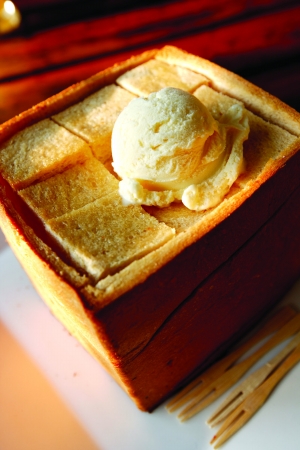
    My colleagues ordered the house specialty dessert, 面包诱惑, which means something like “bread temptation,” though I think “bread seduction” would be better. This is a cube of warm, freshly-baked, soft white bread, sliced into twenty-seven smaller cubes (three cubed – think about the geometry) with a scoop of generic vanilla ice cream melting on top. The heat from the bread melts the ice cream, which runs down into the cracks between the bread cubes and soaks into the crumb and, well, it’s just alchemy, dammit, because the result is gustatory lead transformed into dessert gold. I swear when the waitress carried the first one in the world turned to slow motion while “Thus Spoke Zarathustra” played in my head. You’ll know that as the music that Stanley Kubrick used at the beginning of “2001: A Space Odyssey” to introduce us to a twenty-minute segment of a featureless monolith teaching apes to beat each other to death, which says something important, though I’m not sure what.

    It is the call of the Sirens rendered into cheap bread and ice cream because, speaking of monoliths and ape-like behavior, we ate three of these things. By which I mostly mean thatI ate three of them. I am told that other restaurants have cribbed the idea, but that so far they all lack some…je ne sais quois. Worryingly, I’ve also learned that there is a branch of Green Tea around the corner from my house.

    So, is it a Chinese dessert? Well, not really, I suppose. But it’s Chinese ingenuity applied to Western components with bang-up results. And if that isn’t domestic innovation, well then, what the hell is? The government should be proud.

    Happy New Year to all readers from Imagethief.

    Domestic innovation.
    Domestic innovation.
  • Not enough radiation in your skull and other problems with retail

    Modern Beijing, as distinct from the leafy, 1960s loufang neighborhoods and the hutongs, is an unlovely town at the best of times. No acreage of hanging glass curtain walls can make up for the viscerally alienating nature of the razor-edged, neo-Stalinist SOE office buildings lining the boulevards on the west side of town. The malls and commercial developments of the east side are little better. Wanda Plaza looks like what Albert Speer would have built in Berlin if the Third Reich had lasted into the age of shopping malls. And there are plenty worse than that.

    My own neighborhood is no great prize. It abuts one of those monster intersections on greater Chang’an Avenue that are like urban planning fever dreams – a vast and lethal plane of asphalt ruled by a squawking tribe of crossing-guards that lives in the permanent shadow of a monster overpass, like Brothers Grimm trolls with orange vests. At rush hour the whole thing seizes into gridlock, offering a pretty good preview of what the traffic in Hell will be like. The Guohua power plant’s 500 foot visible-from-space smokestack looms over everything. One of my favorite mental games is looking up at it from different spots in the neighborhood and trying to work out whether it would land on me if it tipped over in my direction. The answer usually is yes.  And people think high school trigonometry is useless.

    Two factors redeem the neighborhood. First, it is within walking distance of the congenial Tuanjiehu, Hujialou and Yanjingli neighborhoods, and the Tonghui canal, which isn’t exactly scenic but is useful for running. Second, it’s convenient, with a subway station, easy access to the Third and Fourth Rings (important for my commute), and a dynamite selection of amenities.

    There is naturally some ebb and flow in those amenities. In early 2008, when Mrs. Imagethief and I returned from a year in Shanghai, we moved into China Central Place Apartments. Soon thereafter workers started converting the previously vacant commercial building in front of  the apartments into an Italian delicatessen and restaurant complex. Having then recently spent a week immersed in the culinary delights of Tuscany, this seemed like a fantastic thing. Exotic sausages and cheeses on our doorstep! Score!

    The reality was rather less inspiring. The Piazza Italia turned out to be three floors of mediocrity: A middlebrow Italian supermarket attached to a cafeteria and an unremarkable restaurant. The curse of the Piazza Italia was demonstrated by its deli. With all the treasures of Italy to choose from, it stuck resolutely to Italian food cliches. I like Parma ham and Parmesan cheese as much as the next guy, but trust me when I say there is much more to Italian deli. For me, the Piazza’s high point came the day Mrs. Imagethief, Zachary and I ate lunch at the cafeteria and found ourselves dining at the table next to Italian prime minister Silvio Berlusconi. Say what you will about the Italians, they’re not hung up about who’s in the restaurant with their leader.

    It was thus moderately disappointing but not in the least surprising when the Piazza rolled over and died. I expressed my grief by rummaging through the wine area and buying several bottles of nice Brunello at knockdown prices. Merchants at Sanyuanli market did a roaring trade in surplus Parmesan for several months thereafter. And Mrs. Imagethief and I started wondering what business might occupy the three newly vacated floors of retail space with an eye watering rent bill.

    I was hoping for a three-floor Jenny Lou, which will tell you how realistic I am. Our neighborhood lost its Jenny Lou three or four years ago, which is a shame because none of the other local shopping options is much good for imports. The BHG Marketplace in the basement of the Shin Kong Place ultramall has pretensions, but mostly it just charges otherworldly prices for produce available for one quarter the price 300 meters away. But, hey, you can get Japanese Cokes for 12rmb.

    In that way, BHG Marketplace is representative of Shin Kong as a whole: glossy, but mostly useless. Take out the Din Tai Feng, the food court and the coffee places, and rest is a waste of space. But maybe that’s just me. I am a man of plain tastes and there are only so many Bvlgari trinkets that I need. And, as I discovered when I tried to buy a jacket a couple of years ago, nothing in the department store fits me. I’m much better off at the Jimmy and Tommy Foreign Trade Club in Sunshine 100. So I guess I have no business assaulting the Piazza Italia for being “middlebrow.”

    After it lay fallow for a few months, work finally began on the abandoned Piazza. We asked the security guards what was being put in, but nobody seemed to know. “A car showroom,” said one. The first sign of trouble came when workers erected an enormous, welded hoarding around the building, concealing it from sight. Concealed buildings in China seldom lead to anything good. A second sign came when the hoarding on one part of the building indicated that it was being subdivided into a cluster of luxury watch boutiques. Finally, the took down the hoardings from the other part and revealed…a three story Burberry boutique.

    If you had asked me to make a list of things that they could have put in the abandoned Piazza that would have been of the least use to me, it would have read like this:

    1. A minefield.
    2. A malarial swamp.
    3. A smelting works.
    4. A Burberry boutique.

    The black, plasticky facade of the Burberry boutique would have been bad enough on its own, but it gained that extra measure of vulgarity thanks to that defining architectural cliche of modern Beijing (after the hanging glass curtain wall), the colossal video screen. In fact, it being a corner lot, one video screen wasn’t enough. There are two house-sized video screens from which endless loops of prancing Eurotrash in plaid trenchcoats can be beamed to the entire neighborhood.

    Our neighborhood was already blessed with an abundance of kinetic distractions, including the semi-animated front of the over-lit Shin Kong mall itself and the usual assortment of kaleidoscopic neon signage and red LED crawls in office windows. But if there is one thing I’ve learned over my years in Beijing, it is that there is no neighborhood so tacky that it can’t be debased just that little bit more.

    It’s hard to transmit the effect of these screens unless you stand in front of them. They’re so bright they can etch your shadow into the sidewalk like atomic explosions. When people stand in front of these things you can see their skeletons and surgical implants. They literally cast a glow over the entire area. The first time Burberry started them up I thought it was large-scale welding works reflecting off of the neighboring buildings. At least my apartment gets only what reflects off of the side of Shin Kong. God help the poor souls living on the east side of Blue Castle who will now be bathed in a nonstop glow of high-energy Burberon particles. They’ll have to install lead-lined curtains or eventually the poor souls will all go thoroughly insane and have to be exiled to some remote corner of Hainan where they can wile away their miserable last days fruitlessly banging damp coconuts together in a wretched attempt to rediscover the technology of fire and cook their meager strands of monkey meat.

    Admittedly, a worst-case scenario, but when you see these screens you’ll know what I’m talking about. If this was Ginza, fine, but this is a partially residential neighborhood. A MyGym looks out over that intersection. Think of the little children!

    I presume they’ll take a cue from the Shin Kong mothership and shut down the illumination at 10:30, but Beijing’s winter sunset comes at about 4:30 PM, which is a lot of time to be exposed to a nonstop loop of fluorescent luxury propaganda. And during the testing phase, all bets are off. A few nights ago I woke up at 2AM and the damned things were on, casting a ghostly flicker across my living room walls.

    I should not be surprised. Our descent into neighborhood tackiness began earlier this year when the property office made the catastrophic decision to line the clubhouse in the middle of our courtyard with animated, green strip lights. This not only made it completely impossible to sit at the outside tables at the coffee shops in the courtyard, but it cast the entire courtyard in a color drawn straight from Pantone’s “Radioactive Monster Puke” palette. Giant video screens were a logical next step. Face the courtyard. Face the street. Face the vast power station. You’re pretty much damned in any direction.

    I guess I should count my blessings. Burberry may have colossal video screens, but at least they didn’t stoop to that other well-worn tactic of Beijing retail marketing: a pair of blown speakers outside the front door blasting distorted Mandarin-pop at a volume that can kill small dogs and knock the magpies out of trees two neighborhoods away.

    But they haven’t opened the watch boutiques yet, so that could still be coming.

    Only much, much bigger.
    Only much, much bigger.
  • Seoul and the fermented stingray of perdition

    I’ll say this for Korea: Recently I’ve had reason to evaluate, and at a national level they have by far the nicest, softest bathroom paper towels I have encountered. Fluffy, soft and absorbent, neither the splinter-bearing roughage nor the instantly-disintegrating tissue we usually get in China. I suppose this is a sign of development. Or tender skin. Or who knows what, but you take the small comforts as you can when you’re traveling.

    After fifteen years in Asia it was my first-ever trip to Korea this week. This doesn’t count numerous stopovers at the old Kimpo Airport on the way from Singapore to the US back in the mid nineties. These flights always connected through just after all the snack shops at Kimpo closed, which is to say at about 4:30PM. Kimpo was not an advertisement for visiting Korea. It was kind of like the abandoned parts of the future city in “Logan’s Run” except with fewer homicidal children and a slightly worse selection of food. I also once got trapped in Seoul overnight and got bussed into a hotel, but pride, and the fact that I never saw much more than the inside of the bus and the hotel room, keeps me from listing that as a “visit.”

    Eventually I switched from Singapore Airlines to EVA, which meant my transits switched to the more modern but (at least then) equally amenity-poor Chiang Kai Shek International in Taipei. CKS is now called Taoyuan airport, which is just as well unless the heirs of the Generalissimo wish for the chief impression of him to be that he endorsed the sale of only tea leaves and museum-piece replicas.

    In the years since my Seoul transit stopvers Kimpo has been relegated to the domestic airport and Korea has opened the glittering Incheon International Airport. Incheon is fine as airports go, well appointed with snacks and coffee. It’s only disadvantage is that it’s actually in China. Or at least that’s what the drive from downtown feels like. It’s not one of those urban airports that you stroll right out of and into downtown wherever (like, say, the old Kai Tak). If you stroll out of Incheon, you’d better have a tent and a rifle to hunt with. Although I’m not sure what there is to hunt in the Han river delta. Egrets, maybe. I’ve never had egret, but if egret tastes like what egrets eat, then it probably tastes like frog. This, to my mind, is not an advertisement for egret meat.

    I’m preoccupied with weird foods because I arrived in Korea with something of a culinary agenda. I mean, I also had a work agenda, but a man’s got to have priorities. I enjoy Korean food but I’d never had it actually in Korea, so I was looking forward to having the real thing even if that meant spicy egret meat or whatever. I did not, as it turns out, have spicy egret meat, although I had something almost as weird. More on that later.

    After getting to the hotel, stowing our stuff and doing a hectic hour’s worth of actual work, my traveling companion David Wolf and I struck out in search of dinner. We were staying at the Grand Intercontinental, which is attached to the Ko-Ex exposition center and glitzy hypermall. I should have known that this meant our chance of finding good Korean food was zero. The first restaurant we encountered upon walking out of the hotel was a TGI Friday’s. A circuit of the mall also yielded an Irish pub, a mass-market pizza place, a couple of Italianoid places, Japanese food, Coldstone-freaking-Creamery, and a range of food-court insults including, yes, a Sbarro. But no Korean restaurant.

    So this is the face of globalization. I built a career in Asia so I could have the option of eating at a Sbarro in a mall food court in Seoul. Either the Koreans are desperate to escape their own cuisine, or they’re catering to foreigners and (with some justifcation) have the lowest possible expectations of what we eat. Given the shocking number of coffee shops and Dunkin’ Donuts I saw in Seoul I tend to favor the latter. This is no exaggeration: There is a main street near the Grand Intercontinental that has a Starbucks and a Dunkin’ Donuts on literally every block for a good two kilometers, not even counting outlets of the local and completely ubiquitous Hollys (sic) coffee chain. This from a country that thinks American beef is crime against humanity. Somewhere in the far distance Tom “The World is Flat” Friedman is laughing his ass off.

    Finally, near the threshold of surrendering to what I like to call the cheeseburger gravity-well, we found a Korean place. This place satisfied all my cliche, preconceived ideas of Korean cuisine by serving me a dish called “chicken ribs” which, despite the name, was 10 percent chicken (no ribs), 10 percent rice cake, and eighty percent cabbage and chili paste.

    Cabbage and chili paste is my image of Korean food, thanks probably to the large amounts of kimchi I have eaten over the years. It’s pretty much the front-to-back of what I thought Korean food was, as though the early Koreans stumbled on this frigid, windswept peninsula where nothing but cabbage and hot chilis grew. Well, and egrets. In the dim recesses of my imagination I pictured some kind of Reese’s Peanut Butter Cup moment where two Korean farmers collided: “You got your cabbage in my chili paste!” “You got your chili paste on my cabbage!” And thus a cuisine was born.

    And so I ate a big whack of cabbage and chili paste. And it was good. I happen to like both cabbage and chili paste.

    Here I should explain something: I have some kind of learning impairment when it comes to spicy food. I love spicy food and chili of every sort. Unfortunately, it has a pronounced effect on me. How can I best describe this? Perhaps a military metaphor. For me, eating any really spicy dish is two battles. There is the initial assault on the palate and then, about twelve hours later, what might be best described as a brutal rearguard action. I know that this will happen and, as a result, one of the things I try to avoid is eating really spicy things when I travel. But, you know, I was in Korea and what the hell.

    What an ass. And I mean that in every conceivable sense of the phrase.

    The next morning, after spending an awkward amount of time in the bathroom (the Kindle app on your phone means never being out of reading material) we headed out to the office to spend a day training CJ, our new head of Korea. After a long day in the conference room drilling on messages and scenarios CJ kindly took to us to dinner at a little, family-run restaurant near our office. It was called something like “A ladle full of moonlight”, but the business card is all in Korean so I can’t really verify this.

    It was here that I got my real education in Korean food. Sixteen courses worth. Sure, there was cabbage and chili paste, but there was also pickled cabbage without chili paste, raw fish, grilled fish, grilled vegetables and bean cakes, awesome mushrooms, beef wrapped around vegetables, miso soup (a fair amount of Japanese influence at the high end, it seems), and some kind of porridge made from the burnt rice scraped from an iron cooking pot that my wife has now made it her life’s mission to taste.

    Most of this food was perfectly straightforward to someone who has been in the region for many years. However there was one dish that earned a place near the top of my list of bizarre stuff I have eaten. This list already included most of the usual Asian roadside organ-meat and insect delicacies and, among other things, black market flying fox served in Singapore of all places. I do not recommend flying fox. I tastes fine but it is extremely fiddly to eat and is likely to be frustrating to anyone who doesn’t have an ancient Roman’s patience for winnowing microscopic morsels of flesh from miniscule carcasses.

    The dish that stood out in Seoul was not fiddly at all, and consisted of large chunks of fermented stingray meat that carried a very distinct whiff of ammonia. (At least, I recall that it was stingray, or skate or some other flat elasmobranch.*) Had Wolf and I not been the guest of a Korean I might have thought that the restaurant staff was unloading the old fish on the foreigners. Or in Korea, maybe unloading old fish on people is considered a courtesy. You are our honored guest. Here is a rotten trout. Would you like to marry my daughter? I’m man enough to admit my ignorance about this kind of thing. CJ described the stingray as being “about 20% of the way toward lutefisk”, which, if you know what lutefisk is and unless you have a fetish for both decay and traditional Scandinavian foods, is not really a plus. There is a reason why lutefisk is not among the delicacies offered at Ikea lunch counters.

    The way to eat the fermented stingray is to set a sushi-sized hunk on a similarly-sized piece of fatty pork, and then wrap the whole thing in a kimchi leaf and pop the works into your mouth. Doctrinally-speaking, at any rate. The real way to eat this dish is to have three shots of shochu beforehand and then chase the whole thing with beer. Lots of beer. In this sense, it’s kind of like a Korean boilermaker with fermented stingray where you might place a lemon twist or a maraschino cherry in the sequence of a normal cocktail. Thinking about it, three shots of shochu –or arak or baijiu or whatever your local equivalent is– and a beer chaser will get you through most nasty foods.

    I had two of the fermented stingray things. The fact that I was willing to go for number two suggests a couple of things: First, like many western idiots, I will go to extreme lengths to prove my manliness to foreign hosts. Second, the stingray was a long way from the nastiest thing I have ever eaten.

    Since you asked, the nastiest thing I have ever eaten was balut, or fertilized duck egg, which I had in Ho Chi Minh city (nee Saigon) in 1998 during a night on the town as a guest of the Tiger Beer company. Balut is approximately three orders of magnitude nastier than fermented stingray in all three culinary dimensions: looks, texture and taste. A Googleimage search for balut is only for those of iron constitution. I chased my balut with a lot of beer which, under the circumstances, was not a hard thing to do. So everything in perspective.

    The next morning I paid for my sins. We were taking a taxi from the Grand Intercontinental to the Shilla Hotel, where our product launch was being held. This meant crossing one of the congested bridges over the Han river during rush hour. As we were crawling along, my entire descending colon suddenly filled up with what felt like a combination of magma and caltrops.  ”Urgent” is completely inadequate word to describe how it felt. If you were to use a rusty needle to tattoo the word “URGENT” across your forehead in flaming capital letters and then rub a mix of soot and Rebel Yell bourbon into the raw, bleeding skin you might come close.

    If there is a feeling worse than sitting in a traffic jam on a bridge in an unfamiliar city an unknown distance from your destination with a rectum full of molten sulfur and the previous day’s fermented stingray remains, I have yet to encounter it, and I’ve had two surgeries, a major car accident and extensive dental work (not all at once). Uncertainty in this situation creates a surprising amount of anxiety. My heart was literally pounding and adrenaline was pumping through my pores. This makes sense, since I’m sure if I’d let go in the taxi, wet breeches or no I’d have had to run like Jim Brown to escape a mighty beating at the hands of the driver. I’m pretty sure I speak for everyone when I say that an enraged Korean taxi driver with a tire iron chasing a balding PR man with soiled trousers across a bridge in downtown Seoul rush hour traffic is a sight much of the world would actually like to see, but I don’t wish to be the person to indulge the world’s prurient fascinations. Except in writing.

    To spare you the details, I made it. Once we cleared the bridge I was going to tell the driver to pleasefortheloveofgodstopatthefirstavailablelocation! but the traffic eased up almost immediately and it was only another five minutes to the hotel. I guess the thought of being arrested for public easing on the side of a Seoul bridge on my way to a press conference gave me just enough fortitude to tough it out.

    Anyway, it was in most ways a good trip and I was happy to finally make it to Korea. There is no greater moral to this story other than the obvious: Be a little cautious about the stingray and try to stay away from morning transit after spicy dinners. These rules evolve for a reason, and one forgets them at his peril.

    *Former marine biologist alert.

  • Absolutely the last post on nasty furniture…

    …at least until I move again, I suppose.

    Imagethief is pleased to report that he has found  a suitable apartment all of 100 meters away from his current apartment in China Central Place. Among this apartment’s distinguishing characteristics are its simple and unadorned light fixtures, the willingness of the landlady to remove whatever furniture we didn’t need (a lot), and the relative tastefulness of the furniture that remains. And the price was decent, for what that’s worth.

    As part of the move I am abandoning my old desk, a 200RMB piece of Ikea crap that has been with me for a few years and that is so flimsy that my monitor bounces when I type. This is not one of those colorful exaggerations for which I am justly renowned. It is literally true. The desk now has a pronounced sag in the middle, and I figured it was worth replacing with something more solid before it either delaminates into toxic splinters or dumps my 24″ monitor onto the floor in a shower of sparks and shattered LCD panel. Or both, I suppose.

    On Sunday Mrs. Imagethief, Zachary and I went down to the Macalline Red Star Furniture Mall on the southeast fourth ring road, not too far from where we live. You may know this mall, which is coincidentally next door to the Macalline Red Star Building Materials Mall and a Decathlon, thus covering all your home furnishing, renovation and fitness needs in one fell, commercial swoop. We had never been there before, and simply thought it was worth seeing something new, rather than either retreating to Ikea or my old standby, the Classic Furniture City mall near Panjiayuan.

    I have tried to foreswear Ikea for several years, but like a junkie who pawns his sister’s DVD player to buy a dime rock I keep on sliding back for a cheap furniture fix despite my earnest vows to stay clean. This leaves me feeling filthy and awash with regrets as I invariably end up hating whatever I buy, whether it’s the balsa-wood table that picks up dings when you look at it wrong, the shelves that wobble when the cat sneezes on the far side of the apartment, or the sofa that loses another support strap with a huge TWANG!every other time I sit down on it (really). So I swear off again, but a year passes and there I am checking out yet another “Knasti” bookshelf, the primary value of which is that it comes from a company that apparently provides meaningful employment as product name developers for Sweden’s dwindling population of consonant-happy illiterates. So I feel socially virtuous but poorly furnished and extremely generic.

    In the last couple of years my standard dodge has been to go to the Classical Furniture City on the east third ring, near the Panjiayuan flea market and repro propaganda extravaganza. This is one of dozens of malls and neighborhoods (including the entire village of Gaobeidian) that offer reproduction Chinese antique furniture at knock-down prices, and it’s magic for bookshelves, TV cabinets and such, especially if you need small customizations like holes for hard-drive cables. On the other hand, it’s really nothing more than Ikea for Sinofied expats, and if you prowl my friends’ houses you can pretty much see that we all use the same approach and all buy the same rosewood tables and camphor chests. We’ve simply traded Scandinavia for Shenzhen in one episode of culturally semi-appropriate mass unoriginality. But at least it ain’t Ikea and by god, we feel Chinese. Just don’t let your kids lick the furniture, because who knows what’s in that lacquer.

    Anyway, the point is that in an attempt to break out of this two-fold rut we went to the Macalline Red Star Furniture mall, mostly because it looked big, and anyplace that big must have something worth looking at. This is a classic example of false logic, like my old college rationalization: Beer is good, therefore more beer must be better. That bit of logic worked right up until it failed spectacularly, with a juvenile Imagethief closely scrutinizing the accumulated plaques on the inside of his dormitory bathroom’s toilet bowls. Surprisingly colorful, if you must know, but harder to see after the third round of violent retching leaves your eyes permanently crossed.

    Speaking of violent retching, that’s what I felt like doing Sunday when, upon entering the mall, I realized that this is where all the landlords of all the ghastly apartments I have seen go to buy their preposterous, eye-boiling furniture. This is the place. The Mecca of repulsive, radioactive, filigreed furniture. The Source. The mother lode. As my father observed one day upon watching me sweep the cat litter off my floor for the third time in an hour, when I die and go to hell my job will be to sweep up the cat litter. What he didn’t point out, but which is almost certainly also true, is that my hell will be furnished from this mall.

    Imagethief firmly believes that the best way to reduce one’s pain is to share it. Therefore I want to share with you, my faithful (and dwindling) readers, some of the most luminous examples of apalling furniture ever conceived by the mind of man. Should you decide to buy an apartment and furnish it in accordance with the Chinese nouveau-riche-低素质 school of interior design, you’ll know right where to go (you’ll also need to buy a Porsche Cayenne — more on that later). I’m sorry the pictures are a bit blurry. They were taken with a phone somewhat surreptitiously as I didn’t want to be beaten by the furniture ladies. Day after day standing around that stuff must lead to some kind of violent psychosis.  And trust me: More detail would not necessarily improve the experience.

    Allow Imagethief to escort you on a tour:

    Louisiana Bordello Moderne

    louisiana bordello

    What could be a better way to put that spare square-footage to work than renting out girls by the hour? In a country with no property tax that’s like printing money. All that’s missing is some furniture appropriate for displaying your collection of emaciated meth-heads in lingerie. That’s where this collection fits in. Because nothing preserves the illusion of virginal innocence like white lacquer, gold trim and purple lace. Just remember to keep the customers off of the couch. The dry cleaning bills are murder.

    Charles Taylor’s Mango Lounge

    Charles Taylor

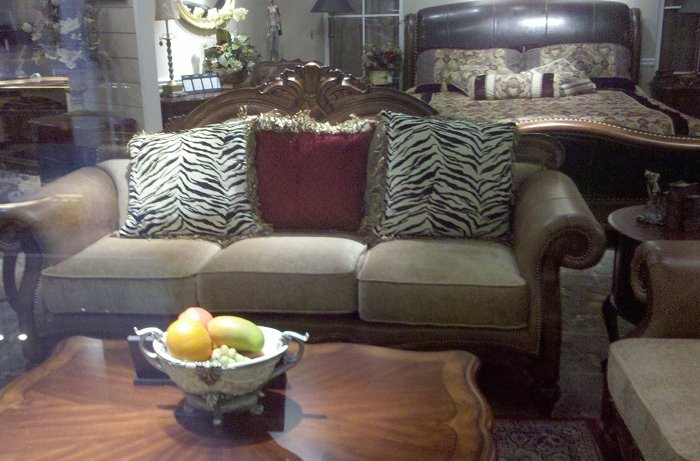
    Had a hard day sawing off people’s hands? You’re going to want to put your feet up for some well deserved rest and recreation. This understated set, with its gold-tasseled crimson and zebra pillows, says, “I may decide life and death in this town, but I still know how to relax in style.” Leather arm rests and muted upholstery resist bloodstains and match the seats in your open-top Hummer limo. When you’re done reviewing the latest catalog of small arms from Vyatsky Polyany’s 2010 line (it makes a great coffee table book for that coffee table), you can have the drugged, underage concubines of your choice dumped onto the tasteful king-size bed in the background. The mangoes are wax, so they’re not good for eating, but they’re superb for hurling at the heads of cowering underlings.

    You’re Not Important Enough to Suck My Toes

    suck my toes

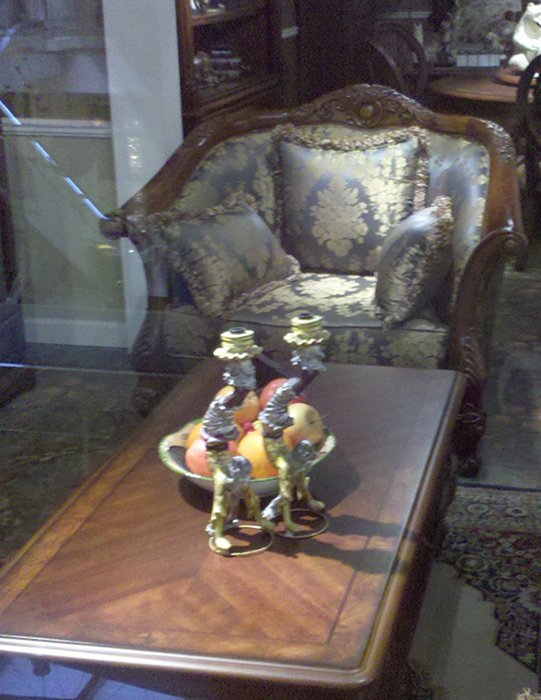
    Want something a little more intimate than the Mango Lounge? For the psychotic despot who might fly into a vicious rage at any moment we offer this set. It includes both a throne fit enough to stroke even the most volatile and insecure delusions of godhood and lethal candlesticks for when you suddenly feel the need to beat one or more of your supplicants to death in order to cow the others into submission. This seat is recommended for the fey and serpentine living god who oozes honey but turns dangerous on a whim rather than angry,  broad-shouldered Norse warrior types better suited by rough-hewn wood and leather. Also good for lonely people who think they live in Anne Rice novels.

    The Chandelier of Damocles

    chandelier of damocles

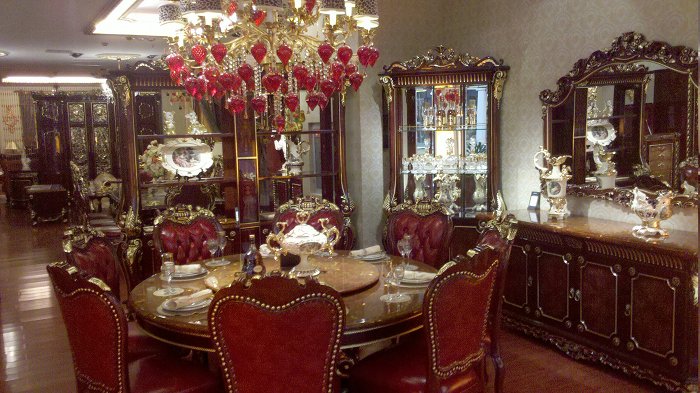
    Hosting a dinner party of the damned? You’ll set a properly infernal mood with this elegant dining set in blood-red leather, complemented by a one-of-a-kind chandelier that audaciously combines equally blood-red globes with white leopard-spot lamp shades. Is it hell or Kisangani? We’re not sure, but turn on the lights and watch pure-hearted guests and small animals recoil in terror. Then serve the roast.

    Purple Rain

    purple rain

    So you finally showed those uppity punks Morris Day and the Time who’s funkiest in Minneapolis and you’re looking for someplace to throw down with the girls from Vanity 6. This tasteful set is fit for even the purplest, if not necessarily for anyone else. Sure, it’s not technically paisley, but with lacy, black filigree and bathed in the tasteful light of a mauve chandelier, who’s going to notice? Accessorize with a marble coffee table and assorted cocaine goblets and get ready to party like it’s 1999. Rear wall mirrors not included.

    And Here Is Where You’ll Live

    chariots of the gods

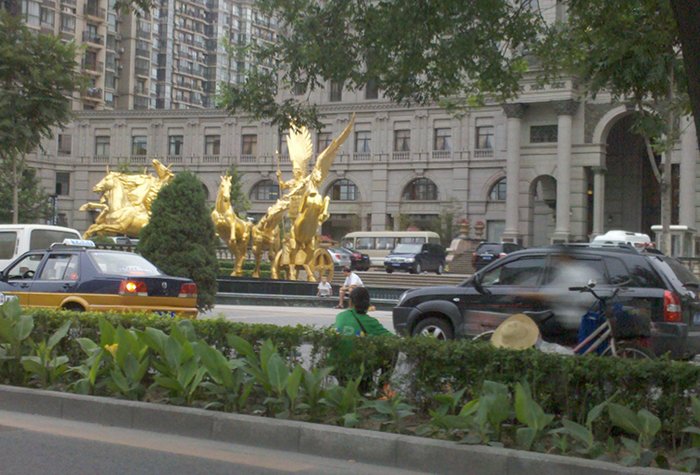
    Once you’ve picked out the furniture of your dreams you’re going to need to a crib to put it in. Imagethief recommends Beijing’s Park Royale apartments in the up and coming Shuangjing neighborhood. I have no idea what they look like inside, but with a forecourt statue of a winged goddess in a chariot being pulled by eight raging stallions, all rendered in gold, it seems like one of the few places likely to be able to withstand your taste in furniture.

  • Hey, baby, come up and see my tiger bedspread

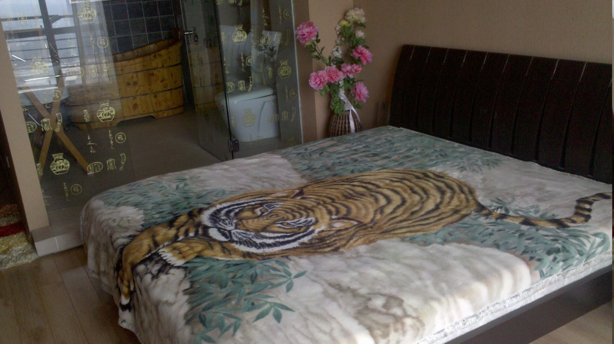
    Our ongoing exploration of the bizarre furnishings of Beijing apartments has entered what appears to be the “oriental love nest” phase. Surely we must be getting close to the end. Today my eye-sockets were cauterized by this:

    bedspread

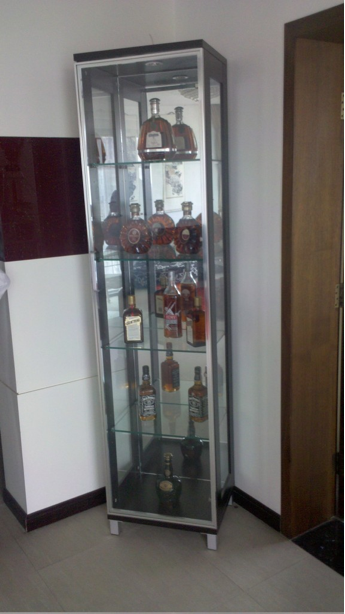
    As you’d expect along with a tiger bedspread, this apartment also came with a toddler-friendly free-standing glass cabinet full of top-notch imported liquor:

    liquor

    I’m not sure if the liquor was included in the rent. Maybe they would have checked it off when moved out, like a mini-bar. Still, you have to admire the innovative rethink of the old, American “fresh-baked cookies” gambit. Combine a tiger bedspread, glass master-bathroom and liquor supply and you’re damn close to the apartment of China Bounder’s dreams (apropos of this week’s Sinica podcast on the evolution of the China blogging scene). Actually, it was in many ways a very nice apartment. But there’s always that question of the accessories.

  • The last king of Guanhu

    Continuing my exploration of the zaniest fixtures and furnishings in China, this weekend I looked at a lovely apartment in Greenlake Place (Guanhu) that was thoroughly trashed by this living room set:

    guanhu

    When I finally get around to overthrowing that small, African nation like I’ve been planning, this is the furniture I’ll want in my throne room (although perhaps re-upholstered in leopard or zebra skin). Until then, a bit too grand for my entirely modest ass. Oh, and whether I’m god-king of Botswana or not, that telephone will have to go.

  • Journey to the planet of the electro-squids

    It’s time to move.

    We’ve been in the same place for nearly three years. It’s been good, but Mrs. Imagethief’s business is growing, I’m spending some of my time working at home, and let’s not even get into the whole child-number-two discussion. The upshot is that we need a bigger place.

    I hate almost everything about moving. It’s disruptive. It’s a pain in the ass. It’s expensive (although less so in China than elsewhere). There is the great mystery as to whether you’re trading your current decent landlord (I’ve been lucky) for Empress Wu. There’s the great computational axis of price vs. commute vs. school vs. amenities vs. could our ayi get here? The only good things about moving are being able to slough off a layer of useless house-cruft — all that stuff at the backs of closets– and the feeling you get when you finally have the new place set up the way you want, before the cats have salted everything in summer cat hair and little, scattered pills of cat litter. I have many miles to go before I have my feet up on that particular ottoman of satisfaction.

    Until then, I must endure the great drudgery of plodding through empty apartments. The other day I had to reel in an agent who was about to take us to look at some places renting for RMB40,000 a month. Hold on there, tiger. I know you’re paid based on the rent, but if I could afford that kind of ticket my personal flunky would be taking the first look. Not me. Our budget is decent, but we’re still squarely in the making-some-compromises bracket. It says something about China that our current leading-candidate apartment had an unflushed toilet full of shit and yet our conclusion was still, say, not bad. In the US realtors tell you set out fresh cookies when people are coming to look at the apartment. In China you get a bog full of crap. But you also get new floor boards, so take the bad with the good, I guess.

    I don’t want to complain at length about all the miseries of hunting for an apartment in China. Well, strictly speaking, that’s not true. I do in fact want to complain about them and I have done so at length. But I also want to focus on just one thing that gets up my nose every time I tour apartments in China. It is not, despite what you might think, piles of human waste. It is the light fixtures.

    To gather all my complex feelings about this into just three words, what the f***?

    It’s true, many Chinese apartments have appalling furniture. My solution to that has been to buy my own furniture and look for unfurnished or partly-furnished places. I’m completely willing to have redundant crap dragged out of the apartment as a condition of rental. That couch that I wouldn’t sit on without wrapping my ass in saran-wrap and sunscreen? Adios, muchacho. But lights are built in. There is wiring, and screws and god knows what. And if I unplug this wire, this being China and all, there is a chance, however small, that all the stop-lights in the neighborhood will turn green at once or the neon sign on the restaurant across the road will spell out a dirty word and my visa will be canceled for gross disturbance of public order.

    None of which would matter if the light fixtures weren’t so consistently awful. I’m not talking some rarefied, well that’s a bit unsightly thing. I’m talking full-on psychotic awful, like having Damien Hirsch Hirst* as your interior decorator and coming home to find pickled sharks lined with halogen bulbs hanging from your ceiling at face level. I’m talking 1970s Disco Inferno throwback nasty that makes me think of lime green shag carpets and Ford Econoline vans with bubble windows and airbrushed paintings of topless space-vixens deflecting lightning bolts with Gibson “Flying V” electric guitars. If you’ve ever wanted to see what it would look like if the space-ship from the end of Close Encounters of the Third Kind landed in your living room, I’ve got the apartment for you. If you want to know what it would look like if Louis XVI had escaped the guillotine, sneaked out of France disguised as un ouvrier Chinois (quelle humiliation!) and wound up in a downtown three-bedroom in Beijing on a middle-class Chinese salary, I’ve got the apartment for you.

    What is this fascination with chandeliers? Listen: If you’ve got a stately pile in the countryside with forty acres (or, this being China, 240 mu) of grape vines and a grand hall with a thirty-foot ceiling that requires banquet illumination, then fine. Get a chandelier. I’m not saying it’s a good decision, but it’s at least technically defensible on some kind of inbred, blue-blood clause. But if you’ve just bought an urban pre-fab concrete box with eight-foot ceilings, a three-foot chandelier is simply not going to work unless you’re renting your apartment to Wee Man from the “Jackass” movies. Sooner or later, someone is winding up in the hospital having bits of Swarovski shrapnel irrigated out of their eyes. Plus, if you are renting your apartment to Wee Man, a stack of turds in the hall bathroom is likely to be the least of your problems when he moves out. Make sure you get the deposit in cash.

    Lights, dude. How hard can it be? It’s the illumination that counts, not the number of fronds on the fixture or getting it exactly the same shade of pink as Aphrodite’s hemorrhoids. A big factor in choosing our current apartment was that it had naked bulbs in the ceiling. All we had to do was hang shades on them. Less is more. Think minimal and simple. Especially –and I cannot stress this enough– if you want to rent to foreigners. We’re weak. Our eyes bleed if we see too much brass filigree at any one time. Easy test: if your light fixtures make my son either giggle or cry, I’m not renting your apartment, even if the fridge is colossal and the toilets just came out of an autoclave and the bathrooms smell like a strawberry muffin factory. It’s that simple. When I stagger home from work late and flick on the living room light, I don’t want my first reaction to be cardiac arrest. I don’t want to feel compelled to place a panicky phone call to SHADO.  I don’t want to crack my head into the goddamn thing when I stumble into the kitchen in the middle of the night for a biscuit. I don’t want to find freaking bats hanging from it.

    I don’t, in a word, want this:

    electro squid

    Now, really, is that too much to ask?

  • Down the rabbit hole in Kansai

    So here’s how it goes. Someone inconveniently dies on your airplane just as it is about to take off. You experience an odd mix of feelings. On the one hand, you sympathize with the family and feel bad for their tragic loss in the least dignified of circumstances. No one should have to die in the economy class of a non-moving airplane. On the other hand, you think to yourself, man, is my connection screwed. You are a bad person and will burn in hell.

    But first you will burn in Kansai. Kansai is the international airport in Osaka. That is a lie. Kansai is the international airport that is somewhere in the same general vicinity of Japan as Osaka. On a clear day, you might see Osaka in the distance as you fly into Kansai. Or, then again, you might not. Kansai is where you are supposed to change planes for Hawaii. You want to be in Hawaii. Hawaii has warm breezes, palm trees, and girls in bikinis. You have packed clothes for Hawaii. They are thin clothes.

    Kansai is on an artificial island they built somewhere in the general vicinity of Osaka because to build an airport on existing land near the city would have been a silly idea, and not used enough concrete. Kansai is apparently sinking slowly. This must really piss people off. Or, then again, maybe it doesn’t. After all, keeping the airport from sinking will keep construction companies busy for decades. Japan likes to keep its construction companies busy. Japan invented the idea of the “bridge to nowhere”. Most places build a useless bridge from somewhere to nowhere. In Japan, they build a bridge from nowhere to nowhere. They are that committed.

    There is a bridge from Kansai Airport to Rinku. Rinku is nowhere. It is certainly not in Osaka. Arguably the airport is somewhere, but it’s nowhere you would want to be. The bridge from Rinku to Kansai is a bridge from nowhere to nowhere. It also has a train. Eat that, Gravina Island.

    You need to take a bus over the bridge to nowhere. A young lady from the airline meets you at the jetway, escorts you through the airport and puts you on the bus. She bows and scrapes constantly. She is a professional bower and scraper called into service to apologize for the inconvenience of your delay. She bows and scrapes so hard that she leaves a scuff mark from the jetway through the terminal, through quarantine, through immigration and through customs. She is, however, incapable of arranging meal vouchers for you. This leads to more bowing and scraping. Your back gets sore as you watch her. You are disarmed but feel like an idiot for it.

    Waiting for the bus you realize that clothing for Hawaii is inappropriate for late winter in Osaka. Or Rinku. Or wherever the hell it is you are. You are cheered, however, by the fact that the bus is full of pretty ANA stewardesses. ANA has very pretty stewardesses. And they can do CPR. This may be useful if you pass out from the cold while waiting for the bus. On the other hand, it didn’t help the guy on the plane you were on earlier. They told that guy not to fall asleep, and look what happened to him. If you hear a stewardess telling you not to fall asleep, panic.

    The bus drives you and the stewardesses over the bridge to nowhere and drops you in front of a splendid, gleaming hotel. This is not your hotel. This is the stewardesses’ hotel. Your hotel is across the street, over a footbridge that you must drag your bags over. It is not tall and gleaming. It is short and squat and looks like a Chinese hospital with a Japanese convenience store embedded in it. There are no stewardesses staying there. There is apparently nobody staying there except for you. The convenience store is useful because the restaurant is closed. Who would want to eat dinner in the evening? Who stays in Rinku? Only the stewardesses, and they’re in the nice hotel across the street. Tough shit, hombre.

    The hotel room is small. It reminds you of the single-occupancy dormitory room you stayed in twenty years ago in college except with a tiny, little, Munchkin-sized ensuite bathroom with an intergalactic toilet in it. They spared no expense on the toilet. The pillows, however, are apparently stuffed with something that gives them the consistency of sacks full of Tylenol gel-caps. This does not seem restful. There is a bilingual New Testament and a bilingual Teachings of Buddha. If you’re an atheist, you’d better have brought your own reading material.

    The room has a view of Rinku. Rinku is nowhere. From this room you cannot even see the bridge. That is one of the room’s redeeming features. Another redeeming feature is that it has a television. The guide on the desk says that channel 1 is the BBC. This is a lie. Channel 1 is showing an infomercial for Japanese lingerie. This is not as exciting as it sounds. This is your grandmother’s lingerie. This is almost certainly not the lingerie that the stewardesses are wearing. The BBC is nowhere to be found. There is Internet, however. Thank god for that, because this is Japan and your mobile phone and Blackberry are only good for talking to the voices in your head. Those voices are telling you to turn off the TV.

    The mini-bar is not a redeeming feature. It is empty. Foreigners are not trusted with a full mini-bar. They might get drunk and head for the stewardess hotel across the street. This would be disorderly. You flip through the hotel service guide in the desk. There is an entry for the mini-bar. It says “Room refrigerators have no drinks.” No shit, Sherlock. I guess the money for the toilet had to come from someplace. You are referred to the convenience store. The Japanese have an answer for everything. But they still have no meal vouchers.

    Breakfast isn’t until 9 tomorrow morning and you are in Rinku in winter watching an infomercial for bad Japanese lingerie in a hotel room with an empty mini bar and James T. Kirk’s crapper. You should be on your way to Hawaii. Travel is great.

    IMG_0263
    Phasers on kill.
  • The zombie-slugging toy police car

    Imagethief’s son, Zachary, turned two this week. I’m amazed we made it. By this I mean I’m amazed that Mrs. Imagethief and I made it. If the boy’s engine room telegraph is stuck on “full-speed-ahead”, Mrs. Imagethief and I are on something more like “dead slow” or “all back one quarter”. It’s been a busy couple of years.

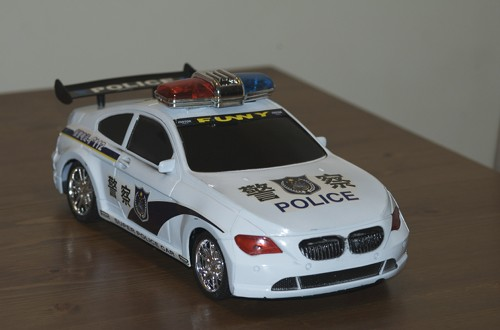
    My Chinese tutor, a wonderful woman who employs the spectacular pedagogical technique of making me translate articles from The Economist into Chinese and then debating me about the contents, was kind enough to give Zach a toy Chinese police car as his present. It was really kind of a fantasy police car, being as it was a BMW in police colors, but it was a big hit with the boy. It hit three of his sweet spots: “nee-nee nee-nee cars” (anything with lights, with the sound representing the siren); “zoom cars” (anything with a spoiler); and “gongan che“, which is not at at the top of his hierarchy –taxis occupy that spot– but which rate pretty high nevertheless.

    The car was electric, so my wife hunted up some batteries for it and we switched it on.

    That was a mistake. The “nee-nee nee-nee” was approximately as loud as a real police car. I almost smashed the thing on the spot, with my tutor watching (smashing a gift in front of the person who gives it to you is not well thought of in polite Chinese society). The cats are still traumatized. Zachary seriously re-thought his infatuation.

    In the end, I took the thing apart and removed the little drive wheels and motor, which kept the car from freewheeling, and cut the wires to the speaker so that the only electric component that still worked was the lights. This made the police car a much improved toy in almost all respects. While I was about my improvements I noticed something a little odd. Here is a photo of the car:

    police car

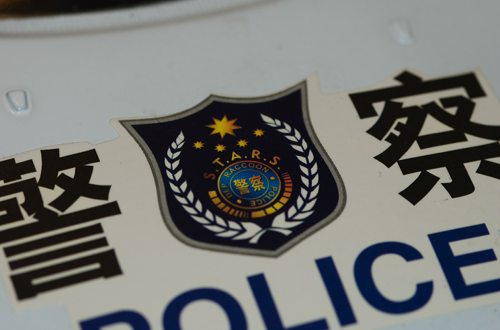
    All well and good, except for the BMW thing, but take a closer look at the police seal on the hood:

    Raccoon City

    I almost didn’t spot it. It says, “Raccoon Police Department”.

    At first I thought this was just your random Chinglish gibberish, which often finds a way onto toys. Zach has one front-end-loader that is spangled with the declaration, “Vigorously Super Power” (which I’m thinking of having tattooed on my ass for no good reason), and some small trucks that say, “Forbid Fireworks” on the gas tank and “Head Back” on the rear bumper.

    But the miracle of Google Images reveals that this is actually the badge of the Raccoon City police department, which is the police department of the zombie-infested city from the Resident Evil video-game and movie franchise. Pop culture bottom-feeders may remember the original movie (there have been about 80 of them now) as the one in which model-turned-actress Milla Jovovich loses her memory, gets naked and kicks the ass of everything that gets in her way. I’m not sure that’s the correct order, but I’m pretty sure all those things happened. Actually, I think all those things happen in almost every movie Milla Jovovich makes, which may be why the Academy continues to snub her. At any rate, here’s the Racoon City Police Department Logo:

    Patch

    This is from a site called, “Patchbug.” Yes, somewhere out there is a patch collector serious enough that he needs a replica of the Raccoon City Police Department uniform patch. It takes all kinds, I guess.

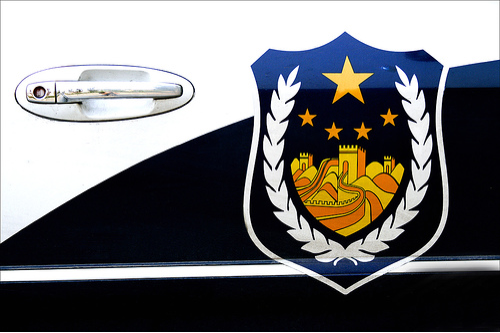
    What I find interesting is that the maker of this toy didn’t steal the Raccoon City patch wholesale, but kind of mashed it up with Chinese to come up with something uniquely ridiculous. For those who need reminding, the actual seal on Beijing police cars is an image of the Great Wall (as if it would be anything else):

    Beijing Police Seal

    So this is apparently a replica of the car of the Beijing Police Zombie Squad, which is apparently the best equipped squad in the Beijing police department. This makes sense: Only the best if you’re going to take on zombies.

    The car also has a line of Chinese over the rear windshield, “有困难找警察”, which would properly be translated as something like, “If you have difficulties, look for a cop,” but which was rendered in English on the car as the delightfully sinister, “Any trouble with you, call the police to help.” Presumably “trouble” in this context means turning into a zombie.

    Note: Actual police car emblem from Upton’s photostream.