Tag: Weird

  • Official: Lei Feng was “hip with his times”

    It’s always a tragedy when your propaganda icons lose relevance to the younger generation. A couple of years past the fortieth anniversary of the original “Study Lei Feng” campaign, China’s propaganda moles are clearly hard-up for a way to make the much mythologized “ideal soldier” resonate with a generation of youngsters brought up on pirate “Friends” DVDs, MP3 players and Internet chat rooms. How else to explain this Xinhua article, which ran a couple of days ago, just before yesterday’s annual “Lei Feng Day” (don’t worry; I didn’t know it was coming either):

    March 5 is an ordinary date on the Chinese calendar, but it’s the day when millions of young people across the country will do something good for someone else, following Lei Feng’s example.

    “Lei Feng Day, honors a Chinese cultural icon who was immortalized by the late Chairman Mao Zedong as a selfless and model person serving the people heart and soul.

    Lei Feng, who was just 22 when he was killed in an accident in 1962, inspired the nation after Mao called on people to “Learn from comrade Lei Feng”, and show the “Lei Feng Spirit”.

    Born to a peasant family in Wangcheng of Central China’s Hunan Province, Lei Feng was orphaned before he was seven. At 20, he joined the People’s Liberation Army (PLA) and spent all his spare time and money helping the needy. Lei died after being hit on the head by a wooden pole that was accidentally knocked over by a fellow soldier.

    Lei left behind him a remarkable legacy of diaries and poems detailing his hopes and aspirations. For emerging new China, which was rapidly evolving through the 1950′s and 60′s, Lei’s diaries are peppered with simple verses of inspiration that rang true for the masses who wanted to “make the world more beautiful everyday. “By the early 1970′s Lei was worshipped as a hero or even a god and millions of young people emulated his acts of generosity.

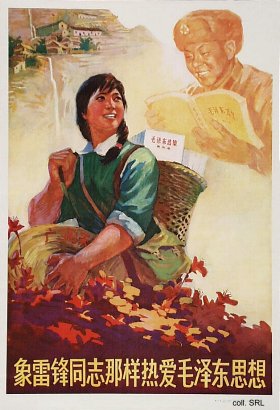
    That adulation was certainly not the result of any orchestrated propaganda campaign, and it’s cynical of you to think so. You should be ashamed. Posters such as the one at left, which exhorts everyone to love Mao Zidong thought in the manner of Lei Feng, were simply the result of people’s spontaneous outpouring of love for a 22 year-old peasant truck driver who died a conspicuously unheroic death. Many more such posters –all equally sincere– are on display at the Lei Feng section of Stefan Landsberger’s superb Chinese propaganda posters website.

    Lei’s new biographer is working hard to ensure that modern youth, notorious for their short attention spans and disdain for Soviet-style, floppy-eared winter hats, stay connected with Lei Feng, who obviously has many lessons left to teach. Most interesting is an attempt to portray Lei as stylish and contemporary. At least, by 1962 Maoist standards:

    Shi Yonggang felt unwell with the situation, who is one of the editors of a new book [sic], “Lei Feng: 1940-1962″, that will be released to on Sunday’s Lei Feng Day to recall Lei Feng’s Spirit.

    This latest edition of Lei Feng’s story is one of more than 1,000 books that have recorded his good deeds.

    “It is a pity that the image of Lei Feng depicted in those books is hard for people, especially young people, to understand and accept nowadays,” said Shi, the editor.

    Shi’s book includes more than 300 never-before-published photographs of Lei showing him as an obviously fun-loving young man who was hip with his times.

    In fact, not only was Lei hip with his times, such as they were, he was, it turns out, the coolest kid in his platoon, and a veritable style maven:

    “Lei Feng did almost all the fashionable things of his day ,” Shi said. When Lei was a farmer, he drove a tractor which is comparable to today’s BMW. When workers became the most respected segment of society in the 1950s, Lei became an iron worker in an Anshan factory in Northeast China’s Liaoning Province. He then upgraded his technical skills to earn a rarely-issued driver’s licence and began a career as a truck driver.

    Shi’s two favorite pictures are of Lei riding a borrowed motorcycle on Tian’anmen Square in downtown Beijing, while the other shows Lei holding a trendy satchel as he stands by the WuhanYangtze River Bridge, in Central China’s Hubei Province.

    The photographs also show that Lei wore fashionable sweaters, a leather jacket and wristwatch, all considered luxury items of the day.

    Driving a tractor; working as an iron worker; flashing a trendy backback. The boy was out of control. I grant you it looks like a stretch to equate nursing your rusty tractor over some dessicated, rutted field with pumping your black BMW 7-series down the highway at asshole speeds or pulling it up in front of Bellagio so the princelings out for their pre-club snacks can see your supermodel girlfriend flash her panties as she ankles her way out of the shotgun seat in a skirt so short it could be mistaken for a wide belt. But you have to remember we’re talking about 1950s China here, and standards were different. Nobody had panties then. Cool was where you found it, even if that was, um, a tractor.

    Finally, it turns out that the obedient and studious model soldier and worker was actually a rebellious hair farmer of the first degree:

    Zhang said that Lei liked to look smart and he loved to wear long bangs even though they were prohibited in the army. “Lei was warned about his hair so he would hide his bangs under his cap when he was on duty, but when he was out of uniform he would let them hang loose,” Zhang said.

    Astounding. It’s a complete reformation. He probably had a band on the side and smoked out under the bleachers. Lei Feng is clearly much more relevant to modern youth than anyone had dared dream possible. Can a new series of propaganda posters showing the iconic youth with shades, an iPod and a sexy girlfriend be far behind? After all, if modern China is all about the glory of getting rich, how can its icons miss the boat? With that in mind, I’d like to suggest a few updated slogans to accompany the new propaganda posters:

    • Seriously study fashion like Lei Feng, and get a nice shirt and some decent shoes.
    • Lei Feng says quit whining and get a grip.
    • Lei Feng wouldn’t be caught dead with his finger up his nose, asshole.
    • Only download legal music, in the manner of Lei Feng.
    • If Lei Feng caught you spitting, he’d bitch-slap you silly.
    • Live fast, die young, and leave a good looking corpse. Just like comrade Lei Feng.

    Look out kids, it’s the all-new Lei Feng.
    Hey there, good looking!
    Hey there, good looking!
  • Chinese medicine puts the squeeze on Imagethief

    Imagethief is a strapping manly-man, and spends long hours in the gym perfecting his Adonis-like physique. Occasionally, however, his enthusiasm gets the better of him, and he tries to hoist a few kilos too many. This happened to me about a month ago as I was doing plate-rows. At the apex of my set, something in my steely, well-honed trapezoidal wentspang! and pain ricocheted down the length of my left arm.

    I called a halt to the day’s strains, thinking that a week or so of recuperation was all that was necessary. Three weeks later, with phantom pains still coursing up and down my left arm and unable to sleep in either of the two positions that I am tolerant of, I finally dragged myself to my regular doctor in Singapore, where I was spending Chinese New Year.

    After palpating me in various unsavory ways and making me bend my head into several unnatural positions, he rendered a verdict: a pinched nerve at the sixth cervical vertebrae.  He said I could either pay $500 for an MRI, or, since there was no loss of strength (this, I gather, would have been bad), I could go on anti-inflammatories for a couple of weeks and see how things played out.

    I selected the cheap, pharmaceutical option. Going for the MRI at that stage would have been far too large a concession of vulnerability. As an American man, I have a battleship-strong sense of denial when it comes to medical issues. In fact, it was an heroic effort of will (no pun intended) just to make it to the doctor in the first place. Like most American men, I won’t go see a doctor unless a bone or major internal organ is protruding through my skin. And even then it’s a toss-up. Is there a good ball game on?

    I did, however, make one extra concession to medical adventure. I agreed to go see my wife’s Chinese doctor.

    And this raises another American medical prejudice. Americans are raised to believe that all medicine is Star Trek. If a medical therapy doesn’t involve nitrogen-cooled electromagnets or a particle accelerator and flat-panel video screens, it’s stone-age witch-doctor crap not worth pursuing. This maximal approach to medicine explains why America’s health system is such a dysfunctional wreck. When even stubbed toes require PET scans, something has got to give. When I lived in America, what gave was my bank account, under the onslaught of my insurance premiums. Freelance writers part-timing as radio producers to avoid starvation get to pay their own way, insurance-wise. That leaves little left over for such wastrel’s luxuries as “food” and “rent”.

    Thus, going to see the Chinese physician was something of a leap of faith for me. I had been to his clinic with my wife before. It looked like Gandalf’s office: dusty, leather-clad tomes, mysterious charts of the human body covered with meridian lines and Chinese script, and shelf after shelf of cryptically labeled, dark-brown potions in equally dark-brown jars. Not a Star Trek medical device or Physician’s Desk Reference in sight.

    Although it was Singapore, the doctor (or, more accurately, daifu) didn’t speak any English. I explained my symptoms in laborious Mandarin, with my wife occasionally helping me through the tricky parts. Accuracy is important in medicine, and doubly so when using a language where a single tonal difference can change the coruscating imprecation “fuck your mother” into the merely perplexing “dry your horse”.

    After listening patiently to my explanation, the doctor arrived at a prescription that involved neither a horse nor my mother. Rather, it involved a course of moxibustion, or “cupping”. I grant you that “cupping” sounds like something where a horse might be involved, but I assure you that this is not the case. You are, perhaps, thinking of a “crupper”, which the leather strap that runs beneath a saddled horse’s tail. If so, you are either an equestrian or a bondage freak and, either way, have ventured into territory beyond the scope of this post.

    The daifu asked me to remove my shirt, and then rubbed a film of of lubricating lotion on my back. This was the pleasant part of the procedure. The only pleasant part. As soon as I was nicely greased, the daifu took a hollow glass globe the size of a baseball and dropped an alcohol-soaked cotton swab through the thick-lipped mouth. He lit the swab, which flared and burned out rapidly, and then clapped the open mouth of globe onto the skin of my back.

    Anyone who has ever performed the collapsing gas-can experiment will be familiar with the principles behind what happened next. In this old, grade-school science experiment you light a little alcohol or other flammable liquid inside a metal container, then screw an airtight top onto it. As the air inside the sealed container cools, the pressure drops and the pitiless math of Boyle’s Law takes over. The sealed container is slowly crushed by outside air pressure. Now, if the container is rigid enough to withstand the pressure, but covered by a flexible membrane, it is the membrane that will distort in response to the decreasing pressure in the sealed vessel. In this case, the membrane was me. A golf-ball sized gobbet of Imagethief was quickly sucked into the glass cup. The suction was surprisingly strong, and I had brief thoughts of my skin rupturing and my left lung exploding into the glass cup. If that had happened, I would have asked for my $15 back.

    As a technical scuba diver, Imagethief is well schooled the concept of barotrauma. This is injury resulting from a pressure differential, a common risk in scuba diving. To date, Imagethief has suffered only one serious barotrauma: a ruptured eardrum self-inflicted when I clapped a hand over my ear following the nearby detonation of an explosive by Indonesian dynamite fishermen. More common, and generally less serious, is something called a “squeeze”. This happens when a diver fails to equalize the pressure in some internal airspace, such as a sinus or middle ear, or an external one, such as the airspace in a diving mask. As the water pressure increases during descent, the growing differential forces –or “squeezes”– tissue and fluid into the area of low pressure. Generally you feel this –trust me; you feel it– and stop descending before you are seriously injured.

    Never in my life did I think I would pay someone to inflict a painful squeeze upon me, but that’s what I was doing.

    Anyone who has lived in China or Singapore will probably have, at one time or another, seen someone with a pattern of round, red welts on their back. These are the marks left by regular moxibustion cupping (I have photos here and here), in which the cups are placed upon specific points on the back, and left there. That kind of moxibustion is for pussies. My wife’s family daifu is renowned in Singapore for his expertise in a technique in which a single cup is slid over the affected area to draw out the “wind” that, from a Chinese medical point of view, is invariably the source of all ailments. My wife swears by this technique, and has had her own sports injuries treated in this way on a few occasions.

    Her pain threshold must be higher than mine. I now have a pretty good idea of what an orange feels like as it is peeled. Grease or no grease, it felt like the skin was being torn from my back as the doctor slid the globe up my trapezoidal muscle and left to right along the delicate supraspinatus. It was one of the most painful procedures that I have ever been subjected to, and I’m a veteran of two root canals, eight dental extractions (four under local anesthetic), outpatient neurosurgery on my hand and a hernia operation. After the first course was complete, leaving me breathless and sweaty, the daifu asked my wife something in Mandarin. “He asks if you can stand a stronger treatment,” she translated. Macho posturing immediately suppressed all other instincts, including my instinct to flee screaming from the office. “No problem,” I wheezed, like a teenager who’s voice has just broken.

    As the daifu began the second course, I tried to mentally transport myself to another location. Blissful green fields. A rowboat on a calm lake. A spectacular, icy glacier. It didn’t matter. Wherever I visualized myself, I was accompanied by a burly, sweating medieval torturer intent on scourging my back. There was nothing for it but to endure the treatment in the here and now. It was clear that the daifu subscribed to the “after I do this to you, the pain you were complaining about won’t seem so bad any more” school of medicine. “Look,” he said. “You can see where all the old, clotted blood is being drawn out of the injury.” Not surprising.

    Centuries later it was all over. I gingerly pulled my shirt on over my abused, stinging back. “Any better?” asked my wife, sweetly.

    It wasn’t enough for the daifu to strip all the skin from the upper-left side of my back. He had to send a reminder of my misery home with me, in the form of a jar of noxious, brown liquid medicine decanted from one of the hundreds of mysterious, cryptically labeled bottles in his office. I was instructed to take one good swig, three times daily. It was the nastiest substance I have ever ingested, a potent combination of bitterness and herbal pungency like a combination of slivovitz, crude oil and potpourri. It made me want to cry the way I did when my mother made me take liquid penicillin for strep throat when I was seven. I had to have a water chaser standing by every time I took it. I carried it onto the flight back so I wouldn’t miss a dose, and I’m mystified as to why the security inspectors didn’t catch it, confiscate it and fine me for trying to bring a dangerous liquid onto the airplane.

    Now, nearly a week later, I can report some improvement in my symptoms. Of course, given that I have been on a combination of moxibustion, bizarre herbal tonic and old-fashioned, western anti-inflammatories, it’s hard to tell what’s responsible for the progress. Would I dare subject myself to another treatment of moxibustion? The daifu told me that, in an ideal world, I’d be able to come back for another treatment a week hence. Now that I am back in China that will be difficult, unless the daifu can refer me to a trusted colleague here. He did, however, suggest that I come in for a repeat session when I am next in Singapore.

    Only time will tell if Imagethief has the nerve to steel himself for another pass. The wind may be bad, but between that and being skinned like a rabbit, I might just stick with wind.

    There, now. Doesn't that feel better?
    There, now. Doesn’t that feel better?
  • The strange lunacy of translators in airliner cockpits

    Singapore is now completely infatuated with China, and the average Straits Times has about seventy-six pages of news from China. I am really good friends with two of the ST correspondents in Beijing, so I will mention that much of this coverage is of the highest standard. Now that I am done sucking up to journalists for the day, I was interested to see an article in today’s (unlinkable) ST on China’s shortage of pilots.

    Anyone who has flown domestically in China will have experienced the fallout (no pun intended) from this problem, as it’s quite clear from the vertical takeoffs and spleen-rupturing landings that many of China’s pilots are actually professional longshoremen or swineherds who are simply moonlighting as pilots for extra cash, or to make time with stewardesses.

    Like many nations with shortages of pilots, and in order to minimize the number of swineherds in the cockpit, China has looked overseas for qualified personnel. The article notes:

    There are now more than 50 foreign pilots from the United States, Canada, Switzerland and Hungary flying for Chinese airlines today. But they do not speak Mandarin, which makes it difficult for them to communicate with air traffic control.

    …and with their co-pilots and with traffic control and with their passengers, it scarcely needs be added. Perhaps I’m old fashioned, but in this era of congested airports and skylanes, and considering Beijing’s shroud of visibility-reducing pollution and southeast China’s constant supply of typhoons, the ability to communicate smoothly with air traffic controllers would seem to be…well, “friggin’ mandatory” is the phrase that springs to my mind.

    But fear not. The rocket scientists at the CAAC, China’s civil aviation authority, are on the job:

    In July the CAAC issued regulations governing the employment of foreign pilots by Chinese airlines, which included a rule stipulating that a qualified English-Mandarin speaking interpreter must be on board an airplane flown by a foreign pilot.

    I am overcome by a warm sensation of security and bliss. But that is because I am still feeling the effects of the Valium I took before my flight on Singapore Airlines this morning. If that had worn off I would now be running in circles and gibbering in terror at the thought of having to rely on translators in airliner cockpits.

    Look, when you’re barrelling along at 300 knots in zero visibility, let’s say during your typical browned-out summer approach to Beijing Capital Airport, and the shit suddenly hits the fan (or turbine blades) for some reason, I should think that every second counts. Do you really want to wait for your air-traffic control instructions to be filtered through a translator on their way to the pilot?

    Furthermore, in my industry we handle a lot of translation, both of written materials and for live speeches and interviews. There is a huge amount of what we in the industry technically refer to as “shit translation”. Now, ninety-nine times out of one hundred, that’s no big deal. We edit or clarify, and no harm is done. But, with rare exception, we in the PR industry are not landing 747s (although we do deal with the aftermath when someone else fails to land one). If I was asked to pick the one time out of that one hundred when it is a big deal to have instantaneous, one-hundred percent accuracy with no exceptions, it would be in commercial airliner cockpits. Or, possibly, nuclear reactor control rooms. It’s a toss-up.

    It really doesn’t take a huge leap of imagination to envision how the scenario of cockpit translators could go wrong, especially in a moment of extreme stress:

    Pilot: “Air China 138 heavy on approach.”
    Translator (to tower): “Air China 138 heavy on approach.”
    Tower: “138 heavy turn two seven zero and descend to 2000.”
    Translator (to pilot): “Turn to two seven zero and descend to 2000.”
    Bang!
    Pilot: “Air China 138 heavy declaring an emergency. Port engine has ingested a goose, is on fire and has lost power. Clear the runway!”
    Translator (to tower): “Air China 138 Heavy is anxiously requesting roast goose! Our sexual prowess is dimished! Please empty the promenade!”
    Tower: “138 Heavy, how much goose do you want?”
    Translator (to pilot): “Why do you want goose at a time like this? We are doomed!”
    Pilot: “Motherfucker!”
    Translator (to tower): “138 Heavy extends warm greetings to your parents!”

    Perhaps I’ll take the train.

  • The Great Donkey Meat – Tiger Piss – Media Whore Axis

    Trust me, it all connects.

    Americans just don’t understand the reality of Chinese food. Mu shu pork, general’s chicken, all that Chinese restaurant crap you get in the US, has almost no relation to anything you can get in China. The defining highlights of Chinese cuisine, with the possible exception of dim sum, which followed the Cantonese diaspora, are conspicuously absent from American menus.

    This is probably because the Chinese eat, not to put too fine a point on it, a lot of nasty shit. (Civit cat?) Don’t get me wrong, the Chinese have some fabulous food as well. But this is country of extremes, and as lofty as the culinary highs are, the lows are scraped straight from the floor of Hell’s own takeaway lunch counter. I’m fairly well inured to Asian and third world diets, having prowled much of the Indonesian archipelago and Indochina (not to mention China proper). But I do have my limits. And I reckon this dish –actually a scam– tests those limits:

    Chinese Eatery Sold Donkey in Tiger Urine

    SHANGHAI, China (AP) – A restaurant in northeastern China that advertised illegal tiger meat dishes was found instead to be selling donkey flesh – marinated in tiger urine, a newspaper reported Thursday.

    The Hufulou restaurant, located beside the Heidaohezi tiger reserve near the city of Hailin, had advertised stir-fried tiger meat with chilies for $98 as well as liquor flavored with tiger bone for $74 a bottle, the China Dailyreported.

    Damn, that’s nasty. On two levels. First, that people though they were eating tiger meat. Yes, I know that tiger meat is supposed to confer sexual prowess, etc. But tigers are still cats, and I own cats, and I can tell you with complete authority that cats are nasty creatures better looked at than eaten. Anyone who has seen what comes out of a cat on a daily basis will understand this. Tigers are pretty and regal, but, when carved into deli slices, they’re still cat meat. By the way, it’s worth reading the China Daily coverage as well, if only for this statement:

    After inspection, the owner, Ma Shikun, confessed that the so-called tiger meat was actually donkey meat that had been dressed with tiger urine, to give the dish a “special” flavour.

    It’s special alright.

    Donkey I have no real issue with. Somehow the idea of eating donkey just seems somehow more savoury (in the metaphorical sense of the word) than eating tiger, and not just because donkeys are neither photogenic nor endangered. But donkey marinated in tiger urine? Check yourself in for therapy if that concept doesn’t automatically make your skin turn green and crawl like a carpet of millipedes. Only one thing on the face of planet should ever be marinated in tiger urine: Paris Hilton. In all circumstances, any form of cat urine should be treated like radioactive waste and interred in abandoned mines in Nevada under a “plain of thorns” sufficiently pointy and tall to dissuade future civilizations from excavating the site. Come to think of it, might not be a bad idea to put Paris Hilton down there too. And Da Shan while they’re at it. Of course if the two of them are put down there together with an unlimited supply of virility-inducing tiger urine, future civilizations stupid enough unearth the site may be confronted with a lost, buried society of hyper-white, inbred, bilingual media whores. I shudder at the prospect.

    There is, of course, more, in this case from the AP story:

    Raw meat was priced at $864 per kilogram.

    The sale of tiger parts is illegal in China and officers shut down the restaurant, only to be told by owner, Ma Shikun, that the meat was actually that of donkeys, flavored with tiger urine to give the dish a “special” tang, the newspaper said.

    The report didn’t say how the urine was obtained.

    Authorities confiscated the restaurant’s profits and fined Ma $296 it said. It wasn’t clear what Ma was fined for. Selling donkey meat is not illegal in China and it is widely consumed in the northeast.

    $864 a kilo is a lot to pay for piss-marinated donkey meat, under any circumstances. I am clearly in the wong business. I have to toil for days to earn $864, and that’s before Chinese government taxes and health contributions. Now many people may suggest that piss-marinated donkey meat and press releases really aren’t all that different, but I don’t write by the kilo no matter how much it may seem that way to journalists.

    As to how they collected the urine, I suppose that’s the hidden cost of earning $864 on capital costs of roughly zero, assuming that donkeys are dirt cheap and the cost of rasing and keeping the tigers wasn’t born by the restaurateur. It occurs to me that $864 might be actually be a justified price for piss-marinated donkey meat considering the health implications of collecting (and working with) the ingredients. I mean, how does one collect enough tiger urine to marinate a donkey?

    Nice kitty! Hold still…

    Thanks to Hose-B for the article.