Tag: Weird

  • How to ensure your reincarnation as a frog

    Having grown up in “Mediterranean” San Francisco and then lived in Singapore nearly a decade, winter is something of a novelty to me. This is still true even after six years in Beijing. I don’t much like the desiccating cold or walking around in a cloud of my own skin flakes like the human sno-globe, but I enjoy the occasional snowfalls and the frozen lakes. One of my favorite Beijing experiences was a morning champagne brunch followed by a slightly drunken careen across frozen Qianhai on one of those ice bicycles that have the twin advantages of high speed and a dangerous illusion of steerability. I was double riding with my then colleague, Dennis. I can’t remember which one of us was steering. I do remember that we were thought of as ruffians and idiots. The latter was certainly true, and it’s only through the intervention of some higher power that we didn’t end up drowning under the ice or impaled on one of those little ski-poles that the kids use to prod their slow-poke sled chairs along.

    Anyway, the point is, winter: Make the most of it. Now that my son is two and learning to appreciate idiotic behavior I look forward to further snowbound adventures. Although if he does anything like Dennis and I did, he will of course be grounded until global warming ensures that any further such hijinks become impractical.

    There is a dark side to these wondrous winter scenes, however. As comes the freezing, so, inevitably, must come the thaw. The thaw has the effect of releasing the animal corpses that have been entombed in the ice all winter. Usually this means fish, and there is nothing like a stroll past a thawing Beijing lake to dazzle you with a lesson in the variety and size of the fish living (or, more accurately, that had lived) in these unpromising sludge ponds. Furthermore, there is always the one currentless doldrum where all the disgorged corpses accumulate.

    I was reminded of this during a stroll around Tuanjiehu Park yesterday, my first visit to any of the frozen lakes this winter. Last year Zachary was really still a baby, and his public emergence in anything less than a crocheted NASA spacesuit was an invitation to admonishment from the aunties of Beijing. They are well-meaning, but deep inside they truly believe that foreigners are incompetent at raising children. After all, if we were better at it, there would be more of us. With Zachary much more in the “small boy” category this year, his emergence in inclement weather leads to less scolding and clucking.

    As always, the park was festive. There was a Chinese oom-pah band (exactly as euphonious as it sounds) leading a massive sing-along inside the front gate, and the usual collection of small singing groups, lone-wolf erhu-ists, and children gnawing on that culinary hallmark of the Chinese fairground, unnaturally-colored mystery meat on-a-stick. God bless Beijing. Summer or winter, people here know how to use a public park.

    The lake that is the dominant feature of Tuanjiehu park was still mostly frozen over. Most of it was slick and gorgeous and only mildly spoiled by a dusting of rubbish half frozen into the ice. But there was one spot, near the pleasure boat docks where in summer you can rent a leaky electric boat and spray cadmium-laced water at friends and family members, that had collected an entire fish market’s worth of moldering corpses. It is an image that will haunt me if ever we take Zach to the water-park on the island in the center of the lake.

    At least it was only fish, which you kind of expect even in an urban Beijing lake. Four or five years ago, at exactly this time of year, Imagethief went on a walk past Houhai and Qianhai with the former Asiapundit, Myrick. He was in town from Shanghai to cover the National People’s Congress for the wire service he was working for at the time, and had never really had a look around the city. One of my dominant memories of that walk is the surprising number of turtle corpses we spotted on the ice, recognizable even at a distance as lonely, black humps surrounded by crows.

    These turtles are not naturally occuring. Well, these are artificial lakes, so nothing in them is “naturally occurring”. But as far as I know, there is no year-round population of turtles in these lakes. Rather, many of them had been released into the lakes by Beijingers. The dead giveaway is that a number of them were still attached to little “turtle leashes” of string and sticks.

    There is a ritual in Chinese Buddhism –放生 or fangsheng– by which one can earn merit by releasing a captive animal. Merit earns you a more advantageous seat on the wheel of karma, and helps ensure your eventual reincarnation a further rung up the ladder toward nirvana rather than a further step down toward cockroach or lemur or whatever your idea of bad is. Forgive the loose explanation, I’m shaky on my Buddhism. But you get the idea.

    I see a lot of this ritual at Spring Festival (the Chinese New Year). This isn’t surprising. Spring Festival is heavy on themes of renewal and remembrance, and the temples do good business both in carnal temple fairs (see mystery meat on-a-stick, above) and in spiritual matters. The Chinese, as in so many spheres, have applied their commercial nous to the fangsheng ritual, and you can often buy birds for release at the fairs. The birds are trained to return to their keepers, which has the double advantage of enabling punters to feel meritorious while ensuring that the bird guy protects his capital stock. Everybody wins. Arguably even the bird, which is a good score in Beijing.

    The idea of fangsheng, however, is to save an animal that is facing imminent death. Under this definition, the captive bird on the temple fair fangsheng circuit may not completely qualify, and, depending upon how strictly you interpret the scriptures, your merit may vary. Sufficient for the relaxed devotee, but perhaps not for the more orthodox. Also, the temple fairs only run a week or so, and there’s never a bird-release guy around when you need one, and so on. Sometimes, a creative solution is called for. This turns out to be the pet-store (or, more often, animal market) or supermarket turtle. Turtles are cheap. Turtles are substantial enough to matter, karmicly speaking. Turtles don’t test your resolve, like freeing that cockroach you found behind the dumpling-skin flour might.

    So people buy and release turtles. Except, with Spring Festival actually falling in a Beijing mid-winter, they release turtles into icy lakes where they promptly freeze to death. The sun then warms their dark shells and the corpses slowly sink into the ice, visible only as dark humps that will be revealed again during the spring thaw. Imagethief is no religious expert, and will defer to someone who is, but to me this seems dubiously meritorious at best. Maybe the turtle moves up the karmic ladder (it starts at a low bar). You won’t.

    Turtles aren’t the only animal that catch a hard one during this season. Frogs draw a crappy lot in China at the best of times. In 2007 Imagethief lived in Shanghai in an apartment that backed onto the local wet market. The frog seller set up shop in front of our rear gate. The frog seller’s total shopfront consisted of a bucket of live frogs, hand-held scales, a pair of kitchen shears and some plastic bags. When someone wanted to buy some frogs, the frog seller would use the kitchen shears to decapitate the frogs, and then weigh and package the rest for the customers. Over the course of an afternoon, a tragic pile of frog heads would accumulate. In summer, this would rapidly become a tragic and smelly pile of frog heads. Imagethief used to keep frogs as pets, so this was always a little traumatic for me, like a pile of kitten heads might be to a more normal person.

    Market frogs don’t do any better in Beijing than in Shanghai, so saving a frog from the kitchen shears seems as though it could be both cheap and meritorious, a combination designed to excite the thrifty Buddhist. But this goes wrong in winter as well. Mrs. Imagethief was once going for a winter jog by the Tonghuihe canal, near our house, when she saw a family releasing frogs. The frogs got about one kick and then froze more or less instantaneously. You’d think people would catch on after the first couple of frogs, but as anyone who works in business or government knows, processes tend to take on a life of their own. These people released lots of frogs. They all froze.

    When the family left, some canal workmen who had been watching from nearby immediately scooped out the frozen frogs and took them home to cook. So, genius, how does the merit allocate on that one?

    My karma ran over my frogma.
    My karma ran over my frogma.
  • Why the Yilishen ant-farming scandal was the perfect China story

    Imagethief recently found himself huddled in a wintry hutong courtyard in conversation with two longtime Beijing-based foreign correspondents. During this discussion we came to the conclusion that the recent Yilishen ant-farming scandal is more or less the perfect China story. It brings together at a stroke all of the elements of the modern Chinese story. And surreal story it is.

    If you’re not familiar with this incident (and you really should be), you can go read Mark O’Neill’s comprehensive article on Asia Sentinel, or any of several other stories which, collectively, have generated something of a bumper crop in pun headlines.

    But if you’re pressed for time here is a synopsis: The Yilishen Tianxi Group, a Shenyang-based company, was manufacturing an allegedly aphrodisiac tonic made from ants, which are widely believed to have medicinal properties in traditional Chinese medicine. But rather than wrangle ants itself (nothing feels as good as bringing in a herd, I hear) Yilishen’s scheme was to sell would-be ant farming “investors” boxes of special medicinal ants at RMB10,000 for three. Along with the boxes came a promise that once the ants matured (read: died), about 14 months later, Yilishen would buy them back for RMB13,250. That’s a 30% guaranteed gain over 14 months which, while not quite pre-meltdown A-shares, kicks the ass of many a hedge fund.

    Except that the Yilishen ant trade was a pyramid scheme, and it went spectacularly bust, leaving tens of thousands of Dongbei punters short RMB10,000 and long three boxes of worthless ants. Not exactly Warren Buffet. Outraged ant farmers from across Liaoning province rioted in Shenyang, the government imposed a news blackout and the wujingarmed police headed north to diligently maintain a harmonious sociey, which is hard under these circumstances.

    You simply could not make it up. Ten Hollywood screenwriters locked in a closet with a kilo of blow, a brick of twenty dollar bills, your sister and a cigar-smoking chimpanzee in boxer shorts wouldn’t come up with this. Even if they weren’t on strike. Only China comes up with this. And not only does China alone come up with this, but the story also nicely draws together all the threads of the modern, Chinese narrative and ties them into a pretty bow. Just look at what this story offers:

    Social Issues
    The Dongbei is China’s rustbelt; a swathe of deep-frozen, fading industrial towns that were once the showpieces of Maoist industrial collectivization. While the cosmopolitan port city of Dalian has blossomed in China’s post-reform economy, much of the region has struggled to keep up with the go-go development of the two Deltas and the capital. Hence the “振兴东北老工业基地” (Revitalize Northeastern Industrial Base) campaign and those tragic stories of families’ life savings being sunk into ants and ant-aunties pooling the funds of their neighborhood taiqi group to go in on a few lucky boxes. Apparently about a million people bought into the ant-dream. Could ant farming be symbolic of the economic desperation of an entire region? Or might it just be a punt? Who cares, because there was also…

    Sex
    About 98 percent of Chinese medicines are aphrodisiacs. The average Chinese pharmacy is about half aphrodisiacs and half prophylactics with one or two boxes of nasty, herbal flu medicine just in case. The reason why rhinoceros and tigers have been hunted to near extinction is to make Chinese aphrodisiacs. Imagethief himself once appeared in a television commercial for a Chinese aphrodisiac. They’re that ubiquitous. You’d think the Chinese had never heard of p0rn. And what goes better with sex than…

    Corruption
    Yilishen Group turned out to be well connected throughout Liaoning provincial circles. This had apparently helped fuel its rise in the province, but also motivated embarrassed local officials to make the whole situation go away as soon as possible. That left bereft antherds with the usual channels of legal recourse available to the small-time victim under provincial Chinese jurisprudence: none. Therefore, the only alternative was…

    Mass incidents
    Ten thousand ant farmers rioted in a provincial capital. Imagethief asks you: What country other than China could cough up that lede? Mass incidents are the sine qua non of the modern Chinese scandal. In a rare and rapidly regretted moment of candor the authorities once admitted that there were 74,000 of them in 2004, up 28% on the year before (not quite as much as the pre-collapse return on ants, but still pretty good). No pressing social issue is complete without one. Chemical plant going up on your rice paddies? Shanty being expropriated for Olympic development? Local manufacturers turning your once limpid lake into a festering pool of PCBs and heavy metals? Two words: Mass incident! However, this may be the first one caused by…

    Ants
    Ants? Yes, Alice, ants. Imagethief tries to maintain a culturally sensitive respect for traditional Chinese medicine. Indeed, when I pinched a nerve in my shoulder two years ago I took traditional Chinese medicine and had a round of cupping (note to Americans: it’s not as dirty as it sounds). It worked, I believe, only because the medicine was so nauseatingly foul and the cupping so excruciatingly painful that I willed myself to recover so that I wouldn’t have to endure a second course of treatment.

    But, really, an ant-based sex tonic? Hasn’t this ground been trodden before? The image of so many fevered, Chinese investors hunched over their RMB10,000 boxes of magical ants is both funny and desperately tragic. Unfortunately it was all a bit too much embarrassment for the Chinese authorities, so naturally…

    The whole thing was harmonized
    Mainstream coverage evaporated and the search term “Yilishen” went down the Chinese Internet memory hole once the authorities decided they’d had enough. Previously uploaded videos and blog posts dropped gnats in a frost. China’s pre-eminent citizen journalist, Zuola, a veteran of the Chongqing nailhouse and Xiamen PX stories, wasescorted out of Liaoning. To add insult to injury he was apparently made to pay for his own plane ticket. No word on whether he had to pay for the tickets of the goons who escorted him.

    Imagethief has a friend from Shenyang who complained bitterly about the suppressed media coverage. “It’s not like we don’t all already know about it,” she said, admitting that her own parents had been among Yilishen’s legion of ant farmers. “It’s so…” she considered the English word she wanted to use…”insulting.”

    Meanwhile, many of the Yilishen riot videos harmonized from Chinese video sharing sites have found their way onto YouTube. You can’t keep a good story (or a bitter ant tonic) down.

    And that’s all there is to it
    Imagethief in no way wishes to minimize the plight of Yilishen’s investors. RMB10,000 is a lot of money by any standards. My friend from Shenyang also explained that her parents neighbors had invested RMB60,000, and they knew people who had invested a whopping RMB1,000,000. Imagethief also doesn’t think that investors in Yilishen’s ants were stupid. Scams and pyramid schemes thrive everywhere. Successful ones are cleverly engineered to appealed to the society in which they operate. Yilishen was a well known brand that had been in business for several years and had a good reputation. Traditional remedies are still widely used and respected in China, and ants are part of the pharmacopoeia. Virility tonics are popular. Combine all of that with a cultural affinity for gambling and a get-rich-now zeitgeist and you have a China story for the times.

    For sheer swoop and color it sure beats the rise and fall of China’s other great pyramid scheme, A-shares.

    Eat me.
    Eat me.

    Notes:

    • Photo copyright Alex Wild, from his superb ant and insect photography gallery.
    • Imagethief realizes he is a bit behind the story. This post has been in drafting for ten days. Darn those day-jobs.
  • Notorious MDA: The Singapore government raps

    From time to time someone will ask me why I left Singapore for China. This is a fair question. I lived there for nearly a decade, Mrs. Imagethief is Singaporean, and I have great affection for the place. Usually I give some longish explanation about various professional and personal frustrations that were beginning to set in. From now on, however, I’ll simply be able to point people at this video on YouTube:

    Via Singapore ultrablogger Mr. Brown, this is a four and  a half minute hip hop video produced by Singapore’s Media Development Authority. The MDA is the statutory board that regulates media content in Singapore and, as you would expect from its name, promotes the development of Singapore’s media industry. The video features the senior management rapping about their respective roles.

    God help me, I don’t know where to start on this one. But I’ll try. Remember how embarassing it was when you were in high school and your parents tried to act “cool” in front of your friends? Now imagine they did that and commited the results to posterity on YouTube. In your name.

    It is often remarked that the Chinese government considers the Singapore government a role model for successful technocratic authoritarianism. Whatever the Chinese government learns from Singapore, let us pray that it does not absorb the idea that rapping bureaucrats is a good idea. The State Council has enough on its mind what with the Olympics, mass rural-urban migration and the Yangtze silting up behind the Three Gorges Dam. They don’t need to be spending nights in the studio trying to figure out what rhymes with “Zhongnanhai” over a phat groove.

    Also, there are several people featured in this video, but not one of them has any discernible rhythm. Statistically you’d think one could carry a beat in common time. We’re not talking bebop here, or some kind of freaky experimental meter. One, and two, and three, hit the BEAT. Count it off, it’s not that hard. Not that they had much to work with. There must be some kind of award for coming up with hip hop lyrics that include the phrases, “KPI”, “service oriented architecture” and “beautify our fusionopolis”. If you can’t bring yourself to watch the whole thing, the lyrics are here. It’s not much easier to read than to watch or listen to.

    Having dispensed with the artistic criticism, let me approach this from a public relations point of view.

    Imagethief is all for using new media. If I squint hard enough and jam my thumbs into my eyes I can kind of see the rationale for doing this (although it could just be the flash of my retinas detaching). You want to explain the role of your bureaucracy in a catchy way that reaches out to youth and the creative industry. And some credit must be extended to the MDA for having, well, the balls to try this.

    Unfortunately, a pigeon with a nail through its skull would still have the brain power to predict the inevitable result of this project: a catastrophic piece of self-ridicule that drags out for four-and-a-half painful minutes every reason why government involvement in creative industries is a disaster. And why Singapore’s media industry is, like the site of a bad plane crash, so much lifeless wreckage. Seriously, these are the people promoting the development of Singapore’s creative industries? They hardly seem qualified.

    Mind you, this is not an internal video that leaked out. Apparently the video was originally distributed with the softcopy version of the MDA’s most recent annual report. It is also available straight from the MDA website, although as of this writing the site was down, possibly due to unintentionally high server load as people gape in slack jawed amazement and slight embarrassment. That’s why I haven’t been able to work out if there is a press release that explains their rationale.

    I’d like to take a moment and differentiate Singapore’s media industry and regulators from Singaporeans in general. There are many creative and talented people in Singapore. However it is my observation that they prosper despite the best efforts of the government,  not because of them. Indeed, it has long been Imagethief’s position that the responsibility of government with regard to art should begin and end at cutting cheques for the things that are so edgy, experimental or niche that the market won’t support them. For that reason I see the words “Singapore” + “media” + “development” + “authority” as oxymoronic.

    Good communication flows from sincerity, and part of sincerity is being true to who you are. This is especially true in music, where authenticity is essential to the message. That’s why a Mississippi John Hurt record sounds deep-down good but a Joss Stone record, despite her manifest singing talent, sounds a little like a con. One of the great joys of music is of course how genres transcend their origins and find mass acceptance. That has certainly been true of hip hop, where the musical tent has widened a great deal since the days of Kurtis Blow. The Beastie Boys proved long ago that Jewish kids from Brooklyn could do it too.

    But the tent still isn’t wide enough for Singapore government bureaucrats. Even bureaucrats need to be true to themselves in communication. It doesn’t mean that they always have to use soul-deadening PowerPoint or white papers. By all means they should roll up their sleeves, loosen their ties, mingle with artists and tell it straight. But just they should also recognize their limitations. Someone in their communications department should have worked this out and told truth to power. Unfortunately the communications director of MDA is one of the people in the video.

    The result is a lot snarky blogging (including here) and yet another example of the Singapore government getting itself written up as “odd news”. That is not communication success.

    The Singapore MDA is not the first bunch of suits to fall victim to siren call of hip hop as a tool for youth communication. They’re following a trail already blazed (if that is the right word) by Singapore’s ruling People’s Action Party. The Hong Kong Institute of Chartered Public Accountants also gave it a try with similarly dismal results. But at least they had some babes and “the ‘Tute” sounds like something you can smoke through.

    Anyway, having made it this far you probably have a bad taste in your mouth. Turn up your speakers and clear your palate with this.

    See also:

    The always funny Talking Cock’s wicked take on this, with photos.

  • Further adventures in glamorous international travel

    Having arrived in Macau, the romance continues. First was immigration, where the lines crawled as officers stamped arriving passengers in with the indifferent sloth that seemed circa Vietnam, 1996. My immigration officer painstakingly inspected every stamp in my generously stamped passport. It’s Macau. There are only two reasons why I would be coming: The GSM Asia Congress or to gamble. And it ain’t to gamble.

    Still, Imagethief has always believed that if there is one overarching indicator of a destination’s civility it’s whether the taxis are metered. On that count, Macau is the pinnacle of gentrification while Kuala Lumpur, for example, which has much to recommend it aside from its Taxis, is Gomorrah. There was some language struggle with the taxi driver, but between his Cantonese and my Mandarin I got to the hotel. The five minute drive cost a walloping 38 patacas, a pataca being the Macanese currency, for all intents and purposes a Hong Kong dollar with a silly name. In fact, “pataca” will now replace “zloty” as my general label for ridiculous currencies, e.g. the plummeting US pataca.

    On further reflection perhaps that’s unfair. The pataca is at least holding its value.

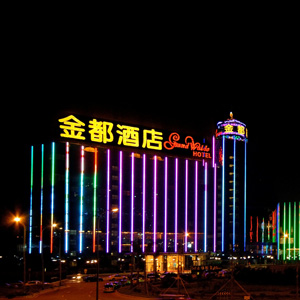
    So the taxi driver got me to my hotel, but I rather wish he hadn’t. The name, “Grand Waldo”, should have tipped me off. Seriously: Grand Waldo? In the shadow of the grandeur and surreal artificiality of the Venetian, the “Grand Waldo”, or “金都” to use its pretentious Chinese name, compensates by having the gaudiest exterior lighting in all of Macau. And that’s saying something. I had actually noticed it from the airplane on the way in, never dreaming that this was where I was headed for.

    The lobby had a touch of desolation about it, a moody silence punctuated by breathy snapping of a nailgun as some evening renovation work was carried out. At the desk, three attendants went through a check-in routine that was even more laborious and sluggish than Macau immigration.

    When I arrived at the desk the woman who was supposed to serve me was distracted first by the need to send a fax to someone, which task took about five minutes, and then by the arrival of a disgruntled man who wanted to complain at length about the crappy service. He was eventually foisted off on the assistant manager, but as I went through check in I listened to his litany of complaints. It ended with him canceling his stay in leaving in search of another hotel. Not a good sign.

    Nevertheless, I toughed it out. My room was reasonably sized, and artfully positioned in an armpit of the building such that the maximum amount of the scintillating external lighting shined right in. Fortunately there were blackout curtains.

    There was no CNN or BBC, but it did have Fox News (did you know that curvy women have smarter children and Virginia is the state with the most personalized license plates?) and, thank heavens, Al Jazeera (gunfire and political tension between Fatah and Hamas in Gaza, major fire in London). It also had Portuguese soap operas featuring attractive, heavy-breasted women in various states of emotional turmoil and scanty dress. That was worth something.

    I dialed room service. I’m pretty sure I dialed correctly because I pressed the button labeled “room service” on the phone. This led to a Kafkaesque phone nightmare in which I was transferred no fewer than six times before I got someone who was prepared to take an order for a club sandwich. 82.5 patacas after tax. The man who brought it to my room wouldn’t allow me to sign for it. I had to pay cash. He didn’t offer to make change for the pataca C-note I handed him. He just grinned and pointed at himself. I was so amazed by this display of chutzpah that he was long gone before I realized he hadn’t left the receipt for me.

    An hour later the phone in room rang. “Hi, I was staying in room 620* before, and I think I left a blue comb in there, in the small bathroom.” (It’s a suite.) “Can I come and get it?” This sounded a lot like, “Businessman gets rolled in Macau hotel” to me. I said I’d check in the bathroom. Sure enough there was a blue comb in the bathroom with bits of gel stuck to it. I told the caller to come on down and put the chain on the door.

    So he had checked out of this room and into some other room in the hotel and left his comb. Housekeeping had flipped the room, but somehow not noticed the grungy, used comb in the outer bathroom. Meanwhile, this guy was so attached to his plastic comb that he turned up his nose at the one included in the room amenity kit and came back for his.

    The icy tendrils of paranoia began to creep up my neck.

    At any rate, the comb owner was apologetic enough when he showed up at my door, and made no attempt to roll me or sell me a blow job (which does rather distinguish him from a hotel experience I once had in the aforementioned Kuala Lumpur, but more on James Bond Massage and Fullsex Escort Service and the Cantonese hookers I had to pay to go away some other time).

    So it’s all quiet now, and at least the broadband works, as I type here in the glow of Al Jazeera (which isn’t half bad).

    I have, however asked my coordinator to look for another hotel for tomorrow night.

    *Not my real room number. Like I said, tendrils of paranoia.

    Update: Hanging on my room door this morning: The Oriental Daily News, which appears to be a Hong Kong gutter rag that, judging from the layout, is designed for a readership devoted to hard hitting stories about police shootings and starlet misadventures. Still, I suppose it gives you something to read while you yank the crank on your one-armed bandit. You could just about finish a story in the time the wheels take to come up, “Bull’s eye”, “Clown” and “Dog riding a tricycle” or whatever symbols they put on slot machines these days (Imagethief is not a gambling man). I guess the name “William Moss” and the US passport didn’t tip them off.

    In all its pomp...
    In all its pomp…
  • The up is red

    Imagethief was enrocketed to read on Friday that China’s taikonauts –whom I prefer to call “astronauts” because “taikonauts” sounds like they should be exploring my sugar bowl– are considering starting a Communist Party cell in outer space:

    “If China has its own space station, the taikonauts on mission will carry out the regular activities of a CPC branch in space in the way we do on earth, such as learning the Party’s policies and exchanging opinions on the Party’s decisions,” said Yang, a delegate to the on-going CPC national congress in Beijing.

    “If we establish a Party branch in space, it would also be the ‘highest’ of its kind in the world,” said Yang, who is also deputy director of the China Astronaut Research and Training Center.

    It’s funny that Yang should say that, because the word “high” was definitely floating through my head as I read this. But Yang’s statement is a little unclear. Does he mean that that orbiting Communist party branch would be the highest Communist party cell in theworld universe, or the highest grass-roots political organization in the universe? He needs to choose his words carefully here. The former will be nothing more than a gentle slap in the face of the world’s less motivated communist parties. And, let’s be honest, no one really expects the Cubans, Laos or even the plucky Vietnamese to start lobbing cadres into orbit to compete with the Chinese ideological juggernaut. Heck, the Laos are happy when their national airline gets planes down in one piece (trust me, I’ve flown with it).

    But if it’s the former, well, that’s a direct challenge to Uncle Sam. You can expect a phalanx of red-blooded republicans to be launched into orbit James Bond/Moonraker style within moments. And I’ll bet you America will go one up. We’ll not only launch a party cell into space, we’ll raise money while we’re there. I’m not sure how, yet, but the Republican national committee will find a way.

    You may find it curious that I, a Democrat, mention Republicans here. After all, the American Lunar project was launched (metaphorically) by Kennedy, a Democrat. But somehow, I’ve always seen space flight as kind of a Republican project. Don’t ask me why. Maybe it’s the image of all those square-jawed Air Force types. Plus I am not sure the Democrats are organized enough to get a party cell into orbit.

    There is more in the story. It turns out that the Taikonauts wouldn’t be forming a party cell out of unfettered, Lei Feng-style loyalty to the cause. It’s more to do with the party charter:

    According to the CPC Constitution, a grass-root CPC organization should be established where there are three or more CPC members. The latest official figure shows that China has more than 73 million CPC members and about 3.6 million grass-roots CPC organizations.

    You got that? Three or more. That means you can’t even have your Communist Party friends over for a round of Poker without a party cell breaking out in your living room. How inconvenient. Having a road trip? Better limit yourself to two party members in your car unless you want to spend the whole drive to Guilin discussing dialectical materialism. Try drowning that out with Van Halen.

    “Like foreign astronauts having their beliefs, we believe in Communism, which is also a spiritual power,” said Yang. “We may not pray in the way our foreign counterparts do, but the common belief has made us more united in space, where there is no national boundary, to accomplish our missions.”

    I’ll pause here so you can inhale the aroma of full-bodied surreality drifting from this statement.

    Yep, that’s space. It’s either cowboy Jesus freaks or commies. Makes you wonder what the first lunar colonies will be like, and give thanks that you’re not likely to be living there. If this is who we plan on launching into the universe someday when the sun becomes a red giant (no pun intended) and consumes the Earth, then the rest of the universe had better look out. Frankly it’s amazing space aliens haven’t shown up to wipe us all out just as a precaution.

    And to think I wanted to be an astronaut when I was a kid. Those youthful dreams die hard. But I noticed another story last week as well (via the Wired blog). Coincidental timing? You be the judge:

    BEIJING (AP) — China hopes to join an international space station project that already counts leading space powers like the United States and Russia as its members, a government official said Tuesday.

    China takes great pride in its expanding space program and sees it as a way to validate its claims to be one of the world’s leading scientific nations. But China does not participate in the International Space Station, due in part to American unease about allowing a communist dictatorship a place aboard.

    ***

    “We hope to take part in activities related to the international space station,” Li Xueyong, a vice minister of science and technology. “If I am not mistaken, this program has 16 countries currently involved and we hope to be the 17th partner.”

    So, lemme get this straight. The Chinese are talking about starting Communist Party cells at the same time as they are asking for inclusion in the International Space Station? So much for “central planning”. This ain’t the strategy to get NASA to roll out the, um, red carpet. Try talking about how little oxygen Chinese astronauts needs or how they live for weeks on one tube of reconstituted porridge. But don’t talk about the Party. After all, the US government still holds the pink slip on the “international” space station, and the last thing they need floating through their overstretched, little heads is the image of zero-G Marxism study sessions.

    Come to think of it, it’s the last thing I need, too.

    He'll know what to do about this!
    He’ll know what to do about this!
  • Deconstructing the White Rabbit wrapper

    Imagethief has rather a sweet tooth. Hence my long acquaintance with the gym and the pleasures of the long run. One of China’s under-appreciated pleasures is the enamel-stripping joy of a chewy White Rabbit Milk Candy. I’m not the first to be smitten, as aquick Googling will reveal. White Rabbit even has a Wikipedia entry.

    My friends are aware of my habit for the Rabbit. At a recent birthday party celebrating my 40th I received a bag containing three packages of M&Ms (which I also like), a jar of homemade peanut butter (he uses nutmeg and brown sugar – it’s really nice) and forty pieces of White Rabbit. It was a great present. I’ve been munching White Rabbit happily at work all week.

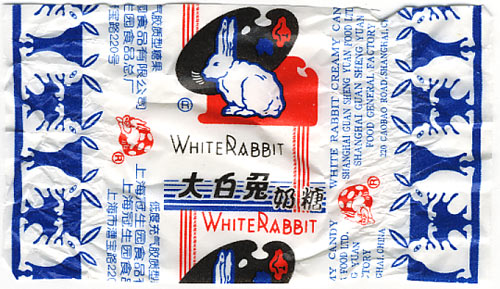
    During a lull brought on by sugar-induced bliss I had a chance to study the White Rabbit wrapper (If you want to sound like Elmer Fudd say that five times fast). It’s pretty weird:

    white-rabbit

    First, note the crazy Art Deco font in both black and red. Then there is not one but three different kinds of rabbits on the wrapper. The central rabbit doesn’t even look like a rabbit so much as it looks like an albino lemon that has sprouted a rabbit head. For reasons known only to the creators this bizarre, lumpy rabbit is seated in front of a painter’s palette with dabs of blue and red paint. The rabbit is apparently engaged in an almighty sneeze. Or perhaps those are albino lemon rabbit whiskers. Who knows?

    At the margins are rows of zombie rabbits facing each other in mirror image. They appear to be covered with grotesque lumps, like enormous, swollen zombie rabbit teats. They also have rather spooky eyes.

    Finally there are two renderings of a somewhat more contemporary rabbit that is leaping in front of what looks like an enormous mushroom that is either conspicuously magic or conspicuously toxic. Company information in Chinese and English fills the rest of the space.

    I think this is a masterpiece of psychedelic candy packaging design, right up there withLemonhead, Pixie Stix and Bazooka bubble gum. Looking at the wrapper now –there are three on my desk– I can taste milky sweetness and hear Jefferson Airplane thundering through my head. There is almost nothing in this design to suggest that what lies within is edible, and yet like a sugary prostitute it screams unwrap me and put me in your mouth!

    There are messages within messages within messages in this candy wrapper. I want an A2 size print that I can hang right next to my enormous “Dark Side of the Moon” poster. Then I can gaze at them both while I eat White Rabbit and listen to “Dark Side” through my headphones. If that isn’t a ticket to an alternate universe I don’t know what is. Pixie Stix, perhaps.

    Note: Image stolen from Speks International as I was too lazy to scan it myself. A larger image of an apparently older version is here.

  • Fly the feces-free skies of China Southern

    Few things have provided more grist for Imagethief’s gripemill than Chinese airlines. A simple search of this website for various permutations of China+Airline+Travel will make that abundantly clear. In part this hostility is unfair. Chinese airlines are every bit as good as American carriers –although I have heaped scorn on those as well– and in some ways they are distinctly better. For instance, I would recommend Chinese carriers to anyone with a fetish for being waited upon by attractive Asian women as opposed to a fetish for being snarled at by hostile, matronly Americans. Not that no one has that particular fetish, its just that its somewhat more eccentric and self-destructive, like a fetish for self-mutilation, blender worship or Paris Hilton.

    And of course, Chinese carriers are every bit as successful as their American counterparts, which is to say they are losing money hand over fist. That’s why I was constipated to readin a Reuters news story (quoting Xinhua) about some of the money-saving steps recently suggested by China Southern Airlines:

    A Chinese airline has calculated that it takes a litre of fuel to flush the toilet at 30,000 feet and is urging passengers to go to the bathroom before they board.

    As Chinese airlines come under increasing pressure to cut fuel expenditures, China Southern’s latest strategy is to encourage passengers “to spend their pennies before boarding the aircraft”, Xinhua news agency reported on Thursday.

    “The energy used in one flush is enough for an economical car to run at least 10 kilometres,” Captain Liu Zhiyuan, who flies regularly between Hangzhou and Beijing, was quoted as saying.

    Citing a survey by the company’s logistics department, Liu said carrying one kilogram of items such as blankets and pillows by air for one hour uses 0.2 kg of fuel.

    “This means the blankets and pillows on board the aircraft eat up 60 tonnes of fuel every day. If each seat is loaded with three 450-gram magazines, another 60 tonnes will be consumed,” Liu explained.

    Well, having taken many flights on China Southern over the past few years, I can tell you that many passengers already consider flushing optional, so it’s debatable how much value such a program might have. I also think that the focus on flushing perhaps ignores the root of the problem, which is that according to this article, airplane toilets are some of the least energy efficient devices on the planet, on a part with M1-Abrams tanks and arc lights. Airplane manufacturers may want to get cracking on this (so to speak). After all, if my home toilet required a liter of kerosene for every flush, I’d just use half the kerosene to burn our daily household quota of excreta in our apartment building’s courtyard (everyone loves a bonfire) and sell the rest on the aviation fuel black market for cold, hard cashola.

    But as the article makes clear, cracking down (again, so to speak) on online flushing is really only part of the solution. The real triumph would be to encourage people not to carry any bodily wastes on board the airplane at all. In fact, I think the “pillows and magazines” in this article are really offered as a gentle metaphor for the collection of excreta sloshing around inside of each of us. After all, to the airline, the accumulated fecal matter fermenting in your bowel is just another form of carry-on luggage, and one that they have no control over. And nothing chafes an airline more than the thought that you might be gaming their system. Turds are just the beginning. Next thing you know people will be wrapping their duty free purchases in condoms and swallowing them to evade carry on limits.

    Let’s look at this scientifically. Doing some quick research, I note from a highly credible source, the movie Beverly Hills Cop, that the gut of the average American fifty-year-old contains about five pounds (2.25 kilos) of undigested red meat. Chinese are not Americans, but they are eating an increasing amount of red meat so let’s use American fifty-year-olds as proxies for the entire Chinese population and go with that number. It’s this spirit of daring scientific inquiry that led to such breakthroughs as cold fusion and Dr. Hang Woo-suk’s cloning program at Seoul National University. Going further I also note that China Southern is one of the airlines that has ordered A380s, which can carry up to 500 passengers. After performing some complex and rigorous calculations far beyond the reach of lesser cortexes, I discover that a single planeload may be hauling around up to 2500 pounds (1,136 kilos) of turds.

    Shocking. If the fuel consumption figures in the article above are accurate, that means that China Southern’s A380s could burn up to 227 extra liters of fuel an hour just dragging around surplus shit. On a twelve-hour long-haul to San Francisco that could mean almost 3000 extra liters of fuel consumed in the name of turd-haulage. Add on another three flushes (conservatively) per person on that same flight and you are looking at another 1500 liters of fuel consumed, for a total of 4500 kilos of fossil fuels –1.5% of the aircraft’stotal fuel capacity– flushed away in the name of airborne waste management. My god, people, haven’t you heard of global warming?

    Looked at this way, you can see that China Southern might be onto something. In fact, they might taking too conservative an approach to managing this situation. In the interest of safeguarding this planet that we all share, Imagethief proposes that, like hair gel and toothpaste in the US, human fecal matter be banned from all Chinese flights. Passengers should be required to consume a heavy dose of laxatives the day before flying and to purge thoroughly before boarding. Enema lounges could be installed in all Chinese airports, helping passengers to unburden themselves their ungreen load before boarding. I find a pre-flight high colonic highly refreshing myself, and imagine that it could become quite the fad. Naturally, pre-boarding security questions should be amended:

    • Did you pack your bags yourself?
    • Has anyone else handled your luggage since you packed it?
    • Did you have a nice, big shit this morning?

    With a few simple steps like this we can help China Southern to claw its way into profitability and reduce the global warming threat posed by air transportation. China could establish itself as environmental leader and revolutionize the entire approach to air travel. Dependency upon oil imports would also be reduced. Just think: if every airline in the world was to implement a program like this, we would live on greener, cleaner, more peaceful planet. Considering the benefits, an enema at a Chinese airport seems like a small price to pay.

    Note: Thanks to Gordon at The Horse’s Mouth for sending this article to me. Dude, when are you coming back to China? This country needs you.

    Related: Shanghai closed flights into and out of Pudong for several hours yesterday due to “air traffic volume”. Foreign flight crews ascribed the delays to military exercises. Anyone who travels in China regularly knows that the all-too-common flight delays and cancellations often get dubious official explanations, and the military’s fiat over Chinese airspace is widely and credibly blamed. In this case it seems likely. No one closes an airport to all traffic because of congestion. You might divert some traffic or delay some flights, but close the airport? The flagship airport at your glamourous international business city? The military explanation sounds a lot more credible in that case. Or some other similarly conspiratorial explanation. At any rate, you coudn’t get much more bush-league, especially considering the government’s usual appalling communication, which extends to what looks to me like a complete absence of any press coverage of the incident.

  • That western ghost festival

    Imagethief would like to wish all readers a happy Halloween.

    I’m a big fan of Halloween, and not just because I have wretched sweet tooth and rosy memories of childhood evenings spent sifting through pillowcases full of Reese’s Peanut Butter Cups, Pixie Sticks, Sugar Daddies, Candy Corns and those goddamn inedible wax lips that I always got at least one set of. Those were the days. The unintelligible sugar-high days, that is.

    For some bullshit reason, when a ten-year-old in a ridiculous costume knocks on your door begging for candy it’s considered “cute” but when a 39 year-old man does it people get all freaky and weird. As far as I’m concerned this is just one more sign of our society’s ruinous youth fetish, and is blatantly unfair. The only solution seems to be to have a child (which we’re trying to do), wait a tasteful few years (I think people might get suspicious if you show up with a basinet and claim the candy is for an infant that is still breast feeding) take the little rugrat out trick-or-treating and then ration the candy out over days “to make it last” while secretly skimming from the top. I’m pretty sure this is what my father did, and it would go a long way toward explaining some of my issues.

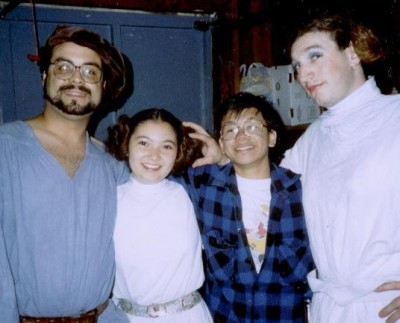
    I also enjoy dressing in costumes. Especially ones that I can be seen in public in. I was a Jawa back in the Star Wars says. And Han Solo one year. And Luke Skywalker of course. And when I was in grad-school in the early nineties and had really long hair I event went in drag as Princess Leia. I actually made the cinnamon buns with my own hair, although they were a bit on the small side. More cupcake sized than the enormous dish antennae that Carrie Fisher wore. Thinking back on it, Star Wars seems to have been involved with most of my Halloween costumes over the years, which, I suppose, reveals my inner nerdly qualities. But at my age I’ve come to terms with that.

    I also like fire, which is a big part of Halloween. After all, you’re either lighting candles in pumpkins or –once you enter high school– blowing them up. Both can be festive and cheery. Although, by the shaving-cream and toilet-paper drenched standards of my high school, I was pretty tame on the prank front. I was really in the whole thing to dress up like somebody from Star Wars and get a bunch of free candy.

    Adults, of course, love Halloween as much as kids. But they all use at as excuses to go to fetish parties. Having grown up in San Francisco’s Castro district (which may explain the whole Princess Leia thing) I’m not much into fetish parties. Not because I have anything against fetishes, mind you. I like black vinyl, thigh high bitch boots and fishnet stockings as much as the next guy. It’s cool when girls wear them too. Rather, it’s that I feel I’ve seen most of it before.

    This year I didn’t go to any parties and I didn’t collect any candy, although I am sure you can trick or treat in the villas. Even in Beijing it’s probably courting trouble to be a trick-or-treating 39 year-old in drag. And god knows what the police report would say. If I were the cops I’d just have me write a self criticism and call it a day rather than try to send that one up through the chain of command. “We have arrested a middle-aged foreigner dressed like a teenage fantasy space princess and begging for sweets in expensive neighborhoods. Hello? Hello, sir?”

    I did carve a pumpkin this year, the first I have done in a long time. On our way back from Sunday brunch at The Orchard my friends and I stopped at a large wet market. Unfortunately, the Chinese don’t cultivate an ideal assortment of carving pumpkins, being more prone to see large gourds as food. I can understand this. Pumpkin pie, pumpkin soup and pumpkin brushed with olive oil and then roasted are all really good. Still, sometimes you need a carving pumpkin. And it should be big, bright orange and able to stand upright on its own. Not small and green or weirdly misshapen in a way that would require you to brace it somehow and thus constitute a fire hazard were the cat to brush against it and tip it over.

    Fortunately we did manage to locate a couple of satisfactory specimens and haggled our way to an only slightly outrageous price. Our driver said it was still better than what we would have paid in the city, so we felt pretty good. My wife speaks better Chinese than me and she’s much more attuned to what’s being said in crowds around us. As we were trudging out of the wet market with large pumpkins under our arms, she overheard one woman say to another, “Oh yes, that western ghost festival is coming soon!”

    That western ghost festival. I quite like the sound of that. In fact it was nice reminder that there is something to Halloween besides all the dressing like Luke Skywalker, amassing sugary swag and going to fetish parties. So in observance of that western ghost festival I have carved my Jack-o’-lantern and placed it in the window of my apartment where everyone across the street can see it. Tonight I’ll light it one more time and enjoy the nostalgia that the smell of slightly singed pumpkin always brings. And, if no one is looking, I might just take out that old Princess Leia costume as well. After all, I might be too old to beg for candy. But you’re never too old for drag.

    leia
    Say, who’s the cute one on the right? The staff of KSFS Radio, ca. 1993. Can you guess Leia is me?
  • Infernalture

    Apartment prices are down and my lease is up, so Imagethief has been looking for a new, larger apartment to accommodate himself, Mrs. Imagethief, two whiny cats and the various junk that has accumulated in the past two years.

    I hate looking at apartments. The whole process is annoying and seedy, like buying a used car, if you were going to live in it. Of course, if you were buying a car at least the whole process would be over when you drove it off the lot (unless, of course, it was a lemon). With apartment rental, once you sign the lease you then have to deal with the brutal moving. I don’t know about you, but I find it impossible to move without losing at least one thing. Once it was the rice cooker (no big deal — it had bicycle shorts crammed into it, so whoever lifted it deserved what they got). Once it was my wife’s dive computer. This time, if I’m lucky, we’ll lose one of the cats.

    Rental agents in China are motley crew, and not all of them strike me as entirely together. One young man greeted me and my wife in a white T-shirt with the sleeves torn off (and wore the same shirt on two separate occasions), and then wondered why the security guard at Huamao gave him trouble at the door. Another explained to me at a certain complex that 160 square meter and 180 square meter apartments “cost the same because the 180 meter ones don’t rent, so the price has come down”. I didn’t have the heart to explain to him that this was both economically impossible, and not supported by the evidence of a real-estate ad listing different prices for 160 and 180 square meter apartments.

    But by far the worst aspect of renting an apartment in China is the furniture. In fact, I will extend this beyond China, since I have seennumerous apartments in Singapore and seen places belonging to Korean landlords, and make a sweeping statement: Asian landlords have, on average, the world’s most appalling taste in furnishings and fixtures. If there is a hell, it will have been furnished by an Asian landlord. And, just playing the odds, probably a Chinese one.

    What is it about buying an apartment in Asia that makes a person instantaneously lose all contact with good taste and common sense? The furniture I see in these apartments is beyond ugly, ranging from Logan’s Run-style 1970s retro-future abominations that would make orange shag carpet cringe in shame (in the future, all furniture will be inflatable leatherette!) to coccyx-shattering rosewood chinoiserie with all the inviting warmth of an ice chastity belt to faux Louis XIV rococo obscenities that could be lifted from Versailles, if Versailles was in Branson, Missouri and lined with neon.

    The other thing that really gets me is chandeliers. If wanted to live in a luxury hotel I’d live in a luxury hotel. I don’t want my apartment to feel like a luxury hotel. I certainly don’t want things that look like inverted, crystal pine trees hanging from the ceiling. These things are like the Chandeliers of Damocles. I’d be waiting for the whole jangly works to tear loose and land on my head as I’m working my way through my morning Grape Nuts. I don’t want to die with my face in a bowl of Grape Nuts and an enormous, crystal pine tree embedded in my skull. The morticians will make fun of my corpse and my family will refuse to take delivery of the remains. The hearse will make jingly crystal noises every time it goes over a speed bump. New-agers will come to worship at my grave. (“He didn’t die! He transcended space-time with the help of crystals in his skull!”) How humiliating. I’ll end up was one of the “odd news” bites in the China Daily: “Foreigner dies in blaze of glory!” It’ll be right above, “Two-headed goat in Shaanxi sings Donny & Marie classics!”

    I suppose chandeliers are better than the alternative, which is relentlessly cold fluorescent lighting that makes the inside of the apartment look like a meat locker. Notice how fluorescent light can make anyone look like a serial killer? Under incandescent or warm fluorescent light Mrs. Imagethief is a gorgeous woman with intoxicating, brown skin, lustrous hair and sparkling eyes. Under fluorescent light she looks like Norman Bates’ mother in Psycho. And, if you don’t recall, Norman Bates’ mother was dead. God knows what it must make me look like. Lurch from the Addams Family, perhaps. Or Dick Cheney.

    But who will notice the cheap lighting when there is a TV the size of a billboard? Yes, every apartment I look at has furniture that looks lifted from Peewee’s Playhouse, either hallucinatory chandeliers that would make Steve Wynn blanch or soul-destroying dimestore fluorescents and, for some reason, a brand-new flatscreen TV big enough burn your shadow into the wall behind you (but inevitably paired with a 200 kuai cheapie DVD player).

    Here’s an idea: Take the money you’ve spent on the forty-inch LCD television and plow it into some decent lighting and tolerable fucking furniture. There’s an Ikea in this town. I know; I’ve seen it. It’s the size of a small planet. It’s Ikea-World. It’s so big that there are probably people who have been lost inside since the day it opened, subsisting on Swedish meatballs that have rolled under the displays. I don’t like Ikea. In fact, in Singapore I was busy purging the Ikea furniture from my house. But it’s so big that, even if they’re catering to dire, nouveau riche tastes, they must have some furniture that, if not exactly nice, is at least bland and inoffensive. I’ll take a piece of furniture called “Kysblispinyx” or some other too-precious Nordic name if that’s what I have to endure in order to have a couch that supports my legs completely rather than suddenly folding down when I slide forward and slamming my face into the glass coffee table. Honestly, why not just have knives shoot out of the cushions?

    I know, I know. You’re thinking I should get an unfurnished place and buy my own furniture. I would, but I already had to sell one houseful of furniture when I moved to China. I don’t relish the idea of accumulating another raft of miscellaneous possessions that I’ll have to unload three or four years hence when I move back to Singapore. And, from what I’ve seen, the chances of my buying anything here that I’ll want to treasure for the rest of my life are slim.

    So I’m sucking it up. I’ll find a chandelier-free apartment with classy furniture in this town if it kills me. It can be the dankest, most cockroach-ridden, formaldehyde-infused shithole in Beijing as long as the furniture doesn’t give me cataracts. If I can’t manage that, I’ll just buy a used car and sleep in that.

    Note: Imagethief would like to tip his hat to his current landlord who, with the exception of the couch, did a reasonable job furnishing his apartment.

  • By chopstick to the moon

    Imagethief was interested to read in today’s China Daily that China’s government is slapping a consumption tax on several items, including disposable chopsticks and luxury yachts. I think this is just and wise, and should be done. The reason why  think so is that, according to the article, China mills 1.3 million cubic meters of wood a year into disposable chopsticks.

    That is, to use a technical term favored by engineers, a whole shitload of wood. Imagethief would like to help you visualize exactly how much wood that is:

    • Picture a block of wood one meter on each side.
    • Now imagine 1.3 million of those.

    As you can see, that amount of wood fair boggles the mind. The other thing that fair boggles the mind is exactly how many disposable chopsticks that adds up to. According to the article, that much wood yields 10 billion “boxes” of disposable chopsticks.

    How many chopsticks is this? Let’s play the visualization game again. After reading this article, Imagethief ran to his office pantry where, no joke, he fished a used pair of disposable chopsticks out of the trash in order to measure them. Science marches ever onward, and discovery is not for the faint of heart. And our office doesn’t stock disposable chopsticks, so I had to use ones that somebody brought from the food court downstairs.

    A quick bit of ruler work revealed that your average disposable chopstick is 19cm long. Now, I have no idea how many chopsticks are in a “box” as referred to by the article. My statistical woes are further compounded by the fact that the caption in this article and the body text provide completely different numbers for the number of cubic meters of wood consumed every year, and the number of resulting chopsticks. The caption says 2 million cubic meters and 15 billion pairs (not “boxes”) of chopsticks. It just goes to show what a black art statistics is in China, where, apparently, almost everything is simply made up. The caption is sourced to AP and the body text to Xinhua, so take that as you will.

    Erring on the side of being conservative, we’ll go with the 1.3 million cubic meters from the Xinhua body text and we’ll read “10 billion boxes” as 10 billion pairs of chopsticks, or 20 billion individual chopsticks (which provides, by the way, a surprisingly low per-capita disposable chopstick usage of 7.7 pairs per year — Imagethief alone probably buries about a pair a week).

    At any rate, if you were to line up 20 billion chopsticks nose to tail, your chain of chopsticks would stretch 380 billion centimeters or 3.8 million kilometers (you may wish to check my math). The distance from the earth to the moon is 384,403 kilometers (according to the Internet), which means that, using China’s annual production of disposable chopsticks, you could built a bridge from the earth to the moon nearly ten chopsticks wide (9.885 to be exact – this may be a universal constant of some kind).

    Now you know how the Chinese space program is going to get people to the moon.

    By any reckoning that’s a pile of chopsticks, which leads Imagethief to discard all notions of cultural relativism and offer the following advice to the Chinese people:

    Get a fork.

    Barring that, even given that the majority of China’s disposable chopsticks are exported to the moo goo gai pan joints of America, a consumption tax sure sounds like a good idea. From what I see around Beijing, there isn’t enough wood left in China to support more than about another ten-days worth of chopstick production.

    And god knows how many luxury yachts you could build with that many chopsticks.