Tag: China in the News

  • Good News! The Press is Out to Get You

    A couple of weeks ago I gave a talk about PR in China to a journalism class at Beijing Foreign Studies University. In any student talk the Q&A is always the most fun, and this group was no exception. Among the many good questions asked was whether it was easier to do PR in China because, as I had discussed in my talk, the Chinese media is generally cozier with businesses than their Western counterparts.

    Easier to get stories? Yes. Easier to achieve meaningful results with the public? No.

    I was reminded of this question by the recent expulsion of hard-charging Al Jazeera English correspondent Melissa Chan, and subsequent closure of the AJE bureau in China after the Ministry of Foreign Affairs refused to accredit another AJE journalist. I didn’t know Melissa well, though I had met her, but I respected her reporting and willingness to insert herself into uncomfortable situations, and I was disappointed to see her go. Reporting on China will be impoverished a bit.

    That, of course, was the point. The Chinese government has never been comfortable with an adversarial media, and Melissa’s reporting was, like that of much of the foreign press corps, pretty adversarial from their point of view. This discomfort is deeper than cursory annoyance at embarrassing foreign gadflies (although I presume that is part of it). It arises from one of the fundamental philosophies of Leninist political parties: the media are considered Party organs and, as with other Party organs, expected to serve the interests of the Party first and foremost. Media that don’t fit into that model are suspect by definition. You can see this philosophy expressed in the mechanisms of control that the Chinese government maintains over all domestic media, and in the government’s struggles to come to terms with the rise of social media that resist conformity with established power structures.

    The Party’s model is rather different from the fundamental philosophy of Western media: that it should be the fourth estate, entrusted with challenging the business and government establishment in the interest of the people. You are welcome to argue about how effective Western media have been in this role in recent years, and there are plenty of exceptions, but as a founding principle the idea of the fourth estate is alive and well and inextricably bound up with our Western ideas of what the media should be (and with the value judgments we render on media that doesn’t conform to that principle). A functional, adversarial media is a necessary component of Western-style liberal democracy, unless you have total faith in politicians and institutions.

    I am not going to comment further on the specifics of the Al Jazeera situation (some links to good articles below), but in light of the Chinese government’s recent struggle with rumors and trust issues, it’s worth reflecting on why an adversarial media is sometimes useful, even to the establishment. This is what I discussed with the students at Beiwai.

    As a news junkie who still pays for several subscriptions, I’m most definitely a fan of adversarial media model (you could also call it an “independent media” model, but independence is only valuable in that enables an adversarial position). There is nothing like a fantastic piece of investigative reporting that rips the lid off of some secret or scandal or that illuminates the dark corners of business or politics. As long as it’s not my dark corner, that is.*

    As a PR practitioner with a company reputation to defend, I’ve experienced firsthand the adversarial media model’s short-term ability to create sleepless nights and great puddles of cubicle sweat. But nevertheless, I still appreciate its value in the long-term. That’s because people are more likely to trust media that challenges me than one they know to be compliant with me, and I need media that the public trusts to get my message out, whether that message is a corporate one, a product review or whatever. If I have to do more work to get coverage in that kind of media, and tolerate some negative coverage as well, so be it.

    In China, on average, relationships between businesses and the media tend to be closer and less adversarial than in the west. There is also a range of ethical problems, including poor separation of advertising and editorial, the “transportation claim” subsidy-in-disguise, and more. Together, these make it easier for companies to earn –or buy– good coverage in local media than it would be in many other markets. But they also mean that the public is relatively more skeptical of much of the coverage and turns to alternative voices for much of its information and insight, many of them on microblogs . The result is a devalued media that makes even our best earned coverage less useful and influential, and that makes it harder for me to manage misinformation and rumors about my company.

    Sound familiar?

    These are generalizations. There are excellent journalists and excellent media in China, and crappy ones in the west. But the overall gap in trust is real. The real sign of progress here will not be in the government showing more tolerance for confrontational Western media, but in its tolerating the emergence of a fully independent, professionalized and adversarial Chinese media. That change, when it happens, will be driven by Chinese journalists. In some ways, it’s already happening.

    For those of us in the establishment, there is value in learning to deal with an adversarial media, and in being good at telling our stories and getting our messages across in media that are willing to challenge us, and that therefore lend credibility to the claims that survive their scrutiny. But if you’ve never had to deal with that kind of media, you haven’t developed the skills necessary to do so, and you rely on a tradition of control and management to get your message across, then you are in the realm of propaganda and will face the consequences in terms of diminished trust.

    And if your situation is so precarious that there is no way to tell a positive story when engaging with adversarial media? Well, then, your problems are much bigger and deeper than PR skills. Or one uppity journalist.

    * Just kidding. Naturally, I have no actual dark corners.

    See also:

    On the Al Jazeera situation:

    On the difficulty of reporting in China:

    Note: This post originally published on the defunct group blog Rectified.name.
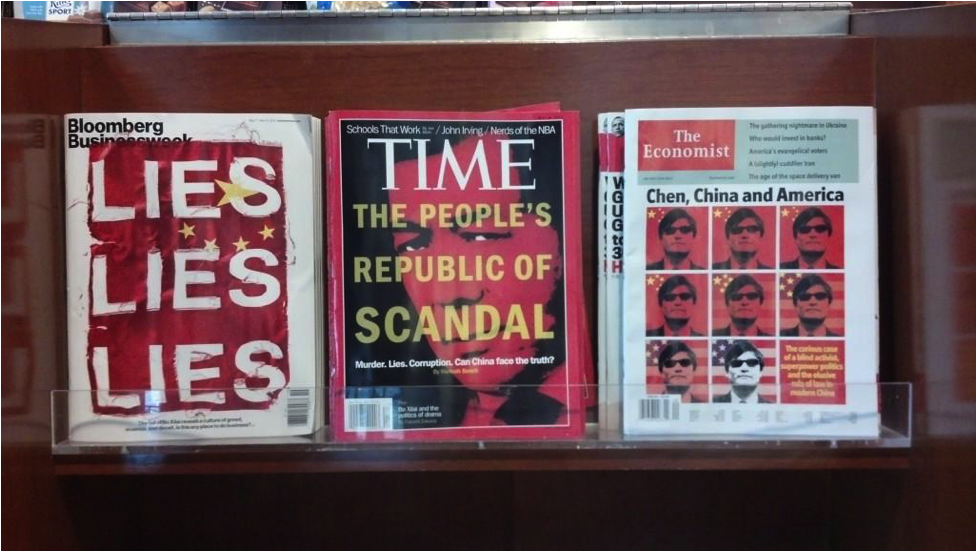
    Good news? A magazine stand at SFO's international terminal on Monday.
    Good news? A magazine stand at SFO’s international terminal on Monday.
  • Unsolicited advice for Xinhua’s new CNC TV news outfit

    To listen to people moan about the fact that China has sixty “Confucius Centers” in the US to America’s zilch-nada in China you’d think the Chinese were wrapping up hearts and minds around the planet while America gets relegated to the public diplomacy junk-heap alongside the usual despotic malcontents. While I’ll concede that China has an advantage in being able to roll out cultural centers in the US while smothering our own poorly funded efforts in red tape, I’m inclined to see that imbalance as the result of the tolerance and openness that have been part of America’s strength for the last 234 years. Give or take.

    Readers in America: When was the last time any of you went to a Confucius Center? I thought so. How about watched a Chinese television program or a Chinese movie that wasn’t directed by Zhang Yimou or Chen Kaige? See any Chinese brands last time you walked down the street? Ever had an American tell you they think Hu Jintao is super cool? Driven a Chinese car lately? Right. Whereas here, people feast on American pop culture (especially TV and movies), the street corners are a plague of American fast food labels and Buick is an aspirational brand. Leaving aside your opinions as to the value of McDonalds and Starbucks as ambassadors of American values, let’s not get all hysterical about the Confucius Centers or wallow in insecurity about America’s cultural influence until poor American refugees start seeking a better life in Fujian.

    In fact, China’s government is well aware of its soft-power deficit with regard to the US (see also this article on Danwei), and has been investing in building up its capabilities. International news is one of the key areas of investment, thus the revamping and expansion of China’s foreign-language media organizations. This has included a refresh of the venerable China Daily, the launch of the surprisingly interesting English edition of theGlobal Times, the revamping of CCTV’s English language station, and more. Most recently, the Wall Street Journal has an interesting story about Xinhua’s plans to roll out an international television news service:

    China’s state news agency announced the launch of a global English-language television channel, part of a broader international push by the country’s government media aimed at countering the dominance of Western news outlets and conveying a Chinese perspective on events.

    Xinhua news agency said trial broadcasts of the new 24-hour TV service, called China Network Corp., or CNC, will start Saturday, and the station will be fully operational July 1. CNC will be available by satellite, cable systems, the Internet and cellphones, Xinhua said, and will carry a range of programming on news, business and lifestyle issues.

    “CNC will offer an alternative source of information for a global audience and aims to promote peace and development by interpreting the world in a global perspective,” Xinhua quoted its president, Li Congjun, as saying at a launch ceremony Friday.

    Well, maybe.

    I fully understand and even support the motivation behind this. China is a globally important country and has a right to be represented in international media. And as American news media continues its slow-motion implosion, you’d think this would be a good time for them to make their move. Nevertheless, I have a history of rolling my eyes at Chinese efforts to improve their international media efforts. This is not because I am some kind of cynical bastard (although that might also be true) or because I doubt China’s technical competence (I do not). It is because I feel that the natural control-freak inclinations of the Chinese government toward media essentially preclude any ability to develop a news organization with real, international credibility.

    The objective–the real objective–is important. If the goal is simply to further disseminate the usual propaganda, then fine, they can do whatever they want. They’ll all feel good about themselves. But no one will watch.

    If, on the other hand, the goal is to develop an international media organization that can compete with what’s already offered in English and offer a legitimately different but respectable perspective, then they’ll need to break their traditional mold a bit. Al Jazeera is perhaps the model here. It emerged from a country and region not known for a liberal approach to media and established itself as a serious and credible news organization largely on the back of its Iraq and Afghan war coverage. It did so while still presenting a point of view that was a clear alternative to most western media. They were helped along by some good journalism and slick packaging.

    I don’t want to overwork the comparison. For one thing, Al Jazeera has had its problems (including serious personnel issues at their English service a couple of years ago). China certainly has the resources to try something similar to Al Jazeera, but it has some very different political and institutional factors to wrestle with than Qatar did. Also, the world isn’t necessarily screaming for an Asian alternative. Remember, Singapore has already tried the international TV news stunt with Channel News Asia, and it has had only modest international success at best. Even Al Jazeera kind of limped along for several years until it found its purpose and voice after 9/11 and the Afghanistan and Iraq wars. One hesitates to imagine a Chinese news organization blossoming in the heat of such a controversial international incident.

    So with all that in mind, here are a few things I think China should do if it is really serious about launching a successful international television news network.

    Base it in Hong Kong
    Let’s face it, as wonderful as Beijing is, nobody is going to take a Beijing-headquartered international news organization seriously. By my thorough calculations, credibility will increase by the square of the distance from Zhongnanhai. This will be especially true if your parent organization is formally a branch of the Central Publicity Department, as Xinhua is. Technically that probably makes Lima or Buenos Aires the best option, but since those might be impractical, how about Hong Kong? Hong Kong is an established media hub with a veneer of press freedom that will be important in helping a new network to establish itself. It’s visa situation will be easier for pundits and professionals, especially the foreigners (see the next point). And, hey, it’s still China, right? Beijing has no trouble calling the shots in Legco, so it could probably manage a Hong Kong-based media organization without too much headache.

    Hire pros to do it
    Al Jazeera raided the BBC Arabic service when it started, and then raided the BBC again when it started its English service. China should do something similar. There are a lot of good, unemployed journalists around these days, including TV journalists. Avoid the second-stringers and discount talent and hire some heavy hitters for the editing and mainstream talent. Go for some recognizable brand-names. This will be hard because most such people won’t want to work in a Chinese news organization. Basing it in Hong Kong will help, but people will have to believe it will be doing serious journalism.

    Also, make sure the production values are competitive with the best out there. No college broadcasting, please.

    Cover China for real
    This is another area where the Al Jazeera comparison breaks down. Al Jazeera was able to concede limits to its ability to cover its patron’s country, Qatar. Fortunately for them, nobody outside Qatar much cares what happens there, and there are plenty of sexier, more powerful and weirder places in the Gulf, let alone the broader middle East.

    This won’t work for China, however. China is pretty much story number one out of Asia these days. How a Chinese international news network covers China will be a key part of how it is evaluated by audiences. The real test will come when, inevitably, such an organization has to cover a serious disaster or bout of civil unrest in China. What plays domestically will not play internationally, especially when people are comparing the coverage to other international media organizations. With all due respect to the Chinese people, who have been poorly served by foreign media on more than one occasion, most people outside of China–even non-Westerners–don’t spend their time grumbling about how crappy and one-sided coverage of China is. So don’t waste too much energy tilting at that particular windmill.

    I’m not sure how China could manage this. It might have to credential its own news organization’s China journalists as foreign media. Now wouldn’t that be something.

    Less scolding, more seduction
    We understand that this operation is there to present China’s point of view, but a little bit of nuance is called for. Sometimes, the organization is going to have to cover the Dalai Lama, or Rebiyah Kadeer, Taiwan’s DPP, or other people the Chinese government finds distasteful. The moment the announcers start slipping into hostile language about black elements, jackals (jackals always get a bad rap), splittist criminals, etc. it’s all over. By all means, be more sympathetic to the Chinese government point of view, but do without with the theatrical, throwback language that alienates foreigners and reminds people that the propaganda mission always comes first. Find articulate, polished spokespeople to present the Chinese government point of view and let them, rather than the journalists or newsreaders, present the government’s points.

    Don’t forget the rest of the world
    It shouldn’t be all China, all the time. Global news organizations report on, yes, the globe. If the big news of the day is from somewhere outside of China, let’s make sure we don’t lead with what the Standing Committee did today, in protocol order, and doesn’t Uncle Wen look nice with the bouquet those schoolgirls gave him. That means opening a lot of bureaus and sending hardcore journalists to interesting places. With many western media organizations in retreat, there are plenty of parts of the globe that could and should be covered better, and where China might get better access than Western media organizations. Africa and Central Asia come to mind. China has the resources and can do this if it wants to.

    Or it could all be a fantasy. I’d be interested to see China come up with something polished, interesting and watchable. There have certainly been signs of life from corners of the Chinese English-language media in the last few years. But given the history, especially in the heavily state-managed regime of television, it’s hard to be optimistic.

  • A handy cheat sheet for interpreting the Google China story

    Should Google have been in China? Did they make the right move in pulling out? Will this influence the Chinese government? What does it mean for foreign businesses in China? Are they evil or not? Who knows? Not me. And none of these questions are going to be answered in this post.

    But stick with me, because that’s the point. The fact is that everyone and their goldfish has an opinion on Google’s fortunes in China, but few people actually know anything conclusive, so what we’re getting is a huge dose of punditry, analysis and opinioneering. This is the kind of thing that PR people live for, because what we’re witnessing first hand is the creation of a narrative. Or, rather, several narratives that serve different worldviews, audiences and points of view.

    This is PR in action: The effort to influence perception and opinion with regard to an entity or event, generally with the objective of supporting some kind of end-state result (higher sales, a political victory, popular consensus, the launch of a war, etc.).

    PR people are often accused of being liars. This is a shame, because a good PR person doesn’t lie or make up facts. I’d like to tell you this is because PR people are noble souls who want only the best for the planet and fuzzy puppies, but the real reason is that lying makes you vulnerable and doesn’t usually work very well (and, yes, it’s also wrong). Lies can often be proved false, and this can cause your position to unravel pretty quickly, often with devastating consequences. Even if you string the lie out long enough to achieve a stated objective, you’ll take damage on the backside if your story comes apart. See, for example, weapons of mass destruction and the Iraq war, which claimed the reputations and legacies of many people.

    But PR people do often try to interpret the facts (or obscure them) in specific in selective ways. In the vernacular, we spin things. In fact, the very term “spin doctor” (sometimes credited to the novelist, Saul Bellow) refers to trying to define the interpretation of events or facts — to determine which way they “spin” in the public sphere.

    PR people do this for a living. But we’re not the only ones who do it. Anyone with an agenda tries to interpret facts to create a narrative that serves that agenda, or that serves their world view. Often, dueling parties compete to establish the defining narrative of a situation or event. Consider how Democrats and Republicans competed to establish the narrative for health care reform in the interest of divergent political objectives. The media and public spheres of discussion are thus, often, noisy and squawky collections of competing narratives interpreted or distorted from the same basic set of facts in order to serve different agendas. Sometimes it takes a long time for a “definitive” narrative to emerge. Sometimes a definitive narrative never emerges, or different audiences arrive at divergent narratives because they’re exposed to different influences (anyone who looks at how Chinese and Western audiences fail to see eye-to-eye on many issues will be familiar with this).

    This is essentially what has been happening with Google over the past few weeks, as people have competed to establish different narratives regarding its withdrawal from China. There has been a huge amount written and said about Google’s predicament and options in both the Chinese and Western media and blogospheres. At last count I had 27 articles bookmarked since the announcement that Google would shift it’s Chinese search operation to Hong Kong. And there were plenty that I didn’t bother to bookmark.

    Well, that’s just too much damned stuff to analyze, and I am way too lazy to pore through it with a notebook and try to draw any meaningful conclusions about what it all means (hey, I don’t get paid for this). Also, my overwhelming impression is that there is so far roughly zero consensus on what it all means.

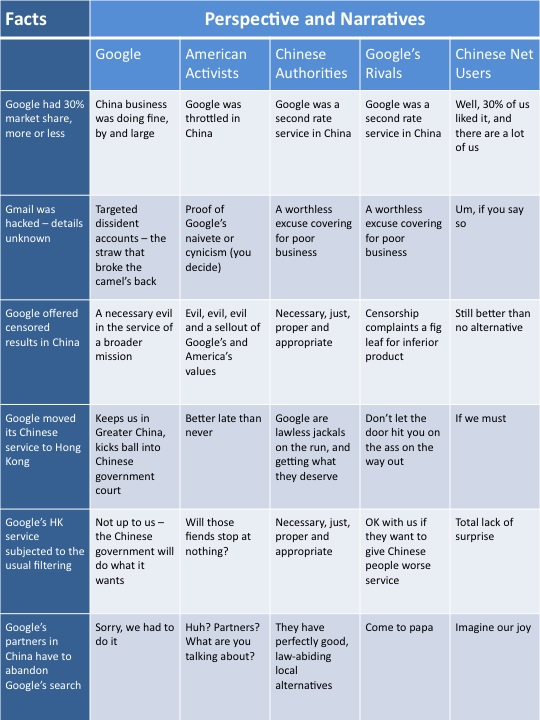
    What I did do, however, was to put together a handy chart that shows the key known facts, and, based upon all the articles I’ve read, how each of the major interest groups that I observe is spinning or reacting to each of those facts. In each case, the vertical thread through the series of facts creates the skeleton of a narrative. And that’s what each of these parties –Google, its rivals, the Chinese government, the Western activist community– is trying to do: They’re each trying to control and define the narrative of Google’s situation in China to serve their own agendas. They are, in other words spinning. Here is what the result looks like:

    google cheat sheet

    I realize this is a vast oversimplification and there are no doubt various interests omitted, but this captures most of the main parties and facts. What’s not included here is any kind of conclusion of each narrative. In my opinion, the story is still unfolding and its too early for that. But we’ll see how things go over the next few weeks.

    The other thing is that these narratives aren’t in equal competition. To use a possibly inappropriate military metaphor, there are different theaters of operation in which the stakeholder have varying levels of influence. So, in the US, Google and the activist (and analyst) community are the loudest voices. in China, the Chinese government has the tools to define the public narrative, and has been using them liberally, although there is some ferment in the margins (also here).

    Eventually, there will be a canonical version of Google’s misadventures in China. or at least one canonical version in the West and one in China. These may not be the creation of a single group. One group might control interpretation of one element of the story, and one group control another. But for the moment, the fun is in watching the battle to own the story. Enjoy it while it lasts.

    Finally, from a PR perspective, there is possibly one overarching lesson that can be drawn from this whole situation. I can’t take credit for this insight, it comes from Craig Adams, a colleague of mine. But it’s deceptively straightforward and I agree with it wholeheartedly. He said that if you have to sell out your basic principles to do business in China, that’s a pretty good sign you should reconsider your plans.

    Other sources (just to prove I’ve done my homework):

  • Paul Midler’s “Poorly Made in China”: Mischief, mayhem, soap

    As a general rule, Imagethief dislikes business books, especially instructional ones. I find them tedious and most of them age faster than caviar on a car dashboard. There are, however, exceptions. Most of these are either books based on journalistic reporting of business events, such as, say, Kurt Eichenwald’s “Conspiracy of Fools”, or on personal narratives of business conducted in extremis. Tim Clissold’s “Mr. China”, to this day the definitive “doing business in China” narrative and probably on the shelves of many Imagethief readers, is the defining example of the latter.

    One of the magnificent things about China is that it seems to provide a bottomless well of business-in-extremis stories. Like many PR pros, I followed with some interest the great product quality scandals of 2007 and 2008, not least because it has a direct bearing on my work when companies discover that something they manufacture in China is [choose one] toxic/sharp/disintegrating/radioactive/manufactured by child slaves. (That list could be extended, but you get the point.) I was thus pleased when a copy of Paul Midler’s “Poorly Made in China” landed on my desk some months ago. However, it went into the long queue on my nightstand and didn’t actually get read for some months until after I received it. Considering my recently ended blog hiatus, this was perhaps for the best.

    In fact, despite my interest in the topic, I was a little reluctant at first to get stuck into Mr. Midler’s book. From the subtitle, “An insider’s account of the tactics behind China’s production game,” and somewhat staid cover art I was expecting something didactic, in the style of the business books I tend not to like. Do not, as the old adage goes, judge a book by its cover. I was pleasantly surprised to find that “Poorly Made in China” is in fact a well told personal narrative of Mr. Midler’s own experiences helping foreign companies to arrange manufacturing relationships in South China. Once opened, I found it entertaining and enlightening (a rare combination also recently attained by Jonathan Fenby’s “Penguin History of Modern China”, one of the books ahead of Mr. Midler’s in my queue, which I recommend to all China expats not already versed in modern Chinese history).

    Most of the story concerns Mr. Midler’s work with an American client manufacturing personal care products (e.g. soaps and shampoos) in China. What could go wrong with soap, you ask? Plenty, it turns out, and the story revolves around the struggle of Mr. Midler and his client to maintain quality standards (of the product, the packaging, the factory sanitation — you name it) in the teeth of entrenched Chinese business habits that seem to give rise to corner-cutting at every imaginable opportunity and a few unimaginable ones. From this main thread Mr. Midler branches off into other interesting stories and illustrations.

    “So what?” you may be saying to yourself. Chinese manufacturers cut corners at every opportunity. What else is new? Even my Singaporean mother-in-law knows this. “Keep a hand on your wallet,” she warned me when I announced my intention to move myself and her daughter to China six years ago. Needless to say, my personal experience here has been much more positive than she expected, but much of the mainstream reporting on the product quality crises of the last couple of years took a similarly one-dimensional China-as-villain tone.

    With that in mind, the value of Mr. Midler’s book is two-fold. First, Mr. Midler tells his story as someone who, despite all the frustrations and adventures, seems to never have lost his basic affection for China. He never falls back on the trope of villainy. “Sister”, the owner of the Chinese soap factory that figures in much of the book, is presented not as a criminal or predator, but as someone trying very hard to succeed in a particular business context. This leads to the second, and main value of “Poorly Made in China”: Mr. Midler does an excellent job of explaining in a readable way that context of Chinese business, and the social, cultural, and economic forces that have shaped the practices of people like Sister. He explains how western buyers and Chinese businesses have created a delicate and sometimes dangerous symbiosis in an environment of ruthless competition, price pressure and complex webs of relationships. The book is critical, but not judgmental, which I found refreshing.

    Even if you’re not in manufacturing or dealing with the consequences of manufacturing problems (as we PR people sometimes do), you may find the book interesting as a study in the forces that have shaped Chines business over thirty years of turbocharged economic growth. Many of these forces that have shaped Chinese manufacturers may be at work in your industry as well. They’re certainly at work in mine. Against this reality, efforts such as the following, while admirable for the move toward international public communication, seem modest indeed.

    http://v.blog.sohu.com/fo/v4/3844191

    Disclaimer: The publisher and author provided Imagethief with a complementary review copy of “Poorly Made in China”. Make of that what you will. Imagethief gladly accepts review copies, but cannot guarantee that he will read or like books furnished.

    Note: Title of this post with apologies to the marketing team for the film “Fight Club”.

  • Consultants say hardened Chinese death-nerds are coming for your daughters

    Yes, it’s true. Those Chinese death-nerds are everywhere. They’re in your bank account. They’re in the Pentagon. They’re sending naked pictures of themselves to your daughter. And they’re completely invulnerable to all known countermeasures!

    Or at least that’s the terrifying conclusion one might draw if one was to read a long article from the Washington Times with the chilling headline, “China blocks US from cyber warfare.” Now, the Washington Times and this journalist in particular have–how shall I put it?–a distinct point of view on China, and it’s perhaps just a tad darker than my own. But I find this story interesting less on its own (thin) merits and more because it represents the latest installment in what seems to be something of a fad in hair-raising stories on the Chinese cyber-security threat. My heavens, are we having a meme?

    You may recall that this idea began rolling in its most recent incarnation with a report about Ghost Net, in which the link to the Chinese government was unclear but widely assumed. It gathered steam with a rather vague Wall Street Journal article about Chinese “spies” hacking into the US electricity grid. With this Washington Times article, which has been picked up by AFP and thus relayed to Yahoo and other portals, it’s reached something of a loony crescendo. You’d think bureaucracies in Washington were competing over turf and budgets and thus doing their best to dial up the general anxiety level in order to exert political leverage. Because, you know, what with the economy, two wars, the Taliban destabilizing Pakistan and Swine A/H1N1 flu we so desperately need one more thing to be afraid of.

    The Washington Times article really is in a class all by itself, though. It focuses on the devastating implications of a “hardened” Chinese operating system that, to read this article, makes Chinese government computers essentially hack-proof. It is based largely on the testimony (PDF) of Mr. Kevin Coleman, one of nine witnesses speaking before the US-China Economic and Security Review Commission on April 30th. (The USCC makes periodic recommendations to congress on the national security implications of trade with China.)  There is no one part of the article can single out for an excerpt, so I’ll instead give you a rundown of the highlights. The article features:

    • An IT security consultant (Mr. Coleman) who “advises the government on cybersecurity” telling us that the Chinese are outplaying us badly. Because what do you expect him to say? “It’s all good. I’m done here.”
    • Terrifying absolutes, such as this quote on the effect of China “hardening” it’s servers with this new operating system:

    “This action also made our offensive cybercapabilities ineffective against them, given the cyberweapons were designed to be used against Linux, UNIX and Windows,” he said.

    • The suggestion that the revelation of this operating system is somehow an intelligence coup, on par with the cracking of Enigma:

    The secure operating system was disclosed as computer hackers in China – some of them sponsored by the communist government and military – are engaged in aggressive attacks against the United States, said officials and experts who disclosed new details of what was described as a growing war in cyberspace.

    • Further vague but terrifying details designed to emphasize our inferiority:

    Additionally, Mr. Coleman said, the Chinese have developed a secure microprocessor that, unlike U.S.-made chips, is known to be hardened against external access by a hacker or automated malicious software. “If you add a hardened microchip and a hardened operating system, that makes a really good solid platform for defending infrastructure [from external attack],” Mr. Coleman said.

    • Hopeless over-generalizations of dubious technical soundness:

    U.S. operating system software, including Microsoft, used open-source and offshore code that makes it less secure and vulnerable to software “trap doors” that could allow access in wartime, he explained.

    • Quotable quotes:

    “What’s so interesting from a strategic standpoint is that in the cyberarena, China is playing chess while we’re playing checkers,” he said.

    • The devastating revelation that the Chinese government is hiring hackers!

    A third computer specialist, Alan Paller, told the Senate Committee on Homeland Security and Governmental Affairs on April 29 that China’s military in 2005 recruited Tan Dailin, a graduate student at Sichuan University, after he showed off his hacker skills at an annual contest.

    Mr. Paller, a computer security specialist with the SANS Institute, said the Chinese military put the hacker through a 30-day, 16-hour-a-day workshop “where he learned to develop really high-end attacks and honed his skills.”

    • Meaningless statistics:

    Mr. Coleman said one indication of the problem was identified by Solutionary, a computer security company that in March detected 128 “acts of cyberagression” per minute tied to Internet addresses in China.

    “These acts should serve as a warning that clearly indicates just how far along China’s cyberintelligence collection capabilities are,” Mr. Coleman said.

    •  Just plain goofyness:

    Mr. [Joel] Brenner [national counterintelligence executive] said there are minimal concerns about a Chinese cyberattack to shut down U.S. banking networks because “they have too much money invested here.”

    Well, thank god for that!

    It’s hard to know where to start with this article, but perhaps I should begin by saying, of course the Chinese government is conducting cyber-espionage against the US. They’d be stupid not to. And of course they are concerned with securing their own critical systems against the United States’ equally inevitable cyber-espionage. Again, they’d be stupid not to. And certainly the US government needs to take information security seriously. And so do businesses. And so does your grandmother. Especially if she’s using Windows. All granted.

    And it’s nice that various American government bureaucracies are having a pissing match about who should oversee American cyber-security at a government level (the end of the article hints at that a bit). I hope somebody wins someday. But, really, do we need to frame all of this in such Michael Bay terms? Let’s take a closer look at this super-secure operating system, “Kylin”. It’s hardly a secret, having been in the press since at least 2004. You can even download the ISO files, which suggests security somewhat shy of, say, the Manhattan Project. I’m thinking Langley may have a copy. A fairly sketchy DIY site promisingly called “Cheapest-computer-hardware-software.com” has the skinny (all Chinglish is sic):

    The Kylin operating system focuses on high performance, reliability and security. The development program was first funded by the Chinese government sponsored R&D program during 2002. The operating system developed in a hierarchical model, in which, the kernel layer is based on Mach, the system service layer is based on FreeBSD and the desktop environment is similar to that of Windows. The operating system standards are similar to UNIX standards, and are highly compatible with Linux binaries.

    ***

    The operating system was on development at the National University of Defense Technology. The operating system was designated as the document processing operating system. It can now turn China into super power in IT product development. The powerfulness, stronger security of the operating system may make Chinese people to replace the foreign operating systems. In China, Kylin was listed among the best 10 scientific and Technological Progresses News of Higher Learning Institutes during 2005.

    ***

    The dominance of IT product by the foreigners in China will get reduced, once this operating system made popular among Chinese population. The security of data will be stronger, because, it is being developed by the Chinese government and people themselves.

    So, the indestructible Chinese operating system is FreeBSD + Mach. Yes, that’s right, the operating system that frees them from foreign innovation and with which China will conquer the world is a less slick version of Mac OS X. Well, I hate to break that to the scare-mongers Washington, but we have that technology also. As for the secure microprocessor, I hope he’s not talking about Godson, the domestic chip project that languishes in the same commercial phantom zone as the domestic video disk project (EVD) and the domestic WiFi standard project (WAPI).

    Why would I trust some half-assed and likely Chinese no-name site over the best and brightest of Washington DC?  Well, for one reason, the language in the extract above rings absolutely true. Second, let’s just say I’m getting agenda sensitivity on this issue. Sure, it’s possible this is all part of some huge Chinese disinformation campaign and I’m just another useful idiot, talking down the crowbar that the Chinese state will someday use to pry open the secret folder where I keep the naughty photos of Mrs. Imagethief. Maybe there are two Kylins, and I’ve got the wrong one. Maybe Kylin + Godson is the shit, and I should trade in my MacBook Pro.

    Or, just conceivably, people with their noses in the Washington trough are blowing smoke up my ass. Let’s face it, it wouldn’t be the first time.

  • Chinese cyberspies? Sheer lies and heinous fabrications!

    Alright, I confess I made up the “heinous fabrications” bit. But the “sheer lies” sound bite comes straight from China’s Ministry of Foreign Affairs, which has clearly worked hard to make sure that its representatives around the world are working from the same talking points.

    China has found itself accused of a lot of hacking recently. A March 28 New York Timesarticle covered the dreaded “GhostNet”; innocent computers ruthlessly compelled to do the bidding of alleged shadowy overlords in Beijing (which bidding was, apparently, to screw with Tibetan exile organizations). More recently, a story in the Wall Street Journalreported on attempts to hack into the systems controlling America’s power grid, some of which apparently originated from China and Russia.

    The Chinese government had chances to rebut both stories. Here is a Beijing-based Ministry of Foreign Affairs spokesman responding to a “GhostNet” question in a regular media Q&A the day after John Markoff’s story broke in the Times:

    “I have noted before that the Chinese Government has always taken cyber-safety very seriously. We resolutely oppose any crime including hacking that destroys the internet or computer network, which is stipulated in relevant Chinese laws and regulations. The current problem is, some people overseas are indulged in fabricating the sheer lies of the so-called cyber-spies in China. What I have seen is a ghost of “Cold War” and a virus of “the China Threat” mentality. The China Threat virus on those haunted by the Cold War ghost strikes from time to time. Their attempt to defame China will get nowhere.”

    And here is Chinese Embassy spokesman in Washington DC responding to the electric grid issue in the Journal (responding in writing, I would guess):

    [The Chinese government] “resolutely oppose[s] any crime, including hacking, that destroys the Internet or computer network” and has laws barring the practice. China was ready to cooperate with other countries to counter such attacks, he said, and added that “some people overseas with Cold War mentality are indulged in fabricating the sheer lies of the so-called cyberspies in China.”

    Well, that’s message discipline for you. And it would be admirable discipline indeed, were the talking points not the usual throwback language that always sounds better coming off of a red-ink woodcut with a picture of Mao in a sunburst than off of the pages of, say, theWall Street Journal. The only thing reminiscent of the Cold War here are those quotes.

    Of course the Chinese government, like all governments with access to electricity, is probably involved in computer-espionage and computer-warfare programs. But it obviously has to deny any involvement in polite company. That’s a given, and no-one can blame them. There are even some good bits and pieces in both responses above: “Always taken cyber-safety very seriously”, “oppose [activities] that destroy the Internet”, and “ready to cooperate with other countries”. Unfortunately, the usual, overly scandalized language wrapped around those bits and pieces does nothing to help. It makes the spokespeople sound, to abuse Shakespeare’s Queen Gertrude, like they are protesting too much. The good stuff gets lost.

    If I was rewriting their talking points, I would take a classic broadening approach where you turn the accusation everyone’s problem. You can see the beginnings of this in the embassy spokesman’s quote. I might suggest something like this, which takes the good bits from both responses and loses the righteous anger:

    “The Chinese government takes Internet security very seriously, and is opposed to any activities, including hacking, that make the Internet less secure or less useful. Internet security is a concern for everyone who uses a computer. As you know, internet use has been growing rapidly in China. This year we passed 300 million users, and now have more people online than any other country. The Internet has been a great contributor to growth and innovation in China, so no one takes these issues more seriously than we do.”

    If you wanted to be extra-saucy, you could build a bit on the embassy spokesman’s cooperation statement and say,

    “We stand ready to cooperate with the governments of other Internet using nations to find ways to improve global Internet security for all users.”

    Less quotable, perhaps (short of a threat to kill the questioner’s pets, what wouldn’t be?), but also much less of that how dare you? tone that comes off so defensively. As we say in PR, you can’t control the questions you get asked, but you can always control the answer you give. Why not take the opportunity to say something positive instead of just reeling off an angry denunciation of the charges?

    And if you read the responses above carefully, denunciations is what they are. There is no outright denial in either of them. I doubt that’s a legal maneuver (after all, what are you going to do, sue them?) so much as a chosen rhetorical technique: Attack the credibility of the charge rather than denying it. If so, it’s shrewd on a certain level. Denials always look terrible in print. “I never stole those panties!” has “cover pull quote” written all over it. That’s why we always tell spokespeople not to “repeat the negative” in a question. But there are many things that could better replace an outright denial than straw men fabricating sheer lies.

    See also:

    James Fallows: What should we make of this Chinese cyber-spy story?

    Schneier on Security: US power grid hacked, everyone panic! Welcome perspective:

    Honestly, I am much more worried about random errors and undirected worms in the computers running our infrastructure than I am about the Chinese military. I am much more worried about criminal hackers than I am about government hackers.

    Nart Villeneuve of the Internet Censorship Explorer on the hype-factor in the article.

  • 5/12, 9/11 and three minutes on Monday afternoon

    On Monday, May 12th, Imagethief was on the 27th floor of the Kerry Center for a meeting at 2:28PM. We all spent a couple of spooky minutes at the window watching Kerry and Fortune Plaza sway alarmingly, not knowing that it was just the faintest echo of a far-away unfolding catastrophe. As a San Franciscan who has been through countless little quakes and one whopper (1989′s Loma Prieta quake, during which I was living in heavily-hit Santa Cruz), I was at first convinced that our tedious and sweaty walk down endless flights of stairs was an overreaction to a trifling local quake. Only when my colleagues began getting SMS messages from friends in Shenzhen and Chengdu did I realize we’d been at the extremity of something terrible and distant.

    An amazing and heart-wrenching story has unfolded in the ten days since. Some of the images that have circulated are still stuck in my head. A journalist acquaintance that I bumped into on Saturday had spent time in devastated Beichuan. He said, simply and soberly, that it would stay with him for a while.

    My office is in Oriental Plaza, just about half a kilometer up the road from Tian’anmen Square. Since I had a bit of free time during the afternoon I decided to walk down to the square for last Monday afternoon’s three minute remembrance of the victims, held exactly one week after the quake. I thought it would be a nice way to book-end a sad week and, to be honest, I was interested to see the scene. I’d had lunch that afternoon with Chinese propaganda expert Stefan Landsberger, who had told me he felt that day’s ceremony was an historic public acknowledgment of a domestic tragedy (an opinion also argued by Paul Denlinger at The China Vortex). One only gets so many chances to witness history, especially when it’s unfolding just up the road.

    There was a big crowd flowing toward the square. I’d cut the timing close, and people were anxious to be out on the square when the ceremony began. In the final moments people were running through the underpasses that lead onto the square, hoping the beat the announcement and defying the police offers trying valiantly to maintain order in the tunnels. Even I, conspicuously overdressed in a jacket and tie, broke into a jog at the last few steps as I watched the time tick toward 2:18.

    There were thousands of people already gathered, with the crowd thickening toward around a roped off area that encompassed the main flagpole. I couldn’t see what or who else might have been there. It wasn’t any of the senior leaders, all of whom observed the ceremony from the fastness of Zhongnanhai. There were also several CCTV satellite trucks and many camera crews roaming about, including one camera high up on a crane, overlooking the crowd.

    That wasn’t surprising. The event had a made-for-TV feel about it. An abundance of the little, red, plastic Chinese flags that I associate with National Day made the mood seem at once reflective and oddly festive. Hundreds of people were holding camera phones above their heads, trying to capture the moment. I don’t doubt the sincerity or depth of feeling of the people there, or anywhere in China, but it occurred to me as I watched a camera crews scanning the crowd that I was participating in a moment of crafted post-quake propaganda.

    At 2:28PM an sonorous voice intoned Beijing time. The crowd fell silent and horns all around started blaring. There in the gaze of Mao’s portrait we all stood for three minutes with our heads bowed.

    At the end of the observance the crowd shifted into life. Some people started drifting back toward the underpasses. From the front of the crowd came a chant of “Go, China!” (中国加油!). In fact, what I heard near me initially was “Long live China!” (中国万岁!). It started scattered but gained strength, ebbing and flowing through the crowd. After a few moments the crowd was pumping fists into the air in unison. A photographer standing on the base of a lamp post nearby was particularly vigorous, rousing the people around him into the chant. Amidst the display of national pride I became acutely aware of my foreignness and decided to move out of the thickest part of the crowd. The chant was still going as I walked back toward the underpass. A video can be found here (H/T China Digital Times).

    Honestly, I was surprised. The fist-pumping chant seemed somehow inappropriate for the occasion. Not that the Chinese shouldn’t be proud of their nation and the response it has mustered to the quake. But a solemn remembrance had shifted in moments into a vigorous nationalist rally. I had expected something more restrained, along the lines of a candlelight vigil. But this is the first time the Chinese have had such a public memorial in the wake of a civilian tragedy. There is no template for how something like this should go here.

    The scene made me think that Twitter comments, articles and blog posts from earlier this week describing the quake as “China’s 9/11″ might be on to something. (For a spooky, visual 9/11 parallel, go to the NBC News site and watch the May 18 clip “First images of the quake”, showing the immediate aftermath in destroyed Beichuan). 9/11 was a devastating blow to American national pride and self confidence. Could this event reverberate similarly strongly through the Chinese national consciousness?

    Looking at the reaction across the country, it is easy to imagine so. The covers of the memorial newspapers, nicely collected in collage by Chinese blogger Hecaitou (H/TDanwei), are reminiscent of the stark and shocked reporting that followed 9/11. The nationwide outpouring of solidarity (also here) and charity and the celebration of heroic rescue workers is also reminiscent of 9/11.

    There are other parallels as well. China is no stranger to sweeping catastrophe and mass fatality, but this is the first disaster of this scope of China’s post-reform period. That makes it China’s first true mass-media disaster and, in parallel with 9/11 in the US, China’s first Internet disaster, shared in real-time across the entire country and around the world. In fact, considering technological developments since 2001, the Internet plays a much more important role in the public experience of China’s quake than it did for 9/11, which was largely defined by television images.

    The prospect of this being “China’s 9/11″ is perhaps a little worrying. In some ways, 9/11 drew America together. It even briefly brought America closer to much of the rest of the world, including some perennial rivals. But, as traumas will, it also unleashed pathologies. In the US those included the prosecution of a war of choice; elevation of security to national ideology; public justification of torture; a surge of angry nationalism (the Chinese don’t have a monopoly on it) that made questioning of government less acceptable even as fundamental freedoms and balances were eroded; an obsession with shallow symbols of patriotism such as lapel flags; and so on.

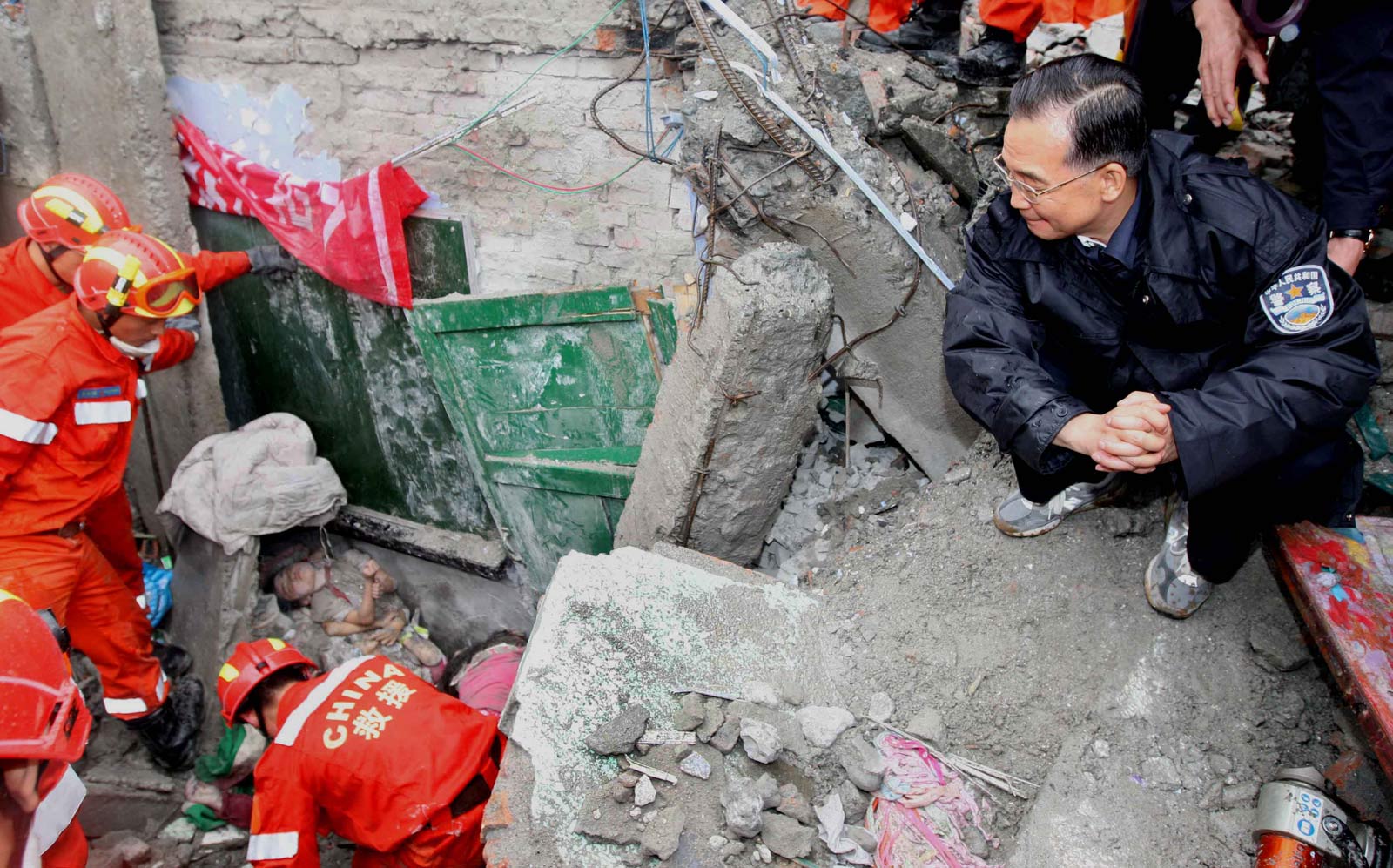
    9/11 was an external event that allowed much, though not all, of America’s anger and grief to be directed outward. China’s earthquake is an internal event. There are no plausible outside forces to blame. The burning questions being asked now are about why a reported 7000 schools collapsed. These questions are given urgency by the pathetic and politically powerful photos (warning: not for the sensitive) of the bodies of primary school students huddled in wreckage. Interestingly, that image was effectively co-opted by Premier Wen Jiabao when he was photographed amid the wreckage, looking at the bodies of students (also not for the faint of heart). An American president would almost certainly not be allowed by his communications team to be photographed in such graphic circumstances.

    So if this is China’s 9/11, where will the Chinese direct their anger and grief as shock begins to wear off? It occurs to me that the earthquake, a true national trauma, might have two possible effects on the current prevailing mood of prickly nationalism. Either it could feed into the nationalist sentiment, and possibly provide fresh impetus for it. Or it might make the nation take a breath and perhaps refocus its energies more constructively. With the Olympics less than three months off, I rather hope for the latter, but the reaction I saw on the square makes me wonder if the former is more likely. So does the degeneration of the nationwide charity drive into a competition in which job threats, Internet floggings and angry SMS campaigns are directed against individuals and companies, especially foreign ones, seen to have been slow or miserly in their contributions.

    One pocket of a nationwide observance is hardly representative, and a poor basis on which to draw sweeping conclusions. A chant is just a chant. Extreme Internet comments are notvox populi. China is not America, and 5/12 was a in the end a very different event than 9/11. The comparison can be easily overblown. Nevertheless, I wonder what place the quake will occupy in the Chinese national consciousness as we slog the rest of the way through this troubled year.

    Shrouded in dust: China's 9/11?
    Shrouded in dust: China’s 9/11?
  • Was the China corruption website collapse story “newsiness”?

    The greatest contribution that comedian Stephen Colbert has made to modern society is the concept of “truthiness”. Reading from the Wikipedia definition, truthiness is:

    …a satirical term to describe things that a person claims to know intuitively or “from the gut” without regard to evidence, logic, intellectual examination, or facts.

    Miraculously, the entry goes on for another 3400 words on the concept of truthiness, proving not so much that truthiness is an important concept as that Wikipedia is balls-out for pop culture. Nevertheless, “truthiness” has transcended its comic-neologism origins to become a legitimate word, which says something about the zeitgeist.

    Imagethief wishes that Colbert had similarly enshrined the concept of “newsiness”. Borrowing from the definition above, newsiness could be described as a satirical term to describe things that a person claims is important or newsworthy without regard to evidence, logic, intellectual examination or facts. It feels like news, whether it really is or not.

    This is something that we flacks are familiar with. At our worst PR types trade in newsiness, packaging up bits of corporate dander and passing them off as significant. But we’re not exclusively to blame. Sometimes newsiness arises spontaneously in the form of a story that is less than meets the eye. Last week’s story concerning the collapse of the National Bureau of Corruption Prevention’s new website under apparently heavy traffic strikes me as an example of newsiness.

    Foreign coverage of this story can be traced backed to a Beijing Youth Daily article, which I don’t have a link for, and a subsequent English-language Xinhua report that was deftlymassaged into final form by our own Chris O’Brien of Beijing Newspeak. The story was that the recently constituted National Bureau of Corruption Prevention, a relatively toothless body set up to “collect and analyze information” on corruption, launched a new website that included a guestbook function enabling members of the public to post semi-anonymous comments. However the website crashed within hours of launch due to a “large number of visitors”.

    This fits very nicely into one of those social-issue memes that define much foreign news coverage of China, and that often take the form of “a nation struggling with [insert social issue here]“. Examples are a nation struggling with pollution; a nation struggling with censorship; a nation struggling with Internet addiction; and so on. The issues are set up via colorful or heartstring-yanking anectodes often involving stoic, salt-of-the-earth 老百姓 types recalling their woes, and rounded out with a mix of quotes from NGOs/overseas experts/local academics/old China hands and the kind of eye-popping statistics that China excels at generating and that make pretty much any problem here seem thoroughly intractable.

    In fact, much good journalism is done this way and it works well for the home audience that reads one newspaper. But if, like Imagethief, you are a news junkie living in China and you read vast troughs of China coverage from a range of publications, it’s hard not not to notice the formula.

    This system also promotes the dissemination of lightweight stories that simply fit into issues established by precedent. This particular story originated via the Xinhua article, which seems to have originated as a “why our website went down” disclosure formality. It plugged nicely into the “nation struggling with corruption” meme and was duly picked up by the foreign press, almost all of which cited the Xinhua article. The tone and detail of the foreign stories vary a bit, but looking at the headlines and ledes a clear mental picture emerges:

    Reuters:
    China anti-graft Web site felled by “too many hits”
    BEIJING (Reuters) – A Chinese government Web site encouraging citizens to report corruption crashed on its first day under the weight of too many hits.

    AFP:
    China anti-graft website crashes under public complaints
    BEIJING (AFP) — The website of China’s new anti-graft bureau crashed shortly after going online due to the huge volume of messages from the public complaining about rampant corruption, state media said Wednesday.

    Telegraph:
    China’s new anti-corruption website crashes
    A Chinese government website set up for the public to complain about corruption crashed within a day of launching under the volume of cases reported.

    The website was constructed by the National Bureau of Corruption Prevention to collect information on corrupt activities as part of an ongoing purge by the Beijing authorities.

    Associated Press:
    Anti-graft Web site swamped in China
    BEIJING: A new Web site created by China’s anti-corruption bureau crashed after barely a day because too many visitors had tried to log on to register complaints, state media reported Wednesday.

    Washington Post:
    Chinese Assail Official Misconduct With Fervor
    BEIJING, Dec. 19 — China’s new National Bureau of Corruption Prevention thought it would be a good idea to open a Web site for citizens to denounce crooked officials. The idea was so good that the site was immediately deluged this week by irate Chinese, overwhelming the system and causing several crashes during the first two days of operation.

    So what did you see in your head? Imagethief saw an image of zillions of oppressed Chinese people desperately clicking on the NBCP’s web page. This is image was helped along by the recent, widely publicized woes of BOCOG’s Olympic ticket sales website, which really did crash under the fevered clicking of zillions of people. But unlike the Olympic ticketing stories, in which the actual traffic and transaction load on the site was reported, the only figure in any of the stories above is the number of pages of comments, ranging from 16 to “more than 20″. Only the AP story lists a specific number of comments: 250. An NBCP official was quoted in the Xinhua article as saying, “The number of visitors was very large and beyond our expectations.”

    Well, yes, but what were your expectations?

    Hoping to find more information, Imagethief took himself to the site for a first-hand look. As of last Friday there were still about 20 pages of comments, each with fifteen individual posts, for a total of about 300. Anyone who has spent time on a popular Chinese blog or in the forums knows that this is pretty small beer. For comparison, when CCTV 9 anchor Rui Chenggang condemned the Forbidden City Starbucks on his Sina blog just under a year ago, he got 450 comments in 24 hours, on his way to nearly 3000. Sam Flemming’s CIC, which monitors Chinese online buzz, tracked over 4 million posts on automobiles in the three-month period from April-June of this year (full report — PDF, registration required).

    These are not entirely fair comparisons. The degree of freedom people feel to comment about corruption is not the same as they feel to comment on the Chery QQ or foreign coffee shops, and the overlap of corruption victims with Internet users is smaller than that of car aficionados. But it does introduce some perspective on what constitutes a “hot” online issue in China.

    Corruption is a real issue here. The corruption website collapse story is neat enough to tie a Christmas bow around, and the foreign reports are all factually accurate, insofar as they essentially relay the Xinhua report. But what does this incident really say about Chinese society and the problem of corruption? There is a big difference between a site that was designed to support tens or hundreds of thousands of simultaneous visitors and was still overwhelmed by crushing demand, such as the Olympic ticketing site, and a small-potatoes site that fell over under moderate traffic or because it was designed, programmed or tested badly. Imagethief designed and developed e-commerce sites for many years and can assure readers that this a common problem. But “China anti-graft website collapses under public complaints”, to borrow one of the headlines above, is going to get many more people reading than, “China anti-graft website collapses because of poor programming”.

    Fine. That’s the news business. Gotta get eyeballs on the page, and Imagethief, a subway commuter who reads on the way to the office, likes a punchy newspaper as much as the next guy. No harm in relaying a vacuous Xinhua story (sorry, Chris — not your fault), especially when it fits so neatly into an existing pigeonhole. It’s still “newsiness”, but if nothing else it can help keep our minds off of much more worrying things, like the ever dumber things American politicians are saying about China.

  • Why the Yilishen ant-farming scandal was the perfect China story

    Imagethief recently found himself huddled in a wintry hutong courtyard in conversation with two longtime Beijing-based foreign correspondents. During this discussion we came to the conclusion that the recent Yilishen ant-farming scandal is more or less the perfect China story. It brings together at a stroke all of the elements of the modern Chinese story. And surreal story it is.

    If you’re not familiar with this incident (and you really should be), you can go read Mark O’Neill’s comprehensive article on Asia Sentinel, or any of several other stories which, collectively, have generated something of a bumper crop in pun headlines.

    But if you’re pressed for time here is a synopsis: The Yilishen Tianxi Group, a Shenyang-based company, was manufacturing an allegedly aphrodisiac tonic made from ants, which are widely believed to have medicinal properties in traditional Chinese medicine. But rather than wrangle ants itself (nothing feels as good as bringing in a herd, I hear) Yilishen’s scheme was to sell would-be ant farming “investors” boxes of special medicinal ants at RMB10,000 for three. Along with the boxes came a promise that once the ants matured (read: died), about 14 months later, Yilishen would buy them back for RMB13,250. That’s a 30% guaranteed gain over 14 months which, while not quite pre-meltdown A-shares, kicks the ass of many a hedge fund.

    Except that the Yilishen ant trade was a pyramid scheme, and it went spectacularly bust, leaving tens of thousands of Dongbei punters short RMB10,000 and long three boxes of worthless ants. Not exactly Warren Buffet. Outraged ant farmers from across Liaoning province rioted in Shenyang, the government imposed a news blackout and the wujingarmed police headed north to diligently maintain a harmonious sociey, which is hard under these circumstances.

    You simply could not make it up. Ten Hollywood screenwriters locked in a closet with a kilo of blow, a brick of twenty dollar bills, your sister and a cigar-smoking chimpanzee in boxer shorts wouldn’t come up with this. Even if they weren’t on strike. Only China comes up with this. And not only does China alone come up with this, but the story also nicely draws together all the threads of the modern, Chinese narrative and ties them into a pretty bow. Just look at what this story offers:

    Social Issues
    The Dongbei is China’s rustbelt; a swathe of deep-frozen, fading industrial towns that were once the showpieces of Maoist industrial collectivization. While the cosmopolitan port city of Dalian has blossomed in China’s post-reform economy, much of the region has struggled to keep up with the go-go development of the two Deltas and the capital. Hence the “振兴东北老工业基地” (Revitalize Northeastern Industrial Base) campaign and those tragic stories of families’ life savings being sunk into ants and ant-aunties pooling the funds of their neighborhood taiqi group to go in on a few lucky boxes. Apparently about a million people bought into the ant-dream. Could ant farming be symbolic of the economic desperation of an entire region? Or might it just be a punt? Who cares, because there was also…

    Sex
    About 98 percent of Chinese medicines are aphrodisiacs. The average Chinese pharmacy is about half aphrodisiacs and half prophylactics with one or two boxes of nasty, herbal flu medicine just in case. The reason why rhinoceros and tigers have been hunted to near extinction is to make Chinese aphrodisiacs. Imagethief himself once appeared in a television commercial for a Chinese aphrodisiac. They’re that ubiquitous. You’d think the Chinese had never heard of p0rn. And what goes better with sex than…

    Corruption
    Yilishen Group turned out to be well connected throughout Liaoning provincial circles. This had apparently helped fuel its rise in the province, but also motivated embarrassed local officials to make the whole situation go away as soon as possible. That left bereft antherds with the usual channels of legal recourse available to the small-time victim under provincial Chinese jurisprudence: none. Therefore, the only alternative was…

    Mass incidents
    Ten thousand ant farmers rioted in a provincial capital. Imagethief asks you: What country other than China could cough up that lede? Mass incidents are the sine qua non of the modern Chinese scandal. In a rare and rapidly regretted moment of candor the authorities once admitted that there were 74,000 of them in 2004, up 28% on the year before (not quite as much as the pre-collapse return on ants, but still pretty good). No pressing social issue is complete without one. Chemical plant going up on your rice paddies? Shanty being expropriated for Olympic development? Local manufacturers turning your once limpid lake into a festering pool of PCBs and heavy metals? Two words: Mass incident! However, this may be the first one caused by…

    Ants
    Ants? Yes, Alice, ants. Imagethief tries to maintain a culturally sensitive respect for traditional Chinese medicine. Indeed, when I pinched a nerve in my shoulder two years ago I took traditional Chinese medicine and had a round of cupping (note to Americans: it’s not as dirty as it sounds). It worked, I believe, only because the medicine was so nauseatingly foul and the cupping so excruciatingly painful that I willed myself to recover so that I wouldn’t have to endure a second course of treatment.

    But, really, an ant-based sex tonic? Hasn’t this ground been trodden before? The image of so many fevered, Chinese investors hunched over their RMB10,000 boxes of magical ants is both funny and desperately tragic. Unfortunately it was all a bit too much embarrassment for the Chinese authorities, so naturally…

    The whole thing was harmonized
    Mainstream coverage evaporated and the search term “Yilishen” went down the Chinese Internet memory hole once the authorities decided they’d had enough. Previously uploaded videos and blog posts dropped gnats in a frost. China’s pre-eminent citizen journalist, Zuola, a veteran of the Chongqing nailhouse and Xiamen PX stories, wasescorted out of Liaoning. To add insult to injury he was apparently made to pay for his own plane ticket. No word on whether he had to pay for the tickets of the goons who escorted him.

    Imagethief has a friend from Shenyang who complained bitterly about the suppressed media coverage. “It’s not like we don’t all already know about it,” she said, admitting that her own parents had been among Yilishen’s legion of ant farmers. “It’s so…” she considered the English word she wanted to use…”insulting.”

    Meanwhile, many of the Yilishen riot videos harmonized from Chinese video sharing sites have found their way onto YouTube. You can’t keep a good story (or a bitter ant tonic) down.

    And that’s all there is to it
    Imagethief in no way wishes to minimize the plight of Yilishen’s investors. RMB10,000 is a lot of money by any standards. My friend from Shenyang also explained that her parents neighbors had invested RMB60,000, and they knew people who had invested a whopping RMB1,000,000. Imagethief also doesn’t think that investors in Yilishen’s ants were stupid. Scams and pyramid schemes thrive everywhere. Successful ones are cleverly engineered to appealed to the society in which they operate. Yilishen was a well known brand that had been in business for several years and had a good reputation. Traditional remedies are still widely used and respected in China, and ants are part of the pharmacopoeia. Virility tonics are popular. Combine all of that with a cultural affinity for gambling and a get-rich-now zeitgeist and you have a China story for the times.

    For sheer swoop and color it sure beats the rise and fall of China’s other great pyramid scheme, A-shares.

    Eat me.
    Eat me.

    Notes:

    • Photo copyright Alex Wild, from his superb ant and insect photography gallery.
    • Imagethief realizes he is a bit behind the story. This post has been in drafting for ten days. Darn those day-jobs.
  • Bang! China shoots its own Olympic PR in the foot

    Imagethief, who has bid for something on the order of RMB12,000 worth of Olympic tickets, is trying resolutely to remain optimistic about the Games. Unfortunately, it’s proving harder as time goes by. Tomorrow marks the one-year-remaining milestone. This should be an opportunity for Beijing to highlight progress, turn the excitement crank, and demonstrate that has the patience and forbearance that will be necessary for a successful Olympics. However yesterday brought an important test of China’s patience and forbearance, and China failed it.

    The problem is that while tomorrow’s milestone date is a legitimate time for celebration and anticipation, it was inevitably also going to be a perfect date for a dry-run by the many activist groups that want to appropriate the Olympics for their own agendas or score points against China. Sure enough, that is what has happened. Reporters Sans Frontieres,Human Rights Watch, the Committee to Protect Journalists and Amnesty International all chose this week to release announcements or hold protests.

    Of these, the RSF protest yesterday was most provocative. Activists wearing T-shirts and carrying signs that portrayed the Olympic rings as handcuffs staged a demonstration on a highway bridge near BOCOG’s headquarters. To add an extra measure of discomfort for Beijing, IOC Chairman Jacques Rogge happens to be in China right now.

    Unfortunately, reports say that foreign correspondents covering the protest were detained by police for one or two hours afterward and “roughed up”. From the AP coverage:

    [Uniformed] and plainclothes police physically restrained reporters coming down from the pedestrian bridge, pushing and pulling them, seizing IDs and refusing to allow them to leave the scene. Reporters were detained in a parking lot directly opposite the Olympics office tower, facing the Beijing 2008 logo and Olympic rings on the outside of the building.

    Journalists were allowed to leave after about two hours, with no explanation from police about why they were detained.

    A woman in the spokesman’s office of the Foreign Ministry said she did not know about the case and would look into it. Liu Wei from the information office of the Beijing Olympics Organizing Committee said she was not aware of the situation and had no comment.

    If that isn’t playing right into RSF’s hands I honestly don’t know what is. I found the reports somewhat confusing and had to dig around to get a clear idea if the journalists detained on site were protest participants or locally credentialed reporters covering the event. But it appears to be the latter. RSF’s own release suggests much the same.

    The best thing for Beijing to do under these circumstances would have been to err on the side of tolerance and allow the protest to proceed under supervision. Credit is earned slowly, painfully and in tiny increments while setbacks come in great, heaving leaps, and activists can win the PR battle by baiting the Chinese authorities into overreacting. Detaining journalists on the scene, under any circumstances, was asking for trouble.

    The result is not only that the protest is probably getting more coverage than it would have otherwise, but that the tone is distinctly nastier from Beijing’s point of view. Coming on the heels of last week’s widely covered FCCC survey and at the same time as all the other reports listed above, it looks very bad and reinforces people’s fears of what might go wrong during the Games themselves.

    The PR rule of thumb operating here is that response to an issue can become the issue if it is handled badly. That is a rule that Beijing needs to stay mindful of. Unfortunately, it seems likely that not all of China’s bureaucracies will be on the same page about this. It is entirely possible that BOCOG and the Public Security Bureau will have different opinions on how these kinds of situations should be handled. This might be someplace where the IOC could provide a little visible leadership, but they have stayed silent until now.

    Fair or not, China will be judged differently than other countries that host the Olympic Games. Now matter how glamorous the venues, how exciting the games, or how successful China’s athletes, the Games will be judged in large part based upon how gracefully Beijing can manage the inevitable protests. That is the price China pays for hosting the Games in a political environment that disdains many of the freedoms that the Games’ primary audiences abroad take for granted. The Financial Times‘ Beijing Bureau Chief, Richard McGregor puts it nicely:

    Over more than a decade Beijing has gradually defused pressure over its human rights record. Through remorseless diplomacy and skilful use of its growing economic clout, it has sidelined western complaints about human rights and marginalised the non-governmental lobbies that seek to promote them.

    The Olympics, however, are offering China’s critics a moment in the sun, and they have grabbed it eagerly.

    McClatchy’s Tim Johnson also captures the risk Beijing faces nicely:

    Because of China’s history of quashing revolt, any protest has the potential to become an iconic image, like the moment when U.S. athletes Tommie Smith and John Carlos raised their fists in a “black power” salute at the 1968 games in Mexico City.

    That’s an important thought to bear in mind. It will be interesting to look back a year and a month from now and see what the iconic image of the Games is. I sincerely hope it will be a moment of athletic triumph or a moment of Olympic splendor in one of those magnificent venues.

    After all, the Olympics are a magnificent opportunity for China. An opportunity not only to showcase the country’s development and rightful place on the international stage, but also to explore a more constructive way of engaging with the activists and NGOs that, for better or for worse, will be interested in China for decades to come.

    But the heavier a hand that Beijing takes in dealing with dissent and protests before and during the games, the higher the chance that the iconic image of Beijing 2008 will be something that dispels the goodwill the Olympics could create and reduces those opportunities to dust.