Tag: China in the News

  • Bullet in the head: Marquee executions and public communication

    As has been widely reported, the Chinese government has got round to making an official example of Zheng Xiaoyu, the disgraced former head of the State Food and Drug Administration who became the poster-boy for China’s rippling food and drug scandals. In their eagerness to send a message, they got round to it quite quickly; from sentencing to execution in about six weeks. American capital punishment supporters can only dream of being able to dispatch ne’er-do-wells with such efficiency. Zheng’s story is nicely recapped in a New York Times article by David Barboza.

    Everyone who comes to China or learns Chinese rapidly becomes acquainted with one of China’s entry-level proverbs, “killing a chicken to scare the monkeys”, meaning to make an example of someone. It’s a phrase that has been thrown around a lot with regard to this case. To Imagethief’s mind, China has probably killed the wrong chicken.

    Executions have a long tradition as public communication. That’s why, historically, executions have either been public or very well publicized. Look what we do to murderers/ robbers/ adulterers/ royalists/ deserters/ partisans/ corrupt mandarins/ spin doctors, etc. It could happen to you, so stay in line. Whether or not executions are effective as a deterrent is debatable (and widely debated). But that they are used as communication is indisputable.

    Imagethief is not a fan of the death penalty. I feel that it is often applied in my own country more as vengeance and social catharsis than justice, with substantial class and racial biases. I am also not convinced of its value as a deterrent. You can always tell which governments are really serious about using death as a tool of policy because they are the ones that skip the public communication element and simply disappear people. Word of mouth does the rest. If you really want to keep the public on its toes, that seems to be the way to do it.

    However I must concede that the public communication value of executions extends beyond deterrence. For example, a death penalty can be employed as a demonstration of government resolve or as proof of piety. Looked at that way, you might reword the hoary Chinese idiom into “killing a chicken to demonstrate institutional resolve to the monkeys,” but that doesn’t reduce elegantly to four characters.

    So was Zheng Xiaoyu’s execution supposed to be a deterrent or a demonstration of resolve? Looking at the (somewhat spotty) English translation of the People’s Daily editorial hailing the execution, perhaps a little of both:

    Death penalty handed to Zheng Xiaoyu has fully proven the will and desire of the people across China, eloquently showed the spirit of the fairness and justice of legal sanction as well as the firm resolve of the Party and the state. For corrupt officials, no matter whoever he is, what a high position he occupies and how deep he has hid himself, probes into the cases he is involved will be carried out resolutely and thoroughly, but no indulgence or soft hand will be granted to him.

    Death penalty handed to Zheng Xiaoyu indicates that laws are stipulated in explicit terms, penalty is meted out in strict compliance with his crimes, and punishments commensurate with his duty.

    ***

    As part of the effort to cope with corruption, no “extraordinary and special” Party members are allowed to stay aloof the laws and no corrupted elements permitted to have any place to hide themselves. Whoever daring to commit outrages and run amuck in defiance of state laws will be subjected to severe punishment of the Party disciplines and the state laws.

    Imagethief also particularly likes one throwback line in which conjures up the best of Maoist-style righteous, nationalist rhetoric:

    A few individual Party officials, prompted by interests and money, nevertheless, have gone crazy to the defiance of laws, and Zheng and his ilk belong to such jackals from the same lair.

    “Jackals from the same lair” is a slightly more advanced Chinese saying meaning roughly, “cut from the same nasty cloth”, and has been used before in Chinese government communication to describe people such as Richard Nixon and Hubert Humphrey, Indian reactionaries and British imperialists, and, as a variation on the same idea but with a shuffling of enemies, Soviet revisionists and US imperialists. It’s nice to see the People’s Daily reaching for some trusty, old tools.

    The question then remains, was Zheng’s execution effective as public communication? This depends who the audience was. If the audience was other senior cadres, possibly, but with qualifications. If the audience was the public, I think not.

    The problem with using punishment as a deterrent, besides having to communicate it, is that the threat needs to be credible and proximate. People need to believe that it if they transgress, punishment is likely to befall them. I’m not a criminologist or lawyer, I’m a communication expert, so I’ll stick to looking at this in terms of the beliefs that might exist and the messages that might be communicated and received around such situations.

    What makes the threat of punishment real to someone? I would suggest that a potential criminal has to believe three things: That the likelihood of being caught is high enough to factor into their calculations; that if caught the punishment will be enforced; and that the punishment itself will hurt.

    A lot of legislation and police work is bound with communication campaigns to ensure that the right people are convinced of these three things. For example, my own state of California produced the memorably titled and widely publicized “Three Strikes and You’re Out” law, whereby a third felony conviction is an automatic life sentence. (It was widely applied, too, and helped to clog up our jails to the delight of the California prison lobby.)

    Assuming a rational and intelligent actor (an immense assumption, I realize — after all, the world is rife with crimes of passion and moronic criminals) these three risk factors will be weighed against potential rewards in a decision as to whether or not to misbehave. So an authority that wants to encourage good behavior ought to communicate credibly on all three fronts (assuming that counting on people’s essential goodness is, ahem, sometimes not enough). You will be caught. You will be punished. And it’s gonna hurt. If any one of those three things isn’t believed, your communication is probably ineffective. This is true at any scale. It’s why governments advertise that they execute people (or even just fine them) and why your mom told you that she had eyes in the back of her head and that you’d lose your allowance if you fought with your little brother and that she was serious. And probably busted you once or twice just to prove it.

    Making a public spectacle of a punishment, say by widely publicizing it in the media, is part of this process. The problem is that when an occasional person is conspicuously made an example of, people are apt to discount the message. It was political. He was unlucky. He didn’t have good enough connections. He was stupid. He was a much bigger fish than I was. All of these rationalizations are ways that potential misbehavers might distance themselves from the person being made an example of, diminishing that sense of the likelihood of being caught.

    If you don’t think you’ll get caught, the other two factors –the likelihood and severity of punishment– are irrelevant. All that stands between you and tainted lucre is, well, your conscience. Furthermore, it’s easier to distance yourself from someone who is unlike you. That’s why Zheng’s execution might be a reasonably strong message to senior cadres and civil servants, and a fair demonstration of party resolve, but why it probably doesn’t mean much cadres out in the provinces or to the guy making counterfeit drugs in the suburbs of Bengbu. (This idea of identification works in reverse as well, and it’s why you use role models to advertise to people.)

    So if the occasional, high profile punishment is ineffective, what might work?

    Let’s start with an assumption: People have to believe that the institutions responsible for the processes of identifying transgressors and dispensing punishment cannot be easily short-circuited. This doesn’t mean that you need western-style rule of law for punishment to be effective, but it does mean you need to demonstrate consistency. The Taliban were ferociously effective based on the simple expedient of consistently shooting or beating to death anyone they thought wasn’t toeing their line. It was repulsive and barbarous, but it worked.

    China probably aspires to a less arbitrary process than the Taliban had, even if it sometimes doesn’t look that way. But this is where endemic corruption causes problems because it short-circuits the institutions and processes by which lawbreakers are identified and punished, rendering them terribly inconsistent. In the absence of consistent proof, communication is reduced to noise. Ultimately, it’s not enough just to say it. You need to do it regularly or people stop listening. The most effective PR, remember, is based on actual deeds.

    But you can’t line up everyone against the wall and shoot them (unless you’re the Taliban). So what should China do?

    What would be effective in the long term is to launch and visibly communicate a nationwide campaign of much tougher enforcement against garden variety businesses and businessmen who cut corners, make unsafe products or skirt the rules, and against local and provincial regulators and cadres who are found to be corrupt. If garden variety misbehavers believe there is a real chance they’ll get a painful fine or jail sentence, that their businesses will be closed or that they’ll be successfully sued, then they might reconsider the percentages. If they don’t believe that, they won’t care whose head gets rolled in Beijing.

    It won’t be the distant threat of execution that does the trick, but the immediate threat of a routine inspection. Beijing shouldn’t avoid punishing corrupt senior officials, but hearing that the guy up the street got raided despite being the cousin of the head of the local PSB will be much more effective than a distant guillotining in the capital. Many such examples –by which I mean thousands– would provide the basis for a much more broadly effective communication campaign.

    To China’s credit, the government is trying to do this. Recent announcements thathundreds of businesses have been closed for safety violations are a start. But ultimately it becomes a question of scale and that’s where the problems seem insurmountable. Without root-and-branch reform of its institutions, and there are eight involved in food alone, it may simply be impractical for China to enforce this kind of program at any meaningful scale. In that case, there is little alternative for the government to continue to rely on “showcase” prosecutions to make its case, ineffective though they are.

    This is also where government control of media and public expression exert a cost. If you can’t build credibility from the top down, an alternative might be to aid communication from the bottom up. Grass-roots anger from Chinese people who are the victims of many of China’s quality problems and scams could be a powerful thing. So could a less fettered media, free to range across the country and peer more deeply into dank corners. But the media is prone to many of the same problems as government institutions, compounded by regulations that make it difficult to report on issues that the government finds sensitive.

    Charitably, Zhen Xiaoyu’s execution shows the government’s resolve to attack its institutional problems as starting point for better enforcement at all levels. Less charitably, it will sail over the heads of the small-time crooks and entrenched powers responsible for so many of China’s problems and doom Mr. Zheng to being just one more in a line of long-forgotten high-profile examples.

    See also:

  • China’s food crisis PR strategy: Blame everyone else

    A few weeks into China’s rippling food quality crisis a PR strategy is coming into view. It’s a classic one: blame everyone else. Unfortunately, it’s not likely to be all that effective because of two things. First, China does actually have long-standing problems with food and drug quality. Second, China’s poor history of transparency makes it hard for them to dispel suspicion (a problem that also dogs their disease-related communication).

    The recent affair began with the discovery that vegetable protein shipped from China to the USA and used in pet food had been contaminated with melamine, a plastic that can make the overall protein level appear higher. Melamine also destroys the kidneys of cats, as it happens, so the contamination was discovered.

    In classic fashion, China’s initial response was to deny everything. As a crisis PR strategy this sucked. Nothing makes you look sillier and less credible than retracting a categorical denial made in haste. It taints every following communication. In fact it wasn’t entirely China’s fault. Initially AQSIQ, China’s quality monitor, wasn’t looking for melamine, but another suspected contaminant. But obscure mitigating technical factors don’t tend to play well in the court of public opinion, or excuse prudence. In the face of further disclosure, the Chinese government’s subsequent choices were to appear dissembling or incompetent.

    Every country has its fair share of food quality problems. In my native USA E. coli bacterial contaminations are something of a national sport, and I can remember plenty of food poisoning scandals. Eric Schlosser’s book, Fast Food Nation, makes fine reading if you are interested in the topic. The FDA conveniently puts its “refusal reports” –the reports of imports rejected– online. If you want to be horrified, read the Mexican list. Food contamination is not an exclusively Chinese problem.

    China’s government has grabbed onto this idea as part of its defense. It has been helped by some recent developments, including the rejection of a shipment of Evian for alleged bacterial taint (a case that stokes the fire of another China PR issue, Danone’s legal war with Wahaha — see this interesting post from China Law Blog) and the discovery of Melamine in some US-manufactured animal feed ingredients. Li Yuanping, director general of the government’s Import and Export Food Safety Bureau, also pointed out that China has in the past rejected US products due to Salmonella contamination, and asserted that China’s record on food exports is slightly better than the United States. Li offered up some winning quotes:

    “Ninety-nine percent is a relatively high percentage of suitable goods,” Li Yuanping, director general of the government’s Import and Export Food Safety Bureau, said at a news conference. “Facts speak more loudly than anything. . . . From what I have told you, you can see China has a very sound system that can guarantee the safety of food exported abroad.”

    ***

    “No food-inspection system is foolproof,” he said. “It’s like an airplane. Flying is said to be the safest way to travel, but sometimes you have plane crashes.”

    Bad choice of words in Imagethief’s opinion. You think an airline would communicate that way? But I haven’t been hired to advise the Chinese government.

    Graceless rhetoric aside, Li might actually be right. But perception is everything. Frank Luntz, a conservative pollster, wrote a pretty good book about public communication called Words that Work in which he relentlessly drove home a key point: It isn’t what you say, it’s what people hear (in fact, that’s the subtitle). You say “99% are good”. Americans in bathed in relentless media coverage will hear, “1% might kill you”. Roll the dice and move your mice.

    Like a premature categorical denial, “everyone else sucks too” is considered a weak strategy around our office. You think China’s national ambition is to suck only as hard as everyone else? I think they want to be better. More importantly, as far as the audience is concerned we’re not talking about everyone else. We’re talking about export-driven China, which has a great deal at stake in overseas perceptions of its food quality. In international trade, food and drug safety issues get entangled with every other hot button issue. And in the US right now China is second possibly only to Iraq as the hottest of hot-button countries.

    To illustrate, let’s look at that Mexican example above. America simply doesn’t have as big an axe to grind about Mexican imports (except for immigrants) as it does about Chinese ones. Mexico isn’t the emerging strategic rival. Mexico doesn’t hold a trillion dollars worth of American debt. You don’t hear about America’s trade deficit with Mexico (about a quarter the size of the one with China in 2006). By and large, Mexico doesn’t threaten American agriculture so much as it props it up with cheap labor.

    You get the idea.

    Agenda hockey

    Following the great melamine scandal of ’07 a few other China-linked disasters have emerged into public view. In early May the New York Times ran a lengthy investigative report on tainted cough syrup in Panama killing people. The cause was toxic, cheap ethylene glycol from China sold as harmless but more expensive glycerine and used in the manufacturing. The ethylene glycol has been getting around, apparently, as it has also found its way into Chinese toothpaste (proxy link) exported to Panama, the Dominican Republic, Costa Rica (and, for good measure, smuggled into Nicaragua) and, it has been discovered, the United States.

    As far back as mid-May, Dave Barboza of the New York Times and International Herald Tribune was writing about China’s “credibility problem” surrounding food exports. The situation has not improved since then. Barboza points out that a thirty-billion dollar a year export business it at risk. And that’s where the agendas come into play. The Washington Post, among others, has run op-ed columns editorializing about Chinese food imports in pretty strong terms. Here’s a recent lede:

    And what is madame’s dining preference this evening? Scallops coated with putrefying bacteria? Or mushrooms laced with illegal pesticides?

    These delicacies and more were among the hundred-plus foods from China that our Food and Drug Administration detained at U.S. ports last month, Rick Weiss reported in Sunday’s Post. Detained and sent back to the importers, who ofttimes sent them back to us again.

    Yuck. The Rick Weiss story linked to in that op-ed piece is headlined “Tainted Chinese imports common”. That’ll stick in people’s heads.

    China is busy trying to persuade the United States to allow imports of Chinese frozen chicken, among other things. What stories do you think American chicken farming companies are busy reminding Congress of right now? The Boston Globe, which is not much of a China cheerleader (they regularly run op-ed pieces on China and Darfur and have played a big role in the “Genocide Olympics” campaign), was running gross-out stories on Chinese chicken farming way back in early May, before this whole episode even kicked into high gear. More recently, the American press has been reminding everyone that their vitamins all come from China. That story was by McClatchy’s Tim Johnson, who also wrote an interesting post about this on his blog. Check it out to see some interesting public reaction.

    So the picture that is emerging is of a food and drug supervision apparatus that is hopelessly broken and that has been for some time. This will be no surprise to anyone who lives in China, where food scandals fall from the skies like the Shanghai plum rains. But it’s making waves overseas now, with enormous business implications. You might think that a serious, soul-searching look at the state of domestic regulation and enforcement, vigorously communicated, would be China’s solution.

    You would be wrong.

    The blame game

    China certainly takes the situation seriously. In fact, seriously enough that English-language state media in China, in the form of the China Daily, excoriated China’s regulators for their crappy communication (here reported on by the AP). That is significant. In fact, suggesting something of an editorial slant, the China Daily also went so far as to publish a Wall Street Journal story titled “China confronts crisis over food safety” in its entirety on the China Daily website, with attribution and an external link.

    The popular Southern Metropolis Daily also ran a column by journalist and blogger Lian Yue, translated by Danwei, that linked the food safety problem to broader problems in China. I don’t know if similar commentaries ran elsewhere in Chinese language media. Anyone who has seen anything should post a comment.

    But the official response from the government, represented largely by AQSIQ, has been essentially to blame anyone and anything but the system.

    In the case of the Panamanian cough syrup, the deputy head of AQSIQ blamed Panamanian traders, an account disputed elsewhere. In the case of the tainted toothpaste, China is accusing the American FDA of sensationalizing the situation. In that same story the head of AQSIQ’s food safety division accused the foreign media of the same thing, describing their reporting on the scandals, in an exquisite choice of words, as “wanton”.

    The charge of media sensationalism may be justified to a degree, but blaming the media is almost never an effective PR strategy. It carries an inescapable whiff of Scooby-Doo, as in, “I would have got away with too, if wasn’t those meddling kid reporters!”

    Finally, the Chinese government is blaming its former drug chief, Zheng Xiaoyu, for the entire situation (interestingly, a Google search for his name this morning causes Nanny to issue the deadly “server reset” message). The unlinkable South China Morning Post drove the point home with a headline last Friday that read, “Corrupt drug chief blamed for scandals.” AQSIQ and the State Food and Drug Administration (SFDA) double-teamed on this one:

    SFDA spokeswoman Yan Jiangying said the agency should not be blamed for Zheng’s mistakes. “I want to highlight that we should not dismiss the entire drug supervisions system because of a single person, Zheng Xiaoyu, and we should not extend the mistakes made by a single person, Zheng Xiaoyu, to the mistakes of the entire system,” she said.

    So its Zheng Xiaoyu’s fault if you had any trouble reading between the lines. And people say the Chinese are cryptic.

    When China rolls somebody’s head over a scandal it’s not always a metaphor. To show how serious it is about that accusation, Beijing has sentenced the hapless Zheng to death. It has been a long fall for the man who was tasked with cleaning up in the wake of the awful Anhui baby formula scandal of 2004.

    Killing the wrong chicken

    Let’s go back to Frank Luntz’ point about it not being what you say but what people hear. Executions have a proud tradition as public communication. China thinks that the message that they are sending  with Zheng’s sentence is, “We are goddamn serious about this.” Imagethief is willing to bet that the signal received by overseas audiences will be, “We are so thoroughly corrupt that we had to execute our former top drug regulator.” The question going through heads overseas will be, “Well, whom haven’t they caught yet?”

    Executing a mandarin probably won’t have any effect at all on the small processors and exporters who seem to be responsible for most of the problems. Zheng is too far removed from them. Unless small companies feel the weight of enforcement landing squarely on their own shoulders, with an attendant shift in the overall risk/reward equation, their behavior won’t change.

    The lingering question is whether a combination of endemic corruption and industry fragmentation render the problem unsolvable. An Imagethief commenter named Jim recently made a good point. He wrote:

    Processing millions of tons of food, through millions of workers in tens of thousands of large and small companies, with high cost-cutting motivations, from millions of farms through thousands of transportation companies to millions of sellers to tens of millions of buyers, is hard.

    Yes, it is. But I’m an optimist and China needs to show that it is serious about regulating that very process and enforcing vigorously if they want to get past this episode. And they need to clearly communicate exactly what they are doing to both domestic and overseas audiences. Good crisis PR isn’t about bluffing your way past a real problem, it’s about explaining what you are doing to solve it. No one will expect China’s food problems to be fixed quickly, but people can be pretty forgiving in the face of some contrition and obvious effort.

    The other option is to keep pointing fingers elsewhere. That might save face and keep people at home happy, but it won’t influence overseas audiences who will keep hearing in the most visceral terms possible how broken China’s regulatory system is. Doors will slam on Chinese imports. Overseas manufacturers conscious of their own brands will look elsewhere for ingredients. And the Chinese government will look foolish and self destructive when the next scandal boils out of the bowels of a broken system.

  • Did the “Genocide Olympics” influence China?

    Propaganda and censorship are two sides of the same coin. Both share the same goal: to enable an individual or organization to shape consensus in a group. They often work together. Censorship eliminates competing ideas, creating a void in which propaganda can be more effective. Having a coup? Seize the transmitters and studios so you control the message. It’s a time-honored strategy. Propaganda and censorship are related in another way. They both work cumulatively, over time. It’s not usually the “magic bullet” that drives consensus so much as the patient steering of discourse over time via many channels.

    But propaganda and censorship do have one difference. I wrote recently that the most powerful censorship is what you don’t see. That’s not always the case with propaganda. Brilliant propaganda can certainly be subtle. Think of manufactured word-of-mouth campaigns that cultivate something that feels like a grass-roots public groundswell. But brilliant propaganda can also be right in your face. There was nothing subtle about the 1934 Nazi Party rallies, but they were brilliant propaganda, as was Leni Reifenstahl’s film of the rallies, Triumph of the Will. That was propaganda as sensory overload and religious experience. And it was devastating in cultivating the Nazi mythology.

    The 1936 Olympiad was also propaganda, designed to showcase the grandeur of the Third Reich and the physical superiority of Hitler’s Aryan race. Like the 1934 rallies it was also filmed by Leni Reifenstahl. There was a problem with the Olympiad, however. It was hijacked by Jesse Owens, the black American sprinter who won four gold medals and undermined the messages that Hitler wanted to send to the world. Owens was a powerful, visual symbol and he himself became the lynchpin of a public mythology.

    Now it’s China’s turn. China is not Nazi Germany, but the 2008 Olympic Games is as symbolically important to China as the 1936 Games was to Hitler, if not more so. It is a monumental affair staggering under symbolic baggage, and it will be, once again, propaganda as a religious experience. Like the 1936 Olympiad, however, it is also vulnerable to being hijacked. Jesse Owens didn’t mean to undermine Hitler’s message. He just wanted to win. But that didn’t change his impact.

    China won’t have it so lucky. The Olympics is more than a sporting competition. It’s a global platform that makes a seductive lever for anyone with an agenda that they want to propel into the public consciousness. The modern Olympics has always been seen as an opportunity to make political statements. Hence Owens in 1936, Tommie Smith’s and John Carlos’ “black power” salute in Mexico City in 1968, the Black September hostage drama in 1972 in Munich (Germany star-crossed again), and the reciprocating Russian and American boycotts of 1980 and 1984. China’s Olympic games isn’t even the first time an authoritarian Asian nation has used the Olympics to debut on the global stage. That honor goes to Korea, for the Seoul games in 1988, when Korea was at the tail end of its authoritarian regime. You can even make a case that Japan beat Korea to the punch in 1964 when its summer games served as the stage for Japan’s symbolic postwar rehabilitation less than twenty years after the end of WWII.

    If all of this makes you feel a little grimy, remember that the modern Olympics exists specifically as a propaganda vehicle (and here I include marketing as a kind of propaganda). The IOC may call it a “movement”, evoking images of grass roots participation and noble sporting ideals, but that is propaganda itself, designed to draw a graceful fig leaf over the reality that the Olympics is a vast business venture –reportedly US$4 billion in revenue over its previous quadrennial cycle– driven by sponsorships and advertising. Sponsors take the messaging opportunity seriously, as well they should considering what they invest.

    China, hungry to be seen anew as a great power, had its own agenda in mind with the Olympics. Unfortunately for China, all the debate and controversy that swirls around its human rights, environmental and geopolitical issues is being dragged along in the Olympic slipstream. People have China axes to grind, and that beautiful Olympic fulcrum is too enticing to pass up. The 2008 Olympics was politicized from the moment it was awarded to Beijing, and will be more contentious than any games in modern memory. That’s a big deal considering the Olympics’ propaganda-splattered pedigree. In the PR industry we refer to the 2008 Olympics as “issues rich”, which is a polite way of saying, “watch this space for crisis”.

    That’s why “the genocide Olympics” is such a brilliant piece of propaganda. It is as un-subtle as you can get, and it looks like being effective.

    The phrase has emerged into the popular consciousness thanks to a campaign by actress and activist Mia Farrow and her son Ronan, most recently in an op-ed piece (also here) published in the Wall Street Journal and Boston Globe (and possibly elsewhere) in late March. Mia Farrow is just one of a constellation of people and groups with a China issue. In fact, Ms. Farrow’s real problem is with the Sudanese government’s sponsorship of widespread destruction and killing in the Darfur region. But China’s support for the Sudanese government and its investment in Sudan make it a convenient pressure point, and the Olympics provide that all-important leverage. The editorial says:

    [There] is now one thing that China may hold more dear than their unfettered access to Sudanese oil: their successful staging of the 2008 Summer Olympics. That desire may provide a lone point of leverage with a country that has otherwise been impervious to all criticism.

    Whether that opportunity goes unexploited lies in the hands of the high-profile supporters of these Olympic Games. Corporate sponsors like Johnson & Johnson, Coca-Cola, General Electric and McDonalds, and key collaborators like Mr. Spielberg, should be put on notice. For there is another slogan afoot, one that is fast becoming viral amongst advocacy groups; rather than “One World, One Dream,” people are beginning to speak of the coming “Genocide Olympics.”

    Does Mr. Spielberg really want to go down in history as the Leni Riefenstahl of the Beijing Games? Do the various television sponsors around the world want to share in that shame? Because they will. Unless, of course, all of them add their singularly well-positioned voices to the growing calls for Chinese action to end the slaughter in Darfur.

    The Farrows don’t take immediate credit for “the genocide Olympics”, and in fact the phrase has been circulating since at least last December, when the Washington Post ran an editorial by that title. The Boston Globe, extends a degree of credit to a Smith University professor named Eric Reeves who advocated the Olympic-China-Darfur link on their own op-ed page, three days after the Post piece ran. A week after Reeve’s piece, theGlobe ran another editorial that cited Reeves and did use the phrase “genocide Olympics”. (The Globe has been banging the drum very hard, and it launched the phrase again in a new editorial from May 8th, here republished in the International Herald Tribune.) The phrase also had a bout of publicity in March thanks to the Farrows, and has been resurrected in the past week or so thanks to the efforts of US politicians, including long-time China critic Tom Lantos and others:

    “We don’t want these Olympics to go down in the history books as the genocide Olympics,” said Lantos, chairman of the House of Representatives committee on foreign affairs.

    ***

    “It is outrageous that China is using the very symbol of international unity and brotherhood to further grind down the Tibetans and the Taiwanese who simply want to live their lives without interference from Beijing,” Lantos said.

    Two things are making this a successful campaign.

    First, the campaigners have a brilliant slogan. The genocide Olympics. It sticks in the head and it conjures up the worst possible set of associations. It fits on a T-shirt (which you can order), and it is evocative and emotive at a visceral level.

    Second, in a classic PR strategy, the advocates have marshaled what we in the biz call “a chorus of voices”. One angry person heaving around an incendiary phrase does not necessarily make for PR disaster. An expanding group of celebrities, politicians, activists and editorial writers heaving that phrase around does. Over time they will imprint “the genocide Olympics” on the public consciousness. (Mr. Reeves writes more about the campaign here.)

    The Farrows did something else brilliant. They appropriated an intensely powerful advocate in Steven Spielberg, who is advising the Beijing Olympic Committee, and they did it in the most audacious fashion possible. The Farrows compared the Jewish film director and Shoah (Holocaust) Foundation founder to Hitler’s own cinematic propagandist, Leni Riefenstahl. The drew a direct and highly visual line from 2008 to 1936, right through Mr. Spielberg’s chest, and turbocharged the genocide concept. Mr. Spielberg obliged by apparently personally lobbying China to take tougher action on Sudan.

    So is it all working?

    This is debatable. China is notoriously impervious to outside pressure. But China doesn’t necessarily need to be directly persuaded. If the “genocide Olympics” idea gains enough currency, major sponsors and other national governments will start to become queasy. If the activists can pressure Visa, McDonalds, Coca Cola, GE, Samsung et. al. (Lenovo is probably a write-off) then they’ll pressure Beijing and the IOC in turn. And the sponsors, who depend upon the image of the Olympics, control the money that is the life-blood of the “movement”.

    Despite its tradition of hard-headedness, China last week appointed a special envoy dedicated to the Darfur crisis. Earlier, shortly after the Farrows and Mr. Spielberg ratcheted up the pressure, China dispatched a “senior official”, Mr. Zhai Jun, to Sudan to push the Sudanese government to accept a UN peacekeeping force in Darfur. On April 12, the New York Times reported on Zhai in an article titled “Darfur collides with Olympics and China yields”. (Behind the Times paywall but can be read on Ms. Farrow’s website.) The article suggested a direct link between the campaign and the mission. Lest you think China is getting soft, however, Mr. Zhai is quoted in the article describing boycott advocates as, “either ignorant or ill natured”.

    Perhaps the link isn’t as direct as it seems. Last week I had coffee with an experienced China journalist who said he felt the article was reaching in linking the campaign directly to Zhai’s visit, and that China had already been in motion on Darfur. Indeed, the article itself says:

    During closed-door diplomatic meetings, Chinese officials have said they do not want any of their Darfur overtures linked to the Olympics, American and European officials said.

    In an e-mail message on Thursday, a spokesman for the Chinese Embassy in Washington warned anew against such a linkage. “If someone wants to pin Olympic Games and Darfur issue together to raise his/her fame, he/she is playing a futile trick,” the spokesman, Chu Maoming, wrote.

    But the Chinese would say that. After all, if they admit having been pressured once, the floodgates will open. Darfur is only one of the agendas swirling around the Olympics, and other interested parties will be watching to see to what extent the Olympics can be used to pressure Beijing.

    In another discussion I had last week, the regional managing director for one of my company’s cross-town rivals wondered aloud to me if China is ready for a “multi-stakeholder world”. That’s a PR flack’s way of wondering if the Chinese can gracefully juggle the pressures that will accumulate from governments, activists, Olympic sponsors, celebrities and everyone else who has one of those China axes to grind. Not every pressure campaign will have the in-your-face impact of “the genocide Olympics”, but more are certainly on the way. I think the success or failure of the Olympics will be determined not by the campaigns themselves, but by the grace and sensitivity with which China can respond to them. Angry rhetoric aside, if there is any sincerity to them them then China’s recent moves with regard to Sudan are promising.

    Unfortunately, it will be hard for China to shed its authoritarian and reactionary instincts. Just this week the country responded to a recent Tibet-oriented protest on the slopes of Mount Everest by cracking down on individual tourism to Tibet. That self-destructive move will generate exactly the kind of negative publicity that will remind the world of all of China’s faults, and ensure that the shadows continue to linger over 2008.

  • Olympics mean a softer touch for foreign correspondents, maybe

    Ed Cody of the Washington Post’s Beijing bureau has written an interesting story on a new decree from the Chinese government that will grant foreign correspondents in China significantly more freedom in the months before and after the games. The article is interesting for a few reasons. First, it suggests that the government might be working out a relatively more sophisticated approach to media management for the games; second it provides a window into some of the media management tactics they are preparing for; and third it explains how the current control regime has been more obnoxious than effective. Cody writes:

    A decree from Premier Wen Jiabao’s government said foreign reporters, whether assigned here permanently or visiting for the Olympics, will be allowed to roam most of the country freely and report without interference by local police or propaganda officials from Jan. 1, 2007, until Oct. 17, 2008. The Games are in August 2008.

    As explained by Foreign Ministry spokesman Liu Jianchao, the new rules departed clearly — if temporarily — from long-standing orders. They also marked a significant watershed for China, where information has long been treated as government property to be manipulated and controlled by propaganda officials.

    ***

    If followed by authorities across the country, [the decree would] for more than 21 months eliminate some major barriers to accurate reporting about China: regulations that legally oblige foreign correspondents to work through local propaganda officials when gathering news. Those restrictions, when followed, have limited frank conversation with Chinese people and emphasized the official version of news.

    I find this interesting because it suggests that the Chinese authorities are thinking a step beyond their normal control-oriented approach to information management. I don’t think much of how the Chinese government manages information. (I’m sure that statement does not come as a profound shock to regular readers of this site.) All governments want to control information and public perception, and all try to devise systems for doing so that reflect the realities of society, technology and the media environment. I think the Chinese government still drags along too much baggage from before China’s opening and subsequent economic boom, and the attendant explosion in the media and public access to information and communication tools. The CCP model still favors brute control of information over effective communication, and it shows in both domestic and international situations where better communication might be helpful.

    This is not just about the Internet. I am not a utopian when it comes to the power of the Internet to free people’s minds. If all Internet censorship in China was lifted tomorrow there would not be any significant change in China. (For some interesting analysis of related topics, see Ann Condi’s recent guest post in Danwei and Howard French’s comparison of the English and Chinese language versions Wikipedia, although the latter has also been fisked by Dave at Peking Duck.) But while the “un-story” approach works OK when there is a relatively small number of centralized media and limited options for personal communication, it works much less well in an era of blogging, instant-messaging, SMS and extensive international contact. At best China’s government would abandon the information control approach in favor of something more progressive. At the very least it needs to be supplemented by more effective communication. I do think the Chinese government is working on this, but they have a ways to go.

    I don’t for a moment believe the decree means that the government has abandoned its traditional approach to information management. It still hasn’t had anything meaningful to say about yesterday’s massive service interruption at Shanghai Pudong International Airport, for instance. But giving foreign correspondents more leeway in the run-up to the Olympics would accomplish two things. First, it’s a PR move in and of itself. “See? We’re improving!” But there is a second, deeper side to the move as well, and it has to do with what kind of incident would make the Olympics a PR failure for the Chinese government. And make no mistake: the Olympic Games are the most important external PR endeavor the modern Chinese government has ever embarked upon.

    Of course others know this. Because its a global event that attracts the eyes and ears of the world, the Olympic Games –especially the more popular summer games– are a convenient platform for people who have an issue they want to publicize. That’s why the US and Russia used boycotts of each others’ Olympics in 1980 and ’84 to make political points, why the 1976 Olympics were targeted by terrorists, and why any Olympic city is on guard against attempts to hijack the games for other agendas.

    China is, as we in the biz say, “issues rich”. And the Beijing Olympics will be the most “issues rich” (i.e. problematic) games since Los Angeles in 1984 (the Soviet boycott). No matter how you slice it, Seoul, Barcelona, Atlanta, Sydney and Athens just don’t compare. (When the Olympics were held in Barcelona, not all that long ago, Deng Xiaoping had just made the “southern tour” that marked China’s post-Tian’anmen reopening.) Aboriginal rights are great and all, but my China issues list is longer than the list of people Koko wanted to execute in The Mikado. Where do you want to start? FLG? Tibet? Uighur rights? Pollution? Censorship? Jailed journalists? Corruption? Rural poverty and migration? Activists are already sharpening their press releases and polishing their signs.

    But that’s expected. There will always be some kind of scandal. Atlanta even had a bombing. The games can survive a scandal, a protest, or even a bomb. What they can’t survive is a bad police reaction to such an event. Let’s put it this way: If a bunch of people assemble in Tian’anmen Square with pro-FLG banners, it’ll be annoying for the Chinese government, but not a disaster for the games. Even if a sweet-faced teenage girl douses herself in gasoline and sets herself on fire it will be tragic and sad, but not necessarily a catastrophe for the games. It is the government’s own actions during the games that will speak loudest, especially overreaction. If the Chinese cops bust up the demonstration, roust the TV crews and photographers and impound tapes and films it will then become a disaster, not least because every person in the vicinity with a modern mobile phone, Chinese or foreign, will have pictures and probably video anyway. (And if you want to start another revolution in China,  the best way to do it would be to try confiscating people’s mobile phones.) A harsh reaction means the story stops being about the protestors or even the originating issue and starts being about the what a bunch of thugs the Chinese government is and why did we give them the Olympics again? That’s a discussion the government will find hard to control once it gains momentum.

    I’m pretty sure the Chinese government and BOCOG know this, and if they don’t, their PR company –one of the major internationals and a competitor of my firm– is probably telling them (unless they’ve been told to keep their mitts off of strategy and are just grinding out press releases about the Fuwa). So telling authorities around the country to go easy on foreign correspondents is not only good PR now, but its a defensive move to guard against scandal escalation.

    There is however, a potential problem: provincial authorities have a flexible approach toward implementing central government decrees. Imagethief is willing to put real money down on the square that says, when push comes to shove, that provincial authorities will still detain and roust foreign correspondents that poke their noses into sensitive areas during the games, threats to call the Foreign Ministry notwithstanding. And hanging over this is the wide latitude for interpretation of what kind of reportage contravenes Chinese law. Also, the government probably knows that attempts to control the moves of something like ten thousand foreign correspondents will be like herding notepad and tape-recorder carrying cats. Indeed, Cody adds:

    In practice, foreign reporters in recent years frequently have managed to report on their own, speaking directly with Chinese people while using subterfuge and stealth to avoid getting caught by local police. Those who have been spotted, however, often have been detained, lectured and forced to write confessions that they broke the law. In many cases, their notes and camera equipment have been confiscated. At times, they have been shoved around by police.

    I believe the Washington Post has been on the receiving end of some of that shoving around, and I perhaps detect a bit of personal annoyance creeping through that paragraph. But maybe it’s just my conspiratorial nature. Since they don’t do much business coverage I don’t know any of the WaPo journalists personally, although I do like their China reporting.

    The  Chinese government is also, of course, making sure that the police are up to snuff on English and prepared with talking points (well, “dialogues” actually) in case they do run into any nosey foreign correspondents:

    A manual published by the Public Security Ministry and handed out to Beijing police, who are studying English in preparation for the Olympics, contained a dialogue making clear how ministry officials believe reporting should be approached. It described a hypothetical situation in which a policeman comes upon a foreign reporter inquiring about Falun Gong:

    “But Falun Gong has nothing to do with the games,” the policeman says.

    “What does that matter?” the reporter replies.

    “It’s beyond the permit.”

    “What permit?”

    “You’re a sports reporter. You should only cover the games.”

    “But I’m interested in Falun Gong.”

    “It’s beyond the limit of your coverage and illegal. As a foreign reporter in China, you should obey China law and do nothing against your status.”

    “Oh, I see. May I go now?”

    “No. Come with us.”

    Oh dear. Better work on that last part.

    A few hints for the Chinese authorities before the games. First, nothing is “beyond the permit”. Journalists are coming with their own agendas and they are going to write stories about anything and everything. When an emerging, baggage-laden country like China not only hosts the games, but intentionally makes them into a global coming-out party, every single issue in the country is automatically connected with the games. Like it or not. Covering the Olympics, which the Chinese government itself would probably admit are much more than a “sporting event”, is not just sports reporting. If the cops run in every journalist they find asking questions about topics the government finds uncomfortable, they’ll either build some new jails or have a fleet of 747s standing by to deport journalists who have their credentials revoked. I’d say start drafting the self-criticisms now and have them waiting in a stack ready to sign. That will save time.

    In the interest of making a contribution to the success of the games, Imagethief humbly suggests the following, improved approach to media management. It not only presents a better solution, it also more accurately reflects how an overworked foreign correspondent –especially one unused to working in China– might react to the situation:

    Cop: “But Falun Gong has nothing to do with the games.”

    Reporter:
    “Everything has to do with the games, Sherlock. That’s how it works.”

    Cop: “It’s beyond the permit.”

    Reporter: “Permit? What kind of happy horseshit is that?”

    Cop: “I’m sorry, I don’t understand your snappy English vernacular. You’re a sports reporter. You should only cover the games.”

    Reporter: “Say, Kojak, why don’t call up the Foreign Ministry? Tell them I’m going to publish a story on how local cops are harassing accredited journalists doing their jobs.”

    Cop: “It’s beyond the limit of your coverage and illegal. As a foreign reporter in China, you should obey China law and do nothing against your status.”

    Reporter: “My status? My status is pissed off, buddy. I gotta deadline here.”

    Cop: “Look! Over there! It’s Zhang Ziyi! And she’s naked!

    Problem solved. The Foreign Ministry can send payment to me care of this website.

  • The elephant in the newsroom

    Imagethief was interested to read in yesterday’s People’s Daily Online a brief articlereporting on a conference to address the problems that China’s international news organizations face in reaching foreign audiences. The discussion focused on how China is portrayed by services such as Xinhua, , China Daily, CCTV9 and the English version ofPeople’s Daily, which are meant to reach out to foreign audiences:

    “The Chinese should develop more efficient ways of communicating with the outside world,” said Wu Jianmin, president of the Foreign Affairs Collegeand former Chinese Ambassador to France.

    “An acclaimed foreign expert on China once told me China’s distorted image would be the largest obstacle for its further development,” Wu said. “Sometimes, even when information is reported objectively, it can still send the wrong signals.”

    For example, some media focus too much on China’s GDP or exports growth, giving the foreign audience an impression that everything in China is rosy, but they forget the cost of the successes, for example harm to the environment, Wu said.

    ***

    Experts believe Chinese media are facing tough challenges in communicating with overseas audiences. “The most difficult thing is that the most talented professionals are gravitating towards higher-paid jobs,” said Ma Shengrong, vice president of Xinhua News Agency.

    “The voices of the Chinese media are still weak on the world stage due to various factors, including the difficulty of translating some Chinese values and phrases into English,” he added.

    I am inclined to agree with those “experts” cited in the second to last paragraph, above. However, while loss of talent and translation may be part of the problem, I think they fit into a much larger picture that is conspicuously ignored by the article.

    First, the general quality of China’s English language media is, by international standards, dismal. There are certainly talented people, both Chinese and foreign, working for China’s various international news services, but for various reasons the average level of quality in both print and broadcast is simply not up to international standards. This is true in the details, like copy editing in much of the English language print media and the foreign talent (in the broadcast sense) employed by CCTV 9, and in a broader sense, in the editing, story selection and frequent ham-fisting of the political slant.

    All of these issues, however, are descended from the larger problem, the elephant in the room studiously overlooked in the article above. China’s international news services are explicit state propaganda organs. It is pointless to discuss whether Chinese media organizations are following a balanced editorial line, especially on issues that impact the image of China abroad, when the editorial line is heavily influenced if not dictated by the state. Even the perception of that influence is damaging, and tends to drive foreigners away or make them wary.

    China isn’t unique in having state news organizations that fill a propaganda role. The United States maintains several state propaganda media agencies, and plenty of other nations do the same. And I would argue that there is a legitimate role for these kinds of organizations in the grand scheme of things. But China’s authoritarian government, with its reputation for micromanaging state public relations issues and zealous propaganda apparatus, will be seen by overseas audiences –correctly, I believe– as being much more deeply involved in the day-to-day operations of China’s international news services than the governments of liberal democracies are in most of their own. This is a problem for China, because I am sure that it wants CCTV9 to be seen as a peer of the BBC World Service or even the Voice of America more than as a peer of the North Korean KCNA. It certainly wants Xinhua to be seen as a credible global wire and financial information service, as we’ve all been recently reminded. But as long as its news organizations are seen as propaganda first and news second they’ll receive an immediate and steep credibility discount from foreign audiences.

    The propaganda link and the general stodginess and stuffiness of state media probably also play a role in the talent drain as well. When state media was the only show in town that wouldn’t have been a problem. But China has an increasingly lively commercial media that is competing with the state behemoths for talent, including some magazines and newspapers with very good reputations. They might be subject to tight state regulation, but that’s not the same thing as being state-run. Also, there is an increasing number of foreign media organizations (and PR agencies) in China that are also able to woo the best and brightest, especially if they have English or other foreign language skills.

    As for the ability to attract foreigners, I am acquainted with some smart and talented foreigners who have worked in Chinese state media. Many were fresh graduates or very young professionals for whom a year or two in Chinese state media was a reasonable way to work in China while moving toward a job in a foreign news organization or a grad school spot back home. Most of the older pros, however, had either grown an armor of cynicism or undergone a tortuous process of rationalization (or become embittered bloggers). And all foreigners working in Chinese state media, and especially the television presenters, had better reconcile themselves to being seen as complicit in China’s propaganda regimen, and to absorbing some of the bitter and often racially-tinged scorn that foreigners reserve for compatriots who are seen to have sold out their dignity or values to carry the Chinese government line. This scorn isn’t always fairly dispensed or justified, but it is there nonetheless.

    Glossing up the production values in both print and broadcast might help, but it won’t be a solution as long as the hand of the state is seen to loom over newsrooms. Singapore, which has tried to turn its Channel News Asia cable news station into a regional equivalent of CNN has experienced some of this. CNA is relatively slick, manned by native English speakers, and should be able offer unique insight into Asia. But as long as parent Mediacorp and CNA are perceived as subservient to the Singapore government’s agenda other governments will be suspicious of them and people –especially the educated, affluent international businesspeople who make advertisers’ mouths water– will reach first for CNN, the BBC or their local equivalent.

    The competition, every other English language print and television news source in the world, will be tough. Many of those organizations have cultivated reputations over decades. Ultimately success will come down to building a solid track record of good programming, editing and talent. China’s international media can’t be run like an English version of domestic media, which is what happens now. Foreign viewers won’t endure a stream of turgid articles reciting awkwardly translated political slogans and concepts, or news spots showing the Chinese leadership’s daily activities in protocol order. Even the Chinese seem to be growing considerably less patient with that, judging from the increasingly zippy and salacious Chinese language media. In fact, if the Chinese really want their global programming to fly, they might consider a significantly lighter government touch, perhaps just laying down some ground rules. That might enable them to do something else helpful, and hire top-flight, experienced foreigners or returnee Chinese from developed media markets to program or help edit. After all, Al-Jazeera has gleefully raided the BBC in its quest for respectability.

    Such a move seems beyond the pale for the Chinese leadership and for the moment it probably is. The instinct to closely manage the media is probably too strong for the government to trust foreigners or even returnees to get too close to levers of power, although they’re welcome to copy edit and be talking heads. But as long they keep sailing the same path they have been, Xinhua the People’s Daily, China Daily and other English print media are doomed to be little more than attributions in foreign news reports and CCTV9 is destined to be a station of some use to locals practicing English, but shunned by most foreigners with access to anything better.

    Note: See also the Peking Duck, especially the comment thread, in which a very good point is made. There is no monolithic “foreign” market, or even a monolithic “English language” market. Reaching out to Americans will be different than reaching out to Australians, Singaporeans or English speaking Italians for that matter. But every international broadcaster deals with that by either segmenting its programming, having different channels or publications, or targeting a narrower segment that crosses nationalities such as businesspeople. For the purposes of reaching a global audience, even via other country’s media, one of the best resources the Chinese ought to have at their disposal is savvy, quotable press officers with local knowledge stationed at embassies around the world. However one gets the sense that those people aren’t always the most quotable individuals around.

  • Tank Man’s place amongst the iconic images of my lifetime

    In the last couple of day’s I’ve been slowly winding my way through Frontline’s documentary, “The Tank Man“, which is now available online in its entirety. Only the first page is accessible in China, but the rest of the content and the video can be viewed through proxies.

    The documentary is interesting, although it projects a bit with regards to what the Tank Man was thinking and why he did what he did. Perhaps that’s inevitable. Part of the power of the image of a lone man in front of a column of tanks is wondering about his motivations. Lack of an answer about that, or about whom he really is, gives the image an enduring timelessness. I suspect it would lose some of its power were he ever identified, and more were he to turn out to be still alive (as happy as that might be). As it is now, people can speculate about his martyrdom, and he can remain a comfortably anonymous symbol rather than an imperfect human being with all the complications that would entail.

    Watching the documentary, and looking at the photographs, I was taken back to 1989, when I was a senior at UC Santa Cruz watching those events unfold on television at the end of the school year. China was a remote abstraction to me then, and never would I have dared imagine that I might someday end up living here. But living here gives those events fresh relevance. The locations discussed in the film –not just the square itself, but the surrounding areas and Muxidi Bridge– are all familiar now. In the documentary footage from 1989 I recognized buildings and neighborhoods. From one of my company’s office windows I can look down past the enormous, new Public Security Bureau headquarters and see the north end of Tiananmen Square and the Great Hall of the People. It’s hard to imagine what that view would have looked like 17 years ago.

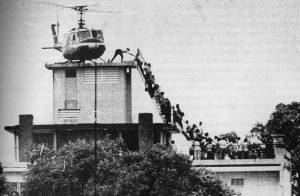
    The documentary also made me consider the enduring power of iconic images, of which the photograph of the tank man is surely one. In a brief discussion with my wife I considered what the other most iconic news images of my lifetime have been. Here the first five that came to mind, in chronological order:

        saigon_small

    The fall of Saigon (1975)
    The swan-song of the Vietnam War. I was seven years old, so my first-hand awareness of these issues was pretty low. But this had been one of the defining events of my parents’ lives so far. My parents had been war protestors, earning me the distinction of being tear-gassed at age two at the Stanford anti-war demonstrations. There are other Vietnam pictures that are extremely powerful, including Nguyen Ngoc Loan’s execution of a Vietcong prisoner during the 1968 Tet offensive, and naked Phan Thi Kim Phuc fleeing her napalmed village 1972, but I was so young when those events took place that they didn’t register at the time. I do, however, remember the end of the war.

    challenger_small

    The Challenger space shuttle explosion (1986)
    As historical events go this was hardly of global importance. Seven people died and a legion of “substitute teacher” jokes was spawned. But for an eighteen year-old college freshman, all idealism and big balls, it was a lesson in the limits of technological power. That dreadful “Bugs Bunny” cloud has been in my head ever since.

    berlin_small

    The fall of the Berlin Wall (1989)
    This was the other great event of 1989, coming some months after Tiananmen Square. And, thankfully, it was a somewhat happier moment in history. This was something else that we all gathered around the dormitory television set for.

    tiananmen_small

    Tank Man (1989)
    Covered above.

    911_small

    9/11 (2001)
    I was watching the live broadcast when the second plane hit, which is what this is a photograph of. That was the moment we all knew that this was something bigger than a single attack, and that it would loom large in American consciousness. And the towers hadn’t even fallen yet. You might ask why not pick a photo of one of the towers collapsing. When I recall this event, it’s the two flaming towers that I always see in my mind first. It’s the threat of disaster that I remember, rather than the disaster itself.

    Looking back at all of these images that have stuck in my head over the years, I notice two things. First, every single one is a humiliation of power, in one way or another. The mighty brought low, if only temporarily. Sometimes that’s joyous, as in Berlin, but most often it is tragic. The second thing is that three of these images are of humiliations of American power. But I guess that is to be expected. I am an American, after all, and those will be the images that remain in my head. You savor the triumphs for a while, but you remember the failures forever.

    So what images stick in your head?

  • By chopstick to the moon

    Imagethief was interested to read in today’s China Daily that China’s government is slapping a consumption tax on several items, including disposable chopsticks and luxury yachts. I think this is just and wise, and should be done. The reason why  think so is that, according to the article, China mills 1.3 million cubic meters of wood a year into disposable chopsticks.

    That is, to use a technical term favored by engineers, a whole shitload of wood. Imagethief would like to help you visualize exactly how much wood that is:

    • Picture a block of wood one meter on each side.
    • Now imagine 1.3 million of those.

    As you can see, that amount of wood fair boggles the mind. The other thing that fair boggles the mind is exactly how many disposable chopsticks that adds up to. According to the article, that much wood yields 10 billion “boxes” of disposable chopsticks.

    How many chopsticks is this? Let’s play the visualization game again. After reading this article, Imagethief ran to his office pantry where, no joke, he fished a used pair of disposable chopsticks out of the trash in order to measure them. Science marches ever onward, and discovery is not for the faint of heart. And our office doesn’t stock disposable chopsticks, so I had to use ones that somebody brought from the food court downstairs.

    A quick bit of ruler work revealed that your average disposable chopstick is 19cm long. Now, I have no idea how many chopsticks are in a “box” as referred to by the article. My statistical woes are further compounded by the fact that the caption in this article and the body text provide completely different numbers for the number of cubic meters of wood consumed every year, and the number of resulting chopsticks. The caption says 2 million cubic meters and 15 billion pairs (not “boxes”) of chopsticks. It just goes to show what a black art statistics is in China, where, apparently, almost everything is simply made up. The caption is sourced to AP and the body text to Xinhua, so take that as you will.

    Erring on the side of being conservative, we’ll go with the 1.3 million cubic meters from the Xinhua body text and we’ll read “10 billion boxes” as 10 billion pairs of chopsticks, or 20 billion individual chopsticks (which provides, by the way, a surprisingly low per-capita disposable chopstick usage of 7.7 pairs per year — Imagethief alone probably buries about a pair a week).

    At any rate, if you were to line up 20 billion chopsticks nose to tail, your chain of chopsticks would stretch 380 billion centimeters or 3.8 million kilometers (you may wish to check my math). The distance from the earth to the moon is 384,403 kilometers (according to the Internet), which means that, using China’s annual production of disposable chopsticks, you could built a bridge from the earth to the moon nearly ten chopsticks wide (9.885 to be exact – this may be a universal constant of some kind).

    Now you know how the Chinese space program is going to get people to the moon.

    By any reckoning that’s a pile of chopsticks, which leads Imagethief to discard all notions of cultural relativism and offer the following advice to the Chinese people:

    Get a fork.

    Barring that, even given that the majority of China’s disposable chopsticks are exported to the moo goo gai pan joints of America, a consumption tax sure sounds like a good idea. From what I see around Beijing, there isn’t enough wood left in China to support more than about another ten-days worth of chopstick production.

    And god knows how many luxury yachts you could build with that many chopsticks.

  • Harbin aftermath: Government vows to thoroughly scape all goats

    Catastrophes are fun to watch, but not nearly so much fun as the aftermath of kicking, screaming and recriminations as blame is liberally heaped and fingers pointed. Katrina lasted only a day, after all, but the operatic fallout has reverberated for weeks, although less loudly now than it did at first. Chinese post-disaster convulsions are, perhaps, a bit more cryptic and mysterious than the American version, but interesting nonetheless. The aftermath of the Songhua River poisoning is just getting going, and, as it unfolds, the Chinese government and US government are notable for some of their similarities as well as some of their differences.

    The Chinese are following the US precedent by eagerly shoveling blame down onto lower levels of government. The better to distract people’s attention from the fact that the central government, if not directly responsible for the explosion, was apparently directly involved in the subsequent ten-day coverup. But at the same time, they are indulging in the classic central goverment pastime of erasing the inconvenient bits of the story in a way that the US government only wishes it could do.

    My attention was drawn back to this issue by an article that ran on Xinhua’s website today, hopefully titled, “China vows to “sternly” punish those responsible for river pollution“. (I’ve taken the liberty of correcting the spelling of the word “river”.) The article is interesting because it’s a classic bit of PR misdirection. Read this:

    The head of national work safety watchdog vowed Tuesday to “sternly” punish those responsible for a chemical plant explosion in northeast China’s Jilin Province, which caused toxic leakage into the Songhua River, a main water supply source in the area.

    Li Yizhong, director of the National Bureau of Production Safety Supervision Administration, pledged a thorough investigation in the explosion and the ensuing toxic spill in the river.

    Li, who headed an investigation team set up by the State Council on Tuesday to probe the accident, promised to seriously deal with those enterprises, departments and individuals held responsible for the accident.

    “Anyone, who were found guilty of dereliction of duty, will be harshly dealt with,” he said, “those who break the law will be handed over to the judicial departments.”

    “People who are found to have provided false information to investigators will also be punished severely,” the official said. “Any move trying to cover up the cause of the accident and any passive attitude toward the probe are deemed deception and a defiance of law.”

    ***

    The investigation team will probe the cause of the blast and why there were no preventative measures in place to prevent the benzene from being discharged into the Songhua River.

    An earlier report said that Yu Li, head of the Jilin branch of China National Petroleum Corporation (CNPC), was removed from his post.

    Two other officials, who allegedly held direct responsibility for the plant explosion, were also dismissed.

    Besides, Xie Zhenhua, head of the State Environmental Protection Administration (SEPA), China’s environmental watchdog, resigned after the accident, becoming the highest-ranking Chinese official to resign for an environmental incident.

    Ask yourself two questions. 1) What do you see in this article? 2) What do you not see in this article? My answers:

    What I see in this article:

    • A resolute central government taking action
    • An investigation team created by the State Council to probe the accident
    • Rolling of heads involved in the explosion (and one central government head)
    • Stern threats of punishment for those found to have caused the article through dereliction or negligence
    • Stern threats of punishment for those found to have “provided false information to investigators”
    • This last one is important: stern threats of punishment for those found to have covered up the cause of the accident (my emphasis)

    What I do not see in this article:

    • Any acknowledgment of the coverup of the release of Benzene (as opposed to the cause of the explosion)
    • Any suggestion that the central government was complicit in any way in that coverup (although the resignation of Xie Zhenhua suggests some acknowledgment of responsibility for the initial accident)
    • Any suggestion that a general climate of lax central regulation and control might have played a role creating conditions conducive to the explosion

    This is not surprising in the least, but it lets you see how the story is going to be spun. The accident was bad, and if negligence was involved, it is appropriate to punish the people involved. And this makes a handy flash-bang for catching people’s attention and making them feel that Something is Being Done. But it ignores the fact that the coverup of the benzene release was arguably an equally (or even more) serious crime to any negligence that might have precipitated the original explosion. After all, it was the coverup that exposed everyone living along the Songhua River between the chemical plant and whatever point the Benzene had reached when the coverup was blown to potential poisoning. If anything is going to be investigated, it’s the coverup and the decisions made around it that should come under scrutiny.

    But there is, of course, faint hope of that. The coverup is joining the lengthening list of catastrophic un-events in recent Chinese history.

    I realize this is a deconstruction of a translation, which is dangerous territory. But everything I see is consistent with how I would expect the government here to respond.

    In what looks like another consequence of the disaster, it was reported by the AFP today that a Jilin City vice mayor and environmental chief has died in apparently mysterious circumstances:

    The vice mayor and environment chief for China’s Jilin city has been found dead, the city’s Communist Party press office said, amid accusations he was involved in last month’s toxic disaster cover-up there.

    “He died yesterday,” a spokesman for the Jilin city party press office told AFP, without giving any details as to the cause of death.

    “The police are investigating. We don’t know any more about it. I think the police will make a public announcement after they finish their investigation.”

    Wang Wei, the vice mayor who was also in charge of environment protection, took a high-profile role after a blast at the PetroChina chemical plant in Jilin on November 13 that killed eight people and injured 60 others.

    The accident led to the spillage of 100 tonnes of the carcinogens benzene and nitrobenzene into the Songhua River, one of China’s longest waterways and a source of water for millions of people.

    However officials said nothing of the contamination of the Songhua for nearly 10 days.

    “It will not cause large scale pollution. We have decided not to have a large scale evacuation,” the China Business News quoted Wang on November 15 as saying.

    If the police are investigating, one must assume that Wang Wei did not pass away peacefully in his sleep. A Japanese-style shame suicide, perhaps? Conspiracy buffs may supply their theories in the comment space.

    Update: The Associated Press interprets the story a little differently than I did.

  • The Harbin water crisis

    A couple of days ago, in response to a link I posted to his roundup of articles on the Harbin water crisis ESWN put this comment up on my site:

    As you are the PR expert, how would you have managed the situation? Would you have own up to the benzene problem way up front? Alternately, how would you handle the ‘clean-up’ afterwards? This is a serious matter because they were clearly way, way out of their depth in terms of what they believe that they could get away with.

    Well it’s always flattering to be considered a “PR expert”, although it’s probably closer to the truth to say I play a PR expert on TV. But the Chinese government’s response to the Harbin crisis has been a case study in bad PR management, and, with ESWN’s prodding, I’d like to explain why.

    But first the disclaimers: I am not a crisis specialist. We have hard-core people in my company who do that sort of thing. However, I’ve been doing PR for a while and there are some generally applicable rules of crisis PR that most of us in the industry know. Also, I am basing my analysis on China’s English language press coverage and on foreign press coverage. My Chinese isn’t good enough to get past headlines most of the time, so I can’t comb through Chinese-language press in any depth. Finally, I was not directly involved in this event and, therefore, do not have full information. Bear all of that in mind.

    With that out of the way, let’s have some fun.

    The Event and Coverage
    There are some basic facts that should be reviewed first, along with the history of the press coverage. The explosion in Jilin first happened on Sunday, November 13th. While there was some agonizing about the immediate casualties and the potential for major toxic events posed by shoddy chemical plant construction, there was no hint that this event had resulted in a severe toxic release.

    A China Daily report from November 14, the day after the explosion, said this:

    The local government has kept monitoring the air and water quality in the area, and further investigation into the blast is being made.

    So from nearly immediately after the explosion, representations were being made that the potential toxic fallout from the explosion was being monitored.

    A China Daily search for Jilin + Explosion, which I will use as an inexact proxy for press coverage as it should catch most articles, yields zero results from November 15 through November 22, when the announcement of Harbin’s water cutoff was made. A Xinhua search turns up a similar gap over those dates, except for one story from November 16, which carries the following headline:

    Chemical plant blasts releases no toxic substances [sic]

    The headline is based on an assertion by the Jilin provincial government that there is no problem with air quality. The story makes no mention of water. With the benefit of hindsight, this omission looks suspicious.

    So that’s a one-week gap –at least in English press– when there are no newsworthy public announcements about the potential aftermath of a chemical plant explosion next to a major river that flows through densely populated urban areas and into a neighboring country, except for a patently incorrect or deceptive one.

    On November 22, the announcement of the interruption of Harbin’s water supply is made. Initial reports specifically deny any link between the shut off and the Jilin explosion, as is clear from this China Daily article, the first in English language press to report on the stoppage. The article implausibly cites “maintenance and repair” as the official reasons for a previously unannounced stoppage. Although there is vague mention of the Jilin explosions in official statements cited in the article, any connection is vociferously denied by the authorities:

    The common refrain was that the explosion at Jilin city of neighbouring Jilin Province on the upper reaches of Songhua River may have caused a leakage of poisonous substances into the river as it is only a few hundred metres away from the plant. Harbin is located at the middle reaches of the river.

    But an official with the Harbin municipal government, who did not want to be named, dismissed the assumption as “just a rumour.”

    Harbin Water Supply Company refused to comment but sources at the municipal environment bureau said that there was nothing abnormal with the quality of water in the river.

    In corroboration, Jilin said that the local environment bureau found that the water quality was barely affected after the blast.

    In the absence of hard information, rumors flew through Harbin, stoking public anxiety and leading to a run on stores, as reported in that same article. As reported in foreign press, there was a large, voluntary evacuation of the city. Wells had to be dug quickly in Harbin and massive amounts of water shipped in rapidly.

    Only on the next day was there a Xinhua report confirming that the explosion had polluted the river. Interestingly, the admission is made by a central government agency, the State Environmental Protection Agency (SEPA). This article makes several interesting statements:

    “After the explosion at the Jilin Petrochemical Company under China National Petroleum Corporation, our observation showed pollutants containing benzene had flown into the Songhua River and caused water pollution,” said an official with SEPA.

    Benzene is a substance harmful to human health.

    The official said upon receiving the report, the administration immediately sent experts to Heilongjiang Province to assist local pollution-control efforts. Quality of the river water is under close observation for 24 hours every day.

    The Jilin and Heilongjiang provincial governments have activated their contingency programs for environmental incidents, and have taken measures to ensure the safety of potable water, said the official.

    He said Jilin had quickly blocked entry of the pollutants into the river and discharged water from a reservoir to dilute pollutants in the river. It also organized environmental, water conservancy and chemical experts to discuss pollution control plans, and beefed up monitoring work.

    Most interesting is the assertion that Jilin had “quickly blocked entry of the pollutants into the river and discharged water from a reservoir to dilute pollutants in the river”. This suggests that the Jilin government knew exactly what was going on. Bear that in mind for later.

    Then the inevitable consequences began to unfold. Public erosion of trust in government was one casualty, as reported by the Financial Times:

    “I am fleeing,” said Pang Shijun, a 50-year-old man among the crowds at the central railway station. He said his wife had already left the night before to go to the nearby city of Jixi. “I just do not trust the government to provide true information on this.”

    Whoops. More from Reuters:

    “It’s worrying, because it may not have a strong smell or colour, so you can’t tell when it’s gone,” said Hong Shan, a retired official exercising beside the river. “It’s up to the government to keep us informed. We can’t tell ourselves.”

    Commentators in Beijing and further afield condemned the “lies” told before the authorities revealed what had really happened. A paper in Harbin itself tried to play down the crisis.

    And, of course, there were recriminations. CNPC and the Jilin provincial government have emerged as the principle villains for running the plant and covering up the benzene release, respectively. Here the New York Times reports:

    “We will be very clear about who’s responsible,” said Zhang Lijun, deputy director of the State Environmental Protection Administration, at a news conference in Beijing. “It is the chemical plant of the C.N.P.C. in Jilin Province,” he said, referring to China National Petroleum.

    Mr. Zhang said the investigation would consider whether there was any criminal liability for the spill.

    PetroChina Company, a subsidiary of the state-owned China National Petroleum listed in New York and Hong Kong, is responsible for the company’s domestic petrochemical production, the China National Petroleum Web site says. China National Petroleum holds 90 percent of PetroChina’s shares.

    The official New China News Agency reported that China National Petroleum had apologized. The company “deeply regrets” the spill and will take responsibility for handling the consequences, the deputy general manager, Zeng Yukang, was quoted as saying. The vice governor of Jilin Province, Jiao Zhengzhong, also apologized to the people of Harbin, The Beijing News reported Thursday.

    Zhang Lijun is no champion of transparency, as we’ll see later. Even the China Dailyweighed in, with an editorial yesterday condemning the actions of the Jilin government. They noticed the same thing I did; that the Jilin government has essentially admitted that it knew all along that there was a problem:

    A spokesman from the State Environmental Protection Administration said yesterday at a news conference that Jilin Province and Jilin Petrochemical Corporation had adopted timely measures to stop the toxic spill from being discharged into the river immediately after the explosion.

    This shows that the corporation knew very clearly about the contamination and its possible result but still wanted to keep the secret to itself.

    Leaders from the Jilin provincial government and Daqing Petroleum Administration apologized for the contamination of river water and for the inconvenience and losses the pollution has inflicted on Harbin’s residents. But they never apologized for the hiding of truth.

    We do not know what is behind the cover-up. It might be because they were afraid that they would have to pay money for the losses the pollution has incurred in Harbin, and it might be because they were afraid of losing face.

    But the fact is they have brought shame on themselves by covering up the truth.

    So there is the chronology. Now the fun bit.

    Where They Went Wrong
    No matter how much you prepare and plan, shit happens. That the Jilin chemical plant exploded and released tons of benzene was bad. It could have been incompetence or it could have been plain bad luck. But the actions of CNPC and the Jilin and Harbin governments after the disaster have tarred them with the stink of incompetence and untrustworthiness regardless of the reasons for the original disaster. They were caught in an enormous lie, and that makes everything else they have to say about the disaster untrustworthy. And people will remember.

    Without having been in the boardroom, it is hard to say why the decision to cover up the disaster was made. It may be that Chinese doesn’t provide and incentive for openness about these sorts of things; this is an area where I don’t have enough information to make an informed judgment. Certainly neither the Chinese government nor Chinese business has a great reputation for transparency. The explosion would already be subjecting the plant to scrutiny for safety and operational standards. Perhaps a toxic release would have brought a different level of scrutiny, say from central government as opposed to malleable provincial authorities. And perhaps that level of scrutiny would have turned up some unpleasant truths surrounding CNPC, the plant and the Jilin government.

    All of this is complete speculation. But, of course, that is kind of speculation a cover-up provokes, and why cover-ups are almost always bad PR decisions. I use the phrase “spin doctor” in gentle self-mockery in the subtitle of my blog. Perhaps that’s a mistake, because it perpetuates a myth about PR, which is that it is all about twisting the truth about these kinds of situations. It’s a shame people see PR that way, because a surprising amount of the time, our advice in crises is to be completely honest. And when lives are at stake there is simply no other choice.

    Lives were at stake in this case. The moment CNPC and the Jilin government knew they had a chemical release on their hands they should have first informed the central government (which, scarily, perhaps they did) in order to motivate the appropriate support, and then informed the public. Harbin isn’t the only city along the Songhua river, and every other town along the same way deserved to know what was flowing past their riverbanks.

    How much benzene was released? What are the potential effects? How long will it take to reach key population centers, and how diluted will it be at each stage? What will need to be done to protect those population centers? What help is being offered?

    No doubt people would have panicked anyway, just as they did in Harbin. But after the supermarket shelves emptied out, there still would have been several days in which to prepare alternative water supplies and take other protective measures before the taps had to be turned off in Harbin. And the Jilin provincial government and CNPC, a major government-owned corporation (and, to a lesser extent, the Harbin and Heilongjiang governments), would not have squandered whatever trust people had in them.

    Now, I am applying western PR standards to China, which has a completely different tradition of openness and public communication than developed, western countries. As ESWN pointed out in his comment, the Jilin authorities were clearly way out of their depth in dealing with the crisis and in evaluating what they could get away with. That’s true. And it is a serious problem that the Chinese government needs to solve if it wants development to continue smoothly.

    Government is a Brand, Whether You Like it or Not
    Let’s think of the Chinese government as a brand. This is an oversimplification, but the comparison holds true in many ways. Like all brands, government, in this case Chinese Government (new and improved!), possesses or seeks certain attributes that it believes will help it in the execution of its business. Competence, compassion, pragmatism, security, and so on. For most governments, trust is an essential attribute. The job of governing is easier when people trust what the government tells them and trust that the government will provide essential services and intervene in times of stress or disaster.

    To see how erosion of trust can affect a government badly, look at the current US administration, which has two trust serious issues right now. First, many people saw Katrina as a huge abrogation of trust, and it severely damaged government credibility at municipal, state and federal levels by undermining the compact that the government will help to mitigate severe crisis. Second, a majority of the US public now believes that it was misled about the reasons for launching the war in Iraq. That is eroding public support and making it much harder for the administration to prosecute its plans in Iraq.

    With regards to China, the foreign knee-jerk reaction is to say, “The Chinese government is authoritarian! Why should they give a damn about trust?” But I would wager that most Chinese people trust their government on a fundamental level, or at least want to trust it, and that the Chinese central government places a fairly high priority on maintaining that trust. You can see aspects of this in many of the initiatives the CCP is prioritizing right now. Programs to control corruption and help the rural poor to climb out of miserable poverties are all part of building and maintaining trust. Even propaganda is designed to foster trust in the government. Power may flow from the barrel of a gun, but it is significantly easier to hold onto that power and exercise it effectively when people trust you. The Chinese government is executing several simultaneous, tricky balancing acts. I think they realize that their jobs will be much easier the more people trust them. Unfortunately, they seem unable to break their bad, Stalinist habits.

    Credibility engenders trust, and goes hand-in-hand with it. And credibility is a really serious issue for the Chinese government. Just today, the Chinese government was busyrefuting a report in New Scientist that bird flu deaths in China total over 300. (The Horse’s Mouth blogged the Boxun report that also covered this a couple of days ago – it’s blocked in China.) But people will continue to be suspicious of Chinese government protestations because the track record is bad. If the Chinese government expects to maintain credibility and trust it has to come up with the goods. Statements like this,reported in today’s FT in a good story on Chinese media reaction to the disaster, will not help:

    “There are many ways to release information. Making it public is one way and only informing the local governments and enterprises along the route of the contamination is another,” said Zhang Lijun, a vice-director of the State Environmental Protection Agency.

    The South China Morning Post summed up the Chinese government’s credibility gap (via Howard French’s “A Glimpse of the World”) blog:

    The way in which the affair has been handled raises fresh concerns about the willingness of mainland officials to disclose bad news.

    The PR aphorism is that trust is easy to lose and, once lost, fiendishly hard to regain. That’s why we so often counsel honesty and direct action in crisis situations. So here is Imagethief’s free PR advice to the Chinese government: what works in a closed, Stalinist state does not fly in a modern, open economy. There is no having it both ways. CNPC is a publicly listed company traded in Hong Kong and New York and need to behave like one, even with regards to its operations in China.  The expectations upon you are changing. That is the inevitable price of success, development and integration with the rest of the world. If you expect to continue that success, you will have to learn how you want to communicate around these kinds of events. In the long run, whatever you it is you think you are achieving by trying to hide your disasters, missteps and calamities, you are almost certainly achieving the exact opposite. Honesty in times of crisis can build your credibility. Infinite successful cover-ups add nothing to it. Every failed cover-up destroys it that much more.

    You can only get caught in so many lies before people stop listening.

    Update: Two good roundups of foreign press articles from the Peking Duck, here andhere.

    Also, tough luck if you live in the small villages along the Songhua, as reported by the New York Times here.

    Update 2: This, in particular, is  a good story to read. From the Washington Post’s Philip Pan, it discusses how local journalists broke the coverup story. That’s Chinese media doing its job well. What will be telling is how the Chinese government –especially the central government– reacts. If it is used as an excuse to crack down further on the ability of media to report such things, or if the journalists responsible are punished, it will be a very bad sign indeed.

  • How to write a generic China bird flu story

    Bird flu may not be sweeping through the human population, but it’s sure sweeping through the media. It seems that every newspaper and wire service has packed their Beijing reporter off to the poultry-infested boonies of China (which begin right outside Beijing’s fifth ring road) to report on the dire and pox-ridden scene in the Chinese countryside. As a result, the stories have begun to take on a certain formulaic feeling.

    As a public service to my readership, I’d like to present Imagethief’s handy, paragraph-by-paragraph guide to the standard China bird flu feature story. When it finally achieves Enlightenment and begins recognizing bloggers, the Pulitzer committee knows where to reach me.

    1) Alarmist headline:

    Rural Chinese farms perfect incubators for planet-destroying superbug!

    2) Rustic introductory scene to demonstrate China’s backwardness and ignorance:

    November 8, Choukeng, China: In the remote village of Choukeng, chicken farmer Shen Jifen wades through a veritable lake of chickenshit.

    “Chickens, chickens, chickens. It’s all we know in this village,” said the 103 year old, dirt-poor illiterate farmer as he lazily swatted a wheezing, mortally ill chicken off of his head. “We raise chickens, we eat chickens, we wear chickens. I treat these chickens like my own children. Except for the slaughtering.”

    3) Inducement of disgust to drive home backwardness and ignorance:

    So numerous are the chickens in Choukeng that the entire village is three feet deep in warm chickenshit. To get to market or visit neigbors, villagers pole small, flat-bottomed boats through the fetid chickenshit. The flimsy houses are built on stilts, and anything heavier than a chicken rapidly sinks.

    “Last year three people drowned in chickenshit,” said Shen. “We buried them in coffins of baked chickenshit. It’s our primitive and destitute way.”

    4) Sinister hint of biological menace, amplified by rural backwardness:

    But now the stream of chickenshit is drying up as Choukeng’s once nearly infinite supply of chickens begins to drop dead. Avian flu has arrived here, carried by the Siberian booze-cranes that stop to feed in Choukeng as they follow their migratory route from Smolensk to winter drinking grounds in Lan Kwai Fong.

    Instead of culling their sickening flocks or incinerating the dead birds, the villagers of Choukeng are unwittingly creating an environment ripe for the rise of  pandemic bird flu.

    “When chickens die, we collect the blood and rub it all over our bodies,” said Shen. “The blood of chickens that have died from infection is a well known cure for wind.”

    5) Raise the specter of government incompetence:

    Now the Chinese government has arrived in Choukeng to manage a cull of sick poultry. But instead of helping, they may be making the problem worse. Local officials are using compensation money provided by the central government and intended for farmers to stage bloody, baijiu-lubricated cockfights and to build the world’s largest, free-standing concrete chicken statue in a bid to attract more tourists to the impoverished region.

    6) Gratuitous journalist abuse:

    A journalist who attempted to sneak into one of the cockfighting sessions disguised in a chicken suit was detained by plainclothes police and forced to write ‘I am not a giant chicken’ 1000 times on a blackboard, before he was stripped of all clothing and possessions, sprayed with superglue, rolled in glitter, and turfed out of town with the Chinese words for “dangerous lunatic” written on his forehead in permanent marker.

    7) Alarm bells from the international health bureaucracy:

    “They’re making a righteous screw-job of the whole thing up there,” said Bjorn Neutral-Öbserver, a Beijing-based representative of the World Health Organization. “The Ministry of Health would cover up news of acne if it could get away with it.”

    Mr. Neutral-Öbserver stressed, however, that bird flu remains confined to poultry and migratory birds.

    “For the moment, it’s still perfectly safe to visit remote, unsanitary shitholes infested with thuggish police,” he said before boarding a plane bound for his apocalypse bunker buried deep in the Swiss Alps.

    8) Vox populi:

    Foreigners living in China are paying little heed to the brewing health crisis in the hinterlands.

    “What? What are you talking about? What’s this about chickenshit? And why do you have ‘dangerous lunatic’ written on your forehead?” commented a Beijing based PR consultant and blogger who gave his name only as ‘Imagethief’.

    9) Tear-jerking rural finale:

    But in remote and smelly Choukeng village, the crisis is already all too real.

    “When all the chickens die, the lake of chickenshit will dry up and become hard,” said a wistful Shen. “Our way of life will come to an end. And it will be really hard to pole those little boats around.”

    Bonus prediction: The bird flu story du jour is the closure of live poultry markets in Beijing. Later this week, we’ll hear about black-market sales of live poultry. You heard it here first.