Month: May 2012

  • The Devil’s Air Conditioner and Other Tales of Woe

    Sometimes life in Beijing is like one of those Japanese game shows where they see how much torture people are willing to endure for surprisingly mediocre prizes. Picture the following and you’ve more or less got it:

    “Mr. Ishihara, for a new desktop dumpling fridge you’ve been strapped naked to a hospital gurney in the burning sun for twelve hours. You’re pinking up nicely. Do you wish to continue?”

    “Yes!”

    “Then it’s time to raise the bar! Here comes a team of lingerie models to glue Gabonese fire ants to your testicles!”

    “I can take it! Must…have…tiny…fridge!”

    “Great! While they prepare the ants, let’s watch this secretly recorded video of you confessing erectile dysfunction at last week’s office drinking party!”

    That’s us on the gurney. We’re all in it for the rush and the dubious prize while an oddball assortment of it-could-only-happen-here, Rube Goldberg discomforts repeatedly jabs its three-fingered cartoon glove into our sensitive bits. As long as you can take it, you live in Beijing. When, like Popeye the Sailor Man, you can’t stands no more, you pack up and head for more congenial shores. With a dumpling fridge, if you’re lucky.

    This weekend’s finger to my sensitive bits involved the air conditioner in my apartment.

    Let me tell you a bit about my apartment. Nominally in a “luxury” development, it’s horrendously expensive and situated in one of Beijing’s most fabulous areas. The amenities are good. There’s even a French bakery in the courtyard. But construction-wise it’s less luxury and more like what would happen if you got a pack of wild monkeys just drunk enough on Snow Beer to almost read a blueprint and fenced them into ten hectares of land with a pile of grade-B residential fittings and free-flow concrete. The caulking wanders off in random directions, the hot and cold indicators on the faucets are reversed, the “hardwood” flooring buckles in weird places, the towel racks droop, and when the wind blows, a majestic assortment of Jurassic aromas billows from the drains. There’s more, but you get the idea.

    Still, I was hardened by a year in Shanghai, so in most ways I consider it pretty good as Chinese apartments go. The worst that can be said of the landlord is that she’s totally disinterested, which is way better than totally venal, which is always a possibility here. The landlord situation reminds me a bit of the shopworn parable about Confucius, the widow and the tiger:

    One day the Master came upon a woman weeping at a grave. He said, “You weep as one afflicted by great sorrow.”

    The woman replied, “It is true. My husband’s father was killed here by a tiger, and my husband also. Now the tiger has killed my son.”

    “Why do you not leave this place?” asked the Master?

    The woman replied, “The government here is not cruel.”

    Replace “government” with “landlord” and it’s still more or less valid.

    But the air conditioning problem is serious. Our apartment is hot and stuffy year round. Even in Beijing’s Siberian winter we pick up so much waste-heat from the neighboring apartments and poorly insulated piping that we often end up running a fan in our bedroom at night. As for summer, well, if you haven’t experienced August in Beijing you can simulate it by tying yourself to a burning coal stove and then having your friends hurl you into an open sewer. If you actually try this, put it on YouTube so everyone can benefit from your sacrifice. That’s how knowledge is born.

    Anyway, we rely on our air conditioner. This sucks for us, because it is an enormous, fiddly contraption that looks like what might happen if Lockheed Corp. and Hubei People’s Steam Propulsion Systems Factory No. 182 jointly bid on air conditioners for TEPCO. This model, which is standard in our apartment complex due, one can only assume, to graft, is approximately the size of a 1968 Volkswagen Camper, and takes up the entire balcony outside my son’s room. Unlike a Volkswagen Camper, it uses water as a coolant, making it complex and prone to breakdown. But it does have the Camper’s woeful lack of power and tendency to choke in the face of modest demands.

    In a masterstroke of engineering, our air conditioner also manages to combine the worst attributes of central and split air conditioning. Like central air conditioning, it has to be switched from “heat” mode to “cooling” by the property office, which puts us at the mercy of the government rather than the climate. The switchover involves one big button and just enough fiddling with valves to be complicated, but the good news is that regardless of official dates the property office usually folds in the face of a little hectoring.

    Like a split aircon, however, the compressor draws on our household electricity (our breaker box emits an alarming buzz every time it turns on), and coolant pipes run through the ceiling to the vents in all the rooms. In our previous apartment, in the same complex, the pipe over the kitchen dripped condensation. During summer it reliably shorted out the gas leak detector in the kitchen ceiling about once a month, usually at three in the morning (we ran the aircon at night), triggering an electronic shriek that could curdle the fluid in your eyeballs. I would deal with this problem by blearily jamming a screwdriver into the alarm until it shut up, and then having the property office replace it. If we’d ever had an actual gas leak, the sparks created by my screwdriver surgery would have blown us all into the courtyard like Ed Norton’s furniture and condiments in “Fight Club.”

    The compressor unit on the balcony is wired to a set of high-tech thermostats, all of which insist that every room in the house is always 25C regardless of actual temperature. When the sun expands into a red giant and incinerates the Earth a billion years from now, these thermostats will insist it is 25C right until the moment they evaporate. Whether you set the thermostats to 30C or 5C (which is where ours are all set), you get the same anemic trickle of semi-cool air from the vents.

    But we take what we can get. Spring in Beijing is a season of hot days and cool nights. And dust and fuzz and pollution. The apartment warms up during the day and stays warm pretty much all night, forcing us to run the air conditioning even though the outside temperature has dropped. Any cooling is better than no cooling.

    At 2AM on Saturday night I woke up bathed in sweat. The outside temperature was a crisp 12C, but our room had crept up to a broiling, humid 28.5C. The aircon vent was cheerily pumping out a stream of toasty, warm air.

    Well, you say, turn it off and open the windows, genius. And in many places in the world this would be sound advice. But on Saturday night the air pollution AQI reading was 212. In China an AQI of 212 counts as “moderate,” but in the rest of the world it’s more like, Holy Jesus, Martha, it’s the apocalypse! Get the kids into the fallout shelter while I shoot the dog! You don’t really want to sleep in it. What’s the point of having $3,000 worth of Swedish air filters (yes, really) in the apartment if you’re just going to throw open the windows and let the scuzz in?

    We let the scuzz in, at least for a while. But that led to another problem. Our previous apartment faced the courtyard from the 7th floor. Other than the occasional raving drunkard or 160db Phil Spector wall-of-sound throat-clearing hawk, it was reasonably quiet. On the rare clear-air nights we occasionally slept with the windows open just for the hell of it (although always with the risk of waking up to find the loess plateau in our bed).

    Our current apartment faces the road between our complex and the neighboring ultra-mall. This road is small, but punches way above its weight in terms of congestion, perma-honking and random cacophony. To add insult to injury, when they built the mega-mall they somehow neglected to design in a loading dock. The result is that all deliveries to the mall are made at the entrance to the parking lot, which is just below our 16th floor apartment. This happens at the only time when they can partially block the road, which is the middle of the night. For a mall that sells a huge amount of really expensive stuff, these deliveries are not gentle. They often sound like someone backing a flatbed truck with busted shocks and a full load of plate glass and live hogs over a row of two-by-fours.

    As long as our hermetically-sealing, double-paned windows are buttoned up, the noise doesn’t bother us. And, anemic as it is, if the air conditioning is working, we can keep the windows closed. But if the air conditioning fails, our choices rapidly dwindle to dying of heat exhaustion in our own bed, opening the windows and admitting the din and miasma of Satan’s workshop, or suicide.

    At two in the morning, suicide doesn’t look all that bad, but we resisted. After my wife went out and poked futilely at the buttons on the compressor for a while, we went for heat exhaustion, turning off the compressor but keeping the windows shut. On Sunday morning the property office showed up, declared that we had somehow switched the air conditioning unit to “heat,” switched it back, and left. On Sunday evening the aircon ran refreshing and cool, as much as it ever does. Maybe it was our fault, I thought. Maybe we did something wrong.

    And then Sunday night at 2AM we woke up bathed in sweat again. With a flashlight I went out to the balcony where the Beast lives and examined the controls. Outside it was pleasantly cool. The air conditioner had switched itself to “heat.” I switched it back to “cool.” The mechanics might be complex, but the controls are simple. There are only three buttons: On/Off, Heat and Cool, and an LED that displays “HE” or “CO” and the coolant temperature. It ran in “cool” mode for a minute or so. I watched the coolant temperature drop. And then it switched itself back to “heat.” I repeated this five times. Every time the air conditioner switched itself back to “heat.”

    On top of all its other problems—the fiddly complexity, the anemic output, the buzzing breaker box—this cursed thing apparently thinks it’s smarter than us. When it’s warm outside, in the early evening or right at dusk, it chugs along merrily in cooling mode. The moment the temperature outside drops too much, it figures we must be freezing in our booties, and spontaneously switches itself into heat mode. Damn the thermostats (25C), full speed ahead!

    Or, worse, it’s actually trying to kill us, like the possessed laundry press in the old Stephen King story, “The Mangler.” It wants to roast us to death in our sleep and let the cats feast on our remains, just for the sheer sport of it. I don’t know what happened to the previous tenant in our apartment. I do know that he left a fair amount of his stuff behind when he “moved out.” Coincidence?

    I just made the last rent payment on our current contract. In about two months, we have to decide whether to move or to stay in the same place and accept the inevitable rent increase. On the one hand, the apartment is expensive and noisy and the air conditioning unit is apparently possessed by Satan and determined to destroy us all.

    On the other hand, there are croissants downstairs and the government is not cruel.

    It’s a tough call.

    Note: This post originally published on the defunct group blog Rectified.name.
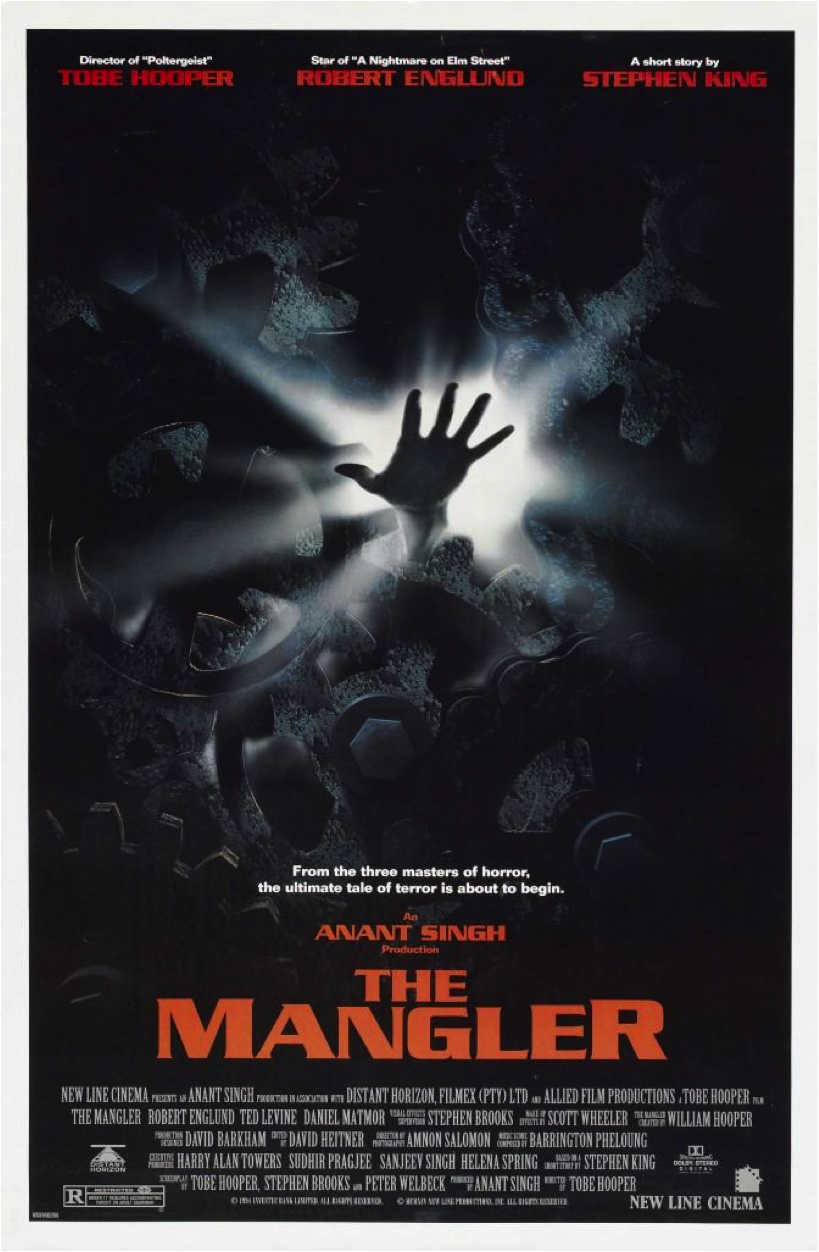
    But it's refreshingly cool!
    But it’s refreshingly cool!
  • Good News! The Press is Out to Get You

    A couple of weeks ago I gave a talk about PR in China to a journalism class at Beijing Foreign Studies University. In any student talk the Q&A is always the most fun, and this group was no exception. Among the many good questions asked was whether it was easier to do PR in China because, as I had discussed in my talk, the Chinese media is generally cozier with businesses than their Western counterparts.

    Easier to get stories? Yes. Easier to achieve meaningful results with the public? No.

    I was reminded of this question by the recent expulsion of hard-charging Al Jazeera English correspondent Melissa Chan, and subsequent closure of the AJE bureau in China after the Ministry of Foreign Affairs refused to accredit another AJE journalist. I didn’t know Melissa well, though I had met her, but I respected her reporting and willingness to insert herself into uncomfortable situations, and I was disappointed to see her go. Reporting on China will be impoverished a bit.

    That, of course, was the point. The Chinese government has never been comfortable with an adversarial media, and Melissa’s reporting was, like that of much of the foreign press corps, pretty adversarial from their point of view. This discomfort is deeper than cursory annoyance at embarrassing foreign gadflies (although I presume that is part of it). It arises from one of the fundamental philosophies of Leninist political parties: the media are considered Party organs and, as with other Party organs, expected to serve the interests of the Party first and foremost. Media that don’t fit into that model are suspect by definition. You can see this philosophy expressed in the mechanisms of control that the Chinese government maintains over all domestic media, and in the government’s struggles to come to terms with the rise of social media that resist conformity with established power structures.

    The Party’s model is rather different from the fundamental philosophy of Western media: that it should be the fourth estate, entrusted with challenging the business and government establishment in the interest of the people. You are welcome to argue about how effective Western media have been in this role in recent years, and there are plenty of exceptions, but as a founding principle the idea of the fourth estate is alive and well and inextricably bound up with our Western ideas of what the media should be (and with the value judgments we render on media that doesn’t conform to that principle). A functional, adversarial media is a necessary component of Western-style liberal democracy, unless you have total faith in politicians and institutions.

    I am not going to comment further on the specifics of the Al Jazeera situation (some links to good articles below), but in light of the Chinese government’s recent struggle with rumors and trust issues, it’s worth reflecting on why an adversarial media is sometimes useful, even to the establishment. This is what I discussed with the students at Beiwai.

    As a news junkie who still pays for several subscriptions, I’m most definitely a fan of adversarial media model (you could also call it an “independent media” model, but independence is only valuable in that enables an adversarial position). There is nothing like a fantastic piece of investigative reporting that rips the lid off of some secret or scandal or that illuminates the dark corners of business or politics. As long as it’s not my dark corner, that is.*

    As a PR practitioner with a company reputation to defend, I’ve experienced firsthand the adversarial media model’s short-term ability to create sleepless nights and great puddles of cubicle sweat. But nevertheless, I still appreciate its value in the long-term. That’s because people are more likely to trust media that challenges me than one they know to be compliant with me, and I need media that the public trusts to get my message out, whether that message is a corporate one, a product review or whatever. If I have to do more work to get coverage in that kind of media, and tolerate some negative coverage as well, so be it.

    In China, on average, relationships between businesses and the media tend to be closer and less adversarial than in the west. There is also a range of ethical problems, including poor separation of advertising and editorial, the “transportation claim” subsidy-in-disguise, and more. Together, these make it easier for companies to earn –or buy– good coverage in local media than it would be in many other markets. But they also mean that the public is relatively more skeptical of much of the coverage and turns to alternative voices for much of its information and insight, many of them on microblogs . The result is a devalued media that makes even our best earned coverage less useful and influential, and that makes it harder for me to manage misinformation and rumors about my company.

    Sound familiar?

    These are generalizations. There are excellent journalists and excellent media in China, and crappy ones in the west. But the overall gap in trust is real. The real sign of progress here will not be in the government showing more tolerance for confrontational Western media, but in its tolerating the emergence of a fully independent, professionalized and adversarial Chinese media. That change, when it happens, will be driven by Chinese journalists. In some ways, it’s already happening.

    For those of us in the establishment, there is value in learning to deal with an adversarial media, and in being good at telling our stories and getting our messages across in media that are willing to challenge us, and that therefore lend credibility to the claims that survive their scrutiny. But if you’ve never had to deal with that kind of media, you haven’t developed the skills necessary to do so, and you rely on a tradition of control and management to get your message across, then you are in the realm of propaganda and will face the consequences in terms of diminished trust.

    And if your situation is so precarious that there is no way to tell a positive story when engaging with adversarial media? Well, then, your problems are much bigger and deeper than PR skills. Or one uppity journalist.

    * Just kidding. Naturally, I have no actual dark corners.

    See also:

    On the Al Jazeera situation:

    On the difficulty of reporting in China:

    Note: This post originally published on the defunct group blog Rectified.name.
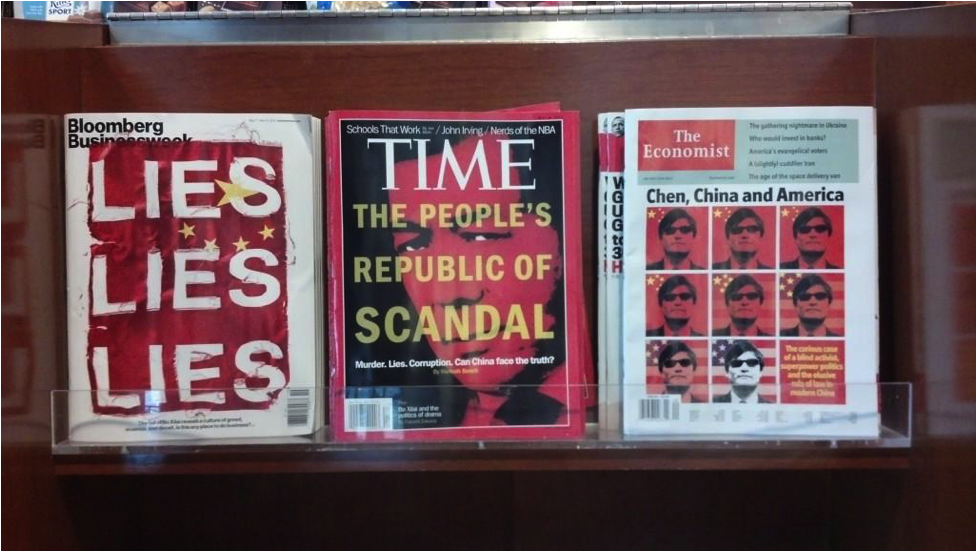
    Good news? A magazine stand at SFO's international terminal on Monday.
    Good news? A magazine stand at SFO’s international terminal on Monday.
  • In defense of the fuzz

    For many years I lived in Singapore, which is right on the equator and has roughly two seasons: slightly more rainy, and slightly less rainy. Otherwise, it was pretty much hot and humid throughout, which always used to freak me out a bit at Christmas. To an American, encountering Santa Claus in 30C heat is unexpected, like finding a live rattlesnake in your refrigerator. It’s always struck me as somewhat unnatural that Australians see Christmas as a summer phenomenon. What else do they do backwards? Maybe on Christmas morning, they randomly steal things and slap people.

    One of the things I enjoyed about moving to Beijing, besides being further away from the antipodes, was clearly demarcated seasons. Winter was a genuine novelty. Summer was like Singapore, except with air that could delaminate plywood. Spring and autumn were glorious interludes, as long as you didn’t mind having the Gobi Desert airmailed to you from time to time. Seasons are the demarcations on the great clock of the year, the way you internalize the passage of time. So are television shows, the National People’s Conference and the ebb and flow of denim hot-pants on the teenage girls of Beijing, of course, but seasons are a more poetic way of doing it.

    Since moving to Beijing I’ve found myself thinking in terms of how many winters and summers I’ve seen here. How many sandstorm seasons, and piling up of the throngs at Xiangshan. And how many times I’ve experienced the fuzz.

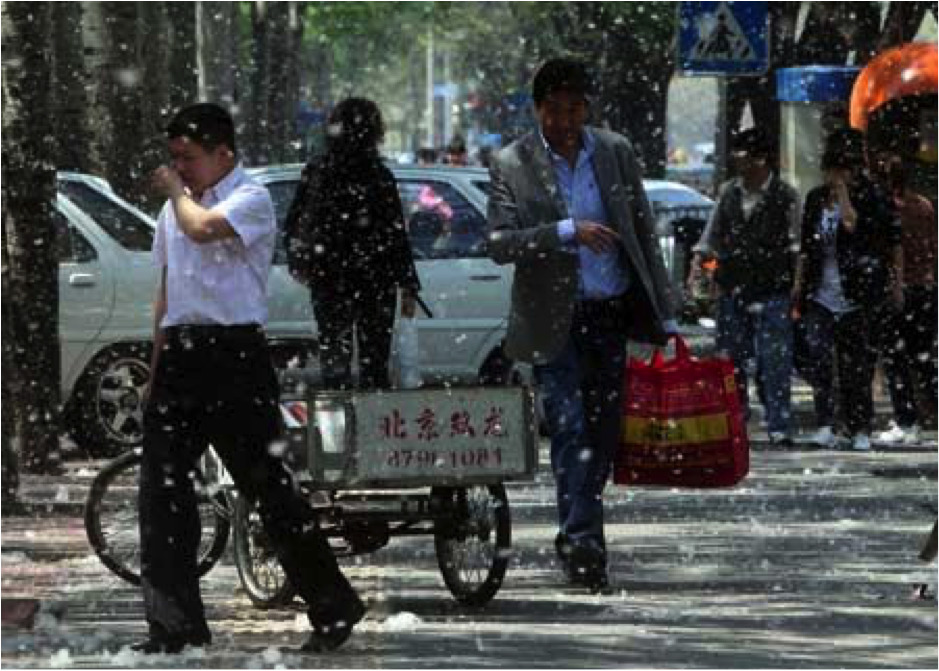
    If you have ever been in Beijing in spring, you will know the fuzz. This is the floating shroud of gauzy puffs that blankets the city every April, thanks to Beijing’s large population of poplar and willow trees. It’s not a problem exclusive to Beijing. The offending species of poplars are widespread (you might know them as cottonwoods in the US), and where there are poplars there are poplar catkins and, thus, poplar fuzz.

    And poplars are Beijing’s municipal tree, planted in rows along every median strip, bike lane and windbreak in the city, in great shivering ranks. A 1992 paper on the forestry of urban Beijing identifies two species of poplars as accounting for about 25 percent of the surveyed stock of trees, far outstripping the Chinese juniper trees in second place. It’s hard to imagine that their share has dwindled since then. Apparently, Beijing Forestry University even has an institute devoted to the study of Chinese white poplars, which confirms either the importance of the species, or all your worst fears about the treacherous vortex where the navel gazing currents of academia and municipal bureaucracy swirl together.

    Willows aren’t as common as poplars, but based on my own observation what they lack in numbers they make up for in sheer fuzzogenic enthusiasm. In fact, it took me a long time to catch up to the fact that the willows were contributing. Years ago, when I asked a local what he called the trees that made the fuzz, he said “yangshu.” This confused me because I thought he meant willow, and I was pretty sure he was wrong. Fortunately I bit my tongue, or I’d have made an ass of myself on at least two counts. The problem comes from the similar names of the trees in Chinese. The white poplars are baiyang (白杨) or yangshu (杨树), the willows are yangliu ( 杨柳). The trees are not of the same genera, so perhaps in the antiquity of the Chinese language there is some lost etymological connection between 杨 and fuzz.

    A further search of the literature reveals that ours are not the first generations to dwell upon the fuzz. A poem from the Six Dynasties period, in the first millennium AD, invokes the inherent eroticism of the poplar catkin thus:

    We break off a branch of poplar catkins.
    A hundred birds sing in the tree.
    Lying beneath it in the garden,
    We talk to each other,
    Tongues in each other’s mouths.

    Fuzz in their mouths, too, and any other orifices exposed during this little episode, but somehow that doesn’t make it into the poem.

    Erotic charms aside notwithstanding, it is easy to hate on the fuzz. Apparently, it can entrap airborne pollen from other species, and become something of a little, allergenic bomb. I don’t have allergies, but I have to admit that, while I find the fuzz pleasant enough while it’s wafting in the air, it tends to collect into stodgy, grey piles the moment it hits ground. In this way it is rather like Beijing’s snow, which can blanket the city in a dreamy, white veil for a vanishingly brief moment before collapsing into verminous, sooty piles that skulk in the shade for weeks while collecting suspicious, yellow pockmarks.

    A couple of years ago I took my son to play on the rides at Tuanjiehu Park, which are shaded by a particularly vigorous stand of white poplars. He and I both a good time watching the aunties use cigarette lighters to set great drifts of fuzz alight. It combusts like rocket fuel, so perhaps this wasn’t the best thing to be doing around dozens of toddlers, but it was entertaining. I have heard (though never confirmed) that the fuzz has been implicated in automobile fires after collecting in radiators. It has definitely contributed to yard and household fires, and the Internet has plenty ofearnest warnings urging homeowners to diligently police the fuzz.

    To address Beijing’s share of these fuzzborne woes, the city government in 2007hatched a scheme to convert the offending, female poplars into docile, fuzz-free male poplars. Apparently, this has been a semi-regular endeavor. They should have consulted with me first as I have my own experience with quixotic nature-control plans. When I was in college I spent two years as part of my university’s ultra-secret ground squirrel control program. We used air rifles, traps and poison in an attempt to control a ground squirrel population that had exploded because, in a triumph of natural selection, ground squirrels have a much higher tolerance for drunk college students and acid rock than all of their natural predators. This program was an utter failure and in the end we signed articles of surrender and turned over our weapons. The ground squirrels are still there, 25 years later. We who dared take them on are all long gone. Poplar trees don’t move as fast as ground squirrels, but on the evidence of Beijing’s obvious failure to control the fuzz, they are equally crafty.

    Personally, I like the fuzz. True, it catches on my head-stubble, gets all over the house and lurks under the couch, where it collects into dust-bunnies the size of Saint Bernards. But while airborne it’s cheery, and transient and a damn sight more congenial than the other harbinger of spring, the sand storms. It has also become one of the ways I mark time in Beijing. Another April of fuzz, another year gone by. A few more crows-feet around the eyes. Another sweaty, corrosive summer to grit my teeth for.

    A few years ago I was driving to the airport for an early morning flight. Just outside the Fourth Ring Road, deep stands of white poplar line both sides of the airport expressway. It was the height of fuzz season, and a breeze was carrying dense flurries of the stuff across the road. The morning sun from the east backlit the fuzz, endowing it with a luminous, warm corona. For a moment I forgot all the anticipated miseries of economy-class domestic travel and just watched the fuzz. The moment it hit the ground it was dirt, but while it was in the air, it was magic. And anything that can bring a touch of magic to that benighted road is worth at least a little appreciation, isn’t it?

    A little bit of magic.
    A little bit of magic.

    See also:

    Note: Originally published on the defunct group blog Rectified.name.