Month: November 2008

  • If you’re angry about Guns’n’Roses surely it must be 1991

    Let’s all take a moment to appreciate the Global Times, the nationalist tabloid cousin to the staid People’s Daily, which has decided to get indignant about the new Guns’n’Roses album, “Chinese Democracy”. It’s not that the Chinese people don’t have some cause to be angry. After all, the title is somewhat provocative, and the title track itself makes mention of the dreaded FLG. It also includes the following verses, which are pretty much worth getting angry about simply on artistic grounds alone, regardless of nationality:

    Cause it would take a lot more time than you
    Have got for masturbation
    Even with your iron fist
    All they got to rule the nation
    When all we got is precious time
    All they got to fool the nation
    When all I got is precious time

    Yep, you’re on the artistic edge when you’re rhyming “masturbation” with “nation” in an oblique criticism of China’s political system. Or maybe you’re just on your second bottle of Wild Turkey and your sixth line of Bolivian fairy dandruff. Who knows? Either way, as a musical critique of China, it’s ways from the sly, ironic rage of Roger Waters’ “Watching TV” (which is itself a ways from Waters’ best work). And Waters played live in Shanghai not very long ago, although I doubt he played that particular song.

    But Guns’n’Roses? Guns’n’Roses?  The band singer that took so long to get this album out that the phrase “Chinese Democracy” is now, with perhaps unintentional aptness, a music industry euphemism for a project that never ends? My friends, if you’re getting worked up about this record then your yardstick for cultural relevance is perhaps in need of some recalibration. And fortunately for you, Imagethief can provide that recalibration. In terms of gross influence on society and popular consciousness, Imagethief rates Guns’n’Roses circa 2008 thusly:
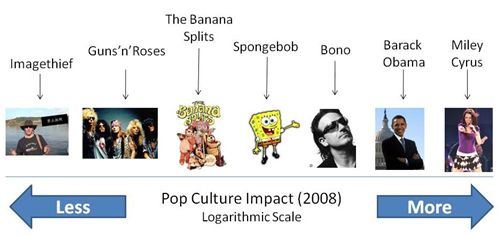
    pop-culture-scale

    Arguably, Miley Cyrus is also past it, and should be replaced by the cast of “Twilight”.

    All pop acts, and most pop-culture in general, reflect a particular moment in time. There is no such thing as “timeless rock”, only formerly timely rock that has aged well. I say that as a bona-fide classic rock fan who learned to play bass by jamming over Hendrix records, Pink Floyd, Zep, The Stranglers, and other dinosaurs. Guns’n’Roses, for all their hostility and edginess, needs to be recognized for what they actually were: The last of the LA hair-metal bands. The final, angry stand of a cornered ’80s genre. “Appetite for Destruction” came out in 1987, but languished for a year before it gained real notice. By the time “Use Your Illusion” came out, in 1991, about the time I was launching my college radio career, the band still had some juice but in fact most rock fans and and the industry itself were already up in Seattle trying to figure out exactly exactly what a “Mudhoney” was.

    Some rare bands and pop musicians endure, reinventing themselves to stay relevant. That’s why, although I don’t much like her music, I have fair respect for Madonna. She has accomplished the near impossible with almost twenty-five years of pop-music success and reasonably consistent relevance. (Although, note to Hollywood, please don’t let her approach either end of a movie camera ever again.) But most bands, even if they do successfully endure and reinvent themselves, have a peak when they hit maximum alignment with the zeitgeist. Even those that stay successful thereafter are usually living on borrowed time and aging fans, like a human body that deteriorates inexorably after the late teens no matter how healthy it is kept.

    So let’s take that equation and add to it not releasing an album for seventeen years. Just how long has it been since the last Guns’n’Roses studio album? When it came out, Deng Xiaoping was still a year away from making his famous “Southern Tour”, the climax of the factional battles that resulted in China’s economic opening to the world. Going after them could be considered quixotic, if Don Quixote had tilted at pinwheels.

    Thus, when the Global Times published the headline (via CNN), “American band releases album venomously attacking China”, lent credibility to Chinese net gossip that the album was a Western plot to “grasp and control the world using democracy as a pawn”, and wrote that the the record “turns its spear point on China,” they were committing a classic PR sin: Drawing attention to an unworthy critic.

    Let’s illustrate this principle. Let’s say you’re Enormocorp, a gigantic, publicly listed conglomerate with its fingers in a myriad of businesses that span the globe. One day a small, pimply boy with his finger jammed up his nose walks up to you and says, “You suck!” What is the correct response?

    The correct response is something along the lines of turning to your friend and saying, “Did you hear something?” It is not putting out a global press release on your non-suckyness, sending your CEO to do the Sunday talk shows to refute suck allegations and publishing white papers on all the anti-suckage measures that you are undertaking. Doing this is drawing attention to an unworthy critic, someone who’s ability to genuinely affect public perception is essentially nil. We call this “PRing the problem.” Global Times has PR’d the problem.

    But I suppose it’s their job to do so. The angry rhetoric will play to readers and shift newspapers, which is the real job of any newspaper. So while it makes little sense from a national PR or defending-Chinese-ears point of view, it makes plenty of sense from a business point of view. As long as you don’t mind the cynicism of accepting that a legion of people who otherwise wouldn’t have bothered will probably stampede to Baidu to run MP3 searches for “Chinese Democracy” (or the Chinese nanny-defeating linguistic spoof thereof) as a result of the article.

    Personally, Imagethief thinks the Foreign Ministry, which was quoted in the same CNN article, had it dead right when they were asked about the album:

    “We don’t need to comment on that.”

    Note: Imagethief owns “Appetite for Destruction” and considers it one of the great workout records of all time. He has not, however, listened to “Chinese Democracy” yet. Who knows? Maybe it rocks.

  • Pardon me, but who gives a damn about Gong Li anyway?

    Imagethief was not in the least surprised to hear that Chinese netizens were outraged that movie actress Gong Li has taken Singapore citizenship. But then, Imagethief is not in the least surprised by anything that outrages Chinese netizens. Chinese netizens were outraged when Gong Li played a Japanese woman in “Memoirs of Geisha”, alongside fellow crypto-Chinese actress Zhang Ziyi. (In fact, all the leading roles in Memoirs of a Geisha were played by ethnic Chinese women, so if anyone should be outraged it’s the Japanese.) Chinese netizens often seem outraged by things that appear trivial to the rest of the world, such as the appearance of circles in provocative locations, kind-hearted attempts at mediation, and being French. Chinese netizens, in fact, often seem outraged by anything that transgresses against a hard-boiled nationalist line.

    Which suggests that we are actually talking about a certain segment of Chinese netizens, rather than Chinese netizens as a whole or Chinese people in general. Unfortunately this distinction didn’t survive Jane Macartney’s recent Times story on Ms. Gong. To be fair, Ms. Macartney’s story is clearly focused on nationalist online sentiment. Here’s the lede:

    A decision by one of China’s most famous film stars to take Singaporean nationality has set off an online furore with many ardent nationalists branding her a traitor and a shame to her native country.

    Following from there, rest of the story is actually reasonable and balanced. Unfortunately the headline, which is what most readers will see and which was probably written by a sub-editor in London, is general in a way designed to reinforce foreign perceptions of the Chinese as a bunch of xenophobic goons in Mao suits. Reasonable work by good China journalists often runs into problems like this, which may be why several of my foreign correspondent friends (you’ll understand if I don’t name names) think the editors at their organizations’ foreign desks are tools.

    Unfortunately the Internet-comment-as-vox-pop is a common technique in China reporting, and the colorful comments that often drive the stories usually can be traced back to that same rich vein of nationalism that surges through the Chinese Internet. While Imagethief, who has seen first-hand the PR damage that can be done when a stick is poked into the nationalist ant-nest, would never dismiss the importance of nationalism in China, there are some problems with this approach.

    First, as anyone who has spent any time on the Internet knows, you can find any opinion you want on it, no matter how outlandish. Second, it’s very easy to select from a skewed sample on the Internet (which in China represents an already skewed sample). It’s fine to discuss the opinions of a narrow sample as long as that’s how you represent it. But when it’s presented in a way that invites the drawing of broader conclusions, you step into dangerous territory. If the rest of the world based their opinion of America on the comments in American political blogs, they’d sterilize the country with neutron bombs. Some of them probably want to do it that anyway, but the point stands.

    This is particularly fraught in China, where Internet users are still only 19% of the population, and are demographically concentrated among male, urban youth (more here). So using Internet comments as a proxy for overall Chinese sentiment without some serious qualification, or even statistics, is dangerous.

    All of which is scholarly good fun, but ignores the biggest point: Who besides undersexed dorm-crawlers gives a damn what Gong Li does? Imagethief is willing to bet that if you stopped Chinese people at random on the street in Beijing and asked them how they felt about Gong Li taking Singaporean citizenship, the most often expressed sentiments would be, “Huh?”, “How can I do that?” and “Who are you and why are you talking to me?” Not necessarily in that order.

    I suspect most of this anger comes because some of these same netizens voted Gong Li “China’s Most Beautiful Person” in 2005. That’s gotta hurt. You say, “You’re China’s most beautiful!” She says, “Yeah, about that Chinese thing…” And for Singapore? For most people, this looks like pragmatism. But from a Chinese Internet nationalist point of view this has gotta be like stepping out of prom night for a smoke and finding your girlfriend making out with the football team’s waterboy in your Vega.*

    Well, maybe not that bad, but pretty bad anyway.

    Frankly, given the recent state of Gong Li’s oeuvre, Singapore is probably one of the few countries that would be particularly excited to land her. I’m sure it’s seen as a coup for the local artistic community and as validation of Singapore’s ambitions to be a “media hub” (whatever that means). But the state of the Singaporean movie industry can be summed up in three words: Liang Po Po.  If you don’t know what that is, count yourself lucky. In fact, thinking about it, it’s a miracle that China didn’t revoke Gong Li’s citizenship for the crime of appearing in “Miami Vice”. I watched “Miami Vice” for free and still felt violated. And Gong Li didn’t even serve in my country’s government. (Nor, thankfully, does Colin Farrel, although I’m open minded if Obama wants to offer Jamie Foxx a portfolio.)

    In fact, looking back over Gong Li’s last decade or so of work, it’s all a bit worrying. “Memoirs” was watchable if you squinted and jammed your fingers into your eyes until you got those little sparkly bursts of color. “2046″, I suppose, if you’re into that otherworldly Wong Kar Wai thing (Imagethief has no patience for it, but I’m an admitted philistine). Otherwise, set the wayback machine for 1992 and “The Story of Qiu Jiu”. It’s been downhill for the Gong Li-Zhang Yimou team since then. I mean, seriously, “Curse of the Golden Flower”? Curse of the costume department more likely.

    When Zhang Ziyi (who made her film debut in a Zhang Yimou movie herself) someday abandons Chinese citizenship the nationalist youth can crash on my couch and spend the night talking things out. Until then, get over it. There’s lots more important things to get worked up about, like the collapsing economy, the evaporation of the Himalayan glaciers that supply China’s water, or whether foreign bloggers are besmirching the country’s honor with snarky rants about formerly Chinese movie stars.

    *This never happened to me. I couldn’t get a date for prom night.