Month: April 2011

  • China and the nature of Facebook

    Reports have been percolating for a couple of weeks that Facebook will partner with Chinese search engine Baidu to launch Facebook China, or something similar. Anyone who has followed the history of foreign Internet firms in China knows that this is fraught territory. Chinese competitors are well established, and while many successful Chinese Internet firms have foreign backing of some kind (even Baidu once claimed Google as an investor), marquee marriages between Chinese and Foreign Internet companies have often been troubled.

    There are others better placed than me to speculate on the likely business fortunes of a Facebook China (cf. Epstein, Bishop), but what really interests me are the communication challenge and reputational consequences. Some glimpse of those possible consequences came in a Wall Street Journal article about Facebook’s lobbying efforts that ran yesterday. It included the following:

    [Facebook] is talking with potential Chinese partners about entering the huge China market, where the government has been cracking down on dissidents. That crackdown has come in response to the uprisings shaking authoritarian Middle Eastern regimes, movements that have used U.S.-based social-media sites like Facebook and Twitter as organizing tools.

    “Maybe we will block content in some countries, but not others,” Adam Conner, a Facebook lobbyist, told the Journal. “We are occasionally held in uncomfortable positions because now we’re allowing too much, maybe, free speech in countries that haven’t experienced it before,” he said.

    Yowza! Better work on those talking points and come up with something that doesn’t sound quite so paternalistic. Read as generously as possible, this is one quote from what one presumes was a larger discussion on the issues of running transnational social networks in countries with different approaches to censorship and freedom of speech. Read less generously, it sounds like a lobbyist for Facebook arrogating to his client the responsibility to decide what constitutes an appropriate amount of free speech in any given country. Risky territory.

    From a business point of view deciding an appropriate amount of free speech might be a practical necessity. From a public communication point of view it’s dangerous. Five years ago, when Facebook was still a plucky upstart too trivial to be noticed, Yahoo, Google, Cisco and Microsoft were hauled in front of a congressional hearing to testify on their activities in China and their willingness to accommodate governments with illiberal approaches to free speech. It was not a banner moment for the American Internet industry. “Moral pygmies!” declared Tom Lantos, the principal congressional antagonist. Much of the cast has changed and Tom Lantos has since died, but the issue remains sensitive. (Not all the cast has changed. Facebook’s current head of communication, Elliott Schrage, represented Google in the 2007 hearings.)

    Facebook itself has not committed publicly to anything in China. They also haven’t yet committed any of the blunders that those four firms did (most notoriously Yahoo, with the Shi Tao affair). Finally, Facebook hasn’t made nobility a part of their brand in the way that Google conspicuously did in its early days, something that was used against Google in its China engagement. In fact, if anything Facebook is known for a kind of calculating amorality that may be useful in the ruthlessly sharp-elbowed Chinese Internet world.

    But what’s important here is not how Facebook sees itself, but rather how people at large see it, and how activists and politicians think they can use it to drive their own agendas. Whether Facebook likes it or not, it has been publicly associated with recent events in the Middle East and is widely seen as a force for enabling dissidents and protestors whose causes resonate with western publics and politicians. See for example New York Timesstories here, here and here. Evgeny Morozov and Malcolm Gladwell might ridicule the notion of social media as democracy tools, but that won’t necessarily dispel a belief that was made clear in the 2007 hearings: American Internet firms should represent American values.

    Companies’ decisions about China are revealing. Facebook’s decision on whether or not to formally enter China will be especially interesting. It will establish something fundamental about the identity of one of the two most powerful Internet companies on the planet. Is Facebook, as some have supposed, the great enabler of democracy? Or is it a company of business pragmatists willing to censor (or delegate censorship) in order to open a potentially lucrative market? The reality is probably more nuanced than either of those positions, but as far as public perception goes it will be difficult to have it both ways. How does one balance groups of stakeholders with completely incompatible views on what constitutes a responsible and conscientious Internet firm?

    The nut of the problem is that, right or wrong, democracy activists, American politicians and the Chinese authorities all tend to see American Internet firms as standard bearers for western values. Facebook’s task is to convince the Chinese authorities otherwise while not making activists or western users in general feel betrayed. I can think of few more precarious communication challenges. The quote above is an unpromising start.

    Update:

    Obama hosted a town hall at Facebook HQ yesterday. Interesting. And likely to be noticed here in Beijing.

    See also:

  • Apocalypse box part two: Apocalypse box

    Bummer, but at least I've got chili.
    Bummer, but at least I’ve got chili.

    Yesterday I posted part one of Apocalypse Box, in which I wrote a bit about the communication problems surrounding the reactor disaster in Japan. I concluded with saying that just because something is unthinkable doesn’t mean it won’t happen.

    It was with the unthinkable in mind (as it were) that Mrs. Imagethief and I set about reconstituting our household emergency kit in the wake of the Fukushima disaster. Six years ago, when all the world believed that lethal bird flu was but a sneeze away, the wife and I assembled a reasonably comprehensive household emergency kit. This consisted of two weeks of non-perishable food, drinking water, and various household supplies such as batteries, candles, gloves and such. I called this our “apocalypse box.” To be clear, the box (technically, two boxes) was not really designed for the apocalypse, so much as it was designed to enable us to withstand a run on supermarkets and a temporary disruption of services. But “apocalypse box” sounds cooler than “temporary disruption of services box.”

    There was a return-on-investment calculation at work. Let’s face it: If civilization actually collapses Roland Emmerich style, a couple of cans of Dinty Moore stew and a Bic lighter are probably not going to make the difference between survival and being devoured by feral dogs (just for example). For that kind of Mad Maxery you need a crate of assault rifles, a cave in Wyoming and, of course, the last of the V8 interceptors*. And liquor. Lots of liquor.

    But the investment required for that level of extreme preparation measured against my relatively low estimate of the chances civilization actually collapsing Mad Max-style in my lifetime rings up no-sale. Two plastic bins of food and general supplies measured against the possibility of a run on supermarkets or a temporary disruption in power and goods distribution looks much more rational and less militia-nutcase. Especially in China. It’s not that it might not be useful to have a crate of assault rifles and a fully stocked cave in Wyoming, just in case. It’s just that it seems to me that the resources I would have to invest in such a level of preparation is better spent on, oh, health insurance or rent or cat food (can always eat the cats).

    There is some family precedent for this preparation. I grew up in California where we all heard as children that someday the Big One would come, the state would drop into the sea and that would just be tough shit. Or variations on that story. When I was in high school my mom used to keep a large bin of provisions and bottled water in the garage. My brother used to keep beer hidden in the tool closet. But that wasn’t really for survival purposes so much as to keep my mom from finding it.

    In 1989 I was living in Santa Cruz during the nearby 7.1 Loma Prieta quake. Crouched on my kitchen floor as the cupboards emptied out I actually rather expected to drop into the sea, which wasn’t very far away. (Although as we have learned a couple of times in recent years, in these situations it turns out the sea may come to you.) In any event, Loma Prieta wasn’t The Big One, though it was Pretty Big and did do a lot of damage. There was in fact a smallish run on supermarkets in Santa Cruz after the quake, although everything was back to normal within a day or two. Having also been in Singapore during the  SARS epidemic, I’ve long thought it made sense to have a certain basic level of preparation for extra-weird times. It took the bird flu phantom to kick us into actual preparation, but then we moved to Shanghai and back in 2007 and the apocalypse box went by the wayside for four years.

    I had actually been thinking about the old emergency kit quite a bit over the last few months, and mumbling about doing something about it in the same way that one mumbles about getting one’s teeth cleaned or other disagreeable but virtuous chores. But Fukushima and the great Beijing salt run of ’11 kicked us into high gear. I know from experience that I can go without food for some time, but to leave Mrs. Imagethief hungry is to dice with death. We made a pass through Wal-Mart and Jenny Lou’s and assessed where we stood. Where we stood was on a pile of mostly canned legumes and absolutely no Beano. This begged the question, if the apocalypse actually did strike, would anyone in our house still want to be alive after 24 hours of the farts?

    In fact, on review the whole assortment seemed very conventionally western. If you’re really going hardcore, you’d want to lay in some things with local value so that they could be traded for ammunition, gasoline, breeding age females, or whatever it is you may need for your bunker. In China that argues for an emergency kit stocked with dried cuttlefish, melon seeds and baijiu. But one of our guiding principles was that the apocalypse box should contain food we’d actually want to eat. This is both so that we’re not completely miserable in the event of an emergency (who wants to be sitting in the light of one guttering candle, banging your hands together for heat and morosely staring at a bag of deep-fried crab snax?), and also because things need to be rotated out and eaten periodically as they reach their expiry dates. Yes, I have a spreadsheet with all the expiry dates.

    Some recalibrating of the supplies yielded a more balanced though rather salty mix of canned meats and vegetables, and calorie-dense dried fruits, nuts and chocolate and such, with the idea being that at least some of the supplies be easily portable in the event of an evacuation.

    That’s right, evacuation. Perhaps I’ll regret this someday, but I am not actually paranoid enough to keep a “go-bag,” a pack with the essentials you’d need to carry in the event of  sudden evacuation. Like the cave in Wyoming, this is just a touch too Jack Bauer for me. But I am paranoid enough to keep a “go-list”, which is designed to save me the trouble of thinking under pressure and tells me exactly what we should pack for two kinds of evacuation.

    The first is a walking trip to the airport (roughly a day’s walk from where we live). The other is an indefinite walking evacuation to points unknown. Both include essential documents, specifics on clothing, a list of easily portable food items, basic tools and such. The indefinite one trades laptops for more food and clothing and some backpacking supplies and such. Alas, the cats come out poorly in both scenarios. I also keep current documents in the cloud and an annual backup of all my important data in the United States, just in case. I mean, who wants to re-rip all those CDs just because someone dropped The Bomb?

    Let me be clear: I don’t think my family is in danger. If I did, we wouldn’t live here. The point behind the apocalypse box is to take a reasonable level of precaution for unforeseen events. It was a couple thousand RMB plus some things I already owned, and it all fits into two stacked bins that double as an end-table in my son’s room. The evacuation go-list has a marginal cost of zero, other than a little thinking ahead. Two weeks ago I had lunch with a journalist friend who’d just returned from reporting in Japan, and he showed me the unused bunny suit his newspaper had issued him. This made me feel completely rational.

    The spreadsheet on which I keep track of all this stuff is public on Google Docs. Feel free to check it out – there are three sheets (hold your jokes). Don’t take that document as definitive – it’s just where we stand now and not meant to constitute advice to you or your family. But maybe it will give you some ideas. Or maybe you’ll see stuff we’ve missed. Or maybe you’ll think –perhaps with some justification– that I’m a complete idiot. But, should the worst ever happen and the supermarkets empty out for a few days, I’m gonna be loving me that chili. And when you’re trading your children to me for chocolate bars, we’ll see who’s laughing.

    *A piece of history. Be a shame to blow it up.

  • Apocalypse box part one: Thinking unthinkable thoughts

    Note: This is part one. Part two is here.

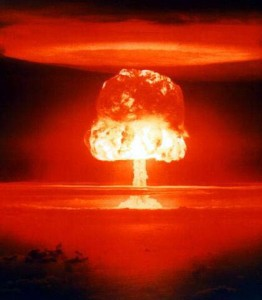
    Apropos of today’s escalation of the Fukushima reactor disaster to “7″ (Chernobyl) on the international scale, there is something about the word “radiation” that bypasses rationality and whispers right to the lizard brain. Perhaps one or two other words have the same power to spook. “Pandemic” comes to mind. But that aside, there is little else I that has quite the same potency as “radiation.” Almost all the connotations are negative: Contamination; the atom bomb; fallout; nuclear waste disposal; dirty bombs; Godzilla; the ugly, yellow trefoil symbol. Even radiation’s positive connotations are negative. Nuclear medicine might save you…if you have cancer! And the New York Times has spent the past year running a series of stories about nuclear medicine gone horribly wrong. Radiation? Duck and cover.*

    All this would seem to make any public communication about radiation hazards tricky. I can’t, however, speak from experience. Perhaps fortunately, Imagethief has never been called upon to participate in crisis communications involving radiation. Or nerve gas leaks or alien invasion or anything with quite the same pilo-erective zing. I’ve done food problems a couple of times. Also, years ago I helped an insurance industry association roll out a chain of inspection centers for mandatory post-collision inspections, which may actually be the closest I have ever come to being between a client and a torch-bearing mob. In terms of public sentiment, insurance and radiation aren’t actually all that different.

    The challenge in a public safety communication situation is to find that delicate line between keeping people well informed and prepared for the worst, and going overboard and triggering a destructive panic. This isn’t a trivial thing. To get an idea of how easy it is for hysteria to blossom in the right circumstances, recall that at the height of the Japan nuclear issue there was a run on table salt (rumored to prevent radiation sickness) in Beijing, 2000 kilometers upwind of the Fukushima reactors.

    What’s the worst that could happen?

    The natural tendency in crisis communications is to undershoot and be tight-lipped. This happens for all kinds of reasons, of which avoidance of panic is perhaps the only noble one. The others include optimism or wishful thinking that the worst is over, poor communication planning, bad communication culture, and the general tendency to choose ass-coverage over ‘fessing up for any number of legal, reputational and personal reasons.

    The problem with undershooting communication in an escalating crisis is that you wind up making a series of hopeful the-worst-is-over pronouncements, each of which is rapidly obliterated by events. TEPCO is a case study of this syndrome. So is BP from last year. Both companies wound up in a kind of reverse-Chicken-Little situation, where public trust evaporated and no one believed them anymore. In both situations, government wrested much of the public communication responsibility away. Getting publicly ejected from the drivers’ seat is not good for credibility.

    If you were forced to choose between timidity and risk of panic, you might choose timidity as the lesser of two evils. But in public safety situations the rumors and misinformation that can drive hysteria are likely to thrive in the vacuum created by poor communication or lack of trust. The Beijing salt-run is illustrative. Ask yourself: strictly hypothetically speaking, how conducive would it be to public order to have an escalating radiation crisis being managed by an organization that no one believes?

    This is the situation that TEPCO appears to have found itself in. A good analysis of their situation from a communication point of view can be found in PR trade The Holmes Report. Paul Holmes introduces consultant Peter Sandman’s useful “hazard vs. outrage” model of risk communication. Hazard is the actual danger to people. Outrage is the emotional reaction provoked. Varying ratios of hazard and outrage inform communication strategies in risk situations. The irony for TEPCO is that the actual hazard has to this point been pretty low. But the outrage factor is, if you’ll pardon the pun, nuclear. Holmes lists some of the key factors driving that outrage:

    • Coerced risk causes more outrage than voluntary risk, and the majority of people living close to nuclear plants did not volunteer to be exposed to the risk;
    • Industrial risk causes more outrage than natural risk, and nuclear is pretty obviously industrial;
    • Exotic risk causes more outrage than familiar risk, and most people are far less familiar with nuclear power than they are with oil and gas;
    • Memorable risk causes more outrage than unmemorable risk, and nuclear incidents—Three Mile Island, Chernobyl—are extremely memorable;
    • Dreaded risk causes more outrage than undreaded risk, and activist groups have been successful in creating and nurturing nuclear dread;
    • Catastrophic risk causes more outrage than chronic risk, which may be the biggest challenge, since nuclear incidents tend to be catastrophic, while fossil fuels do their damage primarily by creating chronic illnesses and environmental problems;
    • Risk controlled by others causes more outrage than risk controlled by individuals (which is why people fear air travel more than car travel), and nuclear power is completely beyond an individual’s control.

    A longer and very interesting analysis of the Fukushima situation by Mr. Sandman himself can be found on his website. Mr. Sandman’s conclusion with regard to crisis communication is: Always err on the alarming side, until you are absolutely 100% certain the situation cannot get any worse. Else risk your credibility and thus your ability to respond. Communications professionals would also do well to read security expert Bruce Schneier’s writings about how people evaluate and respond to risks, which dovetails with many of Mr. Sandman’s points. I recommend Schneier’s book, Beyond Fear. It’s a few years old, but still relevant.

    In TEPCO’s defense, the playbook for nuclear catastrophe communication in the midst of a general natural disaster is pretty thin. There are exactly zero precedents. Even absent the natural disaster component, there have been only three previous reactor accidents of any scope: Windscale, Three Mile Island and Chernobyl. Only Three Mile Island is really analogous to Fukushima, but the communication there was also blown, as Mr. Sandman points out. But it shouldn’t really matter whether there is a precedent or not. Nuclear power, which has always had a bigger outrage than hazard problem, really deserves over-preparation.

    In his book The Big Short author Michael Lewis proposes that the people who made fortunes betting on the collapse of the American housing bubble shared the iconoclastic traits of both being able to envision the worst happening (the bubble collapsing) and, in the face of social pressure, to act on that vision. It struck me upon reading that book that being able to envision the worst happening and preparing for such an outcome is a really valuable skill for communications professionals. To come back to Chicken Little, it’s not that a PR person should run around screaming that the sky is falling, but a PR person –and indeed any member of a company’s crisis management team– should be able to pose the question, what would we do if the sky fell?

    Even if –and this is important– even if others in the organization suggest that such a thing is unthinkable. After all, just because something is unthinkable doesn’t mean it won’t happen.

    In part two: What the hell is an “apocalypse box” anyway?

    Note:

    *If you haven’t seen the “Bert the Turtle” public service announcement on how to survive an atomic attack, it’s well worth watching. A surreal mix of 1950′s cold war terror and sunny “you can survive” optimism with a Ward Cleaver voice-over that must be somewhere in Billy West’s stack of reference material. “It’s such a big explosion that it can…break windows all over town.” Indeed. It’s a YouTube link, so get your VPN ready. If it’s working.