Month: November 2007

  • Notorious MDA: The Singapore government raps

    From time to time someone will ask me why I left Singapore for China. This is a fair question. I lived there for nearly a decade, Mrs. Imagethief is Singaporean, and I have great affection for the place. Usually I give some longish explanation about various professional and personal frustrations that were beginning to set in. From now on, however, I’ll simply be able to point people at this video on YouTube:

    Via Singapore ultrablogger Mr. Brown, this is a four and  a half minute hip hop video produced by Singapore’s Media Development Authority. The MDA is the statutory board that regulates media content in Singapore and, as you would expect from its name, promotes the development of Singapore’s media industry. The video features the senior management rapping about their respective roles.

    God help me, I don’t know where to start on this one. But I’ll try. Remember how embarassing it was when you were in high school and your parents tried to act “cool” in front of your friends? Now imagine they did that and commited the results to posterity on YouTube. In your name.

    It is often remarked that the Chinese government considers the Singapore government a role model for successful technocratic authoritarianism. Whatever the Chinese government learns from Singapore, let us pray that it does not absorb the idea that rapping bureaucrats is a good idea. The State Council has enough on its mind what with the Olympics, mass rural-urban migration and the Yangtze silting up behind the Three Gorges Dam. They don’t need to be spending nights in the studio trying to figure out what rhymes with “Zhongnanhai” over a phat groove.

    Also, there are several people featured in this video, but not one of them has any discernible rhythm. Statistically you’d think one could carry a beat in common time. We’re not talking bebop here, or some kind of freaky experimental meter. One, and two, and three, hit the BEAT. Count it off, it’s not that hard. Not that they had much to work with. There must be some kind of award for coming up with hip hop lyrics that include the phrases, “KPI”, “service oriented architecture” and “beautify our fusionopolis”. If you can’t bring yourself to watch the whole thing, the lyrics are here. It’s not much easier to read than to watch or listen to.

    Having dispensed with the artistic criticism, let me approach this from a public relations point of view.

    Imagethief is all for using new media. If I squint hard enough and jam my thumbs into my eyes I can kind of see the rationale for doing this (although it could just be the flash of my retinas detaching). You want to explain the role of your bureaucracy in a catchy way that reaches out to youth and the creative industry. And some credit must be extended to the MDA for having, well, the balls to try this.

    Unfortunately, a pigeon with a nail through its skull would still have the brain power to predict the inevitable result of this project: a catastrophic piece of self-ridicule that drags out for four-and-a-half painful minutes every reason why government involvement in creative industries is a disaster. And why Singapore’s media industry is, like the site of a bad plane crash, so much lifeless wreckage. Seriously, these are the people promoting the development of Singapore’s creative industries? They hardly seem qualified.

    Mind you, this is not an internal video that leaked out. Apparently the video was originally distributed with the softcopy version of the MDA’s most recent annual report. It is also available straight from the MDA website, although as of this writing the site was down, possibly due to unintentionally high server load as people gape in slack jawed amazement and slight embarrassment. That’s why I haven’t been able to work out if there is a press release that explains their rationale.

    I’d like to take a moment and differentiate Singapore’s media industry and regulators from Singaporeans in general. There are many creative and talented people in Singapore. However it is my observation that they prosper despite the best efforts of the government,  not because of them. Indeed, it has long been Imagethief’s position that the responsibility of government with regard to art should begin and end at cutting cheques for the things that are so edgy, experimental or niche that the market won’t support them. For that reason I see the words “Singapore” + “media” + “development” + “authority” as oxymoronic.

    Good communication flows from sincerity, and part of sincerity is being true to who you are. This is especially true in music, where authenticity is essential to the message. That’s why a Mississippi John Hurt record sounds deep-down good but a Joss Stone record, despite her manifest singing talent, sounds a little like a con. One of the great joys of music is of course how genres transcend their origins and find mass acceptance. That has certainly been true of hip hop, where the musical tent has widened a great deal since the days of Kurtis Blow. The Beastie Boys proved long ago that Jewish kids from Brooklyn could do it too.

    But the tent still isn’t wide enough for Singapore government bureaucrats. Even bureaucrats need to be true to themselves in communication. It doesn’t mean that they always have to use soul-deadening PowerPoint or white papers. By all means they should roll up their sleeves, loosen their ties, mingle with artists and tell it straight. But just they should also recognize their limitations. Someone in their communications department should have worked this out and told truth to power. Unfortunately the communications director of MDA is one of the people in the video.

    The result is a lot snarky blogging (including here) and yet another example of the Singapore government getting itself written up as “odd news”. That is not communication success.

    The Singapore MDA is not the first bunch of suits to fall victim to siren call of hip hop as a tool for youth communication. They’re following a trail already blazed (if that is the right word) by Singapore’s ruling People’s Action Party. The Hong Kong Institute of Chartered Public Accountants also gave it a try with similarly dismal results. But at least they had some babes and “the ‘Tute” sounds like something you can smoke through.

    Anyway, having made it this far you probably have a bad taste in your mouth. Turn up your speakers and clear your palate with this.

    See also:

    The always funny Talking Cock’s wicked take on this, with photos.
  • Hairy crabs, the hill of pain and the boulevard of a thousand massage touts

    Imagethief went for a hike with some good friends on Sunday. Hiking is one of the things that I was sorry to give up when I moved to Shanghai, and that I’ve been most eager to rediscover upon my return. In Shanghai you can drive for days through the industrial sprawl of the Yangzi delta before you find anything that looks remotely appealing for a stroll. Unless you like walking through cement plants, paint factories and valve workshops.

    This isn’t a joke. I recently went with my Shanghai colleagues to Jiangsu’s fabled Yangcheng Lake, home of the world’s most legendary hairy crabs. I was picturing someplace out of a Chinese fantasy. Limpid waters. Verdant banks shaded by drooping willow trees. Graceful pavilions on which maidens in silk gowns would pluck pipas for my pleasure (it’s not as dirty as it sounds) while I feasted on plump crab hoisted fresh from pure spring-fed pools.

    Wrong. Yangcheng lake is a suspiciously turbid expanse of water with concrete and rapple banks and ringed by cement plants, paint factories and valve workshops. It’s connected to a labyrinth of local canals that look like they supply the drinking water to Mogadishu. I’d be wary of eating of anything pulled from Yangcheng’s dubious depths, let alone a creature that lives in the heavy-metal sludge and eats the carrion of whatever couldn’t survive in the lake, died and sank to the bottom.

    So much for the hairy crabs. They’re overrated anyway. It turns out the Chinese idea of what constitutes damn good crab is something you can easily suck the innards out of. I grew up in San Francisco, eating fat Dungeness crabs. We discarded the innards so we could get to the meat. Better yet, we had the fishmonger discard the innards so we didn’t need to be reminded they ever existed. Nothing but meat and a hollow space in the middle that, as far as you know, was always full of fresh lemon slices. That’s good crab.

    A hairy crab has no meat. It’s all innards. And hair. Hence the bliss of my Chinese colleagues, who gleefully explained to me every organ they were eating. Except when the girl sitting next to me got to the testes of a male crab. “You don’t want to know what this is,” she gracefully suggested. Doing my best to ignore the gusto with which crab ‘nads were being consumed at my elbow, I was reduced to trying to squeeze miniscule fragments of meat out of legs the size of toothpick envelopes. You could starve to death doing this.

    But this has nothing to do with hiking. Or massage touts.

    Shanghai is all industrial wasteland and toxic lakes infested with carrion-eating vermin that somehow got rebranded as a delicacy, probably during one of the many famines. But in Beijing you only need an hour on clear roads and you’re back in the dongbei in all its rural, dustbowl splendor. This is fine for me because, as it happens, I like rural dustbowl splendor. There is something about Northeast China that evokes loneliness, resilience and endurance honed in an endless arid wasteland. The ghost of hard times still lingers over these lands.

    Plus there are mountains. We climbed into the remote hills somewhere north of Beijing where there are desolate stretches of unrestored Wall traversing peaks with panoramic views stretching from Beijing’s smoky basin to the Kangxi grasslands. I am told this is where the Mongols fed and watered their horses before riding through the pass at Badaling (where the famous touristy section of wall is) to assault the capital.

    I nearly didn’t manage the climb. I run three times a week when I’m being good and can go on flat ground more or less indefinitely. But hill-climbing fitness is different, and I was contemplating the pros and cons of a good vomit within about twenty minutes of setting off. It didn’t help that my hiking companion leaped up the mountain like a goat on speed. To add insult to injury, he smoked his way up and down. The road to true fitness apparently leads through Marlboro country.

    Outside of the embrace of Beijing’s heat island it was also cold enough to freeze the water in our bottles. A ripping wind peeled the skin from our lips and reminded us all why living in a porous, brick hut in the dongbei is not, perhaps, an ideal lifestyle. And why this is the land that gave birth to the kang, a traditional bed warmed by the exhaust of a fire.

    But the worst penance of the trip came the next day. Sometime during the night someone secretly replaced the fine thigh muscles I normally use with bags of broken glass soaked in vinegar and cat urine. Or that’s what it felt like when I tried to walk. This is what happens when you let moving blow up your workout schedule for a month and them climb a mountain with smoking gazelle-man. I spent the next forty-eight hours doing an extremely good impression of an eighty year old man with crippling arthritis. I also experimented with every variation of the standing up and sitting down groans.

    On Monday evening I worked a bit late. Knowing that by the time I got home it would be so late that I would blow off the gym yet again, I decided to walk from my office in Oriental Plaza back to my apartment at China Central Place. I figured this would give me some exercise while also enabling me work some of the devastating soreness out of my legs.

    I have no idea why we always think the solution to exercise pain is more exercise. This is total BS and should be resisted. Nevertheless, I enjoyed the walk. This was unexpected, because it was an hour and fifteen minute slog down Chang’an Jie and Jianguomen, past the world’s champion assortment of dour, institutional looking buildings and vaguely seedy hotels. I put it down to the odd euphoria that returning to Beijing has generated in me. This could be because I am deeply affectionate for this sprawling, funky city. Or it could be some kind of toxicological effect from all the pollutants in the air. Either way, it’s a good feeling and I’m nursing it.

    In addition to enabling me to survey at leisure what an architectural wasteland Beijing’s central artery has turned into (Wanda Plaza, anyone?), it gave me a chance to sample some of the city’s finest massage pitches. By which I mean prostitution pitches. You can always tell when you cross from an office’s or institutional building’s frontage to one of the hotels because you immediately get hit with, “Hello? Massage? Girl?” And, to up the ante, “Pretty girl?”

    In the course of my walk I got it from singles, tag-team pairs, men and women. But the all time winner was a girl who glided past me on one of those preposterous, little folding bicycles with wheels the size of salad plates. She had long, black hair and was painted unnaturally pail, so her face leaped out in the darkness. She had false eyelashes so big it looked like she could have propelled herself along by flapping them.

    “Helloooo,” she cooed in a singsong as she carved out graceful turns in front of me. “Massage?” And then, “Hellooooo! I love you!” And then, with a final flap of those absurd, batwing eyelashes, “Hellooooo! Sex?”

    On the bicycle? I wondered. But it was too late to ask. She had given up on me and was pedaling off down the sidewalk. While I was still writing down her pitch in my notebook a rough looking man in a leather jacket came up to me and said, “Hey, massage?”

    It really is great to be back in Beijing.

  • Further adventures in glamorous international travel

    Having arrived in Macau, the romance continues. First was immigration, where the lines crawled as officers stamped arriving passengers in with the indifferent sloth that seemed circa Vietnam, 1996. My immigration officer painstakingly inspected every stamp in my generously stamped passport. It’s Macau. There are only two reasons why I would be coming: The GSM Asia Congress or to gamble. And it ain’t to gamble.

    Still, Imagethief has always believed that if there is one overarching indicator of a destination’s civility it’s whether the taxis are metered. On that count, Macau is the pinnacle of gentrification while Kuala Lumpur, for example, which has much to recommend it aside from its Taxis, is Gomorrah. There was some language struggle with the taxi driver, but between his Cantonese and my Mandarin I got to the hotel. The five minute drive cost a walloping 38 patacas, a pataca being the Macanese currency, for all intents and purposes a Hong Kong dollar with a silly name. In fact, “pataca” will now replace “zloty” as my general label for ridiculous currencies, e.g. the plummeting US pataca.

    On further reflection perhaps that’s unfair. The pataca is at least holding its value.

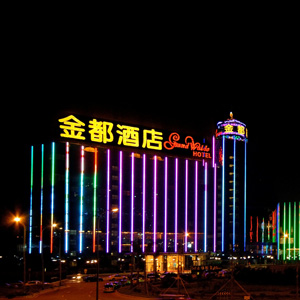
    So the taxi driver got me to my hotel, but I rather wish he hadn’t. The name, “Grand Waldo”, should have tipped me off. Seriously: Grand Waldo? In the shadow of the grandeur and surreal artificiality of the Venetian, the “Grand Waldo”, or “金都” to use its pretentious Chinese name, compensates by having the gaudiest exterior lighting in all of Macau. And that’s saying something. I had actually noticed it from the airplane on the way in, never dreaming that this was where I was headed for.

    The lobby had a touch of desolation about it, a moody silence punctuated by breathy snapping of a nailgun as some evening renovation work was carried out. At the desk, three attendants went through a check-in routine that was even more laborious and sluggish than Macau immigration.

    When I arrived at the desk the woman who was supposed to serve me was distracted first by the need to send a fax to someone, which task took about five minutes, and then by the arrival of a disgruntled man who wanted to complain at length about the crappy service. He was eventually foisted off on the assistant manager, but as I went through check in I listened to his litany of complaints. It ended with him canceling his stay in leaving in search of another hotel. Not a good sign.

    Nevertheless, I toughed it out. My room was reasonably sized, and artfully positioned in an armpit of the building such that the maximum amount of the scintillating external lighting shined right in. Fortunately there were blackout curtains.

    There was no CNN or BBC, but it did have Fox News (did you know that curvy women have smarter children and Virginia is the state with the most personalized license plates?) and, thank heavens, Al Jazeera (gunfire and political tension between Fatah and Hamas in Gaza, major fire in London). It also had Portuguese soap operas featuring attractive, heavy-breasted women in various states of emotional turmoil and scanty dress. That was worth something.

    I dialed room service. I’m pretty sure I dialed correctly because I pressed the button labeled “room service” on the phone. This led to a Kafkaesque phone nightmare in which I was transferred no fewer than six times before I got someone who was prepared to take an order for a club sandwich. 82.5 patacas after tax. The man who brought it to my room wouldn’t allow me to sign for it. I had to pay cash. He didn’t offer to make change for the pataca C-note I handed him. He just grinned and pointed at himself. I was so amazed by this display of chutzpah that he was long gone before I realized he hadn’t left the receipt for me.

    An hour later the phone in room rang. “Hi, I was staying in room 620* before, and I think I left a blue comb in there, in the small bathroom.” (It’s a suite.) “Can I come and get it?” This sounded a lot like, “Businessman gets rolled in Macau hotel” to me. I said I’d check in the bathroom. Sure enough there was a blue comb in the bathroom with bits of gel stuck to it. I told the caller to come on down and put the chain on the door.

    So he had checked out of this room and into some other room in the hotel and left his comb. Housekeeping had flipped the room, but somehow not noticed the grungy, used comb in the outer bathroom. Meanwhile, this guy was so attached to his plastic comb that he turned up his nose at the one included in the room amenity kit and came back for his.

    The icy tendrils of paranoia began to creep up my neck.

    At any rate, the comb owner was apologetic enough when he showed up at my door, and made no attempt to roll me or sell me a blow job (which does rather distinguish him from a hotel experience I once had in the aforementioned Kuala Lumpur, but more on James Bond Massage and Fullsex Escort Service and the Cantonese hookers I had to pay to go away some other time).

    So it’s all quiet now, and at least the broadband works, as I type here in the glow of Al Jazeera (which isn’t half bad).

    I have, however asked my coordinator to look for another hotel for tomorrow night.

    *Not my real room number. Like I said, tendrils of paranoia.

    Update: Hanging on my room door this morning: The Oriental Daily News, which appears to be a Hong Kong gutter rag that, judging from the layout, is designed for a readership devoted to hard hitting stories about police shootings and starlet misadventures. Still, I suppose it gives you something to read while you yank the crank on your one-armed bandit. You could just about finish a story in the time the wheels take to come up, “Bull’s eye”, “Clown” and “Dog riding a tricycle” or whatever symbols they put on slot machines these days (Imagethief is not a gambling man). I guess the name “William Moss” and the US passport didn’t tip them off.

    In all its pomp...
    In all its pomp…