Tag: Xinhua

  • Unsolicited advice for Xinhua’s new CNC TV news outfit

    To listen to people moan about the fact that China has sixty “Confucius Centers” in the US to America’s zilch-nada in China you’d think the Chinese were wrapping up hearts and minds around the planet while America gets relegated to the public diplomacy junk-heap alongside the usual despotic malcontents. While I’ll concede that China has an advantage in being able to roll out cultural centers in the US while smothering our own poorly funded efforts in red tape, I’m inclined to see that imbalance as the result of the tolerance and openness that have been part of America’s strength for the last 234 years. Give or take.

    Readers in America: When was the last time any of you went to a Confucius Center? I thought so. How about watched a Chinese television program or a Chinese movie that wasn’t directed by Zhang Yimou or Chen Kaige? See any Chinese brands last time you walked down the street? Ever had an American tell you they think Hu Jintao is super cool? Driven a Chinese car lately? Right. Whereas here, people feast on American pop culture (especially TV and movies), the street corners are a plague of American fast food labels and Buick is an aspirational brand. Leaving aside your opinions as to the value of McDonalds and Starbucks as ambassadors of American values, let’s not get all hysterical about the Confucius Centers or wallow in insecurity about America’s cultural influence until poor American refugees start seeking a better life in Fujian.

    In fact, China’s government is well aware of its soft-power deficit with regard to the US (see also this article on Danwei), and has been investing in building up its capabilities. International news is one of the key areas of investment, thus the revamping and expansion of China’s foreign-language media organizations. This has included a refresh of the venerable China Daily, the launch of the surprisingly interesting English edition of theGlobal Times, the revamping of CCTV’s English language station, and more. Most recently, the Wall Street Journal has an interesting story about Xinhua’s plans to roll out an international television news service:

    China’s state news agency announced the launch of a global English-language television channel, part of a broader international push by the country’s government media aimed at countering the dominance of Western news outlets and conveying a Chinese perspective on events.

    Xinhua news agency said trial broadcasts of the new 24-hour TV service, called China Network Corp., or CNC, will start Saturday, and the station will be fully operational July 1. CNC will be available by satellite, cable systems, the Internet and cellphones, Xinhua said, and will carry a range of programming on news, business and lifestyle issues.

    “CNC will offer an alternative source of information for a global audience and aims to promote peace and development by interpreting the world in a global perspective,” Xinhua quoted its president, Li Congjun, as saying at a launch ceremony Friday.

    Well, maybe.

    I fully understand and even support the motivation behind this. China is a globally important country and has a right to be represented in international media. And as American news media continues its slow-motion implosion, you’d think this would be a good time for them to make their move. Nevertheless, I have a history of rolling my eyes at Chinese efforts to improve their international media efforts. This is not because I am some kind of cynical bastard (although that might also be true) or because I doubt China’s technical competence (I do not). It is because I feel that the natural control-freak inclinations of the Chinese government toward media essentially preclude any ability to develop a news organization with real, international credibility.

    The objective–the real objective–is important. If the goal is simply to further disseminate the usual propaganda, then fine, they can do whatever they want. They’ll all feel good about themselves. But no one will watch.

    If, on the other hand, the goal is to develop an international media organization that can compete with what’s already offered in English and offer a legitimately different but respectable perspective, then they’ll need to break their traditional mold a bit. Al Jazeera is perhaps the model here. It emerged from a country and region not known for a liberal approach to media and established itself as a serious and credible news organization largely on the back of its Iraq and Afghan war coverage. It did so while still presenting a point of view that was a clear alternative to most western media. They were helped along by some good journalism and slick packaging.

    I don’t want to overwork the comparison. For one thing, Al Jazeera has had its problems (including serious personnel issues at their English service a couple of years ago). China certainly has the resources to try something similar to Al Jazeera, but it has some very different political and institutional factors to wrestle with than Qatar did. Also, the world isn’t necessarily screaming for an Asian alternative. Remember, Singapore has already tried the international TV news stunt with Channel News Asia, and it has had only modest international success at best. Even Al Jazeera kind of limped along for several years until it found its purpose and voice after 9/11 and the Afghanistan and Iraq wars. One hesitates to imagine a Chinese news organization blossoming in the heat of such a controversial international incident.

    So with all that in mind, here are a few things I think China should do if it is really serious about launching a successful international television news network.

    Base it in Hong Kong
    Let’s face it, as wonderful as Beijing is, nobody is going to take a Beijing-headquartered international news organization seriously. By my thorough calculations, credibility will increase by the square of the distance from Zhongnanhai. This will be especially true if your parent organization is formally a branch of the Central Publicity Department, as Xinhua is. Technically that probably makes Lima or Buenos Aires the best option, but since those might be impractical, how about Hong Kong? Hong Kong is an established media hub with a veneer of press freedom that will be important in helping a new network to establish itself. It’s visa situation will be easier for pundits and professionals, especially the foreigners (see the next point). And, hey, it’s still China, right? Beijing has no trouble calling the shots in Legco, so it could probably manage a Hong Kong-based media organization without too much headache.

    Hire pros to do it
    Al Jazeera raided the BBC Arabic service when it started, and then raided the BBC again when it started its English service. China should do something similar. There are a lot of good, unemployed journalists around these days, including TV journalists. Avoid the second-stringers and discount talent and hire some heavy hitters for the editing and mainstream talent. Go for some recognizable brand-names. This will be hard because most such people won’t want to work in a Chinese news organization. Basing it in Hong Kong will help, but people will have to believe it will be doing serious journalism.

    Also, make sure the production values are competitive with the best out there. No college broadcasting, please.

    Cover China for real
    This is another area where the Al Jazeera comparison breaks down. Al Jazeera was able to concede limits to its ability to cover its patron’s country, Qatar. Fortunately for them, nobody outside Qatar much cares what happens there, and there are plenty of sexier, more powerful and weirder places in the Gulf, let alone the broader middle East.

    This won’t work for China, however. China is pretty much story number one out of Asia these days. How a Chinese international news network covers China will be a key part of how it is evaluated by audiences. The real test will come when, inevitably, such an organization has to cover a serious disaster or bout of civil unrest in China. What plays domestically will not play internationally, especially when people are comparing the coverage to other international media organizations. With all due respect to the Chinese people, who have been poorly served by foreign media on more than one occasion, most people outside of China–even non-Westerners–don’t spend their time grumbling about how crappy and one-sided coverage of China is. So don’t waste too much energy tilting at that particular windmill.

    I’m not sure how China could manage this. It might have to credential its own news organization’s China journalists as foreign media. Now wouldn’t that be something.

    Less scolding, more seduction
    We understand that this operation is there to present China’s point of view, but a little bit of nuance is called for. Sometimes, the organization is going to have to cover the Dalai Lama, or Rebiyah Kadeer, Taiwan’s DPP, or other people the Chinese government finds distasteful. The moment the announcers start slipping into hostile language about black elements, jackals (jackals always get a bad rap), splittist criminals, etc. it’s all over. By all means, be more sympathetic to the Chinese government point of view, but do without with the theatrical, throwback language that alienates foreigners and reminds people that the propaganda mission always comes first. Find articulate, polished spokespeople to present the Chinese government point of view and let them, rather than the journalists or newsreaders, present the government’s points.

    Don’t forget the rest of the world
    It shouldn’t be all China, all the time. Global news organizations report on, yes, the globe. If the big news of the day is from somewhere outside of China, let’s make sure we don’t lead with what the Standing Committee did today, in protocol order, and doesn’t Uncle Wen look nice with the bouquet those schoolgirls gave him. That means opening a lot of bureaus and sending hardcore journalists to interesting places. With many western media organizations in retreat, there are plenty of parts of the globe that could and should be covered better, and where China might get better access than Western media organizations. Africa and Central Asia come to mind. China has the resources and can do this if it wants to.

    Or it could all be a fantasy. I’d be interested to see China come up with something polished, interesting and watchable. There have certainly been signs of life from corners of the Chinese English-language media in the last few years. But given the history, especially in the heavily state-managed regime of television, it’s hard to be optimistic.
  • Asian media vows to make western media cry

    Imagethief was tickled to read today in Xinhua an article from the Boao Forum for Asia, an annual Chinese talking shop, on how Asian media will rise up to challenge western media juggernauts. It seems that Asians take umbrage that they are 96.2% of the world’s population and yet produce only 0.3% of its international media. Or something like that.

    The article makes many serious points:

    “The world is not flat actually,” Liu Jiang, deputy editor-in-chief of Xinhua News Agency, said at the annual conference of the Boao Forum for Asia (BFA), which was held over the weekend in the south China town of Boao.

    “The world is in reality a slop [sic] on which information flows downward from developed countries to developing countries and regions,” Liu said.

    “The World Is Flat” by the New York Times columnist Thomas Friedman has been frequently quoted to prove an alleged “magic power” of globalization by Bill Gates and other lecturers at the conference.

    The book figures out ten driving forces to grind the world flat, in each of which media play an important role.

    “Developed contrives, which have one seventh of the world population, have dominated two thirds of the total information flow,” Liu said. “However, globalization does not balance a horizontal world when it is grinding the world.”

    “Why do Asian media always yield to Western culture?” Felix Soh, deputy editor-in-chief of The Straits Times headquartered in Singapore, questioned in his speech at the sub-forum discussing globalization and the media.

    Imagethief has lived in Asia for over a decade and is a fan of Asia and things Asian. So he will try to address Mr. Soh’s question as delicately and constructively as possible.

    It’s because on average Asian media suck. Especially news media.

    Now this is not an entirely categorical statement. There are fine Asian newspapers and magazines, and, heaven knows, gifted Asian filmmakers and writers. But in general –and I am truly sorry for purely selfish reasons that this is the case– Asian commercial media is a desperate wasteland that teeters perpetually on the precarious knife-edge of irredeemability.

    Mr. Soh himself heads up one of the blazing test cases for the failed potential of Asian media. Imagethief needs to tread carefully here because he is really good friends with several Straits Times journalists, and they are hardworking, smart, talented people. But friends are honest with each other, so here it is: the Straits Times took the last train to dullsville and fell asleep in its seat and missed the stop. I know. I subscribed for years.

    The tragedy of this –the great, majestic, swooping tragedy– is that if any country was going to produce a credible pan-Asian newspaper it would be Singapore. It’s in the right place, it’s got the right people, and it speaks the right languages. It really is a regional hub. But it will never happen.

    I blame government. Governments, by and large, should not involve themselves in media. But Asia’s governments cannot, for the life of them, keep their grubby mitts off the media. And damned if they don’t have a near mystical talent for boiling the life out of it.

    I realize you can argue both aspects of the government involvement equation. The government-run chartered [see note below -WM] BBC, for its troubles, is one of the world’s great news gathering organizations. Too little government supervision of media and you get dangerously irresponsible or corrupt media.

    But too much government involvement and you get soul-destroying headlines like…well, just for fun, let’s see what the top story on the Straits Times website is right now:

    Need for S’pore to focus on sustainable construction: Grace Fu

    THERE is a scope to reduce the stockpile release price for granite from May onwards, Minister of State for National Development Grace Fu said.

    Gadzooks! And for good measure here’s the number two headline:

    Extraordinary govt, talent keep S’pore ahead, says MM (MM= Minister Mentor Lee Kuan Yew)

    Good gosh, two government headlines in a row. And this is typical. Back in Singapore we used to joke about what the above-the-fold government headline of the day would be.

    Arguably, this is what is important to Singaporeans (although this kind of stuff drives my Singaporean wife up the wall, but she married me so she’s probably deranged). And I realize it’s unfair to dump so much on the Straits Times. But if the editor is going to ask rhetorical questions about the subservience of Asian media, perhaps he should look close to home for the answer.

    This story is rewritten across the region. As long as Asian governments manage their news, censor their films, and interfere explicitly in culture then their newspapers will be treated as propaganda, their most talented artists will flee overseas and their people will wolf-down tawdry but lively foreign culture.

    So my recommendation for the governments of Asia is this: if you want a louder voice in the world, if you’re tired of being walked all over by imperialist western media, if you think you are being misrepresented on the global stage, then back the hell off. Set your own media free. It will probably rise to the challenge, and, I suspect, do it better without you breathing over its shoulder.

    But that’s a pipe dream. Here’s the end of that article:

    High level forums and meetings have been raised by media groups from China and members of Association of Southeast Asian Nations (ASEAN). An agreement of cooperation on communication signed by members of the Non-aligned Movement at Kuala Lumpur in 2005 has shown the developing countries’ strong willing to speak louder in the world.

    Delegates of Asian media attending the BFA conference reached the consensus that Asian media should shoulder a responsibility for broadcasting “a harmonious Asia” with “a harmonious Asian image” and provide a value of “harmonious region” to tell the world a real Asia.

    A “harmonious Asia”? Oh dear. Pass me the Financial Times.

    Note: I do give a tip of the hat to Singapore’s Chinese language daily, Lianhe Zaobao, which is popular in China.

    Update: Charlie (in comments below) [comments no longer available – WM] and another reader (by e-mail) have pointed out the important distinction between publicly funded media, such as BBC or NPR in the US, and state-managed media. I should have made that distinction clearer in the text. The BBC is, thus, probably used incorrectly as a positive example above. Unfortunately that kind of bottoms out the list of exceptions to thegovernment involvement = bad rule.

  • Official: Lei Feng was “hip with his times”

    It’s always a tragedy when your propaganda icons lose relevance to the younger generation. A couple of years past the fortieth anniversary of the original “Study Lei Feng” campaign, China’s propaganda moles are clearly hard-up for a way to make the much mythologized “ideal soldier” resonate with a generation of youngsters brought up on pirate “Friends” DVDs, MP3 players and Internet chat rooms. How else to explain this Xinhua article, which ran a couple of days ago, just before yesterday’s annual “Lei Feng Day” (don’t worry; I didn’t know it was coming either):

    March 5 is an ordinary date on the Chinese calendar, but it’s the day when millions of young people across the country will do something good for someone else, following Lei Feng’s example.

    “Lei Feng Day, honors a Chinese cultural icon who was immortalized by the late Chairman Mao Zedong as a selfless and model person serving the people heart and soul.

    Lei Feng, who was just 22 when he was killed in an accident in 1962, inspired the nation after Mao called on people to “Learn from comrade Lei Feng”, and show the “Lei Feng Spirit”.

    Born to a peasant family in Wangcheng of Central China’s Hunan Province, Lei Feng was orphaned before he was seven. At 20, he joined the People’s Liberation Army (PLA) and spent all his spare time and money helping the needy. Lei died after being hit on the head by a wooden pole that was accidentally knocked over by a fellow soldier.

    Lei left behind him a remarkable legacy of diaries and poems detailing his hopes and aspirations. For emerging new China, which was rapidly evolving through the 1950′s and 60′s, Lei’s diaries are peppered with simple verses of inspiration that rang true for the masses who wanted to “make the world more beautiful everyday. “By the early 1970′s Lei was worshipped as a hero or even a god and millions of young people emulated his acts of generosity.

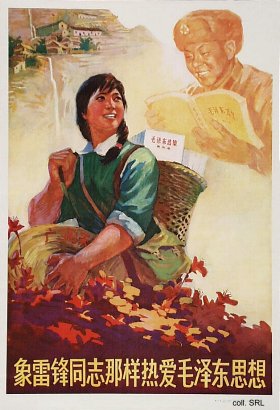
    That adulation was certainly not the result of any orchestrated propaganda campaign, and it’s cynical of you to think so. You should be ashamed. Posters such as the one at left, which exhorts everyone to love Mao Zidong thought in the manner of Lei Feng, were simply the result of people’s spontaneous outpouring of love for a 22 year-old peasant truck driver who died a conspicuously unheroic death. Many more such posters –all equally sincere– are on display at the Lei Feng section of Stefan Landsberger’s superb Chinese propaganda posters website.

    Lei’s new biographer is working hard to ensure that modern youth, notorious for their short attention spans and disdain for Soviet-style, floppy-eared winter hats, stay connected with Lei Feng, who obviously has many lessons left to teach. Most interesting is an attempt to portray Lei as stylish and contemporary. At least, by 1962 Maoist standards:

    Shi Yonggang felt unwell with the situation, who is one of the editors of a new book [sic], “Lei Feng: 1940-1962″, that will be released to on Sunday’s Lei Feng Day to recall Lei Feng’s Spirit.

    This latest edition of Lei Feng’s story is one of more than 1,000 books that have recorded his good deeds.

    “It is a pity that the image of Lei Feng depicted in those books is hard for people, especially young people, to understand and accept nowadays,” said Shi, the editor.

    Shi’s book includes more than 300 never-before-published photographs of Lei showing him as an obviously fun-loving young man who was hip with his times.

    In fact, not only was Lei hip with his times, such as they were, he was, it turns out, the coolest kid in his platoon, and a veritable style maven:

    “Lei Feng did almost all the fashionable things of his day ,” Shi said. When Lei was a farmer, he drove a tractor which is comparable to today’s BMW. When workers became the most respected segment of society in the 1950s, Lei became an iron worker in an Anshan factory in Northeast China’s Liaoning Province. He then upgraded his technical skills to earn a rarely-issued driver’s licence and began a career as a truck driver.

    Shi’s two favorite pictures are of Lei riding a borrowed motorcycle on Tian’anmen Square in downtown Beijing, while the other shows Lei holding a trendy satchel as he stands by the WuhanYangtze River Bridge, in Central China’s Hubei Province.

    The photographs also show that Lei wore fashionable sweaters, a leather jacket and wristwatch, all considered luxury items of the day.

    Driving a tractor; working as an iron worker; flashing a trendy backback. The boy was out of control. I grant you it looks like a stretch to equate nursing your rusty tractor over some dessicated, rutted field with pumping your black BMW 7-series down the highway at asshole speeds or pulling it up in front of Bellagio so the princelings out for their pre-club snacks can see your supermodel girlfriend flash her panties as she ankles her way out of the shotgun seat in a skirt so short it could be mistaken for a wide belt. But you have to remember we’re talking about 1950s China here, and standards were different. Nobody had panties then. Cool was where you found it, even if that was, um, a tractor.

    Finally, it turns out that the obedient and studious model soldier and worker was actually a rebellious hair farmer of the first degree:

    Zhang said that Lei liked to look smart and he loved to wear long bangs even though they were prohibited in the army. “Lei was warned about his hair so he would hide his bangs under his cap when he was on duty, but when he was out of uniform he would let them hang loose,” Zhang said.

    Astounding. It’s a complete reformation. He probably had a band on the side and smoked out under the bleachers. Lei Feng is clearly much more relevant to modern youth than anyone had dared dream possible. Can a new series of propaganda posters showing the iconic youth with shades, an iPod and a sexy girlfriend be far behind? After all, if modern China is all about the glory of getting rich, how can its icons miss the boat? With that in mind, I’d like to suggest a few updated slogans to accompany the new propaganda posters:

    • Seriously study fashion like Lei Feng, and get a nice shirt and some decent shoes.
    • Lei Feng says quit whining and get a grip.
    • Lei Feng wouldn’t be caught dead with his finger up his nose, asshole.
    • Only download legal music, in the manner of Lei Feng.
    • If Lei Feng caught you spitting, he’d bitch-slap you silly.
    • Live fast, die young, and leave a good looking corpse. Just like comrade Lei Feng.

    Look out kids, it’s the all-new Lei Feng.

    Hey there, good looking!
    Hey there, good looking!