Month: March 2006

  • By chopstick to the moon

    Imagethief was interested to read in today’s China Daily that China’s government is slapping a consumption tax on several items, including disposable chopsticks and luxury yachts. I think this is just and wise, and should be done. The reason why  think so is that, according to the article, China mills 1.3 million cubic meters of wood a year into disposable chopsticks.

    That is, to use a technical term favored by engineers, a whole shitload of wood. Imagethief would like to help you visualize exactly how much wood that is:

    • Picture a block of wood one meter on each side.
    • Now imagine 1.3 million of those.

    As you can see, that amount of wood fair boggles the mind. The other thing that fair boggles the mind is exactly how many disposable chopsticks that adds up to. According to the article, that much wood yields 10 billion “boxes” of disposable chopsticks.

    How many chopsticks is this? Let’s play the visualization game again. After reading this article, Imagethief ran to his office pantry where, no joke, he fished a used pair of disposable chopsticks out of the trash in order to measure them. Science marches ever onward, and discovery is not for the faint of heart. And our office doesn’t stock disposable chopsticks, so I had to use ones that somebody brought from the food court downstairs.

    A quick bit of ruler work revealed that your average disposable chopstick is 19cm long. Now, I have no idea how many chopsticks are in a “box” as referred to by the article. My statistical woes are further compounded by the fact that the caption in this article and the body text provide completely different numbers for the number of cubic meters of wood consumed every year, and the number of resulting chopsticks. The caption says 2 million cubic meters and 15 billion pairs (not “boxes”) of chopsticks. It just goes to show what a black art statistics is in China, where, apparently, almost everything is simply made up. The caption is sourced to AP and the body text to Xinhua, so take that as you will.

    Erring on the side of being conservative, we’ll go with the 1.3 million cubic meters from the Xinhua body text and we’ll read “10 billion boxes” as 10 billion pairs of chopsticks, or 20 billion individual chopsticks (which provides, by the way, a surprisingly low per-capita disposable chopstick usage of 7.7 pairs per year — Imagethief alone probably buries about a pair a week).

    At any rate, if you were to line up 20 billion chopsticks nose to tail, your chain of chopsticks would stretch 380 billion centimeters or 3.8 million kilometers (you may wish to check my math). The distance from the earth to the moon is 384,403 kilometers (according to the Internet), which means that, using China’s annual production of disposable chopsticks, you could built a bridge from the earth to the moon nearly ten chopsticks wide (9.885 to be exact – this may be a universal constant of some kind).

    Now you know how the Chinese space program is going to get people to the moon.

    By any reckoning that’s a pile of chopsticks, which leads Imagethief to discard all notions of cultural relativism and offer the following advice to the Chinese people:

    Get a fork.

    Barring that, even given that the majority of China’s disposable chopsticks are exported to the moo goo gai pan joints of America, a consumption tax sure sounds like a good idea. From what I see around Beijing, there isn’t enough wood left in China to support more than about another ten-days worth of chopstick production.

    And god knows how many luxury yachts you could build with that many chopsticks.

  • Press releases with Chinese characteristics

    In my job I am regularly exposed to Chinese press releases from various sources (often not my clients, I hasten to add). We sometimes send these releases for translation into English for our clients. As one of the few native English speakers in the office, I am often asked to edit the spotty results.

    A translated Chinese press release does not read like one written in English. A tendency towards hyperbolic self-congratulation is aggravated by translators who reach for the grandest available English word. The result can be accidentally magnificent, like an imperial proclamation gone commercial. When forwarding translations to English speaking execs I often attach a warning that a Chinese release will not be what they are used to, in either language or structure.

    The dismal nature of many press releases aside, translations don’t do justice to original authors. Translation is a dark art, and there is a big difference between a literal, word-for-word translation and a skillful transliteration that preserves both meaning and style. I can only read a thousand or so Chinese characters, so I can’t refer to originals when I am editing. At least, not easily. This adds a touch of divining to the task, as I try to gaze through the translation and perceive what the author meant to say. This is highly subjective, and sometimes the result is a punt.

    But the vagaries of translation can’t hide the formula. And it’s not just Chinese press releases that are worthy of deconstruction. A cruise of the China websites of many multinationals reveals press releases written in English but often as odd and formulaic as their Chinese counterparts.

    With that in mind, I have mocked up an abbreviated, “parallel” press release that shows the different ways in which Chinese and American partners companies might each announce the same event and identifies some of the classic China press release elements.

    Shaanxi Veeblefetzer* (Joint Venture) Corporation and American partner General Widget plan joint product launch

    Paragraph 1: The Lede

    • Chinese company opens with breathless enthusiasm, sings its own praises for a full paragraph before getting to the news hook, and begins machine-gun repetition of its own name. News (or lack thereof) takes back-seat to hyperbole. Translation creates appalling run-on sentences.

    Beijing, March 10, 2006: Shaanxi Veeblefetzer* (Joint Venture) Corporation is China’s leading widget company, producing exquisite and widely admired widgets for incorporation into the products of many global enterprises. Shaanxi Veeblefetzer is a joint venture between Xiao Jing Hogfarms (twenty percent owned by Eurohog AG) and the Shaanxi Provincial Government Bureau of Pointless Devices. It has long been one of China’s most progressive organizations, achieving business success while properly adhering to the tenets of Mao Zedong thought, Deng Xiaoping Theory, the Three Represents, the Theory of Scientific Development, the development of the New Socialist Countryside, and any other political theories or frameworks that may be advanced by the Standing Committee between now and when this press release is issued, but excepting any that are later discredited.

    Shaanxi Veeblefetzer (Joint Venture) Corporation today announced that its 2005 model widget, jointly produced with America’s General Widget Corporation, would be greeted with enthusiasm by a global market pregnant with expectation. Audiences from all nations have clamored indefatigably for Shaanxi Veeblefetzer widgets since first learning that the new model would be designed and manufactured to exacting standards, in order to meet the highest demands of the international widget marketplace.

    • American company opens matter-of-factly, lulling you with professionalism and numbers-driven news value.

    Beijing, March 10, 2006: General Widget Corporation (NYSE: GWG) and Chinese partner Shaanxi Veeblefetzer (Joint Venture) Corp. today announced plans to jointly develop and manufacture the next generation of general purpose widgets. The combination of General Widget’s design expertise with Shaanxi Veeblefetzer’s low manufacturing costs will enable both companies to take advantage of a global widget market forecast to grow at more than 10% annually over the next five years.

    Paragraph 2: Lofty Credentials

    • Chinese company demonstrates potential to command the global market. Ambition is laid bare.

    Made from glittering and abundant Shaanxi raw materials, copiously provided by the enthusiastic and legally compensated laborers of Shaanxi Veeblefetzer’s extractive industry partners, the 2005 model Shaanxi Veeblefetzer widget is boldly designed to consolidate the fortunes of Shaanxi Veeblefetzer Corporation for many decades.

    • American company demonstrates current command of the global market. Jargon is laid bare.

    Founded by widget inventor Ebenezer Sklyde in 1776, General Widget has been the world’s leading designer and manufacturer of widgets for over 200 years. The joint venture with Shaanxi Veeblefetzer will enable General Widget to leverage manufacturing synergies to capture an increasing share of the surging China market and to satisfy growing global demand for widgets that deliver more value to business and consumer widget users.

    Paragraph 3: The Companies Quote Themselves

    • Chinese company inserts a CEO quote. Slight, institutional inferiority complex is revealed. Overzealous translation of already formal quote language yields Olympian sounding proclamation.

    Wang Jinlong, Founder, Chairman, President and CEO of Shaanxi Veeblefetzer (Joint Venture) Corporation, said, “Shaanxi Veeblefetzer (Joint Venture) Corporation will provoke constant fascination in the global widget market by striding forward to assume the rightful place of Chinese widget manufacturers on the worldwide stage. It is without precedent that such a superlative widget is envisioned and fashioned by a Shaanxi company that now equates in operational excellence to many international leaders in the widget industry. This is the culmination of our strategic machinations, and the imminent showering of largesse upon our shareholders fills us with insuperable satisfaction.”

    • American company inserts a CEO quote. Designed to show that the American CEO is a China hand who understands a market impenetrable to less gifted souls. Complementary of China, in case government officials read the release. Demonstrates social commitment to China to minimize possibilities of a nationalist outburst.

    Butch McSwindle, CEO of General Widget, said, “I’ve been coming to China since I was lad, and over the years I’ve had a chance to see first-hand the tremendous, economic progress of this great land. Now I’m pleased that General Widget will play such a critical role in helping China’s widget industry to take its next great stride.” Mr. McSwindle also announced that General Widget would be launching a new charitable program in China dedicated to rescuing rural orphans who have fallen into abandoned well-shafts. “It’s a gesture from the bottom of our hearts, and not cynical at all,” he added.

    Paragraph 4: The Companies Quote Each Other

    • Chinese company writes a quote for the American CEO in which he lavishes praise on the Chinese company.

    Leading executives from Shaanxi Veeblefetzer’s American joint venture partner, General Widget, a Fortune 100 company, also expressed their satisfaction at the impending release of the jointly developed widget. “We weep with joy at the prospect of this magnificent occasion for Shaanxi Veeblefetzer (Joint Venture) corporation,” said CEO Butch McSwindle. “I have directed our entire company staff to earnestly study Wang Jinlong thought that we may better understand Shaanxi management acuity.”

    • American company writes a quote for the Chinese CEO in which he lavishes praise on the American company.

    Shaanxi Veeblefetzer CEO Wang Jinlong said, “We’re humbled to work with a surpassing, global leader like General Widget. This is a great opportunity for us to sit demurely at the feet of one of the world’s industrial colossi and be schooled in the intricacies of global business, which have long mystified us. General Widget’s timeless dedication to China is a source of pride and warmth for me and all employees of Shaanxi Veeblefetzer.”

    -ends-
    (mercifully)

    The language above is exaggerated, of course, although not as much as you might think. But the formula is real enough, if slightly condensed. In truth, both Chinese companies and American companies in China are getting better, but enough dismal crap crosses my desk to remind me that there are always some offenders yet to be reformed.

    Why does this happen? All press releases are formula to a degree. The objectives are usually clear, and there is a well established rhythm to getting through the essential elements; ledes, quotes, background, etc. a well written one does the job quickly, efficiently, and with a minimum of fuss. The reverse pyramid, as we all learn in flack school.

    But in China, where companies often have to both deal with the vagaries of translation and reconcile the basic function of a press release –telling your story to the media– with a host of dueling concerns, from satisfying face-obsessed bosses to satisfying the government, the results can often be mysterious and fascinating. The state-owned pedigree of many companies and much media also means that different rhythms of communication and different expectations have evolved, although a more western model is slowly becoming prevalent. As a good friend of mine with long China experience once said, “the Chinese don’t understand PR. They understand face.” Think of it as another example of PR with Chinese characteristics.

    Now, don’t get me started on boilerplates.

    *Apologies to Mad Magazine.

  • Official: Lei Feng was “hip with his times”

    It’s always a tragedy when your propaganda icons lose relevance to the younger generation. A couple of years past the fortieth anniversary of the original “Study Lei Feng” campaign, China’s propaganda moles are clearly hard-up for a way to make the much mythologized “ideal soldier” resonate with a generation of youngsters brought up on pirate “Friends” DVDs, MP3 players and Internet chat rooms. How else to explain this Xinhua article, which ran a couple of days ago, just before yesterday’s annual “Lei Feng Day” (don’t worry; I didn’t know it was coming either):

    March 5 is an ordinary date on the Chinese calendar, but it’s the day when millions of young people across the country will do something good for someone else, following Lei Feng’s example.

    “Lei Feng Day, honors a Chinese cultural icon who was immortalized by the late Chairman Mao Zedong as a selfless and model person serving the people heart and soul.

    Lei Feng, who was just 22 when he was killed in an accident in 1962, inspired the nation after Mao called on people to “Learn from comrade Lei Feng”, and show the “Lei Feng Spirit”.

    Born to a peasant family in Wangcheng of Central China’s Hunan Province, Lei Feng was orphaned before he was seven. At 20, he joined the People’s Liberation Army (PLA) and spent all his spare time and money helping the needy. Lei died after being hit on the head by a wooden pole that was accidentally knocked over by a fellow soldier.

    Lei left behind him a remarkable legacy of diaries and poems detailing his hopes and aspirations. For emerging new China, which was rapidly evolving through the 1950′s and 60′s, Lei’s diaries are peppered with simple verses of inspiration that rang true for the masses who wanted to “make the world more beautiful everyday. “By the early 1970′s Lei was worshipped as a hero or even a god and millions of young people emulated his acts of generosity.

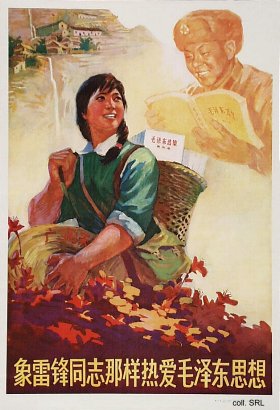
    That adulation was certainly not the result of any orchestrated propaganda campaign, and it’s cynical of you to think so. You should be ashamed. Posters such as the one at left, which exhorts everyone to love Mao Zidong thought in the manner of Lei Feng, were simply the result of people’s spontaneous outpouring of love for a 22 year-old peasant truck driver who died a conspicuously unheroic death. Many more such posters –all equally sincere– are on display at the Lei Feng section of Stefan Landsberger’s superb Chinese propaganda posters website.

    Lei’s new biographer is working hard to ensure that modern youth, notorious for their short attention spans and disdain for Soviet-style, floppy-eared winter hats, stay connected with Lei Feng, who obviously has many lessons left to teach. Most interesting is an attempt to portray Lei as stylish and contemporary. At least, by 1962 Maoist standards:

    Shi Yonggang felt unwell with the situation, who is one of the editors of a new book [sic], “Lei Feng: 1940-1962″, that will be released to on Sunday’s Lei Feng Day to recall Lei Feng’s Spirit.

    This latest edition of Lei Feng’s story is one of more than 1,000 books that have recorded his good deeds.

    “It is a pity that the image of Lei Feng depicted in those books is hard for people, especially young people, to understand and accept nowadays,” said Shi, the editor.

    Shi’s book includes more than 300 never-before-published photographs of Lei showing him as an obviously fun-loving young man who was hip with his times.

    In fact, not only was Lei hip with his times, such as they were, he was, it turns out, the coolest kid in his platoon, and a veritable style maven:

    “Lei Feng did almost all the fashionable things of his day ,” Shi said. When Lei was a farmer, he drove a tractor which is comparable to today’s BMW. When workers became the most respected segment of society in the 1950s, Lei became an iron worker in an Anshan factory in Northeast China’s Liaoning Province. He then upgraded his technical skills to earn a rarely-issued driver’s licence and began a career as a truck driver.

    Shi’s two favorite pictures are of Lei riding a borrowed motorcycle on Tian’anmen Square in downtown Beijing, while the other shows Lei holding a trendy satchel as he stands by the WuhanYangtze River Bridge, in Central China’s Hubei Province.

    The photographs also show that Lei wore fashionable sweaters, a leather jacket and wristwatch, all considered luxury items of the day.

    Driving a tractor; working as an iron worker; flashing a trendy backback. The boy was out of control. I grant you it looks like a stretch to equate nursing your rusty tractor over some dessicated, rutted field with pumping your black BMW 7-series down the highway at asshole speeds or pulling it up in front of Bellagio so the princelings out for their pre-club snacks can see your supermodel girlfriend flash her panties as she ankles her way out of the shotgun seat in a skirt so short it could be mistaken for a wide belt. But you have to remember we’re talking about 1950s China here, and standards were different. Nobody had panties then. Cool was where you found it, even if that was, um, a tractor.

    Finally, it turns out that the obedient and studious model soldier and worker was actually a rebellious hair farmer of the first degree:

    Zhang said that Lei liked to look smart and he loved to wear long bangs even though they were prohibited in the army. “Lei was warned about his hair so he would hide his bangs under his cap when he was on duty, but when he was out of uniform he would let them hang loose,” Zhang said.

    Astounding. It’s a complete reformation. He probably had a band on the side and smoked out under the bleachers. Lei Feng is clearly much more relevant to modern youth than anyone had dared dream possible. Can a new series of propaganda posters showing the iconic youth with shades, an iPod and a sexy girlfriend be far behind? After all, if modern China is all about the glory of getting rich, how can its icons miss the boat? With that in mind, I’d like to suggest a few updated slogans to accompany the new propaganda posters:

    • Seriously study fashion like Lei Feng, and get a nice shirt and some decent shoes.
    • Lei Feng says quit whining and get a grip.
    • Lei Feng wouldn’t be caught dead with his finger up his nose, asshole.
    • Only download legal music, in the manner of Lei Feng.
    • If Lei Feng caught you spitting, he’d bitch-slap you silly.
    • Live fast, die young, and leave a good looking corpse. Just like comrade Lei Feng.

    Look out kids, it’s the all-new Lei Feng.

    Hey there, good looking!
    Hey there, good looking!