Tag: Shanghai

  • How Shanghai Saved the Jews

    I spent National day in Shanghai with my family, our first leisure trip back since we lived there in 2007. Like Beijing, Shanghai has caught a serious case of fabulous in the past five years. The French Concession, already precious when I lived there, now has more coffee houses, boutique bakeries and fashionable bars per hectare than San Francisco’s Mission District, which is no mean feat given SOMA’s hipster factor.

    Case in point: the street behind the apartment I lived in while I was in Shanghai used to be a wet market where you could have your Sunday chickens slaughtered and plucked while-u-wait (very convenient). It’s now a strip of coffee houses, boutique bakeries and fashionable bars. The apartment block itself is as dingy and miserable as ever, but I’m sure rents have gone up.

    I have no philosophical objection to this transformation. Wet markets and Shanghai summers go together exactly like you’d expect a bunch of unrefrigerated animal carcasses, dismembered frogs and fish innards to go with 35C temperatures and relentless humidity. And I have a taste for coffee and fine baked goods. Anyway, such is progress.

    My mom, who had never been to Shanghai, was in tow, so we made a round of The Sites, braving the staggering holiday crowds at the Bund, Luzjiazui, and so on. But one place where the crowds were not staggering was the Shanghai Jewish Refugees Museum, in stubbornly un-fabulous Hongkou district. Jews, it turns out, have an extensive history in Shanghai, originating from the Iraqi Jews who established trading houses there in the 19th century. Although I’m not observant, I am mostly Ukrainian Jew by ethnicity — Moss comes from my great grandfather, Abraham Mosiusnik, who emigrated at the turn of the 20th century — so it seemed something worth exploring.

    Before and during World War II tens of thousands of Jews fled Europe and arrived in Shanghai. Stateless, and disconnected from the established Jewish communities, they were settled in a ghetto in Hongkou, north of Suzhou Creek. Constructed in 1927, the elegant, brick Ohel Moishe synagogue served the Russian Jewish refugee community in the ghetto. About ten years ago it was converted to a museum with the support of the Shanghai city government.

    I don’t generally hold Chinese museums in high regard (though there are some exceptions, such as the Shaanxi Provincial Museum in Xi’an). Many Chinese museums have spectacular artifacts, whether lacquerware or locomotives, but, regardless of language, they are often bad at explanation and storytelling and beholden to the imperatives of The Official Narrative. This is a minor tragedy. The Forbidden City should be one of the great museums of the planet. It’s not. It’s a glorious structure holding a bunch of disconnected and poorly explained stuff. And, no, it’s not because Chiang Kai Shek took a lot of the good stuff to Taiwan (although he did).

    Following a Chinese volunteer docent on a tour, it didn’t take long to see that the Shanghai Jewish Refugees Museum suffers from a variety of the Chinese museum syndrome. Among other things, the tour led off with a comprehensive review of the awards and honors that have been bestowed upon the museum by Jewish groups and diplomats, and a recounting of the Chinese notables who have graced the premises. Always a worrying sign.

    The museum does, however, have a very clear and effectively transmitted narrative. It is this: the east-European Jewish refugees were saved by the charity and benevolence of China, welcomed in Shanghai when the so-called leaders of the free world, the United States and the United Kingdom, turned them away. This point is drummed home by multiple exhibits, including a brief but eye-catching movie presented on multiple overlapping translucent screens.

    The story is accurate, insofar as it goes, but as with many Chinese museums the Shanghai Jewish Refugees Museum is interesting less for what it includes than for what it elides. For example, it is true that Shanghai accepted the Jewish refugees at a time when the US and UK shamefully didn’t. But that was because Shanghai didn’t require an entry visa, so anyone could (and did) land there. Left unmentioned is that the open borders were the result of Shanghai’s status as foreign treaty port under the infamous Treaty of Nanking (the same one that ceded Hong Kong to the British after the First Opium War – and we know how the Chinese felt about that).

    Also absent is a full explanation of the reason why the Hongkou Jewish ghetto wasn’t liquidated late in the war, as the Germans were demanding. The decision to spare the Jews was made by the Japanese, who actually administered the city during the war. As the story goes, the Japanese were persuaded by the Shanghai rabbi Shimon Sholom Kalish. When asked by the Japanese government why the Germans hated Jews, the rabbi replied it was because, “we are orientals.” Or words to that effect; exactly what he said is a matter of dispute. But Chinese museums aren’t in the business of giving credit to the Japanese. It’s not their thing.

    Finally, due recognition is given to Ho Fengshan, the Chinese diplomat in Vienna who defied the orders of his superiors and distributed possibly thousands of exit visas to European Jews, allowing them to depart Europe for Shanghai. Nowhere, as far as I recall, is it mentioned that he was a Nationalist diplomat (or that he retired to the United States). This strikes me as a missed opportunity, given that defying the orders of your Nationalist superiors in support of something the Communists claim as a triumph would seem worth mentioning. (It’s also possible I misremember that display, as I didn’t take notes when I was there.)

    Whether or not the museum is worth a visit depends upon what you’re looking for. The ghetto is still there, in a row of tenements with graceful, Georgian facades, but it’s an unreclaimed Chinese ghetto now. The building housing the Ohel Moishe synagogue is beautiful, and some of the exhibits are interesting despite the layer of Chinese-style political correctness. The third floor is a sort of mini-Holocaust museum, which doesn’t add much to the story of the Jewish refugees in Shanghai, but does illustrate the perfidy of Europeans toward each other and explains why the refugees fled. The history of the Jews in Shanghai is genuinely interesting, and I was inspired by the museum to learn more about it, which is a good thing.

    Ultimately the Shanghai Jewish Refugees Museum may teach you less about the Jewish ghetto in wartime Shanghai than about how the Shanghai government wants to use that part of history in service of its own agenda. Still, if you’re willing to read between the lines, that’s pretty interesting in itself.

    Note: This post originally published on the defunct group blog Rectified.name.

    In the ghetto.
    In the ghetto.
  • Hairy crabs, the hill of pain and the boulevard of a thousand massage touts

    Imagethief went for a hike with some good friends on Sunday. Hiking is one of the things that I was sorry to give up when I moved to Shanghai, and that I’ve been most eager to rediscover upon my return. In Shanghai you can drive for days through the industrial sprawl of the Yangzi delta before you find anything that looks remotely appealing for a stroll. Unless you like walking through cement plants, paint factories and valve workshops.

    This isn’t a joke. I recently went with my Shanghai colleagues to Jiangsu’s fabled Yangcheng Lake, home of the world’s most legendary hairy crabs. I was picturing someplace out of a Chinese fantasy. Limpid waters. Verdant banks shaded by drooping willow trees. Graceful pavilions on which maidens in silk gowns would pluck pipas for my pleasure (it’s not as dirty as it sounds) while I feasted on plump crab hoisted fresh from pure spring-fed pools.

    Wrong. Yangcheng lake is a suspiciously turbid expanse of water with concrete and rapple banks and ringed by cement plants, paint factories and valve workshops. It’s connected to a labyrinth of local canals that look like they supply the drinking water to Mogadishu. I’d be wary of eating of anything pulled from Yangcheng’s dubious depths, let alone a creature that lives in the heavy-metal sludge and eats the carrion of whatever couldn’t survive in the lake, died and sank to the bottom.

    So much for the hairy crabs. They’re overrated anyway. It turns out the Chinese idea of what constitutes damn good crab is something you can easily suck the innards out of. I grew up in San Francisco, eating fat Dungeness crabs. We discarded the innards so we could get to the meat. Better yet, we had the fishmonger discard the innards so we didn’t need to be reminded they ever existed. Nothing but meat and a hollow space in the middle that, as far as you know, was always full of fresh lemon slices. That’s good crab.

    A hairy crab has no meat. It’s all innards. And hair. Hence the bliss of my Chinese colleagues, who gleefully explained to me every organ they were eating. Except when the girl sitting next to me got to the testes of a male crab. “You don’t want to know what this is,” she gracefully suggested. Doing my best to ignore the gusto with which crab ‘nads were being consumed at my elbow, I was reduced to trying to squeeze miniscule fragments of meat out of legs the size of toothpick envelopes. You could starve to death doing this.

    But this has nothing to do with hiking. Or massage touts.

    Shanghai is all industrial wasteland and toxic lakes infested with carrion-eating vermin that somehow got rebranded as a delicacy, probably during one of the many famines. But in Beijing you only need an hour on clear roads and you’re back in the dongbei in all its rural, dustbowl splendor. This is fine for me because, as it happens, I like rural dustbowl splendor. There is something about Northeast China that evokes loneliness, resilience and endurance honed in an endless arid wasteland. The ghost of hard times still lingers over these lands.

    Plus there are mountains. We climbed into the remote hills somewhere north of Beijing where there are desolate stretches of unrestored Wall traversing peaks with panoramic views stretching from Beijing’s smoky basin to the Kangxi grasslands. I am told this is where the Mongols fed and watered their horses before riding through the pass at Badaling (where the famous touristy section of wall is) to assault the capital.

    I nearly didn’t manage the climb. I run three times a week when I’m being good and can go on flat ground more or less indefinitely. But hill-climbing fitness is different, and I was contemplating the pros and cons of a good vomit within about twenty minutes of setting off. It didn’t help that my hiking companion leaped up the mountain like a goat on speed. To add insult to injury, he smoked his way up and down. The road to true fitness apparently leads through Marlboro country.

    Outside of the embrace of Beijing’s heat island it was also cold enough to freeze the water in our bottles. A ripping wind peeled the skin from our lips and reminded us all why living in a porous, brick hut in the dongbei is not, perhaps, an ideal lifestyle. And why this is the land that gave birth to the kang, a traditional bed warmed by the exhaust of a fire.

    But the worst penance of the trip came the next day. Sometime during the night someone secretly replaced the fine thigh muscles I normally use with bags of broken glass soaked in vinegar and cat urine. Or that’s what it felt like when I tried to walk. This is what happens when you let moving blow up your workout schedule for a month and them climb a mountain with smoking gazelle-man. I spent the next forty-eight hours doing an extremely good impression of an eighty year old man with crippling arthritis. I also experimented with every variation of the standing up and sitting down groans.

    On Monday evening I worked a bit late. Knowing that by the time I got home it would be so late that I would blow off the gym yet again, I decided to walk from my office in Oriental Plaza back to my apartment at China Central Place. I figured this would give me some exercise while also enabling me work some of the devastating soreness out of my legs.

    I have no idea why we always think the solution to exercise pain is more exercise. This is total BS and should be resisted. Nevertheless, I enjoyed the walk. This was unexpected, because it was an hour and fifteen minute slog down Chang’an Jie and Jianguomen, past the world’s champion assortment of dour, institutional looking buildings and vaguely seedy hotels. I put it down to the odd euphoria that returning to Beijing has generated in me. This could be because I am deeply affectionate for this sprawling, funky city. Or it could be some kind of toxicological effect from all the pollutants in the air. Either way, it’s a good feeling and I’m nursing it.

    In addition to enabling me to survey at leisure what an architectural wasteland Beijing’s central artery has turned into (Wanda Plaza, anyone?), it gave me a chance to sample some of the city’s finest massage pitches. By which I mean prostitution pitches. You can always tell when you cross from an office’s or institutional building’s frontage to one of the hotels because you immediately get hit with, “Hello? Massage? Girl?” And, to up the ante, “Pretty girl?”

    In the course of my walk I got it from singles, tag-team pairs, men and women. But the all time winner was a girl who glided past me on one of those preposterous, little folding bicycles with wheels the size of salad plates. She had long, black hair and was painted unnaturally pail, so her face leaped out in the darkness. She had false eyelashes so big it looked like she could have propelled herself along by flapping them.

    “Helloooo,” she cooed in a singsong as she carved out graceful turns in front of me. “Massage?” And then, “Hellooooo! I love you!” And then, with a final flap of those absurd, batwing eyelashes, “Hellooooo! Sex?”

    On the bicycle? I wondered. But it was too late to ask. She had given up on me and was pedaling off down the sidewalk. While I was still writing down her pitch in my notebook a rough looking man in a leather jacket came up to me and said, “Hey, massage?”

    It really is great to be back in Beijing.

  • Run

    I like to run.

    It wasn’t always this way. Eight or nine years ago I was a lot heavier, and regular exercise wasn’t really part of my routine. My girlfriend was significantly fitter and more energetic, and she took me on as something of a restoration project. It must have worked out, because she married me.

    As part of my physical reformation I discovered the joys of running. I was living in Singapore at the time, which is hot and humid, but otherwise a lovely city for runners. It has hundreds of kilometers of quiet, tree-lined streets, big parks, clear air and even trails through the tropical forest that surrounds the reservoirs in the middle of the island.

    I’ve always been a solitary runner. I like to set my own pace and direction and allow my mind to wander, and I find that’s harder to do when I run with other people. In Singapore I learned that running alone made me feel closer to the city and the pulse of local life because I paid attention to what I saw. I sometimes ran in the morning, but by far my favorite time to run was dusk, when the heat of the day started to fade and local life spilled into the streets and void-decks of the public housing blocks.

    From my little house in the expatriate haven of Holland Village I ran through the old public housing areas of Tiong Bahru, Queensway and Tanglin Halt, where the food centers and wet markets would be coming to life with the dinner rush. I ran the wide expanse of Holland Road and Napier Road, past the looming American embassy and through the far more inviting botanical gardens. I ran the quiet lanes of Bishopsgate or around Coronation Road and gazed in wonder at the sprawling mansions of Asian tycoons.

    And then I moved to Beijing.

    In Beijing, running outdoors is not enjoyable. On the rare days when the air is not abrasive the ramshackle sidewalks, impersonal boulevards and crush of pedestrians all serve to discourage. In summer the air is at its worst. In winter the icy, desiccating wind strips the lungs and burns the skin.

    So I ran on a treadmill in the gym. Running on a treadmill is the dullest recreational activity on earth. For sheer, painful tedium it ranks somewhere between hand-sorting lint and watching water evaporate. Television monitors help, but something about them dispels the seductive trance that is so vital to a satisfying run. Real scenery slipping by doesn’t have the same effect.

    Nevertheless, you do what you must. Over two and a half years I turned hundreds of kilometers of treadmill belt beneath my feet, and hated every last numbing centimeter of it.

    Then I moved to Shanghai.

    I didn’t want to leave Beijing, and it was only grudgingly that I packed bags, cats and wife and decamped the capital for the delta. But I’ve discovered that Shanghai has its compensations. One of them is that I can once again run outdoors.

    I’ve described Shanghai to friends –somewhat unfairly– as three nice neighborhoods surrounded by Wuhan. Fortunately, I live in one of those nice neighborhoods, in heart of Shanghai’s congenial French Concession. Here the streets are of a human scale, lined with shade trees, and edged with broad, roomy sidewalks. The intimacy is inviting to a runner in the way that Beijing’s sprawling avenues are not.

    Even better, Shanghai’s air is drawn from an entirely different planet than the Venusian miasma that shrouds Beijing. It’s a planet where air is still transparent and cotton-ball clouds sometimes drift by on southerly breezes. In Shanghai bad air days stand in contrast to good air days. In Beijing it’s the other way round.

    And so I’ve been running outdoors again, reveling in my liberation from the tyranny of the treadmill. I started timidly, staying on the familiar streets and lanes within a few blocks of home. As time has gone by, however, I’ve become bolder, and pushed farther into the depths of the city.

    I still like to run at dusk when, as in Singapore, Shanghai’s local life spills out onto the streets. But in Shanghai different rules apply, and they are not quite as forgiving of the runner’s trance as Singapore was.

    For one thing, the sidewalks are much more crowded, as befits a city with five times as many residents as Singapore. So are the roads and bike lanes, where bicycles, electric scooters, goods-tricycles, wheelbarrows and pedestrians all compete for space. I find myself adopting the approach of an NFL halfback: Bob, weave, break for the hole before it closes. Blind corners, alleyway gates and crosswalks are all places for extra vigilance. I also spend a lot of time weaving back and forth between sidewalks and bicycle lanes, bypassing the spots where the sidewalk is simply impassable.

    That happens a lot. Shanghai’s sidewalks support not only more pedestrians than Singapore’s, but also all the myriad fragments of Chinese commerce and life that cannot be contained within walls. The sidewalks are al fresco dining areas for neighborhood restaurants, extra workshop space for local businesses, and public parks. I find myself threading around men grinding metal, noodle stalls, xiangqi games, and ranks of aunties and uncles fanning themselves in lawn-chairs. But these scenes are the life of the city, and running past them and through them reminds of why the treadmill was so tedious.

    As I’ve become more comfortable I’ve been running further afield. If you want to know what it would be like to live in a society where everyone else knew you were slightly crazy, put on running gear and jog through a deeply local neighborhood in a Chinese city.

    In the French Concession, which is awash in expatriates and tourists, locals have developed a certain blasé attitude toward the idiosyncrasies of foreigners. But there is plenty of Shanghai where a pale, sweaty man pounding by in a singlet with glazed eyes is still an oddity. I’ve been greeted with curious stares (not just from children who haven’t learned to suppress their gawping instinct) murmured asides and occasional outright laughter. But it has never been ill-humored.

    Part of this is, of course, in my imagination. Wondering what people are thinking of me is part of the game of passing the time on a long run. That sinewy old man might have been a teenager during the privations of the post-war years. Is he bemused at the thought of someone working off  “excess calories”? Is the young woman with the chubby son pointing me out to him because he’ll be amused, or because she wants him inspired to exercise?

    One route I’ve been enjoying lately goes from my home, near where the old Xiangyang Market used to be, all the way along Fuxing Road to the Huangpu River and then back. It’s a good hour of running, plus ten minutes on the footbridge at the turnaround near the river, watching boats go by. I did it yesterday.

    The first part of the run is pure French Concession. The street is narrow and tree lined, the atmosphere congenial. The sidewalk is lined with restaurants and boutiques, with a wide bike lane I can run in. Traffic is moderate and slow. This is the comfortable warm-up.

    The elevated Chongqing Road, about a third of the way to the river, marks a distinct change in atmosphere. The street becomes down-market, with shabby storefronts occupying the first floor of tumbledown, two-story blocks. But near Huangpi Road, in the corona of Xintiandi, luxury apartments still rise on the north side.

    Slowly this stretch gives way to a more commercial district. There is the excavation for new subway stops, more stoplights, and wide cross-streets bustling with traffic. Fuxing Road widens into six lanes. The traffic that was one-way closer to home now runs both directions. There are large restaurants, office blocks, and the unmistakable chandeliers and mirrors of a large KTV center.

    I’m well settled into my groove at this point, looking for things that interest me. The road is still wide and traffic fast moving. I spend most of my time hugging the curb in a wide bike lane, separated from the main road by a reassuring concrete median. I end up behind a thin workman on his bike. He is wearing an old denim jacket liberally splashed with paint. He has one cigarette tucked behind each ear. His equally paint-splashed companion slowly passes me, pulling even long enough to look me up and down, before edging in front.

    Closer to the river Fuxing Road cuts through Shanghai’s ramshackle old town. Tar-paper second stories, rusting sheet-metal, bird-cages, and alleyways that wind past wet markets and apartment complexes that have missed out on Shanghai’s elevation into the glamorous face of the new China. There are more curious stares here, but it’s still congenial.

    The sidewalk has become one long stretch of urban life, an extended front-yard for the residents of the old city. The throng makes the sidewalk impassible at speed and I am relegated to the bike lane. A small, white dog trots in front of me, heading for the road. As I pass I can hear a woman calling out to it anxiously. I glance over my shoulder to see the dog heading into the road. One car brakes sharply to avoid it, but I can see what is coming. I like animals too much to watch, so I look away. I hear an unmistakable hollow bang. Another look over my shoulder and I see an inert, white lump in the road. The car hasn’t stopped. I wonder if I should go back to the treadmill.

    Then the character of the city changes again. The cars have all entered the tunnel under the Huangpu River and the street, though still wide, is quiet. The scruffy old town has given way to the glamorous apartment blocks and office developments that line the river. But it feels deserted. The buildings are too new to have tenants. This is the ghost of what Shanghai wants to be.

    The footbridge at Zhongshan Road rises ahead. It’s my turnaround point. I run up the ramp of the bridge and stop at the top, as I always do, to watch the boat traffic on the river. Two buxom foreign women are taking each other’s photos with the river as a backdrop. A Chinese worker in a white singlet and shorts approaches me. He tells me I must have a very healthy heart. I thank him and ask if he thinks what I’m doing is strange. It’s a leading question. “Oh, yes, very strange,” he obligingly answers. “We Chinese would ride a bike.”

    A little more chit chat. He gazes for a moment at the buxom tourists. “Are they Americans too?” he asks, perhaps wondering if we’re all a little funny in the head. I venture that they’re European. He purses his lips thoughtfully, and then shuffles along to the ferry terminal.

    The sun is getting low and the clouds are turning orange, so I turn around and head back west towards home. I pass the place where the dog was struck. It’s gone now, borne off to whatever rituals of mourning attend small dogs in Shanghai. I’m getting tired, less concerned with observing life and more focused on making it home before it gets too dark. But I still take some time to appreciate the colors of sunset.

    I cross Chongqing road again. When I cross it I am back in my own neighborhood, and on the home stretch. There are foreigners around again. Two white men come toward me on a scooter. One stretches out his hand as they pass and I slap him a vigorous high-five. I have no idea who they are, but my palm stings satisfyingly for two blocks.

    My legs are weary and my feet are beginning to drag. It’s getting harder to duck and weave around the inevitable obstacles. I’m lazier about looking into blind driveways and alleys before I dart in front of them.  Fatigue is danger if you’re running in a Chinese metropolis, and it would be good to be home. Familiar cross streets that mark out the final kilometer: Sinan, Ruijin, Maoming, Shaanxi, Jiashan. I cheer myself past them until I finally arrive safely in the courtyard of my apartment complex.

    An hour well spent. Every run in Shanghai is a journey.

  • Stupidvator

    One of the fine things about moving to a new city is that you always encounter something you’ve never seen before. In Shanghai I experienced the thriving majesty of the Huangpu river, the early-morning army of huishou men and women that prowl the city with bells made of pot lids, the glittering towers of Pudong (better from a distance), and the shady intimacy of the French Concession. Less charmingly, I also experienced the most annoying elevator ever made.

    I’ve been riding elevators for many years and I like to claim a fair mastery of their use. I am not mystified by their operation, don’t think they are magic, and am pretty sure that I am not being teleported when I use one. When an elevator door closes on a car packed with people and opens to emptiness, I don’t assume the passengers have been disintegrated or dumped into a pool of crocodiles (although from time to time I have wished for that). Rather, I assume they have debarked conveniently upon the floors of their choosing. Yep, elevators and I are old and trusted friends.

    Until now. In Shanghai I stumbled upon a type of elevator I had never seen before. An elevator that rewrites fundamentals of how one summons and uses an elevator. An elevator that shifts not only people, but paradigms of elevator operation.

    It also lives in my apartment building and annoys me no end.

    The difference is deceptively simple. Instead of a call button on the outside and an array of floor selection buttons on the inside, our elevator has a single calculator-style keypad on the outside. The keypad serves two elevator shafts. To summon an elevator one presses the button or buttons for the desired floor. I live on the seventh floor, so I press “7″. If I lived on the 19th floor (I can but dream) I would press “1″ then “9″. The LCD panel acknowledges my input and flashes an arrow to show which shaft I should wait by. If I enter an invalid floor number like 968 (don’t think I haven’t tried), I get a demure “?” in return.

    When the elevator arrives, an LED panel inside the inner door frame shows which floors the car will be stopping so you can verify that you have in fact waited by the correct shaft as directed.

    Simple, no?

    No. This is a perfect example of taking an elegant, robust, time-tested system and over-engineering it into finicky obnoxiousness. Thank you, Schindler Elevator Corp, for gifting this upon the world.

    First of all, no elevator should need an A4-sized plaque of directions explaining how to use it, but that’s what our elevator has. Apparently it confuses enough old people and children that the instructions were necessary. Perhaps people were just piling up in the lobby. I can explain normal elevator usage in four bullet points, just in case I happen to run into a Shipibo tribal elder in the lobby of a building:

    1. Press the call button
    2. When the elevator arrives, step inside
    3. Press the button for the desired floor
    4. When you arrive at the desired floor, as indicated by the display, get out

    But this elevator needs illustrations and arrows to make clear its method of operation.

    Imagethief presumes the select-floor-first method of elevator operation is supposed to speed things up. If everyone waiting for an elevator has selected a floor already, a mighty electronic brain somewhere in the bowels of the building can super-compute an elevator routing solution of maximum efficiency. But our buildings supercomputing brain must have blown a tube because our elevators take forever to show up. I think, freed from the simple linear order of normal elevator operation, the brain gets hung up on some kind of neurosis. Sure I could get the kids in the lobby now, but that auntie on twelve is only going two floors…What do I do? Confronted with this strategic calculation, it elects to punt. It’s just one more example of how much a single bad algorithm can fuck up your day.

    And there are some other disadvantages to the system.

    First, let’s say you’re running for a normal elevator. As long as you make it through the door, you’re home free. You can press the button for your desired floor at leisure. You can even set down your groceries to do it. But with our elevator that doesn’t work. You’ve got to get your floor entered before you step on, which means speedy key work before the doors close, or jamming a hand in to open the doors and then entering the floor outside while everyone else waits. Trust me, when you’re all flustered from your run and have ten pounds of cat litter hanging from one wrist and thirty eggs from the other, a fast floor-entry isn’t as easy as it seems.

    This situation is aggravated if there are several people scrambling because each person has to enter his or her floor outside as well. Unlike a traditional elevator where as many people can press buttons as can simultaneously get their grubby little fingers near the panel, this system is strictly one-at-a-time. We have more than twenty floors, so at peak period this can take a while. Queue up.

    Of course, when you’re in a hurry you sometimes sacrifice some accuracy. Thus when going down I have entered “11″ or “12″ instead of “1″ on a couple of occasions. Tough luck. I’m committed. And if you step inside the car before you notice, there is no bailout option. You can’t press the button for the next floor along and make a graceful exit. It’s the round-trip.

    Furthermore, I have been conditioned for the past 39 years to press a floor button after I get on the elevator. I just can’t shake this habit. After I step into my building’s elevator I have to suppress the desire to jam my index finger into the bare, stainless steel repeatedly. People in my building already think I am wierd enough and anything more is likely to scare them. I suppose I could stab the “close door” button, but I have already conditioned myself to avoid that because nothing annoys me more than passengers who want to “drive” the elevator, and spend their time working the “open door” and “close door” buttons repeatedly.

    There is also a social aspect to the process as well. We all get in; we all enter our floors; and we all enjoy the cameraderie of the elevator. Everybody knows who is going where. None of this cryptic skulking by the panel outside.

    This is all just one more sign that I am getting old and increasingly reject newfangled “conveniences” that disrupt my entrenched habits. You say “iPod”. I say radioactive brain-scrambler. So be it. I welcome crankiness, and you can expect more of it as I confront my inevitable 40th birthday and propulsion into actual adulthood (I’ve been procrastinating it successfully so far).

    In that spirit I’d like to go beyond criticizing my apartment’s elevators and say that I reject the idea of electronic controls for elevators completely. I’ve had it with blinking lights and fabulous electro-conductive buttons with ethereal, blue lighting like the elevators at my office (they light up for nothing; don’t even look at the button for a floor you don’t want to stop on). I want my elevators controlled by a person. And not one of those sullen girls who operate the elevators in old apartment buildings in Beijing. They can’t be bothered to look up from their books, and they knock off at midnight forcing you to walk down ungodly flights of stairs on your way home from late-night beer-swilling sessions with Chinese friends. I want no part of that. I want my elevator operated by a height-impaired man named “Rudy” who wears a velvet waistcoat and a fez and who salutes when I enter the car. This is China; shouldn’t be too hard to arrange.

    And as long as I am complaining, what is it with bathroom icons in bars? I’ve been seeing a lot of “pipes” and “high-heeled shoes” to indicate men’s and ladies’ rooms these days. This is totally unsatisfactory. What are you supposed to do if you’re a pipe-smoking woman? Or a drag queen in heels? What about if you are pipe-smoking drag queen? You might simply give up in confused frustration and take a leak in the hallway. I don’t know about you, but stumbling across a pipe-smoking drag queen taking a leak in the hallway throws me off my game. And I grew up in San Francisco’s Castro district in the seventies. Let’s not encourage it in Xintiandi.

  • The devil wears Prada and won’t rent me an apartment

    Imagethief hates looking for an apartment. Once I am comfortable someplace, I’ll tend to stick with it unless there is some external factor that forces me to move. That could be a raise that lets me upgrade, the relocation of my office, a crack house opening downstairs (if it was noisy) or, just for example, moving to another city.

    A few months ago I briefly looked at apartments in Beijing before ultimately bargaining my rent down and staying put. After that experience, I wrote a post (rant, really) that summed up my feelings about apartment hunting in China. My major complaint was that Chinese landlords are unchallenged in their ability to select the worst, tackiest, ugliest possible furniture for any given apartment.

    So I was understandably staggered when just a bit over a week ago I walked into a rental apartment in Shanghai that had some of the nicest furniture I had ever seen. The apartment was gorgeous, with a tasteful paint job, reasonable lighting (another rarity in a country obsessed with colored fluorescent tubes and baroque chandeliers), simple moldings and truly elegant and comfortable furniture. It was on Julu Rd., a ten minute walk from my office, and near a wet market and several pleasant restaurants and cafes. It was quiet and had a big balcony. To top it off, the rent was reasonable. Its only drawback was a microscopic, Hong Kong-style kitchen. But Mrs. Imagethief and I figured we could live with it if we kept our elbows in.

    There was, naturally, a complication. I have cats. I had warned the agent beforehand that I have cats. “I have cats,” I said, to minimize confusion. “I don’t want to waste time. Make sure any apartment we look at doesn’t mind cats.” This instruction, along with several others of lower importance, like my budget range, was ignored.

    As we looked at the apartment I asked the agent, “How does the owner feel about cats?”

    “There are some concerns,” he said.

    Undaunted, I said that I was interested. He said he would look further into the cat issue and let me know.

    The next day I was requested to appear at the apartment along with my cats so the landlady could evaluate them. I explained that the cats were still in Beijing and an introduction would be somewhat impractical. A compromise was struck. Could I bring photographs instead?

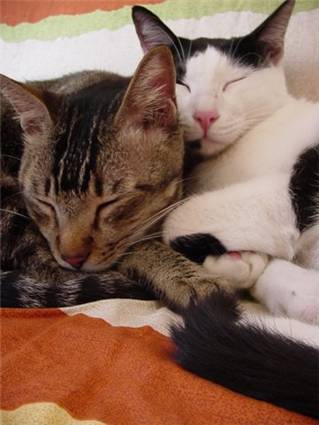
    I had Mrs. Imagethief send me the most cuddly, harmless, nauseatingly cute, aw-shucks photograph of the cats that she could locate (see below) and I printed it out in color. What I didn’t point out is that the reason the cats are so serene is this photo is that they are in shock from being transported from Singapore to Beijing and spending 48 hours in Chinese animal impound. In a spectacular piece of extra-credit work, Mrs. Imagethief also shot a digital video that convincingly shows that the cats will energetically scratch a scratching post but cannot be enticed to sink their claws into the sofa. Unfortunately, I couldn’t get that video into a portable format in time to take with me.

    I arrived at the apartment at the designated time and waited along with the agent. When the landlady swished in I knew I was in trouble. She was immaculate. From the perfect hairstyle down to the tiny pair of sparkly, silver shoes, she was a picture of high-fashion perfection. She also radiated a brittle arrogance that I associated immediately with one or two of my particularly fabulous ex-colleagues, a trademark of those Chinese women that have painstakingly and fastidiously elevated themselves above the long-underwear dowdiness that still pervades so much of the country.

    She did not, in short, appear to be the kind of person well-disposed to a dusting of cat hair on every surface.

    She was also not the landlady. She was the landlady’s good friend. The landlady herself was pregnant in Hong Kong, and this woman had been entrusted with the task of vetting potential tenants. It was a responsibility she took seriously. Where did I work? How long had I been in China? Was I single? Did I absolutely have to keep the cats? Wouldn’t stuffed cats do just as well?

    Still, she was supportive in her own way. “I can see that you have good taste,” she said with the deadpan sincerity with which you might compliment an extremely simple third-grader, “because you like this apartment.”

    You see, she explained, the concern is that the furniture is all imported. The bed alone, I was warned, was worth some RMB 20,000. And it was nothing against animals in general. She had a dog, after all. (I could picture it — something microscopic and high strung. A colicky cotton ball with a diamond collar, protruding eyes and an angry snarl.) Dogs stay on the floor. But cats, well, they like to jump on top of things. And her friend, I had to understand, was her colleague from Vogue, and she was very serious about the condition of her apartment.

    Vogue.

    I had watched “The Devil Wears Prada” a week or two before and had laughed off the attitude as Hollywood hyperbole. And yet here it was in front of me, big as life. They reallyare that self-consciously fabulous. I am the product of a bookishly unstylish bloodline and I have no experience dealing with this sort of person. It was like being in the presence of an extremely fashionable space alien. I mean, what common ground do you really have?

    Well, she had heard of my company. I guess that was something.

    She said she would go back and discuss it with her friend. She also suggested that they would put a list of all the furniture and its values into the contract (actually a sensible idea). Then she turned to the agent and in Mandarin laid down the bottom line on rent. It was incrementally higher than I wanted to pay, and I was slightly annoyed that she didn’t say it directly to me. But it didn’t matter. I had already written off the apartment.

    Even if her absent friend had agreed to my tenancy I had mentally abandoned it about the time I was indirectly complemented on my taste. The world is full of imperfect and obsessive landlords, but the thought of having a phalanx of neurotic fashionistas riding shotgun on my tenancy was more than I could tolerate. It wasn’t just the cats. I’m big, klutzy and drop things. I sit on the couch after sweaty workouts. Mrs. Imagethief and I cook smokey, spicy things that stink up the house, and then eat off the coffee table while we watch TV. I drop my underwear on the bedroom floor. Mrs. Imagethief and I would have made noisy, spring-rattling whoopee on that expensive, imported bed. There is a reason why leases have “normal wear and tear” clauses, and that reason is me.

    And I have enough stress in my life without having it transmitted at me by a landlady who’s going to worry if I sit on the couch in riveted Levis, let alone do any of the things above.

    The next day, even before we heard back from the landlady’s friend, I called the agent and told him to forget it. That was probably exactly what the owner was hoping for, but it spared us all the uncomfortable last dance.

    I defaulted to my second choice. It’s in an uglier building and it’s a tattier apartment. The couch looks like it was lifted from a frat house yard sale and the dining room table is so hopeless I told the agent to get rid of it. But the place is big, nicely painted, and has an enormous kitchen and an unobstructed view of the entire eastern half of the city. It’s a five minute walk from the office.

    And the landlord doesn’t care about cats. For that kind of serenity, I’ll go downmarket.

    Would you trust them on your couch?
    Would you trust them on your couch?
  • Apartmental, a part mental

    As regular readers will know, Imagethief has been on cross-assignment to his company’s Shanghai office in recent weeks. The company is, meanwhile, attempting to persuade me to consider semi-permanent reassignment to Shanghai. I have not yet made a decision about this (and if my landlord in Beijing is reading this, we’ll talk).

    In general, I really like the company I work for. They’ve taken good care of me, provided training, put up with my idiosyncrasies, and were patient with me while I spent my early months wrapping my head around the cataclysmic, nationwide fun-house that is the Chinese media. Because of that I was willing to listen to when they suggested that relocation to Shanghai might be good for my professional development.

    They say that whichever Chinese city you come to first is the one you build an attachment to. I suppose this argument might break down if your first port of call was Linfen. But I came to Beijing by choice, and I’ve certainly become affectionate for the city. Beijing, for all its impersonal ministries and immense boulevards, has an intimacy and a grungy, eccentric streak that really appeals to me. In a little under three years, I’ve really come to think of Beijing as home.

    It doesn’t hurt that I’ve been surrounded by old Beijing-hands who are naturally contemptuous of Shanghai (Schwankert, I’m talking about you), or that I’ve been writing about the city’s eccentricities for That’s Beijing semi-regularly. So I came to Shanghai with the casual, Shanghai? Pfeh! disdain of the confirmed Beijinger.

    Imagine my surprise at discovering that Shanghai is really not bad at all. It has a very different feel than Beijing, for sure. As David Wolf said to me over lunch Friday, in explaining the difference, “Beijing was created to be an imperial capital. It has always been a Chinese city. Shanghai was created to be a treaty port, and foreigners have always been a part of its identity.” He also advised me to make regular trips back to Beijing for sanity checks. Fair enough. But I’ve quite enjoyed the time I’ve been spending in Shanghai, and the city has its own personality and charm, if that is the word to use. My office and apartment are both in a very pleasant part of town, which does help.

    Speaking of my apartment, however, I have some complaints.

    The company provided the apartment for me to use during my cross-assignment. A previous expatriate employee of ours had lived in it for about four months and had then left China. The week before my Christmas break I had quick look in the apartment to see if it was habitable. It was, depending upon your point of view, a relatively high-end local apartment, or a relatively low-end international apartment. Perhaps the latter, given that it had international cable TV channels. It had plenty of room for me and occasional visits from Mrs. Imagethief. My conclusion was that it was generally fine, although I would have to bring some bedding from Singapore. I told our Shanghai office manager she didn’t need to have an ahyi work it over before my return. That was an inexcusable, rookie error. What can I say? It was night, I was rushed. My due diligence was not superb.

    I returned from my Christmas vacation in the US on Saturday, January 6th. On the 7th I flew to Shanghai and went straight to the apartment. There, alone with a suitcase in the dark of a Shanghai winter evening, jetlagged into irascibility, the flimsiness of my earlier appraisal became clear. As did the bachelor existence of the previous occupant. I had not bothered to open the refrigerator during my brief, pre-Christmas visit. Monumental mistake. The entire contents consisted of two rotting, three-week old pieces of meat and a box of Ferrero Rocher candies now infused with the smell of decaying flesh. The rest of the food supply was two things of instant noodles and a huge pile of little sugar sachets stolen from every restaurant and bar in the French Concession.

    Three years ago when I first moved to China and did my Wordlink Education language program, they put me up in a very similar two-bedroom apartment. It was fine, but made no provision for the fact that some people might like to cook and eat at home. The total kitchen implements consisted of a frying pan, a chopper, a cutting board, two bowls, two Chinese soup spoons (the boat-shaped ceramic ones that are hard to use for sugaring coffee) and some chopsticks. I had to go down to the CRC supermarket in Wudaokou’s Huaqing Jiayuan apartments and buy a saucepan, fork, knife, round-bottomed pan, plastic colander and a plate. (And I only got this far after several tragic days of trying to eat salad with chopsticks. Oil-slicked cherry tomatoes are a bitch to eat with chopsticks, no matter how dexterous you are.)

    Buying forks and can-openers when you’re in the heady rush of fresh-arrival and wide-eyed, goldang, lookit that! culture-shock is fine. It’s all part of the adventure. And I was surrounded by threadbare college students, so living like one was a blast of juvenile nostalgia. I went through a somewhat more substantial stocking of my own apartment in Beijing some months later, culminating in the shipping of my accumulated household worth of stuff from Singapore when my move to China become final.

    You forget when you’ve lived in a house or apartment for a while just how much stuff accumulates. Some of it is junk, but some of it is really useful. The great thing about my apartment in Beijing is that it has everything I need (and plenty that I don’t): Dishes, utensils, tools, cables, connectors, bric-a-brac, Q-Tips, spare Kleenex, nail clippers, scissors, scotch tape, shoe polish, laundry detergent, a sewing kit, and so on off into infinity. The apartment in Shanghai had a wok, four bowls, four plates, Chinese spoons, chopsticks, a chopper and cutting boards. It also had, inexplicably, an upright piano. I don’t play piano.

    Barring the piano, this was so close to the contents of my Wudaokou apartment that for a moment I thought I had slipped back in time.

    And here is where I get cranky. I am now thirty-nine and a (semi) respected China business professional. I have lived here for three years. My wife and pets are here. I have a network. I can get around in Chinese. I did not want to have to relive my starving student days by buying a fucking can opener. I believe that if you are trying to woo someone into uprooting themselves from city A and shipping their wife, worldly possessions and fuzzy kitty cats to city B, you need to do everything possible to make that person think city B is paradise on earth. Three months in a luxurious service apartment refreshingly free of carrion and stocked to the gills with conveniences seems like a good place to start. Once they sign on the dotted line you can always pull a bait-and-switch. But remember, it’s bait first then switch.

    I also had to come to grips with the legendary consequences of the south-of-the -Yangtze government heating edict. This is one of those remnants of central planning that make China fascinating at an academic level and a pain in the ass at a practical one. My apartment in Beijing seals like a spaceship (although, like a spaceship, you can also run out of air and die if you don’t ventilate it from time to time). I don’t even need to turn the marvelous central-heat on. The apartment stores solar energy.

    My temporary Shanghai apartment, however, leaks like a straw hat and is apparently heated by a small man from Guangxi who rubs sticks together somewhere in the duct-work above the ceilings. At least that’s what it sounds like. He needs to rub the sticks together for four or five hours before they generate enough heat so that my breath doesn’t fog in the living room. I needed to sort out the arcane timing system which is based on oracle bones and bedsprings. Apparently I am supposed to set the timer to turn the heat on about one hour after I leave the house in the morning. That will ensure that the apartment is damply tepid about the time I get home, rather than arctic. I think the answer is a vastly larger television that would generate supplemental heat, but for some reason the company isn’t buying my arguments.

    I can’t imagine why not.