Tag: Technology

  • The Predictable Prediction Crisis

    The Predictable Prediction Crisis

    The risks of being able to bet on anything, anytime

    One of the things that makes a good crisis comms person is being able to imagine bad situations. The benefit is that you can envision possible scenarios and plan accordingly. The drawback is that you will be a downer at office holiday parties.

    Everyone: Merry Christmas!

    Me [scrolling Bluesky]: Hey, have you seen how many people get violently sick from bad eggnog?

    Everyone:…

    Me: Noël! [Dumps eggnog back into punchbowl]

    If you’re going to prepare for crisis communication, you need to be able to have frank discussions about the possible crises. Death. Crime. Disasters. Whatever. Does it seem silly to prepare for a global pandemic that shuts everything down for a while? Guess what!

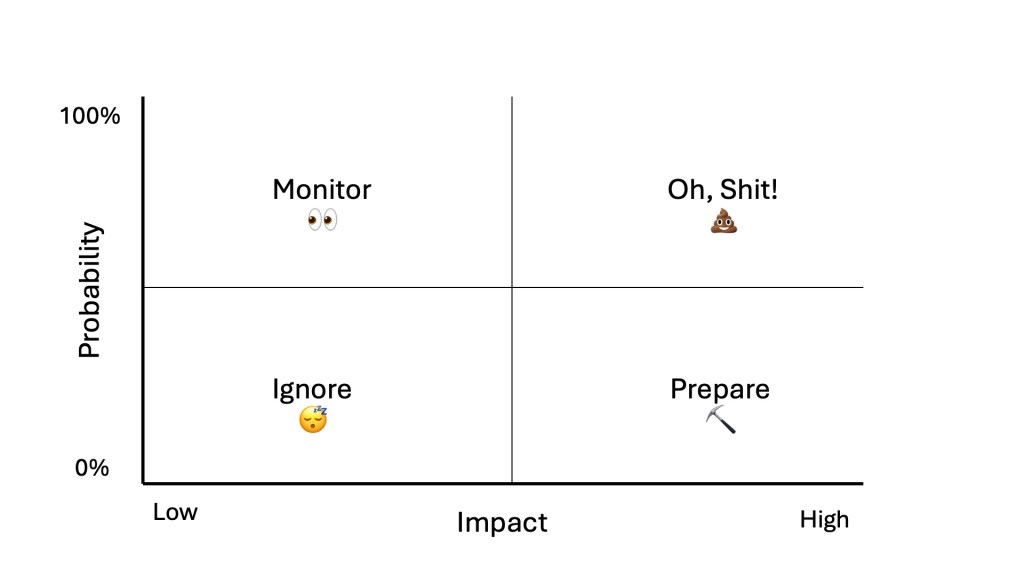
    There is an infinite number of bad scenarios, you can’t prepare for everything, and not all risks demand the same degree of preparation. There is a simple matrix that comms people (and our friends in risk management) sometimes use to think through which scenarios we should be spending time on:
    Obviously, this is oversimplified. “Probability” is timeline dependent and “impact” is contingent on various assumptions. You’re not so much plotting points as little clouds. People will argue about where in the matrix to place things. Sometimes they’ll argue for motivated reasons, like protecting a revenue stream. That’s another risk!

    But it’s a useful heuristic. Alien invasion? High impact! Vanishingly small probability. Don’t worry about it. If it happens, no one will blame you for not having a comms plan and your boss will be too busy fleeing to his luxury bunker in Big Sur with a suitcase full of ketamine to give you a hard time.

    The landscape is always changing and risk maps are dynamic. Two years ago, tariffs weren’t a major consideration. Today they are. What fun! We’re always assessing new risks, or considering what might be causing current risks to shift their position on the matrix.

    Often, you’re just tweaking the map. This or that risk becomes incrementally more likely or potentially more damaging, so you move the plot a few pixels. But occasionally something novel sprouts on the map like a poisonous mushroom. The thing that made me realize there is a shift in the risk landscape was this tweet from NBA star Giannis Antetokounpo, a few weeks ago:
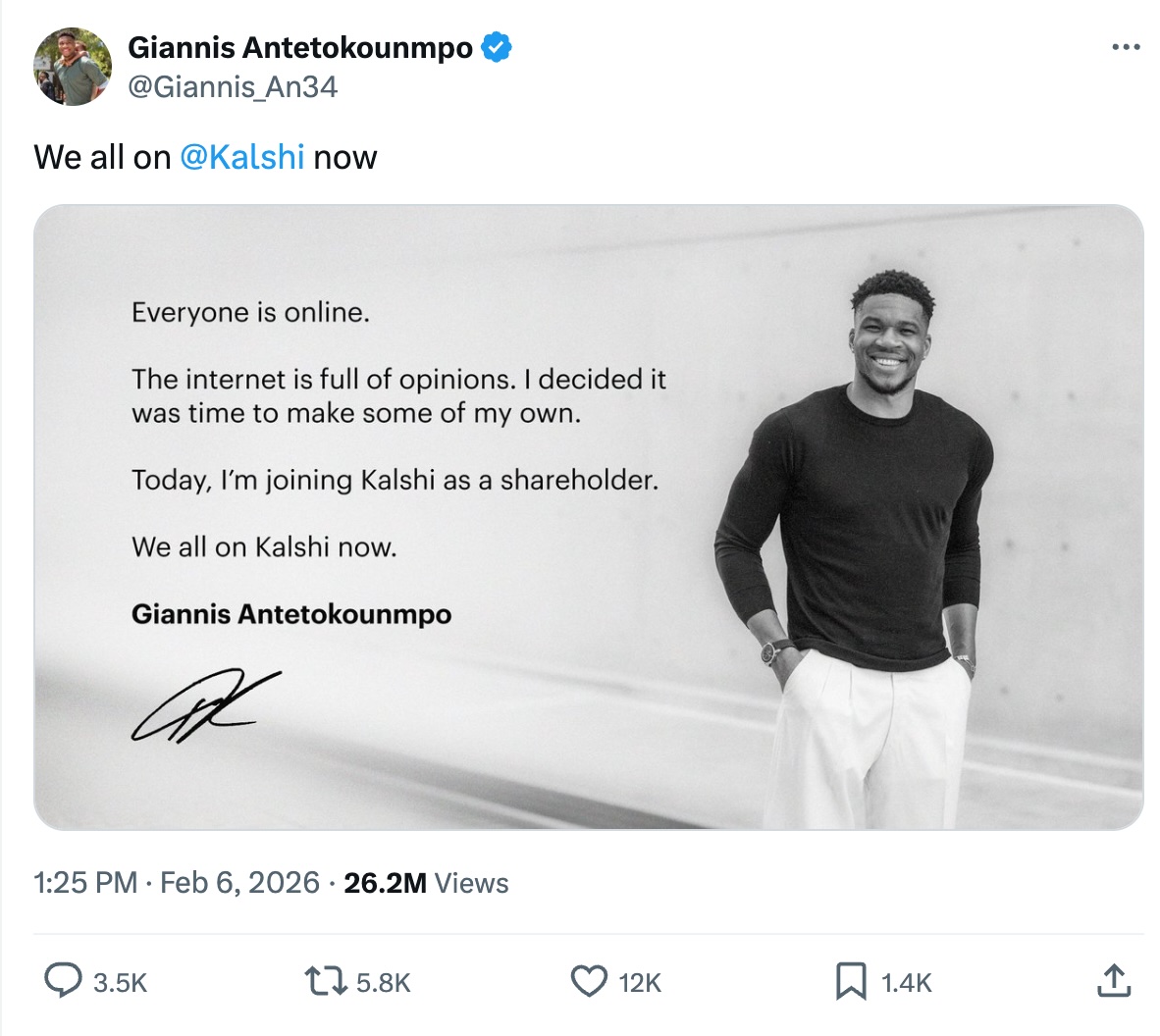
    We not all on Kalshi, Giannis!

    Giannis’ investment prompted reasonable questions, but maybe it will be fine! When has the collision of sports and gambling ever been a problem? And between the two main prediction markets, Kalshi is the sober option, as amazing as that is.

    But a current star player becoming an investor in a lightly regulated prediction market app seems like hurdling the Rubicon and landing in brand new risk territory much broader than sports. Since that tweet, things have got weirder as the prediction markets have been implicated in several “insider trading” events and novel controversies:

    • An anonymous account on Polymarket made suspiciously timed trades on the capture of Nicolas Maduro in Venezuela that netted more than $400,000.
    • OpenAI fired an employee for trading on confidential information on Polymarket.
    • Kalshi banned and fined an editor for mega-YouTuber Jimmy “Mr. Beast” Donaldson for betting on planned stunts he had knowledge of and a California gubernatorial candidate for betting on his own candidacy.
    • Mystery bettors on Polymarket seemed to have the inside track on the start of American bombing in Iran. $529 million was wagered in total and six suspiciously new accounts cleared a million each with uncanny knowledge of the timing.
    • Two Israeli reservists were arrested for using classified information to place bets on Polymarket.

    Listed companies have always had insider trading risk. But the domains of insider knowledge that mattered were relatively constrained: financial results, major transactions, other material corporate developments. Such information is also often restricted to specific teams or departments. Venues for trading on that knowledge were also limited and tightly regulated, at least in the U.S.


    Read the rest on Substack

  • The Life and Death of a Cool Phone

    That time we tried to make the Moto X in the U.S.A.

    I’d been working for Burson-Marsteller in China for nearly six years when I got poached away by our client, Motorola. Jumping from agencies to clients can be tricky, but my boss at Burson gave me her blessings. Maybe she thought it would be good to have an alum as the client. Or maybe she was just happy to be rid of me and my obnoxious blog.

    This was 2010 and the iPhone was popular, but not yet the Greatest Consumer Product of All Time. Smartphones hadn’t changed the world, but you could feel the change coming and everyone wanted in on the action.

    I’d been smitten the first time I handled an iPhone, in 2008, and I’d bought a first-generation model shortly thereafter, on a work trip to San Diego. At the time, all iPhones were U.S. only and locked to AT&T. I had to jailbreak mine when I got it back to China so I could use it on China Mobile. This was terrifying, like performing brain surgery on your child with kitchen implements. I was sure I was going to lobotomize my new $600 superphone.1

    Amazingly, the patient lived. I promptly abandoned both my Motorola Razr V3 flip phone and my Burson-issued China Mobile Blackberry, which looked like a prop from the old Adam West “Batman” TV show. This lasted until I got a nastygram from Burson’s IT department scolding me for using an “unauthorized client.” Reluctantly, I shifted my work email back to the Bat-Berry. But I used the iPhone for everything else.

    No regrets! As small and slow as early models were, touchscreen smartphones were obviously going to revolutionize mobile computing and change our experience of the world. I’d known that the moment I saw the New York Times home page microscopically rendered on a 3 1/2 inch display, and again the first time I saw the map application tracking our location in real time while in a car. The only thing I regretted was losing the tactile snap! of slamming the Razr shut. Hanging up on someone would never be as satisfying again.

    I was in love with smartphones and when Motorola came calling, I was ready. Motorola was still a behemoth in 2010, but activist investor Carl Icahn was cleaving the company in two. Motorola Mobility, the new smartphone-focused business, had lured Sanjay Jha away from Qualcomm to be CEO. Jha was all-in on Android, and Motorola had launched the first Android smartphone in China, the lozenge-shaped XT800. I shelved my iPhone for an Android-powered handset, a goony Motorola Milestone with a slide-out keyboard. The future was wide open and the smartphone market was there for anyone to seize!

    In theory.

    Read the rest on Substack

  • The Endless PR Stunt

    America’s superstar pro-natalist couple hacks the media

    Have you heard about Malcolm and Simone Collins? They’re the American couple that have made themselves the poster-family for the “pro-natal” movement, which is an actual thing we have in the U.S. now. If you haven’t heard about them, congratulations! And I am so sorry to break your streak. But they’ve been profiled repeatedly and I know about them, so now you have to know about them, too. They look like this:

    A photograph of Simone and Malcolm Collins, seated, in front of a reflective window. Simone is on the left, dressed in a white bonnet with long drawstrings hanging down to her elbow level. She is wearing a black skirt over a white blouse with a ruffled neckline and puffy sleeves that end in ruffled cuffs, and her signature, chunky, black, round-framed glasses. Her hands are folded in her lap and she is looking down and to the right, in front of Malcolm. A toddler’s head is visible peeking from behind her left shoulder. Her overall presentation reflects her “techno puritan” aesthetic. Malcolm is dressed in a black leather jacket, black collared shirt and jeans, and square-rimmed black glasses, and is gesturing while speaking to camera for an interview.

    They are often pictured with more of their many children. Simone’s rural-trad presentation notwithstanding, this is a couple that famously met on Reddit a decade or so ago and that has been terminally online for years. They have strong “people you would sidle away from at a party” energy.

    Regrettably, the Collinses are fascinating both because of their cause (I have previously written about government pro-natal campaigns) and because of how successful they have been at getting themselves and the cause profiled. The current arc of coverage started in January and picked up speed through April, and I have read it so you don’t have to:1

    There are many more from last year and the year before. They may be decent at having kids (four plus one on the way), but they are undisputed world champions at getting into the press.

    Read the rest on Substack

  • Every Wolf Everywhere All at Once

    A slick company is suddenly inescapable

    Wolf! Wolf! Wolf! Did you hear about the company that brought dire wolves back from extinction?

    I sure did. Couldn’t miss it. The company is called Colossal Biosciences. On April 7th, Time Magazine dropped this cover story:

    A Time Magazine cover dated May 12, 2025. The cover is a side-on portrait of a white wolf, with its head turned towards the camera. The wolf is against a stark grey background. Below the “Time” logograph is the word “Extinct” with a red line drawn through it. Below that is the following text: This is Remus. He’s a dire wolf. The first to exist in over 10,000 years, Endangered species could be changed forever. By Jeffrey Kluger.”

    Cool, cool. I mean, it turns out it’s not actually dire wolf. They’re still extinct. And this is complicated. But we’ll get back to that.

    Also on April 7th, the New Yorker dropped this story:

    A screen capture from a New Yorker article. The image is a white wolf pup on a solid black background, The pup is facing the camera with its head lowered. The text reads “annals of zoology” and then the headline, “The Dire Wolf is Back.” Below that is the subbed, “Colossal, a genetics startup, has birthed three pups that contain ancient DNA retrieved from the remains of the animal’s extinct ancestors. Is the wooly mammoth next? By D.T. Max. April 7, 2025.”

    Credulous headline, but more nuanced subhed than Time’s breathless treatment. Also, squeeeee! Look at that adorable little foof! (Warning: adult wolves significantly less foofy.)

    But wait, like a late night TV ad for Ginsu knives (shout out to Gen-X), there’s more! Here’s Wired, on the same day:

    Hmm. “Scientists claim…” And a probing subhed. The new Wired goes hard, you may have heard, and won’t just lap up your glitz.

    Never mind! Here’s three hours of Colossal Biosciences co-founder Ben Lamm on Joe Rogan’s podcast, also on April 7th. I’ll spare you the screen cap. Also, there was no way I was going to listen to three hours1 of this. I write this blog for free and there are limits to what I will endure for a wolf gag.

    Read the rest on Substack

  • Adventures in audio tape

    Yesterday Bloomberg ran what was essentially a PR piece for Ballfinger, a German maker of rarefied audio equipment, including reel-to-reel stereo tape decks that start at $11,000. The thesis: reel to reel is making a comeback.

    This is of course a bullshit trend story. I am sure the people who buy $10,000 glass-platter turntables will give these a look, but there is no way that reel-to-reel tape is coming back in any meaningful way. I say this as a recent returnee to vinyl (at a somewhat lower price point), and as someone with a fair tolerance for fiddly audio-visual equipment. But these are beautiful decks, and they remind me of a long-dormant soft-spot in my heart for reel-to-reel.

    I’ve always appreciated the inherently mechanical aspect to music, and therefore I have some affection for elaborately mechanical analog reproduction methods. One of my earliest musical memories is my great-uncle David playing “Abbey Road” on a reel-to-reel deck when I was ten or so, sitting on the carpet in front of the stereo. To this day the opening measures of “Come Together” call to mind dreamily turning tape reels.

    Uncle David was a German Jewish immigrant, a Holocaust survivor by way of the East End of London who found his way to business success and, ultimately, Palo Alto. He and my great aunt Anne, who was English, traveled extensively and radiated sophisticated late-seventies cosmopolitanism in an era when my own family was scruffily academic. David had the first electronic calculator that I ever saw, a delightful piece of technological sorcery. I will forever associate visits to his house with Japanese prints and the aroma of ginger ale. In such a context, reel-to-reel was almost inevitable.

    David also used that reel-to-reel deck to introduce me to “The Goon Show”, the legendary BBC radio comedy starring Spike Milligan, Peter Sellers and Harry Secombe. He ran me a cassette copy of his reel of four episodes, and I listened to that cassette for twenty-five years until, when it was on the threshold of disintegration, I finally digitized it.

    David’s was the only reel-to-reel deck I ever saw that was part of someone’s everyday stereo setup. However, after a long detour through the benighted era of cassette tape (Mix tapes! Dolby B noise reduction!), reel-to-reel came back into my life during grad school, in the early nineties, when I did college radio. Most of our audio production was done on quarter-inch reel, and I spent countless pre-digital hours slicing up Ampex 456 with razor blades, hanging the clips from wires, and splicing them back together with Scotch Tape. I even made some money on the side editing for Antenna Theater, an outfit from Marin that recorded books on tape using reel-to-reel.

    In those days my friends and I also used reel-to-reel for music production. My buddy Gabe and I had been college bandmates in my undergraduate days. That was the era of four-track cassette recorders, the production media of choice for threadbare ‘80s garage bands everywhere. If nothing else, four-tracks enforced a certain ingenuity, as you figured out how many generations you could ping-pong tracks before the only thing you heard was tape noise. Fortunately, this was a skill I’d honed in junior high school, recording audio science fiction epics on dual cassette decks with my nerdy tween friends.

    After college Gabe and I kept jamming, and there was a brief moment between the Tascam four-tracks and the rise of digital when he had an eight-track reel-to-reel in his bedroom. This was the coolest bit of band equipment that any of my friends had ever owned, and it expanded our production horizons dramatically. We mixed down to Digital Audio Tape (DAT) cassettes, another short-lived tape format that inhabited the lacuna between the fall of analog and the rise of accessible digital audio workstations.

    Gabe’s eight-track also taught us the eternal lesson that, no matter how many recording tracks you have, it’s always exactly one less than you need. This was especially true when you had to give a track up to SMPTE time code, which we used to synchronize the analog tape deck with a digital keyboard and drum machine. SMTPE time code sounds like something Jeff Goldblum would tell you portends an alien invasion, and it would inevitably bleed into the neighboring tracks because we couldn’t spare a guard track between the time code and the music. I can still hear it when I listen to those songs. Gabe would soon abandon the analog eight-track for an Alesis ADAT, a contemporary of DAT that used VHS tapes to record eight digital audio tracks. This worked every bit as well as you imagine a recording technology based on VHS media would, but it had a digital sync clock and didn’t need SMPTE, so there’s one more recording track for you if you can un-jam the machine.

    In that era I also spent time in SF State’s recording studio, working with two-inch, 24-track tape on a giant, two-horsepower deck. It was a beast the size of a Viking stove — the reels alone weighed ten pounds when fully wound. All of us with long hair, men and women alike, were advised to keep our ponytails and dreads well away from the reels during transport if we wanted to go through life with scalps. It was huge fun. Finally, we had all the tracks! The instructor, John Barsotti, who’d been a professional engineer, had a first-generation copy of the Billie Jean master on a half-inch stereo reel at 30-inches-per-second, basically the maximum useful ratio of tape surface area to signal achievable. He played it for us in the control room over the big Tannoy monitors and it absolutely blew my mind. I’d heard the song dozens of times before then and been indifferent to it, but I’ve been a fan of Billie Jean ever since. Ah-HOOO!

    But, as anyone who remembers “be kind, rewind” knows, tape is a pain, and not just because it has to be rewound. Tape degrades. Tails in? Tails out? Where on the reel is the cut you’re looking for? Tape is not just the platonic example of a linear media, it’s actually linear. The deck jams and tape stretches and snaps. It’s bulky and weighs a ton. It fouls during rewind or fast forward and suddenly the studio is knee deep in tangles of it. Digital tape formats were only ever awkward placeholders for something better. For production purposes, tape was rightly displaced by random access digital. I went from cutting 456 to using SoundTools on an Intergraph workstation and it was like being born again.

    I’m sure these new reel-to-reel decks will find their place. There is an eccentric for every audiophile market, no matter how niche. People do buy old TEAC decks and scour flea markets and e-Bay for secondhand reels. And I am sure there are people out there who will buy these Ballfinger decks, if for no other reason than they are gorgeous objects that also play analog music at ridiculously high quality. (And I live in Silicon Valley, a place with a well documented weakness for gorgeously over-engineered frippery.)

    But it won’t be me. My wife has already warned me that under no circumstances am I to buy an expensive German tape deck. Or, for that matter, any tape deck. I’ve been enjoying my LPs, but, nostalgia notwithstanding, the old razor-nicks on my hands say I gotta draw the line at tape.

    Also posted on Medium.

  • Coverup? Huawei Should Send Its PR Bill to ZTE

    I’ve never been much for conspiracy theories. Not that I don’t like a touch of the fantastic in my daily life (I live in China, after all). But when you think about the sheer logistics involved in most of the major conspiracy theories things start to break down pretty quickly.

    Consider that old favorite of the tinfoil hat brigade, that NASA faked the American moon landings, and think about what it would have required. It’s not just the fakery of the photographs and video, but also that everyone who worked on all the aspects of the fakery, from the astronauts to the guys who would have had to doctor the photos and fake the moon rocks and telemetry (depending upon whether you think mission control was in on it or not) would have had to keep their mouths shut. For going on 45 years. For six successful lunar landings involving eighteen astronauts, twelve of whom have allegedly walked on the moon. Not only does everyone who knows about the fraud have to keep his mouth shut, but everyone who has a public face has to keep his story aligned. Especially that attention-junkie Aldrin. It only takes one person to blow the lid off, intentionally or accidentally. Frankly, it’s just easier to go to the goddamned moon.

    I’m not particularly interested in getting into a pissing match with conspiracy theorists (like thermonuclear war, it’s not “winnable” in the conventional sense of the word), so much as I am in setting up a problem. Coverups pose similar problems to conspiracies in that, like a big pile of sweaty dynamite, they are unstable by nature and easily detonated, sometimes by the tiniest of disturbances. That’s why they don’t tend to make good PR strategy.

    Of course, by definition no one knows when a coverup succeeds. Small ones involving one or two people? Probably a fair number. Big ones involving lots of people and big stakes? Not so many, I’d guess. “Three may keep a secret if two of them are dead,” wrote Benjamin Franklin, perhaps optimistically. In most cases, the participants aren’t Navy Seals or the CIA or other kinds of people who are indoctrinated and trained into cultures of secrecy (and yet still sometimes blow it). We’re talking about just folks who are easily pressured by law enforcement, or who just get drunk on lychee martinis at Centro and shoot off their mouths. Sooner or later someone is going to slip up and the dynamite is going to blow.

    Then everyone in serious trouble because, as the old truism goes, the coverup is worse than the crime. Technically, it’s more accurate to say that the coverup significantly aggravates the crime. Coverups turn mistakes into crimes and crimes into enormities. Think of the devastation inflicted on Penn State by the recently published Freeh inquiry, which was most damning for revealing the efforts taken to protect the institution over the victims. Or think of your own toddler, if you have one. If he uses a sharpie to draw all over the wallpaper, you’re angry. If he lies about it, well, then you’re disappointed. Anger is over in minutes. Disappointment leads to years of therapy and careers in bitter standup comedy.

    A big pile of sweaty dynamite might be blowing up in the face of Chinese telecoms equipment company ZTE right now. The fuse was lit by a Reuters report back in March (blocked in China), which showed how ZTE was acting as a middleman for relaying restricted American technology to Iran for use in a national Internet monitoring system. The explosion may have started last week when the aptly named website The Smoking Gun reported that the FBI has launched a criminal investigation into the sale. The FBI has not confirmed the investigation, but The Smoking Gun has posted an affidavit that makes fun reading because it includes grubby details of the alleged covering-up. Much of it has the desperate, furtive feel of the third reel of an Abel Ferrara film (or, apropros of the lunar landing discussion above, a Peter Hyams film). You can feel the options narrowing as they talk through them. I don’t know how this situation will turn out, but I do know this: As bad as ZTE looked for shipping US surveillance gear to Iran, they look worse for the discussion of the coverup.

    Two other thoughts about this case. First, the FBI case is apparently based on the deposition of a young, American lawyer who was in ZTE’s employ. I find myself reminded of something I heard from a relative who was once highly placed in the empire of a wealthy Hong Konger: White people don’t handle the money. One wonders how much trust ZTE will invest in its white people after this.

    Second, the organization that should be most annoyed about this alleged coverup isn’t the US government, the FBI or Internet-freedom activists; it’s ZTE’s Chinese competitor and Shenzhen neighbor, Huawei. Huawei has been busting its assthrough an extensive lobbying and PR campaign to impress US politicians and regulators with its trustworthiness and thus extend its limited access to the huge American market. So far it has met with conspicuously limited success not least because US politicians stubbornly refuse to trust it due to its, well, Chineseness.

    Huawei and ZTE are different companies, and illegal shipments to Iran aren’t spy-friendly backdoors in routers, but it will be very easy for American politicians and lobbyists to conflate the two Chinese companies and use this situation against Huawei as well. After all, they’re both giant, state-linked Chinese telecoms equipment companies. From an American political point of view, both carry all the reputation baggage that comes with the pedigree. They’re suspected –sometimes with a dose of hysteria– of being instruments of Chinese policy and possibly vectors for cyberwar attacks. If one is caught with an uncapped sharpie…well, the argument will be, you do the math.

    Given the effort its expended over the last few years and the collateral damage it is likely to sustain if the investigation of ZTE’s alleged coverup gathers steam, perhaps Huawei should send its PR and Lobbying bill for the last few years to ZTE. And as for the rest of us? I’m sure we’re all very disappointed.

    Note: this post originally published on the defunct group blog Rectified.name.

    Not shocked. Just disappointed.
    Not shocked. Just disappointed.

  • Facebook + Instagram + China = Take a Deep Breath

    So, Facebook bought Instagram for a billion bucks. Awesome for those guys. I, alas, did not get rich in either of the Internet startups I participated in. But you can’t put a price on experience, right?

    Deep sigh.

    Anyway, Instagram is freely accessible here in China, at least for the moment, and apparently has a small but growing user base. It’s been limited to a certain slice of the China market by being an iOS-only app until last week. It may get picked up more now that it’s on Android as well, especially given Android’s whomping share of the smartphone market in China.

    Because Instagram is accessible from China there has been some speculation that it might provide a back-door into the market for Facebook. Well, color me embarrassed, because when I looked at how Facebook might get into China a couple of weeks ago, one scenario I didn’t explore was Facebook buying another, unblocked western social network.

    Instagram certainly functions as a posting back-door to both Facebook and Twitter. Instagram posts route to Facebook, Twitter and other social networks through Instagram’s unblocked servers (actually, Amazon’s cloud servers for the moment). There are similar middleman workarounds for posting on blocked social networks, such as Ping.fm, but none come close to providing full access to Twitter or Facebook. And, from what I can see, neither does Instagram. That’s important.

    The question that wins you the brand new car is: Will Instagram now be blocked in China? The reason why you don’t have the car yet is that the answer is complicated. China doesn’t block all foreign social networks. It does block the established, heavy-hitting, horizontal sites like Facebook, Twitter and Google Plus. But many vertical social networks and newer sites are unblocked. I can get on LinkedIn, Quora, Path,Flickr and Pinterest just fine, without a VPN (your mileage may vary). I can even get on MySpace.

    I cannot read the minds of the bureaucrats who decide what gets blocked and what doesn’t, and if I could I’d probably be in a position to be less wistful about the fates of the startups I joined. But there do seem to be a few key factors in determining who stays safely outside the firewall. These include size, perceived influence, how closely the network has been associated with political movements, power to function as tool of mass organization, and whether or not the network has been explicitly associated with content or activities that the Chinese government considers sensitive. On all three counts, I’d rate Facebook and Twitter considerably higher than the rest of the pack. As for Google Plus, I trust this audience doesn’t needmuch explanation.

    So, what happens with Instagram now that it is part of planet Facebook?

    It depends. Assuming people don’t suddenly start posting pictures that annoy the Chinese government, maybe nothing. At the moment, Instagram seems pretty harmless, and its one-way posting features to other social networks don’t look like a big red flag. Posts to Chinese social networks like Sina Weibo essentially outsource the content monitoring and censorship. Of course, Twitter once looked pretty harmless. In 2007 I even wrote a short article mocking its triviality, possibly betraying the lack of vision responsible for my current un-billionaire status. Twitter has been blocked for a while now. So much for harmless. The fact that Instagram is essentially mobile only has also probably helped keep it under the radar.

    But if Instagram is integrated more tightly into Facebook’s core service and stops looking and feeling like an independent platform, then the risks go up fast. Everything hinges on where Facebook sees the value in Instagram, and whether or not it pulls Instagram into the mothership. The more integrated Instagram is, the more powerful it is as “back door into China” for Facebook, but the more likely it is to be blocked. And if Instagram is suddenly used to post a lot of pictures of a sensitive event in China, it might not even matter if Facebook doesn’t change a thing.

    Meanwhile, local photo-sharing clones have been blossoming for a while. Early enthusiasm for foreign social networks in China does not reliably translate into long-term success, while mainstream success in China often does translate into closer scrutiny. Instagram may indeed be a back door into China for Facebook, but if it wants to stay open, it might have to stay a rather small door indeed.

    Other links:

    Note: Originally published on the defunct group blog Rectified.name.

  • Facebook’s China playbook

    As you have undoubtedly heard by now, Facebook CEO Mark Zuckerberg and his girlfriend* were spotted in Shanghai on Wednesday. This has lead to a completelypredictable round of speculation as to whether this signals some new development in Facebook + China. This sort of navel gazing takes off whenever Zuck comes to China, or looks in the direction of China, or gets lunch at P.F. Chang’s, or whatever. And why not? Facebook is the biggest social network in the world. China has the biggest population of Internet users in the world. Facebook is going public soon. Zuck is learning Chinese, etc. So a Zuck sighting in China is, to invoke the memory of Arsenio Hall, one of the things that make you go, hmm…

    Despite all of that, leave to our friends at the excellent Tech in Asia blog to have the most sensible take, “Zuckerberg is in China…Who cares?” Indeed.

    Obviously, we don’t know a thing about Facebook’s designs on China. But to make sense of the speculation it’s helpful to consider the actual scenarios by which Facebook or Twitter or indeed any foreign social network might enter China, and to look at how different stakeholder groups will react to the possible scenarios. This is different than analyzing business strategy or financial implications, but ultimately it’s all connected.

    At the risk of oversimplifying, there are four major scenarios that we can envision: extending the mothership service to China; developing a separate “splinter” service for China under the original brand (this could be disconnected from the main service, or just enforce dramatically different policies); buying an existing Chinese social network; and doing nothing. Obviously, they’re not all immediately practical. Facebook is blocked in China, which makes extending the mothership difficult. There are also intermediate possibilities that blend aspects of these scenarios, but that’s a deep rabbit hole to go down. Along with these scenarios there are five major stakeholder groups, not including Facebook themselves: the Chinese government; Chinese Internet users (potential customers); Western activists and governments; investors; and the Western public (aka Facebook’s current users).

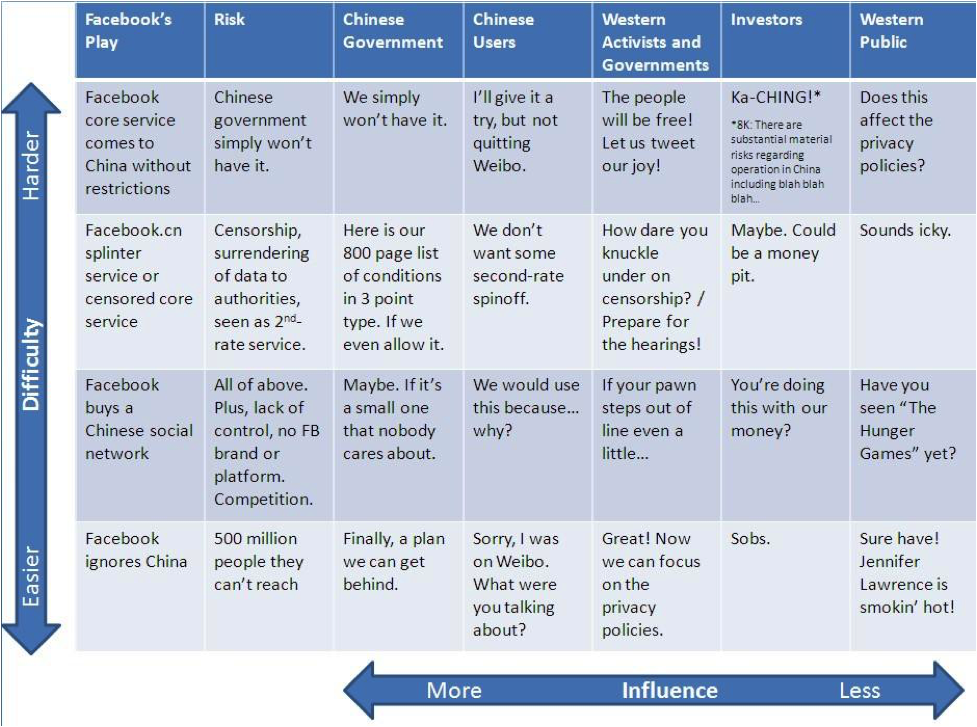
    The easiest way to look at all these moving parts is to simply throw the whole thing in a table that considers for each scenario the risks and how each of the stakeholder groups is likely to react (click the table for a larger, EZ-reading version):

    china playbook

    Admittedly this format throws a lot of nuance overboard, but nevertheless there’s a clear three-way conflict that emerges. The approaches that are more acceptable to the Chinese authorities are both riskier with regards to Western activists and regulators and, importantly, less relevant to Chinese users. The approaches that are most relevant to Chinese users and have the highest potential return to the business are unacceptable to the Chinese government. Ultimately the Chinese government calls the shots.

    The basic math is that to even have a chance of operating here Facebook would have to apply the mandated censorship policies either just to users of its core service in China or to a spinoff service that is kept separate from the core service. It would also have to be prepared to surrender Chinese user information to the authorities if requested. That will raise eyebrows as Facebook knows a ton about its users by design.

    The risks of these approaches are clear to anyone who has studied the history of Yahoo in China and followed the congressional grilling of US Internet firms operating in China back in 2006. That was the stone age of social networking (Rupert Murdoch bought MySpace, Facebook turned 2, Twitter was hatched), and the political atmosphere around such things has not become any less sensitive since then. If anything, the messianic aura that clings to social networks and of which Chinese authorities have always been so distrustful has been exacerbated by last year’s political events in the Middle East. And let’s not forget recent events here in China and the leadership transition later this year.

    There are ways to create distance between the core Facebook brand and service and the Chinese government’s likely requirements, but those ways don’t eliminate political risk at home, and they all make the service less appealing to Chinese users. These same users are already being wooed away from traditional social networks by microblogs and have a colorful history of rejecting foreign online services as irrelevant even when they’ve been allowed to operate here without restriction. Remember MySpace China? Me neither, and a friend of mine helped launch it. Owning a local social network would provide a layer of insulation from the risk of Western backlash, but at the expense of sacrificing much of the point of entering China.

    None of this predicts whether Facebook will enter China, or how they might attempt such a thing. They’re probably playing a very long game. Whatever path they choose, it won’t be easy, either in China or at home. Bear that in mind next time Zuck is spotted in China and the tongues start wagging.

    *Note to editors: Can we get over the fact that Zuck’s girlfriend is Chinese American? Everyone is compelled to point this out, but net impact on the Facebook-in-China story is zero-point-zero.

    Note: This post was originally published on the defunct group blog Rectified.name.

  • I Apologize if Anyone Felt Killed

    Apologies are an under-appreciated art. Most apologies crafted in the name of public relations sound intrinsically weaselly, often because the people making them are preoccupied with saving their prior reputation rather than getting past the mistake and rebuilding trust. I was reminded of this when I read Mike Daisey’sstatement following L’affaire Daisey, which I reckon I don’t need to further explain to this audience. (If you’ve just emerged from decades frozen in an ice cave, clickhere. Also, get a haircut. Styles have changed.)

    Here is what Mr. Daisey wrote:

    I apologized in this week’s episode to anyone who felt betrayed.

    Did you see it? If not, I’ll explain in a moment.

    Before I do, I should be clear: I’m not interested in a broader critique of Mr. Daisey’s work. That’s been done in so many other places that I’m too lazy to even go gather the links. Plus, I know it’s a rough gig in the performance artists. In 1974 Chris Burden crucified himself to a Volkswagen Beetle and had it driven around. So you can’t really have the same expectations of these people that you would of, say, your standard airline executive (much as you might want to crucify airline executives to moving vehicles).

    But still, there it is, “…anyone who felt betrayed.” In four words, the two great sins of public apologies.

    The first is the passive language. Now, I have no problems at all with passive voice in writing (or with starting sentences with conjunctions, or parentheticals, or many other things they told you were bad in your high school comp class). But that passive language is such a trope of public apologies that we pretty much take it for granted these days. It’s so common that Wikipedia has an entry on it. Vanity Fair, also citing Wikipedia, has a small collection of examples. ”We apologize if anyone was offended,” was even trotted out recently by Ben and Jerry’s Ice Cream in response to the (silly) Linsanity flavor scandal.

    The second (and I must thank my partner in crime, Brendan O’Kane for this) is the use of the word “felt.” The passive voice subtly shunts responsibility onto the victim. The use of “felt” suggests that problem itself doesn’t even exist, and is merely some kind of unfortunate vapor or misunderstanding. You felt betrayed, but I didn’t actually betray you.

    Lawyers may like apologies that don’t include a categorical admission of responsibility, but from a public communication point of view they come off as pro-forma, passive-aggressive dissembling that shifts at least some of the blame onto the injured parties. You can see how this works by replacing the standard corporate, public-conduct or ethno-gender-religious sensitivity malfeasance that people are usually apologizing for with something more heinous. I like to use a steamroller homicide, for no other reason than I appreciate the image of a maniac rampaging through town with a steamroller. Plus, as far as I know, no one has ever actually been murdered with a steamroller, so we should be safely in the land of the hypothetical (although the Internet will probably prove me wrong*).

    So imagine you’re a contrite steamroller maniac attempting to rebuild your reputation. What do you say?

    “I apologize for running over those people with a steamroller.”

    Hell no. That’s way too direct and honest. It could be mistaken for assumption of responsibility, which might let the healing begin. We can’t have that.

    Try this on instead:

    “I apologize if anyone was run over by a steamroller.”

    Do you see how this small change embeds whole new levels of denial and distance into that short statement? Seriously, how dumb were those people to get run over by a steamroller? The freaking thing only moves two miles an hour! I mean, head on a swivel, grandpa, this is the big city!!! But, you, know, sorry and all.

    Or, even better,

    “I apologize if anyone felt killed by a steamroller.”

    Because they might not actually be dead. They might just feel that way. By mistake.

    What the heck, let’s go for broke and dispense with the apology altogether. Some light regret is enough for the masses:

    “I regret that due to this unfortunate situation anyone felt killed by a steamroller.”

    Better yet, let’s disembody the regret, so we’re not sure who’s actually doing the regretting. Could be your auntie doing the regretting. You don’t have anything to regret. You’re not a culpable steamroller maniac leaving a twelve-foot-wide trail of blood and flattened personal accessories behind you. You’re just misunderstood:

    “It is regrettable if, due to this unfortunate situation, anyone felt deprived of life by a steamroller.”

    Now that…that is PR gold. A non apology for the ages. I almost weep reading it back.

    Update:

    *The Internet has proved me wrong. Apparently our friends the North Koreans haveused steamrollers as weapons. Hat tip: @samuel_wade.

    Note: This post was originally published on the defunct group blog Rectified.name.

  • China and the nature of Facebook

    Reports have been percolating for a couple of weeks that Facebook will partner with Chinese search engine Baidu to launch Facebook China, or something similar. Anyone who has followed the history of foreign Internet firms in China knows that this is fraught territory. Chinese competitors are well established, and while many successful Chinese Internet firms have foreign backing of some kind (even Baidu once claimed Google as an investor), marquee marriages between Chinese and Foreign Internet companies have often been troubled.

    There are others better placed than me to speculate on the likely business fortunes of a Facebook China (cf. Epstein, Bishop), but what really interests me are the communication challenge and reputational consequences. Some glimpse of those possible consequences came in a Wall Street Journal article about Facebook’s lobbying efforts that ran yesterday. It included the following:

    [Facebook] is talking with potential Chinese partners about entering the huge China market, where the government has been cracking down on dissidents. That crackdown has come in response to the uprisings shaking authoritarian Middle Eastern regimes, movements that have used U.S.-based social-media sites like Facebook and Twitter as organizing tools.

    “Maybe we will block content in some countries, but not others,” Adam Conner, a Facebook lobbyist, told the Journal. “We are occasionally held in uncomfortable positions because now we’re allowing too much, maybe, free speech in countries that haven’t experienced it before,” he said.

    Yowza! Better work on those talking points and come up with something that doesn’t sound quite so paternalistic. Read as generously as possible, this is one quote from what one presumes was a larger discussion on the issues of running transnational social networks in countries with different approaches to censorship and freedom of speech. Read less generously, it sounds like a lobbyist for Facebook arrogating to his client the responsibility to decide what constitutes an appropriate amount of free speech in any given country. Risky territory.

    From a business point of view deciding an appropriate amount of free speech might be a practical necessity. From a public communication point of view it’s dangerous. Five years ago, when Facebook was still a plucky upstart too trivial to be noticed, Yahoo, Google, Cisco and Microsoft were hauled in front of a congressional hearing to testify on their activities in China and their willingness to accommodate governments with illiberal approaches to free speech. It was not a banner moment for the American Internet industry. “Moral pygmies!” declared Tom Lantos, the principal congressional antagonist. Much of the cast has changed and Tom Lantos has since died, but the issue remains sensitive. (Not all the cast has changed. Facebook’s current head of communication, Elliott Schrage, represented Google in the 2007 hearings.)

    Facebook itself has not committed publicly to anything in China. They also haven’t yet committed any of the blunders that those four firms did (most notoriously Yahoo, with the Shi Tao affair). Finally, Facebook hasn’t made nobility a part of their brand in the way that Google conspicuously did in its early days, something that was used against Google in its China engagement. In fact, if anything Facebook is known for a kind of calculating amorality that may be useful in the ruthlessly sharp-elbowed Chinese Internet world.

    But what’s important here is not how Facebook sees itself, but rather how people at large see it, and how activists and politicians think they can use it to drive their own agendas. Whether Facebook likes it or not, it has been publicly associated with recent events in the Middle East and is widely seen as a force for enabling dissidents and protestors whose causes resonate with western publics and politicians. See for example New York Timesstories here, here and here. Evgeny Morozov and Malcolm Gladwell might ridicule the notion of social media as democracy tools, but that won’t necessarily dispel a belief that was made clear in the 2007 hearings: American Internet firms should represent American values.

    Companies’ decisions about China are revealing. Facebook’s decision on whether or not to formally enter China will be especially interesting. It will establish something fundamental about the identity of one of the two most powerful Internet companies on the planet. Is Facebook, as some have supposed, the great enabler of democracy? Or is it a company of business pragmatists willing to censor (or delegate censorship) in order to open a potentially lucrative market? The reality is probably more nuanced than either of those positions, but as far as public perception goes it will be difficult to have it both ways. How does one balance groups of stakeholders with completely incompatible views on what constitutes a responsible and conscientious Internet firm?

    The nut of the problem is that, right or wrong, democracy activists, American politicians and the Chinese authorities all tend to see American Internet firms as standard bearers for western values. Facebook’s task is to convince the Chinese authorities otherwise while not making activists or western users in general feel betrayed. I can think of few more precarious communication challenges. The quote above is an unpromising start.

    Update:

    Obama hosted a town hall at Facebook HQ yesterday. Interesting. And likely to be noticed here in Beijing.

    See also: