Month: September 2008

  • Sanlu melamine milk powder crisis becomes a national issue

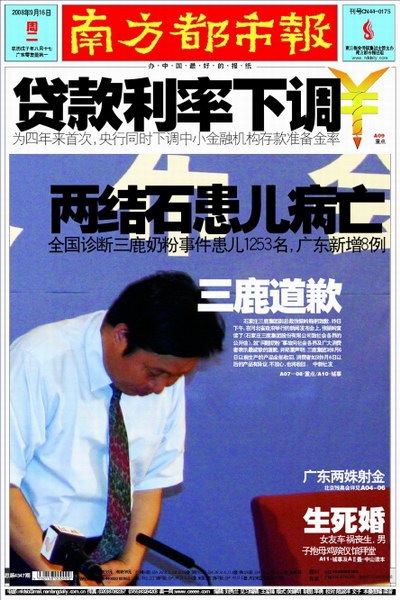
    Like on the top-forty radio show Imagethief used to listen to as a thirteen-year old, the hits keep coming in the Sanlu milk powder crisis. Over the past thirty-six hours the situation has evolved from a company-specific Sanlu crisis to a nationwide dairy-industry crisis reminiscent of the glory days of last summer’s product quality crisis.

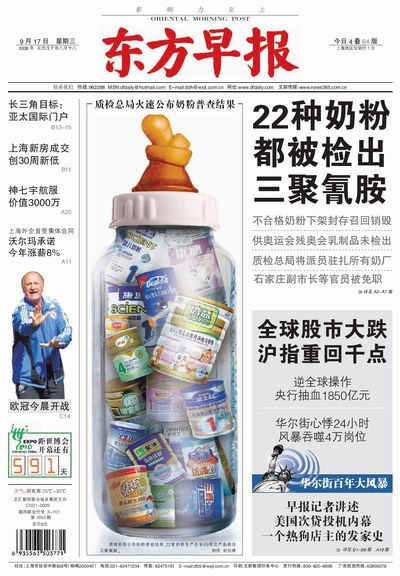
    Here is the latest: Products from 175 dairy companies have been tested (中). Twenty-two of them tested positive. Sanlu is still the champ in terms of micrograms per kilo of product, but some other famous (and not-so-famous) brands are now implicated, including Mengniu and Yili. I bet Yang Liwei didn’t know about this when he decided to endorse Mengniu. But astronauts should be able to digest melamine, which anyway seems like kind of a futuristic substance. Imagethief used to have melamine coasters. No joke. Very “Jetsons”.

    Also not a joke is that over 6000 children are now reported to have been affected and three are dead. The Internet is seething. Collars at the State Food and Drug Administration haven’t felt this tight since Zheng Xiaoyu was frogmarched away and shot for corruptionjust over a year ago.

    So here are the PR implications:

    Winner: Sanlu (sort of)
    For Sanlu this is actually good news. All of a sudden what looked like their problem is a nationwide problem in which they are just one of many companies caught in the riptide. In PR we teach an interview technique called broadening. When confronted by an interviewer with a problem or challenge that cannot be refuted you respond by “broadening” the issue to include the rest of the industry, your rivals or whomever. It works like this:

    Maria Bartiromo: Your stock price is down by 50% this month? Does your company suck?

    You: Well, Maria, market conditions are tough and many companies in our industry have had similar declines but we are key message, key message, key message, yadda yadda yadda.

    Sanlu doesn’t need to broaden the issue. It has broadened itself. This doesn’t make Sanlu’s problem go away. They’re still the worst affected, the most apparently negligent and most closely associated with the issue. In the past day or so, the chicken of accountability (a really big chicken in this case) has come home to roost and heads have justly started rolling. But misery loves company, especially in PR, and now the spotlight of attention has spread out a bit. It buys Sanlu some small breathing space at the trade-off of kindling a hotter but more diffuse groundswell of national anger.

    Losers: Everyone else
    While this broadening might be good news for Sanlu, it’s bad news for everyone else. Consumers have no idea which domestic manufacturers they can trust. Even ice cream bars (sob!) look suspect. Foreign manufacturers such as Nestle may benefit for a while, assuming resentment doesn’t turn on them later, which is possible. Also, Fonterra is now recalling its own Anmum branded milk in China. On top of its involvement in Sanlu, this may be wearing the foreign gloss a touch thin.

    The Chinese dairy industry looks like a hopeless swamp incapable of quality control. Production and upstream wholesaling are completely fragmented and obviously subject to only the most featherlight of regulatory scrutiny or inspection regimes. The job of applying quality control nominally lies with the brands that sit between green fields and cow dung and supermarkets aisles and consumers, but they appear to have dropped the ball completely. Honestly: Twenty-two companies and 66 products? You’d sooner trust the Three Stooges with your dairy factory than this bunch of clowns.

    The SFDA looks about as wired as it did in July, 2007. AQSIQ, which is separate from SFDA, is also scrambling. Regulatory involvement seems conspicuously after-the-fact in this situation. Sanlu was exempted from inspection because it was recognized to be such a fabulously well-run company. Lesson: No one should be exempted from inspection. More inspections for everyone, in fact, seems like part of the prescription for this situation.

    And China in general reminds everyone else in the world of why they are just a touch suspicious of Chinese food products. There are apparently some export products involved in the current situation, although they are apparently exported primarily to the kind of no-hope client-states (think Myanmar) that are unlikely to make too many waves lest they have to start paving their own roads. But the rest of the world is watching.

    As, incidentally, are the (ahem) China-based expatriate parents of small children. I am happier than ever that Imagethief Jr. is breast-fed. Mrs. Imagethief may be made of stern stuff, but it’s almost certainly not melamine.

    Now what?
    Aside from the fact that Imagethief will sadly never look at an Yili ice cream bar the same way again, what happens now?

    Unfortunately, the whole situation has got much trickier. For individual companies PR issues can be managed because it is relatively easy to speak with a single voice. Situations that involve entire industries are trickier, because getting a bunch of competing companies to speak with a single voice about anything is like herding giant cats with tens of thousands of employees each. Cats that often want to blame each other. Try doing PR for an industry association someday and you’ll get a taste of this.

    The cat-wrangling hat now passes to the Chinese government, which has just inherited the stage from Sanlu. The Chinese government needs to explain why there is a pervasive problem in the dairy industry and what it is doing to solve the situation. (It would be nice to talk about a plan for structural changes in the industry.) It needs to make sure that the dairy brands themselves are singing the same song with one voice arranged to church-choir perfection. It also needs to keep on letting consumers know which products are safe and which aren’t and ensure that people have enough real and timely information that gossip and suspicion don’t become the main drivers of the public response. It needs to vigorously punish offenders who have been sloppy and do its best to convince people that the companies, regulators and local governments are all entwined in one sloppy, corrupt ball. I know that executions will look tempting, but executions alone probably won’t solve the problem of restoring consumer confidence, so let’s think more creatively than that.

    Importantly, if there are more melamine skeletons in the closet it is best that they come out soon rather than creep out over the coming weeks and months. The situation has already deteriorated. The sooner it moves into recovery phase the better. More bad news dribbling out over weeks and months will delay the start of the recovery and stoke the fires of suspicion and anger. This is one reason why it’s important to make sure people have enough real information to forestall the worst of the gossip and conspiracy theorizing. For that reason, AQSIQ’s public round of testing was a good thing, even if the news was bad.

    But the whole process will be difficult. In yesterday’s post I mentioned all the entrenched and institutional problems that retard the development of public communication in China. Many of them also serve to slow the development of effective commercial enforcement. In a sense the larger challenge for China is not just to prove that it can clean up the dairy industry, but to prove that its commercial environment can evolve into something other than a cozy swamp where insiders get rich and outsiders get kidney stones.

    But that’s been the challenge for a long time now.

    Suppressing the news is not a PR solution
    Hop on over to ChinaSmack and read the new post “Kidney Stone Gate: Baidu denies censoring search results“, which cites a 21st Century Business Herald report on Baidu’s possible involvement in suppressing negative search results for Sanlu:

    Soon after the Sanlu poisonous milk powder news came out, a copy of letter from the Teller public relations firm to the Sanlu Group began spreading on the internet. In the letter, Teller advised Sanlu to pay Baidu 3 million RMB to have Baidu manage search results containing negative news about Sanlu (supposedly not all news could be censored but most results coming from smaller websites could be deleted). When Baidu heard the rumors, they quickly denied working with Sanlu. A representative from Teller also said the letter was fake.

    Sanlu Group logo: Sanlu is suspected of paying Baidu 3 million RMB to censor negative search results.On September 13th, “21st Century Economic Report” reported that Baidu admitted receiving a “Sanlu Public Relations Crisis Proposal” letter from a public relations firm, but Baidu could not confirm that it was the Teller firm.

    There’s more in the post, including a partial translation of the 21st Century Business Herald article. Some evidence is presented in the story to support the allegation that Baidu was complicit, although Baidu denies it. The jury is still out.

    However, the basic PR rule is this: Supressing bad news is almost never a viable PR solution. Bad news tends to leak. It tends to percolate through the pores. It tends to squirt around to wherever your grip is weakest, like the air inside a balloon animal. This is particularly true in the era of the Internet, regardless of what Baidu (or even the government) does.

    Only an irresponsible PR agency proposes suppressing bad news as the core of a PR strategy. That’s not rebuilding or defending a reputation. That’s admitting you can’t help. But suppressing news is an old tradition here, handed down from the highest levels. It will be a long time before that kind of recommendation stops coming.

    Baidu’s statement (中), also partially translated, includes the following:

    Baidu’s most important value is to seek truth from facts. (百度价值观中最重要的一条就是实事求是)

    One would hope so. But I recall that somebody else in Chinese history used to talk emptily about seeking truth from facts.
    oriental-morning-post-sanlu

    See also:

  • Melamine in Sanlu milk powder? Now that’s a crisis!

    If you want to get people mad –I mean fired-up, torch-and-pitchfork enraged– screw with their pets or their babies. That’s what we’ve learned over the past year thanks to the unfortunate tendency of the plastic melamine to pop up in the strangest places, most recently in infant formula from Sanlu, a mighty Chinese dairy firm.

    You would think that after last year’s long-running product quality fiasco people would have learned. Those of you who have brushed the last of the Olympic rings from your eyes will recall that the product quality crisis began with American pet food tainted with melamine thanks to contaminated ingredients from China. It then rippled into lead-tainted toys (repeatedly), antibiotic-laden fish and various other hysterias that collectively managed to knock Dream for Darfur (remember them?) off the front pages. Man, what a summer that was, especially for PR nerds. I get all misty just thinking back on it.

    But there will be time for nostalgia later. I want to spend a moment on the word “crisis”, which I used in both the headline and the paragraph above. Like the phrase “mission critical”, beloved of jargon-head business types, “crisis” is a word that is often misused to describe any situation where a company is wrestling with a spot of PR trouble. Chinese nationalist youth are insulting our company on the Internet! We’ve got a crisis! No you don’t. You have an “issue.”

    What’s the difference? An easy if somewhat oversimplified way to think of this is chronic and debilitating vs. acute and life threatening. Being morbidly obese with high blood-pressure and diabetes is an issue. But your doctor can prescribe a program that will over time mitigate it. Going into cardiac arrest is a crisis in which the options are immediate treatment or death. In corporate terms this means a situation so bad it threatens the reputation of the company in a way that could rapidly and substantially damage business or shareholder value. Crisis is life-and-limb, billions-of-dollars or fate-of-the-company territory. Cyanide in Tylenol, the Exxon Valdez, Singapore Airlines flight 006; those are crises. Lehman Brothers is was having a crisis (it is now over in the same way that the cardiac-arrest crisis will be over if you don’t get immediate treatment).

    Apply the “life-and-limb” test and I think we can agree that Sanlu is having a crisis. Fonterra, their foreign part-owner to the tune of a significant 43%, is having an issue, although it could get worse. More on that below.

    Here is the story so far. On September 11th, almost a week ago, initial reports emerged that an unusual outbreak of kidney stones in about sixty infants had been linked to tainted milk power. Naturally the first assumption was counterfeit product, as happened in the tragic Anhui milk powder episode of 2004 and in countless food scandals in China. Since then the story has spread, blob like, in a fashion that reeks heavily of a coverup unravelling. There are now over 1000 affected babies and two fatalities. Genuine Sanlu product has been revealed to be the culprit. There’ll be no palming it off on counterfeiters. A recall of over 8000 tons of product is under way. Sanlu apologized in a news conference yesterday. Heads are rolling, but only at a suitably low and distant level in the great chain of scamming and incompetence.

    Deliciously (unless you’re a formula-fed baby), Sanlu and provincial authorities from Hebei, where Sanlu is based, allegedly knew about the problem possibly as far back as early this year, and at the very least in early August, well before the Olympics. We know this because Fonterra execs are now telling anyone who will listen that they told Sanlu and the Hebei authorities that there was a problem but got no action until they got the New Zealand government to tell the Chinese central government. So everyone involved knew the formula was dodgy except for parents merrily feeding it to their babies. The irony of this situation is that foreign involvement is often seen as an indicator of quality thanks to the well documented quality problems of domestic brands.

    The New York Times has this quote from Gao Qiang, Vice-Minister of Health, which is solid gold by the leadenly unquotable standards of Chinese officials:

    “This is a severe food safety accident.”

    You think?

    Now the conspiracy theories are boiling to the surface like worms after summer rain (we’ve had a lot of rain in Beijing recently, so this image is fresh in my head).

    Some think leading Chinese search engine Baidu may have had an agreement with Sanlu to filter negative search results. I don’t really buy this one, but as a student of the Internet I find the supposition interesting. It says a lot about how people feel about the power of search engines as gateways for information. If it was true it would be really interesting. Note to search engines: The time to come clean about how you will and won’t help advertisers is now.

    Others wonder if the story was suppressed because of the Olympics, and invoke the Central Propaganda Bureau’s alleged 21-point reporting guidance for the Olympic period. I find this one pretty credible, and it stokes my belief that in addition to bringing out some of the best about China the games also brought out some of the worst. The post linked to above, from China Digital Times, also has a translation of apparent Propaganda Bureau guidance on how to report the current situation, suggesting that the cogs of harmonization are already grinding through comment on this situation even if they’ve not yet clamped down on it completely.

    And then there are claims that Sanlu not only knew about the issue but has also beenpaying off afflicted consumers to buy their silence. This one is also pretty credible, and goes along with established Chinese practice of privately arranged compensation for the families of people injured in industrial accidents and such, often in return for an agreement not to make waves. Coal mines are past masters of this tactic.

    Uncoverup
    The PR rules for situations involving the endangerment of human life are simple: The company’s priority is to take all steps possible to mitigate danger, and communication should be centered around ensuring that the public is completely and rapidly informed in a way that minimizes the risk of injury or death. If you concede that the contaminated product is fait accompli and that some damage control will be necessary, then such an approach, funnily enough, often pays the best dividends in terms of repairing a damaged reputation. This is because it demonstrates clearly that the company prioritizes customers and human welfare over a grimy buck. In troubled times this a critical message to send, and it helps to remind customers of why they placed their trust in the company in the first place. See the Tylenol-cyanide crisis for the textbook example.

    On this count, everybody involved in the current situation fails. They’ve prevaricated their way into disrepute. There were some shockingly basic steps ignored along the way. As of Sunday, for instance, when the formula recall was in full swing, there was nothing on Sanlu’s website to suggest anything odd was going on. No announcement. No recall information. No advisory to customers. Not hotline. No news since August 14th. Zilch. As of yesterday and into today their website has been unreachable.

    This is not a surprise. It is perhaps unfair to judge Sanlu by my imperialist western standards of public communication given that the company is the product of an environment in which the relevant authorities have not always led by example. Sweeping scandal under the rug is a favorite institutional pastime here. Read up on SARS if you need a refresher on this, or the Songhua river benzene crisis, or the Xifeng county journalist scandal, and so on. But SARS was blown wide open, and if this was a cover-up it is now blown wide open too.

    While acting vigorously in the interests of the public helps to repair reputational damage from a tainted or defective product and rebuild trust, covering it up compounds the problem. Remember when you broke the dining room window and then lied to your mom and said it was the dog? And she didn’t mind the window so much but was gravely disappointed about the lie? And you didn’t even have a dog? You learned an important lesson then (I hope). This is the same thing, only bigger and with the public instead of your mother. And no imaginary dog.

    A blown cover-up demonstrates convincingly to the public that you don’t give a crap about them and that you were willing to let them (and their babies) twist in the wind to save your own hide. Now you have two problems instead of one: Your product is poisonous and your company is run by untrustworthy bastards as far as the public is concerned. The natural conclusion is that you now have at least twice as much work to do to repair your reputation, although Imagethief thinks that the repair work actually goes up as the square of the number of self-inflicted wounds, if not the cube (modern media being three-dimensional).

    In addition to simply being ethical, coming clean is a good approach because it shortens the time-frame for bad news. Scandals often don’t bust all at once, but drag out over days or sometimes weeks as bad news bubbles to surface in bits and pieces. This can feel a like a very long time when you’re on the pointy end of bad press and public scorn, and can leave a very deep impression on the public. As noted above, the CEO of Sanlu has apologized, but once the story has gone this far it looks like an apology under duress. That simply doesn’t have the power of pre-emptive contrition. (Lawyers take note: I am not suggesting pre-emptively admitting liability.)

    While it’s hard by definition to know how many cover-ups succeed, Imagethief expects that most are busted, especially when there is a large public impact. The old mob aphorism holds that two people can keep a secret if one of them is dead. If a lot of people know about your crisis, better for you that you resist the coverup temptation. Own-up and be seen to get cracking on solving the problem and helping the victims. Or hope that your crisis is so thermonuclear that it wipes out all witnesses and all evidence.

    But exhorting transparency is almost certainly pissing into the wind. The problem here isn’t just one of the occasional irresponsible company. And it’s not a problem that one or two or a dozen PR agencies or crazy PR bloggers are going to solve. It’s a problem of endemic business and regulatory culture. There are several factors at work. First, the Chinese government doesn’t have a history of encouraging transparency. Second, the relationship between media and business is often too cozy for the good of anyone but media and business (this is especially true at the local level, which is why the government’s restrictions on all but national news organizations reporting outside of their home areas are so damaging). Third, the government still maintains explicit control over the media and to a degree the Internet, which means that stifling coverage by fiat consistently presents itself as a path of least resistance. Fourth, the government still maintains tight links with major businesses. Sanlu’s majority owner as near as I can determine is the Hebei provincial government, who’s PR philosophy is probably pretty old-school.

    The Kiwi’s aren’t off the hook either
    But what of Fonterra? They’re not a Chinese company. They come from a different media, PR and regulatory tradition. How has their performance been? From the Financial Times:

    The Sanlu board, which has three Fonterra directors, was told of contamination on August 2 when a trade recall began, said Andrew Ferrier, Fonterra’s chief executive,yesterday. A public recall did not start until nearly six weeks later.

    “[Fonterra] have been trying for weeks to get an official recall and the local authorities in China would not do it,” Helen Clark, New Zealand’s prime minister, said on television yesterday. “At a local level . . . I think the first inclination was to try and put a towel over it and deal with it without an official recall.”

    ***

    Sanlu could not be reached for comment yesterday, but Mr Ferrier defended Fonterra’s role, saying “as a minority shareholder [the company] had to continue to push Sanlu. Sanlu had to work with their own government to follow the procedures that they were given.”

    Not so good, I’d say.

    Here’s the million-RMB question: Did Fonterra have a responsibility to go public in China based on what they knew? To someone not directly involved (such as me) it looks an awful lot like Fonterra sat on its hands despite knowing that customers were at risk, possibly to protect its business and relationships in China. Minority shareholder they may be, but 43% is a big minority and they have three board seats. Their reputation is hostage to the behavior of their partners and right now they look complicit in a sketchy situation.

    I am sure it was hard decision considering the prickliness of Chinese authorities and regulators and the likely fallout of ratting on their Chinese partners (see Danone vs. Wahaha for an example of what can happen when sino-foreign business relationships disintegrate). But I wonder how their noisy stakeholders back home in New Zealand, who won’t care so much about the idiosyncrasies of the China market, will react. Several nasty questions present themselves. How bad would the problem have to be before Fonterra blew the whistle? Do they prioritize their China business over the safety of customers? Is China an appropriate market for them to be in under the circumstances? At times like this you’re happy to be a privately held cooperative.

    Fonterra has no official statement on the situation that I can find as yet, although I’ve seen references to press releases. Private or not, I think they have some explaining to do.

    Lessons from the great milk-powder fiasco of ’08
    It has been heartening to see both the Chinese press and the Internet go to town on Sanlu, especially since they’re not my client. While I don’t envy them their PR miseries, the willingness of the Chinese press to take on big Chinese companies that do wrong by their customers is an important development for civil society. While the coverage will follow the Central Propaganda Department guidelines referred to above, the whack of big, negative headlines may still have a salutory effect on other companies. That’s as it should be. People trust brands. The tradeoff is that brands are accountable and the media is an important part of the mechanism for making them so.

    It’s also interesting to see that even Chinese companies can have quality problems with their suppliers. At the height of the product quality crisis much was written about the importance for foreign companies of vetting and monitoring suppliers rigorously and continuously. It is reassuring in some small way to see that it’s not just foreign dupes who have trouble managing these problems. Local dupes can have them too. It is, on the other hand, a reminder of how much room for development there is in the Chinese commercial environment.

    Finally, as bad as this situation is, it shows that there is an opportunity. Chinese companies do understand the value of a powerful brand and a good reputation. That’s a good first step, but more is needed. Many clearly also learn the value of communicating transparently and aggressively in crisis situations in order to defend the brand and reputation. Nobody wants a crisis, but the lessons learned this way can help prepare the best managed and most progressive of China’s big consumer goods companies to succeed internationally, where the old cozy approach won’t work as well.

    An ancient and time-worn chestnut of China journalism is that the word for “crisis”–危机, or weiji–contains the characters for “danger” and “opportunity”, which is sorta-true-but-not-really. As a piece of popular wisdom, it has the unfortunate consequence of trivializing the concept of a crisis. Sure, “crisis” in the classic sense means an inflection point from which multiple outcomes, including perhaps opportunity, may arise. But in the colloquial PR sense it means a grave situation with unpleasant and possibly catastrophic consequences. Thus, Imagethief has always felt that it would be much more accurate if the Chinese word for crisis combined the characters for “shit” and “fan”. I’m sure that right about now executives from both Sanlu and Fonterra would agree.

    Still, I’m an optimist by nature, and I do like to look for the upside. Let’s hope some lessons are learned.

    See also:

    Some observers see a silver lining in the scandal. “One positive result is that people will become more aware of food safety,” says Ren Fazheng, a professor at China Agriculture University in Beijing. “Government and society will pay more attention to this issue … and more inspection agencies will use more methods, so the level of inspection will improve.”

    Yet public opinion, even outrage, has limited impact, as evidenced by the stunted efforts by angry parents who lost children in the Sichuan earthquake in May to demand government accountability. While officials are still investigating why so many schools in the quake area collapsed, protests have been curtailed and media coverage on the issue banned.

    Still, with Sanlu closed by government decree and its future in doubt, two men charged with crimes that can carry the death penalty, and a government investigation widening, “this serves as an extremely strong cautionary tale for the whole industry,” says Professor Yang.

    “Lawsuits have not worked well in China, but the costs are escalating” for companies that cheat, he argues. “Producers realize now how precious their brand name is.”

    Perhaps. But as long as some companies feel their brands can be protected through means other than sound ethics and transparency I’d suggest channelling the Gipper: Trust but verify.

    Disclosures:

    Imagethief once worked for Fonterra’s PR firm in Singapore. Fonterra was not my client.

    The founder of Imagethief’s current employer advised Tylenol during their 1982 crisis. Imagethief was 15 at the time, and was too busy watching “Get Smart” reruns and not doing his homework to be involved.

    We’re very, very sorry we were caught.
    We’re very, very sorry we were caught.
  • Will we all burn in a fire made of mooncake packaging?

    Imagethief likes the Mid-Autumn Festival. I like it because even though it actually comes in late summer, it reminds me of autumn, and autumn is famously the nicest time of year in Beijing. In any year devoid of Olympic rigging, late summer in Beijing is intolerably hot, muggy and polluted. This year it was merely hot.

    Over the years many people have told Imagethief that the Chinese Mid-Autumn Festival falls in summer because of inconsistency between the Chinese lunar and western Gregorian calendars. This is total BS and I see no reason why I should accept obviously finagled explanations from people just because they are “Chinese”. The real reason is that without some reminder of imminent autumn and its much improved climate, half the population of Beijing would commit suicide in late August and early September, in the dregs of the Venusian summer atmosphere. In Scandinavia it’s the lightless winters that do it. In Beijing it’s the airless summers.

    If you assume that Beijing has fourteen million people (and don’t bother controlling for migrant labor, tourists, etc.) a one year half-life would leave Beijing with a population of just thirteen people in a mere twenty years. This would obviously be totally unacceptable to government mandarins, who would no longer be able to feel the satisfaction of clearing out an entire lane on Chang’an Ave. and making millions of gridlocked commuters watch them roar past in a motorcade. Roaring past one peasant and his donkey cart on an otherwise completely deserted twelve lane boulevard just doesn’t have the same effect, and anyway the same effect can be had in the new Burmese capital-cum-supervillain hideout of Naypyidaw.

    So Mid-Autumn Festival is a good thing. We all agree on that. However, just as the miracle of a Tex-Mex dinner comes with the heartbreak of punishing day-after flatulence, the miracle of Mid-Autumn Festival comes with its own curse: Mooncakes.

    Mooncakes are the Chinese fruitcake: Cloying pastries that appears once a year for traditional reasons that everyone has forgotten, generally as gifts, and which, cockroach-like, resist all attempts at eradication. If you must know the history, it’s on Wikipedia. Scroll right to the bottom, since most of the entry is devoted to the culinary characteristics.

    Many people complain to Imagethief about mooncakes. Inedible. Gross. Heavy. Burn longer than a tin of Sterno. And so on. To direct all this anger at the innocent and humble mooncake itself is to miss the point. First, Imagethief likes mooncake, albeit in small doses (it’s best cut with Chinese tea on the side). Of course, Imagethief also likes fruitcake. In fact, Imagethief pretty much likes anything sweet. I’d eat gravel if you mixed it with brown sugar.

    But the other thing is that is that the main problem with the mooncake is not the cake itself. It’s the packaging, which could be the least green consumer item since the Hummer.

    I was reminded of this when the translation company delivered a palletload of mooncake boxes to me and my team as part of the obligatory upward mooncake flow from vendor to client. Each of us received a heavy, embossed and foil stamped bag with rope handles. In the bag was a heavy cardboard box with a tri-fold faux-embroidery lid with faux-embroidery dragon applique. Within the box was a cardboard frame wrapped in a faux-silk shroud and lovingly cradling eight mooncakes. Each mooncake was in an individual cardboard box, a sealed plastic wrap and a plastic cup. Two pairs of wooden chopsticks in a fabric envelope were included for good measure. The theme throughout was tasteful and subdued imperial yellow garnished with dragons.

    Gross weight: About two and a half kilos. Net weight: About 640 grams. Multiply by a nation of 1.3 billion people. Sure, not everybody gets mooncakes. But some of us get lots of mooncakes. You can see where the environmental toll will start to add up.

    Fortunately, the picture is not as grim as it seems. Like fruitcakes, mooncakes are, if not an infinitely renewable resource, at least an infinitely recyclable one. Every year at this time the hand-lettered “recycle mooncakes” signs go up outside neighborhood shops and on curbside stands. Like overpackaged Chinese brandy sets, mooncakes are infinitely re-giftable. Shanghai, ever the city of commerce, has brought the mooncake recycling market to unprecedented levels of trading sophistication. Rather than give physical mooncakes, it’s common to give a coupon that can be redeemed for mooncakes. These coupons are then traded on an informal exchange of office ladies and household ahyis that offers NYMEX-like liquidity. Like the oil futures market, it seems that the actual mooncakes rarely enter into the final equation. However there is some risk as, like a bank run, its unclear if the system could actually withstand a mass-redemption event.

    The upshot is that while approximately four billion tons of mooncakes are gifted every mid-autumn, only about ten pounds are actually consumed. This means that the packaging situation is perhaps not as bleak as it first appeared.

    Imagethief sees this as yet another sign of Chinese technological advancement. Like an MRE a mooncake has a nearly infinite shelf life, allowing for century after century of suck-up regifting on a highly leveraged environmental footprint. Surely this is a system worthy of the inventors of moveable type, the compass, paper money, rhinestone dog collars, the Slinky, aerosol breath freshener, etc. etc.

    The mooncake tradition traces its history back to the fourteenth century. How charming and ecologically sensible that the mooncake you are now slicing into may also date back to that same century.