Tag: Technology

  • Could better PR have prevented Groupon’s China gaffe?

    Unless you live on Pluto and you’re just in town for the temple fairs you probably know the situation with Groupon and their notorious Tibet ad. From within the China echo chamber it can be tricky to calibrate your reaction to this kind of thing. Those of us who live here are prone to flinch at things that people living in America don’t give a damn about. But we often learn that flinch reaction the hard way, over years of doing business in China and wrestling the occasional PR crisis.

    Groupon, it turns out, is trying to build a business in China. Their well-established irreverent sense of humor aside, you’d think they’d thus have some radar for the things that are likely to get them in trouble here. Media 101: In 2011, all media is global media. Culture 101: What plays in Chicago (where Groupon is from) may not play in Changchun, as it were. Think Tommy Lee Jones in the first Men in Black: “We in the FBI have no sense of humor that we are aware of.” Now replace him in your head with just about any Chinese government bureaucracy, and consider the direct and substantial influence that those bureaucracies have over the fortunes of businesses operating in China. And this doesn’t even get into the reaction of Groupon’s potential customers here. They do have a sense of humor, but not necessarily the same one as customers back home.

    I’m not going to get into the details of how screwed Groupon may or may not be in China. For that, read posts from ChinaGeeks, Techrice or Shanghaiist. Suffice to say that most of us who live and work here in China think the Tibet ad increased the risks to any mainland China operation that Groupon launches.

    The question that preoccupies me as a China PR man is, where was the PR team in all of this? One of the things I learned in my years at Burson-Marsteller was that a good PR person is one who can, among other things, look at business decisions being made and tell the management what those decisions will mean for the company’s reputation among all the audiences that matter. A good senior PR person will use a team and agencies to extend that ability beyond what any one person can cover, and be able to bring that information back to management at a level that can shape decisions. If a company is just using PR to pitch journalists and grind out press releases, then it is missing a big part of the point of a good PR team.

    In the best of all possible worlds, Groupon would have had a senior PR person who was aware of the company’s China plans, was tied into what the marketing group was doing, and was smart enough to spot a risk and bring it to management ahead of time. Message: Run this ad if you want, but it will create real risks in China at exactly the wrong time. Maybe this happened. Maybe the company went ahead anyway, in which case they assumed those risks with their eyes open. Maybe it didn’t happen at all. In the end, they went to market with an ad that has real potential to damage their business ambitions.

    The point here is not to change Groupon’s irreverent corporate personality, but to tune that personality so that it stays an asset as they grow into a global company. Startups often grow their businesses and ambitions faster than their PR capabilities. I have personal experience with this from before I was in PR, when I worked as a project manager and operations chief in a fast growing e-commerce company in Singapore in the late nineties. I thought the PR woman’s main contribution was to introduce bureaucracy and slow down things we had to do right now, and I was full of disdain for her and her work. Nothing like ten years on the opposite side of the tracks to broaden your perspective. I’ve often thought I should write her a letter to apologize for the former me. Come to think of it, some of my prior girlfriends could use similar letters. If any of you are reading this, I’m sorry.

    I have no idea how Groupon runs its PR. I do know that Venturebeat offered them some pretty sound advice on PR late last year, and an industry blogger critiqued their response to the ads in the US. I also know that in the wake of the Tibet issue, they’ve expanded Fleischman-Hillard’s remit from Hong Kong to mainland China, which is better than nothing but a bit after the fact and in a galaxy far, far away from headquarters. If you’re entertaining multibillion dollar buyout offers from Google, planning a public listing, and hoping to expand your business in China, you’d better put some really strong PR people right at the center of management decision making. And if you’re going to try to build your business in China, you’d better have someone on the ground here in the mainland who knows what the company is up to and who has the phone number of the key decision makers in the US.

    If Groupon wasn’t doing it before, now would be a good time to start.

    Update: Word on the street (by which I mean Twitter) is that Groupon is also suing this lookalike site in China. Hope they have a China trademark registered.

  • Alibaba’s Alizila is PR. Be proud!

    I just read a post from Forbes’ Hana Alberts on Alizila, a homegrown company news site for the Alibaba Group. Alibaba has hired an experienced journalist, Time Magazine veteran Jim Erickson, to develop the articles for the site:

    Erickson isn’t “selling out” in the traditional sense of the word, that is, he’s not morphing into a press release writer or a corporate communications executive. He will instead remain a reporter — just one who’s getting a paycheck from the only company on his beat. Call him a corporate journalist.

    …

    Erickson, who co-wrote a biography of Bill Gates, is the managing editor of the site — and, at the moment, its only writer. Alibaba, which believes this initiative is the first of its kind, say it’s not a marketing tool but rather a “quasi-independent news outlet.”

    “All my life I’ve known journalists who have gone over to what we call ‘the dark side,’” Erickson says. After 25 years in journalism and a brutal layoff, he felt Alibaba offered him a middle ground: “I could still be a journalist, but I wouldn’t be subject to the same constant financial pressures.”

    I’ll give this to Alibaba Group: I think they’re one of the few Chinese firms that gets international PR. Granted Alibaba is not cut from the same cultural cloth as the big SOEs and red-chip firms, but even controlling for that they’ve done a good job telling their story.

    Although it still feels like a work-in-progress (and is labeled “beta”), Alizila is a good idea. This is the digital age, and as mainstream media are stretched ever more thinly companies need to get better at telling their own stories directly to the audiences that matter to them.

    But I wonder about two things. First is the effort taken to stress that Mr. Erickson remains a journalist and not a PR person. As a PR person, when I look at this site I see PR: A house platform for telling stories about the company and making the company more visible.

    In the end, can you be a journalist in the sense most of us understand it and report impartially on a daily basis on the company cutting your paycheck? What will happen when there’s a real crisis or serious problem that demands coverage or investigation? What will happen the first time someone in an executive suite wants to kill or amend one of Mr. Erickson’s stories?

    Some of the stories on Alizila do delve into Alibaba’s challenges, but none of them is what I would call confrontational. Ms. Alberts quotes Mr. Erickson remarking on an Alizila article he wrote on Alibaba’s efforts to tackle counterfeits on the site, saying, “I’m certainly not going for the jugular, but if you’re in PR it goes against every instinct in your body, because you are drawing attention to the fact that there are fakes on the website.”

    I’m in PR, and as an outside observer it doesn’t go against every instinct in my body. The availability of pirate goods on Alibaba isn’t a secret that’s being suddenly revealed. Personally, I’d see a post on steps the company is taking to control a known problem, even one that embeds some criticisms or discusses past problems, as generally positive. If that story had been on a third-party news site, I’d grade it as positive with regards to Alibaba because of the emphasis on the company’s actions to resolve the problems and the positioning of the piracy problem as a widespread issue afflicting the entire industry (a classic PR technique, “broadening”). If it had been a story earned through PR, it’d be good PR.

    The second question is why jump through hoops to make this look like a news site rather than harnessing Mr. Erickson’s talent and experience as a straightforward company blogger? He could cover the same topics, dig into general industry news, use a more engaging voice, and probably achieve similar visibility results for the company, without having to maintain what to me seems like an unsustainable air of impartiality. He could be an advocate in the best possible way.

    Perhaps it has to do with how the audience they’re trying to reach will perceive a blog as against something that looks like a news site (although they’re also active on several conspicuously American social media networks). Or perhaps it’s simply the approach that everyone is comfortable with. There is a blog on Alizila, but although the posts seem shorter than the “news” articles, the voice is similar.

    Ultimately, Alizila is PR. There’s nothing wrong with that. They should embrace it and be proud. Get past the “dark side” stuff. Good, honest communication and good storytelling are both part of good PR. And there is certainly a role for journalistic skills in good PR, nutting out the stories and telling them well (which is why our industry is full of ex-journalists, although Imagethief is not among them). But trying to distance such efforts from PR strikes me as disservice to PR and journalism alike.

    With all that in mind, I think Alizila is interesting, especially coming from a Chinese company. I’m curious to see where they take it and if they launch a Chinese version.

  • Imagethief movie minute: Wolverines, oil wells and balls of marine brass

    For sheer surreality you gotta love Hollywood. And I’m not even talking about the films. Two PR-worthy Hollywood moments to remark upon today. First, the imminent arrival of the needless remake of cold war teen action flick Red Dawn has finally caught the attention of the Chinese press. Western media are reporting that the chest-thumping Global Times has published not one but two editorials slamming the movie:

    “U.S. reshoots Cold War movie to demonize China” and “American movie plants hostile seeds against China,” read the Monday and Tuesday editorials in the Beijing-based Global Times, whose daily circulation, in Chinese and English editions, is about 1.5 million.

    Coming on the heels of secretary of state Hilary Clinton’s China visit, the commentaries said the $42 million film, directed by Dan Bradley and starring Connor Cruise (son of Tom Cruise and Nicole Kidman), “is deeply rooted in Americans’ fear of China’s rise.”

    “Despite the world’s focus on U.S.-China relations in the strategic and economic dialogue and their increasing economic connections, China can still feel U.S. distrust and fear, especially among its people. Americans’ suspicions about China are the best ground for the hawks to disseminate fear and doubt, which is the biggest concern with the movie ‘Red Dawn,’” one commentary said.

    Well, maybe. Imagethief prefers to think that the remake of Red Dawn is rooted less in Americans’ “fear of China’s rise” than in Hollywood’s lack of imagination and desire to make a buck. But there may be some relationship between the two. I also understand the knee jerk instinct to issue fierce denunciations of the film in the interest of national pride, global harmony, etc. And considering that there was some chatter about this film here in China last March I’m actually kind of surprised it took this long.

    Nevertheless, once again the best PR advice in this situation would have been to shut up. From Hollywood’s point of view, having the nationalist cousin of the People’s Daily rail against the film is better marketing than getting a picture of Connor Cruise with an assault rifle and one of those tractor-pull girls stamped on the forehead of every teenage boy in America. The US press is bound to report on it and it will do nothing but stoke the buzz of the movie back home. This is yet another classic example of “PRing the problem”. Even assuming the objective is to show domestic audiences that the powers-that-be are appropriately outraged, it’s counterproductive on some level.

    But Imagethief isn’t just here to criticize. Like all good consultants (or, former consultants), I come bearing solutions! There is a far, far better way for the Chinese to combat these kinds of silly, sinophobic movies. A way that would make Sun Tzu himself stroke his beard in appreciation. That is for the Chinese to seed their spies throughout Hollywood, use blackmail and honey-traps to build influence in the great Hollywood talent agencies and, whenever they get word that a project they don’t like is going into develop, use their leverage to ensure that Kevin Costner gets attached to it. Problem solved.

    Speaking of Kevin Coster, who has apparently invested heavily in the development of a technology for helping to clean up oil spills, that brings us to our next topic: The great oil spill. (Imagethief is good for artful segues, if little else.) For some reason, this spill has been bringing the Hollywood technologists out of the woodwork.  James Cameron, director of a relentless string of uber-hits and serial inventor of motion picture technologies, recently offered his expertise to BP, who are currently wrestling with a small problem at the bottom of the Gulf of Mexico. In fact, BP’s string of recent failure is something like the mirror-world reflection of Cameron’s own success. From the New York Times:

    “Over the last few weeks I’ve watched, as we all have, with growing horror and heartache, watching what’s happening in the Gulf and thinking those morons don’t know what they’re doing,” Cameron said at the All Things Digital technology conference.

    Cameron, the director of “Avatar” and “Titanic,” has worked extensively with robot submarines and is considered an expert in undersea filming. He did not say explicitly who he meant when he referred to “those morons.”

    His comments came a day after he participated in a meeting at the U.S. Environmental Protection Agency headquarters in Washington to “brainstorm” solutions to the oil spill.

    Cameron said he has offered to help the government and BP in dealing with the spill. He said he was “graciously” turned away by the British energy giant.

    Well, after calling them “morons”, he’s not likely to be invited back. Nevertheless, as the article points out, Cameron’s involvement is not as totally ridiculous as it appears at first 3D look. The guy has backed a lot of underwater R&D. Arguably, investing in the development of remotely operated vehicles for filming is not quite the same as remotely operated vehicles for capping runaway oil wells, but nevertheless it wasn’t totally zany. If you think of him as an “underwater documentarian” it all makes much more sense than if you think of him as “director of Avatar“. Forgive me, but I’m a PR man. This is how my mind works.

    I can, however, understand why BP turned the guy down. This is Jim Cameron we’re talking about, after all. Whatever you think about his movies, the guy is a force of nature. I mean, what if he actually fixed it? Headline: Hollywood director rescues flailing oil firm. BP would be finished. Forever.

    The ocean be damned, that was a PR risk they just couldn’t take.

    See also:

    I'll fix your pipe, pinheads.
    I’ll fix your pipe, pinheads.
  • A handy cheat sheet for interpreting the Google China story

    Should Google have been in China? Did they make the right move in pulling out? Will this influence the Chinese government? What does it mean for foreign businesses in China? Are they evil or not? Who knows? Not me. And none of these questions are going to be answered in this post.

    But stick with me, because that’s the point. The fact is that everyone and their goldfish has an opinion on Google’s fortunes in China, but few people actually know anything conclusive, so what we’re getting is a huge dose of punditry, analysis and opinioneering. This is the kind of thing that PR people live for, because what we’re witnessing first hand is the creation of a narrative. Or, rather, several narratives that serve different worldviews, audiences and points of view.

    This is PR in action: The effort to influence perception and opinion with regard to an entity or event, generally with the objective of supporting some kind of end-state result (higher sales, a political victory, popular consensus, the launch of a war, etc.).

    PR people are often accused of being liars. This is a shame, because a good PR person doesn’t lie or make up facts. I’d like to tell you this is because PR people are noble souls who want only the best for the planet and fuzzy puppies, but the real reason is that lying makes you vulnerable and doesn’t usually work very well (and, yes, it’s also wrong). Lies can often be proved false, and this can cause your position to unravel pretty quickly, often with devastating consequences. Even if you string the lie out long enough to achieve a stated objective, you’ll take damage on the backside if your story comes apart. See, for example, weapons of mass destruction and the Iraq war, which claimed the reputations and legacies of many people.

    But PR people do often try to interpret the facts (or obscure them) in specific in selective ways. In the vernacular, we spin things. In fact, the very term “spin doctor” (sometimes credited to the novelist, Saul Bellow) refers to trying to define the interpretation of events or facts — to determine which way they “spin” in the public sphere.

    PR people do this for a living. But we’re not the only ones who do it. Anyone with an agenda tries to interpret facts to create a narrative that serves that agenda, or that serves their world view. Often, dueling parties compete to establish the defining narrative of a situation or event. Consider how Democrats and Republicans competed to establish the narrative for health care reform in the interest of divergent political objectives. The media and public spheres of discussion are thus, often, noisy and squawky collections of competing narratives interpreted or distorted from the same basic set of facts in order to serve different agendas. Sometimes it takes a long time for a “definitive” narrative to emerge. Sometimes a definitive narrative never emerges, or different audiences arrive at divergent narratives because they’re exposed to different influences (anyone who looks at how Chinese and Western audiences fail to see eye-to-eye on many issues will be familiar with this).

    This is essentially what has been happening with Google over the past few weeks, as people have competed to establish different narratives regarding its withdrawal from China. There has been a huge amount written and said about Google’s predicament and options in both the Chinese and Western media and blogospheres. At last count I had 27 articles bookmarked since the announcement that Google would shift it’s Chinese search operation to Hong Kong. And there were plenty that I didn’t bother to bookmark.

    Well, that’s just too much damned stuff to analyze, and I am way too lazy to pore through it with a notebook and try to draw any meaningful conclusions about what it all means (hey, I don’t get paid for this). Also, my overwhelming impression is that there is so far roughly zero consensus on what it all means.

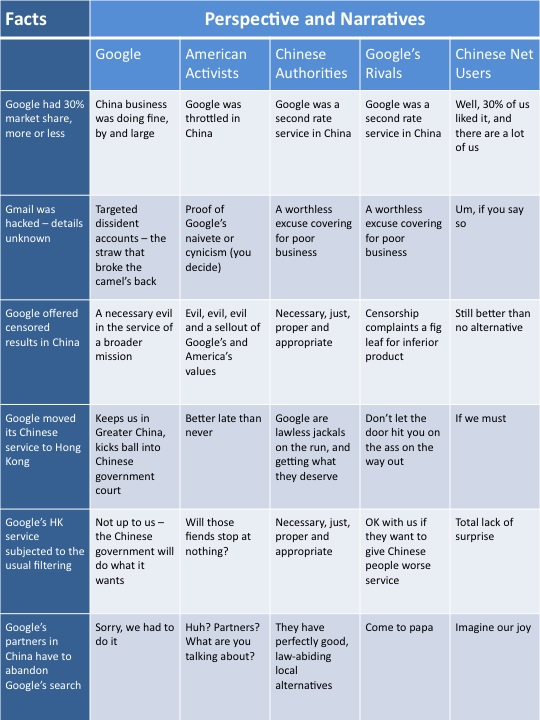
    What I did do, however, was to put together a handy chart that shows the key known facts, and, based upon all the articles I’ve read, how each of the major interest groups that I observe is spinning or reacting to each of those facts. In each case, the vertical thread through the series of facts creates the skeleton of a narrative. And that’s what each of these parties –Google, its rivals, the Chinese government, the Western activist community– is trying to do: They’re each trying to control and define the narrative of Google’s situation in China to serve their own agendas. They are, in other words spinning. Here is what the result looks like:

    google cheat sheet

    I realize this is a vast oversimplification and there are no doubt various interests omitted, but this captures most of the main parties and facts. What’s not included here is any kind of conclusion of each narrative. In my opinion, the story is still unfolding and its too early for that. But we’ll see how things go over the next few weeks.

    The other thing is that these narratives aren’t in equal competition. To use a possibly inappropriate military metaphor, there are different theaters of operation in which the stakeholder have varying levels of influence. So, in the US, Google and the activist (and analyst) community are the loudest voices. in China, the Chinese government has the tools to define the public narrative, and has been using them liberally, although there is some ferment in the margins (also here).

    Eventually, there will be a canonical version of Google’s misadventures in China. or at least one canonical version in the West and one in China. These may not be the creation of a single group. One group might control interpretation of one element of the story, and one group control another. But for the moment, the fun is in watching the battle to own the story. Enjoy it while it lasts.

    Finally, from a PR perspective, there is possibly one overarching lesson that can be drawn from this whole situation. I can’t take credit for this insight, it comes from Craig Adams, a colleague of mine. But it’s deceptively straightforward and I agree with it wholeheartedly. He said that if you have to sell out your basic principles to do business in China, that’s a pretty good sign you should reconsider your plans.

    Other sources (just to prove I’ve done my homework):

  • Free laptops for NPC delegates – it looked good on paper

    Let’s say you’re a company selling some kind of product. Let’s say your product is –let’s just pick something at random here– laptop computers. Globally, this is a heavily commoditized category jammed with companies selling look-alike products with similar feature sets. In China, which has the usual big-time  suspects plus a whole cloud of local also-rans, the situation is even more competitive. How do you stand out? How do you persuade students, young professionals and other consumers to buy your laptop, and not some brand-x laptop poseur laptop?

    Well, in China the answer is often, “be cheapest!” But that’s not always the whole story. Often there is also some PR.

    To that end, one thing you would often do is try to get your product into the hands of “influencers”, people who have the power to help lead public opinion in your target market, ideally in your favor. One way to approach this is the celebrity endorsement: I’ll send a cubic meter of 100RMB notes to your house if you wave my company’s product around, appear in some ads and show up at some of my events. And, hey, why not write a blog about it? This is generally legit and practiced everywhere. George Clooney and Omega watches, for instance, except he probably doesn’t get paid in RMB.

    There is also the schwag approach, in which you give your product away to rich, famous and stylish types in the hope that they’ll be seen using it thus conferring glamor and sexiness upon it, hopefully without you having to write a colossal sponsorship check. This is why you hear about things like the absurd gift baskets at the Academy Awards. This also leads to the great commercial irony that rich people get more stuff for free than more deserving types, such as impoverished PR bloggers, and will no doubt be a contributing factor in the revolution when it finally comes.

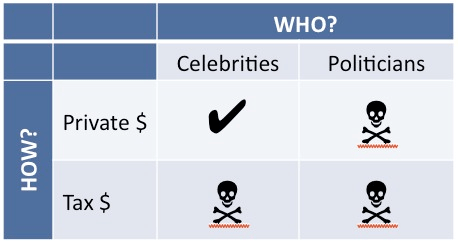
    There are, however, some generally accepted rules about the schwag game. Two of those rules, involving who it’s OK to target and how schwag can be paid for, can be summed up in a diagram that looks like this:

    schwag

    By participating in a program to give free laptop computers to 2000 delegates to the Chinese People’s Political Consultative Congress (CPPCC), Lenovo appears to have landed squarely in the lower-right, or what I like to call the “PR deathtrap” quadrant. The CPPCC is a political body that nominally advises on and suggests policy and which convened this week in Beijing as part of the annual political “two meetings” festivities. The other meeting is that of National People’s Congress, which has the slightly heavier responsibility of endorsing actual policy (a cynic might say, “rubber stamping”, although the NPC has pushed back from time to time).

    The always excellent China Media Project sums up the laptop situation:

    As China’s annual National People’s Congress opened yesterday, many news headlines pounced on Premier Wen Jiabao’s remarks toward the end of his NPC report (see tab 11), in a section on anti-corruption, about the need for leaders to report their personal assets. But in the margins, commentators railed against shady practices nearer at hand — more than 2,000 laptop computers given away to delegates at the public’s expense.

    The laptop story bubbled up out of China’s social media sphere back on March 2, when Chinese Internet users noted an odd mini blog entry from Zhang Xiaomei (张晓梅), a delegate to the Chinese People’s Political Consultative Conference who is also the publisher of Beauty Fashion magazine.

    Zhang’s entries were succinct, mostly mundane summaries of preparations and speeches ahead of the two meetings.

    CPPCC Chairman Tao says: being a national delegate to the CPPCC is a glorious mission, and a post for political participation and discussion. Sichuan party secretary Liu Qibao (刘奇葆) says: last year was the toughest year, this year is the most complex.

    But in one entry she wrote: “When delegates report [to the meeting] they each get a laptop computer. What is different from last year is that this year these don’t need to be returned after we’re done with them. This is much more practical.”

    Yeah, it sure is, isnt it? Keeping stuff often is.

    As China Media Project explains, the response both online and in mainstream media has been pretty negative, with accusations of corruption and speculation about the amount of tax dollars spent on the computers. It has also been pointed out that Lenovo executives account for a large share of the IT industry representation at the CPPCC.

    So here is where it gets interesting, and perhaps where Lenovo put a foot wrong assuming they played some role in creating this program and weren’t just lucky beneficiaries. CPPCC delegates occupy a strange space in between celebrity and politician. Many of the delegates, such as Ms. Zhang, are in fact celebrities or notables from the business world. Most are not politicians or officials in their daily lives. As the Financial Times noted this week, the entire CPPCC is a bit theatrical, and its actual contribution to the legislative process is debatable at best. In previous years delegates had been loaned computers, so why not let them hold onto them this  year? A relatively small change in the grand scheme of things.

    But regardless of what you think about the CPPCC or the actual power of its delegates, in the context of the “two meetings” the delegates are acting as politicians. In an era when Chinese people are increasingly sensitized to corruption and willing to discuss it online and hold officials to account, giving laptops to 2,000 wealthy people operating in a political role looks risky at best. Perhaps in some years it doesn’t become a big deal, but this year it rubbed people the wrong way. It probably would have been best to stick to the loaner approach, even at the risk of some slightly inconvenienced delegates.

    From Imagethief’s point of view the good news is that this issue became, well, an issue. That it escalated online and in the media is a headache for Lenovo and perhaps an embarrassment for some of the delegates (although that may be optimistic), but it’s a good thing for accountability and for China. The CPPCC may be largely symbolic, but at least it could be relatively clean and symbolic.

    So what should Lenovo do? This situation is a long way from being out of control, so what they probably will do is hunker down and wait for the government to decide that discussion of this issue is no longer appropriate and then enjoy the ensuing silence. A more progressive option would be to announce that in subsequent years they’ll return to a policy of loaning delegates computers rather than giving them away. Better yet would be to cancel the whole thing and make delegates self sufficient for computing in future. I’m sure most CPPCC delegates –even the ethnic minority delegates– can afford a computer.

    Or how about this: It’s awkward to inform delegates that, sorry, contrary to what they were originally told they do have to return the machines. But Lenovo could ask delegates who don’t need the computers after the meetings to voluntarily return them, and then publicly donate the returned machines to some worthy cause. Rural schools? Barefoot doctors? Impoverished bloggers? You name it. Plenty of options.

    Note: Some in-situ links removed from the paragraphs quoted from China Media Project. It’s worth visiting their original post.

    Disclosure: I do not work on any laptop computer accounts, however my agency does represent a competitor to Lenovo. The views expressed here are my own.

    Update: David Bandurski of China Media Project left a comment in the original version of this post noting that, as of writing, criticism in the media was not directed at Lenovo specifically. At least, not yet.

  • Seriously? They blocked IMDB?

    Imagethief is as annoyed by the Great Firewall (or Net Nanny or what-have-you) as anyone who lives in China and uses overseas social networks. One of the great joys of mypox-afflicted Christmas vacation was having one of my annual bursts of unfettered Internet use. After months of sipping my Internet through the narrow and frequently blocked swizzle-stick of Chinese “broadband” it’s always refreshing to turn the VPN off and draw my Internet through the big-bore bubble tea straw of an American or Singaporean ISP.

    Still, say what you will about the GFW, it does provide those of us who live in China with one of our most enduring parlor games: Who’s blocked? Why? Who goes down next? What’s accessible again? What does it all mean? Buy? Sell? Hold? Stockpile turnips? Trying to read the tea leaves of the GFW is the Kreminology of  21st Century Beijing, especially for us nerdy blogging types.

    Most of the time, as misguided as it might appear to us bourgeois foreigners, we can at least discern the rationale for GFW decisions. Apple highlights an album dedicated to Tibet on iTunes, so they get slapped for a while. Yeeyan starts translating foreign news a little too freely so the great, sweaty thumb comes down on them like the Monty Python foot of censorship. Microblogs outside the control of the big media groups looking a little too much like group organizing tools? Adios, muchachos. Sorry about all those venture capital deals. In its own way, the GFW is a window into the fever dreams of the Chinese government, albeit a small window in serious need of a spritz of Windex and a roll of “Brawny” paper towls.

    But I have to confess I am totally mystified as to why this week the Chinese authorities decided to block the Internet Movie Database (IMDb). Yes, there are most certainly entries in IMDb that are counter to Chinese doctrine (“Seven Years in Tibet”, etc.), but you’d struggle to find them through the updates on development of the sequel to “The Hangover” and such. All of that “hurt-the-feelings-of-the-Chinese-people” stuff is also available in more practical and influential form on any number of other sites such as iTunes, Google and Amazon.

    If anyone has a good explanation for why this happened, I’d love to hear it. Is it personal? Perhaps it’s because a search for “Tiananmen” yields plenty of misguided Western propaganda while shamefully omitting China Film Corporation’s feel-good National Day picture of the same name*? Who knows. Simply by virtue of its impenetrability and apparent capriciousness, this move puts the GFW dangerously close to self-parody territory. What’s next to be blocked in the interest of the correct guidance of public opinion? Hello Kitty? ESPN? Funny-or-die? The mind reels.

    *This was last year’s lightweight counterpart to the more serious but less watchable “Founding of a Republic.” Imagethief really wants to know what the deal with the girl with the accordion was. She’s on the poster foreground, but in the film for all of about ninety seconds, thus constituting the sum-total of the sex appeal as far as Imagethief is concerned. This, although scant, was admittedly ninety seconds more sex-appeal than “Founding of a Republic” had.

    Update:

    Also blocked, for the first time as far as I know, is Imagethief. Puts me in good company, along with Danwei.

    Update 2:

    Apparently blocked only in Beijing. Imagethief, it seems, is suitable for the decadent financiers of Pudong, but not for the refined sensibilities of Zhongnanhai. I don’t know what to think.

    Think,
    Think, “Die Hard”, only communist, funnier and with an accordion girl.
  • Don’t scoop the reporter who interviews you, and other PR basics

    Last Wednesday, the 21st, the IT news channel of giant Chinese portal Sohu published the transcript of an interview of Sohu CEO Charles Zhang by Hong Kong-based BusinessWeekjournalist Bruce Einhorn. All well and good, you might think. Chinese portals regularly translate and run foreign media articles, and it makes sense that a portal might want to run a high-profile interview with its boss. But there were two problems. First, the interview was on the rather sensitive topic of the dueling IPR lawsuits between Sohu and Youku. Second, BusinessWeek hadn’t run the story yet.

    Alerted by YouKu, BusinessWeek presumably put pressure on Sohu because the Chinese interview transcript vanished by the next day, along with many of the reprints on other Chinese websites. If you’re curious, and read Chinese, a few instances remain online. TheBusinessWeek story by Mr. Einhorn is also now available online. It is interesting to compare the two, although Imagethief suggests reading the transcript with some caution for reasons that shall be explained below.

    Imagethief has no idea what transpired between Mr. Einhorn and Sohu in arranging and conducting the interview, but I’d bet actual money that an agreement for Sohu to publish their own transcript of the interview was not part of the deal. Another Western business journalist told me today that such a move was pretty likely to piss off a publication on any number of levels. Really, I didn’t have much trouble guessing that on my own. In general, Chinese companies have a lot to learn about working with Western media, but I can’t imagine the Economic Observer, 21st Century Business Herald or Caijing (even with its current woes) sitting still for such a move either. The fast removal of the transcript from Sohu suggests that publication took BusinessWeek by surprise.

    There were a couple of problems with what Sohu did. First, and most basically, they used a journalist’s interview to create and publish material that pre-empted that journalist’s story. That’s just plain rude, and probably won’t be soon forgotten. As a media organization itself, Sohu, of all companies, should know better. But it goes beyond that. Mr. Einhorn is an experienced journalist writing for a publication with a reputation to protect. As you would expect, his story on the lawsuits between the two companies is balanced and includes quotes from both Sohu and Youku.

    The transcript published on Sohu, however, included only brief questions and Mr. Zhang’s responses. Sohu’s introduction presents the transcript as “an interview with BusinessWeekjournalist Bruce Einhorn”, which is literally correct, but appropriates BusinessWeek’scredibility for a one-sided view on a contentious issue. That same introduction characterizes Sohu rival Youku extremely negatively, saying that the discussion would, “reveal the details of Youku’s piracy and rights infringement.” Not much balance there.BusinessWeek might run executive Q&As, but it’s safe to say they wouldn’t stake out such a negative position in an article that didn’t give Youku space to respond, and that wasn’t backed up by copious facts and extensive reporting. Interviews are raw material. A transcript of a single interview is not a story, and putting BusinessWeek’s name on the interview is a misrepresentation.

    Readers also have no way of knowing if the transcript is accurate or how it may have been edited. Any Q&A interview is likely to be edited, but a publication editing a Q&A for tightness or focus is not the same thing as a company editing a transcript to better present its point of view. Imagethief knows from experience that editing of interview transcripts by PR teams is common practice in China (many journalists expect a transcript by e-mail following an interview), and a reading with a critical eye is well advised. However, the imprimatur of BusinessWeek on the transcript implies that BusinessWeek itself had the final cut, not Sohu. That looks like another misrepresentation.

    It’s sensible policy for companies and PR teams to record their own versions of interviews with journalists. A recording enables you to check the accuracy of final quotes, provides leverage if you need a correction or clarification, and can help out if the journalist has a problem with their own recording (it has been known to happen). Recorded interviews with experienced spokespeople can also often be good source material for messages, sound-bites and other content. However, publishing or leaking recordings or transcripts in their entirety is a bad idea if you want to preserve your media relationships.

    There is only one situation in which I would suggest to a client publishing verbatim portions of an interview transcript. If a story has already run with an inaccurate or wildly out-of-context quote that I feel misrepresents a spokesperson or client company, and if I can’t get the publication to correct the quote or issue a clarification, I might suggest that the client publish an appropriate excerpt of the transcript on a PR page or company blog. I would only recommend an excerpt, and I would include an explanatory note of why the excerpt is being published and a link to the original article. I would also notify the publication that I was going to do this.

    Running the transcript also hints at a deeper issue. It would have been simplicity itself to have a Sohu journalist interview Mr. Zhang for the exact same responses (or to put the same material on Mr. Zhang’s blog, which appears to have been fallow since July). An admittedly cursory search of Sohu today didn’t turn up any such articles since the founding of the Alliance last month. Why not?

    News organizations are generally disinterested (as opposed to uninterested) in the news they are reporting. When reporting on issues in which they have an interest, such as the fortunes of their parent companies, good news organizations take pains to be balanced in order to preserve their reputations. There are op-ed pages and blogs for points-of-view (not to mention the occasional leaked letter to ownership). Sohu is hardly a disinterested party in the lawsuit with Youku or in the fortunes of the Online Video Anti Piracy Alliance, which it founded and largely speaks for. Running the transcript of the BusinessWeekinterview might just have been a mistake. Or it might have seemed like a way for Sohu to have the best of both worlds: A splendidly one-sided interview that carried that authority of a respected, international business magazine and that didn’t seem to compromise their own newsroom.

    But in the long run you can’t have it both ways. And for a company listed on America’s NASDAQ, annoying Western business media in attempt to have it both ways is probably not a great PR strategy.

    Disclosures: I found out about this episode from a friend who works for Youku. In my job I also regularly work with journalists from Sohu’s news organization, all of whom are completely professional. I have no opinion on the merits of the various lawsuits flying back and forth between Youku and Sohu.

  • Communication is the real lesson from the Green Dam Youth Escort fiasco

    So Green Dam + Youth Escort blocks images based on skin tone. But what if I like Afro-porn? These, and other important questions are arising now that serious analysts (which is to say, people other than me), have had some time to dig into the capabilities of Jinhui’s now infamous software package. The verdict is pretty much as you might have guessed: Green Dam + Youth Escort is a poorly designed rip-off of a foreign nanny-ware product, is unstable, and is riddled with security holes. It is, in short, crapware. I won’t go into the gruesome details, but if you’re interested I highly recommend an analysis by the Computer Science and Engineering division of the University of Michigan. For those in a hurry, the summary gives you a taste of their conclusions:

    We examined the Green Dam software and found that it contains serious security vulnerabilities due to programming errors. Once Green Dam is installed, any web site the user visits can exploit these problems to take control of the computer. This could allow malicious sites to steal private data, send spam, or enlist the computer in a botnet. In addition, we found vulnerabilities in the way Green Dam processes blacklist updates that could allow the software makers or others to install malicious code during the update process.

    We found these problems with less than 12 hours of testing, and we believe they may be only the tip of the iceberg. Green Dam makes frequent use of unsafe and outdated programming practices that likely introduce numerous other vulnerabilities. Correcting these problems will require extensive changes to the software and careful retesting. In the meantime, we recommend that users protect themselves by uninstalling Green Dam immediately.

    Judging from the livid reaction in China, no-one will have to work too hard to convince Chinese computer users to take that advice. So this will go down as yet another shining moment in the annals of government procurement.

    But despite what you may think, the government’s real problem wasn’t in the procurement process or obviously less-than-rigorous technical evaluation. It was in the public communication, which was nonexistent. This is a bit of surprise because on average, Chinese government bodies have become significantly better at public communication in the past few years, developing a level of responsiveness to public opinion that would have been unthinkable a couple of decades ago. But the radar was definitely switched off in this situation.

    In Imagethief’s personal experience, most Chinese people are relatively sanguine about the Great Firewall (or Net Nanny or Golden Shield or what have you). It doesn’t interfere with most of the things your average Chinese net user wants to do (watching a complete and conveniently subtitled version of the new Star Trek movie on Youku, for instance), and is treated as a kind of necessary but slightly obnoxious inconvenience, like a younger brother who wants to join your pickup soccer game. You can always make him play fullback, where he’ll probably stay out of trouble.

    But there is something important about how the mechanism of the Great Firewall relates to this forgiving attitude. The Great Firewall is implemented at a distance from the end user, in the ISPs, routers and gateways that form the infrastructure of the Internet. It’s enforced out in the cloud, and is thus abstract to some degree, even if its effects are apparent in the information you can or cannot access at any given time.

    But what the regulator does in the cloud is one thing. What it does when it reaches out and plants its mitts squarely in your computer — your personal computer, in all senses of the word– is entirely different. It is the difference between posting speed limits and deploying the highway patrol on dangerous stretches of road, and putting a governor in your car so it won’t go over 55 mph no matter what you do. The former is completely reasonable for the public good. The latter is an insult to your manhood (unless you’re a woman, in which case it’s presumably an insult to something else).

    Now, imagine that the authorities are not only putting a governor in your car, but that it’s a crappy governor that sometimes kicks in when you’re only going 35, stalls the car completely when you break 55 rather than simply limiting your acceleration, and spontaneously unlocks all the doors and starts the engine when car thieves walk by. That’s about where we stand with Green Dam + Youth Escort according to the analyses.

    It’s conceivable that the authorities could have pulled this off if they had taken a few basic steps. First, it would have been good to have a period of public consultation. At least that would have provided a chance to assess public reaction and respond appropriately prior to making a commitment. They also could have used that period to defuse some of the negative reaction from the PC manufacturers, all of which are publicly walking a fine diplomatic line, and privately lobbying like Jack Abramoff on poppers and Red Bull. At the risk of letting you see how a PR person thinks (a dark and terrible thing), if I was selling this idea I’d do as much work as I could with grass-roots and community groups and academics to build up the problem of undesirable information with supporting comment from a variety of different directions. I’d run a parallel media compaign also building up the problem and making sure that regulatory interest in a solution was presented in an appropriately benevolent light. Then I’d position the free inclusion of parental control software (and that’s how I’d describe it) with all computers sold in the country as a gift, not as a mandate. Importantly, I’d suggest making it clear that the software is only included with the computer as a disk, and not preinstalled. I’d combine that with community distribution to get the software out to households that already have computers. This puts the software potentially on the desktops of children and students for whom it matters (if you believe in such things) while not wasting time on the committed geeks and randy young men who will immediately scrub the software off of any computer they buy. I’m not saying I like doing this, I’m just saying that’s how I would do it if I had to.

    Oh, it would help immeasurably if the software itself wasn’t complete crap. Because I’d also encourage public review of the software itself prior to finalizing the plan. And, after all, you’ll have a much easier time selling this idea to the PC industry and enlisting their support if the PC industry doesn’t think it’s going to break their products.

    Instead, the authorities mandated bad software by fiat without warning anyone. In the face of the entirely predictable backlask, they are reduced to their usual double-pronged approach to managing public opinion, telling the mainstream commercial media to tone down the criticism and running a happy-banner up the trusty Xinhua flagpole. Good luck with that. Imagethief stands by his original judgment: In six months, this will all be conveniently flushed down the memory hole. You might want to order a new PC soon just for the souvenir value.

    See also:

    Hey, does Green Dam Youth Escort block bunny porn?
    Hey, does Green Dam Youth Escort block bunny porn?
  • Why I’m not in a tizzy over China’s new Internet filtering software

    Another day, another censorship-related thing to get bent out of shape about here in China.This week it’s the dreaded “Green Dam Youth Escort” internet filtering software, which goes right to the head of the nominee list for the annual Imagethief “branding that translates badly” award. They can collect the statuette, a little plastic model of a Chevy Nova*, at the ceremony, which will be hosted by the auntie who empties the garbage can in my apartment hallway. Watch your mailbox for an invitation. Black tie, please.

    Originally reported by the Wall Street Journal and then relayed by the New York Times in somewhat darker terms, the story is that the Ministry of Industry and Information Technology, the IT regulator, will require all computers shipped in China after July 1st to include Green Dam Youth Escort, a client-side Internet filtering program (actually two related programs it turns out, “Green Dam” and “Youth Escort”) . The Journal also published a day-after follow-up with some further industry response and third-party comment. The industry response might best be characterized as weary sighs punctuated with occasional slaps to the forehead when they think no one is looking.

    Personally, Imagethief isn’t getting his shorts in too much of a twist over this. Don’t misread me: There is nothing to celebrate in yet another measure of government intrusiveness in people’s surfing habits, or the mandating of the use of what is almost certainly a perfectly crappy bit of software. But I’d say that the net effect of Green Dam Youth Escort on Chinese surfing habits will be close to zero.

    First of all, it is unclear whether PCs will ship with the software installed. The Wall Street Journal says that the software need only be packaged with PCs sold in China, and not necessarily installed. Rebecca MacKinnon, on the other hand, has received a copy of what is claimed to be the original MIIT notice calling for the use of the software. Her reading is that the document requires that the software be pre-installed on computers. (See also Rebecca’s initial post on the software.)

    Even if Green Dam Youth Escort comes pre-installed, however, it seems like the leakiest of dams. After all, what’s to stop anyone acquiring a new computer from simply doing a fresh reinstall of Windows? Certainly no IT administrator at a major corporation –especially a foreign one– will allow this software on company systems, given its apparent propensity to phone home for poorly documented reasons.

    And even a post-purchase reinstall won’t be necessary in many situations as I’m sure any DIY vendor at the highly competitive IT malls will sell you a nicely scrubbed box at your convenience. They’re already willing to sell you pirate software and technically illegal mobile phones, so it’s hard to imagine they’ll let a little thing like Green Dam Youth Escort stand between them and a sale.

    Also, this is Windows-only software as near as I can tell (the website is not accessible right now, so I can’t confirm). Will Macs and Linux systems be in technical violation? Or will they be conveniently ignored? What about the increasing number of Internet capable mobile handsets that are on the market? Plenty of palm-friendly (I don’t mean it that way, you filthmonger) yellow content out there for on-the-go types.

    The claim is that Green Dam Youth Escort is meant primarily to filter pornographic and otherwise socially objectionable content rather than politically objectionable content. It’s hard to imagine that it wouldn’t be used for both, redundant as that seems given existing censorship mechanisms. But the Chinese government has a well established obsession with limiting access to pornography and similarly nasty content. Hence the periodic Internet-purification campaigns and the regular drip-feed of ghastly stories about Internet addiction, young lives ruined, etc.

    But if this is really about limiting access to porn, then the effort is even more doomed than I thought. Demand for dissident content is pretty selective despite what people overseas may believe (Imagethief’s Chinese colleagues were annoyed by the recent blocking of Twitter, but mostly for mundane reasons). However, it’s a safe bet on demographic grounds alone that demand for porn is as sky-high among Chinese Internet users as it is anywhere else. Commercial forces alone will doom Green Dam Youth Escort (unless it’s actually linked to an escort service, which seems unlikely). After all, look how miserably government attempts to limit online game playing worked. It took a commercial issue to deny Chinese gamers access to World of Warcraft for any significant amount of time.

    Imagethief detects the whiff of a sweetheart deal. Certainly the company that produced the software, Jinhui Computer System Engineering Company, will cash a nice check from the government, which will apparently underwrite the inclusion of the program. But client-side filtering software, even if updated from a central database, is principally useful at an organizational level, such as by a company or household, where policies need to be set locally. If the government wants to set policy for the entire country, then China’s existing DNS, ISP and gateway-based filtering mechanisms are much more efficient and, for all their porousness, harder to circumvent. If Chinese ISPs start denying connectivity to clients not running Green Dam Youth Escort, then I’ll panic. But I don’t see how that’s feasible (and if it gets tried, stand-by for the slap-fight of the century between MIIT and MOFCOM).

    Frankly, despite the inevitable hand-wringing and bluster, I wouldn’t be surprised to see the whole initiative vanish quietly after a few face-saving months.

    *NB: The Chevy Nova story is actually bullshit, but it lives in legend.

    Update:

    From Malcom Moore’s story on this in the Telegraph, this outstanding quote from the Jinhui spokeswoman:

    “This is very good news for users, so they should not uninstall it. It will automatically filter pornographic images and antirevolutionary content. It will not take up much space on the hard drive. It is very stable and we have conducted many tests already,” [the spokeswoman] added.

    As if. Also, screenshots here (in Chinese) courtesy of @davesgonechina.

    Update 2:

    Speaking of handwringing, this quote from the AP’s coverage:

    John Palfrey, an Internet censorship expert at Harvard University, described the latest requirements as “a potential game changer in the story of Internet control,” by moving China’s “Great Firewall” closer to the user, where censorship can be more effective.

    Game changing indeed. As long as the game is strip-Parcheesi played by monkeys in diapers. I disagree that censorship is more effective when it’s closer to the user. I think it’s more effective when it’s centralized for the reasons described above. Ask the DVD consortium how they feel about device-level security restrictions in China (although it’s an imperfect comparison as the government doesn’t give a crap about DVD piracy). Still, unless something completely unexpected is sprung in the implementation of this software, getting it off of your computer will be about as easy as hitting a dead sturgeon with a fork.

    Update 3 (June 10):

    The government and Jinhui both insist it’s not spyware. So that’s OK then, but I notice nobody insists its not crappy software, as alleged elsewhere. Bonus: The Foreign Ministry spokesman claims that China’s internet has always been “open”. Which is true, if by “open” you mean “restricted”.

    Also, Bruce Einhorn of BusinessWeek writes about the lack of consultation with the industry over this move, and what that says about the Chinese approach to regulation.

    Also on Imagethief:

    I can't see any sea cucumbers, but look what Edison Chen's doing with this girl!
    I can’t see any sea cucumbers, but look what Edison Chen’s doing with this girl!
  • Consultants say hardened Chinese death-nerds are coming for your daughters

    Yes, it’s true. Those Chinese death-nerds are everywhere. They’re in your bank account. They’re in the Pentagon. They’re sending naked pictures of themselves to your daughter. And they’re completely invulnerable to all known countermeasures!

    Or at least that’s the terrifying conclusion one might draw if one was to read a long article from the Washington Times with the chilling headline, “China blocks US from cyber warfare.” Now, the Washington Times and this journalist in particular have–how shall I put it?–a distinct point of view on China, and it’s perhaps just a tad darker than my own. But I find this story interesting less on its own (thin) merits and more because it represents the latest installment in what seems to be something of a fad in hair-raising stories on the Chinese cyber-security threat. My heavens, are we having a meme?

    You may recall that this idea began rolling in its most recent incarnation with a report about Ghost Net, in which the link to the Chinese government was unclear but widely assumed. It gathered steam with a rather vague Wall Street Journal article about Chinese “spies” hacking into the US electricity grid. With this Washington Times article, which has been picked up by AFP and thus relayed to Yahoo and other portals, it’s reached something of a loony crescendo. You’d think bureaucracies in Washington were competing over turf and budgets and thus doing their best to dial up the general anxiety level in order to exert political leverage. Because, you know, what with the economy, two wars, the Taliban destabilizing Pakistan and Swine A/H1N1 flu we so desperately need one more thing to be afraid of.

    The Washington Times article really is in a class all by itself, though. It focuses on the devastating implications of a “hardened” Chinese operating system that, to read this article, makes Chinese government computers essentially hack-proof. It is based largely on the testimony (PDF) of Mr. Kevin Coleman, one of nine witnesses speaking before the US-China Economic and Security Review Commission on April 30th. (The USCC makes periodic recommendations to congress on the national security implications of trade with China.)  There is no one part of the article can single out for an excerpt, so I’ll instead give you a rundown of the highlights. The article features:

    • An IT security consultant (Mr. Coleman) who “advises the government on cybersecurity” telling us that the Chinese are outplaying us badly. Because what do you expect him to say? “It’s all good. I’m done here.”
    • Terrifying absolutes, such as this quote on the effect of China “hardening” it’s servers with this new operating system:

    “This action also made our offensive cybercapabilities ineffective against them, given the cyberweapons were designed to be used against Linux, UNIX and Windows,” he said.

    • The suggestion that the revelation of this operating system is somehow an intelligence coup, on par with the cracking of Enigma:

    The secure operating system was disclosed as computer hackers in China – some of them sponsored by the communist government and military – are engaged in aggressive attacks against the United States, said officials and experts who disclosed new details of what was described as a growing war in cyberspace.

    • Further vague but terrifying details designed to emphasize our inferiority:

    Additionally, Mr. Coleman said, the Chinese have developed a secure microprocessor that, unlike U.S.-made chips, is known to be hardened against external access by a hacker or automated malicious software. “If you add a hardened microchip and a hardened operating system, that makes a really good solid platform for defending infrastructure [from external attack],” Mr. Coleman said.

    • Hopeless over-generalizations of dubious technical soundness:

    U.S. operating system software, including Microsoft, used open-source and offshore code that makes it less secure and vulnerable to software “trap doors” that could allow access in wartime, he explained.

    • Quotable quotes:

    “What’s so interesting from a strategic standpoint is that in the cyberarena, China is playing chess while we’re playing checkers,” he said.

    • The devastating revelation that the Chinese government is hiring hackers!

    A third computer specialist, Alan Paller, told the Senate Committee on Homeland Security and Governmental Affairs on April 29 that China’s military in 2005 recruited Tan Dailin, a graduate student at Sichuan University, after he showed off his hacker skills at an annual contest.

    Mr. Paller, a computer security specialist with the SANS Institute, said the Chinese military put the hacker through a 30-day, 16-hour-a-day workshop “where he learned to develop really high-end attacks and honed his skills.”

    • Meaningless statistics:

    Mr. Coleman said one indication of the problem was identified by Solutionary, a computer security company that in March detected 128 “acts of cyberagression” per minute tied to Internet addresses in China.

    “These acts should serve as a warning that clearly indicates just how far along China’s cyberintelligence collection capabilities are,” Mr. Coleman said.

    •  Just plain goofyness:

    Mr. [Joel] Brenner [national counterintelligence executive] said there are minimal concerns about a Chinese cyberattack to shut down U.S. banking networks because “they have too much money invested here.”

    Well, thank god for that!

    It’s hard to know where to start with this article, but perhaps I should begin by saying, of course the Chinese government is conducting cyber-espionage against the US. They’d be stupid not to. And of course they are concerned with securing their own critical systems against the United States’ equally inevitable cyber-espionage. Again, they’d be stupid not to. And certainly the US government needs to take information security seriously. And so do businesses. And so does your grandmother. Especially if she’s using Windows. All granted.

    And it’s nice that various American government bureaucracies are having a pissing match about who should oversee American cyber-security at a government level (the end of the article hints at that a bit). I hope somebody wins someday. But, really, do we need to frame all of this in such Michael Bay terms? Let’s take a closer look at this super-secure operating system, “Kylin”. It’s hardly a secret, having been in the press since at least 2004. You can even download the ISO files, which suggests security somewhat shy of, say, the Manhattan Project. I’m thinking Langley may have a copy. A fairly sketchy DIY site promisingly called “Cheapest-computer-hardware-software.com” has the skinny (all Chinglish is sic):

    The Kylin operating system focuses on high performance, reliability and security. The development program was first funded by the Chinese government sponsored R&D program during 2002. The operating system developed in a hierarchical model, in which, the kernel layer is based on Mach, the system service layer is based on FreeBSD and the desktop environment is similar to that of Windows. The operating system standards are similar to UNIX standards, and are highly compatible with Linux binaries.

    ***

    The operating system was on development at the National University of Defense Technology. The operating system was designated as the document processing operating system. It can now turn China into super power in IT product development. The powerfulness, stronger security of the operating system may make Chinese people to replace the foreign operating systems. In China, Kylin was listed among the best 10 scientific and Technological Progresses News of Higher Learning Institutes during 2005.

    ***

    The dominance of IT product by the foreigners in China will get reduced, once this operating system made popular among Chinese population. The security of data will be stronger, because, it is being developed by the Chinese government and people themselves.

    So, the indestructible Chinese operating system is FreeBSD + Mach. Yes, that’s right, the operating system that frees them from foreign innovation and with which China will conquer the world is a less slick version of Mac OS X. Well, I hate to break that to the scare-mongers Washington, but we have that technology also. As for the secure microprocessor, I hope he’s not talking about Godson, the domestic chip project that languishes in the same commercial phantom zone as the domestic video disk project (EVD) and the domestic WiFi standard project (WAPI).

    Why would I trust some half-assed and likely Chinese no-name site over the best and brightest of Washington DC?  Well, for one reason, the language in the extract above rings absolutely true. Second, let’s just say I’m getting agenda sensitivity on this issue. Sure, it’s possible this is all part of some huge Chinese disinformation campaign and I’m just another useful idiot, talking down the crowbar that the Chinese state will someday use to pry open the secret folder where I keep the naughty photos of Mrs. Imagethief. Maybe there are two Kylins, and I’ve got the wrong one. Maybe Kylin + Godson is the shit, and I should trade in my MacBook Pro.

    Or, just conceivably, people with their noses in the Washington trough are blowing smoke up my ass. Let’s face it, it wouldn’t be the first time.