I’ve never been much for conspiracy theories. Not that I don’t like a touch of the fantastic in my daily life (I live in China, after all). But when you think about the sheer logistics involved in most of the major conspiracy theories things start to break down pretty quickly.
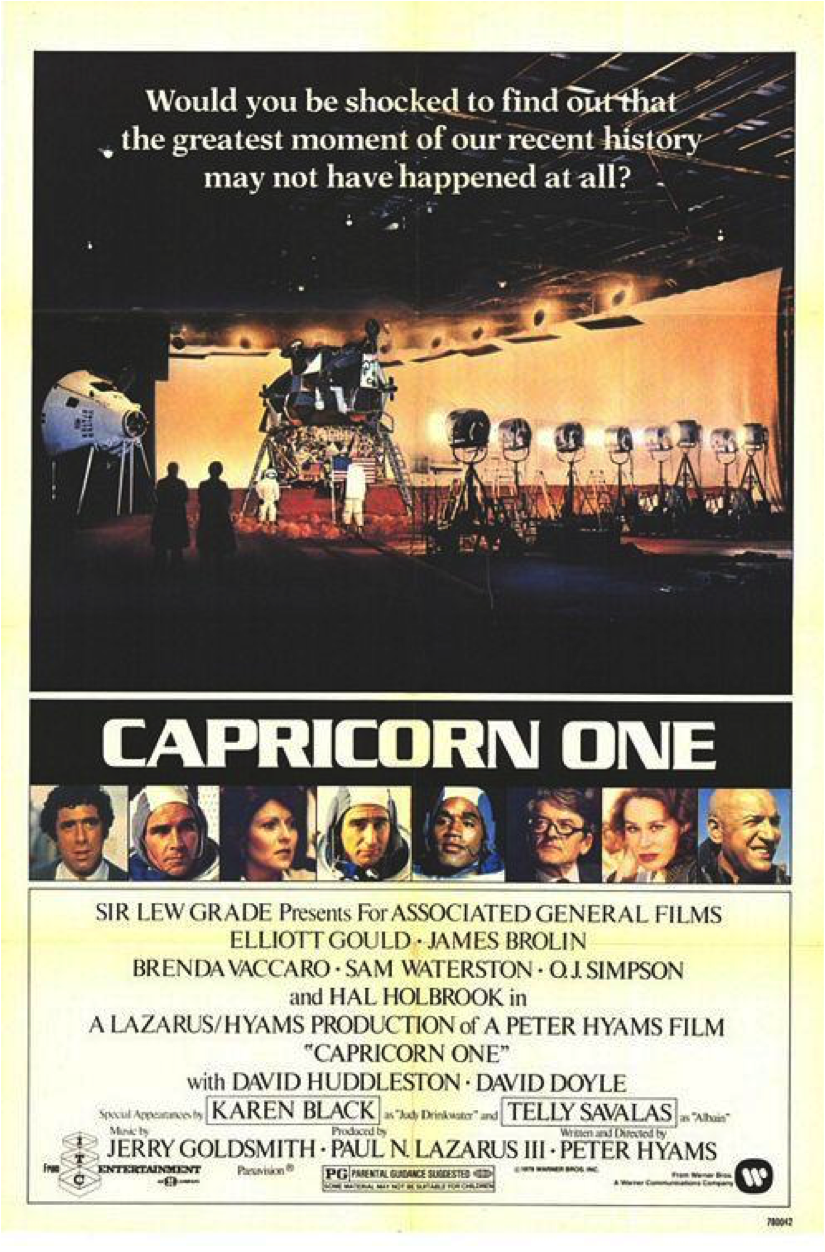
Consider that old favorite of the tinfoil hat brigade, that NASA faked the American moon landings, and think about what it would have required. It’s not just the fakery of the photographs and video, but also that everyone who worked on all the aspects of the fakery, from the astronauts to the guys who would have had to doctor the photos and fake the moon rocks and telemetry (depending upon whether you think mission control was in on it or not) would have had to keep their mouths shut. For going on 45 years. For six successful lunar landings involving eighteen astronauts, twelve of whom have allegedly walked on the moon. Not only does everyone who knows about the fraud have to keep his mouth shut, but everyone who has a public face has to keep his story aligned. Especially that attention-junkie Aldrin. It only takes one person to blow the lid off, intentionally or accidentally. Frankly, it’s just easier to go to the goddamned moon.
I’m not particularly interested in getting into a pissing match with conspiracy theorists (like thermonuclear war, it’s not “winnable” in the conventional sense of the word), so much as I am in setting up a problem. Coverups pose similar problems to conspiracies in that, like a big pile of sweaty dynamite, they are unstable by nature and easily detonated, sometimes by the tiniest of disturbances. That’s why they don’t tend to make good PR strategy.
Of course, by definition no one knows when a coverup succeeds. Small ones involving one or two people? Probably a fair number. Big ones involving lots of people and big stakes? Not so many, I’d guess. “Three may keep a secret if two of them are dead,” wrote Benjamin Franklin, perhaps optimistically. In most cases, the participants aren’t Navy Seals or the CIA or other kinds of people who are indoctrinated and trained into cultures of secrecy (and yet still sometimes blow it). We’re talking about just folks who are easily pressured by law enforcement, or who just get drunk on lychee martinis at Centro and shoot off their mouths. Sooner or later someone is going to slip up and the dynamite is going to blow.
Then everyone in serious trouble because, as the old truism goes, the coverup is worse than the crime. Technically, it’s more accurate to say that the coverup significantly aggravates the crime. Coverups turn mistakes into crimes and crimes into enormities. Think of the devastation inflicted on Penn State by the recently published Freeh inquiry, which was most damning for revealing the efforts taken to protect the institution over the victims. Or think of your own toddler, if you have one. If he uses a sharpie to draw all over the wallpaper, you’re angry. If he lies about it, well, then you’re disappointed. Anger is over in minutes. Disappointment leads to years of therapy and careers in bitter standup comedy.
A big pile of sweaty dynamite might be blowing up in the face of Chinese telecoms equipment company ZTE right now. The fuse was lit by a Reuters report back in March (blocked in China), which showed how ZTE was acting as a middleman for relaying restricted American technology to Iran for use in a national Internet monitoring system. The explosion may have started last week when the aptly named website The Smoking Gun reported that the FBI has launched a criminal investigation into the sale. The FBI has not confirmed the investigation, but The Smoking Gun has posted an affidavit that makes fun reading because it includes grubby details of the alleged covering-up. Much of it has the desperate, furtive feel of the third reel of an Abel Ferrara film (or, apropros of the lunar landing discussion above, a Peter Hyams film). You can feel the options narrowing as they talk through them. I don’t know how this situation will turn out, but I do know this: As bad as ZTE looked for shipping US surveillance gear to Iran, they look worse for the discussion of the coverup.
Two other thoughts about this case. First, the FBI case is apparently based on the deposition of a young, American lawyer who was in ZTE’s employ. I find myself reminded of something I heard from a relative who was once highly placed in the empire of a wealthy Hong Konger: White people don’t handle the money. One wonders how much trust ZTE will invest in its white people after this.
Second, the organization that should be most annoyed about this alleged coverup isn’t the US government, the FBI or Internet-freedom activists; it’s ZTE’s Chinese competitor and Shenzhen neighbor, Huawei. Huawei has been busting its assthrough an extensive lobbying and PR campaign to impress US politicians and regulators with its trustworthiness and thus extend its limited access to the huge American market. So far it has met with conspicuously limited success not least because US politicians stubbornly refuse to trust it due to its, well, Chineseness.
Huawei and ZTE are different companies, and illegal shipments to Iran aren’t spy-friendly backdoors in routers, but it will be very easy for American politicians and lobbyists to conflate the two Chinese companies and use this situation against Huawei as well. After all, they’re both giant, state-linked Chinese telecoms equipment companies. From an American political point of view, both carry all the reputation baggage that comes with the pedigree. They’re suspected –sometimes with a dose of hysteria– of being instruments of Chinese policy and possibly vectors for cyberwar attacks. If one is caught with an uncapped sharpie…well, the argument will be, you do the math.
Given the effort its expended over the last few years and the collateral damage it is likely to sustain if the investigation of ZTE’s alleged coverup gathers steam, perhaps Huawei should send its PR and Lobbying bill for the last few years to ZTE. And as for the rest of us? I’m sure we’re all very disappointed.
Note: this post originally published on the defunct group blog Rectified.name.
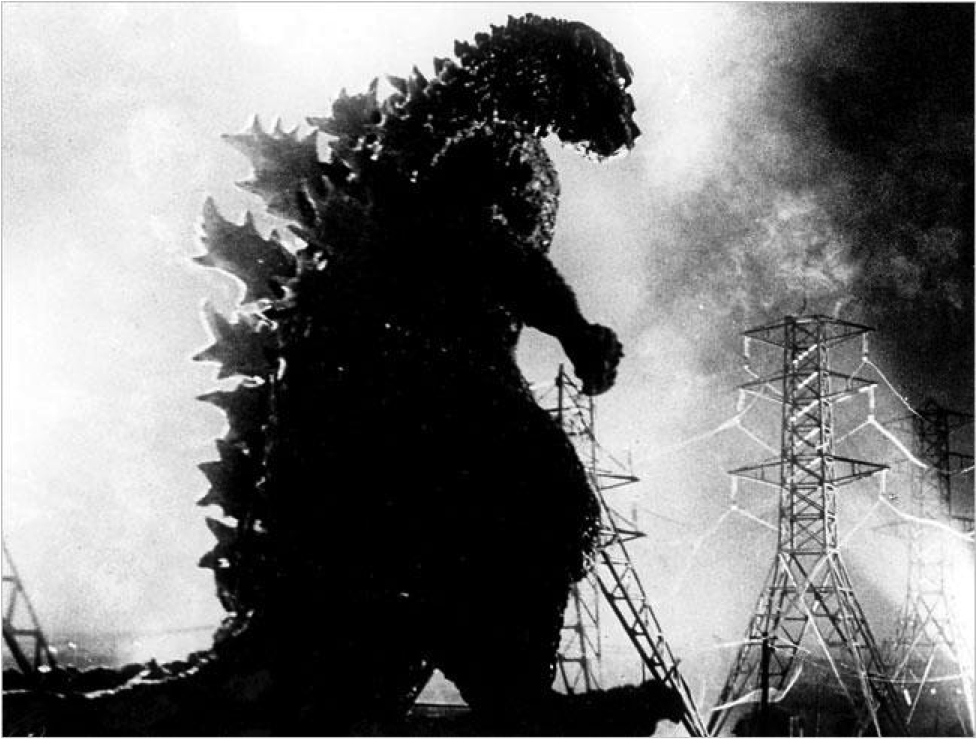
I’ve been watching a lot of Godzilla movies recently. This isn’t some kind of weird Cable TV accident, like stumbling onto “Barbarella, Queen of the Galaxy” at 2AM when you have a microwave burrito in one hand and a vodka cranberry in the other, and thus, tragically, no ability to change channels. It’s on purpose. I’ve loved Godzilla ever since I discovered him on the afternoon sci-fi serials as a small boy. They spoke directly to the primitive part of the small-boy brain stem that wants desperately to rampage through a model city with a flame thrower. That part sometimes survives into adulthood.
I’m mostly nostalgic for the “classic” Godzilla movies, from the 1954 original up to about the late 70′s, when I was in my tweens. I haven’t seen many of the modern films from the 80’s, 90’s and naughties, and the 1998 Matthew Broderick Hollywood obscenity is history’s second most flagrant case of pissing indifferently on a beloved piece of popular culture, after the new Star Wars movies. To this day I can’t watch “Ferris Bueller’s Day Off” without weeping.
Back in the early 90’s I had a well-worn VHS tape of the Americanized version of the 1954 original, “Godzilla: King of the Monsters,” in which the Japanese footage is intercut with shots of “journalist” Raymond Burr calling the destruction from nonspecific locations like a sportscaster: Godzilla has just incinerated Yokohama. Three and two with the bases loaded. Looks like the Japan Self Defense Forces are going to make a change on the mound… But, with an eye on my own son’s cultural indoctrination, I figured it was time to refresh the collection and to finally see Ishiro Honda’s original, Burr-free version of the first movie. It turns out that Amazon sells most of the classic Godzilla oeuvre at knockdown prices. I ordered eight DVDs and I’ve been watching them about one a week for the last couple of months.
Godzilla movies are still good fun. The joy of watching grown men in rubber suits going all WWF on fabulously intricate model cities never goes away. But watching the movies as an adult is a very different experience than it was when I was young. First, they are, as you’d expect, spectacularly cheesy in virtually all respects: set design, special effects, writing, acting, you name it. In the age of “Avatar” there’s something charming about the pre-digital, in-camera crudeness of the latex, cycloramas, piano wire, little model tanks, and such. It’s a dated look that invokes the 60′s and 70′s like Ray Harryhausen’s stop-motion creatures invoke the 50′s.
The series also evolves quickly. The 1954 original was released less than a decade after the Second World War and the same year that Japan experienced radioactive rain from American nuclear tests in the Pacific. Fittingly, it is a moody metaphor for nuclear annihilation and human powerlessness. But the geniuses at Toho figured out approximately instantaneously that the future was in monster-on-monster action. By the second movie, 1955’s “Gozilla Raids Again,” Godzilla is fighting a giant, spiky turtle. The pattern is thus set for the next fifty years.
Godzilla himself rapidly goes from truly sinister to googly-eyed and almost huggable, as though Cookie Monster suddenly grew 400 feet and traded chocolate chips for infrastructure. As Godzilla moves into hero status he’s replaced as villain-in-chief by a motley assortment of other monsters, evil property developers, gangsters, robots, and disco aliens featuring some of the most awesome space-couture since Sean Connery wore a red bikini for “Zardoz.”
Nobody seemed to care much about this curious transition in Godzilla’s motivations. I guess it was a bit like sports free agency in the US. When Deion Sanders was an Atlanta Falcon, he was a gigawatt hate-magnet that sucked bile out of my pores and toward the Georgia Dome. But when he came to the Forty Niners and started running punts back for us I would have airmailed him my sister, if I’d had one. Of course, just as Deion slid back into villain status when he moved on to the hated Dallas Cowboys, Godzilla himself was reborn as a menace in his modern filmography, but that’s outside the scope of this essay.
The other thing that struck me upon watching the movies was that there is no way in hell that similar ones could have been made in China, or would be now.
As I wrote in 2005, no city has ascended the Olympian heights of popular culture until it has been ravaged by a giant monster. Tokyo is clearly way out in front in this regard. It’s taken for granted that monsters are drawn to Tokyo like frat boys to Jaeger shots. Monsters have also afflicted New York, London, San Francisco, Seoul, Paris, Rome, Los Angeles and even Bangkok (look it up). But as far as I can tell, Beijing has been blissfully free of giant monsters. Mothra was reported to be attacking Beijing in “Destroy All Monsters,” but it was never shown on screen, so it doesn’t count. Neither does “Mighty Peking Man,” which was made by the Shaw Brothers while Hong Kong was still British and, despite the name, had no action in Peking (the Chinese name was “Gorilla King”).
Why hasn’t there been a Chinese giant-monster film with a Chinese giant monster? While armies, police forces and parliaments have crumbled before Godzilla and his brethren, there is one bureaucracy that is apparently entirely impervious to giant monsters: the State Administration for Radio, Film and Television. SARFT has apparently erected a monster-proof shield around Beijing and indeed around all Chinese cities. This is not because giant monsters are particularly scary, obscene or conducive to social unrest. It is because they are politically unacceptable.
To understand why China never had a giant monster phase you have to understand something about SARFT itself. SARFT administers all of the state-owned media organizations in China and it sets the guidelines for broadcast and film censorship, ensuring that morals, political ideology and good taste are upheld. It takes the latter mission very seriously, as anyone who watches television or goes to the movies in China knows. This mandate includes approving the screenplays for all films to be produced in China, as well as approving films for distribution and exhibition.
I’m not aware of any official list of SARFT’s decisions, which is too bad because I’m sure it would be fun and educational. You can, however, get an idea of what rings their bell by reviewing their decisions concerning domestic television shows over the last few years and referring to this handy list of foreign films that have been banned or edited for Chinese release. Some recent edits are especially illustrative: removing scenes of ethnic Chinese “space aliens” from “Men in Black III”; culling Chow Yun Fat’s Chinese pirate from “Pirates of the Caribbean III”; garbling references to Shanghai in “Transformers II”; and so on (maybe they just don’t like sequels). Similarly, you can get a pretty good idea of what passes muster simply by going to the cineplex, or, god help you, channel surfing. A few generalizations:
The police are incorruptible
The People’s Liberation Army is heroic and, ultimately, invincible
The modern government is composed of benevolent technocrats who want the best for you
No one in China ever gets away with any kind of wrongdoing in the long term
There are no superstitions (or they end badly)
No one has any sex, though chaste kissing and longing gazes are OK
All of history is either dudes with swords and ponytails, famous PLA victories, or the Monkey King (whoever can combine all three without breaking the “no time travel” restriction will do well)
Everyone is ultimately happy, and doesn’t complain about news, politics, housing, infrastructure, inflation, rural migrants, pollution or the poor state of television
Chinese people are not “space aliens”
So what does this have to do with giant monsters? Everything. Think about what Japan’s giant monsters perpetrated. They stomped every famous Japanese landmark. They crushed ageless castles and temples. They smashed the Diet (possibly while it was in session). They nested in Tokyo Tower. They repeatedly incinerated the capital. They dug huge, nasty burrows into the flanks of sacred Mount Fuji.
Japanese monsters also rendered the Japan Self Defense Forces totally impotent. Is there a movie in which the JSDF doesn’t get its ass handed to it on a radioactive plate? Actually, that’s a trick question. In 1955’s “Godzilla Raids Again,” the second in the series, the JSDF has its one and only significant triumph against Godzilla, using fighter planes to bury him in ice (at least until the third movie). But rival monster Anguirus had already done the heavy lifting. Otherwise, it’s a total wash. In the first Godzilla movie, the government and army are completely trampled and Godzilla is ultimately vanquished by an iconoclastic, reclusive scientist so tortured by the weapon he has created that he commits suicide rather than entrust the government with it. Not exactly the communist hero archetype (except maybe for the suicide part, a la Dong Cunrui).
By the mid 1970’s the JSDF has traded F-86 Sabres for laser tanks (laser tanks!) and rocket ships, but it’s still getting owned by every monster that heaves itself out of Tokyo bay. In fact, the main job of humans in most of the movies is to flee in panic, be appalled by the destruction or supply Raymond Burr-style color commentary:Look! It’s a flying saucer! Is it? I didn’t know. Oh no! It’s Godzilla! Really? I hadn’t noticed.
Now envision a Chinese monster movie that goes by the classic Godzilla formula. Something scaly and awful emerges from, let’s say, Miyun reservoir, where it has been awakened by decades of polluted agricultural runoff. It follows the Jingmi Road down to the capital, pausing only to snack on the new Expo Center and T3 (we can hope). In Beijing it proceeds to stomp the Forbidden City, trash Zhongnanhai, incincerate the Great Hall of the People and leave nasty footprints all over Tian’anmen Square despite the best efforts of the PLA. It is only defeated when an iconoclastic rebel unveils a weapon so powerful that he tragically kills himself to ensure it doesn’t fall into the Party’s hands.
Who here thinks SARFT greenlights that one?
That’s what I thought. If SARFT had approved a Chinese giant monster movie, it would have gone something like this:
Reel one: The Chinese people are peacefully minding their domestic affairs and improving their lives under the guidance of the Party.
Reel two: The Japanese (can’t use the Americans – the Japanese and Koreans have gone there already) do something horrible that creates a monster that emerges from the Bohai Bay, skips Tianjin like every other tourist, and heads straight for Beijing.
Reel three: The PLA uses domestically innovated technology and socialism to kick its ass before it can damage any historic sites, Party monuments or Famous National Brands. Ba yi, motherfucker!
I think even Zhang Yimou would have spotted that as a loser.
It’s too bad that giant monster films have never got traction in China. Giant monsters are wonderfully flexible metaphors for modern ills like atomic technology, pollution, industrialization and disagreeable political systems. Even the North Koreans saw the political angle when they created Pulgasari as a metaphor for capitalism and had him attack Kaeson. They couldn’t bear to have him rampage through Pyongyang –that’s just going too far– but they found someplace to put him, thus returning the cinematic favor of the communist space melons from “Invasion of the Body Snatchers.” Surely there must be some appropriate metaphorical deployment of giant monsters with Chinese characteristics. Corruption? Runaway Maoism? Runaway capitalism? Soviet revisionism? The dairy industry? And think of the soft-power angle! Where have you gone, Han Sanping? A nation turns its lonely eyes to you!
But alas, even with the monster-bait of Guomao Tower 3, Yintai, the new CCTV Center, the Egg and the Bird’s Nest it seems we’re destined to be monsterless in Beijing. That’s a shame. Like political cartoons, tolerance of the cinematic destruction of treasured symbols is a sign of political and cultural maturity and confidence. If you can watch a rubber-suit monster smash a tiny representation of your society and not worry that it will somehow erode faith in the actual society, then you’ve taken an important step. And you’ve done a wonderful thing for every small boy in your country.