How hard should we cancel the Michael Jackson biopic?
I was in high school in 1982 when Michael Jackson’s Thriller came out. Those were the days of national monoculture, and that album was the aural equivalent of chewing gum on your shoe. It was in cars, in malls, in the 7-11 while you were getting a Slurpee, just impossible to ignore. People forget that “Michael or Prince?” was a national debate during Reagan’s first term.
The videos for “Beat It,” “Billie Jean” and “Thriller” were credited with breaking the “color barrier” on MTV, which was barely a year old and a new taste-making force in pop music. Seven of the nine tracks on Thriller were top-ten hits and the album was number one on the Billboard charts for 37 weeks. Michael Jackson, 24 years old but nearly two decades into his pop-music career, reached celebrity escape-velocity and became the King of Pop™.
Jackson’s life story is fascinating. Molded into early celebrity by a domineering father, he appeared to spend much of his life in arrested childhood. Neverland Ranch, Bubbles the chimp, his extreme cosmetic surgery and progressive de-blackification, his masked kids. A troubled late-career shadowed by debt, drug abuse, deep eccentricity and several credible allegations of child sexual abuse, most famously covered in the 2019 documentary Leaving Neverland.1 Finally, death at 50 from a drug overdose on the eve of a series of comeback concerts in London. Fertile territory for a biopic on race, celebrity, sexual pathology and the cost of fame!
Alas, that is not the biopic you’re going to get. The biopic you’re going to get is Michael, and it is reportedly on track to be a monster hit. But the movie elides all that late-career complexity and ends with Jackson’s triumphant concert at Wembley in 1988, when he was still on the rise and before any troubling child sexual abuse allegations.
Way back in the early nineties, there was a popular sitcom called “Murphy Brown” set in a TV newsroom. The plot device of the lead character’s single motherhood offended then vice president Dan Quayle1, and he gave a speech in which he criticized the character by name, almost as if she were a real person.
Delighted by the gift they had been handed, the writers duly wrote the remarks into the next season opener and nuked the vice president from orbit. Weeks later, America elected Bill Clinton2 president.
Look, there are lots of reasons why the Bush/Quayle ticket went down. Among them were that Bill Clinton radiated white-hot sex (too much for his own good, tbh) while George H.W. Bush radiated Yalie barbershop quartet and surplus initials. But Quayle linking the recent LA riots to a sitcom didn’t help, and it enshrined a truism of modern public relations: don’t go to war with a TV show.
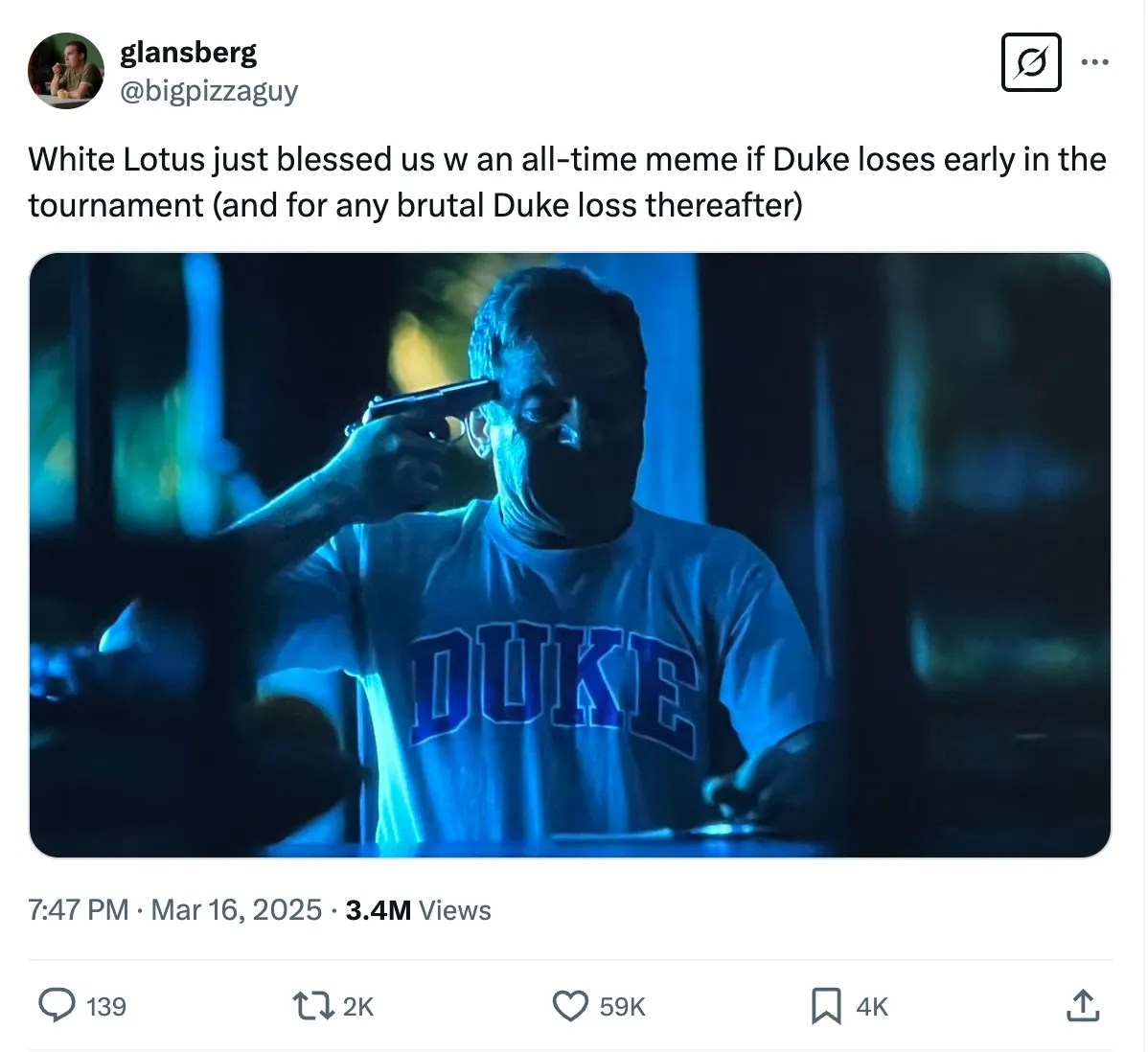
We live in a different media era. Network sitcoms aren’t the vanguard of culture they were back in the nineties (the era of Seinfeld, Friends3, etc.), and the modern equivalent of that truism might be, “don’t go to war with a meme.”
And, whatever you do, don’t go to war with a meme based on a popular TV show!
I’ve never been much for conspiracy theories. Not that I don’t like a touch of the fantastic in my daily life (I live in China, after all). But when you think about the sheer logistics involved in most of the major conspiracy theories things start to break down pretty quickly.
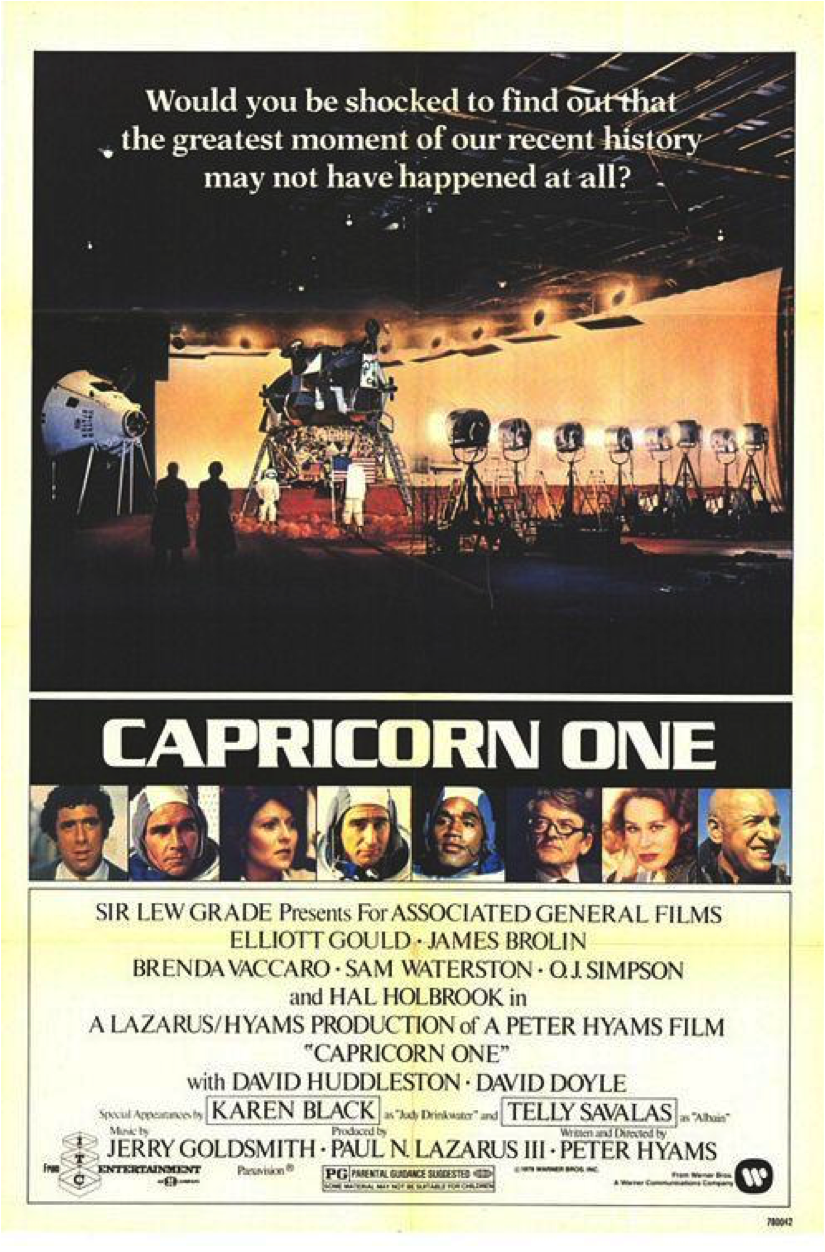
Consider that old favorite of the tinfoil hat brigade, that NASA faked the American moon landings, and think about what it would have required. It’s not just the fakery of the photographs and video, but also that everyone who worked on all the aspects of the fakery, from the astronauts to the guys who would have had to doctor the photos and fake the moon rocks and telemetry (depending upon whether you think mission control was in on it or not) would have had to keep their mouths shut. For going on 45 years. For six successful lunar landings involving eighteen astronauts, twelve of whom have allegedly walked on the moon. Not only does everyone who knows about the fraud have to keep his mouth shut, but everyone who has a public face has to keep his story aligned. Especially that attention-junkie Aldrin. It only takes one person to blow the lid off, intentionally or accidentally. Frankly, it’s just easier to go to the goddamned moon.
I’m not particularly interested in getting into a pissing match with conspiracy theorists (like thermonuclear war, it’s not “winnable” in the conventional sense of the word), so much as I am in setting up a problem. Coverups pose similar problems to conspiracies in that, like a big pile of sweaty dynamite, they are unstable by nature and easily detonated, sometimes by the tiniest of disturbances. That’s why they don’t tend to make good PR strategy.
Of course, by definition no one knows when a coverup succeeds. Small ones involving one or two people? Probably a fair number. Big ones involving lots of people and big stakes? Not so many, I’d guess. “Three may keep a secret if two of them are dead,” wrote Benjamin Franklin, perhaps optimistically. In most cases, the participants aren’t Navy Seals or the CIA or other kinds of people who are indoctrinated and trained into cultures of secrecy (and yet still sometimes blow it). We’re talking about just folks who are easily pressured by law enforcement, or who just get drunk on lychee martinis at Centro and shoot off their mouths. Sooner or later someone is going to slip up and the dynamite is going to blow.
Then everyone in serious trouble because, as the old truism goes, the coverup is worse than the crime. Technically, it’s more accurate to say that the coverup significantly aggravates the crime. Coverups turn mistakes into crimes and crimes into enormities. Think of the devastation inflicted on Penn State by the recently published Freeh inquiry, which was most damning for revealing the efforts taken to protect the institution over the victims. Or think of your own toddler, if you have one. If he uses a sharpie to draw all over the wallpaper, you’re angry. If he lies about it, well, then you’re disappointed. Anger is over in minutes. Disappointment leads to years of therapy and careers in bitter standup comedy.
A big pile of sweaty dynamite might be blowing up in the face of Chinese telecoms equipment company ZTE right now. The fuse was lit by a Reuters report back in March (blocked in China), which showed how ZTE was acting as a middleman for relaying restricted American technology to Iran for use in a national Internet monitoring system. The explosion may have started last week when the aptly named website The Smoking Gun reported that the FBI has launched a criminal investigation into the sale. The FBI has not confirmed the investigation, but The Smoking Gun has posted an affidavit that makes fun reading because it includes grubby details of the alleged covering-up. Much of it has the desperate, furtive feel of the third reel of an Abel Ferrara film (or, apropros of the lunar landing discussion above, a Peter Hyams film). You can feel the options narrowing as they talk through them. I don’t know how this situation will turn out, but I do know this: As bad as ZTE looked for shipping US surveillance gear to Iran, they look worse for the discussion of the coverup.
Two other thoughts about this case. First, the FBI case is apparently based on the deposition of a young, American lawyer who was in ZTE’s employ. I find myself reminded of something I heard from a relative who was once highly placed in the empire of a wealthy Hong Konger: White people don’t handle the money. One wonders how much trust ZTE will invest in its white people after this.
Second, the organization that should be most annoyed about this alleged coverup isn’t the US government, the FBI or Internet-freedom activists; it’s ZTE’s Chinese competitor and Shenzhen neighbor, Huawei. Huawei has been busting its assthrough an extensive lobbying and PR campaign to impress US politicians and regulators with its trustworthiness and thus extend its limited access to the huge American market. So far it has met with conspicuously limited success not least because US politicians stubbornly refuse to trust it due to its, well, Chineseness.
Huawei and ZTE are different companies, and illegal shipments to Iran aren’t spy-friendly backdoors in routers, but it will be very easy for American politicians and lobbyists to conflate the two Chinese companies and use this situation against Huawei as well. After all, they’re both giant, state-linked Chinese telecoms equipment companies. From an American political point of view, both carry all the reputation baggage that comes with the pedigree. They’re suspected –sometimes with a dose of hysteria– of being instruments of Chinese policy and possibly vectors for cyberwar attacks. If one is caught with an uncapped sharpie…well, the argument will be, you do the math.
Given the effort its expended over the last few years and the collateral damage it is likely to sustain if the investigation of ZTE’s alleged coverup gathers steam, perhaps Huawei should send its PR and Lobbying bill for the last few years to ZTE. And as for the rest of us? I’m sure we’re all very disappointed.
Note: this post originally published on the defunct group blog Rectified.name.
Apropos of today’s escalation of the Fukushima reactor disaster to “7″ (Chernobyl) on the international scale, there is something about the word “radiation” that bypasses rationality and whispers right to the lizard brain. Perhaps one or two other words have the same power to spook. “Pandemic” comes to mind. But that aside, there is little else I that has quite the same potency as “radiation.” Almost all the connotations are negative: Contamination; the atom bomb; fallout; nuclear waste disposal; dirty bombs; Godzilla; the ugly, yellow trefoil symbol. Even radiation’s positive connotations are negative. Nuclear medicine might save you…if you have cancer! And the New York Times has spent the past year running a series of stories about nuclear medicine gone horribly wrong. Radiation? Duck and cover.*
All this would seem to make any public communication about radiation hazards tricky. I can’t, however, speak from experience. Perhaps fortunately, Imagethief has never been called upon to participate in crisis communications involving radiation. Or nerve gas leaks or alien invasion or anything with quite the same pilo-erective zing. I’ve done food problems a couple of times. Also, years ago I helped an insurance industry association roll out a chain of inspection centers for mandatory post-collision inspections, which may actually be the closest I have ever come to being between a client and a torch-bearing mob. In terms of public sentiment, insurance and radiation aren’t actually all that different.
The challenge in a public safety communication situation is to find that delicate line between keeping people well informed and prepared for the worst, and going overboard and triggering a destructive panic. This isn’t a trivial thing. To get an idea of how easy it is for hysteria to blossom in the right circumstances, recall that at the height of the Japan nuclear issue there was a run on table salt (rumored to prevent radiation sickness) in Beijing, 2000 kilometers upwind of the Fukushima reactors.
What’s the worst that could happen?
The natural tendency in crisis communications is to undershoot and be tight-lipped. This happens for all kinds of reasons, of which avoidance of panic is perhaps the only noble one. The others include optimism or wishful thinking that the worst is over, poor communication planning, bad communication culture, and the general tendency to choose ass-coverage over ‘fessing up for any number of legal, reputational and personal reasons.
The problem with undershooting communication in an escalating crisis is that you wind up making a series of hopeful the-worst-is-over pronouncements, each of which is rapidly obliterated by events. TEPCO is a case study of this syndrome. So is BP from last year. Both companies wound up in a kind of reverse-Chicken-Little situation, where public trust evaporated and no one believed them anymore. In both situations, government wrested much of the public communication responsibility away. Getting publicly ejected from the drivers’ seat is not good for credibility.
If you were forced to choose between timidity and risk of panic, you might choose timidity as the lesser of two evils. But in public safety situations the rumors and misinformation that can drive hysteria are likely to thrive in the vacuum created by poor communication or lack of trust. The Beijing salt-run is illustrative. Ask yourself: strictly hypothetically speaking, how conducive would it be to public order to have an escalating radiation crisis being managed by an organization that no one believes?
This is the situation that TEPCO appears to have found itself in. A good analysis of their situation from a communication point of view can be found in PR trade The Holmes Report. Paul Holmes introduces consultant Peter Sandman’s useful “hazard vs. outrage” model of risk communication. Hazard is the actual danger to people. Outrage is the emotional reaction provoked. Varying ratios of hazard and outrage inform communication strategies in risk situations. The irony for TEPCO is that the actual hazard has to this point been pretty low. But the outrage factor is, if you’ll pardon the pun, nuclear. Holmes lists some of the key factors driving that outrage:
Coerced risk causes more outrage than voluntary risk, and the majority of people living close to nuclear plants did not volunteer to be exposed to the risk;
Industrial risk causes more outrage than natural risk, and nuclear is pretty obviously industrial;
Exotic risk causes more outrage than familiar risk, and most people are far less familiar with nuclear power than they are with oil and gas;
Memorable risk causes more outrage than unmemorable risk, and nuclear incidents—Three Mile Island, Chernobyl—are extremely memorable;
Dreaded risk causes more outrage than undreaded risk, and activist groups have been successful in creating and nurturing nuclear dread;
Catastrophic risk causes more outrage than chronic risk, which may be the biggest challenge, since nuclear incidents tend to be catastrophic, while fossil fuels do their damage primarily by creating chronic illnesses and environmental problems;
Risk controlled by others causes more outrage than risk controlled by individuals (which is why people fear air travel more than car travel), and nuclear power is completely beyond an individual’s control.
A longer and very interesting analysis of the Fukushima situation by Mr. Sandman himself can be found on his website. Mr. Sandman’s conclusion with regard to crisis communication is: Always err on the alarming side, until you are absolutely 100% certain the situation cannot get any worse. Else risk your credibility and thus your ability to respond. Communications professionals would also do well to read security expert Bruce Schneier’s writings about how people evaluate and respond to risks, which dovetails with many of Mr. Sandman’s points. I recommend Schneier’s book, Beyond Fear. It’s a few years old, but still relevant.
In TEPCO’s defense, the playbook for nuclear catastrophe communication in the midst of a general natural disaster is pretty thin. There are exactly zero precedents. Even absent the natural disaster component, there have been only three previous reactor accidents of any scope: Windscale, Three Mile Island and Chernobyl. Only Three Mile Island is really analogous to Fukushima, but the communication there was also blown, as Mr. Sandman points out. But it shouldn’t really matter whether there is a precedent or not. Nuclear power, which has always had a bigger outrage than hazard problem, really deserves over-preparation.
In his book The Big Short author Michael Lewis proposes that the people who made fortunes betting on the collapse of the American housing bubble shared the iconoclastic traits of both being able to envision the worst happening (the bubble collapsing) and, in the face of social pressure, to act on that vision. It struck me upon reading that book that being able to envision the worst happening and preparing for such an outcome is a really valuable skill for communications professionals. To come back to Chicken Little, it’s not that a PR person should run around screaming that the sky is falling, but a PR person –and indeed any member of a company’s crisis management team– should be able to pose the question, what would we do if the sky fell?
Even if –and this is important– even if others in the organization suggest that such a thing is unthinkable. After all, just because something is unthinkable doesn’t mean it won’t happen.
In part two: What the hell is an “apocalypse box” anyway?
Note:
*If you haven’t seen the “Bert the Turtle” public service announcement on how to survive an atomic attack, it’s well worth watching. A surreal mix of 1950′s cold war terror and sunny “you can survive” optimism with a Ward Cleaver voice-over that must be somewhere in Billy West’s stack of reference material. “It’s such a big explosion that it can…break windows all over town.” Indeed. It’s a YouTube link, so get your VPN ready. If it’s working.
The milk business in China just can’t seem to stay out of trouble.
A couple of months ago baby formula maker Synutra found itself the victim of allegationsthat its product was linked to early puberty in girls. Its shares ate a big one on the NASDAQ and the company spent much time defending itself furiously. So furiously, in fact, that I was moved to ding them on Twitter for a CEO quote blaming the situation on “certain parties in the media.” Don’t blame the media was the gist of my message.
As true as I still think that is in general, Synutra’s CEO may have had a point. Chinese media reported yesterday (and the China Daily relayed in English today) that executives from giant dairy company Mengniu and one of their PR firms, BossePR, have been detained on suspicion of stoking rumors against both Synutra and Mengniu’s chief rival, Yili. Mengniu is denying the allegations.
Who knows what really happened. As one analyst points out in the China Daily story, baby formula isn’t really a huge part of Mengniu’s business, so why go after Synutra? This is probably true at the board level. I find it hard to believe that the senior management of Mengniu were sitting around the conference table and came up with a plan to slander Synutra. It’s just a touch too Snidely Whiplash for me.
On the other hand, while the baby formula business may only be a small part of Mengniu’s business, I’m sure it’s damned important to whomever manages it at Mengniu (and is, presumably, judged on its success). There are two reasons why the allegations are at least plausible. First, as anyone living here knows, despite its brand images of purity and healthy, angelic children, the milk business in China is capable of complete sordidness. One need only read up on the now legendary melamine scandals of 2008 to be reminded of that. And there is more where that came from. In our family all the milk comes from one of the expensive organic farms near Beijing. It costs about triple what regular local milk costs, but when it’s your kid you err on the side of less melamine if you have the means. The milk industry in China is like the finance industry in the US now: Trust is so damaged that people are primed to believe the worst of just about any company, and it’s not hard to get the rumors flying.
The second factor is that using PR agencies and Internet firms to run sock-puppet campaigns attacking rivals is a time-honored tactic here. (BusinessWeek has written a bit about this here, although this story lumps some companies I respect together with some I don’t.) I’ve run into it in both the car and consumer electronics industries. It’s not always incendiary child health stuff like the Synutra allegations. Sometimes it’s just garden-variety griping about products. Even that can be extremely difficult to defend against. On the Internet, criticism is forever and anonymous rumors or allegations can take on a life of their own, at warp speed if they’re salacious or involve the health of children. And it’s generally pretty cheap to do, so the temptation to stoop to such tactics can be powerful, especially in a competitive consumer business.
I’m a fan of transparency online. When I was on the agency side my advice to clients was straightforward: Don’t astroturf, don’t sock puppet. The long-term benefits are small and the risks to reputation are high (as may be the legal risks). I expect that most international agencies would give similar advice and that most PR managers, especially at international firms operating in China, would agree. At least to your face.
Nevertheless, when push comes to shove, it seems some companies still take the easy path, and many agencies will do what they need to do to keep a client happy. Also, many large companies use a range of international and local agencies, often reporting to different managers facing different pressures and having different points of view about what constitutes ethical PR. A company without a clear policy or tight management of such things may find that not every department is equally scrupulous in its approach. I wonder if that’s what happened to Mengniu.
Note:
After this post was published I also appeared on Blue Ocean Network’s “Chinalogue” program along with Alistair Nicholas of AC Capital Consulting [Note – now of Weber Shandwick – WM] to discuss…PR slime! By which the producers of the show meant the recent Mengniu vs. Yili vs. Synutra PR sockpuppet slagfest. The heavy-breathing title of the segment aside, most of the show was a fairly sober discussion of PR ethics in general. The video is here.
Let’s say you’re a company selling some kind of product. Let’s say your product is –let’s just pick something at random here– laptop computers. Globally, this is a heavily commoditized category jammed with companies selling look-alike products with similar feature sets. In China, which has the usual big-time suspects plus a whole cloud of local also-rans, the situation is even more competitive. How do you stand out? How do you persuade students, young professionals and other consumers to buy your laptop, and not some brand-x laptop poseur laptop?
Well, in China the answer is often, “be cheapest!” But that’s not always the whole story. Often there is also some PR.
To that end, one thing you would often do is try to get your product into the hands of “influencers”, people who have the power to help lead public opinion in your target market, ideally in your favor. One way to approach this is the celebrity endorsement: I’ll send a cubic meter of 100RMB notes to your house if you wave my company’s product around, appear in some ads and show up at some of my events. And, hey, why not write a blog about it? This is generally legit and practiced everywhere. George Clooney and Omega watches, for instance, except he probably doesn’t get paid in RMB.
There is also the schwag approach, in which you give your product away to rich, famous and stylish types in the hope that they’ll be seen using it thus conferring glamor and sexiness upon it, hopefully without you having to write a colossal sponsorship check. This is why you hear about things like the absurd gift baskets at the Academy Awards. This also leads to the great commercial irony that rich people get more stuff for free than more deserving types, such as impoverished PR bloggers, and will no doubt be a contributing factor in the revolution when it finally comes.
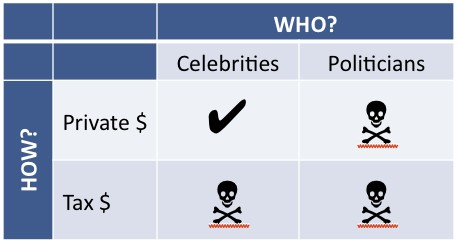
There are, however, some generally accepted rules about the schwag game. Two of those rules, involving who it’s OK to target and how schwag can be paid for, can be summed up in a diagram that looks like this:
By participating in a program to give free laptop computers to 2000 delegates to the Chinese People’s Political Consultative Congress (CPPCC), Lenovo appears to have landed squarely in the lower-right, or what I like to call the “PR deathtrap” quadrant. The CPPCC is a political body that nominally advises on and suggests policy and which convened this week in Beijing as part of the annual political “two meetings” festivities. The other meeting is that of National People’s Congress, which has the slightly heavier responsibility of endorsing actual policy (a cynic might say, “rubber stamping”, although the NPC has pushed back from time to time).
As China’s annual National People’s Congress opened yesterday, many news headlines pounced on Premier Wen Jiabao’s remarks toward the end of his NPC report (see tab 11), in a section on anti-corruption, about the need for leaders to report their personal assets. But in the margins, commentators railed against shady practices nearer at hand — more than 2,000 laptop computers given away to delegates at the public’s expense.
The laptop story bubbled up out of China’s social media sphere back on March 2, when Chinese Internet users noted an odd mini blog entry from Zhang Xiaomei (张晓梅), a delegate to the Chinese People’s Political Consultative Conference who is also the publisher of Beauty Fashion magazine.
Zhang’s entries were succinct, mostly mundane summaries of preparations and speeches ahead of the two meetings.
CPPCC Chairman Tao says: being a national delegate to the CPPCC is a glorious mission, and a post for political participation and discussion. Sichuan party secretary Liu Qibao (刘奇葆) says: last year was the toughest year, this year is the most complex.
But in one entry she wrote: “When delegates report [to the meeting] they each get a laptop computer. What is different from last year is that this year these don’t need to be returned after we’re done with them. This is much more practical.”
Yeah, it sure is, isnt it? Keeping stuff often is.
As China Media Project explains, the response both online and in mainstream media has been pretty negative, with accusations of corruption and speculation about the amount of tax dollars spent on the computers. It has also been pointed out that Lenovo executives account for a large share of the IT industry representation at the CPPCC.
So here is where it gets interesting, and perhaps where Lenovo put a foot wrong assuming they played some role in creating this program and weren’t just lucky beneficiaries. CPPCC delegates occupy a strange space in between celebrity and politician. Many of the delegates, such as Ms. Zhang, are in fact celebrities or notables from the business world. Most are not politicians or officials in their daily lives. As the Financial Times noted this week, the entire CPPCC is a bit theatrical, and its actual contribution to the legislative process is debatable at best. In previous years delegates had been loaned computers, so why not let them hold onto them this year? A relatively small change in the grand scheme of things.
But regardless of what you think about the CPPCC or the actual power of its delegates, in the context of the “two meetings” the delegates are acting as politicians. In an era when Chinese people are increasingly sensitized to corruption and willing to discuss it online and hold officials to account, giving laptops to 2,000 wealthy people operating in a political role looks risky at best. Perhaps in some years it doesn’t become a big deal, but this year it rubbed people the wrong way. It probably would have been best to stick to the loaner approach, even at the risk of some slightly inconvenienced delegates.
From Imagethief’s point of view the good news is that this issue became, well, an issue. That it escalated online and in the media is a headache for Lenovo and perhaps an embarrassment for some of the delegates (although that may be optimistic), but it’s a good thing for accountability and for China. The CPPCC may be largely symbolic, but at least it could be relatively clean and symbolic.
So what should Lenovo do? This situation is a long way from being out of control, so what they probably will do is hunker down and wait for the government to decide that discussion of this issue is no longer appropriate and then enjoy the ensuing silence. A more progressive option would be to announce that in subsequent years they’ll return to a policy of loaning delegates computers rather than giving them away. Better yet would be to cancel the whole thing and make delegates self sufficient for computing in future. I’m sure most CPPCC delegates –even the ethnic minority delegates– can afford a computer.
Or how about this: It’s awkward to inform delegates that, sorry, contrary to what they were originally told they do have to return the machines. But Lenovo could ask delegates who don’t need the computers after the meetings to voluntarily return them, and then publicly donate the returned machines to some worthy cause. Rural schools? Barefoot doctors? Impoverished bloggers? You name it. Plenty of options.
Note: Some in-situ links removed from the paragraphs quoted from China Media Project. It’s worth visiting their original post.
Disclosure: I do not work on any laptop computer accounts, however my agency does represent a competitor to Lenovo. The views expressed here are my own.
Update: David Bandurski of China Media Project left a comment in the original version of this post noting that, as of writing, criticism in the media was not directed at Lenovo specifically. At least, not yet.
Sunday is shopping day in the Imagethief household, so this morning Mrs. Imagethief, Zachary and I bundled ourselves up and headed out to Wal-Mart.
Before you gasp in a fit of effete surprise, let me explain. As a card-carrying Bay Area intellectual snob, my pedigree is more Whole Foods than Wal-Mart, even if Whole Foods is basically just Wal Mart for Prius-driving gourmets (well, and my mom). But in my neighborhood in Beijing walking-distance supermarket options are limited to the eye-wateringly expensive import-barn in the basement of Shin Kong Place (RMB35 for four kiwi fruits? Sure!); the fast-declining Bonjour, in the basement of the equally fast-declining Sunshine 100 (like Carrefour without the lingering veneer of French-ness and, in winter, heated like hell’s supermarket); and the Wal-Mart at Wanda Plaza.
OK, we have a Jingkelong, too, but it’s not much use if your shopping needs extend beyond soft drinks, instant noodles and strawberry-flavored UHT milk. Once upon a time we had a Jenny Lou, but Jenny apparently decided our neighborhood was for losers and moved down to the accursed Jianwai Soho instead. So Wal-Mart it is. Plus, they deliver, which is essential when your shopping needs include kitty litter for two.
With Wal-Mart fresh in my head, and fresh kitty litter in my guest bathroom (for the cats, not for the guests, although there have been some parties…), I was therefore interested to see a Washington Post article covering in mostly positive terms Wal-Mart’s efforts to get its Chinese Suppliers to improve their environmental and labor standards (part of a special report called, “The Climate Agenda.”):
As a result [of Wal-Mart’s urging, Hong Kong-based soap and cosmetic manufacturer] Lutex has been paying attention to more efficient light bulbs, better ventilation and less packaging. It switched from Styrofoam to recycled paper and saved enough Styrofoam to cover four football fields. And Lutex, which has been here since 1991, says it treats four tons of wastewater that it used to dump into the municipal sewage line. That water was supposed to be treated by the city, but like three-quarters or more of China’s wastewater, it almost certainly wasn’t.
“We heard that in the future, to become a Wal-Mart supplier, you have to be an environmentally friendly company,” [CEO Benny] Fung said. “So we switched some of our products and the way we produced them.”
Wal-Mart has more than 10,000 suppliers in China. In addition, about a million farmers supply produce to the company’s 281 stores in China. If Wal-Mart were a sovereign nation, it would be China’s fifth- or sixth-largest export market. So the company hopes that small measures taken by all suppliers start to add up. Its 200 biggest suppliers in China have already trimmed 5 percent of their energy use.
***
In October 2008, Wal-Mart held a conference in Beijing for a thousand of its biggest suppliers to urge them to pay attention not only to price but also to “sustainability,” which has become a touchstone for many companies.
“For those who may still be on the sidelines, I want to be direct,” Wal-Mart chief executive Lee Scott said sternly. “Meeting social and environmental standards is not optional. I firmly believe that a company that cheats on overtime and on the age of its labor, that dumps its scraps and its chemicals in our rivers, that does not pay its taxes or honor its contracts will ultimately cheat on the quality of its products. And cheating on the quality of products is the same as cheating on customers. We will not tolerate that at Wal-Mart.”
Well, if he says so.
My first reaction to this story was, “What a PR score!” Cynical me wasn’t really prepared to consider if there might actually be something to this. But might there be real business motivations for moves that seem antithetical to a company with a mission to drive costs to the absolute lowest level?
One possible answer to that question can be found in a post at the well-known “Naked Capitalism” economics blog. Yves Smith suggests three factors that could motivate Wal-Mart to put real effort into pressuring its Chinese suppliers to improve. They are:
Creating an “insurance policy” against possible American trade restrictions that might be based upon setting minimum environmental and labor standards.
An effort to differentiate itself in the Chinese market by demonstrating attention to food quality standards and environmental issues.
A move to appease evangelical Christians who increasingly see earth-stewardship as part of their religious duty.
In fact, two out of those three things (see if you can spot which two) are still essentially public relations. Personally, I have a hard time believing the third is anything close to being a sufficient motivation for a serious revamp of Wal-Mart’s Chinese supplier relationships, but, then, I live a long way from the American heartland and am thus not well attuned to its priorities.
The second point seems plausible, but as a regular Wal-Mart China shopper I can attest that Chinese shoppers seem perfectly enthusiastic about Wal-Mart already. Wal-Mart also does a brisk trade in allegedly organic Chinese produce (we buy it, but I’m really not sure how far to trust the “organic” claims). At any rate, as an approach it sure couldn’t hurt, unless it starts leading to significant job losses at Wal-Mart suppliers in China, in which case, all bets are off.
Ultimately, although the impact is in China, I still see this as primarily a move to influence the customers and activists back home in the US who have the greatest ability to influence Wal-Mart’s business. China environmental and labor issues are important in China, of course, but arguably not as important as they are in the US. (Next up for trouble: Apple? Don’t miss the bizarre fanboy comments.)
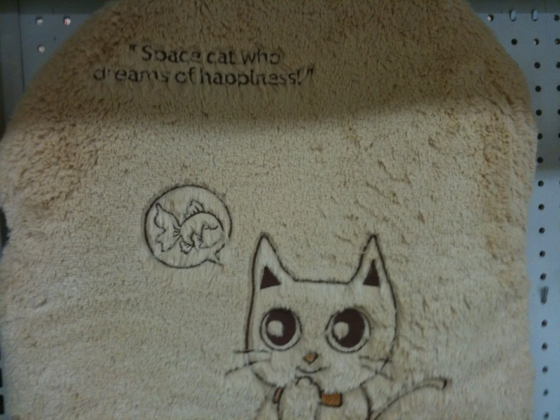
As for me, I’ll take a pass on the live soft-shelled turtles (where are the PETA people?), but the produce section isn’t bad and you can’t beat a fuzzy car-seat cover that carries the inscription, “Space cat who dreams of happiness!” If only I had a car.
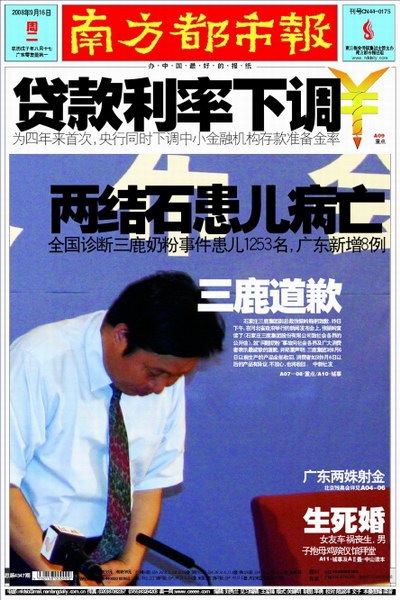
If you want to get people mad –I mean fired-up, torch-and-pitchfork enraged– screw with their pets or their babies. That’s what we’ve learned over the past year thanks to the unfortunate tendency of the plastic melamine to pop up in the strangest places, most recently in infant formula from Sanlu, a mighty Chinese dairy firm.
You would think that after last year’s long-running product quality fiasco people would have learned. Those of you who have brushed the last of the Olympic rings from your eyes will recall that the product quality crisis began with American pet food tainted with melamine thanks to contaminated ingredients from China. It then rippled into lead-tainted toys (repeatedly), antibiotic-laden fish and various other hysterias that collectively managed to knock Dream for Darfur (remember them?) off the front pages. Man, what a summer that was, especially for PR nerds. I get all misty just thinking back on it.
But there will be time for nostalgia later. I want to spend a moment on the word “crisis”, which I used in both the headline and the paragraph above. Like the phrase “mission critical”, beloved of jargon-head business types, “crisis” is a word that is often misused to describe any situation where a company is wrestling with a spot of PR trouble. Chinese nationalist youth are insulting our company on the Internet! We’ve got a crisis! No you don’t. You have an “issue.”
What’s the difference? An easy if somewhat oversimplified way to think of this is chronic and debilitating vs. acute and life threatening. Being morbidly obese with high blood-pressure and diabetes is an issue. But your doctor can prescribe a program that will over time mitigate it. Going into cardiac arrest is a crisis in which the options are immediate treatment or death. In corporate terms this means a situation so bad it threatens the reputation of the company in a way that could rapidly and substantially damage business or shareholder value. Crisis is life-and-limb, billions-of-dollars or fate-of-the-company territory. Cyanide in Tylenol, the Exxon Valdez, Singapore Airlines flight 006; those are crises. Lehman Brothers is was having a crisis (it is now over in the same way that the cardiac-arrest crisis will be over if you don’t get immediate treatment).
Apply the “life-and-limb” test and I think we can agree that Sanlu is having a crisis. Fonterra, their foreign part-owner to the tune of a significant 43%, is having an issue, although it could get worse. More on that below.
Here is the story so far. On September 11th, almost a week ago, initial reports emerged that an unusual outbreak of kidney stones in about sixty infants had been linked to tainted milk power. Naturally the first assumption was counterfeit product, as happened in the tragic Anhui milk powder episode of 2004 and in countless food scandals in China. Since then the story has spread, blob like, in a fashion that reeks heavily of a coverup unravelling. There are now over 1000 affected babies and two fatalities. Genuine Sanlu product has been revealed to be the culprit. There’ll be no palming it off on counterfeiters. A recall of over 8000 tons of product is under way. Sanlu apologized in a news conference yesterday. Heads are rolling, but only at a suitably low and distant level in the great chain of scamming and incompetence.
Deliciously (unless you’re a formula-fed baby), Sanlu and provincial authorities from Hebei, where Sanlu is based, allegedly knew about the problem possibly as far back as early this year, and at the very least in early August, well before the Olympics. We know this because Fonterra execs are now telling anyone who will listen that they told Sanlu and the Hebei authorities that there was a problem but got no action until they got the New Zealand government to tell the Chinese central government. So everyone involved knew the formula was dodgy except for parents merrily feeding it to their babies. The irony of this situation is that foreign involvement is often seen as an indicator of quality thanks to the well documented quality problems of domestic brands.
The New York Timeshas this quote from Gao Qiang, Vice-Minister of Health, which is solid gold by the leadenly unquotable standards of Chinese officials:
“This is a severe food safety accident.”
You think?
Now the conspiracy theories are boiling to the surface like worms after summer rain (we’ve had a lot of rain in Beijing recently, so this image is fresh in my head).
Some think leading Chinese search engine Baidu may have had an agreement with Sanlu to filter negative search results. I don’t really buy this one, but as a student of the Internet I find the supposition interesting. It says a lot about how people feel about the power of search engines as gateways for information. If it was true it would be really interesting. Note to search engines: The time to come clean about how you will and won’t help advertisers is now.
Others wonder if the story was suppressed because of the Olympics, and invoke the Central Propaganda Bureau’s alleged 21-point reporting guidance for the Olympic period. I find this one pretty credible, and it stokes my belief that in addition to bringing out some of the best about China the games also brought out some of the worst. The post linked to above, from China Digital Times, also has a translation of apparent Propaganda Bureau guidance on how to report the current situation, suggesting that the cogs of harmonization are already grinding through comment on this situation even if they’ve not yet clamped down on it completely.
And then there are claims that Sanlu not only knew about the issue but has also beenpaying off afflicted consumers to buy their silence. This one is also pretty credible, and goes along with established Chinese practice of privately arranged compensation for the families of people injured in industrial accidents and such, often in return for an agreement not to make waves. Coal mines are past masters of this tactic.
Uncoverup The PR rules for situations involving the endangerment of human life are simple: The company’s priority is to take all steps possible to mitigate danger, and communication should be centered around ensuring that the public is completely and rapidly informed in a way that minimizes the risk of injury or death. If you concede that the contaminated product is fait accompli and that some damage control will be necessary, then such an approach, funnily enough, often pays the best dividends in terms of repairing a damaged reputation. This is because it demonstrates clearly that the company prioritizes customers and human welfare over a grimy buck. In troubled times this a critical message to send, and it helps to remind customers of why they placed their trust in the company in the first place. See the Tylenol-cyanide crisis for the textbook example.
On this count, everybody involved in the current situation fails. They’ve prevaricated their way into disrepute. There were some shockingly basic steps ignored along the way. As of Sunday, for instance, when the formula recall was in full swing, there was nothing on Sanlu’s website to suggest anything odd was going on. No announcement. No recall information. No advisory to customers. Not hotline. No news since August 14th. Zilch. As of yesterday and into today their website has been unreachable.
This is not a surprise. It is perhaps unfair to judge Sanlu by my imperialist western standards of public communication given that the company is the product of an environment in which the relevant authorities have not always led by example. Sweeping scandal under the rug is a favorite institutional pastime here. Read up on SARS if you need a refresher on this, or the Songhua river benzene crisis, or the Xifeng county journalist scandal, and so on. But SARS was blown wide open, and if this was a cover-up it is now blown wide open too.
While acting vigorously in the interests of the public helps to repair reputational damage from a tainted or defective product and rebuild trust, covering it up compounds the problem. Remember when you broke the dining room window and then lied to your mom and said it was the dog? And she didn’t mind the window so much but was gravely disappointed about the lie? And you didn’t even have a dog? You learned an important lesson then (I hope). This is the same thing, only bigger and with the public instead of your mother. And no imaginary dog.
A blown cover-up demonstrates convincingly to the public that you don’t give a crap about them and that you were willing to let them (and their babies) twist in the wind to save your own hide. Now you have two problems instead of one: Your product is poisonous and your company is run by untrustworthy bastards as far as the public is concerned. The natural conclusion is that you now have at least twice as much work to do to repair your reputation, although Imagethief thinks that the repair work actually goes up as the square of the number of self-inflicted wounds, if not the cube (modern media being three-dimensional).
In addition to simply being ethical, coming clean is a good approach because it shortens the time-frame for bad news. Scandals often don’t bust all at once, but drag out over days or sometimes weeks as bad news bubbles to surface in bits and pieces. This can feel a like a very long time when you’re on the pointy end of bad press and public scorn, and can leave a very deep impression on the public. As noted above, the CEO of Sanlu has apologized, but once the story has gone this far it looks like an apology under duress. That simply doesn’t have the power of pre-emptive contrition. (Lawyers take note: I am not suggesting pre-emptively admitting liability.)
While it’s hard by definition to know how many cover-ups succeed, Imagethief expects that most are busted, especially when there is a large public impact. The old mob aphorism holds that two people can keep a secret if one of them is dead. If a lot of people know about your crisis, better for you that you resist the coverup temptation. Own-up and be seen to get cracking on solving the problem and helping the victims. Or hope that your crisis is so thermonuclear that it wipes out all witnesses and all evidence.
But exhorting transparency is almost certainly pissing into the wind. The problem here isn’t just one of the occasional irresponsible company. And it’s not a problem that one or two or a dozen PR agencies or crazy PR bloggers are going to solve. It’s a problem of endemic business and regulatory culture. There are several factors at work. First, the Chinese government doesn’t have a history of encouraging transparency. Second, the relationship between media and business is often too cozy for the good of anyone but media and business (this is especially true at the local level, which is why the government’s restrictions on all but national news organizations reporting outside of their home areas are so damaging). Third, the government still maintains explicit control over the media and to a degree the Internet, which means that stifling coverage by fiat consistently presents itself as a path of least resistance. Fourth, the government still maintains tight links with major businesses. Sanlu’s majority owner as near as I can determine is the Hebei provincial government, who’s PR philosophy is probably pretty old-school.
The Kiwi’s aren’t off the hook either
But what of Fonterra? They’re not a Chinese company. They come from a different media, PR and regulatory tradition. How has their performance been? From the Financial Times:
The Sanlu board, which has three Fonterra directors, was told of contamination on August 2 when a trade recall began, said Andrew Ferrier, Fonterra’s chief executive,yesterday. A public recall did not start until nearly six weeks later.
“[Fonterra] have been trying for weeks to get an official recall and the local authorities in China would not do it,” Helen Clark, New Zealand’s prime minister, said on television yesterday. “At a local level . . . I think the first inclination was to try and put a towel over it and deal with it without an official recall.”
***
Sanlu could not be reached for comment yesterday, but Mr Ferrier defended Fonterra’s role, saying “as a minority shareholder [the company] had to continue to push Sanlu. Sanlu had to work with their own government to follow the procedures that they were given.”
Not so good, I’d say.
Here’s the million-RMB question: Did Fonterra have a responsibility to go public in China based on what they knew? To someone not directly involved (such as me) it looks an awful lot like Fonterra sat on its hands despite knowing that customers were at risk, possibly to protect its business and relationships in China. Minority shareholder they may be, but 43% is a big minority and they have three board seats. Their reputation is hostage to the behavior of their partners and right now they look complicit in a sketchy situation.
I am sure it was hard decision considering the prickliness of Chinese authorities and regulators and the likely fallout of ratting on their Chinese partners (see Danone vs. Wahaha for an example of what can happen when sino-foreign business relationships disintegrate). But I wonder how their noisy stakeholders back home in New Zealand, who won’t care so much about the idiosyncrasies of the China market, will react. Several nasty questions present themselves. How bad would the problem have to be before Fonterra blew the whistle? Do they prioritize their China business over the safety of customers? Is China an appropriate market for them to be in under the circumstances? At times like this you’re happy to be a privately held cooperative.
Fonterra has no official statement on the situation that I can find as yet, although I’ve seen references to press releases. Private or not, I think they have some explaining to do.
Lessons from the great milk-powder fiasco of ’08
It has been heartening to see both the Chinese press and the Internet go to town on Sanlu, especially since they’re not my client. While I don’t envy them their PR miseries, the willingness of the Chinese press to take on big Chinese companies that do wrong by their customers is an important development for civil society. While the coverage will follow the Central Propaganda Department guidelines referred to above, the whack of big, negative headlines may still have a salutory effect on other companies. That’s as it should be. People trust brands. The tradeoff is that brands are accountable and the media is an important part of the mechanism for making them so.
It’s also interesting to see that even Chinese companies can have quality problems with their suppliers. At the height of the product quality crisis much was written about the importance for foreign companies of vetting and monitoring suppliers rigorously and continuously. It is reassuring in some small way to see that it’s not just foreign dupes who have trouble managing these problems. Local dupes can have them too. It is, on the other hand, a reminder of how much room for development there is in the Chinese commercial environment.
Finally, as bad as this situation is, it shows that there is an opportunity. Chinese companies do understand the value of a powerful brand and a good reputation. That’s a good first step, but more is needed. Many clearly also learn the value of communicating transparently and aggressively in crisis situations in order to defend the brand and reputation. Nobody wants a crisis, but the lessons learned this way can help prepare the best managed and most progressive of China’s big consumer goods companies to succeed internationally, where the old cozy approach won’t work as well.
An ancient and time-worn chestnut of China journalism is that the word for “crisis”–危机, or weiji–contains the characters for “danger” and “opportunity”, which is sorta-true-but-not-really. As a piece of popular wisdom, it has the unfortunate consequence of trivializing the concept of a crisis. Sure, “crisis” in the classic sense means an inflection point from which multiple outcomes, including perhaps opportunity, may arise. But in the colloquial PR sense it means a grave situation with unpleasant and possibly catastrophic consequences. Thus, Imagethief has always felt that it would be much more accurate if the Chinese word for crisis combined the characters for “shit” and “fan”. I’m sure that right about now executives from both Sanlu and Fonterra would agree.
Still, I’m an optimist by nature, and I do like to look for the upside. Let’s hope some lessons are learned.
A very interesting story from Peter Ford of the Christian Science Monitor on the systemic problems in China that have made situations like this so depressingly regular.H/T China Law Blog:
Some observers see a silver lining in the scandal. “One positive result is that people will become more aware of food safety,” says Ren Fazheng, a professor at China Agriculture University in Beijing. “Government and society will pay more attention to this issue … and more inspection agencies will use more methods, so the level of inspection will improve.”
Yet public opinion, even outrage, has limited impact, as evidenced by the stunted efforts by angry parents who lost children in the Sichuan earthquake in May to demand government accountability. While officials are still investigating why so many schools in the quake area collapsed, protests have been curtailed and media coverage on the issue banned.
Still, with Sanlu closed by government decree and its future in doubt, two men charged with crimes that can carry the death penalty, and a government investigation widening, “this serves as an extremely strong cautionary tale for the whole industry,” says Professor Yang.
“Lawsuits have not worked well in China, but the costs are escalating” for companies that cheat, he argues. “Producers realize now how precious their brand name is.”
Perhaps. But as long as some companies feel their brands can be protected through means other than sound ethics and transparency I’d suggest channelling the Gipper: Trust but verify.
Disclosures:
Imagethief once worked for Fonterra’s PR firm in Singapore. Fonterra was not my client.
The founder of Imagethief’s current employer advised Tylenol during their 1982 crisis. Imagethief was 15 at the time, and was too busy watching “Get Smart” reruns and not doing his homework to be involved.
Imagethief found the LA Times article on CCTV9′s western anchorman, Edwin Maher, quite interesting. I didn’t have time to comment on it when it first appeared, but in general I found the story balanced as it presented both criticisms and defenses of Maher’s choice to work for Chinese state-owned media. It was, thus, interesting to see some of the subsequent discussion that emerged, especially at Black and White Cat, which translated aGlobal Times article excoriating the western press for criticizing Maher.
Rather than rehash old ground, I will point you to Cam MacMurchy’s latest post at Zhongnanhai, which, I think, does a very good job of answering the Global Timescriticisms and analyzing the original story. It’s well worth a read.
I will, however, add a few other thoughts.
What is it about westerners who appear on television that attracts our particular ire? Anyone wanting to look deeper into this phenomenon need only consider Dashan. If there is a foreigner who elicits more widespread contempt from fellow western expatriates I’ve yet to encounter him (or her). One friend of mine attributed this to latent racism. It’s all very well to live and work in China, but to be seen acting ridiculous for the entertainment of the Chinese is taboo. My friend memorably referred to this as the “Dance, monkey!” syndrome.
Maher seems to have earned himself the same kind of contempt. Even Imagethief has written unkind things about him in past. But everyone who works in business in China is complicit with the Chinese government to some degree. We’re all doing our bit to prop up the State. An explicit part of my job is helping foreign companies to pander to the Chinese government. That’s why we’re always helping companies to talk about their “commitment to China”.
It’s true that anything having to do with propaganda or censorship touches a particularly raw nerve in people from liberal democracies (including Imagethief), but there are plenty of other westerners working in the Chinese media. Imagethief has met many bright people who work or have worked for Xinhua, China Radio International and the China Daily. One of them, Xinhua polisher Chris O’brien, writes Beijing Newspeak, one of the best China blogs around. The now defunct Positive Solutions gave us an entertaining inside look at the China Daily for nearly two years. (Positive Solutions author Charlie has since gone on to more glamorous things, like many other western veterans of Chinese media.) Cam himself is a Chinese media veteran.
But both Chris and Charlie also excelled at taking their employers down a peg, and giving the rest of us amusing glimpses of the mechanisms driving state-owned English language media. I believe they were forgiven because they were seen as our spies inside; people who obviously didn’t buy into the product. And, of course, neither of them was in a publicly visible or bylined role.
And this is where Maher is different. He is very visible and in the LA Times piece he is unapologetic. I believe that’s what leads those of us who don’t know him personally to dismiss him. We observers of China’s state-owned media have perfected our airs of cynical dismissal. We know how it works. We know the agenda. We can read between the big and clumsily drawn lines. We’re always happy to ridicule its amateurism and censorship. Armed with our prejudices, when confronted with someone who publicly buys into the mission of China’s English language media we are forced to see them as either dupe or collaborator. And also, if you want to be incendiary, as race traitor. None of those labels allows much room for nuance or charity.
I don’t know Edwin Maher and I don’t think it is fair for me to judge him as an individual. On the other hand, I think it’s perfectly fair for me, or anyone else who watches CCTV9, to judge him as a media professional. Other than as a crude barometer of the Chinese government’s agenda I don’t have much time for CCTV9, or any of the state-run English language media. Their failure isn’t in presenting the Chinese government’s point of view, but in doing so spectacularly clumsily. Maher shouldn’t be criticized for helping the Chinese government to tell its story. If anything, he should be criticized for not helping them to tell it better.
Note: This was originally two posts, published within a few days of each other.
Part 1: China problems create rewards for PR risk takers (July 30, 2007)
All PR has an element of risk to it. That’s one of the things that separates it from advertising. Ultimately, much as we might like to be able to control the press, we can’t. Any time we agree to an interview, or put an executive together with a journalist or reach out to a blogger there is a degree of uncertainly. The wrong thing said, a spot of bad luck, or someone simply having a bad day can turn what should have been good coverage bad.
Risk is part of the PR bargain. We surrender final control over the message in return for the credibility that third party coverage can create and advertising cannot. We’re in the business of getting other people to say nice things about our clients. But other people continue to have minds of their own despite the best efforts of me, my dark brethren and the entire television industry.
Much of PR is the art of managing communication risk. We look for journalists and publications that offer the right mix of favorable attitude and credibility. We coach executives to give interviews and speak publicly. We prepare briefings and talking points, trying strike the balance between preserving the liveliness that makes a discussion interesting and preparing for the curveballs that can derail a discussion. We develop crisis manuals so that less is left to chance in the heat of a corporate disaster.
As is true in so many other aspects of life, larger risks are often the price of larger rewards. I can always do a softball interview in a small-circulation industry trade. Or I can try to get something in the Wall Street Journal, with a correspondent who will ask much tougher questions. I risk a less positive article or no article at all for much wider and more credible coverage. Willingness to assume a calculated risk can often be the key to a big payoff.
I detected such a calculated risk last week when I came across a New York Times article on how the American toy company Mattel quality-controls the products it has manufactured in China. Written by Dave Barboza, who has been omnipresent on this issue, and the US-based Louise Story, the article is based largely upon a visit by Barboza to Mattel’s facilities in Shenzhen.
The article drags up some bad memories from Mattel’s past in Asia, but it is largely positive. It sets Mattel up as an example of how to manage overseas manufacturing, dwelling at length on what the company has learned from its experiences and what distinguishes it as a leader today:
[In] 1997, Mattel took a significant step to improve its image and working conditions. The company hired S. Prakash Sethi, a professor at Baruch College, part of the City University of New York, who had an international reputation as a critic of worker mistreatment.
Mr. Sethi would make unannounced visits to Mattel’s factories and vendors’ plants. He insisted that he would only monitor Mattel if the toy maker let him post his reports publicly and uncensored.
Mattel agreed.
Ten years later, Mr. Sethi says Mattel, unlike most companies operating abroad, still gives him 100 percent independence in his reports, which are often critical. “Mattel is the gold standard,” he said.
Today, industry analysts tend to mention Mattel’s commitment to worker conditions in the same breath as its commitment to product safety.
“Mattel talks about this with a passion, and it is not just lip service,” said Sean McGowan, managing director and toy industry analyst at Wedbush Morgan Securities.
That’s a nice boost for Mattel’s reputation in a way that no advertisement will ever buy.
What makes this article interesting is that the topic of quality control in China was one that many companies wanted to stay away from. In response to a request from a journalist a couple of weeks ago I tried to find a client that would speak about how it ensures quality in Chinese supply chains. No one wanted to go on the record. Even an industry association told me it was too radioactive to touch. Companies didn’t want to remind the public back home that they manufactured in China, even if they were doing so to show how thorough their quality control was. They all judged the risk too high.
Mattel, however, took the risk, based presumably on confidence in their QC systems and processes. They thought they had a good story to tell and they found a way to tell it to a journalist who was interested. That’s the essence of good PR, and to my eye it has paid off nicely for them. In fact, in the article Barboza and Story take pains to point out the companies that did not cooperate:
Mattel was one of only two major toy makers that agreed to allow a reporter for The New York Times to visit one of its factories in China — or even to put an executive on the phone to discuss the issue of Chinese product safety. Hasbro, LeapFrog and Zizzle — the maker of Pirates of the Caribbean toys, among others — all declined requests.
Lego does not manufacture in China, but it declined a request to visit factories elsewhere. Aside from Mattel, only MEGA Brands of Canada said it would permit a visit.
Those paragraphs make Mattel look like a well-managed company with nothing to hide. By contrast, Mattel’s reticent competitors come off looking insecure by comparison even though they may simply have been being cautious.
I wonder whether Mattel simply spotted the opportunity when they took a call from theTimes, or if they actively pitched the story. If the latter, they earn an extra measure of respect from me.
I suppose this story could back to haunt Mattel if they have a China-based problem in the next few months. But that seems unlikely –or at least an acceptable risk– and in the meantime they’ve earned themselves good coverage out of a situation that many other companies simply hoped would blow over.
Note: Mattel is not Imagethief’s client. Nor are any of the other companies named.
Related:
Dan Harris has also remarked on this article in China Law Blog, from a slightly different perspective.
Part 2: …And sometimes they blow up in the faces of PR risk takers (August 2, 2007)
A few days ago I wrote a post [above] about how Mattel appeared to have seized the opportunity to generate some good PR for itself out of the China product situation. I framed it as a PR risk vs. reward equation, and thought that Mattel had done a very good job of bolstering its reputation by taking the risk of inviting journalists to tour its facilities in China.
The problem with those risks is that they are so darn risky. At the end of my post I wrote:
I suppose this story could back to haunt Mattel if they have a China-based problem in the next few months. But that seems unlikely –or at least an acceptable risk– and in the meantime they’ve earned themselves good coverage out of a situation that many other companies simply hoped would blow over.
I was wrong. It was not unlikely. It was, in a perfect illustration of Murphy’s Law (or Sod’s Law if you are anglicized), inevitable. The news broke this morning that Mattel is recalling nearly a million toys for problems with lead-based paint. It was first reported by AP, but one of the two journalists who wrote the story I commented on last week has written it upmore extensively for the New York Times:
On July 18, Mattel took a reporter for The New York Times on a tour of a factory in Guanyao, China, and of Mattel’s toy safety lab in Shenzhen. At that time, Mattel executives say, it was unclear whether Mattel was facing a widespread lead paint problem, or if the European case was an anomaly.
Last Thursday, the same day this newspaper ran an article on the subject of preventing safety violations in Chinese factories that focused on Mattel, the company’s executives say they received conclusive data that convinced them to recall the 83 products. Then, the company contacted retailers who stocked the toys.
“This is a vendor plant with whom we’ve worked for 15 years; this isn’t somebody that just started making toys for us,” Robert Eckert, the chief executive of Mattel, said in an interview. “They understand our regulations, they understand our program, and something went wrong. That hurts.”
Boy, does it ever.
What does this mean for Mattel? They seem to be doing a pretty good job of handling the recall, and they have a history of managing this kind of situation fairly well. But the timing is disastrous and the episode will undo the reputational boost they got from the story last week. Furthermore, they now face the extra scrutiny that will come from having showcased (the PR man in me hesitates to use the phrase “boasted about”) their quality control mechanisms in such detail. If you’re so good, why didn’t you catch this?
One of my regular commenters, a lawyer, pointed out:
[You] raise a good point about what happens if a problem occurs in the future, e.g. a product liability claim based on their China-made toys. Having established for broad public view their set of standards, the potential for deviation from those standards could form the basis for negligence issues.
I wonder whether Mattel had internal communication issues. Last week’s article was apparently in development for about a week, before being published on the 26th. Today’s article notes that Mattel received information of the problems on same day that the report ran. Now that’s bad timing, and, if this was a surprising result from routine testing, perhaps just colossally bad luck. But if anyone in Mattel suspected problems or knew before the article ran –or, especially, before the journalists were invited to tour Mattel’s facilities– that the results might be problematic, then Mattel had an internal communication breakdown that might have substantially affected their PR decision making. All this is simply speculation on my part, and should be taken as such.
PR people should take calculated risks, and I still admire Mattel’s decision to work with the Times journalists for last week’s story. I think it was gutsy and had until now yielded good results. But PR people also need to do their own due-diligence on these kinds of risks. What test results do we have pending? Are there any known issues that might break in the next few weeks? What’s my level of confidence? Mattel’s PR squad may well have done this and more, but I’m still happy I’m not the person explaining the decision making to Mattel’s senior management this week.
I’ll be interested to see how Mattel handles communication around the recall. I also hope that companies don’t take the wrong lesson from this and become even more cautious in communicating about their China QC and sourcing. In general I still think there is a lot to be gained from showing consumers what you do to protect them, even if the systems aren’t perfect.