When I cradled my newborn son, Zachary, in a daze in Beijing in 2008, the idea of him as a young man seemed as remote as the planet Neptune. Babies are all-consuming in their baby-ness and it’s hard to imagine someone as an adult when they’re the size of a pineapple, can’t hold their own head up and merrily shit themselves. There is so much growing-up to come! Jesus, when he’s eighteen I’ll be…well, best to not think about that.
A thing about time is that if you wait long enough, even the remotest of deadlines will eventually arrive. Zach turned eighteen in March, which makes me…well, still best to not think about that. He graduated from high school two weeks ago and I am all the things you’d expect: proud, a little sad, mystified at how the years of his childhood seem to have compressed into a heartbeat. Relieved that I don’t have to change diapers at 2AM anymore.
Despite mostly growing up in California, Zach is obligated to return to Singapore for 22 months of national service starting this August. When he was born, my wife and I didn’t know whether we would return to Singapore, where she is from, or to the US. We hedged our bets and got him both passports. The Singapore passport was hand-delivered to our apartment by two young embassy staffers along with a national service obligation and, to cushion the blow, a delightful gift basket. A reasonable trade, I thought, as I ate the butter cookies in the basket. Somebody had to eat them, and Zach didn’t have any teeth yet.
Friends have asked me over the years if I couldn’t get Zach out of national service, but this misunderstands my feelings. I am fully NS-pilled and excited for him to do it! This is easy for me to say since I’m definitely not the one doing it. But, in hindsight, a couple of years of discipline before I showed up for university would have done me good. I sacrificed my freshman year on the altar of monster bong rips and two-liter Sapporo mini-kegs before my parents gave me The Talk.
Fortunately, Zach is a better student than I was and has no discernible interest in monster bong rips, which are frowned upon in Singapore, or Sapporo mini-kegs, which start good but finish flat, warm and pungent, like a road-killed tanuki in a Hokkaido summer. He’s grown up knowing that NS was coming and seems to accept it as the price of being half-Singaporean.
My wife and I have always planned to return to Asia while Zach is in NS. For a long time this was a distantly appealing prospect that we chatted about with other parents at playdates full of six year olds. It was a thing that would happen, you know, someday, like AARP membership or a prescription for statins.
Well, motherfucker, someday is here and now we have to move back across the Pacific. I also get regular AARP membership pitches in the mail, which makes me…honestly, best not to think about that.
Twenty years ago, I wrote a post on this old China blog, “Sanitized for My Protection,” in which I discussed my approach to self-censorship. The post was prompted by a reader comment asking me how I thought about the risks to myself as a resident foreigner blogging about China. The truth was, I hadn’t thought about it systematically, and it was interesting to give some shape to the risks and decisions that defined my writing.
I never felt like I had the luxury of shooting my mouth off with complete abandon. This was mostly professional caution. As I wrote last September, in the post inaugurating this Substack, my boss at the PR agency I was working for was not a fan of my blogging. She was a former Chinese diplomat, well attuned to Chinese government sensibilities, and conservative in matters of public expression.
I did get her into trouble once, in 2008. This was not through a blog post, but through a quote I gave to a reporter from The Guardian on China’s “50 Cent Party” (五毛党) of Internet propagandists. This is what ran in the story:
According to popular lore, and a number of Chinese bloggers, each post made pays 50 Chinese cents or five mao. It is not, by any stretch of the imagination, a lucrative occupation. William Moss, an account director at the public relations agency Burson-Marsteller, calculates that a post needs to be made every four minutes during a gruelling 72-hour working week if you are hoping to earn the bare minimum wage in one of the country’s bigger cities.
“Pocket money? Maybe. But I wouldn’t plan on sending the kids to college that way,” says Moss.
Sounds like me.
My sin was to imply that China’s nationalist astroturfers might not be receiving a living wage for their work in the service of the state. CIPRA, the government-linked China-International Public Relations Association, gave my boss an earful and she, in turn, gave me an earful. I probably laid low for a while after that, but, idk. It was a long time ago and I’m a fool.
I surrender to the inevitable, plus a state-of-the-newsletter update
In 2004, in one of the great over-reactions of my life, I moved from Singapore to China because I was bored. This was a giant adventure and a hazardous level of culture shock. One of the ways I processed the experience was by writing about it.
This wasn’t new. I’d written for fun since high school and for money since college. I’d kept an infamously public journal of the experience of my ill-fated games startup in Singapore, which lasted from late 1995 until early 1997. This was the early days of the web and all of that, along with the rest of my “world wide web-site” (fancy!) was hand coded.
That journal is no longer online. It’s super cringe and very embarrassing. It is, however, a useful historical document and is providing the feedstock for a slow-gestating memoir of the game startup that I have been working on for a few years. This will also be cringe, but hopefully a bit more sophisticated. Maybe I’ll eventually publish it here, but I am currently stuck in the “why my parents’ divorce was responsible for everything” chapter. I’ve been stuck there for eighteen months.
Cards on the table, I’m a fan of the administrative state. Societies are large and complex, and a little technocratic competence goes a long way in ensuring the availability of public goods and infrastructure. But there are some areas where the administrative state struggles. Sex, for one.
Like China, my adopted home of Singapore advocated for limited birthrates during the 1970s “population bomb” panic, when it was widely agreed we were destined to devour each other like starving jackals. Singapore realized its demographic error in the 1980s, as its birthrate plummeted, and went through policy whiplash. When I arrived, in 1995, there was an advertising campaign encouraging young couples to have larger families. I recall lots of slow-motion video and gauzy photos of attractive young couples with cherubic babies, and an omnipresent theme song. Alas, it was too early to be immortalized on the Internet, but there is evidence of later campaigns.
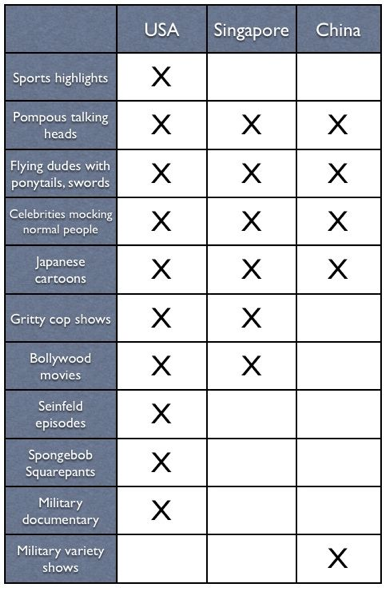
Imagethief has a theory that at any given time, any given American cable TV system will be broadcasting an episode of “Seinfeld.” Admittedly, I tend to cruise the channels late, but that’s what I see.
Recent travels have given me an opportunity to surf not only the channels on offer at my mom’s house in Palo Alto, but also those at my in-laws’ apartment in Singapore, and on my own system here in Beijing. (I’ve recently been watching more Chinese television, as my wife and I let the satellite package expire through a combination of disappointment with the offering and garden-variety laziness.) From what I can see, every culture has it’s “Seinfelds”, those shows or genres that are always on some channel somewhere, day or night. For what it’s worth, here’s what I observe:
Seinfeld’s Law: Shows being broadcast at any given moment.
Make of that what you will.
I’ve also observed that the available amount of quality programming on offer does not increase in proportion to the number of available channels. There is, in fact, a sharply diminishing return. This appears to be some kind of power-law relationship, and whoever works out the actual math will, I am sure, earn themselves a Nobel Prize.
Imagethief was not in the least surprised to hear that Chinese netizens were outraged that movie actress Gong Li has taken Singapore citizenship. But then, Imagethief is not in the least surprised by anything that outrages Chinese netizens. Chinese netizens were outraged when Gong Li played a Japanese woman in “Memoirs of Geisha”, alongside fellow crypto-Chinese actress Zhang Ziyi. (In fact, all the leading roles in Memoirs of a Geisha were played by ethnic Chinese women, so if anyone should be outraged it’s the Japanese.) Chinese netizens often seem outraged by things that appear trivial to the rest of the world, such as the appearance of circles in provocative locations, kind-hearted attempts at mediation, and being French. Chinese netizens, in fact, often seem outraged by anything that transgresses against a hard-boiled nationalist line.
Which suggests that we are actually talking about a certain segment of Chinese netizens, rather than Chinese netizens as a whole or Chinese people in general. Unfortunately this distinction didn’t survive Jane Macartney’s recent Times story on Ms. Gong. To be fair, Ms. Macartney’s story is clearly focused on nationalist online sentiment. Here’s the lede:
A decision by one of China’s most famous film stars to take Singaporean nationality has set off an online furore with many ardent nationalists branding her a traitor and a shame to her native country.
Following from there, rest of the story is actually reasonable and balanced. Unfortunately the headline, which is what most readers will see and which was probably written by a sub-editor in London, is general in a way designed to reinforce foreign perceptions of the Chinese as a bunch of xenophobic goons in Mao suits. Reasonable work by good China journalists often runs into problems like this, which may be why several of my foreign correspondent friends (you’ll understand if I don’t name names) think the editors at their organizations’ foreign desks are tools.
Unfortunately the Internet-comment-as-vox-pop is a common technique in China reporting, and the colorful comments that often drive the stories usually can be traced back to that same rich vein of nationalism that surges through the Chinese Internet. While Imagethief, who has seen first-hand the PR damage that can be done when a stick is poked into the nationalist ant-nest, would never dismiss the importance of nationalism in China, there are some problems with this approach.
First, as anyone who has spent any time on the Internet knows, you can find any opinion you want on it, no matter how outlandish. Second, it’s very easy to select from a skewed sample on the Internet (which in China represents an already skewed sample). It’s fine to discuss the opinions of a narrow sample as long as that’s how you represent it. But when it’s presented in a way that invites the drawing of broader conclusions, you step into dangerous territory. If the rest of the world based their opinion of America on the comments in American political blogs, they’d sterilize the country with neutron bombs. Some of them probably want to do it that anyway, but the point stands.
This is particularly fraught in China, where Internet users are still only 19% of the population, and are demographically concentrated among male, urban youth (more here). So using Internet comments as a proxy for overall Chinese sentiment without some serious qualification, or even statistics, is dangerous.
All of which is scholarly good fun, but ignores the biggest point: Who besides undersexed dorm-crawlers gives a damn what Gong Li does? Imagethief is willing to bet that if you stopped Chinese people at random on the street in Beijing and asked them how they felt about Gong Li taking Singaporean citizenship, the most often expressed sentiments would be, “Huh?”, “How can I do that?” and “Who are you and why are you talking to me?” Not necessarily in that order.
I suspect most of this anger comes because some of these same netizens voted Gong Li “China’s Most Beautiful Person” in 2005. That’s gotta hurt. You say, “You’re China’s most beautiful!” She says, “Yeah, about that Chinese thing…” And for Singapore? For most people, this looks like pragmatism. But from a Chinese Internet nationalist point of view this has gotta be like stepping out of prom night for a smoke and finding your girlfriend making out with the football team’s waterboy in your Vega.*
Well, maybe not that bad, but pretty bad anyway.
Frankly, given the recent state of Gong Li’s oeuvre, Singapore is probably one of the few countries that would be particularly excited to land her. I’m sure it’s seen as a coup for the local artistic community and as validation of Singapore’s ambitions to be a “media hub” (whatever that means). But the state of the Singaporean movie industry can be summed up in three words: Liang Po Po. If you don’t know what that is, count yourself lucky. In fact, thinking about it, it’s a miracle that China didn’t revoke Gong Li’s citizenship for the crime of appearing in “Miami Vice”. I watched “Miami Vice” for free and still felt violated. And Gong Li didn’t even serve in my country’s government. (Nor, thankfully, does Colin Farrel, although I’m open minded if Obama wants to offer Jamie Foxx a portfolio.)
In fact, looking back over Gong Li’s last decade or so of work, it’s all a bit worrying. “Memoirs” was watchable if you squinted and jammed your fingers into your eyes until you got those little sparkly bursts of color. “2046″, I suppose, if you’re into that otherworldly Wong Kar Wai thing (Imagethief has no patience for it, but I’m an admitted philistine). Otherwise, set the wayback machine for 1992 and “The Story of Qiu Jiu”. It’s been downhill for the Gong Li-Zhang Yimou team since then. I mean, seriously, “Curse of the Golden Flower”? Curse of the costume department more likely.
When Zhang Ziyi (who made her film debut in a Zhang Yimou movie herself) someday abandons Chinese citizenship the nationalist youth can crash on my couch and spend the night talking things out. Until then, get over it. There’s lots more important things to get worked up about, like the collapsing economy, the evaporation of the Himalayan glaciers that supply China’s water, or whether foreign bloggers are besmirching the country’s honor with snarky rants about formerly Chinese movie stars.
*This never happened to me. I couldn’t get a date for prom night.
Note: This combines two original posts. In the first part, I suggest something to the Singaporean embassy. In the second part, they respond.
Illegal baby part 1: The strange case of the sluggish passport July 1, 2008
Anyone within earshot will know that Imagethief welcomed his son, Zachary, into the world last March 9th. The nearly four months since have been one long sleepless adventure. Despite my fatigue induced delirium, however, the experience has been a happy one. Like parents everywhere I take the most profound pleasure in things that non-parents wouldn’t even notice. This week’s new talent: Blowing damp, drooly raspberries. I glow just thinking about it. In Imagethief’s parenthood-addled mind, it is but the merest step from a wet raspberry to a full ride at Harvard.
Having a baby means paperwork. Last week’s trip home to Singapore was case in point, as I spent my “holiday” dealing with health insurance for Zachary, life insurance for me, a will for everyone in the family, and various other “responsible parent” stuff. It all left me feeling rather old and grown up.
Having a baby abroad means even more paperwork, as one must go through various registrations with various consulates and embassies in order to ensure that papers are obtained and the relevant authorities (“relevant authorities” is Imagethief’s top phrase for Summer ’08) don’t think you’re some kind of flesh peddler smuggling healthy Chinese babies out of the country for resale to monied but childless Western suburbanites.
The racial distinction in the sentence above is important because Mrs. Imagethief is Singaporean and Zachary is thus Eurasian, with his looks falling less to the “Eur” and more to the “Asian”. Dad’s nose and ears, mom’s everything else if you must know. Considering my nose, this may not be the optimum distribution of features, but so it goes. Imagethief believes that mixed races are the future of mankind and is glad to be doing his part for ethnic homogeneity and conscientious outbreeding. (“Conscientious outbreeding” is Imagethief’s number-two phrase for Summer ’08.)
But ethnicity isn’t everything. While it hasn’t always been the case, the trump-it-all organizing political concept of the last few hundred years has been the nation-state. Imagethief has mixed feelings about nation-states, especially as a proxy for good old-fashioned tribalism, but bows to the prevailing fashion. This means that my boy is a dual citizen, and entitled to both United States and Singaporean passports.
Some people –especially my cynical Singaporean friends– might ask why bother with the Singapore citizenship. Singapore doesn’t permit dual citizenship for adults, and assuming that policy doesn’t change Zachary will eventually have to choose a nationality. But it is important to me that he have a say in that choice. He has roots and family in Singapore, and being part Singaporean will always be part of his identity. There is also a good chance that he will go to primary and secondary school in Singapore, where he will no doubt learn the finer points of Hokkien vulgarity. Should he remain a Singapore citizen or permanent resident, national service will fill any gaps in his vocabulary and ensure that he matriculates with a truly colorful assortment of multilingual profanity. I swell with paternal pride at the thought.
So we duly registered Zachary’s birth at both embassies. And this is where the surprise lay. Singapore has a reputation for bureaucratic efficiency. Having participated in the registration of a business in Singapore, filed taxes there for many years, and applied for both work permits and permanent residency papers, Imagethief can attest that this reputation is largely justified. Singapore’s civil service is cool, crisp, courteous and efficient, and maintains comfortable waiting rooms with widescreen televisions invariably featuring either Mr. Bean reruns or Tom & Jerry cartoons. (Both can be watched silently and neither offends any of Singapore’s established religions or creeds, although I personally find Mr. Bean rather offensive.)
The United States’ reputation for bureaucratic efficiency is less glittering. Thanks to America’s Global War on Terror (TM) this has been especially true in matters of travel and identification, with Vietnam or Soviet Russia seeming better comparisons than Singapore. So I fully expected Singapore to produce a passport within days while the US Embassy waited for the Department of Homeland Security to grind through a months-long analysis of whether my mixed-race, China-born baby constituted a clear and present danger to national security or intellectual property.
I was exactly wrong. The US Embassy approved our application on the spot and had a passport ready one week later. Two weeks after applying, the only thing the Singapore embassy had managed to do was to call my wife and ask her to come back and sign an oath that she had not renounced her Singaporean citizenship. Somehow it didn’t occur to them to do this during her first visit. Going on two months later we have a recently delivered Singaporean citizenship certificate, but no passport. Thus, despite the fact that we travel to Singapore far more often than to the US, Zach’s Chinese visa is in his US passport, and he just completed his first visit to Singapore as a foreigner. I can stay as long as I want, but after ninety days he is baby non grata.
That seems a shame, because Singapore has a problem: No babies. According to the CIA World Factbook, it has the third worst fertility rate in the world, at 1.08 children per woman. Only Hong Kong and Macau (where everyone is apparently too busy gambling to have babies) fare worse.
In fact, that 1.08 is apparently misreported. A 2007 article from Singapore’s Channel News Asia (think CNN stripped of the things that make CNN interesting) gives a figure of 1.24 as the record low, from 2004, with 1.08 being the number for ethnic Chinese women.
But that’s still pretty bad given that the ethnic Chinese are about 75% of Singapore’s population. And it means that the Malays, the most significant minority group, are doing most of the heavy lifting when it comes to having kids. The government is unlikely to admit this publicly, but I think they’d prefer ethnic status quo rather than a growing Malay minority that may upset Singapore’s carefully nurtured political balance.
In addition to trying to encourage the immigration of educated professionals, Singapore has trundled out the incentives for having children. These apply to everyone, not just the reproductively-indifferent Chinese, and include grants of SGD$3,000 for the first two children, with even larger sums for the next two. But judging from the figures, the incentives don’t seem to have helped much. This is not too surprising. The “baby bonus” is nice, but having kids is a complex, long-term project and SGD$3,000 in Singapore is a couple of months rent even if you live in public housing. Personally Imagethief would much rather have free local childcare and less stress about whether his kids will get into a top school or languish in some also-ran academy for mouth-breathing troglodytes.
Anyway, the long and short of it is that Singapore needs babies. And what it really wants, it will tell you over a teary, confessional piss-up (if a nation-state could do that), are the high-potential babies of prosperous, educated people. Precisely the people who don’t have children because they’re too busy chasing the brass ring and spending SGD$150 a pop to tank up their Lexus LS400s.
So, if I may flatter myself, you’d think they’d be going overboard to ensure that the child of an educated, long-time permanent resident who works in China (a country Singapore prioritizes) and an educated, professional, Singaporean woman becomes a Singapore citizen. You’d think they’d have sent salesmen around while we were still pregnant, with brochures explaining why Singaporean citizenship is the best choice for our child. You’d think the embassy would have called to remind us of the top notch medical care and excellent schools that await my child in the motherland. You’d think they’d have had a passport tucked into an immense fruit basket waiting for us outside the delivery room with a letter from the Minister of Babies (or whomever) thanking us for doing our bit for the country’s future prosperity.
But no. Two months later and I’m still waiting for a passport. And no fruit basket either. Which is a shame, because Singapore has outstanding fruit (even if it’s all imported). Meanwhile, Uncle Sam, who ranks near the top of the developed world fertility league tables and has no baby shortage at all, has stolen a march.
Which brings me to complaint two: Singapore’s policy on dual citizenship. It’s not having any, thank you. Hence my boy’s impending Big Choice. For a country that wants to be the Switzerland of Asia, the antipathy to dual citizenship seems surprising, but I understand where it comes from. Singapore’s government fosters a national sense of vulnerability as a political tool. We’re economically fragile, surrounded by Indonesians, could lose it all in a heartbeat, etc. Work harder. A conviction that national loyalties can’t be divided under such precarious circumstances fits neatly into that picture. After all, when the going gets tough, those with foreign passports might just bail and leave the rest treading water (literally, if the challenge at hand is the rising sea level).
Aside from assuming the worst of its citizens, the problem with this approach is that any visit to Western Australia will demonstrate that educated, prosperous Singaporeans aren’t waiting for permission to leave. As always, those who are most desirable will be those with the most options. As a nation that thrives on its international connections, Singapore needs to sell itself not just to foreigners, but also to its own citizens on an ongoing basis.
Even though I’m a foreigner I consider myself pretty invested in Singapore. That’s why I want Zachary to have the option of choosing Singapore citizenship for himself someday. I would even consider taking Singapore citizenship myself if I didn’t have to renounce US citizenship to do it. Sorry, but that trade ain’t happening (America’s stone-age expatriate tax policies notwithstanding). And perhaps that’s QED for the Singapore government. If I’m not willing to make the big commitment, why should I be taken into the fold?
But it all comes back to that desire to grow the population and encourage successful professionals to make Singapore home. Part of that is being flexible enough to do what’s necessary to make people feel welcome in a long term, raise-my-children-here kind of way. Singapore is afraid of its citizens hedging their bets, but that’s exactly what it does. That’s why my “permanent” residency expires every five years and why Singapore won’t tolerate dual citizenship. It’s a not a big deal for me, but it’s a shame for my boy, who will be part American and part Singaporean for the rest of his life, regardless of which passports he is allowed to carry.
Encouragingly, things change. It wasn’t that long ago that Singaporean women married to foreigners weren’t allowed to register their children for Singaporean citizenship at all. If that can change, who knows what else might come to pass in the sixteen or so years that will pass before Zachary has to choose a nationality. Perhaps he will be part of Singapore’s first generation of dual-nationals.
In the meantime, however, just getting that passport would be a good start.
Illegal baby part 1A: The Singapore embassy sends a fruit basket July 26th, 2008
About a month ago I wrote about the long time it was taking the Singapore embassy in Beijing to produce our son’s Singaporean passport. Reflecting my frustrations about various aspects of Singaporean citizenship policy, and what I see as the conflict between Singapore’s reluctance to accept dual citizenship and desire to have more citizens, I wrote the following:
[If] I may flatter myself, you’d think [the government of Singapore would] be going overboard to ensure that the child of an educated, long-time permanent resident who works in China (a country Singapore prioritizes) and an educated, professional, Singaporean woman becomes a Singapore citizen. You’d think they’d have sent salesmen around while we were still pregnant, with brochures explaining why Singaporean citizenship is the best choice for our child. You’d think the embassy would have called to remind us of the top notch medical care and excellent schools that await my child in the motherland. You’d think they’d have had a passport tucked into an immense fruit basket waiting for us outside the delivery room with a letter from the Minister of Babies (or whomever) thanking us for doing our bit for the country’s future prosperity.
Well, it did indeed take three months, but last Monday the Singaporean embassy finally came up with Zachary’s passport. Not only did they come up with it, but they sent two Singaporean embassy staff (as oppose to local couriers) around to our apartment to hand deliver it along with congratulations and a personal apology for it taking so long and, yes, a fruit basket:
Technically it was more of a biscuit basket (for giggles, say that out loud) than a fruit basket, but the idea was the same. I have no idea if this is Singapore embassy SOP, they just felt they needed to make restitution for the delay or they are (gulp) reading this blog. The latter possibility is a little worrying considering some of the less than worshipful things I have written about Singapore’s government over the years. Any Singaporean readers who’ve registered the births of their children in Beijing are invited to let me know if they received the same treatment.
The apology and fruit biscuit basket didn’t change how I feel about Singapore’s reluctance to allow dual citizenship for adults. But they did go a long ways toward defusing my annoyance at the delay in delivering Zach’s passport. Nothing like a touch of personal service and attention to mollify a disgruntled customer. Especially a blogging customer.
Note: The passport was not actually tucked into the fruit basket. That’s my own arrangement.
From time to time someone will ask me why I left Singapore for China. This is a fair question. I lived there for nearly a decade, Mrs. Imagethief is Singaporean, and I have great affection for the place. Usually I give some longish explanation about various professional and personal frustrations that were beginning to set in. From now on, however, I’ll simply be able to point people at this video on YouTube:
Via Singapore ultrablogger Mr. Brown, this is a four and a half minute hip hop video produced by Singapore’s Media Development Authority. The MDA is the statutory board that regulates media content in Singapore and, as you would expect from its name, promotes the development of Singapore’s media industry. The video features the senior management rapping about their respective roles.
God help me, I don’t know where to start on this one. But I’ll try. Remember how embarassing it was when you were in high school and your parents tried to act “cool” in front of your friends? Now imagine they did that and commited the results to posterity on YouTube. In your name.
It is often remarked that the Chinese government considers the Singapore government a role model for successful technocratic authoritarianism. Whatever the Chinese government learns from Singapore, let us pray that it does not absorb the idea that rapping bureaucrats is a good idea. The State Council has enough on its mind what with the Olympics, mass rural-urban migration and the Yangtze silting up behind the Three Gorges Dam. They don’t need to be spending nights in the studio trying to figure out what rhymes with “Zhongnanhai” over a phat groove.
Also, there are several people featured in this video, but not one of them has any discernible rhythm. Statistically you’d think one could carry a beat in common time. We’re not talking bebop here, or some kind of freaky experimental meter. One, and two, and three, hit the BEAT. Count it off, it’s not that hard. Not that they had much to work with. There must be some kind of award for coming up with hip hop lyrics that include the phrases, “KPI”, “service oriented architecture” and “beautify our fusionopolis”. If you can’t bring yourself to watch the whole thing, the lyrics are here. It’s not much easier to read than to watch or listen to.
Having dispensed with the artistic criticism, let me approach this from a public relations point of view.
Imagethief is all for using new media. If I squint hard enough and jam my thumbs into my eyes I can kind of see the rationale for doing this (although it could just be the flash of my retinas detaching). You want to explain the role of your bureaucracy in a catchy way that reaches out to youth and the creative industry. And some credit must be extended to the MDA for having, well, the balls to try this.
Unfortunately, a pigeon with a nail through its skull would still have the brain power to predict the inevitable result of this project: a catastrophic piece of self-ridicule that drags out for four-and-a-half painful minutes every reason why government involvement in creative industries is a disaster. And why Singapore’s media industry is, like the site of a bad plane crash, so much lifeless wreckage. Seriously, these are the people promoting the development of Singapore’s creative industries? They hardly seem qualified.
Mind you, this is not an internal video that leaked out. Apparently the video was originally distributed with the softcopy version of the MDA’s most recent annual report. It is also available straight from the MDA website, although as of this writing the site was down, possibly due to unintentionally high server load as people gape in slack jawed amazement and slight embarrassment. That’s why I haven’t been able to work out if there is a press release that explains their rationale.
I’d like to take a moment and differentiate Singapore’s media industry and regulators from Singaporeans in general. There are many creative and talented people in Singapore. However it is my observation that they prosper despite the best efforts of the government, not because of them. Indeed, it has long been Imagethief’s position that the responsibility of government with regard to art should begin and end at cutting cheques for the things that are so edgy, experimental or niche that the market won’t support them. For that reason I see the words “Singapore” + “media” + “development” + “authority” as oxymoronic.
Good communication flows from sincerity, and part of sincerity is being true to who you are. This is especially true in music, where authenticity is essential to the message. That’s why a Mississippi John Hurt record sounds deep-down good but a Joss Stone record, despite her manifest singing talent, sounds a little like a con. One of the great joys of music is of course how genres transcend their origins and find mass acceptance. That has certainly been true of hip hop, where the musical tent has widened a great deal since the days of Kurtis Blow. The Beastie Boys proved long ago that Jewish kids from Brooklyn could do it too.
But the tent still isn’t wide enough for Singapore government bureaucrats. Even bureaucrats need to be true to themselves in communication. It doesn’t mean that they always have to use soul-deadening PowerPoint or white papers. By all means they should roll up their sleeves, loosen their ties, mingle with artists and tell it straight. But just they should also recognize their limitations. Someone in their communications department should have worked this out and told truth to power. Unfortunately the communications director of MDA is one of the people in the video.
The result is a lot snarky blogging (including here) and yet another example of the Singapore government getting itself written up as “odd news”. That is not communication success.
The Singapore MDA is not the first bunch of suits to fall victim to siren call of hip hop as a tool for youth communication. They’re following a trail already blazed (if that is the right word) by Singapore’s ruling People’s Action Party. The Hong Kong Institute of Chartered Public Accountants also gave it a try with similarly dismal results. But at least they had some babes and “the ‘Tute” sounds like something you can smoke through.
Anyway, having made it this far you probably have a bad taste in your mouth. Turn up your speakers and clear your palate with this.
Imagethief was tickled to read today in Xinhua an article from the Boao Forum for Asia, an annual Chinese talking shop, on how Asian media will rise up to challenge western media juggernauts. It seems that Asians take umbrage that they are 96.2% of the world’s population and yet produce only 0.3% of its international media. Or something like that.
The article makes many serious points:
“The world is not flat actually,” Liu Jiang, deputy editor-in-chief of Xinhua News Agency, said at the annual conference of the Boao Forum for Asia (BFA), which was held over the weekend in the south China town of Boao.
“The world is in reality a slop [sic] on which information flows downward from developed countries to developing countries and regions,” Liu said.
“The World Is Flat” by the New York Times columnist Thomas Friedman has been frequently quoted to prove an alleged “magic power” of globalization by Bill Gates and other lecturers at the conference.
The book figures out ten driving forces to grind the world flat, in each of which media play an important role.
“Developed contrives, which have one seventh of the world population, have dominated two thirds of the total information flow,” Liu said. “However, globalization does not balance a horizontal world when it is grinding the world.”
“Why do Asian media always yield to Western culture?” Felix Soh, deputy editor-in-chief of The Straits Times headquartered in Singapore, questioned in his speech at the sub-forum discussing globalization and the media.
Imagethief has lived in Asia for over a decade and is a fan of Asia and things Asian. So he will try to address Mr. Soh’s question as delicately and constructively as possible.
It’s because on average Asian media suck. Especially news media.
Now this is not an entirely categorical statement. There are fine Asian newspapers and magazines, and, heaven knows, gifted Asian filmmakers and writers. But in general –and I am truly sorry for purely selfish reasons that this is the case– Asian commercial media is a desperate wasteland that teeters perpetually on the precarious knife-edge of irredeemability.
Mr. Soh himself heads up one of the blazing test cases for the failed potential of Asian media. Imagethief needs to tread carefully here because he is really good friends with several Straits Times journalists, and they are hardworking, smart, talented people. But friends are honest with each other, so here it is: the Straits Times took the last train to dullsville and fell asleep in its seat and missed the stop. I know. I subscribed for years.
The tragedy of this –the great, majestic, swooping tragedy– is that if any country was going to produce a credible pan-Asian newspaper it would be Singapore. It’s in the right place, it’s got the right people, and it speaks the right languages. It really is a regional hub. But it will never happen.
I blame government. Governments, by and large, should not involve themselves in media. But Asia’s governments cannot, for the life of them, keep their grubby mitts off the media. And damned if they don’t have a near mystical talent for boiling the life out of it.
I realize you can argue both aspects of the government involvement equation. The government-run chartered [see note below -WM] BBC, for its troubles, is one of the world’s great news gathering organizations. Too little government supervision of media and you get dangerously irresponsible or corrupt media.
But too much government involvement and you get soul-destroying headlines like…well, just for fun, let’s see what the top story on the Straits Times website is right now:
Good gosh, two government headlines in a row. And this is typical. Back in Singapore we used to joke about what the above-the-fold government headline of the day would be.
Arguably, this is what is important to Singaporeans (although this kind of stuff drives my Singaporean wife up the wall, but she married me so she’s probably deranged). And I realize it’s unfair to dump so much on the Straits Times. But if the editor is going to ask rhetorical questions about the subservience of Asian media, perhaps he should look close to home for the answer.
This story is rewritten across the region. As long as Asian governments manage their news, censor their films, and interfere explicitly in culture then their newspapers will be treated as propaganda, their most talented artists will flee overseas and their people will wolf-down tawdry but lively foreign culture.
So my recommendation for the governments of Asia is this: if you want a louder voice in the world, if you’re tired of being walked all over by imperialist western media, if you think you are being misrepresented on the global stage, then back the hell off. Set your own media free. It will probably rise to the challenge, and, I suspect, do it better without you breathing over its shoulder.
But that’s a pipe dream. Here’s the end of that article:
High level forums and meetings have been raised by media groups from China and members of Association of Southeast Asian Nations (ASEAN). An agreement of cooperation on communication signed by members of the Non-aligned Movement at Kuala Lumpur in 2005 has shown the developing countries’ strong willing to speak louder in the world.
Delegates of Asian media attending the BFA conference reached the consensus that Asian media should shoulder a responsibility for broadcasting “a harmonious Asia” with “a harmonious Asian image” and provide a value of “harmonious region” to tell the world a real Asia.
A “harmonious Asia”? Oh dear. Pass me the Financial Times.
Note: I do give a tip of the hat to Singapore’s Chinese language daily, Lianhe Zaobao, which is popular in China.
Update: Charlie (in comments below) [comments no longer available – WM] and another reader (by e-mail) have pointed out the important distinction between publicly funded media, such as BBC or NPR in the US, and state-managed media. I should have made that distinction clearer in the text. The BBC is, thus, probably used incorrectly as a positive example above. Unfortunately that kind of bottoms out the list of exceptions to thegovernment involvement = bad rule.
Imagethief is a strapping manly-man, and spends long hours in the gym perfecting his Adonis-like physique. Occasionally, however, his enthusiasm gets the better of him, and he tries to hoist a few kilos too many. This happened to me about a month ago as I was doing plate-rows. At the apex of my set, something in my steely, well-honed trapezoidal wentspang! and pain ricocheted down the length of my left arm.
I called a halt to the day’s strains, thinking that a week or so of recuperation was all that was necessary. Three weeks later, with phantom pains still coursing up and down my left arm and unable to sleep in either of the two positions that I am tolerant of, I finally dragged myself to my regular doctor in Singapore, where I was spending Chinese New Year.
After palpating me in various unsavory ways and making me bend my head into several unnatural positions, he rendered a verdict: a pinched nerve at the sixth cervical vertebrae. He said I could either pay $500 for an MRI, or, since there was no loss of strength (this, I gather, would have been bad), I could go on anti-inflammatories for a couple of weeks and see how things played out.
I selected the cheap, pharmaceutical option. Going for the MRI at that stage would have been far too large a concession of vulnerability. As an American man, I have a battleship-strong sense of denial when it comes to medical issues. In fact, it was an heroic effort of will (no pun intended) just to make it to the doctor in the first place. Like most American men, I won’t go see a doctor unless a bone or major internal organ is protruding through my skin. And even then it’s a toss-up. Is there a good ball game on?
I did, however, make one extra concession to medical adventure. I agreed to go see my wife’s Chinese doctor.
And this raises another American medical prejudice. Americans are raised to believe that all medicine is Star Trek. If a medical therapy doesn’t involve nitrogen-cooled electromagnets or a particle accelerator and flat-panel video screens, it’s stone-age witch-doctor crap not worth pursuing. This maximal approach to medicine explains why America’s health system is such a dysfunctional wreck. When even stubbed toes require PET scans, something has got to give. When I lived in America, what gave was my bank account, under the onslaught of my insurance premiums. Freelance writers part-timing as radio producers to avoid starvation get to pay their own way, insurance-wise. That leaves little left over for such wastrel’s luxuries as “food” and “rent”.
Thus, going to see the Chinese physician was something of a leap of faith for me. I had been to his clinic with my wife before. It looked like Gandalf’s office: dusty, leather-clad tomes, mysterious charts of the human body covered with meridian lines and Chinese script, and shelf after shelf of cryptically labeled, dark-brown potions in equally dark-brown jars. Not a Star Trek medical device or Physician’s Desk Reference in sight.
Although it was Singapore, the doctor (or, more accurately, daifu) didn’t speak any English. I explained my symptoms in laborious Mandarin, with my wife occasionally helping me through the tricky parts. Accuracy is important in medicine, and doubly so when using a language where a single tonal difference can change the coruscating imprecation “fuck your mother” into the merely perplexing “dry your horse”.
After listening patiently to my explanation, the doctor arrived at a prescription that involved neither a horse nor my mother. Rather, it involved a course of moxibustion, or “cupping”. I grant you that “cupping” sounds like something where a horse might be involved, but I assure you that this is not the case. You are, perhaps, thinking of a “crupper”, which the leather strap that runs beneath a saddled horse’s tail. If so, you are either an equestrian or a bondage freak and, either way, have ventured into territory beyond the scope of this post.
The daifu asked me to remove my shirt, and then rubbed a film of of lubricating lotion on my back. This was the pleasant part of the procedure. The only pleasant part. As soon as I was nicely greased, the daifu took a hollow glass globe the size of a baseball and dropped an alcohol-soaked cotton swab through the thick-lipped mouth. He lit the swab, which flared and burned out rapidly, and then clapped the open mouth of globe onto the skin of my back.
Anyone who has ever performed the collapsing gas-can experiment will be familiar with the principles behind what happened next. In this old, grade-school science experiment you light a little alcohol or other flammable liquid inside a metal container, then screw an airtight top onto it. As the air inside the sealed container cools, the pressure drops and the pitiless math of Boyle’s Law takes over. The sealed container is slowly crushed by outside air pressure. Now, if the container is rigid enough to withstand the pressure, but covered by a flexible membrane, it is the membrane that will distort in response to the decreasing pressure in the sealed vessel. In this case, the membrane was me. A golf-ball sized gobbet of Imagethief was quickly sucked into the glass cup. The suction was surprisingly strong, and I had brief thoughts of my skin rupturing and my left lung exploding into the glass cup. If that had happened, I would have asked for my $15 back.
As a technical scuba diver, Imagethief is well schooled the concept of barotrauma. This is injury resulting from a pressure differential, a common risk in scuba diving. To date, Imagethief has suffered only one serious barotrauma: a ruptured eardrum self-inflicted when I clapped a hand over my ear following the nearby detonation of an explosive by Indonesian dynamite fishermen. More common, and generally less serious, is something called a “squeeze”. This happens when a diver fails to equalize the pressure in some internal airspace, such as a sinus or middle ear, or an external one, such as the airspace in a diving mask. As the water pressure increases during descent, the growing differential forces –or “squeezes”– tissue and fluid into the area of low pressure. Generally you feel this –trust me; you feel it– and stop descending before you are seriously injured.
Never in my life did I think I would pay someone to inflict a painful squeeze upon me, but that’s what I was doing.
Anyone who has lived in China or Singapore will probably have, at one time or another, seen someone with a pattern of round, red welts on their back. These are the marks left by regular moxibustion cupping (I have photos here and here), in which the cups are placed upon specific points on the back, and left there. That kind of moxibustion is for pussies. My wife’s family daifu is renowned in Singapore for his expertise in a technique in which a single cup is slid over the affected area to draw out the “wind” that, from a Chinese medical point of view, is invariably the source of all ailments. My wife swears by this technique, and has had her own sports injuries treated in this way on a few occasions.
Her pain threshold must be higher than mine. I now have a pretty good idea of what an orange feels like as it is peeled. Grease or no grease, it felt like the skin was being torn from my back as the doctor slid the globe up my trapezoidal muscle and left to right along the delicate supraspinatus. It was one of the most painful procedures that I have ever been subjected to, and I’m a veteran of two root canals, eight dental extractions (four under local anesthetic), outpatient neurosurgery on my hand and a hernia operation. After the first course was complete, leaving me breathless and sweaty, the daifu asked my wife something in Mandarin. “He asks if you can stand a stronger treatment,” she translated. Macho posturing immediately suppressed all other instincts, including my instinct to flee screaming from the office. “No problem,” I wheezed, like a teenager who’s voice has just broken.
As the daifu began the second course, I tried to mentally transport myself to another location. Blissful green fields. A rowboat on a calm lake. A spectacular, icy glacier. It didn’t matter. Wherever I visualized myself, I was accompanied by a burly, sweating medieval torturer intent on scourging my back. There was nothing for it but to endure the treatment in the here and now. It was clear that the daifu subscribed to the “after I do this to you, the pain you were complaining about won’t seem so bad any more” school of medicine. “Look,” he said. “You can see where all the old, clotted blood is being drawn out of the injury.” Not surprising.
Centuries later it was all over. I gingerly pulled my shirt on over my abused, stinging back. “Any better?” asked my wife, sweetly.
It wasn’t enough for the daifu to strip all the skin from the upper-left side of my back. He had to send a reminder of my misery home with me, in the form of a jar of noxious, brown liquid medicine decanted from one of the hundreds of mysterious, cryptically labeled bottles in his office. I was instructed to take one good swig, three times daily. It was the nastiest substance I have ever ingested, a potent combination of bitterness and herbal pungency like a combination of slivovitz, crude oil and potpourri. It made me want to cry the way I did when my mother made me take liquid penicillin for strep throat when I was seven. I had to have a water chaser standing by every time I took it. I carried it onto the flight back so I wouldn’t miss a dose, and I’m mystified as to why the security inspectors didn’t catch it, confiscate it and fine me for trying to bring a dangerous liquid onto the airplane.
Now, nearly a week later, I can report some improvement in my symptoms. Of course, given that I have been on a combination of moxibustion, bizarre herbal tonic and old-fashioned, western anti-inflammatories, it’s hard to tell what’s responsible for the progress. Would I dare subject myself to another treatment of moxibustion? The daifu told me that, in an ideal world, I’d be able to come back for another treatment a week hence. Now that I am back in China that will be difficult, unless the daifu can refer me to a trusted colleague here. He did, however, suggest that I come in for a repeat session when I am next in Singapore.
Only time will tell if Imagethief has the nerve to steel himself for another pass. The wind may be bad, but between that and being skinned like a rabbit, I might just stick with wind.