Tag: Facebook

  • Facebook + Instagram + China = Take a Deep Breath

    So, Facebook bought Instagram for a billion bucks. Awesome for those guys. I, alas, did not get rich in either of the Internet startups I participated in. But you can’t put a price on experience, right?

    Deep sigh.

    Anyway, Instagram is freely accessible here in China, at least for the moment, and apparently has a small but growing user base. It’s been limited to a certain slice of the China market by being an iOS-only app until last week. It may get picked up more now that it’s on Android as well, especially given Android’s whomping share of the smartphone market in China.

    Because Instagram is accessible from China there has been some speculation that it might provide a back-door into the market for Facebook. Well, color me embarrassed, because when I looked at how Facebook might get into China a couple of weeks ago, one scenario I didn’t explore was Facebook buying another, unblocked western social network.

    Instagram certainly functions as a posting back-door to both Facebook and Twitter. Instagram posts route to Facebook, Twitter and other social networks through Instagram’s unblocked servers (actually, Amazon’s cloud servers for the moment). There are similar middleman workarounds for posting on blocked social networks, such as Ping.fm, but none come close to providing full access to Twitter or Facebook. And, from what I can see, neither does Instagram. That’s important.

    The question that wins you the brand new car is: Will Instagram now be blocked in China? The reason why you don’t have the car yet is that the answer is complicated. China doesn’t block all foreign social networks. It does block the established, heavy-hitting, horizontal sites like Facebook, Twitter and Google Plus. But many vertical social networks and newer sites are unblocked. I can get on LinkedIn, Quora, Path,Flickr and Pinterest just fine, without a VPN (your mileage may vary). I can even get on MySpace.

    I cannot read the minds of the bureaucrats who decide what gets blocked and what doesn’t, and if I could I’d probably be in a position to be less wistful about the fates of the startups I joined. But there do seem to be a few key factors in determining who stays safely outside the firewall. These include size, perceived influence, how closely the network has been associated with political movements, power to function as tool of mass organization, and whether or not the network has been explicitly associated with content or activities that the Chinese government considers sensitive. On all three counts, I’d rate Facebook and Twitter considerably higher than the rest of the pack. As for Google Plus, I trust this audience doesn’t needmuch explanation.

    So, what happens with Instagram now that it is part of planet Facebook?

    It depends. Assuming people don’t suddenly start posting pictures that annoy the Chinese government, maybe nothing. At the moment, Instagram seems pretty harmless, and its one-way posting features to other social networks don’t look like a big red flag. Posts to Chinese social networks like Sina Weibo essentially outsource the content monitoring and censorship. Of course, Twitter once looked pretty harmless. In 2007 I even wrote a short article mocking its triviality, possibly betraying the lack of vision responsible for my current un-billionaire status. Twitter has been blocked for a while now. So much for harmless. The fact that Instagram is essentially mobile only has also probably helped keep it under the radar.

    But if Instagram is integrated more tightly into Facebook’s core service and stops looking and feeling like an independent platform, then the risks go up fast. Everything hinges on where Facebook sees the value in Instagram, and whether or not it pulls Instagram into the mothership. The more integrated Instagram is, the more powerful it is as “back door into China” for Facebook, but the more likely it is to be blocked. And if Instagram is suddenly used to post a lot of pictures of a sensitive event in China, it might not even matter if Facebook doesn’t change a thing.

    Meanwhile, local photo-sharing clones have been blossoming for a while. Early enthusiasm for foreign social networks in China does not reliably translate into long-term success, while mainstream success in China often does translate into closer scrutiny. Instagram may indeed be a back door into China for Facebook, but if it wants to stay open, it might have to stay a rather small door indeed.

    Other links:

    Note: Originally published on the defunct group blog Rectified.name.
  • Facebook’s China playbook

    As you have undoubtedly heard by now, Facebook CEO Mark Zuckerberg and his girlfriend* were spotted in Shanghai on Wednesday. This has lead to a completelypredictable round of speculation as to whether this signals some new development in Facebook + China. This sort of navel gazing takes off whenever Zuck comes to China, or looks in the direction of China, or gets lunch at P.F. Chang’s, or whatever. And why not? Facebook is the biggest social network in the world. China has the biggest population of Internet users in the world. Facebook is going public soon. Zuck is learning Chinese, etc. So a Zuck sighting in China is, to invoke the memory of Arsenio Hall, one of the things that make you go, hmm…

    Despite all of that, leave to our friends at the excellent Tech in Asia blog to have the most sensible take, “Zuckerberg is in China…Who cares?” Indeed.

    Obviously, we don’t know a thing about Facebook’s designs on China. But to make sense of the speculation it’s helpful to consider the actual scenarios by which Facebook or Twitter or indeed any foreign social network might enter China, and to look at how different stakeholder groups will react to the possible scenarios. This is different than analyzing business strategy or financial implications, but ultimately it’s all connected.

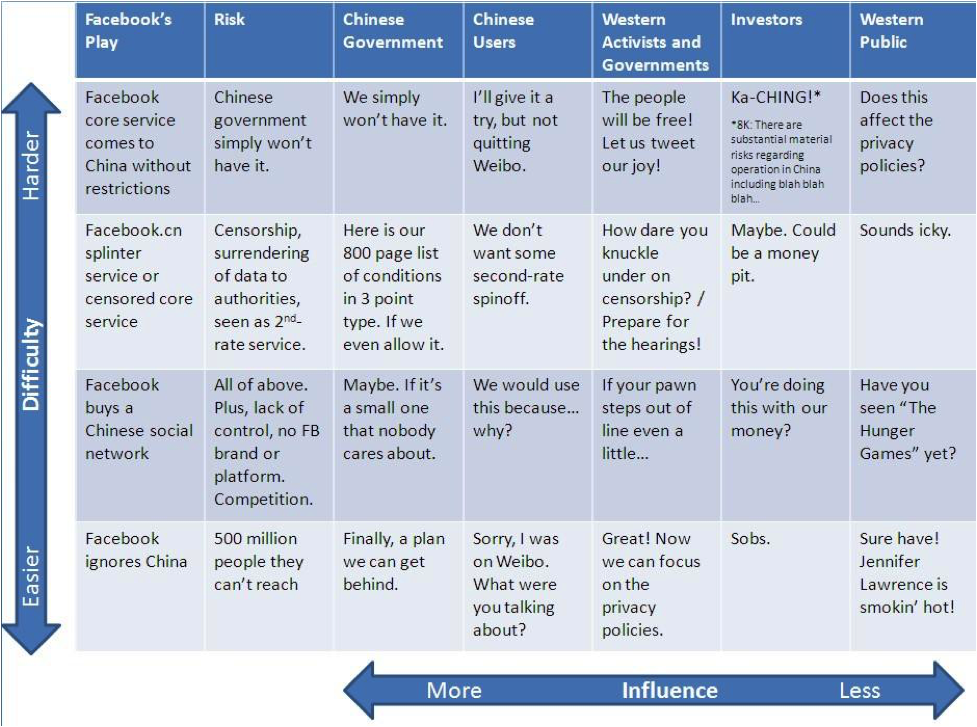
    At the risk of oversimplifying, there are four major scenarios that we can envision: extending the mothership service to China; developing a separate “splinter” service for China under the original brand (this could be disconnected from the main service, or just enforce dramatically different policies); buying an existing Chinese social network; and doing nothing. Obviously, they’re not all immediately practical. Facebook is blocked in China, which makes extending the mothership difficult. There are also intermediate possibilities that blend aspects of these scenarios, but that’s a deep rabbit hole to go down. Along with these scenarios there are five major stakeholder groups, not including Facebook themselves: the Chinese government; Chinese Internet users (potential customers); Western activists and governments; investors; and the Western public (aka Facebook’s current users).

    The easiest way to look at all these moving parts is to simply throw the whole thing in a table that considers for each scenario the risks and how each of the stakeholder groups is likely to react (click the table for a larger, EZ-reading version):

    china playbook

    Admittedly this format throws a lot of nuance overboard, but nevertheless there’s a clear three-way conflict that emerges. The approaches that are more acceptable to the Chinese authorities are both riskier with regards to Western activists and regulators and, importantly, less relevant to Chinese users. The approaches that are most relevant to Chinese users and have the highest potential return to the business are unacceptable to the Chinese government. Ultimately the Chinese government calls the shots.

    The basic math is that to even have a chance of operating here Facebook would have to apply the mandated censorship policies either just to users of its core service in China or to a spinoff service that is kept separate from the core service. It would also have to be prepared to surrender Chinese user information to the authorities if requested. That will raise eyebrows as Facebook knows a ton about its users by design.

    The risks of these approaches are clear to anyone who has studied the history of Yahoo in China and followed the congressional grilling of US Internet firms operating in China back in 2006. That was the stone age of social networking (Rupert Murdoch bought MySpace, Facebook turned 2, Twitter was hatched), and the political atmosphere around such things has not become any less sensitive since then. If anything, the messianic aura that clings to social networks and of which Chinese authorities have always been so distrustful has been exacerbated by last year’s political events in the Middle East. And let’s not forget recent events here in China and the leadership transition later this year.

    There are ways to create distance between the core Facebook brand and service and the Chinese government’s likely requirements, but those ways don’t eliminate political risk at home, and they all make the service less appealing to Chinese users. These same users are already being wooed away from traditional social networks by microblogs and have a colorful history of rejecting foreign online services as irrelevant even when they’ve been allowed to operate here without restriction. Remember MySpace China? Me neither, and a friend of mine helped launch it. Owning a local social network would provide a layer of insulation from the risk of Western backlash, but at the expense of sacrificing much of the point of entering China.

    None of this predicts whether Facebook will enter China, or how they might attempt such a thing. They’re probably playing a very long game. Whatever path they choose, it won’t be easy, either in China or at home. Bear that in mind next time Zuck is spotted in China and the tongues start wagging.

    *Note to editors: Can we get over the fact that Zuck’s girlfriend is Chinese American? Everyone is compelled to point this out, but net impact on the Facebook-in-China story is zero-point-zero.

    Note: This post was originally published on the defunct group blog Rectified.name.

  • China and the nature of Facebook

    Reports have been percolating for a couple of weeks that Facebook will partner with Chinese search engine Baidu to launch Facebook China, or something similar. Anyone who has followed the history of foreign Internet firms in China knows that this is fraught territory. Chinese competitors are well established, and while many successful Chinese Internet firms have foreign backing of some kind (even Baidu once claimed Google as an investor), marquee marriages between Chinese and Foreign Internet companies have often been troubled.

    There are others better placed than me to speculate on the likely business fortunes of a Facebook China (cf. Epstein, Bishop), but what really interests me are the communication challenge and reputational consequences. Some glimpse of those possible consequences came in a Wall Street Journal article about Facebook’s lobbying efforts that ran yesterday. It included the following:

    [Facebook] is talking with potential Chinese partners about entering the huge China market, where the government has been cracking down on dissidents. That crackdown has come in response to the uprisings shaking authoritarian Middle Eastern regimes, movements that have used U.S.-based social-media sites like Facebook and Twitter as organizing tools.

    “Maybe we will block content in some countries, but not others,” Adam Conner, a Facebook lobbyist, told the Journal. “We are occasionally held in uncomfortable positions because now we’re allowing too much, maybe, free speech in countries that haven’t experienced it before,” he said.

    Yowza! Better work on those talking points and come up with something that doesn’t sound quite so paternalistic. Read as generously as possible, this is one quote from what one presumes was a larger discussion on the issues of running transnational social networks in countries with different approaches to censorship and freedom of speech. Read less generously, it sounds like a lobbyist for Facebook arrogating to his client the responsibility to decide what constitutes an appropriate amount of free speech in any given country. Risky territory.

    From a business point of view deciding an appropriate amount of free speech might be a practical necessity. From a public communication point of view it’s dangerous. Five years ago, when Facebook was still a plucky upstart too trivial to be noticed, Yahoo, Google, Cisco and Microsoft were hauled in front of a congressional hearing to testify on their activities in China and their willingness to accommodate governments with illiberal approaches to free speech. It was not a banner moment for the American Internet industry. “Moral pygmies!” declared Tom Lantos, the principal congressional antagonist. Much of the cast has changed and Tom Lantos has since died, but the issue remains sensitive. (Not all the cast has changed. Facebook’s current head of communication, Elliott Schrage, represented Google in the 2007 hearings.)

    Facebook itself has not committed publicly to anything in China. They also haven’t yet committed any of the blunders that those four firms did (most notoriously Yahoo, with the Shi Tao affair). Finally, Facebook hasn’t made nobility a part of their brand in the way that Google conspicuously did in its early days, something that was used against Google in its China engagement. In fact, if anything Facebook is known for a kind of calculating amorality that may be useful in the ruthlessly sharp-elbowed Chinese Internet world.

    But what’s important here is not how Facebook sees itself, but rather how people at large see it, and how activists and politicians think they can use it to drive their own agendas. Whether Facebook likes it or not, it has been publicly associated with recent events in the Middle East and is widely seen as a force for enabling dissidents and protestors whose causes resonate with western publics and politicians. See for example New York Timesstories here, here and here. Evgeny Morozov and Malcolm Gladwell might ridicule the notion of social media as democracy tools, but that won’t necessarily dispel a belief that was made clear in the 2007 hearings: American Internet firms should represent American values.

    Companies’ decisions about China are revealing. Facebook’s decision on whether or not to formally enter China will be especially interesting. It will establish something fundamental about the identity of one of the two most powerful Internet companies on the planet. Is Facebook, as some have supposed, the great enabler of democracy? Or is it a company of business pragmatists willing to censor (or delegate censorship) in order to open a potentially lucrative market? The reality is probably more nuanced than either of those positions, but as far as public perception goes it will be difficult to have it both ways. How does one balance groups of stakeholders with completely incompatible views on what constitutes a responsible and conscientious Internet firm?

    The nut of the problem is that, right or wrong, democracy activists, American politicians and the Chinese authorities all tend to see American Internet firms as standard bearers for western values. Facebook’s task is to convince the Chinese authorities otherwise while not making activists or western users in general feel betrayed. I can think of few more precarious communication challenges. The quote above is an unpromising start.

    Update:

    Obama hosted a town hall at Facebook HQ yesterday. Interesting. And likely to be noticed here in Beijing.

    See also: