Stadium Concerts and the Iconography of Totalitarianism
I am going to start with something polarizing. I like the band Oasis.
When people who don’t like Oasis find out that you do like Oasis, they will often try an intervention, like they discovered you’re in a cult where everyone wears white Skechers and signs a suicide pact. People who are musically inclined will explain that your taste is basic, and start suggesting bands that use weird time signatures and exotic modes. If I wanted to listen to King Crimson, I would just listen to King Crimson.
Plenty of Oasis’ music is simple. “Columbia” is A-D-C in a loop for five minutes. But AC/DC proved fifty years ago that there is a bottomless appetite for three-chord party rock, and I think it comes down to branding. Britpop produced a lot of interesting and thoughtful bands—Stone Roses, Suede, James, arguably Radiohead—and then there were Liam and Noel Gallagher, a two-headed wrecking-ball of surly Manchester sex-appeal.
The Gallagher brothers famously despised each other and the band broke up in acrimony in 2009, years after their creative peak. But the shimmering aura of money has magical healing properties, like an amethyst chandelier, and the brothers embarked upon a reunion tour this year.
My family and I lucked into tickets to the concert at the Rose Bowl in Pasadena last month. The Gallaghers could remember at any moment that they hate each other and tumble back into violence, so we couldn’t pass up the opportunity to see them together as it might never happen again. We had a great time.
Family fun at America’s answer to the military parade
We were living in Beijing in 2009 when the Party celebrated the 60th anniversary of the establishment of the People’s Republic. The main event was a giant military parade that would roll down Chang’an Avenue and past the Party dignitaries assembled on top of the Gate of Heavenly Peace, which definitely sounds like a place to review a bunch of weapons.1
Our apartment was east of downtown, along the same boulevard that becomes Chang’an Ave. A rail spur that normally delivered trainloads of coal to the huge power station next door made it a good place to stage the armored vehicles participating in the parade. It was also a good place to breathe a lot of coal soot and heavy metals, but that was Beijing in those days.
The day of the parade dress rehearsal, I put my toddler son on my shoulders and we stood with our neighbors and watched hundreds of tanks roll down the street2 in front of our compound. Tanks on Chang’an Ave is a historically complicated image, but it was also undeniably cool. My son was raptured on a cloud of diesel fumes.
After the rehearsal, I was excited to watch the actual parade in person. We would all line the streets and cheer for the might of China!
We would do no such thing. In the best authoritarian tradition, there would be no disorderly public crowds along the route. Only carefully selected groups in carefully selected areas. I, a politically unreliable foreign dork, would have to watch on TV with the masses. Like everyone else who lived along the parade route, we were restricted to our compound during the day of the main event.
When do the old rules of political communication become obsolete?
Note: There are two things that have been on my mind as I observe everything happening in U.S. politics right now. I am using this space to think through them out loud. This is the first topic. Second to follow when time permits. I am not sure how well this holds together. Feel free to debate!
On January 28th, 1986, the space shuttle Challenger exploded just over a minute after lift-off. This was one of the defining, “where were you when…?” moments of my youth. I remember stapling my eyes to the television in a common area at my dorm at UC Santa Cruz.
Later that day, President Reagan addressed the nation from the Oval Office. I’ve never been what you’d call a big Reagan fan—he wasn’t popular in the bong-littered halls of Porter College—but it’s good. A classic of public solace, delivered to a traumatized nation. Go watch it if you have five minutes.
Cards on the table, I’m a fan of the administrative state. Societies are large and complex, and a little technocratic competence goes a long way in ensuring the availability of public goods and infrastructure. But there are some areas where the administrative state struggles. Sex, for one.
Like China, my adopted home of Singapore advocated for limited birthrates during the 1970s “population bomb” panic, when it was widely agreed we were destined to devour each other like starving jackals. Singapore realized its demographic error in the 1980s, as its birthrate plummeted, and went through policy whiplash. When I arrived, in 1995, there was an advertising campaign encouraging young couples to have larger families. I recall lots of slow-motion video and gauzy photos of attractive young couples with cherubic babies, and an omnipresent theme song. Alas, it was too early to be immortalized on the Internet, but there is evidence of later campaigns.
I spent National day in Shanghai with my family, our first leisure trip back since we lived there in 2007. Like Beijing, Shanghai has caught a serious case of fabulous in the past five years. The French Concession, already precious when I lived there, now has more coffee houses, boutique bakeries and fashionable bars per hectare than San Francisco’s Mission District, which is no mean feat given SOMA’s hipster factor.
Case in point: the street behind the apartment I lived in while I was in Shanghai used to be a wet market where you could have your Sunday chickens slaughtered and plucked while-u-wait (very convenient). It’s now a strip of coffee houses, boutique bakeries and fashionable bars. The apartment block itself is as dingy and miserable as ever, but I’m sure rents have gone up.
I have no philosophical objection to this transformation. Wet markets and Shanghai summers go together exactly like you’d expect a bunch of unrefrigerated animal carcasses, dismembered frogs and fish innards to go with 35C temperatures and relentless humidity. And I have a taste for coffee and fine baked goods. Anyway, such is progress.
My mom, who had never been to Shanghai, was in tow, so we made a round of The Sites, braving the staggering holiday crowds at the Bund, Luzjiazui, and so on. But one place where the crowds were not staggering was the Shanghai Jewish Refugees Museum, in stubbornly un-fabulous Hongkou district. Jews, it turns out, have an extensive history in Shanghai, originating from the Iraqi Jews who established trading houses there in the 19th century. Although I’m not observant, I am mostly Ukrainian Jew by ethnicity — Moss comes from my great grandfather, Abraham Mosiusnik, who emigrated at the turn of the 20th century — so it seemed something worth exploring.
Before and during World War II tens of thousands of Jews fled Europe and arrived in Shanghai. Stateless, and disconnected from the established Jewish communities, they were settled in a ghetto in Hongkou, north of Suzhou Creek. Constructed in 1927, the elegant, brick Ohel Moishe synagogue served the Russian Jewish refugee community in the ghetto. About ten years ago it was converted to a museum with the support of the Shanghai city government.
I don’t generally hold Chinese museums in high regard (though there are some exceptions, such as the Shaanxi Provincial Museum in Xi’an). Many Chinese museums have spectacular artifacts, whether lacquerware or locomotives, but, regardless of language, they are often bad at explanation and storytelling and beholden to the imperatives of The Official Narrative. This is a minor tragedy. The Forbidden City should be one of the great museums of the planet. It’s not. It’s a glorious structure holding a bunch of disconnected and poorly explained stuff. And, no, it’s not because Chiang Kai Shek took a lot of the good stuff to Taiwan (although he did).
Following a Chinese volunteer docent on a tour, it didn’t take long to see that the Shanghai Jewish Refugees Museum suffers from a variety of the Chinese museum syndrome. Among other things, the tour led off with a comprehensive review of the awards and honors that have been bestowed upon the museum by Jewish groups and diplomats, and a recounting of the Chinese notables who have graced the premises. Always a worrying sign.
The museum does, however, have a very clear and effectively transmitted narrative. It is this: the east-European Jewish refugees were saved by the charity and benevolence of China, welcomed in Shanghai when the so-called leaders of the free world, the United States and the United Kingdom, turned them away. This point is drummed home by multiple exhibits, including a brief but eye-catching movie presented on multiple overlapping translucent screens.
The story is accurate, insofar as it goes, but as with many Chinese museums the Shanghai Jewish Refugees Museum is interesting less for what it includes than for what it elides. For example, it is true that Shanghai accepted the Jewish refugees at a time when the US and UK shamefully didn’t. But that was because Shanghai didn’t require an entry visa, so anyone could (and did) land there. Left unmentioned is that the open borders were the result of Shanghai’s status as foreign treaty port under the infamous Treaty of Nanking (the same one that ceded Hong Kong to the British after the First Opium War – and we know how the Chinese felt about that).
Also absent is a full explanation of the reason why the Hongkou Jewish ghetto wasn’t liquidated late in the war, as the Germans were demanding. The decision to spare the Jews was made by the Japanese, who actually administered the city during the war. As the story goes, the Japanese were persuaded by the Shanghai rabbi Shimon Sholom Kalish. When asked by the Japanese government why the Germans hated Jews, the rabbi replied it was because, “we are orientals.” Or words to that effect; exactly what he said is a matter of dispute. But Chinese museums aren’t in the business of giving credit to the Japanese. It’s not their thing.
Finally, due recognition is given to Ho Fengshan, the Chinese diplomat in Vienna who defied the orders of his superiors and distributed possibly thousands of exit visas to European Jews, allowing them to depart Europe for Shanghai. Nowhere, as far as I recall, is it mentioned that he was a Nationalist diplomat (or that he retired to the United States). This strikes me as a missed opportunity, given that defying the orders of your Nationalist superiors in support of something the Communists claim as a triumph would seem worth mentioning. (It’s also possible I misremember that display, as I didn’t take notes when I was there.)
Whether or not the museum is worth a visit depends upon what you’re looking for. The ghetto is still there, in a row of tenements with graceful, Georgian facades, but it’s an unreclaimed Chinese ghetto now. The building housing the Ohel Moishe synagogue is beautiful, and some of the exhibits are interesting despite the layer of Chinese-style political correctness. The third floor is a sort of mini-Holocaust museum, which doesn’t add much to the story of the Jewish refugees in Shanghai, but does illustrate the perfidy of Europeans toward each other and explains why the refugees fled. The history of the Jews in Shanghai is genuinely interesting, and I was inspired by the museum to learn more about it, which is a good thing.
Ultimately the Shanghai Jewish Refugees Museum may teach you less about the Jewish ghetto in wartime Shanghai than about how the Shanghai government wants to use that part of history in service of its own agenda. Still, if you’re willing to read between the lines, that’s pretty interesting in itself.
Note: This post originally published on the defunct group blog Rectified.name.
I’ve been watching a lot of Godzilla movies recently. This isn’t some kind of weird Cable TV accident, like stumbling onto “Barbarella, Queen of the Galaxy” at 2AM when you have a microwave burrito in one hand and a vodka cranberry in the other, and thus, tragically, no ability to change channels. It’s on purpose. I’ve loved Godzilla ever since I discovered him on the afternoon sci-fi serials as a small boy. They spoke directly to the primitive part of the small-boy brain stem that wants desperately to rampage through a model city with a flame thrower. That part sometimes survives into adulthood.
I’m mostly nostalgic for the “classic” Godzilla movies, from the 1954 original up to about the late 70′s, when I was in my tweens. I haven’t seen many of the modern films from the 80’s, 90’s and naughties, and the 1998 Matthew Broderick Hollywood obscenity is history’s second most flagrant case of pissing indifferently on a beloved piece of popular culture, after the new Star Wars movies. To this day I can’t watch “Ferris Bueller’s Day Off” without weeping.
Back in the early 90’s I had a well-worn VHS tape of the Americanized version of the 1954 original, “Godzilla: King of the Monsters,” in which the Japanese footage is intercut with shots of “journalist” Raymond Burr calling the destruction from nonspecific locations like a sportscaster: Godzilla has just incinerated Yokohama. Three and two with the bases loaded. Looks like the Japan Self Defense Forces are going to make a change on the mound… But, with an eye on my own son’s cultural indoctrination, I figured it was time to refresh the collection and to finally see Ishiro Honda’s original, Burr-free version of the first movie. It turns out that Amazon sells most of the classic Godzilla oeuvre at knockdown prices. I ordered eight DVDs and I’ve been watching them about one a week for the last couple of months.
Godzilla movies are still good fun. The joy of watching grown men in rubber suits going all WWF on fabulously intricate model cities never goes away. But watching the movies as an adult is a very different experience than it was when I was young. First, they are, as you’d expect, spectacularly cheesy in virtually all respects: set design, special effects, writing, acting, you name it. In the age of “Avatar” there’s something charming about the pre-digital, in-camera crudeness of the latex, cycloramas, piano wire, little model tanks, and such. It’s a dated look that invokes the 60′s and 70′s like Ray Harryhausen’s stop-motion creatures invoke the 50′s.
The series also evolves quickly. The 1954 original was released less than a decade after the Second World War and the same year that Japan experienced radioactive rain from American nuclear tests in the Pacific. Fittingly, it is a moody metaphor for nuclear annihilation and human powerlessness. But the geniuses at Toho figured out approximately instantaneously that the future was in monster-on-monster action. By the second movie, 1955’s “Gozilla Raids Again,” Godzilla is fighting a giant, spiky turtle. The pattern is thus set for the next fifty years.
Godzilla himself rapidly goes from truly sinister to googly-eyed and almost huggable, as though Cookie Monster suddenly grew 400 feet and traded chocolate chips for infrastructure. As Godzilla moves into hero status he’s replaced as villain-in-chief by a motley assortment of other monsters, evil property developers, gangsters, robots, and disco aliens featuring some of the most awesome space-couture since Sean Connery wore a red bikini for “Zardoz.”
Nobody seemed to care much about this curious transition in Godzilla’s motivations. I guess it was a bit like sports free agency in the US. When Deion Sanders was an Atlanta Falcon, he was a gigawatt hate-magnet that sucked bile out of my pores and toward the Georgia Dome. But when he came to the Forty Niners and started running punts back for us I would have airmailed him my sister, if I’d had one. Of course, just as Deion slid back into villain status when he moved on to the hated Dallas Cowboys, Godzilla himself was reborn as a menace in his modern filmography, but that’s outside the scope of this essay.
The other thing that struck me upon watching the movies was that there is no way in hell that similar ones could have been made in China, or would be now.
As I wrote in 2005, no city has ascended the Olympian heights of popular culture until it has been ravaged by a giant monster. Tokyo is clearly way out in front in this regard. It’s taken for granted that monsters are drawn to Tokyo like frat boys to Jaeger shots. Monsters have also afflicted New York, London, San Francisco, Seoul, Paris, Rome, Los Angeles and even Bangkok (look it up). But as far as I can tell, Beijing has been blissfully free of giant monsters. Mothra was reported to be attacking Beijing in “Destroy All Monsters,” but it was never shown on screen, so it doesn’t count. Neither does “Mighty Peking Man,” which was made by the Shaw Brothers while Hong Kong was still British and, despite the name, had no action in Peking (the Chinese name was “Gorilla King”).
Why hasn’t there been a Chinese giant-monster film with a Chinese giant monster? While armies, police forces and parliaments have crumbled before Godzilla and his brethren, there is one bureaucracy that is apparently entirely impervious to giant monsters: the State Administration for Radio, Film and Television. SARFT has apparently erected a monster-proof shield around Beijing and indeed around all Chinese cities. This is not because giant monsters are particularly scary, obscene or conducive to social unrest. It is because they are politically unacceptable.
To understand why China never had a giant monster phase you have to understand something about SARFT itself. SARFT administers all of the state-owned media organizations in China and it sets the guidelines for broadcast and film censorship, ensuring that morals, political ideology and good taste are upheld. It takes the latter mission very seriously, as anyone who watches television or goes to the movies in China knows. This mandate includes approving the screenplays for all films to be produced in China, as well as approving films for distribution and exhibition.
I’m not aware of any official list of SARFT’s decisions, which is too bad because I’m sure it would be fun and educational. You can, however, get an idea of what rings their bell by reviewing their decisions concerning domestic television shows over the last few years and referring to this handy list of foreign films that have been banned or edited for Chinese release. Some recent edits are especially illustrative: removing scenes of ethnic Chinese “space aliens” from “Men in Black III”; culling Chow Yun Fat’s Chinese pirate from “Pirates of the Caribbean III”; garbling references to Shanghai in “Transformers II”; and so on (maybe they just don’t like sequels). Similarly, you can get a pretty good idea of what passes muster simply by going to the cineplex, or, god help you, channel surfing. A few generalizations:
The police are incorruptible
The People’s Liberation Army is heroic and, ultimately, invincible
The modern government is composed of benevolent technocrats who want the best for you
No one in China ever gets away with any kind of wrongdoing in the long term
There are no superstitions (or they end badly)
No one has any sex, though chaste kissing and longing gazes are OK
All of history is either dudes with swords and ponytails, famous PLA victories, or the Monkey King (whoever can combine all three without breaking the “no time travel” restriction will do well)
Everyone is ultimately happy, and doesn’t complain about news, politics, housing, infrastructure, inflation, rural migrants, pollution or the poor state of television
Chinese people are not “space aliens”
So what does this have to do with giant monsters? Everything. Think about what Japan’s giant monsters perpetrated. They stomped every famous Japanese landmark. They crushed ageless castles and temples. They smashed the Diet (possibly while it was in session). They nested in Tokyo Tower. They repeatedly incinerated the capital. They dug huge, nasty burrows into the flanks of sacred Mount Fuji.
Japanese monsters also rendered the Japan Self Defense Forces totally impotent. Is there a movie in which the JSDF doesn’t get its ass handed to it on a radioactive plate? Actually, that’s a trick question. In 1955’s “Godzilla Raids Again,” the second in the series, the JSDF has its one and only significant triumph against Godzilla, using fighter planes to bury him in ice (at least until the third movie). But rival monster Anguirus had already done the heavy lifting. Otherwise, it’s a total wash. In the first Godzilla movie, the government and army are completely trampled and Godzilla is ultimately vanquished by an iconoclastic, reclusive scientist so tortured by the weapon he has created that he commits suicide rather than entrust the government with it. Not exactly the communist hero archetype (except maybe for the suicide part, a la Dong Cunrui).
By the mid 1970’s the JSDF has traded F-86 Sabres for laser tanks (laser tanks!) and rocket ships, but it’s still getting owned by every monster that heaves itself out of Tokyo bay. In fact, the main job of humans in most of the movies is to flee in panic, be appalled by the destruction or supply Raymond Burr-style color commentary:Look! It’s a flying saucer! Is it? I didn’t know. Oh no! It’s Godzilla! Really? I hadn’t noticed.
Now envision a Chinese monster movie that goes by the classic Godzilla formula. Something scaly and awful emerges from, let’s say, Miyun reservoir, where it has been awakened by decades of polluted agricultural runoff. It follows the Jingmi Road down to the capital, pausing only to snack on the new Expo Center and T3 (we can hope). In Beijing it proceeds to stomp the Forbidden City, trash Zhongnanhai, incincerate the Great Hall of the People and leave nasty footprints all over Tian’anmen Square despite the best efforts of the PLA. It is only defeated when an iconoclastic rebel unveils a weapon so powerful that he tragically kills himself to ensure it doesn’t fall into the Party’s hands.
Who here thinks SARFT greenlights that one?
That’s what I thought. If SARFT had approved a Chinese giant monster movie, it would have gone something like this:
Reel one: The Chinese people are peacefully minding their domestic affairs and improving their lives under the guidance of the Party.
Reel two: The Japanese (can’t use the Americans – the Japanese and Koreans have gone there already) do something horrible that creates a monster that emerges from the Bohai Bay, skips Tianjin like every other tourist, and heads straight for Beijing.
Reel three: The PLA uses domestically innovated technology and socialism to kick its ass before it can damage any historic sites, Party monuments or Famous National Brands. Ba yi, motherfucker!
I think even Zhang Yimou would have spotted that as a loser.
It’s too bad that giant monster films have never got traction in China. Giant monsters are wonderfully flexible metaphors for modern ills like atomic technology, pollution, industrialization and disagreeable political systems. Even the North Koreans saw the political angle when they created Pulgasari as a metaphor for capitalism and had him attack Kaeson. They couldn’t bear to have him rampage through Pyongyang –that’s just going too far– but they found someplace to put him, thus returning the cinematic favor of the communist space melons from “Invasion of the Body Snatchers.” Surely there must be some appropriate metaphorical deployment of giant monsters with Chinese characteristics. Corruption? Runaway Maoism? Runaway capitalism? Soviet revisionism? The dairy industry? And think of the soft-power angle! Where have you gone, Han Sanping? A nation turns its lonely eyes to you!
But alas, even with the monster-bait of Guomao Tower 3, Yintai, the new CCTV Center, the Egg and the Bird’s Nest it seems we’re destined to be monsterless in Beijing. That’s a shame. Like political cartoons, tolerance of the cinematic destruction of treasured symbols is a sign of political and cultural maturity and confidence. If you can watch a rubber-suit monster smash a tiny representation of your society and not worry that it will somehow erode faith in the actual society, then you’ve taken an important step. And you’ve done a wonderful thing for every small boy in your country.
For sheer surreality you gotta love Hollywood. And I’m not even talking about the films. Two PR-worthy Hollywood moments to remark upon today. First, the imminent arrival of the needless remake of cold war teen action flick Red Dawn has finally caught the attention of the Chinese press. Western media are reporting that the chest-thumping Global Times has published not one but two editorials slamming the movie:
“U.S. reshoots Cold War movie to demonize China” and “American movie plants hostile seeds against China,” read the Monday and Tuesday editorials in the Beijing-based Global Times, whose daily circulation, in Chinese and English editions, is about 1.5 million.
Coming on the heels of secretary of state Hilary Clinton’s China visit, the commentaries said the $42 million film, directed by Dan Bradley and starring Connor Cruise (son of Tom Cruise and Nicole Kidman), “is deeply rooted in Americans’ fear of China’s rise.”
“Despite the world’s focus on U.S.-China relations in the strategic and economic dialogue and their increasing economic connections, China can still feel U.S. distrust and fear, especially among its people. Americans’ suspicions about China are the best ground for the hawks to disseminate fear and doubt, which is the biggest concern with the movie ‘Red Dawn,’” one commentary said.
Well, maybe. Imagethief prefers to think that the remake of Red Dawn is rooted less in Americans’ “fear of China’s rise” than in Hollywood’s lack of imagination and desire to make a buck. But there may be some relationship between the two. I also understand the knee jerk instinct to issue fierce denunciations of the film in the interest of national pride, global harmony, etc. And considering that there was some chatter about this film here in China last March I’m actually kind of surprised it took this long.
Nevertheless, once again the best PR advice in this situation would have been to shut up. From Hollywood’s point of view, having the nationalist cousin of the People’s Daily rail against the film is better marketing than getting a picture of Connor Cruise with an assault rifle and one of those tractor-pull girls stamped on the forehead of every teenage boy in America. The US press is bound to report on it and it will do nothing but stoke the buzz of the movie back home. This is yet another classic example of “PRing the problem”. Even assuming the objective is to show domestic audiences that the powers-that-be are appropriately outraged, it’s counterproductive on some level.
But Imagethief isn’t just here to criticize. Like all good consultants (or, former consultants), I come bearing solutions! There is a far, far better way for the Chinese to combat these kinds of silly, sinophobic movies. A way that would make Sun Tzu himself stroke his beard in appreciation. That is for the Chinese to seed their spies throughout Hollywood, use blackmail and honey-traps to build influence in the great Hollywood talent agencies and, whenever they get word that a project they don’t like is going into develop, use their leverage to ensure that Kevin Costner gets attached to it. Problem solved.
Speaking of Kevin Coster, who has apparently invested heavily in the development of a technology for helping to clean up oil spills, that brings us to our next topic: The great oil spill. (Imagethief is good for artful segues, if little else.) For some reason, this spill has been bringing the Hollywood technologists out of the woodwork. James Cameron, director of a relentless string of uber-hits and serial inventor of motion picture technologies, recently offered his expertise to BP, who are currently wrestling with a small problem at the bottom of the Gulf of Mexico. In fact, BP’s string of recent failure is something like the mirror-world reflection of Cameron’s own success. From the New York Times:
“Over the last few weeks I’ve watched, as we all have, with growing horror and heartache, watching what’s happening in the Gulf and thinking those morons don’t know what they’re doing,” Cameron said at the All Things Digital technology conference.
Cameron, the director of “Avatar” and “Titanic,” has worked extensively with robot submarines and is considered an expert in undersea filming. He did not say explicitly who he meant when he referred to “those morons.”
His comments came a day after he participated in a meeting at the U.S. Environmental Protection Agency headquarters in Washington to “brainstorm” solutions to the oil spill.
Cameron said he has offered to help the government and BP in dealing with the spill. He said he was “graciously” turned away by the British energy giant.
Well, after calling them “morons”, he’s not likely to be invited back. Nevertheless, as the article points out, Cameron’s involvement is not as totally ridiculous as it appears at first 3D look. The guy has backed a lot of underwater R&D. Arguably, investing in the development of remotely operated vehicles for filming is not quite the same as remotely operated vehicles for capping runaway oil wells, but nevertheless it wasn’t totally zany. If you think of him as an “underwater documentarian” it all makes much more sense than if you think of him as “director of Avatar“. Forgive me, but I’m a PR man. This is how my mind works.
I can, however, understand why BP turned the guy down. This is Jim Cameron we’re talking about, after all. Whatever you think about his movies, the guy is a force of nature. I mean, what if he actually fixed it? Headline: Hollywood director rescues flailing oil firm. BP would be finished. Forever.
The ocean be damned, that was a PR risk they just couldn’t take.
To listen to people moan about the fact that China has sixty “Confucius Centers” in the US to America’s zilch-nada in China you’d think the Chinese were wrapping up hearts and minds around the planet while America gets relegated to the public diplomacy junk-heap alongside the usual despotic malcontents. While I’ll concede that China has an advantage in being able to roll out cultural centers in the US while smothering our own poorly funded efforts in red tape, I’m inclined to see that imbalance as the result of the tolerance and openness that have been part of America’s strength for the last 234 years. Give or take.
Readers in America: When was the last time any of you went to a Confucius Center? I thought so. How about watched a Chinese television program or a Chinese movie that wasn’t directed by Zhang Yimou or Chen Kaige? See any Chinese brands last time you walked down the street? Ever had an American tell you they think Hu Jintao is super cool? Driven a Chinese car lately? Right. Whereas here, people feast on American pop culture (especially TV and movies), the street corners are a plague of American fast food labels and Buick is an aspirational brand. Leaving aside your opinions as to the value of McDonalds and Starbucks as ambassadors of American values, let’s not get all hysterical about the Confucius Centers or wallow in insecurity about America’s cultural influence until poor American refugees start seeking a better life in Fujian.
In fact, China’s government is well aware of its soft-power deficit with regard to the US (see also this article on Danwei), and has been investing in building up its capabilities. International news is one of the key areas of investment, thus the revamping and expansion of China’s foreign-language media organizations. This has included a refresh of the venerable China Daily, the launch of the surprisingly interesting English edition of theGlobal Times, the revamping of CCTV’s English language station, and more. Most recently, the Wall Street Journal has an interesting story about Xinhua’s plans to roll out an international television news service:
China’s state news agency announced the launch of a global English-language television channel, part of a broader international push by the country’s government media aimed at countering the dominance of Western news outlets and conveying a Chinese perspective on events.
Xinhua news agency said trial broadcasts of the new 24-hour TV service, called China Network Corp., or CNC, will start Saturday, and the station will be fully operational July 1. CNC will be available by satellite, cable systems, the Internet and cellphones, Xinhua said, and will carry a range of programming on news, business and lifestyle issues.
“CNC will offer an alternative source of information for a global audience and aims to promote peace and development by interpreting the world in a global perspective,” Xinhua quoted its president, Li Congjun, as saying at a launch ceremony Friday.
Well, maybe.
I fully understand and even support the motivation behind this. China is a globally important country and has a right to be represented in international media. And as American news media continues its slow-motion implosion, you’d think this would be a good time for them to make their move. Nevertheless, I have a history of rolling my eyes at Chinese efforts to improve their international media efforts. This is not because I am some kind of cynical bastard (although that might also be true) or because I doubt China’s technical competence (I do not). It is because I feel that the natural control-freak inclinations of the Chinese government toward media essentially preclude any ability to develop a news organization with real, international credibility.
The objective–the real objective–is important. If the goal is simply to further disseminate the usual propaganda, then fine, they can do whatever they want. They’ll all feel good about themselves. But no one will watch.
If, on the other hand, the goal is to develop an international media organization that can compete with what’s already offered in English and offer a legitimately different but respectable perspective, then they’ll need to break their traditional mold a bit. Al Jazeera is perhaps the model here. It emerged from a country and region not known for a liberal approach to media and established itself as a serious and credible news organization largely on the back of its Iraq and Afghan war coverage. It did so while still presenting a point of view that was a clear alternative to most western media. They were helped along by some good journalism and slick packaging.
I don’t want to overwork the comparison. For one thing, Al Jazeera has had its problems (including serious personnel issues at their English service a couple of years ago). China certainly has the resources to try something similar to Al Jazeera, but it has some very different political and institutional factors to wrestle with than Qatar did. Also, the world isn’t necessarily screaming for an Asian alternative. Remember, Singapore has already tried the international TV news stunt with Channel News Asia, and it has had only modest international success at best. Even Al Jazeera kind of limped along for several years until it found its purpose and voice after 9/11 and the Afghanistan and Iraq wars. One hesitates to imagine a Chinese news organization blossoming in the heat of such a controversial international incident.
So with all that in mind, here are a few things I think China should do if it is really serious about launching a successful international television news network.
Base it in Hong Kong Let’s face it, as wonderful as Beijing is, nobody is going to take a Beijing-headquartered international news organization seriously. By my thorough calculations, credibility will increase by the square of the distance from Zhongnanhai. This will be especially true if your parent organization is formally a branch of the Central Publicity Department, as Xinhua is. Technically that probably makes Lima or Buenos Aires the best option, but since those might be impractical, how about Hong Kong? Hong Kong is an established media hub with a veneer of press freedom that will be important in helping a new network to establish itself. It’s visa situation will be easier for pundits and professionals, especially the foreigners (see the next point). And, hey, it’s still China, right? Beijing has no trouble calling the shots in Legco, so it could probably manage a Hong Kong-based media organization without too much headache.
Hire pros to do it Al Jazeera raided the BBC Arabic service when it started, and then raided the BBC again when it started its English service. China should do something similar. There are a lot of good, unemployed journalists around these days, including TV journalists. Avoid the second-stringers and discount talent and hire some heavy hitters for the editing and mainstream talent. Go for some recognizable brand-names. This will be hard because most such people won’t want to work in a Chinese news organization. Basing it in Hong Kong will help, but people will have to believe it will be doing serious journalism.
Also, make sure the production values are competitive with the best out there. No college broadcasting, please.
Cover China for real This is another area where the Al Jazeera comparison breaks down. Al Jazeera was able to concede limits to its ability to cover its patron’s country, Qatar. Fortunately for them, nobody outside Qatar much cares what happens there, and there are plenty of sexier, more powerful and weirder places in the Gulf, let alone the broader middle East.
This won’t work for China, however. China is pretty much story number one out of Asia these days. How a Chinese international news network covers China will be a key part of how it is evaluated by audiences. The real test will come when, inevitably, such an organization has to cover a serious disaster or bout of civil unrest in China. What plays domestically will not play internationally, especially when people are comparing the coverage to other international media organizations. With all due respect to the Chinese people, who have been poorly served by foreign media on more than one occasion, most people outside of China–even non-Westerners–don’t spend their time grumbling about how crappy and one-sided coverage of China is. So don’t waste too much energy tilting at that particular windmill.
I’m not sure how China could manage this. It might have to credential its own news organization’s China journalists as foreign media. Now wouldn’t that be something.
Less scolding, more seduction
We understand that this operation is there to present China’s point of view, but a little bit of nuance is called for. Sometimes, the organization is going to have to cover the Dalai Lama, or Rebiyah Kadeer, Taiwan’s DPP, or other people the Chinese government finds distasteful. The moment the announcers start slipping into hostile language about black elements, jackals (jackals always get a bad rap), splittist criminals, etc. it’s all over. By all means, be more sympathetic to the Chinese government point of view, but do without with the theatrical, throwback language that alienates foreigners and reminds people that the propaganda mission always comes first. Find articulate, polished spokespeople to present the Chinese government point of view and let them, rather than the journalists or newsreaders, present the government’s points.
Don’t forget the rest of the world It shouldn’t be all China, all the time. Global news organizations report on, yes, the globe. If the big news of the day is from somewhere outside of China, let’s make sure we don’t lead with what the Standing Committee did today, in protocol order, and doesn’t Uncle Wen look nice with the bouquet those schoolgirls gave him. That means opening a lot of bureaus and sending hardcore journalists to interesting places. With many western media organizations in retreat, there are plenty of parts of the globe that could and should be covered better, and where China might get better access than Western media organizations. Africa and Central Asia come to mind. China has the resources and can do this if it wants to.
Or it could all be a fantasy. I’d be interested to see China come up with something polished, interesting and watchable. There have certainly been signs of life from corners of the Chinese English-language media in the last few years. But given the history, especially in the heavily state-managed regime of television, it’s hard to be optimistic.
Should Google have been in China? Did they make the right move in pulling out? Will this influence the Chinese government? What does it mean for foreign businesses in China? Are they evil or not? Who knows? Not me. And none of these questions are going to be answered in this post.
But stick with me, because that’s the point. The fact is that everyone and their goldfish has an opinion on Google’s fortunes in China, but few people actually know anything conclusive, so what we’re getting is a huge dose of punditry, analysis and opinioneering. This is the kind of thing that PR people live for, because what we’re witnessing first hand is the creation of a narrative. Or, rather, several narratives that serve different worldviews, audiences and points of view.
This is PR in action: The effort to influence perception and opinion with regard to an entity or event, generally with the objective of supporting some kind of end-state result (higher sales, a political victory, popular consensus, the launch of a war, etc.).
PR people are often accused of being liars. This is a shame, because a good PR person doesn’t lie or make up facts. I’d like to tell you this is because PR people are noble souls who want only the best for the planet and fuzzy puppies, but the real reason is that lying makes you vulnerable and doesn’t usually work very well (and, yes, it’s also wrong). Lies can often be proved false, and this can cause your position to unravel pretty quickly, often with devastating consequences. Even if you string the lie out long enough to achieve a stated objective, you’ll take damage on the backside if your story comes apart. See, for example, weapons of mass destruction and the Iraq war, which claimed the reputations and legacies of many people.
But PR people do often try to interpret the facts (or obscure them) in specific in selective ways. In the vernacular, we spin things. In fact, the very term “spin doctor” (sometimes credited to the novelist, Saul Bellow) refers to trying to define the interpretation of events or facts — to determine which way they “spin” in the public sphere.
PR people do this for a living. But we’re not the only ones who do it. Anyone with an agenda tries to interpret facts to create a narrative that serves that agenda, or that serves their world view. Often, dueling parties compete to establish the defining narrative of a situation or event. Consider how Democrats and Republicans competed to establish the narrative for health care reform in the interest of divergent political objectives. The media and public spheres of discussion are thus, often, noisy and squawky collections of competing narratives interpreted or distorted from the same basic set of facts in order to serve different agendas. Sometimes it takes a long time for a “definitive” narrative to emerge. Sometimes a definitive narrative never emerges, or different audiences arrive at divergent narratives because they’re exposed to different influences (anyone who looks at how Chinese and Western audiences fail to see eye-to-eye on many issues will be familiar with this).
This is essentially what has been happening with Google over the past few weeks, as people have competed to establish different narratives regarding its withdrawal from China. There has been a huge amount written and said about Google’s predicament and options in both the Chinese and Western media and blogospheres. At last count I had 27 articles bookmarked since the announcement that Google would shift it’s Chinese search operation to Hong Kong. And there were plenty that I didn’t bother to bookmark.
Well, that’s just too much damned stuff to analyze, and I am way too lazy to pore through it with a notebook and try to draw any meaningful conclusions about what it all means (hey, I don’t get paid for this). Also, my overwhelming impression is that there is so far roughly zero consensus on what it all means.
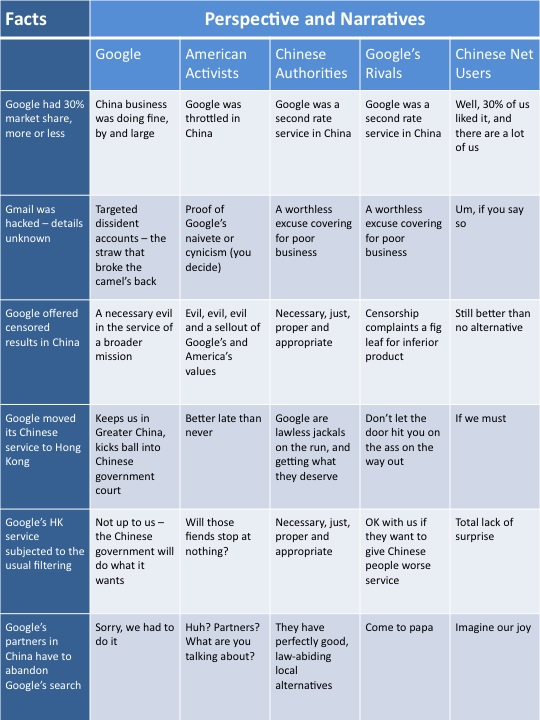
What I did do, however, was to put together a handy chart that shows the key known facts, and, based upon all the articles I’ve read, how each of the major interest groups that I observe is spinning or reacting to each of those facts. In each case, the vertical thread through the series of facts creates the skeleton of a narrative. And that’s what each of these parties –Google, its rivals, the Chinese government, the Western activist community– is trying to do: They’re each trying to control and define the narrative of Google’s situation in China to serve their own agendas. They are, in other words spinning. Here is what the result looks like:
I realize this is a vast oversimplification and there are no doubt various interests omitted, but this captures most of the main parties and facts. What’s not included here is any kind of conclusion of each narrative. In my opinion, the story is still unfolding and its too early for that. But we’ll see how things go over the next few weeks.
The other thing is that these narratives aren’t in equal competition. To use a possibly inappropriate military metaphor, there are different theaters of operation in which the stakeholder have varying levels of influence. So, in the US, Google and the activist (and analyst) community are the loudest voices. in China, the Chinese government has the tools to define the public narrative, and has been using them liberally, although there is some ferment in the margins (also here).
Eventually, there will be a canonical version of Google’s misadventures in China. or at least one canonical version in the West and one in China. These may not be the creation of a single group. One group might control interpretation of one element of the story, and one group control another. But for the moment, the fun is in watching the battle to own the story. Enjoy it while it lasts.
Finally, from a PR perspective, there is possibly one overarching lesson that can be drawn from this whole situation. I can’t take credit for this insight, it comes from Craig Adams, a colleague of mine. But it’s deceptively straightforward and I agree with it wholeheartedly. He said that if you have to sell out your basic principles to do business in China, that’s a pretty good sign you should reconsider your plans.
Other sources (just to prove I’ve done my homework):
Yes, it’s true. Those Chinese death-nerds are everywhere. They’re in your bank account. They’re in the Pentagon. They’re sending naked pictures of themselves to your daughter. And they’re completely invulnerable to all known countermeasures!
Or at least that’s the terrifying conclusion one might draw if one was to read a long article from the Washington Times with the chilling headline, “China blocks US from cyber warfare.” Now, the Washington Times and this journalist in particular have–how shall I put it?–a distinct point of view on China, and it’s perhaps just a tad darker than my own. But I find this story interesting less on its own (thin) merits and more because it represents the latest installment in what seems to be something of a fad in hair-raising stories on the Chinese cyber-security threat. My heavens, are we having a meme?
You may recall that this idea began rolling in its most recent incarnation with a report about Ghost Net, in which the link to the Chinese government was unclear but widely assumed. It gathered steam with a rather vague Wall Street Journal article about Chinese “spies” hacking into the US electricity grid. With this Washington Times article, which has been picked up by AFP and thus relayed to Yahoo and other portals, it’s reached something of a loony crescendo. You’d think bureaucracies in Washington were competing over turf and budgets and thus doing their best to dial up the general anxiety level in order to exert political leverage. Because, you know, what with the economy, two wars, the Taliban destabilizing Pakistan and Swine A/H1N1 flu we so desperately need one more thing to be afraid of.
The Washington Times article really is in a class all by itself, though. It focuses on the devastating implications of a “hardened” Chinese operating system that, to read this article, makes Chinese government computers essentially hack-proof. It is based largely on the testimony (PDF) of Mr. Kevin Coleman, one of nine witnesses speaking before the US-China Economic and Security Review Commission on April 30th. (The USCC makes periodic recommendations to congress on the national security implications of trade with China.) There is no one part of the article can single out for an excerpt, so I’ll instead give you a rundown of the highlights. The article features:
An IT security consultant (Mr. Coleman) who “advises the government on cybersecurity” telling us that the Chinese are outplaying us badly. Because what do you expect him to say? “It’s all good. I’m done here.”
Terrifying absolutes, such as this quote on the effect of China “hardening” it’s servers with this new operating system:
“This action also made our offensive cybercapabilities ineffective against them, given the cyberweapons were designed to be used against Linux, UNIX and Windows,” he said.
The suggestion that the revelation of this operating system is somehow an intelligence coup, on par with the cracking of Enigma:
The secure operating system was disclosed as computer hackers in China – some of them sponsored by the communist government and military – are engaged in aggressive attacks against the United States, said officials and experts who disclosed new details of what was described as a growing war in cyberspace.
Further vague but terrifying details designed to emphasize our inferiority:
Additionally, Mr. Coleman said, the Chinese have developed a secure microprocessor that, unlike U.S.-made chips, is known to be hardened against external access by a hacker or automated malicious software. “If you add a hardened microchip and a hardened operating system, that makes a really good solid platform for defending infrastructure [from external attack],” Mr. Coleman said.
Hopeless over-generalizations of dubious technical soundness:
U.S. operating system software, including Microsoft, used open-source and offshore code that makes it less secure and vulnerable to software “trap doors” that could allow access in wartime, he explained.
Quotable quotes:
“What’s so interesting from a strategic standpoint is that in the cyberarena, China is playing chess while we’re playing checkers,” he said.
The devastating revelation that the Chinese government is hiring hackers!
A third computer specialist, Alan Paller, told the Senate Committee on Homeland Security and Governmental Affairs on April 29 that China’s military in 2005 recruited Tan Dailin, a graduate student at Sichuan University, after he showed off his hacker skills at an annual contest.
Mr. Paller, a computer security specialist with the SANS Institute, said the Chinese military put the hacker through a 30-day, 16-hour-a-day workshop “where he learned to develop really high-end attacks and honed his skills.”
Meaningless statistics:
Mr. Coleman said one indication of the problem was identified by Solutionary, a computer security company that in March detected 128 “acts of cyberagression” per minute tied to Internet addresses in China.
“These acts should serve as a warning that clearly indicates just how far along China’s cyberintelligence collection capabilities are,” Mr. Coleman said.
Just plain goofyness:
Mr. [Joel] Brenner [national counterintelligence executive] said there are minimal concerns about a Chinese cyberattack to shut down U.S. banking networks because “they have too much money invested here.”
Well, thank god for that!
It’s hard to know where to start with this article, but perhaps I should begin by saying, of course the Chinese government is conducting cyber-espionage against the US. They’d be stupid not to. And of course they are concerned with securing their own critical systems against the United States’ equally inevitable cyber-espionage. Again, they’d be stupid not to. And certainly the US government needs to take information security seriously. And so do businesses. And so does your grandmother. Especially if she’s using Windows. All granted.
And it’s nice that various American government bureaucracies are having a pissing match about who should oversee American cyber-security at a government level (the end of the article hints at that a bit). I hope somebody wins someday. But, really, do we need to frame all of this in such Michael Bay terms? Let’s take a closer look at this super-secure operating system, “Kylin”. It’s hardly a secret, having been in the press since at least 2004. You can even download the ISO files, which suggests security somewhat shy of, say, the Manhattan Project. I’m thinking Langley may have a copy. A fairly sketchy DIY site promisingly called “Cheapest-computer-hardware-software.com” has the skinny (all Chinglish is sic):
The Kylin operating system focuses on high performance, reliability and security. The development program was first funded by the Chinese government sponsored R&D program during 2002. The operating system developed in a hierarchical model, in which, the kernel layer is based on Mach, the system service layer is based on FreeBSD and the desktop environment is similar to that of Windows. The operating system standards are similar to UNIX standards, and are highly compatible with Linux binaries.
***
The operating system was on development at the National University of Defense Technology. The operating system was designated as the document processing operating system. It can now turn China into super power in IT product development. The powerfulness, stronger security of the operating system may make Chinese people to replace the foreign operating systems. In China, Kylin was listed among the best 10 scientific and Technological Progresses News of Higher Learning Institutes during 2005.
***
The dominance of IT product by the foreigners in China will get reduced, once this operating system made popular among Chinese population. The security of data will be stronger, because, it is being developed by the Chinese government and people themselves.
So, the indestructible Chinese operating system is FreeBSD + Mach. Yes, that’s right, the operating system that frees them from foreign innovation and with which China will conquer the world is a less slick version of Mac OS X. Well, I hate to break that to the scare-mongers Washington, but we have that technology also. As for the secure microprocessor, I hope he’s not talking about Godson, the domestic chip project that languishes in the same commercial phantom zone as the domestic video disk project (EVD) and the domestic WiFi standard project (WAPI).
Why would I trust some half-assed and likely Chinese no-name site over the best and brightest of Washington DC? Well, for one reason, the language in the extract above rings absolutely true. Second, let’s just say I’m getting agenda sensitivity on this issue. Sure, it’s possible this is all part of some huge Chinese disinformation campaign and I’m just another useful idiot, talking down the crowbar that the Chinese state will someday use to pry open the secret folder where I keep the naughty photos of Mrs. Imagethief. Maybe there are two Kylins, and I’ve got the wrong one. Maybe Kylin + Godson is the shit, and I should trade in my MacBook Pro.
Or, just conceivably, people with their noses in the Washington trough are blowing smoke up my ass. Let’s face it, it wouldn’t be the first time.