Tag: Propaganda

  • Chinese cyberspies? Sheer lies and heinous fabrications!

    Alright, I confess I made up the “heinous fabrications” bit. But the “sheer lies” sound bite comes straight from China’s Ministry of Foreign Affairs, which has clearly worked hard to make sure that its representatives around the world are working from the same talking points.

    China has found itself accused of a lot of hacking recently. A March 28 New York Timesarticle covered the dreaded “GhostNet”; innocent computers ruthlessly compelled to do the bidding of alleged shadowy overlords in Beijing (which bidding was, apparently, to screw with Tibetan exile organizations). More recently, a story in the Wall Street Journalreported on attempts to hack into the systems controlling America’s power grid, some of which apparently originated from China and Russia.

    The Chinese government had chances to rebut both stories. Here is a Beijing-based Ministry of Foreign Affairs spokesman responding to a “GhostNet” question in a regular media Q&A the day after John Markoff’s story broke in the Times:

    “I have noted before that the Chinese Government has always taken cyber-safety very seriously. We resolutely oppose any crime including hacking that destroys the internet or computer network, which is stipulated in relevant Chinese laws and regulations. The current problem is, some people overseas are indulged in fabricating the sheer lies of the so-called cyber-spies in China. What I have seen is a ghost of “Cold War” and a virus of “the China Threat” mentality. The China Threat virus on those haunted by the Cold War ghost strikes from time to time. Their attempt to defame China will get nowhere.”

    And here is Chinese Embassy spokesman in Washington DC responding to the electric grid issue in the Journal (responding in writing, I would guess):

    [The Chinese government] “resolutely oppose[s] any crime, including hacking, that destroys the Internet or computer network” and has laws barring the practice. China was ready to cooperate with other countries to counter such attacks, he said, and added that “some people overseas with Cold War mentality are indulged in fabricating the sheer lies of the so-called cyberspies in China.”

    Well, that’s message discipline for you. And it would be admirable discipline indeed, were the talking points not the usual throwback language that always sounds better coming off of a red-ink woodcut with a picture of Mao in a sunburst than off of the pages of, say, theWall Street Journal. The only thing reminiscent of the Cold War here are those quotes.

    Of course the Chinese government, like all governments with access to electricity, is probably involved in computer-espionage and computer-warfare programs. But it obviously has to deny any involvement in polite company. That’s a given, and no-one can blame them. There are even some good bits and pieces in both responses above: “Always taken cyber-safety very seriously”, “oppose [activities] that destroy the Internet”, and “ready to cooperate with other countries”. Unfortunately, the usual, overly scandalized language wrapped around those bits and pieces does nothing to help. It makes the spokespeople sound, to abuse Shakespeare’s Queen Gertrude, like they are protesting too much. The good stuff gets lost.

    If I was rewriting their talking points, I would take a classic broadening approach where you turn the accusation everyone’s problem. You can see the beginnings of this in the embassy spokesman’s quote. I might suggest something like this, which takes the good bits from both responses and loses the righteous anger:

    “The Chinese government takes Internet security very seriously, and is opposed to any activities, including hacking, that make the Internet less secure or less useful. Internet security is a concern for everyone who uses a computer. As you know, internet use has been growing rapidly in China. This year we passed 300 million users, and now have more people online than any other country. The Internet has been a great contributor to growth and innovation in China, so no one takes these issues more seriously than we do.”

    If you wanted to be extra-saucy, you could build a bit on the embassy spokesman’s cooperation statement and say,

    “We stand ready to cooperate with the governments of other Internet using nations to find ways to improve global Internet security for all users.”

    Less quotable, perhaps (short of a threat to kill the questioner’s pets, what wouldn’t be?), but also much less of that how dare you? tone that comes off so defensively. As we say in PR, you can’t control the questions you get asked, but you can always control the answer you give. Why not take the opportunity to say something positive instead of just reeling off an angry denunciation of the charges?

    And if you read the responses above carefully, denunciations is what they are. There is no outright denial in either of them. I doubt that’s a legal maneuver (after all, what are you going to do, sue them?) so much as a chosen rhetorical technique: Attack the credibility of the charge rather than denying it. If so, it’s shrewd on a certain level. Denials always look terrible in print. “I never stole those panties!” has “cover pull quote” written all over it. That’s why we always tell spokespeople not to “repeat the negative” in a question. But there are many things that could better replace an outright denial than straw men fabricating sheer lies.

    See also:

    James Fallows: What should we make of this Chinese cyber-spy story?

    Schneier on Security: US power grid hacked, everyone panic! Welcome perspective:

    Honestly, I am much more worried about random errors and undirected worms in the computers running our infrastructure than I am about the Chinese military. I am much more worried about criminal hackers than I am about government hackers.

    Nart Villeneuve of the Internet Censorship Explorer on the hype-factor in the article.

  • If you’re angry about Guns’n’Roses surely it must be 1991

    Let’s all take a moment to appreciate the Global Times, the nationalist tabloid cousin to the staid People’s Daily, which has decided to get indignant about the new Guns’n’Roses album, “Chinese Democracy”. It’s not that the Chinese people don’t have some cause to be angry. After all, the title is somewhat provocative, and the title track itself makes mention of the dreaded FLG. It also includes the following verses, which are pretty much worth getting angry about simply on artistic grounds alone, regardless of nationality:

    Cause it would take a lot more time than you
    Have got for masturbation
    Even with your iron fist
    All they got to rule the nation
    When all we got is precious time
    All they got to fool the nation
    When all I got is precious time

    Yep, you’re on the artistic edge when you’re rhyming “masturbation” with “nation” in an oblique criticism of China’s political system. Or maybe you’re just on your second bottle of Wild Turkey and your sixth line of Bolivian fairy dandruff. Who knows? Either way, as a musical critique of China, it’s ways from the sly, ironic rage of Roger Waters’ “Watching TV” (which is itself a ways from Waters’ best work). And Waters played live in Shanghai not very long ago, although I doubt he played that particular song.

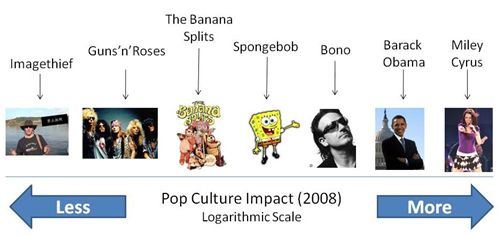
    But Guns’n’Roses? Guns’n’Roses?  The band singer that took so long to get this album out that the phrase “Chinese Democracy” is now, with perhaps unintentional aptness, a music industry euphemism for a project that never ends? My friends, if you’re getting worked up about this record then your yardstick for cultural relevance is perhaps in need of some recalibration. And fortunately for you, Imagethief can provide that recalibration. In terms of gross influence on society and popular consciousness, Imagethief rates Guns’n’Roses circa 2008 thusly:

    pop-culture-scale

    Arguably, Miley Cyrus is also past it, and should be replaced by the cast of “Twilight”.

    All pop acts, and most pop-culture in general, reflect a particular moment in time. There is no such thing as “timeless rock”, only formerly timely rock that has aged well. I say that as a bona-fide classic rock fan who learned to play bass by jamming over Hendrix records, Pink Floyd, Zep, The Stranglers, and other dinosaurs. Guns’n’Roses, for all their hostility and edginess, needs to be recognized for what they actually were: The last of the LA hair-metal bands. The final, angry stand of a cornered ’80s genre. “Appetite for Destruction” came out in 1987, but languished for a year before it gained real notice. By the time “Use Your Illusion” came out, in 1991, about the time I was launching my college radio career, the band still had some juice but in fact most rock fans and and the industry itself were already up in Seattle trying to figure out exactly exactly what a “Mudhoney” was.

    Some rare bands and pop musicians endure, reinventing themselves to stay relevant. That’s why, although I don’t much like her music, I have fair respect for Madonna. She has accomplished the near impossible with almost twenty-five years of pop-music success and reasonably consistent relevance. (Although, note to Hollywood, please don’t let her approach either end of a movie camera ever again.) But most bands, even if they do successfully endure and reinvent themselves, have a peak when they hit maximum alignment with the zeitgeist. Even those that stay successful thereafter are usually living on borrowed time and aging fans, like a human body that deteriorates inexorably after the late teens no matter how healthy it is kept.

    So let’s take that equation and add to it not releasing an album for seventeen years. Just how long has it been since the last Guns’n’Roses studio album? When it came out, Deng Xiaoping was still a year away from making his famous “Southern Tour”, the climax of the factional battles that resulted in China’s economic opening to the world. Going after them could be considered quixotic, if Don Quixote had tilted at pinwheels.

    Thus, when the Global Times published the headline (via CNN), “American band releases album venomously attacking China”, lent credibility to Chinese net gossip that the album was a Western plot to “grasp and control the world using democracy as a pawn”, and wrote that the the record “turns its spear point on China,” they were committing a classic PR sin: Drawing attention to an unworthy critic.

    Let’s illustrate this principle. Let’s say you’re Enormocorp, a gigantic, publicly listed conglomerate with its fingers in a myriad of businesses that span the globe. One day a small, pimply boy with his finger jammed up his nose walks up to you and says, “You suck!” What is the correct response?

    The correct response is something along the lines of turning to your friend and saying, “Did you hear something?” It is not putting out a global press release on your non-suckyness, sending your CEO to do the Sunday talk shows to refute suck allegations and publishing white papers on all the anti-suckage measures that you are undertaking. Doing this is drawing attention to an unworthy critic, someone who’s ability to genuinely affect public perception is essentially nil. We call this “PRing the problem.” Global Times has PR’d the problem.

    But I suppose it’s their job to do so. The angry rhetoric will play to readers and shift newspapers, which is the real job of any newspaper. So while it makes little sense from a national PR or defending-Chinese-ears point of view, it makes plenty of sense from a business point of view. As long as you don’t mind the cynicism of accepting that a legion of people who otherwise wouldn’t have bothered will probably stampede to Baidu to run MP3 searches for “Chinese Democracy” (or the Chinese nanny-defeating linguistic spoof thereof) as a result of the article.

    Personally, Imagethief thinks the Foreign Ministry, which was quoted in the same CNN article, had it dead right when they were asked about the album:

    “We don’t need to comment on that.”

    Note: Imagethief owns “Appetite for Destruction” and considers it one of the great workout records of all time. He has not, however, listened to “Chinese Democracy” yet. Who knows? Maybe it rocks.

  • Tibet and the trouble with unassailable national myths

    Outside of Young Frankenstein there isn’t really any such thing as a “good time” for rioting, but this might be an especially bad time for China to have a bout of punishing ethnic unrest. It hasn’t really been a banner start to the Olympic year so far, what with the worst storms anyone can remember, the Darfur activists on a tear, the bizarre Uighur terrorism story, and now this. Commentators are already linking this episode to China’s Olympic fortunes (see also the LA Times, Time, Asia Sentinel and Newsweek), and the French foreign minister has already been spotted talking about a partial boycott. Even Wen Jiabao has suggested that the riots were calculated to damage the games.

    Things seem to have quietened down in the last couple of days, although that may simply be because reporting has been stifled. Certainly the flow of news has dwindled a bit, and many publications have shifted into context and analysis mode. But we can probably expect bits and pieces of information to dribble out over the next few weeks, as refugees leave Tibet and a few intrepid journalists break the cone of silence that that the Chinese government has dropped over the troubled areas. In the past few days many of our favorite local correspondents have made a run for the Tibet border, but blog posts, such as fromTim Johnson and Richard Spencer (and again here), suggest it’s tricky getting any reporting done.

    The Foreign Correspondents Club of China has already petitioned the government for better access to the affected areas and circulated a list of incidents in which journalists and camera crews have been detained or hassled by the authorities. It would seem that Olympic pledges of greater openness were tested in the breach and found wanting. This, I suppose, shouldn’t surprise anyone. Old instincts die hard. The Chinese government has also reverted to its common tactic of belittling foreign coverage as intentionally biased. If this happens during the Olympics then, to borrow a line from Gerry Anderson, stand by for action.

    Over the past few days, China’s communication strategy with regard to the Tibet riots has become clear. It has consisted roughly of the following:

    • Ban all international access so that Chinese media can monopolize images and on-site reporting
    • Cinch down on the Internet (here too) and international news sources so that messaging to domestic audiences can be tightly controlled
    • Demonize the Dalai Lama as the black hand behind the rioting in throwback, Cultural Revolution language, and drive the point home with images of rioting monks

    These three are all true to type. But then it gets more interesting:

    For a good overview of the Chinese approach to all of this, see Mark Magnier’s interesting article on China’s PR efforts around the Tibet riots. It includes this damning quote from Chinese blogger and journalist Michael Anti:

    “The [Chinese] government is showing more confidence and learning more about spin,” said Michael Anti, a well-known Chinese blogger on a Nieman fellowship this year at Harvard. “They’ve learned more PR tactics from Western people. They see the way the White House and the Pentagon do it.”

    In some ways China’s strategy has been effective. They’ve certainly done a good job back-footing the Dalai Lama, who made the mistake of not condemning the violence forcefully and immediately. Domestically it’s been gangbusters as usual. But the Chinese government shouldn’t be too proud of itself yet, because there remains one substantial problem: China has invested so much in its narrative of Tibetan development and growth that it is reluctant take any actions that undermine this story. This prevents them from communicating internationally in a way that foreign audiences will be receptive to, and it stores up serious ethnic problems for the future.

    China’s prevailing narrative about Tibet is that China liberated it from feudal brutality and gave it all the wonders of development. The great mass of Tibetan people understands this and is duly grateful. This narrative has been thoroughly sold domestically, but it has never been widely accepted in the West.

    While there are elements of truth to China’s version, China’s ability to sell it internationally has always been hampered by the government’s time-honed credibility gap with western audiences. This is exacerbated by the difficulty of getting independent points of view. Reporting from Tibet was heavily controlled even before the riots. Furthermore, International opinion is subject to an effective PR campaign run by Tibetan exile groups and the charismatic Dalai Lama. It’s safe to say that International audiences will never be entirely convinced by a Chinese state narrative that doesn’t even allow for the possibility that there might be genuine discontent in Tibet. China is much better at dictating ideas to a captive audience than at selling them to an open one.

    Historically, it hasn’t really mattered to China’s government what International audiences think about Chinese domestic issues. But 2007 was the year in which China discovered the importance of International stakeholders. This began with the product quality crisis that erupted last summer, and it has gained strength over the Olympics in the past few months. The reality is that a global, economically integrated China that has invested hugely in hosting the world’s biggest sporting event is vulnerable to foreign public opinion. That’s why it stung so much when Steven Spielberg (who must be feeling pretty good about this right about now) withdrew from official participation in the Olympics. If it hadn’t stung, you’d have seen a lot less indignant Chinese press coverage about it.

    If foreign stakeholders can boycott your products, screw up your outbound investment or trash the most glamorous event you’ve ever hosted, you need to develop some PR game. Unfortunately the mechanisms that have served China’s government so well over the years, a combination of explicit control over domestic media and pervasive state propaganda, don’t translate well to International audiences, and it has yet to learn a new approach. The need to defend the national narrative at all costs means that foreign media have to be kept away from Tibet, lest they reveal the cracks in the edifice. Heaven forbid that those inconsistencies make their way back to domestic audiences and undermine the national myth of Tibetan success and perhaps even government legitimacy. Tibetan integration –or suppression depending on your point of view– is part of Hu Jintao’s personal legacy as former Tibetan party chief and author of the crackdown on the 1989 demonstration. Unfortunately, nothing says, “We have terrible things to hide” to a foreign audience like detained or harassed journalists.

    China’s growing international exposure aside, it must be tempting to wave away international concern as interference in China’s internal affairs. Unfortunately, another problem with defending the myth at all costs is that this approach seems calculated to inflame ethnic tensions rather than dispel them. Coverage of the riots suggests that much of the violence was Tibetans taking out their frustrations on Han who simply had the bad luck to be in Lhasa. That’s a shame, and the Chinese authorities are justified in seeking out and punishing those who have committed crimes against people and property. But the job of government is to ameliorate ethnic tensions within the country, not exacerbate them. Xinhua’s heavily spun coverage of the disturbances seems calculated to stoke outrage among the Han majority, and the Internet comment that has been allowed to stand echoes with that outrage, if not universally at least widely. Much of the Han comment reflects common colonial sentiment toward natives: Tibetans are lazy, ungrateful, intractable. Worrying signs for a country that disavows any colonial inclinations and preaches integration.

    This is where the “cost” element of maintaining the myth at all costs really becomes clear. If the national narrative leaves no room for entertaining the notion that regular Tibetans might have legitimate grievances, then there is no hope of recourse for Tibetans and no alternative for non-Tibetan Chinese but to see the unrest as pure betrayal and thuggery. It becomes impossible to even acknowledge underlying problems in any constructive way. All that is left is ruthless crackdown and an ever-widening gulf between the two peoples.

    Unfortunately, the more the Han majority sees Tibetans as ungrateful, violent dupes in the thrall of a sinister Dalai Lama, the harder any kind of real reconciliation will be. Mutual suspicion, hatred and racism-without-end loom. One wonders what will happen if Dalai Lama dies and there is still unrest in Tibet. Who will they blame then? There is a harder-line coterie of Tibetan exile leaders waiting in the wings, but none of them will fill the role of China’s “Goldstein” as well as the Dalai Lama does.

    The best thing China can hope for now is that things stay quiet and the episode fades from view over the next few weeks. But that isn’t a long-term solution. In the end the situation is a tragedy not just because it was violent and ugly, but because it was a wasted opportunity. China could have introduced some transparency, allowed foreign reporters in, and started earning itself greater international credibility at a time when it desperately needs it. China could also have used this as an opportunity to move beyond its propagandistic approach to the problem of Tibetan integration, and to kindle a real national discussion on how to address the concerns of Tibetans in a way that might make integration a reality rather than a propaganda slogan. Done correctly, this need not have looked like succumbing to foreign pressure.

    But that’s not how things are done here. That’s a shame, because no matter what wishful thinkers overseas want, Tibet will be a part of China for the foreseeable future. That will lead to continued problems. And as everyone knows, its hard to solve problems if you can’t admit to them.

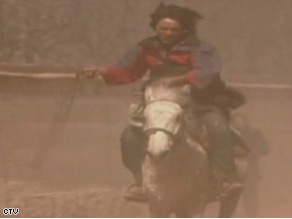
    Horseman of the apocalypse.
    Horseman of the apocalypse.

    See also:

  • Was the China corruption website collapse story “newsiness”?

    The greatest contribution that comedian Stephen Colbert has made to modern society is the concept of “truthiness”. Reading from the Wikipedia definition, truthiness is:

    …a satirical term to describe things that a person claims to know intuitively or “from the gut” without regard to evidence, logic, intellectual examination, or facts.

    Miraculously, the entry goes on for another 3400 words on the concept of truthiness, proving not so much that truthiness is an important concept as that Wikipedia is balls-out for pop culture. Nevertheless, “truthiness” has transcended its comic-neologism origins to become a legitimate word, which says something about the zeitgeist.

    Imagethief wishes that Colbert had similarly enshrined the concept of “newsiness”. Borrowing from the definition above, newsiness could be described as a satirical term to describe things that a person claims is important or newsworthy without regard to evidence, logic, intellectual examination or facts. It feels like news, whether it really is or not.

    This is something that we flacks are familiar with. At our worst PR types trade in newsiness, packaging up bits of corporate dander and passing them off as significant. But we’re not exclusively to blame. Sometimes newsiness arises spontaneously in the form of a story that is less than meets the eye. Last week’s story concerning the collapse of the National Bureau of Corruption Prevention’s new website under apparently heavy traffic strikes me as an example of newsiness.

    Foreign coverage of this story can be traced backed to a Beijing Youth Daily article, which I don’t have a link for, and a subsequent English-language Xinhua report that was deftlymassaged into final form by our own Chris O’Brien of Beijing Newspeak. The story was that the recently constituted National Bureau of Corruption Prevention, a relatively toothless body set up to “collect and analyze information” on corruption, launched a new website that included a guestbook function enabling members of the public to post semi-anonymous comments. However the website crashed within hours of launch due to a “large number of visitors”.

    This fits very nicely into one of those social-issue memes that define much foreign news coverage of China, and that often take the form of “a nation struggling with [insert social issue here]“. Examples are a nation struggling with pollution; a nation struggling with censorship; a nation struggling with Internet addiction; and so on. The issues are set up via colorful or heartstring-yanking anectodes often involving stoic, salt-of-the-earth 老百姓 types recalling their woes, and rounded out with a mix of quotes from NGOs/overseas experts/local academics/old China hands and the kind of eye-popping statistics that China excels at generating and that make pretty much any problem here seem thoroughly intractable.

    In fact, much good journalism is done this way and it works well for the home audience that reads one newspaper. But if, like Imagethief, you are a news junkie living in China and you read vast troughs of China coverage from a range of publications, it’s hard not not to notice the formula.

    This system also promotes the dissemination of lightweight stories that simply fit into issues established by precedent. This particular story originated via the Xinhua article, which seems to have originated as a “why our website went down” disclosure formality. It plugged nicely into the “nation struggling with corruption” meme and was duly picked up by the foreign press, almost all of which cited the Xinhua article. The tone and detail of the foreign stories vary a bit, but looking at the headlines and ledes a clear mental picture emerges:

    Reuters:
    China anti-graft Web site felled by “too many hits”
    BEIJING (Reuters) – A Chinese government Web site encouraging citizens to report corruption crashed on its first day under the weight of too many hits.

    AFP:
    China anti-graft website crashes under public complaints
    BEIJING (AFP) — The website of China’s new anti-graft bureau crashed shortly after going online due to the huge volume of messages from the public complaining about rampant corruption, state media said Wednesday.

    Telegraph:
    China’s new anti-corruption website crashes
    A Chinese government website set up for the public to complain about corruption crashed within a day of launching under the volume of cases reported.

    The website was constructed by the National Bureau of Corruption Prevention to collect information on corrupt activities as part of an ongoing purge by the Beijing authorities.

    Associated Press:
    Anti-graft Web site swamped in China
    BEIJING: A new Web site created by China’s anti-corruption bureau crashed after barely a day because too many visitors had tried to log on to register complaints, state media reported Wednesday.

    Washington Post:
    Chinese Assail Official Misconduct With Fervor
    BEIJING, Dec. 19 — China’s new National Bureau of Corruption Prevention thought it would be a good idea to open a Web site for citizens to denounce crooked officials. The idea was so good that the site was immediately deluged this week by irate Chinese, overwhelming the system and causing several crashes during the first two days of operation.

    So what did you see in your head? Imagethief saw an image of zillions of oppressed Chinese people desperately clicking on the NBCP’s web page. This is image was helped along by the recent, widely publicized woes of BOCOG’s Olympic ticket sales website, which really did crash under the fevered clicking of zillions of people. But unlike the Olympic ticketing stories, in which the actual traffic and transaction load on the site was reported, the only figure in any of the stories above is the number of pages of comments, ranging from 16 to “more than 20″. Only the AP story lists a specific number of comments: 250. An NBCP official was quoted in the Xinhua article as saying, “The number of visitors was very large and beyond our expectations.”

    Well, yes, but what were your expectations?

    Hoping to find more information, Imagethief took himself to the site for a first-hand look. As of last Friday there were still about 20 pages of comments, each with fifteen individual posts, for a total of about 300. Anyone who has spent time on a popular Chinese blog or in the forums knows that this is pretty small beer. For comparison, when CCTV 9 anchor Rui Chenggang condemned the Forbidden City Starbucks on his Sina blog just under a year ago, he got 450 comments in 24 hours, on his way to nearly 3000. Sam Flemming’s CIC, which monitors Chinese online buzz, tracked over 4 million posts on automobiles in the three-month period from April-June of this year (full report — PDF, registration required).

    These are not entirely fair comparisons. The degree of freedom people feel to comment about corruption is not the same as they feel to comment on the Chery QQ or foreign coffee shops, and the overlap of corruption victims with Internet users is smaller than that of car aficionados. But it does introduce some perspective on what constitutes a “hot” online issue in China.

    Corruption is a real issue here. The corruption website collapse story is neat enough to tie a Christmas bow around, and the foreign reports are all factually accurate, insofar as they essentially relay the Xinhua report. But what does this incident really say about Chinese society and the problem of corruption? There is a big difference between a site that was designed to support tens or hundreds of thousands of simultaneous visitors and was still overwhelmed by crushing demand, such as the Olympic ticketing site, and a small-potatoes site that fell over under moderate traffic or because it was designed, programmed or tested badly. Imagethief designed and developed e-commerce sites for many years and can assure readers that this a common problem. But “China anti-graft website collapses under public complaints”, to borrow one of the headlines above, is going to get many more people reading than, “China anti-graft website collapses because of poor programming”.

    Fine. That’s the news business. Gotta get eyeballs on the page, and Imagethief, a subway commuter who reads on the way to the office, likes a punchy newspaper as much as the next guy. No harm in relaying a vacuous Xinhua story (sorry, Chris — not your fault), especially when it fits so neatly into an existing pigeonhole. It’s still “newsiness”, but if nothing else it can help keep our minds off of much more worrying things, like the ever dumber things American politicians are saying about China.

  • What to make of Edwin Maher?

    Imagethief found the LA Times article on CCTV9′s western anchorman, Edwin Maher, quite interesting. I didn’t have time to comment on it when it first appeared, but in general I found the story balanced as it presented both criticisms and defenses of Maher’s choice to work for Chinese state-owned media. It was, thus, interesting to see some of the subsequent discussion that emerged, especially at Black and White Cat, which translated aGlobal Times article excoriating the western press for criticizing Maher.

    Rather than rehash old ground, I will point you to Cam MacMurchy’s latest post at Zhongnanhai, which, I think, does a very good job of answering the Global Timescriticisms and analyzing the original story. It’s well worth a read.

    I will, however, add a few other thoughts.

    What is it about westerners who appear on television that attracts our particular ire? Anyone wanting to look deeper into this phenomenon need only consider Dashan. If there is a foreigner who elicits more widespread contempt from fellow western expatriates I’ve yet to encounter him (or her). One friend of mine attributed this to latent racism. It’s all very well to live and work in China, but to be seen acting ridiculous for the entertainment of the Chinese is taboo. My friend memorably referred to this as the “Dance, monkey!” syndrome.

    Maher seems to have earned himself the same kind of contempt. Even Imagethief has written unkind things about him in past. But everyone who works in business in China is complicit with the Chinese government to some degree. We’re all doing our bit to prop up the State. An explicit part of my job is helping foreign companies to pander to the Chinese government. That’s why we’re always helping companies to talk about their “commitment to China”.

    It’s true that anything having to do with propaganda or censorship touches a particularly raw nerve in people from liberal democracies (including Imagethief), but there are plenty of other westerners working in the Chinese media. Imagethief has met many bright people who work or have worked for Xinhua, China Radio International and the China Daily.  One of them, Xinhua polisher Chris O’brien, writes Beijing Newspeak, one of the best China blogs around. The now defunct Positive Solutions gave us an entertaining inside look at the China Daily for nearly two years. (Positive Solutions author Charlie has since gone on to more glamorous things, like many other western veterans of Chinese media.) Cam himself is a Chinese media veteran.

    But both Chris and Charlie also excelled at taking their employers down a peg, and giving the rest of us amusing glimpses of the mechanisms driving state-owned English language media. I believe they were forgiven because they were seen as our spies inside; people who obviously didn’t buy into the product. And, of course, neither of them was in a publicly visible or bylined role.

    And this is where Maher is different. He is very visible and in the LA Times piece he is unapologetic. I believe that’s what leads those of us who don’t know him personally to dismiss him. We observers of China’s state-owned media have perfected our airs of cynical dismissal. We know how it works. We know the agenda. We can read between the big and clumsily drawn lines. We’re always happy to ridicule its amateurism and censorship. Armed with our prejudices, when confronted with someone who publicly buys into the mission of China’s English language media we are forced to see them as either dupe or collaborator. And also, if you want to be incendiary, as race traitor. None of those labels allows much room for nuance or charity.

    I don’t know Edwin Maher and I don’t think it is fair for me to judge him as an individual. On the other hand, I think it’s perfectly fair for me, or anyone else who watches CCTV9, to judge him as a media professional. Other than as a crude barometer of the Chinese government’s agenda I don’t have much time for CCTV9, or any of the state-run English language media. Their failure isn’t in presenting the Chinese government’s point of view, but in doing so spectacularly clumsily. Maher shouldn’t be criticized for helping the Chinese government to tell its story. If anything, he should be criticized for not helping them to tell it better.

    See also:

    Inside Chinese state TV (Informed Comment – H/T ESWN)

  • Notorious MDA: The Singapore government raps

    From time to time someone will ask me why I left Singapore for China. This is a fair question. I lived there for nearly a decade, Mrs. Imagethief is Singaporean, and I have great affection for the place. Usually I give some longish explanation about various professional and personal frustrations that were beginning to set in. From now on, however, I’ll simply be able to point people at this video on YouTube:

    Via Singapore ultrablogger Mr. Brown, this is a four and  a half minute hip hop video produced by Singapore’s Media Development Authority. The MDA is the statutory board that regulates media content in Singapore and, as you would expect from its name, promotes the development of Singapore’s media industry. The video features the senior management rapping about their respective roles.

    God help me, I don’t know where to start on this one. But I’ll try. Remember how embarassing it was when you were in high school and your parents tried to act “cool” in front of your friends? Now imagine they did that and commited the results to posterity on YouTube. In your name.

    It is often remarked that the Chinese government considers the Singapore government a role model for successful technocratic authoritarianism. Whatever the Chinese government learns from Singapore, let us pray that it does not absorb the idea that rapping bureaucrats is a good idea. The State Council has enough on its mind what with the Olympics, mass rural-urban migration and the Yangtze silting up behind the Three Gorges Dam. They don’t need to be spending nights in the studio trying to figure out what rhymes with “Zhongnanhai” over a phat groove.

    Also, there are several people featured in this video, but not one of them has any discernible rhythm. Statistically you’d think one could carry a beat in common time. We’re not talking bebop here, or some kind of freaky experimental meter. One, and two, and three, hit the BEAT. Count it off, it’s not that hard. Not that they had much to work with. There must be some kind of award for coming up with hip hop lyrics that include the phrases, “KPI”, “service oriented architecture” and “beautify our fusionopolis”. If you can’t bring yourself to watch the whole thing, the lyrics are here. It’s not much easier to read than to watch or listen to.

    Having dispensed with the artistic criticism, let me approach this from a public relations point of view.

    Imagethief is all for using new media. If I squint hard enough and jam my thumbs into my eyes I can kind of see the rationale for doing this (although it could just be the flash of my retinas detaching). You want to explain the role of your bureaucracy in a catchy way that reaches out to youth and the creative industry. And some credit must be extended to the MDA for having, well, the balls to try this.

    Unfortunately, a pigeon with a nail through its skull would still have the brain power to predict the inevitable result of this project: a catastrophic piece of self-ridicule that drags out for four-and-a-half painful minutes every reason why government involvement in creative industries is a disaster. And why Singapore’s media industry is, like the site of a bad plane crash, so much lifeless wreckage. Seriously, these are the people promoting the development of Singapore’s creative industries? They hardly seem qualified.

    Mind you, this is not an internal video that leaked out. Apparently the video was originally distributed with the softcopy version of the MDA’s most recent annual report. It is also available straight from the MDA website, although as of this writing the site was down, possibly due to unintentionally high server load as people gape in slack jawed amazement and slight embarrassment. That’s why I haven’t been able to work out if there is a press release that explains their rationale.

    I’d like to take a moment and differentiate Singapore’s media industry and regulators from Singaporeans in general. There are many creative and talented people in Singapore. However it is my observation that they prosper despite the best efforts of the government,  not because of them. Indeed, it has long been Imagethief’s position that the responsibility of government with regard to art should begin and end at cutting cheques for the things that are so edgy, experimental or niche that the market won’t support them. For that reason I see the words “Singapore” + “media” + “development” + “authority” as oxymoronic.

    Good communication flows from sincerity, and part of sincerity is being true to who you are. This is especially true in music, where authenticity is essential to the message. That’s why a Mississippi John Hurt record sounds deep-down good but a Joss Stone record, despite her manifest singing talent, sounds a little like a con. One of the great joys of music is of course how genres transcend their origins and find mass acceptance. That has certainly been true of hip hop, where the musical tent has widened a great deal since the days of Kurtis Blow. The Beastie Boys proved long ago that Jewish kids from Brooklyn could do it too.

    But the tent still isn’t wide enough for Singapore government bureaucrats. Even bureaucrats need to be true to themselves in communication. It doesn’t mean that they always have to use soul-deadening PowerPoint or white papers. By all means they should roll up their sleeves, loosen their ties, mingle with artists and tell it straight. But just they should also recognize their limitations. Someone in their communications department should have worked this out and told truth to power. Unfortunately the communications director of MDA is one of the people in the video.

    The result is a lot snarky blogging (including here) and yet another example of the Singapore government getting itself written up as “odd news”. That is not communication success.

    The Singapore MDA is not the first bunch of suits to fall victim to siren call of hip hop as a tool for youth communication. They’re following a trail already blazed (if that is the right word) by Singapore’s ruling People’s Action Party. The Hong Kong Institute of Chartered Public Accountants also gave it a try with similarly dismal results. But at least they had some babes and “the ‘Tute” sounds like something you can smoke through.

    Anyway, having made it this far you probably have a bad taste in your mouth. Turn up your speakers and clear your palate with this.

    See also:

    The always funny Talking Cock’s wicked take on this, with photos.

  • The up is red

    Imagethief was enrocketed to read on Friday that China’s taikonauts –whom I prefer to call “astronauts” because “taikonauts” sounds like they should be exploring my sugar bowl– are considering starting a Communist Party cell in outer space:

    “If China has its own space station, the taikonauts on mission will carry out the regular activities of a CPC branch in space in the way we do on earth, such as learning the Party’s policies and exchanging opinions on the Party’s decisions,” said Yang, a delegate to the on-going CPC national congress in Beijing.

    “If we establish a Party branch in space, it would also be the ‘highest’ of its kind in the world,” said Yang, who is also deputy director of the China Astronaut Research and Training Center.

    It’s funny that Yang should say that, because the word “high” was definitely floating through my head as I read this. But Yang’s statement is a little unclear. Does he mean that that orbiting Communist party branch would be the highest Communist party cell in theworld universe, or the highest grass-roots political organization in the universe? He needs to choose his words carefully here. The former will be nothing more than a gentle slap in the face of the world’s less motivated communist parties. And, let’s be honest, no one really expects the Cubans, Laos or even the plucky Vietnamese to start lobbing cadres into orbit to compete with the Chinese ideological juggernaut. Heck, the Laos are happy when their national airline gets planes down in one piece (trust me, I’ve flown with it).

    But if it’s the former, well, that’s a direct challenge to Uncle Sam. You can expect a phalanx of red-blooded republicans to be launched into orbit James Bond/Moonraker style within moments. And I’ll bet you America will go one up. We’ll not only launch a party cell into space, we’ll raise money while we’re there. I’m not sure how, yet, but the Republican national committee will find a way.

    You may find it curious that I, a Democrat, mention Republicans here. After all, the American Lunar project was launched (metaphorically) by Kennedy, a Democrat. But somehow, I’ve always seen space flight as kind of a Republican project. Don’t ask me why. Maybe it’s the image of all those square-jawed Air Force types. Plus I am not sure the Democrats are organized enough to get a party cell into orbit.

    There is more in the story. It turns out that the Taikonauts wouldn’t be forming a party cell out of unfettered, Lei Feng-style loyalty to the cause. It’s more to do with the party charter:

    According to the CPC Constitution, a grass-root CPC organization should be established where there are three or more CPC members. The latest official figure shows that China has more than 73 million CPC members and about 3.6 million grass-roots CPC organizations.

    You got that? Three or more. That means you can’t even have your Communist Party friends over for a round of Poker without a party cell breaking out in your living room. How inconvenient. Having a road trip? Better limit yourself to two party members in your car unless you want to spend the whole drive to Guilin discussing dialectical materialism. Try drowning that out with Van Halen.

    “Like foreign astronauts having their beliefs, we believe in Communism, which is also a spiritual power,” said Yang. “We may not pray in the way our foreign counterparts do, but the common belief has made us more united in space, where there is no national boundary, to accomplish our missions.”

    I’ll pause here so you can inhale the aroma of full-bodied surreality drifting from this statement.

    Yep, that’s space. It’s either cowboy Jesus freaks or commies. Makes you wonder what the first lunar colonies will be like, and give thanks that you’re not likely to be living there. If this is who we plan on launching into the universe someday when the sun becomes a red giant (no pun intended) and consumes the Earth, then the rest of the universe had better look out. Frankly it’s amazing space aliens haven’t shown up to wipe us all out just as a precaution.

    And to think I wanted to be an astronaut when I was a kid. Those youthful dreams die hard. But I noticed another story last week as well (via the Wired blog). Coincidental timing? You be the judge:

    BEIJING (AP) — China hopes to join an international space station project that already counts leading space powers like the United States and Russia as its members, a government official said Tuesday.

    China takes great pride in its expanding space program and sees it as a way to validate its claims to be one of the world’s leading scientific nations. But China does not participate in the International Space Station, due in part to American unease about allowing a communist dictatorship a place aboard.

    ***

    “We hope to take part in activities related to the international space station,” Li Xueyong, a vice minister of science and technology. “If I am not mistaken, this program has 16 countries currently involved and we hope to be the 17th partner.”

    So, lemme get this straight. The Chinese are talking about starting Communist Party cells at the same time as they are asking for inclusion in the International Space Station? So much for “central planning”. This ain’t the strategy to get NASA to roll out the, um, red carpet. Try talking about how little oxygen Chinese astronauts needs or how they live for weeks on one tube of reconstituted porridge. But don’t talk about the Party. After all, the US government still holds the pink slip on the “international” space station, and the last thing they need floating through their overstretched, little heads is the image of zero-G Marxism study sessions.

    Come to think of it, it’s the last thing I need, too.

    He'll know what to do about this!
    He’ll know what to do about this!
  • Bang! China shoots its own Olympic PR in the foot

    Imagethief, who has bid for something on the order of RMB12,000 worth of Olympic tickets, is trying resolutely to remain optimistic about the Games. Unfortunately, it’s proving harder as time goes by. Tomorrow marks the one-year-remaining milestone. This should be an opportunity for Beijing to highlight progress, turn the excitement crank, and demonstrate that has the patience and forbearance that will be necessary for a successful Olympics. However yesterday brought an important test of China’s patience and forbearance, and China failed it.

    The problem is that while tomorrow’s milestone date is a legitimate time for celebration and anticipation, it was inevitably also going to be a perfect date for a dry-run by the many activist groups that want to appropriate the Olympics for their own agendas or score points against China. Sure enough, that is what has happened. Reporters Sans Frontieres,Human Rights Watch, the Committee to Protect Journalists and Amnesty International all chose this week to release announcements or hold protests.

    Of these, the RSF protest yesterday was most provocative. Activists wearing T-shirts and carrying signs that portrayed the Olympic rings as handcuffs staged a demonstration on a highway bridge near BOCOG’s headquarters. To add an extra measure of discomfort for Beijing, IOC Chairman Jacques Rogge happens to be in China right now.

    Unfortunately, reports say that foreign correspondents covering the protest were detained by police for one or two hours afterward and “roughed up”. From the AP coverage:

    [Uniformed] and plainclothes police physically restrained reporters coming down from the pedestrian bridge, pushing and pulling them, seizing IDs and refusing to allow them to leave the scene. Reporters were detained in a parking lot directly opposite the Olympics office tower, facing the Beijing 2008 logo and Olympic rings on the outside of the building.

    Journalists were allowed to leave after about two hours, with no explanation from police about why they were detained.

    A woman in the spokesman’s office of the Foreign Ministry said she did not know about the case and would look into it. Liu Wei from the information office of the Beijing Olympics Organizing Committee said she was not aware of the situation and had no comment.

    If that isn’t playing right into RSF’s hands I honestly don’t know what is. I found the reports somewhat confusing and had to dig around to get a clear idea if the journalists detained on site were protest participants or locally credentialed reporters covering the event. But it appears to be the latter. RSF’s own release suggests much the same.

    The best thing for Beijing to do under these circumstances would have been to err on the side of tolerance and allow the protest to proceed under supervision. Credit is earned slowly, painfully and in tiny increments while setbacks come in great, heaving leaps, and activists can win the PR battle by baiting the Chinese authorities into overreacting. Detaining journalists on the scene, under any circumstances, was asking for trouble.

    The result is not only that the protest is probably getting more coverage than it would have otherwise, but that the tone is distinctly nastier from Beijing’s point of view. Coming on the heels of last week’s widely covered FCCC survey and at the same time as all the other reports listed above, it looks very bad and reinforces people’s fears of what might go wrong during the Games themselves.

    The PR rule of thumb operating here is that response to an issue can become the issue if it is handled badly. That is a rule that Beijing needs to stay mindful of. Unfortunately, it seems likely that not all of China’s bureaucracies will be on the same page about this. It is entirely possible that BOCOG and the Public Security Bureau will have different opinions on how these kinds of situations should be handled. This might be someplace where the IOC could provide a little visible leadership, but they have stayed silent until now.

    Fair or not, China will be judged differently than other countries that host the Olympic Games. Now matter how glamorous the venues, how exciting the games, or how successful China’s athletes, the Games will be judged in large part based upon how gracefully Beijing can manage the inevitable protests. That is the price China pays for hosting the Games in a political environment that disdains many of the freedoms that the Games’ primary audiences abroad take for granted. The Financial Times‘ Beijing Bureau Chief, Richard McGregor puts it nicely:

    Over more than a decade Beijing has gradually defused pressure over its human rights record. Through remorseless diplomacy and skilful use of its growing economic clout, it has sidelined western complaints about human rights and marginalised the non-governmental lobbies that seek to promote them.

    The Olympics, however, are offering China’s critics a moment in the sun, and they have grabbed it eagerly.

    McClatchy’s Tim Johnson also captures the risk Beijing faces nicely:

    Because of China’s history of quashing revolt, any protest has the potential to become an iconic image, like the moment when U.S. athletes Tommie Smith and John Carlos raised their fists in a “black power” salute at the 1968 games in Mexico City.

    That’s an important thought to bear in mind. It will be interesting to look back a year and a month from now and see what the iconic image of the Games is. I sincerely hope it will be a moment of athletic triumph or a moment of Olympic splendor in one of those magnificent venues.

    After all, the Olympics are a magnificent opportunity for China. An opportunity not only to showcase the country’s development and rightful place on the international stage, but also to explore a more constructive way of engaging with the activists and NGOs that, for better or for worse, will be interested in China for decades to come.

    But the heavier a hand that Beijing takes in dealing with dissent and protests before and during the games, the higher the chance that the iconic image of Beijing 2008 will be something that dispels the goodwill the Olympics could create and reduces those opportunities to dust.

  • Bullet in the head: Marquee executions and public communication

    As has been widely reported, the Chinese government has got round to making an official example of Zheng Xiaoyu, the disgraced former head of the State Food and Drug Administration who became the poster-boy for China’s rippling food and drug scandals. In their eagerness to send a message, they got round to it quite quickly; from sentencing to execution in about six weeks. American capital punishment supporters can only dream of being able to dispatch ne’er-do-wells with such efficiency. Zheng’s story is nicely recapped in a New York Times article by David Barboza.

    Everyone who comes to China or learns Chinese rapidly becomes acquainted with one of China’s entry-level proverbs, “killing a chicken to scare the monkeys”, meaning to make an example of someone. It’s a phrase that has been thrown around a lot with regard to this case. To Imagethief’s mind, China has probably killed the wrong chicken.

    Executions have a long tradition as public communication. That’s why, historically, executions have either been public or very well publicized. Look what we do to murderers/ robbers/ adulterers/ royalists/ deserters/ partisans/ corrupt mandarins/ spin doctors, etc. It could happen to you, so stay in line. Whether or not executions are effective as a deterrent is debatable (and widely debated). But that they are used as communication is indisputable.

    Imagethief is not a fan of the death penalty. I feel that it is often applied in my own country more as vengeance and social catharsis than justice, with substantial class and racial biases. I am also not convinced of its value as a deterrent. You can always tell which governments are really serious about using death as a tool of policy because they are the ones that skip the public communication element and simply disappear people. Word of mouth does the rest. If you really want to keep the public on its toes, that seems to be the way to do it.

    However I must concede that the public communication value of executions extends beyond deterrence. For example, a death penalty can be employed as a demonstration of government resolve or as proof of piety. Looked at that way, you might reword the hoary Chinese idiom into “killing a chicken to demonstrate institutional resolve to the monkeys,” but that doesn’t reduce elegantly to four characters.

    So was Zheng Xiaoyu’s execution supposed to be a deterrent or a demonstration of resolve? Looking at the (somewhat spotty) English translation of the People’s Daily editorial hailing the execution, perhaps a little of both:

    Death penalty handed to Zheng Xiaoyu has fully proven the will and desire of the people across China, eloquently showed the spirit of the fairness and justice of legal sanction as well as the firm resolve of the Party and the state. For corrupt officials, no matter whoever he is, what a high position he occupies and how deep he has hid himself, probes into the cases he is involved will be carried out resolutely and thoroughly, but no indulgence or soft hand will be granted to him.

    Death penalty handed to Zheng Xiaoyu indicates that laws are stipulated in explicit terms, penalty is meted out in strict compliance with his crimes, and punishments commensurate with his duty.

    ***

    As part of the effort to cope with corruption, no “extraordinary and special” Party members are allowed to stay aloof the laws and no corrupted elements permitted to have any place to hide themselves. Whoever daring to commit outrages and run amuck in defiance of state laws will be subjected to severe punishment of the Party disciplines and the state laws.

    Imagethief also particularly likes one throwback line in which conjures up the best of Maoist-style righteous, nationalist rhetoric:

    A few individual Party officials, prompted by interests and money, nevertheless, have gone crazy to the defiance of laws, and Zheng and his ilk belong to such jackals from the same lair.

    “Jackals from the same lair” is a slightly more advanced Chinese saying meaning roughly, “cut from the same nasty cloth”, and has been used before in Chinese government communication to describe people such as Richard Nixon and Hubert Humphrey, Indian reactionaries and British imperialists, and, as a variation on the same idea but with a shuffling of enemies, Soviet revisionists and US imperialists. It’s nice to see the People’s Daily reaching for some trusty, old tools.

    The question then remains, was Zheng’s execution effective as public communication? This depends who the audience was. If the audience was other senior cadres, possibly, but with qualifications. If the audience was the public, I think not.

    The problem with using punishment as a deterrent, besides having to communicate it, is that the threat needs to be credible and proximate. People need to believe that it if they transgress, punishment is likely to befall them. I’m not a criminologist or lawyer, I’m a communication expert, so I’ll stick to looking at this in terms of the beliefs that might exist and the messages that might be communicated and received around such situations.

    What makes the threat of punishment real to someone? I would suggest that a potential criminal has to believe three things: That the likelihood of being caught is high enough to factor into their calculations; that if caught the punishment will be enforced; and that the punishment itself will hurt.

    A lot of legislation and police work is bound with communication campaigns to ensure that the right people are convinced of these three things. For example, my own state of California produced the memorably titled and widely publicized “Three Strikes and You’re Out” law, whereby a third felony conviction is an automatic life sentence. (It was widely applied, too, and helped to clog up our jails to the delight of the California prison lobby.)

    Assuming a rational and intelligent actor (an immense assumption, I realize — after all, the world is rife with crimes of passion and moronic criminals) these three risk factors will be weighed against potential rewards in a decision as to whether or not to misbehave. So an authority that wants to encourage good behavior ought to communicate credibly on all three fronts (assuming that counting on people’s essential goodness is, ahem, sometimes not enough). You will be caught. You will be punished. And it’s gonna hurt. If any one of those three things isn’t believed, your communication is probably ineffective. This is true at any scale. It’s why governments advertise that they execute people (or even just fine them) and why your mom told you that she had eyes in the back of her head and that you’d lose your allowance if you fought with your little brother and that she was serious. And probably busted you once or twice just to prove it.

    Making a public spectacle of a punishment, say by widely publicizing it in the media, is part of this process. The problem is that when an occasional person is conspicuously made an example of, people are apt to discount the message. It was political. He was unlucky. He didn’t have good enough connections. He was stupid. He was a much bigger fish than I was. All of these rationalizations are ways that potential misbehavers might distance themselves from the person being made an example of, diminishing that sense of the likelihood of being caught.

    If you don’t think you’ll get caught, the other two factors –the likelihood and severity of punishment– are irrelevant. All that stands between you and tainted lucre is, well, your conscience. Furthermore, it’s easier to distance yourself from someone who is unlike you. That’s why Zheng’s execution might be a reasonably strong message to senior cadres and civil servants, and a fair demonstration of party resolve, but why it probably doesn’t mean much cadres out in the provinces or to the guy making counterfeit drugs in the suburbs of Bengbu. (This idea of identification works in reverse as well, and it’s why you use role models to advertise to people.)

    So if the occasional, high profile punishment is ineffective, what might work?

    Let’s start with an assumption: People have to believe that the institutions responsible for the processes of identifying transgressors and dispensing punishment cannot be easily short-circuited. This doesn’t mean that you need western-style rule of law for punishment to be effective, but it does mean you need to demonstrate consistency. The Taliban were ferociously effective based on the simple expedient of consistently shooting or beating to death anyone they thought wasn’t toeing their line. It was repulsive and barbarous, but it worked.

    China probably aspires to a less arbitrary process than the Taliban had, even if it sometimes doesn’t look that way. But this is where endemic corruption causes problems because it short-circuits the institutions and processes by which lawbreakers are identified and punished, rendering them terribly inconsistent. In the absence of consistent proof, communication is reduced to noise. Ultimately, it’s not enough just to say it. You need to do it regularly or people stop listening. The most effective PR, remember, is based on actual deeds.

    But you can’t line up everyone against the wall and shoot them (unless you’re the Taliban). So what should China do?

    What would be effective in the long term is to launch and visibly communicate a nationwide campaign of much tougher enforcement against garden variety businesses and businessmen who cut corners, make unsafe products or skirt the rules, and against local and provincial regulators and cadres who are found to be corrupt. If garden variety misbehavers believe there is a real chance they’ll get a painful fine or jail sentence, that their businesses will be closed or that they’ll be successfully sued, then they might reconsider the percentages. If they don’t believe that, they won’t care whose head gets rolled in Beijing.

    It won’t be the distant threat of execution that does the trick, but the immediate threat of a routine inspection. Beijing shouldn’t avoid punishing corrupt senior officials, but hearing that the guy up the street got raided despite being the cousin of the head of the local PSB will be much more effective than a distant guillotining in the capital. Many such examples –by which I mean thousands– would provide the basis for a much more broadly effective communication campaign.

    To China’s credit, the government is trying to do this. Recent announcements thathundreds of businesses have been closed for safety violations are a start. But ultimately it becomes a question of scale and that’s where the problems seem insurmountable. Without root-and-branch reform of its institutions, and there are eight involved in food alone, it may simply be impractical for China to enforce this kind of program at any meaningful scale. In that case, there is little alternative for the government to continue to rely on “showcase” prosecutions to make its case, ineffective though they are.

    This is also where government control of media and public expression exert a cost. If you can’t build credibility from the top down, an alternative might be to aid communication from the bottom up. Grass-roots anger from Chinese people who are the victims of many of China’s quality problems and scams could be a powerful thing. So could a less fettered media, free to range across the country and peer more deeply into dank corners. But the media is prone to many of the same problems as government institutions, compounded by regulations that make it difficult to report on issues that the government finds sensitive.

    Charitably, Zhen Xiaoyu’s execution shows the government’s resolve to attack its institutional problems as starting point for better enforcement at all levels. Less charitably, it will sail over the heads of the small-time crooks and entrenched powers responsible for so many of China’s problems and doom Mr. Zheng to being just one more in a line of long-forgotten high-profile examples.

    See also:

  • We’re Hu Jintao’s Lonely Hearts Club Band

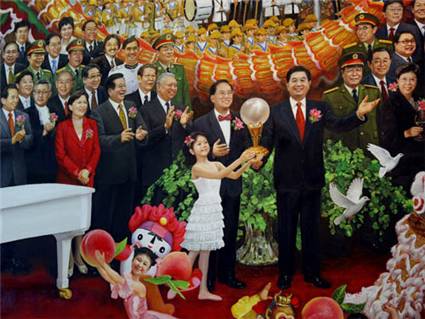
    Imagethief was interested to see on the front of the Saturday South China Morning Post a segment of a painting that has just been unveiled in Hong Kong to commemorate the tenth anniversary of the 1997 hand-over of sovereignty. This is no ordinary canvas, mind you. It’s essentially a mural, seven meters by three, with the likenesses of Chinese President Hu Jintao and 500 of Hong Kong’s great and good. Here is the segment that was printed in the paper:

    Hu-Jintao-HK-Painting

    Painted by artist Liu Yuyi, who came to Hong Kong from the mainland in 1991, painting is apparently meant to be inclusive in representing Hong Kong’s political plurality. Nevertheless, there does seem to be something of a pecking order. The (as ever, subscription-only) Post reports:

    [Liu] said he included people of different political views.

    Near the edge of the painting stand such figures as Cardinal Joseph Zen Ze-kiun, former chief secretary Anson Chan Fang On-sang and Civic Party legislator Alan Leong Kah-kit.

    Tycoons Li Ka-shing and Stanley Ho Hung-sun were among the closest to the state leaders in the canvas.

    Some key members of the Democratic Alliance for the Betterment and Progress of Hong Kong and the Liberal Party were also close to the action. Liu, who has lived in Hong Kong since 1991, said he had not yet decided whether to auction the painting, although some interested buyers had contacted him in recent days. “I may just give it to the state,” he said. “And I don’t rule out the possibility of giving it to the Hong Kong government.”

    One wonders where they would put it. Featuring President Hu as prominently as it does, one also wonders if perhaps it might need to be updated in future anniversaries, as the face of China’s leadership inevitably changes.

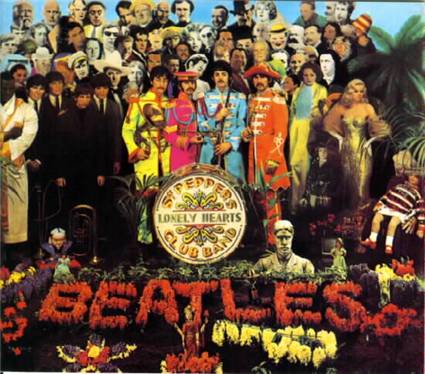
    In addition to the placement pecking-order of Hong Kong personalities, two things about the painting struck Imagethief as particularly interesting. First, in composition and palette it resembles a certain famous album cover:

    sgt-pepper

    In fact, my colleague Alex, upon spotting the photograph, said, “Hey, it reminds me of Sgt. Pepper!” I am not sure this is the effect Liu was going for. (There’s even a drum partially visible at the very top of the painting.) If you ask me, psychedelic Olympic mascot “Huanhuan”, visible in Liu’s painting, would have fit right in on the Sgt. Pepper cover.

    Somewhat more disturbingly, the painting is highly suggestive of Maoist propaganda posters, especially the ones where the Great Helmsman is surrounded by hundreds of cheerful, energetic and well-fed looking Chinese people representing various ethnicities and acceptable segments of proletarian society. For example:

    mzd13

    Or perhaps this:

    mzd15

    If you’re having trouble reading the tiny caption on this second poster, I believe it says, “The ever victorious Chairman Mao gets by with a little help from his friends.”*

    Look at Hu in the painting above again. In the segment I can see, he is the only person who’s body is completely unobstructed. He has the greatest amount of negative space around him. His hand is upraised in beneficence. He’s surrounded by positive symbols; doves of peace, a pearl of harmony (according to the artist — don’t know if that’s accepted symbolism), and peaches of longevity (which are accepted symbolism). He’s conspicuously taller than Donald Tsang (which may be literally true). Intentionally or not, it’s a case study in cult-of-personality iconography. The only difference is that instead of being surrounded by an idealized version of the common people he’s surrounded by an ordered version of Hong Kong’s power elite.

    I leave it to the people of Hong Kong to decide what that means to them. But if Liu does bestow the painting upon the people of Hong Kong, I’ll be interested to hear where they hang it.

    Notes:

    *It actually says “Follow the communist party forever, follow Chairman Mao forever”, but I like my caption better.