Tag: Propaganda

  • I say “tomato”, you say “massacre”, let’s call the whole thing off

    It is a truism of public relations and communication that he who controls the language with which an issue is defined controls the debate. If you can attach your terminology to a situation, you have leverage over public opinion. Don’t like the inheritance tax? Label it a “death tax”. Is that guy with the AK-47 a gunman or a freedom fighter? Is the person with the explosive vest a martyr or a terrorist? Which label works for you? Did that politician lie or misspeak? War or police action? “Dead-enders”, insurgency or civil war? If you can assign the language you can frame the discussion.

    The power of language is especially apparent when words are emotionally charged. There is a reason why there are grinding political conflicts about when and how to apply the word “genocide”. The word demands action and commitment. The obtuse language of diplomacy has essentially developed to allow governments to escape commitment when it is inconvenient. You can debate and prevaricate about “internal displacement”, “human rights” and even “ethnic cleansing”. Once something is accepted in popular discourse as “genocide” the debate is over. Act or be complicit.

    “Massacre” is a similarly charged word. The dictionary definition is: “The unnecessary, indiscriminate killing of a large number of human beings or animals, as in barbarous warfare or persecution or for revenge or plunder”. Indiscriminate killing. Barbarous. These are the things that “massacre” evokes. It is a word to describe a deed of evil.

    That’s why Imagethief has followed with some interest the controversy generated by Ma Lik, Chairman of Democratic Alliance for the Betterment and Progress of Hong Kong (DAB), one of Hong Kong’s political parties. The DAB is often described as “pro-Beijing”, and with his recent comment, Ma has left little doubt. Last Wednesday’s South China Morning Post* reported on Ma Lik’s statments on the front page, under the headline, “Fury at DAB chief’s Tiananmen tirade”. The lede said it all:

    Hong Kong will not be ready for universal sufferage until around 2022 because the people lack national identity and many still believe there was a massacre in Tiananmen Square in 1989, the leader of the main pro-Beijing party said yesterday.

    ***

    [Ma] said one example to show Hong Kong society was not mature was people’s belief that pro-democracy advocates were “massacred” in Tiananmen Square in 1989.

    The quotation marks are theirs. It is the word “massacre” itself that is in contention, as became clear when the story got to the quotes:

    “We should not say the Communist Party massacred people on June 4. I never said that nobody was killed, but it was not a massacre,” Mr. Ma told a media gathering less than three weeks before the 18th anniversary of the bloody crackdown on protesting students. “A massacre would mean the Communist Party intentionally killed people with machine guns indiscriminately.”

    Indeed. See the definition above. In addition to Ma’s own comments, the interesting thing in the paragraph above is the use of the word “crackdown” by the newspaper to describe the incident. Newspapers are, of course, wary of making emotional judgments about events, and language like “massacre” does render judgment. That’s why when you Google Tiananmen + crackdown you get a lot of newspaper articles. “Crackdown” has become an accepted, non-judgmental way of defining what happened on that late spring day in 1989.Google Tiananmen + massacre and you get plenty of returns, but fewer newspaper pieces. (You get a lot of CNN online articles, however.)

    For the sake of comparison, the dictionary defines “crackdown” as, “the severe or stern enforcement of regulations, laws, etc., as to root out abuses or correct a problem” or, slightly more forcefully, as, “an act or example of forceful regulation, repression, or restraint”. So we get as far as repression.

    Massacre or crackdown? You decide.

    I wasn’t there, but I’ll inject something judgmental into this piece. It’s part of journalist John Pomfret’s first-hand account of the events of that day from his excellent book,Chinese Lessons:

    The soldiers began to fire live ammunition low into the crowd, hitting people in the stomach and legs. The night, balmy with a calm breeze, crackled with automatic gunfire. People fled in all directions. Some returned, rocks in hand. Armored personnel carriers rolled onto the bridge and began cutting the busses aside, cutting a path into the inner city.

    I was petrified. Because I had never heard live gunfire before, it took me a few minutes to realize that I, too, could get shot. I was standing about one hundred feet north of the intersection. A crowd surrounded me and began yelling: “They are shooting us! They are shooting us! They are shooting the people!” I saw in their eyes a wild insistence. “You must report this to the world,” yelled one man. Then  the bullets zinged in our direction. I found what I took to be relative safety by lying flat on thw asphalt, pinne dup against a curb. Others ran. I remember thinking they must be crazy. As I lay on the ground with my cheek against the roadbed, I saw several demonstrators fall. The armored personnel carriers had done their work, ramming a channel through the burning busses. Then came the troop trucks, fifty of them rolling through the cumpled roadblock. Random gunfire killed a housekeeper on the fourteenth floor of one building. Another woman was wounded as she looked out of an eighth-floor window.

    So is it a massacre? These are the kinds of things we foreigners have to go on when we assign words to events like what happened in Tiananmen Square or elsewhere in Beijing on that day. (In the passage above Pomfret is writing about Muxidi Bridge, to the west of Tiananmen. Pomfret himself uses “crackdown”.)

    Citing the above won’t satisfy Ma Lik. Part of his complaint is that he feels that the events of 1989 are being defined by foreigners. Or so I interpret from this quote:

    “The government should say what actually happened on June 4… It is not something that teachers can teach whatever they want about. Are saying [what happened] should be decided by gweilos?

    The ellipsis and brackets are the Post’s.

    In fact Ma Lik is doing two things. One is an extremely clumsy but otherwise garden-variety political language control maneuver. He is attempting to define the language used to describe the events of June 4th 1989 in order to serve a particular political agenda. He may also believe what he is saying whole-heartedly. Attempts to manipulate language are not necessarily cynical or dishonest, although they certainly can be.

    But there is a second, and to my mind spookier, part of his statements that I have not seen remarked upon much in initial or follow-up coverage. It is hinted it at in that last quote. This is that Ma Lik wants not only to redefine the language that is used to describe the Tiananmen Square events, but that he wants to institutionalize that redefinition as a pre-requisite for universal suffrage in Hong Kong. According to the Post,

    [Ma] said local students had not received proper “national education” since the handover and many still “care nothing” about the mainland.

    And later,

    Mr Ma, who is not known as an outspoken, hard-core leftist, said universal suffrage could not be introduced before the public adopted “heart-felt” patriotism.

    In other words, “you’re not mature enough to be trusted with democracy”. This old saw, played to various melodies, is a favorite of undemocratic regimes across Asia.

    Ma has climbed down a bit from his initial statements. A follow-up Post story (paywall) reports:

    Mr Ma, who left for Guangzhou after speaking on the radio programme, said he was only trying to call for more rational and balanced views towards the incident. “I think what is most important is to find out the whole truth.”

    He also said it was not his intention to ask the Hong Kong government to issue a definitive guideline to schools on how the crackdown should be taught. He only thought teachers should not “teach whatever they wanted”.

    I don’t think any reasonable person would disagree with that. No one thinks teachers should have an unfettered reach to teach whatever they want. That’s why we have standards and curricula. In the US, school curricula, especially with regard to things like evolution, are the subject of vigorous, noisy debate. That is as it should be. The difference is that in the US no one who didn’t want to be labeled a crank would argue that a doctrinal viewpoint across society is a pre-requisite for a successful democracy.

    That’s the thing about democracy; by it’s very nature it accepts that people will have different viewpoints, different beliefs and different opinions about important events and topics. They will use different language to describe the same thing. They will fight compete vigorously with each other to define the political environment in the language of their choosing, in order to reflect their beliefs and politics. That’s the contest of ideas that is fundamental to healthy  democracy. It is the essence of democracy.

    If Ma wants to suggest that what happened in Tiananmen wasn’t a massacre that should be his right in a democracy or any society that allows freedom of speech. After all, you can’t have a true democracy without freedom of political speech, even if that sometimes yields ideas that are distasteful to some. To suggest, however, that homogeneous belief is a prerequisite for democracy is not only to utterly miss the point of democracy, it is also, sadly, to render the very idea irrelevant.

    See also:

    ESWN: Ma Lik’s comments on June 4th.

    *Sorry, I don’t have a link for this article. The South China Morning Post not only has an all-consuming paywall, but it also has the single worst search engine and archiving system of any online newspaper I have ever dealt with.
  • Did the “Genocide Olympics” influence China?

    Propaganda and censorship are two sides of the same coin. Both share the same goal: to enable an individual or organization to shape consensus in a group. They often work together. Censorship eliminates competing ideas, creating a void in which propaganda can be more effective. Having a coup? Seize the transmitters and studios so you control the message. It’s a time-honored strategy. Propaganda and censorship are related in another way. They both work cumulatively, over time. It’s not usually the “magic bullet” that drives consensus so much as the patient steering of discourse over time via many channels.

    But propaganda and censorship do have one difference. I wrote recently that the most powerful censorship is what you don’t see. That’s not always the case with propaganda. Brilliant propaganda can certainly be subtle. Think of manufactured word-of-mouth campaigns that cultivate something that feels like a grass-roots public groundswell. But brilliant propaganda can also be right in your face. There was nothing subtle about the 1934 Nazi Party rallies, but they were brilliant propaganda, as was Leni Reifenstahl’s film of the rallies, Triumph of the Will. That was propaganda as sensory overload and religious experience. And it was devastating in cultivating the Nazi mythology.

    The 1936 Olympiad was also propaganda, designed to showcase the grandeur of the Third Reich and the physical superiority of Hitler’s Aryan race. Like the 1934 rallies it was also filmed by Leni Reifenstahl. There was a problem with the Olympiad, however. It was hijacked by Jesse Owens, the black American sprinter who won four gold medals and undermined the messages that Hitler wanted to send to the world. Owens was a powerful, visual symbol and he himself became the lynchpin of a public mythology.

    Now it’s China’s turn. China is not Nazi Germany, but the 2008 Olympic Games is as symbolically important to China as the 1936 Games was to Hitler, if not more so. It is a monumental affair staggering under symbolic baggage, and it will be, once again, propaganda as a religious experience. Like the 1936 Olympiad, however, it is also vulnerable to being hijacked. Jesse Owens didn’t mean to undermine Hitler’s message. He just wanted to win. But that didn’t change his impact.

    China won’t have it so lucky. The Olympics is more than a sporting competition. It’s a global platform that makes a seductive lever for anyone with an agenda that they want to propel into the public consciousness. The modern Olympics has always been seen as an opportunity to make political statements. Hence Owens in 1936, Tommie Smith’s and John Carlos’ “black power” salute in Mexico City in 1968, the Black September hostage drama in 1972 in Munich (Germany star-crossed again), and the reciprocating Russian and American boycotts of 1980 and 1984. China’s Olympic games isn’t even the first time an authoritarian Asian nation has used the Olympics to debut on the global stage. That honor goes to Korea, for the Seoul games in 1988, when Korea was at the tail end of its authoritarian regime. You can even make a case that Japan beat Korea to the punch in 1964 when its summer games served as the stage for Japan’s symbolic postwar rehabilitation less than twenty years after the end of WWII.

    If all of this makes you feel a little grimy, remember that the modern Olympics exists specifically as a propaganda vehicle (and here I include marketing as a kind of propaganda). The IOC may call it a “movement”, evoking images of grass roots participation and noble sporting ideals, but that is propaganda itself, designed to draw a graceful fig leaf over the reality that the Olympics is a vast business venture –reportedly US$4 billion in revenue over its previous quadrennial cycle– driven by sponsorships and advertising. Sponsors take the messaging opportunity seriously, as well they should considering what they invest.

    China, hungry to be seen anew as a great power, had its own agenda in mind with the Olympics. Unfortunately for China, all the debate and controversy that swirls around its human rights, environmental and geopolitical issues is being dragged along in the Olympic slipstream. People have China axes to grind, and that beautiful Olympic fulcrum is too enticing to pass up. The 2008 Olympics was politicized from the moment it was awarded to Beijing, and will be more contentious than any games in modern memory. That’s a big deal considering the Olympics’ propaganda-splattered pedigree. In the PR industry we refer to the 2008 Olympics as “issues rich”, which is a polite way of saying, “watch this space for crisis”.

    That’s why “the genocide Olympics” is such a brilliant piece of propaganda. It is as un-subtle as you can get, and it looks like being effective.

    The phrase has emerged into the popular consciousness thanks to a campaign by actress and activist Mia Farrow and her son Ronan, most recently in an op-ed piece (also here) published in the Wall Street Journal and Boston Globe (and possibly elsewhere) in late March. Mia Farrow is just one of a constellation of people and groups with a China issue. In fact, Ms. Farrow’s real problem is with the Sudanese government’s sponsorship of widespread destruction and killing in the Darfur region. But China’s support for the Sudanese government and its investment in Sudan make it a convenient pressure point, and the Olympics provide that all-important leverage. The editorial says:

    [There] is now one thing that China may hold more dear than their unfettered access to Sudanese oil: their successful staging of the 2008 Summer Olympics. That desire may provide a lone point of leverage with a country that has otherwise been impervious to all criticism.

    Whether that opportunity goes unexploited lies in the hands of the high-profile supporters of these Olympic Games. Corporate sponsors like Johnson & Johnson, Coca-Cola, General Electric and McDonalds, and key collaborators like Mr. Spielberg, should be put on notice. For there is another slogan afoot, one that is fast becoming viral amongst advocacy groups; rather than “One World, One Dream,” people are beginning to speak of the coming “Genocide Olympics.”

    Does Mr. Spielberg really want to go down in history as the Leni Riefenstahl of the Beijing Games? Do the various television sponsors around the world want to share in that shame? Because they will. Unless, of course, all of them add their singularly well-positioned voices to the growing calls for Chinese action to end the slaughter in Darfur.

    The Farrows don’t take immediate credit for “the genocide Olympics”, and in fact the phrase has been circulating since at least last December, when the Washington Post ran an editorial by that title. The Boston Globe, extends a degree of credit to a Smith University professor named Eric Reeves who advocated the Olympic-China-Darfur link on their own op-ed page, three days after the Post piece ran. A week after Reeve’s piece, theGlobe ran another editorial that cited Reeves and did use the phrase “genocide Olympics”. (The Globe has been banging the drum very hard, and it launched the phrase again in a new editorial from May 8th, here republished in the International Herald Tribune.) The phrase also had a bout of publicity in March thanks to the Farrows, and has been resurrected in the past week or so thanks to the efforts of US politicians, including long-time China critic Tom Lantos and others:

    “We don’t want these Olympics to go down in the history books as the genocide Olympics,” said Lantos, chairman of the House of Representatives committee on foreign affairs.

    ***

    “It is outrageous that China is using the very symbol of international unity and brotherhood to further grind down the Tibetans and the Taiwanese who simply want to live their lives without interference from Beijing,” Lantos said.

    Two things are making this a successful campaign.

    First, the campaigners have a brilliant slogan. The genocide Olympics. It sticks in the head and it conjures up the worst possible set of associations. It fits on a T-shirt (which you can order), and it is evocative and emotive at a visceral level.

    Second, in a classic PR strategy, the advocates have marshaled what we in the biz call “a chorus of voices”. One angry person heaving around an incendiary phrase does not necessarily make for PR disaster. An expanding group of celebrities, politicians, activists and editorial writers heaving that phrase around does. Over time they will imprint “the genocide Olympics” on the public consciousness. (Mr. Reeves writes more about the campaign here.)

    The Farrows did something else brilliant. They appropriated an intensely powerful advocate in Steven Spielberg, who is advising the Beijing Olympic Committee, and they did it in the most audacious fashion possible. The Farrows compared the Jewish film director and Shoah (Holocaust) Foundation founder to Hitler’s own cinematic propagandist, Leni Riefenstahl. The drew a direct and highly visual line from 2008 to 1936, right through Mr. Spielberg’s chest, and turbocharged the genocide concept. Mr. Spielberg obliged by apparently personally lobbying China to take tougher action on Sudan.

    So is it all working?

    This is debatable. China is notoriously impervious to outside pressure. But China doesn’t necessarily need to be directly persuaded. If the “genocide Olympics” idea gains enough currency, major sponsors and other national governments will start to become queasy. If the activists can pressure Visa, McDonalds, Coca Cola, GE, Samsung et. al. (Lenovo is probably a write-off) then they’ll pressure Beijing and the IOC in turn. And the sponsors, who depend upon the image of the Olympics, control the money that is the life-blood of the “movement”.

    Despite its tradition of hard-headedness, China last week appointed a special envoy dedicated to the Darfur crisis. Earlier, shortly after the Farrows and Mr. Spielberg ratcheted up the pressure, China dispatched a “senior official”, Mr. Zhai Jun, to Sudan to push the Sudanese government to accept a UN peacekeeping force in Darfur. On April 12, the New York Times reported on Zhai in an article titled “Darfur collides with Olympics and China yields”. (Behind the Times paywall but can be read on Ms. Farrow’s website.) The article suggested a direct link between the campaign and the mission. Lest you think China is getting soft, however, Mr. Zhai is quoted in the article describing boycott advocates as, “either ignorant or ill natured”.

    Perhaps the link isn’t as direct as it seems. Last week I had coffee with an experienced China journalist who said he felt the article was reaching in linking the campaign directly to Zhai’s visit, and that China had already been in motion on Darfur. Indeed, the article itself says:

    During closed-door diplomatic meetings, Chinese officials have said they do not want any of their Darfur overtures linked to the Olympics, American and European officials said.

    In an e-mail message on Thursday, a spokesman for the Chinese Embassy in Washington warned anew against such a linkage. “If someone wants to pin Olympic Games and Darfur issue together to raise his/her fame, he/she is playing a futile trick,” the spokesman, Chu Maoming, wrote.

    But the Chinese would say that. After all, if they admit having been pressured once, the floodgates will open. Darfur is only one of the agendas swirling around the Olympics, and other interested parties will be watching to see to what extent the Olympics can be used to pressure Beijing.

    In another discussion I had last week, the regional managing director for one of my company’s cross-town rivals wondered aloud to me if China is ready for a “multi-stakeholder world”. That’s a PR flack’s way of wondering if the Chinese can gracefully juggle the pressures that will accumulate from governments, activists, Olympic sponsors, celebrities and everyone else who has one of those China axes to grind. Not every pressure campaign will have the in-your-face impact of “the genocide Olympics”, but more are certainly on the way. I think the success or failure of the Olympics will be determined not by the campaigns themselves, but by the grace and sensitivity with which China can respond to them. Angry rhetoric aside, if there is any sincerity to them them then China’s recent moves with regard to Sudan are promising.

    Unfortunately, it will be hard for China to shed its authoritarian and reactionary instincts. Just this week the country responded to a recent Tibet-oriented protest on the slopes of Mount Everest by cracking down on individual tourism to Tibet. That self-destructive move will generate exactly the kind of negative publicity that will remind the world of all of China’s faults, and ensure that the shadows continue to linger over 2008.

  • Asian media vows to make western media cry

    Imagethief was tickled to read today in Xinhua an article from the Boao Forum for Asia, an annual Chinese talking shop, on how Asian media will rise up to challenge western media juggernauts. It seems that Asians take umbrage that they are 96.2% of the world’s population and yet produce only 0.3% of its international media. Or something like that.

    The article makes many serious points:

    “The world is not flat actually,” Liu Jiang, deputy editor-in-chief of Xinhua News Agency, said at the annual conference of the Boao Forum for Asia (BFA), which was held over the weekend in the south China town of Boao.

    “The world is in reality a slop [sic] on which information flows downward from developed countries to developing countries and regions,” Liu said.

    “The World Is Flat” by the New York Times columnist Thomas Friedman has been frequently quoted to prove an alleged “magic power” of globalization by Bill Gates and other lecturers at the conference.

    The book figures out ten driving forces to grind the world flat, in each of which media play an important role.

    “Developed contrives, which have one seventh of the world population, have dominated two thirds of the total information flow,” Liu said. “However, globalization does not balance a horizontal world when it is grinding the world.”

    “Why do Asian media always yield to Western culture?” Felix Soh, deputy editor-in-chief of The Straits Times headquartered in Singapore, questioned in his speech at the sub-forum discussing globalization and the media.

    Imagethief has lived in Asia for over a decade and is a fan of Asia and things Asian. So he will try to address Mr. Soh’s question as delicately and constructively as possible.

    It’s because on average Asian media suck. Especially news media.

    Now this is not an entirely categorical statement. There are fine Asian newspapers and magazines, and, heaven knows, gifted Asian filmmakers and writers. But in general –and I am truly sorry for purely selfish reasons that this is the case– Asian commercial media is a desperate wasteland that teeters perpetually on the precarious knife-edge of irredeemability.

    Mr. Soh himself heads up one of the blazing test cases for the failed potential of Asian media. Imagethief needs to tread carefully here because he is really good friends with several Straits Times journalists, and they are hardworking, smart, talented people. But friends are honest with each other, so here it is: the Straits Times took the last train to dullsville and fell asleep in its seat and missed the stop. I know. I subscribed for years.

    The tragedy of this –the great, majestic, swooping tragedy– is that if any country was going to produce a credible pan-Asian newspaper it would be Singapore. It’s in the right place, it’s got the right people, and it speaks the right languages. It really is a regional hub. But it will never happen.

    I blame government. Governments, by and large, should not involve themselves in media. But Asia’s governments cannot, for the life of them, keep their grubby mitts off the media. And damned if they don’t have a near mystical talent for boiling the life out of it.

    I realize you can argue both aspects of the government involvement equation. The government-run chartered [see note below -WM] BBC, for its troubles, is one of the world’s great news gathering organizations. Too little government supervision of media and you get dangerously irresponsible or corrupt media.

    But too much government involvement and you get soul-destroying headlines like…well, just for fun, let’s see what the top story on the Straits Times website is right now:

    Need for S’pore to focus on sustainable construction: Grace Fu

    THERE is a scope to reduce the stockpile release price for granite from May onwards, Minister of State for National Development Grace Fu said.

    Gadzooks! And for good measure here’s the number two headline:

    Extraordinary govt, talent keep S’pore ahead, says MM (MM= Minister Mentor Lee Kuan Yew)

    Good gosh, two government headlines in a row. And this is typical. Back in Singapore we used to joke about what the above-the-fold government headline of the day would be.

    Arguably, this is what is important to Singaporeans (although this kind of stuff drives my Singaporean wife up the wall, but she married me so she’s probably deranged). And I realize it’s unfair to dump so much on the Straits Times. But if the editor is going to ask rhetorical questions about the subservience of Asian media, perhaps he should look close to home for the answer.

    This story is rewritten across the region. As long as Asian governments manage their news, censor their films, and interfere explicitly in culture then their newspapers will be treated as propaganda, their most talented artists will flee overseas and their people will wolf-down tawdry but lively foreign culture.

    So my recommendation for the governments of Asia is this: if you want a louder voice in the world, if you’re tired of being walked all over by imperialist western media, if you think you are being misrepresented on the global stage, then back the hell off. Set your own media free. It will probably rise to the challenge, and, I suspect, do it better without you breathing over its shoulder.

    But that’s a pipe dream. Here’s the end of that article:

    High level forums and meetings have been raised by media groups from China and members of Association of Southeast Asian Nations (ASEAN). An agreement of cooperation on communication signed by members of the Non-aligned Movement at Kuala Lumpur in 2005 has shown the developing countries’ strong willing to speak louder in the world.

    Delegates of Asian media attending the BFA conference reached the consensus that Asian media should shoulder a responsibility for broadcasting “a harmonious Asia” with “a harmonious Asian image” and provide a value of “harmonious region” to tell the world a real Asia.

    A “harmonious Asia”? Oh dear. Pass me the Financial Times.

    Note: I do give a tip of the hat to Singapore’s Chinese language daily, Lianhe Zaobao, which is popular in China.

    Update: Charlie (in comments below) [comments no longer available – WM] and another reader (by e-mail) have pointed out the important distinction between publicly funded media, such as BBC or NPR in the US, and state-managed media. I should have made that distinction clearer in the text. The BBC is, thus, probably used incorrectly as a positive example above. Unfortunately that kind of bottoms out the list of exceptions to thegovernment involvement = bad rule.

  • A funny thing happened on the way to political re-education

    Imagethief was morbidly fascinated to find a Reuters article over the weekend that explains how the Chinese Propaganda Ministry has launched a point-based “demerit” system to try to encourage proper behavior from the print media:

    CHINA’S Communist Party propaganda department has launched a points-based penalty system to try to rein in the increasingly muck-raking print media, a Hong Kong newspaper reported today.

    Media outlets will be allocated a dozen points that the propaganda department and the government media regulator can deduct one, three, six or all 12 at a time, the newspaper quoted unnamed sources as saying.

    It was not clear how the severity of a perceived infringement would be judged, but penalties would range from warnings and dismissals to closure of the publication, it said.

    ***

    “The new system is a clear message that the top leadership wants a peaceful social environment ahead of the 17th Party Congress and next year’s Olympic games,” the newspaper quoted a senior state media executive as saying.

    The media point system was similar to China’s driver license point system whereby deducted for moving violations.

    And, in fact, similar to systems used for penalizing motorists all over the world. This begs the question, for the first offence can a media organization send its staff to the Propaganda Ministry’s comedy media school and have the points restored, like going to comedy traffic school for a first offense in the US? After all, the government here has a tradition of political re-education. Why not work a few laughs in along the way?

    Sure, right now you’re thinking to yourself, I don’t think the propaganda ministry is a humorous organization. But with a little work it could be. For instance, a favorite disciplinary tool here is the “self-criticism”. Anyone who pays attention to comedy knows that self-criticism is at the heart of much comedy. It’s Woody Allen’s entire oeuvre, after all. Could it be that hard to work comedy into other aspects of media discipline? I don’t think so.

    Join me now as we look in on the Ministry’s comedy re-education school. An unnamed media organization has been slapped with three demerit points for unauthorized portrayal of a pig during the Chinese New Year Festivities, in contravention of recently announced regulations:

    Cadre: Good evening, comrades. I am Mr. Wei and I will be conducting your political re-education today.

    Editors and journalists: Good evening comrade Wei.

    Cadre: You know, it’s great to see you all here today. I hear you got sent up for showing an advertisement with a pig in it during New Year. Honestly, muslims, who can figger ‘em out? You know they don’t eat pork? They don’t eat pork! How crazy is that? Say, that reminds me of a joke. A man was walking by a village when he saw a pig with a wooden leg. Not quite sure of what he was seeing, he went up to the house and knocked on the door. A peasant answered the door and the man said, “I was walking by and saw a pig with a wooden leg and I just had to find out why!”

    “Well” the farmer answered,”that is a really special pig. Our house was on fire and that pig dragged my whole family out and saved our lives.”

    “But why the wooden leg?” asked the man.

    “Well,” the farmer replied,”a pig that special you wouldn’t eat all at once!”

    Uproarious laughter.

    Cadre: Yeah, the great thing about Hanification of the west is that you’ll finally be able to get a decent pork bun in Kashgar.

    Chuckles.

    Cadre: So how do you think the ministry found out about your pig advertisement?

    Editor: They read our newspaper?

    Cadre: Nah, somebody squealed! (Rimshot)

    Laughter.

    Cadre: Honestly, it’s not really your fault. The party believes that religion is the opiate of the masses. It just makes people crazy. (Twiddles index finger at temple.) Say, that reminds me of another joke. A Hindu, a rabbi and a capitalist are driving through thenongcun when their car breaks down. Fortunately they find a farmhouse nearby. The peasant tells them that he has only space for two more people to sleep inside the house. They are welcome to it, but one of them will have to sleep in the shed outside.

    Well, after much discussion, the Hindu volunteers to go to the shed. A few moments later there’s a knock on the house door. It’s the Hindu. He explains that there is a cow in the shed, and cows are sacred to Hindus and he can’t possibly sleep in the barn with a sacred cow.

    Annoyed, the rabbi volunteers to go sleep in the shed. A few moments later, a knock on the door. The rabbi explains that there’s a pig in the shed and that he, being orthodox, can’t spend the night in the shed with a pig.

    So the capitalist says that he will go to the shed. A few minutes later there’s a knock on the door. It’s the cow and the pig!

    Hearty laughter.

    Cadre: But, crazy or not, the big Hu says we have to promote a harmonious society, right? So what do you think will happen if you publish another pig advertisement?

    Journalist: We’ll lose another three demerit points?

    Cadre: No, you’ll all be dragged out to the quarry and shot in the back of the head.

    Stunned silence.

    Cadre: Hey, just kidding.

    Nervous laughter.

    Cadre: You guys should have seen the looks on your faces. But seriously, folks, you’re a wonderful audience. Give yourselves a big hand.

    Yes, it would be a laff riot.

  • I’m sorry, the government has killed your story

    Colleagues from American and European offices often ask Imagethief how PR in China is different from PR in the west. Usually I give a two-part answer. First I tell them that were they to step into our offices in China they would see many things that they would instantly recognize as garden variety PR. We write press releases, organize events, craft angles and pitch stories to competitive publications and journalists, develop communication strategies and train executives in how to handle the media, among other things. But then I tell them about what’s different, usually sticking to the highlights. In the best diplomatic, spin-doctorese I tell them that the Chinese media’s “ethical framework is not entirely developed”. By which I mean that it is, in many ways, a corrupt swamp. (This is something of a theme in the foreign media recently, having been covered by the Washington Post,New York Times and AP with the Lan Chengzhang case as catalyst.)

    The other difference is that the government has explicit power over the media agenda. Most of the time, self-censorship is the rule. However the propaganda ministry –中宣部– also sends out guidance on sensitive issues to major media. Editors who want to keep their jobs are expected to toe the line. Occasionally an acute issue will motivate a directive to halt coverage of a topic, as when media were directed to layoff the Foxconn-Apple scandalof last year. (Recently this has led to proscribed topics sloshing over into journalists’ and editors’ blogs, but that’s a topic for ESWN.)

    We were reminded of the realities of government management of the media agenda recently, shortly after arranging an interview between one of our MNC clients and a Chinese business magazine. The magazine in question had requested the interview, with an eye on exploring our client’s business and investments in China. The discussion was vigorous but reasonably balanced and we were expecting a decent article as a result, with publication planned prior to Chinese New Year.

    About two weeks after the interview, one of the editors involved called us and said the story would be “delayed”. Apparently the magazine had just received guidance from the Propaganda Ministry to be more “sensitive” in publishing stories that involved foreign investment, particularly around certain industries or well-known Chinese brands. We had not, at first blush, considered the story we were developing to be particularly risky or sensitive. But the journalists and editors at the magazine were, as you would expect, taking the ministerial guidance extremely seriously. So we had to wait, and so did our client.

    But clients who make busy senior (foreign) executives available expect explanations about these kinds of things. “Hey, dude, it’s China,” doesn’t really cut it, so we did a little poking around. The back-story is illustrative of one of the challenges of the PR biz in China.

    Anyone who follows current affairs in China will know that these are delicate times for discussing the topic of foreign investment. Questions are being raised about the quality of foreign investment and the intent behind it. Early last November the 11th Five Year Plan was published. It put a great deal of emphasis on the quality of foreign investment. In this English Xinhua article about the plan, the money graf –as far as we were concerned– is the very last one:

    In response to the rising concern over foreign acquisitions of leading Chinese firms in critical sectors, the document says China will speed up legislation and step up the supervision of sensitive acquisitions and takeovers to ensure critical industries and enterprises remain under Chinese control.

    Shortly thereafter, it seems the initial guidance to treat reporting around this topic sensitively was passed on to at least some Chinese media. The publication we were dealing with was government-linked, and had little wiggle-room as far as interpreting this directive to be “sensitive”. Unfortunately, apparently, they had somehow missed the memo and in their previous issue published an article that had raised eyebrows upstairs. This had resulted in a ministerial reminder to toe the line, which descended, Rumsfeldian snowflake fashion, into the in-boxes of the editors of the magazine we were working with the day before they called to tell us that they had to postpone.

    My initial response when the Chinese media-relations guru on my team told me that the magazine had to postpone the story because of a government directive was to assume they were giving me a polite brush-off. Similar, perhaps, to what you might get if a Western editor didn’t like the story a journalist had put together on your client, and the journalist in question wanted to tell you something more polite than, “The editor thinks your interview was crap on a stick.”

    “Are they yanking our chain?” was the first question I asked her. Some of our other Chinese team members, including one of our government relations people, had the same first reaction, so it wasn’t just foreigner-itis. But after some research and phone calls turned up the story above I changed my opinion. At the very least, if it was an excuse, it was a damn well substantiated one with abundant face-saving for everyone. In which case, my face duly saved, I could sleep well at night.

    The net result, however, is that our story went on the back burner, where it remains until the publication feels that it can once again broach the topic of foreign investment in certain industries, or hell freezes over (whichever comes first). And now I have one more piece of due-diligence to do when identifying Chinese media to work with in future.

    Such is one of the many things that make PR in China such a rush.

  • Olympics mean a softer touch for foreign correspondents, maybe

    Ed Cody of the Washington Post’s Beijing bureau has written an interesting story on a new decree from the Chinese government that will grant foreign correspondents in China significantly more freedom in the months before and after the games. The article is interesting for a few reasons. First, it suggests that the government might be working out a relatively more sophisticated approach to media management for the games; second it provides a window into some of the media management tactics they are preparing for; and third it explains how the current control regime has been more obnoxious than effective. Cody writes:

    A decree from Premier Wen Jiabao’s government said foreign reporters, whether assigned here permanently or visiting for the Olympics, will be allowed to roam most of the country freely and report without interference by local police or propaganda officials from Jan. 1, 2007, until Oct. 17, 2008. The Games are in August 2008.

    As explained by Foreign Ministry spokesman Liu Jianchao, the new rules departed clearly — if temporarily — from long-standing orders. They also marked a significant watershed for China, where information has long been treated as government property to be manipulated and controlled by propaganda officials.

    ***

    If followed by authorities across the country, [the decree would] for more than 21 months eliminate some major barriers to accurate reporting about China: regulations that legally oblige foreign correspondents to work through local propaganda officials when gathering news. Those restrictions, when followed, have limited frank conversation with Chinese people and emphasized the official version of news.

    I find this interesting because it suggests that the Chinese authorities are thinking a step beyond their normal control-oriented approach to information management. I don’t think much of how the Chinese government manages information. (I’m sure that statement does not come as a profound shock to regular readers of this site.) All governments want to control information and public perception, and all try to devise systems for doing so that reflect the realities of society, technology and the media environment. I think the Chinese government still drags along too much baggage from before China’s opening and subsequent economic boom, and the attendant explosion in the media and public access to information and communication tools. The CCP model still favors brute control of information over effective communication, and it shows in both domestic and international situations where better communication might be helpful.

    This is not just about the Internet. I am not a utopian when it comes to the power of the Internet to free people’s minds. If all Internet censorship in China was lifted tomorrow there would not be any significant change in China. (For some interesting analysis of related topics, see Ann Condi’s recent guest post in Danwei and Howard French’s comparison of the English and Chinese language versions Wikipedia, although the latter has also been fisked by Dave at Peking Duck.) But while the “un-story” approach works OK when there is a relatively small number of centralized media and limited options for personal communication, it works much less well in an era of blogging, instant-messaging, SMS and extensive international contact. At best China’s government would abandon the information control approach in favor of something more progressive. At the very least it needs to be supplemented by more effective communication. I do think the Chinese government is working on this, but they have a ways to go.

    I don’t for a moment believe the decree means that the government has abandoned its traditional approach to information management. It still hasn’t had anything meaningful to say about yesterday’s massive service interruption at Shanghai Pudong International Airport, for instance. But giving foreign correspondents more leeway in the run-up to the Olympics would accomplish two things. First, it’s a PR move in and of itself. “See? We’re improving!” But there is a second, deeper side to the move as well, and it has to do with what kind of incident would make the Olympics a PR failure for the Chinese government. And make no mistake: the Olympic Games are the most important external PR endeavor the modern Chinese government has ever embarked upon.

    Of course others know this. Because its a global event that attracts the eyes and ears of the world, the Olympic Games –especially the more popular summer games– are a convenient platform for people who have an issue they want to publicize. That’s why the US and Russia used boycotts of each others’ Olympics in 1980 and ’84 to make political points, why the 1976 Olympics were targeted by terrorists, and why any Olympic city is on guard against attempts to hijack the games for other agendas.

    China is, as we in the biz say, “issues rich”. And the Beijing Olympics will be the most “issues rich” (i.e. problematic) games since Los Angeles in 1984 (the Soviet boycott). No matter how you slice it, Seoul, Barcelona, Atlanta, Sydney and Athens just don’t compare. (When the Olympics were held in Barcelona, not all that long ago, Deng Xiaoping had just made the “southern tour” that marked China’s post-Tian’anmen reopening.) Aboriginal rights are great and all, but my China issues list is longer than the list of people Koko wanted to execute in The Mikado. Where do you want to start? FLG? Tibet? Uighur rights? Pollution? Censorship? Jailed journalists? Corruption? Rural poverty and migration? Activists are already sharpening their press releases and polishing their signs.

    But that’s expected. There will always be some kind of scandal. Atlanta even had a bombing. The games can survive a scandal, a protest, or even a bomb. What they can’t survive is a bad police reaction to such an event. Let’s put it this way: If a bunch of people assemble in Tian’anmen Square with pro-FLG banners, it’ll be annoying for the Chinese government, but not a disaster for the games. Even if a sweet-faced teenage girl douses herself in gasoline and sets herself on fire it will be tragic and sad, but not necessarily a catastrophe for the games. It is the government’s own actions during the games that will speak loudest, especially overreaction. If the Chinese cops bust up the demonstration, roust the TV crews and photographers and impound tapes and films it will then become a disaster, not least because every person in the vicinity with a modern mobile phone, Chinese or foreign, will have pictures and probably video anyway. (And if you want to start another revolution in China,  the best way to do it would be to try confiscating people’s mobile phones.) A harsh reaction means the story stops being about the protestors or even the originating issue and starts being about the what a bunch of thugs the Chinese government is and why did we give them the Olympics again? That’s a discussion the government will find hard to control once it gains momentum.

    I’m pretty sure the Chinese government and BOCOG know this, and if they don’t, their PR company –one of the major internationals and a competitor of my firm– is probably telling them (unless they’ve been told to keep their mitts off of strategy and are just grinding out press releases about the Fuwa). So telling authorities around the country to go easy on foreign correspondents is not only good PR now, but its a defensive move to guard against scandal escalation.

    There is however, a potential problem: provincial authorities have a flexible approach toward implementing central government decrees. Imagethief is willing to put real money down on the square that says, when push comes to shove, that provincial authorities will still detain and roust foreign correspondents that poke their noses into sensitive areas during the games, threats to call the Foreign Ministry notwithstanding. And hanging over this is the wide latitude for interpretation of what kind of reportage contravenes Chinese law. Also, the government probably knows that attempts to control the moves of something like ten thousand foreign correspondents will be like herding notepad and tape-recorder carrying cats. Indeed, Cody adds:

    In practice, foreign reporters in recent years frequently have managed to report on their own, speaking directly with Chinese people while using subterfuge and stealth to avoid getting caught by local police. Those who have been spotted, however, often have been detained, lectured and forced to write confessions that they broke the law. In many cases, their notes and camera equipment have been confiscated. At times, they have been shoved around by police.

    I believe the Washington Post has been on the receiving end of some of that shoving around, and I perhaps detect a bit of personal annoyance creeping through that paragraph. But maybe it’s just my conspiratorial nature. Since they don’t do much business coverage I don’t know any of the WaPo journalists personally, although I do like their China reporting.

    The  Chinese government is also, of course, making sure that the police are up to snuff on English and prepared with talking points (well, “dialogues” actually) in case they do run into any nosey foreign correspondents:

    A manual published by the Public Security Ministry and handed out to Beijing police, who are studying English in preparation for the Olympics, contained a dialogue making clear how ministry officials believe reporting should be approached. It described a hypothetical situation in which a policeman comes upon a foreign reporter inquiring about Falun Gong:

    “But Falun Gong has nothing to do with the games,” the policeman says.

    “What does that matter?” the reporter replies.

    “It’s beyond the permit.”

    “What permit?”

    “You’re a sports reporter. You should only cover the games.”

    “But I’m interested in Falun Gong.”

    “It’s beyond the limit of your coverage and illegal. As a foreign reporter in China, you should obey China law and do nothing against your status.”

    “Oh, I see. May I go now?”

    “No. Come with us.”

    Oh dear. Better work on that last part.

    A few hints for the Chinese authorities before the games. First, nothing is “beyond the permit”. Journalists are coming with their own agendas and they are going to write stories about anything and everything. When an emerging, baggage-laden country like China not only hosts the games, but intentionally makes them into a global coming-out party, every single issue in the country is automatically connected with the games. Like it or not. Covering the Olympics, which the Chinese government itself would probably admit are much more than a “sporting event”, is not just sports reporting. If the cops run in every journalist they find asking questions about topics the government finds uncomfortable, they’ll either build some new jails or have a fleet of 747s standing by to deport journalists who have their credentials revoked. I’d say start drafting the self-criticisms now and have them waiting in a stack ready to sign. That will save time.

    In the interest of making a contribution to the success of the games, Imagethief humbly suggests the following, improved approach to media management. It not only presents a better solution, it also more accurately reflects how an overworked foreign correspondent –especially one unused to working in China– might react to the situation:

    Cop: “But Falun Gong has nothing to do with the games.”

    Reporter:
    “Everything has to do with the games, Sherlock. That’s how it works.”

    Cop: “It’s beyond the permit.”

    Reporter: “Permit? What kind of happy horseshit is that?”

    Cop: “I’m sorry, I don’t understand your snappy English vernacular. You’re a sports reporter. You should only cover the games.”

    Reporter: “Say, Kojak, why don’t call up the Foreign Ministry? Tell them I’m going to publish a story on how local cops are harassing accredited journalists doing their jobs.”

    Cop: “It’s beyond the limit of your coverage and illegal. As a foreign reporter in China, you should obey China law and do nothing against your status.”

    Reporter: “My status? My status is pissed off, buddy. I gotta deadline here.”

    Cop: “Look! Over there! It’s Zhang Ziyi! And she’s naked!

    Problem solved. The Foreign Ministry can send payment to me care of this website.

  • The elephant in the newsroom

    Imagethief was interested to read in yesterday’s People’s Daily Online a brief articlereporting on a conference to address the problems that China’s international news organizations face in reaching foreign audiences. The discussion focused on how China is portrayed by services such as Xinhua, , China Daily, CCTV9 and the English version ofPeople’s Daily, which are meant to reach out to foreign audiences:

    “The Chinese should develop more efficient ways of communicating with the outside world,” said Wu Jianmin, president of the Foreign Affairs Collegeand former Chinese Ambassador to France.

    “An acclaimed foreign expert on China once told me China’s distorted image would be the largest obstacle for its further development,” Wu said. “Sometimes, even when information is reported objectively, it can still send the wrong signals.”

    For example, some media focus too much on China’s GDP or exports growth, giving the foreign audience an impression that everything in China is rosy, but they forget the cost of the successes, for example harm to the environment, Wu said.

    ***

    Experts believe Chinese media are facing tough challenges in communicating with overseas audiences. “The most difficult thing is that the most talented professionals are gravitating towards higher-paid jobs,” said Ma Shengrong, vice president of Xinhua News Agency.

    “The voices of the Chinese media are still weak on the world stage due to various factors, including the difficulty of translating some Chinese values and phrases into English,” he added.

    I am inclined to agree with those “experts” cited in the second to last paragraph, above. However, while loss of talent and translation may be part of the problem, I think they fit into a much larger picture that is conspicuously ignored by the article.

    First, the general quality of China’s English language media is, by international standards, dismal. There are certainly talented people, both Chinese and foreign, working for China’s various international news services, but for various reasons the average level of quality in both print and broadcast is simply not up to international standards. This is true in the details, like copy editing in much of the English language print media and the foreign talent (in the broadcast sense) employed by CCTV 9, and in a broader sense, in the editing, story selection and frequent ham-fisting of the political slant.

    All of these issues, however, are descended from the larger problem, the elephant in the room studiously overlooked in the article above. China’s international news services are explicit state propaganda organs. It is pointless to discuss whether Chinese media organizations are following a balanced editorial line, especially on issues that impact the image of China abroad, when the editorial line is heavily influenced if not dictated by the state. Even the perception of that influence is damaging, and tends to drive foreigners away or make them wary.

    China isn’t unique in having state news organizations that fill a propaganda role. The United States maintains several state propaganda media agencies, and plenty of other nations do the same. And I would argue that there is a legitimate role for these kinds of organizations in the grand scheme of things. But China’s authoritarian government, with its reputation for micromanaging state public relations issues and zealous propaganda apparatus, will be seen by overseas audiences –correctly, I believe– as being much more deeply involved in the day-to-day operations of China’s international news services than the governments of liberal democracies are in most of their own. This is a problem for China, because I am sure that it wants CCTV9 to be seen as a peer of the BBC World Service or even the Voice of America more than as a peer of the North Korean KCNA. It certainly wants Xinhua to be seen as a credible global wire and financial information service, as we’ve all been recently reminded. But as long as its news organizations are seen as propaganda first and news second they’ll receive an immediate and steep credibility discount from foreign audiences.

    The propaganda link and the general stodginess and stuffiness of state media probably also play a role in the talent drain as well. When state media was the only show in town that wouldn’t have been a problem. But China has an increasingly lively commercial media that is competing with the state behemoths for talent, including some magazines and newspapers with very good reputations. They might be subject to tight state regulation, but that’s not the same thing as being state-run. Also, there is an increasing number of foreign media organizations (and PR agencies) in China that are also able to woo the best and brightest, especially if they have English or other foreign language skills.

    As for the ability to attract foreigners, I am acquainted with some smart and talented foreigners who have worked in Chinese state media. Many were fresh graduates or very young professionals for whom a year or two in Chinese state media was a reasonable way to work in China while moving toward a job in a foreign news organization or a grad school spot back home. Most of the older pros, however, had either grown an armor of cynicism or undergone a tortuous process of rationalization (or become embittered bloggers). And all foreigners working in Chinese state media, and especially the television presenters, had better reconcile themselves to being seen as complicit in China’s propaganda regimen, and to absorbing some of the bitter and often racially-tinged scorn that foreigners reserve for compatriots who are seen to have sold out their dignity or values to carry the Chinese government line. This scorn isn’t always fairly dispensed or justified, but it is there nonetheless.

    Glossing up the production values in both print and broadcast might help, but it won’t be a solution as long as the hand of the state is seen to loom over newsrooms. Singapore, which has tried to turn its Channel News Asia cable news station into a regional equivalent of CNN has experienced some of this. CNA is relatively slick, manned by native English speakers, and should be able offer unique insight into Asia. But as long as parent Mediacorp and CNA are perceived as subservient to the Singapore government’s agenda other governments will be suspicious of them and people –especially the educated, affluent international businesspeople who make advertisers’ mouths water– will reach first for CNN, the BBC or their local equivalent.

    The competition, every other English language print and television news source in the world, will be tough. Many of those organizations have cultivated reputations over decades. Ultimately success will come down to building a solid track record of good programming, editing and talent. China’s international media can’t be run like an English version of domestic media, which is what happens now. Foreign viewers won’t endure a stream of turgid articles reciting awkwardly translated political slogans and concepts, or news spots showing the Chinese leadership’s daily activities in protocol order. Even the Chinese seem to be growing considerably less patient with that, judging from the increasingly zippy and salacious Chinese language media. In fact, if the Chinese really want their global programming to fly, they might consider a significantly lighter government touch, perhaps just laying down some ground rules. That might enable them to do something else helpful, and hire top-flight, experienced foreigners or returnee Chinese from developed media markets to program or help edit. After all, Al-Jazeera has gleefully raided the BBC in its quest for respectability.

    Such a move seems beyond the pale for the Chinese leadership and for the moment it probably is. The instinct to closely manage the media is probably too strong for the government to trust foreigners or even returnees to get too close to levers of power, although they’re welcome to copy edit and be talking heads. But as long they keep sailing the same path they have been, Xinhua the People’s Daily, China Daily and other English print media are doomed to be little more than attributions in foreign news reports and CCTV9 is destined to be a station of some use to locals practicing English, but shunned by most foreigners with access to anything better.

    Note: See also the Peking Duck, especially the comment thread, in which a very good point is made. There is no monolithic “foreign” market, or even a monolithic “English language” market. Reaching out to Americans will be different than reaching out to Australians, Singaporeans or English speaking Italians for that matter. But every international broadcaster deals with that by either segmenting its programming, having different channels or publications, or targeting a narrower segment that crosses nationalities such as businesspeople. For the purposes of reaching a global audience, even via other country’s media, one of the best resources the Chinese ought to have at their disposal is savvy, quotable press officers with local knowledge stationed at embassies around the world. However one gets the sense that those people aren’t always the most quotable individuals around.

  • Official: Lei Feng was “hip with his times”

    It’s always a tragedy when your propaganda icons lose relevance to the younger generation. A couple of years past the fortieth anniversary of the original “Study Lei Feng” campaign, China’s propaganda moles are clearly hard-up for a way to make the much mythologized “ideal soldier” resonate with a generation of youngsters brought up on pirate “Friends” DVDs, MP3 players and Internet chat rooms. How else to explain this Xinhua article, which ran a couple of days ago, just before yesterday’s annual “Lei Feng Day” (don’t worry; I didn’t know it was coming either):

    March 5 is an ordinary date on the Chinese calendar, but it’s the day when millions of young people across the country will do something good for someone else, following Lei Feng’s example.

    “Lei Feng Day, honors a Chinese cultural icon who was immortalized by the late Chairman Mao Zedong as a selfless and model person serving the people heart and soul.

    Lei Feng, who was just 22 when he was killed in an accident in 1962, inspired the nation after Mao called on people to “Learn from comrade Lei Feng”, and show the “Lei Feng Spirit”.

    Born to a peasant family in Wangcheng of Central China’s Hunan Province, Lei Feng was orphaned before he was seven. At 20, he joined the People’s Liberation Army (PLA) and spent all his spare time and money helping the needy. Lei died after being hit on the head by a wooden pole that was accidentally knocked over by a fellow soldier.

    Lei left behind him a remarkable legacy of diaries and poems detailing his hopes and aspirations. For emerging new China, which was rapidly evolving through the 1950′s and 60′s, Lei’s diaries are peppered with simple verses of inspiration that rang true for the masses who wanted to “make the world more beautiful everyday. “By the early 1970′s Lei was worshipped as a hero or even a god and millions of young people emulated his acts of generosity.

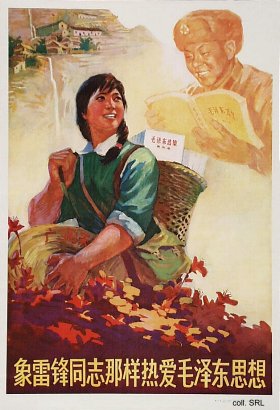
    That adulation was certainly not the result of any orchestrated propaganda campaign, and it’s cynical of you to think so. You should be ashamed. Posters such as the one at left, which exhorts everyone to love Mao Zidong thought in the manner of Lei Feng, were simply the result of people’s spontaneous outpouring of love for a 22 year-old peasant truck driver who died a conspicuously unheroic death. Many more such posters –all equally sincere– are on display at the Lei Feng section of Stefan Landsberger’s superb Chinese propaganda posters website.

    Lei’s new biographer is working hard to ensure that modern youth, notorious for their short attention spans and disdain for Soviet-style, floppy-eared winter hats, stay connected with Lei Feng, who obviously has many lessons left to teach. Most interesting is an attempt to portray Lei as stylish and contemporary. At least, by 1962 Maoist standards:

    Shi Yonggang felt unwell with the situation, who is one of the editors of a new book [sic], “Lei Feng: 1940-1962″, that will be released to on Sunday’s Lei Feng Day to recall Lei Feng’s Spirit.

    This latest edition of Lei Feng’s story is one of more than 1,000 books that have recorded his good deeds.

    “It is a pity that the image of Lei Feng depicted in those books is hard for people, especially young people, to understand and accept nowadays,” said Shi, the editor.

    Shi’s book includes more than 300 never-before-published photographs of Lei showing him as an obviously fun-loving young man who was hip with his times.

    In fact, not only was Lei hip with his times, such as they were, he was, it turns out, the coolest kid in his platoon, and a veritable style maven:

    “Lei Feng did almost all the fashionable things of his day ,” Shi said. When Lei was a farmer, he drove a tractor which is comparable to today’s BMW. When workers became the most respected segment of society in the 1950s, Lei became an iron worker in an Anshan factory in Northeast China’s Liaoning Province. He then upgraded his technical skills to earn a rarely-issued driver’s licence and began a career as a truck driver.

    Shi’s two favorite pictures are of Lei riding a borrowed motorcycle on Tian’anmen Square in downtown Beijing, while the other shows Lei holding a trendy satchel as he stands by the WuhanYangtze River Bridge, in Central China’s Hubei Province.

    The photographs also show that Lei wore fashionable sweaters, a leather jacket and wristwatch, all considered luxury items of the day.

    Driving a tractor; working as an iron worker; flashing a trendy backback. The boy was out of control. I grant you it looks like a stretch to equate nursing your rusty tractor over some dessicated, rutted field with pumping your black BMW 7-series down the highway at asshole speeds or pulling it up in front of Bellagio so the princelings out for their pre-club snacks can see your supermodel girlfriend flash her panties as she ankles her way out of the shotgun seat in a skirt so short it could be mistaken for a wide belt. But you have to remember we’re talking about 1950s China here, and standards were different. Nobody had panties then. Cool was where you found it, even if that was, um, a tractor.

    Finally, it turns out that the obedient and studious model soldier and worker was actually a rebellious hair farmer of the first degree:

    Zhang said that Lei liked to look smart and he loved to wear long bangs even though they were prohibited in the army. “Lei was warned about his hair so he would hide his bangs under his cap when he was on duty, but when he was out of uniform he would let them hang loose,” Zhang said.

    Astounding. It’s a complete reformation. He probably had a band on the side and smoked out under the bleachers. Lei Feng is clearly much more relevant to modern youth than anyone had dared dream possible. Can a new series of propaganda posters showing the iconic youth with shades, an iPod and a sexy girlfriend be far behind? After all, if modern China is all about the glory of getting rich, how can its icons miss the boat? With that in mind, I’d like to suggest a few updated slogans to accompany the new propaganda posters:

    • Seriously study fashion like Lei Feng, and get a nice shirt and some decent shoes.
    • Lei Feng says quit whining and get a grip.
    • Lei Feng wouldn’t be caught dead with his finger up his nose, asshole.
    • Only download legal music, in the manner of Lei Feng.
    • If Lei Feng caught you spitting, he’d bitch-slap you silly.
    • Live fast, die young, and leave a good looking corpse. Just like comrade Lei Feng.

    Look out kids, it’s the all-new Lei Feng.

    Hey there, good looking!
    Hey there, good looking!
  • Harbin aftermath: Government vows to thoroughly scape all goats

    Catastrophes are fun to watch, but not nearly so much fun as the aftermath of kicking, screaming and recriminations as blame is liberally heaped and fingers pointed. Katrina lasted only a day, after all, but the operatic fallout has reverberated for weeks, although less loudly now than it did at first. Chinese post-disaster convulsions are, perhaps, a bit more cryptic and mysterious than the American version, but interesting nonetheless. The aftermath of the Songhua River poisoning is just getting going, and, as it unfolds, the Chinese government and US government are notable for some of their similarities as well as some of their differences.

    The Chinese are following the US precedent by eagerly shoveling blame down onto lower levels of government. The better to distract people’s attention from the fact that the central government, if not directly responsible for the explosion, was apparently directly involved in the subsequent ten-day coverup. But at the same time, they are indulging in the classic central goverment pastime of erasing the inconvenient bits of the story in a way that the US government only wishes it could do.

    My attention was drawn back to this issue by an article that ran on Xinhua’s website today, hopefully titled, “China vows to “sternly” punish those responsible for river pollution“. (I’ve taken the liberty of correcting the spelling of the word “river”.) The article is interesting because it’s a classic bit of PR misdirection. Read this:

    The head of national work safety watchdog vowed Tuesday to “sternly” punish those responsible for a chemical plant explosion in northeast China’s Jilin Province, which caused toxic leakage into the Songhua River, a main water supply source in the area.

    Li Yizhong, director of the National Bureau of Production Safety Supervision Administration, pledged a thorough investigation in the explosion and the ensuing toxic spill in the river.

    Li, who headed an investigation team set up by the State Council on Tuesday to probe the accident, promised to seriously deal with those enterprises, departments and individuals held responsible for the accident.

    “Anyone, who were found guilty of dereliction of duty, will be harshly dealt with,” he said, “those who break the law will be handed over to the judicial departments.”

    “People who are found to have provided false information to investigators will also be punished severely,” the official said. “Any move trying to cover up the cause of the accident and any passive attitude toward the probe are deemed deception and a defiance of law.”

    ***

    The investigation team will probe the cause of the blast and why there were no preventative measures in place to prevent the benzene from being discharged into the Songhua River.

    An earlier report said that Yu Li, head of the Jilin branch of China National Petroleum Corporation (CNPC), was removed from his post.

    Two other officials, who allegedly held direct responsibility for the plant explosion, were also dismissed.

    Besides, Xie Zhenhua, head of the State Environmental Protection Administration (SEPA), China’s environmental watchdog, resigned after the accident, becoming the highest-ranking Chinese official to resign for an environmental incident.

    Ask yourself two questions. 1) What do you see in this article? 2) What do you not see in this article? My answers:

    What I see in this article:

    • A resolute central government taking action
    • An investigation team created by the State Council to probe the accident
    • Rolling of heads involved in the explosion (and one central government head)
    • Stern threats of punishment for those found to have caused the article through dereliction or negligence
    • Stern threats of punishment for those found to have “provided false information to investigators”
    • This last one is important: stern threats of punishment for those found to have covered up the cause of the accident (my emphasis)

    What I do not see in this article:

    • Any acknowledgment of the coverup of the release of Benzene (as opposed to the cause of the explosion)
    • Any suggestion that the central government was complicit in any way in that coverup (although the resignation of Xie Zhenhua suggests some acknowledgment of responsibility for the initial accident)
    • Any suggestion that a general climate of lax central regulation and control might have played a role creating conditions conducive to the explosion

    This is not surprising in the least, but it lets you see how the story is going to be spun. The accident was bad, and if negligence was involved, it is appropriate to punish the people involved. And this makes a handy flash-bang for catching people’s attention and making them feel that Something is Being Done. But it ignores the fact that the coverup of the benzene release was arguably an equally (or even more) serious crime to any negligence that might have precipitated the original explosion. After all, it was the coverup that exposed everyone living along the Songhua River between the chemical plant and whatever point the Benzene had reached when the coverup was blown to potential poisoning. If anything is going to be investigated, it’s the coverup and the decisions made around it that should come under scrutiny.

    But there is, of course, faint hope of that. The coverup is joining the lengthening list of catastrophic un-events in recent Chinese history.

    I realize this is a deconstruction of a translation, which is dangerous territory. But everything I see is consistent with how I would expect the government here to respond.

    In what looks like another consequence of the disaster, it was reported by the AFP today that a Jilin City vice mayor and environmental chief has died in apparently mysterious circumstances:

    The vice mayor and environment chief for China’s Jilin city has been found dead, the city’s Communist Party press office said, amid accusations he was involved in last month’s toxic disaster cover-up there.

    “He died yesterday,” a spokesman for the Jilin city party press office told AFP, without giving any details as to the cause of death.

    “The police are investigating. We don’t know any more about it. I think the police will make a public announcement after they finish their investigation.”

    Wang Wei, the vice mayor who was also in charge of environment protection, took a high-profile role after a blast at the PetroChina chemical plant in Jilin on November 13 that killed eight people and injured 60 others.

    The accident led to the spillage of 100 tonnes of the carcinogens benzene and nitrobenzene into the Songhua River, one of China’s longest waterways and a source of water for millions of people.

    However officials said nothing of the contamination of the Songhua for nearly 10 days.

    “It will not cause large scale pollution. We have decided not to have a large scale evacuation,” the China Business News quoted Wang on November 15 as saying.

    If the police are investigating, one must assume that Wang Wei did not pass away peacefully in his sleep. A Japanese-style shame suicide, perhaps? Conspiracy buffs may supply their theories in the comment space.

    Update: The Associated Press interprets the story a little differently than I did.

  • Van Nguyen died for your sins: Executions as public communication

    The Australians were doomed from the start, literally and metaphorically.

    They were doomed because they misapprehended the nature of capital punishment for drug offenses in Singapore. They thought of it as retribution, or punishment. This is wrong. Drug-offense executions in Singapore are, first and foremost, public communication. That radically affects how the Singapore government can be expected to respond to noisy pleas for clemency. Mercy is appropriate for punishment, but it is bad for deterrent communication. The louder and more passionate the public please for clemency became, the more inevitable was Van’s execution.

    The Singapore government is fairly transparent about its death penalty. Anyone entering the country by airplane is treated to “the lecture”, in the form of a standardized announcement of the stiff penalties for drug offenses, including death. Immigration entry cards carry the same warning. The country publicizes many of its executions via coverage in the local media. The reason why is that, unlike many nations that apply a death penalty, Singapore appears to have given some thought to how to wield it most effectively as a deterrent.

    In order to be effective a deterrent needs to be two things. First, it needs to be credible. In other words, people have to believe in the threat. Second, that credibility has to be communicated. A deterrent that no-one knows about or believes in is useless. Your trained rottweiler is a credible burglar deterrent. But you still put a “beware of dog” sign on your gate and scatter shredded dog toys, an enormous dog dish and a cow femur around your yard to drive the point home. That’s the communciation. It lets the thief know the penalty for hopping your fence and saves you the trouble of winnowing pieces of human flesh from between your dog’s teeth before his breath goes foul.

    In the US, a death sentence is often an abstraction for those convicted; something sinister that hovers on the horizon, but which is often delayed for a decade or longer by the legal process. In a sense, the death penalty in the US is not credible (“hang ‘em high” Texas possibly excepted). This lack of credibility is aggravated by laws that differ from state to state. Singapore, on the other hand, is very systematic and uniform about meting out the death penalty for drug crimes. It applies strict criteria for when the death penalty applies to drug offenses, and those criteria are openly published. The appeals process is limited and the time from conviction to execution, anecdotally, is generally around a year. That’s immediate enough to make the prospect of death very real and credible indeed.

    The Australian protests over Van’s execution yesterday arguably played right into Singapore’s hands on two fronts. It not only let them communicate their penalty globally, which the Singapore government has no qualms about, but it also let them publicly demonstrate the credibility of the deterrent by refusing to entertain pleas of clemency. The message was quite clear and effective: We are willing to execute a citizen of a first-world ally despite repeated, public pleas from his government and tearful mother. So you’d better believe we will damn-sure hang your narrow, friendless Burmese/Thai/Malay/Indonesian/Lao smuggler ass without a second thought.

    From the Singaporean government’s point of view, the consistent application of the death penalty is the lynchpin of the credibility that must be communicated. Any visible erosion of that credibility is dangerous. You can think of this a bit like you would think of negotiation with kidnappers or terrorists. You can never be publicly seen to give in as that sends a message to others that they might succeed at the same thing. If you do negotiate, you will do it only in quiet situations where there is little risk of public disclosure. If there was to be any hope for Van at all (and that hope was never more than gossamer), it would have come from sotto voce diplomatic communication out of the public view, accompanied by restrained and dignified public silence. Candlelight vigils make nice photo-ops and public remonstrations generate good copy for Aussie politicians. But they essentially guarantee that the Singapore government will follow-through with the execution, because to do anything else would undermine the entire communication strategy around their deterrent.

    Whether Singapore’s death penalty, credible or not, has any actual deterrent effect is, of course, nearly impossible to measure. It’s a truism amongst anti death-penalty campaigners that the deterrent effects of the death penalty are suspect. The fact is that, no matter how stiff the deterrent, Singapore is a strategic trans-shipment location. That is the unintended consequence of making yourself the modern transportation and air hub for one of the world’s most important drug production regions. And in Southeast Asia, and Australia as well, there is obviously a ready supply of people who will risk their lives for a large enough payoff.

    Speaking of public communication, after Schapelle Corby and Van Nguyen, the Australians might want to think twice about having a noisy public protest if another one of their own is booked on drug charges in the next few months. Right now they are looking like the whiny kingpins of the Southeast Asian drug trade. Unfair and untrue, but that’s the perception being created.

    Another spooky aspect of Singapore’s drug laws that is seldom remarked upon is that Singaporean citizens and (gulp) permanent residents can be prosecuted in Singapore for consumption of drugs overseas, even in places where it is legal or barely criminal. Singapore has, in effect, made its drug consumption laws extra-territorial, ensuring that its social values and legal restrictions apply to citizens and PRs no matter where they may live. Drug consumption spans a pretty wide range of activities, from the manifestly corrosive habits of a heroin junkie to the arguably pretty harmless dormitory spliff. The philosophical questions raised by this are, therefore, interesting ones.

    Following the promulgation of that law, in 1998, in another classic piece of Singapore drug-enforcement public communication, a couple returning from a rave in Malaysia a few years ago was famously arrested at the causeway and convicted for smoking marijuana. They were reportedly, and not very credibly, rumbled by sharp border guards who spotted their reddened “addicts eyes”. My Singaporean friends theorized that it was more likely informers planted at the rave who had ratted the couple out. Many Singaporeans I know take it for granted that informers are also cultivated amongst Singaporean student communities overseas. After all, if too many defenseless Singaporeans caught the bong habit in the dorm rooms of libertine Perth, London or Los Angeles, who knows what that might lead to. Reggae, perhaps.

    Disclosure: Imagethief opposes the death penalty in all applications. It is, I believe, a worthless deterrerent, prone to error and more often applied as a tool for satisfying an unworthy social lust for vengeance rather than as a gravely considered sanction of last-resort. In a societies that claim the mantle of modern civilization it is hypocrisy of the deepest level and there should be no place for it.