Tag: Ethics

  • How to Lose a War With the Press

    If you’re going to burn, at least burn for doing the right thing.

    At heart, PR is a simple trade. Figure out interesting stories and tell them. Build trust with reporters and others in positions of influence. Try to not screw up egregiously. There is craft and skill implied in those three points, but that’s the gist of it.

    Nevertheless, people continue to find ways to screw up egregiously. If your PR strategy ends with you and your former employer paying $57 million dollars in legal settlements, you have screwed up.

    A couple of weeks ago, e-commerce site Ebay settled a lawsuit with David and Ina Steiner, editors of EcommerceBytes, a trade news website, concluding a case that dates back to 2019. In 2020 the New York Times published a long a deeply reported piece on the scandal, and it’s worth a read if you want all the grisly details. If you don’t have that kind of time, a July 28th Times story on the settlement has a summary:

    In the spring of 2019, eBay was under pressure from an activist hedge fund. A handful of Ms. Steiner’s articles, including one about a bar [then Ebay CEO Devin Wenig] had built on eBay’s campus, infuriated company executives, according to texts revealed by prosecutors. Further details of the stalking operation were later revealed by journalists and the Steiners’ own lawsuit, which was filed in 2021.

    “Take her down,” Mr. Wenig told his communications chief, who in turn told the security team leader to do “whatever it takes.”

    The Steiners were bombarded with anonymous material including deliveries of live cockroaches and a bloody pig mask. They were threatened online. Much of the material they were sent, including a funeral wreath and a book on surviving the loss of a spouse, suggested imminent death. The security team was on the verge of breaking into the Steiners’ garage to put a tracker on their car when the plot was derailed.

    No! Wrong! Bad! If you are a communications chief and you get a request like this, you have two options:

    1. Counsel your executive on why this is a bad idea and offer alternatives.
    2. Resign on principle.

    You may have to do both of these things, in this order!

    Read the rest on Substack

    A sepia-toned scientific illustration of a coiled rattlesnake, labeled "Fig. 148 - Rattlesnake"
    Don’t be a snake!

  • Good PR People Don’t Lie

    Also, a dumb theory of lying in PR

    I stumbled into a PR career ass-backward. I say this with love and respect for those of you who dreamed of a PR career, went to PR school and diligently worked your way up. But that’s not how it happened for me.

    It was late 2001 and startup number two in Singapore had imploded following the collapse of the dot-com bubble and some poor management choices. Italian furniture isn’t cheap. Six years and two dead startups into my Singapore journey, it seemed like time for a change of vocation. Also, no one was hiring “Internet” people in 2001. Sitting in the oily puddle at the the bottom of the trough of disillusionment, we were best not touched with bare hands, like medical waste.

    Some of my beach football friends worked for the Singapore office of a small New Zealand-based PR firm. They had a problem in the form of Microsoft Singapore, one of their clients. Nobody at the agency knew much about technology, and the notoriously demanding Microsoft team was losing patience.

    On the beach, a ropey and affable New Zealander, who was amazingly fit and fast at the inconceivably geriatric age of 45, made the pitch. I had worked in radio and television in San Francisco and co-written two books about computer games, and I had just done several years of technology project management and had a good grasp of Microsoft’s products. Had I ever considered working in public relations?

    I had not. Not only that, but at startup number two I’d held our PR woman in cold contempt. I didn’t understand her job. Her requests seemed burdensome and trivial. I had important things to do!

    Karma is, as they say, a bitch. I owe her the hugest apology.

    I owe you an apology for this newsletter. But you should still subscribe.Subscribed

    I met the agency’s Singapore office leader, Kylie, a radiantly charismatic Australian woman who was the team rainmaker. “Ehhh,” she drawled when I pointed out that I had zero PR experience. “You can write and you understand tech. We can teach you the PR bit.” Also, she offered double what anyone would pay me to do Internet related work.

    I negotiated the final details of the job a week or two later, while in Laos with my father, standing ankle-deep in the Mekong in Vientiane so I could catch a Thai cell signal from across the river. And that is how, at the age of 34, I made a mid-career switch into comms. And probably also got some kind of hideous river-borne blood parasite.

    Read the rest on Substack

    Don’t be a serpent.

  • Good News! The Press is Out to Get You

    A couple of weeks ago I gave a talk about PR in China to a journalism class at Beijing Foreign Studies University. In any student talk the Q&A is always the most fun, and this group was no exception. Among the many good questions asked was whether it was easier to do PR in China because, as I had discussed in my talk, the Chinese media is generally cozier with businesses than their Western counterparts.

    Easier to get stories? Yes. Easier to achieve meaningful results with the public? No.

    I was reminded of this question by the recent expulsion of hard-charging Al Jazeera English correspondent Melissa Chan, and subsequent closure of the AJE bureau in China after the Ministry of Foreign Affairs refused to accredit another AJE journalist. I didn’t know Melissa well, though I had met her, but I respected her reporting and willingness to insert herself into uncomfortable situations, and I was disappointed to see her go. Reporting on China will be impoverished a bit.

    That, of course, was the point. The Chinese government has never been comfortable with an adversarial media, and Melissa’s reporting was, like that of much of the foreign press corps, pretty adversarial from their point of view. This discomfort is deeper than cursory annoyance at embarrassing foreign gadflies (although I presume that is part of it). It arises from one of the fundamental philosophies of Leninist political parties: the media are considered Party organs and, as with other Party organs, expected to serve the interests of the Party first and foremost. Media that don’t fit into that model are suspect by definition. You can see this philosophy expressed in the mechanisms of control that the Chinese government maintains over all domestic media, and in the government’s struggles to come to terms with the rise of social media that resist conformity with established power structures.

    The Party’s model is rather different from the fundamental philosophy of Western media: that it should be the fourth estate, entrusted with challenging the business and government establishment in the interest of the people. You are welcome to argue about how effective Western media have been in this role in recent years, and there are plenty of exceptions, but as a founding principle the idea of the fourth estate is alive and well and inextricably bound up with our Western ideas of what the media should be (and with the value judgments we render on media that doesn’t conform to that principle). A functional, adversarial media is a necessary component of Western-style liberal democracy, unless you have total faith in politicians and institutions.

    I am not going to comment further on the specifics of the Al Jazeera situation (some links to good articles below), but in light of the Chinese government’s recent struggle with rumors and trust issues, it’s worth reflecting on why an adversarial media is sometimes useful, even to the establishment. This is what I discussed with the students at Beiwai.

    As a news junkie who still pays for several subscriptions, I’m most definitely a fan of adversarial media model (you could also call it an “independent media” model, but independence is only valuable in that enables an adversarial position). There is nothing like a fantastic piece of investigative reporting that rips the lid off of some secret or scandal or that illuminates the dark corners of business or politics. As long as it’s not my dark corner, that is.*

    As a PR practitioner with a company reputation to defend, I’ve experienced firsthand the adversarial media model’s short-term ability to create sleepless nights and great puddles of cubicle sweat. But nevertheless, I still appreciate its value in the long-term. That’s because people are more likely to trust media that challenges me than one they know to be compliant with me, and I need media that the public trusts to get my message out, whether that message is a corporate one, a product review or whatever. If I have to do more work to get coverage in that kind of media, and tolerate some negative coverage as well, so be it.

    In China, on average, relationships between businesses and the media tend to be closer and less adversarial than in the west. There is also a range of ethical problems, including poor separation of advertising and editorial, the “transportation claim” subsidy-in-disguise, and more. Together, these make it easier for companies to earn –or buy– good coverage in local media than it would be in many other markets. But they also mean that the public is relatively more skeptical of much of the coverage and turns to alternative voices for much of its information and insight, many of them on microblogs . The result is a devalued media that makes even our best earned coverage less useful and influential, and that makes it harder for me to manage misinformation and rumors about my company.

    Sound familiar?

    These are generalizations. There are excellent journalists and excellent media in China, and crappy ones in the west. But the overall gap in trust is real. The real sign of progress here will not be in the government showing more tolerance for confrontational Western media, but in its tolerating the emergence of a fully independent, professionalized and adversarial Chinese media. That change, when it happens, will be driven by Chinese journalists. In some ways, it’s already happening.

    For those of us in the establishment, there is value in learning to deal with an adversarial media, and in being good at telling our stories and getting our messages across in media that are willing to challenge us, and that therefore lend credibility to the claims that survive their scrutiny. But if you’ve never had to deal with that kind of media, you haven’t developed the skills necessary to do so, and you rely on a tradition of control and management to get your message across, then you are in the realm of propaganda and will face the consequences in terms of diminished trust.

    And if your situation is so precarious that there is no way to tell a positive story when engaging with adversarial media? Well, then, your problems are much bigger and deeper than PR skills. Or one uppity journalist.

    * Just kidding. Naturally, I have no actual dark corners.

    See also:

    On the Al Jazeera situation:

    On the difficulty of reporting in China:

    Note: This post originally published on the defunct group blog Rectified.name.

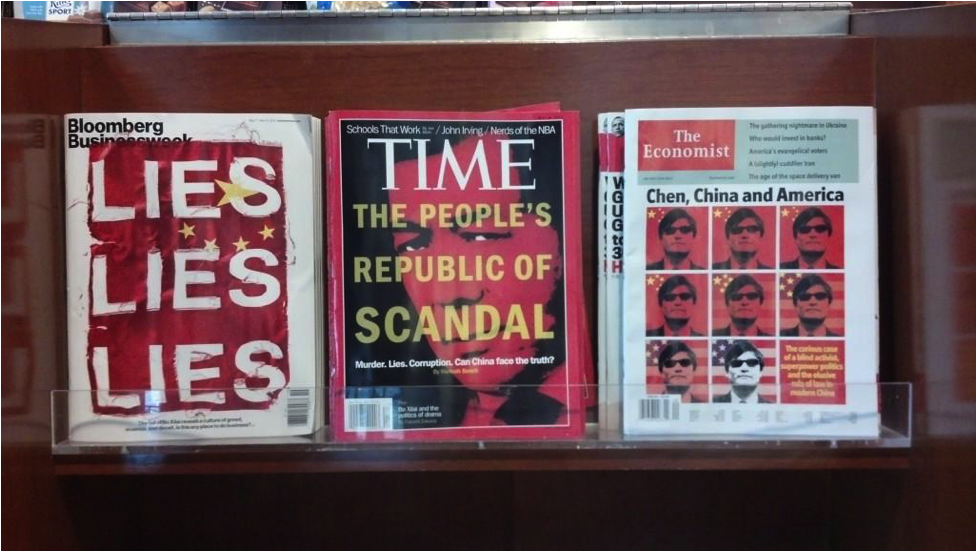
    Good news? A magazine stand at SFO's international terminal on Monday.
    Good news? A magazine stand at SFO’s international terminal on Monday.

  • China and the nature of Facebook

    Reports have been percolating for a couple of weeks that Facebook will partner with Chinese search engine Baidu to launch Facebook China, or something similar. Anyone who has followed the history of foreign Internet firms in China knows that this is fraught territory. Chinese competitors are well established, and while many successful Chinese Internet firms have foreign backing of some kind (even Baidu once claimed Google as an investor), marquee marriages between Chinese and Foreign Internet companies have often been troubled.

    There are others better placed than me to speculate on the likely business fortunes of a Facebook China (cf. Epstein, Bishop), but what really interests me are the communication challenge and reputational consequences. Some glimpse of those possible consequences came in a Wall Street Journal article about Facebook’s lobbying efforts that ran yesterday. It included the following:

    [Facebook] is talking with potential Chinese partners about entering the huge China market, where the government has been cracking down on dissidents. That crackdown has come in response to the uprisings shaking authoritarian Middle Eastern regimes, movements that have used U.S.-based social-media sites like Facebook and Twitter as organizing tools.

    “Maybe we will block content in some countries, but not others,” Adam Conner, a Facebook lobbyist, told the Journal. “We are occasionally held in uncomfortable positions because now we’re allowing too much, maybe, free speech in countries that haven’t experienced it before,” he said.

    Yowza! Better work on those talking points and come up with something that doesn’t sound quite so paternalistic. Read as generously as possible, this is one quote from what one presumes was a larger discussion on the issues of running transnational social networks in countries with different approaches to censorship and freedom of speech. Read less generously, it sounds like a lobbyist for Facebook arrogating to his client the responsibility to decide what constitutes an appropriate amount of free speech in any given country. Risky territory.

    From a business point of view deciding an appropriate amount of free speech might be a practical necessity. From a public communication point of view it’s dangerous. Five years ago, when Facebook was still a plucky upstart too trivial to be noticed, Yahoo, Google, Cisco and Microsoft were hauled in front of a congressional hearing to testify on their activities in China and their willingness to accommodate governments with illiberal approaches to free speech. It was not a banner moment for the American Internet industry. “Moral pygmies!” declared Tom Lantos, the principal congressional antagonist. Much of the cast has changed and Tom Lantos has since died, but the issue remains sensitive. (Not all the cast has changed. Facebook’s current head of communication, Elliott Schrage, represented Google in the 2007 hearings.)

    Facebook itself has not committed publicly to anything in China. They also haven’t yet committed any of the blunders that those four firms did (most notoriously Yahoo, with the Shi Tao affair). Finally, Facebook hasn’t made nobility a part of their brand in the way that Google conspicuously did in its early days, something that was used against Google in its China engagement. In fact, if anything Facebook is known for a kind of calculating amorality that may be useful in the ruthlessly sharp-elbowed Chinese Internet world.

    But what’s important here is not how Facebook sees itself, but rather how people at large see it, and how activists and politicians think they can use it to drive their own agendas. Whether Facebook likes it or not, it has been publicly associated with recent events in the Middle East and is widely seen as a force for enabling dissidents and protestors whose causes resonate with western publics and politicians. See for example New York Timesstories here, here and here. Evgeny Morozov and Malcolm Gladwell might ridicule the notion of social media as democracy tools, but that won’t necessarily dispel a belief that was made clear in the 2007 hearings: American Internet firms should represent American values.

    Companies’ decisions about China are revealing. Facebook’s decision on whether or not to formally enter China will be especially interesting. It will establish something fundamental about the identity of one of the two most powerful Internet companies on the planet. Is Facebook, as some have supposed, the great enabler of democracy? Or is it a company of business pragmatists willing to censor (or delegate censorship) in order to open a potentially lucrative market? The reality is probably more nuanced than either of those positions, but as far as public perception goes it will be difficult to have it both ways. How does one balance groups of stakeholders with completely incompatible views on what constitutes a responsible and conscientious Internet firm?

    The nut of the problem is that, right or wrong, democracy activists, American politicians and the Chinese authorities all tend to see American Internet firms as standard bearers for western values. Facebook’s task is to convince the Chinese authorities otherwise while not making activists or western users in general feel betrayed. I can think of few more precarious communication challenges. The quote above is an unpromising start.

    Update:

    Obama hosted a town hall at Facebook HQ yesterday. Interesting. And likely to be noticed here in Beijing.

    See also:

  • Don’t scoop the reporter who interviews you, and other PR basics

    Last Wednesday, the 21st, the IT news channel of giant Chinese portal Sohu published the transcript of an interview of Sohu CEO Charles Zhang by Hong Kong-based BusinessWeekjournalist Bruce Einhorn. All well and good, you might think. Chinese portals regularly translate and run foreign media articles, and it makes sense that a portal might want to run a high-profile interview with its boss. But there were two problems. First, the interview was on the rather sensitive topic of the dueling IPR lawsuits between Sohu and Youku. Second, BusinessWeek hadn’t run the story yet.

    Alerted by YouKu, BusinessWeek presumably put pressure on Sohu because the Chinese interview transcript vanished by the next day, along with many of the reprints on other Chinese websites. If you’re curious, and read Chinese, a few instances remain online. TheBusinessWeek story by Mr. Einhorn is also now available online. It is interesting to compare the two, although Imagethief suggests reading the transcript with some caution for reasons that shall be explained below.

    Imagethief has no idea what transpired between Mr. Einhorn and Sohu in arranging and conducting the interview, but I’d bet actual money that an agreement for Sohu to publish their own transcript of the interview was not part of the deal. Another Western business journalist told me today that such a move was pretty likely to piss off a publication on any number of levels. Really, I didn’t have much trouble guessing that on my own. In general, Chinese companies have a lot to learn about working with Western media, but I can’t imagine the Economic Observer, 21st Century Business Herald or Caijing (even with its current woes) sitting still for such a move either. The fast removal of the transcript from Sohu suggests that publication took BusinessWeek by surprise.

    There were a couple of problems with what Sohu did. First, and most basically, they used a journalist’s interview to create and publish material that pre-empted that journalist’s story. That’s just plain rude, and probably won’t be soon forgotten. As a media organization itself, Sohu, of all companies, should know better. But it goes beyond that. Mr. Einhorn is an experienced journalist writing for a publication with a reputation to protect. As you would expect, his story on the lawsuits between the two companies is balanced and includes quotes from both Sohu and Youku.

    The transcript published on Sohu, however, included only brief questions and Mr. Zhang’s responses. Sohu’s introduction presents the transcript as “an interview with BusinessWeekjournalist Bruce Einhorn”, which is literally correct, but appropriates BusinessWeek’scredibility for a one-sided view on a contentious issue. That same introduction characterizes Sohu rival Youku extremely negatively, saying that the discussion would, “reveal the details of Youku’s piracy and rights infringement.” Not much balance there.BusinessWeek might run executive Q&As, but it’s safe to say they wouldn’t stake out such a negative position in an article that didn’t give Youku space to respond, and that wasn’t backed up by copious facts and extensive reporting. Interviews are raw material. A transcript of a single interview is not a story, and putting BusinessWeek’s name on the interview is a misrepresentation.

    Readers also have no way of knowing if the transcript is accurate or how it may have been edited. Any Q&A interview is likely to be edited, but a publication editing a Q&A for tightness or focus is not the same thing as a company editing a transcript to better present its point of view. Imagethief knows from experience that editing of interview transcripts by PR teams is common practice in China (many journalists expect a transcript by e-mail following an interview), and a reading with a critical eye is well advised. However, the imprimatur of BusinessWeek on the transcript implies that BusinessWeek itself had the final cut, not Sohu. That looks like another misrepresentation.

    It’s sensible policy for companies and PR teams to record their own versions of interviews with journalists. A recording enables you to check the accuracy of final quotes, provides leverage if you need a correction or clarification, and can help out if the journalist has a problem with their own recording (it has been known to happen). Recorded interviews with experienced spokespeople can also often be good source material for messages, sound-bites and other content. However, publishing or leaking recordings or transcripts in their entirety is a bad idea if you want to preserve your media relationships.

    There is only one situation in which I would suggest to a client publishing verbatim portions of an interview transcript. If a story has already run with an inaccurate or wildly out-of-context quote that I feel misrepresents a spokesperson or client company, and if I can’t get the publication to correct the quote or issue a clarification, I might suggest that the client publish an appropriate excerpt of the transcript on a PR page or company blog. I would only recommend an excerpt, and I would include an explanatory note of why the excerpt is being published and a link to the original article. I would also notify the publication that I was going to do this.

    Running the transcript also hints at a deeper issue. It would have been simplicity itself to have a Sohu journalist interview Mr. Zhang for the exact same responses (or to put the same material on Mr. Zhang’s blog, which appears to have been fallow since July). An admittedly cursory search of Sohu today didn’t turn up any such articles since the founding of the Alliance last month. Why not?

    News organizations are generally disinterested (as opposed to uninterested) in the news they are reporting. When reporting on issues in which they have an interest, such as the fortunes of their parent companies, good news organizations take pains to be balanced in order to preserve their reputations. There are op-ed pages and blogs for points-of-view (not to mention the occasional leaked letter to ownership). Sohu is hardly a disinterested party in the lawsuit with Youku or in the fortunes of the Online Video Anti Piracy Alliance, which it founded and largely speaks for. Running the transcript of the BusinessWeekinterview might just have been a mistake. Or it might have seemed like a way for Sohu to have the best of both worlds: A splendidly one-sided interview that carried that authority of a respected, international business magazine and that didn’t seem to compromise their own newsroom.

    But in the long run you can’t have it both ways. And for a company listed on America’s NASDAQ, annoying Western business media in attempt to have it both ways is probably not a great PR strategy.

    Disclosures: I found out about this episode from a friend who works for Youku. In my job I also regularly work with journalists from Sohu’s news organization, all of whom are completely professional. I have no opinion on the merits of the various lawsuits flying back and forth between Youku and Sohu.

  • How to turn one terrible scandal into two

    Note: This includes two posts originally published on back-to-back days.

    Part 1: How to turn one terrible scandal into two

    Imagethief loves watching companies hang themselves. Unless they are his clients, in which case he has fits watching them hang themselves because it means sleepless nights in the glow of the computer eating greasy dinners out of Styrofoam boxes.

    Fortunately for me, China Railway 12th Bureau Group Company is not one of my clients. For one thing, if they were, I’d advise them to change their name. I had to look at the original article twice to transcribe it. I’m sorry, but if you’re not a law firm you have no business having five nouns in your company name.

    More importantly, they have just committed one of the great PR sins: the busted coverup. From AP, via BusinessWeek:

    Police have detained 10 people in charge of building a new subway line for the 2008 Beijing Olympics after one of the project’s tunnels collapsed, trapping six workers, state media said Friday.

    ***

    Construction company China Railway 12th Bureau Group Co., was suspected of trying to cover up the accident and delaying rescue efforts that might have saved lives, Xinhua said.

    Police have detained 10 people including the project supervisor and the tunnel’s designers, Xinhua said. It did not give their names or say if they had been formally charged with any crime.

    Xinhua said the construction company sealed the site immediately after the accident, confiscated employees’ mobile phones and ordered people not to talk to police or media.

    The company did not report the accident to city authorities until eight hours after it occurred, it said, citing unidentified Beijing officials.

    You would think that after the great Songhua River disaster of ’05 people would have learned their lessons about this. But it’s hard to overcome those olde fashioned instincts, and probably even harder when you are working on a marquee project that is part of Beijing’s pre-Olympic rectification program.

    By definition, no one really knows how many successful coverups there are. However, I’d bet there really aren’t many. It all comes down to the old adage that two people can keep a secret if one them gets a lead tattoo. I am not sure any peer-reviewed scholarly work has been done in this area, but I am convinced that as the number of people involved in a coverup goes up, the risk of it being blown increases far more than in linear fashion. I betting that risk increases as at least the square of the number of people involved.

    So you can confiscate all the mobile phones you want, and you can order people not to talk, but sooner or later somebody will. And probably sooner. And even if they don’t, people –family members and friends for instance– tend to notice a lot of sudden deaths.

    Now China Railway 12th Bureau Group Co. (or CR12BGC as I like to think of it) has two crises on its hands: the possibly negligent deaths of twelve workers, plus a mass arrest of its executives and supervisors. Instead of looking negligent, they now look negligent, sleazy and criminal. Congratulations! It’s not easy to self-destruct that dramatically without being discovered trafficking in kiddie pr*n. Good luck explaining all this to the press.

    Unless the government bans all coverage of the situation. This is China, after all, and the rules remain a little different. I realize also that CR12BGC is probably not the most progressive company when it comes to communication. But despite the high level of government intervention, China now has a scrappy, modern media that loves a good scandal. The sooner Chinese companies learn how to deal with this, the better things will go for them.

    We PR people are widely unloved. There is some justification for this. As an industry we have a history of taking on unsavory clients and disagreeable jobs. But its also unfair in some ways. In crisis situations we spend a lot of time giving variations on the following straightforward advice to our clients:

    1. Don’t lie.
    2. Be mindful of your legal risk and prudent in communication, but don’t try to hide or distort the facts of what actually happened.
    3. Don’t lie. (Again.)

    Writ large or small, successful crisis communication is about clearly explaining your side of what happened and being publicly seen to take all practical steps to address the crisis and assist the people affected. You can’t bring back the dead, but you can take care of the living, understand what went wrong, visibly cooperate with authorities and demonstrate a commitment to learning from mistakes. It might not do anything about your legal liability, but it will help your reputation and generally costs less in the long run than the alternatives. And if you do get prosecuted, a constructive approach looks a lot better in court than an attempted cover up.

    Plus its hard to work a crisis when all your spokespeople are in jail.

    Gasp! It's the China Railway 12th Bureau Group Co.!
    Gasp! It’s the China Railway 12th Bureau Group Co.!

    Part 2: Beijing subway collapse: Whose crisis is it?

    Following up on yesterday’s post about the Beijing subway collapse, I saw an interesting article (subscription) by Mei Fong in yesterday’s Wall Street Journal, Asia. (I try to get that right ever since one of their journalists explained to our staff in Beijing that it’s not the “Asian Wall Street Journal” any more, and that we had better get with the times.)

    Because of its galvanizing effect on everyone with a China agenda, the Beijing Olympics has been described within my industry as “issues rich”. This is PR code for “shitstorm waiting to happen”, and is the kind of thing that usually leaves PR men cackling to themselves and planning expensive purchases. (Or, at my pay grade, grocery shopping.)

    Among the many China issues that people get in a twist about is migrant laborers. There are by the government’s own estimates 115 million of them. For perspective, that’s less than 10% of the population of China, but more than 35% of the population of the United States. And I’m not sure the government is counting everyone.

    A lot of these migrant workers are currently in Beijing, slaving away on extremely high-profile, deadline-sensitive projects that are part of the city’s pre-Olympic renovation. People have noticed this. Mei writes:

    [Beijing’s] haste to meet its construction deadlines has resulted in round-the-clock work for the armies of often poorly paid, badly equipped migrant workers who build most of these projects. Some work shifts that can last as long as 24 hours.

    The relatively poor working conditions of migrant workers has come under greater media scrutiny in recent months, causing international labor groups — many already critical of China’s poor human-rights record — to put greater pressure on the International Olympic Committee to improve the situation.

    IOC spokeswoman Giselle Davies said in an email that “our understanding is that all efforts have been made both in terms of safety — specifically putting precaution first, and also in terms of transparent management.”

    Does the IOC really believe that? Even if it doesn’t, is there anything else it could say without admitting culpability and precipitating its own crisis? How about:

    “The IOC is aware of the widespread exploitation of Chinese migrant laborers, the mistreatment they commonly suffer and the appalling and unsafe conditions they endure. We sympathize completely. But we also believe that during the pomp of the opening ceremony, amidst the pageantry, grandeur and fireworks, no one will be thinking about a few bones in the foundations.”

    Maybe not. OK, what Ms. Davies says isn’t as bad as my idiot scenario above. Note the weasel words, though: “Our understanding is…” That phrase is the IOC’s absolution. It transfers responsibility onto BOCOG and the Chinese government. They told us everything is OK. But for credibility it depends upon you and me believing that the chain of honest communication and transparency from labor contractors to construction subcontractors to primary contractors to the municipal government and BOCOG is intact. Do you really believe that? Of the Chinese construction industry? And if you don’t, then should the IOC?

    I realize I am dissecting one partial statement out of context here. But that’s what the public will see, so that’s what will inform people’s opinions.

    As for BOCOG, it has duelling priorities:

    Priority 1) Have a glamorous and untarnished Olympic Games that mark China’s emergence on the International stage.

    Priority 2) Get the goddamn thing done in time and on budget.

    So which priority will win, and whose reputations will get trashed in the process?

    493 days, 6 hours, 51 minutes and 17 seconds to go as of this posting.

    Gasp! It's BOCOG and the IOC!
    Gasp! It’s BOCOG and the IOC!

  • Foxconn shoots themselves, Apple in foot

    Note: This post consolidates three original posts on this topic that were published on consecutive days. It was also cross-posted on my CNET blog, published in 2006 and 2007.

    Part One: Foxconn shoots themselves, Apple in foot

    You may recall Foxconn, AKA Honhai Precision Manufacturing, as the company at the center of a recent PR crisis for Apple Computer, when a British newspaper published reports that they were mistreating the workforce responsible for assembling luscious (and expensive) iPods. In the last few days Apple, ever image conscious, got round to publishing their own report on the situation, and it has largely faded from the public consciousness.

    But Apple isn’t the only company that was left scrambling to protect its reputation in the wake of the scandal. Foxconn too felt hard-done by, and is taking steps to assert itself. Unfortunately, rather than take constructive steps to reassure the international companies who’s own brands are propped on Foxconn’s labor practices, Foxconn has instead decided to make an example of two Chinese journalists. This looks like a move that has the potential for mighty backlash.

    China’s English Language Shanghai Daily broke the story in the mainstream. Here it is reprinted by Xinhua:

    BEIJING, Aug. 29 (Xinhua) – A Chinese court has frozen the personal assets of a reporter and an editor at a Shanghai newspaper after Apple iPod manufacturer Foxconn sued the pair for 30 million yuan (US$3.77 million) for allegedly damaging its reputation over reports of substandard work conditions.

    Foxconn’s subsidiary in Shenzhen reportedly petitioned the city’s Intermediate People’s Court on July 10 to freeze the property of Wang You, a reporter for China Business News, and Weng Bao, an editor at the newspaper. The locked-up assets include apartments, a car and bank accounts.

    The company also filed a lawsuit against the journalists, seeking 20 million yuan from Wang and 10 million yuan from Weng. The case is the biggest of its kind on the Chinese mainland in terms of the size of the compensation claim.

    I am not the only one who sees Foxconn’s response as being perhaps a bit disproportionate. Sentiment seems to be gathering that the lawsuit is a blatant press intimidation tactic rather than a dispassionate seeking of legal redress. Two excellent English language China blogs have taken Foxconn to task. Non Violent Resistance writes, in a post scathingly titled “FoxConn is not dumb, but downright vicious“:

    Words in the Chinese press circles are, that FoxConn, therefore Hon Hai, had deliberately picked the two journalists from China Business News to sue in a painstaking plot to harrass and intimidate media outlets and journalists. After all, China Business News was not the only newspaper that doggedly followed the iPod sweatshop story. It seems that FoxConn, before launching the much criticized lawsuit, had also considered targeting 21st Century Economic Herald, another popular business newspaper who had similarly covered the story. But FoxConn’s lawyers, after much investigation, found out that the 21st Century reporters who were involved in reporting the story had solid, formal employment contracts with the paper — therefore, unlikely to be held as legitimate defendants in a court.

    Roland Soong, of EastSouthWestNorth, writes:

    If I can make this case very simple.  This is not a question of whether the First Financial Reporter was right or wrong in his reports.  Either way, FoxConn is entitled to file a civil libel suit against the newspaper, which employs that reporter and his editor.  But since when does a civil libel suit involve freezing the assets of the reporter and the editor, including their bank savings accounts, stock holdings, homes and automobiles, to the tune of 10 million RMB for the editor and 20 million RMB for the reproter?  As the reporter noted, this amount is many more times than that which he can ever expect to make in his lifetime.  By comparison, how would the western media react if a prominent American newscaster such as Katie Couric were sued by a large corporation and have all her personal assets frozen for the duration of the legal proceedings?  The Chinese media workers are of the opinion that if this case were allowed to go through, it will be the end of any coverage of the doings of large corporations.

    More good information from Roland here.

    I can see the thought forming in your head. Dude, it’s China. Press intimidation? So what else is new? But it isn’t quite that simple. Yes, the press in China doesn’t operate with the same freedom that is does in the west, especially when it comes to political reporting. But what the government can get away with in the name of social harmony and what a Taiwanese corporation –even a connected one– can get away with are not the same.

    So what might the PR implications be? Well, the story is now being picked up by various foreign media, including specialized voices such as China CSR, and wire services like AFX,AFP (here on the International Herald Tribune) and Reuters, whose headline suggests that, despite what Non Violent Resistance fears, the newspaper will vigorously defend its journalists. Reuters has actually bothered to get out and do some reportage, and their story includes a quote from one of the sued journalists and a quote lifted from a party-managed Chinese newspaper’s editorial, and written apparently without irony:

    “(The case) has sent a dangerous signal to society, and means legal procedures could be used to suppress freedom of speech,” said an editorial in the official China Youth Daily.

    How about that. If China Youth Daily is complaining that you’re infringing freedom of speech, you have a problem. But journalists –even at official news organizations– will look after their own. Superb China media blog Danwei thinks the story has all the right ingredients to keep titillating western editors (and I agree). The China blogosphere is also gathering heat. Yesterday mega-portal Sina, smelling a juicy story, set up a blog for the two journalists, and the posts are attracting lots of comments and lots of readers. The momentum may not last, but its got off to a good start. The net result is that Foxconn is committing one of the great PR sins by busily making itself look worse than the people it is angry at ever did. And there is no damage worse than self-inflicted damage, which suggests stupidity.
    So if you’re Apple what do you think of this? Remember, this incident is descended from an Apple-related story, and MacWorld UK has also picked up the lawsuit story, so it’s creeping close to Apple’s own brand. The whole thing has now gone beyond simple libel lawsuit and in just 48 hours has spiraled into something nasty with a real whiff of media intimidation about it. Reputation damaging questions are also being asked about Foxconn’s relationship with the Shenzhen government and courts. Chinese press isrubbishing the case. Well, if I’m Apple (or their PR guy), the last thing I need is for the contract manufacturer who just gave me a mighty PR headache to give me another mighty PR headache just ten days after I’ve put the last one to bed (Apple’s report was released August 17). Despite their own recent, poorly thought out lawsuits, media intimidation is not something that resonates well with Apple’s cerebral, trendy brand. If I was Apple I’d be gently suggesting that Foxconn back off if they want to keep my business.

    But, hey, that’s just me, and I’m a nice guy who likes reporters, even though I do bug them with pitch calls from time to time.

    Part two: What was Foxconn thinking?

    Originally published August 30, 2006.

    Every now and then, Roland [Soong, of EastSouthNorthWest] dangles a PR question in front of me and, like a shark rising predictably to the bait, I pretty much always go for it. In yesterday’s post [above] about Foxconn’s fit of PR self destruction, Roland asked in a comment:

    What is the matter with FoxConn? Why is this “no comment” thing? Keeping their fingers crossed and hoping that it will all go away? Can you guess what is going on?

    Well, I am happy to guess. But I’d like to remind all readers that this is nothing more than speculation, innuendo and hypothesis. Of course, that’s never stopped me before.

    From a PR point of view, there are a few things going on here: the original foreign and Chinese newspaper reports about Foxconn’s labor practices, the subsequent lawsuit filed against two Chinese journalists, and the current (entirely predictable) coverage explosion over the lawsuit and refusal of Foxconn to comment. This would be a complex situation for any company to manage from a PR point of view. But it’s going to be even harder for Foxconn. I am going to make a sweeping generalization here: Chinese companies (including Taiwanese ones – please keep your “one China” screeds to yourself) by and large don’t “get” PR. As an old China hand friend of mine said, “They don’t understand PR. They understand face.” Well, just like face can get you into a fistfight that never needed to happen, it can also get you into a PR disaster that never needed to happen. But I think the Foxconn situation runs deeper than simple face.

    Putting the problems of Chinese companies with PR somewhat more scientifically, many of them are just learning what PR is and how to use it. As a Taiwanese company and contract manufacturer, Foxconn evolved in a somewhat more developed media market than mainland companies. It has also been around for more than thirty years, although its internationalization in earnest started in 1993. But as a contract manufacturer –and not, say, a consumer brand– Foxconn may also think that it is insulated from certain kinds of PR problems. This may have been true once, but today, when the bloom is off the outsourcing and contract manufacturing rose, and MNCs are under increasing scrutiny for the behavior of their partners, this is not the case. That lesson should have been made painfully apparent in the original Apple scandal of a couple months ago.

    But there is another complexity operating here: this isn’t just a PR crisis (yes, its an official crisis now). It’s a legal PR crisis. And legal situations are always particularly difficult. With all due respect to my good friends at China Law Blog (who may wish to comment upon some of the legal aspects of this case), lawyers and PR people often rub along poorly. A sound legal approach and a sound PR approach to a given situation do not always agree. I am perhaps nursing a bit of resentment here. Put a CEO, a head of PR and a general counsel in a lifeboat together and maroon them at sea until they begin to starve and see who gets eaten first. Nine times out of ten the CEO and general counsel will eat the PR guy. The CEO’s calculation may be that he’ll need a lawyer to keep him out of jail for cannibalism. Personally, I think that’s misguided. After all, who’s going to do a better job of explaining cannibalism to the public and protecting his reputation?

    My personal issues aside, the upshot is that legal decisions are often considered to trump PR decisions, and are thus taken without regard for the PR consequences. This is especially true in companies with an unsophisticated approach to PR, but it can happen to anyone. In China we see this with things like IPR lawsuits by MNCs against local companies, which make perfect legal sense but can sometimes have PR consequences far more damaging than the actual infringement. But somehow legal problems are considered “real” while PR is considered, well, just PR. So it’s possible that even if someone within Foxconn explained to the management that suing journalists directly was a stupendously bad idea PR-wise, it’s possible that they were simply dismissed as a touchy-feely PR type without the spine to face up to hard-boiled business issues.

    To which that PR person, if he exists, should be saying who’s laughing now, dumbass? Of course, now this poor flack is busy trying to deal with the PR crisis upon which he will probably be judged, so he has no time to gloat. It’s a hard life in the spin doctors.

    So that brings us to the “‘no comment’ thing” mentioned by Roland. Regardless of whether PR people were consulted prior to the lawsuit or not, it’s pretty standard practice for companies to refuse to comment on pending or ongoing litigation. Doing so can often create further legal problems, anger judges, etc. Unfortunately, this can also evolve into a sort of programmed, knee jerk response that is automatically given even in situations where companies really ought to comment. Personally, I think this is a situation that increasingly merits comment. Furthermore, my advice to clients is that you always return a journalist’s phone call, even if it’s just to tell them that you can’t comment, and even if you expect to get roasted for that. It’s a basic courtesy and “could not comment” or even “refused to comment” generally looks better in print than “could not be reached for comment” or “did not return phone calls”, both of which make it sound like you’re hiding and amplify the appearance of guilt. Next to the image of you cowering in a smoke-filled crisis room while unanswered phones ring away, the blandest of holding statements can seem like pure gold. In this case, Foxconn is apparently not returning any calls, so, true or not, they look like they’re hiding. It also makes it hard to know if they’re playing the “don’t comment on litigation” card or if they’re just being obtuse. I’m betting on obtuse.

    Ultimately the question of motivation looms here. Is Foxconn motivated by a sincere desire to address a slight to its reputation by seeking legal redress? Or is it seeking to intimidate the Chinese press as a way of buying future insurance against bad coverage? If it is taking the first course it has committed some serious PR mistakes. It is almost always a bad idea for corporations (or governments) to sue individuals who were working on behalf of an organization, such as a newspaper. For examples, see Apple’s lawsuits against leakers and the RIAA lawsuits against file sharers, both of which were PR disasters even if they were legally sound. Suing an organization looks like seeking redress. Suing an individual looks like petty vindictiveness. David v. Goliath. It’s not that difficult an equation. (Mind you, I am speaking strictly from a PR point of view, not a legal one.) Foxconn has sued the journalists rather than their newspaper. Not only that, it has sued them for far more money than either of them is ever likely to possess, and has had their assets frozen. This not only looks petty and vindictive, it also looks sleazy since they have somehow managed to engineer a presumption of guilt and, without the benefit of a judgment, inflict considerable misery on…a journalist and an editor. And we all know how much Chinese journalists are paid. So if Foxconn was seeking to address a slight to its reputation, it has failed monumentally and is now doing even more damage to its reputation.

    On the other hand, if Foxconn was seeking to intimidate journalists…it has also failed monumentally since the Chinese (and International press and, um, bloggers) are now going crazy.  Nice work guys. It’s Miller time.

    In addition to the China PR problem, Foxconn is also entering into extremely risky territory with regards to its foreign customers, like Apple. Anyone who has followed the recent problems of US Internet and technology companies in China knows that freedom of speech issues are weeping dynamite for foreign companies doing business in China. The last thing a company like Apple needs is a contract manufacturer being accused of media intimidation in China. Imagine:

    “Hey Apple! Your contract manufacturer was just accused of horsewhipping underage girls for sixteen hours a day and now they’re trying to intimidate Chinese journalists into silence on the issue. What’s your comment? How do you feel about the freedom of Chinese media to report on these kinds of issues?”

    Despite my advice above, I’m thinking Apple doesn’t return that phone call. Or if they do, they give a non-answer about how this is an issue for the Chinese courts to settle, Apple has taken great pains to blah blah blah noise noise noise. Apple, you will recall, has had its own problems with the media, and may not want to attract charges of hypocrisy. They will also, somewhat justifiably, want to get All The Facts first.

    But that’s tough for them, because this is their PR problem too and, as I wrote yesterday, if I’m Apple I’m on the phone to Foxconn right now telling them to drop the suit, save face by announcing that their point has been made and suck it up. Better yet, Apple should set a further example for MNCs using contract manufacturing in China and come out with a statement vigorously defending the right of the Chinese press to look into the practices of MNCs and contract manufacturers in China. Apple sells jack here and has essentially no market to lose in China, and can always shift its manufacturing to Vietnam or wherever, so why not retake some of the high ground it lost over the original scandal? What’s Foxconn going to do? They’re Apple’s vendor, and there are plenty of business-hungry contract manufacturers in line behind it.

    And this situation has begun to touch Apple. RSF is already on the case, with an open letter to Steve Jobs.

    But what if the journalists actually did libel Foxconn?

    Interesting question. But from a PR point of view (not a legal one, mind you) now irrelevant. The public opinion and reputational battles have already been lost. A legal victory would be Pyrrhic at best. Foxconn absolutely has a right to defend its reputation in the courts and to respond vigorously when libeled. But legal action in defense of reputation must be considered, planned and executed with an eye on further reputational consequences (this is where PR people and lawyers often diverge). And that is something that Foxconn did not do. Furthermore, Chinese journalists will, if anything, probably be motivated to scrutinize Foxconn even more closely from now on.

    So if I were Foxconn’s PR person what would I now advise them? Presumably after I got done berating them for not talking to me before they launched the lawsuit?

    Drop the lawsuit. It’s too late to salvage this one. Drop it, make a face saving announcement and let it go. And if you must pursue the lawsuit, admit that you were “overzealous”, have the court unfreeze the journalists assets and allow them to go on with their lives pending a judgment. And reduce the damages sought to something symbolic. Remember, this is PR advice, not legal advice. I have no idea how possible any of this would be in Chinese courts. But, at first glance, Foxconn’s relationship with the Shenzhen courts looks pretty cozy, so it shouldn’t be too hard.

    And, really, stop making life difficult for your customers. You don’t need a PR man to tell you that’s a crappy way to do business.

    Notes:

    • iSuppli analyst Adam Pick recently wrote a story hailing Foxconn’s success. Among the factors he noted, “making the most of the China advantage”. It scarcely needs be remarked that one can take “the China advantage” a bit too far if not careful.
    • I should note, by way of full disclosure, that I am not a litigation support expert. That’s a specialized PR field, like financial communications, best practiced by people with a good understanding of the legal environment in which they operate. So my observations are those of a PR generalist. Litigation support experts are welcome to comment.

    Updates:

    • Danwei with some more interesting background and opinions from Chinese media.
    • Sina’s tech news page (not the journalist blog) devoted to the situation, including a handy timeline graphic (Chinese).
    • One of my bosses, a very experienced Chinese PR professional, thinks that Foxconn will be forced to withdraw the litigation. He even thinks it is possible their chairman may have to apologise. We’ll see.
    • Roland’s excellent follow up on the PR war between Foxconn and the journalists includes translations of some of Weng Bao’s blogs (the sued editor). Roland also makes an excellent point that I should have, and which is key to how Foxconn needs to think about this PR battle. From a public communication point of view this PR war is assymetrical. Foxconn is an enormous, faceless corporation speaking in corporatese. The journalists are identifiable human beings able to muster emotion and personal sympathy and use press freedom (in an acceptable local context) as a rallying cry. That means that even if they are guilty, they have the upper hand in the PR battle. Foxconn needs to consider that in all of the their PR strategizing if they are to have hope of looking like anything other than relentless bullies. (Hint: get some real people front and center.) As I wrote above, whether or not libel was committed is now essentially irrelevant. Foxconn can win but still lose if they are not careful.
    • I hear that CCTV 2′s “Dialogue” program is planning a special segment on the affair.

    Part Three: All’s well that ends in retreat

    Originally published on August 31, 2006.

    According to ESWN Foxconn has reduced the damages requested to 1 yuan. Roland is citing a very brief Netease report, and I am not sure how authoritative it is. But if it is true, then it means that Foxconn has taken one of the possible paths I outlined yesterday: reduce the damages to a symbolic level but proceed with the lawsuit. Apple also interceded in the dispute, as I suggested they should. I’d like to claim credit for remote PR genius but, a) it’s not genius, it’s common sense; b) Foxconn and Apple are probably not reading this blog and c) we’ll see how things play out for Foxconn in the Chinese press over the next few days.

    Just as interesting as the Foxconn scandal itself is a sideline discussion that has broken out over the newsworthiness of the story with regard to western audiences. Roland was originally disappointed with slow uptake of the story by Western media. Do read his post above, which offers his point of view on this and lists many of the foreign news sources that eventually did carry the story. Then be sure (especially if you’re a China PR pro) to read this post from Richard Spencer, bureau chief of UK newspaper the Telegraph. Richard keeps one of the best journalist blogs in China and he explains very clearly what news value this story has and doesn’t have with regard to his (middle-England) readers. I should send this post to my clients when they ask why I don’t pitch their China business stories to general-interest Western media like the Telegraph, as opposed to specialist business media such as The Wall Street Journal, Financial Times and Business Week.

    I’m a technology PR man so I think in terms of brand and reputation with regards to technology companies. I wrote the story for my CNET Asia blog, but then I have a specific China technology mandate, no editing to speak of, and write for an Asian readership specifically interested in technology. More generally, I tend to judge a story this way: “If I was that company’s PR man, would I be worried?” For me this story had potential legs overseas for one reason: Apple. Apple is a hot brand that just navigated a China PR scandal involving Foxconn. With an Apple press story as the origination of the of the lawsuit this is potentially interesting to foreign audiences and thus a PR risk for them. If was Apple’s PR man, I would have been worried.

    I see that a lot of the overseas coverage was fairly narrow. Some of it is in journalist blogs (as in Barron’s and the San Francisco Chronicle) and much of it in specialist technology news (Slashdot, VNUNet, MacWorld) interested specifically in the Apple connection. I put “Apple” in my own CNET headline. Most of what might considered mainstream coverage with a broad impact is either from the wire services –which covered the story widely– or business media (The Wall Street Journal, Financial Times), many of which ran the wire coverage. That’s understandable; Foxconn is a large, listed company and a major supplier to many enormous, Western technology firms, so there are business implications.

    So it was a story outside of China, but a particular kind of story. It’s interesting what crosses borders and why. When I do internal training in foreign media relations for my company I spend some time on what different kinds of foreign media consider an interesting “China story”. It always raises some eyebrows among my local colleagues.

    A closing thought. I love my summer PR scandals. Last year: the Songhua River. This year Foxconn. Gotta love those crazy August days.

    Disclosure: I am not Apple’s PR man.

    Update: Xinhua has run a story on Foxconn’s claim reduction:

    Foxconn said it lowered the compensation claim so that the public could focus on the fact that “the untrue reports had damaged the reputation of our company,” and not just on the 30 million yuan compensation claim, Sina reported, citing company spokesman Edmund Ding.

    Damn straight. And the newspaper reports aren’t the only thing damaging Foxconn’s reputation now, and it’s a little late to refocus the public’s attention. Next they think they have been libeled, they can sue the newspaper. Then, if they win, the newspaper can discipline the reporters and it won’t be their problem. Hard lessons learned. Note that I have no opinion on whether the journalists did libel Foxconn or not. That’s something for an (ahem) impartial  court to work out.

  • Are PR and MNCs corrupting Chinese media?

    The week before last I had lunch with a foreign correspondent who asked me if there was corruption in PR in China. Although I was only providing background, and not speaking to him on the record, I was, to put it politely, diplomatic in my answer. Ever mindful of the brand that graces my business-card, it’s an issue that I tend to tread lightly upon. I did, however, send him on to a friend who has been here longer than me and who works independently and is, therefore, inclined to be more forthcoming about such things.

    But the topic arose again last week, courtesy of bloggers Bingfeng, of Bingfeng Teahouse, and Myrick, of Asiapundit. Bingfeng fired the first shot in a post telling foreigners who complain about China’s media restrictions to find something better to do with their time. The crux of his argument was the blocking of any individual site affects only a few thousand people. However, a pervasive culture of media corruption fostered by “foreign MNCs” (multinational corporations) affects everyone in China:

    As we all know, the blocking of these web sites, in its worst situation, influence the life of a few thousands in china, while at the same time, the corrupt journalists/media taking money from firms and various organizations and writing misleading articles to fool the public is a everyday story in china, as i know, the norm of taking money from firms to make favorable media exposures was cultivated by many MNCs in china, which bribe chinese journalists in the name of “media PR” or “marketing PR” activities, and bribe them when they have a “PR crisis”. such collusion affects the lives of millions of people and you could do something to change it, especially a lot of them are related with MNCs in china.

    There is some truth in what Bingfeng wrote. On this site I have previously written, tongue somewhat in cheek, of the “transportation claim” commonly paid to journalists who attend press events in China. According to the journalist I had lunch with, foreign technology companies originated this practice about ten years ago. I don’t know the detailed history. Anyone who does is invited to comment.

    So I agree with Bingfeng to some extent. However, before he makes me his “star of the week” again, he needs to read on, because I’m going to bite later.

    Myrick posted a rather interesting response to Bingfeng. First, he pointed out that he, a foreign correspondent by day, was recently offered 500 RMB (about US$60) himself while attending an event sponsored by a nameless European telecommunications firm. He mentioned that, although he refused the money, three Chinese journalists who were present accepted. I suspect that this was vanilla “transportation claim” (车马费) as 500 RMB is the amount typically offered to journalists who attend an event from out of town, while 200 RMB is the going rate for journalists from in town. If Myrick was attending an event in the town he is based in, then there is some inflation happening.

    I would like to point out that whoever offered Myrick the money, even if it was simply transportation claim, was an idiot or badly trained. Foreign correspondents work differently than Chinese ones on many levels. Any PR firm, local or foreign, that doesn’t train their staff on these differences is courting trouble. In my company we often dissuade clients from mixing local and foreign journalists not only because it makes things like the transportation claim awkward, but because we often have different messages for domestic and overseas audiences.

    In a rebuttal to Bingfeng that I agreed with, Myrick wrote the following:

    Bingfeng is correct that this is a serious problem for China – a 2003 study by the Institute for Public Relations [proxy link – WM] puts China dead last in a list of 66 countries in a study on the acceptability of bribery for coverage.

    Still, by citing the existence of this problem as a criticism of free-speech advocates he is making a common fallacy of argument by evading the issue.

    This is also known as the Chewbacca defense.

    That last link is from the blocked-in-China Wikipedia. I regret that readers here won’t be able to access it without a proxy.

    The problems of censorship in and press bribery in China are related issues, both shape the content of news here. But to say that censorship of a website is something that only affects a “few thousand” is a gross understatement. While it may be only a handful of residents who are affected by a block on a single blogspot site, the control of information in China promotes ignorance, retards democratic development and prevents the building of an educated civil society. This affects 1.3 billion.

    The report that Myrick points to is well worth looking at. The reason why I agree with Myrick’s response, besides correctly calling out the “Chewbacca defense”, is that it points out that there is a relationship between corruption of the media and censorship. I think that relationship is quite deep, and has to do with how the media have evolved here and what Chinese societal expectations of the media are. I also think that relationship should be looked at in terms of corruption in general.

    Not to be dissuaded, Bingfeng came back with the following:

    [The] so-called “bribery for coverage” is more than just giving money to get favorable media exposures, thanks to the cultivatons of MNCs in china, the collusion between media and business has evolved into more sophisticated forms that influence/manipulate the public and they are unfortuantely followed by more and more organizations and individuals. khodorkovski-style chinese firms are on the horizons and their agents are already very active. this imposes an immediate threat to the emerging “civil society” in china, not the censorship.

    “free speech/press fighters” could do something to change the media corruptions, but in the short term i don’t see their chant could do anything to reduce the media censorships. MNCs are the one who set the norms of media bribery, government “PR”, media “PR”, marketing “PR”, etc. and our “free speech/press fighters” could do something to ask them to change the norms or even follow a more strict business ethics. this is a more approachable goal.

    like many things in china, the dysfunctional part of the system is not removed directly through a confrontational approach, but through the cultivations of incremental parts of the system. a less corrupt media will forster an environment that leads to less censorship.

    the only disadvantage of a different roadmap is that hte process will be less satisfying for the moral superiority of some westerners and perhaps doesn’t fit into the political agendas of some of them.

    Here again, Bingfeng is half right. There is “collusion between media and business [that] has evolved into more sophisticated forms that influence/manipulate the public.” We call that public relations, and it’s what I do for a living. But no matter how distasteful you might find it, it is not necessarily corrupt, and seems not to have undermined civil society in most of the rest of the world.

    The origins of the transportation claim notwithstanding, blaming MNCs and PR companies for corruption in the Chinese media is absurd. Complicit though they may sometimes be, it’s like blaming vultures for the death of your horse in the desert. This argument is the reframing of a victimization theme I often see wielded against foreigners and multinationals when discussing problems in China. It plays well on nationalist sentiments and often does a really good job of deflecting attention away from serious, underlying issues worthy of scrutiny. The Chewbacca defense, as Myrick pointed out.

    Furthermore, to suggest that a cleaner media will lead to fewer restrictions on free speech is, quite simply, to put the cart before the horse. I believe the exact opposite is true. Free speech and a less fettered press are much more likely to be effective weapons against corruption.

    Who Are You Calling Corrupt?
    Chinese companies and institutions, as anyone who lives here rapidly learns, are quite capable of corruption without any foreign influence whatsoever. Corruption, in the media or anywhere else, isn’t something that springs up spontaneously, or as the result of the wicked influence of foreign MNCs, who are perennial favorite targets of Chinese nationalism. Corruption is like a gas. It’s always there and it expands to fill the shape and volume of the space available for it.

    The volume of space available for corruption is created by lack of transparency and by well established patterns of government and commercial behavior. While many countries, including the United States, have corruption, China leaves a comparatively wide-open space for it. For some details, sift through Transparency International’s website, which ranks China at number 78, alongside such illustrious company as Morocco, Sri Lanka, Senegal and Suriname. Or this more recent article (subscription) by Andrew Yeh, one of the Financial Times’ Beijing-based journalists, on the OECD’s assessment on the impact of widespread corruption in China.

    However, this isn’t to say that some MNCs won’t collude with corruption. MNCs tend to be amoral beasts that adapt themselves superbly to any environment in which they need to operate. Many governments are aware of this, which explains laws like the United States’ Foreign Corrupt Practices Act. Companies like mine often help to clean up the mess when MNCs get caught misbehaving. Bingfeng may be shocked to learn how often those cleanup efforts involve absolutely no bribes.

    For the record, in my time in the PR industry in China, I have never witnessed anything I felt to be corrupt. I have never seen anyone in my company do anything I felt was corrupt. Nor, in the course of their work with me, have any of my clients, all MNCs, done anything I felt was corrupt or even borderline. One of my clients’ policies on separating advertising and paid coverage from PR is so strict that we don’t even help with advertorial copy, something I did all the time in Singapore.

    If I was asked to do something I felt was wrong, I would decline to do it and warn whoever was asking me of the consequences. If necessary, I would resign before compromising myself, my colleagues or my company. I don’t think this is likely to happen, so it doesn’t keep me up nights. Our (Chinese) finance director is one of the most scrupulous and careful men I have ever met. He is constantly reminding us of our financial disclosure and probity obligations as part of a listed, international media conglomerate. Furthermore, despite the occasional ghastly scandal, there is no company as aware of the value of its reputation as a global PR company.

    None of this, however, means that Bingfeng is wrong about there being corruption in the media or in PR in China. Within our office, it’s the local, Chinese PR firms that take the most flack for corruption. Chinese consultants in my office have spoken to me many times of what they perceive as the distinctly lower ethical standards of local firms. This may simply be their pride talking, or just empty gossip. Although given how close many of our Chinese consultants are to Chinese journalists, they’d be in a position to hear about anything that happens.

    Now, allow me to pose a hypothetical scenario. If you’re MNC X, and you want to buy some coverage savaging your bitter competitor, MNC Y, in the China market, which of the two following PR firms would you use to arrange it?

    1. The SOX compliant multinational PR firm with public company accounting requirements and an international reputation to protect or,
    2. The privately held, locally owned firm with no international reputation or financial disclosure obligations.

    Simple risk management suggests the latter would be a better choice. Now perhaps, was this to actually happen, it would be a case of a wicked MNC leading an otherwise chaste Chinese PR company down the dark path of corruption. More likely, it would be willing buyer/willing seller. Furthermore, I’d be shocked Smurf blue to hear that Chinese companies, forever battling their own corruption demons, would turn up their noses at these methods. I don’t think they’d need to learn the trick from foreign MNCs.

    In case you are wondering, although I think it’s a bad idea, I don’t feel that the transportation claim is corrupt. Media corruption thrives in the dark, when its influence is hidden. The transportation claim is completely matter-of-fact and auditable. You can follow the trail, from our cost estimate for events to our invoices to clients to the list of exactly which journalists showed up at a press event, and their sign-in signatures. It’s never guaranteed us good coverage, or even attendance at events. Frankly, I think it’s a desperate waste of money, and it will be a good day for the maturity of Chinese media when it is abolished. But that will only happen when the Chinese media decide for themselves to abolish it, or when all companies with PR efforts in China, both local and foreign, decide to abolish it together. It would take a company with a large risk appetite indeed to unilaterally decide no longer offer the transportation claim, especially while their competitors still did.

    Is my position hypocrisy? Or rationalization? Maybe.

    What is this Media of which You Speak?
    I have been working in China for just over a year, and I, as an individual, am not an expert on the Chinese media. But I have been involved in media-related work, one way or another, for thirteen years, my graduate degree is in media studies, and I work in an industry whose stock in trade is an understanding of media. With that disclosure, you may take the following observations as you will.

    The problem with Chinese media is not that it is being corrupted by ne’er-do-well foreign MNCs or PR firms. Rather, it is that the Chinese media are in transition from explicit state control to something subtler and more reflective of modern Chinese society. It has become something that isn’t developed country media, but which looks like it from a distance. Bound up in this transition are the ongoing changes in China’s media regulations as the government tries to figure out what it wants Chinese media to be, and shifting public expectations of what role the media should play in Chinese society. The tremors of this transition have been documented in Chinese media, overseas media and, not least, by the China blogging community. An interesting recent example includes ESWN’s post on fraudsters representing themselves as journalists.

    If all this seems like a recipe for confusion…it is. This shows in, yes, the opportunities for corruption and, more mundanely, in how the media relate to authority, to multinationals and, of course, to PR firms.

    There is a relationship aspect to PR work everywhere. It’s formalized. We call it, surprisingly enough, “media relations”. An ability to build good relationships with journalists is one of our marketable skills. Here in China, our relationships with journalists are especially cozy. Not corrupt, mind you, just cozy.

    This coziness isn’t unique to China any more than media corruption or the influence of corporate or state parent organizations. Anyone who thinks that the US, for example, is immune to this hasn’t been following the salacious Plamegate affair. This has done wonders to illuminate the shameful coziness that greases the operations of both the Washington DC press corps and the spin-obsessed White House. But in China this coziness is more pervasive.

    Although I never did PR in the US, I did do it in Singapore, which also has state-controlled media often accused of pliancy. Even in Singapore, no matter how good my personal relationships with journalists were (and they were pretty good), there was often an adversarial quality to the professional relationship. That wasn’t necessarily expressed in hostility or bad press, but in healthy skepticism, tough questions, and wariness of spin. All qualities of a decent press corps.

    Here in China I find, on average, that it is much easier for us to control a line of questioning or set it in advance, review coverage and quotes before they go to press, suggest themes and anticipate the tone of stories. Journalists here often expect us to package stories quite completely for them, giving us yet more room to set the agenda. We have stenographers at most media events, and send complete transcripts of press conferences and round tables to the journalists who attend them, often on the same day. It is expected that we will do this. When we can package a story more completely, we can dictate its tone more effectively. Among my Chinese team members, the nickname for pliant journalists is “rabbits”. Not the image of ferocity.

    Now, I want to stress two important things. First, relationships are not a red carpet. We flacks in China are not excused from having to come up with good pitches and interesting events. And we’re not immune to bad press, by any stretch of the imagination. We also have real PR challenges that are unique to doing business in China. It’s just that the relationships are more central to how we work. In the land of guanxi, this is not so surprising.

    Second, and most important, my observations above are industry generalizations. I know many extremely bright and motivated Chinese journalists who take real pride in their work. They are capable of asking dynamite questions, picking up killer angles, and writing hard-hitting and intelligent stories. Chinese journalists have suffered and died for their commitment to their work, and for their integrity and many are worthy of the highest respect. (Contrary to what you might think, most PR people are news junkies and really appreciate dynamite journalism, as long as it isn’t causing trouble for our own clients.) Even many of the “rabbits” are good, smart people working in an established system. Please do not interpret my observations as a condemnation of Chinese journalists.

    Some Chinese media pliancy may simply be a result of a wildly booming industry that is hungry for content. The seller of a product that is in high demand, such as particular content, exerts more control. That’s why Hollywood publicists can dictate question lists for stars, whereas corporate flacks like me seldom can. But I think some of it also descends from the Chinese media’s recent legacy of control and management from above. Chinese media are still evolving their editorial standards and modes of operation. PR firms, multinationals and Chinese firms will all figure out how best to operate and achieve their goals in this environment. That might be cynical, and you don’t have to like it, but it isn’t corrupt. Ruthlessly separating my preferences as a media consumer from my objectives as a PR pro, I am under no obligation to tell a journalist to ask tougher questions of my client.

    Mouthpieces or Watchdogs?
    What does China want from its media? Let me return to the idea that started it all off: the relationship between free speech and corruption. The media can be a potent weapon in fighting corruption, given the space to do so. A few years ago, Jiang Zemin appeared to recognize this when he cited media as one of the country’s great tools in its perennial war against corruption. Of course the media themselves were fighting their own corruption demons in ways that went far beyond low-rent payola for good coverage, as 2004 busts of senior editorial staff from the well known Southern Metropolis News and Nanfang Daily Group showed.

    But beyond media’s own corruption problems, counting on them to help unmask corruption demands independence and a culture of enterprise that needs room to grow. The current government seems to have different ideas, as this recent article from The Economist (subscription) reports:

    The Chinese government’s increasingly hardline stance is encapsulated in Document 16, promulgated this spring. Among other things, this banned the practice of yidi baodao, or “reports from non-local places”, with journalists travelling to distant cities where, free of their local minders, they could write harder-hitting stories about corrupt local officials or social unrest. “This was the best hope for China developing an open press,” says Mr [Nicolas] Becquelin [of human-rights group HRIC]. In Hong Kong, papers critical of China, like Apple Daily, are complaining that advertisers are fleeing because of threats to their mainland businesses. Journalists there are suddenly finding it harder to get visas for travel to the mainland.

    These regulations were also covered nicely by the invaluable Chinese media blog, Danwei.

    Even more worrying, some suggest that anti-corruption drives in China are simply tools to clean out the lingering remnants of the previous power structure and, bizarrely, to implement monetary policy, as suggested by this Asia Times Online article. So, even in their role as corruption fighters, the Chinese media face the specter of being cynically deployed tools of state policy.

    Media can, of course, be effective weapons against corruption, whether that’s corruption in government, business or within their own industry. Even if, for no other reason than fulfilling their own business objectives by attracting eyeballs, most publications love nothing more than to break a big scandal wide open.

    But that will never happen here unless the government can decide what role the media should fill in society: mouthpieces or watchdogs. They can’t be both. You can’t state-manage a media industry to effectiveness as anti-corruption crusaders, and keep it muzzled at the same time. You have to do the opposite. Give them space, in the form of freedom of the press, which is just another way of saying freedom of speech. That will help to lift the veil on corruption everywhere including, yes, in the media itself.

    So when we arrogant foreigners rail against the restrictions on the Chinese media, we aren’t ignoring the problem of corruption in the media, or anywhere else. In fact, we are advocating for the unleashing of China’s most potent weapon against corruption.

    A truly free media.

  • A scholarly analysis of the economics of PR in China

    It occurs to me that, despite having been a Beijing PR professional for six months, I have yet to write anything about working in Beijing, as opposed to just living here.

    So let me tackle that by talking about one of the most striking differences between public relations in China, and public relations anywhere else. We pay journalists to come to press conferences.

    I can now hear the collective, outraged gasp from my peers around the world. But, as adventurers throughout history have discovered, it is asking for a short trip to the dog-headed guillotine to judge China by your imperialist standards. Unless you have gunboats.

    I have no gunboats, so I try to stay open-minded.

    When we do a press conference in Beijing, we give every journalist who shows up a 200 yuan “transportation reimbursement”. I use quotation marks because you have to labor mightily to roll up even a 50 yuan taxi fare in Beijing, and the average ride probably sets you back 20. Clearly, it ain’t all going to transportation.

    Before you let your imagination run wild, we do not keep a bucket full of cash behind the media reception desk. It’s all very discreet, with the money distributed in plain, white envelopes along with the press release and the naff corporate gift du jour. This is completely standard practice across China, so save your indignation.

    200 yuan, or roughly $40 Singapore/$25 US, is a lot of money in Beijing. I can get through a weekend on 200 yuan if I am not crawling the decadent, five-star hotel bars like Centro or Red Moon.

    But exchange rates don’t tell the real story. Having learned a lesson from that most scholarly of news magazines, The Economist, I believe international monetary comparisons are best expressed in terms of purchasing power parity (PPP), rather than straight exchange rates. So, for the benefit of my friends in Singapore (Americans, bear with me), I will make a PPP comparison using the commodity that flacks and hacks best understand: beer.

    In Beijing, rock bottom for a beer out on the town (say, a pint of Yanjing at the Electric Cactus Garden in Wudaokou) is about 3 yuan. In Singapore, rock bottom for a beer out on the town (a tall Tiger at the Maxwell Road hawker center) is about $5 Sing, or 25 yuan, more or less.

    So the 200 yuan we pay a journalist, after we deduct a legitimate 50 yuan for round-trip taxis, will buy about 50 beers. (150 yuan remaining divided by 3 yuan a pint. Are you following me? If not, you need to come over to my house for poker night.)

    OK, Singaporean journalists, hold onto your hat. To achieve similar benefits from attending a press conference in Singapore, you’d have to receive an ang pao containing, wait for it, $270 Sing. That’s two $10 cab fares (ignoring the fact that you will claim them), and $250 to pay for your 50 tall Tigers at $5 a snort. (Other countries, insert your own math. Bloomberg exchange rate calculator here, and I know you don’t need me to tell you the price of a cheap beer.)

    So, journalists, next time my peers from whatever PR firm in Singapore phone you up and ask if you will be attending their client’s unveiling of the latest in electronic toilet brushes, or whatever, I suggest you demand just compensation. If it’s good enough for the Chinese press corps, by god, it’s good enough for you.

    Note: Some economically literate readers may wish to point out that PPP should be calculated using a basket of commodities rather than just one. In defense of my analysis, a beer represents a basket of agricultural and industrial commodities: hops, malt, water, packaging, the energy required for manufacturing and distribution, etc. If you still want to take issue with my analysis, get a girlfriend or a hobby for god’s sake.