Month: March 2010

  • A handy cheat sheet for interpreting the Google China story

    Should Google have been in China? Did they make the right move in pulling out? Will this influence the Chinese government? What does it mean for foreign businesses in China? Are they evil or not? Who knows? Not me. And none of these questions are going to be answered in this post.

    But stick with me, because that’s the point. The fact is that everyone and their goldfish has an opinion on Google’s fortunes in China, but few people actually know anything conclusive, so what we’re getting is a huge dose of punditry, analysis and opinioneering. This is the kind of thing that PR people live for, because what we’re witnessing first hand is the creation of a narrative. Or, rather, several narratives that serve different worldviews, audiences and points of view.

    This is PR in action: The effort to influence perception and opinion with regard to an entity or event, generally with the objective of supporting some kind of end-state result (higher sales, a political victory, popular consensus, the launch of a war, etc.).

    PR people are often accused of being liars. This is a shame, because a good PR person doesn’t lie or make up facts. I’d like to tell you this is because PR people are noble souls who want only the best for the planet and fuzzy puppies, but the real reason is that lying makes you vulnerable and doesn’t usually work very well (and, yes, it’s also wrong). Lies can often be proved false, and this can cause your position to unravel pretty quickly, often with devastating consequences. Even if you string the lie out long enough to achieve a stated objective, you’ll take damage on the backside if your story comes apart. See, for example, weapons of mass destruction and the Iraq war, which claimed the reputations and legacies of many people.

    But PR people do often try to interpret the facts (or obscure them) in specific in selective ways. In the vernacular, we spin things. In fact, the very term “spin doctor” (sometimes credited to the novelist, Saul Bellow) refers to trying to define the interpretation of events or facts — to determine which way they “spin” in the public sphere.

    PR people do this for a living. But we’re not the only ones who do it. Anyone with an agenda tries to interpret facts to create a narrative that serves that agenda, or that serves their world view. Often, dueling parties compete to establish the defining narrative of a situation or event. Consider how Democrats and Republicans competed to establish the narrative for health care reform in the interest of divergent political objectives. The media and public spheres of discussion are thus, often, noisy and squawky collections of competing narratives interpreted or distorted from the same basic set of facts in order to serve different agendas. Sometimes it takes a long time for a “definitive” narrative to emerge. Sometimes a definitive narrative never emerges, or different audiences arrive at divergent narratives because they’re exposed to different influences (anyone who looks at how Chinese and Western audiences fail to see eye-to-eye on many issues will be familiar with this).

    This is essentially what has been happening with Google over the past few weeks, as people have competed to establish different narratives regarding its withdrawal from China. There has been a huge amount written and said about Google’s predicament and options in both the Chinese and Western media and blogospheres. At last count I had 27 articles bookmarked since the announcement that Google would shift it’s Chinese search operation to Hong Kong. And there were plenty that I didn’t bother to bookmark.

    Well, that’s just too much damned stuff to analyze, and I am way too lazy to pore through it with a notebook and try to draw any meaningful conclusions about what it all means (hey, I don’t get paid for this). Also, my overwhelming impression is that there is so far roughly zero consensus on what it all means.

    What I did do, however, was to put together a handy chart that shows the key known facts, and, based upon all the articles I’ve read, how each of the major interest groups that I observe is spinning or reacting to each of those facts. In each case, the vertical thread through the series of facts creates the skeleton of a narrative. And that’s what each of these parties –Google, its rivals, the Chinese government, the Western activist community– is trying to do: They’re each trying to control and define the narrative of Google’s situation in China to serve their own agendas. They are, in other words spinning. Here is what the result looks like:
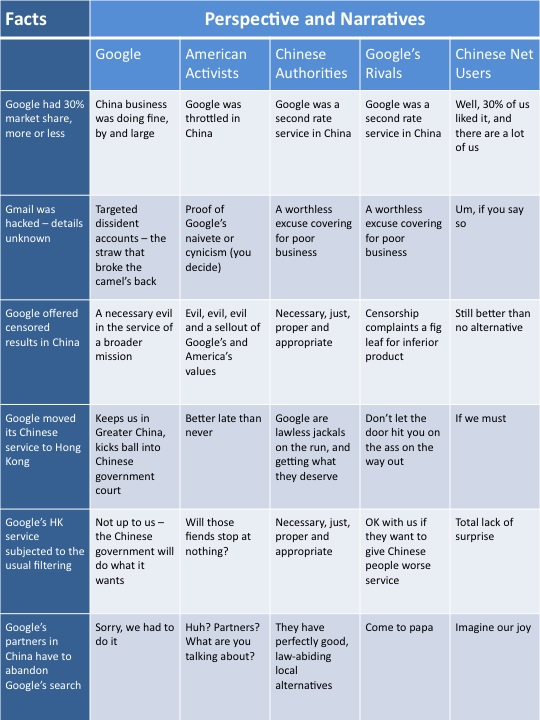
    google cheat sheet

    I realize this is a vast oversimplification and there are no doubt various interests omitted, but this captures most of the main parties and facts. What’s not included here is any kind of conclusion of each narrative. In my opinion, the story is still unfolding and its too early for that. But we’ll see how things go over the next few weeks.

    The other thing is that these narratives aren’t in equal competition. To use a possibly inappropriate military metaphor, there are different theaters of operation in which the stakeholder have varying levels of influence. So, in the US, Google and the activist (and analyst) community are the loudest voices. in China, the Chinese government has the tools to define the public narrative, and has been using them liberally, although there is some ferment in the margins (also here).

    Eventually, there will be a canonical version of Google’s misadventures in China. or at least one canonical version in the West and one in China. These may not be the creation of a single group. One group might control interpretation of one element of the story, and one group control another. But for the moment, the fun is in watching the battle to own the story. Enjoy it while it lasts.

    Finally, from a PR perspective, there is possibly one overarching lesson that can be drawn from this whole situation. I can’t take credit for this insight, it comes from Craig Adams, a colleague of mine. But it’s deceptively straightforward and I agree with it wholeheartedly. He said that if you have to sell out your basic principles to do business in China, that’s a pretty good sign you should reconsider your plans.

    Other sources (just to prove I’ve done my homework):

  • Down the rabbit hole in Kansai

    So here’s how it goes. Someone inconveniently dies on your airplane just as it is about to take off. You experience an odd mix of feelings. On the one hand, you sympathize with the family and feel bad for their tragic loss in the least dignified of circumstances. No one should have to die in the economy class of a non-moving airplane. On the other hand, you think to yourself, man, is my connection screwed. You are a bad person and will burn in hell.

    But first you will burn in Kansai. Kansai is the international airport in Osaka. That is a lie. Kansai is the international airport that is somewhere in the same general vicinity of Japan as Osaka. On a clear day, you might see Osaka in the distance as you fly into Kansai. Or, then again, you might not. Kansai is where you are supposed to change planes for Hawaii. You want to be in Hawaii. Hawaii has warm breezes, palm trees, and girls in bikinis. You have packed clothes for Hawaii. They are thin clothes.

    Kansai is on an artificial island they built somewhere in the general vicinity of Osaka because to build an airport on existing land near the city would have been a silly idea, and not used enough concrete. Kansai is apparently sinking slowly. This must really piss people off. Or, then again, maybe it doesn’t. After all, keeping the airport from sinking will keep construction companies busy for decades. Japan likes to keep its construction companies busy. Japan invented the idea of the “bridge to nowhere”. Most places build a useless bridge from somewhere to nowhere. In Japan, they build a bridge from nowhere to nowhere. They are that committed.

    There is a bridge from Kansai Airport to Rinku. Rinku is nowhere. It is certainly not in Osaka. Arguably the airport is somewhere, but it’s nowhere you would want to be. The bridge from Rinku to Kansai is a bridge from nowhere to nowhere. It also has a train. Eat that, Gravina Island.

    You need to take a bus over the bridge to nowhere. A young lady from the airline meets you at the jetway, escorts you through the airport and puts you on the bus. She bows and scrapes constantly. She is a professional bower and scraper called into service to apologize for the inconvenience of your delay. She bows and scrapes so hard that she leaves a scuff mark from the jetway through the terminal, through quarantine, through immigration and through customs. She is, however, incapable of arranging meal vouchers for you. This leads to more bowing and scraping. Your back gets sore as you watch her. You are disarmed but feel like an idiot for it.

    Waiting for the bus you realize that clothing for Hawaii is inappropriate for late winter in Osaka. Or Rinku. Or wherever the hell it is you are. You are cheered, however, by the fact that the bus is full of pretty ANA stewardesses. ANA has very pretty stewardesses. And they can do CPR. This may be useful if you pass out from the cold while waiting for the bus. On the other hand, it didn’t help the guy on the plane you were on earlier. They told that guy not to fall asleep, and look what happened to him. If you hear a stewardess telling you not to fall asleep, panic.

    The bus drives you and the stewardesses over the bridge to nowhere and drops you in front of a splendid, gleaming hotel. This is not your hotel. This is the stewardesses’ hotel. Your hotel is across the street, over a footbridge that you must drag your bags over. It is not tall and gleaming. It is short and squat and looks like a Chinese hospital with a Japanese convenience store embedded in it. There are no stewardesses staying there. There is apparently nobody staying there except for you. The convenience store is useful because the restaurant is closed. Who would want to eat dinner in the evening? Who stays in Rinku? Only the stewardesses, and they’re in the nice hotel across the street. Tough shit, hombre.

    The hotel room is small. It reminds you of the single-occupancy dormitory room you stayed in twenty years ago in college except with a tiny, little, Munchkin-sized ensuite bathroom with an intergalactic toilet in it. They spared no expense on the toilet. The pillows, however, are apparently stuffed with something that gives them the consistency of sacks full of Tylenol gel-caps. This does not seem restful. There is a bilingual New Testament and a bilingual Teachings of Buddha. If you’re an atheist, you’d better have brought your own reading material.

    The room has a view of Rinku. Rinku is nowhere. From this room you cannot even see the bridge. That is one of the room’s redeeming features. Another redeeming feature is that it has a television. The guide on the desk says that channel 1 is the BBC. This is a lie. Channel 1 is showing an infomercial for Japanese lingerie. This is not as exciting as it sounds. This is your grandmother’s lingerie. This is almost certainly not the lingerie that the stewardesses are wearing. The BBC is nowhere to be found. There is Internet, however. Thank god for that, because this is Japan and your mobile phone and Blackberry are only good for talking to the voices in your head. Those voices are telling you to turn off the TV.

    The mini-bar is not a redeeming feature. It is empty. Foreigners are not trusted with a full mini-bar. They might get drunk and head for the stewardess hotel across the street. This would be disorderly. You flip through the hotel service guide in the desk. There is an entry for the mini-bar. It says “Room refrigerators have no drinks.” No shit, Sherlock. I guess the money for the toilet had to come from someplace. You are referred to the convenience store. The Japanese have an answer for everything. But they still have no meal vouchers.

    Breakfast isn’t until 9 tomorrow morning and you are in Rinku in winter watching an infomercial for bad Japanese lingerie in a hotel room with an empty mini bar and James T. Kirk’s crapper. You should be on your way to Hawaii. Travel is great.

    IMG_0263
    Phasers on kill.
  • The zombie-slugging toy police car

    Imagethief’s son, Zachary, turned two this week. I’m amazed we made it. By this I mean I’m amazed that Mrs. Imagethief and I made it. If the boy’s engine room telegraph is stuck on “full-speed-ahead”, Mrs. Imagethief and I are on something more like “dead slow” or “all back one quarter”. It’s been a busy couple of years.

    My Chinese tutor, a wonderful woman who employs the spectacular pedagogical technique of making me translate articles from The Economist into Chinese and then debating me about the contents, was kind enough to give Zach a toy Chinese police car as his present. It was really kind of a fantasy police car, being as it was a BMW in police colors, but it was a big hit with the boy. It hit three of his sweet spots: “nee-nee nee-nee cars” (anything with lights, with the sound representing the siren); “zoom cars” (anything with a spoiler); and “gongan che“, which is not at at the top of his hierarchy –taxis occupy that spot– but which rate pretty high nevertheless.

    The car was electric, so my wife hunted up some batteries for it and we switched it on.

    That was a mistake. The “nee-nee nee-nee” was approximately as loud as a real police car. I almost smashed the thing on the spot, with my tutor watching (smashing a gift in front of the person who gives it to you is not well thought of in polite Chinese society). The cats are still traumatized. Zachary seriously re-thought his infatuation.

    In the end, I took the thing apart and removed the little drive wheels and motor, which kept the car from freewheeling, and cut the wires to the speaker so that the only electric component that still worked was the lights. This made the police car a much improved toy in almost all respects. While I was about my improvements I noticed something a little odd. Here is a photo of the car:

    police car

    All well and good, except for the BMW thing, but take a closer look at the police seal on the hood:

    Raccoon City

    I almost didn’t spot it. It says, “Raccoon Police Department”.

    At first I thought this was just your random Chinglish gibberish, which often finds a way onto toys. Zach has one front-end-loader that is spangled with the declaration, “Vigorously Super Power” (which I’m thinking of having tattooed on my ass for no good reason), and some small trucks that say, “Forbid Fireworks” on the gas tank and “Head Back” on the rear bumper.

    But the miracle of Google Images reveals that this is actually the badge of the Raccoon City police department, which is the police department of the zombie-infested city from the Resident Evil video-game and movie franchise. Pop culture bottom-feeders may remember the original movie (there have been about 80 of them now) as the one in which model-turned-actress Milla Jovovich loses her memory, gets naked and kicks the ass of everything that gets in her way. I’m not sure that’s the correct order, but I’m pretty sure all those things happened. Actually, I think all those things happen in almost every movie Milla Jovovich makes, which may be why the Academy continues to snub her. At any rate, here’s the Racoon City Police Department Logo:

    Patch

    This is from a site called, “Patchbug.” Yes, somewhere out there is a patch collector serious enough that he needs a replica of the Raccoon City Police Department uniform patch. It takes all kinds, I guess.

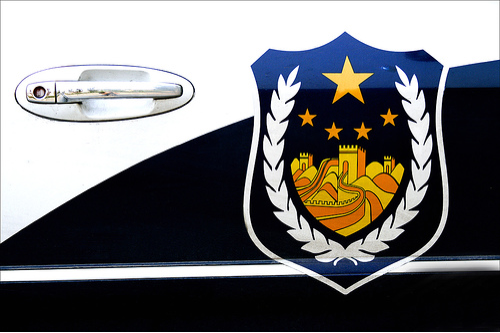
    What I find interesting is that the maker of this toy didn’t steal the Raccoon City patch wholesale, but kind of mashed it up with Chinese to come up with something uniquely ridiculous. For those who need reminding, the actual seal on Beijing police cars is an image of the Great Wall (as if it would be anything else):

    Beijing Police Seal

    So this is apparently a replica of the car of the Beijing Police Zombie Squad, which is apparently the best equipped squad in the Beijing police department. This makes sense: Only the best if you’re going to take on zombies.

    The car also has a line of Chinese over the rear windshield, “有困难找警察”, which would properly be translated as something like, “If you have difficulties, look for a cop,” but which was rendered in English on the car as the delightfully sinister, “Any trouble with you, call the police to help.” Presumably “trouble” in this context means turning into a zombie.

    Note: Actual police car emblem from Upton’s photostream.

  • How to ensure your reincarnation as a frog

    Having grown up in “Mediterranean” San Francisco and then lived in Singapore nearly a decade, winter is something of a novelty to me. This is still true even after six years in Beijing. I don’t much like the desiccating cold or walking around in a cloud of my own skin flakes like the human sno-globe, but I enjoy the occasional snowfalls and the frozen lakes. One of my favorite Beijing experiences was a morning champagne brunch followed by a slightly drunken careen across frozen Qianhai on one of those ice bicycles that have the twin advantages of high speed and a dangerous illusion of steerability. I was double riding with my then colleague, Dennis. I can’t remember which one of us was steering. I do remember that we were thought of as ruffians and idiots. The latter was certainly true, and it’s only through the intervention of some higher power that we didn’t end up drowning under the ice or impaled on one of those little ski-poles that the kids use to prod their slow-poke sled chairs along.

    Anyway, the point is, winter: Make the most of it. Now that my son is two and learning to appreciate idiotic behavior I look forward to further snowbound adventures. Although if he does anything like Dennis and I did, he will of course be grounded until global warming ensures that any further such hijinks become impractical.

    There is a dark side to these wondrous winter scenes, however. As comes the freezing, so, inevitably, must come the thaw. The thaw has the effect of releasing the animal corpses that have been entombed in the ice all winter. Usually this means fish, and there is nothing like a stroll past a thawing Beijing lake to dazzle you with a lesson in the variety and size of the fish living (or, more accurately, that had lived) in these unpromising sludge ponds. Furthermore, there is always the one currentless doldrum where all the disgorged corpses accumulate.

    I was reminded of this during a stroll around Tuanjiehu Park yesterday, my first visit to any of the frozen lakes this winter. Last year Zachary was really still a baby, and his public emergence in anything less than a crocheted NASA spacesuit was an invitation to admonishment from the aunties of Beijing. They are well-meaning, but deep inside they truly believe that foreigners are incompetent at raising children. After all, if we were better at it, there would be more of us. With Zachary much more in the “small boy” category this year, his emergence in inclement weather leads to less scolding and clucking.

    As always, the park was festive. There was a Chinese oom-pah band (exactly as euphonious as it sounds) leading a massive sing-along inside the front gate, and the usual collection of small singing groups, lone-wolf erhu-ists, and children gnawing on that culinary hallmark of the Chinese fairground, unnaturally-colored mystery meat on-a-stick. God bless Beijing. Summer or winter, people here know how to use a public park.

    The lake that is the dominant feature of Tuanjiehu park was still mostly frozen over. Most of it was slick and gorgeous and only mildly spoiled by a dusting of rubbish half frozen into the ice. But there was one spot, near the pleasure boat docks where in summer you can rent a leaky electric boat and spray cadmium-laced water at friends and family members, that had collected an entire fish market’s worth of moldering corpses. It is an image that will haunt me if ever we take Zach to the water-park on the island in the center of the lake.

    At least it was only fish, which you kind of expect even in an urban Beijing lake. Four or five years ago, at exactly this time of year, Imagethief went on a walk past Houhai and Qianhai with the former Asiapundit, Myrick. He was in town from Shanghai to cover the National People’s Congress for the wire service he was working for at the time, and had never really had a look around the city. One of my dominant memories of that walk is the surprising number of turtle corpses we spotted on the ice, recognizable even at a distance as lonely, black humps surrounded by crows.

    These turtles are not naturally occuring. Well, these are artificial lakes, so nothing in them is “naturally occurring”. But as far as I know, there is no year-round population of turtles in these lakes. Rather, many of them had been released into the lakes by Beijingers. The dead giveaway is that a number of them were still attached to little “turtle leashes” of string and sticks.

    There is a ritual in Chinese Buddhism –放生 or fangsheng– by which one can earn merit by releasing a captive animal. Merit earns you a more advantageous seat on the wheel of karma, and helps ensure your eventual reincarnation a further rung up the ladder toward nirvana rather than a further step down toward cockroach or lemur or whatever your idea of bad is. Forgive the loose explanation, I’m shaky on my Buddhism. But you get the idea.

    I see a lot of this ritual at Spring Festival (the Chinese New Year). This isn’t surprising. Spring Festival is heavy on themes of renewal and remembrance, and the temples do good business both in carnal temple fairs (see mystery meat on-a-stick, above) and in spiritual matters. The Chinese, as in so many spheres, have applied their commercial nous to the fangsheng ritual, and you can often buy birds for release at the fairs. The birds are trained to return to their keepers, which has the double advantage of enabling punters to feel meritorious while ensuring that the bird guy protects his capital stock. Everybody wins. Arguably even the bird, which is a good score in Beijing.

    The idea of fangsheng, however, is to save an animal that is facing imminent death. Under this definition, the captive bird on the temple fair fangsheng circuit may not completely qualify, and, depending upon how strictly you interpret the scriptures, your merit may vary. Sufficient for the relaxed devotee, but perhaps not for the more orthodox. Also, the temple fairs only run a week or so, and there’s never a bird-release guy around when you need one, and so on. Sometimes, a creative solution is called for. This turns out to be the pet-store (or, more often, animal market) or supermarket turtle. Turtles are cheap. Turtles are substantial enough to matter, karmicly speaking. Turtles don’t test your resolve, like freeing that cockroach you found behind the dumpling-skin flour might.

    So people buy and release turtles. Except, with Spring Festival actually falling in a Beijing mid-winter, they release turtles into icy lakes where they promptly freeze to death. The sun then warms their dark shells and the corpses slowly sink into the ice, visible only as dark humps that will be revealed again during the spring thaw. Imagethief is no religious expert, and will defer to someone who is, but to me this seems dubiously meritorious at best. Maybe the turtle moves up the karmic ladder (it starts at a low bar). You won’t.

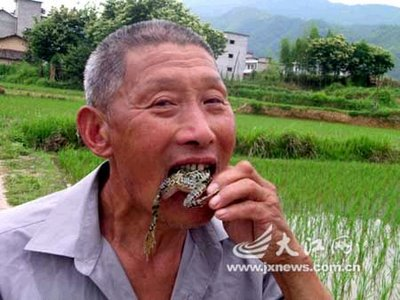
    Turtles aren’t the only animal that catch a hard one during this season. Frogs draw a crappy lot in China at the best of times. In 2007 Imagethief lived in Shanghai in an apartment that backed onto the local wet market. The frog seller set up shop in front of our rear gate. The frog seller’s total shopfront consisted of a bucket of live frogs, hand-held scales, a pair of kitchen shears and some plastic bags. When someone wanted to buy some frogs, the frog seller would use the kitchen shears to decapitate the frogs, and then weigh and package the rest for the customers. Over the course of an afternoon, a tragic pile of frog heads would accumulate. In summer, this would rapidly become a tragic and smelly pile of frog heads. Imagethief used to keep frogs as pets, so this was always a little traumatic for me, like a pile of kitten heads might be to a more normal person.

    Market frogs don’t do any better in Beijing than in Shanghai, so saving a frog from the kitchen shears seems as though it could be both cheap and meritorious, a combination designed to excite the thrifty Buddhist. But this goes wrong in winter as well. Mrs. Imagethief was once going for a winter jog by the Tonghuihe canal, near our house, when she saw a family releasing frogs. The frogs got about one kick and then froze more or less instantaneously. You’d think people would catch on after the first couple of frogs, but as anyone who works in business or government knows, processes tend to take on a life of their own. These people released lots of frogs. They all froze.

    When the family left, some canal workmen who had been watching from nearby immediately scooped out the frozen frogs and took them home to cook. So, genius, how does the merit allocate on that one?

    My karma ran over my frogma.
    My karma ran over my frogma.
  • Free laptops for NPC delegates – it looked good on paper

    Let’s say you’re a company selling some kind of product. Let’s say your product is –let’s just pick something at random here– laptop computers. Globally, this is a heavily commoditized category jammed with companies selling look-alike products with similar feature sets. In China, which has the usual big-time  suspects plus a whole cloud of local also-rans, the situation is even more competitive. How do you stand out? How do you persuade students, young professionals and other consumers to buy your laptop, and not some brand-x laptop poseur laptop?

    Well, in China the answer is often, “be cheapest!” But that’s not always the whole story. Often there is also some PR.

    To that end, one thing you would often do is try to get your product into the hands of “influencers”, people who have the power to help lead public opinion in your target market, ideally in your favor. One way to approach this is the celebrity endorsement: I’ll send a cubic meter of 100RMB notes to your house if you wave my company’s product around, appear in some ads and show up at some of my events. And, hey, why not write a blog about it? This is generally legit and practiced everywhere. George Clooney and Omega watches, for instance, except he probably doesn’t get paid in RMB.

    There is also the schwag approach, in which you give your product away to rich, famous and stylish types in the hope that they’ll be seen using it thus conferring glamor and sexiness upon it, hopefully without you having to write a colossal sponsorship check. This is why you hear about things like the absurd gift baskets at the Academy Awards. This also leads to the great commercial irony that rich people get more stuff for free than more deserving types, such as impoverished PR bloggers, and will no doubt be a contributing factor in the revolution when it finally comes.

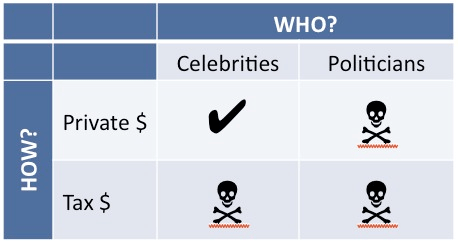
    There are, however, some generally accepted rules about the schwag game. Two of those rules, involving who it’s OK to target and how schwag can be paid for, can be summed up in a diagram that looks like this:

    schwag

    By participating in a program to give free laptop computers to 2000 delegates to the Chinese People’s Political Consultative Congress (CPPCC), Lenovo appears to have landed squarely in the lower-right, or what I like to call the “PR deathtrap” quadrant. The CPPCC is a political body that nominally advises on and suggests policy and which convened this week in Beijing as part of the annual political “two meetings” festivities. The other meeting is that of National People’s Congress, which has the slightly heavier responsibility of endorsing actual policy (a cynic might say, “rubber stamping”, although the NPC has pushed back from time to time).

    The always excellent China Media Project sums up the laptop situation:

    As China’s annual National People’s Congress opened yesterday, many news headlines pounced on Premier Wen Jiabao’s remarks toward the end of his NPC report (see tab 11), in a section on anti-corruption, about the need for leaders to report their personal assets. But in the margins, commentators railed against shady practices nearer at hand — more than 2,000 laptop computers given away to delegates at the public’s expense.

    The laptop story bubbled up out of China’s social media sphere back on March 2, when Chinese Internet users noted an odd mini blog entry from Zhang Xiaomei (张晓梅), a delegate to the Chinese People’s Political Consultative Conference who is also the publisher of Beauty Fashion magazine.

    Zhang’s entries were succinct, mostly mundane summaries of preparations and speeches ahead of the two meetings.

    CPPCC Chairman Tao says: being a national delegate to the CPPCC is a glorious mission, and a post for political participation and discussion. Sichuan party secretary Liu Qibao (刘奇葆) says: last year was the toughest year, this year is the most complex.

    But in one entry she wrote: “When delegates report [to the meeting] they each get a laptop computer. What is different from last year is that this year these don’t need to be returned after we’re done with them. This is much more practical.”

    Yeah, it sure is, isnt it? Keeping stuff often is.

    As China Media Project explains, the response both online and in mainstream media has been pretty negative, with accusations of corruption and speculation about the amount of tax dollars spent on the computers. It has also been pointed out that Lenovo executives account for a large share of the IT industry representation at the CPPCC.

    So here is where it gets interesting, and perhaps where Lenovo put a foot wrong assuming they played some role in creating this program and weren’t just lucky beneficiaries. CPPCC delegates occupy a strange space in between celebrity and politician. Many of the delegates, such as Ms. Zhang, are in fact celebrities or notables from the business world. Most are not politicians or officials in their daily lives. As the Financial Times noted this week, the entire CPPCC is a bit theatrical, and its actual contribution to the legislative process is debatable at best. In previous years delegates had been loaned computers, so why not let them hold onto them this  year? A relatively small change in the grand scheme of things.

    But regardless of what you think about the CPPCC or the actual power of its delegates, in the context of the “two meetings” the delegates are acting as politicians. In an era when Chinese people are increasingly sensitized to corruption and willing to discuss it online and hold officials to account, giving laptops to 2,000 wealthy people operating in a political role looks risky at best. Perhaps in some years it doesn’t become a big deal, but this year it rubbed people the wrong way. It probably would have been best to stick to the loaner approach, even at the risk of some slightly inconvenienced delegates.

    From Imagethief’s point of view the good news is that this issue became, well, an issue. That it escalated online and in the media is a headache for Lenovo and perhaps an embarrassment for some of the delegates (although that may be optimistic), but it’s a good thing for accountability and for China. The CPPCC may be largely symbolic, but at least it could be relatively clean and symbolic.

    So what should Lenovo do? This situation is a long way from being out of control, so what they probably will do is hunker down and wait for the government to decide that discussion of this issue is no longer appropriate and then enjoy the ensuing silence. A more progressive option would be to announce that in subsequent years they’ll return to a policy of loaning delegates computers rather than giving them away. Better yet would be to cancel the whole thing and make delegates self sufficient for computing in future. I’m sure most CPPCC delegates –even the ethnic minority delegates– can afford a computer.

    Or how about this: It’s awkward to inform delegates that, sorry, contrary to what they were originally told they do have to return the machines. But Lenovo could ask delegates who don’t need the computers after the meetings to voluntarily return them, and then publicly donate the returned machines to some worthy cause. Rural schools? Barefoot doctors? Impoverished bloggers? You name it. Plenty of options.

    Note: Some in-situ links removed from the paragraphs quoted from China Media Project. It’s worth visiting their original post.

    Disclosure: I do not work on any laptop computer accounts, however my agency does represent a competitor to Lenovo. The views expressed here are my own.

    Update: David Bandurski of China Media Project left a comment in the original version of this post noting that, as of writing, criticism in the media was not directed at Lenovo specifically. At least, not yet.

  • Is Wal-Mart’s eco-consciousness in China more than PR?

    Sunday is shopping day in the Imagethief household, so this morning Mrs. Imagethief, Zachary and I bundled ourselves up and headed out to Wal-Mart.

    Before you gasp in a fit of effete surprise, let me explain. As a card-carrying Bay Area intellectual snob, my pedigree is more Whole Foods than Wal-Mart, even if Whole Foods is basically just Wal Mart for Prius-driving gourmets (well, and my mom). But in my neighborhood in Beijing  walking-distance supermarket options are limited to the eye-wateringly expensive import-barn in the basement of Shin Kong Place (RMB35 for four kiwi fruits? Sure!); the fast-declining Bonjour, in the basement of the equally fast-declining Sunshine 100 (like Carrefour without the lingering veneer of French-ness and, in winter, heated like hell’s supermarket); and the Wal-Mart at Wanda Plaza.

    OK, we have a Jingkelong, too, but it’s not much use if your shopping needs extend beyond soft drinks, instant noodles and strawberry-flavored UHT milk. Once upon a time we had a Jenny Lou, but Jenny apparently decided our neighborhood was for losers and moved down to the accursed Jianwai Soho instead. So Wal-Mart it is. Plus, they deliver, which is essential when your shopping needs include kitty litter for two.

    With Wal-Mart fresh in my head, and fresh kitty litter in my guest bathroom (for the cats, not for the guests, although there have been some parties…), I was therefore interested to see a Washington Post article covering in mostly positive terms Wal-Mart’s efforts to get its Chinese Suppliers to improve their environmental and labor standards (part of a special report called, “The Climate Agenda.”):

    As a result [of Wal-Mart’s urging, Hong Kong-based soap and cosmetic manufacturer] Lutex has been paying attention to more efficient light bulbs, better ventilation and less packaging. It switched from Styrofoam to recycled paper and saved enough Styrofoam to cover four football fields. And Lutex, which has been here since 1991, says it treats four tons of wastewater that it used to dump into the municipal sewage line. That water was supposed to be treated by the city, but like three-quarters or more of China’s wastewater, it almost certainly wasn’t.

    “We heard that in the future, to become a Wal-Mart supplier, you have to be an environmentally friendly company,” [CEO Benny] Fung said. “So we switched some of our products and the way we produced them.”

    Wal-Mart has more than 10,000 suppliers in China. In addition, about a million farmers supply produce to the company’s 281 stores in China. If Wal-Mart were a sovereign nation, it would be China’s fifth- or sixth-largest export market. So the company hopes that small measures taken by all suppliers start to add up. Its 200 biggest suppliers in China have already trimmed 5 percent of their energy use.

    ***

    In October 2008, Wal-Mart held a conference in Beijing for a thousand of its biggest suppliers to urge them to pay attention not only to price but also to “sustainability,” which has become a touchstone for many companies.

    “For those who may still be on the sidelines, I want to be direct,” Wal-Mart chief executive Lee Scott said sternly. “Meeting social and environmental standards is not optional. I firmly believe that a company that cheats on overtime and on the age of its labor, that dumps its scraps and its chemicals in our rivers, that does not pay its taxes or honor its contracts will ultimately cheat on the quality of its products. And cheating on the quality of products is the same as cheating on customers. We will not tolerate that at Wal-Mart.”

    Well, if he says so.

    My first reaction to this story was, “What a PR score!” Cynical me wasn’t really prepared to consider if there might actually be something to this. But might there be real business motivations for moves that seem antithetical to a company with a mission to drive costs to the absolute lowest level?

    One possible answer to that question can be found in a post at the well-known “Naked Capitalism” economics blog. Yves Smith suggests three factors that could motivate Wal-Mart to put real effort into pressuring its Chinese suppliers to improve. They are:

    • Creating an “insurance policy” against possible American trade restrictions that might be based upon setting minimum environmental and labor standards.
    • An effort to differentiate itself in the Chinese market by demonstrating attention to food quality standards and environmental issues.
    • A move to appease evangelical Christians who increasingly see earth-stewardship as part of their religious duty.

    In fact, two out of those three things (see if you can spot which two) are still essentially public relations. Personally, I have a hard time believing the third is anything close to being a sufficient motivation for a serious revamp of Wal-Mart’s Chinese supplier relationships, but, then, I live a long way from the American heartland and am thus not well attuned to its priorities.

    The second point seems plausible, but as a regular Wal-Mart China shopper I can attest that Chinese shoppers seem perfectly enthusiastic about Wal-Mart already. Wal-Mart also does a brisk trade in allegedly organic Chinese produce (we buy it, but I’m really not sure how far to trust the “organic” claims). At any rate, as an approach it sure couldn’t hurt, unless it starts leading to significant job losses at Wal-Mart suppliers in China, in which case, all bets are off.

    Ultimately, although the impact is in China, I still see this as primarily a move to influence the customers and activists back home in the US who have the greatest ability to influence Wal-Mart’s business. China environmental and labor issues are important in China, of course, but arguably not as important as they are in the US. (Next up for trouble: Apple? Don’t miss the bizarre fanboy comments.)

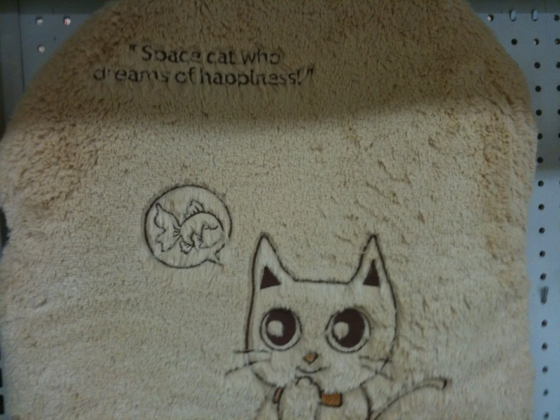
    As for me, I’ll take a pass on the live soft-shelled turtles (where are the PETA people?), but the produce section isn’t bad and you can’t beat a fuzzy car-seat cover that carries the inscription, “Space cat who dreams of happiness!” If only I had a car.

    Space cat who dreams of happiness.
    Space cat who dreams of happiness.