Tag: Censorship

  • Good News! The Press is Out to Get You

    A couple of weeks ago I gave a talk about PR in China to a journalism class at Beijing Foreign Studies University. In any student talk the Q&A is always the most fun, and this group was no exception. Among the many good questions asked was whether it was easier to do PR in China because, as I had discussed in my talk, the Chinese media is generally cozier with businesses than their Western counterparts.

    Easier to get stories? Yes. Easier to achieve meaningful results with the public? No.

    I was reminded of this question by the recent expulsion of hard-charging Al Jazeera English correspondent Melissa Chan, and subsequent closure of the AJE bureau in China after the Ministry of Foreign Affairs refused to accredit another AJE journalist. I didn’t know Melissa well, though I had met her, but I respected her reporting and willingness to insert herself into uncomfortable situations, and I was disappointed to see her go. Reporting on China will be impoverished a bit.

    That, of course, was the point. The Chinese government has never been comfortable with an adversarial media, and Melissa’s reporting was, like that of much of the foreign press corps, pretty adversarial from their point of view. This discomfort is deeper than cursory annoyance at embarrassing foreign gadflies (although I presume that is part of it). It arises from one of the fundamental philosophies of Leninist political parties: the media are considered Party organs and, as with other Party organs, expected to serve the interests of the Party first and foremost. Media that don’t fit into that model are suspect by definition. You can see this philosophy expressed in the mechanisms of control that the Chinese government maintains over all domestic media, and in the government’s struggles to come to terms with the rise of social media that resist conformity with established power structures.

    The Party’s model is rather different from the fundamental philosophy of Western media: that it should be the fourth estate, entrusted with challenging the business and government establishment in the interest of the people. You are welcome to argue about how effective Western media have been in this role in recent years, and there are plenty of exceptions, but as a founding principle the idea of the fourth estate is alive and well and inextricably bound up with our Western ideas of what the media should be (and with the value judgments we render on media that doesn’t conform to that principle). A functional, adversarial media is a necessary component of Western-style liberal democracy, unless you have total faith in politicians and institutions.

    I am not going to comment further on the specifics of the Al Jazeera situation (some links to good articles below), but in light of the Chinese government’s recent struggle with rumors and trust issues, it’s worth reflecting on why an adversarial media is sometimes useful, even to the establishment. This is what I discussed with the students at Beiwai.

    As a news junkie who still pays for several subscriptions, I’m most definitely a fan of adversarial media model (you could also call it an “independent media” model, but independence is only valuable in that enables an adversarial position). There is nothing like a fantastic piece of investigative reporting that rips the lid off of some secret or scandal or that illuminates the dark corners of business or politics. As long as it’s not my dark corner, that is.*

    As a PR practitioner with a company reputation to defend, I’ve experienced firsthand the adversarial media model’s short-term ability to create sleepless nights and great puddles of cubicle sweat. But nevertheless, I still appreciate its value in the long-term. That’s because people are more likely to trust media that challenges me than one they know to be compliant with me, and I need media that the public trusts to get my message out, whether that message is a corporate one, a product review or whatever. If I have to do more work to get coverage in that kind of media, and tolerate some negative coverage as well, so be it.

    In China, on average, relationships between businesses and the media tend to be closer and less adversarial than in the west. There is also a range of ethical problems, including poor separation of advertising and editorial, the “transportation claim” subsidy-in-disguise, and more. Together, these make it easier for companies to earn –or buy– good coverage in local media than it would be in many other markets. But they also mean that the public is relatively more skeptical of much of the coverage and turns to alternative voices for much of its information and insight, many of them on microblogs . The result is a devalued media that makes even our best earned coverage less useful and influential, and that makes it harder for me to manage misinformation and rumors about my company.

    Sound familiar?

    These are generalizations. There are excellent journalists and excellent media in China, and crappy ones in the west. But the overall gap in trust is real. The real sign of progress here will not be in the government showing more tolerance for confrontational Western media, but in its tolerating the emergence of a fully independent, professionalized and adversarial Chinese media. That change, when it happens, will be driven by Chinese journalists. In some ways, it’s already happening.

    For those of us in the establishment, there is value in learning to deal with an adversarial media, and in being good at telling our stories and getting our messages across in media that are willing to challenge us, and that therefore lend credibility to the claims that survive their scrutiny. But if you’ve never had to deal with that kind of media, you haven’t developed the skills necessary to do so, and you rely on a tradition of control and management to get your message across, then you are in the realm of propaganda and will face the consequences in terms of diminished trust.

    And if your situation is so precarious that there is no way to tell a positive story when engaging with adversarial media? Well, then, your problems are much bigger and deeper than PR skills. Or one uppity journalist.

    * Just kidding. Naturally, I have no actual dark corners.

    See also:

    On the Al Jazeera situation:

    On the difficulty of reporting in China:

    Note: This post originally published on the defunct group blog Rectified.name.
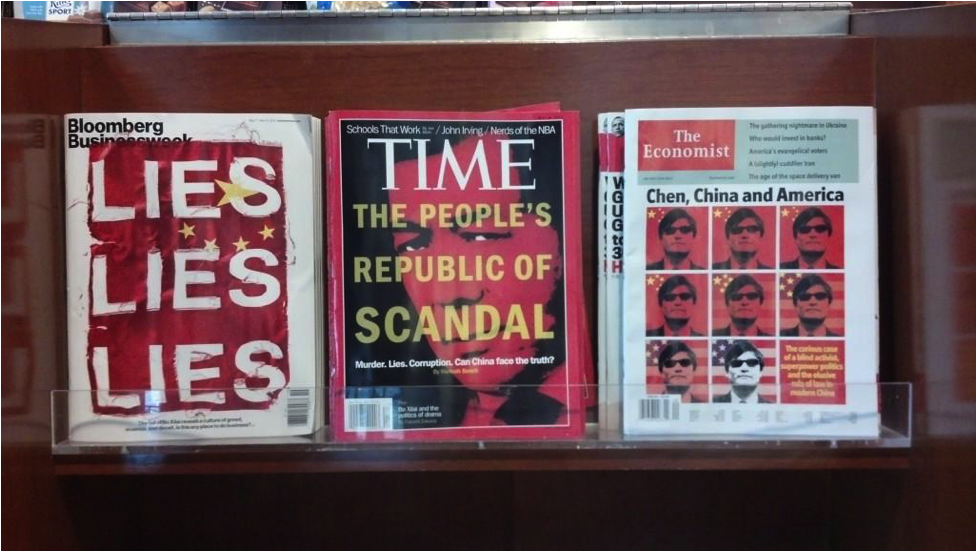
    Good news? A magazine stand at SFO's international terminal on Monday.
    Good news? A magazine stand at SFO’s international terminal on Monday.
  • Facebook + Instagram + China = Take a Deep Breath

    So, Facebook bought Instagram for a billion bucks. Awesome for those guys. I, alas, did not get rich in either of the Internet startups I participated in. But you can’t put a price on experience, right?

    Deep sigh.

    Anyway, Instagram is freely accessible here in China, at least for the moment, and apparently has a small but growing user base. It’s been limited to a certain slice of the China market by being an iOS-only app until last week. It may get picked up more now that it’s on Android as well, especially given Android’s whomping share of the smartphone market in China.

    Because Instagram is accessible from China there has been some speculation that it might provide a back-door into the market for Facebook. Well, color me embarrassed, because when I looked at how Facebook might get into China a couple of weeks ago, one scenario I didn’t explore was Facebook buying another, unblocked western social network.

    Instagram certainly functions as a posting back-door to both Facebook and Twitter. Instagram posts route to Facebook, Twitter and other social networks through Instagram’s unblocked servers (actually, Amazon’s cloud servers for the moment). There are similar middleman workarounds for posting on blocked social networks, such as Ping.fm, but none come close to providing full access to Twitter or Facebook. And, from what I can see, neither does Instagram. That’s important.

    The question that wins you the brand new car is: Will Instagram now be blocked in China? The reason why you don’t have the car yet is that the answer is complicated. China doesn’t block all foreign social networks. It does block the established, heavy-hitting, horizontal sites like Facebook, Twitter and Google Plus. But many vertical social networks and newer sites are unblocked. I can get on LinkedIn, Quora, Path,Flickr and Pinterest just fine, without a VPN (your mileage may vary). I can even get on MySpace.

    I cannot read the minds of the bureaucrats who decide what gets blocked and what doesn’t, and if I could I’d probably be in a position to be less wistful about the fates of the startups I joined. But there do seem to be a few key factors in determining who stays safely outside the firewall. These include size, perceived influence, how closely the network has been associated with political movements, power to function as tool of mass organization, and whether or not the network has been explicitly associated with content or activities that the Chinese government considers sensitive. On all three counts, I’d rate Facebook and Twitter considerably higher than the rest of the pack. As for Google Plus, I trust this audience doesn’t needmuch explanation.

    So, what happens with Instagram now that it is part of planet Facebook?

    It depends. Assuming people don’t suddenly start posting pictures that annoy the Chinese government, maybe nothing. At the moment, Instagram seems pretty harmless, and its one-way posting features to other social networks don’t look like a big red flag. Posts to Chinese social networks like Sina Weibo essentially outsource the content monitoring and censorship. Of course, Twitter once looked pretty harmless. In 2007 I even wrote a short article mocking its triviality, possibly betraying the lack of vision responsible for my current un-billionaire status. Twitter has been blocked for a while now. So much for harmless. The fact that Instagram is essentially mobile only has also probably helped keep it under the radar.

    But if Instagram is integrated more tightly into Facebook’s core service and stops looking and feeling like an independent platform, then the risks go up fast. Everything hinges on where Facebook sees the value in Instagram, and whether or not it pulls Instagram into the mothership. The more integrated Instagram is, the more powerful it is as “back door into China” for Facebook, but the more likely it is to be blocked. And if Instagram is suddenly used to post a lot of pictures of a sensitive event in China, it might not even matter if Facebook doesn’t change a thing.

    Meanwhile, local photo-sharing clones have been blossoming for a while. Early enthusiasm for foreign social networks in China does not reliably translate into long-term success, while mainstream success in China often does translate into closer scrutiny. Instagram may indeed be a back door into China for Facebook, but if it wants to stay open, it might have to stay a rather small door indeed.

    Other links:

    Note: Originally published on the defunct group blog Rectified.name.
  • Facebook’s China playbook

    As you have undoubtedly heard by now, Facebook CEO Mark Zuckerberg and his girlfriend* were spotted in Shanghai on Wednesday. This has lead to a completelypredictable round of speculation as to whether this signals some new development in Facebook + China. This sort of navel gazing takes off whenever Zuck comes to China, or looks in the direction of China, or gets lunch at P.F. Chang’s, or whatever. And why not? Facebook is the biggest social network in the world. China has the biggest population of Internet users in the world. Facebook is going public soon. Zuck is learning Chinese, etc. So a Zuck sighting in China is, to invoke the memory of Arsenio Hall, one of the things that make you go, hmm…

    Despite all of that, leave to our friends at the excellent Tech in Asia blog to have the most sensible take, “Zuckerberg is in China…Who cares?” Indeed.

    Obviously, we don’t know a thing about Facebook’s designs on China. But to make sense of the speculation it’s helpful to consider the actual scenarios by which Facebook or Twitter or indeed any foreign social network might enter China, and to look at how different stakeholder groups will react to the possible scenarios. This is different than analyzing business strategy or financial implications, but ultimately it’s all connected.

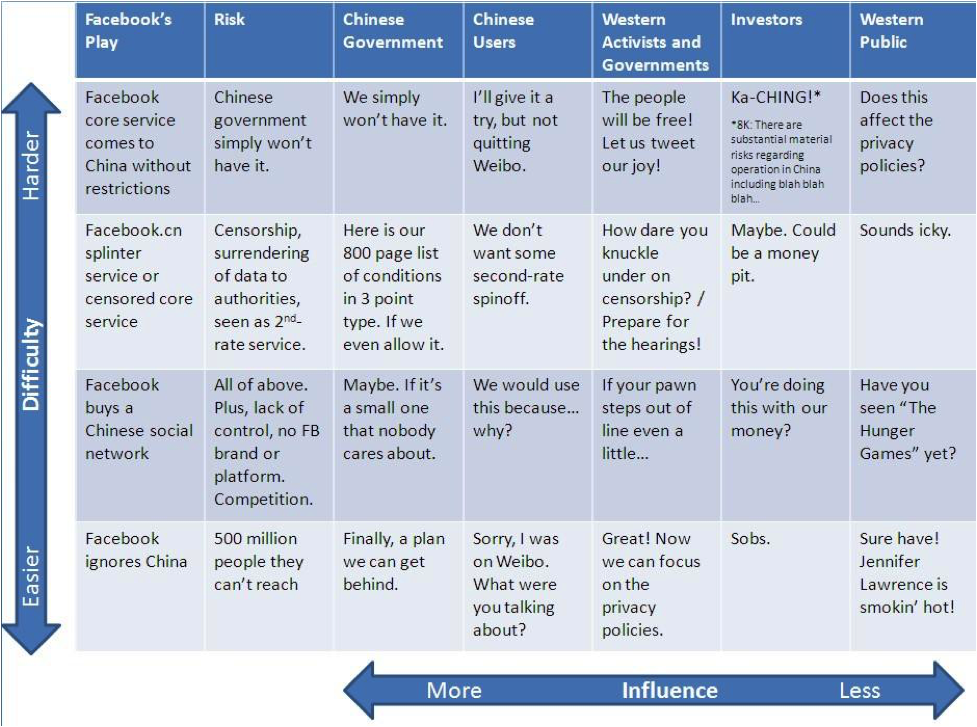
    At the risk of oversimplifying, there are four major scenarios that we can envision: extending the mothership service to China; developing a separate “splinter” service for China under the original brand (this could be disconnected from the main service, or just enforce dramatically different policies); buying an existing Chinese social network; and doing nothing. Obviously, they’re not all immediately practical. Facebook is blocked in China, which makes extending the mothership difficult. There are also intermediate possibilities that blend aspects of these scenarios, but that’s a deep rabbit hole to go down. Along with these scenarios there are five major stakeholder groups, not including Facebook themselves: the Chinese government; Chinese Internet users (potential customers); Western activists and governments; investors; and the Western public (aka Facebook’s current users).

    The easiest way to look at all these moving parts is to simply throw the whole thing in a table that considers for each scenario the risks and how each of the stakeholder groups is likely to react (click the table for a larger, EZ-reading version):

    china playbook

    Admittedly this format throws a lot of nuance overboard, but nevertheless there’s a clear three-way conflict that emerges. The approaches that are more acceptable to the Chinese authorities are both riskier with regards to Western activists and regulators and, importantly, less relevant to Chinese users. The approaches that are most relevant to Chinese users and have the highest potential return to the business are unacceptable to the Chinese government. Ultimately the Chinese government calls the shots.

    The basic math is that to even have a chance of operating here Facebook would have to apply the mandated censorship policies either just to users of its core service in China or to a spinoff service that is kept separate from the core service. It would also have to be prepared to surrender Chinese user information to the authorities if requested. That will raise eyebrows as Facebook knows a ton about its users by design.

    The risks of these approaches are clear to anyone who has studied the history of Yahoo in China and followed the congressional grilling of US Internet firms operating in China back in 2006. That was the stone age of social networking (Rupert Murdoch bought MySpace, Facebook turned 2, Twitter was hatched), and the political atmosphere around such things has not become any less sensitive since then. If anything, the messianic aura that clings to social networks and of which Chinese authorities have always been so distrustful has been exacerbated by last year’s political events in the Middle East. And let’s not forget recent events here in China and the leadership transition later this year.

    There are ways to create distance between the core Facebook brand and service and the Chinese government’s likely requirements, but those ways don’t eliminate political risk at home, and they all make the service less appealing to Chinese users. These same users are already being wooed away from traditional social networks by microblogs and have a colorful history of rejecting foreign online services as irrelevant even when they’ve been allowed to operate here without restriction. Remember MySpace China? Me neither, and a friend of mine helped launch it. Owning a local social network would provide a layer of insulation from the risk of Western backlash, but at the expense of sacrificing much of the point of entering China.

    None of this predicts whether Facebook will enter China, or how they might attempt such a thing. They’re probably playing a very long game. Whatever path they choose, it won’t be easy, either in China or at home. Bear that in mind next time Zuck is spotted in China and the tongues start wagging.

    *Note to editors: Can we get over the fact that Zuck’s girlfriend is Chinese American? Everyone is compelled to point this out, but net impact on the Facebook-in-China story is zero-point-zero.

    Note: This post was originally published on the defunct group blog Rectified.name.
  • A handy cheat sheet for interpreting the Google China story

    Should Google have been in China? Did they make the right move in pulling out? Will this influence the Chinese government? What does it mean for foreign businesses in China? Are they evil or not? Who knows? Not me. And none of these questions are going to be answered in this post.

    But stick with me, because that’s the point. The fact is that everyone and their goldfish has an opinion on Google’s fortunes in China, but few people actually know anything conclusive, so what we’re getting is a huge dose of punditry, analysis and opinioneering. This is the kind of thing that PR people live for, because what we’re witnessing first hand is the creation of a narrative. Or, rather, several narratives that serve different worldviews, audiences and points of view.

    This is PR in action: The effort to influence perception and opinion with regard to an entity or event, generally with the objective of supporting some kind of end-state result (higher sales, a political victory, popular consensus, the launch of a war, etc.).

    PR people are often accused of being liars. This is a shame, because a good PR person doesn’t lie or make up facts. I’d like to tell you this is because PR people are noble souls who want only the best for the planet and fuzzy puppies, but the real reason is that lying makes you vulnerable and doesn’t usually work very well (and, yes, it’s also wrong). Lies can often be proved false, and this can cause your position to unravel pretty quickly, often with devastating consequences. Even if you string the lie out long enough to achieve a stated objective, you’ll take damage on the backside if your story comes apart. See, for example, weapons of mass destruction and the Iraq war, which claimed the reputations and legacies of many people.

    But PR people do often try to interpret the facts (or obscure them) in specific in selective ways. In the vernacular, we spin things. In fact, the very term “spin doctor” (sometimes credited to the novelist, Saul Bellow) refers to trying to define the interpretation of events or facts — to determine which way they “spin” in the public sphere.

    PR people do this for a living. But we’re not the only ones who do it. Anyone with an agenda tries to interpret facts to create a narrative that serves that agenda, or that serves their world view. Often, dueling parties compete to establish the defining narrative of a situation or event. Consider how Democrats and Republicans competed to establish the narrative for health care reform in the interest of divergent political objectives. The media and public spheres of discussion are thus, often, noisy and squawky collections of competing narratives interpreted or distorted from the same basic set of facts in order to serve different agendas. Sometimes it takes a long time for a “definitive” narrative to emerge. Sometimes a definitive narrative never emerges, or different audiences arrive at divergent narratives because they’re exposed to different influences (anyone who looks at how Chinese and Western audiences fail to see eye-to-eye on many issues will be familiar with this).

    This is essentially what has been happening with Google over the past few weeks, as people have competed to establish different narratives regarding its withdrawal from China. There has been a huge amount written and said about Google’s predicament and options in both the Chinese and Western media and blogospheres. At last count I had 27 articles bookmarked since the announcement that Google would shift it’s Chinese search operation to Hong Kong. And there were plenty that I didn’t bother to bookmark.

    Well, that’s just too much damned stuff to analyze, and I am way too lazy to pore through it with a notebook and try to draw any meaningful conclusions about what it all means (hey, I don’t get paid for this). Also, my overwhelming impression is that there is so far roughly zero consensus on what it all means.

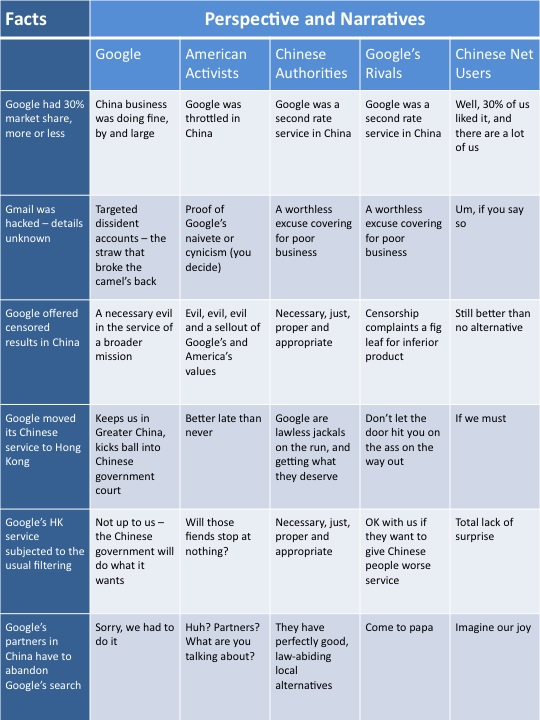
    What I did do, however, was to put together a handy chart that shows the key known facts, and, based upon all the articles I’ve read, how each of the major interest groups that I observe is spinning or reacting to each of those facts. In each case, the vertical thread through the series of facts creates the skeleton of a narrative. And that’s what each of these parties –Google, its rivals, the Chinese government, the Western activist community– is trying to do: They’re each trying to control and define the narrative of Google’s situation in China to serve their own agendas. They are, in other words spinning. Here is what the result looks like:

    google cheat sheet

    I realize this is a vast oversimplification and there are no doubt various interests omitted, but this captures most of the main parties and facts. What’s not included here is any kind of conclusion of each narrative. In my opinion, the story is still unfolding and its too early for that. But we’ll see how things go over the next few weeks.

    The other thing is that these narratives aren’t in equal competition. To use a possibly inappropriate military metaphor, there are different theaters of operation in which the stakeholder have varying levels of influence. So, in the US, Google and the activist (and analyst) community are the loudest voices. in China, the Chinese government has the tools to define the public narrative, and has been using them liberally, although there is some ferment in the margins (also here).

    Eventually, there will be a canonical version of Google’s misadventures in China. or at least one canonical version in the West and one in China. These may not be the creation of a single group. One group might control interpretation of one element of the story, and one group control another. But for the moment, the fun is in watching the battle to own the story. Enjoy it while it lasts.

    Finally, from a PR perspective, there is possibly one overarching lesson that can be drawn from this whole situation. I can’t take credit for this insight, it comes from Craig Adams, a colleague of mine. But it’s deceptively straightforward and I agree with it wholeheartedly. He said that if you have to sell out your basic principles to do business in China, that’s a pretty good sign you should reconsider your plans.

    Other sources (just to prove I’ve done my homework):

  • Google detonates the China corporate communications script

    Imagethief stumbled blearily to his computer this morning expecting a relaxed scan of the news but found the Chinese Twittersphere ablaze with the news of Google’s bombshell blog post, which went up in the middle of the night early this morning our time. Titled “A new approach to China”, the post, by Google’s Senior Vice President for Corporate Development and Chief Legal Officer, David Drummond, was essentially a public threat to withdraw from China. As such, it was as direct a challenge to the Chinese authorities as I have ever seen in a piece of public corporate communication.

    The first half of the post discusses alleged hacking attempts on Google, apparently with the aims of both recovering Google source code and accessing the Gmail accounts of dissidents. But the second half of the post is more interesting. The money grafs below (emphasis mine):

    We launched Google.cn in January 2006 in the belief that the benefits of increased access to information for people in China and a more open Internet outweighed our discomfort in agreeing to censor some results. At the time we made clear that “we will carefully monitor conditions in China, including new laws and other restrictions on our services. If we determine that we are unable to achieve the objectives outlined we will not hesitate to reconsider our approach to China.”

    These attacks and the surveillance they have uncovered–combined with the attempts over the past year to further limit free speech on the web–have led us to conclude that we should review the feasibility of our business operations in China. We have decided we are no longer willing to continue censoring our results on Google.cn, and so over the next few weeks we will be discussing with the Chinese government the basis on which we could operate an unfiltered search engine within the law, if at all. We recognize that this may well mean having to shut down Google.cn, and potentially our offices in China.

    No doubt a great deal has transpired behind the scenes in the lead up to this announcement. To save time, here’s what I don’t know:

    • Whether this is linked to rumors of Google’s possible withdrawal from China and staff exodus that circulated several weeks ago.
    • The relative weights of the hacking issue, censorship issue and Google’s business struggles in China in leading the company to make this statement.
    • What, if any, discussions Google had with Chinese authorities prior to making this statement (they speak of discussions “over the next few weeks”), or whether there are actually continuing negotiations.
    • Whether recent blocks of Google Docs and Google Groups in China contributed to this decision.
    • Whether Google would have done this if their business in China was stronger. China contributes a minuscule portion of Google’s revenue.
    • What will actually happen to Google’s business in China in the long run.

    Here is what I do know:

    Google has taken the China corporate communications playbook, wrapped it in oily rags, doused it in gasoline and dropped a lit match on it. In China, foreign companies tend to be deferential to the authorities to the point of obsequiousness, in a way that you would almost certainly never encounter in the United States or Europe. Scan any foreign company’s China press releases and count the number of times you see the phrase, “commitment to China”. Demonstrating “alignment with the Chinese government’s agenda” is an accepted tenet of corporate positioning and corporate social responsibility work in China. This is testament to the degree of direct power that the Chinese authorities wield over the fortunes of foreign businesses in China. Even when foreign companies are in dispute with the Chinese government they tend to offer criticism obliquely as long as they have a business stake or operations in the country. Note, for example, the scrupulous diplomacy of Rio Tinto’s communications concerning the detention of its employees last summer, a far more serious situation than anything Google has encountered (although also with far more money at stake).

    In this situation Google has undertaken a bet-the-farm confrontational communications approach in China. They will not have made this decision lightly. Dressed up in the polite language above is what is essentially an ultimatum: Allow us to present uncensored search results to our Chinese users or we’ll walk. The Chinese government is not likely to cave to an ultimatum from a foreign company, no matter how decorously delivered. As Richard Waters of the FT has pointed out, the language does leave some wiggle room for further negotiation. However, Imagethief cannot imagine a circumstance in which the Chinese government will give Google free reign, especially in the current, highly restrictive climate for Internet services. Barring some surprising developments, the clock would therefore appear to be ticking for Google.cn, if not Google’s overall operations in China. It will be very interesting to see how this plays out.

    Would Google continue with an office in China if there was no Google.cn site? They could still conduct R&D here, for instance. But Google’s R&D operations in China have been troubled (remember the Sogou IME scandal?) and if the security issues are taken at face value continuing operations here in the absence of a local business to support might simply be extra risk. Consider how many China R&D operations are “PR&D”, designed to demonstrate that essential “commitment to China” in support of a revenue-generating business in China. It’s not that real R&D doesn’t happen here, but how many companies do high-level, primary R&D in China in the absence of an on-shore business and supporting government relations program? And could Google attract talent to a pariah operation? Distraught Chinese netizens are already laying flowers at Google’s China headquarters.

    The Wall Street Journal’s story (sub) on the unfolding situation makes some interesting points (emphasis again mine):

    The common assumption, however, is that no matter how onerous the limitations and challenges faced by foreign companies in China, the market is too big and important to walk away from.

    That calculation has forced a number of foreign firms to accept conditions in China that they might not tolerate elsewhere. The country has 338 million Internet users as of June, more than any other country.

    Google would be the most high-profile Western company in recent years to draw a line under the kind of compromises it is prepared to make and walk away from China.

    It would be an extremely rare case of a foreign company taking a stand on human rights, and placing that issue over commercial considerations. A number of foreign companies exited China after the Chinese army crushed student protesters around Tiananmen Square in 1989. But they mostly came back in the following years.

    A Google withdrawal would also be an implicit rejection of the argument made by many technology companies that their presence in China overall helps expand access to information for Chinese citizens, despite censorship.

    That’s the very last line in the story, but I found it one of the most interesting. If you followed the original justifications offered by many American Internet companies for launching businesses in China, or the congressional hearings on the matter in 2006, you will recall that the argument that even a censored presence in China improved access to information for Chinese Internet users was central. If Google repudiates that argument it will put pressure on other American Internet firms currently toeing the regulatory line in China, especially Microsoft, and weaken one of their core public arguments for a continued presence in China. Then again, it may also represent an opportunity for them. After all, “Google” doesn’t phoneticize well in Chinese, as the flap over the “谷歌” branddemonstrated. But “Bing” works quite nicely indeed.

    This only the latest chapter –albeit potentially a critical one– in the very interesting story of Google in China. Someone needs to write the book. Anyone want to step forward for that?

    See also:

    • Rebecca MacKinnon’s roundup of responses.
    • James Fallows’ analysis on how this development fits into a broader picture of increasingly tense economic relationships for China.
    • Sarah Lacy in TechCrunch, citing tweets from both Bill Bishop (@niubi — now also blogging again at Digicha) and Marc van der Chijs (@chijs).
    • Brief US State Department statement.
    • CNBC interview with David Drummond (Video – also embedded below): “We’re not saying one way or the other whether the attacks were state sponsored…” Note also the silly use of the word, “cyberterrorists” by the interviewer.
    • Brief, relatively straightforward report from the People’s Daily online (Chinese).
    • Chinese telecoms analyst Xiang Ligang calls it “psychological warfare”, doesn’t think Google will pull the trigger, and doesn’t think it will be a cataclysm if they do (if I read it correctly – Chinese).

    Updates:

    “In a world in which we are so used to public relations massaging of messages, this stands out as a direct declaration. It’s amazing,” said Jonathan Zittrain, professor of Internet law at Harvard Law School and co-director of Harvard’s Berkman Center for Internet & Society.

    The fallout will be interesting. I can’t recall a single case of a major international company with operations in China taking a stand like this. As someone who agreed with Google’s reasoning when it entered China, I also support this move. If it cannot operate here in accordance with its global standards, it should leave. I have given up on getting my own website unblocked by the government and am resigned to the fact that it’s only accessible to people who are outside China or know the technical tricks to get over the Great Firewall.

    I’d rather be outside the wall and free than inside it with the icy hand of the censor around my throat.

    • Wired’s “Threat Level” blog on some of the considerations within Google (via @kaiserkuo).
    • Full disclosure: Imagethief is a supporter of foreign Internet services operating in China. Elaboration in this comment, below, in response to a point from a reader.
    • Isaac Mao’s open letter to Google (English), via Harvard’s “Difficult Problems in Cyberlaw” blog.
    • Xinhua English report on the statement: “‘It is still hard to say whether Google will quit China or not. Nobody knows,’ the official said.”
    • Gady Epstein’s column on Forbes.com: “Dreams of Internet openness in China appear to be a fantasy.” Indeed.
    • Evgeny Morozov punctures the feelgood balloon at Foreign Policy: “If…you believe that [Google] did the right thing in China by offering their limited service (rather than no service at all), I don’t see how this move could make you feel good…”

    http://plus.cnbc.com/rssvideosearch/action/player/id/1383977803/code/cnbcplayershare

  • Seriously? They blocked IMDB?

    Imagethief is as annoyed by the Great Firewall (or Net Nanny or what-have-you) as anyone who lives in China and uses overseas social networks. One of the great joys of mypox-afflicted Christmas vacation was having one of my annual bursts of unfettered Internet use. After months of sipping my Internet through the narrow and frequently blocked swizzle-stick of Chinese “broadband” it’s always refreshing to turn the VPN off and draw my Internet through the big-bore bubble tea straw of an American or Singaporean ISP.

    Still, say what you will about the GFW, it does provide those of us who live in China with one of our most enduring parlor games: Who’s blocked? Why? Who goes down next? What’s accessible again? What does it all mean? Buy? Sell? Hold? Stockpile turnips? Trying to read the tea leaves of the GFW is the Kreminology of  21st Century Beijing, especially for us nerdy blogging types.

    Most of the time, as misguided as it might appear to us bourgeois foreigners, we can at least discern the rationale for GFW decisions. Apple highlights an album dedicated to Tibet on iTunes, so they get slapped for a while. Yeeyan starts translating foreign news a little too freely so the great, sweaty thumb comes down on them like the Monty Python foot of censorship. Microblogs outside the control of the big media groups looking a little too much like group organizing tools? Adios, muchachos. Sorry about all those venture capital deals. In its own way, the GFW is a window into the fever dreams of the Chinese government, albeit a small window in serious need of a spritz of Windex and a roll of “Brawny” paper towls.

    But I have to confess I am totally mystified as to why this week the Chinese authorities decided to block the Internet Movie Database (IMDb). Yes, there are most certainly entries in IMDb that are counter to Chinese doctrine (“Seven Years in Tibet”, etc.), but you’d struggle to find them through the updates on development of the sequel to “The Hangover” and such. All of that “hurt-the-feelings-of-the-Chinese-people” stuff is also available in more practical and influential form on any number of other sites such as iTunes, Google and Amazon.

    If anyone has a good explanation for why this happened, I’d love to hear it. Is it personal? Perhaps it’s because a search for “Tiananmen” yields plenty of misguided Western propaganda while shamefully omitting China Film Corporation’s feel-good National Day picture of the same name*? Who knows. Simply by virtue of its impenetrability and apparent capriciousness, this move puts the GFW dangerously close to self-parody territory. What’s next to be blocked in the interest of the correct guidance of public opinion? Hello Kitty? ESPN? Funny-or-die? The mind reels.

    *This was last year’s lightweight counterpart to the more serious but less watchable “Founding of a Republic.” Imagethief really wants to know what the deal with the girl with the accordion was. She’s on the poster foreground, but in the film for all of about ninety seconds, thus constituting the sum-total of the sex appeal as far as Imagethief is concerned. This, although scant, was admittedly ninety seconds more sex-appeal than “Founding of a Republic” had.

    Update:

    Also blocked, for the first time as far as I know, is Imagethief. Puts me in good company, along with Danwei.

    Update 2:

    Apparently blocked only in Beijing. Imagethief, it seems, is suitable for the decadent financiers of Pudong, but not for the refined sensibilities of Zhongnanhai. I don’t know what to think.

    Think,
    Think, “Die Hard”, only communist, funnier and with an accordion girl.
  • Communication is the real lesson from the Green Dam Youth Escort fiasco

    So Green Dam + Youth Escort blocks images based on skin tone. But what if I like Afro-porn? These, and other important questions are arising now that serious analysts (which is to say, people other than me), have had some time to dig into the capabilities of Jinhui’s now infamous software package. The verdict is pretty much as you might have guessed: Green Dam + Youth Escort is a poorly designed rip-off of a foreign nanny-ware product, is unstable, and is riddled with security holes. It is, in short, crapware. I won’t go into the gruesome details, but if you’re interested I highly recommend an analysis by the Computer Science and Engineering division of the University of Michigan. For those in a hurry, the summary gives you a taste of their conclusions:

    We examined the Green Dam software and found that it contains serious security vulnerabilities due to programming errors. Once Green Dam is installed, any web site the user visits can exploit these problems to take control of the computer. This could allow malicious sites to steal private data, send spam, or enlist the computer in a botnet. In addition, we found vulnerabilities in the way Green Dam processes blacklist updates that could allow the software makers or others to install malicious code during the update process.

    We found these problems with less than 12 hours of testing, and we believe they may be only the tip of the iceberg. Green Dam makes frequent use of unsafe and outdated programming practices that likely introduce numerous other vulnerabilities. Correcting these problems will require extensive changes to the software and careful retesting. In the meantime, we recommend that users protect themselves by uninstalling Green Dam immediately.

    Judging from the livid reaction in China, no-one will have to work too hard to convince Chinese computer users to take that advice. So this will go down as yet another shining moment in the annals of government procurement.

    But despite what you may think, the government’s real problem wasn’t in the procurement process or obviously less-than-rigorous technical evaluation. It was in the public communication, which was nonexistent. This is a bit of surprise because on average, Chinese government bodies have become significantly better at public communication in the past few years, developing a level of responsiveness to public opinion that would have been unthinkable a couple of decades ago. But the radar was definitely switched off in this situation.

    In Imagethief’s personal experience, most Chinese people are relatively sanguine about the Great Firewall (or Net Nanny or Golden Shield or what have you). It doesn’t interfere with most of the things your average Chinese net user wants to do (watching a complete and conveniently subtitled version of the new Star Trek movie on Youku, for instance), and is treated as a kind of necessary but slightly obnoxious inconvenience, like a younger brother who wants to join your pickup soccer game. You can always make him play fullback, where he’ll probably stay out of trouble.

    But there is something important about how the mechanism of the Great Firewall relates to this forgiving attitude. The Great Firewall is implemented at a distance from the end user, in the ISPs, routers and gateways that form the infrastructure of the Internet. It’s enforced out in the cloud, and is thus abstract to some degree, even if its effects are apparent in the information you can or cannot access at any given time.

    But what the regulator does in the cloud is one thing. What it does when it reaches out and plants its mitts squarely in your computer — your personal computer, in all senses of the word– is entirely different. It is the difference between posting speed limits and deploying the highway patrol on dangerous stretches of road, and putting a governor in your car so it won’t go over 55 mph no matter what you do. The former is completely reasonable for the public good. The latter is an insult to your manhood (unless you’re a woman, in which case it’s presumably an insult to something else).

    Now, imagine that the authorities are not only putting a governor in your car, but that it’s a crappy governor that sometimes kicks in when you’re only going 35, stalls the car completely when you break 55 rather than simply limiting your acceleration, and spontaneously unlocks all the doors and starts the engine when car thieves walk by. That’s about where we stand with Green Dam + Youth Escort according to the analyses.

    It’s conceivable that the authorities could have pulled this off if they had taken a few basic steps. First, it would have been good to have a period of public consultation. At least that would have provided a chance to assess public reaction and respond appropriately prior to making a commitment. They also could have used that period to defuse some of the negative reaction from the PC manufacturers, all of which are publicly walking a fine diplomatic line, and privately lobbying like Jack Abramoff on poppers and Red Bull. At the risk of letting you see how a PR person thinks (a dark and terrible thing), if I was selling this idea I’d do as much work as I could with grass-roots and community groups and academics to build up the problem of undesirable information with supporting comment from a variety of different directions. I’d run a parallel media compaign also building up the problem and making sure that regulatory interest in a solution was presented in an appropriately benevolent light. Then I’d position the free inclusion of parental control software (and that’s how I’d describe it) with all computers sold in the country as a gift, not as a mandate. Importantly, I’d suggest making it clear that the software is only included with the computer as a disk, and not preinstalled. I’d combine that with community distribution to get the software out to households that already have computers. This puts the software potentially on the desktops of children and students for whom it matters (if you believe in such things) while not wasting time on the committed geeks and randy young men who will immediately scrub the software off of any computer they buy. I’m not saying I like doing this, I’m just saying that’s how I would do it if I had to.

    Oh, it would help immeasurably if the software itself wasn’t complete crap. Because I’d also encourage public review of the software itself prior to finalizing the plan. And, after all, you’ll have a much easier time selling this idea to the PC industry and enlisting their support if the PC industry doesn’t think it’s going to break their products.

    Instead, the authorities mandated bad software by fiat without warning anyone. In the face of the entirely predictable backlask, they are reduced to their usual double-pronged approach to managing public opinion, telling the mainstream commercial media to tone down the criticism and running a happy-banner up the trusty Xinhua flagpole. Good luck with that. Imagethief stands by his original judgment: In six months, this will all be conveniently flushed down the memory hole. You might want to order a new PC soon just for the souvenir value.

    See also:

    Hey, does Green Dam Youth Escort block bunny porn?
    Hey, does Green Dam Youth Escort block bunny porn?
  • Why I’m not in a tizzy over China’s new Internet filtering software

    Another day, another censorship-related thing to get bent out of shape about here in China.This week it’s the dreaded “Green Dam Youth Escort” internet filtering software, which goes right to the head of the nominee list for the annual Imagethief “branding that translates badly” award. They can collect the statuette, a little plastic model of a Chevy Nova*, at the ceremony, which will be hosted by the auntie who empties the garbage can in my apartment hallway. Watch your mailbox for an invitation. Black tie, please.

    Originally reported by the Wall Street Journal and then relayed by the New York Times in somewhat darker terms, the story is that the Ministry of Industry and Information Technology, the IT regulator, will require all computers shipped in China after July 1st to include Green Dam Youth Escort, a client-side Internet filtering program (actually two related programs it turns out, “Green Dam” and “Youth Escort”) . The Journal also published a day-after follow-up with some further industry response and third-party comment. The industry response might best be characterized as weary sighs punctuated with occasional slaps to the forehead when they think no one is looking.

    Personally, Imagethief isn’t getting his shorts in too much of a twist over this. Don’t misread me: There is nothing to celebrate in yet another measure of government intrusiveness in people’s surfing habits, or the mandating of the use of what is almost certainly a perfectly crappy bit of software. But I’d say that the net effect of Green Dam Youth Escort on Chinese surfing habits will be close to zero.

    First of all, it is unclear whether PCs will ship with the software installed. The Wall Street Journal says that the software need only be packaged with PCs sold in China, and not necessarily installed. Rebecca MacKinnon, on the other hand, has received a copy of what is claimed to be the original MIIT notice calling for the use of the software. Her reading is that the document requires that the software be pre-installed on computers. (See also Rebecca’s initial post on the software.)

    Even if Green Dam Youth Escort comes pre-installed, however, it seems like the leakiest of dams. After all, what’s to stop anyone acquiring a new computer from simply doing a fresh reinstall of Windows? Certainly no IT administrator at a major corporation –especially a foreign one– will allow this software on company systems, given its apparent propensity to phone home for poorly documented reasons.

    And even a post-purchase reinstall won’t be necessary in many situations as I’m sure any DIY vendor at the highly competitive IT malls will sell you a nicely scrubbed box at your convenience. They’re already willing to sell you pirate software and technically illegal mobile phones, so it’s hard to imagine they’ll let a little thing like Green Dam Youth Escort stand between them and a sale.

    Also, this is Windows-only software as near as I can tell (the website is not accessible right now, so I can’t confirm). Will Macs and Linux systems be in technical violation? Or will they be conveniently ignored? What about the increasing number of Internet capable mobile handsets that are on the market? Plenty of palm-friendly (I don’t mean it that way, you filthmonger) yellow content out there for on-the-go types.

    The claim is that Green Dam Youth Escort is meant primarily to filter pornographic and otherwise socially objectionable content rather than politically objectionable content. It’s hard to imagine that it wouldn’t be used for both, redundant as that seems given existing censorship mechanisms. But the Chinese government has a well established obsession with limiting access to pornography and similarly nasty content. Hence the periodic Internet-purification campaigns and the regular drip-feed of ghastly stories about Internet addiction, young lives ruined, etc.

    But if this is really about limiting access to porn, then the effort is even more doomed than I thought. Demand for dissident content is pretty selective despite what people overseas may believe (Imagethief’s Chinese colleagues were annoyed by the recent blocking of Twitter, but mostly for mundane reasons). However, it’s a safe bet on demographic grounds alone that demand for porn is as sky-high among Chinese Internet users as it is anywhere else. Commercial forces alone will doom Green Dam Youth Escort (unless it’s actually linked to an escort service, which seems unlikely). After all, look how miserably government attempts to limit online game playing worked. It took a commercial issue to deny Chinese gamers access to World of Warcraft for any significant amount of time.

    Imagethief detects the whiff of a sweetheart deal. Certainly the company that produced the software, Jinhui Computer System Engineering Company, will cash a nice check from the government, which will apparently underwrite the inclusion of the program. But client-side filtering software, even if updated from a central database, is principally useful at an organizational level, such as by a company or household, where policies need to be set locally. If the government wants to set policy for the entire country, then China’s existing DNS, ISP and gateway-based filtering mechanisms are much more efficient and, for all their porousness, harder to circumvent. If Chinese ISPs start denying connectivity to clients not running Green Dam Youth Escort, then I’ll panic. But I don’t see how that’s feasible (and if it gets tried, stand-by for the slap-fight of the century between MIIT and MOFCOM).

    Frankly, despite the inevitable hand-wringing and bluster, I wouldn’t be surprised to see the whole initiative vanish quietly after a few face-saving months.

    *NB: The Chevy Nova story is actually bullshit, but it lives in legend.

    Update:

    From Malcom Moore’s story on this in the Telegraph, this outstanding quote from the Jinhui spokeswoman:

    “This is very good news for users, so they should not uninstall it. It will automatically filter pornographic images and antirevolutionary content. It will not take up much space on the hard drive. It is very stable and we have conducted many tests already,” [the spokeswoman] added.

    As if. Also, screenshots here (in Chinese) courtesy of @davesgonechina.

    Update 2:

    Speaking of handwringing, this quote from the AP’s coverage:

    John Palfrey, an Internet censorship expert at Harvard University, described the latest requirements as “a potential game changer in the story of Internet control,” by moving China’s “Great Firewall” closer to the user, where censorship can be more effective.

    Game changing indeed. As long as the game is strip-Parcheesi played by monkeys in diapers. I disagree that censorship is more effective when it’s closer to the user. I think it’s more effective when it’s centralized for the reasons described above. Ask the DVD consortium how they feel about device-level security restrictions in China (although it’s an imperfect comparison as the government doesn’t give a crap about DVD piracy). Still, unless something completely unexpected is sprung in the implementation of this software, getting it off of your computer will be about as easy as hitting a dead sturgeon with a fork.

    Update 3 (June 10):

    The government and Jinhui both insist it’s not spyware. So that’s OK then, but I notice nobody insists its not crappy software, as alleged elsewhere. Bonus: The Foreign Ministry spokesman claims that China’s internet has always been “open”. Which is true, if by “open” you mean “restricted”.

    Also, Bruce Einhorn of BusinessWeek writes about the lack of consultation with the industry over this move, and what that says about the Chinese approach to regulation.

    Also on Imagethief:

    I can't see any sea cucumbers, but look what Edison Chen's doing with this girl!
    I can’t see any sea cucumbers, but look what Edison Chen’s doing with this girl!
  • What the “grass mud horse” means and doesn’t mean

    Warning: This post contains vulgarity in an academic context. Those with weak constitutions are advised to stop reading and visit this wholesome site instead.

    The New York Times has an interesting story about Chinese Internet users putting a stick in government efforts to “purify the Internet” with various plays on a rude pun: 草泥马. Read “cáo ní mă“, it means “grass mud horse”. It’s also, however, a few tones away from the scorching but well-worn vulgarity “操你妈”, which is read “cào nĭ mā” and means (send the children out of the room) “fuck your mother”. From the Times:

    A YouTube children’s song about the beast has drawn nearly 1.4 million viewers. A grass-mud horse cartoon has logged a quarter million more views. A nature documentary on its habits attracted 180,000 more. Stores are selling grass-mud horse dolls. Chinese intellectuals are writing treatises on the grass-mud horse’s social importance. The story of the grass-mud horse’s struggle against the evil river crab has spread far and wide across the Chinese online community.

    Not bad for a mythical creature whose name, in Chinese, sounds very much like an especially vile obscenity. Which is precisely the point.

    The grass-mud horse is an example of something that, in China’s authoritarian system, passes as subversive behavior. Conceived as an impish protest against censorship, the foul-named little horse has not merely made government censors look ridiculous, although it has surely done that.

    Have a read, and make sure you visit some of the linked videos. One of them will ensure you never think about alpacas the same way again. Nasty looking beasts. [Original video now deleted, but re-uploaded by Rebecca McKinnon here.]

    Imagethief, a labored speaker of Chinese at best, is no expert on Mandarin profanity or puns, although I have an academic appreciation for the latter. But as with any passenger of Beijing taxis, I am well acquainted with “cào nĭ mā“, and its common accompaniment, the hissed “shaaaaabi!” (You can look it up on the Wikipedia page linked right above.) I hastily point out that these are generally directed at other drivers and pedestrians, and rarely at Imagethief.

    Sound-alikes and double entendres are important in Chinese (think of all the words that are auspicious or inauspicious because they sound like something else), and they certainly have played role in the ongoing dance between Chinese Internet users and censors. But I rather think this story reads a bit too much significance into what is, at the end of the day, a naughty pun:

    It has also raised real questions about China’s ability to stanch the flow of information over the Internet — a project on which the Chinese government already has expended untold riches, and written countless software algorithms to weed deviant thought from the world’s largest cyber-community.

    Perhaps. But the idiosyncrasies of the Chinese language cut both ways. Have a read of ESWN’s translation of a recent Southern Metropolis Daily article on “The Seven Possible Fates of an Internet Post” which talks about how many BBS postings get filtered because of accidental character combinations that look like forbidden terms. And also have a read of James Fallows’ excellent Atlantic Monthly article on China’s Internet censorship from almost exactly one year ago, perhaps the best analysis so far in mainstream media.

    The goal of Chinese Internet censorship is not absolute control, but sufficient inconvenience and management to keep most people people on the straight-and-narrow. In that context, some naughty puns, even ones that encode an implicit criticism of censorship, can probably be thought of as a feature, if an annoying one, rather than a bug. Poke some fun. Have some laughs. Don’t cross the red lines. I’d guess that the authorities are pretty comfortable waiting for people to get bored and move on to the next allegorical pun.

    See also:

  • I’m sorry, the government has killed your story

    Colleagues from American and European offices often ask Imagethief how PR in China is different from PR in the west. Usually I give a two-part answer. First I tell them that were they to step into our offices in China they would see many things that they would instantly recognize as garden variety PR. We write press releases, organize events, craft angles and pitch stories to competitive publications and journalists, develop communication strategies and train executives in how to handle the media, among other things. But then I tell them about what’s different, usually sticking to the highlights. In the best diplomatic, spin-doctorese I tell them that the Chinese media’s “ethical framework is not entirely developed”. By which I mean that it is, in many ways, a corrupt swamp. (This is something of a theme in the foreign media recently, having been covered by the Washington Post,New York Times and AP with the Lan Chengzhang case as catalyst.)

    The other difference is that the government has explicit power over the media agenda. Most of the time, self-censorship is the rule. However the propaganda ministry –中宣部– also sends out guidance on sensitive issues to major media. Editors who want to keep their jobs are expected to toe the line. Occasionally an acute issue will motivate a directive to halt coverage of a topic, as when media were directed to layoff the Foxconn-Apple scandalof last year. (Recently this has led to proscribed topics sloshing over into journalists’ and editors’ blogs, but that’s a topic for ESWN.)

    We were reminded of the realities of government management of the media agenda recently, shortly after arranging an interview between one of our MNC clients and a Chinese business magazine. The magazine in question had requested the interview, with an eye on exploring our client’s business and investments in China. The discussion was vigorous but reasonably balanced and we were expecting a decent article as a result, with publication planned prior to Chinese New Year.

    About two weeks after the interview, one of the editors involved called us and said the story would be “delayed”. Apparently the magazine had just received guidance from the Propaganda Ministry to be more “sensitive” in publishing stories that involved foreign investment, particularly around certain industries or well-known Chinese brands. We had not, at first blush, considered the story we were developing to be particularly risky or sensitive. But the journalists and editors at the magazine were, as you would expect, taking the ministerial guidance extremely seriously. So we had to wait, and so did our client.

    But clients who make busy senior (foreign) executives available expect explanations about these kinds of things. “Hey, dude, it’s China,” doesn’t really cut it, so we did a little poking around. The back-story is illustrative of one of the challenges of the PR biz in China.

    Anyone who follows current affairs in China will know that these are delicate times for discussing the topic of foreign investment. Questions are being raised about the quality of foreign investment and the intent behind it. Early last November the 11th Five Year Plan was published. It put a great deal of emphasis on the quality of foreign investment. In this English Xinhua article about the plan, the money graf –as far as we were concerned– is the very last one:

    In response to the rising concern over foreign acquisitions of leading Chinese firms in critical sectors, the document says China will speed up legislation and step up the supervision of sensitive acquisitions and takeovers to ensure critical industries and enterprises remain under Chinese control.

    Shortly thereafter, it seems the initial guidance to treat reporting around this topic sensitively was passed on to at least some Chinese media. The publication we were dealing with was government-linked, and had little wiggle-room as far as interpreting this directive to be “sensitive”. Unfortunately, apparently, they had somehow missed the memo and in their previous issue published an article that had raised eyebrows upstairs. This had resulted in a ministerial reminder to toe the line, which descended, Rumsfeldian snowflake fashion, into the in-boxes of the editors of the magazine we were working with the day before they called to tell us that they had to postpone.

    My initial response when the Chinese media-relations guru on my team told me that the magazine had to postpone the story because of a government directive was to assume they were giving me a polite brush-off. Similar, perhaps, to what you might get if a Western editor didn’t like the story a journalist had put together on your client, and the journalist in question wanted to tell you something more polite than, “The editor thinks your interview was crap on a stick.”

    “Are they yanking our chain?” was the first question I asked her. Some of our other Chinese team members, including one of our government relations people, had the same first reaction, so it wasn’t just foreigner-itis. But after some research and phone calls turned up the story above I changed my opinion. At the very least, if it was an excuse, it was a damn well substantiated one with abundant face-saving for everyone. In which case, my face duly saved, I could sleep well at night.

    The net result, however, is that our story went on the back burner, where it remains until the publication feels that it can once again broach the topic of foreign investment in certain industries, or hell freezes over (whichever comes first). And now I have one more piece of due-diligence to do when identifying Chinese media to work with in future.

    Such is one of the many things that make PR in China such a rush.