Tag: Food

  • Deconstructing the White Rabbit wrapper

    Imagethief has rather a sweet tooth. Hence my long acquaintance with the gym and the pleasures of the long run. One of China’s under-appreciated pleasures is the enamel-stripping joy of a chewy White Rabbit Milk Candy. I’m not the first to be smitten, as aquick Googling will reveal. White Rabbit even has a Wikipedia entry.

    My friends are aware of my habit for the Rabbit. At a recent birthday party celebrating my 40th I received a bag containing three packages of M&Ms (which I also like), a jar of homemade peanut butter (he uses nutmeg and brown sugar – it’s really nice) and forty pieces of White Rabbit. It was a great present. I’ve been munching White Rabbit happily at work all week.

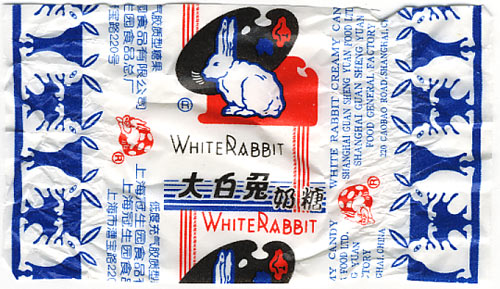
    During a lull brought on by sugar-induced bliss I had a chance to study the White Rabbit wrapper (If you want to sound like Elmer Fudd say that five times fast). It’s pretty weird:

    white-rabbit

    First, note the crazy Art Deco font in both black and red. Then there is not one but three different kinds of rabbits on the wrapper. The central rabbit doesn’t even look like a rabbit so much as it looks like an albino lemon that has sprouted a rabbit head. For reasons known only to the creators this bizarre, lumpy rabbit is seated in front of a painter’s palette with dabs of blue and red paint. The rabbit is apparently engaged in an almighty sneeze. Or perhaps those are albino lemon rabbit whiskers. Who knows?

    At the margins are rows of zombie rabbits facing each other in mirror image. They appear to be covered with grotesque lumps, like enormous, swollen zombie rabbit teats. They also have rather spooky eyes.

    Finally there are two renderings of a somewhat more contemporary rabbit that is leaping in front of what looks like an enormous mushroom that is either conspicuously magic or conspicuously toxic. Company information in Chinese and English fills the rest of the space.

    I think this is a masterpiece of psychedelic candy packaging design, right up there withLemonhead, Pixie Stix and Bazooka bubble gum. Looking at the wrapper now –there are three on my desk– I can taste milky sweetness and hear Jefferson Airplane thundering through my head. There is almost nothing in this design to suggest that what lies within is edible, and yet like a sugary prostitute it screams unwrap me and put me in your mouth!

    There are messages within messages within messages in this candy wrapper. I want an A2 size print that I can hang right next to my enormous “Dark Side of the Moon” poster. Then I can gaze at them both while I eat White Rabbit and listen to “Dark Side” through my headphones. If that isn’t a ticket to an alternate universe I don’t know what is. Pixie Stix, perhaps.

    Note: Image stolen from Speks International as I was too lazy to scan it myself. A larger image of an apparently older version is here.

  • Why aren’t you drinking the Wang Lao Ji?

    Imagethief spent a busy two days helping some representatives of a European country manage a last minute press conference. This was a sudden request that had resulted in 36 hours of breakneck work involving much frantic communication, central European languages, weird time differences and assorted ministers, agencies and secret handshakes. Ultimately all went well, but it was a weary team that schlepped its way back to the office.

    Upon getting back, I headed for the pantry to get a Diet Coke. Once upon a time I used to drink a can of real Coke a day, but I also used to be 20 kilos heavier. I have a wicked sweet tooth inherited from my father, an Englishman (no further explanation should be required), and kicking soft drinks was a big part of my weight loss program. But we keep a fridge full of the stuff in the office and for the past few months I had increasingly fallen under the seductive thrall of the Diet Coke. Wicked sweet with no caloric guilt!

    One-a-day Diet Cokes got to be such a habit that a couple of weeks ago I decided to give up on it for a while, lest I become a poster boy for the as-yet unknown effects of excessive aspartame consumption (are those antennae on your head, or are you just happy to see me?). But after today’s frantic activities, and the hot taxi ride back, I caved. As I was pulling a can from the fridge in the pantry our assistant finance manager flounced in, all floral sun dress and bright eyes, and said to me, “Why aren’t you drinking the Wang Lao Ji?”

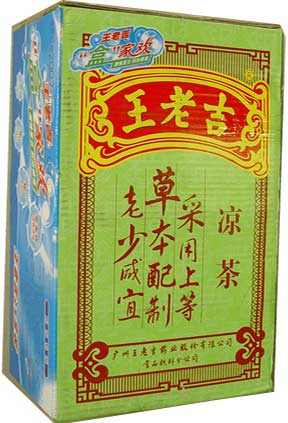
    I really had no answer for that. I had noticed that little cartons of Wang Lao Ji had started appearing in the fridge a week or two before. They looked a bit incongruous next to the Coke and Fanta Orange that are the mainstays of our beverage selection. Wang Lao Ji is a Chinese soft drink based upon a herbal tea. It’s advertised on busses across the nation and  recognizable by its distinctive red and yellow logo. Like any Chinese food or drink with a tenuous connection to the world of Chinese herbology, it is ascribed mythical powers as a tonic, including the ability to forestall diseases you’ve never heard of and increase various vital essences. Most of this is marketing courtesy of the manufacturer, a large Guangdong-based beverage and pharmaceutical company. On a more practical level, the Black China Hand has cited Wang Lao Ji as a hangover cure.

    Despite all this, I was stumped as to how to answer my colleague’s innocent question. She rushed to take advantage of my speechlessness. “It’s very good for…I don’t know how to say it in English…It can help you to jiang huo.”

    I didn’t know what “jiang huo” was, but it didn’t sound like something I should be doing in the office. I wasn’t even sure what about my appearance suggested that I needed to jiang huo. Either way, whatever jiang huo was, it was clear that she didn’t think a Diet Coke was going to help me achieve it.

    “It’s a Chinese medicine thing,” she added helpfully. “Sometimes, you know, you eat things that make your body too hot.”

    Got it. It’s a cooling food. Jiang huo (降火) means “reduce heat”. In fact, I’ve had some exposure to this. My Singaporean mother-in-law is big on cooling, home-made liangcha(cold herbal tea). In sweaty Singapore that’s not hard buy into. But to the Chinese and their overseas kin, “heaty” foods and “cooling” ones aren’t just about spiciness or physical temperature. It’s a metaphysical concept that relates to proper balance, energy and health. Certain times and physical conditions demand certain kinds of foods. Too much heaty or cooling food can cause problems. Too much durian (a classic heaty food)? Guaranteed pimples. Of course it might also be that durians are loaded with oil. But anyone who has eaten durians would agree that “heaty” is not a bad classification for the sulfurous fruit. Herbal teas, along with bamboo shoots, crab meat, water chestnuts, egg whites, pears etc. are cooling. I gather it’s best to aim for a kind of lukewarm average over time. Balance is everything, right?

    So I cracked open a carton of Wang Lao Ji and gave it a slurp.

    The mystery cooling ingredient is sugar. Despite its olde-style patent medicine labeling and health tonic claims, Wang Lao Ji is well placed in a fridge full of soft drinks. There might the barest, most elusive hint of herbal flavor lingering somewhere behind the cloying sweetness, but you have to breathe in over the liquid like a wine connoisseur to detect it. Everything else is syrup. It’s definitely not my mother-in-law’s bitter, bracing, home-brewed liangcha. I can also report that the little cartons of Wang Lao Ji will burp sticky liquid out of the straw and all over your suit at the slightest provocation.

    So it’s back to the Diet Coke for me. It might do much for my balance or help me jiang huo, but nor will it put me on the express train to diabetes.

    However I can believe that Wang Lao Ji makes a good hangover cure. After all, is there anything heatier than a hangover? For that reason alone it might be worth keeping a carton or two in fridge, wedged between the sour plum juice and the hair of the dog that bit you.

    wang-lao-ji

  • China’s food crisis PR strategy: Blame everyone else

    A few weeks into China’s rippling food quality crisis a PR strategy is coming into view. It’s a classic one: blame everyone else. Unfortunately, it’s not likely to be all that effective because of two things. First, China does actually have long-standing problems with food and drug quality. Second, China’s poor history of transparency makes it hard for them to dispel suspicion (a problem that also dogs their disease-related communication).

    The recent affair began with the discovery that vegetable protein shipped from China to the USA and used in pet food had been contaminated with melamine, a plastic that can make the overall protein level appear higher. Melamine also destroys the kidneys of cats, as it happens, so the contamination was discovered.

    In classic fashion, China’s initial response was to deny everything. As a crisis PR strategy this sucked. Nothing makes you look sillier and less credible than retracting a categorical denial made in haste. It taints every following communication. In fact it wasn’t entirely China’s fault. Initially AQSIQ, China’s quality monitor, wasn’t looking for melamine, but another suspected contaminant. But obscure mitigating technical factors don’t tend to play well in the court of public opinion, or excuse prudence. In the face of further disclosure, the Chinese government’s subsequent choices were to appear dissembling or incompetent.

    Every country has its fair share of food quality problems. In my native USA E. coli bacterial contaminations are something of a national sport, and I can remember plenty of food poisoning scandals. Eric Schlosser’s book, Fast Food Nation, makes fine reading if you are interested in the topic. The FDA conveniently puts its “refusal reports” –the reports of imports rejected– online. If you want to be horrified, read the Mexican list. Food contamination is not an exclusively Chinese problem.

    China’s government has grabbed onto this idea as part of its defense. It has been helped by some recent developments, including the rejection of a shipment of Evian for alleged bacterial taint (a case that stokes the fire of another China PR issue, Danone’s legal war with Wahaha — see this interesting post from China Law Blog) and the discovery of Melamine in some US-manufactured animal feed ingredients. Li Yuanping, director general of the government’s Import and Export Food Safety Bureau, also pointed out that China has in the past rejected US products due to Salmonella contamination, and asserted that China’s record on food exports is slightly better than the United States. Li offered up some winning quotes:

    “Ninety-nine percent is a relatively high percentage of suitable goods,” Li Yuanping, director general of the government’s Import and Export Food Safety Bureau, said at a news conference. “Facts speak more loudly than anything. . . . From what I have told you, you can see China has a very sound system that can guarantee the safety of food exported abroad.”

    ***

    “No food-inspection system is foolproof,” he said. “It’s like an airplane. Flying is said to be the safest way to travel, but sometimes you have plane crashes.”

    Bad choice of words in Imagethief’s opinion. You think an airline would communicate that way? But I haven’t been hired to advise the Chinese government.

    Graceless rhetoric aside, Li might actually be right. But perception is everything. Frank Luntz, a conservative pollster, wrote a pretty good book about public communication called Words that Work in which he relentlessly drove home a key point: It isn’t what you say, it’s what people hear (in fact, that’s the subtitle). You say “99% are good”. Americans in bathed in relentless media coverage will hear, “1% might kill you”. Roll the dice and move your mice.

    Like a premature categorical denial, “everyone else sucks too” is considered a weak strategy around our office. You think China’s national ambition is to suck only as hard as everyone else? I think they want to be better. More importantly, as far as the audience is concerned we’re not talking about everyone else. We’re talking about export-driven China, which has a great deal at stake in overseas perceptions of its food quality. In international trade, food and drug safety issues get entangled with every other hot button issue. And in the US right now China is second possibly only to Iraq as the hottest of hot-button countries.

    To illustrate, let’s look at that Mexican example above. America simply doesn’t have as big an axe to grind about Mexican imports (except for immigrants) as it does about Chinese ones. Mexico isn’t the emerging strategic rival. Mexico doesn’t hold a trillion dollars worth of American debt. You don’t hear about America’s trade deficit with Mexico (about a quarter the size of the one with China in 2006). By and large, Mexico doesn’t threaten American agriculture so much as it props it up with cheap labor.

    You get the idea.

    Agenda hockey

    Following the great melamine scandal of ’07 a few other China-linked disasters have emerged into public view. In early May the New York Times ran a lengthy investigative report on tainted cough syrup in Panama killing people. The cause was toxic, cheap ethylene glycol from China sold as harmless but more expensive glycerine and used in the manufacturing. The ethylene glycol has been getting around, apparently, as it has also found its way into Chinese toothpaste (proxy link) exported to Panama, the Dominican Republic, Costa Rica (and, for good measure, smuggled into Nicaragua) and, it has been discovered, the United States.

    As far back as mid-May, Dave Barboza of the New York Times and International Herald Tribune was writing about China’s “credibility problem” surrounding food exports. The situation has not improved since then. Barboza points out that a thirty-billion dollar a year export business it at risk. And that’s where the agendas come into play. The Washington Post, among others, has run op-ed columns editorializing about Chinese food imports in pretty strong terms. Here’s a recent lede:

    And what is madame’s dining preference this evening? Scallops coated with putrefying bacteria? Or mushrooms laced with illegal pesticides?

    These delicacies and more were among the hundred-plus foods from China that our Food and Drug Administration detained at U.S. ports last month, Rick Weiss reported in Sunday’s Post. Detained and sent back to the importers, who ofttimes sent them back to us again.

    Yuck. The Rick Weiss story linked to in that op-ed piece is headlined “Tainted Chinese imports common”. That’ll stick in people’s heads.

    China is busy trying to persuade the United States to allow imports of Chinese frozen chicken, among other things. What stories do you think American chicken farming companies are busy reminding Congress of right now? The Boston Globe, which is not much of a China cheerleader (they regularly run op-ed pieces on China and Darfur and have played a big role in the “Genocide Olympics” campaign), was running gross-out stories on Chinese chicken farming way back in early May, before this whole episode even kicked into high gear. More recently, the American press has been reminding everyone that their vitamins all come from China. That story was by McClatchy’s Tim Johnson, who also wrote an interesting post about this on his blog. Check it out to see some interesting public reaction.

    So the picture that is emerging is of a food and drug supervision apparatus that is hopelessly broken and that has been for some time. This will be no surprise to anyone who lives in China, where food scandals fall from the skies like the Shanghai plum rains. But it’s making waves overseas now, with enormous business implications. You might think that a serious, soul-searching look at the state of domestic regulation and enforcement, vigorously communicated, would be China’s solution.

    You would be wrong.

    The blame game

    China certainly takes the situation seriously. In fact, seriously enough that English-language state media in China, in the form of the China Daily, excoriated China’s regulators for their crappy communication (here reported on by the AP). That is significant. In fact, suggesting something of an editorial slant, the China Daily also went so far as to publish a Wall Street Journal story titled “China confronts crisis over food safety” in its entirety on the China Daily website, with attribution and an external link.

    The popular Southern Metropolis Daily also ran a column by journalist and blogger Lian Yue, translated by Danwei, that linked the food safety problem to broader problems in China. I don’t know if similar commentaries ran elsewhere in Chinese language media. Anyone who has seen anything should post a comment.

    But the official response from the government, represented largely by AQSIQ, has been essentially to blame anyone and anything but the system.

    In the case of the Panamanian cough syrup, the deputy head of AQSIQ blamed Panamanian traders, an account disputed elsewhere. In the case of the tainted toothpaste, China is accusing the American FDA of sensationalizing the situation. In that same story the head of AQSIQ’s food safety division accused the foreign media of the same thing, describing their reporting on the scandals, in an exquisite choice of words, as “wanton”.

    The charge of media sensationalism may be justified to a degree, but blaming the media is almost never an effective PR strategy. It carries an inescapable whiff of Scooby-Doo, as in, “I would have got away with too, if wasn’t those meddling kid reporters!”

    Finally, the Chinese government is blaming its former drug chief, Zheng Xiaoyu, for the entire situation (interestingly, a Google search for his name this morning causes Nanny to issue the deadly “server reset” message). The unlinkable South China Morning Post drove the point home with a headline last Friday that read, “Corrupt drug chief blamed for scandals.” AQSIQ and the State Food and Drug Administration (SFDA) double-teamed on this one:

    SFDA spokeswoman Yan Jiangying said the agency should not be blamed for Zheng’s mistakes. “I want to highlight that we should not dismiss the entire drug supervisions system because of a single person, Zheng Xiaoyu, and we should not extend the mistakes made by a single person, Zheng Xiaoyu, to the mistakes of the entire system,” she said.

    So its Zheng Xiaoyu’s fault if you had any trouble reading between the lines. And people say the Chinese are cryptic.

    When China rolls somebody’s head over a scandal it’s not always a metaphor. To show how serious it is about that accusation, Beijing has sentenced the hapless Zheng to death. It has been a long fall for the man who was tasked with cleaning up in the wake of the awful Anhui baby formula scandal of 2004.

    Killing the wrong chicken

    Let’s go back to Frank Luntz’ point about it not being what you say but what people hear. Executions have a proud tradition as public communication. China thinks that the message that they are sending  with Zheng’s sentence is, “We are goddamn serious about this.” Imagethief is willing to bet that the signal received by overseas audiences will be, “We are so thoroughly corrupt that we had to execute our former top drug regulator.” The question going through heads overseas will be, “Well, whom haven’t they caught yet?”

    Executing a mandarin probably won’t have any effect at all on the small processors and exporters who seem to be responsible for most of the problems. Zheng is too far removed from them. Unless small companies feel the weight of enforcement landing squarely on their own shoulders, with an attendant shift in the overall risk/reward equation, their behavior won’t change.

    The lingering question is whether a combination of endemic corruption and industry fragmentation render the problem unsolvable. An Imagethief commenter named Jim recently made a good point. He wrote:

    Processing millions of tons of food, through millions of workers in tens of thousands of large and small companies, with high cost-cutting motivations, from millions of farms through thousands of transportation companies to millions of sellers to tens of millions of buyers, is hard.

    Yes, it is. But I’m an optimist and China needs to show that it is serious about regulating that very process and enforcing vigorously if they want to get past this episode. And they need to clearly communicate exactly what they are doing to both domestic and overseas audiences. Good crisis PR isn’t about bluffing your way past a real problem, it’s about explaining what you are doing to solve it. No one will expect China’s food problems to be fixed quickly, but people can be pretty forgiving in the face of some contrition and obvious effort.

    The other option is to keep pointing fingers elsewhere. That might save face and keep people at home happy, but it won’t influence overseas audiences who will keep hearing in the most visceral terms possible how broken China’s regulatory system is. Doors will slam on Chinese imports. Overseas manufacturers conscious of their own brands will look elsewhere for ingredients. And the Chinese government will look foolish and self destructive when the next scandal boils out of the bowels of a broken system.

  • Chinese restaurant calculation made easy

    A couple of days ago, Imagethief had lunch with four members of his team at a Chinese restaurant downstairs from our office. Choosing dishes was easy –I’ll eat almost anything– but, predictably, there was much debate about exactly how many dishes we should order. And, just as predictably, we ended up with twice as much food as we needed. This is the great conundrum of Chinese dining, and, indeed, most Asian-style dining.

    In the US it’s simple. You decide what entree you want and you order it. The only complexity is whether or not you share appetizers with your friends, choosing the wine (it’s fiendishly easy embarrass yourself oenologically; in college I had a buddy who wrecked a date with a rich girl by breathing the white wine) and settling the bill. In the US, settling a split restaurant bill is the most mathematically challenging task you are ever likely to undertake unless you are a high-energy physicist. And if you’re a physicist, you’ll have purpose-written computer software to help you. There is no software for sorting out restaurant checks, and by the time you and your friends are done sorting out who had how many of what beverages, and which appetizers, and I didn’t drink any goddamned wine, someone always gets screwed. Bitter, trans-generational rivalries have started this way. The Hatfields and the McCoys? That started with a restaurant check. And that was just Arby’s; think how much worse it could have been.

    Chinese dining trades the ordering simplicity and bill complexity for ordering complexity and bill simplicity. All the food goes into the middle, so you just divide the check by the number of people. Only miserly bastards will argue, “well, I had less of the duck tongue, so I shouldn’t pay so much”. You probably don’t hang out with people that anal, unless you are totally anal yourself. In which case, you probably live to dissect restaurant checks to two decimal places, so you’re wasting your time reading this. With even the beers being cheap in most Chinese restaurants, most of the time it’s not even worth adjusting for alcohol consumption. So the check is easy.

    But the ordering, ah, now that’s hard. And it’s not just hard for the obvious linguistic reasons. Yes, you have to learn some food and cooking vocabulary, but that comes quickly if you don’t want to starve. And you do need to get past the Chinese infatuation with cryptic dish names. You’ll never know that “Buddha’s glistening five-taste jewels” is braised camel testicles with sea cucumber unless you ask. But what’s really difficult is figuring out how much you should order. How many dishes should go into the center of the table in order to ensure that your party is sufficiently fed, without causing cataclysmic waste?

    Food is cheap in China, you argue, so why worry about cataclysmic waste? Well, guilt, for one reason. As a Jew, this is an inextricable part of my worldview. You can abandon kosher restrictions, but the guilt is bred in, like eye color and curly, brown hair. Remember all those years your mother told you that kids were starving in China, so you should shut up and eat the damned broccoli? That really comes back to haunt you when you’re actually in China, and you wander around some of the piss poor villages that begin on the far side of Beijing’s fifth ring road and stretch, more or less uninterrupted, all the way to Kyrgyzstan. And, really, who wants to see too much nice food thrown into the grime-blackened oil drums of the slop collectors? These are the poor souls who ply Beijing’s streets by tricycle and (illegally) xiao beng beng after dark, collecting restaurant leavings for the pig farms outside of town where they raise the pigs who will be, well, next week’s meals and, eventually, pig slop. It’s the Circle of Life, Beijing style. You won’t see Disney touching this one.

    Also, of course, when there is a vast amount of food on the table in front of you, you’ll tend to eat it. Now this isn’t necessarily bad, but Beijing cuisine isn’t of the light and heart-healthy variety. It’s of the Exxon Valdez, billions of gallons of oil and salt mixing together variety. Too much at any one sitting will put you into a coma. Too many sittings will put you into a casket. A really big, reinforced casket. And China is short of wood, so this only compounds the guilt.

    So this brings us to one of the truly great questions of our age. It’s right up there with, “is there an elegant, mathematical way to unify classical and quantum physical models?” or “who, in their right mind, thinks Paris Hilton is sexy?” That question is this: what is a truly rational ratio of Chinese dishes to people, assuming average people and an average restaurant? (I’ll assume that you’re smart enough to avoid one of those touristy “imperial” dives where they charge outrageous prices to serve you precious little niblets of bizarre organ meats that you could find being sold on sticks off the charcoal grill around the corner for a kuai a pop.)

    Think about it. You and a friend go a Chinese restaurant for lunch. You probably could survive splitting one dish and rice, but you’ll get a meat (or tofu; equivalent for this exercise) and a vegetable. If you’re aggressive, you’ll get two meats and a vegetable because you feel that you need the variety to justify a Chinese restaurant. But this is a trap, and you’ve now over-ordered. With two people, one dish per person is appropriate. Add another person and you’ll definitely add another dish. Your still at one dish per person, following a classic “one-per-head” rule often applied by Chinese people. But with four people, what do you do? Four dishes for four people might be a lot. You could probably stick with three. Five people? You’ll want four dishes. Six? Dicey…four will instinctively seem too little to you, even though it’s probably correct. Six will definitely be too much. This is touch and go. Seven or eight people? Er, uh…

    So you can see that lot of voodoo is coming to bear to here. And there is more complexity as well. When I say “dish” here, I am assuming one of the standards: a stir fried vegetable or a meat or tofu in sauce. But how do you account for the cold dishes, or veggies, which tend to be lighter? Or a duck, or even the mighty shuizhu yu, which are undoubtedly heavier? What about dumplings? Some places sell by the liang, some by orders of 10 or 12. Well, at this point you’re just guessing wildly, aren’t you?

    Of course you could turn to the waitress for help because she, of course, has a totally disinterested perspective on what represents enough food for your party. This is a variation of the deadly trap in which you ask the waitress to recommend a dish. Yes, sometimes they’ll send you to a legitimate, hidden gem, but nine times out of ten the finger goes straight to the abalone and sharks fin XO supreme in tiger-penis broth at RMB888 a bowl. And, at a restaurant where a plate of yuxiang rousi costs 12 kuai, that can be a quite a shock to the system. In truth, I’ve never felt that Chinese waiters or waitresses were really aggressively pushing more food than was appropriate, but they’ll definitely err high. I can recall dozens of times where waiters and waitresses suggested we order just one more dish, and only one instance where we were told that we might want to take one thing off the list.

    So, can this process be made easier? Can it be somehow defined in a way that will enable you to prove, mathematically, that you have ordered a correct amount of food? Who knows. But it’s Saturday morning, and I have nothing better to do, so I am going to try.

    For simplicity, let’s assume that we want a system that sticks to the Chinese rule of one dish per head. So if you have five people, you want an aggregate score of five. But we also want a system that weights dishes correctly based on their gustatory impact. For instance, there is no way that your pai huang gua or bowl of white rice has the same impact as an oil-and-chili drenched mapo doufu. Now I don’t have time to sit here and individually weight every Beijing and provincial standard that you can order in this town, for Chrissake. But I can roughly categorize dishes in a way that, I hope, makes sense. So here is my proposed weighting system for types of Chinese dishes:

    Underweighted dishes:

    • White rice: .25 in aggregate (assuming everyone orders a bowl – if less than half the party orders white rice, ignore)
    • Dumplings (shuijiao): .25 per liang of five or .5 for an order of 10 to 12
    • Dumplings (guotie): .5 per liang of five or 1 for an order of 10 to 12
    • Cold dishes (pickles, cold meats, appetizers, hua sheng, etc.): .5
    • Plain breads (no meat): .5
    • Desserts: .5 (this is counterintuitive as Chinese desserts are unparalleled calorie bombs, but I’ve always subscribed to the “separate tank” theory of dessert consumption
    • Cooked green vegetables: .75 (that’s stir-fried or steamed green vegetables; di san xian,yuxiang qiezi, or anything in sauce counts as a full dish)

    Standard weighted dishes:

    • Soups and noodles: 1 (soup is a trap; don’t assume that it’s lighter than other dishes)
    • Breads with meat (roubing, etc.): 1
    • Standards: 1 (most meats, poultry and fish; vegetables in sauce or gan bian style; and any cooked or sauced tofu; the vast majority of dishes)

    Overweighted dishes:

    • Shuizhu yu or niu rou: 1.5 (I’m inclined to double weight it, but I’ll be generous)
    • Beijing roast duck: 2 per duck and, yes, a half-duck is 1 point (the duck is greasy and there are pancakes, plum sauce, etc.)
    • “Set piece” dishes: 2 (roast suckling pig, roast mutton leg, anything that serves as a centerpiece dish or that would be served at a wedding)
    • Hot pot: .75 per person (so if you have four people, it counts as a total of 3 points)
    • Intimidation dishes: 2 (bizarre organ meats; exotic animals; anything you are served by people trying to get a rise out of the laowai or that you serve to your “just arrived in China” friends to give them a taste of “the real thing”

    So if you and five of your friends (six people total) are going out for dinner, you have an available score of six. Everyone has white rice, leaving you 4.5 available dishes. Two cold dishes leave you 3.5 remaining slots. Order two green vegetables and two standards, and it’s perfection. Or one standard, a duck and one more cold dish. Or, if this is a duck feast, six people qualifies for two ducks, a standard and two cold dishes. See how easy this is? For the sake of argument, I’ll even allow rounding.

    Global modifiers:
    Global modifiers affect the overall score of a meal. Positive modifiers are added to your available score to allow the addition of extra dishes, negative modifiers subtract from the total allowed dishes. For example, if you have four people, and, thus, a total available score of four, a global modifier of +2 allows you order dishes totaling a score of 6. Conversely, a global modifier of -2 would allow you to order only two dishes. Some global modifiers apply to specific numbers of people, and so must be modified for party size. Simple, isn’t it?

    • Auspicious occasion (wedding, deal closure): +2 for every five people
    • All just arrived in China: +2 (gotta experiment)
    • All female party: -1 for each four people
    • All teenage girls: -3 for each four people
    • Lunch: -1
    • Rugby team: x2 available score
    • In Guangdong: -2
    • In Sichuan or Hunan: +1
    • Any restaurant with a floor show: -2
    • Any restaurant with a government tourism or China Famous Brand plaque: -2
    • Any restaurant at a provincial 办事区: +1
    • Beer and other liquors: no impact

    There. Drop that all into Microsoft Excel or a handy, slide-rule style device and you’re good to go. I’ve tested it not at all and I have very little confidence that it will hold up under rigorous examination. But, in the end, it’s as good as anything else you’ve got to work with. Suggestions for other weightings or modifications can be submitted via the usual methods. The Nobel committee can contact me care of this website.

  • How to survive a Chinese drinking party

    Imagethief is in Shenzhen, supporting a Japanese client company at the Seventh Annual China High Technology Exposition, currently occupying a huge amount of space at one of Shenzhen’s two convention halls (our first taxi driver took us to the wrong convention center this morning). We’re also staying at one of two hotels with nearly identical names, which caused us some problems yesterday. Shenzhen is a confusing town.

    It’s extra confusing when you’re drunk. After a hard day’s teeing up interviews for our client with the Chinese media, they invited us to a lavish dinner at the Beihai Fishing Village Restaurant. Like all Asian dinner parties, it was really an excuse to drink ruinously and publicly shame friends and colleagues. A free flow of lethal Chinese brandy and beer was arranged. Thankfully, delicate Japanese sensibilities (I presume) kept baijiu, China’s liver-and brain-dissolving white spirit, off the list.

    Despite their often-reported political and cultural schisms, the Japanese and Chinese share one thing in common: they love social drinking. It’s the time when protocol hits the road and everyone becomes loudly friendly, until they pass out. This shared interest notwithstanding, I was interested to see a clear segregation of Japanese executives at one table (with one Japanese speaking Chinese manager) and Chinese and Imagethief at a second table (with two Japanese executives). Given that one Japanese executive at my table spoke both English and Chinese, it may have been simple linguistic segregation rather than some kind of spooky, racial arrangement.

    The national table arrangements didn’t stop much cordial toasting back and forth. Yours truly was seated next to a young Chinese executive who spoke passable English and was both friendly and, apparently, interested in seeing exactly how much alcohol would go down an American’s throat before his head exploded.

    I learned a valuable lesson tonight. These kinds of ganbei toast-o-ramas are not tests of your drinking abilities. They are tests of your wits. The contest is not who can drink the most or hold their liquor the best. The test is who can slyly cajole his friends and colleagues into drinking more than he does. It’s all about duplicity, challenges, evasions, filling the glasses of people in the bathrooms, and gentle belittlement to encourage people to risk alcohol poisoning.

    Imagethief is a quick study. I rapidly sent my brandy glass away, as just having it in front of me was going to result in my painful and premature death. I also never let the waitress fill my beer glass more than halfway, and often stopped her at a third. That way I was never far from a gan bei (dry glass). I went over and toasted the other table as a group to pre-empt them coming over and toasting me one by one (the lone white boy is always a toast-magnet). Finally, I drank 1.5 liters of water during the evening, in addition to my liquor, as good hydration helps to mitigate both drunkenness and, especially, hangovers.

    While I was employing these tactics I observed various other forms of duplicity, including toasting beer against brandy; diluting beer with water; toast deflection (finding someone more worthy of a toast than you  – this often victimized the women) and, the coup de grace, one Japanese executive actually pretending to be passed out at the table. He somehow managed a miraculous recovery when it was time to walk to the bus.

    I figure I earned a B- for my performance. I was called out for sending my brandy glass back after three shots, but managed to go toast-for-toast with my beers and sacrificed only a moderate amount of face. One Chinese executive who upbraided me for quaffing water was doing the same thing ten minutes later. I was never caught dumping or cutting liquor, and I never shied from a toast that was offered me. I am still sober enough to write this, and should be borderline functional tomorrow. Which, in PR, is par for the course.

    But I’ll probably be sleeping in the bathroom tonight as I get rid of that liter and a half of water. Nothing in this world comes free.

    Coda: It is now the next morning. There is nothing sadder than a bunch of hung-over executives slinking around an incredibly noisy and hot convention floor. That might be the definition of hell.

  • The Great Donkey Meat – Tiger Piss – Media Whore Axis

    Trust me, it all connects.

    Americans just don’t understand the reality of Chinese food. Mu shu pork, general’s chicken, all that Chinese restaurant crap you get in the US, has almost no relation to anything you can get in China. The defining highlights of Chinese cuisine, with the possible exception of dim sum, which followed the Cantonese diaspora, are conspicuously absent from American menus.

    This is probably because the Chinese eat, not to put too fine a point on it, a lot of nasty shit. (Civit cat?) Don’t get me wrong, the Chinese have some fabulous food as well. But this is country of extremes, and as lofty as the culinary highs are, the lows are scraped straight from the floor of Hell’s own takeaway lunch counter. I’m fairly well inured to Asian and third world diets, having prowled much of the Indonesian archipelago and Indochina (not to mention China proper). But I do have my limits. And I reckon this dish –actually a scam– tests those limits:

    Chinese Eatery Sold Donkey in Tiger Urine

    SHANGHAI, China (AP) – A restaurant in northeastern China that advertised illegal tiger meat dishes was found instead to be selling donkey flesh – marinated in tiger urine, a newspaper reported Thursday.

    The Hufulou restaurant, located beside the Heidaohezi tiger reserve near the city of Hailin, had advertised stir-fried tiger meat with chilies for $98 as well as liquor flavored with tiger bone for $74 a bottle, the China Dailyreported.

    Damn, that’s nasty. On two levels. First, that people though they were eating tiger meat. Yes, I know that tiger meat is supposed to confer sexual prowess, etc. But tigers are still cats, and I own cats, and I can tell you with complete authority that cats are nasty creatures better looked at than eaten. Anyone who has seen what comes out of a cat on a daily basis will understand this. Tigers are pretty and regal, but, when carved into deli slices, they’re still cat meat. By the way, it’s worth reading the China Daily coverage as well, if only for this statement:

    After inspection, the owner, Ma Shikun, confessed that the so-called tiger meat was actually donkey meat that had been dressed with tiger urine, to give the dish a “special” flavour.

    It’s special alright.

    Donkey I have no real issue with. Somehow the idea of eating donkey just seems somehow more savoury (in the metaphorical sense of the word) than eating tiger, and not just because donkeys are neither photogenic nor endangered. But donkey marinated in tiger urine? Check yourself in for therapy if that concept doesn’t automatically make your skin turn green and crawl like a carpet of millipedes. Only one thing on the face of planet should ever be marinated in tiger urine: Paris Hilton. In all circumstances, any form of cat urine should be treated like radioactive waste and interred in abandoned mines in Nevada under a “plain of thorns” sufficiently pointy and tall to dissuade future civilizations from excavating the site. Come to think of it, might not be a bad idea to put Paris Hilton down there too. And Da Shan while they’re at it. Of course if the two of them are put down there together with an unlimited supply of virility-inducing tiger urine, future civilizations stupid enough unearth the site may be confronted with a lost, buried society of hyper-white, inbred, bilingual media whores. I shudder at the prospect.

    There is, of course, more, in this case from the AP story:

    Raw meat was priced at $864 per kilogram.

    The sale of tiger parts is illegal in China and officers shut down the restaurant, only to be told by owner, Ma Shikun, that the meat was actually that of donkeys, flavored with tiger urine to give the dish a “special” tang, the newspaper said.

    The report didn’t say how the urine was obtained.

    Authorities confiscated the restaurant’s profits and fined Ma $296 it said. It wasn’t clear what Ma was fined for. Selling donkey meat is not illegal in China and it is widely consumed in the northeast.

    $864 a kilo is a lot to pay for piss-marinated donkey meat, under any circumstances. I am clearly in the wong business. I have to toil for days to earn $864, and that’s before Chinese government taxes and health contributions. Now many people may suggest that piss-marinated donkey meat and press releases really aren’t all that different, but I don’t write by the kilo no matter how much it may seem that way to journalists.

    As to how they collected the urine, I suppose that’s the hidden cost of earning $864 on capital costs of roughly zero, assuming that donkeys are dirt cheap and the cost of rasing and keeping the tigers wasn’t born by the restaurateur. It occurs to me that $864 might be actually be a justified price for piss-marinated donkey meat considering the health implications of collecting (and working with) the ingredients. I mean, how does one collect enough tiger urine to marinate a donkey?

    Nice kitty! Hold still…

    Thanks to Hose-B for the article.