Apologies are an under-appreciated art. Most apologies crafted in the name of public relations sound intrinsically weaselly, often because the people making them are preoccupied with saving their prior reputation rather than getting past the mistake and rebuilding trust. I was reminded of this when I read Mike Daisey’sstatement following L’affaire Daisey, which I reckon I don’t need to further explain to this audience. (If you’ve just emerged from decades frozen in an ice cave, clickhere. Also, get a haircut. Styles have changed.)
Here is what Mr. Daisey wrote:
I apologized in this week’s episode to anyone who felt betrayed.
Did you see it? If not, I’ll explain in a moment.
Before I do, I should be clear: I’m not interested in a broader critique of Mr. Daisey’s work. That’s been done in so many other places that I’m too lazy to even go gather the links. Plus, I know it’s a rough gig in the performance artists. In 1974 Chris Burden crucified himself to a Volkswagen Beetle and had it driven around. So you can’t really have the same expectations of these people that you would of, say, your standard airline executive (much as you might want to crucify airline executives to moving vehicles).
But still, there it is, “…anyone who felt betrayed.” In four words, the two great sins of public apologies.
The first is the passive language. Now, I have no problems at all with passive voice in writing (or with starting sentences with conjunctions, or parentheticals, or many other things they told you were bad in your high school comp class). But that passive language is such a trope of public apologies that we pretty much take it for granted these days. It’s so common that Wikipedia has an entry on it. Vanity Fair, also citing Wikipedia, has a small collection of examples. ”We apologize if anyone was offended,” was even trotted out recently by Ben and Jerry’s Ice Cream in response to the (silly) Linsanity flavor scandal.
The second (and I must thank my partner in crime, Brendan O’Kane for this) is the use of the word “felt.” The passive voice subtly shunts responsibility onto the victim. The use of “felt” suggests that problem itself doesn’t even exist, and is merely some kind of unfortunate vapor or misunderstanding. You felt betrayed, but I didn’t actually betray you.
Lawyers may like apologies that don’t include a categorical admission of responsibility, but from a public communication point of view they come off as pro-forma, passive-aggressive dissembling that shifts at least some of the blame onto the injured parties. You can see how this works by replacing the standard corporate, public-conduct or ethno-gender-religious sensitivity malfeasance that people are usually apologizing for with something more heinous. I like to use a steamroller homicide, for no other reason than I appreciate the image of a maniac rampaging through town with a steamroller. Plus, as far as I know, no one has ever actually been murdered with a steamroller, so we should be safely in the land of the hypothetical (although the Internet will probably prove me wrong*).
So imagine you’re a contrite steamroller maniac attempting to rebuild your reputation. What do you say?
“I apologize for running over those people with a steamroller.”
Hell no. That’s way too direct and honest. It could be mistaken for assumption of responsibility, which might let the healing begin. We can’t have that.
Try this on instead:
“I apologize if anyone was run over by a steamroller.”
Do you see how this small change embeds whole new levels of denial and distance into that short statement? Seriously, how dumb were those people to get run over by a steamroller? The freaking thing only moves two miles an hour! I mean, head on a swivel, grandpa, this is the big city!!! But, you, know, sorry and all.
Or, even better,
“I apologize if anyone felt killed by a steamroller.”
Because they might not actually be dead. They might just feel that way. By mistake.
What the heck, let’s go for broke and dispense with the apology altogether. Some light regret is enough for the masses:
“I regret that due to this unfortunate situation anyone felt killed by a steamroller.”
Better yet, let’s disembody the regret, so we’re not sure who’s actually doing the regretting. Could be your auntie doing the regretting. You don’t have anything to regret. You’re not a culpable steamroller maniac leaving a twelve-foot-wide trail of blood and flattened personal accessories behind you. You’re just misunderstood:
“It is regrettable if, due to this unfortunate situation, anyone felt deprived of life by a steamroller.”
Now that…that is PR gold. A non apology for the ages. I almost weep reading it back.
I’m ridiculously late to this, as usual, but people keep asking me about the Burson-Facebook thing because of my years at Burson, so I thought I’d post the gist of the response I’ve been giving. If you’re not familiar with the story of Burson’s ill-fated project stirring up FUD about Google on behalf of Facebook, you can read about it here.
But first, some housekeeping. I worked for Burson-Marsteller for six years, all here in China. It was a great experience. Much of what I know about PR and virtually all of what I know about doing PR in China I learned at Burson. I still use Burson-Marsteller China as an agency, and hold the people there in the highest regard. All agencies make mistakes. No one in PR wants to damage the reputation of a client, or their own agency. When it happens, we try to learn from it.
I don’t know what the chain of events involved in the Burson-Facebook project was, and I don’t know any of the people involved. I have no inside track. But as an industry observer, and in the spirit of learning from the situation, here are four lessons to take from this episode:
If it will embarrass you to have a pitch go public, it’s a bad pitch
The art of selling stories or viewpoints to journalists, bloggers or the public is a pitch. In writing or verbally, a pitch should stand alone as something you’d be comfortable going public on its own. If a pitch doesn’t pass that test, and its public release would embarrass you, your agency or your client, it’s a bad pitch. Any pitch that doesn’t identify the interest behind it is by definition a bad pitch, because lack of disclosure in a pitch suggests that someone would be embarrassed to be connected with it. Rethink the strategy. Yes, this tars a whole branch of political PR based on anonymous leaks. So be it.
There’s nothing wrong with criticizing a rival…transparently
It’s silly to pretend that slamming competitors isn’t part of PR. In the industry it’s called “depositioning”, a sanitized word that suggests some lingering discomfort. Outside it might be called smearing or, for those in the tech industry, FUD (fear, uncertainty and doubt). So what’s the difference between a smear and a legit piece of competitive PR? Transparency, for one thing. There is nothing wrong with criticizing a rival (or a client’s rival) or pointing journalists at their shortcomings. But you’d better be prepared to stand behind your claims, and that means being well researched and transparent.
PR instincts and journalism instincts are not the same
PR agencies hire a lot of ex-journalists for their story instincts and their usefulness in media relations due to their contacts and credibility with other journalists (more on this below). But the fit isn’t always natural. Someone senior from a global agency other than Burson told me recently that they have about a ten percent long-term stick-rate from their senior journalist hires in the US. I’m not surprised.
One problem is that although they overlap, journalist instincts and PR instincts are not the same. Oversimplified, journalistic instincts emphasize spotting and piecing together stories while PR instincts often emphasize identifying and managing risks. We spend as many years and as much work developing our instincts as journalists spend developing theirs. Any crossover in either direction means a learning curve. The risk that should have been spotted in this particular case was that the backstory of the pitch –an anonymous client paying a major PR firm to slam Google on privacy– was more interesting than the pitch itself.
Set a thief to catch a thief
Despite the blurring of the line between mainstream media and blogging, journalists and bloggers are different. If you send a bad pitch to a mainstream journalist, generally it just dies (perhaps along with some of your credibility). If you send a bad pitch to a blogger, there’s every chance it’s going to published and ridiculed. Welcome to blogging. This isn’t 2003, and everyone should be up on this. I understand hiring mainstream journalists to pitch other mainstream journalists, but it seems to me that the PR industry has been slow to embrace using bloggers the same way. As a blogging PR person I don’t think bloggers are particularly more resistant to working in PR, but I definitely think they respond to PR differently than mainstream journalists. And that’s definitely true for tech bloggers.
Yesterday I posted part one of Apocalypse Box, in which I wrote a bit about the communication problems surrounding the reactor disaster in Japan. I concluded with saying that just because something is unthinkable doesn’t mean it won’t happen.
It was with the unthinkable in mind (as it were) that Mrs. Imagethief and I set about reconstituting our household emergency kit in the wake of the Fukushima disaster. Six years ago, when all the world believed that lethal bird flu was but a sneeze away, the wife and I assembled a reasonably comprehensive household emergency kit. This consisted of two weeks of non-perishable food, drinking water, and various household supplies such as batteries, candles, gloves and such. I called this our “apocalypse box.” To be clear, the box (technically, two boxes) was not really designed for the apocalypse, so much as it was designed to enable us to withstand a run on supermarkets and a temporary disruption of services. But “apocalypse box” sounds cooler than “temporary disruption of services box.”
There was a return-on-investment calculation at work. Let’s face it: If civilization actually collapses Roland Emmerich style, a couple of cans of Dinty Moore stew and a Bic lighter are probably not going to make the difference between survival and being devoured by feral dogs (just for example). For that kind of Mad Maxery you need a crate of assault rifles, a cave in Wyoming and, of course, the last of the V8 interceptors*. And liquor. Lots of liquor.
But the investment required for that level of extreme preparation measured against my relatively low estimate of the chances civilization actually collapsing Mad Max-style in my lifetime rings up no-sale. Two plastic bins of food and general supplies measured against the possibility of a run on supermarkets or a temporary disruption in power and goods distribution looks much more rational and less militia-nutcase. Especially in China. It’s not that it might not be useful to have a crate of assault rifles and a fully stocked cave in Wyoming, just in case. It’s just that it seems to me that the resources I would have to invest in such a level of preparation is better spent on, oh, health insurance or rent or cat food (can always eat the cats).
There is some family precedent for this preparation. I grew up in California where we all heard as children that someday the Big One would come, the state would drop into the sea and that would just be tough shit. Or variations on that story. When I was in high school my mom used to keep a large bin of provisions and bottled water in the garage. My brother used to keep beer hidden in the tool closet. But that wasn’t really for survival purposes so much as to keep my mom from finding it.
In 1989 I was living in Santa Cruz during the nearby 7.1 Loma Prieta quake. Crouched on my kitchen floor as the cupboards emptied out I actually rather expected to drop into the sea, which wasn’t very far away. (Although as we have learned a couple of times in recent years, in these situations it turns out the sea may come to you.) In any event, Loma Prieta wasn’t The Big One, though it was Pretty Big and did do a lot of damage. There was in fact a smallish run on supermarkets in Santa Cruz after the quake, although everything was back to normal within a day or two. Having also been in Singapore during the SARS epidemic, I’ve long thought it made sense to have a certain basic level of preparation for extra-weird times. It took the bird flu phantom to kick us into actual preparation, but then we moved to Shanghai and back in 2007 and the apocalypse box went by the wayside for four years.
I had actually been thinking about the old emergency kit quite a bit over the last few months, and mumbling about doing something about it in the same way that one mumbles about getting one’s teeth cleaned or other disagreeable but virtuous chores. But Fukushima and the great Beijing salt run of ’11 kicked us into high gear. I know from experience that I can go without food for some time, but to leave Mrs. Imagethief hungry is to dice with death. We made a pass through Wal-Mart and Jenny Lou’s and assessed where we stood. Where we stood was on a pile of mostly canned legumes and absolutely no Beano. This begged the question, if the apocalypse actually did strike, would anyone in our house still want to be alive after 24 hours of the farts?
In fact, on review the whole assortment seemed very conventionally western. If you’re really going hardcore, you’d want to lay in some things with local value so that they could be traded for ammunition, gasoline, breeding age females, or whatever it is you may need for your bunker. In China that argues for an emergency kit stocked with dried cuttlefish, melon seeds and baijiu. But one of our guiding principles was that the apocalypse box should contain food we’d actually want to eat. This is both so that we’re not completely miserable in the event of an emergency (who wants to be sitting in the light of one guttering candle, banging your hands together for heat and morosely staring at a bag of deep-fried crab snax?), and also because things need to be rotated out and eaten periodically as they reach their expiry dates. Yes, I have a spreadsheet with all the expiry dates.
Some recalibrating of the supplies yielded a more balanced though rather salty mix of canned meats and vegetables, and calorie-dense dried fruits, nuts and chocolate and such, with the idea being that at least some of the supplies be easily portable in the event of an evacuation.
That’s right, evacuation. Perhaps I’ll regret this someday, but I am not actually paranoid enough to keep a “go-bag,” a pack with the essentials you’d need to carry in the event of sudden evacuation. Like the cave in Wyoming, this is just a touch too Jack Bauer for me. But I am paranoid enough to keep a “go-list”, which is designed to save me the trouble of thinking under pressure and tells me exactly what we should pack for two kinds of evacuation.
The first is a walking trip to the airport (roughly a day’s walk from where we live). The other is an indefinite walking evacuation to points unknown. Both include essential documents, specifics on clothing, a list of easily portable food items, basic tools and such. The indefinite one trades laptops for more food and clothing and some backpacking supplies and such. Alas, the cats come out poorly in both scenarios. I also keep current documents in the cloud and an annual backup of all my important data in the United States, just in case. I mean, who wants to re-rip all those CDs just because someone dropped The Bomb?
Let me be clear: I don’t think my family is in danger. If I did, we wouldn’t live here. The point behind the apocalypse box is to take a reasonable level of precaution for unforeseen events. It was a couple thousand RMB plus some things I already owned, and it all fits into two stacked bins that double as an end-table in my son’s room. The evacuation go-list has a marginal cost of zero, other than a little thinking ahead. Two weeks ago I had lunch with a journalist friend who’d just returned from reporting in Japan, and he showed me the unused bunny suit his newspaper had issued him. This made me feel completely rational.
The spreadsheet on which I keep track of all this stuff is public on Google Docs. Feel free to check it out – there are three sheets (hold your jokes). Don’t take that document as definitive – it’s just where we stand now and not meant to constitute advice to you or your family. But maybe it will give you some ideas. Or maybe you’ll see stuff we’ve missed. Or maybe you’ll think –perhaps with some justification– that I’m a complete idiot. But, should the worst ever happen and the supermarkets empty out for a few days, I’m gonna be loving me that chili. And when you’re trading your children to me for chocolate bars, we’ll see who’s laughing.
Apropos of today’s escalation of the Fukushima reactor disaster to “7″ (Chernobyl) on the international scale, there is something about the word “radiation” that bypasses rationality and whispers right to the lizard brain. Perhaps one or two other words have the same power to spook. “Pandemic” comes to mind. But that aside, there is little else I that has quite the same potency as “radiation.” Almost all the connotations are negative: Contamination; the atom bomb; fallout; nuclear waste disposal; dirty bombs; Godzilla; the ugly, yellow trefoil symbol. Even radiation’s positive connotations are negative. Nuclear medicine might save you…if you have cancer! And the New York Times has spent the past year running a series of stories about nuclear medicine gone horribly wrong. Radiation? Duck and cover.*
All this would seem to make any public communication about radiation hazards tricky. I can’t, however, speak from experience. Perhaps fortunately, Imagethief has never been called upon to participate in crisis communications involving radiation. Or nerve gas leaks or alien invasion or anything with quite the same pilo-erective zing. I’ve done food problems a couple of times. Also, years ago I helped an insurance industry association roll out a chain of inspection centers for mandatory post-collision inspections, which may actually be the closest I have ever come to being between a client and a torch-bearing mob. In terms of public sentiment, insurance and radiation aren’t actually all that different.
The challenge in a public safety communication situation is to find that delicate line between keeping people well informed and prepared for the worst, and going overboard and triggering a destructive panic. This isn’t a trivial thing. To get an idea of how easy it is for hysteria to blossom in the right circumstances, recall that at the height of the Japan nuclear issue there was a run on table salt (rumored to prevent radiation sickness) in Beijing, 2000 kilometers upwind of the Fukushima reactors.
What’s the worst that could happen?
The natural tendency in crisis communications is to undershoot and be tight-lipped. This happens for all kinds of reasons, of which avoidance of panic is perhaps the only noble one. The others include optimism or wishful thinking that the worst is over, poor communication planning, bad communication culture, and the general tendency to choose ass-coverage over ‘fessing up for any number of legal, reputational and personal reasons.
The problem with undershooting communication in an escalating crisis is that you wind up making a series of hopeful the-worst-is-over pronouncements, each of which is rapidly obliterated by events. TEPCO is a case study of this syndrome. So is BP from last year. Both companies wound up in a kind of reverse-Chicken-Little situation, where public trust evaporated and no one believed them anymore. In both situations, government wrested much of the public communication responsibility away. Getting publicly ejected from the drivers’ seat is not good for credibility.
If you were forced to choose between timidity and risk of panic, you might choose timidity as the lesser of two evils. But in public safety situations the rumors and misinformation that can drive hysteria are likely to thrive in the vacuum created by poor communication or lack of trust. The Beijing salt-run is illustrative. Ask yourself: strictly hypothetically speaking, how conducive would it be to public order to have an escalating radiation crisis being managed by an organization that no one believes?
This is the situation that TEPCO appears to have found itself in. A good analysis of their situation from a communication point of view can be found in PR trade The Holmes Report. Paul Holmes introduces consultant Peter Sandman’s useful “hazard vs. outrage” model of risk communication. Hazard is the actual danger to people. Outrage is the emotional reaction provoked. Varying ratios of hazard and outrage inform communication strategies in risk situations. The irony for TEPCO is that the actual hazard has to this point been pretty low. But the outrage factor is, if you’ll pardon the pun, nuclear. Holmes lists some of the key factors driving that outrage:
Coerced risk causes more outrage than voluntary risk, and the majority of people living close to nuclear plants did not volunteer to be exposed to the risk;
Industrial risk causes more outrage than natural risk, and nuclear is pretty obviously industrial;
Exotic risk causes more outrage than familiar risk, and most people are far less familiar with nuclear power than they are with oil and gas;
Memorable risk causes more outrage than unmemorable risk, and nuclear incidents—Three Mile Island, Chernobyl—are extremely memorable;
Dreaded risk causes more outrage than undreaded risk, and activist groups have been successful in creating and nurturing nuclear dread;
Catastrophic risk causes more outrage than chronic risk, which may be the biggest challenge, since nuclear incidents tend to be catastrophic, while fossil fuels do their damage primarily by creating chronic illnesses and environmental problems;
Risk controlled by others causes more outrage than risk controlled by individuals (which is why people fear air travel more than car travel), and nuclear power is completely beyond an individual’s control.
A longer and very interesting analysis of the Fukushima situation by Mr. Sandman himself can be found on his website. Mr. Sandman’s conclusion with regard to crisis communication is: Always err on the alarming side, until you are absolutely 100% certain the situation cannot get any worse. Else risk your credibility and thus your ability to respond. Communications professionals would also do well to read security expert Bruce Schneier’s writings about how people evaluate and respond to risks, which dovetails with many of Mr. Sandman’s points. I recommend Schneier’s book, Beyond Fear. It’s a few years old, but still relevant.
In TEPCO’s defense, the playbook for nuclear catastrophe communication in the midst of a general natural disaster is pretty thin. There are exactly zero precedents. Even absent the natural disaster component, there have been only three previous reactor accidents of any scope: Windscale, Three Mile Island and Chernobyl. Only Three Mile Island is really analogous to Fukushima, but the communication there was also blown, as Mr. Sandman points out. But it shouldn’t really matter whether there is a precedent or not. Nuclear power, which has always had a bigger outrage than hazard problem, really deserves over-preparation.
In his book The Big Short author Michael Lewis proposes that the people who made fortunes betting on the collapse of the American housing bubble shared the iconoclastic traits of both being able to envision the worst happening (the bubble collapsing) and, in the face of social pressure, to act on that vision. It struck me upon reading that book that being able to envision the worst happening and preparing for such an outcome is a really valuable skill for communications professionals. To come back to Chicken Little, it’s not that a PR person should run around screaming that the sky is falling, but a PR person –and indeed any member of a company’s crisis management team– should be able to pose the question, what would we do if the sky fell?
Even if –and this is important– even if others in the organization suggest that such a thing is unthinkable. After all, just because something is unthinkable doesn’t mean it won’t happen.
In part two: What the hell is an “apocalypse box” anyway?
Note:
*If you haven’t seen the “Bert the Turtle” public service announcement on how to survive an atomic attack, it’s well worth watching. A surreal mix of 1950′s cold war terror and sunny “you can survive” optimism with a Ward Cleaver voice-over that must be somewhere in Billy West’s stack of reference material. “It’s such a big explosion that it can…break windows all over town.” Indeed. It’s a YouTube link, so get your VPN ready. If it’s working.
Unless you live on Pluto and you’re just in town for the temple fairs you probably know the situation with Groupon and their notorious Tibet ad. From within the China echo chamber it can be tricky to calibrate your reaction to this kind of thing. Those of us who live here are prone to flinch at things that people living in America don’t give a damn about. But we often learn that flinch reaction the hard way, over years of doing business in China and wrestling the occasional PR crisis.
Groupon, it turns out, is trying to build a business in China. Their well-established irreverent sense of humor aside, you’d think they’d thus have some radar for the things that are likely to get them in trouble here. Media 101: In 2011, all media is global media. Culture 101: What plays in Chicago (where Groupon is from) may not play in Changchun, as it were. Think Tommy Lee Jones in the first Men in Black: “We in the FBI have no sense of humor that we are aware of.” Now replace him in your head with just about any Chinese government bureaucracy, and consider the direct and substantial influence that those bureaucracies have over the fortunes of businesses operating in China. And this doesn’t even get into the reaction of Groupon’s potential customers here. They do have a sense of humor, but not necessarily the same one as customers back home.
I’m not going to get into the details of how screwed Groupon may or may not be in China. For that, read posts from ChinaGeeks, Techrice or Shanghaiist. Suffice to say that most of us who live and work here in China think the Tibet ad increased the risks to any mainland China operation that Groupon launches.
The question that preoccupies me as a China PR man is, where was the PR team in all of this? One of the things I learned in my years at Burson-Marsteller was that a good PR person is one who can, among other things, look at business decisions being made and tell the management what those decisions will mean for the company’s reputation among all the audiences that matter. A good senior PR person will use a team and agencies to extend that ability beyond what any one person can cover, and be able to bring that information back to management at a level that can shape decisions. If a company is just using PR to pitch journalists and grind out press releases, then it is missing a big part of the point of a good PR team.
In the best of all possible worlds, Groupon would have had a senior PR person who was aware of the company’s China plans, was tied into what the marketing group was doing, and was smart enough to spot a risk and bring it to management ahead of time. Message: Run this ad if you want, but it will create real risks in China at exactly the wrong time. Maybe this happened. Maybe the company went ahead anyway, in which case they assumed those risks with their eyes open. Maybe it didn’t happen at all. In the end, they went to market with an ad that has real potential to damage their business ambitions.
The point here is not to change Groupon’s irreverent corporate personality, but to tune that personality so that it stays an asset as they grow into a global company. Startups often grow their businesses and ambitions faster than their PR capabilities. I have personal experience with this from before I was in PR, when I worked as a project manager and operations chief in a fast growing e-commerce company in Singapore in the late nineties. I thought the PR woman’s main contribution was to introduce bureaucracy and slow down things we had to do right now, and I was full of disdain for her and her work. Nothing like ten years on the opposite side of the tracks to broaden your perspective. I’ve often thought I should write her a letter to apologize for the former me. Come to think of it, some of my prior girlfriends could use similar letters. If any of you are reading this, I’m sorry.
I have no idea how Groupon runs its PR. I do know that Venturebeat offered them some pretty sound advice on PR late last year, and an industry blogger critiqued their response to the ads in the US. I also know that in the wake of the Tibet issue, they’ve expanded Fleischman-Hillard’s remit from Hong Kong to mainland China, which is better than nothing but a bit after the fact and in a galaxy far, far away from headquarters. If you’re entertaining multibillion dollar buyout offers from Google, planning a public listing, and hoping to expand your business in China, you’d better put some really strong PR people right at the center of management decision making. And if you’re going to try to build your business in China, you’d better have someone on the ground here in the mainland who knows what the company is up to and who has the phone number of the key decision makers in the US.
If Groupon wasn’t doing it before, now would be a good time to start.
Update: Word on the street (by which I mean Twitter) is that Groupon is also suing this lookalike site in China. Hope they have a China trademark registered.
For sheer surreality you gotta love Hollywood. And I’m not even talking about the films. Two PR-worthy Hollywood moments to remark upon today. First, the imminent arrival of the needless remake of cold war teen action flick Red Dawn has finally caught the attention of the Chinese press. Western media are reporting that the chest-thumping Global Times has published not one but two editorials slamming the movie:
“U.S. reshoots Cold War movie to demonize China” and “American movie plants hostile seeds against China,” read the Monday and Tuesday editorials in the Beijing-based Global Times, whose daily circulation, in Chinese and English editions, is about 1.5 million.
Coming on the heels of secretary of state Hilary Clinton’s China visit, the commentaries said the $42 million film, directed by Dan Bradley and starring Connor Cruise (son of Tom Cruise and Nicole Kidman), “is deeply rooted in Americans’ fear of China’s rise.”
“Despite the world’s focus on U.S.-China relations in the strategic and economic dialogue and their increasing economic connections, China can still feel U.S. distrust and fear, especially among its people. Americans’ suspicions about China are the best ground for the hawks to disseminate fear and doubt, which is the biggest concern with the movie ‘Red Dawn,’” one commentary said.
Well, maybe. Imagethief prefers to think that the remake of Red Dawn is rooted less in Americans’ “fear of China’s rise” than in Hollywood’s lack of imagination and desire to make a buck. But there may be some relationship between the two. I also understand the knee jerk instinct to issue fierce denunciations of the film in the interest of national pride, global harmony, etc. And considering that there was some chatter about this film here in China last March I’m actually kind of surprised it took this long.
Nevertheless, once again the best PR advice in this situation would have been to shut up. From Hollywood’s point of view, having the nationalist cousin of the People’s Daily rail against the film is better marketing than getting a picture of Connor Cruise with an assault rifle and one of those tractor-pull girls stamped on the forehead of every teenage boy in America. The US press is bound to report on it and it will do nothing but stoke the buzz of the movie back home. This is yet another classic example of “PRing the problem”. Even assuming the objective is to show domestic audiences that the powers-that-be are appropriately outraged, it’s counterproductive on some level.
But Imagethief isn’t just here to criticize. Like all good consultants (or, former consultants), I come bearing solutions! There is a far, far better way for the Chinese to combat these kinds of silly, sinophobic movies. A way that would make Sun Tzu himself stroke his beard in appreciation. That is for the Chinese to seed their spies throughout Hollywood, use blackmail and honey-traps to build influence in the great Hollywood talent agencies and, whenever they get word that a project they don’t like is going into develop, use their leverage to ensure that Kevin Costner gets attached to it. Problem solved.
Speaking of Kevin Coster, who has apparently invested heavily in the development of a technology for helping to clean up oil spills, that brings us to our next topic: The great oil spill. (Imagethief is good for artful segues, if little else.) For some reason, this spill has been bringing the Hollywood technologists out of the woodwork. James Cameron, director of a relentless string of uber-hits and serial inventor of motion picture technologies, recently offered his expertise to BP, who are currently wrestling with a small problem at the bottom of the Gulf of Mexico. In fact, BP’s string of recent failure is something like the mirror-world reflection of Cameron’s own success. From the New York Times:
“Over the last few weeks I’ve watched, as we all have, with growing horror and heartache, watching what’s happening in the Gulf and thinking those morons don’t know what they’re doing,” Cameron said at the All Things Digital technology conference.
Cameron, the director of “Avatar” and “Titanic,” has worked extensively with robot submarines and is considered an expert in undersea filming. He did not say explicitly who he meant when he referred to “those morons.”
His comments came a day after he participated in a meeting at the U.S. Environmental Protection Agency headquarters in Washington to “brainstorm” solutions to the oil spill.
Cameron said he has offered to help the government and BP in dealing with the spill. He said he was “graciously” turned away by the British energy giant.
Well, after calling them “morons”, he’s not likely to be invited back. Nevertheless, as the article points out, Cameron’s involvement is not as totally ridiculous as it appears at first 3D look. The guy has backed a lot of underwater R&D. Arguably, investing in the development of remotely operated vehicles for filming is not quite the same as remotely operated vehicles for capping runaway oil wells, but nevertheless it wasn’t totally zany. If you think of him as an “underwater documentarian” it all makes much more sense than if you think of him as “director of Avatar“. Forgive me, but I’m a PR man. This is how my mind works.
I can, however, understand why BP turned the guy down. This is Jim Cameron we’re talking about, after all. Whatever you think about his movies, the guy is a force of nature. I mean, what if he actually fixed it? Headline: Hollywood director rescues flailing oil firm. BP would be finished. Forever.
The ocean be damned, that was a PR risk they just couldn’t take.
Should Google have been in China? Did they make the right move in pulling out? Will this influence the Chinese government? What does it mean for foreign businesses in China? Are they evil or not? Who knows? Not me. And none of these questions are going to be answered in this post.
But stick with me, because that’s the point. The fact is that everyone and their goldfish has an opinion on Google’s fortunes in China, but few people actually know anything conclusive, so what we’re getting is a huge dose of punditry, analysis and opinioneering. This is the kind of thing that PR people live for, because what we’re witnessing first hand is the creation of a narrative. Or, rather, several narratives that serve different worldviews, audiences and points of view.
This is PR in action: The effort to influence perception and opinion with regard to an entity or event, generally with the objective of supporting some kind of end-state result (higher sales, a political victory, popular consensus, the launch of a war, etc.).
PR people are often accused of being liars. This is a shame, because a good PR person doesn’t lie or make up facts. I’d like to tell you this is because PR people are noble souls who want only the best for the planet and fuzzy puppies, but the real reason is that lying makes you vulnerable and doesn’t usually work very well (and, yes, it’s also wrong). Lies can often be proved false, and this can cause your position to unravel pretty quickly, often with devastating consequences. Even if you string the lie out long enough to achieve a stated objective, you’ll take damage on the backside if your story comes apart. See, for example, weapons of mass destruction and the Iraq war, which claimed the reputations and legacies of many people.
But PR people do often try to interpret the facts (or obscure them) in specific in selective ways. In the vernacular, we spin things. In fact, the very term “spin doctor” (sometimes credited to the novelist, Saul Bellow) refers to trying to define the interpretation of events or facts — to determine which way they “spin” in the public sphere.
PR people do this for a living. But we’re not the only ones who do it. Anyone with an agenda tries to interpret facts to create a narrative that serves that agenda, or that serves their world view. Often, dueling parties compete to establish the defining narrative of a situation or event. Consider how Democrats and Republicans competed to establish the narrative for health care reform in the interest of divergent political objectives. The media and public spheres of discussion are thus, often, noisy and squawky collections of competing narratives interpreted or distorted from the same basic set of facts in order to serve different agendas. Sometimes it takes a long time for a “definitive” narrative to emerge. Sometimes a definitive narrative never emerges, or different audiences arrive at divergent narratives because they’re exposed to different influences (anyone who looks at how Chinese and Western audiences fail to see eye-to-eye on many issues will be familiar with this).
This is essentially what has been happening with Google over the past few weeks, as people have competed to establish different narratives regarding its withdrawal from China. There has been a huge amount written and said about Google’s predicament and options in both the Chinese and Western media and blogospheres. At last count I had 27 articles bookmarked since the announcement that Google would shift it’s Chinese search operation to Hong Kong. And there were plenty that I didn’t bother to bookmark.
Well, that’s just too much damned stuff to analyze, and I am way too lazy to pore through it with a notebook and try to draw any meaningful conclusions about what it all means (hey, I don’t get paid for this). Also, my overwhelming impression is that there is so far roughly zero consensus on what it all means.
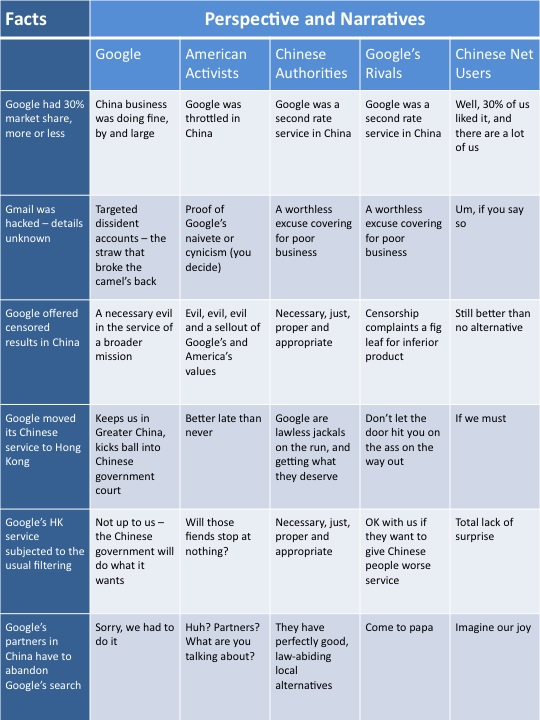
What I did do, however, was to put together a handy chart that shows the key known facts, and, based upon all the articles I’ve read, how each of the major interest groups that I observe is spinning or reacting to each of those facts. In each case, the vertical thread through the series of facts creates the skeleton of a narrative. And that’s what each of these parties –Google, its rivals, the Chinese government, the Western activist community– is trying to do: They’re each trying to control and define the narrative of Google’s situation in China to serve their own agendas. They are, in other words spinning. Here is what the result looks like:
I realize this is a vast oversimplification and there are no doubt various interests omitted, but this captures most of the main parties and facts. What’s not included here is any kind of conclusion of each narrative. In my opinion, the story is still unfolding and its too early for that. But we’ll see how things go over the next few weeks.
The other thing is that these narratives aren’t in equal competition. To use a possibly inappropriate military metaphor, there are different theaters of operation in which the stakeholder have varying levels of influence. So, in the US, Google and the activist (and analyst) community are the loudest voices. in China, the Chinese government has the tools to define the public narrative, and has been using them liberally, although there is some ferment in the margins (also here).
Eventually, there will be a canonical version of Google’s misadventures in China. or at least one canonical version in the West and one in China. These may not be the creation of a single group. One group might control interpretation of one element of the story, and one group control another. But for the moment, the fun is in watching the battle to own the story. Enjoy it while it lasts.
Finally, from a PR perspective, there is possibly one overarching lesson that can be drawn from this whole situation. I can’t take credit for this insight, it comes from Craig Adams, a colleague of mine. But it’s deceptively straightforward and I agree with it wholeheartedly. He said that if you have to sell out your basic principles to do business in China, that’s a pretty good sign you should reconsider your plans.
Other sources (just to prove I’ve done my homework):
Imagethief stumbled blearily to his computer this morning expecting a relaxed scan of the news but found the Chinese Twittersphere ablaze with the news of Google’s bombshell blog post, which went up in the middle of the night early this morning our time. Titled “A new approach to China”, the post, by Google’s Senior Vice President for Corporate Development and Chief Legal Officer, David Drummond, was essentially a public threat to withdraw from China. As such, it was as direct a challenge to the Chinese authorities as I have ever seen in a piece of public corporate communication.
The first half of the post discusses alleged hacking attempts on Google, apparently with the aims of both recovering Google source code and accessing the Gmail accounts of dissidents. But the second half of the post is more interesting. The money grafs below (emphasis mine):
We launched Google.cn in January 2006 in the belief that the benefits of increased access to information for people in China and a more open Internet outweighed our discomfort in agreeing to censor some results. At the time we made clear that “we will carefully monitor conditions in China, including new laws and other restrictions on our services. If we determine that we are unable to achieve the objectives outlined we will not hesitate to reconsider our approach to China.”
These attacks and the surveillance they have uncovered–combined with the attempts over the past year to further limit free speech on the web–have led us to conclude that we should review the feasibility of our business operations in China. We have decided we are no longer willing to continue censoring our results on Google.cn, and so over the next few weeks we will be discussing with the Chinese government the basis on which we could operate an unfiltered search engine within the law, if at all. We recognize that this may well mean having to shut down Google.cn, and potentially our offices in China.
No doubt a great deal has transpired behind the scenes in the lead up to this announcement. To save time, here’s what I don’t know:
Whether this is linked to rumors of Google’s possible withdrawal from China and staff exodus that circulated several weeks ago.
The relative weights of the hacking issue, censorship issue and Google’s business struggles in China in leading the company to make this statement.
What, if any, discussions Google had with Chinese authorities prior to making this statement (they speak of discussions “over the next few weeks”), or whether there are actually continuing negotiations.
Whether recent blocks of Google Docs and Google Groups in China contributed to this decision.
Whether Google would have done this if their business in China was stronger. China contributes a minuscule portion of Google’s revenue.
What will actually happen to Google’s business in China in the long run.
Here is what I do know:
Google has taken the China corporate communications playbook, wrapped it in oily rags, doused it in gasoline and dropped a lit match on it. In China, foreign companies tend to be deferential to the authorities to the point of obsequiousness, in a way that you would almost certainly never encounter in the United States or Europe. Scan any foreign company’s China press releases and count the number of times you see the phrase, “commitment to China”. Demonstrating “alignment with the Chinese government’s agenda” is an accepted tenet of corporate positioning and corporate social responsibility work in China. This is testament to the degree of direct power that the Chinese authorities wield over the fortunes of foreign businesses in China. Even when foreign companies are in dispute with the Chinese government they tend to offer criticism obliquely as long as they have a business stake or operations in the country. Note, for example, the scrupulous diplomacy of Rio Tinto’s communications concerning the detention of its employees last summer, a far more serious situation than anything Google has encountered (although also with far more money at stake).
In this situation Google has undertaken a bet-the-farm confrontational communications approach in China. They will not have made this decision lightly. Dressed up in the polite language above is what is essentially an ultimatum: Allow us to present uncensored search results to our Chinese users or we’ll walk. The Chinese government is not likely to cave to an ultimatum from a foreign company, no matter how decorously delivered. As Richard Waters of the FThas pointed out, the language does leave some wiggle room for further negotiation. However, Imagethief cannot imagine a circumstance in which the Chinese government will give Google free reign, especially in the current, highly restrictive climate for Internet services. Barring some surprising developments, the clock would therefore appear to be ticking for Google.cn, if not Google’s overall operations in China. It will be very interesting to see how this plays out.
Would Google continue with an office in China if there was no Google.cn site? They could still conduct R&D here, for instance. But Google’s R&D operations in China have been troubled (remember the Sogou IME scandal?) and if the security issues are taken at face value continuing operations here in the absence of a local business to support might simply be extra risk. Consider how many China R&D operations are “PR&D”, designed to demonstrate that essential “commitment to China” in support of a revenue-generating business in China. It’s not that real R&D doesn’t happen here, but how many companies do high-level, primary R&D in China in the absence of an on-shore business and supporting government relations program? And could Google attract talent to a pariah operation? Distraught Chinese netizens are already laying flowers at Google’s China headquarters.
The Wall Street Journal’s story (sub) on the unfolding situation makes some interesting points (emphasis again mine):
The common assumption, however, is that no matter how onerous the limitations and challenges faced by foreign companies in China, the market is too big and important to walk away from.
That calculation has forced a number of foreign firms to accept conditions in China that they might not tolerate elsewhere. The country has 338 million Internet users as of June, more than any other country.
Google would be the most high-profile Western company in recent years to draw a line under the kind of compromises it is prepared to make and walk away from China.
It would be an extremely rare case of a foreign company taking a stand on human rights, and placing that issue over commercial considerations. A number of foreign companies exited China after the Chinese army crushed student protesters around Tiananmen Square in 1989. But they mostly came back in the following years.
A Google withdrawal would also be an implicit rejection of the argument made by many technology companies that their presence in China overall helps expand access to information for Chinese citizens, despite censorship.
That’s the very last line in the story, but I found it one of the most interesting. If you followed the original justifications offered by many American Internet companies for launching businesses in China, or the congressional hearings on the matter in 2006, you will recall that the argument that even a censored presence in China improved access to information for Chinese Internet users was central. If Google repudiates that argument it will put pressure on other American Internet firms currently toeing the regulatory line in China, especially Microsoft, and weaken one of their core public arguments for a continued presence in China. Then again, it may also represent an opportunity for them. After all, “Google” doesn’t phoneticize well in Chinese, as the flap over the “谷歌” branddemonstrated. But “Bing” works quite nicely indeed.
This only the latest chapter –albeit potentially a critical one– in the very interesting story of Google in China. Someone needs to write the book. Anyone want to step forward for that?
CNBC interview with David Drummond (Video – also embedded below): “We’re not saying one way or the other whether the attacks were state sponsored…” Note also the silly use of the word, “cyberterrorists” by the interviewer.
Brief, relatively straightforward report from the People’s Daily online (Chinese).
Chinese telecoms analyst Xiang Ligang calls it “psychological warfare”, doesn’t think Google will pull the trigger, and doesn’t think it will be a cataclysm if they do (if I read it correctly – Chinese).
“In a world in which we are so used to public relations massaging of messages, this stands out as a direct declaration. It’s amazing,” said Jonathan Zittrain, professor of Internet law at Harvard Law School and co-director of Harvard’s Berkman Center for Internet & Society.
The fallout will be interesting. I can’t recall a single case of a major international company with operations in China taking a stand like this. As someone who agreed with Google’s reasoning when it entered China, I also support this move. If it cannot operate here in accordance with its global standards, it should leave. I have given up on getting my own website unblocked by the government and am resigned to the fact that it’s only accessible to people who are outside China or know the technical tricks to get over the Great Firewall.
I’d rather be outside the wall and free than inside it with the icy hand of the censor around my throat.
Full disclosure: Imagethief is a supporter of foreign Internet services operating in China. Elaboration in this comment, below, in response to a point from a reader.
Xinhua English report on the statement: “‘It is still hard to say whether Google will quit China or not. Nobody knows,’ the official said.”
Gady Epstein’s column on Forbes.com: “Dreams of Internet openness in China appear to be a fantasy.” Indeed.
Evgeny Morozov punctures the feelgood balloon at Foreign Policy: “If…you believe that [Google] did the right thing in China by offering their limited service (rather than no service at all), I don’t see how this move could make you feel good…”
Like on the top-forty radio show Imagethief used to listen to as a thirteen-year old, the hits keep coming in the Sanlu milk powder crisis. Over the past thirty-six hours the situation has evolved from a company-specific Sanlu crisis to a nationwide dairy-industry crisis reminiscent of the glory days of last summer’s product quality crisis.
Here is the latest: Products from 175 dairy companies have been tested (中). Twenty-two of them tested positive. Sanlu is still the champ in terms of micrograms per kilo of product, but some other famous (and not-so-famous) brands are now implicated, including Mengniu and Yili. I bet Yang Liwei didn’t know about this when he decided to endorse Mengniu. But astronauts should be able to digest melamine, which anyway seems like kind of a futuristic substance. Imagethief used to have melamine coasters. No joke. Very “Jetsons”.
Also not a joke is that over 6000 children are now reported to have been affected and three are dead. The Internet is seething. Collars at the State Food and Drug Administration haven’t felt this tight since Zheng Xiaoyu was frogmarched away and shot for corruptionjust over a year ago.
So here are the PR implications:
Winner: Sanlu (sort of)
For Sanlu this is actually good news. All of a sudden what looked like their problem is a nationwide problem in which they are just one of many companies caught in the riptide. In PR we teach an interview technique called broadening. When confronted by an interviewer with a problem or challenge that cannot be refuted you respond by “broadening” the issue to include the rest of the industry, your rivals or whomever. It works like this:
Maria Bartiromo: Your stock price is down by 50% this month? Does your company suck?
You: Well, Maria, market conditions are tough and many companies in our industry have had similar declines but we are key message, key message, key message, yadda yadda yadda.
Sanlu doesn’t need to broaden the issue. It has broadened itself. This doesn’t make Sanlu’s problem go away. They’re still the worst affected, the most apparently negligent and most closely associated with the issue. In the past day or so, the chicken of accountability (a really big chicken in this case) has come home to roost and heads have justly started rolling. But misery loves company, especially in PR, and now the spotlight of attention has spread out a bit. It buys Sanlu some small breathing space at the trade-off of kindling a hotter but more diffuse groundswell of national anger.
Losers: Everyone else
While this broadening might be good news for Sanlu, it’s bad news for everyone else. Consumers have no idea which domestic manufacturers they can trust. Even ice cream bars (sob!) look suspect. Foreign manufacturers such as Nestle may benefit for a while, assuming resentment doesn’t turn on them later, which is possible. Also, Fonterra is now recalling its own Anmum branded milk in China. On top of its involvement in Sanlu, this may be wearing the foreign gloss a touch thin.
The Chinese dairy industry looks like a hopeless swamp incapable of quality control. Production and upstream wholesaling are completely fragmented and obviously subject to only the most featherlight of regulatory scrutiny or inspection regimes. The job of applying quality control nominally lies with the brands that sit between green fields and cow dung and supermarkets aisles and consumers, but they appear to have dropped the ball completely. Honestly: Twenty-two companies and 66 products? You’d sooner trust the Three Stooges with your dairy factory than this bunch of clowns.
The SFDA looks about as wired as it did in July, 2007. AQSIQ, which is separate from SFDA, is also scrambling. Regulatory involvement seems conspicuously after-the-fact in this situation. Sanlu was exempted from inspection because it was recognized to be such a fabulously well-run company. Lesson: No one should be exempted from inspection. More inspections for everyone, in fact, seems like part of the prescription for this situation.
And China in general reminds everyone else in the world of why they are just a touch suspicious of Chinese food products. There are apparently some export products involved in the current situation, although they are apparently exported primarily to the kind of no-hope client-states (think Myanmar) that are unlikely to make too many waves lest they have to start paving their own roads. But the rest of the world is watching.
As, incidentally, are the (ahem) China-based expatriate parents of small children. I am happier than ever that Imagethief Jr. is breast-fed. Mrs. Imagethief may be made of stern stuff, but it’s almost certainly not melamine.
Now what?
Aside from the fact that Imagethief will sadly never look at an Yili ice cream bar the same way again, what happens now?
Unfortunately, the whole situation has got much trickier. For individual companies PR issues can be managed because it is relatively easy to speak with a single voice. Situations that involve entire industries are trickier, because getting a bunch of competing companies to speak with a single voice about anything is like herding giant cats with tens of thousands of employees each. Cats that often want to blame each other. Try doing PR for an industry association someday and you’ll get a taste of this.
The cat-wrangling hat now passes to the Chinese government, which has just inherited the stage from Sanlu. The Chinese government needs to explain why there is a pervasive problem in the dairy industry and what it is doing to solve the situation. (It would be nice to talk about a plan for structural changes in the industry.) It needs to make sure that the dairy brands themselves are singing the same song with one voice arranged to church-choir perfection. It also needs to keep on letting consumers know which products are safe and which aren’t and ensure that people have enough real and timely information that gossip and suspicion don’t become the main drivers of the public response. It needs to vigorously punish offenders who have been sloppy and do its best to convince people that the companies, regulators and local governments are all entwined in one sloppy, corrupt ball. I know that executions will look tempting, but executions alone probably won’t solve the problem of restoring consumer confidence, so let’s think more creatively than that.
Importantly, if there are more melamine skeletons in the closet it is best that they come out soon rather than creep out over the coming weeks and months. The situation has already deteriorated. The sooner it moves into recovery phase the better. More bad news dribbling out over weeks and months will delay the start of the recovery and stoke the fires of suspicion and anger. This is one reason why it’s important to make sure people have enough real information to forestall the worst of the gossip and conspiracy theorizing. For that reason, AQSIQ’s public round of testing was a good thing, even if the news was bad.
But the whole process will be difficult. In yesterday’s post I mentioned all the entrenched and institutional problems that retard the development of public communication in China. Many of them also serve to slow the development of effective commercial enforcement. In a sense the larger challenge for China is not just to prove that it can clean up the dairy industry, but to prove that its commercial environment can evolve into something other than a cozy swamp where insiders get rich and outsiders get kidney stones.
But that’s been the challenge for a long time now.
Suppressing the news is not a PR solution Hop on over to ChinaSmack and read the new post “Kidney Stone Gate: Baidu denies censoring search results“, which cites a 21st Century Business Herald report on Baidu’s possible involvement in suppressing negative search results for Sanlu:
Soon after the Sanlu poisonous milk powder news came out, a copy of letter from the Teller public relations firm to the Sanlu Group began spreading on the internet. In the letter, Teller advised Sanlu to pay Baidu 3 million RMB to have Baidu manage search results containing negative news about Sanlu (supposedly not all news could be censored but most results coming from smaller websites could be deleted). When Baidu heard the rumors, they quickly denied working with Sanlu. A representative from Teller also said the letter was fake.
Sanlu Group logo: Sanlu is suspected of paying Baidu 3 million RMB to censor negative search results.On September 13th, “21st Century Economic Report” reported that Baidu admitted receiving a “Sanlu Public Relations Crisis Proposal” letter from a public relations firm, but Baidu could not confirm that it was the Teller firm.
There’s more in the post, including a partial translation of the 21st Century Business Herald article. Some evidence is presented in the story to support the allegation that Baidu was complicit, although Baidu denies it. The jury is still out.
However, the basic PR rule is this: Supressing bad news is almost never a viable PR solution. Bad news tends to leak. It tends to percolate through the pores. It tends to squirt around to wherever your grip is weakest, like the air inside a balloon animal. This is particularly true in the era of the Internet, regardless of what Baidu (or even the government) does.
Only an irresponsible PR agency proposes suppressing bad news as the core of a PR strategy. That’s not rebuilding or defending a reputation. That’s admitting you can’t help. But suppressing news is an old tradition here, handed down from the highest levels. It will be a long time before that kind of recommendation stops coming.
Baidu’s statement (中), also partially translated, includes the following:
Baidu’s most important value is to seek truth from facts. (百度价值观中最重要的一条就是实事求是)
One would hope so. But I recall that somebody else in Chinese history used to talk emptily about seeking truth from facts.
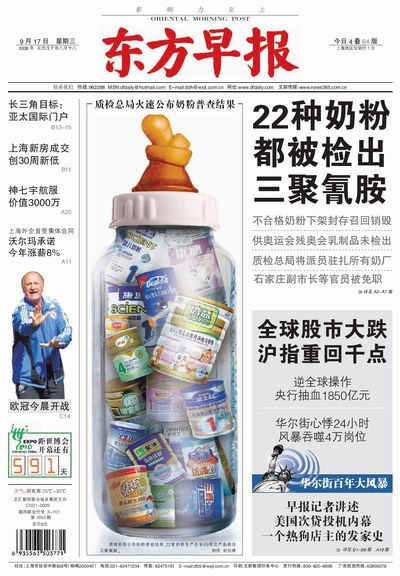
If you want to get people mad –I mean fired-up, torch-and-pitchfork enraged– screw with their pets or their babies. That’s what we’ve learned over the past year thanks to the unfortunate tendency of the plastic melamine to pop up in the strangest places, most recently in infant formula from Sanlu, a mighty Chinese dairy firm.
You would think that after last year’s long-running product quality fiasco people would have learned. Those of you who have brushed the last of the Olympic rings from your eyes will recall that the product quality crisis began with American pet food tainted with melamine thanks to contaminated ingredients from China. It then rippled into lead-tainted toys (repeatedly), antibiotic-laden fish and various other hysterias that collectively managed to knock Dream for Darfur (remember them?) off the front pages. Man, what a summer that was, especially for PR nerds. I get all misty just thinking back on it.
But there will be time for nostalgia later. I want to spend a moment on the word “crisis”, which I used in both the headline and the paragraph above. Like the phrase “mission critical”, beloved of jargon-head business types, “crisis” is a word that is often misused to describe any situation where a company is wrestling with a spot of PR trouble. Chinese nationalist youth are insulting our company on the Internet! We’ve got a crisis! No you don’t. You have an “issue.”
What’s the difference? An easy if somewhat oversimplified way to think of this is chronic and debilitating vs. acute and life threatening. Being morbidly obese with high blood-pressure and diabetes is an issue. But your doctor can prescribe a program that will over time mitigate it. Going into cardiac arrest is a crisis in which the options are immediate treatment or death. In corporate terms this means a situation so bad it threatens the reputation of the company in a way that could rapidly and substantially damage business or shareholder value. Crisis is life-and-limb, billions-of-dollars or fate-of-the-company territory. Cyanide in Tylenol, the Exxon Valdez, Singapore Airlines flight 006; those are crises. Lehman Brothers is was having a crisis (it is now over in the same way that the cardiac-arrest crisis will be over if you don’t get immediate treatment).
Apply the “life-and-limb” test and I think we can agree that Sanlu is having a crisis. Fonterra, their foreign part-owner to the tune of a significant 43%, is having an issue, although it could get worse. More on that below.
Here is the story so far. On September 11th, almost a week ago, initial reports emerged that an unusual outbreak of kidney stones in about sixty infants had been linked to tainted milk power. Naturally the first assumption was counterfeit product, as happened in the tragic Anhui milk powder episode of 2004 and in countless food scandals in China. Since then the story has spread, blob like, in a fashion that reeks heavily of a coverup unravelling. There are now over 1000 affected babies and two fatalities. Genuine Sanlu product has been revealed to be the culprit. There’ll be no palming it off on counterfeiters. A recall of over 8000 tons of product is under way. Sanlu apologized in a news conference yesterday. Heads are rolling, but only at a suitably low and distant level in the great chain of scamming and incompetence.
Deliciously (unless you’re a formula-fed baby), Sanlu and provincial authorities from Hebei, where Sanlu is based, allegedly knew about the problem possibly as far back as early this year, and at the very least in early August, well before the Olympics. We know this because Fonterra execs are now telling anyone who will listen that they told Sanlu and the Hebei authorities that there was a problem but got no action until they got the New Zealand government to tell the Chinese central government. So everyone involved knew the formula was dodgy except for parents merrily feeding it to their babies. The irony of this situation is that foreign involvement is often seen as an indicator of quality thanks to the well documented quality problems of domestic brands.
The New York Timeshas this quote from Gao Qiang, Vice-Minister of Health, which is solid gold by the leadenly unquotable standards of Chinese officials:
“This is a severe food safety accident.”
You think?
Now the conspiracy theories are boiling to the surface like worms after summer rain (we’ve had a lot of rain in Beijing recently, so this image is fresh in my head).
Some think leading Chinese search engine Baidu may have had an agreement with Sanlu to filter negative search results. I don’t really buy this one, but as a student of the Internet I find the supposition interesting. It says a lot about how people feel about the power of search engines as gateways for information. If it was true it would be really interesting. Note to search engines: The time to come clean about how you will and won’t help advertisers is now.
Others wonder if the story was suppressed because of the Olympics, and invoke the Central Propaganda Bureau’s alleged 21-point reporting guidance for the Olympic period. I find this one pretty credible, and it stokes my belief that in addition to bringing out some of the best about China the games also brought out some of the worst. The post linked to above, from China Digital Times, also has a translation of apparent Propaganda Bureau guidance on how to report the current situation, suggesting that the cogs of harmonization are already grinding through comment on this situation even if they’ve not yet clamped down on it completely.
And then there are claims that Sanlu not only knew about the issue but has also beenpaying off afflicted consumers to buy their silence. This one is also pretty credible, and goes along with established Chinese practice of privately arranged compensation for the families of people injured in industrial accidents and such, often in return for an agreement not to make waves. Coal mines are past masters of this tactic.
Uncoverup The PR rules for situations involving the endangerment of human life are simple: The company’s priority is to take all steps possible to mitigate danger, and communication should be centered around ensuring that the public is completely and rapidly informed in a way that minimizes the risk of injury or death. If you concede that the contaminated product is fait accompli and that some damage control will be necessary, then such an approach, funnily enough, often pays the best dividends in terms of repairing a damaged reputation. This is because it demonstrates clearly that the company prioritizes customers and human welfare over a grimy buck. In troubled times this a critical message to send, and it helps to remind customers of why they placed their trust in the company in the first place. See the Tylenol-cyanide crisis for the textbook example.
On this count, everybody involved in the current situation fails. They’ve prevaricated their way into disrepute. There were some shockingly basic steps ignored along the way. As of Sunday, for instance, when the formula recall was in full swing, there was nothing on Sanlu’s website to suggest anything odd was going on. No announcement. No recall information. No advisory to customers. Not hotline. No news since August 14th. Zilch. As of yesterday and into today their website has been unreachable.
This is not a surprise. It is perhaps unfair to judge Sanlu by my imperialist western standards of public communication given that the company is the product of an environment in which the relevant authorities have not always led by example. Sweeping scandal under the rug is a favorite institutional pastime here. Read up on SARS if you need a refresher on this, or the Songhua river benzene crisis, or the Xifeng county journalist scandal, and so on. But SARS was blown wide open, and if this was a cover-up it is now blown wide open too.
While acting vigorously in the interests of the public helps to repair reputational damage from a tainted or defective product and rebuild trust, covering it up compounds the problem. Remember when you broke the dining room window and then lied to your mom and said it was the dog? And she didn’t mind the window so much but was gravely disappointed about the lie? And you didn’t even have a dog? You learned an important lesson then (I hope). This is the same thing, only bigger and with the public instead of your mother. And no imaginary dog.
A blown cover-up demonstrates convincingly to the public that you don’t give a crap about them and that you were willing to let them (and their babies) twist in the wind to save your own hide. Now you have two problems instead of one: Your product is poisonous and your company is run by untrustworthy bastards as far as the public is concerned. The natural conclusion is that you now have at least twice as much work to do to repair your reputation, although Imagethief thinks that the repair work actually goes up as the square of the number of self-inflicted wounds, if not the cube (modern media being three-dimensional).
In addition to simply being ethical, coming clean is a good approach because it shortens the time-frame for bad news. Scandals often don’t bust all at once, but drag out over days or sometimes weeks as bad news bubbles to surface in bits and pieces. This can feel a like a very long time when you’re on the pointy end of bad press and public scorn, and can leave a very deep impression on the public. As noted above, the CEO of Sanlu has apologized, but once the story has gone this far it looks like an apology under duress. That simply doesn’t have the power of pre-emptive contrition. (Lawyers take note: I am not suggesting pre-emptively admitting liability.)
While it’s hard by definition to know how many cover-ups succeed, Imagethief expects that most are busted, especially when there is a large public impact. The old mob aphorism holds that two people can keep a secret if one of them is dead. If a lot of people know about your crisis, better for you that you resist the coverup temptation. Own-up and be seen to get cracking on solving the problem and helping the victims. Or hope that your crisis is so thermonuclear that it wipes out all witnesses and all evidence.
But exhorting transparency is almost certainly pissing into the wind. The problem here isn’t just one of the occasional irresponsible company. And it’s not a problem that one or two or a dozen PR agencies or crazy PR bloggers are going to solve. It’s a problem of endemic business and regulatory culture. There are several factors at work. First, the Chinese government doesn’t have a history of encouraging transparency. Second, the relationship between media and business is often too cozy for the good of anyone but media and business (this is especially true at the local level, which is why the government’s restrictions on all but national news organizations reporting outside of their home areas are so damaging). Third, the government still maintains explicit control over the media and to a degree the Internet, which means that stifling coverage by fiat consistently presents itself as a path of least resistance. Fourth, the government still maintains tight links with major businesses. Sanlu’s majority owner as near as I can determine is the Hebei provincial government, who’s PR philosophy is probably pretty old-school.
The Kiwi’s aren’t off the hook either
But what of Fonterra? They’re not a Chinese company. They come from a different media, PR and regulatory tradition. How has their performance been? From the Financial Times:
The Sanlu board, which has three Fonterra directors, was told of contamination on August 2 when a trade recall began, said Andrew Ferrier, Fonterra’s chief executive,yesterday. A public recall did not start until nearly six weeks later.
“[Fonterra] have been trying for weeks to get an official recall and the local authorities in China would not do it,” Helen Clark, New Zealand’s prime minister, said on television yesterday. “At a local level . . . I think the first inclination was to try and put a towel over it and deal with it without an official recall.”
***
Sanlu could not be reached for comment yesterday, but Mr Ferrier defended Fonterra’s role, saying “as a minority shareholder [the company] had to continue to push Sanlu. Sanlu had to work with their own government to follow the procedures that they were given.”
Not so good, I’d say.
Here’s the million-RMB question: Did Fonterra have a responsibility to go public in China based on what they knew? To someone not directly involved (such as me) it looks an awful lot like Fonterra sat on its hands despite knowing that customers were at risk, possibly to protect its business and relationships in China. Minority shareholder they may be, but 43% is a big minority and they have three board seats. Their reputation is hostage to the behavior of their partners and right now they look complicit in a sketchy situation.
I am sure it was hard decision considering the prickliness of Chinese authorities and regulators and the likely fallout of ratting on their Chinese partners (see Danone vs. Wahaha for an example of what can happen when sino-foreign business relationships disintegrate). But I wonder how their noisy stakeholders back home in New Zealand, who won’t care so much about the idiosyncrasies of the China market, will react. Several nasty questions present themselves. How bad would the problem have to be before Fonterra blew the whistle? Do they prioritize their China business over the safety of customers? Is China an appropriate market for them to be in under the circumstances? At times like this you’re happy to be a privately held cooperative.
Fonterra has no official statement on the situation that I can find as yet, although I’ve seen references to press releases. Private or not, I think they have some explaining to do.
Lessons from the great milk-powder fiasco of ’08
It has been heartening to see both the Chinese press and the Internet go to town on Sanlu, especially since they’re not my client. While I don’t envy them their PR miseries, the willingness of the Chinese press to take on big Chinese companies that do wrong by their customers is an important development for civil society. While the coverage will follow the Central Propaganda Department guidelines referred to above, the whack of big, negative headlines may still have a salutory effect on other companies. That’s as it should be. People trust brands. The tradeoff is that brands are accountable and the media is an important part of the mechanism for making them so.
It’s also interesting to see that even Chinese companies can have quality problems with their suppliers. At the height of the product quality crisis much was written about the importance for foreign companies of vetting and monitoring suppliers rigorously and continuously. It is reassuring in some small way to see that it’s not just foreign dupes who have trouble managing these problems. Local dupes can have them too. It is, on the other hand, a reminder of how much room for development there is in the Chinese commercial environment.
Finally, as bad as this situation is, it shows that there is an opportunity. Chinese companies do understand the value of a powerful brand and a good reputation. That’s a good first step, but more is needed. Many clearly also learn the value of communicating transparently and aggressively in crisis situations in order to defend the brand and reputation. Nobody wants a crisis, but the lessons learned this way can help prepare the best managed and most progressive of China’s big consumer goods companies to succeed internationally, where the old cozy approach won’t work as well.
An ancient and time-worn chestnut of China journalism is that the word for “crisis”–危机, or weiji–contains the characters for “danger” and “opportunity”, which is sorta-true-but-not-really. As a piece of popular wisdom, it has the unfortunate consequence of trivializing the concept of a crisis. Sure, “crisis” in the classic sense means an inflection point from which multiple outcomes, including perhaps opportunity, may arise. But in the colloquial PR sense it means a grave situation with unpleasant and possibly catastrophic consequences. Thus, Imagethief has always felt that it would be much more accurate if the Chinese word for crisis combined the characters for “shit” and “fan”. I’m sure that right about now executives from both Sanlu and Fonterra would agree.
Still, I’m an optimist by nature, and I do like to look for the upside. Let’s hope some lessons are learned.
A very interesting story from Peter Ford of the Christian Science Monitor on the systemic problems in China that have made situations like this so depressingly regular.H/T China Law Blog:
Some observers see a silver lining in the scandal. “One positive result is that people will become more aware of food safety,” says Ren Fazheng, a professor at China Agriculture University in Beijing. “Government and society will pay more attention to this issue … and more inspection agencies will use more methods, so the level of inspection will improve.”
Yet public opinion, even outrage, has limited impact, as evidenced by the stunted efforts by angry parents who lost children in the Sichuan earthquake in May to demand government accountability. While officials are still investigating why so many schools in the quake area collapsed, protests have been curtailed and media coverage on the issue banned.
Still, with Sanlu closed by government decree and its future in doubt, two men charged with crimes that can carry the death penalty, and a government investigation widening, “this serves as an extremely strong cautionary tale for the whole industry,” says Professor Yang.
“Lawsuits have not worked well in China, but the costs are escalating” for companies that cheat, he argues. “Producers realize now how precious their brand name is.”
Perhaps. But as long as some companies feel their brands can be protected through means other than sound ethics and transparency I’d suggest channelling the Gipper: Trust but verify.
Disclosures:
Imagethief once worked for Fonterra’s PR firm in Singapore. Fonterra was not my client.
The founder of Imagethief’s current employer advised Tylenol during their 1982 crisis. Imagethief was 15 at the time, and was too busy watching “Get Smart” reruns and not doing his homework to be involved.