Tag: Crisis Management

  • The Life and Death of a Cool Phone

    That time we tried to make the Moto X in the U.S.A.

    I’d been working for Burson-Marsteller in China for nearly six years when I got poached away by our client, Motorola. Jumping from agencies to clients can be tricky, but my boss at Burson gave me her blessings. Maybe she thought it would be good to have an alum as the client. Or maybe she was just happy to be rid of me and my obnoxious blog.

    This was 2010 and the iPhone was popular, but not yet the Greatest Consumer Product of All Time. Smartphones hadn’t changed the world, but you could feel the change coming and everyone wanted in on the action.

    I’d been smitten the first time I handled an iPhone, in 2008, and I’d bought a first-generation model shortly thereafter, on a work trip to San Diego. At the time, all iPhones were U.S. only and locked to AT&T. I had to jailbreak mine when I got it back to China so I could use it on China Mobile. This was terrifying, like performing brain surgery on your child with kitchen implements. I was sure I was going to lobotomize my new $600 superphone.1

    Amazingly, the patient lived. I promptly abandoned both my Motorola Razr V3 flip phone and my Burson-issued China Mobile Blackberry, which looked like a prop from the old Adam West “Batman” TV show. This lasted until I got a nastygram from Burson’s IT department scolding me for using an “unauthorized client.” Reluctantly, I shifted my work email back to the Bat-Berry. But I used the iPhone for everything else.

    No regrets! As small and slow as early models were, touchscreen smartphones were obviously going to revolutionize mobile computing and change our experience of the world. I’d known that the moment I saw the New York Times home page microscopically rendered on a 3 1/2 inch display, and again the first time I saw the map application tracking our location in real time while in a car. The only thing I regretted was losing the tactile snap! of slamming the Razr shut. Hanging up on someone would never be as satisfying again.

    I was in love with smartphones and when Motorola came calling, I was ready. Motorola was still a behemoth in 2010, but activist investor Carl Icahn was cleaving the company in two. Motorola Mobility, the new smartphone-focused business, had lured Sanjay Jha away from Qualcomm to be CEO. Jha was all-in on Android, and Motorola had launched the first Android smartphone in China, the lozenge-shaped XT800. I shelved my iPhone for an Android-powered handset, a goony Motorola Milestone with a slide-out keyboard. The future was wide open and the smartphone market was there for anyone to seize!

    In theory.

    Read the rest on Substack

  • The Kiss-Cam of Annihilation

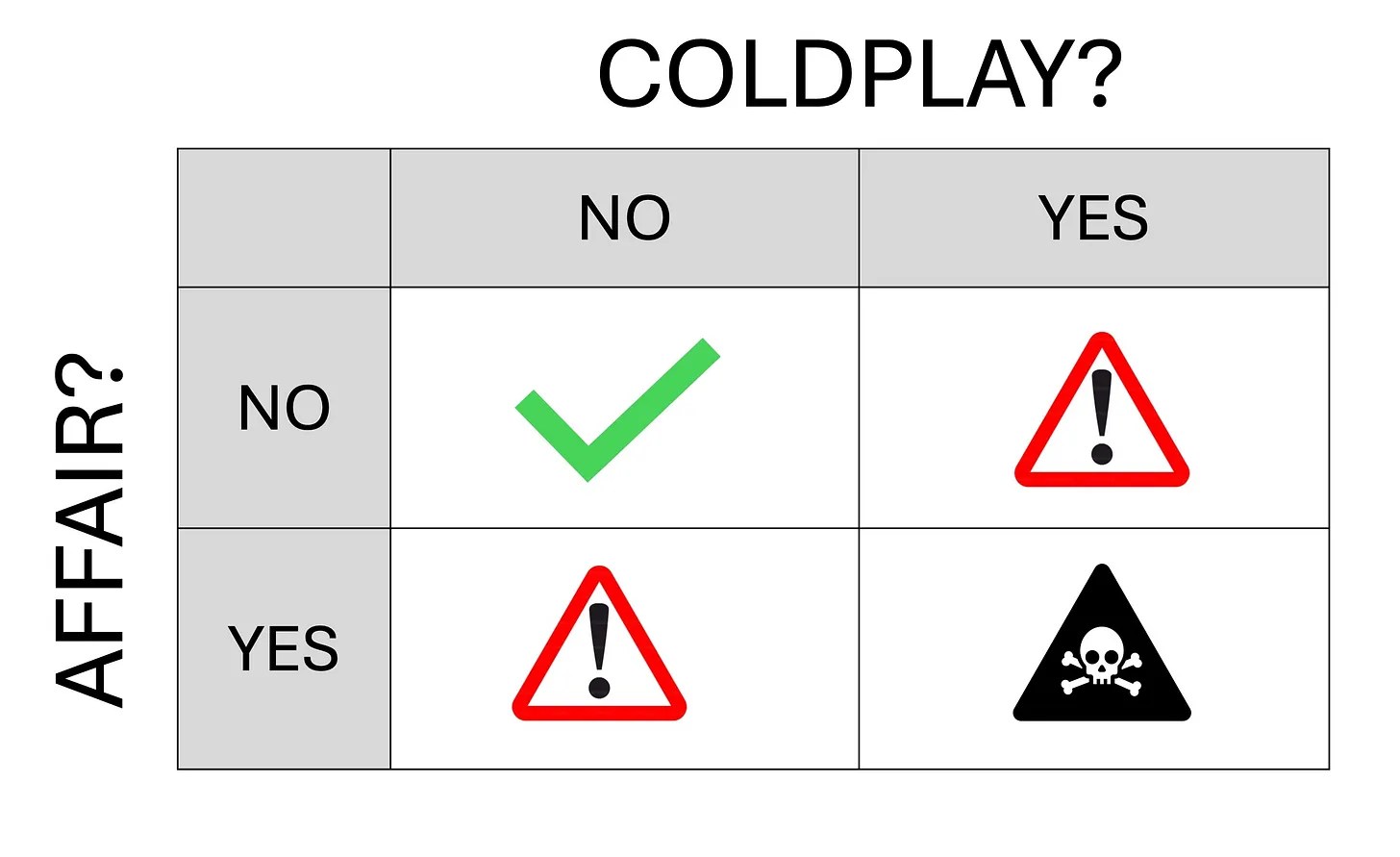
    The reputational risks of being a Coldplay fan

    Here is proof that the universe hates you:

    You go to a Coldplay show with your paramour thinking you will be safely anonymous in a darkened arena full of 50,000 people with similarly questionable music taste. Suddenly, like the eye of Sauron, the arena kiss-cam falls upon the two of you. Your canoodling mugs are now up there on the Jumbotron, illuminated and 10,000 times larger than life.

    If you’re at the concert with your date-who-is-definitely-not-your-spouse and with whom you have a professional relationship that absolutely precludes getting handsy at a Coldplay show, and the spotlight hits you, what is the move?

    Counterintuitively, the move is to kiss for the kiss cam, and maybe smile and wave. In short, do what you’re supposed to do in that situation, and, in so doing, be unremarkable so the camera moves on.

    The problem is that in this situation the human instinct to cower, hide and radiate high-energy shame particles is so lizard-brain reflexive, you’d have to be the genetic cross of Ethan Hunt and Mr. Spock to suppress it in the moment.

    Your lizard brain is telling you to subscribe to Imagethief!

    In this very real and not-theoretical situation, two people conspicuously did not suppress the instinct to cower and radiate shame particles. Instead, when the kiss-cam found them, they acted as guilty as a couple on a tryst could possibly act:

    View the video on TikTok

    It is physically impossible to act any more busted than that. The LeBron James of acting busted1 could not act more busted.

    Humans are social animals and naturally wired to recognize deep cringe. Coldplay singer Chris Martin and everyone else in the arena noticed this behavior. Within moments it was all over the Internet and the couple was promptly identified as the married CEO of software company Astronomer.io and his head of human resources who is definitively not his wife. It has since ascended into mainstream national media.2

    This is a crisis! A personal crisis. A corporate crisis. And definitely a music taste crisis. Let’s take them in order.

    Read the rest on Substack

  • Who Speaks for the Killer Shark?

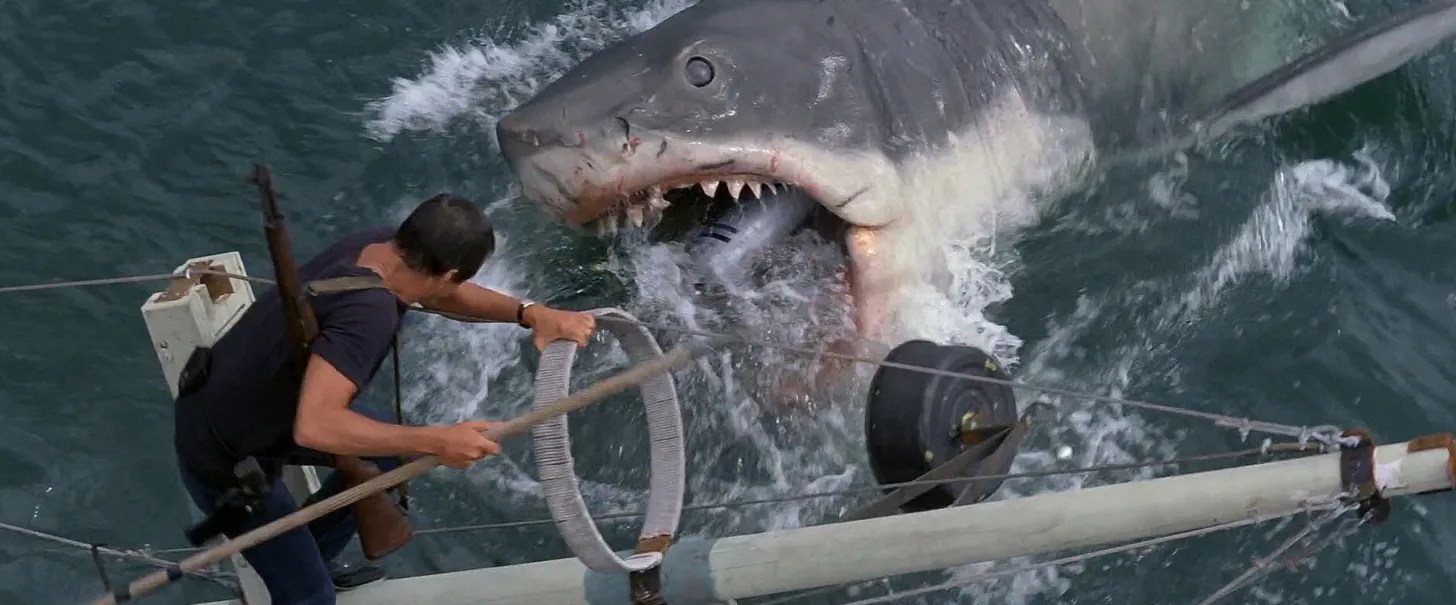
    You’re gonna need a bigger PR plan

    I saw Jaws for the first time when it premiered on network television. This was in in November 1979, just after I’d turned 12 and more than four years after the movie had been in theaters.

    In those days, if you wanted to see a movie after its theatrical run, tough shit. If you didn’t catch it in a second-run theater, you’d have to wait for one of the big-three networks to broadcast it. I didn’t know anyone who had a VCR or cable TV until I was in high school. Network premieres of hit movies were big events, hyped for months.

    I was living with my dad in the top two floors of his ramshackle four-story Victorian in San Francisco’s Castro neighborhood. He was a relaxed parent, and not hung up on the child-appropriateness of media. Earlier that year he’d taken me and my younger brother to see Ridley Scott’s Alien at the Geneva Drive-In, in Daly City. That movie fucked my head for years. I still love it.

    Jaws was ABC’s Movie of the Week, at 8:30PM on a Sunday night. I remember watching the first part in the living room with my dad. He’d recently upgraded his old black-and-white TV to a larger color set, a revelatory change.

    About halfway through the movie, my dad sent me to bed. Maybe he thought it was getting too gruesome, but it was also a school night. Fair enough.

    Old, serially remodeled Victorians have lots of eccentricities. In my dad’s house, one such eccentricity was a star-shaped cutout in one of the risers of the steep staircase up to the attic, where the bedrooms were. It was only four or five inches across, but it had oblique line-of-sight through the downstairs hallway, into the living room and to our new television. I watched the entire second half of the movie crouched on the stairs, eye glued to the star-shaped cutout.

    Read the rest on Substack

  • Decapitation!

    Doing comms when a leader is ousted. Also, travel fun!

    I just got home from a trip that took me around the world, from San Francisco to Amsterdam, from Amsterdam to Taiwan, and then back home.

    I arrived in Amsterdam at 6AM on a Monday morning with a full work day ahead. It’s always a treat to stay awake and productive after a sleepless flight and an early arrival. By the afternoon my eyeballs are vibrating like tuning forks. Finally going to sleep after one of these days is the purest bliss. It’s like rediscovering the whole idea of a bed. It’s so soft and welcoming and flat!

    This newsletter is soft and welcoming. Why not subscribe?Subscribed

    The hotel in Amsterdam was joined to the airport by a long corridor, which was convenient for everyone flying in for our event. But I stayed in a room with an inward-facing “atrium view” and for three days I saw little unfiltered daylight. This creates a space-station vibe that is bad for your body clock. Who cares what time it is when you’re unshackled from Earth’s natural rhythms like a Morlock?

    After a long-haul flight, the thing I want most is a shower to remove the film of plane-sweat and the lingering scent of disposable upholstery and economy class ravioli. The hot shower is one of the crowning creations of industrial civilization, something so pure and good it seems impossible that you could fuck it up. Unfortunately, some malignant tinkerer invented the “rain” style shower head, the kind mounted in the ceiling directly above you.

    I assume hotels install rain showers out of sadism. The shower cubicle is inevitably designed so you have to stand directly under the shower head to use the valves. These will be elaborate, like the controls of a steam locomotive, and nothing will be labeled. Just a collection of unmarked brass cranks and levers. I guess wrong 100% of the time and get blasted from above by the initial rush of cold water. What’s wrong with on/off, hot/cold? If I wanted horrifying Victorian plumbing, I’d live in London.1

    Then it was on to Taipei, a brutal 18-hour travel day. I had a three-hour layover in Munich, so I tried to talk my way into a Star Alliance lounge on the back of my outrageously expensive airline-affiliated credit card. According to my inexpert reading of the alchemical matrix on the credit card’s website, this should have worked, but the woman at the counter wasn’t having it. There is no walk of shame longer than the one after you’ve been tossed from the rope-line of a middlebrow airport lounge by a woman with a German accent. No cheese cubes for you!

    Flying from Europe to Taiwan is weird now due to the need to wind around various war zones and hot spots. The flight path looked like the pilots were slightly drunk and having trouble flying in a straight line. The world is troubled and unstable and everywhere there is strife and tension. If only there were something—some kind of Forum—where leaders from government, business and civil society could come together to discuss meaningful solutions and collaborate to make the world a better place…

    Hold that thought.

    Read the rest on Substack

    Let’s talk about your severance…

  • The Art of Keeping Your Mouth Shut

    Never go to war with a popular TV program

    Way back in the early nineties, there was a popular sitcom called “Murphy Brown” set in a TV newsroom. The plot device of the lead character’s single motherhood offended then vice president Dan Quayle1, and he gave a speech in which he criticized the character by name, almost as if she were a real person.

    Delighted by the gift they had been handed, the writers duly wrote the remarks into the next season opener and nuked the vice president from orbit. Weeks later, America elected Bill Clinton2 president.

    Look, there are lots of reasons why the Bush/Quayle ticket went down. Among them were that Bill Clinton radiated white-hot sex (too much for his own good, tbh) while George H.W. Bush radiated Yalie barbershop quartet and surplus initials. But Quayle linking the recent LA riots to a sitcom didn’t help, and it enshrined a truism of modern public relations: don’t go to war with a TV show.

    We live in a different media era. Network sitcoms aren’t the vanguard of culture they were back in the nineties (the era of Seinfeld, Friends3, etc.), and the modern equivalent of that truism might be, “don’t go to war with a meme.”

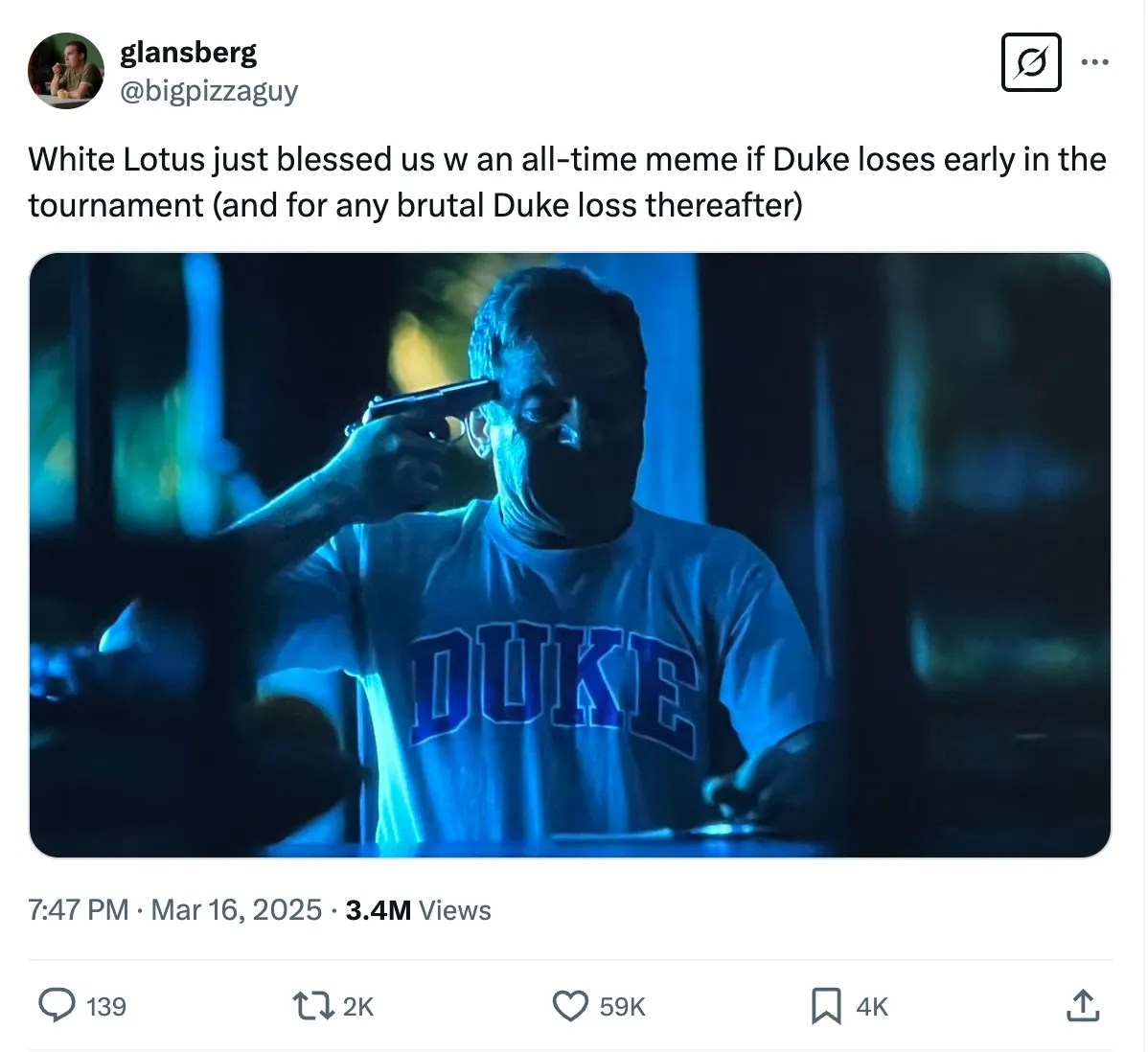
    And, whatever you do, don’t go to war with a meme based on a popular TV show!

    Anyway, here is a New York Times story with the headline, “Duke University Wants No Part of ‘The White Lotus’

    Read the rest on Substack

  • We Can Character-Assassinate You for Wholesale

    We Can Character-Assassinate You for Wholesale

    The long tradition of shady PR knife work in dark alleys

    A few years ago, I had the exquisite experience of having my emails read back to me by lawyers. 

    There had been a snafu involving disclosure of financial information at my then employer. In handling the communications aftermath, I had emailed with several people involved. The lawyers were doing due-diligence so they could be prepared for any legal consequences, and a number of us had these meetings. I wasn’t in trouble. I wasn’t being deposed. I hadn’t written anything wrong or embarrassing. But it was still uncomfortable. 

    What did you mean in this part?

    Was this line a joke?

    To whom were you referring here?

    This was a valuable experience. When we train people in communication, we stress that you should write every email, chat and text message imagining it being read back to you at a deposition. All these communications are subject to legal discovery and “attorney-client privilege” in the header isn’t a magic incantation, though people sometimes treat it as one. An internal investigation is a reminder that the lawyers you have friendly chats with in the cafeteria aren’t your lawyers1 and, by the way, the company sees everything you do on your work computer, and someday it might be opposing counsel reading your emails back to you.

    Read the rest on Substack

    A picture of a bloody knife on a dark background.
  • Who Wants to Be On the Death Panel?

    PR thoughts on the murder of an insurance man

    Two weeks ago, Brian Thompson, CEO of big health insurer United Healthcare, was gunned down in New York. This created an epic amount of Discourse on social media, aggravated by the mysterious nature of the killer and his temporary escape. This week, a suspect named Luigi Mangione was arrested. He turned out to be a bit of a snack, which is causing weird undulations in the fabric of the media continuum.

    The trajectory of the social discourse was amazing. Immediately after the news broke, there was a wave of gleeful social media posts. That was followed by a second wave scolding those making jokes and celebrating Mr. Thompson’s death. Completing the ouroboros, there was then a wave scolding the scolds for not acknowledging the depth of popular hatred of big health insurers.

    If a prominent executive in your industry is gunned down on a sidewalk and the public response is party-poppers and dancing in the streets, you should ask yourself some hard questions!

    Read the rest on Substack

    Just off to see the insurance man, Evey.
  • Always Check the Link!

    Everything on the Internet is bad or porn until proven otherwise.

    Oops! CNN.com:

    Toy manufacturer Mattel has apologized after mistakenly printing the web address of a pornographic site on the packaging of its newly launched “Wicked” dolls.

    Instead of pointing readers to the official website of the movie adaptation of the Tony Award-winning musical, information found on boxes of the special edition dolls leads to a page that requires users to be 18 years or older to enter, according to social media users on X.

    “Mattel was made aware of a misprint on the packaging of the Mattel Wicked collection dolls, primarily sold in the US, which intended to direct consumers to the official WickedMovie.com landing page,” the company said in a statement sent to CNN on Sunday.

    “We deeply regret this unfortunate error and are taking immediate action to remedy this. Parents are advised that the misprinted, incorrect website is not appropriate for children,” it said.

    People who have already purchased the dolls are advised to discard the packaging or obscure the link, Mattel added.

    “Misprint.” Sure. Like the colors were out of registration. Could happen to anyone.

    Honestly, this does not seem like a crisis. If Mattel had accidentally printed a porno URL on packaging for Barbie (25 percent of revenue in 2023), that would have been a crisis! And at that point possibly simpler for them to just go buy out the offending domain, though they’d be in a weak negotiating position. But on the “Wicked” movie tie-in dolls? I don’t anticipate a tearful CEO video apology for this, though I suspect some people in the packaging design and marketing teams got yelled at.

    And rightly so! It was careless. Site unseen, what are the chances the domain “wicked.com” is a pornography website? Close to 100 percent, right? If you were doing the packaging for “Kinky Boots” dolls, you’d damn well check the URL before printing the packaging. (There does not seem to be either toys or a dedicated website for “Kinky Boots,” so this is academic.)

    Read the rest on Substack.

  • The Great Luncheon Meat Disaster of ’24

    A food crisis hits me where it hurts

    This is one of the greatest things I have ever read in a press statement:

    First and foremost, our investigation has identified the root cause of the contamination as a specific production process that only existed at the Jarratt facility and was used only for liverwurst. With this discovery, we have decided to permanently discontinue liverwurst.

    The emphasis is in the original and it sells the paragraph. 

    This comms masterpiece is from a statement released yesterday by the food company Boar’s Head, which is dealing with a crisis regarding listeria contamination of liverwurst manufactured at a facility in Virginia.

    One general rule in crisis communications is that you should clearly explain the actions you will take to remediate the problem. “We have decided to permanently discontinue liverwurst.” That’s an action! This step was so important that it was the first of three remedial steps covered in that press release. The second was that they are permanently closing the facility and apparently laying off several hundred people. Naturally, that’s the headline the press went with. Still, if you’re going to bury the lede, bury it under liverwurst! 

    Read the rest on Substack!

  • Three months that changed everything: communicating COVID

    I wrote an article about leading coronavirus comms for Intel during the first three months of 2020, when there was little information and lots of fear. We learned a lot of hard lessons. The introduction is below, and you can read the entire article on the IPRA website.

    Will

    Three months that changed everything
    A global company, a dangerous time and five hard-won lessons in risk communication

    Imagining bad outcomes and envisioning and planning for worst-case scenarios is a requirement for my job. A mantra that I’ve repeated to my colleagues is that bad things happen to good people and one should prepare accordingly. But at the beginning of the covid-19 pandemic, I succumbed to conventional wisdom and told my team they’d be better off worrying about the seasonal flu and making sure they got their shots. Oops. A year later, they still gleefully –and deservedly– like to remind me of this failure of imagination.

    In my defense, I’d experienced three pandemic near-misses. I lived in Singapore during the SARS outbreak of 2003 and in Beijing during alarm over bird flu and swine flu. SARS was the most frightening, but it petered out at 8,000 cases and fewer than 800 known fatalities. For those of us not directly impacted, its most visible legacy was the thermal cameras that lingered in airports all over Asia for years afterward.

    SARS did leave another important legacy at Intel, one of the world’s biggest designers and manufacturers of semiconductors, with more than 110,000 employees around the world. At Intel, keeping our immense wafer fabrication and assembly/test facilities operating safely is everything. These facilities are spread across seven countries and four continents and without them there is no company. Safety culture is deeply ingrained at Intel, and the company has experienced global and site-level emergency operations teams that help to manage risk situations. After SARS, Intel created a “Pandemic Leadership Team” (PLT) that could coordinate a corporate response during disease outbreaks.

    Read the rest on the IPRA website