Deconstructing the White Rabbit wrapper

Imagethief has rather a sweet tooth. Hence my long acquaintance with the gym and the pleasures of the long run. One of China’s under-appreciated pleasures is the enamel-stripping joy of a chewy White Rabbit Milk Candy. I’m not the first to be smitten, as aquick Googling will reveal. White Rabbit even has a Wikipedia entry.

My friends are aware of my habit for the Rabbit. At a recent birthday party celebrating my 40th I received a bag containing three packages of M&Ms (which I also like), a jar of homemade peanut butter (he uses nutmeg and brown sugar – it’s really nice) and forty pieces of White Rabbit. It was a great present. I’ve been munching White Rabbit happily at work all week.

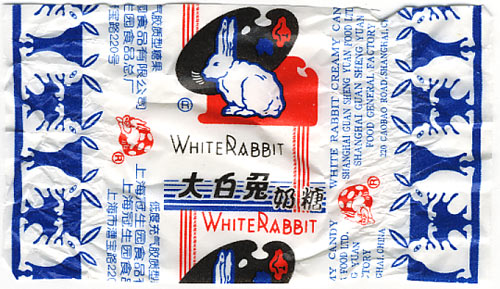
During a lull brought on by sugar-induced bliss I had a chance to study the White Rabbit wrapper (If you want to sound like Elmer Fudd say that five times fast). It’s pretty weird:

white-rabbit

First, note the crazy Art Deco font in both black and red. Then there is not one but three different kinds of rabbits on the wrapper. The central rabbit doesn’t even look like a rabbit so much as it looks like an albino lemon that has sprouted a rabbit head. For reasons known only to the creators this bizarre, lumpy rabbit is seated in front of a painter’s palette with dabs of blue and red paint. The rabbit is apparently engaged in an almighty sneeze. Or perhaps those are albino lemon rabbit whiskers. Who knows?

At the margins are rows of zombie rabbits facing each other in mirror image. They appear to be covered with grotesque lumps, like enormous, swollen zombie rabbit teats. They also have rather spooky eyes.

Finally there are two renderings of a somewhat more contemporary rabbit that is leaping in front of what looks like an enormous mushroom that is either conspicuously magic or conspicuously toxic. Company information in Chinese and English fills the rest of the space.

I think this is a masterpiece of psychedelic candy packaging design, right up there withLemonhead, Pixie Stix and Bazooka bubble gum. Looking at the wrapper now –there are three on my desk– I can taste milky sweetness and hear Jefferson Airplane thundering through my head. There is almost nothing in this design to suggest that what lies within is edible, and yet like a sugary prostitute it screams unwrap me and put me in your mouth!

There are messages within messages within messages in this candy wrapper. I want an A2 size print that I can hang right next to my enormous “Dark Side of the Moon” poster. Then I can gaze at them both while I eat White Rabbit and listen to “Dark Side” through my headphones. If that isn’t a ticket to an alternate universe I don’t know what is. Pixie Stix, perhaps.

Note: Image stolen from Speks International as I was too lazy to scan it myself. A larger image of an apparently older version is here.

Posted in Uncategorized | Tagged , , , | Comments Off on Deconstructing the White Rabbit wrapper

Why aren’t you drinking the Wang Lao Ji?

Imagethief spent a busy two days helping some representatives of a European country manage a last minute press conference. This was a sudden request that had resulted in 36 hours of breakneck work involving much frantic communication, central European languages, weird time differences and assorted ministers, agencies and secret handshakes. Ultimately all went well, but it was a weary team that schlepped its way back to the office.

Upon getting back, I headed for the pantry to get a Diet Coke. Once upon a time I used to drink a can of real Coke a day, but I also used to be 20 kilos heavier. I have a wicked sweet tooth inherited from my father, an Englishman (no further explanation should be required), and kicking soft drinks was a big part of my weight loss program. But we keep a fridge full of the stuff in the office and for the past few months I had increasingly fallen under the seductive thrall of the Diet Coke. Wicked sweet with no caloric guilt!

One-a-day Diet Cokes got to be such a habit that a couple of weeks ago I decided to give up on it for a while, lest I become a poster boy for the as-yet unknown effects of excessive aspartame consumption (are those antennae on your head, or are you just happy to see me?). But after today’s frantic activities, and the hot taxi ride back, I caved. As I was pulling a can from the fridge in the pantry our assistant finance manager flounced in, all floral sun dress and bright eyes, and said to me, “Why aren’t you drinking the Wang Lao Ji?”

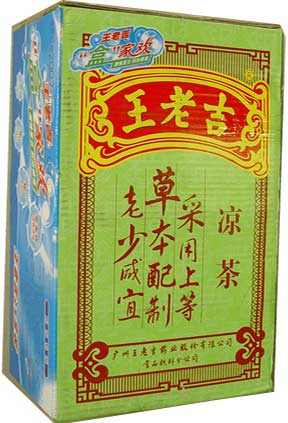
I really had no answer for that. I had noticed that little cartons of Wang Lao Ji had started appearing in the fridge a week or two before. They looked a bit incongruous next to the Coke and Fanta Orange that are the mainstays of our beverage selection. Wang Lao Ji is a Chinese soft drink based upon a herbal tea. It’s advertised on busses across the nation and  recognizable by its distinctive red and yellow logo. Like any Chinese food or drink with a tenuous connection to the world of Chinese herbology, it is ascribed mythical powers as a tonic, including the ability to forestall diseases you’ve never heard of and increase various vital essences. Most of this is marketing courtesy of the manufacturer, a large Guangdong-based beverage and pharmaceutical company. On a more practical level, the Black China Hand has cited Wang Lao Ji as a hangover cure.

Despite all this, I was stumped as to how to answer my colleague’s innocent question. She rushed to take advantage of my speechlessness. “It’s very good for…I don’t know how to say it in English…It can help you to jiang huo.”

I didn’t know what “jiang huo” was, but it didn’t sound like something I should be doing in the office. I wasn’t even sure what about my appearance suggested that I needed to jiang huo. Either way, whatever jiang huo was, it was clear that she didn’t think a Diet Coke was going to help me achieve it.

“It’s a Chinese medicine thing,” she added helpfully. “Sometimes, you know, you eat things that make your body too hot.”

Got it. It’s a cooling food. Jiang huo (降火) means “reduce heat”. In fact, I’ve had some exposure to this. My Singaporean mother-in-law is big on cooling, home-made liangcha(cold herbal tea). In sweaty Singapore that’s not hard buy into. But to the Chinese and their overseas kin, “heaty” foods and “cooling” ones aren’t just about spiciness or physical temperature. It’s a metaphysical concept that relates to proper balance, energy and health. Certain times and physical conditions demand certain kinds of foods. Too much heaty or cooling food can cause problems. Too much durian (a classic heaty food)? Guaranteed pimples. Of course it might also be that durians are loaded with oil. But anyone who has eaten durians would agree that “heaty” is not a bad classification for the sulfurous fruit. Herbal teas, along with bamboo shoots, crab meat, water chestnuts, egg whites, pears etc. are cooling. I gather it’s best to aim for a kind of lukewarm average over time. Balance is everything, right?

So I cracked open a carton of Wang Lao Ji and gave it a slurp.

The mystery cooling ingredient is sugar. Despite its olde-style patent medicine labeling and health tonic claims, Wang Lao Ji is well placed in a fridge full of soft drinks. There might the barest, most elusive hint of herbal flavor lingering somewhere behind the cloying sweetness, but you have to breathe in over the liquid like a wine connoisseur to detect it. Everything else is syrup. It’s definitely not my mother-in-law’s bitter, bracing, home-brewed liangcha. I can also report that the little cartons of Wang Lao Ji will burp sticky liquid out of the straw and all over your suit at the slightest provocation.

So it’s back to the Diet Coke for me. It might do much for my balance or help me jiang huo, but nor will it put me on the express train to diabetes.

However I can believe that Wang Lao Ji makes a good hangover cure. After all, is there anything heatier than a hangover? For that reason alone it might be worth keeping a carton or two in fridge, wedged between the sour plum juice and the hair of the dog that bit you.

wang-lao-ji

Posted in Uncategorized | Tagged , , , | Comments Off on Why aren’t you drinking the Wang Lao Ji?

Why patriotism won’t save the Chinese film industry

Imagethief was intrigued to read in an AP article a week or two ago that Han Sanping, Chairman of the government-backed China Film Group, has called for more patriotism in Chinese movies. Han minced no words, saying:

“The reality of this country’s economic reforms is that the country, the race, is prospering. This must be extolled. It can only be extolled. There can’t be anyone who makes fun of it. People who do either have ulterior motives or they’re mentally challenged,” the executive was quoted as saying.

“As a Chinese director … as a Chinese actor, this point of view must be firmly entrenched,” Han said.

He also said he wanted to see more “ethically inspiring” content produced by his group.

Imagethief is all for extolling that which needs to be extolled, although he also believes that almost anything, including the rise of China, can be made fun of. Imagethief is also easily excited when bureaucracy sticks its nose into popular culture because it is inevitably a train wreck and often precludes the need for anyone else to make fun of anything. In fact, government involvement in any aspect of popular culture, unless it is simply cutting a check, is generally bad form. This is because politicians and bureaucrats are, by and large, crappy arbiters of taste.

This is not a uniquely Chinese or even Asian problem. Any American of my generation can be driven into a cold sweat by these two words: Tipper Gore. In 1985 the then future second lady started an entire political movement in the United States based upon the conviction that Prince was perverting her daughters (ironic, considering that seven years later those same daughters would spend a great deal of time in close proximity to horndog-in-chief Bill Clinton). Today, the Parent’s Music Resource Center smolders on the ash heap of cultural history. Prince rocks on, even if his CDs do now carry a “parental advisory: explicit lyrics” sticker, itself a desperate redundancy in the era of hip hop and digital downloads. Darling Nikki might have been masturbating with a magazine, but at least she wasn’t popping a cap in yo’ ass.

Dan Quayle, a serial self-debaser, also once got into the act, publicly chastising Candice Bergen’s fictional newscaster “Murphy Brown” for setting a bad example by glamorizing single motherhood. He’d have been better off leaving the value judgments aside and pointing out that Murphy’s baby was when the show jumped the shark and began its decline. But in a moment of phoenix-like comedy resurrection, the producers actually incorporated Quayle’s comment into one of the waning show’s funniest moments. Moralizing politicians: 0. Hollywood trash merchants: 1. Yet again.

And so it goes. Politicians, civil servants and bureaucrats simply aren’t mentally equipped to do battle with the entertainment industry. Politicians forget that showbiz professionals thrive in environment that selects for ruthlessness deal-making and amoral chicanery even more than politics does. Furthermore, while some actors might be dumb, comedians and humor writers tend to be smart. Honestly, do you think there is a politician out there who stands a rhetorical chance against a successful sitcom writer? Or, barring that, against the lowest-common-denominator mass market tastes that virtually guarantee that a free media will produce 95% schlock and 5% provocative, literate art? In a free media environment schlock largely subsidizes provocative, literate art, and can probably be seen as a form of cultural tax.

But you can see why politicians can’t resist moralizing at the film industry. With near global uniformity, the movie industry is filled with pimps, sleazebuckets and coke-heads. But it turns out that pimps, sleazebuckets and coke-heads are exactly who you want green-lighting movies, assuming you want anything watchable hitting the screen. Certainly I’d pick them over bureaucrats. If you want to see what happens when bureaucrats control a film industry, look at Singapore. Quick, name a famous Singaporean movie.

I thought so.

And even seasoned, morally bankrupt Hollywood couch-casters get it wrong regularly. After all, they gave us “Herbie Rides Again”. I think I speak for most of the developed world when I say that the only movie I want to see starring L!ndsay Lohan and a car has her spending most of the time in the back seat, morality and family entertainment be damned.

But morality isn’t the only thing that bureaucrats want from movieland. Let’s come back to China. As we read above, Han believes passionately that China must be “extolled” and must not be made fun of in film. He pointed out that:

[Nationalism] was also common in U.S. movies, saying they often cast Americans as saviors.

“(In Hollywood movies) every time mankind faces disaster, Americans rescue mankind … When an evil monster that wants to destroy the world appears, who saves mankind? Americans. This is patriotism too. You can’t deny it,” Han said.

Well this really shouldn’t be too much of a surprise. But it’s not just patriotism. It’s also business. If an American movie studio with an American director makes a film for American audiences, then, yes, it’ll probably be Americans saving the world. You think if Hollywood made a film about a relentless killer asteroid being deflected by a rocket ship full of heroic Latvians that Americans would stampede out to see it? The Latvians can make that movie, if they can get the budget together. We’ll send Bruce Willis, Ben Affleck and Michael Clarke Duncan thanks very much. Americans might also sneak in some stealth-Canadians, like Brendan Fraser or Keanu Reeves, and even the occasional Englishman, but all other foreigners are likely to be  villains, exotic sex appeal or comic relief. Occasionally they might even be all three (consider the evil Liz Hurley robot from “Austin Powers II”).

And this is as it should be. Not just in America, but everywhere. Your people are the heroes. Everyone else is set dressing, villainy or jiggle. Even the North Koreans have figured that one out. It’s more apparent with Americans because America has the biggest global film export business and produces the slickest product. But make no mistake: it’s produced to satisfy the domestic audience first, with the assumption that most of the rest of movie-going world won’t mind the occasional jingoistic American flag as long as it doesn’t get in the way of the spectacle or the tits. And those countries where an American flag will have a significant effect on the box office (Iran? Pakistan? North Korea?) are probably not the biggest legal markets for Hollywood.

This isn’t a result of government direction. It’s a result of marketing, and any benefits conferred upon government are incidental and may expire without notice. It is, however, true that Americans can take cinematic patriotism to an obnoxious extent. Apropos of the asteroid example above think of Michael Bay, who is literally incapable of making a movie without American fighter planes (although he did cast stealth-Scot Ewan McGregor as his hero in “The Island”).

We’ll even inject our patriotism into other countries’ movies. The Japanese had a good thing going where Japanese people were saving Japan from a giant radioactive monster created, as it would happen, by the Americans. Hollywood couldn’t leave that alone, however, and had to replace the perfectly good Japanese nationalism in that film with 45 minutes of Raymond Burr standing around talking into a microphone. That was a raw deal for everyone involved. Even Raymond Burr. Fortunately the Japanese recovered nicely from that indignity and to this day Japanese celluloid heroes are saving the world from an assortment of radioactive monsters, giant robots and sinister alien races in pointy helmets and sunglasses. Good for them.

But lost in Han Sanping’s point of view is the little secret that America makes plenty of movies that don’t conform to the conventional idea of patriotism. For every “The Green Berets” there is an “Apocalypse Now” brooding darkly over the shape of American governance and power. There are movies that question American politics, society and history. There are movies that upend the conventional American narrative. There are movies that sympathize with our past adversaries. There are subversive movies in which the government is the villain. There are documentaries that poke and pry and sniff into every aspect of American life, policy and society. And there are countless movies that make fun of America, the American people and the American government in every conceivable way. The patriotism needs to be seen in that much broader context — as a single facet of American film making that fills one of the markets many needs. Patriotism doesn’t need to be mandated or suggested to Hollywood. It comes naturally, as does everything else.

And it would come naturally to Chinese film makers also. If Han Sanping truly loves the Chinese film industry he should therefore do everything in his power to ensure that the government sets it free, because at the moment it’s in pretty woeful shape, and dictating priorities from the top is not going to help. Chinese films (and imports shown in theaters here) can’t have sex, superstition, Chinese gangs or excessive violence. That’s basically the entire movie-making playbook off-limits before the cameras even roll. Furthermore, since there are no film ratings in China, all films must be suitable for all audiences. In a country with 1.3 billion people that sets the lowest common denominator pretty low indeed.

Once you take all the fun stuff out what do you have left? A bunch of woeful, overproduced, badly paced period films full of people standing around in gorgeous costumes looking pensive while horrible indignities are heaped upon Gong Li’s breasts without ever actually revealing them to the audience. It must chafe the mandarins of the Chinese film industry that they are investing their hopes in a genre that was perfected in its modern incarnation by a Taiwanese director who has been appropriated by Hollywood. No wonder people stay home in droves and buy pirate imports.

Diktats from above notwithstanding, the Chinese seem quite clear about the kinds of movies they want to watch. If the government wants to look into this the market research will be easy. Put a guy with a suitcase full of DVDs on the corner and have him flog them for 8 kuai a hit. Come back at the end of the day and see what’s sold. I’m thinking it will be the movies with sex, superstition, Chinese gangs and excessive violence. And maybe even some patriotism, just by accident.

Perhaps rather than trying to state-manage their way to film success the Chinese government should consider backdating their ownership of the Hong Kong film industry to 1970 and just calling it theirs. More constructively, Imagethief offers the following advice to the Chinese government, the China Film Group, and other bureaucratic culture czars on how to make the mainland Chinese film industry world class. I propose three simple steps:

  • Nationalize the pirate film rings, appropriate the distribution networks for similarly priced legal content and rub out anyone who muscles in with ruthless gangland tactics.
  • Create a rating system so not every movie needs to be suitable for eight-year-olds.
  • Build more nice theaters with decent sound and projection and price tickets under 20 kuai.
  • Shut the fuck up.

Imagethief looks forward to the rebirth of Chinese cinema.

Stand up for China!

Stand up for China!

Related:

Posted in Uncategorized | Comments Off on Why patriotism won’t save the Chinese film industry

Run

I like to run.

It wasn’t always this way. Eight or nine years ago I was a lot heavier, and regular exercise wasn’t really part of my routine. My girlfriend was significantly fitter and more energetic, and she took me on as something of a restoration project. It must have worked out, because she married me.

As part of my physical reformation I discovered the joys of running. I was living in Singapore at the time, which is hot and humid, but otherwise a lovely city for runners. It has hundreds of kilometers of quiet, tree-lined streets, big parks, clear air and even trails through the tropical forest that surrounds the reservoirs in the middle of the island.

I’ve always been a solitary runner. I like to set my own pace and direction and allow my mind to wander, and I find that’s harder to do when I run with other people. In Singapore I learned that running alone made me feel closer to the city and the pulse of local life because I paid attention to what I saw. I sometimes ran in the morning, but by far my favorite time to run was dusk, when the heat of the day started to fade and local life spilled into the streets and void-decks of the public housing blocks.

From my little house in the expatriate haven of Holland Village I ran through the old public housing areas of Tiong Bahru, Queensway and Tanglin Halt, where the food centers and wet markets would be coming to life with the dinner rush. I ran the wide expanse of Holland Road and Napier Road, past the looming American embassy and through the far more inviting botanical gardens. I ran the quiet lanes of Bishopsgate or around Coronation Road and gazed in wonder at the sprawling mansions of Asian tycoons.

And then I moved to Beijing.

In Beijing, running outdoors is not enjoyable. On the rare days when the air is not abrasive the ramshackle sidewalks, impersonal boulevards and crush of pedestrians all serve to discourage. In summer the air is at its worst. In winter the icy, desiccating wind strips the lungs and burns the skin.

So I ran on a treadmill in the gym. Running on a treadmill is the dullest recreational activity on earth. For sheer, painful tedium it ranks somewhere between hand-sorting lint and watching water evaporate. Television monitors help, but something about them dispels the seductive trance that is so vital to a satisfying run. Real scenery slipping by doesn’t have the same effect.

Nevertheless, you do what you must. Over two and a half years I turned hundreds of kilometers of treadmill belt beneath my feet, and hated every last numbing centimeter of it.

Then I moved to Shanghai.

I didn’t want to leave Beijing, and it was only grudgingly that I packed bags, cats and wife and decamped the capital for the delta. But I’ve discovered that Shanghai has its compensations. One of them is that I can once again run outdoors.

I’ve described Shanghai to friends –somewhat unfairly– as three nice neighborhoods surrounded by Wuhan. Fortunately, I live in one of those nice neighborhoods, in heart of Shanghai’s congenial French Concession. Here the streets are of a human scale, lined with shade trees, and edged with broad, roomy sidewalks. The intimacy is inviting to a runner in the way that Beijing’s sprawling avenues are not.

Even better, Shanghai’s air is drawn from an entirely different planet than the Venusian miasma that shrouds Beijing. It’s a planet where air is still transparent and cotton-ball clouds sometimes drift by on southerly breezes. In Shanghai bad air days stand in contrast to good air days. In Beijing it’s the other way round.

And so I’ve been running outdoors again, reveling in my liberation from the tyranny of the treadmill. I started timidly, staying on the familiar streets and lanes within a few blocks of home. As time has gone by, however, I’ve become bolder, and pushed farther into the depths of the city.

I still like to run at dusk when, as in Singapore, Shanghai’s local life spills out onto the streets. But in Shanghai different rules apply, and they are not quite as forgiving of the runner’s trance as Singapore was.

For one thing, the sidewalks are much more crowded, as befits a city with five times as many residents as Singapore. So are the roads and bike lanes, where bicycles, electric scooters, goods-tricycles, wheelbarrows and pedestrians all compete for space. I find myself adopting the approach of an NFL halfback: Bob, weave, break for the hole before it closes. Blind corners, alleyway gates and crosswalks are all places for extra vigilance. I also spend a lot of time weaving back and forth between sidewalks and bicycle lanes, bypassing the spots where the sidewalk is simply impassable.

That happens a lot. Shanghai’s sidewalks support not only more pedestrians than Singapore’s, but also all the myriad fragments of Chinese commerce and life that cannot be contained within walls. The sidewalks are al fresco dining areas for neighborhood restaurants, extra workshop space for local businesses, and public parks. I find myself threading around men grinding metal, noodle stalls, xiangqi games, and ranks of aunties and uncles fanning themselves in lawn-chairs. But these scenes are the life of the city, and running past them and through them reminds of why the treadmill was so tedious.

As I’ve become more comfortable I’ve been running further afield. If you want to know what it would be like to live in a society where everyone else knew you were slightly crazy, put on running gear and jog through a deeply local neighborhood in a Chinese city.

In the French Concession, which is awash in expatriates and tourists, locals have developed a certain blasé attitude toward the idiosyncrasies of foreigners. But there is plenty of Shanghai where a pale, sweaty man pounding by in a singlet with glazed eyes is still an oddity. I’ve been greeted with curious stares (not just from children who haven’t learned to suppress their gawping instinct) murmured asides and occasional outright laughter. But it has never been ill-humored.

Part of this is, of course, in my imagination. Wondering what people are thinking of me is part of the game of passing the time on a long run. That sinewy old man might have been a teenager during the privations of the post-war years. Is he bemused at the thought of someone working off  “excess calories”? Is the young woman with the chubby son pointing me out to him because he’ll be amused, or because she wants him inspired to exercise?

One route I’ve been enjoying lately goes from my home, near where the old Xiangyang Market used to be, all the way along Fuxing Road to the Huangpu River and then back. It’s a good hour of running, plus ten minutes on the footbridge at the turnaround near the river, watching boats go by. I did it yesterday.

The first part of the run is pure French Concession. The street is narrow and tree lined, the atmosphere congenial. The sidewalk is lined with restaurants and boutiques, with a wide bike lane I can run in. Traffic is moderate and slow. This is the comfortable warm-up.

The elevated Chongqing Road, about a third of the way to the river, marks a distinct change in atmosphere. The street becomes down-market, with shabby storefronts occupying the first floor of tumbledown, two-story blocks. But near Huangpi Road, in the corona of Xintiandi, luxury apartments still rise on the north side.

Slowly this stretch gives way to a more commercial district. There is the excavation for new subway stops, more stoplights, and wide cross-streets bustling with traffic. Fuxing Road widens into six lanes. The traffic that was one-way closer to home now runs both directions. There are large restaurants, office blocks, and the unmistakable chandeliers and mirrors of a large KTV center.

I’m well settled into my groove at this point, looking for things that interest me. The road is still wide and traffic fast moving. I spend most of my time hugging the curb in a wide bike lane, separated from the main road by a reassuring concrete median. I end up behind a thin workman on his bike. He is wearing an old denim jacket liberally splashed with paint. He has one cigarette tucked behind each ear. His equally paint-splashed companion slowly passes me, pulling even long enough to look me up and down, before edging in front.

Closer to the river Fuxing Road cuts through Shanghai’s ramshackle old town. Tar-paper second stories, rusting sheet-metal, bird-cages, and alleyways that wind past wet markets and apartment complexes that have missed out on Shanghai’s elevation into the glamorous face of the new China. There are more curious stares here, but it’s still congenial.

The sidewalk has become one long stretch of urban life, an extended front-yard for the residents of the old city. The throng makes the sidewalk impassible at speed and I am relegated to the bike lane. A small, white dog trots in front of me, heading for the road. As I pass I can hear a woman calling out to it anxiously. I glance over my shoulder to see the dog heading into the road. One car brakes sharply to avoid it, but I can see what is coming. I like animals too much to watch, so I look away. I hear an unmistakable hollow bang. Another look over my shoulder and I see an inert, white lump in the road. The car hasn’t stopped. I wonder if I should go back to the treadmill.

Then the character of the city changes again. The cars have all entered the tunnel under the Huangpu River and the street, though still wide, is quiet. The scruffy old town has given way to the glamorous apartment blocks and office developments that line the river. But it feels deserted. The buildings are too new to have tenants. This is the ghost of what Shanghai wants to be.

The footbridge at Zhongshan Road rises ahead. It’s my turnaround point. I run up the ramp of the bridge and stop at the top, as I always do, to watch the boat traffic on the river. Two buxom foreign women are taking each other’s photos with the river as a backdrop. A Chinese worker in a white singlet and shorts approaches me. He tells me I must have a very healthy heart. I thank him and ask if he thinks what I’m doing is strange. It’s a leading question. “Oh, yes, very strange,” he obligingly answers. “We Chinese would ride a bike.”

A little more chit chat. He gazes for a moment at the buxom tourists. “Are they Americans too?” he asks, perhaps wondering if we’re all a little funny in the head. I venture that they’re European. He purses his lips thoughtfully, and then shuffles along to the ferry terminal.

The sun is getting low and the clouds are turning orange, so I turn around and head back west towards home. I pass the place where the dog was struck. It’s gone now, borne off to whatever rituals of mourning attend small dogs in Shanghai. I’m getting tired, less concerned with observing life and more focused on making it home before it gets too dark. But I still take some time to appreciate the colors of sunset.

I cross Chongqing road again. When I cross it I am back in my own neighborhood, and on the home stretch. There are foreigners around again. Two white men come toward me on a scooter. One stretches out his hand as they pass and I slap him a vigorous high-five. I have no idea who they are, but my palm stings satisfyingly for two blocks.

My legs are weary and my feet are beginning to drag. It’s getting harder to duck and weave around the inevitable obstacles. I’m lazier about looking into blind driveways and alleys before I dart in front of them.  Fatigue is danger if you’re running in a Chinese metropolis, and it would be good to be home. Familiar cross streets that mark out the final kilometer: Sinan, Ruijin, Maoming, Shaanxi, Jiashan. I cheer myself past them until I finally arrive safely in the courtyard of my apartment complex.

An hour well spent. Every run in Shanghai is a journey.

Posted in Uncategorized | Tagged , | Comments Off on Run

Imagethief and the man-eating otter of Changbaishan

I’ve posted to YouTube a video of the trip I took to Changhbaishan last summer with Mrs. Imagethief and my father. It took me the better part of a year to get around to editing it, but here it is. Changbaishan is the rugged mountain range that divides northeast China from the Korean peninsula. There is a “nature reserve” a few hours drive outside of the town of Yanji, and that’s where we went. It’s a beatiful area, but also a major tourism waystation. As always, we had a pretty good time.


This was shot on Mrs. Imagethief’s point-and-shoot digital camera, which also has a video function. I did a few make-it-up-as-I-go standups and cut those together with other footage mostly taken by Mrs. Imagethief and some of my photographs. There was a lot of a wind noise, so I’ve subtitled a couple of spots it might otherwise be hard to make out what is being said. It’s a hair under ten minutes. Enjoy.

Posted in Uncategorized | Tagged , , , | Comments Off on Imagethief and the man-eating otter of Changbaishan

Bang! China shoots its own Olympic PR in the foot

Imagethief, who has bid for something on the order of RMB12,000 worth of Olympic tickets, is trying resolutely to remain optimistic about the Games. Unfortunately, it’s proving harder as time goes by. Tomorrow marks the one-year-remaining milestone. This should be an opportunity for Beijing to highlight progress, turn the excitement crank, and demonstrate that has the patience and forbearance that will be necessary for a successful Olympics. However yesterday brought an important test of China’s patience and forbearance, and China failed it.

The problem is that while tomorrow’s milestone date is a legitimate time for celebration and anticipation, it was inevitably also going to be a perfect date for a dry-run by the many activist groups that want to appropriate the Olympics for their own agendas or score points against China. Sure enough, that is what has happened. Reporters Sans Frontieres,Human Rights Watch, the Committee to Protect Journalists and Amnesty International all chose this week to release announcements or hold protests.

Of these, the RSF protest yesterday was most provocative. Activists wearing T-shirts and carrying signs that portrayed the Olympic rings as handcuffs staged a demonstration on a highway bridge near BOCOG’s headquarters. To add an extra measure of discomfort for Beijing, IOC Chairman Jacques Rogge happens to be in China right now.

Unfortunately, reports say that foreign correspondents covering the protest were detained by police for one or two hours afterward and “roughed up”. From the AP coverage:

[Uniformed] and plainclothes police physically restrained reporters coming down from the pedestrian bridge, pushing and pulling them, seizing IDs and refusing to allow them to leave the scene. Reporters were detained in a parking lot directly opposite the Olympics office tower, facing the Beijing 2008 logo and Olympic rings on the outside of the building.

Journalists were allowed to leave after about two hours, with no explanation from police about why they were detained.

A woman in the spokesman’s office of the Foreign Ministry said she did not know about the case and would look into it. Liu Wei from the information office of the Beijing Olympics Organizing Committee said she was not aware of the situation and had no comment.

If that isn’t playing right into RSF’s hands I honestly don’t know what is. I found the reports somewhat confusing and had to dig around to get a clear idea if the journalists detained on site were protest participants or locally credentialed reporters covering the event. But it appears to be the latter. RSF’s own release suggests much the same.

The best thing for Beijing to do under these circumstances would have been to err on the side of tolerance and allow the protest to proceed under supervision. Credit is earned slowly, painfully and in tiny increments while setbacks come in great, heaving leaps, and activists can win the PR battle by baiting the Chinese authorities into overreacting. Detaining journalists on the scene, under any circumstances, was asking for trouble.

The result is not only that the protest is probably getting more coverage than it would have otherwise, but that the tone is distinctly nastier from Beijing’s point of view. Coming on the heels of last week’s widely covered FCCC survey and at the same time as all the other reports listed above, it looks very bad and reinforces people’s fears of what might go wrong during the Games themselves.

The PR rule of thumb operating here is that response to an issue can become the issue if it is handled badly. That is a rule that Beijing needs to stay mindful of. Unfortunately, it seems likely that not all of China’s bureaucracies will be on the same page about this. It is entirely possible that BOCOG and the Public Security Bureau will have different opinions on how these kinds of situations should be handled. This might be someplace where the IOC could provide a little visible leadership, but they have stayed silent until now.

Fair or not, China will be judged differently than other countries that host the Olympic Games. Now matter how glamorous the venues, how exciting the games, or how successful China’s athletes, the Games will be judged in large part based upon how gracefully Beijing can manage the inevitable protests. That is the price China pays for hosting the Games in a political environment that disdains many of the freedoms that the Games’ primary audiences abroad take for granted. The Financial Times‘ Beijing Bureau Chief, Richard McGregor puts it nicely:

Over more than a decade Beijing has gradually defused pressure over its human rights record. Through remorseless diplomacy and skilful use of its growing economic clout, it has sidelined western complaints about human rights and marginalised the non-governmental lobbies that seek to promote them.

The Olympics, however, are offering China’s critics a moment in the sun, and they have grabbed it eagerly.

McClatchy’s Tim Johnson also captures the risk Beijing faces nicely:

Because of China’s history of quashing revolt, any protest has the potential to become an iconic image, like the moment when U.S. athletes Tommie Smith and John Carlos raised their fists in a “black power” salute at the 1968 games in Mexico City.

That’s an important thought to bear in mind. It will be interesting to look back a year and a month from now and see what the iconic image of the Games is. I sincerely hope it will be a moment of athletic triumph or a moment of Olympic splendor in one of those magnificent venues.

After all, the Olympics are a magnificent opportunity for China. An opportunity not only to showcase the country’s development and rightful place on the international stage, but also to explore a more constructive way of engaging with the activists and NGOs that, for better or for worse, will be interested in China for decades to come.

But the heavier a hand that Beijing takes in dealing with dissent and protests before and during the games, the higher the chance that the iconic image of Beijing 2008 will be something that dispels the goodwill the Olympics could create and reduces those opportunities to dust.

Posted in Uncategorized | Tagged , , , , , | Comments Off on Bang! China shoots its own Olympic PR in the foot

China problems create rewards (and disasters) for PR risk takers

Note: This was originally two posts, published within a few days of each other.

Part 1: China problems create rewards for PR risk takers (July 30, 2007)

All PR has an element of risk to it. That’s one of the things that separates it from advertising. Ultimately, much as we might like to be able to control the press, we can’t. Any time we agree to an interview, or put an executive together with a journalist or reach out to a blogger there is a degree of uncertainly. The wrong thing said, a spot of bad luck, or someone simply having a bad day can turn what should have been good coverage bad.

Risk is part of the PR bargain. We surrender final control over the message in return for the credibility that third party coverage can create and advertising cannot. We’re in the business of getting other people to say nice things about our clients. But other people continue to have minds of their own despite the best efforts of me, my dark brethren and the entire television industry.

Much of PR is the art of managing communication risk. We look for journalists and publications that offer the right mix of favorable attitude and credibility. We coach executives to give interviews and speak publicly. We prepare briefings and talking points, trying strike the balance between preserving the liveliness that makes a discussion interesting and preparing for the curveballs that can derail a discussion. We develop crisis manuals so that less is left to chance in the heat of a corporate disaster.

As is true in so many other aspects of life, larger risks are often the price of larger rewards. I can always do a softball interview in a small-circulation industry trade. Or I can try to get something in the Wall Street Journal, with a correspondent who will ask much tougher questions. I risk a less positive article or no article at all for much wider and more credible coverage. Willingness to assume a calculated risk can often be the key to a big payoff.

I detected such a calculated risk last week when I came across a New York Times article on how the American toy company Mattel quality-controls the products it has manufactured in China. Written by Dave Barboza, who has been omnipresent on this issue, and the US-based Louise Story, the article is based largely upon a visit by Barboza to Mattel’s facilities in Shenzhen.

The article drags up some bad memories from Mattel’s past in Asia, but it is largely positive. It sets Mattel up as an example of how to manage overseas manufacturing, dwelling at length on what the company has learned from its experiences and what distinguishes it as a leader today:

[In] 1997, Mattel took a significant step to improve its image and working conditions. The company hired S. Prakash Sethi, a professor at Baruch College, part of the City University of New York, who had an international reputation as a critic of worker mistreatment.

Mr. Sethi would make unannounced visits to Mattel’s factories and vendors’ plants. He insisted that he would only monitor Mattel if the toy maker let him post his reports publicly and uncensored.

Mattel agreed.

Ten years later, Mr. Sethi says Mattel, unlike most companies operating abroad, still gives him 100 percent independence in his reports, which are often critical. “Mattel is the gold standard,” he said.

Today, industry analysts tend to mention Mattel’s commitment to worker conditions in the same breath as its commitment to product safety.

“Mattel talks about this with a passion, and it is not just lip service,” said Sean McGowan, managing director and toy industry analyst at Wedbush Morgan Securities.

That’s a nice boost for Mattel’s reputation in a way that no advertisement will ever buy.

What makes this article interesting is that the topic of quality control in China was one that many companies wanted to stay away from. In response to a request from a journalist a couple of weeks ago I tried to find a client that would speak about how it ensures quality in Chinese supply chains. No one wanted to go on the record. Even an industry association told me it was too radioactive to touch. Companies didn’t want to remind the public back home that they manufactured in China, even if they were doing so to show how thorough their quality control was. They all judged the risk too high.

Mattel, however, took the risk, based presumably on confidence in their QC systems and processes. They thought they had a good story to tell and they found a way to tell it to a journalist who was interested. That’s the essence of good PR, and to my eye it has paid off nicely for them. In fact, in the article Barboza and Story take pains to point out the companies that did not cooperate:

Mattel was one of only two major toy makers that agreed to allow a reporter for The New York Times to visit one of its factories in China — or even to put an executive on the phone to discuss the issue of Chinese product safety. Hasbro, LeapFrog and Zizzle — the maker of Pirates of the Caribbean toys, among others — all declined requests.

Lego does not manufacture in China, but it declined a request to visit factories elsewhere. Aside from Mattel, only MEGA Brands of Canada said it would permit a visit.

Those paragraphs make Mattel look like a well-managed company with nothing to hide. By contrast, Mattel’s reticent competitors come off looking insecure by comparison even though they may simply have been being cautious.

I wonder whether Mattel simply spotted the opportunity when they took a call from theTimes, or if they actively pitched the story. If the latter, they earn an extra measure of respect from me.

I suppose this story could back to haunt Mattel if they have a China-based problem in the next few months. But that seems unlikely –or at least an acceptable risk– and in the meantime they’ve earned themselves good coverage out of a situation that many other companies simply hoped would blow over.

Note: Mattel is not Imagethief’s client. Nor are any of the other companies named.

Related:
Dan Harris has also remarked on this article in China Law Blog, from a slightly different perspective.

Part 2: …And sometimes they blow up in the faces of PR risk takers (August 2, 2007)

A few days ago I wrote a post [above] about how Mattel appeared to have seized the opportunity to generate some good PR for itself out of the China product situation. I framed it as a PR risk vs. reward equation, and thought that Mattel had done a very good job of bolstering its reputation by taking the risk of inviting journalists to tour its facilities in China.

The problem with those risks is that they are so darn risky. At the end of my post I wrote:

I suppose this story could back to haunt Mattel if they have a China-based problem in the next few months. But that seems unlikely –or at least an acceptable risk– and in the meantime they’ve earned themselves good coverage out of a situation that many other companies simply hoped would blow over.

I was wrong. It was not unlikely. It was, in a perfect illustration of Murphy’s Law (or Sod’s Law if you are anglicized), inevitable. The news broke this morning that Mattel is recalling nearly a million toys for problems with lead-based paint. It was first reported by AP, but one of the two journalists who wrote the story I commented on last week has written it upmore extensively for the New York Times:

On July 18, Mattel took a reporter for The New York Times on a tour of a factory in Guanyao, China, and of Mattel’s toy safety lab in Shenzhen. At that time, Mattel executives say, it was unclear whether Mattel was facing a widespread lead paint problem, or if the European case was an anomaly.

Last Thursday, the same day this newspaper ran an article on the subject of preventing safety violations in Chinese factories that focused on Mattel, the company’s executives say they received conclusive data that convinced them to recall the 83 products. Then, the company contacted retailers who stocked the toys.

“This is a vendor plant with whom we’ve worked for 15 years; this isn’t somebody that just started making toys for us,” Robert Eckert, the chief executive of Mattel, said in an interview. “They understand our regulations, they understand our program, and something went wrong. That hurts.”

Boy, does it ever.

What does this mean for Mattel? They seem to be doing a pretty good job of handling the recall, and they have a history of managing this kind of situation fairly well. But the timing is disastrous and the episode will undo the reputational boost they got from the story last week. Furthermore, they now face the extra scrutiny that will come from having showcased (the PR man in me hesitates to use the phrase “boasted about”) their quality control mechanisms in such detail. If you’re so good, why didn’t you catch this?

One of my regular commenters, a lawyer, pointed out:

[You] raise a good point about what happens if a problem occurs in the future, e.g. a product liability claim based on their China-made toys.  Having established for broad public view their set of standards, the potential for deviation from those standards could form the basis for negligence issues.

I wonder whether Mattel had internal communication issues. Last week’s article was apparently in development for about a week, before being published on the 26th. Today’s article notes that Mattel received information of the problems on same day that the report ran. Now that’s bad timing, and, if this was a surprising result from routine testing, perhaps just colossally bad luck. But if anyone in Mattel suspected problems or knew before the article ran –or, especially, before the journalists were invited to tour Mattel’s facilities–  that the results might be problematic, then Mattel had an internal communication breakdown that might have substantially affected their PR decision making. All this is simply speculation on my part, and should be taken as such.

PR people should take calculated risks, and I still admire Mattel’s decision to work with the Times journalists for last week’s story. I think it was gutsy and had until now yielded good results. But PR people also need to do their own due-diligence on these kinds of risks. What test results do we have pending? Are there any known issues that might break in the next few weeks? What’s my level of confidence? Mattel’s PR squad may well have done this and more, but I’m still happy I’m not the person explaining the decision making to Mattel’s senior management this week.

I’ll be interested to see how Mattel handles communication around the recall. I also hope that companies don’t take the wrong lesson from this and become even more cautious in communicating about their China QC and sourcing. In general I still think there is a lot to be gained from showing consumers what you do to protect them, even if the systems aren’t perfect.

Posted in Uncategorized | Tagged , , , , | Comments Off on China problems create rewards (and disasters) for PR risk takers

Bullet in the head: Marquee executions and public communication

As has been widely reported, the Chinese government has got round to making an official example of Zheng Xiaoyu, the disgraced former head of the State Food and Drug Administration who became the poster-boy for China’s rippling food and drug scandals. In their eagerness to send a message, they got round to it quite quickly; from sentencing to execution in about six weeks. American capital punishment supporters can only dream of being able to dispatch ne’er-do-wells with such efficiency. Zheng’s story is nicely recapped in a New York Times article by David Barboza.

Everyone who comes to China or learns Chinese rapidly becomes acquainted with one of China’s entry-level proverbs, “killing a chicken to scare the monkeys”, meaning to make an example of someone. It’s a phrase that has been thrown around a lot with regard to this case. To Imagethief’s mind, China has probably killed the wrong chicken.

Executions have a long tradition as public communication. That’s why, historically, executions have either been public or very well publicized. Look what we do to murderers/ robbers/ adulterers/ royalists/ deserters/ partisans/ corrupt mandarins/ spin doctors, etc. It could happen to you, so stay in line. Whether or not executions are effective as a deterrent is debatable (and widely debated). But that they are used as communication is indisputable.

Imagethief is not a fan of the death penalty. I feel that it is often applied in my own country more as vengeance and social catharsis than justice, with substantial class and racial biases. I am also not convinced of its value as a deterrent. You can always tell which governments are really serious about using death as a tool of policy because they are the ones that skip the public communication element and simply disappear people. Word of mouth does the rest. If you really want to keep the public on its toes, that seems to be the way to do it.

However I must concede that the public communication value of executions extends beyond deterrence. For example, a death penalty can be employed as a demonstration of government resolve or as proof of piety. Looked at that way, you might reword the hoary Chinese idiom into “killing a chicken to demonstrate institutional resolve to the monkeys,” but that doesn’t reduce elegantly to four characters.

So was Zheng Xiaoyu’s execution supposed to be a deterrent or a demonstration of resolve? Looking at the (somewhat spotty) English translation of the People’s Daily editorial hailing the execution, perhaps a little of both:

Death penalty handed to Zheng Xiaoyu has fully proven the will and desire of the people across China, eloquently showed the spirit of the fairness and justice of legal sanction as well as the firm resolve of the Party and the state. For corrupt officials, no matter whoever he is, what a high position he occupies and how deep he has hid himself, probes into the cases he is involved will be carried out resolutely and thoroughly, but no indulgence or soft hand will be granted to him.

Death penalty handed to Zheng Xiaoyu indicates that laws are stipulated in explicit terms, penalty is meted out in strict compliance with his crimes, and punishments commensurate with his duty.

***

As part of the effort to cope with corruption, no “extraordinary and special” Party members are allowed to stay aloof the laws and no corrupted elements permitted to have any place to hide themselves. Whoever daring to commit outrages and run amuck in defiance of state laws will be subjected to severe punishment of the Party disciplines and the state laws.

Imagethief also particularly likes one throwback line in which conjures up the best of Maoist-style righteous, nationalist rhetoric:

A few individual Party officials, prompted by interests and money, nevertheless, have gone crazy to the defiance of laws, and Zheng and his ilk belong to such jackals from the same lair.

“Jackals from the same lair” is a slightly more advanced Chinese saying meaning roughly, “cut from the same nasty cloth”, and has been used before in Chinese government communication to describe people such as Richard Nixon and Hubert Humphrey, Indian reactionaries and British imperialists, and, as a variation on the same idea but with a shuffling of enemies, Soviet revisionists and US imperialists. It’s nice to see the People’s Daily reaching for some trusty, old tools.

The question then remains, was Zheng’s execution effective as public communication? This depends who the audience was. If the audience was other senior cadres, possibly, but with qualifications. If the audience was the public, I think not.

The problem with using punishment as a deterrent, besides having to communicate it, is that the threat needs to be credible and proximate. People need to believe that it if they transgress, punishment is likely to befall them. I’m not a criminologist or lawyer, I’m a communication expert, so I’ll stick to looking at this in terms of the beliefs that might exist and the messages that might be communicated and received around such situations.

What makes the threat of punishment real to someone? I would suggest that a potential criminal has to believe three things: That the likelihood of being caught is high enough to factor into their calculations; that if caught the punishment will be enforced; and that the punishment itself will hurt.

A lot of legislation and police work is bound with communication campaigns to ensure that the right people are convinced of these three things. For example, my own state of California produced the memorably titled and widely publicized “Three Strikes and You’re Out” law, whereby a third felony conviction is an automatic life sentence. (It was widely applied, too, and helped to clog up our jails to the delight of the California prison lobby.)

Assuming a rational and intelligent actor (an immense assumption, I realize — after all, the world is rife with crimes of passion and moronic criminals) these three risk factors will be weighed against potential rewards in a decision as to whether or not to misbehave. So an authority that wants to encourage good behavior ought to communicate credibly on all three fronts (assuming that counting on people’s essential goodness is, ahem, sometimes not enough). You will be caught. You will be punished. And it’s gonna hurt. If any one of those three things isn’t believed, your communication is probably ineffective. This is true at any scale. It’s why governments advertise that they execute people (or even just fine them) and why your mom told you that she had eyes in the back of her head and that you’d lose your allowance if you fought with your little brother and that she was serious. And probably busted you once or twice just to prove it.

Making a public spectacle of a punishment, say by widely publicizing it in the media, is part of this process. The problem is that when an occasional person is conspicuously made an example of, people are apt to discount the message. It was political. He was unlucky. He didn’t have good enough connections. He was stupid. He was a much bigger fish than I was. All of these rationalizations are ways that potential misbehavers might distance themselves from the person being made an example of, diminishing that sense of the likelihood of being caught.

If you don’t think you’ll get caught, the other two factors –the likelihood and severity of punishment– are irrelevant. All that stands between you and tainted lucre is, well, your conscience. Furthermore, it’s easier to distance yourself from someone who is unlike you. That’s why Zheng’s execution might be a reasonably strong message to senior cadres and civil servants, and a fair demonstration of party resolve, but why it probably doesn’t mean much cadres out in the provinces or to the guy making counterfeit drugs in the suburbs of Bengbu. (This idea of identification works in reverse as well, and it’s why you use role models to advertise to people.)

So if the occasional, high profile punishment is ineffective, what might work?

Let’s start with an assumption: People have to believe that the institutions responsible for the processes of identifying transgressors and dispensing punishment cannot be easily short-circuited. This doesn’t mean that you need western-style rule of law for punishment to be effective, but it does mean you need to demonstrate consistency. The Taliban were ferociously effective based on the simple expedient of consistently shooting or beating to death anyone they thought wasn’t toeing their line. It was repulsive and barbarous, but it worked.

China probably aspires to a less arbitrary process than the Taliban had, even if it sometimes doesn’t look that way. But this is where endemic corruption causes problems because it short-circuits the institutions and processes by which lawbreakers are identified and punished, rendering them terribly inconsistent. In the absence of consistent proof, communication is reduced to noise. Ultimately, it’s not enough just to say it. You need to do it regularly or people stop listening. The most effective PR, remember, is based on actual deeds.

But you can’t line up everyone against the wall and shoot them (unless you’re the Taliban). So what should China do?

What would be effective in the long term is to launch and visibly communicate a nationwide campaign of much tougher enforcement against garden variety businesses and businessmen who cut corners, make unsafe products or skirt the rules, and against local and provincial regulators and cadres who are found to be corrupt. If garden variety misbehavers believe there is a real chance they’ll get a painful fine or jail sentence, that their businesses will be closed or that they’ll be successfully sued, then they might reconsider the percentages. If they don’t believe that, they won’t care whose head gets rolled in Beijing.

It won’t be the distant threat of execution that does the trick, but the immediate threat of a routine inspection. Beijing shouldn’t avoid punishing corrupt senior officials, but hearing that the guy up the street got raided despite being the cousin of the head of the local PSB will be much more effective than a distant guillotining in the capital. Many such examples –by which I mean thousands– would provide the basis for a much more broadly effective communication campaign.

To China’s credit, the government is trying to do this. Recent announcements thathundreds of businesses have been closed for safety violations are a start. But ultimately it becomes a question of scale and that’s where the problems seem insurmountable. Without root-and-branch reform of its institutions, and there are eight involved in food alone, it may simply be impractical for China to enforce this kind of program at any meaningful scale. In that case, there is little alternative for the government to continue to rely on “showcase” prosecutions to make its case, ineffective though they are.

This is also where government control of media and public expression exert a cost. If you can’t build credibility from the top down, an alternative might be to aid communication from the bottom up. Grass-roots anger from Chinese people who are the victims of many of China’s quality problems and scams could be a powerful thing. So could a less fettered media, free to range across the country and peer more deeply into dank corners. But the media is prone to many of the same problems as government institutions, compounded by regulations that make it difficult to report on issues that the government finds sensitive.

Charitably, Zhen Xiaoyu’s execution shows the government’s resolve to attack its institutional problems as starting point for better enforcement at all levels. Less charitably, it will sail over the heads of the small-time crooks and entrenched powers responsible for so many of China’s problems and doom Mr. Zheng to being just one more in a line of long-forgotten high-profile examples.

See also:

Posted in Uncategorized | Tagged , , , , | Comments Off on Bullet in the head: Marquee executions and public communication

How to work with interpreters

I spend a lot of time working with interpreters, which can be trying. Interpretation is one of those things that it seems no one is ever entirely happy with. Someone always feels like some essential point or nuance didn’t make it through. This is occasionally true. But we work with some pretty skilled interpreters and most of the time the results are good.

A client once asked me to provide some hints on working with interpreters. I often put a paragraph or so on this into briefing books, especially for foreign execs that haven’t worked with interpreters before, but I had never really thought systematically about it. Considering how crucial interpretation is to our work, it was overdue. A lot of this is common sense, as you will see, but I did receive some valuable feedback. I am indebted to several interpreters, translators (a different art altogether) and blog commenters who shared their thoughts with me as I developed this.

Here are my guidelines for working with interpreters:

Give the interpreter the time and materials they need to prepare

Every company and industry has its own specialized set of language, terms and even jargon. Interpreters may not necessarily be familiar with this before working with your company. Make sure that interpreters are given a selection of printed materials in both languages that they can study prior to any event. The more specific these materials are to the substance of your speech or discussion the better. Technical materials can be especially important. Where possible, give them complete text of speeches and press announcements in advance. Even if you advise them to translate as actually delivered, the materials will help them prepare and provide the best possible translation.

It is also a good idea to meet with interpreters for a few minutes prior to an event so they can get an idea of your spokesperson’s accent and rhythms of speech and ask any questions they may have.

Find two or three interpreters you like and stick with them where possible

Once an interpreter is used to your company, style and language, it will be much easier for them to prepare for subsequent events and deliver solid results, especially if you deal in highly specialized topics or terminology. Where possible, groom a pool of two or three interpreters over time so you have multiple options handy.

Understand the differences between consecutive and simultaneous interpretation

There are two kinds of interpretation, consecutive and simultaneous. Consecutive interpretation is where you say something and then wait while an interpreter nearby repeats it. Simultaneous interpretation (“UN-style”) is where you say something and it is translated simultaneously by an interpreter in a soundproof booth, who can be heard over headsets worn by audience members.

Both consecutive and simultaneous interpretation are commonly used in China. Both have the same demands for preparation and familiarity. Simultaneous interpretation is more expensive, technically demanding and often a little less accurate (no do-overs, clarifications or correction). It does, however, preserve the flow of a speech or presentation since a speaker need not wait for interpretation to catch up. Consecutive interpretation is cheaper, more flexible and forgiving. It does require speakers to pace themselves, however.

In general consecutive translation is used for smaller or more intimate events or where budget or technical constraints make simultaneous interpretation impractical. It is also often a better choice when translation has to be particularly accurate. Simultaneous interpretation is generally better for large events and mixed audiences where interpretation has to go in both directions, and where time constraints make consecutive interpretation impractical. It is also the only choice when something needs to be translated into multiple languages for an audience.

Budget for time when using consecutive interpretation

A forty-minute speaking slot with consecutive interpretation leaves time for roughly a twenty-minute speech. A twenty-minute Q&A with consecutive interpretation is really a ten-minute Q&A. And so on. Plan accordingly, especially when deciding how much time to allow for media or audience questions.

When dealing with consecutive interpretation, mind your pacing

Enthusiastic executives sometimes forget about the interpretation and ramble on. Stay mindful of the interpreter and keep each statement to a paragraph or a few sentences. Pacing is helpful for the interpreter, but a good interpreter can stay with you for a surprisingly long time and still often deliver a solid interpretation. An audience, however, will tune out very rapidly listening to something they don’t understand for too long.

There is no hard and fast rule for how often to break. A greeting can be interpreted after one sentence. A complex chain of thought might go on for one or two minutes. Look for subject or pace changes as natural breaking points, and discuss with your interpreter beforehand if necessary. Don’t err too far on the side of caution and speak one sentence at a time. An interpreter will often require a few sentences for context in order to provide an accurate interpretation. While pacing for interpretation can feel like it disrupts the flow of a speech or presentation, spokespeople rapidly get used to it.

If you are working from a prepared text, mark potential break points in advance. While a good interpreter can follow natural speech comfortably, make sure your pace stays measured. If you are delivering particularly technical or complex messages, ensure that you give the interpreter a little extra space to work with.

It may not be a good idea to have someone from inside your company interpret

Good interpreters are trained and experienced. Interpreting well requires more than simply knowing both languages; it also requires a systematic approach to note taking, capturing key points and preserving the essence of meaning in statements and idioms that may not cross cultures. Also, while someone from inside your company may know your terminology well, they may either forget they are interpreting or introduce their own biases into interpretation (both of which I have seen happen).

There may be times when it makes sense to have an employee or PR consultant translate, if a professional is not available, if there are extreme confidentiality issues that can not be adequately addressed with outside personnel, or in informal situations such as a dinner where the discussion is casual or brief. But most of the time a professional interpreter is the best choice.

Don’t be surprised if the interpretation isn’t exact

Interpretation is an inexact science, especially as it is a “live” process. An interpreter at an event, who can see facial expressions and sense the atmosphere of an event, might interpret differently than a translator working from a written transcript of the event. Fast speakers may also find that details get filtered out in favor of key points.

Good interpretation carries the facts and essential tone of a speaker’s message. It may not capture specific phrases or even the exact arrangement of ideas. This can be due to the demands of different languages, the need to work around cultural issues, or the fundamental limitations of the interpretation process. Warn spokespeople who may see their speeches or Q&A back-translated into English that what they are reading has been translated twice, and may not exactly reflect what they said.

Although interpretation is inexact, it should be accurate and consistent. Don’t work with interpreters that are error prone or introduce their own biases or ideas into interpretation. But also do what you can to make the interpreter successful.

Don’t daisy-chain interpreters

People sometimes want to do this when they can’t find the interpreter they need in China. If they can’t find a Korean-to-English interpreter here, they consider using a Korean-to-Mandarin interpreter and then a Mandarin-to-English interpreter. In this situation you’d be better off flying somebody in from Korea. It will be worth the money. Your event will be an order of magnitude less awkward and your interpretation more accurate. Don’t play “telephone” when your reputation is on the line.

Never assume an audience doesn’t speak your language just because you’re using an interpreter

Many Chinese people, especially in professional circles, understand some English. They may understand it much better than they can speak it. Even when working with an interpreter, assume the audience understands you. Have a local staff member vet your English speech or presentation for cultural appropriateness beforehand, and don’t assume an interpreter will correct problems. Don’t discuss confidential or irrelevant information in front of the audience and assume that language will protect you.

Review interpretation after an event and see what problems need to be addressed next time

After working with an interpreter, sit down with your local team and the interpreters as well if possible and review the delivery for any problems or pitfalls that should be addressed in future. Go over the transcript if you have one. If local staff members complain about interpretation, make them be specific about their complaints. Complaining about interpreters is a favorite sport since the quality of interpretation is a rather subjective thing. Learn to differentiate real problems –issues of substance or accuracy– from disagreements over style or word-choice.

Blaming the interpreter is not an acceptable PR defense…

…unless you want to accuse your own PR staff or agency of incompetence in the process. A well-prepared interpreter should not cause you PR problems. If you are dealing with sensitive information, such as financial or crisis situations, pre-event preparation should be appropriately thorough and your own Chinese-speaking staff should monitor interpretation for accuracy during the event and intervene if clarification is necessary.

For more advice see the International Association of Conference Interpreters’ (AIIC) guidelines at http://www.aiic.net/ViewPage.cfm/page29.htm. These are oriented toward simultaneous interpretation, but have some broadly applicable points. It includes such helpful hints as a reminder not to test microphones by tapping on them or blowing into them when simultaneous interpreters are listening to the audio feed over headphones.

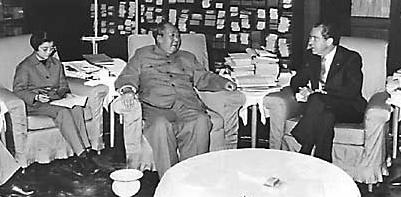
The Chairman would like to ask you about "Laugh In".

The Chairman would like to ask you about “Laugh In”.

Posted in Uncategorized | Tagged , | Comments Off on How to work with interpreters

We’re Hu Jintao’s Lonely Hearts Club Band

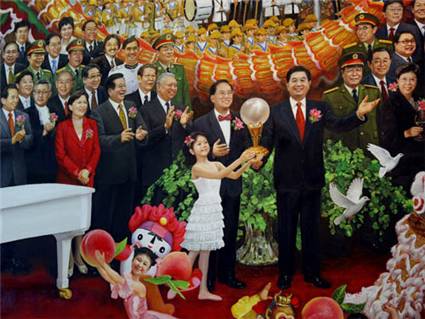
Imagethief was interested to see on the front of the Saturday South China Morning Post a segment of a painting that has just been unveiled in Hong Kong to commemorate the tenth anniversary of the 1997 hand-over of sovereignty. This is no ordinary canvas, mind you. It’s essentially a mural, seven meters by three, with the likenesses of Chinese President Hu Jintao and 500 of Hong Kong’s great and good. Here is the segment that was printed in the paper:

Hu-Jintao-HK-Painting

Painted by artist Liu Yuyi, who came to Hong Kong from the mainland in 1991, painting is apparently meant to be inclusive in representing Hong Kong’s political plurality. Nevertheless, there does seem to be something of a pecking order. The (as ever, subscription-onlyPost reports:

[Liu] said he included people of different political views.

Near the edge of the painting stand such figures as Cardinal Joseph Zen Ze-kiun, former chief secretary Anson Chan Fang On-sang and Civic Party legislator Alan Leong Kah-kit.

Tycoons Li Ka-shing and Stanley Ho Hung-sun were among the closest to the state leaders in the canvas.

Some key members of the Democratic Alliance for the Betterment and Progress of Hong Kong and the Liberal Party were also close to the action. Liu, who has lived in Hong Kong since 1991, said he had not yet decided whether to auction the painting, although some interested buyers had contacted him in recent days. “I may just give it to the state,” he said. “And I don’t rule out the possibility of giving it to the Hong Kong government.”

One wonders where they would put it. Featuring President Hu as prominently as it does, one also wonders if perhaps it might need to be updated in future anniversaries, as the face of China’s leadership inevitably changes.

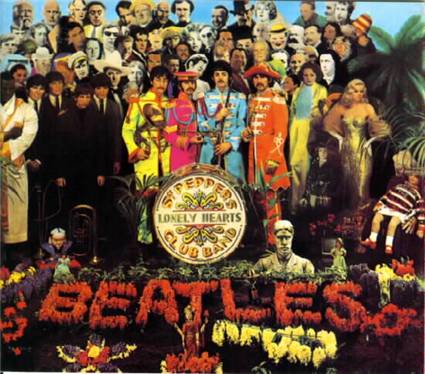
In addition to the placement pecking-order of Hong Kong personalities, two things about the painting struck Imagethief as particularly interesting. First, in composition and palette it resembles a certain famous album cover:

sgt-pepper

In fact, my colleague Alex, upon spotting the photograph, said, “Hey, it reminds me of Sgt. Pepper!” I am not sure this is the effect Liu was going for. (There’s even a drum partially visible at the very top of the painting.) If you ask me, psychedelic Olympic mascot “Huanhuan”, visible in Liu’s painting, would have fit right in on the Sgt. Pepper cover.

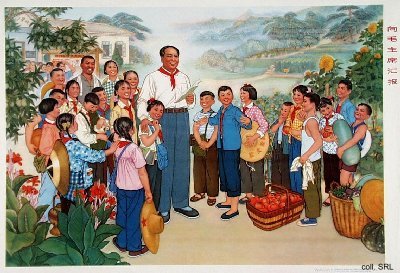
Somewhat more disturbingly, the painting is highly suggestive of Maoist propaganda posters, especially the ones where the Great Helmsman is surrounded by hundreds of cheerful, energetic and well-fed looking Chinese people representing various ethnicities and acceptable segments of proletarian society. For example:

mzd13

Or perhaps this:

mzd15

If you’re having trouble reading the tiny caption on this second poster, I believe it says, “The ever victorious Chairman Mao gets by with a little help from his friends.”*

Look at Hu in the painting above again. In the segment I can see, he is the only person who’s body is completely unobstructed. He has the greatest amount of negative space around him. His hand is upraised in beneficence. He’s surrounded by positive symbols; doves of peace, a pearl of harmony (according to the artist — don’t know if that’s accepted symbolism), and peaches of longevity (which are accepted symbolism). He’s conspicuously taller than Donald Tsang (which may be literally true). Intentionally or not, it’s a case study in cult-of-personality iconography. The only difference is that instead of being surrounded by an idealized version of the common people he’s surrounded by an ordered version of Hong Kong’s power elite.

I leave it to the people of Hong Kong to decide what that means to them. But if Liu does bestow the painting upon the people of Hong Kong, I’ll be interested to hear where they hang it.

Notes:

*It actually says “Follow the communist party forever, follow Chairman Mao forever”, but I like my caption better.

Posted in Uncategorized | Tagged , | Comments Off on We’re Hu Jintao’s Lonely Hearts Club Band