What I learned from Dashan

I don’t have much time for social Q&A site Quora, I confess. It seems to combine the narcissism of blogging (I should know!) with the politics of Wikipedia editing in all sorts of odd ways. I signed up early, lurked for a while, and then more or less forgot about it despite its popularity among several of my friends. But this morning I read a very good post on Quora by longtime Canadian China resident Mark Rowswell, aka TV performer “Dashan.” The question he was answering was: Why do so many Chinese learners seem to hate Dashan?

And a good question it is.

I myself have heard the outrageous lie, “Your Chinese is as good as Dashan’s!” often enough over the years to have had to suppress a gag reflex on many occasions. But I find both the comparison and Dashan-hate in general to be much less prevalent than they were six or seven years ago. I am not sure if this because there is actually less of them, or simply because I now move in circles that have graduated to other concerns. When one is a parent, one spends less time pondering Dashan and more time pondering how to keep one’s children from developing silicosis from the air. Or, at least, I do. Just writing about Dashan feels a bit like turning the clock back a few years.

But for a long time, Dashan was a guaranteed conversation starter. As you can see in the Quora entry, my old friend Kaiser Kuo actually wrote a That’s Beijing column in 2006 in praise of Dashan (he called me, among others, in researching it). It’s not worth recapping all of the pro- and con-Dashan arguments here. Rowswell gets into most of them in his Quora answer. But I would touch on one factor that I think is important. Rowswell writes about what he calls “stereotyping”:

This even borders on racism in more extreme cases. The logic seems to go like this: white guy – speaks Chinese – Chinese people laugh – he must be making an ass of himself. Of course, the only way a white guy could possibly entertain a Chinese audience would be to be a complete buffoon.

It’s the “race traitor” syndrome, and it’s always been a huge part of expat perceptions of Dashan. We all like to think we’re enlightened, but there are things that push deeply buried emotional buttons, including the notion that a compatriot (or, for Americans, near compatriot) might be demeaning us racially in front of –pardon my language– the natives. This is, of course, a completely colonial, racist and unworthy attitude, but that doesn’t mean it isn’t there. And it says something about how, deep down, many of us view our relationship with our Chinese hosts.

When the media is involved I think there is also a political reaction, where we see participants as selling out to or somehow collaborating with the regime in a way that crosses some imaginary line of decorum that the rest of us have respected. Both of these reactions also had a great deal to do with a bout of hate directed at CCTV 9 news anchor Edwin Maher a few years back, following an LA Times profile.

Rowswell’s entire Quora response is thoughtful and worth a read. There was, however, one other part that stood out to me, and is particularly relevant to anyone who communicates in China on behalf of a foreign entity (such as PR people, just to name a random example):

…I work within Chinese cultural norms – the limits of what is culturally acceptable to a Chinese audience. That doesn’t necessarily mean you pander. You can challenge the norms and push limits here and there, and I believe I have done and continue to do that, but in large part you work within a cultural acceptable limit. Chinese don’t go for shock humour, nor do they tend to accept what is commonly accepted in the West – that it’s OK to be offensive as long as you are offensive on an equal opportunity basis. That’s just not part of the Chinese comedy or media scenes.

Also, in many instances what would be acceptable for a Chinese performer to say is not considered acceptable for a foreign performer, especially when it comes to social or political satire. Even in a comedic exchange between individuals, you have to be aware that the audience may not perceive this as Character A making fun of Character B, but instead as Foreign Character making fun of Chinese Character, which goes over like a ton of bricks.

So I work within cultural norms. This spills over into the political realm, because, to be honest, Chinese cultural acceptance of foreign political criticism is almost nil. In short, I don’t have to worry about what government censors might say because Chinese audiences would never let me get that far anyway.

So, I could make a short public statement like that of Christian Bale recently or Björk a few years ago. It’s very easy to do and ensures you get very good coverage in the Western media. You go home and everyone thinks you are a person of moral conviction who stood up to the great Chinese monster. But the fact is that these kinds of statements elicit almost no sympathy whatsoever from ordinary Chinese citizens. They simply are not culturally acceptable to the broad Chinese audience. And it’s very difficult to see what impact they have other than to further convince ordinary Chinese people that China is misunderstood and that the Western world is antagonistic towards China and resentful of China’s development. What use is that?

Indeed. Whatever you think of Dashan, there are broader lessons in there for those who care to look.

Update:

In retrospect, and after hearing from some friends who feel differently, it occurs to me that I should have called this post, “Excuse me while I refuse to hate on Dashan.”

Posted in Uncategorized | Tagged , , , | Comments Off on What I learned from Dashan

Holiday special: An advanced socialist dessert culture

In my years here, I have participated in passionate and heated debates on virtually all aspects of Chinese politics and society. What is the true nature of the government? Can the Chinese educational system produce creativity? Is the country rising or falling? All of these topics are capable of rending friendships, dividing rooms and spoiling a perfectly good dinner party. And yet none produces the same level of incandescent conflict as the question of whether or not China can do desserts.

China has an evident sweet-tooth. A walk down the candy aisle of any Chinese supermarket is trip to a tinsel-wrapped wonderland of waxy treats of infinite variety. True, I’m occasionally sucker-punched by spicy dried beef, which is often wrapped like candy, but a lot of it actually is candy, at least loosely defined. And what Chinese restaurant meal is complete without the fruit plate? If you’re lucky, the fruit plate might even be spouting dry-ice fog. Dinner and a show – what could be sweeter? One of the very first gifts I was given after starting work in China was a box of tangyuan. (I learned an important lesson:tangyuan are meant to be cooked. Hence the “tang“.) And the price people in this town will pay for Häagen-Dazs is second only to the price they will pay for ridiculous luxury watches, a phenomenon I’ve been able to study since our overheated local Häagen-Dazs shop is just around the corner from our local ridiculous-luxury-watch boutique.

It’s not just urban. The meanest, most wretched outhouse of a rural provision shop will somehow manage an ice-cream cooler, even if the refrigeration is powered by a mule on a treadmill or local orphans trudging around a giant “wheel-of-pain” like the one that turned a skinny waif into Arnold Schwarzenegger in “Conan the Barbarian.” I once had fresh made ice cream in a one-donkey town in Xinjiang in the foothills of the Pamir Mountains. It was awesome. Possibly because I was on the verge of heatstroke at the time.

Which raises a question: Does one need to be under some kind of physical duress to appreciate desserts in China? Admittedly, I have a roaring sweet tooth, apparently inherited from my father. I might my strap my own son into the wheel of pain if Häagen-Dazs Rum Raisin ice cream came out of the far end, especially given that it costs $13 a pint here. But ultimately, I’m open minded when it comes to Chinese desserts. I don’t just mean desserts obtained in China, but also desserts drawn from Chinese cuisine. Deep fried pumpkin bisuits. Red bean buns. Glutinous rice confections. Hot walnut soup. I’m pretty much OK with all of them. I still get bricks of blown honey when I walk through Qianmen, despite their proven ability to epoxy my jaws together for hours.

And yet the derision I’ve come in for from western friends is shocking. I could tell foreigners that my hobby is driving two-inch galvanized roofing nails through the skulls of live ferrets and they’d get less worked than they do when I tell them I like Chinese desserts. This leads me to ask: Is it them, or is it me? Are they right? Is that I’ve finally gone native and this is how its expressed itself? Instead of fleeing into the mountains of Yunnan to start a sustainable flax farm I’ve simply decided that its OK to eat black sesame paste? Or are they narrow minded conventionalists whose eyes are fogged with a lethal mix of Oreo dust and crème brûlée?

I won’t stand for that kind of cultural dessert imperialism myself. A century of hardship inculcates flexibility in confectionery.  Just as almost anything can be food in China (especially southern China), so can nearly anything be dessert. If all you have is mutton and molasses, by god you’re having molasses sweetened mutton floss for dessert.

But these ethnic treats take you only so far. Perhaps the most fertile ground lies in fusion desserts, where Chinese (or Asian) sensibilities collide with western ingredients or traditions. It’s unfair, but some places were blessed more by dessert providence than others. The French, at least after the enlightenment, had butter and flour and invented European pâtisserie. The Indonesians had palm sugar and coconut milk and invented cendol (and you haven’t lived until you’ve had a really good cendol). And China had…well, China had pluck. And legumes. But it’s been willing to recombine, which goes a long way. After all, what better illustrates the potential of modern China than the shaping of foreign ideas to suit Chinese circumstances? Hence the entirely respectable red-bean ice-cream stick. (Although the less said about the phallic corn-dildo ice cream stick the better.)

This trait reaches its zenith is in its ability to take components that under other circumstances I’d be utterly contemptuous of and fashion them into miracles. I experienced this during a recent dinner with my colleagues at a restaurant called Green Tea, a sort of upper-middlebrow Hangzhou place with pretensions. Dinner was fine. But when they got to dessert they earned a place in my heart forever.

When I moved to Singapore in 1995 I discovered the phenomenon that I came to think of as “Japanese-style” bakeries. If you live anywhere in Asia, you’ll recognize this genre of store as offering a range of vaguely sweet, soft white breads, sausage rolls and alarming-looking combinations of cheese and sugar. I’m expansive about desserts, but I’m a bread snob so I’ve always been completely disdainful of the entire genre. Seriously: My standards are high. I wept when the Fauchon in Shin Kong Place went out of business. They were priced and stocked for Marie Antoinette’s snottier cousin, but their breads were the best in Beijing as long as they were in business – and were the only thing I ever bought, which was symptomatic of their problem, I guess. Respectable French pâtisserie Comptoirs de France opened in Beijing four years ago and it took them until last month to come up with a loaf of bread I like (the sourdough).

I’m also reasonably discerning about Ice Cream. Longtime readers will know that Mrs. Imagethief is a nutritionist. Among the many things I’ve learned from her is this: if you must indulge, do it right and don’t fart around with the small-time stuff. If you’re going to have ice cream and suffer the attendant guilt, you might as well have good ice cream. Bi-Rite salted caramel*, for example, or Strauss Mint Chip. Who wants to pound out the extra kilometers just because you caved on a pint of Baxy? No one, that’s who. So, like Nancy Reagan, I just say no to the soft bread and flavorless ice cream.

Or, I did. Until that dinner at Green Tea.

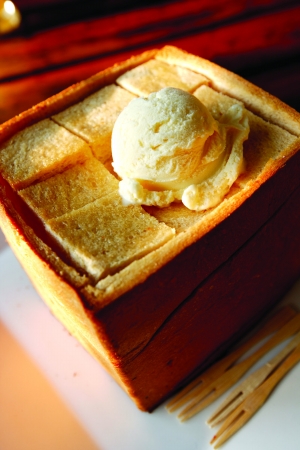
My colleagues ordered the house specialty dessert, 面包诱惑, which means something like “bread temptation,” though I think “bread seduction” would be better. This is a cube of warm, freshly-baked, soft white bread, sliced into twenty-seven smaller cubes (three cubed – think about the geometry) with a scoop of generic vanilla ice cream melting on top. The heat from the bread melts the ice cream, which runs down into the cracks between the bread cubes and soaks into the crumb and, well, it’s just alchemy, dammit, because the result is gustatory lead transformed into dessert gold. I swear when the waitress carried the first one in the world turned to slow motion while “Thus Spoke Zarathustra” played in my head. You’ll know that as the music that Stanley Kubrick used at the beginning of “2001: A Space Odyssey” to introduce us to a twenty-minute segment of a featureless monolith teaching apes to beat each other to death, which says something important, though I’m not sure what.

It is the call of the Sirens rendered into cheap bread and ice cream because, speaking of monoliths and ape-like behavior, we ate three of these things. By which I mostly mean thatI ate three of them. I am told that other restaurants have cribbed the idea, but that so far they all lack some…je ne sais quois. Worryingly, I’ve also learned that there is a branch of Green Tea around the corner from my house.

So, is it a Chinese dessert? Well, not really, I suppose. But it’s Chinese ingenuity applied to Western components with bang-up results. And if that isn’t domestic innovation, well then, what the hell is? The government should be proud.

Happy New Year to all readers from Imagethief.

Domestic innovation.

Domestic innovation.

Posted in Uncategorized | Tagged , , , | Comments Off on Holiday special: An advanced socialist dessert culture

The almighty soft-power princess bomb

Chinese soft-power is doomed.

I came to this conclusion a couple of weeks ago. The message was delivered in the form of a guy in a mouse suit on ice skates, and I received it loud and clear when Mrs. Imagethief and I took our son to see the Disney on Ice show at the Workers Gymnasium.

Having a child recalibrates your pop culture consumption habits. Before Zach was born I was all about Led Zeppelin and Michael Bay movies. Even better: Led Zeppelin in Michael Bay movies. Mrs. Imagethief, despite what she may say to you, was pretty much the same, which is why we got married. I have few pop culture pretensions. I have some jazz and such, which I wheel out for brunches because no one other than me wants to listen to “When the Levee Breaks” over mimosas and pancakes. But mostly I was about the loudness and explosions.

I still have my adolescent pleasures, but they’ve been crowded into the margins of my life by The Wiggles, Bob the Builder and Lightning McQueen. Mostly I’m OK with that. The Wiggles haven’t penetrated my workout mix yet, but I don’t have to leave the room when they’re on.

But going to a Disney on Ice show seemed like sailing across some kind of event horizon and beginning an unrecoverable, light-speed plummet into the black hole of pop culture, at the singularity of which one might find such atomized debris as Cop Rock, Kevin Federline and the XFL.

I have no objection to Disney per se. Back in my (nerd alert) laserdisc days I had a respectable assortment of neo-classic animated Disney films. Hakuna matata, dude. And I still go for Pixar stuff, although I suffer from the overexposure to Cars that afflicts every parent of a small boy. As they say, there are no toxins, only toxic doses, and I exceeded a toxic dose of Mater the tow truck quite some time ago. I’m just waiting for my gums to start bleeding.

No, what I resisted on some visceral level, as I might resist a box of candy-frosted frog eyeballs, was the idea of Disney on Ice. With the exception of hockey, which, like Michael Bay movies, is redeemed by violence and thuggery, it’s hard to think of any performance that is improved by putting it on ice. Conceivably NASCAR and political debates (especially if the candidates get hockey gear), but after that, what? Hamlet? Radiohead? Even Olympic figure skating is really just the speck of sanitized-for-mass-consumption flotsam at the top of the vast, reality-show swamp that is everything else having to do with professional figure skating. It’s the back room stuff they should be broadcasting. Remember Tonya Harding?

Despite the evidence supplied by my Michael Bay habit, I am sure some readers have concluded that I am some kind of rarefied cultural élite hopelessly distanced from the entertainments of normal people. After all, I spell “élite” with an “é.” But that’s cool. It’s my over-educated, west-coast leftnik pedigree, and I’ve come to terms with it and the conflicts that it has engendered. If I want to scoff at Disney on Ice over the chardonnay and New Yorker that I use to kill the time between pyrotechnic robot movies, I damned well will.

Nevertheless, I went to Disney on Ice because when you have kids what you and your chardonnay want goes straight into the bin and what your kids want pretty much becomes the yardstick by which all recreation is evaluated. Hence my chronic Matertoxosis. So off we went.

Actually, it was pretty good fun.

No, really. As a parent you gain a certain appreciation for anything that can hold a three-year-old’s attention for ninety minutes. But despite the many layers of corporatism wrapped around it, it’s hard not enjoy a multi-villain extravaganza featuring Cruella DeVille, Jafar, Maleficent and about four other fiends in colorful hats.  I also added Disney on Ice to my expanding list of oddball things that now make me get all teary.

But what really struck me was how successful the show was. They’d sold out the Worker’s Gymnasium and the seats were packed to the brim with Chinese kids, apparently all of whom had successfully argued their parents into springing for the light-up wands and inedible cosmo-sausage they were hawking at the mezzanine. Scalpers were doing a good trade on the way in. Whatever else is going on in Beijing, people will pony up for Disney on Ice.

The only content that referenced China was two minutes of Mulan, who ranks in the Disney pantheon about where Jar Jar Binks ranks in the Star Wars pantheon, if not below. The show was, however translated into Chinese. It’s a bit surreal watching Caucasian skaters in eye-popping stage makeup nonsense-lip-synching to Chinese Disney character voiceovers.

As an American it’s even weirder listening to Mickey Mouse himself in Chinese, not least because they nailed the voice. It was spooky. But also, much more than the Chinese audience, I think we Americans have internalized Mickey Mouse as an American symbol. I confess a bit of surprise that Mickey hasn’t replaced the eagle on the great seal of the United States of America. I have clear memories of a T-shirt from 1979 that said, “Hey, Iran!” and featured a cheery Mickey flipping the bird. I’m pretty sure it wasn’t an authorized product, but you never know. Could have been clever licensing. Give that mouse a shield, an olive branch and thirteen arrows and stand the hell back.

But the fact was that Chinese families in droves were handing over 180RMB a head before snacks, beverages and sparkly wands to be exposed to possibly the basest layer of American pop culture. Meanwhile, China is exporting Confucius institutes, ponderous Zhang Yimou films, and a billboard in Times Square that nobody seems to understand. It’s an asymmetrical battle, and probably only going to get more so now that SARFT may be taking steps (zh) to ensure that entertainment television is rendered as unprofitable as possible for broadcasters in China. Am I missing anything?

When Americans are paying $30 a pop to watch Xi Yangyang on ice, then I’ll know China is really getting somewhere. Until then, hakuna matata, dude.

Fairy godmother, can you make Chinese TV better?

Fairy godmother, can you make Chinese TV better?

Posted in Uncategorized | Tagged , , , | Comments Off on The almighty soft-power princess bomb

Remembering Talk Talk China and the “Cycle of Funk”

A lot has changed in the China blogosphere since I first put (virtual) pen to paper for Imagethief in June, 2004. I can’t think of many blogs that are still around from those days in anything like their original form. The Peking Duck and John Pasden’s Sinosplice come to mind. Even the venerable Danwei has undergone a transformation. In general, the renewal is good. Jeremy Goldkorn (of Danwei), Kaiser Kuo and I talked about this on Sinica in July 2010, when we celebrated the death –and rebirth– of the China blog.

But I thought it was worth revisiting China blog history today because it is, to the best of my knowledge, the fifth anniversary of the shuttering of Talk Talk China. This was the brain-droppings of three anonymous, long-time China expats who went by the nommes-du-snark of Dan, Dawanr and DD (no, I don’t know who they were). For about a year and a half, in 2005 and 2006 it was consistently the funniest, angriest China blog out there, and a wicked channel for the collected frustrations and gripes of the China expat community. This being the days before Twitter vacuumed up “the conversation”, it also had thermonuclear comment threads, as you’d expect.

I remember Talk Talk China not just because of the anniversary of its closing, but because of one post in particular, called “The Cycle of Funk.” It may be to this day the truest thing I have ever read regarding the experience of being a foreigner in China. While many of the rough edges of expat life here have been whittled away by the transformation of Beijing into fairly cosmopolitan city, enough remain so that I find myself thinking of this post pretty regularly.

But also, there has been a general shift in mood among much of the expat community in the past two years, as many foreigners I thought were here for the duration have started talking openly about life beyond China. This is purely anecdotal, and I have no data to back it up, but it’s enough of a trend that several other people I know have picked up on it. Rich Brubaker of the long running “All Roads Lead to China” business blog wrote a post touching on this just yesterday. It would seem that the “cycle of funk” is not just a personal thing, but perhaps a social one.

Talk Talk China is off the air, but thanks to the Internet Archive’s “Wayback Machine” much of the oeuvre, including the Cycle of Funk is still online. However, it is a pain to nut out. As a public service, and totally without permission, I am going to take the liberty of reposting the Cycle of Funk here. If Dan, Dawanr or DD want to send me a cease-and-desist, they know where to find me:

The Cycle of Funk
May 24th, 2006 by Dan

Y’know, not every day is a bad China day. Sure, at TTC this is the case but for most people, a bad China day occurs only every now and then. However, for my entire time in China, I have noticed a particular trend among all laowai that I call “The cycle of funk”. No matter how much you love China, the little things that bother you will start to gather in a little ball of rage deep within you and sooner or later that ball of hate and spite needs to be released (often obnoxiously). That’s fine. It’s understandable. When it gets to that point no one can tell you whether or not your rage is justified. What is important to note is that this clearly comes and goes in a cycle. I imagine for most people the frequency and intensity of maximum funk decreases with time however the length of maximum funk and the intensity of said funk will likely vary widely for each person.

It is important to note that, in most cases, maximum funk is initiated not by some massive occurrence but usually by some small innocuous thing. Basically, you’re already at the edge and it is the very next thing that sets you off.

The-Cycle-of-Funk

Remember, when you’re having a supremely awful bad China day and you are trying to tear the roof off the sucker, try to find where you are in your funk cycle. If you have obtained maximum funk you can relax knowing that it ain’t getting any worse and it will only get better…at least until the next funk hits.

After running less than two years Talk Talk China wound up pretty suddenly for reasons I don’t recall. Sinocidal tried to carry the snark-bucket for a while, but never played at the same level and it has long since gone by the wayside. These days I seem to carry the burden of being the “funny” China blogger (although George Ding of The Hypermodern and now The Beijinger’s back page is giving me a run for my money). Anyway, I’ve thoroughly shirked this burden, as any glance at post count for the past year or two demonstrates. But when they were at their best, the guys behind Talk Talk China were funnier and definitely more succinct than I was. And let’s face it, we need all the humor we can get.

So I commemorate five years since the end of Talk Talk China. For what it’s worth, I’m not in danger of leaving China any time soon. It’s been pretty good to me and my family. Nor am I particularly grouchy about it at this moment. But as anyone who has read Imagethief for any length of time knows, I’d be lying if I told you I was immune to the cycle of funk. And so would you.

Razor wit.

Razor wit.

Posted in Uncategorized | Tagged , , , | Comments Off on Remembering Talk Talk China and the “Cycle of Funk”

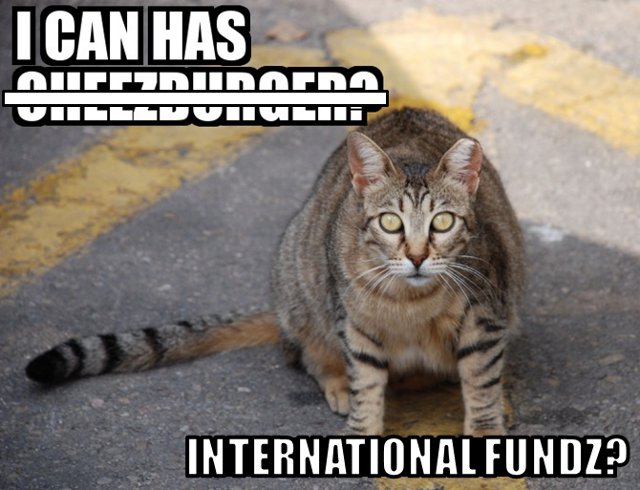
I can haz international funds?

After seven years and change in China it’s hard not to come to the conclusion that the purpose of the Chinese banking system is to keep you from doing anything useful with your money. It is widely said that the Railway Ministry in China is the best surviving example of a reactionary Communist bureaucracy, and after recent events it’s hard to argue with that. But in my experience the big, state-owned banks are giving the Railway bureaucrats a run for their money.

Many people speak in (relatively) glowing terms of the service provided by some of the newer commercial banks, such as China Merchants Bank or Bank of Communications. I have no experience with that, because both of the companies I have worked for in China have limited my options for paycheck deposit to two of the “big four” state banks (the ones Gordon Chang is always telling people are about to implode). Yes, I suppose I could open an account at one of the smaller banks and then move my paycheck every month, but the thought of having any more Chinese bank accounts than I absolutely need makes my liver spasm. Due to a bank switch by my old company, my year in Shanghai, the fact that Chinese banks don’t actually function in any recognized sense of the word “nationally,” and their conviction that joint accounts are some kind of rightist plot,  I’ve already left a daisy-chain of zombie accounts scattered across the country. Each has about RMB2 in it and no doubt at least one will be used to hijack my identity at some point in the future.

I would bulldoze a field of spaniel puppies and nursery schoolgirls in fairy costumes to avoid a trip to the bank. Every trip to a big, state-owned bank is like the scene from the end of Beetlejuice where Michael Keaton is in the waiting room for hell with a ten-digit ticket while they serve number 14. It’s not so much the magnitude of the numbers as the glacial pace of the transactions. Teller window service numbers increment like Neptunian orbits – about one a century. If there are even two windows serving general business it’s your lucky day, and every transaction seems to involve a mortgage application in octuplicate and the structuring of some kind of derivative for a grandmother who speaks only a Guangxi provincial dialect, or the hand-counting of RMB100,000 in cash pulled from a man-bag. Surely no simple, retail banking transaction could take a freaking hour.

But of course it could. I myself have been the jerk at the window on many an occasion, while some pensioner laotou at the head of the line pisses and moans loudly about drag-ass foreigners tying up the teller windows with their sketchy international transactions. It’s not that I want the transaction to take forever. I have much better things to be doing than sitting at a teller window, like pulling out my own toenails with needlenose pliers or eating a sandwich made of Wonder Bread and used crankcase grease. But the system moves at the pace it moves at, which is roughly the same pace as continental drift. You know how in 150 million years the San Francisco Bay Area will be in Alaska? That’s the exact same time your transaction will be complete.

Given that using the ATM aside there is no such thing as a simple transaction at a Chinese bank, by far the most confounding thing I’ve had to do is to change large amounts of renminbi into foreign currency. Almost six years ago the CFO of my previous employer sat me down and explained that it would be in my best interest to switch my then US dollar salary into renminbi. Damn if he wasn’t right about that, because in the intervening years the renminbi has kicked the S&P500′s ass as an investment. In US dollar terms I’ve made out nicely since the renminbi started to appreciate back in ’05. Unfortunately my long-term savings currency is the Singapore dollar, which is basically flat in RMB terms, but I’m still killing it on the US dollar. Someday when I’m deported from the continent of Asia for writing uppity blogs that will come in useful.

The catch, of course, is that the renminbi isn’t freely convertible. Oh, sure, it’s nominally convertible, but only in the same sense that nominally I could become a Navy SEAL. The process is designed to be painful enough to discourage me from actually trying in order to save everyone the trouble and embarrassment of watching me fail miserably, or die. That’s why over the past five years I have subjected myself to this process a grand total of twice. The last time was in 2009. The two years since then had both enabled me to accumulate a fair wad of renminbi savings and had dulled my memory of events just enough for trying a conversion to seem reasonable again.

A sensible man suggested that I leave everything in renminbi. After all, the renminbi is still appreciating in US dollar terms, and it seems unlikely that the government will allow any of the big four banks to submarine. But the problem is that as useful as the renminbi is for settling bills in China (where a zero is added to my rent approximately every six months), it is completely illiquid as far as the rest of the world goes. Should I have a sudden need for money overseas, my accumulated renminbi savings in China would be worth about as much as a cargo container full of used cat litter. Interesting perhaps, but hard to pass off as legal tender. And the only thing more horrifying than trying a large-scale personal currency conversion in China is trying a large-scale personal currency conversion in China in a hurry.

I set about gathering the necessary documentation. This included a chopped copy of my work contract, a chopped income statement from my company indicating how much I had been paid in the period covering the income I wished to exchange, and a receipt from the personal income tax office serving my employer that certified the payment of taxes assessed on the income for that period. Plus my passport with current visa and my employment permit (a small, passport-like booklet), which, although I am officially required to carry it at all times, has never been used for any other purpose in all my years in China.

My first attempt was made at my bank branch in Wangjing. It ended in crushing failure when, after waiting an hour to be served, the bank informed me that my documentation would permit me to remit only 15% of the amount I actually wanted to send. Some squinting at the forms revealed that my HR department had procured the tax receipts for only a part of my tenure with the company, something I had somehow missed.

There was, of course, a complexity. Since joining Motorola the company had split, and I had been employed by two different corporate entities in my time there. This required another round of documentation wrangling as I gathered the various contractual addenda reflecting my transfer and a new and more comprehensive set of tax receipts. Then, just to be safe and because the income I wanted to remit extended far enough back, I decided it would be sensible to also assemble the documentation from my previous job. I had most of this from my previous remittance in 2009, but I needed updated tax receipts. So I went to down to Oriental Plaza with my identification and contracts to get the receipts from the appropriate office.

There was, of course, another complexity. I discovered that somehow the Oriental Plaza personal income tax bureau had a typo in my name, listing me as Dillon W. Moss instead of the correct Diccon W. Moss. Part of me wanted to laugh, as the Chinese tax bureau had suddenly transported me back to junior high-school, where the following was a typical first-roll-call-of-the-year experience:

Teacher: Janet Martinez?
Janet: Here!
Teacher: Shawn Meacham?
Shawn: Here!
Teacher (hesitantly): Um. Uh. Dillon? Dillon Moss?
Me: It’s Diccon.
Teacher (incredulous): Deacon?
Me: Diccon. Short “i”.
Teacher: “Diccon?”
Me: Yeah.
Teacher: Diccon William Moss?
Me (to the sound of tittering from other students): Yeah.
Teacher: Oh. (Pause.) Are you sure?

Repeat in next class, and so on. That’s why I started using my middle name.

I get why a junior high teacher in Westwood would assume that “Diccon” is a typo for “Dillon”, but how would a Chinese person know that “Diccon” is unusual any more than a typical American would know that 张艺谋 is a real Chinese name and 草泥马 is a rude pun? It would have been funny except I knew from experience that the bank would deny me for so much as a molecule out of place on my paperwork –This molecule is void! No cash for you! NEXT!–, let alone a suspicious misspelling of my name that might indicate fraud or attempted financing of international terrorism.

Fixing my name in the tax records required nothing so simple as me showing up with my ID or some other appropriate documentation. Instead, my prior employer had to re-file allthe paperwork from the period covered with my correct name. This took a month, during which I entertained dark visions of catastrophe detonating my Chinese savings. It wasn’t any more likely then than it was the prior two years, but that’s how the neurotic mind works. Now I can’t move my money at all? Weimar Republic, here we come!

 Eventually I got the corrected forms. In the end this is what I took to the bank:

  • Three chopped employment contracts
  • Two chopped income statements
  • Five tax bureau receipts covering different time periods and corporate entities
  • My savings passbook (they still use those here)
  • My passport (required for basically every transaction at a Chinese bank)
  • My employment permit
  • Two bank cards (just to be sure…)

I had everything in a big manila envelope that I carried around clutched to my chest like a teenage schoolgirl. I felt like I was applying for citizenship.

This system is needlessly complex. Many foreigners I know have no idea how to exchange large amounts of currency and no two expats I polled gave me the same verdict on the current state of requirements for buying large amounts foreign currency with legitimate income. Indeed, some foreigners I know have given up altogether and are simply waiting for China to open its capital account or have taken to flying cash out of the country (risky) and using money changers on the far end. Did you know that a money changer in Singapore will exchange 200,000 RMB for you if you give him a day’s notice? Now you do.

The system is so complex that even the bank seems to wrestle with it. At the Oriental Plaza branch of my bank, where I finally completed the transaction, there were several alarming huddles behind the counter where tellers and managers conferred about the paperwork. I am usually pretty good at handling bank transactions in Chinese, but this time I’d brought a Chinese friend along just in case. If there is one thing that I know can break my Chinese it’s an unexpected clot of bank bureaucracy. I kept looking at her and asking, “Should I worry now?” She comforted me by saying, “Maybe. It’s hard to tell.”

In the end they chopped all my applications for purchasing foreign currency and wiring it to Singapore and did that worrying thing where they bulldog-clip your completed paperwork together and toss it on a huge stack of similar paperwork. This the signal for you to depart and, if you’re me, compulsively check your online banking to see if the money appears at the far end, or if rats ate the paperwork before the data-entry trolls put it into the Babbage engine in the bank’s basement. 48 hours later, the correct amount of Singapore dollars appeared in my bank in Singapore. The whole process had taken three months to complete. I felt like running through the streets naked except for a party hat and an open bottle of Veuve Cliquot, but foreigners have been deported for much less so I settled for deep sigh of relief.

But not too deep. In 2013 I’ll have to do it again.

Note: The week I completed that transaction was a good one for the resolution of long-standing financial problems. I also received a refund check from the IRS for several thousand dollars following the incorrect assessment of extra taxes from 2009. It took me 13 months to get that check. But at least, unlike a Chinese bank account, the IRS paid a reasonable interest rate on the money.
Really?

Really?

Note: In reconstituting my archives, this was the only post for which I also copied the comments, just because this is obviously such a source of shared misery.

43 Responses to I can haz international funds?

  1. jen says:

    Great Post. We had similar experiences, but with the additional steps of:
    1) Going to our home branch, only to be told that international transfers were only handled by the main branch in Wangfujing
    2) Going to the main branch in Wangfujing (1 1/2-2 hours by car) to be told that our home branch was wrong and these international bank-to-bank wire transfers can only be handled by your home branch
    3) Going to the Lido branch of our Hong Kong Bank, which technically only serves high rollers but they were willing to help us in our desperation. After a good laugh over our go around with a “countryside” bank (I was still under the assumption we lived in a city until that point), they told us exactly what forms our home bank needed to use to complete the transaction. Yes, the HK bank knew better the systems of the “Big Four” Chinese bank than the tellers.
    4) Return to “Countryside” branch, armed with Knowledge! Is Power! and after another two hours (seated, though), successfully moved the maximum amount to HK bank. The next day, within minutes, made secure transfers ONLINE from HK to our US banks.

  2. ge says:

    haha jesus, no wonder you were ecstatic when you tweeted, it is freakin’ TEDIOUS!! good to hear it went through though.

  3. Shannon says:

    Or you can take the easy route — as I and many, many other expats do — and simply spend every single fen you earn.

    RMB “savings”?!? Just you being able to say that phrase drops my sympathy with your banking odyssey to roughly zero.

    Just kidding. Kinda. ;-)

    At least you’re not dealing with incoming WOFE funds denominated in foreign currencies prior to 2010. Back in them there olden days the — well let’s just say a big state-owned bank — would (totally illegally) simply expropriate the money for an indeterminable period to play the short term money-market with it.

    Not kidding. Not at all.

  4. Will says:

    @shannon – Actually, on the subject of spending every fen I earn, no joke. I used to buy all my big ticket items, like new computers, overseas. One product of this experience is that I’ve resolved to buy such things here so that I don’t use my foreign currency any more than I have to. Air tickets, too. Used to book through airline websites using overseas credit cards. Probably through local agents now. Yes, I realize this is surrendering to the government’s agenda, but what the hell. Whatever minimizes my paperwork.

  5. Terence says:

    Now I realize that you’re probably dealing in much larger amounts than I – but even for tens of thousands of RMB, I have used the Uyghurs outside of the Bank of China and gotten better than state rate. Of course then I end up with more USD cash in my pocket than I’ve ever had in my life (enough to buy a used economy car) and I’m nervous like an MIT student on his way to Las Vegas to count blackjack cards.

  6. Will says:

    @Terence: I’ve thought about it, but that still leaves me with the problem of either having to get a brick of dollars out of the country (carry on, or check through? Discuss…), or re-depositing the dollars into the bank and trying to wire it out. Not sure how the big banks will react if I walk up with a shoebox full of black market dollars and a grin. But if I saw me do that, I’d probably call the cops on myself.

  7. David says:

    Sounds like your employer won’t let you have two employment contracts – a China one and overseas. That sucks.

    Another option – as far as I know Chinese passport holders are allowed to change $50,000 a year into foreign currency so get a local to help. Don’t think they care too much about foreign currency been carried out, but they don’t like people carrying lot’s of RMB out. A friend of mine got caught carrying about RMB150,000 to HK and was fined 10% of the total amount.

  8. Shannon says:

    David wrote: ” A friend of mine got caught carrying about RMB150,000 to HK and was fined 10% of the total amount.”

    Jeez! Is that all!? I was imagining confiscation or worse. For 10%, I think the risk becomes *far* less.

  9. Marian Rosenberg says:

    @Shannon

    I am dealing with incoming WOFE funds in foreign currency.

    After 6 weeks the bank eventually sent the money back to the US and started the transaction over from scratch but only after I found the US bank’s Guangzhou phone number so they could confirm that the form the Chinese bank wanted really really honestly didn’t exist and never had existed and that the lack of the existence of such a form made it quite impossible to fill it out.

    The US bank’s Guangzhou office also had to explain to the Chinese bank how to send my money back.

    And once my money was back in the States, I needed to show them the US bank’s bank statement to prove that:
    a) they still charged me a transaction fee
    b) the number was larger than they thought

    In the end they did refund me for the transaction fee but I’m more than slightly disturbed that my refund happened in the branch manager’s office, off camera, with no forms or paperwork of any kind, and came out of her wallet. Not that I’m going to claim that I was never refunded or anything sleazy like that but I’ve got to wonder whose salary (or what slush pile) my fee is coming out of. It also means that there is no official recognition that this branch messed up super big.

  10. SIDNEY says:

    if you are really desperate you can always take the Macau route .. I have not tried it before but you can get a “gambling account” with the Wynn casino and deposit money there.. then you can freely transfer it between the Wynn Macau and the Wynn Vegas .. doesnt matter how big the amounts are aslong as you can proof the source of the money

    you can even do all of this without breaking any Chinese laws ..

    – you have lots of RMBs in Chinese bank account
    – none of the money is “illegal” / you paid tax on all of it
    – clear out your account
    – you have multiple entry visa
    – go to Zhuhai
    – cross the border holding the maximum RMB cash amount allowed
    – deposit money in Wynn casino “gambling acount”
    – cross the border every day for a week or aslong as it takes

    people are used to LARGE cash amounts in Macau .. its all ok over there

    it might sound like impossible to do if you have truely large amounts .. but both Zhuhai and Macau are very nice cities , just take a two week holiday here and cross the border each day

  11. Frank Fomby says:

    Edutainment at it’s finest Will. While still living in China I took a 14 month contract in Malaysia. When they transferred me money, I would go stand in line at UMB to receive my money, and generally got 100% in ringgit (RM). Not thinking about it, I booked a week stay in Bangkok (never again, Phuket is my Thailand destination) and flew over. I was shocked, SHOCKED that the hotel would not take RM or RMB… So 8pm on a Sunday, and no local currency or non RMB bank cards. Luckily, a friend of a friend ran a bar on 20th Soy nearby. He poured me a beer and disappeared with 5000 of my RM. He returned about 20 minutes later with a printed page from a currency exchange website, and the exact amount in Thai baht. He took nothing off the top for the transaction. Land of a thousand smiles indeed.

  12. Matt O says:

    Hey Will,

    I can’t speak for Singapore, but if you’re trying to move money to the States, as long as you keep are carrying less than $10,000, then you don’t have to claim it. You’ll get a few looks at your Stateside bank, but it’s doable (and as far as I can tell, completely legal). Space this out over a couple family visits and voila… You do have to accept the fact that you will be carrying a wad of cash in a traveler’s money belt, but I’m fairly certain that pickpockets do not abound on trans-pacific flights.

    Also, I never once changed money through the Bank of China. I accompanied a friend who was doing that early on and the experience, despite being entirely vicarious, was painful enough that I couldn’t fathom going through it myself. I suggest you find a…*ahem*…private money changer who’s reliable and stick with him/her. I changed somewhere between $20k and $25k USD through the guy I used before I left (spaced out over a couple years). All bills were legit and accepted on the US side.

  13. Homer says:

    So, in your opinion what is the least hassle bank in China? Perhaps a HK bank is better? I recently started working for a medium size factory and need to open a bank account. I also should be getting salary soon. I need to be able to transfer money back to the States if need be. I guess I am going to have to double check and make sure that this place can provide all the above documents. Nothing is easy here is it..

  14. Shannon says:

    @Marian Rosenberg

    My thoughts are with you. Those transactions can be absolute hell. My hair went salt’n’pepper over 2006-2009, and I blame the WOFE incomings that I was doing once a quarter.

    I once, for shits and giggles, demanded to see the local bank’s internal receipt paperwork (foreign banks will give you this if you ask) and was told that such paperwork was a “commercial secret in China”.

    So the computer system confirming that you’ve received *my* money that *I* have sent you — and I have here in my hand the internal sending paperwork from the foreign bank — is a “secret” eh? Riiiiiiiight. Actually, we both know that it’s illegal under the international banking rules you’ve signed up to to deny me access to that paperwork, and we both know that the bank received the money days ago, but we also both know that there’s no chance in hell that you’re going to admit either of these things.

    Good luck!

  15. Great post. I’ve been pondering this issue because my wife insists we save and I’m wondering how to get the funds out of China towards buying a house in Scotland. Now I find it’s even more complicated than I anticipated…!

  16. Marian Rosenberg says:

    @Shannon

    When the money came back into China this time, it still took another 3 hours of bank time for it to hit my account. Of course, I had to be there throughout the whole process in case something needed to be signed or filled out or double checked or translated.

    My personal favorite was when I was handed a form that already had my essentials printed out (company name, account number, originating account holder’s name, etc…) and was asked to write ALL THE SAME INFORMATION by hand underneath the printing and sign it.

    -M

  17. FOARP says:

    The first time I had to send money home it literally took me a whole day being ping-ponged between branches of the same bank (BoC), standing in queue (always, ALWAYS with someone jumping the line), doing and re-doing forms (“here’s a mistake, you’ll have to re-do the whole three-page form”), but I got it done.

    Having gone through all that, I thought that things would be much easier the second time. WRONG! I had all the same paper-work that I had used before, I was at the same branch, talking to the same people, transfering a similar amount of money to the same account, but suddenly they were insisting that I could only transfer as much money out of the country as I had paid in taxes, no more. Since this was in Shenzhen back when people were still paying 8% tax, obviously no amount of tax receipts would have mollified the staff there – so what could I do?

    I argued with them. I then called up a friend of mine who worked for another bank, and she argued with them. I came back the next day with a friend of mine who argued with them. I then argued with them some more. In all I spent three days arguing with the staff there, but the story (which everyone I knew insisted was false) remained the same – I couldn’t transfer more money out of the country than I had paid in tax.

    I then made one call to someone I knew who worked in the accounting department at the company I worked for – a major customer of this particular bank -asking him to confirm what the people at the bank were saying. Funnily enough, the next day I received a phone-call from the bank-manager saying that he was very sorry for the inconvenience, and that a car would come from the bank to pick me up so they could sort things out for me. I was taken directly to the Bank’s VIP room, where the transaction took about ten minutes – no more.

    Now , I hate this kind of queue-jumping through using connections, and, even more, I hate troubling colleagues with my private affairs, but the lesson I learned from this is that things could be sorted out quickly if people simply knew their jobs and didn’t have such a bad attitude about confirming whether what they though was correct actually was.

  18. ChinaMatt says:

    This brings back memories that will require therapy.

    Fortunately, I never had to exchange large sums of money. When I did exchange money for my vacation to the US and my move back, my wife went to the bank. All she needed was her ID card, Chinese passport, and single form filled out–no questions asked.

    And for some reason, banks in the US are getting to be almost as maddening. Or maybe it’s just my neighborhood.

  19. Marian Rosenberg says:

    @FOARP

    I have a shade less than USD 6000 already deposited in a personal banking account at a Chinese bank that also needs to be transferred into my WOFE’s minimum registered capital account.

    Bank says not possible to do this transfer, you should withdraw it in cash and go make the deposit that way.

    Sorry – but the reason the money is in my personal account is because minimum registered capital accounts can’t accept cash deposits.

    Bank says but we’ll have to exchange your dollars for renminbi before we can put them in the account.

    Sorry – but the account on the other end is ALSO a dollar account.

    Bank says not possible, you should withdraw it in cash etc… etc…

    Sorry – but the leader at the Hainan Office of the Foreign Exchange Bureau of the Treasure Department whose mobile phone number I can give you if you want TOLD ME that this was how to do it…

    Bank says “let me talk to my manager”

    (five minute huddle later)

    Okay, no problem … you just need to fill out this form…

  20. richard says:

    Memories of a post I wrote in 2003, when it was even harder to transfer money out of China:

    I had an awful day today. A classically bad day. At one point I was sure I was going to simply resign and go home. Home, as in America. And why was my day so bad? Because I had to go to the bank, because I need to get money wired to America to pay my mortgage there. Only the banks in Beijing don’t like people trading RMB, the currency of the PRC, for US dollars. It means less money will be spent here in China. They like to keep the money here, as RMB, and they are masterful at erecting every conceivable obstacle to letting you change RMB and spend it in another country. It’s very easy to take US money and put it into a bank in China. But oh, is it hard getting it out, at least as dollars.

    The bottom line is that I simply could not do it. I failed. I thank God I recognized several weeks ago that this could become a huge headache for me, and my company has agreed to pay my salary directly into my not-in-China bank account starting February 1. I won’t go into how I finally got the money to wire to the US; let’s just say it wasn’t easy and I hope I never have to go through such an ordeal again.

    It is at moments like this, when I was in the bank nearly in tears, that I really wonder what the fuck I am doing here.

    Things had become a lot better when I returned in 2007. I only had to wait two hours and not all day, and I was actually able to transfer to my US bank after filling out tons of paperwork and supplying proof of employment, etc. Progress, of sorts.

  21. laomei says:

    Been there, done that… yes it’s absolute hell.
    The last (and only time) I attempted it I too was given the runaround of being told “no, not here, you have to go to some other bank”. I eventually said fuck it and got a connection to a money changer who gave better rates than the banks did.

    Even simpler solution now is to just dump it into the wife’s account, go online, click button and hello any currency I want. I strongly advise getting a Chinese wife, not only is it easier than exchanging money at the bank on your own, it’s also much faster and more straightforward.

  22. Homer says:

    That’s China.

    My friend had pretty much the same thing happen but with the birth of his child. No single rooms available, doctors are all busy, nothing is happening, wife is in labor.

    One phone call to our boss. A private doctor comes in just for the birth, he is from another hospital, 2 nurses, a private room, etc.

    I had a beer with him the other day just after the birth of his son. He first words were… If I hadn’t made that call, nothing would of happened and it would of been impossible to give birth here in this hospital. Even with my wife and her mother being Chinese..

    It’s all the same. It all moves at the same pace. It all has the same solution.. Guanxi.

  23. Will says:

    @laomei Good advice, although my current (Singaporean) wife might not be so thrilled with that approach. Still, if it helps cover the bills…

  24. Pingback: Hao Hao Report
  25. This would be a lot funnier and much less tragic had I not been in that similar situation many times over the past 7 years….. still, this sentence is a classic:

    “I would bulldoze a field of spaniel puppies and nursery schoolgirls in fairy costumes to avoid a trip to the bank. ”
    you made my day

  26. bab says:

    I recently wired 125,000usd out of china back to the usa to buy a house….surely there has to be other avenues then these processes…or being married to a Chinese citizen carries ridiculous benefits. The only catch we had, was each member of her family–my wife, her mother, and her father, each had to do a single transaction of 25-50,000usd (which was RMB only moments earlier)…

    Badabing badaboom…three days, three trips to the bank, money in USA bank account, house purchased in full…not a bad week.

  27. Max says:

    A few months ago I had a similarly fun experience getting my pathetically small 7 years of “life savings” out of China when leaving for Singapore. It was just substantial enough that carrying it out by hand would’ve meant declaring it, taking it out over several trips, or risking getting caught not declaring. I tried all legal means but apparently foreigners are limited to USD 500 per day in foreign bank transfers. The fees on each $500 transfer, not to mention the amount of time I would’ve had to spend hanging out in Chinese banks, made that one a non-starter. The Bank of China staff themselves, who were sincerely helpful despite being functionally useless, said my best option was to convert the money on the black market and get a Chinese friend to do the foreign transfer for me using their USD 50,000 annual limit on transfers abroad. I got a recommendation from a friend about a reliable black-market moneychanger- that’s a fun story for another day but mostly because it was amazingly smooth. Then I got a Chinese friend to use a portion of her USD 50,000 annual limit on transferring funds abroad to help me out. I had to sweat for a few days waiting to see if the transfer went through. If it didn’t go through, the money would’ve been returned to my friend’s account. I trust her, but having what would equal several years of her annual income sitting in her savings account would surely be a little tempting for anyone. Luckily no problems and my money is out of there. Just in time to miss out on the recent CNY appreciation…

    On the flip side, it is amazing how easy it is to open a bank account in China. Just show them a passport and voila. Chinese laws are designed to suck in money, making China the Hotel California (or Roach Motel) of banking. I contrast this with Singapore, where I can’t open a bank account, sign up for cable TV, or internet plans, borrow a book from a library, use public sports facilities, or perform a multitude of other mundane activities, without an Employment Pass. Fingers crossed, should be getting one of those by early September.

  28. Nick says:

    I used the CCCB when I was teaching, and although the sum we wanted to take home wasn’t considerable, it was a huge amount of money for us. Because we had always banked at the CCCB, we went to the main branch and when they said ‘oh, we can’t do that’, we just went to another department. Materials required: every piece of paper we had ever been given that had red ink or the yuan symbol on it, sense of outraged entitlement to our own money. Total expenditure: 3.5 hours. The final solution included:
    1) a guy with a man-bag full of USD who had been sitting (alone? in the dark?) in a small closet off the vestibule of the bank and who was summoned by a gesture to the security guard. He didn’t work for the bank, but everybody there knew him. He did the money changing, discounted a tiny amount off the bank rate, and the bank counted and verified the money he changed. This was done to avoid paperwork and was an ironclad requirement of the final solution.
    2) two trainees on the second floor of the bank who taught themselves to do an international transfer, step by step, occasionally asking questions like “is your Bank of America headquartered in New York, or in Flushing?” When they finished, they said “well, we think that worked. We’re not sure how we’re supposed to tell whether or not it went through.”
    3) repeated, sincere promises not to ever tell any of the other foreign teachers that this had been done or that it was even possible.
    4) 6 cigarettes (although I have to say, none of the most helpful employees smoked, and most of them went to people who stood by ‘giving advice’ that was basically useless) for everyone else, and about 10 for me.

    Now I see that we got off easy! Three months is less time than it would take to go to the US and EARN a similar amount of money.

  29. Jasmine says:

    Having just spent a semester abroad in China and doing everything possible to avoid walking into a Chinese bank if possible, I laughed out loud throughout this piece. I don’t think the Chinese banking experience could have been explained better (or as humorously).

  30. Will says:

    @Max: When my business partner and I opened our UOB accounts in Singapore in 1995 we had all the necessary materials required to open the accounts. However, to receive checkbooks (necessary in Singapore then) we needed letters of recommendation from a current account holder. We didn’t know anyone who was a current account holder. When four more of our US colleagues arrived, they could open their accounts, and we, as current account holders, could give them letters of recommendations for checkbooks even though we ourselves couldn’t have them. Our friends suggested we cancel our accounts, re-open them, and they could then recommend us. I wanted to shoot myself.

    I still use that account, but I honestly can’t remember the last time I wrote a check drawn on it. Maybe 2001 or so.

    @nick: Great story. The black market seems to be consensus approach (even from the banks!). Unfortunately, as a spokesman for a global corporation there are certain risks inherent in extra-legal solutions, even if the bank itself is recommending them. Alas, it seems paperwork is my future.

    @Jasmine: Thanks. Turning frustration into black humor is my coping mechanism. The alternative is Xanax and it’s hard to get a prescription here.

  31. Sascha says:

    I use a moneychanger in China who has stacks of Euros, Dollars, Aussie Dollars, Pounds and other currencies in a briefcase in his home. I have seen it. After he exchanges my shopping bag full of RMB into a small stack of green bills, I put those bills in my backpack and go to HK.

    Obviously this only works if the shopping bag is not ALL red bills and the green stack is less than 6 inches thick.

    Western Union is another option, with toothgrinding fees.

  32. Pingback: Money » The Peking Duck
  33. FOARP says:

    Anyone else noticed how many of the folk on this thread have seemingly been told different things about what they need to do a bank transfer?

    @Will, this post is an example of an almost-dead breed – the Bad China Day post. It’s hey-day was in 05-06, before the GFW came into full effect,it’s apogee was on the pages of Sinocidal. It once ruled hundreds of blogs, with more appearing every week. It is now almost no more, even if the source of its inspiration is still alive and kicking.

  34. CN says:

    A friend who taught in China found a relatively painless way to transfer money out of China.

    As you may or may not know Bank of America and China Construction Bank are heavily invested in each other and so its a little easier to do certain transfers between them (such as being able to withdraw fee-less RMB from a CCB ATM using a BoA card).

    My friend was advised by the CCB main headquarters in the city he worked in to transfer his RMB to a CCB account in his Chinese girlfriend’s name then transfer it to his BoA account for a relatively small fee. It apparently avoided a lot of paper work required when a foreigner wants to transfer money out of China. The only thing you need is a Chinese friend you can trust. At least the bank was a smart by helping him try to simplify things. Prevents a lot of headaches.

  35. Jamar says:

    As someone who’s gone down the Western Union path before, as long as you have a little-used branch of Everbright (somewhat likely), the Agricultural Bank (less likely), or the Post Office (wishful thinking) near you, it’s relatively painless. Sure, if you’re handing them RMB it’s a max of $500 a day, including the sending fee that has to be paid in US$ as well, but better than the others in a pinch. Otherwise, there’s a reason my primary accounts are with Standard Chartered and BEA. The BOC account is only because school demands it for certain payments, and ICBC because no one else will issue me an unsecured RMB-denominated credit card.

  36. Will says:

    @FOARP: I consider myself a past-master of the bad China day post (and I remember Sinocidal well). Some of these still live under the “rants” tag. When I go through the more extensive offline archives it’s shocking how many involved banking in some way. Actually, to judge by the comment thread, this may be the single most painful thing for every expat in China. Or perhaps #2 after the GFW.

    As to this particular story being a bad China day, I like to think of it as the classic Hollywood arc, where an everyman hero encounters almost hopeless odds, but emerges battered but victorious at the end. It’s only missing Mila Kunis.

  37. Will says:

    Question to any and all: Does hawala exist in China, or is that just too freaky for the authorities here?

  38. Shannon says:

    Hawala: yes. But barring a mid-life religious experience that you haven’t told me about, you don’t qualify.

  39. Bob says:

    Oh life is SO tough when wondering what to do with our hundreds of thousands of dollars.

    So it takes time. Live in China? Just accept RMB is like this and get over it, thanking whoever that you have (1) money and (2) time.

  40. Will says:

    “Hundred of thousands”? Wow. I’d have accountants to handle this crap. Although then, to be fair, I’d probably write pay a ghost to write posts complaining about the accountants.

  41. mike says:

    “Good advice, although my current (Singaporean) wife might not be so thrilled with that approach. ”

    Current wife Will? Only current? Hope she is not reading this or could be a rolling pin on your return home

  42. Will says:

    @mike: What makes me think she hasn’t already clobbered me?

  43. trevelyan says:

    I will swear by China Merchant’s Bank. Not because they make it any easier to do this stuff, but because I’ve never had to wait more than about 45 minutes to see a teller at the Dongzhimen branch.

    In contrast, it once took three hours of waiting to withdraw the equivalent of about $2000 USD from my credit card from the main Yabaolu branch of the Bank of China. A number of people apparently complained about this, so they installed a large television that – to this day – plays endless re-runs of Tom and Jerry.

Posted in Uncategorized | Tagged , , , | Comments Off on I can haz international funds?

In which I finally hire a car and driver

After seven years of taking taxis in Beijing I finally crossed the Rubicon of bourgeois colonialism and hired a car and driver. I now have two full time domestic employees, which seems somehow wrong. In the back of my mind lurks the ghost of the former graduate student adding up the cost of groceries as he shops so as not to exceed the cash in his wallet. What am I doing with domestic help? I’d hardly describe us as rich, but comfortably middle class by western standards goes a long way in Beijing. All the way to a car and driver, it turns out.

I’d resisted this maneuver for some time. For one thing, even in Beijing it’s rather a lot of money. Money that could significantly increase the floor space of our apartment if I wanted. Or go some ways toward covering an outrageous international school tuition bill. Or buy a lot of geeky toys. Or earn .00001% annual interest in a Chinese bank account. So why? Why burn thousands of RMB every month?

It wuz the taxis what done it.

I’ve taken a lot of taxis since arriving  in Beijing. But for the past year, since joining Motorola, my usage has skyrocketed thanks to a twice-daily 40 minute commute. I’ve tried public transportation twice. That turns the commute into a 90 minute odyssey that leaves me looking and feeling like a wino who’s been gang-rolled by a college football team after a 36 hour Ripple bender.

I always viewed taxis as a kind of proxy for the overall state of wherever they are from. In Beijing the taxis are functional, but rough around the edges, kind of like the city itself. Every country’s taxis have their idiosyncrasies, but you can glean some insight from the overall level of comfort, city knowledge, cleanliness and service. To some degree you get what you pay for. London and Tokyo have excellent taxis, but you could cover your monthly mortgage with an airport fare in either town. On the other hand, Singapore taxis are also excellent and remain a relative bargain, especially considering how expensive everything else in Singapore seems to be getting. In Kuala Lumpur bring patience and negotiating skills.

So here is my list of the positive attributes of Beijing taxis:

  • They’re cheap
  • They’re metered

This is nothing to dismiss. Cheap and metered is a good thing, as anyone who’s had to navigate unmetered taxis knows. That’s one reason why I’ve stuck with taxis so long, and used them for my commute.

However, returning to the “you get what you pay for” theorem, here are the problems:

After a wholesale fleet upgrade that started about five years ago, the state of the art among Beijing taxis is still a Hyundai Elantra with a rear-seat pitch designed for Munchkins. As a result, the magazine rack that hangs behind the shotgun sear etches a groove in my knees. My shoes get tangled up in the seat undercarriage and look like they’ve been scoured with Brillo pads and broken glass. I can’t keep a shine longer than 24 hours. First thing I now do in any taxi is tilt the shotgun seat forward a few notches. The second thing I do is turn off the annoying seat-back advertising screen. Thank god you can turn them off, or I’d have to carry a roll of opaque tape with me.

The Elantras are a stupendous upgrade from the miserable Xialis that represented the great bulk of Beijing taxis when I arrived. But that is the most subterranean of low bars. The Xialis were  only “cars” in the loosest sense of the word in that they had wheels and some variety of barely-internal combustion. Xialis vented their exhaust directly into the back seat. Xiali seatbelts used to leave black stripes on my white shirts. As small as the Elantras are, I had to dislocate my own hips to sit in the back seat of a Xiali, and risk electrocution from the wires and fuses dangling from the dashboard to sit in the front. If you slammed the door of a Xiali you might fly out the far side of the car. So the current cars are better, but not great.

This brings us to the other essential component: the drivers. There are some great taxi drivers in Beijing. But getting one has become sort of miraculous, like a surprise business class upgrade on a long-haul flight. And the good ones throw into sharp relief the dire service provided by so many drivers.

Beijing taxi drivers listen to the radio. Loud. Often to the gravelly-voiced storyteller who makes storm sounds with his mouth. When the front speakers are blown, back seat passengers get woofer-Sensurround storytelling.  Asking the driver to turn down the radio is just one of many requests that can land you in a purgatory of passive-aggressive swerving, brake-jamming and teeth-sucking. Other sins include: Not going far enough; going anywhere when traffic is bad, which is always; suggesting a route that the driver is unaccustomed to; suggesting the diver focus on driving rather than texting or having a roaring argument with someone on the phone; requesting a destination the driver doesn’t know (surprisingly frequent); asking for some change in the climate arrangements; using a large bill; or rumpling the seat covers.

What is with the damned seat covers? Taxis the world over use vinyl seat covers because, Einstein, they’re durable and easy to clean. But in Beijing they use white fabric seat covers and then squint at you when you bring a three year old into the taxi because he might scuff the upholstery. Dude, three year olds will scuff the upholstery. That’s what they do. Have you seen my furniture?

I understand why the drivers get upset about the upholstery. Apparently the taxi companies fine them if the upholstery is dirty. But why don’t the taxi companies fine them for driving like maniacs? Or hugging the right lane so they crawl through on-ramp traffic? Or stopping to take leaks while they’re carrying fares? (Twice, recently.) Or waving off foreigners for locals? Or eating raw cloves of garlic? Or smoking in their taxis? Or filling up the trunk with miscellaneous crap so your luggage won’t fit? Why is it wrong to scuff the upholstery but OK for the cab to smell like the corpse of a dog that died from a three-pack-a-day Changhong habit is pickling in a box of garlic under the rear seat? Why?

And what about seatbelts?

Imagethief once had his life saved by a seatbelt in a bad, high-speed rollover accident. So I take seatbelts seriously. In Beijing working rear-seat seatbelts are almost as rare as courteous, friendly drivers. Oh, there’s a seatbelt alright. Trapped behind the bench seat. Or maybe the shoulder belt is in front of the bench, but it will be purely for decoration because the buckle is under the cushion. You usually get one or the other. Rarely both.

I know it’s a hard life in the Beijing taxi drivers, offering brutally long working days for meager wages. It’s become a semi-migrant job, filled by men (and the very occasional woman) from the outlying areas of Beijing municipality. I sympathize. While in grad school in the ’70s my own father was briefly a Yellow Cab driver in San Francisco. To this day he still tells stories about how miserable it was. And that was in San Francisco! I’d cheerfully pay more if it meant more comfort and better service. I tip when I get good service. But no matter how rough the job, taking your frustrations out on customers isn’t a recipe for success.

So after a year of ninety minutes a day of tooth-sucking, brake-jamming, actuarially damning, argumentative frustration, I’ve largely abandoned the taxis. I hired the highly-recommended driver of an ex-colleague who left China. I’m paying RMB6,000 per month plus gas. Seems like a lot, and I agonized about it a bit.

Last Wednesday was his first day of work. When I left the apartment, he was waiting for me downstairs. His car is a VW Jetta Santana. Not glamorous, but clean and with a spacious rear seat. He drove me across town for an event, went back to the house to shuttle my wife around, then met me at the end of the day to take me home. The ride back across town was an hour-and-a-half crawl through the worst of Beijing rush hour traffic. But the radio was off, the air conditioning was on and the service polite. I had enough space to open my laptop and work. I had a seatbelt.

It seems like a lot of money. But, yeah, I could get used to it.

Posted in Uncategorized | Tagged , , | Comments Off on In which I finally hire a car and driver

Four lessons from the Burson-Facebook fiasco

I’m ridiculously late to this, as usual, but people keep asking me about the Burson-Facebook thing because of my years at Burson, so I thought I’d post the gist of the response I’ve been giving. If you’re not familiar with the story of Burson’s ill-fated project stirring up FUD about Google on behalf of Facebook, you can read about it here.

But first, some housekeeping. I worked for Burson-Marsteller for six years, all here in China. It was a great experience. Much of what I know about PR and virtually all of what I know about doing PR in China I learned at Burson. I still use Burson-Marsteller China as an agency, and hold the people there in the highest regard. All agencies make mistakes. No one in PR wants to damage the reputation of a client, or their own agency. When it happens, we try to learn from it.

I don’t know what the chain of events involved in the Burson-Facebook project was, and I don’t know any of the people involved. I have no inside track. But as an industry observer, and in the spirit of learning from the situation, here are four lessons to take from this episode:

If it will embarrass you to have a pitch go public, it’s a bad pitch

The art of selling stories or viewpoints to journalists, bloggers or the public is a pitch. In writing or verbally, a pitch should stand alone as something you’d be comfortable going public on its own. If a pitch doesn’t pass that test, and its public release would embarrass you, your agency or your client, it’s a bad pitch. Any pitch that doesn’t identify the interest behind it is by definition a bad pitch, because lack of disclosure in a pitch suggests that someone would be embarrassed to be connected with it.  Rethink the strategy. Yes, this tars a whole branch of political PR based on anonymous leaks. So be it.

There’s nothing wrong with criticizing a rival…transparently

It’s silly to pretend that slamming competitors isn’t part of PR. In the industry it’s called “depositioning”, a sanitized word that suggests some lingering discomfort. Outside it might be called smearing or, for those in the tech industry, FUD (fear, uncertainty and doubt). So what’s the difference between a smear and a legit piece of competitive PR? Transparency, for one thing. There is nothing wrong with criticizing a rival (or a client’s rival) or pointing journalists at their shortcomings. But you’d better be prepared to stand behind your claims, and that means being well researched and transparent.

PR instincts and journalism instincts are not the same

PR agencies hire a lot of ex-journalists for their story instincts and their usefulness in media relations due to their contacts and credibility with other journalists (more on this below). But the fit isn’t always natural. Someone senior from a global agency other than Burson told me recently that they have about a ten percent long-term stick-rate from their senior journalist hires in the US. I’m not surprised.

One problem is that although they overlap, journalist instincts and PR instincts are not the same. Oversimplified, journalistic instincts emphasize spotting and piecing together stories while PR instincts often emphasize identifying and managing risks. We spend as many years and as much work developing our instincts as journalists spend developing theirs. Any crossover in either direction means a learning curve. The risk that should have been spotted in this particular case was that the backstory of the pitch –an anonymous client paying a major PR firm to slam Google on privacy– was more interesting than the pitch itself.

Set a thief to catch a thief

Despite the blurring of the line between mainstream media and blogging, journalists and bloggers are different. If you send a bad pitch to a mainstream journalist, generally it just dies (perhaps along with some of your credibility). If you send a bad pitch to a blogger, there’s every chance it’s going to published and ridiculed. Welcome to blogging. This isn’t 2003, and everyone should be up on this. I understand hiring mainstream journalists to pitch other mainstream journalists, but it seems to me that the PR industry has been slow to embrace using bloggers the same way. As a blogging PR person I don’t think bloggers are particularly more resistant to working in PR, but I definitely think they respond to PR differently than mainstream journalists. And that’s definitely true for tech bloggers.

Thoughts? Feel free to argue with me.

See also:

Lou Hoffman’s “Ishmael’s Corner”: More to the Facebook PR campaign against Google story

Posted in Uncategorized | Tagged , , , , | Comments Off on Four lessons from the Burson-Facebook fiasco

What I learned when I shaved my head

I had a good run. I got more than forty years out of it. But I had to face the fact that my hair was in retreat and there was no going back. In fact, the front had already been beginning to thin as far back as 1999, when I (perhaps belatedly) cut off my long hair after sweating it out in Singapore for four years. Long hair in the tropics is, not to put too fine a point on it, stupid.

It was a slow retreat and I was able nurse fantasies of a front-loaded hairline for a few more years. But the last couple of years it seemed the pace was accelerating and back was also beginning to feel more fuzzy than full. I’m not into the male pattern baldness look, so after two years of cutting my hair progressively more severely and mumbling about going all the way, I finally did. As a public service to others blessed the with consequences of a surfeit of testosterone (or just plain bad genetic luck), here are the five most important things I learned when I shaved my head.

My skull is  weird

Seriously. There are all sorts of little divots, traps and undulations, like a challenging golf course. Except round. The back of my skull is kind of flat. Is this true for everyone, or am I some kind of phrenological freakshow? The practical consequence of this is that it’s almost impossible to shave myself to completion because there always spots that I miss. And, of course, I can’t see most of it. Mrs. Imagethief has to help with skull cleanup to ensure I don’t wind up with some bizarre, postapocalyptic style involving little tufts of hair out of an otherwise glossy pate.

Gillette should send me a dividend

We have a baby hair trimmer that I’ve used to buzz my head, but it’s designed for, well, babies and tends to choke on the thicker patches. It also doesn’t get all the way down. So I finish with a wet shave. I never really thought about it, but my head is damn big, and the parts of my face I’ve shaved for years seem to account for something like ten percent of the overall surface area. Like Australia on a globe. Or at least that’s what it feels like. The result is that I go through blades at a terrifying rate, which is worrying because as anyone who shaves knows, Gillette charges for blades like they’re milled out of platinum. I guess I could go generic on the blades, but, dude, this is my HEAD we’re talking about. You don’t want to walk into the office with your skull all covered in little, bloody bits of toilet paper. People will talk.

I am the human velcro

Even a hot, wet skull-shave leaves my scalp with the texture of sharkskin. Rub it one direction and its frictionless and smooth like a sphere of Teflon. Rub it in the other direction and it will peel the skin off your hands like a belt sander. The result is that my head snags on shirts, pillows, car headrests, and pretty much anything covered with fabric. It also collects cat hair, Beijing’s endemic poplar fuzz, and any other loose detritus it comes in contact with. I’m going to have to start carrying one of those sticky lint-rollers for my head and giving myself a quick going over before meetings.

My hair is fighting back

After years of what looked like slow surrender, the prospect of extinction has encouraged my hair to fight a valiant rearguard action. I mean, this stuff grows back instantly. I ruin yet another ten dollar chromium uber-blade on Sunday evening, and by Monday morning my hair is already sprouting again. By midweek it’s walking tall, like Buford freaking Pusser. Where was all this vigor when I actually wanted it? I know, I know. Five o’clock shadow and all. But still, it seems like a cruel joke.

I still don’t look like Vin Diesel

I mean, what’s the deal with that? Where are the chicks with the head fetishes?

Anyway, it’s refreshingly cool in summer. Try it out.

Then: Singapore, 1995.

Then: Singapore, 1995.

Now: Beijing, 2011.

Now: Beijing, 2011.

Posted in Uncategorized | Tagged , | Comments Off on What I learned when I shaved my head

China and the nature of Facebook

Reports have been percolating for a couple of weeks that Facebook will partner with Chinese search engine Baidu to launch Facebook China, or something similar. Anyone who has followed the history of foreign Internet firms in China knows that this is fraught territory. Chinese competitors are well established, and while many successful Chinese Internet firms have foreign backing of some kind (even Baidu once claimed Google as an investor), marquee marriages between Chinese and Foreign Internet companies have often been troubled.

There are others better placed than me to speculate on the likely business fortunes of a Facebook China (cf. Epstein, Bishop), but what really interests me are the communication challenge and reputational consequences. Some glimpse of those possible consequences came in a Wall Street Journal article about Facebook’s lobbying efforts that ran yesterday. It included the following:

[Facebook] is talking with potential Chinese partners about entering the huge China market, where the government has been cracking down on dissidents. That crackdown has come in response to the uprisings shaking authoritarian Middle Eastern regimes, movements that have used U.S.-based social-media sites like Facebook and Twitter as organizing tools.

“Maybe we will block content in some countries, but not others,” Adam Conner, a Facebook lobbyist, told the Journal. “We are occasionally held in uncomfortable positions because now we’re allowing too much, maybe, free speech in countries that haven’t experienced it before,” he said.

Yowza! Better work on those talking points and come up with something that doesn’t sound quite so paternalistic. Read as generously as possible, this is one quote from what one presumes was a larger discussion on the issues of running transnational social networks in countries with different approaches to censorship and freedom of speech. Read less generously, it sounds like a lobbyist for Facebook arrogating to his client the responsibility to decide what constitutes an appropriate amount of free speech in any given country. Risky territory.

From a business point of view deciding an appropriate amount of free speech might be a practical necessity. From a public communication point of view it’s dangerous. Five years ago, when Facebook was still a plucky upstart too trivial to be noticed, Yahoo, Google, Cisco and Microsoft were hauled in front of a congressional hearing to testify on their activities in China and their willingness to accommodate governments with illiberal approaches to free speech. It was not a banner moment for the American Internet industry. “Moral pygmies!” declared Tom Lantos, the principal congressional antagonist. Much of the cast has changed and Tom Lantos has since died, but the issue remains sensitive. (Not all the cast has changed. Facebook’s current head of communication, Elliott Schrage, represented Google in the 2007 hearings.)

Facebook itself has not committed publicly to anything in China. They also haven’t yet committed any of the blunders that those four firms did (most notoriously Yahoo, with the Shi Tao affair). Finally, Facebook hasn’t made nobility a part of their brand in the way that Google conspicuously did in its early days, something that was used against Google in its China engagement. In fact, if anything Facebook is known for a kind of calculating amorality that may be useful in the ruthlessly sharp-elbowed Chinese Internet world.

But what’s important here is not how Facebook sees itself, but rather how people at large see it, and how activists and politicians think they can use it to drive their own agendas. Whether Facebook likes it or not, it has been publicly associated with recent events in the Middle East and is widely seen as a force for enabling dissidents and protestors whose causes resonate with western publics and politicians. See for example New York Timesstories here, here and here. Evgeny Morozov and Malcolm Gladwell might ridicule the notion of social media as democracy tools, but that won’t necessarily dispel a belief that was made clear in the 2007 hearings: American Internet firms should represent American values.

Companies’ decisions about China are revealing. Facebook’s decision on whether or not to formally enter China will be especially interesting. It will establish something fundamental about the identity of one of the two most powerful Internet companies on the planet. Is Facebook, as some have supposed, the great enabler of democracy? Or is it a company of business pragmatists willing to censor (or delegate censorship) in order to open a potentially lucrative market? The reality is probably more nuanced than either of those positions, but as far as public perception goes it will be difficult to have it both ways. How does one balance groups of stakeholders with completely incompatible views on what constitutes a responsible and conscientious Internet firm?

The nut of the problem is that, right or wrong, democracy activists, American politicians and the Chinese authorities all tend to see American Internet firms as standard bearers for western values. Facebook’s task is to convince the Chinese authorities otherwise while not making activists or western users in general feel betrayed. I can think of few more precarious communication challenges. The quote above is an unpromising start.

Update:

Obama hosted a town hall at Facebook HQ yesterday. Interesting. And likely to be noticed here in Beijing.

See also:

Posted in Uncategorized | Tagged , , , , , , , | Comments Off on China and the nature of Facebook

Apocalypse box part two: Apocalypse box

Bummer, but at least I've got chili.

Bummer, but at least I’ve got chili.

Yesterday I posted part one of Apocalypse Box, in which I wrote a bit about the communication problems surrounding the reactor disaster in Japan. I concluded with saying that just because something is unthinkable doesn’t mean it won’t happen.

It was with the unthinkable in mind (as it were) that Mrs. Imagethief and I set about reconstituting our household emergency kit in the wake of the Fukushima disaster. Six years ago, when all the world believed that lethal bird flu was but a sneeze away, the wife and I assembled a reasonably comprehensive household emergency kit. This consisted of two weeks of non-perishable food, drinking water, and various household supplies such as batteries, candles, gloves and such. I called this our “apocalypse box.” To be clear, the box (technically, two boxes) was not really designed for the apocalypse, so much as it was designed to enable us to withstand a run on supermarkets and a temporary disruption of services. But “apocalypse box” sounds cooler than “temporary disruption of services box.”

There was a return-on-investment calculation at work. Let’s face it: If civilization actually collapses Roland Emmerich style, a couple of cans of Dinty Moore stew and a Bic lighter are probably not going to make the difference between survival and being devoured by feral dogs (just for example). For that kind of Mad Maxery you need a crate of assault rifles, a cave in Wyoming and, of course, the last of the V8 interceptors*. And liquor. Lots of liquor.

But the investment required for that level of extreme preparation measured against my relatively low estimate of the chances civilization actually collapsing Mad Max-style in my lifetime rings up no-sale. Two plastic bins of food and general supplies measured against the possibility of a run on supermarkets or a temporary disruption in power and goods distribution looks much more rational and less militia-nutcase. Especially in China. It’s not that it might not be useful to have a crate of assault rifles and a fully stocked cave in Wyoming, just in case. It’s just that it seems to me that the resources I would have to invest in such a level of preparation is better spent on, oh, health insurance or rent or cat food (can always eat the cats).

There is some family precedent for this preparation. I grew up in California where we all heard as children that someday the Big One would come, the state would drop into the sea and that would just be tough shit. Or variations on that story. When I was in high school my mom used to keep a large bin of provisions and bottled water in the garage. My brother used to keep beer hidden in the tool closet. But that wasn’t really for survival purposes so much as to keep my mom from finding it.

In 1989 I was living in Santa Cruz during the nearby 7.1 Loma Prieta quake. Crouched on my kitchen floor as the cupboards emptied out I actually rather expected to drop into the sea, which wasn’t very far away. (Although as we have learned a couple of times in recent years, in these situations it turns out the sea may come to you.) In any event, Loma Prieta wasn’t The Big One, though it was Pretty Big and did do a lot of damage. There was in fact a smallish run on supermarkets in Santa Cruz after the quake, although everything was back to normal within a day or two. Having also been in Singapore during the  SARS epidemic, I’ve long thought it made sense to have a certain basic level of preparation for extra-weird times. It took the bird flu phantom to kick us into actual preparation, but then we moved to Shanghai and back in 2007 and the apocalypse box went by the wayside for four years.

I had actually been thinking about the old emergency kit quite a bit over the last few months, and mumbling about doing something about it in the same way that one mumbles about getting one’s teeth cleaned or other disagreeable but virtuous chores. But Fukushima and the great Beijing salt run of ’11 kicked us into high gear. I know from experience that I can go without food for some time, but to leave Mrs. Imagethief hungry is to dice with death. We made a pass through Wal-Mart and Jenny Lou’s and assessed where we stood. Where we stood was on a pile of mostly canned legumes and absolutely no Beano. This begged the question, if the apocalypse actually did strike, would anyone in our house still want to be alive after 24 hours of the farts?

In fact, on review the whole assortment seemed very conventionally western. If you’re really going hardcore, you’d want to lay in some things with local value so that they could be traded for ammunition, gasoline, breeding age females, or whatever it is you may need for your bunker. In China that argues for an emergency kit stocked with dried cuttlefish, melon seeds and baijiu. But one of our guiding principles was that the apocalypse box should contain food we’d actually want to eat. This is both so that we’re not completely miserable in the event of an emergency (who wants to be sitting in the light of one guttering candle, banging your hands together for heat and morosely staring at a bag of deep-fried crab snax?), and also because things need to be rotated out and eaten periodically as they reach their expiry dates. Yes, I have a spreadsheet with all the expiry dates.

Some recalibrating of the supplies yielded a more balanced though rather salty mix of canned meats and vegetables, and calorie-dense dried fruits, nuts and chocolate and such, with the idea being that at least some of the supplies be easily portable in the event of an evacuation.

That’s right, evacuation. Perhaps I’ll regret this someday, but I am not actually paranoid enough to keep a “go-bag,” a pack with the essentials you’d need to carry in the event of  sudden evacuation. Like the cave in Wyoming, this is just a touch too Jack Bauer for me. But I am paranoid enough to keep a “go-list”, which is designed to save me the trouble of thinking under pressure and tells me exactly what we should pack for two kinds of evacuation.

The first is a walking trip to the airport (roughly a day’s walk from where we live). The other is an indefinite walking evacuation to points unknown. Both include essential documents, specifics on clothing, a list of easily portable food items, basic tools and such. The indefinite one trades laptops for more food and clothing and some backpacking supplies and such. Alas, the cats come out poorly in both scenarios. I also keep current documents in the cloud and an annual backup of all my important data in the United States, just in case. I mean, who wants to re-rip all those CDs just because someone dropped The Bomb?

Let me be clear: I don’t think my family is in danger. If I did, we wouldn’t live here. The point behind the apocalypse box is to take a reasonable level of precaution for unforeseen events. It was a couple thousand RMB plus some things I already owned, and it all fits into two stacked bins that double as an end-table in my son’s room. The evacuation go-list has a marginal cost of zero, other than a little thinking ahead. Two weeks ago I had lunch with a journalist friend who’d just returned from reporting in Japan, and he showed me the unused bunny suit his newspaper had issued him. This made me feel completely rational.

The spreadsheet on which I keep track of all this stuff is public on Google Docs. Feel free to check it out – there are three sheets (hold your jokes). Don’t take that document as definitive – it’s just where we stand now and not meant to constitute advice to you or your family. But maybe it will give you some ideas. Or maybe you’ll see stuff we’ve missed. Or maybe you’ll think –perhaps with some justification– that I’m a complete idiot. But, should the worst ever happen and the supermarkets empty out for a few days, I’m gonna be loving me that chili. And when you’re trading your children to me for chocolate bars, we’ll see who’s laughing.

*A piece of history. Be a shame to blow it up.

Posted in Uncategorized | Tagged , , | Comments Off on Apocalypse box part two: Apocalypse box