Run

I like to run.

It wasn’t always this way. Eight or nine years ago I was a lot heavier, and regular exercise wasn’t really part of my routine. My girlfriend was significantly fitter and more energetic, and she took me on as something of a restoration project. It must have worked out, because she married me.

As part of my physical reformation I discovered the joys of running. I was living in Singapore at the time, which is hot and humid, but otherwise a lovely city for runners. It has hundreds of kilometers of quiet, tree-lined streets, big parks, clear air and even trails through the tropical forest that surrounds the reservoirs in the middle of the island.

I’ve always been a solitary runner. I like to set my own pace and direction and allow my mind to wander, and I find that’s harder to do when I run with other people. In Singapore I learned that running alone made me feel closer to the city and the pulse of local life because I paid attention to what I saw. I sometimes ran in the morning, but by far my favorite time to run was dusk, when the heat of the day started to fade and local life spilled into the streets and void-decks of the public housing blocks.

From my little house in the expatriate haven of Holland Village I ran through the old public housing areas of Tiong Bahru, Queensway and Tanglin Halt, where the food centers and wet markets would be coming to life with the dinner rush. I ran the wide expanse of Holland Road and Napier Road, past the looming American embassy and through the far more inviting botanical gardens. I ran the quiet lanes of Bishopsgate or around Coronation Road and gazed in wonder at the sprawling mansions of Asian tycoons.

And then I moved to Beijing.

In Beijing, running outdoors is not enjoyable. On the rare days when the air is not abrasive the ramshackle sidewalks, impersonal boulevards and crush of pedestrians all serve to discourage. In summer the air is at its worst. In winter the icy, desiccating wind strips the lungs and burns the skin.

So I ran on a treadmill in the gym. Running on a treadmill is the dullest recreational activity on earth. For sheer, painful tedium it ranks somewhere between hand-sorting lint and watching water evaporate. Television monitors help, but something about them dispels the seductive trance that is so vital to a satisfying run. Real scenery slipping by doesn’t have the same effect.

Nevertheless, you do what you must. Over two and a half years I turned hundreds of kilometers of treadmill belt beneath my feet, and hated every last numbing centimeter of it.

Then I moved to Shanghai.

I didn’t want to leave Beijing, and it was only grudgingly that I packed bags, cats and wife and decamped the capital for the delta. But I’ve discovered that Shanghai has its compensations. One of them is that I can once again run outdoors.

I’ve described Shanghai to friends –somewhat unfairly– as three nice neighborhoods surrounded by Wuhan. Fortunately, I live in one of those nice neighborhoods, in heart of Shanghai’s congenial French Concession. Here the streets are of a human scale, lined with shade trees, and edged with broad, roomy sidewalks. The intimacy is inviting to a runner in the way that Beijing’s sprawling avenues are not.

Even better, Shanghai’s air is drawn from an entirely different planet than the Venusian miasma that shrouds Beijing. It’s a planet where air is still transparent and cotton-ball clouds sometimes drift by on southerly breezes. In Shanghai bad air days stand in contrast to good air days. In Beijing it’s the other way round.

And so I’ve been running outdoors again, reveling in my liberation from the tyranny of the treadmill. I started timidly, staying on the familiar streets and lanes within a few blocks of home. As time has gone by, however, I’ve become bolder, and pushed farther into the depths of the city.

I still like to run at dusk when, as in Singapore, Shanghai’s local life spills out onto the streets. But in Shanghai different rules apply, and they are not quite as forgiving of the runner’s trance as Singapore was.

For one thing, the sidewalks are much more crowded, as befits a city with five times as many residents as Singapore. So are the roads and bike lanes, where bicycles, electric scooters, goods-tricycles, wheelbarrows and pedestrians all compete for space. I find myself adopting the approach of an NFL halfback: Bob, weave, break for the hole before it closes. Blind corners, alleyway gates and crosswalks are all places for extra vigilance. I also spend a lot of time weaving back and forth between sidewalks and bicycle lanes, bypassing the spots where the sidewalk is simply impassable.

That happens a lot. Shanghai’s sidewalks support not only more pedestrians than Singapore’s, but also all the myriad fragments of Chinese commerce and life that cannot be contained within walls. The sidewalks are al fresco dining areas for neighborhood restaurants, extra workshop space for local businesses, and public parks. I find myself threading around men grinding metal, noodle stalls, xiangqi games, and ranks of aunties and uncles fanning themselves in lawn-chairs. But these scenes are the life of the city, and running past them and through them reminds of why the treadmill was so tedious.

As I’ve become more comfortable I’ve been running further afield. If you want to know what it would be like to live in a society where everyone else knew you were slightly crazy, put on running gear and jog through a deeply local neighborhood in a Chinese city.

In the French Concession, which is awash in expatriates and tourists, locals have developed a certain blasé attitude toward the idiosyncrasies of foreigners. But there is plenty of Shanghai where a pale, sweaty man pounding by in a singlet with glazed eyes is still an oddity. I’ve been greeted with curious stares (not just from children who haven’t learned to suppress their gawping instinct) murmured asides and occasional outright laughter. But it has never been ill-humored.

Part of this is, of course, in my imagination. Wondering what people are thinking of me is part of the game of passing the time on a long run. That sinewy old man might have been a teenager during the privations of the post-war years. Is he bemused at the thought of someone working off  “excess calories”? Is the young woman with the chubby son pointing me out to him because he’ll be amused, or because she wants him inspired to exercise?

One route I’ve been enjoying lately goes from my home, near where the old Xiangyang Market used to be, all the way along Fuxing Road to the Huangpu River and then back. It’s a good hour of running, plus ten minutes on the footbridge at the turnaround near the river, watching boats go by. I did it yesterday.

The first part of the run is pure French Concession. The street is narrow and tree lined, the atmosphere congenial. The sidewalk is lined with restaurants and boutiques, with a wide bike lane I can run in. Traffic is moderate and slow. This is the comfortable warm-up.

The elevated Chongqing Road, about a third of the way to the river, marks a distinct change in atmosphere. The street becomes down-market, with shabby storefronts occupying the first floor of tumbledown, two-story blocks. But near Huangpi Road, in the corona of Xintiandi, luxury apartments still rise on the north side.

Slowly this stretch gives way to a more commercial district. There is the excavation for new subway stops, more stoplights, and wide cross-streets bustling with traffic. Fuxing Road widens into six lanes. The traffic that was one-way closer to home now runs both directions. There are large restaurants, office blocks, and the unmistakable chandeliers and mirrors of a large KTV center.

I’m well settled into my groove at this point, looking for things that interest me. The road is still wide and traffic fast moving. I spend most of my time hugging the curb in a wide bike lane, separated from the main road by a reassuring concrete median. I end up behind a thin workman on his bike. He is wearing an old denim jacket liberally splashed with paint. He has one cigarette tucked behind each ear. His equally paint-splashed companion slowly passes me, pulling even long enough to look me up and down, before edging in front.

Closer to the river Fuxing Road cuts through Shanghai’s ramshackle old town. Tar-paper second stories, rusting sheet-metal, bird-cages, and alleyways that wind past wet markets and apartment complexes that have missed out on Shanghai’s elevation into the glamorous face of the new China. There are more curious stares here, but it’s still congenial.

The sidewalk has become one long stretch of urban life, an extended front-yard for the residents of the old city. The throng makes the sidewalk impassible at speed and I am relegated to the bike lane. A small, white dog trots in front of me, heading for the road. As I pass I can hear a woman calling out to it anxiously. I glance over my shoulder to see the dog heading into the road. One car brakes sharply to avoid it, but I can see what is coming. I like animals too much to watch, so I look away. I hear an unmistakable hollow bang. Another look over my shoulder and I see an inert, white lump in the road. The car hasn’t stopped. I wonder if I should go back to the treadmill.

Then the character of the city changes again. The cars have all entered the tunnel under the Huangpu River and the street, though still wide, is quiet. The scruffy old town has given way to the glamorous apartment blocks and office developments that line the river. But it feels deserted. The buildings are too new to have tenants. This is the ghost of what Shanghai wants to be.

The footbridge at Zhongshan Road rises ahead. It’s my turnaround point. I run up the ramp of the bridge and stop at the top, as I always do, to watch the boat traffic on the river. Two buxom foreign women are taking each other’s photos with the river as a backdrop. A Chinese worker in a white singlet and shorts approaches me. He tells me I must have a very healthy heart. I thank him and ask if he thinks what I’m doing is strange. It’s a leading question. “Oh, yes, very strange,” he obligingly answers. “We Chinese would ride a bike.”

A little more chit chat. He gazes for a moment at the buxom tourists. “Are they Americans too?” he asks, perhaps wondering if we’re all a little funny in the head. I venture that they’re European. He purses his lips thoughtfully, and then shuffles along to the ferry terminal.

The sun is getting low and the clouds are turning orange, so I turn around and head back west towards home. I pass the place where the dog was struck. It’s gone now, borne off to whatever rituals of mourning attend small dogs in Shanghai. I’m getting tired, less concerned with observing life and more focused on making it home before it gets too dark. But I still take some time to appreciate the colors of sunset.

I cross Chongqing road again. When I cross it I am back in my own neighborhood, and on the home stretch. There are foreigners around again. Two white men come toward me on a scooter. One stretches out his hand as they pass and I slap him a vigorous high-five. I have no idea who they are, but my palm stings satisfyingly for two blocks.

My legs are weary and my feet are beginning to drag. It’s getting harder to duck and weave around the inevitable obstacles. I’m lazier about looking into blind driveways and alleys before I dart in front of them.  Fatigue is danger if you’re running in a Chinese metropolis, and it would be good to be home. Familiar cross streets that mark out the final kilometer: Sinan, Ruijin, Maoming, Shaanxi, Jiashan. I cheer myself past them until I finally arrive safely in the courtyard of my apartment complex.

An hour well spent. Every run in Shanghai is a journey.
Posted in Uncategorized | Tagged , | Comments Off on Run

Imagethief and the man-eating otter of Changbaishan

I’ve posted to YouTube a video of the trip I took to Changhbaishan last summer with Mrs. Imagethief and my father. It took me the better part of a year to get around to editing it, but here it is. Changbaishan is the rugged mountain range that divides northeast China from the Korean peninsula. There is a “nature reserve” a few hours drive outside of the town of Yanji, and that’s where we went. It’s a beatiful area, but also a major tourism waystation. As always, we had a pretty good time.


This was shot on Mrs. Imagethief’s point-and-shoot digital camera, which also has a video function. I did a few make-it-up-as-I-go standups and cut those together with other footage mostly taken by Mrs. Imagethief and some of my photographs. There was a lot of a wind noise, so I’ve subtitled a couple of spots it might otherwise be hard to make out what is being said. It’s a hair under ten minutes. Enjoy.

Posted in Uncategorized | Tagged , , , | Comments Off on Imagethief and the man-eating otter of Changbaishan

Bang! China shoots its own Olympic PR in the foot

Imagethief, who has bid for something on the order of RMB12,000 worth of Olympic tickets, is trying resolutely to remain optimistic about the Games. Unfortunately, it’s proving harder as time goes by. Tomorrow marks the one-year-remaining milestone. This should be an opportunity for Beijing to highlight progress, turn the excitement crank, and demonstrate that has the patience and forbearance that will be necessary for a successful Olympics. However yesterday brought an important test of China’s patience and forbearance, and China failed it.

The problem is that while tomorrow’s milestone date is a legitimate time for celebration and anticipation, it was inevitably also going to be a perfect date for a dry-run by the many activist groups that want to appropriate the Olympics for their own agendas or score points against China. Sure enough, that is what has happened. Reporters Sans Frontieres,Human Rights Watch, the Committee to Protect Journalists and Amnesty International all chose this week to release announcements or hold protests.

Of these, the RSF protest yesterday was most provocative. Activists wearing T-shirts and carrying signs that portrayed the Olympic rings as handcuffs staged a demonstration on a highway bridge near BOCOG’s headquarters. To add an extra measure of discomfort for Beijing, IOC Chairman Jacques Rogge happens to be in China right now.

Unfortunately, reports say that foreign correspondents covering the protest were detained by police for one or two hours afterward and “roughed up”. From the AP coverage:

[Uniformed] and plainclothes police physically restrained reporters coming down from the pedestrian bridge, pushing and pulling them, seizing IDs and refusing to allow them to leave the scene. Reporters were detained in a parking lot directly opposite the Olympics office tower, facing the Beijing 2008 logo and Olympic rings on the outside of the building.

Journalists were allowed to leave after about two hours, with no explanation from police about why they were detained.

A woman in the spokesman’s office of the Foreign Ministry said she did not know about the case and would look into it. Liu Wei from the information office of the Beijing Olympics Organizing Committee said she was not aware of the situation and had no comment.

If that isn’t playing right into RSF’s hands I honestly don’t know what is. I found the reports somewhat confusing and had to dig around to get a clear idea if the journalists detained on site were protest participants or locally credentialed reporters covering the event. But it appears to be the latter. RSF’s own release suggests much the same.

The best thing for Beijing to do under these circumstances would have been to err on the side of tolerance and allow the protest to proceed under supervision. Credit is earned slowly, painfully and in tiny increments while setbacks come in great, heaving leaps, and activists can win the PR battle by baiting the Chinese authorities into overreacting. Detaining journalists on the scene, under any circumstances, was asking for trouble.

The result is not only that the protest is probably getting more coverage than it would have otherwise, but that the tone is distinctly nastier from Beijing’s point of view. Coming on the heels of last week’s widely covered FCCC survey and at the same time as all the other reports listed above, it looks very bad and reinforces people’s fears of what might go wrong during the Games themselves.

The PR rule of thumb operating here is that response to an issue can become the issue if it is handled badly. That is a rule that Beijing needs to stay mindful of. Unfortunately, it seems likely that not all of China’s bureaucracies will be on the same page about this. It is entirely possible that BOCOG and the Public Security Bureau will have different opinions on how these kinds of situations should be handled. This might be someplace where the IOC could provide a little visible leadership, but they have stayed silent until now.

Fair or not, China will be judged differently than other countries that host the Olympic Games. Now matter how glamorous the venues, how exciting the games, or how successful China’s athletes, the Games will be judged in large part based upon how gracefully Beijing can manage the inevitable protests. That is the price China pays for hosting the Games in a political environment that disdains many of the freedoms that the Games’ primary audiences abroad take for granted. The Financial Times‘ Beijing Bureau Chief, Richard McGregor puts it nicely:

Over more than a decade Beijing has gradually defused pressure over its human rights record. Through remorseless diplomacy and skilful use of its growing economic clout, it has sidelined western complaints about human rights and marginalised the non-governmental lobbies that seek to promote them.

The Olympics, however, are offering China’s critics a moment in the sun, and they have grabbed it eagerly.

McClatchy’s Tim Johnson also captures the risk Beijing faces nicely:

Because of China’s history of quashing revolt, any protest has the potential to become an iconic image, like the moment when U.S. athletes Tommie Smith and John Carlos raised their fists in a “black power” salute at the 1968 games in Mexico City.

That’s an important thought to bear in mind. It will be interesting to look back a year and a month from now and see what the iconic image of the Games is. I sincerely hope it will be a moment of athletic triumph or a moment of Olympic splendor in one of those magnificent venues.

After all, the Olympics are a magnificent opportunity for China. An opportunity not only to showcase the country’s development and rightful place on the international stage, but also to explore a more constructive way of engaging with the activists and NGOs that, for better or for worse, will be interested in China for decades to come.

But the heavier a hand that Beijing takes in dealing with dissent and protests before and during the games, the higher the chance that the iconic image of Beijing 2008 will be something that dispels the goodwill the Olympics could create and reduces those opportunities to dust.

Posted in Uncategorized | Tagged , , , , , | Comments Off on Bang! China shoots its own Olympic PR in the foot

China problems create rewards (and disasters) for PR risk takers

Note: This was originally two posts, published within a few days of each other.

Part 1: China problems create rewards for PR risk takers (July 30, 2007)

All PR has an element of risk to it. That’s one of the things that separates it from advertising. Ultimately, much as we might like to be able to control the press, we can’t. Any time we agree to an interview, or put an executive together with a journalist or reach out to a blogger there is a degree of uncertainly. The wrong thing said, a spot of bad luck, or someone simply having a bad day can turn what should have been good coverage bad.

Risk is part of the PR bargain. We surrender final control over the message in return for the credibility that third party coverage can create and advertising cannot. We’re in the business of getting other people to say nice things about our clients. But other people continue to have minds of their own despite the best efforts of me, my dark brethren and the entire television industry.

Much of PR is the art of managing communication risk. We look for journalists and publications that offer the right mix of favorable attitude and credibility. We coach executives to give interviews and speak publicly. We prepare briefings and talking points, trying strike the balance between preserving the liveliness that makes a discussion interesting and preparing for the curveballs that can derail a discussion. We develop crisis manuals so that less is left to chance in the heat of a corporate disaster.

As is true in so many other aspects of life, larger risks are often the price of larger rewards. I can always do a softball interview in a small-circulation industry trade. Or I can try to get something in the Wall Street Journal, with a correspondent who will ask much tougher questions. I risk a less positive article or no article at all for much wider and more credible coverage. Willingness to assume a calculated risk can often be the key to a big payoff.

I detected such a calculated risk last week when I came across a New York Times article on how the American toy company Mattel quality-controls the products it has manufactured in China. Written by Dave Barboza, who has been omnipresent on this issue, and the US-based Louise Story, the article is based largely upon a visit by Barboza to Mattel’s facilities in Shenzhen.

The article drags up some bad memories from Mattel’s past in Asia, but it is largely positive. It sets Mattel up as an example of how to manage overseas manufacturing, dwelling at length on what the company has learned from its experiences and what distinguishes it as a leader today:

[In] 1997, Mattel took a significant step to improve its image and working conditions. The company hired S. Prakash Sethi, a professor at Baruch College, part of the City University of New York, who had an international reputation as a critic of worker mistreatment.

Mr. Sethi would make unannounced visits to Mattel’s factories and vendors’ plants. He insisted that he would only monitor Mattel if the toy maker let him post his reports publicly and uncensored.

Mattel agreed.

Ten years later, Mr. Sethi says Mattel, unlike most companies operating abroad, still gives him 100 percent independence in his reports, which are often critical. “Mattel is the gold standard,” he said.

Today, industry analysts tend to mention Mattel’s commitment to worker conditions in the same breath as its commitment to product safety.

“Mattel talks about this with a passion, and it is not just lip service,” said Sean McGowan, managing director and toy industry analyst at Wedbush Morgan Securities.

That’s a nice boost for Mattel’s reputation in a way that no advertisement will ever buy.

What makes this article interesting is that the topic of quality control in China was one that many companies wanted to stay away from. In response to a request from a journalist a couple of weeks ago I tried to find a client that would speak about how it ensures quality in Chinese supply chains. No one wanted to go on the record. Even an industry association told me it was too radioactive to touch. Companies didn’t want to remind the public back home that they manufactured in China, even if they were doing so to show how thorough their quality control was. They all judged the risk too high.

Mattel, however, took the risk, based presumably on confidence in their QC systems and processes. They thought they had a good story to tell and they found a way to tell it to a journalist who was interested. That’s the essence of good PR, and to my eye it has paid off nicely for them. In fact, in the article Barboza and Story take pains to point out the companies that did not cooperate:

Mattel was one of only two major toy makers that agreed to allow a reporter for The New York Times to visit one of its factories in China — or even to put an executive on the phone to discuss the issue of Chinese product safety. Hasbro, LeapFrog and Zizzle — the maker of Pirates of the Caribbean toys, among others — all declined requests.

Lego does not manufacture in China, but it declined a request to visit factories elsewhere. Aside from Mattel, only MEGA Brands of Canada said it would permit a visit.

Those paragraphs make Mattel look like a well-managed company with nothing to hide. By contrast, Mattel’s reticent competitors come off looking insecure by comparison even though they may simply have been being cautious.

I wonder whether Mattel simply spotted the opportunity when they took a call from theTimes, or if they actively pitched the story. If the latter, they earn an extra measure of respect from me.

I suppose this story could back to haunt Mattel if they have a China-based problem in the next few months. But that seems unlikely –or at least an acceptable risk– and in the meantime they’ve earned themselves good coverage out of a situation that many other companies simply hoped would blow over.

Note: Mattel is not Imagethief’s client. Nor are any of the other companies named.

Related:
Dan Harris has also remarked on this article in China Law Blog, from a slightly different perspective.

Part 2: …And sometimes they blow up in the faces of PR risk takers (August 2, 2007)

A few days ago I wrote a post [above] about how Mattel appeared to have seized the opportunity to generate some good PR for itself out of the China product situation. I framed it as a PR risk vs. reward equation, and thought that Mattel had done a very good job of bolstering its reputation by taking the risk of inviting journalists to tour its facilities in China.

The problem with those risks is that they are so darn risky. At the end of my post I wrote:

I suppose this story could back to haunt Mattel if they have a China-based problem in the next few months. But that seems unlikely –or at least an acceptable risk– and in the meantime they’ve earned themselves good coverage out of a situation that many other companies simply hoped would blow over.

I was wrong. It was not unlikely. It was, in a perfect illustration of Murphy’s Law (or Sod’s Law if you are anglicized), inevitable. The news broke this morning that Mattel is recalling nearly a million toys for problems with lead-based paint. It was first reported by AP, but one of the two journalists who wrote the story I commented on last week has written it upmore extensively for the New York Times:

On July 18, Mattel took a reporter for The New York Times on a tour of a factory in Guanyao, China, and of Mattel’s toy safety lab in Shenzhen. At that time, Mattel executives say, it was unclear whether Mattel was facing a widespread lead paint problem, or if the European case was an anomaly.

Last Thursday, the same day this newspaper ran an article on the subject of preventing safety violations in Chinese factories that focused on Mattel, the company’s executives say they received conclusive data that convinced them to recall the 83 products. Then, the company contacted retailers who stocked the toys.

“This is a vendor plant with whom we’ve worked for 15 years; this isn’t somebody that just started making toys for us,” Robert Eckert, the chief executive of Mattel, said in an interview. “They understand our regulations, they understand our program, and something went wrong. That hurts.”

Boy, does it ever.

What does this mean for Mattel? They seem to be doing a pretty good job of handling the recall, and they have a history of managing this kind of situation fairly well. But the timing is disastrous and the episode will undo the reputational boost they got from the story last week. Furthermore, they now face the extra scrutiny that will come from having showcased (the PR man in me hesitates to use the phrase “boasted about”) their quality control mechanisms in such detail. If you’re so good, why didn’t you catch this?

One of my regular commenters, a lawyer, pointed out:

[You] raise a good point about what happens if a problem occurs in the future, e.g. a product liability claim based on their China-made toys.  Having established for broad public view their set of standards, the potential for deviation from those standards could form the basis for negligence issues.

I wonder whether Mattel had internal communication issues. Last week’s article was apparently in development for about a week, before being published on the 26th. Today’s article notes that Mattel received information of the problems on same day that the report ran. Now that’s bad timing, and, if this was a surprising result from routine testing, perhaps just colossally bad luck. But if anyone in Mattel suspected problems or knew before the article ran –or, especially, before the journalists were invited to tour Mattel’s facilities–  that the results might be problematic, then Mattel had an internal communication breakdown that might have substantially affected their PR decision making. All this is simply speculation on my part, and should be taken as such.

PR people should take calculated risks, and I still admire Mattel’s decision to work with the Times journalists for last week’s story. I think it was gutsy and had until now yielded good results. But PR people also need to do their own due-diligence on these kinds of risks. What test results do we have pending? Are there any known issues that might break in the next few weeks? What’s my level of confidence? Mattel’s PR squad may well have done this and more, but I’m still happy I’m not the person explaining the decision making to Mattel’s senior management this week.

I’ll be interested to see how Mattel handles communication around the recall. I also hope that companies don’t take the wrong lesson from this and become even more cautious in communicating about their China QC and sourcing. In general I still think there is a lot to be gained from showing consumers what you do to protect them, even if the systems aren’t perfect.

Posted in Uncategorized | Tagged , , , , | Comments Off on China problems create rewards (and disasters) for PR risk takers

Bullet in the head: Marquee executions and public communication

As has been widely reported, the Chinese government has got round to making an official example of Zheng Xiaoyu, the disgraced former head of the State Food and Drug Administration who became the poster-boy for China’s rippling food and drug scandals. In their eagerness to send a message, they got round to it quite quickly; from sentencing to execution in about six weeks. American capital punishment supporters can only dream of being able to dispatch ne’er-do-wells with such efficiency. Zheng’s story is nicely recapped in a New York Times article by David Barboza.

Everyone who comes to China or learns Chinese rapidly becomes acquainted with one of China’s entry-level proverbs, “killing a chicken to scare the monkeys”, meaning to make an example of someone. It’s a phrase that has been thrown around a lot with regard to this case. To Imagethief’s mind, China has probably killed the wrong chicken.

Executions have a long tradition as public communication. That’s why, historically, executions have either been public or very well publicized. Look what we do to murderers/ robbers/ adulterers/ royalists/ deserters/ partisans/ corrupt mandarins/ spin doctors, etc. It could happen to you, so stay in line. Whether or not executions are effective as a deterrent is debatable (and widely debated). But that they are used as communication is indisputable.

Imagethief is not a fan of the death penalty. I feel that it is often applied in my own country more as vengeance and social catharsis than justice, with substantial class and racial biases. I am also not convinced of its value as a deterrent. You can always tell which governments are really serious about using death as a tool of policy because they are the ones that skip the public communication element and simply disappear people. Word of mouth does the rest. If you really want to keep the public on its toes, that seems to be the way to do it.

However I must concede that the public communication value of executions extends beyond deterrence. For example, a death penalty can be employed as a demonstration of government resolve or as proof of piety. Looked at that way, you might reword the hoary Chinese idiom into “killing a chicken to demonstrate institutional resolve to the monkeys,” but that doesn’t reduce elegantly to four characters.

So was Zheng Xiaoyu’s execution supposed to be a deterrent or a demonstration of resolve? Looking at the (somewhat spotty) English translation of the People’s Daily editorial hailing the execution, perhaps a little of both:

Death penalty handed to Zheng Xiaoyu has fully proven the will and desire of the people across China, eloquently showed the spirit of the fairness and justice of legal sanction as well as the firm resolve of the Party and the state. For corrupt officials, no matter whoever he is, what a high position he occupies and how deep he has hid himself, probes into the cases he is involved will be carried out resolutely and thoroughly, but no indulgence or soft hand will be granted to him.

Death penalty handed to Zheng Xiaoyu indicates that laws are stipulated in explicit terms, penalty is meted out in strict compliance with his crimes, and punishments commensurate with his duty.

***

As part of the effort to cope with corruption, no “extraordinary and special” Party members are allowed to stay aloof the laws and no corrupted elements permitted to have any place to hide themselves. Whoever daring to commit outrages and run amuck in defiance of state laws will be subjected to severe punishment of the Party disciplines and the state laws.

Imagethief also particularly likes one throwback line in which conjures up the best of Maoist-style righteous, nationalist rhetoric:

A few individual Party officials, prompted by interests and money, nevertheless, have gone crazy to the defiance of laws, and Zheng and his ilk belong to such jackals from the same lair.

“Jackals from the same lair” is a slightly more advanced Chinese saying meaning roughly, “cut from the same nasty cloth”, and has been used before in Chinese government communication to describe people such as Richard Nixon and Hubert Humphrey, Indian reactionaries and British imperialists, and, as a variation on the same idea but with a shuffling of enemies, Soviet revisionists and US imperialists. It’s nice to see the People’s Daily reaching for some trusty, old tools.

The question then remains, was Zheng’s execution effective as public communication? This depends who the audience was. If the audience was other senior cadres, possibly, but with qualifications. If the audience was the public, I think not.

The problem with using punishment as a deterrent, besides having to communicate it, is that the threat needs to be credible and proximate. People need to believe that it if they transgress, punishment is likely to befall them. I’m not a criminologist or lawyer, I’m a communication expert, so I’ll stick to looking at this in terms of the beliefs that might exist and the messages that might be communicated and received around such situations.

What makes the threat of punishment real to someone? I would suggest that a potential criminal has to believe three things: That the likelihood of being caught is high enough to factor into their calculations; that if caught the punishment will be enforced; and that the punishment itself will hurt.

A lot of legislation and police work is bound with communication campaigns to ensure that the right people are convinced of these three things. For example, my own state of California produced the memorably titled and widely publicized “Three Strikes and You’re Out” law, whereby a third felony conviction is an automatic life sentence. (It was widely applied, too, and helped to clog up our jails to the delight of the California prison lobby.)

Assuming a rational and intelligent actor (an immense assumption, I realize — after all, the world is rife with crimes of passion and moronic criminals) these three risk factors will be weighed against potential rewards in a decision as to whether or not to misbehave. So an authority that wants to encourage good behavior ought to communicate credibly on all three fronts (assuming that counting on people’s essential goodness is, ahem, sometimes not enough). You will be caught. You will be punished. And it’s gonna hurt. If any one of those three things isn’t believed, your communication is probably ineffective. This is true at any scale. It’s why governments advertise that they execute people (or even just fine them) and why your mom told you that she had eyes in the back of her head and that you’d lose your allowance if you fought with your little brother and that she was serious. And probably busted you once or twice just to prove it.

Making a public spectacle of a punishment, say by widely publicizing it in the media, is part of this process. The problem is that when an occasional person is conspicuously made an example of, people are apt to discount the message. It was political. He was unlucky. He didn’t have good enough connections. He was stupid. He was a much bigger fish than I was. All of these rationalizations are ways that potential misbehavers might distance themselves from the person being made an example of, diminishing that sense of the likelihood of being caught.

If you don’t think you’ll get caught, the other two factors –the likelihood and severity of punishment– are irrelevant. All that stands between you and tainted lucre is, well, your conscience. Furthermore, it’s easier to distance yourself from someone who is unlike you. That’s why Zheng’s execution might be a reasonably strong message to senior cadres and civil servants, and a fair demonstration of party resolve, but why it probably doesn’t mean much cadres out in the provinces or to the guy making counterfeit drugs in the suburbs of Bengbu. (This idea of identification works in reverse as well, and it’s why you use role models to advertise to people.)

So if the occasional, high profile punishment is ineffective, what might work?

Let’s start with an assumption: People have to believe that the institutions responsible for the processes of identifying transgressors and dispensing punishment cannot be easily short-circuited. This doesn’t mean that you need western-style rule of law for punishment to be effective, but it does mean you need to demonstrate consistency. The Taliban were ferociously effective based on the simple expedient of consistently shooting or beating to death anyone they thought wasn’t toeing their line. It was repulsive and barbarous, but it worked.

China probably aspires to a less arbitrary process than the Taliban had, even if it sometimes doesn’t look that way. But this is where endemic corruption causes problems because it short-circuits the institutions and processes by which lawbreakers are identified and punished, rendering them terribly inconsistent. In the absence of consistent proof, communication is reduced to noise. Ultimately, it’s not enough just to say it. You need to do it regularly or people stop listening. The most effective PR, remember, is based on actual deeds.

But you can’t line up everyone against the wall and shoot them (unless you’re the Taliban). So what should China do?

What would be effective in the long term is to launch and visibly communicate a nationwide campaign of much tougher enforcement against garden variety businesses and businessmen who cut corners, make unsafe products or skirt the rules, and against local and provincial regulators and cadres who are found to be corrupt. If garden variety misbehavers believe there is a real chance they’ll get a painful fine or jail sentence, that their businesses will be closed or that they’ll be successfully sued, then they might reconsider the percentages. If they don’t believe that, they won’t care whose head gets rolled in Beijing.

It won’t be the distant threat of execution that does the trick, but the immediate threat of a routine inspection. Beijing shouldn’t avoid punishing corrupt senior officials, but hearing that the guy up the street got raided despite being the cousin of the head of the local PSB will be much more effective than a distant guillotining in the capital. Many such examples –by which I mean thousands– would provide the basis for a much more broadly effective communication campaign.

To China’s credit, the government is trying to do this. Recent announcements thathundreds of businesses have been closed for safety violations are a start. But ultimately it becomes a question of scale and that’s where the problems seem insurmountable. Without root-and-branch reform of its institutions, and there are eight involved in food alone, it may simply be impractical for China to enforce this kind of program at any meaningful scale. In that case, there is little alternative for the government to continue to rely on “showcase” prosecutions to make its case, ineffective though they are.

This is also where government control of media and public expression exert a cost. If you can’t build credibility from the top down, an alternative might be to aid communication from the bottom up. Grass-roots anger from Chinese people who are the victims of many of China’s quality problems and scams could be a powerful thing. So could a less fettered media, free to range across the country and peer more deeply into dank corners. But the media is prone to many of the same problems as government institutions, compounded by regulations that make it difficult to report on issues that the government finds sensitive.

Charitably, Zhen Xiaoyu’s execution shows the government’s resolve to attack its institutional problems as starting point for better enforcement at all levels. Less charitably, it will sail over the heads of the small-time crooks and entrenched powers responsible for so many of China’s problems and doom Mr. Zheng to being just one more in a line of long-forgotten high-profile examples.

See also:

Posted in Uncategorized | Tagged , , , , | Comments Off on Bullet in the head: Marquee executions and public communication

How to work with interpreters

I spend a lot of time working with interpreters, which can be trying. Interpretation is one of those things that it seems no one is ever entirely happy with. Someone always feels like some essential point or nuance didn’t make it through. This is occasionally true. But we work with some pretty skilled interpreters and most of the time the results are good.

A client once asked me to provide some hints on working with interpreters. I often put a paragraph or so on this into briefing books, especially for foreign execs that haven’t worked with interpreters before, but I had never really thought systematically about it. Considering how crucial interpretation is to our work, it was overdue. A lot of this is common sense, as you will see, but I did receive some valuable feedback. I am indebted to several interpreters, translators (a different art altogether) and blog commenters who shared their thoughts with me as I developed this.

Here are my guidelines for working with interpreters:

Give the interpreter the time and materials they need to prepare

Every company and industry has its own specialized set of language, terms and even jargon. Interpreters may not necessarily be familiar with this before working with your company. Make sure that interpreters are given a selection of printed materials in both languages that they can study prior to any event. The more specific these materials are to the substance of your speech or discussion the better. Technical materials can be especially important. Where possible, give them complete text of speeches and press announcements in advance. Even if you advise them to translate as actually delivered, the materials will help them prepare and provide the best possible translation.

It is also a good idea to meet with interpreters for a few minutes prior to an event so they can get an idea of your spokesperson’s accent and rhythms of speech and ask any questions they may have.

Find two or three interpreters you like and stick with them where possible

Once an interpreter is used to your company, style and language, it will be much easier for them to prepare for subsequent events and deliver solid results, especially if you deal in highly specialized topics or terminology. Where possible, groom a pool of two or three interpreters over time so you have multiple options handy.

Understand the differences between consecutive and simultaneous interpretation

There are two kinds of interpretation, consecutive and simultaneous. Consecutive interpretation is where you say something and then wait while an interpreter nearby repeats it. Simultaneous interpretation (“UN-style”) is where you say something and it is translated simultaneously by an interpreter in a soundproof booth, who can be heard over headsets worn by audience members.

Both consecutive and simultaneous interpretation are commonly used in China. Both have the same demands for preparation and familiarity. Simultaneous interpretation is more expensive, technically demanding and often a little less accurate (no do-overs, clarifications or correction). It does, however, preserve the flow of a speech or presentation since a speaker need not wait for interpretation to catch up. Consecutive interpretation is cheaper, more flexible and forgiving. It does require speakers to pace themselves, however.

In general consecutive translation is used for smaller or more intimate events or where budget or technical constraints make simultaneous interpretation impractical. It is also often a better choice when translation has to be particularly accurate. Simultaneous interpretation is generally better for large events and mixed audiences where interpretation has to go in both directions, and where time constraints make consecutive interpretation impractical. It is also the only choice when something needs to be translated into multiple languages for an audience.

Budget for time when using consecutive interpretation

A forty-minute speaking slot with consecutive interpretation leaves time for roughly a twenty-minute speech. A twenty-minute Q&A with consecutive interpretation is really a ten-minute Q&A. And so on. Plan accordingly, especially when deciding how much time to allow for media or audience questions.

When dealing with consecutive interpretation, mind your pacing

Enthusiastic executives sometimes forget about the interpretation and ramble on. Stay mindful of the interpreter and keep each statement to a paragraph or a few sentences. Pacing is helpful for the interpreter, but a good interpreter can stay with you for a surprisingly long time and still often deliver a solid interpretation. An audience, however, will tune out very rapidly listening to something they don’t understand for too long.

There is no hard and fast rule for how often to break. A greeting can be interpreted after one sentence. A complex chain of thought might go on for one or two minutes. Look for subject or pace changes as natural breaking points, and discuss with your interpreter beforehand if necessary. Don’t err too far on the side of caution and speak one sentence at a time. An interpreter will often require a few sentences for context in order to provide an accurate interpretation. While pacing for interpretation can feel like it disrupts the flow of a speech or presentation, spokespeople rapidly get used to it.

If you are working from a prepared text, mark potential break points in advance. While a good interpreter can follow natural speech comfortably, make sure your pace stays measured. If you are delivering particularly technical or complex messages, ensure that you give the interpreter a little extra space to work with.

It may not be a good idea to have someone from inside your company interpret

Good interpreters are trained and experienced. Interpreting well requires more than simply knowing both languages; it also requires a systematic approach to note taking, capturing key points and preserving the essence of meaning in statements and idioms that may not cross cultures. Also, while someone from inside your company may know your terminology well, they may either forget they are interpreting or introduce their own biases into interpretation (both of which I have seen happen).

There may be times when it makes sense to have an employee or PR consultant translate, if a professional is not available, if there are extreme confidentiality issues that can not be adequately addressed with outside personnel, or in informal situations such as a dinner where the discussion is casual or brief. But most of the time a professional interpreter is the best choice.

Don’t be surprised if the interpretation isn’t exact

Interpretation is an inexact science, especially as it is a “live” process. An interpreter at an event, who can see facial expressions and sense the atmosphere of an event, might interpret differently than a translator working from a written transcript of the event. Fast speakers may also find that details get filtered out in favor of key points.

Good interpretation carries the facts and essential tone of a speaker’s message. It may not capture specific phrases or even the exact arrangement of ideas. This can be due to the demands of different languages, the need to work around cultural issues, or the fundamental limitations of the interpretation process. Warn spokespeople who may see their speeches or Q&A back-translated into English that what they are reading has been translated twice, and may not exactly reflect what they said.

Although interpretation is inexact, it should be accurate and consistent. Don’t work with interpreters that are error prone or introduce their own biases or ideas into interpretation. But also do what you can to make the interpreter successful.

Don’t daisy-chain interpreters

People sometimes want to do this when they can’t find the interpreter they need in China. If they can’t find a Korean-to-English interpreter here, they consider using a Korean-to-Mandarin interpreter and then a Mandarin-to-English interpreter. In this situation you’d be better off flying somebody in from Korea. It will be worth the money. Your event will be an order of magnitude less awkward and your interpretation more accurate. Don’t play “telephone” when your reputation is on the line.

Never assume an audience doesn’t speak your language just because you’re using an interpreter

Many Chinese people, especially in professional circles, understand some English. They may understand it much better than they can speak it. Even when working with an interpreter, assume the audience understands you. Have a local staff member vet your English speech or presentation for cultural appropriateness beforehand, and don’t assume an interpreter will correct problems. Don’t discuss confidential or irrelevant information in front of the audience and assume that language will protect you.

Review interpretation after an event and see what problems need to be addressed next time

After working with an interpreter, sit down with your local team and the interpreters as well if possible and review the delivery for any problems or pitfalls that should be addressed in future. Go over the transcript if you have one. If local staff members complain about interpretation, make them be specific about their complaints. Complaining about interpreters is a favorite sport since the quality of interpretation is a rather subjective thing. Learn to differentiate real problems –issues of substance or accuracy– from disagreements over style or word-choice.

Blaming the interpreter is not an acceptable PR defense…

…unless you want to accuse your own PR staff or agency of incompetence in the process. A well-prepared interpreter should not cause you PR problems. If you are dealing with sensitive information, such as financial or crisis situations, pre-event preparation should be appropriately thorough and your own Chinese-speaking staff should monitor interpretation for accuracy during the event and intervene if clarification is necessary.

For more advice see the International Association of Conference Interpreters’ (AIIC) guidelines at http://www.aiic.net/ViewPage.cfm/page29.htm. These are oriented toward simultaneous interpretation, but have some broadly applicable points. It includes such helpful hints as a reminder not to test microphones by tapping on them or blowing into them when simultaneous interpreters are listening to the audio feed over headphones.

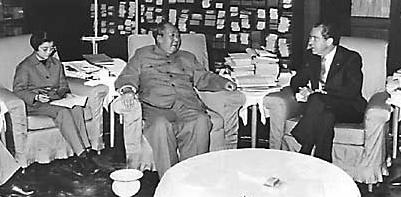
The Chairman would like to ask you about "Laugh In".

The Chairman would like to ask you about “Laugh In”.

Posted in Uncategorized | Tagged , | Comments Off on How to work with interpreters

We’re Hu Jintao’s Lonely Hearts Club Band

Imagethief was interested to see on the front of the Saturday South China Morning Post a segment of a painting that has just been unveiled in Hong Kong to commemorate the tenth anniversary of the 1997 hand-over of sovereignty. This is no ordinary canvas, mind you. It’s essentially a mural, seven meters by three, with the likenesses of Chinese President Hu Jintao and 500 of Hong Kong’s great and good. Here is the segment that was printed in the paper:

Hu-Jintao-HK-Painting

Painted by artist Liu Yuyi, who came to Hong Kong from the mainland in 1991, painting is apparently meant to be inclusive in representing Hong Kong’s political plurality. Nevertheless, there does seem to be something of a pecking order. The (as ever, subscription-onlyPost reports:

[Liu] said he included people of different political views.

Near the edge of the painting stand such figures as Cardinal Joseph Zen Ze-kiun, former chief secretary Anson Chan Fang On-sang and Civic Party legislator Alan Leong Kah-kit.

Tycoons Li Ka-shing and Stanley Ho Hung-sun were among the closest to the state leaders in the canvas.

Some key members of the Democratic Alliance for the Betterment and Progress of Hong Kong and the Liberal Party were also close to the action. Liu, who has lived in Hong Kong since 1991, said he had not yet decided whether to auction the painting, although some interested buyers had contacted him in recent days. “I may just give it to the state,” he said. “And I don’t rule out the possibility of giving it to the Hong Kong government.”

One wonders where they would put it. Featuring President Hu as prominently as it does, one also wonders if perhaps it might need to be updated in future anniversaries, as the face of China’s leadership inevitably changes.

In addition to the placement pecking-order of Hong Kong personalities, two things about the painting struck Imagethief as particularly interesting. First, in composition and palette it resembles a certain famous album cover:

sgt-pepper

In fact, my colleague Alex, upon spotting the photograph, said, “Hey, it reminds me of Sgt. Pepper!” I am not sure this is the effect Liu was going for. (There’s even a drum partially visible at the very top of the painting.) If you ask me, psychedelic Olympic mascot “Huanhuan”, visible in Liu’s painting, would have fit right in on the Sgt. Pepper cover.

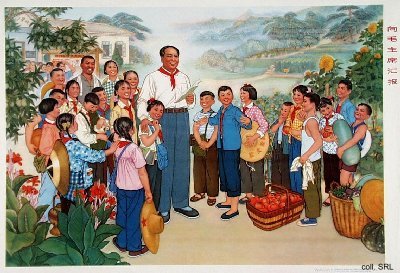
Somewhat more disturbingly, the painting is highly suggestive of Maoist propaganda posters, especially the ones where the Great Helmsman is surrounded by hundreds of cheerful, energetic and well-fed looking Chinese people representing various ethnicities and acceptable segments of proletarian society. For example:

mzd13

Or perhaps this:

mzd15

If you’re having trouble reading the tiny caption on this second poster, I believe it says, “The ever victorious Chairman Mao gets by with a little help from his friends.”*

Look at Hu in the painting above again. In the segment I can see, he is the only person who’s body is completely unobstructed. He has the greatest amount of negative space around him. His hand is upraised in beneficence. He’s surrounded by positive symbols; doves of peace, a pearl of harmony (according to the artist — don’t know if that’s accepted symbolism), and peaches of longevity (which are accepted symbolism). He’s conspicuously taller than Donald Tsang (which may be literally true). Intentionally or not, it’s a case study in cult-of-personality iconography. The only difference is that instead of being surrounded by an idealized version of the common people he’s surrounded by an ordered version of Hong Kong’s power elite.

I leave it to the people of Hong Kong to decide what that means to them. But if Liu does bestow the painting upon the people of Hong Kong, I’ll be interested to hear where they hang it.

Notes:

*It actually says “Follow the communist party forever, follow Chairman Mao forever”, but I like my caption better.

Posted in Uncategorized | Tagged , | Comments Off on We’re Hu Jintao’s Lonely Hearts Club Band

Nobody said media-whoring would be easy

If you follow the Internet in China, you may have heard of a young man who goes by the online name “Zola” (or “Zuola” to be perfectly correct). He has been billed as “China’s first citizen journalist“. Zola first attracted widespread attention when he blogged from the site of Chongqing’s famous (and now demolished) nail house in late March. He also popped upat the recent demonstrations opposing construction of a chemical plant in Xiamen.

It all fit the model of the crusading online journalist/blogger quite nicely. Fame, fortune and –who knows?– perhaps even hot chicks beckoned. Then Zola decided he was going to take a crack at Google, and his fortunes took a turn for the worse.

In what seems to be a move taken from the Michael Moore playbook, Zola showed up at Google’s Haidian R&D office in Beijing armed with a video camera and confronted a security guard and then a receptionist about a customer service problem. The gist of his complaint appears to be that he was victimized by click fraud and then, in resolving that, shortchanged about seventy bucks he claims he was owed by Google. Neither the bemused security guard nor the Google receptionist was much help. The security guard palmed Zola off onto the receptionist (possibly the best move he made that week) and the receptionist alternated between futile attempts to steer Zola into Google’s normal online customer service channels and sullen silence.

Zola posted a ten-minute video of the confrontation on YouKu, which Bingfeng kindly posted a link to. It’s in Chinese, but a rough English transcript can be found on Reading China.

If Zola was expecting to be lauded for putting a burr up Google’s ass, he was, as we used to say in college, on crack (I was going to say “in high school” but I went to high school before the crack epidemic). He was instead pretty ruthlessly savaged in comments to his blog and on the YouKu video. The situation appears to have been aggravated by a bout of petulance over lack of public appreciation for his efforts in the Xiamen PX incident and an admirably honest but image- tarnishing confession that, really, he’s just in it to get famous.

China blogger and commenter-at-large Feng37 was helpful enough to send me a rough translation he did of some of the harsh criticism being launched in Zola’s direction. Here are three consecutive beauties in Chinese and English from Zola’s Bullog blog:

4 支持
[匿名] 火星 @ 2007-6-19 16:24:49
你直言不讳求名求钱,足够坦诚。但你动机如此纯粹,作为公民记者,不免让人对你的职业操守和诚信额度担心。

you’re straight up about wanting fame and money, that’s honest enough. But if your motives are so pure, as a citizen reporter, people can’t help worry about your professionalism, personal integrity and honesty.

[匿名] emlary @ 2007-6-19 23:08:47
网上那么多骂你的人,看来你离出名不远了,不知道你对客服是怎么理解的,不过看来在你之前已经有很多人去过google公司了,对于一点小事就睚眦必报,你觉得真的有这个必要吗?
So many people cursing you out on the internet, it looks as though you’re not too far away from getting famous. I don’t know what your understanding of customer service is, but it looks as though many people have been to Google before you…do you really think it’s necessary to get revenge and report on something to small and irrelevant?

[匿名] 给你一个警告 @ 2007-6-19 23:21:34
你太SB了,小子北京不是你想进就进的更不是你想出就出的
You stupid little cunt, Beijing isn’t a place you can just walk into when you feel like it and leave when you want.

And it gets worse. It’s hard being a celebrity, isn’t it?

As Feng37 pointed out, Bullog does not allow blog owners to delete comments (an interesting and debatably worthy policy). His new blog, http://www.alouz.com/, does allow that, and I am told he’s been making use of that function to purge the unfavorable comments.

In our communications about this issue, Feng37 asked me what advice “a PR 高手” (flattering, if perhaps a tad exaggerated) such as myself would give to Zola at this stage. I am sucker for this kind of challenge, so as much as I hate to be the john to Zola’s media whoring I am going make some suggestions. This is free advice and it’s worth every penny Zola has paid for it.

1) It’s not about you

You were in a good situation when you were covering the Chongqing nailhouse story. You had a sympathetic subject colorfully personified in Wu Ping, a relatively clear villain in the sinister developers, and a nicely unfolding drama that encapsulated a serious issue facing China. The Xiamen PX case had much the same drama and similar social relevance. Then you followed up these two immense dramas by going to Google to complain about seventy bucks they owe you. Spot the inconsistency.

By making yourself the focus of what was a comparatively trivial complaint, you also made yourself look petty and unsympathetic. People are generally not interested in sympathizing with the observer, but with the subject. If you wanted to complain about Google’s customer service, you should have found someone else trapped in their Kafkaesque customer service maze and gone to bat for that person. It’s OK for you be manipulative, that’s part of the art form, so pick someone as tragic and photogenic as you can find. A cancer-stricken orphan with a website, for instance. But you need to channel someone else’s misery, not your own. That enables you to remain comfortably heroic.

2) Pick your villains carefully and don’t humanize them any more than you have to

Google could make a good villain, heaven knows. In the space of three years they have gone from the plucky little startup everyone was rooting for to sprawling, secretive and vaguely sinister monolith that could be the next Microsoft assuming Microsoft knew every little thing about you right down to what kind of p*rn gets you off. But not everyone hates Google. They still have a lot of fans even here in China. Furthermore, it is possible to make a naturally unsympathetic entity (and Google has definitely become that) sympathetic by personifying it in a way that undermines your crusade. In this case, Google was personified by the receptionist who was clearly totally unable to resolve your situation no matter how much you harangued her. In the end I felt sorrier for her than I did for you (although this whole episode revealed some issues for Google China as well — more on that later). The lesson is to go after people who represent power or who are actual gatekeepers for power (like, gulp, their PR people). Next time pick on Kaifu Lee.

3) Grow a thick skin

As they say, the only thing worse than being talked about is not being talked about. If you’ve already confessed that your motive is fame then you better be prepared for the reality that just because people know who you are doesn’t necessarily mean they will like you. And the more you appear to be shamelessly self promoting, the more people will naturally lean toward disdain. Think Furong Jiejie, who never seemed to realize that the joke was on her and ended up being famous (briefly) and unintentionally tragic and embarassing. You don’t want your fame to be of the car-wreck variety.

But even if you are at your best, people will criticize you for any of a number of reasons. Suck it up, dude, and show some confidence. Soak up the criticism and, indeed, revel in it. The price of being a lone crusader is being lone crusader. Show some spine and treat the unbelievers as gnats unworthy of swatting. And remember your basic blogging etiquette: Don’t delete comments or posts if it can be avoided. Consider the fact that controversy on your websites will attract readers and that perhaps you should be cultivating it.

4) Never forget that the Internet is the lowest rung of celebrity

American radio star Howard Stern once said that radio was the lowest rung of the celebrity ladder (and as someone who used to work in radio, I empathize). Fortunately for him, the Internet has finally given him someone to look down upon. Audiences are fickle and celebrity is volatile and often short-lived. That’s especially true of Internet celebrity, which lends itself to transient, “flavor of the moment” fads and freakshows (see Furong Jiejie, above). Durable Internet celebrity is surpassingly rare. We’re all disposable on the Internet. Sucks, doesn’t it? In 1968 a smart man named Andy Warhol said, “In the future everyone will be world-famous for fifteen minutes.” He may have envisioning an Internet-powered world like the one we live in today. Or he may simply have been on dope. It was 1968, after all. But the essential truth of the statement remains. It is important, therefore, not to let Internet celebrity go to your head. Whatever else, don’t act like a movie star until you actually become one.

5) If you’re going to make it about you, consider the value of irony

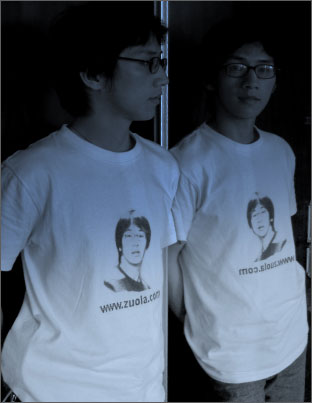
OK, so maybe you’re going to ignore that first piece of advice and make it about you. There is a way it can be done. I note that the front page of your new website has a picture of you gazing into a mirror while wearing a T-shirt emblazoned with–a picture of you. I desperately hope this is meant to be a gentle bit of self-satire. Because if it’s not self-satire then you really are headed for same lonely, post-Warholian purgatory currently inhabited by William Hung (look him up).

If you are willing to mock yourself, then you can ignore most of the rules above. But you then need to recognize that your mission has changed from citizen journalist to comic entertainer. Not everyone has the fortitude to make a career out of irony or self-ridicule, and my guess is that’s not what you want. So think it over carefully because this route will take 100 percent commitment, and it will be hard to mix with the kind of stories that got you notoriety in the first place.

Reflect upon Mr. Moore

I mentioned crusading film-maker Michael Moore on purpose. In crafting this advice, I considered quite a bit what makes Mr. Moore successful. He seems to be in the mold to which you aspire (metaphorically speaking — I don’t think you’ll ever be that big). Michael Moore is an utterly polarizing artist, but whether you love him or hate him he is undeniably a hit. Moore injects himself into his stories, but he is never the subject, only a conduit or engaged observer of someone else’s plight. He chooses his villains wisely (from an American perspective), knowing that his choices will generate controversy that will attract attention. And he is teflon-coated when it comes to criticism. Millions of people hate him. But millions also love him and he is world famous.

So that’s my advice. It is offered constructively. I think China benefits from having citizen journalists, and I encourage you to keep at it and get world famous. Don’t take the media-whore comment too seriously. You’ve already confessed. And, after all, many of us in the blogging and PR biz are media- whores ourselves. We can all whore together. That is what the Internet is all about, isn’t it?

That doesn’t sound like PR advice…

Readers may be thinking to themselves that the above is more advice on Zola’s craft than his PR. But for a media celebrity –even an aspiring one– the two are often related. The persona is the PR. The answer to Zola’s public perception problem doesn’t lie in anything he can say or write, but in how he defines his public persona. Looked at another way, we PR people are often accused of crafting slick, empty words to rescue people or companies from bad situations. Sometimes that’s true. But PR at its best is helping a client to find a genuine, constructive solution to a problem and then communicating the solution. This is especially true in crisis situations, and I think it’s safe to say that Zola has had something of a little crisis. Therefore I have proposed what I think is a solution

Bonus advice for Google China:

Despite the fact that Zola’s Google stunt went wrong, Google doesn’t get a free pass from Imagethief. A basic rule of PR is that in this day and age everyone is a public representative of your company. This is doubly true of a company like Google that is famous, controversial, and the subject of much discussion in China. That secretary was sitting in a Google lobby and wearing a Google T-shirt. How is it that she (and for that matter the security guard) wasn’t briefed on what to do when a journalist came to the front desk? And in the era of blogging and the Internet, anyone waving a camera around in the lobby, even if they are raising a customer service complaint, needs to be treated like a journalist. Especially by the world’s biggest Internet company, which happens to own a huge blogging engine and world’s biggest video-sharing website. Connect the dots, people.

In fact, a good policy might be to assume anyone who comes into the lobby is a journalist until conclusively proven otherwise.

So give the poor girl at the front desk some clear guidance on what to do in that situation, and a simple escalation path she can follow when she is dealing with someone with a camera. That doesn’t mean escalating to security or the police, unless the story you want going public is “How I was roughed up by Google”. Have someone on call who is media trained, savvy and knows enough about customer service to answer questions on the record. Who knows? You might find that these kinds of situations can be turned into PR opportunities.

Hey, nice shirt!

Hey, nice shirt!

Posted in Uncategorized | Tagged , , , , , | Comments Off on Nobody said media-whoring would be easy

China’s food crisis PR strategy: Blame everyone else

A few weeks into China’s rippling food quality crisis a PR strategy is coming into view. It’s a classic one: blame everyone else. Unfortunately, it’s not likely to be all that effective because of two things. First, China does actually have long-standing problems with food and drug quality. Second, China’s poor history of transparency makes it hard for them to dispel suspicion (a problem that also dogs their disease-related communication).

The recent affair began with the discovery that vegetable protein shipped from China to the USA and used in pet food had been contaminated with melamine, a plastic that can make the overall protein level appear higher. Melamine also destroys the kidneys of cats, as it happens, so the contamination was discovered.

In classic fashion, China’s initial response was to deny everything. As a crisis PR strategy this sucked. Nothing makes you look sillier and less credible than retracting a categorical denial made in haste. It taints every following communication. In fact it wasn’t entirely China’s fault. Initially AQSIQ, China’s quality monitor, wasn’t looking for melamine, but another suspected contaminant. But obscure mitigating technical factors don’t tend to play well in the court of public opinion, or excuse prudence. In the face of further disclosure, the Chinese government’s subsequent choices were to appear dissembling or incompetent.

Every country has its fair share of food quality problems. In my native USA E. coli bacterial contaminations are something of a national sport, and I can remember plenty of food poisoning scandals. Eric Schlosser’s book, Fast Food Nation, makes fine reading if you are interested in the topic. The FDA conveniently puts its “refusal reports” –the reports of imports rejected– online. If you want to be horrified, read the Mexican list. Food contamination is not an exclusively Chinese problem.

China’s government has grabbed onto this idea as part of its defense. It has been helped by some recent developments, including the rejection of a shipment of Evian for alleged bacterial taint (a case that stokes the fire of another China PR issue, Danone’s legal war with Wahaha — see this interesting post from China Law Blog) and the discovery of Melamine in some US-manufactured animal feed ingredients. Li Yuanping, director general of the government’s Import and Export Food Safety Bureau, also pointed out that China has in the past rejected US products due to Salmonella contamination, and asserted that China’s record on food exports is slightly better than the United States. Li offered up some winning quotes:

“Ninety-nine percent is a relatively high percentage of suitable goods,” Li Yuanping, director general of the government’s Import and Export Food Safety Bureau, said at a news conference. “Facts speak more loudly than anything. . . . From what I have told you, you can see China has a very sound system that can guarantee the safety of food exported abroad.”

***

“No food-inspection system is foolproof,” he said. “It’s like an airplane. Flying is said to be the safest way to travel, but sometimes you have plane crashes.”

Bad choice of words in Imagethief’s opinion. You think an airline would communicate that way? But I haven’t been hired to advise the Chinese government.

Graceless rhetoric aside, Li might actually be right. But perception is everything. Frank Luntz, a conservative pollster, wrote a pretty good book about public communication called Words that Work in which he relentlessly drove home a key point: It isn’t what you say, it’s what people hear (in fact, that’s the subtitle). You say “99% are good”. Americans in bathed in relentless media coverage will hear, “1% might kill you”. Roll the dice and move your mice.

Like a premature categorical denial, “everyone else sucks too” is considered a weak strategy around our office. You think China’s national ambition is to suck only as hard as everyone else? I think they want to be better. More importantly, as far as the audience is concerned we’re not talking about everyone else. We’re talking about export-driven China, which has a great deal at stake in overseas perceptions of its food quality. In international trade, food and drug safety issues get entangled with every other hot button issue. And in the US right now China is second possibly only to Iraq as the hottest of hot-button countries.

To illustrate, let’s look at that Mexican example above. America simply doesn’t have as big an axe to grind about Mexican imports (except for immigrants) as it does about Chinese ones. Mexico isn’t the emerging strategic rival. Mexico doesn’t hold a trillion dollars worth of American debt. You don’t hear about America’s trade deficit with Mexico (about a quarter the size of the one with China in 2006). By and large, Mexico doesn’t threaten American agriculture so much as it props it up with cheap labor.

You get the idea.

Agenda hockey

Following the great melamine scandal of ’07 a few other China-linked disasters have emerged into public view. In early May the New York Times ran a lengthy investigative report on tainted cough syrup in Panama killing people. The cause was toxic, cheap ethylene glycol from China sold as harmless but more expensive glycerine and used in the manufacturing. The ethylene glycol has been getting around, apparently, as it has also found its way into Chinese toothpaste (proxy link) exported to Panama, the Dominican Republic, Costa Rica (and, for good measure, smuggled into Nicaragua) and, it has been discovered, the United States.

As far back as mid-May, Dave Barboza of the New York Times and International Herald Tribune was writing about China’s “credibility problem” surrounding food exports. The situation has not improved since then. Barboza points out that a thirty-billion dollar a year export business it at risk. And that’s where the agendas come into play. The Washington Post, among others, has run op-ed columns editorializing about Chinese food imports in pretty strong terms. Here’s a recent lede:

And what is madame’s dining preference this evening? Scallops coated with putrefying bacteria? Or mushrooms laced with illegal pesticides?

These delicacies and more were among the hundred-plus foods from China that our Food and Drug Administration detained at U.S. ports last month, Rick Weiss reported in Sunday’s Post. Detained and sent back to the importers, who ofttimes sent them back to us again.

Yuck. The Rick Weiss story linked to in that op-ed piece is headlined “Tainted Chinese imports common”. That’ll stick in people’s heads.

China is busy trying to persuade the United States to allow imports of Chinese frozen chicken, among other things. What stories do you think American chicken farming companies are busy reminding Congress of right now? The Boston Globe, which is not much of a China cheerleader (they regularly run op-ed pieces on China and Darfur and have played a big role in the “Genocide Olympics” campaign), was running gross-out stories on Chinese chicken farming way back in early May, before this whole episode even kicked into high gear. More recently, the American press has been reminding everyone that their vitamins all come from China. That story was by McClatchy’s Tim Johnson, who also wrote an interesting post about this on his blog. Check it out to see some interesting public reaction.

So the picture that is emerging is of a food and drug supervision apparatus that is hopelessly broken and that has been for some time. This will be no surprise to anyone who lives in China, where food scandals fall from the skies like the Shanghai plum rains. But it’s making waves overseas now, with enormous business implications. You might think that a serious, soul-searching look at the state of domestic regulation and enforcement, vigorously communicated, would be China’s solution.

You would be wrong.

The blame game

China certainly takes the situation seriously. In fact, seriously enough that English-language state media in China, in the form of the China Daily, excoriated China’s regulators for their crappy communication (here reported on by the AP). That is significant. In fact, suggesting something of an editorial slant, the China Daily also went so far as to publish a Wall Street Journal story titled “China confronts crisis over food safety” in its entirety on the China Daily website, with attribution and an external link.

The popular Southern Metropolis Daily also ran a column by journalist and blogger Lian Yue, translated by Danwei, that linked the food safety problem to broader problems in China. I don’t know if similar commentaries ran elsewhere in Chinese language media. Anyone who has seen anything should post a comment.

But the official response from the government, represented largely by AQSIQ, has been essentially to blame anyone and anything but the system.

In the case of the Panamanian cough syrup, the deputy head of AQSIQ blamed Panamanian traders, an account disputed elsewhere. In the case of the tainted toothpaste, China is accusing the American FDA of sensationalizing the situation. In that same story the head of AQSIQ’s food safety division accused the foreign media of the same thing, describing their reporting on the scandals, in an exquisite choice of words, as “wanton”.

The charge of media sensationalism may be justified to a degree, but blaming the media is almost never an effective PR strategy. It carries an inescapable whiff of Scooby-Doo, as in, “I would have got away with too, if wasn’t those meddling kid reporters!”

Finally, the Chinese government is blaming its former drug chief, Zheng Xiaoyu, for the entire situation (interestingly, a Google search for his name this morning causes Nanny to issue the deadly “server reset” message). The unlinkable South China Morning Post drove the point home with a headline last Friday that read, “Corrupt drug chief blamed for scandals.” AQSIQ and the State Food and Drug Administration (SFDA) double-teamed on this one:

SFDA spokeswoman Yan Jiangying said the agency should not be blamed for Zheng’s mistakes. “I want to highlight that we should not dismiss the entire drug supervisions system because of a single person, Zheng Xiaoyu, and we should not extend the mistakes made by a single person, Zheng Xiaoyu, to the mistakes of the entire system,” she said.

So its Zheng Xiaoyu’s fault if you had any trouble reading between the lines. And people say the Chinese are cryptic.

When China rolls somebody’s head over a scandal it’s not always a metaphor. To show how serious it is about that accusation, Beijing has sentenced the hapless Zheng to death. It has been a long fall for the man who was tasked with cleaning up in the wake of the awful Anhui baby formula scandal of 2004.

Killing the wrong chicken

Let’s go back to Frank Luntz’ point about it not being what you say but what people hear. Executions have a proud tradition as public communication. China thinks that the message that they are sending  with Zheng’s sentence is, “We are goddamn serious about this.” Imagethief is willing to bet that the signal received by overseas audiences will be, “We are so thoroughly corrupt that we had to execute our former top drug regulator.” The question going through heads overseas will be, “Well, whom haven’t they caught yet?”

Executing a mandarin probably won’t have any effect at all on the small processors and exporters who seem to be responsible for most of the problems. Zheng is too far removed from them. Unless small companies feel the weight of enforcement landing squarely on their own shoulders, with an attendant shift in the overall risk/reward equation, their behavior won’t change.

The lingering question is whether a combination of endemic corruption and industry fragmentation render the problem unsolvable. An Imagethief commenter named Jim recently made a good point. He wrote:

Processing millions of tons of food, through millions of workers in tens of thousands of large and small companies, with high cost-cutting motivations, from millions of farms through thousands of transportation companies to millions of sellers to tens of millions of buyers, is hard.

Yes, it is. But I’m an optimist and China needs to show that it is serious about regulating that very process and enforcing vigorously if they want to get past this episode. And they need to clearly communicate exactly what they are doing to both domestic and overseas audiences. Good crisis PR isn’t about bluffing your way past a real problem, it’s about explaining what you are doing to solve it. No one will expect China’s food problems to be fixed quickly, but people can be pretty forgiving in the face of some contrition and obvious effort.

The other option is to keep pointing fingers elsewhere. That might save face and keep people at home happy, but it won’t influence overseas audiences who will keep hearing in the most visceral terms possible how broken China’s regulatory system is. Doors will slam on Chinese imports. Overseas manufacturers conscious of their own brands will look elsewhere for ingredients. And the Chinese government will look foolish and self destructive when the next scandal boils out of the bowels of a broken system.

Posted in Uncategorized | Tagged , , , , , , , | Comments Off on China’s food crisis PR strategy: Blame everyone else

Stupidvator

One of the fine things about moving to a new city is that you always encounter something you’ve never seen before. In Shanghai I experienced the thriving majesty of the Huangpu river, the early-morning army of huishou men and women that prowl the city with bells made of pot lids, the glittering towers of Pudong (better from a distance), and the shady intimacy of the French Concession. Less charmingly, I also experienced the most annoying elevator ever made.

I’ve been riding elevators for many years and I like to claim a fair mastery of their use. I am not mystified by their operation, don’t think they are magic, and am pretty sure that I am not being teleported when I use one. When an elevator door closes on a car packed with people and opens to emptiness, I don’t assume the passengers have been disintegrated or dumped into a pool of crocodiles (although from time to time I have wished for that). Rather, I assume they have debarked conveniently upon the floors of their choosing. Yep, elevators and I are old and trusted friends.

Until now. In Shanghai I stumbled upon a type of elevator I had never seen before. An elevator that rewrites fundamentals of how one summons and uses an elevator. An elevator that shifts not only people, but paradigms of elevator operation.

It also lives in my apartment building and annoys me no end.

The difference is deceptively simple. Instead of a call button on the outside and an array of floor selection buttons on the inside, our elevator has a single calculator-style keypad on the outside. The keypad serves two elevator shafts. To summon an elevator one presses the button or buttons for the desired floor. I live on the seventh floor, so I press “7″. If I lived on the 19th floor (I can but dream) I would press “1″ then “9″. The LCD panel acknowledges my input and flashes an arrow to show which shaft I should wait by. If I enter an invalid floor number like 968 (don’t think I haven’t tried), I get a demure “?” in return.

When the elevator arrives, an LED panel inside the inner door frame shows which floors the car will be stopping so you can verify that you have in fact waited by the correct shaft as directed.

Simple, no?

No. This is a perfect example of taking an elegant, robust, time-tested system and over-engineering it into finicky obnoxiousness. Thank you, Schindler Elevator Corp, for gifting this upon the world.

First of all, no elevator should need an A4-sized plaque of directions explaining how to use it, but that’s what our elevator has. Apparently it confuses enough old people and children that the instructions were necessary. Perhaps people were just piling up in the lobby. I can explain normal elevator usage in four bullet points, just in case I happen to run into a Shipibo tribal elder in the lobby of a building:

  1. Press the call button
  2. When the elevator arrives, step inside
  3. Press the button for the desired floor
  4. When you arrive at the desired floor, as indicated by the display, get out

But this elevator needs illustrations and arrows to make clear its method of operation.

Imagethief presumes the select-floor-first method of elevator operation is supposed to speed things up. If everyone waiting for an elevator has selected a floor already, a mighty electronic brain somewhere in the bowels of the building can super-compute an elevator routing solution of maximum efficiency. But our buildings supercomputing brain must have blown a tube because our elevators take forever to show up. I think, freed from the simple linear order of normal elevator operation, the brain gets hung up on some kind of neurosis. Sure I could get the kids in the lobby now, but that auntie on twelve is only going two floors…What do I do? Confronted with this strategic calculation, it elects to punt. It’s just one more example of how much a single bad algorithm can fuck up your day.

And there are some other disadvantages to the system.

First, let’s say you’re running for a normal elevator. As long as you make it through the door, you’re home free. You can press the button for your desired floor at leisure. You can even set down your groceries to do it. But with our elevator that doesn’t work. You’ve got to get your floor entered before you step on, which means speedy key work before the doors close, or jamming a hand in to open the doors and then entering the floor outside while everyone else waits. Trust me, when you’re all flustered from your run and have ten pounds of cat litter hanging from one wrist and thirty eggs from the other, a fast floor-entry isn’t as easy as it seems.

This situation is aggravated if there are several people scrambling because each person has to enter his or her floor outside as well. Unlike a traditional elevator where as many people can press buttons as can simultaneously get their grubby little fingers near the panel, this system is strictly one-at-a-time. We have more than twenty floors, so at peak period this can take a while. Queue up.

Of course, when you’re in a hurry you sometimes sacrifice some accuracy. Thus when going down I have entered “11″ or “12″ instead of “1″ on a couple of occasions. Tough luck. I’m committed. And if you step inside the car before you notice, there is no bailout option. You can’t press the button for the next floor along and make a graceful exit. It’s the round-trip.

Furthermore, I have been conditioned for the past 39 years to press a floor button after I get on the elevator. I just can’t shake this habit. After I step into my building’s elevator I have to suppress the desire to jam my index finger into the bare, stainless steel repeatedly. People in my building already think I am wierd enough and anything more is likely to scare them. I suppose I could stab the “close door” button, but I have already conditioned myself to avoid that because nothing annoys me more than passengers who want to “drive” the elevator, and spend their time working the “open door” and “close door” buttons repeatedly.

There is also a social aspect to the process as well. We all get in; we all enter our floors; and we all enjoy the cameraderie of the elevator. Everybody knows who is going where. None of this cryptic skulking by the panel outside.

This is all just one more sign that I am getting old and increasingly reject newfangled “conveniences” that disrupt my entrenched habits. You say “iPod”. I say radioactive brain-scrambler. So be it. I welcome crankiness, and you can expect more of it as I confront my inevitable 40th birthday and propulsion into actual adulthood (I’ve been procrastinating it successfully so far).

In that spirit I’d like to go beyond criticizing my apartment’s elevators and say that I reject the idea of electronic controls for elevators completely. I’ve had it with blinking lights and fabulous electro-conductive buttons with ethereal, blue lighting like the elevators at my office (they light up for nothing; don’t even look at the button for a floor you don’t want to stop on). I want my elevators controlled by a person. And not one of those sullen girls who operate the elevators in old apartment buildings in Beijing. They can’t be bothered to look up from their books, and they knock off at midnight forcing you to walk down ungodly flights of stairs on your way home from late-night beer-swilling sessions with Chinese friends. I want no part of that. I want my elevator operated by a height-impaired man named “Rudy” who wears a velvet waistcoat and a fez and who salutes when I enter the car. This is China; shouldn’t be too hard to arrange.

And as long as I am complaining, what is it with bathroom icons in bars? I’ve been seeing a lot of “pipes” and “high-heeled shoes” to indicate men’s and ladies’ rooms these days. This is totally unsatisfactory. What are you supposed to do if you’re a pipe-smoking woman? Or a drag queen in heels? What about if you are pipe-smoking drag queen? You might simply give up in confused frustration and take a leak in the hallway. I don’t know about you, but stumbling across a pipe-smoking drag queen taking a leak in the hallway throws me off my game. And I grew up in San Francisco’s Castro district in the seventies. Let’s not encourage it in Xintiandi.

Posted in Uncategorized | Tagged , , , | Comments Off on Stupidvator