Why the Yilishen ant-farming scandal was the perfect China story

Imagethief recently found himself huddled in a wintry hutong courtyard in conversation with two longtime Beijing-based foreign correspondents. During this discussion we came to the conclusion that the recent Yilishen ant-farming scandal is more or less the perfect China story. It brings together at a stroke all of the elements of the modern Chinese story. And surreal story it is.

If you’re not familiar with this incident (and you really should be), you can go read Mark O’Neill’s comprehensive article on Asia Sentinel, or any of several other stories which, collectively, have generated something of a bumper crop in pun headlines.

But if you’re pressed for time here is a synopsis: The Yilishen Tianxi Group, a Shenyang-based company, was manufacturing an allegedly aphrodisiac tonic made from ants, which are widely believed to have medicinal properties in traditional Chinese medicine. But rather than wrangle ants itself (nothing feels as good as bringing in a herd, I hear) Yilishen’s scheme was to sell would-be ant farming “investors” boxes of special medicinal ants at RMB10,000 for three. Along with the boxes came a promise that once the ants matured (read: died), about 14 months later, Yilishen would buy them back for RMB13,250. That’s a 30% guaranteed gain over 14 months which, while not quite pre-meltdown A-shares, kicks the ass of many a hedge fund.

Except that the Yilishen ant trade was a pyramid scheme, and it went spectacularly bust, leaving tens of thousands of Dongbei punters short RMB10,000 and long three boxes of worthless ants. Not exactly Warren Buffet. Outraged ant farmers from across Liaoning province rioted in Shenyang, the government imposed a news blackout and the wujingarmed police headed north to diligently maintain a harmonious sociey, which is hard under these circumstances.

You simply could not make it up. Ten Hollywood screenwriters locked in a closet with a kilo of blow, a brick of twenty dollar bills, your sister and a cigar-smoking chimpanzee in boxer shorts wouldn’t come up with this. Even if they weren’t on strike. Only China comes up with this. And not only does China alone come up with this, but the story also nicely draws together all the threads of the modern, Chinese narrative and ties them into a pretty bow. Just look at what this story offers:

Social Issues
The Dongbei is China’s rustbelt; a swathe of deep-frozen, fading industrial towns that were once the showpieces of Maoist industrial collectivization. While the cosmopolitan port city of Dalian has blossomed in China’s post-reform economy, much of the region has struggled to keep up with the go-go development of the two Deltas and the capital. Hence the “振兴东北老工业基地” (Revitalize Northeastern Industrial Base) campaign and those tragic stories of families’ life savings being sunk into ants and ant-aunties pooling the funds of their neighborhood taiqi group to go in on a few lucky boxes. Apparently about a million people bought into the ant-dream. Could ant farming be symbolic of the economic desperation of an entire region? Or might it just be a punt? Who cares, because there was also…

Sex
About 98 percent of Chinese medicines are aphrodisiacs. The average Chinese pharmacy is about half aphrodisiacs and half prophylactics with one or two boxes of nasty, herbal flu medicine just in case. The reason why rhinoceros and tigers have been hunted to near extinction is to make Chinese aphrodisiacs. Imagethief himself once appeared in a television commercial for a Chinese aphrodisiac. They’re that ubiquitous. You’d think the Chinese had never heard of p0rn. And what goes better with sex than…

Corruption
Yilishen Group turned out to be well connected throughout Liaoning provincial circles. This had apparently helped fuel its rise in the province, but also motivated embarrassed local officials to make the whole situation go away as soon as possible. That left bereft antherds with the usual channels of legal recourse available to the small-time victim under provincial Chinese jurisprudence: none. Therefore, the only alternative was…

Mass incidents
Ten thousand ant farmers rioted in a provincial capital. Imagethief asks you: What country other than China could cough up that lede? Mass incidents are the sine qua non of the modern Chinese scandal. In a rare and rapidly regretted moment of candor the authorities once admitted that there were 74,000 of them in 2004, up 28% on the year before (not quite as much as the pre-collapse return on ants, but still pretty good). No pressing social issue is complete without one. Chemical plant going up on your rice paddies? Shanty being expropriated for Olympic development? Local manufacturers turning your once limpid lake into a festering pool of PCBs and heavy metals? Two words: Mass incident! However, this may be the first one caused by…

Ants
Ants? Yes, Alice, ants. Imagethief tries to maintain a culturally sensitive respect for traditional Chinese medicine. Indeed, when I pinched a nerve in my shoulder two years ago I took traditional Chinese medicine and had a round of cupping (note to Americans: it’s not as dirty as it sounds). It worked, I believe, only because the medicine was so nauseatingly foul and the cupping so excruciatingly painful that I willed myself to recover so that I wouldn’t have to endure a second course of treatment.

But, really, an ant-based sex tonic? Hasn’t this ground been trodden before? The image of so many fevered, Chinese investors hunched over their RMB10,000 boxes of magical ants is both funny and desperately tragic. Unfortunately it was all a bit too much embarrassment for the Chinese authorities, so naturally…

The whole thing was harmonized
Mainstream coverage evaporated and the search term “Yilishen” went down the Chinese Internet memory hole once the authorities decided they’d had enough. Previously uploaded videos and blog posts dropped gnats in a frost. China’s pre-eminent citizen journalist, Zuola, a veteran of the Chongqing nailhouse and Xiamen PX stories, wasescorted out of Liaoning. To add insult to injury he was apparently made to pay for his own plane ticket. No word on whether he had to pay for the tickets of the goons who escorted him.

Imagethief has a friend from Shenyang who complained bitterly about the suppressed media coverage. “It’s not like we don’t all already know about it,” she said, admitting that her own parents had been among Yilishen’s legion of ant farmers. “It’s so…” she considered the English word she wanted to use…”insulting.”

Meanwhile, many of the Yilishen riot videos harmonized from Chinese video sharing sites have found their way onto YouTube. You can’t keep a good story (or a bitter ant tonic) down.

And that’s all there is to it
Imagethief in no way wishes to minimize the plight of Yilishen’s investors. RMB10,000 is a lot of money by any standards. My friend from Shenyang also explained that her parents neighbors had invested RMB60,000, and they knew people who had invested a whopping RMB1,000,000. Imagethief also doesn’t think that investors in Yilishen’s ants were stupid. Scams and pyramid schemes thrive everywhere. Successful ones are cleverly engineered to appealed to the society in which they operate. Yilishen was a well known brand that had been in business for several years and had a good reputation. Traditional remedies are still widely used and respected in China, and ants are part of the pharmacopoeia. Virility tonics are popular. Combine all of that with a cultural affinity for gambling and a get-rich-now zeitgeist and you have a China story for the times.

For sheer swoop and color it sure beats the rise and fall of China’s other great pyramid scheme, A-shares.

Eat me.

Eat me.

Notes:

  • Photo copyright Alex Wild, from his superb ant and insect photography gallery.
  • Imagethief realizes he is a bit behind the story. This post has been in drafting for ten days. Darn those day-jobs.
Posted in Uncategorized | Tagged , , , , | Comments Off on Why the Yilishen ant-farming scandal was the perfect China story

What to make of Edwin Maher?

Imagethief found the LA Times article on CCTV9′s western anchorman, Edwin Maher, quite interesting. I didn’t have time to comment on it when it first appeared, but in general I found the story balanced as it presented both criticisms and defenses of Maher’s choice to work for Chinese state-owned media. It was, thus, interesting to see some of the subsequent discussion that emerged, especially at Black and White Cat, which translated aGlobal Times article excoriating the western press for criticizing Maher.

Rather than rehash old ground, I will point you to Cam MacMurchy’s latest post at Zhongnanhai, which, I think, does a very good job of answering the Global Timescriticisms and analyzing the original story. It’s well worth a read.

I will, however, add a few other thoughts.

What is it about westerners who appear on television that attracts our particular ire? Anyone wanting to look deeper into this phenomenon need only consider Dashan. If there is a foreigner who elicits more widespread contempt from fellow western expatriates I’ve yet to encounter him (or her). One friend of mine attributed this to latent racism. It’s all very well to live and work in China, but to be seen acting ridiculous for the entertainment of the Chinese is taboo. My friend memorably referred to this as the “Dance, monkey!” syndrome.

Maher seems to have earned himself the same kind of contempt. Even Imagethief has written unkind things about him in past. But everyone who works in business in China is complicit with the Chinese government to some degree. We’re all doing our bit to prop up the State. An explicit part of my job is helping foreign companies to pander to the Chinese government. That’s why we’re always helping companies to talk about their “commitment to China”.

It’s true that anything having to do with propaganda or censorship touches a particularly raw nerve in people from liberal democracies (including Imagethief), but there are plenty of other westerners working in the Chinese media. Imagethief has met many bright people who work or have worked for Xinhua, China Radio International and the China Daily.  One of them, Xinhua polisher Chris O’brien, writes Beijing Newspeak, one of the best China blogs around. The now defunct Positive Solutions gave us an entertaining inside look at the China Daily for nearly two years. (Positive Solutions author Charlie has since gone on to more glamorous things, like many other western veterans of Chinese media.) Cam himself is a Chinese media veteran.

But both Chris and Charlie also excelled at taking their employers down a peg, and giving the rest of us amusing glimpses of the mechanisms driving state-owned English language media. I believe they were forgiven because they were seen as our spies inside; people who obviously didn’t buy into the product. And, of course, neither of them was in a publicly visible or bylined role.

And this is where Maher is different. He is very visible and in the LA Times piece he is unapologetic. I believe that’s what leads those of us who don’t know him personally to dismiss him. We observers of China’s state-owned media have perfected our airs of cynical dismissal. We know how it works. We know the agenda. We can read between the big and clumsily drawn lines. We’re always happy to ridicule its amateurism and censorship. Armed with our prejudices, when confronted with someone who publicly buys into the mission of China’s English language media we are forced to see them as either dupe or collaborator. And also, if you want to be incendiary, as race traitor. None of those labels allows much room for nuance or charity.

I don’t know Edwin Maher and I don’t think it is fair for me to judge him as an individual. On the other hand, I think it’s perfectly fair for me, or anyone else who watches CCTV9, to judge him as a media professional. Other than as a crude barometer of the Chinese government’s agenda I don’t have much time for CCTV9, or any of the state-run English language media. Their failure isn’t in presenting the Chinese government’s point of view, but in doing so spectacularly clumsily. Maher shouldn’t be criticized for helping the Chinese government to tell its story. If anything, he should be criticized for not helping them to tell it better.

See also:

Inside Chinese state TV (Informed Comment – H/T ESWN)

Posted in Uncategorized | Tagged , , , , , | Comments Off on What to make of Edwin Maher?

I hate Secret Santa

Imagethief likes the holiday season. He is not one of those December curmudgeons who bah-humbugs his way through Christmas. Give me trees, tinsel, candy canes and a big dinner with my friends. My dad used to roast a goose for Christmas. How traditional is that? And we’re Jewish.

There is, however, one Christmas tradition that I dread every year, and that never gets any easier to deal with. That is the office “secret Santa” program.

Anyone who works in a large office probably endures something similar. The way it works in our office is that the office assistant walks around with a box from which you draw the name of a colleague. You then have to buy that person a gift for under 50RMB. The gifts are all presented at a Christmas party at which Santa Clause, played by the white guy who most recently joined the company, calls each person up one-by-one to receive his or her anonymous gift. I did the Santa gig myself my first Christmas with the company, three years ago, and spent a miserable, hot, itchy two hours in the Santa suit pulling artificial whiskers out of my mouth while my colleagues, sat on my lap one by one. Someone else will be pulling those same spit-encrusted whiskers out of his mouth this year.

I would play Santa every year if I could only get out of the gift-giving, though.

The problem is that we are a fairly big company and I inevitably draw the name of someone I don’t know. This is a pain because if it’s a friend you have two decent options: either you have some idea of their tastes and you can get something you will be reasonably sure they will like; or you can get them a gag gift and be confident they won’t take the wrong way.

But I never, ever draw the name of someone I know well. I always get the shy, new, Chinese girl who doesn’t talk and whom nobody knows. I have a 100% perfect track record of this. And I know most of the people in the company (although given that I just spent ten months in Shanghai there is a slightly higher proportion of unfamiliar faces than normal). It’s like they’re rigging the draw on me.

In fact, I learned this year that some of my colleagues were re-drawing until they picked the name of someone they knew. I had no idea such a thing was allowed or I would have gamed my own draw. Some people in are office are easy to buy for, such as the company driver (baijiu). But, no, I had to play by the rules and ended up with a new girl who works way at the other end of the office and who has a spartan desk that reveals nothing about her life, loves, hopes, pets, celebrity crushes, get-even list, or anything else that might be remotely useful in picking a gift.

Not that with 50RMB to spend I could get all that creative. Our offices are in Oriental Plaza, which features a mall where the list of things that can be purchased for under RMB50 is this long:

  • Dumplings.

Trust me: You don’t want to leave a box of gift wrapped dumplings under the tree for too long, unless you want to deck the halls with vomit on Christmas morning.

Thus inspired, I invariably procrastinate my purchase until the last possible minute and then end up in one of two places: Watsons or the “Ole!” supermarket. There I end up contemplating the usual range of naff or inappropriate possibilities. Doraemon shampoo? Nahh, toiletries are too personal. Who knows what fragrance this girl likes? Condoms? I don’t want to be hacked to death by her family And anyway, the Japanese ones are RMB75 and thus over the budget. Muesli? Nail polish? Stationery? A fake Rolex? (You have to go outside to buy this.) None of it seems very exciting. And the western get-out-of-Christmas-jail-free card, the gift certificate, doesn’t really seem to exist here.

I actually thought about breaking the rules this year and spending semi-lavishly just for the hell of it. Why not buy her a real Swatch or Casio watch? Or an iPod Nano? Or a sexy mobile phone? That would rock the party. But it might also kindle jealousy, dangerous recriminations or the (wrong) assumption that a certain Santa was on the make. The program might be “anonymous”, but even a fairly retarded detective could identify the offending Santa by simple elimination. This is especially true as secret Santas tend to out themselves at the party unless they are particularly ashamed of their gifts.

Faced with these undesirable options I elect to punt: I buy candy. At least, my theory goes, she can share it with her teammates if she doesn’t like it. Having become acquainted with the strange, Chinese fascination for a certain kind of imported candy, and mind controlled by the miles of it on display, I made the inevitable choice. Ironically, even though I have a world-beating sweet tooth inherited from my English, goose-roasting father, I hate this particular candy. How pathetic is that? I  bought this poor girl whom I don’t even know candy that I can’t stand because I was too creatively bankrupt to come up with a better choice. Merry freakin’ Christmas.

To make this situation extra tragic, I have one-and-a-half boxes of this same candy sitting at home. They were brought over to my house by one of my colleagues when I had a team dinner recently. But these were in a distinctively shaped package, and I didn’t want to give the same configuration, lest my naked re-gifting ploy be spotted. Those candies are destined for my ahyi. She’s from Anhui. She’ll eat anything. Or, more likely, huishou it for cash.

So bought an RMB45 box of candy I already had and put in a gift bag that cost another RMB20, thus putting me over the limit but, I figure, allowing me to squeak by on a technicality as the bag isn’t technically the gift. I probably should have given her an envelope with cash in it.

I console myself with the thought that most of my colleagues, Chinese and foreign, aren’t much better at this than me. While buying my “gift” today I bumped into another colleague who was on the same mission. She, however, opted for default choice two, different famous candy brand. A couple of years ago one colleague of mine was so unimpressed with her secret Santa gift –which I won’t describe here for fear of driving someone to suicide– that she “forgot” it in the back of a taxi on the way home from the party. It wasn’t even worth passing to her ahyi. It was that bad.

At least I have this burdensome task dealt with for another year. But I’ll be on a plane back from a meeting in Japan during this year’s Christmas party. That’s a shame because, secret Santa aside, I genuinely enjoy the Christmas party. But at least I won’t be there to see the look of numb indifference on my colleague’s face when she becomes the 20th person that evening to receive a box of the same candy.

Ho, ho, ho.

Note: Slightly edited from the original to add some deniability.

Posted in Uncategorized | Tagged , , | Comments Off on I hate Secret Santa

Notorious MDA: The Singapore government raps

From time to time someone will ask me why I left Singapore for China. This is a fair question. I lived there for nearly a decade, Mrs. Imagethief is Singaporean, and I have great affection for the place. Usually I give some longish explanation about various professional and personal frustrations that were beginning to set in. From now on, however, I’ll simply be able to point people at this video on YouTube:

Via Singapore ultrablogger Mr. Brown, this is a four and  a half minute hip hop video produced by Singapore’s Media Development Authority. The MDA is the statutory board that regulates media content in Singapore and, as you would expect from its name, promotes the development of Singapore’s media industry. The video features the senior management rapping about their respective roles.

God help me, I don’t know where to start on this one. But I’ll try. Remember how embarassing it was when you were in high school and your parents tried to act “cool” in front of your friends? Now imagine they did that and commited the results to posterity on YouTube. In your name.

It is often remarked that the Chinese government considers the Singapore government a role model for successful technocratic authoritarianism. Whatever the Chinese government learns from Singapore, let us pray that it does not absorb the idea that rapping bureaucrats is a good idea. The State Council has enough on its mind what with the Olympics, mass rural-urban migration and the Yangtze silting up behind the Three Gorges Dam. They don’t need to be spending nights in the studio trying to figure out what rhymes with “Zhongnanhai” over a phat groove.

Also, there are several people featured in this video, but not one of them has any discernible rhythm. Statistically you’d think one could carry a beat in common time. We’re not talking bebop here, or some kind of freaky experimental meter. One, and two, and three, hit the BEAT. Count it off, it’s not that hard. Not that they had much to work with. There must be some kind of award for coming up with hip hop lyrics that include the phrases, “KPI”, “service oriented architecture” and “beautify our fusionopolis”. If you can’t bring yourself to watch the whole thing, the lyrics are here. It’s not much easier to read than to watch or listen to.

Having dispensed with the artistic criticism, let me approach this from a public relations point of view.

Imagethief is all for using new media. If I squint hard enough and jam my thumbs into my eyes I can kind of see the rationale for doing this (although it could just be the flash of my retinas detaching). You want to explain the role of your bureaucracy in a catchy way that reaches out to youth and the creative industry. And some credit must be extended to the MDA for having, well, the balls to try this.

Unfortunately, a pigeon with a nail through its skull would still have the brain power to predict the inevitable result of this project: a catastrophic piece of self-ridicule that drags out for four-and-a-half painful minutes every reason why government involvement in creative industries is a disaster. And why Singapore’s media industry is, like the site of a bad plane crash, so much lifeless wreckage. Seriously, these are the people promoting the development of Singapore’s creative industries? They hardly seem qualified.

Mind you, this is not an internal video that leaked out. Apparently the video was originally distributed with the softcopy version of the MDA’s most recent annual report. It is also available straight from the MDA website, although as of this writing the site was down, possibly due to unintentionally high server load as people gape in slack jawed amazement and slight embarrassment. That’s why I haven’t been able to work out if there is a press release that explains their rationale.

I’d like to take a moment and differentiate Singapore’s media industry and regulators from Singaporeans in general. There are many creative and talented people in Singapore. However it is my observation that they prosper despite the best efforts of the government,  not because of them. Indeed, it has long been Imagethief’s position that the responsibility of government with regard to art should begin and end at cutting cheques for the things that are so edgy, experimental or niche that the market won’t support them. For that reason I see the words “Singapore” + “media” + “development” + “authority” as oxymoronic.

Good communication flows from sincerity, and part of sincerity is being true to who you are. This is especially true in music, where authenticity is essential to the message. That’s why a Mississippi John Hurt record sounds deep-down good but a Joss Stone record, despite her manifest singing talent, sounds a little like a con. One of the great joys of music is of course how genres transcend their origins and find mass acceptance. That has certainly been true of hip hop, where the musical tent has widened a great deal since the days of Kurtis Blow. The Beastie Boys proved long ago that Jewish kids from Brooklyn could do it too.

But the tent still isn’t wide enough for Singapore government bureaucrats. Even bureaucrats need to be true to themselves in communication. It doesn’t mean that they always have to use soul-deadening PowerPoint or white papers. By all means they should roll up their sleeves, loosen their ties, mingle with artists and tell it straight. But just they should also recognize their limitations. Someone in their communications department should have worked this out and told truth to power. Unfortunately the communications director of MDA is one of the people in the video.

The result is a lot snarky blogging (including here) and yet another example of the Singapore government getting itself written up as “odd news”. That is not communication success.

The Singapore MDA is not the first bunch of suits to fall victim to siren call of hip hop as a tool for youth communication. They’re following a trail already blazed (if that is the right word) by Singapore’s ruling People’s Action Party. The Hong Kong Institute of Chartered Public Accountants also gave it a try with similarly dismal results. But at least they had some babes and “the ‘Tute” sounds like something you can smoke through.

Anyway, having made it this far you probably have a bad taste in your mouth. Turn up your speakers and clear your palate with this.

See also:

The always funny Talking Cock’s wicked take on this, with photos.

Posted in Uncategorized | Tagged , , , , | Comments Off on Notorious MDA: The Singapore government raps

Hairy crabs, the hill of pain and the boulevard of a thousand massage touts

Imagethief went for a hike with some good friends on Sunday. Hiking is one of the things that I was sorry to give up when I moved to Shanghai, and that I’ve been most eager to rediscover upon my return. In Shanghai you can drive for days through the industrial sprawl of the Yangzi delta before you find anything that looks remotely appealing for a stroll. Unless you like walking through cement plants, paint factories and valve workshops.

This isn’t a joke. I recently went with my Shanghai colleagues to Jiangsu’s fabled Yangcheng Lake, home of the world’s most legendary hairy crabs. I was picturing someplace out of a Chinese fantasy. Limpid waters. Verdant banks shaded by drooping willow trees. Graceful pavilions on which maidens in silk gowns would pluck pipas for my pleasure (it’s not as dirty as it sounds) while I feasted on plump crab hoisted fresh from pure spring-fed pools.

Wrong. Yangcheng lake is a suspiciously turbid expanse of water with concrete and rapple banks and ringed by cement plants, paint factories and valve workshops. It’s connected to a labyrinth of local canals that look like they supply the drinking water to Mogadishu. I’d be wary of eating of anything pulled from Yangcheng’s dubious depths, let alone a creature that lives in the heavy-metal sludge and eats the carrion of whatever couldn’t survive in the lake, died and sank to the bottom.

So much for the hairy crabs. They’re overrated anyway. It turns out the Chinese idea of what constitutes damn good crab is something you can easily suck the innards out of. I grew up in San Francisco, eating fat Dungeness crabs. We discarded the innards so we could get to the meat. Better yet, we had the fishmonger discard the innards so we didn’t need to be reminded they ever existed. Nothing but meat and a hollow space in the middle that, as far as you know, was always full of fresh lemon slices. That’s good crab.

A hairy crab has no meat. It’s all innards. And hair. Hence the bliss of my Chinese colleagues, who gleefully explained to me every organ they were eating. Except when the girl sitting next to me got to the testes of a male crab. “You don’t want to know what this is,” she gracefully suggested. Doing my best to ignore the gusto with which crab ‘nads were being consumed at my elbow, I was reduced to trying to squeeze miniscule fragments of meat out of legs the size of toothpick envelopes. You could starve to death doing this.

But this has nothing to do with hiking. Or massage touts.

Shanghai is all industrial wasteland and toxic lakes infested with carrion-eating vermin that somehow got rebranded as a delicacy, probably during one of the many famines. But in Beijing you only need an hour on clear roads and you’re back in the dongbei in all its rural, dustbowl splendor. This is fine for me because, as it happens, I like rural dustbowl splendor. There is something about Northeast China that evokes loneliness, resilience and endurance honed in an endless arid wasteland. The ghost of hard times still lingers over these lands.

Plus there are mountains. We climbed into the remote hills somewhere north of Beijing where there are desolate stretches of unrestored Wall traversing peaks with panoramic views stretching from Beijing’s smoky basin to the Kangxi grasslands. I am told this is where the Mongols fed and watered their horses before riding through the pass at Badaling (where the famous touristy section of wall is) to assault the capital.

I nearly didn’t manage the climb. I run three times a week when I’m being good and can go on flat ground more or less indefinitely. But hill-climbing fitness is different, and I was contemplating the pros and cons of a good vomit within about twenty minutes of setting off. It didn’t help that my hiking companion leaped up the mountain like a goat on speed. To add insult to injury, he smoked his way up and down. The road to true fitness apparently leads through Marlboro country.

Outside of the embrace of Beijing’s heat island it was also cold enough to freeze the water in our bottles. A ripping wind peeled the skin from our lips and reminded us all why living in a porous, brick hut in the dongbei is not, perhaps, an ideal lifestyle. And why this is the land that gave birth to the kang, a traditional bed warmed by the exhaust of a fire.

But the worst penance of the trip came the next day. Sometime during the night someone secretly replaced the fine thigh muscles I normally use with bags of broken glass soaked in vinegar and cat urine. Or that’s what it felt like when I tried to walk. This is what happens when you let moving blow up your workout schedule for a month and them climb a mountain with smoking gazelle-man. I spent the next forty-eight hours doing an extremely good impression of an eighty year old man with crippling arthritis. I also experimented with every variation of the standing up and sitting down groans.

On Monday evening I worked a bit late. Knowing that by the time I got home it would be so late that I would blow off the gym yet again, I decided to walk from my office in Oriental Plaza back to my apartment at China Central Place. I figured this would give me some exercise while also enabling me work some of the devastating soreness out of my legs.

I have no idea why we always think the solution to exercise pain is more exercise. This is total BS and should be resisted. Nevertheless, I enjoyed the walk. This was unexpected, because it was an hour and fifteen minute slog down Chang’an Jie and Jianguomen, past the world’s champion assortment of dour, institutional looking buildings and vaguely seedy hotels. I put it down to the odd euphoria that returning to Beijing has generated in me. This could be because I am deeply affectionate for this sprawling, funky city. Or it could be some kind of toxicological effect from all the pollutants in the air. Either way, it’s a good feeling and I’m nursing it.

In addition to enabling me to survey at leisure what an architectural wasteland Beijing’s central artery has turned into (Wanda Plaza, anyone?), it gave me a chance to sample some of the city’s finest massage pitches. By which I mean prostitution pitches. You can always tell when you cross from an office’s or institutional building’s frontage to one of the hotels because you immediately get hit with, “Hello? Massage? Girl?” And, to up the ante, “Pretty girl?”

In the course of my walk I got it from singles, tag-team pairs, men and women. But the all time winner was a girl who glided past me on one of those preposterous, little folding bicycles with wheels the size of salad plates. She had long, black hair and was painted unnaturally pail, so her face leaped out in the darkness. She had false eyelashes so big it looked like she could have propelled herself along by flapping them.

“Helloooo,” she cooed in a singsong as she carved out graceful turns in front of me. “Massage?” And then, “Hellooooo! I love you!” And then, with a final flap of those absurd, batwing eyelashes, “Hellooooo! Sex?”

On the bicycle? I wondered. But it was too late to ask. She had given up on me and was pedaling off down the sidewalk. While I was still writing down her pitch in my notebook a rough looking man in a leather jacket came up to me and said, “Hey, massage?”

It really is great to be back in Beijing.

Posted in Uncategorized | Tagged , , , , | Comments Off on Hairy crabs, the hill of pain and the boulevard of a thousand massage touts

Further adventures in glamorous international travel

Having arrived in Macau, the romance continues. First was immigration, where the lines crawled as officers stamped arriving passengers in with the indifferent sloth that seemed circa Vietnam, 1996. My immigration officer painstakingly inspected every stamp in my generously stamped passport. It’s Macau. There are only two reasons why I would be coming: The GSM Asia Congress or to gamble. And it ain’t to gamble.

Still, Imagethief has always believed that if there is one overarching indicator of a destination’s civility it’s whether the taxis are metered. On that count, Macau is the pinnacle of gentrification while Kuala Lumpur, for example, which has much to recommend it aside from its Taxis, is Gomorrah. There was some language struggle with the taxi driver, but between his Cantonese and my Mandarin I got to the hotel. The five minute drive cost a walloping 38 patacas, a pataca being the Macanese currency, for all intents and purposes a Hong Kong dollar with a silly name. In fact, “pataca” will now replace “zloty” as my general label for ridiculous currencies, e.g. the plummeting US pataca.

On further reflection perhaps that’s unfair. The pataca is at least holding its value.

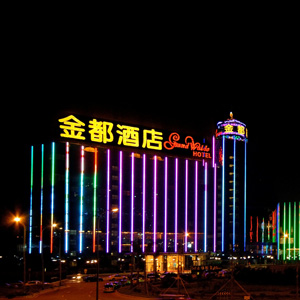
So the taxi driver got me to my hotel, but I rather wish he hadn’t. The name, “Grand Waldo”, should have tipped me off. Seriously: Grand Waldo? In the shadow of the grandeur and surreal artificiality of the Venetian, the “Grand Waldo”, or “金都” to use its pretentious Chinese name, compensates by having the gaudiest exterior lighting in all of Macau. And that’s saying something. I had actually noticed it from the airplane on the way in, never dreaming that this was where I was headed for.

The lobby had a touch of desolation about it, a moody silence punctuated by breathy snapping of a nailgun as some evening renovation work was carried out. At the desk, three attendants went through a check-in routine that was even more laborious and sluggish than Macau immigration.

When I arrived at the desk the woman who was supposed to serve me was distracted first by the need to send a fax to someone, which task took about five minutes, and then by the arrival of a disgruntled man who wanted to complain at length about the crappy service. He was eventually foisted off on the assistant manager, but as I went through check in I listened to his litany of complaints. It ended with him canceling his stay in leaving in search of another hotel. Not a good sign.

Nevertheless, I toughed it out. My room was reasonably sized, and artfully positioned in an armpit of the building such that the maximum amount of the scintillating external lighting shined right in. Fortunately there were blackout curtains.

There was no CNN or BBC, but it did have Fox News (did you know that curvy women have smarter children and Virginia is the state with the most personalized license plates?) and, thank heavens, Al Jazeera (gunfire and political tension between Fatah and Hamas in Gaza, major fire in London). It also had Portuguese soap operas featuring attractive, heavy-breasted women in various states of emotional turmoil and scanty dress. That was worth something.

I dialed room service. I’m pretty sure I dialed correctly because I pressed the button labeled “room service” on the phone. This led to a Kafkaesque phone nightmare in which I was transferred no fewer than six times before I got someone who was prepared to take an order for a club sandwich. 82.5 patacas after tax. The man who brought it to my room wouldn’t allow me to sign for it. I had to pay cash. He didn’t offer to make change for the pataca C-note I handed him. He just grinned and pointed at himself. I was so amazed by this display of chutzpah that he was long gone before I realized he hadn’t left the receipt for me.

An hour later the phone in room rang. “Hi, I was staying in room 620* before, and I think I left a blue comb in there, in the small bathroom.” (It’s a suite.) “Can I come and get it?” This sounded a lot like, “Businessman gets rolled in Macau hotel” to me. I said I’d check in the bathroom. Sure enough there was a blue comb in the bathroom with bits of gel stuck to it. I told the caller to come on down and put the chain on the door.

So he had checked out of this room and into some other room in the hotel and left his comb. Housekeeping had flipped the room, but somehow not noticed the grungy, used comb in the outer bathroom. Meanwhile, this guy was so attached to his plastic comb that he turned up his nose at the one included in the room amenity kit and came back for his.

The icy tendrils of paranoia began to creep up my neck.

At any rate, the comb owner was apologetic enough when he showed up at my door, and made no attempt to roll me or sell me a blow job (which does rather distinguish him from a hotel experience I once had in the aforementioned Kuala Lumpur, but more on James Bond Massage and Fullsex Escort Service and the Cantonese hookers I had to pay to go away some other time).

So it’s all quiet now, and at least the broadband works, as I type here in the glow of Al Jazeera (which isn’t half bad).

I have, however asked my coordinator to look for another hotel for tomorrow night.

*Not my real room number. Like I said, tendrils of paranoia.

Update: Hanging on my room door this morning: The Oriental Daily News, which appears to be a Hong Kong gutter rag that, judging from the layout, is designed for a readership devoted to hard hitting stories about police shootings and starlet misadventures. Still, I suppose it gives you something to read while you yank the crank on your one-armed bandit. You could just about finish a story in the time the wheels take to come up, “Bull’s eye”, “Clown” and “Dog riding a tricycle” or whatever symbols they put on slot machines these days (Imagethief is not a gambling man). I guess the name “William Moss” and the US passport didn’t tip them off.

In all its pomp...

In all its pomp…

Posted in Uncategorized | Tagged , , | Comments Off on Further adventures in glamorous international travel

The up is red

Imagethief was enrocketed to read on Friday that China’s taikonauts –whom I prefer to call “astronauts” because “taikonauts” sounds like they should be exploring my sugar bowl– are considering starting a Communist Party cell in outer space:

“If China has its own space station, the taikonauts on mission will carry out the regular activities of a CPC branch in space in the way we do on earth, such as learning the Party’s policies and exchanging opinions on the Party’s decisions,” said Yang, a delegate to the on-going CPC national congress in Beijing.

“If we establish a Party branch in space, it would also be the ‘highest’ of its kind in the world,” said Yang, who is also deputy director of the China Astronaut Research and Training Center.

It’s funny that Yang should say that, because the word “high” was definitely floating through my head as I read this. But Yang’s statement is a little unclear. Does he mean that that orbiting Communist party branch would be the highest Communist party cell in theworld universe, or the highest grass-roots political organization in the universe? He needs to choose his words carefully here. The former will be nothing more than a gentle slap in the face of the world’s less motivated communist parties. And, let’s be honest, no one really expects the Cubans, Laos or even the plucky Vietnamese to start lobbing cadres into orbit to compete with the Chinese ideological juggernaut. Heck, the Laos are happy when their national airline gets planes down in one piece (trust me, I’ve flown with it).

But if it’s the former, well, that’s a direct challenge to Uncle Sam. You can expect a phalanx of red-blooded republicans to be launched into orbit James Bond/Moonraker style within moments. And I’ll bet you America will go one up. We’ll not only launch a party cell into space, we’ll raise money while we’re there. I’m not sure how, yet, but the Republican national committee will find a way.

You may find it curious that I, a Democrat, mention Republicans here. After all, the American Lunar project was launched (metaphorically) by Kennedy, a Democrat. But somehow, I’ve always seen space flight as kind of a Republican project. Don’t ask me why. Maybe it’s the image of all those square-jawed Air Force types. Plus I am not sure the Democrats are organized enough to get a party cell into orbit.

There is more in the story. It turns out that the Taikonauts wouldn’t be forming a party cell out of unfettered, Lei Feng-style loyalty to the cause. It’s more to do with the party charter:

According to the CPC Constitution, a grass-root CPC organization should be established where there are three or more CPC members. The latest official figure shows that China has more than 73 million CPC members and about 3.6 million grass-roots CPC organizations.

You got that? Three or more. That means you can’t even have your Communist Party friends over for a round of Poker without a party cell breaking out in your living room. How inconvenient. Having a road trip? Better limit yourself to two party members in your car unless you want to spend the whole drive to Guilin discussing dialectical materialism. Try drowning that out with Van Halen.

“Like foreign astronauts having their beliefs, we believe in Communism, which is also a spiritual power,” said Yang. “We may not pray in the way our foreign counterparts do, but the common belief has made us more united in space, where there is no national boundary, to accomplish our missions.”

I’ll pause here so you can inhale the aroma of full-bodied surreality drifting from this statement.

Yep, that’s space. It’s either cowboy Jesus freaks or commies. Makes you wonder what the first lunar colonies will be like, and give thanks that you’re not likely to be living there. If this is who we plan on launching into the universe someday when the sun becomes a red giant (no pun intended) and consumes the Earth, then the rest of the universe had better look out. Frankly it’s amazing space aliens haven’t shown up to wipe us all out just as a precaution.

And to think I wanted to be an astronaut when I was a kid. Those youthful dreams die hard. But I noticed another story last week as well (via the Wired blog). Coincidental timing? You be the judge:

BEIJING (AP) — China hopes to join an international space station project that already counts leading space powers like the United States and Russia as its members, a government official said Tuesday.

China takes great pride in its expanding space program and sees it as a way to validate its claims to be one of the world’s leading scientific nations. But China does not participate in the International Space Station, due in part to American unease about allowing a communist dictatorship a place aboard.

***

“We hope to take part in activities related to the international space station,” Li Xueyong, a vice minister of science and technology. “If I am not mistaken, this program has 16 countries currently involved and we hope to be the 17th partner.”

So, lemme get this straight. The Chinese are talking about starting Communist Party cells at the same time as they are asking for inclusion in the International Space Station? So much for “central planning”. This ain’t the strategy to get NASA to roll out the, um, red carpet. Try talking about how little oxygen Chinese astronauts needs or how they live for weeks on one tube of reconstituted porridge. But don’t talk about the Party. After all, the US government still holds the pink slip on the “international” space station, and the last thing they need floating through their overstretched, little heads is the image of zero-G Marxism study sessions.

Come to think of it, it’s the last thing I need, too.

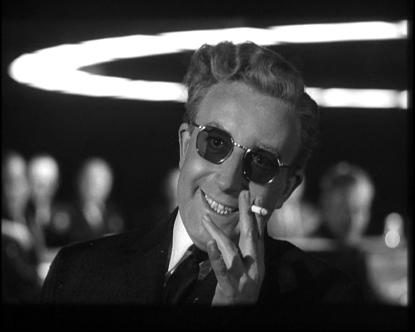
He'll know what to do about this!

He’ll know what to do about this!

Posted in Uncategorized | Tagged , , , | Comments Off on The up is red

Deconstructing the White Rabbit wrapper

Imagethief has rather a sweet tooth. Hence my long acquaintance with the gym and the pleasures of the long run. One of China’s under-appreciated pleasures is the enamel-stripping joy of a chewy White Rabbit Milk Candy. I’m not the first to be smitten, as aquick Googling will reveal. White Rabbit even has a Wikipedia entry.

My friends are aware of my habit for the Rabbit. At a recent birthday party celebrating my 40th I received a bag containing three packages of M&Ms (which I also like), a jar of homemade peanut butter (he uses nutmeg and brown sugar – it’s really nice) and forty pieces of White Rabbit. It was a great present. I’ve been munching White Rabbit happily at work all week.

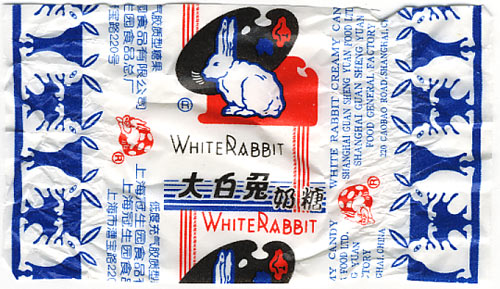
During a lull brought on by sugar-induced bliss I had a chance to study the White Rabbit wrapper (If you want to sound like Elmer Fudd say that five times fast). It’s pretty weird:

white-rabbit

First, note the crazy Art Deco font in both black and red. Then there is not one but three different kinds of rabbits on the wrapper. The central rabbit doesn’t even look like a rabbit so much as it looks like an albino lemon that has sprouted a rabbit head. For reasons known only to the creators this bizarre, lumpy rabbit is seated in front of a painter’s palette with dabs of blue and red paint. The rabbit is apparently engaged in an almighty sneeze. Or perhaps those are albino lemon rabbit whiskers. Who knows?

At the margins are rows of zombie rabbits facing each other in mirror image. They appear to be covered with grotesque lumps, like enormous, swollen zombie rabbit teats. They also have rather spooky eyes.

Finally there are two renderings of a somewhat more contemporary rabbit that is leaping in front of what looks like an enormous mushroom that is either conspicuously magic or conspicuously toxic. Company information in Chinese and English fills the rest of the space.

I think this is a masterpiece of psychedelic candy packaging design, right up there withLemonhead, Pixie Stix and Bazooka bubble gum. Looking at the wrapper now –there are three on my desk– I can taste milky sweetness and hear Jefferson Airplane thundering through my head. There is almost nothing in this design to suggest that what lies within is edible, and yet like a sugary prostitute it screams unwrap me and put me in your mouth!

There are messages within messages within messages in this candy wrapper. I want an A2 size print that I can hang right next to my enormous “Dark Side of the Moon” poster. Then I can gaze at them both while I eat White Rabbit and listen to “Dark Side” through my headphones. If that isn’t a ticket to an alternate universe I don’t know what is. Pixie Stix, perhaps.

Note: Image stolen from Speks International as I was too lazy to scan it myself. A larger image of an apparently older version is here.

Posted in Uncategorized | Tagged , , , | Comments Off on Deconstructing the White Rabbit wrapper

Why aren’t you drinking the Wang Lao Ji?

Imagethief spent a busy two days helping some representatives of a European country manage a last minute press conference. This was a sudden request that had resulted in 36 hours of breakneck work involving much frantic communication, central European languages, weird time differences and assorted ministers, agencies and secret handshakes. Ultimately all went well, but it was a weary team that schlepped its way back to the office.

Upon getting back, I headed for the pantry to get a Diet Coke. Once upon a time I used to drink a can of real Coke a day, but I also used to be 20 kilos heavier. I have a wicked sweet tooth inherited from my father, an Englishman (no further explanation should be required), and kicking soft drinks was a big part of my weight loss program. But we keep a fridge full of the stuff in the office and for the past few months I had increasingly fallen under the seductive thrall of the Diet Coke. Wicked sweet with no caloric guilt!

One-a-day Diet Cokes got to be such a habit that a couple of weeks ago I decided to give up on it for a while, lest I become a poster boy for the as-yet unknown effects of excessive aspartame consumption (are those antennae on your head, or are you just happy to see me?). But after today’s frantic activities, and the hot taxi ride back, I caved. As I was pulling a can from the fridge in the pantry our assistant finance manager flounced in, all floral sun dress and bright eyes, and said to me, “Why aren’t you drinking the Wang Lao Ji?”

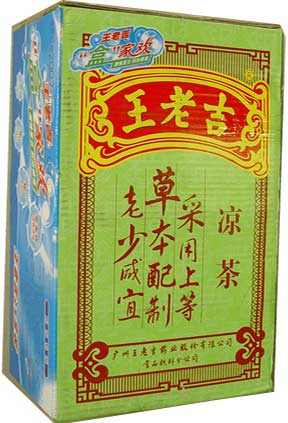
I really had no answer for that. I had noticed that little cartons of Wang Lao Ji had started appearing in the fridge a week or two before. They looked a bit incongruous next to the Coke and Fanta Orange that are the mainstays of our beverage selection. Wang Lao Ji is a Chinese soft drink based upon a herbal tea. It’s advertised on busses across the nation and  recognizable by its distinctive red and yellow logo. Like any Chinese food or drink with a tenuous connection to the world of Chinese herbology, it is ascribed mythical powers as a tonic, including the ability to forestall diseases you’ve never heard of and increase various vital essences. Most of this is marketing courtesy of the manufacturer, a large Guangdong-based beverage and pharmaceutical company. On a more practical level, the Black China Hand has cited Wang Lao Ji as a hangover cure.

Despite all this, I was stumped as to how to answer my colleague’s innocent question. She rushed to take advantage of my speechlessness. “It’s very good for…I don’t know how to say it in English…It can help you to jiang huo.”

I didn’t know what “jiang huo” was, but it didn’t sound like something I should be doing in the office. I wasn’t even sure what about my appearance suggested that I needed to jiang huo. Either way, whatever jiang huo was, it was clear that she didn’t think a Diet Coke was going to help me achieve it.

“It’s a Chinese medicine thing,” she added helpfully. “Sometimes, you know, you eat things that make your body too hot.”

Got it. It’s a cooling food. Jiang huo (降火) means “reduce heat”. In fact, I’ve had some exposure to this. My Singaporean mother-in-law is big on cooling, home-made liangcha(cold herbal tea). In sweaty Singapore that’s not hard buy into. But to the Chinese and their overseas kin, “heaty” foods and “cooling” ones aren’t just about spiciness or physical temperature. It’s a metaphysical concept that relates to proper balance, energy and health. Certain times and physical conditions demand certain kinds of foods. Too much heaty or cooling food can cause problems. Too much durian (a classic heaty food)? Guaranteed pimples. Of course it might also be that durians are loaded with oil. But anyone who has eaten durians would agree that “heaty” is not a bad classification for the sulfurous fruit. Herbal teas, along with bamboo shoots, crab meat, water chestnuts, egg whites, pears etc. are cooling. I gather it’s best to aim for a kind of lukewarm average over time. Balance is everything, right?

So I cracked open a carton of Wang Lao Ji and gave it a slurp.

The mystery cooling ingredient is sugar. Despite its olde-style patent medicine labeling and health tonic claims, Wang Lao Ji is well placed in a fridge full of soft drinks. There might the barest, most elusive hint of herbal flavor lingering somewhere behind the cloying sweetness, but you have to breathe in over the liquid like a wine connoisseur to detect it. Everything else is syrup. It’s definitely not my mother-in-law’s bitter, bracing, home-brewed liangcha. I can also report that the little cartons of Wang Lao Ji will burp sticky liquid out of the straw and all over your suit at the slightest provocation.

So it’s back to the Diet Coke for me. It might do much for my balance or help me jiang huo, but nor will it put me on the express train to diabetes.

However I can believe that Wang Lao Ji makes a good hangover cure. After all, is there anything heatier than a hangover? For that reason alone it might be worth keeping a carton or two in fridge, wedged between the sour plum juice and the hair of the dog that bit you.

wang-lao-ji

Posted in Uncategorized | Tagged , , , | Comments Off on Why aren’t you drinking the Wang Lao Ji?

Why patriotism won’t save the Chinese film industry

Imagethief was intrigued to read in an AP article a week or two ago that Han Sanping, Chairman of the government-backed China Film Group, has called for more patriotism in Chinese movies. Han minced no words, saying:

“The reality of this country’s economic reforms is that the country, the race, is prospering. This must be extolled. It can only be extolled. There can’t be anyone who makes fun of it. People who do either have ulterior motives or they’re mentally challenged,” the executive was quoted as saying.

“As a Chinese director … as a Chinese actor, this point of view must be firmly entrenched,” Han said.

He also said he wanted to see more “ethically inspiring” content produced by his group.

Imagethief is all for extolling that which needs to be extolled, although he also believes that almost anything, including the rise of China, can be made fun of. Imagethief is also easily excited when bureaucracy sticks its nose into popular culture because it is inevitably a train wreck and often precludes the need for anyone else to make fun of anything. In fact, government involvement in any aspect of popular culture, unless it is simply cutting a check, is generally bad form. This is because politicians and bureaucrats are, by and large, crappy arbiters of taste.

This is not a uniquely Chinese or even Asian problem. Any American of my generation can be driven into a cold sweat by these two words: Tipper Gore. In 1985 the then future second lady started an entire political movement in the United States based upon the conviction that Prince was perverting her daughters (ironic, considering that seven years later those same daughters would spend a great deal of time in close proximity to horndog-in-chief Bill Clinton). Today, the Parent’s Music Resource Center smolders on the ash heap of cultural history. Prince rocks on, even if his CDs do now carry a “parental advisory: explicit lyrics” sticker, itself a desperate redundancy in the era of hip hop and digital downloads. Darling Nikki might have been masturbating with a magazine, but at least she wasn’t popping a cap in yo’ ass.

Dan Quayle, a serial self-debaser, also once got into the act, publicly chastising Candice Bergen’s fictional newscaster “Murphy Brown” for setting a bad example by glamorizing single motherhood. He’d have been better off leaving the value judgments aside and pointing out that Murphy’s baby was when the show jumped the shark and began its decline. But in a moment of phoenix-like comedy resurrection, the producers actually incorporated Quayle’s comment into one of the waning show’s funniest moments. Moralizing politicians: 0. Hollywood trash merchants: 1. Yet again.

And so it goes. Politicians, civil servants and bureaucrats simply aren’t mentally equipped to do battle with the entertainment industry. Politicians forget that showbiz professionals thrive in environment that selects for ruthlessness deal-making and amoral chicanery even more than politics does. Furthermore, while some actors might be dumb, comedians and humor writers tend to be smart. Honestly, do you think there is a politician out there who stands a rhetorical chance against a successful sitcom writer? Or, barring that, against the lowest-common-denominator mass market tastes that virtually guarantee that a free media will produce 95% schlock and 5% provocative, literate art? In a free media environment schlock largely subsidizes provocative, literate art, and can probably be seen as a form of cultural tax.

But you can see why politicians can’t resist moralizing at the film industry. With near global uniformity, the movie industry is filled with pimps, sleazebuckets and coke-heads. But it turns out that pimps, sleazebuckets and coke-heads are exactly who you want green-lighting movies, assuming you want anything watchable hitting the screen. Certainly I’d pick them over bureaucrats. If you want to see what happens when bureaucrats control a film industry, look at Singapore. Quick, name a famous Singaporean movie.

I thought so.

And even seasoned, morally bankrupt Hollywood couch-casters get it wrong regularly. After all, they gave us “Herbie Rides Again”. I think I speak for most of the developed world when I say that the only movie I want to see starring L!ndsay Lohan and a car has her spending most of the time in the back seat, morality and family entertainment be damned.

But morality isn’t the only thing that bureaucrats want from movieland. Let’s come back to China. As we read above, Han believes passionately that China must be “extolled” and must not be made fun of in film. He pointed out that:

[Nationalism] was also common in U.S. movies, saying they often cast Americans as saviors.

“(In Hollywood movies) every time mankind faces disaster, Americans rescue mankind … When an evil monster that wants to destroy the world appears, who saves mankind? Americans. This is patriotism too. You can’t deny it,” Han said.

Well this really shouldn’t be too much of a surprise. But it’s not just patriotism. It’s also business. If an American movie studio with an American director makes a film for American audiences, then, yes, it’ll probably be Americans saving the world. You think if Hollywood made a film about a relentless killer asteroid being deflected by a rocket ship full of heroic Latvians that Americans would stampede out to see it? The Latvians can make that movie, if they can get the budget together. We’ll send Bruce Willis, Ben Affleck and Michael Clarke Duncan thanks very much. Americans might also sneak in some stealth-Canadians, like Brendan Fraser or Keanu Reeves, and even the occasional Englishman, but all other foreigners are likely to be  villains, exotic sex appeal or comic relief. Occasionally they might even be all three (consider the evil Liz Hurley robot from “Austin Powers II”).

And this is as it should be. Not just in America, but everywhere. Your people are the heroes. Everyone else is set dressing, villainy or jiggle. Even the North Koreans have figured that one out. It’s more apparent with Americans because America has the biggest global film export business and produces the slickest product. But make no mistake: it’s produced to satisfy the domestic audience first, with the assumption that most of the rest of movie-going world won’t mind the occasional jingoistic American flag as long as it doesn’t get in the way of the spectacle or the tits. And those countries where an American flag will have a significant effect on the box office (Iran? Pakistan? North Korea?) are probably not the biggest legal markets for Hollywood.

This isn’t a result of government direction. It’s a result of marketing, and any benefits conferred upon government are incidental and may expire without notice. It is, however, true that Americans can take cinematic patriotism to an obnoxious extent. Apropos of the asteroid example above think of Michael Bay, who is literally incapable of making a movie without American fighter planes (although he did cast stealth-Scot Ewan McGregor as his hero in “The Island”).

We’ll even inject our patriotism into other countries’ movies. The Japanese had a good thing going where Japanese people were saving Japan from a giant radioactive monster created, as it would happen, by the Americans. Hollywood couldn’t leave that alone, however, and had to replace the perfectly good Japanese nationalism in that film with 45 minutes of Raymond Burr standing around talking into a microphone. That was a raw deal for everyone involved. Even Raymond Burr. Fortunately the Japanese recovered nicely from that indignity and to this day Japanese celluloid heroes are saving the world from an assortment of radioactive monsters, giant robots and sinister alien races in pointy helmets and sunglasses. Good for them.

But lost in Han Sanping’s point of view is the little secret that America makes plenty of movies that don’t conform to the conventional idea of patriotism. For every “The Green Berets” there is an “Apocalypse Now” brooding darkly over the shape of American governance and power. There are movies that question American politics, society and history. There are movies that upend the conventional American narrative. There are movies that sympathize with our past adversaries. There are subversive movies in which the government is the villain. There are documentaries that poke and pry and sniff into every aspect of American life, policy and society. And there are countless movies that make fun of America, the American people and the American government in every conceivable way. The patriotism needs to be seen in that much broader context — as a single facet of American film making that fills one of the markets many needs. Patriotism doesn’t need to be mandated or suggested to Hollywood. It comes naturally, as does everything else.

And it would come naturally to Chinese film makers also. If Han Sanping truly loves the Chinese film industry he should therefore do everything in his power to ensure that the government sets it free, because at the moment it’s in pretty woeful shape, and dictating priorities from the top is not going to help. Chinese films (and imports shown in theaters here) can’t have sex, superstition, Chinese gangs or excessive violence. That’s basically the entire movie-making playbook off-limits before the cameras even roll. Furthermore, since there are no film ratings in China, all films must be suitable for all audiences. In a country with 1.3 billion people that sets the lowest common denominator pretty low indeed.

Once you take all the fun stuff out what do you have left? A bunch of woeful, overproduced, badly paced period films full of people standing around in gorgeous costumes looking pensive while horrible indignities are heaped upon Gong Li’s breasts without ever actually revealing them to the audience. It must chafe the mandarins of the Chinese film industry that they are investing their hopes in a genre that was perfected in its modern incarnation by a Taiwanese director who has been appropriated by Hollywood. No wonder people stay home in droves and buy pirate imports.

Diktats from above notwithstanding, the Chinese seem quite clear about the kinds of movies they want to watch. If the government wants to look into this the market research will be easy. Put a guy with a suitcase full of DVDs on the corner and have him flog them for 8 kuai a hit. Come back at the end of the day and see what’s sold. I’m thinking it will be the movies with sex, superstition, Chinese gangs and excessive violence. And maybe even some patriotism, just by accident.

Perhaps rather than trying to state-manage their way to film success the Chinese government should consider backdating their ownership of the Hong Kong film industry to 1970 and just calling it theirs. More constructively, Imagethief offers the following advice to the Chinese government, the China Film Group, and other bureaucratic culture czars on how to make the mainland Chinese film industry world class. I propose three simple steps:

  • Nationalize the pirate film rings, appropriate the distribution networks for similarly priced legal content and rub out anyone who muscles in with ruthless gangland tactics.
  • Create a rating system so not every movie needs to be suitable for eight-year-olds.
  • Build more nice theaters with decent sound and projection and price tickets under 20 kuai.
  • Shut the fuck up.

Imagethief looks forward to the rebirth of Chinese cinema.

Stand up for China!

Stand up for China!

Related:

Posted in Uncategorized | Comments Off on Why patriotism won’t save the Chinese film industry