A few other people that China could helpfully quarantine

Imagethief has been watching with some interest the resolution of the drama concerning the quarantining of Mexican passport holders, some of whom hadn’t even been to Mexico in recent months. Given that my own country, the United States, was only recently contemplating the building of a border wall specifically designed to keep Mexicans out even before the flu, it seems small of me to criticize China for this policy. Especially now that news has surfaced that four Americans and a bunch of Canadian students have joined the Mexicans already enjoying government-sponsored stays in luxurious, one-star accommodations.

Fortunately, I am a small man. Charitably, the jury is still out on the epidemiological efficacy of quarantining the Mexicans. Uncharitably, it was a scattershot, poorly-thought-out bit of knee-jerk policy that did for Chinese-Mexican relations what the notorious P3 incident off of Hainan did for Chinese-US relations in 2002.

There is something rather 19th century about the whole idea of “quarantine”, conjuring as it does visions of smallpox and death ships. Not that there aren’t situations in which quarantine is a perfectly reasonably option. Infectious diseases are simply the most obvious application. But if the Chinese authorities are going to get all quaranteeny, Imagethief is happy to suggest a few other groups of people that the government should consider holding in isolation, for the benefit of society at large:

  • Taxi drivers who piss and moan under their breath about the traffic. It’s Beijing. You’re a taxi driver. What were you expecting?
  • Sanlitun bar touts.
  • Those girls with blue-frosted eyelids at Oriental plaza who try to waylay me for the tea-house scam when all I want is a coffee from Starbucks.
  • People who walk slower than me and follow an unpredictable path that makes it hard for me to get around them, or who stand two abreast on escalators.
  • People who cram huge trolley bags onto the subway at rush hour.
  • Drivers at the back of a line of thirty cars who honk the instant the light turns green. In fact, all drivers.
  • People who tell me my son needs to wear more clothes. Or less clothes. Or offer any kind of unsolicited parental advice based on folk wisdom.
  • People who put smiley-face emoticons in otherwise unpleasant e-mails: “You’re being audited. :)
  • Anyone who sends me an SMS that begins, “本公司…”
  • The Bank of China.
  • Snarky foreign bloggers.

All of them would benefit from a spell in isolation, if only as a precautionary measure.

Addenda:

  • People who smoke in elevators or office-tower bathrooms
  • People who instant-message you from ten feet away.
Posted in Uncategorized | Tagged , , , | Comments Off on A few other people that China could helpfully quarantine

Chinese cyberspies? Sheer lies and heinous fabrications!

Alright, I confess I made up the “heinous fabrications” bit. But the “sheer lies” sound bite comes straight from China’s Ministry of Foreign Affairs, which has clearly worked hard to make sure that its representatives around the world are working from the same talking points.

China has found itself accused of a lot of hacking recently. A March 28 New York Timesarticle covered the dreaded “GhostNet”; innocent computers ruthlessly compelled to do the bidding of alleged shadowy overlords in Beijing (which bidding was, apparently, to screw with Tibetan exile organizations). More recently, a story in the Wall Street Journalreported on attempts to hack into the systems controlling America’s power grid, some of which apparently originated from China and Russia.

The Chinese government had chances to rebut both stories. Here is a Beijing-based Ministry of Foreign Affairs spokesman responding to a “GhostNet” question in a regular media Q&A the day after John Markoff’s story broke in the Times:

“I have noted before that the Chinese Government has always taken cyber-safety very seriously. We resolutely oppose any crime including hacking that destroys the internet or computer network, which is stipulated in relevant Chinese laws and regulations. The current problem is, some people overseas are indulged in fabricating the sheer lies of the so-called cyber-spies in China. What I have seen is a ghost of “Cold War” and a virus of “the China Threat” mentality. The China Threat virus on those haunted by the Cold War ghost strikes from time to time. Their attempt to defame China will get nowhere.”

And here is Chinese Embassy spokesman in Washington DC responding to the electric grid issue in the Journal (responding in writing, I would guess):

[The Chinese government] “resolutely oppose[s] any crime, including hacking, that destroys the Internet or computer network” and has laws barring the practice. China was ready to cooperate with other countries to counter such attacks, he said, and added that “some people overseas with Cold War mentality are indulged in fabricating the sheer lies of the so-called cyberspies in China.”

Well, that’s message discipline for you. And it would be admirable discipline indeed, were the talking points not the usual throwback language that always sounds better coming off of a red-ink woodcut with a picture of Mao in a sunburst than off of the pages of, say, theWall Street Journal. The only thing reminiscent of the Cold War here are those quotes.

Of course the Chinese government, like all governments with access to electricity, is probably involved in computer-espionage and computer-warfare programs. But it obviously has to deny any involvement in polite company. That’s a given, and no-one can blame them. There are even some good bits and pieces in both responses above: “Always taken cyber-safety very seriously”, “oppose [activities] that destroy the Internet”, and “ready to cooperate with other countries”. Unfortunately, the usual, overly scandalized language wrapped around those bits and pieces does nothing to help. It makes the spokespeople sound, to abuse Shakespeare’s Queen Gertrude, like they are protesting too much. The good stuff gets lost.

If I was rewriting their talking points, I would take a classic broadening approach where you turn the accusation everyone’s problem. You can see the beginnings of this in the embassy spokesman’s quote. I might suggest something like this, which takes the good bits from both responses and loses the righteous anger:

“The Chinese government takes Internet security very seriously, and is opposed to any activities, including hacking, that make the Internet less secure or less useful. Internet security is a concern for everyone who uses a computer. As you know, internet use has been growing rapidly in China. This year we passed 300 million users, and now have more people online than any other country. The Internet has been a great contributor to growth and innovation in China, so no one takes these issues more seriously than we do.”

If you wanted to be extra-saucy, you could build a bit on the embassy spokesman’s cooperation statement and say,

“We stand ready to cooperate with the governments of other Internet using nations to find ways to improve global Internet security for all users.”

Less quotable, perhaps (short of a threat to kill the questioner’s pets, what wouldn’t be?), but also much less of that how dare you? tone that comes off so defensively. As we say in PR, you can’t control the questions you get asked, but you can always control the answer you give. Why not take the opportunity to say something positive instead of just reeling off an angry denunciation of the charges?

And if you read the responses above carefully, denunciations is what they are. There is no outright denial in either of them. I doubt that’s a legal maneuver (after all, what are you going to do, sue them?) so much as a chosen rhetorical technique: Attack the credibility of the charge rather than denying it. If so, it’s shrewd on a certain level. Denials always look terrible in print. “I never stole those panties!” has “cover pull quote” written all over it. That’s why we always tell spokespeople not to “repeat the negative” in a question. But there are many things that could better replace an outright denial than straw men fabricating sheer lies.

See also:

James Fallows: What should we make of this Chinese cyber-spy story?

Schneier on Security: US power grid hacked, everyone panic! Welcome perspective:

Honestly, I am much more worried about random errors and undirected worms in the computers running our infrastructure than I am about the Chinese military. I am much more worried about criminal hackers than I am about government hackers.

Nart Villeneuve of the Internet Censorship Explorer on the hype-factor in the article.

Posted in Uncategorized | Tagged , , , , , , | Comments Off on Chinese cyberspies? Sheer lies and heinous fabrications!

Coke, Huiyuan and the audiences that matter

Nothing as timely as the blogs, I tell you. As everyone on the planet now knows, the Coke-Huiyuan deal has fallen through. It retrospect, it wasn’t particularly surprising. It broke new ground in size, and public sentiment was never behind the deal. David Wolf and Dan Harris have both written good posts about this, and I recommend taking the time to check out both.

I have been trying to find finely-parsed and academic way of stating a basic truth, and it hasn’t worked out. So here it is in plain language: If you’re a large foreign firm taking over a Chinese firm, prepare to be flogged in public. And prepare for it before you announce your acquisition.

Here is a basic PR lesson to go along with that: Part of selling any acquisition is convincing stakeholders of the value that the acquisition will bring in terms that make sense to them. That last part is the detail that often gets lost. In a perfect capitalist world (if you don’t see that as oxymoronic) it would be easy to explain the value of an acquisition to the key stakeholders on all sides of the deal. “Dollars” and a business case would do the trick.

However the real world is messy, not every stakeholder is interested in the share price premium, and I think we can all agree that China is a long way from being a perfect capitalist world. Some of its complexities are nicely captured in a summary of the unwritten rules guiding foreign acquisitions assembled by Dan and Steve at China Law Blog and included in the post linked above:

Foreigners are permitted to purchase large, state-owned enterprises that suffer from financial difficulty, provided the foreign investor agrees to restructure the purchased company.

Foreigners are permitted to purchase non-majority interests in strong, successful Chinese companies, but only if there is some added benefit, such as transfer of technology, advanced management or access to foreign markets.

Foreigners are not permitted to purchase a majority interest in a large and financially successful Chinese company. Even smaller companies are off the table if they are financially sound and work in a core technology field or have created a strong or historically important brand.

I’m a PR man, so I am compelled by some mystical force to reduce these rules to something I can work with: Perception. When you understand how you are perceived by different audiences, you can begin to figure how to communicate and act in way that will reinforce those perceptions if they are good, or change them if they are bad. So here is what China Law Blog’s rules say to me about how foreign companies and foreign acquisitions are perceived in China:

  • The government and a loud and influential slice of the grass roots automatically perceives the motives of foreign companies as suspect
  • The state perceives foreign acquisitions of Chinese companies as value-destroying by default, even if they’re good for shareholders, therefore it perceives value differently than shareholders do
  • A foreign acquisition can be perceived to add value if there is explicit upside with regard to national priorities

This lays out the difficult communication challenge for any company in Coke’s position. Note the really small role of “what’s good for shareholders” in the above. Therefore, in communicating about a major planned acquisition in China, and knowing that both government and popular backlash are likely, leading with shareholder value might not be the ideal approach. But here is Coke’s statement of September 3rd (it’s the same inChinese):

“This acquisition will deliver value to our shareholders and provide a unique opportunity to strengthen our business in China, especially since the juice segment is so dynamic and fast growing in China. It is also further evidence of our deep commitment to China and to providing Chinese consumers with the beverage choices that meet their needs,” Mr Kent said.

If successful with the offers, the Company will use its expertise as a global beverage company to further develop the Huiyuan brand to address the evolving needs of consumers. There are anticipated synergies that will drive operational efficiencies, particularly in the Huiyuan business’ production footprint and in Coca-Cola’s distribution and raw material purchasing capabilities.

When I read that, here is the order of priorities I see in the messaging:

  1. Coke shareholders
  2. Coke’s business in China
  3. Chinese consumers
  4. Huiyuan’s success

That’s a perfectly good set of messages for Coke’s investors and stakeholders back home. But I might reverse that list if I was writing this for Chinese audiences. I also see a message on how Coke’s global experience will benefit Huiyuan. Viewed one way, that seems wonderful and constructive. Viewed through a nationalist looking-glass, which is how many foreign acquisitions are seen, it could seem paternalistic.

This statement was just the initial announcement and one slice of all the communication that took place, and by most measures it is fine (although “commitment to China” messages are such a pro-forma recitation as to have become essentially meaningless). But it’s an interesting glimpse into the formula that often guides MNC communication in these situations.

Huiyuan didn’t post a statement of their own on the day the deal was announced, but two days later they published on their site a congratulatory note from the government of Wanrong county, where they are headquartered. This is also formulaic, but in a locally relevant way. The fact that it’s a local government statement — a third-party endorsement — is a bit of communication in itself. The first two paragraphs are congratulations and a recap of Huiyuan’s history. The last paragraph reads (in loose translation):

The successful merger of Coca Cola, the world’s largest beverage company, with Huiyuan Group will inevitably foster a win-win situation and create more excellent social and economic benefits. We will create an excellent environment for the development of business creativity and promote the common progress of both sides.

There’s plenty of pro-forma recitation in this statement as well, but it’s recitation that speaks directly to local priorities. Coke’s statement, on the other hand, reads like a communique primarily to Coke’s shareholders, who were probably the one stakeholder group that was on-board with the plan from the beginning.

But other stakeholder groups were driving the outcome. Just a day or so before the deal was spiked a further glimpse into the process was afforded by a Reuters article optimistically titled, “Coke expected to get OK for China Huiyuan deal“. The lede is interesting, because it ties Coke’s prospects for success directly to a fortuitously-timed package of new China investments announced earlier this month:

Chinese authorities are expected to grant a conditional approval soon to Coca-Cola Co (KO.N) for its $2.5 billion purchase of Huiyuan Juice after the world’s largest soft drinks maker pledged to invest another $2 billion in China over the next three years.

But the telling stuff is further down in the article:

Beijing’s influential Caijing magazine reported last month the MOC held a closed-door hearing on December 26 to seek advice and hear from Huiyuan’s domestic rivals and drinks industry groups.

Some participants objected to the deal, citing protection of Huiyuan as a national brand as well as concerns about Coca-Cola’s growing monopoly power in China’s soft drink markets where small local juice makers may be hurt.

***

Lawyers and bankers close to the process say the political pressures on the government over this deal have been significant.

While Beijing wants to signal that China is open to foreign investment, it does not want to be seen as easily surrendering national interests and brands, said the sources.

***

“Beijing decided to give the deal a serious and tough review after it saw growing concerns and objections from Huiyuan’s local rivals and some pro-nationalism marketwatchers,” said [an anonymous source].

Again, it’s not the individual statements themselves that are important, but more the overall approaches and priorities they suggest. In the end, only Coke and Huiyan know exactly what steps they took to communicate about the deal to the public and to regulators and other people in the government with an interest in the outcome. Coke has been doing business globally since forever and in China since 1979, and I have no doubt they worked multiple channels very hard. But they still seemed surprised by the backlash.

A friend of Imagethief’s who follows these things reports that Coke PR people at a recent conference had the point of view that they were acting within the law, and that China’s netizens thus had nothing to complain about (this is second-hand, so take it as such). This might be true at a strictly rational level. But rationality is relative, especially in matters of national pride. And, as any parent knows, not having anything to complain about has never stopped anyone from complaining.

If I boil all of the above down into one rule for such situations, this is what ends up stuck to the bottom of the pot: Foreign companies making significant acquisitions in China should assume that the default starting communications position is “in trouble”, and plan appropriately. In fairness, Chinese companies making major acquisitions in the US should probably make the same assumption. In his post linked above, David Wolf writes:

Any acquisition of a local firm by a foreign company demands a communications effort directed at both the general public and the policy making elite that makes a logical, intelligent, and sensitive case for the purchase. The bigger the buy, the better you need to be at the communications.

So true. And this was the biggest buy of all, so far.

See also:

And several posts from the Wall Street Journal’s “China Journal” blog, which followed the deal closely:

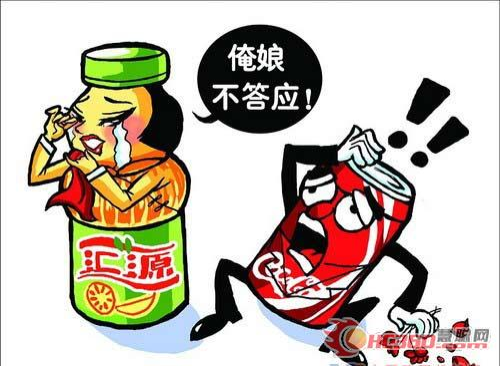
"Mother doesn't consent."

“Mother doesn’t consent.”

Posted in Uncategorized | Tagged , , , | Comments Off on Coke, Huiyuan and the audiences that matter

What the “grass mud horse” means and doesn’t mean

Warning: This post contains vulgarity in an academic context. Those with weak constitutions are advised to stop reading and visit this wholesome site instead.

The New York Times has an interesting story about Chinese Internet users putting a stick in government efforts to “purify the Internet” with various plays on a rude pun: 草泥马. Read “cáo ní mă“, it means “grass mud horse”. It’s also, however, a few tones away from the scorching but well-worn vulgarity “操你妈”, which is read “cào nĭ mā” and means (send the children out of the room) “fuck your mother”. From the Times:

A YouTube children’s song about the beast has drawn nearly 1.4 million viewers. A grass-mud horse cartoon has logged a quarter million more views. A nature documentary on its habits attracted 180,000 more. Stores are selling grass-mud horse dolls. Chinese intellectuals are writing treatises on the grass-mud horse’s social importance. The story of the grass-mud horse’s struggle against the evil river crab has spread far and wide across the Chinese online community.

Not bad for a mythical creature whose name, in Chinese, sounds very much like an especially vile obscenity. Which is precisely the point.

The grass-mud horse is an example of something that, in China’s authoritarian system, passes as subversive behavior. Conceived as an impish protest against censorship, the foul-named little horse has not merely made government censors look ridiculous, although it has surely done that.

Have a read, and make sure you visit some of the linked videos. One of them will ensure you never think about alpacas the same way again. Nasty looking beasts. [Original video now deleted, but re-uploaded by Rebecca McKinnon here.]

Imagethief, a labored speaker of Chinese at best, is no expert on Mandarin profanity or puns, although I have an academic appreciation for the latter. But as with any passenger of Beijing taxis, I am well acquainted with “cào nĭ mā“, and its common accompaniment, the hissed “shaaaaabi!” (You can look it up on the Wikipedia page linked right above.) I hastily point out that these are generally directed at other drivers and pedestrians, and rarely at Imagethief.

Sound-alikes and double entendres are important in Chinese (think of all the words that are auspicious or inauspicious because they sound like something else), and they certainly have played role in the ongoing dance between Chinese Internet users and censors. But I rather think this story reads a bit too much significance into what is, at the end of the day, a naughty pun:

It has also raised real questions about China’s ability to stanch the flow of information over the Internet — a project on which the Chinese government already has expended untold riches, and written countless software algorithms to weed deviant thought from the world’s largest cyber-community.

Perhaps. But the idiosyncrasies of the Chinese language cut both ways. Have a read of ESWN’s translation of a recent Southern Metropolis Daily article on “The Seven Possible Fates of an Internet Post” which talks about how many BBS postings get filtered because of accidental character combinations that look like forbidden terms. And also have a read of James Fallows’ excellent Atlantic Monthly article on China’s Internet censorship from almost exactly one year ago, perhaps the best analysis so far in mainstream media.

The goal of Chinese Internet censorship is not absolute control, but sufficient inconvenience and management to keep most people people on the straight-and-narrow. In that context, some naughty puns, even ones that encode an implicit criticism of censorship, can probably be thought of as a feature, if an annoying one, rather than a bug. Poke some fun. Have some laughs. Don’t cross the red lines. I’d guess that the authorities are pretty comfortable waiting for people to get bored and move on to the next allegorical pun.

See also:

Posted in Uncategorized | Tagged , , , | Comments Off on What the “grass mud horse” means and doesn’t mean

Adventures in pyromania

So CCTV burned down their own hotel. That has got to look bad in the yearly evaluation. However, here is what I am pretty sure didn’t happen: I am pretty sure that they didn’t torch their own building for the insurance money using the year’s second-biggest night of fireworks as convenient cover. This conclusion rests on no special powers of insight or criminological ability, only on my conviction poor planning and an abundance of colossal fireworks in a dense, urban area is explanation enough. I might concede sloppy construction-site management, bad safeguards and poor materials choice as a contributing factors, but that’s about it.

I am, however,  sad. I have no particular attachment to the Mandarin Oriental tower (or much of the other graceless architectural wank that has sprung up in this town in the past five years), but I expect the fire will lead to new controls on fireworks in Beijing. As wise as that might be from a civil defense point of view, it would dilute one of the Beijing’s great spectacles: the Chinese New Year fireworks inferno.

Fireworks reach a special part of me.That part is the twelve-year-old boy that still lives inside of me somewhere. He’s not gone, he’s just been gradually wrapped under three more decades of of maturity added over the years one thin coating at a time, like a pearl. But he’s still in there. And he still thinks fireworks are a hoot.

Like many small boys, Imagethief went through an extended phase where fire was just about the coolest thing ever, with slot racers and jet airplanes close behind. A scientifically-inclined lad, I pursued a rigorous program of experimentation in which I tested the combustibility and incendiary characteristics of various household objects and substances. Those were good times.

But not for my father. In those days I was living with him in a four-story Victorian in San Francisco’s Castro district that he’d bought in ’74 (for what would now seem like a preposterously small amount of money). 1890s redwood Victorians are notorious tinderboxes. Living in one is about the closest you can get to living in a house built from oil-soaked rags. When the 1906 earthquake struck, most of the damage was caused by the resulting fire ripping through hundreds of wood-frame Victorian houses. And that was when they were relatively new.

So what I thought was good clean, educational fun, my father thought was borderline psychopathy. He may have had a point. Over the years I set my hands on fire with alcohol, singed my eyebrows with gasoline, melted one kitchen trash can, accumulated a ghoulish collection of blisters and retained my eyesight only through, pardon the expression, blind luck.

In fairness, I had a local role model. Not neighborhood toughs lighting trash-can fires, but Walter, a friendly engineer who lived on our block and worked at Sutro Tower, the enormous, three-legged broadcasting antenna that dominates San Francisco from atop Twin Peaks. For many years in my family Sutro Tower was known as “Walt’s Tower”. In fact, I may have thought for some years that that was the official name.

One year for the Fourth of July, which is when one lights fireworks in the United States, Walt put on a show for the neighborhood. He built a large aircraft carrier model out of cardboard, filled it full of small explosives and smoke charges wired to an electrical switch panel, and proceeded to recreate the Battle of Midway. The climactic explosion disintegrated the model and deafened the entire neighborhood. I can picture it with near perfect clarity to this day.

I was also a budding film-maker with a super-8 camera. Suitably inspired, I soon launched an ambitious project to recreate every pyrotechnic effects shot from Star Wars, but at a level of spectacle that I felt George Lucas had lacked the balls and vision to achieve. My Millenium Falcon adventure playset? Blown up. My X-Wing fighter? Incinerated. My painstakingly built The Empire Strikes Back snowspeeder model? Scorched with flaming WD-40. And so on. What would be valuable collectables today became molten puddles and detonated fragments. I have no regrets.

Fireworks (presumably including homebrew exploding aircraft carriers) were illegal to purchase in San Francisco, but could be bought legally a ten minute drive up Interstate 280 in Daly City. The stalls were almost always on the lots of car dealerships, as I recall. Perhaps because these were convenient spaces, or perhaps because you might feel the need to celebrate the purchase of a Dodge Dart with a little something extra. The stalls were plywood shacks that sold a changeless assortment of cheap-and-cheerful pyrotechnics including sparklers, ground flowers and fountain cones.

You could buy the fireworks a la carte, but typically you picked up the biggest boxed assortment you could wheedle your parents into and prayed it didn’t burst into flames in the car. The only drawback was that the boxed sets also included some b-list stuff like Piccolo Petes (all sound, no flame) and those risible charcoal “snakes” that expanded magically from black pellets into, um, a pile of ash. We conducted some experiments trying to launch Piccolo Petes like rockets, but after one blew up on the pad we suspended the program.

There were limits to what you could buy, however. For one thing, no bottle rockets. In fact, anything with a projectile component appeared verboten. I recall Roman Candles as being very hard to get. This seems pointless in retrospect since I have clear memories of engaging in totally legal model rocketry at about the same time, using much larger and potentially more destructive projectiles. This lesson that was etched in my mind for all time when (Star Wars again — this was the late ’70s after all) my classmate Andy Filler’s Estes X-Wing encountered guidance problems off the pad and nearly gave the entire Marin Country Day School class of 1981 a haircut. That was just one of several grand failures on our school model rocketry day.

In practice, the projectile ban simply tempted inventive lads to test the strength of their throwing arms with pyrotechnics never meant to go airborne. It may be called a “ground flower”, but it makes a hell of an impressive sight when it ignites in mid-air. It also, like Andy Filler’s X-Wing, has erratic and unpredictable ballistic characteristics. One fourth of July I accidentally lofted one right into the middle of a bunch of beer-drinking adults. It was like dropping a rattlesnake into the hot tub. Liberty Street’s own Nolan Ryan and his flaming fastball were promptly benched.

Firecrackers were also illegal to purchase, along with their larger cousins, cherry bombs and the dreaded M-80, a hand-vaporising bastard with military antecedents and sixty times the punch of a garden-variety firecracker. Thus, in an early brush with Chinese globalization, my experiments were heavily dependent upon the availability of black-market Chinese fireworks in San Francisco’s Chinatown. Even for a small boy it was easy to go down to China Town and buy bricks of 1280 firecrackers and packs of bottle rockets sold out of the backs of Datsun 280-Zs by skinny, dangerous looking Hongkie kids for not too much money.

Those black market firecrackers were grist for many of my experiments. They also went off many times in my hand (which leaves you with a characterestic numbed burning sensation in your fingertips and a sheepish expression) and once right in my face (stunned amazement), so it’s probably a good thing we didn’t have access to anything bigger.

If only I had known what real Chinese firepower was. Imagine the fiendish child that I was with access to real Chinese fireworks…

To understand the gravity of that bit of conjecture, you need to understand the nature of fireworks that can be had at retail in China during the Spring Festival. As in Daly City the booths spring up seasonally, gaudy and colorful, their wares piled high alongside. And what wares! In China any drunk fool with a few hundred RMB can buy a colorful box the size of a beer keg that includes twelve or eighteen thudding mortar tubes that launch starbursts that would look good at the Pro Bowl. Imagine legalized, recreational white phosphorus. The first time some friends of mine set one of these off in China I thought the cops would come for us.

And there is a kaleidoscope of options on down from there. When you read about a Chinese fireworks factory exploding (as they do), it’s not the fwisssh….phut! stuff that gets sent to America that does the damage. It’s the high-grade domestic product that levels the village and kills the livestock. I admit one must have different expectations for China. Nevertheless, having grown up in San Francisco, where fireworks are controlled, and then lived a decade in Singapore, where private fireworks are banned, it staggers me to this day what you can buy legally in China. I don’t even want to imagine what’s available on the local black market. Stand back and don your radiation goggles.

So we get treated to quite a show during the fifteen days of lunar new year. Everybody and their maid buys piles of fireworks. On key days–new year’s eve, the lantern festival–there are queues at the stands. This being China, it’s imperative that your Golden Lotus Atomic Flower Detonator be bigger and more impressive than your neighbor’s Mighty Dragon Lucky Supernova. Or, if you can’t beat him on size, counter with volume and pepper him with a vast battery of the smaller stuff.

All of this would be chaos enough if the Chinese set off their fireworks with any sort of rational planning as to safe areas, minimum distances from nearby structures and crowd control. And in fairness some of the bigger apartments maintain pretty sound operations, with barricades, fire extinguishers at the ready and people stationed on the roofs to watch for embers (an essential precaution apparently not adopted at the Mandarin Oriental).

But in much of Beijing, and presumably in most other Chinese cities, that isn’t how it works. Many of the fireworks, possibly most of them, are detonated in the narrow warrens of old neighborhoods where sound is trapped, star-burst fragments ricochet off of windows and the general sense of bedlam is amplified far beyond the limits of common sense. Now that is good fun, and if you ever have the opportunity to wander through such a neighborhood at the height of fireworks season I heartily recommend you take it. The noise will feel like someone has painlessly run a large metal pole through your chest and is shaking it vigorously. (However it may also feel like someone has very painfully run knitting needles through your eardrums and is shaking them, too.) Heavy metal bands can only fantasize about this kind of sound and fury.

Even in the large courtyard of our apartment, where fireworks are not permitted, the sound is powerful. A rolling tide of detonations that sloshes back and forth between the slab sides of the surrounding towers, the echo creating a distinct basso triplet.WHUMPWhumpwhump! One, two, three. Often I’ll just stand in the center of the courtyard and listen to that glorious sound. I’ve often wished I could record it in a way that would do it justice.

One thing I’ve never witnessed in China is malicious use of fireworks. I’m sure it happens. People –teenagers especially– throw firecrackers at each other. They aim mortars through the superintendent’s window. They blow up small animals. That kind of behavior must be universal. Indeed, sombody scandalously blew up a popular cat at a university in Hebei recently. But I’ve never seen this kind of thing myself during the festivities in Beijing. It’s always been very family-oriented and congenial.

I have, however, seen plenty of garden-variety recklessness and stupidity, reminding me of my own past as a garden-variety reckless youth with a fire fascination. Every year fires break out and the emergency rooms stand ready for the fingerless masses. A friend of mine once videotaped a guy accidentally blowing his hand apart. Not something you’ll put on YouTube for mom to see. Alcohol, carelessness and really large fireworks mix badly. The police plaster the town with safety advisories and guidelines in the weeks leading up to new year, and the period when fireworks are allowed in the city is rigidly controlled. But it’s crazy nevertheless.

The rules for fireworks in Beijing have ebbed and flowed over the years. But I wonder if this week’s huge CCTV disaster, itself an apparent product of garden-variety recklessness at an institutional level, will mean another great ebbing. Will the city government finally decide that unfettered pyromania is inconsistent with the development of a dense metropolis of 15 million people? It wouldn’t surprise me.

And that would probably be the sensible thing to do. The twelve-year-old boy inside me, the one who still runs to the window for the fireworks and wanders the besieged streets in glee, would be sad to see that happen. But, then, he’s never had to apologize for burning down a new hotel.

Posted in Uncategorized | Tagged , , | Comments Off on Adventures in pyromania

If you’re angry about Guns’n’Roses surely it must be 1991

Let’s all take a moment to appreciate the Global Times, the nationalist tabloid cousin to the staid People’s Daily, which has decided to get indignant about the new Guns’n’Roses album, “Chinese Democracy”. It’s not that the Chinese people don’t have some cause to be angry. After all, the title is somewhat provocative, and the title track itself makes mention of the dreaded FLG. It also includes the following verses, which are pretty much worth getting angry about simply on artistic grounds alone, regardless of nationality:

Cause it would take a lot more time than you
Have got for masturbation
Even with your iron fist
All they got to rule the nation
When all we got is precious time
All they got to fool the nation
When all I got is precious time

Yep, you’re on the artistic edge when you’re rhyming “masturbation” with “nation” in an oblique criticism of China’s political system. Or maybe you’re just on your second bottle of Wild Turkey and your sixth line of Bolivian fairy dandruff. Who knows? Either way, as a musical critique of China, it’s ways from the sly, ironic rage of Roger Waters’ “Watching TV” (which is itself a ways from Waters’ best work). And Waters played live in Shanghai not very long ago, although I doubt he played that particular song.

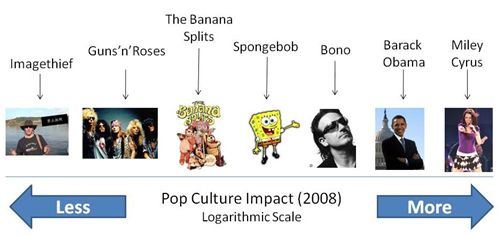
But Guns’n’Roses? Guns’n’Roses?  The band singer that took so long to get this album out that the phrase “Chinese Democracy” is now, with perhaps unintentional aptness, a music industry euphemism for a project that never ends? My friends, if you’re getting worked up about this record then your yardstick for cultural relevance is perhaps in need of some recalibration. And fortunately for you, Imagethief can provide that recalibration. In terms of gross influence on society and popular consciousness, Imagethief rates Guns’n’Roses circa 2008 thusly:

pop-culture-scale

Arguably, Miley Cyrus is also past it, and should be replaced by the cast of “Twilight”.

All pop acts, and most pop-culture in general, reflect a particular moment in time. There is no such thing as “timeless rock”, only formerly timely rock that has aged well. I say that as a bona-fide classic rock fan who learned to play bass by jamming over Hendrix records, Pink Floyd, Zep, The Stranglers, and other dinosaurs. Guns’n’Roses, for all their hostility and edginess, needs to be recognized for what they actually were: The last of the LA hair-metal bands. The final, angry stand of a cornered ’80s genre. “Appetite for Destruction” came out in 1987, but languished for a year before it gained real notice. By the time “Use Your Illusion” came out, in 1991, about the time I was launching my college radio career, the band still had some juice but in fact most rock fans and and the industry itself were already up in Seattle trying to figure out exactly exactly what a “Mudhoney” was.

Some rare bands and pop musicians endure, reinventing themselves to stay relevant. That’s why, although I don’t much like her music, I have fair respect for Madonna. She has accomplished the near impossible with almost twenty-five years of pop-music success and reasonably consistent relevance. (Although, note to Hollywood, please don’t let her approach either end of a movie camera ever again.) But most bands, even if they do successfully endure and reinvent themselves, have a peak when they hit maximum alignment with the zeitgeist. Even those that stay successful thereafter are usually living on borrowed time and aging fans, like a human body that deteriorates inexorably after the late teens no matter how healthy it is kept.

So let’s take that equation and add to it not releasing an album for seventeen years. Just how long has it been since the last Guns’n’Roses studio album? When it came out, Deng Xiaoping was still a year away from making his famous “Southern Tour”, the climax of the factional battles that resulted in China’s economic opening to the world. Going after them could be considered quixotic, if Don Quixote had tilted at pinwheels.

Thus, when the Global Times published the headline (via CNN), “American band releases album venomously attacking China”, lent credibility to Chinese net gossip that the album was a Western plot to “grasp and control the world using democracy as a pawn”, and wrote that the the record “turns its spear point on China,” they were committing a classic PR sin: Drawing attention to an unworthy critic.

Let’s illustrate this principle. Let’s say you’re Enormocorp, a gigantic, publicly listed conglomerate with its fingers in a myriad of businesses that span the globe. One day a small, pimply boy with his finger jammed up his nose walks up to you and says, “You suck!” What is the correct response?

The correct response is something along the lines of turning to your friend and saying, “Did you hear something?” It is not putting out a global press release on your non-suckyness, sending your CEO to do the Sunday talk shows to refute suck allegations and publishing white papers on all the anti-suckage measures that you are undertaking. Doing this is drawing attention to an unworthy critic, someone who’s ability to genuinely affect public perception is essentially nil. We call this “PRing the problem.” Global Times has PR’d the problem.

But I suppose it’s their job to do so. The angry rhetoric will play to readers and shift newspapers, which is the real job of any newspaper. So while it makes little sense from a national PR or defending-Chinese-ears point of view, it makes plenty of sense from a business point of view. As long as you don’t mind the cynicism of accepting that a legion of people who otherwise wouldn’t have bothered will probably stampede to Baidu to run MP3 searches for “Chinese Democracy” (or the Chinese nanny-defeating linguistic spoof thereof) as a result of the article.

Personally, Imagethief thinks the Foreign Ministry, which was quoted in the same CNN article, had it dead right when they were asked about the album:

“We don’t need to comment on that.”

Note: Imagethief owns “Appetite for Destruction” and considers it one of the great workout records of all time. He has not, however, listened to “Chinese Democracy” yet. Who knows? Maybe it rocks.

Posted in Uncategorized | Tagged , , , , | Comments Off on If you’re angry about Guns’n’Roses surely it must be 1991

Pardon me, but who gives a damn about Gong Li anyway?

Imagethief was not in the least surprised to hear that Chinese netizens were outraged that movie actress Gong Li has taken Singapore citizenship. But then, Imagethief is not in the least surprised by anything that outrages Chinese netizens. Chinese netizens were outraged when Gong Li played a Japanese woman in “Memoirs of Geisha”, alongside fellow crypto-Chinese actress Zhang Ziyi. (In fact, all the leading roles in Memoirs of a Geisha were played by ethnic Chinese women, so if anyone should be outraged it’s the Japanese.) Chinese netizens often seem outraged by things that appear trivial to the rest of the world, such as the appearance of circles in provocative locations, kind-hearted attempts at mediation, and being French. Chinese netizens, in fact, often seem outraged by anything that transgresses against a hard-boiled nationalist line.

Which suggests that we are actually talking about a certain segment of Chinese netizens, rather than Chinese netizens as a whole or Chinese people in general. Unfortunately this distinction didn’t survive Jane Macartney’s recent Times story on Ms. Gong. To be fair, Ms. Macartney’s story is clearly focused on nationalist online sentiment. Here’s the lede:

A decision by one of China’s most famous film stars to take Singaporean nationality has set off an online furore with many ardent nationalists branding her a traitor and a shame to her native country.

Following from there, rest of the story is actually reasonable and balanced. Unfortunately the headline, which is what most readers will see and which was probably written by a sub-editor in London, is general in a way designed to reinforce foreign perceptions of the Chinese as a bunch of xenophobic goons in Mao suits. Reasonable work by good China journalists often runs into problems like this, which may be why several of my foreign correspondent friends (you’ll understand if I don’t name names) think the editors at their organizations’ foreign desks are tools.

Unfortunately the Internet-comment-as-vox-pop is a common technique in China reporting, and the colorful comments that often drive the stories usually can be traced back to that same rich vein of nationalism that surges through the Chinese Internet. While Imagethief, who has seen first-hand the PR damage that can be done when a stick is poked into the nationalist ant-nest, would never dismiss the importance of nationalism in China, there are some problems with this approach.

First, as anyone who has spent any time on the Internet knows, you can find any opinion you want on it, no matter how outlandish. Second, it’s very easy to select from a skewed sample on the Internet (which in China represents an already skewed sample). It’s fine to discuss the opinions of a narrow sample as long as that’s how you represent it. But when it’s presented in a way that invites the drawing of broader conclusions, you step into dangerous territory. If the rest of the world based their opinion of America on the comments in American political blogs, they’d sterilize the country with neutron bombs. Some of them probably want to do it that anyway, but the point stands.

This is particularly fraught in China, where Internet users are still only 19% of the population, and are demographically concentrated among male, urban youth (more here). So using Internet comments as a proxy for overall Chinese sentiment without some serious qualification, or even statistics, is dangerous.

All of which is scholarly good fun, but ignores the biggest point: Who besides undersexed dorm-crawlers gives a damn what Gong Li does? Imagethief is willing to bet that if you stopped Chinese people at random on the street in Beijing and asked them how they felt about Gong Li taking Singaporean citizenship, the most often expressed sentiments would be, “Huh?”, “How can I do that?” and “Who are you and why are you talking to me?” Not necessarily in that order.

I suspect most of this anger comes because some of these same netizens voted Gong Li “China’s Most Beautiful Person” in 2005. That’s gotta hurt. You say, “You’re China’s most beautiful!” She says, “Yeah, about that Chinese thing…” And for Singapore? For most people, this looks like pragmatism. But from a Chinese Internet nationalist point of view this has gotta be like stepping out of prom night for a smoke and finding your girlfriend making out with the football team’s waterboy in your Vega.*

Well, maybe not that bad, but pretty bad anyway.

Frankly, given the recent state of Gong Li’s oeuvre, Singapore is probably one of the few countries that would be particularly excited to land her. I’m sure it’s seen as a coup for the local artistic community and as validation of Singapore’s ambitions to be a “media hub” (whatever that means). But the state of the Singaporean movie industry can be summed up in three words: Liang Po Po.  If you don’t know what that is, count yourself lucky. In fact, thinking about it, it’s a miracle that China didn’t revoke Gong Li’s citizenship for the crime of appearing in “Miami Vice”. I watched “Miami Vice” for free and still felt violated. And Gong Li didn’t even serve in my country’s government. (Nor, thankfully, does Colin Farrel, although I’m open minded if Obama wants to offer Jamie Foxx a portfolio.)

In fact, looking back over Gong Li’s last decade or so of work, it’s all a bit worrying. “Memoirs” was watchable if you squinted and jammed your fingers into your eyes until you got those little sparkly bursts of color. “2046″, I suppose, if you’re into that otherworldly Wong Kar Wai thing (Imagethief has no patience for it, but I’m an admitted philistine). Otherwise, set the wayback machine for 1992 and “The Story of Qiu Jiu”. It’s been downhill for the Gong Li-Zhang Yimou team since then. I mean, seriously, “Curse of the Golden Flower”? Curse of the costume department more likely.

When Zhang Ziyi (who made her film debut in a Zhang Yimou movie herself) someday abandons Chinese citizenship the nationalist youth can crash on my couch and spend the night talking things out. Until then, get over it. There’s lots more important things to get worked up about, like the collapsing economy, the evaporation of the Himalayan glaciers that supply China’s water, or whether foreign bloggers are besmirching the country’s honor with snarky rants about formerly Chinese movie stars.

*This never happened to me. I couldn’t get a date for prom night.

Posted in Uncategorized | Tagged , , , | Comments Off on Pardon me, but who gives a damn about Gong Li anyway?

Illegal baby part 2: I fought the law (and the law won)

Regular readers will recall that Imagethief became a father earlier this year. Having a child requires new parents to undertake many unfamiliar responsibilities. These include the obvious, such as the care and feeding of an infant, and some things that you really just don’t think much about in advance. Among those are the bureaucratic hoops that the parents of new children have to go through, especially in China.

There were some things that I anticipated. In my mind I had a pretty clear idea of the set of bureaucratic steps we’d need to go through for Imagethief Jr., a.k.a. “Z”. 1) Apply for passports (Z is a dual citizen so there are two passports). 2) Apply for a visa. 3) Apply for a certificate of temporary residency. Simple. Easy. Logical.

And missing  one critical step. I didn’t know that I’d have to actually register Z’s birth separately with the Chaoyang District police. After all, it wasn’t like I’d bought a weapon or imported an exotic car. It’s a baby, fer chrissake. The only things he’s a threat to are diapers, teething rusks and the thoroughly detonated sleeping habits of his parents.

I discovered the police registration requirement for newborns by accident when we went to apply for Z’s visa. Mrs. Imagethief and I had waited a while to do this because we hadn’t applied for the passports right away. We were, as you might expect, a bit overwhelmed by the presence of a newborn and didn’t have any immediate plans to travel. When we finally got Z’s US passport, which was the one under which we intended to apply for his Chinese visa, he was about two-and-a-half months old.

My company helpfully pulled together a letter and assorted business registration documents for me. We had Z’s Chinese birth certificate and shiny, new American RFID passport. For linguistic help I drafted my assistant from work to accompany us. Mrs. Imagethief, a Singaporean, speaks pretty competent Chinese –far better than Imagethief himself– but for bureaucratic situations a local can be useful.

In fact we’d had some rumblings of possible trouble already. That same week a friend of ours had attempted to get a visa for her new baby, who was almost exactly the same age as Z. Informed by the Beijing Entry and Exit Authority that she had missed the critical registration step and could expect to pay a fine of several thousand RMB she had stormed out of the building in a rage. I, cocky in my  various successes wrestling with the Chinese bureaucracy, was optimistic that no such misfortune would befall us.

Pride, as is widely known, goeth before the fall. My pride had goeth-ed and my fall was not far behind.

At the Entry and Exit Authority we waited in the snaking queue for the better part of an hour before arriving at the counter. Around us swirled the usual motley collection of immigrants dealing with their visas: West African families; necktie wearing businesspeople with Chinese handlers; visa agents with fistfuls of other people’s passports and so on. Other than the tax authority, which I am pleased to have avoided having to visit in China, there is no clearer glimpse into the soul of a government than the waiting room of its immigration bureaucracy. You rapidly get a picture of whose life is made easy, whose is made difficult, and the average level of desperation inflicted on the gathered applicants, supplicants and itinerants.

At the counter the uniformed young lady fiddling through our paperwork was quick to spot a problem.

“How long have you had his passport?”

“We just got it. It took a while to arrive.” This was kinda true. It took a while to arrive because we took a while to apply for it. Zach’s Singaporean passport had taken nearly three months from application to delivery, but the US passport had only taken a week.

“Do you have a receipt that says when you picked up the passport?”

“Uh, no.” This was true. The US government does not give you a dated receipt when you pick up the passport. Just the passport itself. I pointed out that that passport had an issue date in it that was within the prior two weeks.

“No, I need a receipt. Can you get a receipt?”

I weighed the likelihood of getting the US State Department to write me a letter saying exactly when they had given me the passport in anything less than a matter of weeks, decided the yardage was too far and elected to punt.

“I don’t think so.”

She promptly ran my punt back for the touchdown. “We can’t issue a visa now. Your baby is not properly registered with the police. You’ll have to register him and pay a fine.”

“How much is the fine?”

“Five thousand renminbi.”

I didn’t see the relationship between the passport issue date and the missing police registration, but there it was. At this point I decided to unleash my masterful china-hand negotiating skills.

“Isn’t there anything else I can do?”

“No. Take him to the Chaoyang District police post on Ritan Donglu. Next!

Damn. She knew how to negotiate. I had no choice but to make way for the extended West African family crowding up to my counter.

Early the next day we were off to the Chaoyang District police post. I had expected a massive, bustling metropolitan police station out of American television fantasy. Cops banging out reports on IBM Selectrics; perps being hustled past; a crowd of prostitutes flirting with grizzled sergeants while waiting to be booked. This was exactly wrong. It was more like something out of rural Indonesia. There was a quiet front courtyard with a couple of idle police cars. Inside there was exactly one desk with one bored looking officer sitting at it. We were the only other people in sight, although there was one officer in another room that the guy at the desk shouted occasional questions at. Sultry May air had penetrated the lobby, completing the languid, tropical feel. On the wall behind us, watched by nobody in particular, an Olympic countdown clock ticked away the months, weeks, days, minutes and seconds (no picoseconds?) until 8/8/08.

I’d rather expected a stern police haranguing, but to the officer on duty this was clearly just a trivial bit of paperwork in a long, uneventful and somewhat sweaty day. He asked me to tell him what happened, which I did with as much honesty and clarity as a PR man can muster. He took copious notes and, when I was done, explained the bottom line to me.

“As a foreigner are legally required to report the birth of your baby to the police within thirty days. Your baby is seventy-seven days old. That means he has been illegal for forty-seven days.”

Good heavens, I thought. I have an illegal baby! I never thought this was the kind of thing that would happen to me, a good Silicon Valley boy who’s sole scrap with the police was being ordered off of Santa Cruz’ Seabright Beach after official closing time.

The next part, explained the officer, was important:

“Did you break the law intentionally or were you ignorant of it?”

So there it was. Are you a criminal or an idiot? Even I could see which way this one would cut, so I cast my lot with idiot.

“I had no idea.”

He grunted and finished the paperwork, which turned out to be my confession that I had accidentally but most definitely transgressed against the laws of the People’s Republic, was contrite, and agreed to accept such punishment as the authorities had decided to mete out, which in this case was five large. This was read back to me to make sure I understood my idiocy in complete detail, which I did. Anxious to transform my illegal baby into a legal baby, I signed. It was my first confession to anyone other than my parents. I did feel a new lightness washing over me as I unburdened myself of my sins, but it may have just been the lightness caused by the extraction of RMB 5,000 from my wallet.

Or the psychological impact of imagining RMB 5,000 being removed from my wallet, since I didn’t actually pay at the the police station. Instead, I was told to present myself again at the Entry and Exit Authority the next day. A representative from the police would meet us there and we could pay the fine and complete the registration of our illegal baby.

It seemed a little odd that the police would send somebody round to meet us and deal with this, but this is China and I’ve learned not to be surprised by bureaucratic eccentricities, such as the fact that the residency records of my neighborhood are apparently maintained on paper in a library’s worth of binders arranged by estate and danwei. Or the fact that although I live in the bustling, commercial heart of Beijing’s ever-extending central business district, our local paichusuo is on the other side of the Fourth Ring Road in a remote,down-at-the-heels neighborhood called Balizhuang that is being rapidly flattened to make way for god only knows what. It’s these sorts of things that remind me that the area I’m now living in was farmland and industrial estates just a decade ago.

Of course the police didn’t send someone to meet us. We discovered this as we waited like idiots (fittingly, since I’d already officially confessed to being one) on the foreigner floor of the Entry and Exit Administration, scrutinizing every cop who came in to see if it was one of the two we had seen at the Chaoyang District police station. Following a half hour of gathering flies, some investigation revealed that there was a police desk on the floor that apparently existed for the sole purpose of paying fines. It was doing thumping business.

We presented our confession and various chopped documents officially certifying our idiocy and tipped RMB 5,000 into the government coffers (possibly used to help pay for last week’s space launch), at which point we were once again duly authorized to stand in line and submit our visa application for Z. A week later we got his passport back with visa in place. We went straight off to the  to register him for his certificate of temporary residency, and I’m pleased to say he’s been fully legal ever since.

Thinking back on this episode, it’s clear in retrospect that the attendants at the hospital where Z was born told me as we were checking out to register him with the police within thirty days. I had confused this fairly rigid, visa-oriented requirement with the certificate of temporary residency registration that foreigners need to complete with 24 hours when they arrive in China or move to a new address. Despite sounding very urgent, I’d always found the enforcement of temporary residency registration to be pretty squishy. I’d often been late –once in Shanghai by a staggering six months– and never got more than a lecture for my sins, if even that. But the baby requirement is different, and in the period leading up to the Olympics nothing about the enforcement of China’s immigration laws was squishy.

Honestly, it’s a lot of bureaucracy for new fathers, who aren’t the most competent of creatures at the best of times. Z was born in a hospital where little English is spoken, so combined with the linguistic gulf it was a recipe for trouble. Maybe they should have simply tacked the fine onto my bill at the hospital and saved everyone the trouble.

It also would have been nice if my company’s HR department had thought to warn me of the baby registration requirement, but apparently not too many of our foreign staff have had babies in Beijing and it’s simply not on the checklist. So if you’re a foreigner living in China and expecting a baby, remember you have thirty days to do the paperwork. True, the Olympics are over and things might be getting a bit squishy again, but RMB 5,000 pays for a lot of diapers, so why tempt fate?

And though I offer a few weak excuses, in the end there is really nothing to blame but my own idiocy. I have a stamped confession to prove it.

Previously:

Illegal baby part 1: The strange case of the sluggish passport

Posted in Uncategorized | Tagged , , | Comments Off on Illegal baby part 2: I fought the law (and the law won)

Sanlu melamine milk powder crisis becomes a national issue

Like on the top-forty radio show Imagethief used to listen to as a thirteen-year old, the hits keep coming in the Sanlu milk powder crisis. Over the past thirty-six hours the situation has evolved from a company-specific Sanlu crisis to a nationwide dairy-industry crisis reminiscent of the glory days of last summer’s product quality crisis.

Here is the latest: Products from 175 dairy companies have been tested (中). Twenty-two of them tested positive. Sanlu is still the champ in terms of micrograms per kilo of product, but some other famous (and not-so-famous) brands are now implicated, including Mengniu and Yili. I bet Yang Liwei didn’t know about this when he decided to endorse Mengniu. But astronauts should be able to digest melamine, which anyway seems like kind of a futuristic substance. Imagethief used to have melamine coasters. No joke. Very “Jetsons”.

Also not a joke is that over 6000 children are now reported to have been affected and three are dead. The Internet is seething. Collars at the State Food and Drug Administration haven’t felt this tight since Zheng Xiaoyu was frogmarched away and shot for corruptionjust over a year ago.

So here are the PR implications:

Winner: Sanlu (sort of)
For Sanlu this is actually good news. All of a sudden what looked like their problem is a nationwide problem in which they are just one of many companies caught in the riptide. In PR we teach an interview technique called broadening. When confronted by an interviewer with a problem or challenge that cannot be refuted you respond by “broadening” the issue to include the rest of the industry, your rivals or whomever. It works like this:

Maria Bartiromo: Your stock price is down by 50% this month? Does your company suck?

You: Well, Maria, market conditions are tough and many companies in our industry have had similar declines but we are key message, key message, key message, yadda yadda yadda.

Sanlu doesn’t need to broaden the issue. It has broadened itself. This doesn’t make Sanlu’s problem go away. They’re still the worst affected, the most apparently negligent and most closely associated with the issue. In the past day or so, the chicken of accountability (a really big chicken in this case) has come home to roost and heads have justly started rolling. But misery loves company, especially in PR, and now the spotlight of attention has spread out a bit. It buys Sanlu some small breathing space at the trade-off of kindling a hotter but more diffuse groundswell of national anger.

Losers: Everyone else
While this broadening might be good news for Sanlu, it’s bad news for everyone else. Consumers have no idea which domestic manufacturers they can trust. Even ice cream bars (sob!) look suspect. Foreign manufacturers such as Nestle may benefit for a while, assuming resentment doesn’t turn on them later, which is possible. Also, Fonterra is now recalling its own Anmum branded milk in China. On top of its involvement in Sanlu, this may be wearing the foreign gloss a touch thin.

The Chinese dairy industry looks like a hopeless swamp incapable of quality control. Production and upstream wholesaling are completely fragmented and obviously subject to only the most featherlight of regulatory scrutiny or inspection regimes. The job of applying quality control nominally lies with the brands that sit between green fields and cow dung and supermarkets aisles and consumers, but they appear to have dropped the ball completely. Honestly: Twenty-two companies and 66 products? You’d sooner trust the Three Stooges with your dairy factory than this bunch of clowns.

The SFDA looks about as wired as it did in July, 2007. AQSIQ, which is separate from SFDA, is also scrambling. Regulatory involvement seems conspicuously after-the-fact in this situation. Sanlu was exempted from inspection because it was recognized to be such a fabulously well-run company. Lesson: No one should be exempted from inspection. More inspections for everyone, in fact, seems like part of the prescription for this situation.

And China in general reminds everyone else in the world of why they are just a touch suspicious of Chinese food products. There are apparently some export products involved in the current situation, although they are apparently exported primarily to the kind of no-hope client-states (think Myanmar) that are unlikely to make too many waves lest they have to start paving their own roads. But the rest of the world is watching.

As, incidentally, are the (ahem) China-based expatriate parents of small children. I am happier than ever that Imagethief Jr. is breast-fed. Mrs. Imagethief may be made of stern stuff, but it’s almost certainly not melamine.

Now what?
Aside from the fact that Imagethief will sadly never look at an Yili ice cream bar the same way again, what happens now?

Unfortunately, the whole situation has got much trickier. For individual companies PR issues can be managed because it is relatively easy to speak with a single voice. Situations that involve entire industries are trickier, because getting a bunch of competing companies to speak with a single voice about anything is like herding giant cats with tens of thousands of employees each. Cats that often want to blame each other. Try doing PR for an industry association someday and you’ll get a taste of this.

The cat-wrangling hat now passes to the Chinese government, which has just inherited the stage from Sanlu. The Chinese government needs to explain why there is a pervasive problem in the dairy industry and what it is doing to solve the situation. (It would be nice to talk about a plan for structural changes in the industry.) It needs to make sure that the dairy brands themselves are singing the same song with one voice arranged to church-choir perfection. It also needs to keep on letting consumers know which products are safe and which aren’t and ensure that people have enough real and timely information that gossip and suspicion don’t become the main drivers of the public response. It needs to vigorously punish offenders who have been sloppy and do its best to convince people that the companies, regulators and local governments are all entwined in one sloppy, corrupt ball. I know that executions will look tempting, but executions alone probably won’t solve the problem of restoring consumer confidence, so let’s think more creatively than that.

Importantly, if there are more melamine skeletons in the closet it is best that they come out soon rather than creep out over the coming weeks and months. The situation has already deteriorated. The sooner it moves into recovery phase the better. More bad news dribbling out over weeks and months will delay the start of the recovery and stoke the fires of suspicion and anger. This is one reason why it’s important to make sure people have enough real information to forestall the worst of the gossip and conspiracy theorizing. For that reason, AQSIQ’s public round of testing was a good thing, even if the news was bad.

But the whole process will be difficult. In yesterday’s post I mentioned all the entrenched and institutional problems that retard the development of public communication in China. Many of them also serve to slow the development of effective commercial enforcement. In a sense the larger challenge for China is not just to prove that it can clean up the dairy industry, but to prove that its commercial environment can evolve into something other than a cozy swamp where insiders get rich and outsiders get kidney stones.

But that’s been the challenge for a long time now.

Suppressing the news is not a PR solution
Hop on over to ChinaSmack and read the new post “Kidney Stone Gate: Baidu denies censoring search results“, which cites a 21st Century Business Herald report on Baidu’s possible involvement in suppressing negative search results for Sanlu:

Soon after the Sanlu poisonous milk powder news came out, a copy of letter from the Teller public relations firm to the Sanlu Group began spreading on the internet. In the letter, Teller advised Sanlu to pay Baidu 3 million RMB to have Baidu manage search results containing negative news about Sanlu (supposedly not all news could be censored but most results coming from smaller websites could be deleted). When Baidu heard the rumors, they quickly denied working with Sanlu. A representative from Teller also said the letter was fake.

Sanlu Group logo: Sanlu is suspected of paying Baidu 3 million RMB to censor negative search results.On September 13th, “21st Century Economic Report” reported that Baidu admitted receiving a “Sanlu Public Relations Crisis Proposal” letter from a public relations firm, but Baidu could not confirm that it was the Teller firm.

There’s more in the post, including a partial translation of the 21st Century Business Herald article. Some evidence is presented in the story to support the allegation that Baidu was complicit, although Baidu denies it. The jury is still out.

However, the basic PR rule is this: Supressing bad news is almost never a viable PR solution. Bad news tends to leak. It tends to percolate through the pores. It tends to squirt around to wherever your grip is weakest, like the air inside a balloon animal. This is particularly true in the era of the Internet, regardless of what Baidu (or even the government) does.

Only an irresponsible PR agency proposes suppressing bad news as the core of a PR strategy. That’s not rebuilding or defending a reputation. That’s admitting you can’t help. But suppressing news is an old tradition here, handed down from the highest levels. It will be a long time before that kind of recommendation stops coming.

Baidu’s statement (中), also partially translated, includes the following:

Baidu’s most important value is to seek truth from facts. (百度价值观中最重要的一条就是实事求是)

One would hope so. But I recall that somebody else in Chinese history used to talk emptily about seeking truth from facts.

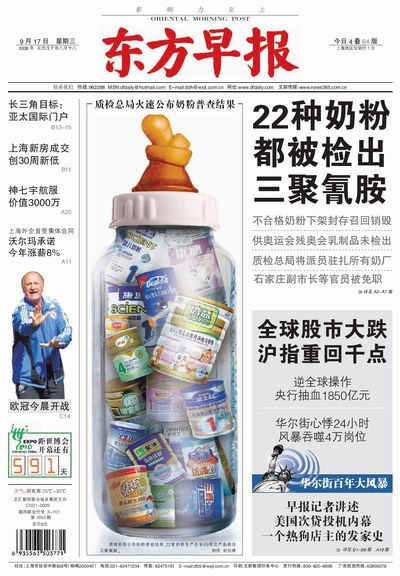
oriental-morning-post-sanlu

See also:

Posted in Uncategorized | Tagged , , , , , | Comments Off on Sanlu melamine milk powder crisis becomes a national issue

Melamine in Sanlu milk powder? Now that’s a crisis!

If you want to get people mad –I mean fired-up, torch-and-pitchfork enraged– screw with their pets or their babies. That’s what we’ve learned over the past year thanks to the unfortunate tendency of the plastic melamine to pop up in the strangest places, most recently in infant formula from Sanlu, a mighty Chinese dairy firm.

You would think that after last year’s long-running product quality fiasco people would have learned. Those of you who have brushed the last of the Olympic rings from your eyes will recall that the product quality crisis began with American pet food tainted with melamine thanks to contaminated ingredients from China. It then rippled into lead-tainted toys (repeatedly), antibiotic-laden fish and various other hysterias that collectively managed to knock Dream for Darfur (remember them?) off the front pages. Man, what a summer that was, especially for PR nerds. I get all misty just thinking back on it.

But there will be time for nostalgia later. I want to spend a moment on the word “crisis”, which I used in both the headline and the paragraph above. Like the phrase “mission critical”, beloved of jargon-head business types, “crisis” is a word that is often misused to describe any situation where a company is wrestling with a spot of PR trouble. Chinese nationalist youth are insulting our company on the Internet! We’ve got a crisis! No you don’t. You have an “issue.”

What’s the difference? An easy if somewhat oversimplified way to think of this is chronic and debilitating vs. acute and life threatening. Being morbidly obese with high blood-pressure and diabetes is an issue. But your doctor can prescribe a program that will over time mitigate it. Going into cardiac arrest is a crisis in which the options are immediate treatment or death. In corporate terms this means a situation so bad it threatens the reputation of the company in a way that could rapidly and substantially damage business or shareholder value. Crisis is life-and-limb, billions-of-dollars or fate-of-the-company territory. Cyanide in Tylenol, the Exxon Valdez, Singapore Airlines flight 006; those are crises. Lehman Brothers is was having a crisis (it is now over in the same way that the cardiac-arrest crisis will be over if you don’t get immediate treatment).

Apply the “life-and-limb” test and I think we can agree that Sanlu is having a crisis. Fonterra, their foreign part-owner to the tune of a significant 43%, is having an issue, although it could get worse. More on that below.

Here is the story so far. On September 11th, almost a week ago, initial reports emerged that an unusual outbreak of kidney stones in about sixty infants had been linked to tainted milk power. Naturally the first assumption was counterfeit product, as happened in the tragic Anhui milk powder episode of 2004 and in countless food scandals in China. Since then the story has spread, blob like, in a fashion that reeks heavily of a coverup unravelling. There are now over 1000 affected babies and two fatalities. Genuine Sanlu product has been revealed to be the culprit. There’ll be no palming it off on counterfeiters. A recall of over 8000 tons of product is under way. Sanlu apologized in a news conference yesterday. Heads are rolling, but only at a suitably low and distant level in the great chain of scamming and incompetence.

Deliciously (unless you’re a formula-fed baby), Sanlu and provincial authorities from Hebei, where Sanlu is based, allegedly knew about the problem possibly as far back as early this year, and at the very least in early August, well before the Olympics. We know this because Fonterra execs are now telling anyone who will listen that they told Sanlu and the Hebei authorities that there was a problem but got no action until they got the New Zealand government to tell the Chinese central government. So everyone involved knew the formula was dodgy except for parents merrily feeding it to their babies. The irony of this situation is that foreign involvement is often seen as an indicator of quality thanks to the well documented quality problems of domestic brands.

The New York Times has this quote from Gao Qiang, Vice-Minister of Health, which is solid gold by the leadenly unquotable standards of Chinese officials:

“This is a severe food safety accident.”

You think?

Now the conspiracy theories are boiling to the surface like worms after summer rain (we’ve had a lot of rain in Beijing recently, so this image is fresh in my head).

Some think leading Chinese search engine Baidu may have had an agreement with Sanlu to filter negative search results. I don’t really buy this one, but as a student of the Internet I find the supposition interesting. It says a lot about how people feel about the power of search engines as gateways for information. If it was true it would be really interesting. Note to search engines: The time to come clean about how you will and won’t help advertisers is now.

Others wonder if the story was suppressed because of the Olympics, and invoke the Central Propaganda Bureau’s alleged 21-point reporting guidance for the Olympic period. I find this one pretty credible, and it stokes my belief that in addition to bringing out some of the best about China the games also brought out some of the worst. The post linked to above, from China Digital Times, also has a translation of apparent Propaganda Bureau guidance on how to report the current situation, suggesting that the cogs of harmonization are already grinding through comment on this situation even if they’ve not yet clamped down on it completely.

And then there are claims that Sanlu not only knew about the issue but has also beenpaying off afflicted consumers to buy their silence. This one is also pretty credible, and goes along with established Chinese practice of privately arranged compensation for the families of people injured in industrial accidents and such, often in return for an agreement not to make waves. Coal mines are past masters of this tactic.

Uncoverup
The PR rules for situations involving the endangerment of human life are simple: The company’s priority is to take all steps possible to mitigate danger, and communication should be centered around ensuring that the public is completely and rapidly informed in a way that minimizes the risk of injury or death. If you concede that the contaminated product is fait accompli and that some damage control will be necessary, then such an approach, funnily enough, often pays the best dividends in terms of repairing a damaged reputation. This is because it demonstrates clearly that the company prioritizes customers and human welfare over a grimy buck. In troubled times this a critical message to send, and it helps to remind customers of why they placed their trust in the company in the first place. See the Tylenol-cyanide crisis for the textbook example.

On this count, everybody involved in the current situation fails. They’ve prevaricated their way into disrepute. There were some shockingly basic steps ignored along the way. As of Sunday, for instance, when the formula recall was in full swing, there was nothing on Sanlu’s website to suggest anything odd was going on. No announcement. No recall information. No advisory to customers. Not hotline. No news since August 14th. Zilch. As of yesterday and into today their website has been unreachable.

This is not a surprise. It is perhaps unfair to judge Sanlu by my imperialist western standards of public communication given that the company is the product of an environment in which the relevant authorities have not always led by example. Sweeping scandal under the rug is a favorite institutional pastime here. Read up on SARS if you need a refresher on this, or the Songhua river benzene crisis, or the Xifeng county journalist scandal, and so on. But SARS was blown wide open, and if this was a cover-up it is now blown wide open too.

While acting vigorously in the interests of the public helps to repair reputational damage from a tainted or defective product and rebuild trust, covering it up compounds the problem. Remember when you broke the dining room window and then lied to your mom and said it was the dog? And she didn’t mind the window so much but was gravely disappointed about the lie? And you didn’t even have a dog? You learned an important lesson then (I hope). This is the same thing, only bigger and with the public instead of your mother. And no imaginary dog.

A blown cover-up demonstrates convincingly to the public that you don’t give a crap about them and that you were willing to let them (and their babies) twist in the wind to save your own hide. Now you have two problems instead of one: Your product is poisonous and your company is run by untrustworthy bastards as far as the public is concerned. The natural conclusion is that you now have at least twice as much work to do to repair your reputation, although Imagethief thinks that the repair work actually goes up as the square of the number of self-inflicted wounds, if not the cube (modern media being three-dimensional).

In addition to simply being ethical, coming clean is a good approach because it shortens the time-frame for bad news. Scandals often don’t bust all at once, but drag out over days or sometimes weeks as bad news bubbles to surface in bits and pieces. This can feel a like a very long time when you’re on the pointy end of bad press and public scorn, and can leave a very deep impression on the public. As noted above, the CEO of Sanlu has apologized, but once the story has gone this far it looks like an apology under duress. That simply doesn’t have the power of pre-emptive contrition. (Lawyers take note: I am not suggesting pre-emptively admitting liability.)

While it’s hard by definition to know how many cover-ups succeed, Imagethief expects that most are busted, especially when there is a large public impact. The old mob aphorism holds that two people can keep a secret if one of them is dead. If a lot of people know about your crisis, better for you that you resist the coverup temptation. Own-up and be seen to get cracking on solving the problem and helping the victims. Or hope that your crisis is so thermonuclear that it wipes out all witnesses and all evidence.

But exhorting transparency is almost certainly pissing into the wind. The problem here isn’t just one of the occasional irresponsible company. And it’s not a problem that one or two or a dozen PR agencies or crazy PR bloggers are going to solve. It’s a problem of endemic business and regulatory culture. There are several factors at work. First, the Chinese government doesn’t have a history of encouraging transparency. Second, the relationship between media and business is often too cozy for the good of anyone but media and business (this is especially true at the local level, which is why the government’s restrictions on all but national news organizations reporting outside of their home areas are so damaging). Third, the government still maintains explicit control over the media and to a degree the Internet, which means that stifling coverage by fiat consistently presents itself as a path of least resistance. Fourth, the government still maintains tight links with major businesses. Sanlu’s majority owner as near as I can determine is the Hebei provincial government, who’s PR philosophy is probably pretty old-school.

The Kiwi’s aren’t off the hook either
But what of Fonterra? They’re not a Chinese company. They come from a different media, PR and regulatory tradition. How has their performance been? From the Financial Times:

The Sanlu board, which has three Fonterra directors, was told of contamination on August 2 when a trade recall began, said Andrew Ferrier, Fonterra’s chief executive,yesterday. A public recall did not start until nearly six weeks later.

“[Fonterra] have been trying for weeks to get an official recall and the local authorities in China would not do it,” Helen Clark, New Zealand’s prime minister, said on television yesterday. “At a local level . . . I think the first inclination was to try and put a towel over it and deal with it without an official recall.”

***

Sanlu could not be reached for comment yesterday, but Mr Ferrier defended Fonterra’s role, saying “as a minority shareholder [the company] had to continue to push Sanlu. Sanlu had to work with their own government to follow the procedures that they were given.”

Not so good, I’d say.

Here’s the million-RMB question: Did Fonterra have a responsibility to go public in China based on what they knew? To someone not directly involved (such as me) it looks an awful lot like Fonterra sat on its hands despite knowing that customers were at risk, possibly to protect its business and relationships in China. Minority shareholder they may be, but 43% is a big minority and they have three board seats. Their reputation is hostage to the behavior of their partners and right now they look complicit in a sketchy situation.

I am sure it was hard decision considering the prickliness of Chinese authorities and regulators and the likely fallout of ratting on their Chinese partners (see Danone vs. Wahaha for an example of what can happen when sino-foreign business relationships disintegrate). But I wonder how their noisy stakeholders back home in New Zealand, who won’t care so much about the idiosyncrasies of the China market, will react. Several nasty questions present themselves. How bad would the problem have to be before Fonterra blew the whistle? Do they prioritize their China business over the safety of customers? Is China an appropriate market for them to be in under the circumstances? At times like this you’re happy to be a privately held cooperative.

Fonterra has no official statement on the situation that I can find as yet, although I’ve seen references to press releases. Private or not, I think they have some explaining to do.

Lessons from the great milk-powder fiasco of ’08
It has been heartening to see both the Chinese press and the Internet go to town on Sanlu, especially since they’re not my client. While I don’t envy them their PR miseries, the willingness of the Chinese press to take on big Chinese companies that do wrong by their customers is an important development for civil society. While the coverage will follow the Central Propaganda Department guidelines referred to above, the whack of big, negative headlines may still have a salutory effect on other companies. That’s as it should be. People trust brands. The tradeoff is that brands are accountable and the media is an important part of the mechanism for making them so.

It’s also interesting to see that even Chinese companies can have quality problems with their suppliers. At the height of the product quality crisis much was written about the importance for foreign companies of vetting and monitoring suppliers rigorously and continuously. It is reassuring in some small way to see that it’s not just foreign dupes who have trouble managing these problems. Local dupes can have them too. It is, on the other hand, a reminder of how much room for development there is in the Chinese commercial environment.

Finally, as bad as this situation is, it shows that there is an opportunity. Chinese companies do understand the value of a powerful brand and a good reputation. That’s a good first step, but more is needed. Many clearly also learn the value of communicating transparently and aggressively in crisis situations in order to defend the brand and reputation. Nobody wants a crisis, but the lessons learned this way can help prepare the best managed and most progressive of China’s big consumer goods companies to succeed internationally, where the old cozy approach won’t work as well.

An ancient and time-worn chestnut of China journalism is that the word for “crisis”–危机, or weiji–contains the characters for “danger” and “opportunity”, which is sorta-true-but-not-really. As a piece of popular wisdom, it has the unfortunate consequence of trivializing the concept of a crisis. Sure, “crisis” in the classic sense means an inflection point from which multiple outcomes, including perhaps opportunity, may arise. But in the colloquial PR sense it means a grave situation with unpleasant and possibly catastrophic consequences. Thus, Imagethief has always felt that it would be much more accurate if the Chinese word for crisis combined the characters for “shit” and “fan”. I’m sure that right about now executives from both Sanlu and Fonterra would agree.

Still, I’m an optimist by nature, and I do like to look for the upside. Let’s hope some lessons are learned.

See also:

Some observers see a silver lining in the scandal. “One positive result is that people will become more aware of food safety,” says Ren Fazheng, a professor at China Agriculture University in Beijing. “Government and society will pay more attention to this issue … and more inspection agencies will use more methods, so the level of inspection will improve.”

Yet public opinion, even outrage, has limited impact, as evidenced by the stunted efforts by angry parents who lost children in the Sichuan earthquake in May to demand government accountability. While officials are still investigating why so many schools in the quake area collapsed, protests have been curtailed and media coverage on the issue banned.

Still, with Sanlu closed by government decree and its future in doubt, two men charged with crimes that can carry the death penalty, and a government investigation widening, “this serves as an extremely strong cautionary tale for the whole industry,” says Professor Yang.

“Lawsuits have not worked well in China, but the costs are escalating” for companies that cheat, he argues. “Producers realize now how precious their brand name is.”

Perhaps. But as long as some companies feel their brands can be protected through means other than sound ethics and transparency I’d suggest channelling the Gipper: Trust but verify.

Disclosures:

Imagethief once worked for Fonterra’s PR firm in Singapore. Fonterra was not my client.

The founder of Imagethief’s current employer advised Tylenol during their 1982 crisis. Imagethief was 15 at the time, and was too busy watching “Get Smart” reruns and not doing his homework to be involved.
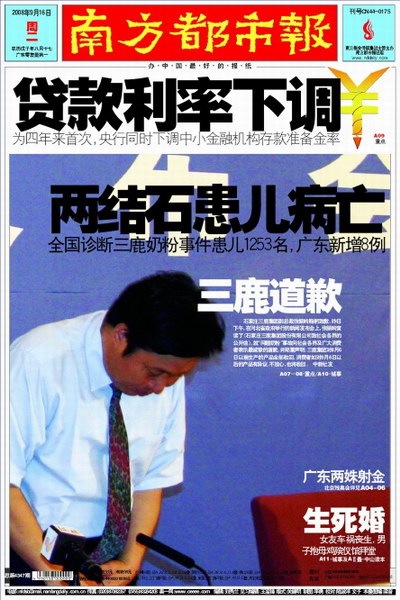
We’re very, very sorry we were caught.

We’re very, very sorry we were caught.

Posted in Uncategorized | Tagged , , , , , , | Comments Off on Melamine in Sanlu milk powder? Now that’s a crisis!