Poorly thought out adventures in commuting

In the grip of my darkest and most bourgeois moments I actually considered buying a car and hiring a driver. So, it’s come to this… I thought, as I hovered over a digital map of Beijing. I have to get one of those Buick vans. No matter how I traced the route or arranged the useless layers of meta-data in Google Maps I had to face up to reality. My new office was in the sticks.

More specifically, it was in Wangjing. North Wangjing, hard against the Fifth Ring Road. The Fifth is commonly accepted as the dividing line between the frothy, urban Beijing of Apple Stores and upscale dining and the great void of the Chinese hinterland where all is windswept grist for broody New York Times articles about how miserable the rest of the world has it. Well, and also Tongzhou. Never mind that when I moved to Beijing the Fourth Ring Road was that line.

You can tell the office is in a neighborhood that didn’t exist three years ago. The building is as gorgeous and new as a space station and just as isolated from amenities and comforts. The nearest Starbucks is at least two kilometers away. In Beijing in 2010 more than two kilometers from Starbucks is the qualification for a rural hukou. I brought a French press to office.

I am strong enough to confront my flaws (although weak enough wrap that confrontation in a layer of prickly humor). By the standards of my Chinese colleagues this is, I admit, jello-kneed schoolgirl bitching. Many of them live outside the Fifth and have commutes that sound lifted from the darker pages of Jack London novels, where people die freezing for want of a twist of jerky somewhere on the track from Fort Yukon to Unalakleet. Just substitute a bendy-bus for the dog sled. Against this, even the commute from Dawang Rd. to Wangjing is lower middle-distance at best, like one of those mid-range Olympic track races that is too long to be exciting but too short to be impressive and that nobody remembers who won.

I, however, have been spoiled. For six years my distance from the office has ranged from a five minute walk to a five-stop straight shot on subway line 1. Even the latter is the Beijing commute equivalent of schlepping from the couch to the fridge during a commercial break for a half-full can of Duncan-Hines frosting and a Pabst Blue Ribbon.

Although I toyed seriously with the idea of either buying a car or hiring a car and driver, in the end my socialist* pedigree won out. For my first day at the new job I decided to take public transport.

Man, was that stupid.

It looked good on the map, though. From my house I can take the line 1 subway one stop to Guomao. Then it’s a straight shot north on line 10 to the Shaoyaoju interchange and one more stop on line 13 to Wangjing West. From there a short bus ride. Simple!

If you read the New York Times you probably scan the occasional Tom Friedman column where he hyperventilates about how fast the Chinese are building infrastructure for which Americans have lost the blueprints. Subways, for instance. The statistics for Beijing are magnificent: Thirty lines planned, totaling over 1000 kilometers of track. Everyone living within the Fourth Ring to be able to walk to a station in fifteen minutes. Sounds like The Future!

Sure. It’s Logan’s Run. But with the subway system from The Warriors.

There are two reasons for this. First, adding more lines and interchanges has certainly made the entire system more useful. But the number of people riding has gone up as something like a cubic function of the number of track kilometers. In the course of two years my old line 1 commute went from crowded but tolerable to needing to lubricate yourself with Astroglide and use a prybar to get on or off the train. Combined with the casual Chinese disdain for off first, on second it’s a miracle the platforms aren’t entirely covered with bits of scalp and shards of broken teeth.

Second, the planners of the Beijing subway system haven’t really figured out the whole idea of the subway interchange. In Singapore, subway interchanges are designed such that trains that make the most natural connections pull up on opposite sides of the same platform. Walk thirty air-conditioned feet, get on the next train. Now that’s the future!

But why build an actual subway interchange when you can just build a long, sweaty tunnel between stations in adjacent neighborhoods? Changing trains in Beijing is a little bit like changing airport terminals, right down to the surprising number of people dragging luggage. Add the rush hour crowds and idiotic security screening chokepoints and it’s almost (though not quite) as bad as checking in at JFK.

It took me an hour to get from my house to Wangjing West station. When I finally staggered off the third train I was ready to bail on the bus and head for a taxi. Except that Wangjing West apparently serves as the informal transportation hub for the entire Wangjing new town, which means that at any given moment there are zero authorized taxis and about fifty black cabs. I don’t generally like taking black cabs, although I do it from time to time, so I reverted to the bus.

Big mistake. Should have taken the black cab. Beijing subway platform minders are good at cramming an apparently limitless number of people onto a train, but they have nothing on the bus drivers. Beijing’s bus drivers have taken that skill and extended it into a rarefied art form of otherworldly magnificence. The driver of the bus I took used a combination of eye-watering verbal abuse, physical bullying and backyard-steel-furnace socialist will power to get people stacked three deep in the bus. Mine was the Very. Last. Stop.

Except that I accidentally got off a stop early and had to walk the last kilometer. There isn’t much in Wangjing and they space out the bus stops like railroad towns. An hour and twenty minutes after leaving the house I got to the office, late and looking like I had been caught in a kitchen fire at a Bob’s Big Boy. I felt virtuous, but exhausted and dumber than a chicken on roofies. Some of my colleagues do this daily. In both directions. This, not the threat of cyberwar, is why America should be scared of China.

So I’ve been taking the taxi. I did the math. Sure, it adds up, but it’s still way cheaper than a regular car and driver, let alone buying my own car. About 25% of the taxi cost is offset by my having to brew my own coffee (which says something about the magnitude of my coffee habit). And it gave me the gossamer thin rationalization I needed to justify my iPad (thus instantly cancelling out something like two year’s worth of coffee savings). A quiet half-hour each way alone with my electronic newspapers. Well, quiet except for the ubiquitous radio story teller who makes wet lightning-and-thunder noises with his mouth.

I’ve come to terms with the cost. I’ve come to terms with my increased contribution to global warming. The only thing that really worries me is the feeling that a taxi-based commute in Beijing is actuarial equivalent of moving to Detroit and developing a habit for convenience store robbery. After all, few Beijing taxis have seatbelts and most are driven by people with the patience and deliberation of a fox terrier that has been whipped with car antennas. If you hear of a pileup on the fourth ring and a white man being whisked to hospital to have an iPad removed from his abdominal cavity that’ll be me. If you hear of a taxi driver being whisked to hospital with an iPad embedded in his skull and an angry white man being questioned by police, that will also be me.

*by American standards.

You can't get there from here.

You can’t get there from here.

Posted in Uncategorized | Tagged , , , | Comments Off on Poorly thought out adventures in commuting

Imagethief movie minute: Wolverines, oil wells and balls of marine brass

For sheer surreality you gotta love Hollywood. And I’m not even talking about the films. Two PR-worthy Hollywood moments to remark upon today. First, the imminent arrival of the needless remake of cold war teen action flick Red Dawn has finally caught the attention of the Chinese press. Western media are reporting that the chest-thumping Global Times has published not one but two editorials slamming the movie:

“U.S. reshoots Cold War movie to demonize China” and “American movie plants hostile seeds against China,” read the Monday and Tuesday editorials in the Beijing-based Global Times, whose daily circulation, in Chinese and English editions, is about 1.5 million.

Coming on the heels of secretary of state Hilary Clinton’s China visit, the commentaries said the $42 million film, directed by Dan Bradley and starring Connor Cruise (son of Tom Cruise and Nicole Kidman), “is deeply rooted in Americans’ fear of China’s rise.”

“Despite the world’s focus on U.S.-China relations in the strategic and economic dialogue and their increasing economic connections, China can still feel U.S. distrust and fear, especially among its people. Americans’ suspicions about China are the best ground for the hawks to disseminate fear and doubt, which is the biggest concern with the movie ‘Red Dawn,’” one commentary said.

Well, maybe. Imagethief prefers to think that the remake of Red Dawn is rooted less in Americans’ “fear of China’s rise” than in Hollywood’s lack of imagination and desire to make a buck. But there may be some relationship between the two. I also understand the knee jerk instinct to issue fierce denunciations of the film in the interest of national pride, global harmony, etc. And considering that there was some chatter about this film here in China last March I’m actually kind of surprised it took this long.

Nevertheless, once again the best PR advice in this situation would have been to shut up. From Hollywood’s point of view, having the nationalist cousin of the People’s Daily rail against the film is better marketing than getting a picture of Connor Cruise with an assault rifle and one of those tractor-pull girls stamped on the forehead of every teenage boy in America. The US press is bound to report on it and it will do nothing but stoke the buzz of the movie back home. This is yet another classic example of “PRing the problem”. Even assuming the objective is to show domestic audiences that the powers-that-be are appropriately outraged, it’s counterproductive on some level.

But Imagethief isn’t just here to criticize. Like all good consultants (or, former consultants), I come bearing solutions! There is a far, far better way for the Chinese to combat these kinds of silly, sinophobic movies. A way that would make Sun Tzu himself stroke his beard in appreciation. That is for the Chinese to seed their spies throughout Hollywood, use blackmail and honey-traps to build influence in the great Hollywood talent agencies and, whenever they get word that a project they don’t like is going into develop, use their leverage to ensure that Kevin Costner gets attached to it. Problem solved.

Speaking of Kevin Coster, who has apparently invested heavily in the development of a technology for helping to clean up oil spills, that brings us to our next topic: The great oil spill. (Imagethief is good for artful segues, if little else.) For some reason, this spill has been bringing the Hollywood technologists out of the woodwork.  James Cameron, director of a relentless string of uber-hits and serial inventor of motion picture technologies, recently offered his expertise to BP, who are currently wrestling with a small problem at the bottom of the Gulf of Mexico. In fact, BP’s string of recent failure is something like the mirror-world reflection of Cameron’s own success. From the New York Times:

“Over the last few weeks I’ve watched, as we all have, with growing horror and heartache, watching what’s happening in the Gulf and thinking those morons don’t know what they’re doing,” Cameron said at the All Things Digital technology conference.

Cameron, the director of “Avatar” and “Titanic,” has worked extensively with robot submarines and is considered an expert in undersea filming. He did not say explicitly who he meant when he referred to “those morons.”

His comments came a day after he participated in a meeting at the U.S. Environmental Protection Agency headquarters in Washington to “brainstorm” solutions to the oil spill.

Cameron said he has offered to help the government and BP in dealing with the spill. He said he was “graciously” turned away by the British energy giant.

Well, after calling them “morons”, he’s not likely to be invited back. Nevertheless, as the article points out, Cameron’s involvement is not as totally ridiculous as it appears at first 3D look. The guy has backed a lot of underwater R&D. Arguably, investing in the development of remotely operated vehicles for filming is not quite the same as remotely operated vehicles for capping runaway oil wells, but nevertheless it wasn’t totally zany. If you think of him as an “underwater documentarian” it all makes much more sense than if you think of him as “director of Avatar“. Forgive me, but I’m a PR man. This is how my mind works.

I can, however, understand why BP turned the guy down. This is Jim Cameron we’re talking about, after all. Whatever you think about his movies, the guy is a force of nature. I mean, what if he actually fixed it? Headline: Hollywood director rescues flailing oil firm. BP would be finished. Forever.

The ocean be damned, that was a PR risk they just couldn’t take.

See also:

I'll fix your pipe, pinheads.

I’ll fix your pipe, pinheads.

Posted in Uncategorized | Tagged , , , , , , | Comments Off on Imagethief movie minute: Wolverines, oil wells and balls of marine brass

Unsolicited advice for Xinhua’s new CNC TV news outfit

To listen to people moan about the fact that China has sixty “Confucius Centers” in the US to America’s zilch-nada in China you’d think the Chinese were wrapping up hearts and minds around the planet while America gets relegated to the public diplomacy junk-heap alongside the usual despotic malcontents. While I’ll concede that China has an advantage in being able to roll out cultural centers in the US while smothering our own poorly funded efforts in red tape, I’m inclined to see that imbalance as the result of the tolerance and openness that have been part of America’s strength for the last 234 years. Give or take.

Readers in America: When was the last time any of you went to a Confucius Center? I thought so. How about watched a Chinese television program or a Chinese movie that wasn’t directed by Zhang Yimou or Chen Kaige? See any Chinese brands last time you walked down the street? Ever had an American tell you they think Hu Jintao is super cool? Driven a Chinese car lately? Right. Whereas here, people feast on American pop culture (especially TV and movies), the street corners are a plague of American fast food labels and Buick is an aspirational brand. Leaving aside your opinions as to the value of McDonalds and Starbucks as ambassadors of American values, let’s not get all hysterical about the Confucius Centers or wallow in insecurity about America’s cultural influence until poor American refugees start seeking a better life in Fujian.

In fact, China’s government is well aware of its soft-power deficit with regard to the US (see also this article on Danwei), and has been investing in building up its capabilities. International news is one of the key areas of investment, thus the revamping and expansion of China’s foreign-language media organizations. This has included a refresh of the venerable China Daily, the launch of the surprisingly interesting English edition of theGlobal Times, the revamping of CCTV’s English language station, and more. Most recently, the Wall Street Journal has an interesting story about Xinhua’s plans to roll out an international television news service:

China’s state news agency announced the launch of a global English-language television channel, part of a broader international push by the country’s government media aimed at countering the dominance of Western news outlets and conveying a Chinese perspective on events.

Xinhua news agency said trial broadcasts of the new 24-hour TV service, called China Network Corp., or CNC, will start Saturday, and the station will be fully operational July 1. CNC will be available by satellite, cable systems, the Internet and cellphones, Xinhua said, and will carry a range of programming on news, business and lifestyle issues.

“CNC will offer an alternative source of information for a global audience and aims to promote peace and development by interpreting the world in a global perspective,” Xinhua quoted its president, Li Congjun, as saying at a launch ceremony Friday.

Well, maybe.

I fully understand and even support the motivation behind this. China is a globally important country and has a right to be represented in international media. And as American news media continues its slow-motion implosion, you’d think this would be a good time for them to make their move. Nevertheless, I have a history of rolling my eyes at Chinese efforts to improve their international media efforts. This is not because I am some kind of cynical bastard (although that might also be true) or because I doubt China’s technical competence (I do not). It is because I feel that the natural control-freak inclinations of the Chinese government toward media essentially preclude any ability to develop a news organization with real, international credibility.

The objective–the real objective–is important. If the goal is simply to further disseminate the usual propaganda, then fine, they can do whatever they want. They’ll all feel good about themselves. But no one will watch.

If, on the other hand, the goal is to develop an international media organization that can compete with what’s already offered in English and offer a legitimately different but respectable perspective, then they’ll need to break their traditional mold a bit. Al Jazeera is perhaps the model here. It emerged from a country and region not known for a liberal approach to media and established itself as a serious and credible news organization largely on the back of its Iraq and Afghan war coverage. It did so while still presenting a point of view that was a clear alternative to most western media. They were helped along by some good journalism and slick packaging.

I don’t want to overwork the comparison. For one thing, Al Jazeera has had its problems (including serious personnel issues at their English service a couple of years ago). China certainly has the resources to try something similar to Al Jazeera, but it has some very different political and institutional factors to wrestle with than Qatar did. Also, the world isn’t necessarily screaming for an Asian alternative. Remember, Singapore has already tried the international TV news stunt with Channel News Asia, and it has had only modest international success at best. Even Al Jazeera kind of limped along for several years until it found its purpose and voice after 9/11 and the Afghanistan and Iraq wars. One hesitates to imagine a Chinese news organization blossoming in the heat of such a controversial international incident.

So with all that in mind, here are a few things I think China should do if it is really serious about launching a successful international television news network.

Base it in Hong Kong
Let’s face it, as wonderful as Beijing is, nobody is going to take a Beijing-headquartered international news organization seriously. By my thorough calculations, credibility will increase by the square of the distance from Zhongnanhai. This will be especially true if your parent organization is formally a branch of the Central Publicity Department, as Xinhua is. Technically that probably makes Lima or Buenos Aires the best option, but since those might be impractical, how about Hong Kong? Hong Kong is an established media hub with a veneer of press freedom that will be important in helping a new network to establish itself. It’s visa situation will be easier for pundits and professionals, especially the foreigners (see the next point). And, hey, it’s still China, right? Beijing has no trouble calling the shots in Legco, so it could probably manage a Hong Kong-based media organization without too much headache.

Hire pros to do it
Al Jazeera raided the BBC Arabic service when it started, and then raided the BBC again when it started its English service. China should do something similar. There are a lot of good, unemployed journalists around these days, including TV journalists. Avoid the second-stringers and discount talent and hire some heavy hitters for the editing and mainstream talent. Go for some recognizable brand-names. This will be hard because most such people won’t want to work in a Chinese news organization. Basing it in Hong Kong will help, but people will have to believe it will be doing serious journalism.

Also, make sure the production values are competitive with the best out there. No college broadcasting, please.

Cover China for real
This is another area where the Al Jazeera comparison breaks down. Al Jazeera was able to concede limits to its ability to cover its patron’s country, Qatar. Fortunately for them, nobody outside Qatar much cares what happens there, and there are plenty of sexier, more powerful and weirder places in the Gulf, let alone the broader middle East.

This won’t work for China, however. China is pretty much story number one out of Asia these days. How a Chinese international news network covers China will be a key part of how it is evaluated by audiences. The real test will come when, inevitably, such an organization has to cover a serious disaster or bout of civil unrest in China. What plays domestically will not play internationally, especially when people are comparing the coverage to other international media organizations. With all due respect to the Chinese people, who have been poorly served by foreign media on more than one occasion, most people outside of China–even non-Westerners–don’t spend their time grumbling about how crappy and one-sided coverage of China is. So don’t waste too much energy tilting at that particular windmill.

I’m not sure how China could manage this. It might have to credential its own news organization’s China journalists as foreign media. Now wouldn’t that be something.

Less scolding, more seduction
We understand that this operation is there to present China’s point of view, but a little bit of nuance is called for. Sometimes, the organization is going to have to cover the Dalai Lama, or Rebiyah Kadeer, Taiwan’s DPP, or other people the Chinese government finds distasteful. The moment the announcers start slipping into hostile language about black elements, jackals (jackals always get a bad rap), splittist criminals, etc. it’s all over. By all means, be more sympathetic to the Chinese government point of view, but do without with the theatrical, throwback language that alienates foreigners and reminds people that the propaganda mission always comes first. Find articulate, polished spokespeople to present the Chinese government point of view and let them, rather than the journalists or newsreaders, present the government’s points.

Don’t forget the rest of the world
It shouldn’t be all China, all the time. Global news organizations report on, yes, the globe. If the big news of the day is from somewhere outside of China, let’s make sure we don’t lead with what the Standing Committee did today, in protocol order, and doesn’t Uncle Wen look nice with the bouquet those schoolgirls gave him. That means opening a lot of bureaus and sending hardcore journalists to interesting places. With many western media organizations in retreat, there are plenty of parts of the globe that could and should be covered better, and where China might get better access than Western media organizations. Africa and Central Asia come to mind. China has the resources and can do this if it wants to.

Or it could all be a fantasy. I’d be interested to see China come up with something polished, interesting and watchable. There have certainly been signs of life from corners of the Chinese English-language media in the last few years. But given the history, especially in the heavily state-managed regime of television, it’s hard to be optimistic.

Posted in Uncategorized | Tagged , , , , , , , , , | Comments Off on Unsolicited advice for Xinhua’s new CNC TV news outfit

So, you want to work in PR in China…

From time to time Imagethief gets a note from an American or English student who thinks that a career in PR in China would be just the ticket and wants some advice as to how to get into the field. This week I had two such inquiries. The first got a carefully written note answering his questions in detail. The second got a paragraph followed by a cut-and-paste of the note that went to the first one.

I wasn’t just being miserly, although I can be miserly when called upon. The people writing me may come from different circumstances, but they tend to ask similar questions and get the same basic advice, which is generally applicable to most young foreigners looking to build a PR career in China. It makes sense to put some of that information into a blog post so that it is more broadly available and so I don’t have to write the same response over and over.

With that in mind, here is my advice. Bear in mind that this advice is for foreigners looking to break into PR in China. The conditions are different for Chinese applicants. Also, the following reflects my own inclinations. Other people may take a different approach, and your mileage may vary.

First, be able to explain why you’re fascinated by PR

I wrote all the China stuff below and then it occurred to me that I hadn’t included this most basic of conditions. But you’d better be prepared to discuss why you’re fascinated by (not just interested in) public relations. Know something about the key players in the industry. Be able to explain what PR is, how it works, and what some of the issues the industry is currently facing are. Tell me why you are passionate about PR. Then tell me why you are passionate about doing it in China, of all places. If you tell me it’s because you’re “a people-person” or because you “love to communicate” I may scream in pain. That is because I will have just sprained the muscles I use to roll my eyes.

Be here now*

If you’re already in China or planning to be here, great. If not, plan on bringing yourself out. It sucks, but no one is going to fly a fresh graduate out for interviews no matter how good their GPA. You might get telephone interviews, but most people making hiring decisions will choose someone they’ve met face-to-face over someone they’ve only interviewed on the phone. Even if you have a good phone interview, you’re still going to have to pick up your own ticket in the end. Agencies might seek out and hire experienced domain specialists from overseas, but at the entry level there are plenty of fresh graduates, language students and English teachers looking to make leap already here, so don’t expect someone else to do the heavy lifting. Plan a month in China and arrange interviews while you’re here. Spend your spare time in language school or traveling. Or writing the Great Chinese Novel. It doesn’t really matter. People will be impressed that you were willing to take the risk and bring yourself out.

Naturally, the more time you’ve spent in China already the better. It’s true that Beijing in 2010 (or whenever you’re reading this) is pretty civilized, but it’s still a long way from home. Not everyone who comes here likes it as much as they think they will. One thing I always look for is some sign that you know what you’re getting yourself into. A year or even a summer already spent studying in China is a good start. I want to know that you’re fascinated by China. That your life won’t be complete until you can live and work in China. The (distant) second best option is serious time spent abroad somewhere else, preferably in Asia. The two weeks you spent on a class trip doesn’t impress me so much. I want to be reasonably sure you won’t be here for three months and then freak out because it’s dirty/there are too many beggars/the air is bad/there are recognizable animal parts in the food/[your neurosis here]. I’ve seen it happen.

*With apologies to Oasis.

Prove you have a passion for China

I hinted at this a bit above, but let me spend a little more time on it because it’s important. I’m not so interested in someone who wants to work in China because they think it’s the next big thing or a couple of years in China will look great on their CV or help them get into business school. What I really want is someone who is fascinated by China. A person who is fascinated by China will be able to talk at length about the China books they’ve read, about China journalism, and about why it is that China excites them. (In an interview I’ll always ask which China books a foreign candidate has read, which they liked and didn’t like, and why.) These days every candidate has spent at least some time studying the language, although a caveat about this below. They’ll have opinions about Chinese companies or how China is perceived in the US, even if they haven’t been to China before.

Related to that, another thing I always test for is a good knowledge of current events in China. What issues are important in China at the moment? What are the latest scandals? What’s been in the Chinese news or in foreign news about China? If you follow the reading advice below, this should come naturally. Knowing the headline stuff (Expo is opening next month, Google has troubles here, there was just an earthquake in Qinghai…) is obligatory. If you can take it to the next level (KFC just had a coupon crisis in China, there is a big debate over whether or not there is a property bubble in the major cities, Gao Zhisheng was recently released from jail, Western media is having a Han Han moment, what was that whole deal with Deng Yujiao…) you’ll impress me more.

What if your reasons for coming to China are completely cynical and you’re simply well prepared enough to confidently address all of the above? That works for me too. I’m in business, and one has to be pragmatic. If you’ve got mad skills I don’t care so much if you’re not all infatuated.

Think about what you offer

Not to be harsh, but why am I going to hire you, an entry-level foreigner, with all the extra costs and paperwork and visa BS you will require, over the English-speaking Chinese graduate who wants to join my company? The Chinese applicant probably scored in the top fifth percentile in the Gaokao and went to an elite university. One of my most junior team members was number two in his province, and his province has a population a fifth the size of the United States. Contrary to what you may have heard, you’re not necessarily more creative than Chinese applicants. True, the Chinese educational system isn’t known for being entirely conducive to free-spirited exploration, but we can be choosy. Ninety percent of our work is meant for Chinese audiences. So, how do you fit in?

This was a loaded question but an important one. We do hire entry-level foreigners so there are opportunities. Initial responsibilities lean heavily toward editing English language materials, but the goal is always to move on up to more involved and comprehensive work. But the issue I’m getting at is how you differentiate yourself from the other applicants, Chinese and foreign. Most of the foreigners I interview have spent time in China and have studied Chinese, so those aren’t differentiators anymore. Particularly interesting work experience (even internships) can be. Some of the things I’m always interested in are time spent working or interning in mainstream foreign media organizations (foreigners at my company generally manage relationships with foreign journalists); a really good understanding of social media and Internet (be prepared to talk literately about how technology is changing the news and PR industries); college radio or TV experience; an entrepreneurial streak; and a love of writing.

Writing in particular remains the most fundamental of PR skills even in the era of social media and word-of-mouth. If you can’t write well or don’t enjoy writing, then I seriously suggest considering another line of work. Furthermore, most junior foreigners at my agency start out as English language editors. Their job is to make sure that senior foreigners, like me, don’t have to spend too much of our scarce time copy editing. This means you need to have some writing and editing talent (the two aren’t quite the same thing). I’ll always ask for writing samples, and one of the things I look for is a sign that an applicant not only can write, but genuinely enjoys it. Keeping a blog, writing for student publications and writing as a hobby are the kinds of thing that I like to see.

Show you love to read, too

People who write well are almost always compulsive readers. I want to know that an applicant reads everything they can get their hands on. I mentioned books above. I also like to hear which blogs, websites, newspapers and magazines an applicant likes. Things that I keep an eye open for are Chinese or vertical industry interests. For instance, I handle technology clients, so I like an applicant that goes to a lot of tech news sites every day and has opinions about technology that are informed by reading. I’ll always dig into the responses a bit to get a sense of what drives an applicant’s tastes and how they discover interesting material.

One of the things I often ask foreign applicants is where they go for China news, which Western media organizations they think are best for Chinese news, how they think China is represented in Western media, and which journalists’ work they like. Only the most hardcore can discuss the latter question, but I like it because if you’re going to be working with foreign media you should have some sense of who they are and the framework they operate in.

I also like people who are clearly paying attention to the China blogs. If you’re already here and don’t know what Danwei or China Media Project is, you’re not trying hard enough. If you’ve read my blog too you’ll definitely get some brownie points (but that alone won’t get you a job). Look at the blogroll to the left, and start reading. Even if you can’t read them easily, I’ll be impressed if you know who’s influential in the China blogosphere, either in general or in the industry that you’re interested in.

Finally, if you can read Chinese and can have the same discussion about Chinese media and journalism, that will definitely help. Notice that it’s not the language skill itself, but how you’re applying it that’s important to me here. More on that below. But even if you can’t read Chinese comfortably, several good Chinese media organizations publish in English now and I’ll be much more impressed with an applicant that is paying attention to two or three of them than one that is not.

Chinese language is an advantage, not a guarantee

Back in 2004 when my (Chinese) boss hired me, I explained that my Chinese wasn’t very good. “Don’t worry,” she laughed. “I’m not hiring you for your Chinese skills. I’ve got plenty of Chinese people who can handle that.” And thank heavens for that, because my Chinese still isn’t great.

Don’t misunderstand me: Chinese skills are really useful and I much prefer a Chinese speaking (and reading) foreign applicant. But it’s only one factor among many. Abundant Chinese skills won’t make up for a lack of other qualifications or selling points. You can speak Chinese like Dashan, but if your English writing isn’t up to scratch I’m not going to hire you. As a foreigner, you’re never hired first and foremost for your Chinese skills. Like my boss, I have Chinese people on my team to handle the Chinese stuff. You’re there either to handle the English language stuff, or use your Chinese skills in support of English language stuff (for example, by being able to refer to a Chinese original document when editing a translation). Also, if you claim awesome Chinese I’ll have my Chinese team members interview you in Chinese to see how well your claim holds up (including asking you about any Chinese language stuff you may have cited in your “I love to read” proof points). Bear that in mind.

Work your contacts and get a recommendation or a referral

I got hired in China because I had several years of PR and Internet experience and a pretty deep knowledge of technology. I had also brought myself to Beijing for three months to do a language program, so I was able to do interviews in person. But, importantly, I also had an introduction from the guy who then ran the Singapore office of the company I joined in Beijing. I hadn’t worked for him, but he had interviewed me right before I left for my language program and was (inexplicably) impressed enough to make the connection.

I love it when I have candidates referred by people whose judgment I trust. Hiring involves risk. In China, where hiring foreigners comes with extra bureaucratic hassle, the risk is magnified. A candidate that doesn’t work out costs me time, money, effort and possibly client trust. I like to mitigate my hiring risk as much as possible, and recommendations are one way to do that.

If you want to work in PR in China, I strongly recommend doing an internship with an agency back home. Not only will you get some experience, but at best they’ll hook you up with their China office after you graduate. That won’t guarantee you a job, but it may very well help get you an interview. If nothing else, hopefully they’ll give you a good recommendation, and I value good recommendations from other people in the PR industry even if I don’t know them personally. If I think you’re worth hiring, however, I will make a phone call, so that person will need to be prepared to go into some detail about you.

Other places to check

There are two other things I’ll refer you to. One is a post by my good friend David Wolf (who was instrumental in my own hiring into my first job in China), “Some advice for the China-bound job seeker.”

Also, some months ago I did a long interview on the Blue Ocean Network during which I talked about things I look for in job applicants. If you’ve read down to here you’ll know most of it already, but it wouldn’t hurt to check it out.

Finally, some of you upon reading all of this may wonder, did he just give away the keys to the kingdom? Let me answer with a story. When I was in college in the late eighties I was a biology student. Like all bio students, I had to take organic chemistry. O-chem was the weeding class for science majors. You passed and went on to complete a hard science degree, or you washed out and went into the social sciences or whatever. O-chem exams were open book. “Hah!” I thought. “Open book! That’s easy!”

What a dumbass I was. O-chem is one of those subjects where “open book” is meaningless. You either know the material and the underlying concepts, or you choke, frantically flipping through your 800 page tome looking for the right formula while flop-sweat drips onto your test paper. Amazingly, I passed, but it was not an experience that I look back upon with warmth.

The kinds of things I’ve mentioned above are like that. You could memorize all the questions I’m going to ask in an interview and have answers ready in advance for all of them (which I would consider a sign of diligence and good preparation), but once you start talking I’ll know within sixty seconds whether it’s just a cram or the underlying passion, knowledge and understanding are really there.

I certainly welcome comments from people on both sides of this process, especially if they’ve had different experiences than me.

Good luck, and see you in China.

Note: Thanks to Gerald Schmidt for the copy edits. Like I said, writing and editing are different skills. Candidates take note: Another desirable quality is being able to take corrections with good grace.


Posted in Uncategorized | Tagged , | Comments Off on So, you want to work in PR in China…

A handy cheat sheet for interpreting the Google China story

Should Google have been in China? Did they make the right move in pulling out? Will this influence the Chinese government? What does it mean for foreign businesses in China? Are they evil or not? Who knows? Not me. And none of these questions are going to be answered in this post.

But stick with me, because that’s the point. The fact is that everyone and their goldfish has an opinion on Google’s fortunes in China, but few people actually know anything conclusive, so what we’re getting is a huge dose of punditry, analysis and opinioneering. This is the kind of thing that PR people live for, because what we’re witnessing first hand is the creation of a narrative. Or, rather, several narratives that serve different worldviews, audiences and points of view.

This is PR in action: The effort to influence perception and opinion with regard to an entity or event, generally with the objective of supporting some kind of end-state result (higher sales, a political victory, popular consensus, the launch of a war, etc.).

PR people are often accused of being liars. This is a shame, because a good PR person doesn’t lie or make up facts. I’d like to tell you this is because PR people are noble souls who want only the best for the planet and fuzzy puppies, but the real reason is that lying makes you vulnerable and doesn’t usually work very well (and, yes, it’s also wrong). Lies can often be proved false, and this can cause your position to unravel pretty quickly, often with devastating consequences. Even if you string the lie out long enough to achieve a stated objective, you’ll take damage on the backside if your story comes apart. See, for example, weapons of mass destruction and the Iraq war, which claimed the reputations and legacies of many people.

But PR people do often try to interpret the facts (or obscure them) in specific in selective ways. In the vernacular, we spin things. In fact, the very term “spin doctor” (sometimes credited to the novelist, Saul Bellow) refers to trying to define the interpretation of events or facts — to determine which way they “spin” in the public sphere.

PR people do this for a living. But we’re not the only ones who do it. Anyone with an agenda tries to interpret facts to create a narrative that serves that agenda, or that serves their world view. Often, dueling parties compete to establish the defining narrative of a situation or event. Consider how Democrats and Republicans competed to establish the narrative for health care reform in the interest of divergent political objectives. The media and public spheres of discussion are thus, often, noisy and squawky collections of competing narratives interpreted or distorted from the same basic set of facts in order to serve different agendas. Sometimes it takes a long time for a “definitive” narrative to emerge. Sometimes a definitive narrative never emerges, or different audiences arrive at divergent narratives because they’re exposed to different influences (anyone who looks at how Chinese and Western audiences fail to see eye-to-eye on many issues will be familiar with this).

This is essentially what has been happening with Google over the past few weeks, as people have competed to establish different narratives regarding its withdrawal from China. There has been a huge amount written and said about Google’s predicament and options in both the Chinese and Western media and blogospheres. At last count I had 27 articles bookmarked since the announcement that Google would shift it’s Chinese search operation to Hong Kong. And there were plenty that I didn’t bother to bookmark.

Well, that’s just too much damned stuff to analyze, and I am way too lazy to pore through it with a notebook and try to draw any meaningful conclusions about what it all means (hey, I don’t get paid for this). Also, my overwhelming impression is that there is so far roughly zero consensus on what it all means.

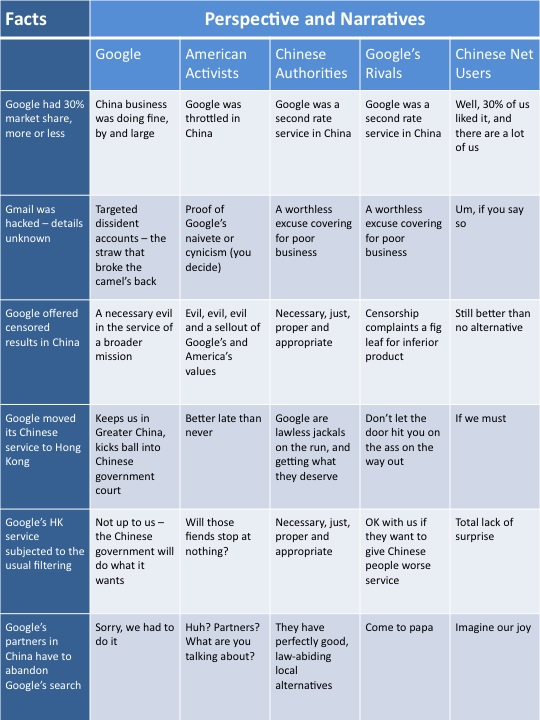
What I did do, however, was to put together a handy chart that shows the key known facts, and, based upon all the articles I’ve read, how each of the major interest groups that I observe is spinning or reacting to each of those facts. In each case, the vertical thread through the series of facts creates the skeleton of a narrative. And that’s what each of these parties –Google, its rivals, the Chinese government, the Western activist community– is trying to do: They’re each trying to control and define the narrative of Google’s situation in China to serve their own agendas. They are, in other words spinning. Here is what the result looks like:

google cheat sheet

I realize this is a vast oversimplification and there are no doubt various interests omitted, but this captures most of the main parties and facts. What’s not included here is any kind of conclusion of each narrative. In my opinion, the story is still unfolding and its too early for that. But we’ll see how things go over the next few weeks.

The other thing is that these narratives aren’t in equal competition. To use a possibly inappropriate military metaphor, there are different theaters of operation in which the stakeholder have varying levels of influence. So, in the US, Google and the activist (and analyst) community are the loudest voices. in China, the Chinese government has the tools to define the public narrative, and has been using them liberally, although there is some ferment in the margins (also here).

Eventually, there will be a canonical version of Google’s misadventures in China. or at least one canonical version in the West and one in China. These may not be the creation of a single group. One group might control interpretation of one element of the story, and one group control another. But for the moment, the fun is in watching the battle to own the story. Enjoy it while it lasts.

Finally, from a PR perspective, there is possibly one overarching lesson that can be drawn from this whole situation. I can’t take credit for this insight, it comes from Craig Adams, a colleague of mine. But it’s deceptively straightforward and I agree with it wholeheartedly. He said that if you have to sell out your basic principles to do business in China, that’s a pretty good sign you should reconsider your plans.

Other sources (just to prove I’ve done my homework):

Posted in Uncategorized | Tagged , , , , , , , , , , | Comments Off on A handy cheat sheet for interpreting the Google China story

Down the rabbit hole in Kansai

So here’s how it goes. Someone inconveniently dies on your airplane just as it is about to take off. You experience an odd mix of feelings. On the one hand, you sympathize with the family and feel bad for their tragic loss in the least dignified of circumstances. No one should have to die in the economy class of a non-moving airplane. On the other hand, you think to yourself, man, is my connection screwed. You are a bad person and will burn in hell.

But first you will burn in Kansai. Kansai is the international airport in Osaka. That is a lie. Kansai is the international airport that is somewhere in the same general vicinity of Japan as Osaka. On a clear day, you might see Osaka in the distance as you fly into Kansai. Or, then again, you might not. Kansai is where you are supposed to change planes for Hawaii. You want to be in Hawaii. Hawaii has warm breezes, palm trees, and girls in bikinis. You have packed clothes for Hawaii. They are thin clothes.

Kansai is on an artificial island they built somewhere in the general vicinity of Osaka because to build an airport on existing land near the city would have been a silly idea, and not used enough concrete. Kansai is apparently sinking slowly. This must really piss people off. Or, then again, maybe it doesn’t. After all, keeping the airport from sinking will keep construction companies busy for decades. Japan likes to keep its construction companies busy. Japan invented the idea of the “bridge to nowhere”. Most places build a useless bridge from somewhere to nowhere. In Japan, they build a bridge from nowhere to nowhere. They are that committed.

There is a bridge from Kansai Airport to Rinku. Rinku is nowhere. It is certainly not in Osaka. Arguably the airport is somewhere, but it’s nowhere you would want to be. The bridge from Rinku to Kansai is a bridge from nowhere to nowhere. It also has a train. Eat that, Gravina Island.

You need to take a bus over the bridge to nowhere. A young lady from the airline meets you at the jetway, escorts you through the airport and puts you on the bus. She bows and scrapes constantly. She is a professional bower and scraper called into service to apologize for the inconvenience of your delay. She bows and scrapes so hard that she leaves a scuff mark from the jetway through the terminal, through quarantine, through immigration and through customs. She is, however, incapable of arranging meal vouchers for you. This leads to more bowing and scraping. Your back gets sore as you watch her. You are disarmed but feel like an idiot for it.

Waiting for the bus you realize that clothing for Hawaii is inappropriate for late winter in Osaka. Or Rinku. Or wherever the hell it is you are. You are cheered, however, by the fact that the bus is full of pretty ANA stewardesses. ANA has very pretty stewardesses. And they can do CPR. This may be useful if you pass out from the cold while waiting for the bus. On the other hand, it didn’t help the guy on the plane you were on earlier. They told that guy not to fall asleep, and look what happened to him. If you hear a stewardess telling you not to fall asleep, panic.

The bus drives you and the stewardesses over the bridge to nowhere and drops you in front of a splendid, gleaming hotel. This is not your hotel. This is the stewardesses’ hotel. Your hotel is across the street, over a footbridge that you must drag your bags over. It is not tall and gleaming. It is short and squat and looks like a Chinese hospital with a Japanese convenience store embedded in it. There are no stewardesses staying there. There is apparently nobody staying there except for you. The convenience store is useful because the restaurant is closed. Who would want to eat dinner in the evening? Who stays in Rinku? Only the stewardesses, and they’re in the nice hotel across the street. Tough shit, hombre.

The hotel room is small. It reminds you of the single-occupancy dormitory room you stayed in twenty years ago in college except with a tiny, little, Munchkin-sized ensuite bathroom with an intergalactic toilet in it. They spared no expense on the toilet. The pillows, however, are apparently stuffed with something that gives them the consistency of sacks full of Tylenol gel-caps. This does not seem restful. There is a bilingual New Testament and a bilingual Teachings of Buddha. If you’re an atheist, you’d better have brought your own reading material.

The room has a view of Rinku. Rinku is nowhere. From this room you cannot even see the bridge. That is one of the room’s redeeming features. Another redeeming feature is that it has a television. The guide on the desk says that channel 1 is the BBC. This is a lie. Channel 1 is showing an infomercial for Japanese lingerie. This is not as exciting as it sounds. This is your grandmother’s lingerie. This is almost certainly not the lingerie that the stewardesses are wearing. The BBC is nowhere to be found. There is Internet, however. Thank god for that, because this is Japan and your mobile phone and Blackberry are only good for talking to the voices in your head. Those voices are telling you to turn off the TV.

The mini-bar is not a redeeming feature. It is empty. Foreigners are not trusted with a full mini-bar. They might get drunk and head for the stewardess hotel across the street. This would be disorderly. You flip through the hotel service guide in the desk. There is an entry for the mini-bar. It says “Room refrigerators have no drinks.” No shit, Sherlock. I guess the money for the toilet had to come from someplace. You are referred to the convenience store. The Japanese have an answer for everything. But they still have no meal vouchers.

Breakfast isn’t until 9 tomorrow morning and you are in Rinku in winter watching an infomercial for bad Japanese lingerie in a hotel room with an empty mini bar and James T. Kirk’s crapper. You should be on your way to Hawaii. Travel is great.

IMG_0263

Phasers on kill.

Posted in Uncategorized | Tagged , , , | Comments Off on Down the rabbit hole in Kansai

The zombie-slugging toy police car

Imagethief’s son, Zachary, turned two this week. I’m amazed we made it. By this I mean I’m amazed that Mrs. Imagethief and I made it. If the boy’s engine room telegraph is stuck on “full-speed-ahead”, Mrs. Imagethief and I are on something more like “dead slow” or “all back one quarter”. It’s been a busy couple of years.

My Chinese tutor, a wonderful woman who employs the spectacular pedagogical technique of making me translate articles from The Economist into Chinese and then debating me about the contents, was kind enough to give Zach a toy Chinese police car as his present. It was really kind of a fantasy police car, being as it was a BMW in police colors, but it was a big hit with the boy. It hit three of his sweet spots: “nee-nee nee-nee cars” (anything with lights, with the sound representing the siren); “zoom cars” (anything with a spoiler); and “gongan che“, which is not at at the top of his hierarchy –taxis occupy that spot– but which rate pretty high nevertheless.

The car was electric, so my wife hunted up some batteries for it and we switched it on.

That was a mistake. The “nee-nee nee-nee” was approximately as loud as a real police car. I almost smashed the thing on the spot, with my tutor watching (smashing a gift in front of the person who gives it to you is not well thought of in polite Chinese society). The cats are still traumatized. Zachary seriously re-thought his infatuation.

In the end, I took the thing apart and removed the little drive wheels and motor, which kept the car from freewheeling, and cut the wires to the speaker so that the only electric component that still worked was the lights. This made the police car a much improved toy in almost all respects. While I was about my improvements I noticed something a little odd. Here is a photo of the car:

police car

All well and good, except for the BMW thing, but take a closer look at the police seal on the hood:

Raccoon City

I almost didn’t spot it. It says, “Raccoon Police Department”.

At first I thought this was just your random Chinglish gibberish, which often finds a way onto toys. Zach has one front-end-loader that is spangled with the declaration, “Vigorously Super Power” (which I’m thinking of having tattooed on my ass for no good reason), and some small trucks that say, “Forbid Fireworks” on the gas tank and “Head Back” on the rear bumper.

But the miracle of Google Images reveals that this is actually the badge of the Raccoon City police department, which is the police department of the zombie-infested city from the Resident Evil video-game and movie franchise. Pop culture bottom-feeders may remember the original movie (there have been about 80 of them now) as the one in which model-turned-actress Milla Jovovich loses her memory, gets naked and kicks the ass of everything that gets in her way. I’m not sure that’s the correct order, but I’m pretty sure all those things happened. Actually, I think all those things happen in almost every movie Milla Jovovich makes, which may be why the Academy continues to snub her. At any rate, here’s the Racoon City Police Department Logo:

Patch

This is from a site called, “Patchbug.” Yes, somewhere out there is a patch collector serious enough that he needs a replica of the Raccoon City Police Department uniform patch. It takes all kinds, I guess.

What I find interesting is that the maker of this toy didn’t steal the Raccoon City patch wholesale, but kind of mashed it up with Chinese to come up with something uniquely ridiculous. For those who need reminding, the actual seal on Beijing police cars is an image of the Great Wall (as if it would be anything else):

Beijing Police Seal

So this is apparently a replica of the car of the Beijing Police Zombie Squad, which is apparently the best equipped squad in the Beijing police department. This makes sense: Only the best if you’re going to take on zombies.

The car also has a line of Chinese over the rear windshield, “有困难找警察”, which would properly be translated as something like, “If you have difficulties, look for a cop,” but which was rendered in English on the car as the delightfully sinister, “Any trouble with you, call the police to help.” Presumably “trouble” in this context means turning into a zombie.

Note: Actual police car emblem from Upton’s photostream.

Posted in Uncategorized | Tagged , , , , , | Comments Off on The zombie-slugging toy police car

How to ensure your reincarnation as a frog

Having grown up in “Mediterranean” San Francisco and then lived in Singapore nearly a decade, winter is something of a novelty to me. This is still true even after six years in Beijing. I don’t much like the desiccating cold or walking around in a cloud of my own skin flakes like the human sno-globe, but I enjoy the occasional snowfalls and the frozen lakes. One of my favorite Beijing experiences was a morning champagne brunch followed by a slightly drunken careen across frozen Qianhai on one of those ice bicycles that have the twin advantages of high speed and a dangerous illusion of steerability. I was double riding with my then colleague, Dennis. I can’t remember which one of us was steering. I do remember that we were thought of as ruffians and idiots. The latter was certainly true, and it’s only through the intervention of some higher power that we didn’t end up drowning under the ice or impaled on one of those little ski-poles that the kids use to prod their slow-poke sled chairs along.

Anyway, the point is, winter: Make the most of it. Now that my son is two and learning to appreciate idiotic behavior I look forward to further snowbound adventures. Although if he does anything like Dennis and I did, he will of course be grounded until global warming ensures that any further such hijinks become impractical.

There is a dark side to these wondrous winter scenes, however. As comes the freezing, so, inevitably, must come the thaw. The thaw has the effect of releasing the animal corpses that have been entombed in the ice all winter. Usually this means fish, and there is nothing like a stroll past a thawing Beijing lake to dazzle you with a lesson in the variety and size of the fish living (or, more accurately, that had lived) in these unpromising sludge ponds. Furthermore, there is always the one currentless doldrum where all the disgorged corpses accumulate.

I was reminded of this during a stroll around Tuanjiehu Park yesterday, my first visit to any of the frozen lakes this winter. Last year Zachary was really still a baby, and his public emergence in anything less than a crocheted NASA spacesuit was an invitation to admonishment from the aunties of Beijing. They are well-meaning, but deep inside they truly believe that foreigners are incompetent at raising children. After all, if we were better at it, there would be more of us. With Zachary much more in the “small boy” category this year, his emergence in inclement weather leads to less scolding and clucking.

As always, the park was festive. There was a Chinese oom-pah band (exactly as euphonious as it sounds) leading a massive sing-along inside the front gate, and the usual collection of small singing groups, lone-wolf erhu-ists, and children gnawing on that culinary hallmark of the Chinese fairground, unnaturally-colored mystery meat on-a-stick. God bless Beijing. Summer or winter, people here know how to use a public park.

The lake that is the dominant feature of Tuanjiehu park was still mostly frozen over. Most of it was slick and gorgeous and only mildly spoiled by a dusting of rubbish half frozen into the ice. But there was one spot, near the pleasure boat docks where in summer you can rent a leaky electric boat and spray cadmium-laced water at friends and family members, that had collected an entire fish market’s worth of moldering corpses. It is an image that will haunt me if ever we take Zach to the water-park on the island in the center of the lake.

At least it was only fish, which you kind of expect even in an urban Beijing lake. Four or five years ago, at exactly this time of year, Imagethief went on a walk past Houhai and Qianhai with the former Asiapundit, Myrick. He was in town from Shanghai to cover the National People’s Congress for the wire service he was working for at the time, and had never really had a look around the city. One of my dominant memories of that walk is the surprising number of turtle corpses we spotted on the ice, recognizable even at a distance as lonely, black humps surrounded by crows.

These turtles are not naturally occuring. Well, these are artificial lakes, so nothing in them is “naturally occurring”. But as far as I know, there is no year-round population of turtles in these lakes. Rather, many of them had been released into the lakes by Beijingers. The dead giveaway is that a number of them were still attached to little “turtle leashes” of string and sticks.

There is a ritual in Chinese Buddhism –放生 or fangsheng– by which one can earn merit by releasing a captive animal. Merit earns you a more advantageous seat on the wheel of karma, and helps ensure your eventual reincarnation a further rung up the ladder toward nirvana rather than a further step down toward cockroach or lemur or whatever your idea of bad is. Forgive the loose explanation, I’m shaky on my Buddhism. But you get the idea.

I see a lot of this ritual at Spring Festival (the Chinese New Year). This isn’t surprising. Spring Festival is heavy on themes of renewal and remembrance, and the temples do good business both in carnal temple fairs (see mystery meat on-a-stick, above) and in spiritual matters. The Chinese, as in so many spheres, have applied their commercial nous to the fangsheng ritual, and you can often buy birds for release at the fairs. The birds are trained to return to their keepers, which has the double advantage of enabling punters to feel meritorious while ensuring that the bird guy protects his capital stock. Everybody wins. Arguably even the bird, which is a good score in Beijing.

The idea of fangsheng, however, is to save an animal that is facing imminent death. Under this definition, the captive bird on the temple fair fangsheng circuit may not completely qualify, and, depending upon how strictly you interpret the scriptures, your merit may vary. Sufficient for the relaxed devotee, but perhaps not for the more orthodox. Also, the temple fairs only run a week or so, and there’s never a bird-release guy around when you need one, and so on. Sometimes, a creative solution is called for. This turns out to be the pet-store (or, more often, animal market) or supermarket turtle. Turtles are cheap. Turtles are substantial enough to matter, karmicly speaking. Turtles don’t test your resolve, like freeing that cockroach you found behind the dumpling-skin flour might.

So people buy and release turtles. Except, with Spring Festival actually falling in a Beijing mid-winter, they release turtles into icy lakes where they promptly freeze to death. The sun then warms their dark shells and the corpses slowly sink into the ice, visible only as dark humps that will be revealed again during the spring thaw. Imagethief is no religious expert, and will defer to someone who is, but to me this seems dubiously meritorious at best. Maybe the turtle moves up the karmic ladder (it starts at a low bar). You won’t.

Turtles aren’t the only animal that catch a hard one during this season. Frogs draw a crappy lot in China at the best of times. In 2007 Imagethief lived in Shanghai in an apartment that backed onto the local wet market. The frog seller set up shop in front of our rear gate. The frog seller’s total shopfront consisted of a bucket of live frogs, hand-held scales, a pair of kitchen shears and some plastic bags. When someone wanted to buy some frogs, the frog seller would use the kitchen shears to decapitate the frogs, and then weigh and package the rest for the customers. Over the course of an afternoon, a tragic pile of frog heads would accumulate. In summer, this would rapidly become a tragic and smelly pile of frog heads. Imagethief used to keep frogs as pets, so this was always a little traumatic for me, like a pile of kitten heads might be to a more normal person.

Market frogs don’t do any better in Beijing than in Shanghai, so saving a frog from the kitchen shears seems as though it could be both cheap and meritorious, a combination designed to excite the thrifty Buddhist. But this goes wrong in winter as well. Mrs. Imagethief was once going for a winter jog by the Tonghuihe canal, near our house, when she saw a family releasing frogs. The frogs got about one kick and then froze more or less instantaneously. You’d think people would catch on after the first couple of frogs, but as anyone who works in business or government knows, processes tend to take on a life of their own. These people released lots of frogs. They all froze.

When the family left, some canal workmen who had been watching from nearby immediately scooped out the frozen frogs and took them home to cook. So, genius, how does the merit allocate on that one?

My karma ran over my frogma.

My karma ran over my frogma.

Posted in Uncategorized | Tagged , , , | Comments Off on How to ensure your reincarnation as a frog

Free laptops for NPC delegates – it looked good on paper

Let’s say you’re a company selling some kind of product. Let’s say your product is –let’s just pick something at random here– laptop computers. Globally, this is a heavily commoditized category jammed with companies selling look-alike products with similar feature sets. In China, which has the usual big-time  suspects plus a whole cloud of local also-rans, the situation is even more competitive. How do you stand out? How do you persuade students, young professionals and other consumers to buy your laptop, and not some brand-x laptop poseur laptop?

Well, in China the answer is often, “be cheapest!” But that’s not always the whole story. Often there is also some PR.

To that end, one thing you would often do is try to get your product into the hands of “influencers”, people who have the power to help lead public opinion in your target market, ideally in your favor. One way to approach this is the celebrity endorsement: I’ll send a cubic meter of 100RMB notes to your house if you wave my company’s product around, appear in some ads and show up at some of my events. And, hey, why not write a blog about it? This is generally legit and practiced everywhere. George Clooney and Omega watches, for instance, except he probably doesn’t get paid in RMB.

There is also the schwag approach, in which you give your product away to rich, famous and stylish types in the hope that they’ll be seen using it thus conferring glamor and sexiness upon it, hopefully without you having to write a colossal sponsorship check. This is why you hear about things like the absurd gift baskets at the Academy Awards. This also leads to the great commercial irony that rich people get more stuff for free than more deserving types, such as impoverished PR bloggers, and will no doubt be a contributing factor in the revolution when it finally comes.

There are, however, some generally accepted rules about the schwag game. Two of those rules, involving who it’s OK to target and how schwag can be paid for, can be summed up in a diagram that looks like this:

schwag

By participating in a program to give free laptop computers to 2000 delegates to the Chinese People’s Political Consultative Congress (CPPCC), Lenovo appears to have landed squarely in the lower-right, or what I like to call the “PR deathtrap” quadrant. The CPPCC is a political body that nominally advises on and suggests policy and which convened this week in Beijing as part of the annual political “two meetings” festivities. The other meeting is that of National People’s Congress, which has the slightly heavier responsibility of endorsing actual policy (a cynic might say, “rubber stamping”, although the NPC has pushed back from time to time).

The always excellent China Media Project sums up the laptop situation:

As China’s annual National People’s Congress opened yesterday, many news headlines pounced on Premier Wen Jiabao’s remarks toward the end of his NPC report (see tab 11), in a section on anti-corruption, about the need for leaders to report their personal assets. But in the margins, commentators railed against shady practices nearer at hand — more than 2,000 laptop computers given away to delegates at the public’s expense.

The laptop story bubbled up out of China’s social media sphere back on March 2, when Chinese Internet users noted an odd mini blog entry from Zhang Xiaomei (张晓梅), a delegate to the Chinese People’s Political Consultative Conference who is also the publisher of Beauty Fashion magazine.

Zhang’s entries were succinct, mostly mundane summaries of preparations and speeches ahead of the two meetings.

CPPCC Chairman Tao says: being a national delegate to the CPPCC is a glorious mission, and a post for political participation and discussion. Sichuan party secretary Liu Qibao (刘奇葆) says: last year was the toughest year, this year is the most complex.

But in one entry she wrote: “When delegates report [to the meeting] they each get a laptop computer. What is different from last year is that this year these don’t need to be returned after we’re done with them. This is much more practical.”

Yeah, it sure is, isnt it? Keeping stuff often is.

As China Media Project explains, the response both online and in mainstream media has been pretty negative, with accusations of corruption and speculation about the amount of tax dollars spent on the computers. It has also been pointed out that Lenovo executives account for a large share of the IT industry representation at the CPPCC.

So here is where it gets interesting, and perhaps where Lenovo put a foot wrong assuming they played some role in creating this program and weren’t just lucky beneficiaries. CPPCC delegates occupy a strange space in between celebrity and politician. Many of the delegates, such as Ms. Zhang, are in fact celebrities or notables from the business world. Most are not politicians or officials in their daily lives. As the Financial Times noted this week, the entire CPPCC is a bit theatrical, and its actual contribution to the legislative process is debatable at best. In previous years delegates had been loaned computers, so why not let them hold onto them this  year? A relatively small change in the grand scheme of things.

But regardless of what you think about the CPPCC or the actual power of its delegates, in the context of the “two meetings” the delegates are acting as politicians. In an era when Chinese people are increasingly sensitized to corruption and willing to discuss it online and hold officials to account, giving laptops to 2,000 wealthy people operating in a political role looks risky at best. Perhaps in some years it doesn’t become a big deal, but this year it rubbed people the wrong way. It probably would have been best to stick to the loaner approach, even at the risk of some slightly inconvenienced delegates.

From Imagethief’s point of view the good news is that this issue became, well, an issue. That it escalated online and in the media is a headache for Lenovo and perhaps an embarrassment for some of the delegates (although that may be optimistic), but it’s a good thing for accountability and for China. The CPPCC may be largely symbolic, but at least it could be relatively clean and symbolic.

So what should Lenovo do? This situation is a long way from being out of control, so what they probably will do is hunker down and wait for the government to decide that discussion of this issue is no longer appropriate and then enjoy the ensuing silence. A more progressive option would be to announce that in subsequent years they’ll return to a policy of loaning delegates computers rather than giving them away. Better yet would be to cancel the whole thing and make delegates self sufficient for computing in future. I’m sure most CPPCC delegates –even the ethnic minority delegates– can afford a computer.

Or how about this: It’s awkward to inform delegates that, sorry, contrary to what they were originally told they do have to return the machines. But Lenovo could ask delegates who don’t need the computers after the meetings to voluntarily return them, and then publicly donate the returned machines to some worthy cause. Rural schools? Barefoot doctors? Impoverished bloggers? You name it. Plenty of options.

Note: Some in-situ links removed from the paragraphs quoted from China Media Project. It’s worth visiting their original post.

Disclosure: I do not work on any laptop computer accounts, however my agency does represent a competitor to Lenovo. The views expressed here are my own.

Update: David Bandurski of China Media Project left a comment in the original version of this post noting that, as of writing, criticism in the media was not directed at Lenovo specifically. At least, not yet.

Posted in Uncategorized | Tagged , , , , , | Comments Off on Free laptops for NPC delegates – it looked good on paper

Is Wal-Mart’s eco-consciousness in China more than PR?

Sunday is shopping day in the Imagethief household, so this morning Mrs. Imagethief, Zachary and I bundled ourselves up and headed out to Wal-Mart.

Before you gasp in a fit of effete surprise, let me explain. As a card-carrying Bay Area intellectual snob, my pedigree is more Whole Foods than Wal-Mart, even if Whole Foods is basically just Wal Mart for Prius-driving gourmets (well, and my mom). But in my neighborhood in Beijing  walking-distance supermarket options are limited to the eye-wateringly expensive import-barn in the basement of Shin Kong Place (RMB35 for four kiwi fruits? Sure!); the fast-declining Bonjour, in the basement of the equally fast-declining Sunshine 100 (like Carrefour without the lingering veneer of French-ness and, in winter, heated like hell’s supermarket); and the Wal-Mart at Wanda Plaza.

OK, we have a Jingkelong, too, but it’s not much use if your shopping needs extend beyond soft drinks, instant noodles and strawberry-flavored UHT milk. Once upon a time we had a Jenny Lou, but Jenny apparently decided our neighborhood was for losers and moved down to the accursed Jianwai Soho instead. So Wal-Mart it is. Plus, they deliver, which is essential when your shopping needs include kitty litter for two.

With Wal-Mart fresh in my head, and fresh kitty litter in my guest bathroom (for the cats, not for the guests, although there have been some parties…), I was therefore interested to see a Washington Post article covering in mostly positive terms Wal-Mart’s efforts to get its Chinese Suppliers to improve their environmental and labor standards (part of a special report called, “The Climate Agenda.”):

As a result [of Wal-Mart’s urging, Hong Kong-based soap and cosmetic manufacturer] Lutex has been paying attention to more efficient light bulbs, better ventilation and less packaging. It switched from Styrofoam to recycled paper and saved enough Styrofoam to cover four football fields. And Lutex, which has been here since 1991, says it treats four tons of wastewater that it used to dump into the municipal sewage line. That water was supposed to be treated by the city, but like three-quarters or more of China’s wastewater, it almost certainly wasn’t.

“We heard that in the future, to become a Wal-Mart supplier, you have to be an environmentally friendly company,” [CEO Benny] Fung said. “So we switched some of our products and the way we produced them.”

Wal-Mart has more than 10,000 suppliers in China. In addition, about a million farmers supply produce to the company’s 281 stores in China. If Wal-Mart were a sovereign nation, it would be China’s fifth- or sixth-largest export market. So the company hopes that small measures taken by all suppliers start to add up. Its 200 biggest suppliers in China have already trimmed 5 percent of their energy use.

***

In October 2008, Wal-Mart held a conference in Beijing for a thousand of its biggest suppliers to urge them to pay attention not only to price but also to “sustainability,” which has become a touchstone for many companies.

“For those who may still be on the sidelines, I want to be direct,” Wal-Mart chief executive Lee Scott said sternly. “Meeting social and environmental standards is not optional. I firmly believe that a company that cheats on overtime and on the age of its labor, that dumps its scraps and its chemicals in our rivers, that does not pay its taxes or honor its contracts will ultimately cheat on the quality of its products. And cheating on the quality of products is the same as cheating on customers. We will not tolerate that at Wal-Mart.”

Well, if he says so.

My first reaction to this story was, “What a PR score!” Cynical me wasn’t really prepared to consider if there might actually be something to this. But might there be real business motivations for moves that seem antithetical to a company with a mission to drive costs to the absolute lowest level?

One possible answer to that question can be found in a post at the well-known “Naked Capitalism” economics blog. Yves Smith suggests three factors that could motivate Wal-Mart to put real effort into pressuring its Chinese suppliers to improve. They are:

  • Creating an “insurance policy” against possible American trade restrictions that might be based upon setting minimum environmental and labor standards.
  • An effort to differentiate itself in the Chinese market by demonstrating attention to food quality standards and environmental issues.
  • A move to appease evangelical Christians who increasingly see earth-stewardship as part of their religious duty.

In fact, two out of those three things (see if you can spot which two) are still essentially public relations. Personally, I have a hard time believing the third is anything close to being a sufficient motivation for a serious revamp of Wal-Mart’s Chinese supplier relationships, but, then, I live a long way from the American heartland and am thus not well attuned to its priorities.

The second point seems plausible, but as a regular Wal-Mart China shopper I can attest that Chinese shoppers seem perfectly enthusiastic about Wal-Mart already. Wal-Mart also does a brisk trade in allegedly organic Chinese produce (we buy it, but I’m really not sure how far to trust the “organic” claims). At any rate, as an approach it sure couldn’t hurt, unless it starts leading to significant job losses at Wal-Mart suppliers in China, in which case, all bets are off.

Ultimately, although the impact is in China, I still see this as primarily a move to influence the customers and activists back home in the US who have the greatest ability to influence Wal-Mart’s business. China environmental and labor issues are important in China, of course, but arguably not as important as they are in the US. (Next up for trouble: Apple? Don’t miss the bizarre fanboy comments.)

As for me, I’ll take a pass on the live soft-shelled turtles (where are the PETA people?), but the produce section isn’t bad and you can’t beat a fuzzy car-seat cover that carries the inscription, “Space cat who dreams of happiness!” If only I had a car.

Space cat who dreams of happiness.

Space cat who dreams of happiness.

Posted in Uncategorized | Tagged , , , , | Comments Off on Is Wal-Mart’s eco-consciousness in China more than PR?