Will we all burn in a fire made of mooncake packaging?

Imagethief likes the Mid-Autumn Festival. I like it because even though it actually comes in late summer, it reminds me of autumn, and autumn is famously the nicest time of year in Beijing. In any year devoid of Olympic rigging, late summer in Beijing is intolerably hot, muggy and polluted. This year it was merely hot.

Over the years many people have told Imagethief that the Chinese Mid-Autumn Festival falls in summer because of inconsistency between the Chinese lunar and western Gregorian calendars. This is total BS and I see no reason why I should accept obviously finagled explanations from people just because they are “Chinese”. The real reason is that without some reminder of imminent autumn and its much improved climate, half the population of Beijing would commit suicide in late August and early September, in the dregs of the Venusian summer atmosphere. In Scandinavia it’s the lightless winters that do it. In Beijing it’s the airless summers.

If you assume that Beijing has fourteen million people (and don’t bother controlling for migrant labor, tourists, etc.) a one year half-life would leave Beijing with a population of just thirteen people in a mere twenty years. This would obviously be totally unacceptable to government mandarins, who would no longer be able to feel the satisfaction of clearing out an entire lane on Chang’an Ave. and making millions of gridlocked commuters watch them roar past in a motorcade. Roaring past one peasant and his donkey cart on an otherwise completely deserted twelve lane boulevard just doesn’t have the same effect, and anyway the same effect can be had in the new Burmese capital-cum-supervillain hideout of Naypyidaw.

So Mid-Autumn Festival is a good thing. We all agree on that. However, just as the miracle of a Tex-Mex dinner comes with the heartbreak of punishing day-after flatulence, the miracle of Mid-Autumn Festival comes with its own curse: Mooncakes.

Mooncakes are the Chinese fruitcake: Cloying pastries that appears once a year for traditional reasons that everyone has forgotten, generally as gifts, and which, cockroach-like, resist all attempts at eradication. If you must know the history, it’s on Wikipedia. Scroll right to the bottom, since most of the entry is devoted to the culinary characteristics.

Many people complain to Imagethief about mooncakes. Inedible. Gross. Heavy. Burn longer than a tin of Sterno. And so on. To direct all this anger at the innocent and humble mooncake itself is to miss the point. First, Imagethief likes mooncake, albeit in small doses (it’s best cut with Chinese tea on the side). Of course, Imagethief also likes fruitcake. In fact, Imagethief pretty much likes anything sweet. I’d eat gravel if you mixed it with brown sugar.

But the other thing is that is that the main problem with the mooncake is not the cake itself. It’s the packaging, which could be the least green consumer item since the Hummer.

I was reminded of this when the translation company delivered a palletload of mooncake boxes to me and my team as part of the obligatory upward mooncake flow from vendor to client. Each of us received a heavy, embossed and foil stamped bag with rope handles. In the bag was a heavy cardboard box with a tri-fold faux-embroidery lid with faux-embroidery dragon applique. Within the box was a cardboard frame wrapped in a faux-silk shroud and lovingly cradling eight mooncakes. Each mooncake was in an individual cardboard box, a sealed plastic wrap and a plastic cup. Two pairs of wooden chopsticks in a fabric envelope were included for good measure. The theme throughout was tasteful and subdued imperial yellow garnished with dragons.

Gross weight: About two and a half kilos. Net weight: About 640 grams. Multiply by a nation of 1.3 billion people. Sure, not everybody gets mooncakes. But some of us get lots of mooncakes. You can see where the environmental toll will start to add up.

Fortunately, the picture is not as grim as it seems. Like fruitcakes, mooncakes are, if not an infinitely renewable resource, at least an infinitely recyclable one. Every year at this time the hand-lettered “recycle mooncakes” signs go up outside neighborhood shops and on curbside stands. Like overpackaged Chinese brandy sets, mooncakes are infinitely re-giftable. Shanghai, ever the city of commerce, has brought the mooncake recycling market to unprecedented levels of trading sophistication. Rather than give physical mooncakes, it’s common to give a coupon that can be redeemed for mooncakes. These coupons are then traded on an informal exchange of office ladies and household ahyis that offers NYMEX-like liquidity. Like the oil futures market, it seems that the actual mooncakes rarely enter into the final equation. However there is some risk as, like a bank run, its unclear if the system could actually withstand a mass-redemption event.

The upshot is that while approximately four billion tons of mooncakes are gifted every mid-autumn, only about ten pounds are actually consumed. This means that the packaging situation is perhaps not as bleak as it first appeared.

Imagethief sees this as yet another sign of Chinese technological advancement. Like an MRE a mooncake has a nearly infinite shelf life, allowing for century after century of suck-up regifting on a highly leveraged environmental footprint. Surely this is a system worthy of the inventors of moveable type, the compass, paper money, rhinestone dog collars, the Slinky, aerosol breath freshener, etc. etc.

The mooncake tradition traces its history back to the fourteenth century. How charming and ecologically sensible that the mooncake you are now slicing into may also date back to that same century.

Posted in Uncategorized | Tagged , , , | Comments Off on Will we all burn in a fire made of mooncake packaging?

Why I don’t care about the opening ceremony’s fraudulent footprints

Or so you would start to believe from the press reports over the last day. Some have dwelt upon the lip-synched singing of hyper-precious Lin Miaoke, the impossibly apple-cheeked munchkin girl who “sang” the laudatory and self-referentially titled “I sing for my motherland” without toppling over in shock at the thought of being watched live by 90,000 people and countless millions on live television. She must have been on ketamine, because I would have frozen like fudge in Fargo. And I generally have no problem with public speaking.

More reports have focused on the somewhat more scandalous replacement of the “giant footprints” fireworks display with a computer-generated special effect.

Here is what Imagethief thinks of both of these revelations: So what?

I got news for you: Li Ning wasn’t really flying either. If they’d really wanted him to fly they would have shot him out of an air cannon in a flaming suit and he could have lit the torch as he sailed over it and out of the stadium into the Great Beyond of the Olympic Green.

Damn, forget Zhang Yimou. With ideas like that, I oughtta plan these events.

The Olympic opening ceremony may have represented many things, but “veracity” was not among them. I thought it was a pretty good show. But let’s face it: it packaged Chinese culture as vulgar burlesque and reduced the legendary 5000 years of history to arena-rock light show. The whole thing was one giant special effect from beginning to end. But I don’t care. I like vulgar burlesque and arena-rock light shows. This was my kinda show!

In fact, arguably Olympic Beijing, tarted up, hyper-sanitized, stripped of automobiles and resolutely micro-managed for two weeks, is something of a colossal special effect in and of itself. Among all this surely one digital process shot can be forgiven.

Even the Olympics themselves can be thought of the same way. Overmarketed, pompous, awash in idiotic pseudo-religious symbolism (remenber the “priestess”-infested torch lighting ceremony?), and rife with doping and age scandals, they’re certainly a yard or two from what most of us would consider “reality”. It’s well off the deep-end of showbiz, and showbiz is all about illusion. And I write all of this as someone who’s relatively excited about the games! But you have to be clear-eyed about these things.

The only grudge I hold about the footsteps is that it was a particularly cool idea. I even said, “That’s cool!” to Mrs. Imagethief while we were watching it on the immense TV that my landlord so graciously installed in my apartment. So, yes, I was fooled. My bad. But I was still entertained by the shot, which is more than can be said for the oxygen-destroying tedium of the totally un-retouched parade of national teams. If anything, I could have used a little less veracity there. (On that note, NBC denies editing the parade to make the US team come out later in the US broadcast. Imagethief suggests that the turgid pace of the parade simply made it seem like eternity before the US team came out.)

As for munchkin girl, of course she was lip synching. While we were watching her I turned to Mrs. Imagethief and said, “The munchkin is lip synching.” This doesn’t make me a genius. It simply makes me someone who grew up watching Superbowl halftime shows, the Grammy Awards, and other lip-synch classics.

In fact, on that note, and overlooking the two hour Grand March of Tedium and my various bitchy comments above, I give the opening ceremony pretty high marks. The first part was legitimately spectacular, and I enjoyed the finale as well. Yes, I think Zhang and the Gang could have done themselves a favor and left out the footprints if they didn’t think it would work. Or simply taken their chances on the helicopter chase. But I’m sure they were all biting their nails to quick during the entire four hour extravaganza already. Has anybody tracked sales of Tums (or the Chinese equivalent) in Beijing over the past month?

In fact, the soporific parade aside, the only other things I’d have voted to remove from the ceremony were the absurd hand-doves of peace, the goose-stepping soldiers and slow march of the Olympic flag around the entire circumference of the field in the statium. The soldiers kindled unpleasant associations for many foreigners, and the flag march simply came way too late in the show for such draggy self-indulgence.

But good marks on the whole. I’d say that the London 2012 crew (remember, there will be another Olympics after this one, assuming the sun doesn’t explode) has its work cut out for them. Imagethief has just one bit of advice for them: Keep it under two hours. At four hours, the Beijing ceremony was longer than the Oscars (speaking of fraudulent). Keep it short, leave ‘em wanting more. Everyone will love you for it. Or at least I will.

And that’s gotta be worth something, right?

What? Me? Sing?

What? Me? Sing?

Posted in Uncategorized | Tagged , , , , | Comments Off on Why I don’t care about the opening ceremony’s fraudulent footprints

Imagethief and the top-secret dam of Panjiakou: A Great Wall diving adventure

Regular readers will recall that Imagethief recently accompanied Steven Schwankert ofSinoscuba to dive a section of the Great Wall that lies underwater in a reservoir at Panjiakou, near Tangshan. A prior blog post about that trip is here. We had an Associated Press camera crew with us on that trip, and their video ran on various television networks. You can find online versions in which I offer various breathless quotes at at National Geographic and elsewhere.

However, I also shot my own video, both at the surface and underwater. It’s about six minutes long and has a few more details than the AP segment, as well as a bit more of the singular Imagethief wit and the trademark oilskin hat and sunglasses. It’s now posted on YouTube. Enjoy, and consider it a break from the current flood of Olympic content (although there is a tangential Olympic connection).

Various other odds and ends also on my YouTube channel at http://www.youtube.com/user/imagethief.

Posted in Uncategorized | Tagged , , , | Comments Off on Imagethief and the top-secret dam of Panjiakou: A Great Wall diving adventure

E-Z steps to make your own Beijing air at home

Imagethief realizes that he and much of the journalistic and blogging community have been doing a grave disservice to our readers who don’t live in Beijing. We beg your forgiveness. Living in Beijing is such an all-consuming experience that we sometimes forget there is a world beyond the fifth ring road. Although we are, of course, tangentially reminded of this world every time we go to our beloved import supermarkets, which thrive on the business of bringing us Doritos, Haagen Dazs and other nibblicious, western treats from beyond the Great Barrier.

The disservice we have perpetrated is to groan on at length about Beijing’s shabby, noxious air while never giving you, the reader abroad, the chance to understand for yourself what we really mean. Beijing in August is not best experienced as some kind of abstract mental construct based on the fulminations of bloggers, or the moralizing of the mainstream media. It is a physical experience, and has to be experienced viscerally and immediately. After all, reading about a rock band simply isn’t the same as standing in the mosh pit in front of the stacks, with the thump of the bass separating the cartilage from your bones and slow-cooking the fluid in your eyes.

Part of the reason why Imagethief thinks that first-hand experience is valuable is that it provides perspective when one reads the dissembling of official apologists who are doing their best to insist that the air is not really as bad as it looks, tastes or feels in our eyes. In fairness, it has been much better the last couple of days than it was the past week, thanks to a welcome breeze and a touch of rain. But the mandarins have passed much of the last few days demonstrating that they are either disconnected from reality as the rest of us understand it, or that they have a less than satisfactory understanding of the meaning of the word “good” as it is commonly employed in English.

It is hard to know which of these two situations is correct. Imagethief suspects that faulty dictionaries may be the problem, since the word “moderate” is used in SEPA reports to describe air quality that Imagethief would label “hopelessly toxic”, “depressing” or “squalid”. Adjectival nuance can be tricky, especially in a language as eccentric and irregular as English.

It may also be that the authorities are simply trying to be “hip with the times”, and have noted the tendency of English-speaking youth to use negative adjectives as endorsements, e.g. “sick*” (what we who went to high school in the ’80s used to call “cool”, “awesome” or, in the most rarefied of circumstances, “radical”). If this is the case, then the fault is ours and when the authorities say “good” they actually mean “screwed”. Athletes are overwhelmingly young, so this is perhaps a forgivable error in these Olympic times. If SEPA, or its ministerial successor, refers to one of our rare blue-sky days as “sick”, then this theory may gain credence.

The shame of this situation is that Beijing is in many ways a great city. It’s interesting and fun enough that many of us live here despite the often crummy air, which is really saying something. And when, every now and then, the air is truly clear, Beijing verges on beautiful. Colors pop out. The hills are visible to the north and west. The gorgeous parks and temples beckon. These clear days cluster in the brief spring and autumn, when temperatures and winds are favorable (although spring also gets dust storms). By any standard, however, they are rare. An enveloping, noxious fug is far more typical.

Which brings me back to the point. I want to help you, the reader abroad, understand exactly what we’re talking about when we refer to Beijing’s poor air quality. After long experimentation at Imagethief Laboratories SA, I am pleased to report that we have developed a method of simulating Beijing’s typical August atmosphere with nothing more than a few easily obtainable ingredients and a common household appliance.

Here is what you will need:

  • A serving plate.
  • Large bowl that can be used to cover the serving plate.
  • A bucket of water.
  • A Yorkshire terrier, Pekingese or similar small dog (at a pinch, a dog pelt can be used, but a whole dog is more reliable). Important: If the dog is wearing a metallic collar or tags, remove them.
  • A packet of bad cigarettes. Ideally, Chinese Red Pagodas. But at a pinch, Gitanes or Parliaments will do.
  • A non-metallic ashtray.
  • A turd.
  • A microwave oven.

Steps:

  • Soak the dog in the bucket until wet to the skin.
  • Place the wet dog on the serving plate with the turd and the ashtray.
  • Place three lit cigarettes in the ashtray.
  • Cover the serving plate and all ingredients with the bowl.
  • Microwave on “high” for sixty seconds.

Congratulations. What’s under the bowl is a close recreation of typical August Beijing air. Use a fork or butter knife to carefully lift the edge of the bowl (it’s hot!) and have a sniff. Now you’ll have something to visualize (or “olfactorize”) when you read the inevitable thousands of stories still to come on Beijing’s Olympic air quality. If you’re daring, you may want to get a garden hose, have a few of the frat brothers over and challenge each other to do “hits” of Beijing. You may need more than one dog**.

*Probably already hopelessly out of date.
**Imagethief does not actually condone microwaving yappy dogs, although he does sometimes fantasize about it.

Posted in Uncategorized | Tagged , , | Comments Off on E-Z steps to make your own Beijing air at home

Illegal baby part 1: The strange case of the sluggish passport

Note: This combines two original posts. In the first part, I suggest something to the Singaporean embassy. In the second part, they respond.

Illegal baby part 1: The strange case of the sluggish passport
July 1, 2008

Anyone within earshot will know that Imagethief welcomed his son, Zachary, into the world last March 9th. The nearly four months since have been one long sleepless adventure. Despite my fatigue induced delirium, however, the experience has been a happy one. Like parents everywhere I take the most profound pleasure in things that non-parents wouldn’t even notice. This week’s new talent: Blowing damp, drooly raspberries. I glow just thinking about it. In Imagethief’s parenthood-addled mind, it is but the merest step from a wet raspberry to a full ride at Harvard.

Having a baby means paperwork. Last week’s trip home to Singapore was case in point, as I spent my “holiday” dealing with health insurance for Zachary, life insurance for me, a will for everyone in the family, and various other “responsible parent” stuff. It all left me feeling rather old and grown up.

Having a baby abroad means even more paperwork, as one must go through various registrations with various consulates and embassies in order to ensure that papers are obtained and the relevant authorities (“relevant authorities” is Imagethief’s top phrase for Summer ’08) don’t think you’re some kind of flesh peddler smuggling healthy Chinese babies out of the country for resale to monied but childless Western suburbanites.

The racial distinction in the sentence above is important because Mrs. Imagethief is Singaporean and Zachary is thus Eurasian, with his looks falling less to the “Eur” and more to the “Asian”. Dad’s nose and ears, mom’s everything else if you must know. Considering my nose, this may not be the optimum distribution of features, but so it goes. Imagethief believes that mixed races are the future of mankind and is glad to be doing his part for ethnic homogeneity and conscientious outbreeding. (“Conscientious outbreeding” is Imagethief’s number-two phrase for Summer ’08.)

But ethnicity isn’t everything. While it hasn’t always been the case, the trump-it-all organizing political concept of the last few hundred years has been the nation-state. Imagethief has mixed feelings about nation-states, especially as a proxy for good old-fashioned tribalism, but bows to the prevailing fashion. This means that my boy is a dual citizen, and entitled to both United States and Singaporean passports.

Some people –especially my cynical Singaporean friends– might ask why bother with the Singapore citizenship. Singapore doesn’t permit dual citizenship for adults, and assuming that policy doesn’t change Zachary will eventually have to choose a nationality. But it is important to me that he have a say in that choice. He has roots and family in Singapore, and being part Singaporean will always be part of his identity. There is also a good chance that he will go to primary and secondary school in Singapore, where he will no doubt learn the finer points of Hokkien vulgarity. Should he remain a Singapore citizen or permanent resident, national service will fill any gaps in his vocabulary and ensure that he matriculates with a truly colorful assortment of multilingual profanity. I swell with paternal pride at the thought.

So we duly registered Zachary’s birth at both embassies. And this is where the surprise lay. Singapore has a reputation for bureaucratic efficiency. Having participated in the registration of a business in Singapore, filed taxes there for many years, and applied for both work permits and permanent residency papers, Imagethief can attest that this reputation is largely justified. Singapore’s civil service is cool, crisp, courteous and efficient, and maintains comfortable waiting rooms with widescreen televisions invariably featuring either Mr. Bean reruns or Tom & Jerry cartoons. (Both can be watched silently and neither offends any of Singapore’s established religions or creeds, although I personally find Mr. Bean rather offensive.)

The United States’ reputation for bureaucratic efficiency is less glittering. Thanks to America’s Global War on Terror (TM) this has been especially true in matters of travel and identification, with Vietnam or Soviet Russia seeming better comparisons than Singapore. So I fully expected Singapore to produce a passport within days while the US Embassy waited for the Department of Homeland Security to grind through a months-long analysis of whether my mixed-race, China-born baby constituted a clear and present danger to national security or intellectual property.

I was exactly wrong. The US Embassy approved our application on the spot and had a passport ready one week later. Two weeks after applying, the only thing the Singapore embassy had managed to do was to call my wife and ask her to come back and sign an oath that she had not renounced her Singaporean citizenship. Somehow it didn’t occur to them to do this during her first visit. Going on two months later we have a recently delivered Singaporean citizenship certificate, but no passport. Thus, despite the fact that we travel to Singapore far more often than to the US, Zach’s Chinese visa is in his US passport, and he just completed his first visit to Singapore as a foreigner. I can stay as long as I want, but after ninety days he is baby non grata.

That seems a shame, because Singapore has a problem: No babies. According to the CIA World Factbook, it has the third worst fertility rate in the world, at 1.08 children per woman. Only Hong Kong and Macau (where everyone is apparently too busy gambling to have babies) fare worse.

In fact, that 1.08 is apparently misreported. A 2007 article from Singapore’s Channel News Asia (think CNN stripped of the things that make CNN interesting) gives a figure of 1.24 as the record low, from 2004, with 1.08 being the number for ethnic Chinese women.

But that’s still pretty bad given that the ethnic Chinese are about 75% of Singapore’s population. And it means that the Malays, the most significant minority group, are doing most of the heavy lifting when it comes to having kids. The government is unlikely to admit this publicly, but I think they’d prefer ethnic status quo rather than a growing Malay minority that may upset Singapore’s carefully nurtured political balance.

In addition to trying to encourage the immigration of educated professionals, Singapore has trundled out the incentives for having children. These apply to everyone, not just the reproductively-indifferent Chinese, and include grants of SGD$3,000 for the first two children, with even larger sums for the next two. But judging from the figures, the incentives don’t seem to have helped much. This is not too surprising. The “baby bonus” is nice, but having kids is a complex, long-term project and SGD$3,000 in Singapore is a couple of months rent even if you live in public housing. Personally Imagethief would much rather have free local childcare and less stress about whether his kids will get into a top school or languish in some also-ran academy for mouth-breathing troglodytes.

Anyway, the long and short of it is that Singapore needs babies. And what it really wants, it will tell you over a teary, confessional piss-up (if a nation-state could do that), are the high-potential babies of prosperous, educated people. Precisely the people who don’t have children because they’re too busy chasing the brass ring and spending SGD$150 a pop to tank up their Lexus LS400s.

So, if I may flatter myself, you’d think they’d be going overboard to ensure that the child of an educated, long-time permanent resident who works in China (a country Singapore prioritizes) and an educated, professional, Singaporean woman becomes a Singapore citizen. You’d think they’d have sent salesmen around while we were still pregnant, with brochures explaining why Singaporean citizenship is the best choice for our child. You’d think the embassy would have called to remind us of the top notch medical care and excellent schools that await my child in the motherland. You’d think they’d have had a passport tucked into an immense fruit basket waiting for us outside the delivery room with a letter from the Minister of Babies (or whomever) thanking us for doing our bit for the country’s future prosperity.

But no. Two months later and I’m still waiting for a passport. And no fruit basket either. Which is a shame, because Singapore has outstanding fruit (even if it’s all imported). Meanwhile, Uncle Sam, who ranks near the top of the developed world fertility league tables and has no baby shortage at all, has stolen a march.

Which brings me to complaint two: Singapore’s policy on dual citizenship. It’s not having any, thank you. Hence my boy’s impending Big Choice. For a country that wants to be the Switzerland of Asia, the antipathy to dual citizenship seems surprising, but I understand where it comes from. Singapore’s government fosters a national sense of vulnerability as a political tool. We’re economically fragile, surrounded by Indonesians, could lose it all in a heartbeat, etc. Work harder. A conviction that national loyalties can’t be divided under such precarious circumstances fits neatly into that picture. After all, when the going gets tough, those with foreign passports might just bail and leave the rest treading water (literally, if the challenge at hand is the rising sea level).

Aside from assuming the worst of its citizens, the problem with this approach is that any visit to Western Australia will demonstrate that educated, prosperous Singaporeans aren’t waiting for permission to leave. As always, those who are most desirable will be those with the most options. As a nation that thrives on its international connections, Singapore needs to sell itself not just to foreigners, but also to its own citizens on an ongoing basis.

Even though I’m a foreigner I consider myself pretty invested in Singapore. That’s why I want Zachary to have the option of choosing Singapore citizenship for himself someday. I would even consider taking Singapore citizenship myself if I didn’t have to renounce US citizenship to do it. Sorry, but that trade ain’t happening (America’s stone-age expatriate tax policies notwithstanding). And perhaps that’s QED for the Singapore government. If I’m not willing to make the big commitment, why should I be taken into the fold?

But it all comes back to that desire to grow the population and encourage successful professionals to make Singapore home. Part of that is being flexible enough to do what’s necessary to make people feel welcome in a long term, raise-my-children-here kind of way. Singapore is afraid of its citizens hedging their bets, but that’s exactly what it does. That’s why my “permanent” residency expires every five years and why Singapore won’t tolerate dual citizenship. It’s a not a big deal for me, but it’s a shame for my boy, who will be part American and part Singaporean for the rest of his life, regardless of which passports he is allowed to carry.

Encouragingly, things change. It wasn’t that long ago that Singaporean women married to foreigners weren’t allowed to register their children for Singaporean citizenship at all. If that can change, who knows what else might come to pass in the sixteen or so years that will pass before Zachary has to choose a nationality. Perhaps he will be part of Singapore’s first generation of dual-nationals.

In the meantime, however, just getting that passport would be a good start.

Illegal baby part 1A: The Singapore embassy sends a fruit basket
July 26th, 2008

About a month ago I wrote about the long time it was taking the Singapore embassy in Beijing to produce our son’s Singaporean passport. Reflecting my frustrations about various aspects of Singaporean citizenship policy, and what I see as the conflict between Singapore’s reluctance to accept dual citizenship and desire to have more citizens, I wrote the following:

[If] I may flatter myself, you’d think [the government of Singapore would] be going overboard to ensure that the child of an educated, long-time permanent resident who works in China (a country Singapore prioritizes) and an educated, professional, Singaporean woman becomes a Singapore citizen. You’d think they’d have sent salesmen around while we were still pregnant, with brochures explaining why Singaporean citizenship is the best choice for our child. You’d think the embassy would have called to remind us of the top notch medical care and excellent schools that await my child in the motherland. You’d think they’d have had a passport tucked into an immense fruit basket waiting for us outside the delivery room with a letter from the Minister of Babies (or whomever) thanking us for doing our bit for the country’s future prosperity.

Well, it did indeed take three months, but last Monday the Singaporean embassy finally came up with Zachary’s passport. Not only did they come up with it, but they sent two Singaporean embassy staff (as oppose to local couriers) around to our apartment to hand deliver it along with congratulations and a personal apology for it taking so long and, yes, a fruit basket:
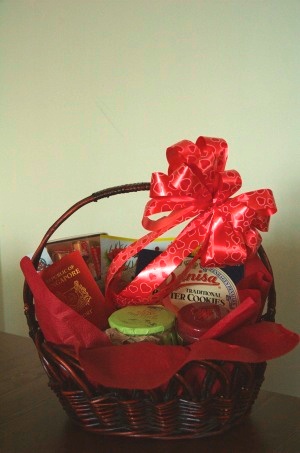
fruitbasket-corrected

Technically it was more of a biscuit basket (for giggles, say that out loud) than a fruit basket, but the idea was the same. I have no idea if this is Singapore embassy SOP, they just felt they needed to make restitution for the delay or they are (gulp) reading this blog. The latter possibility is a little worrying considering some of the less than worshipful things I have written about Singapore’s government over the years. Any Singaporean readers who’ve registered the births of their children in Beijing are invited to let me know if they received the same treatment.

The apology and fruit biscuit basket didn’t change how I feel about Singapore’s reluctance to allow dual citizenship for adults. But they did go a long ways toward defusing my annoyance at the delay in delivering Zach’s passport. Nothing like a touch of personal service and attention to mollify a disgruntled customer. Especially a blogging customer.

Note: The passport was not actually tucked into the fruit basket. That’s my own arrangement.

See Also:

Illegal baby part 2: I fought the law and the law won
Posted in Uncategorized | Tagged , , , | Comments Off on Illegal baby part 1: The strange case of the sluggish passport

5/12, 9/11 and three minutes on Monday afternoon

On Monday, May 12th, Imagethief was on the 27th floor of the Kerry Center for a meeting at 2:28PM. We all spent a couple of spooky minutes at the window watching Kerry and Fortune Plaza sway alarmingly, not knowing that it was just the faintest echo of a far-away unfolding catastrophe. As a San Franciscan who has been through countless little quakes and one whopper (1989′s Loma Prieta quake, during which I was living in heavily-hit Santa Cruz), I was at first convinced that our tedious and sweaty walk down endless flights of stairs was an overreaction to a trifling local quake. Only when my colleagues began getting SMS messages from friends in Shenzhen and Chengdu did I realize we’d been at the extremity of something terrible and distant.

An amazing and heart-wrenching story has unfolded in the ten days since. Some of the images that have circulated are still stuck in my head. A journalist acquaintance that I bumped into on Saturday had spent time in devastated Beichuan. He said, simply and soberly, that it would stay with him for a while.

My office is in Oriental Plaza, just about half a kilometer up the road from Tian’anmen Square. Since I had a bit of free time during the afternoon I decided to walk down to the square for last Monday afternoon’s three minute remembrance of the victims, held exactly one week after the quake. I thought it would be a nice way to book-end a sad week and, to be honest, I was interested to see the scene. I’d had lunch that afternoon with Chinese propaganda expert Stefan Landsberger, who had told me he felt that day’s ceremony was an historic public acknowledgment of a domestic tragedy (an opinion also argued by Paul Denlinger at The China Vortex). One only gets so many chances to witness history, especially when it’s unfolding just up the road.

There was a big crowd flowing toward the square. I’d cut the timing close, and people were anxious to be out on the square when the ceremony began. In the final moments people were running through the underpasses that lead onto the square, hoping the beat the announcement and defying the police offers trying valiantly to maintain order in the tunnels. Even I, conspicuously overdressed in a jacket and tie, broke into a jog at the last few steps as I watched the time tick toward 2:18.

There were thousands of people already gathered, with the crowd thickening toward around a roped off area that encompassed the main flagpole. I couldn’t see what or who else might have been there. It wasn’t any of the senior leaders, all of whom observed the ceremony from the fastness of Zhongnanhai. There were also several CCTV satellite trucks and many camera crews roaming about, including one camera high up on a crane, overlooking the crowd.

That wasn’t surprising. The event had a made-for-TV feel about it. An abundance of the little, red, plastic Chinese flags that I associate with National Day made the mood seem at once reflective and oddly festive. Hundreds of people were holding camera phones above their heads, trying to capture the moment. I don’t doubt the sincerity or depth of feeling of the people there, or anywhere in China, but it occurred to me as I watched a camera crews scanning the crowd that I was participating in a moment of crafted post-quake propaganda.

At 2:28PM an sonorous voice intoned Beijing time. The crowd fell silent and horns all around started blaring. There in the gaze of Mao’s portrait we all stood for three minutes with our heads bowed.

At the end of the observance the crowd shifted into life. Some people started drifting back toward the underpasses. From the front of the crowd came a chant of “Go, China!” (中国加油!). In fact, what I heard near me initially was “Long live China!” (中国万岁!). It started scattered but gained strength, ebbing and flowing through the crowd. After a few moments the crowd was pumping fists into the air in unison. A photographer standing on the base of a lamp post nearby was particularly vigorous, rousing the people around him into the chant. Amidst the display of national pride I became acutely aware of my foreignness and decided to move out of the thickest part of the crowd. The chant was still going as I walked back toward the underpass. A video can be found here (H/T China Digital Times).

Honestly, I was surprised. The fist-pumping chant seemed somehow inappropriate for the occasion. Not that the Chinese shouldn’t be proud of their nation and the response it has mustered to the quake. But a solemn remembrance had shifted in moments into a vigorous nationalist rally. I had expected something more restrained, along the lines of a candlelight vigil. But this is the first time the Chinese have had such a public memorial in the wake of a civilian tragedy. There is no template for how something like this should go here.

The scene made me think that Twitter comments, articles and blog posts from earlier this week describing the quake as “China’s 9/11″ might be on to something. (For a spooky, visual 9/11 parallel, go to the NBC News site and watch the May 18 clip “First images of the quake”, showing the immediate aftermath in destroyed Beichuan). 9/11 was a devastating blow to American national pride and self confidence. Could this event reverberate similarly strongly through the Chinese national consciousness?

Looking at the reaction across the country, it is easy to imagine so. The covers of the memorial newspapers, nicely collected in collage by Chinese blogger Hecaitou (H/TDanwei), are reminiscent of the stark and shocked reporting that followed 9/11. The nationwide outpouring of solidarity (also here) and charity and the celebration of heroic rescue workers is also reminiscent of 9/11.

There are other parallels as well. China is no stranger to sweeping catastrophe and mass fatality, but this is the first disaster of this scope of China’s post-reform period. That makes it China’s first true mass-media disaster and, in parallel with 9/11 in the US, China’s first Internet disaster, shared in real-time across the entire country and around the world. In fact, considering technological developments since 2001, the Internet plays a much more important role in the public experience of China’s quake than it did for 9/11, which was largely defined by television images.

The prospect of this being “China’s 9/11″ is perhaps a little worrying. In some ways, 9/11 drew America together. It even briefly brought America closer to much of the rest of the world, including some perennial rivals. But, as traumas will, it also unleashed pathologies. In the US those included the prosecution of a war of choice; elevation of security to national ideology; public justification of torture; a surge of angry nationalism (the Chinese don’t have a monopoly on it) that made questioning of government less acceptable even as fundamental freedoms and balances were eroded; an obsession with shallow symbols of patriotism such as lapel flags; and so on.

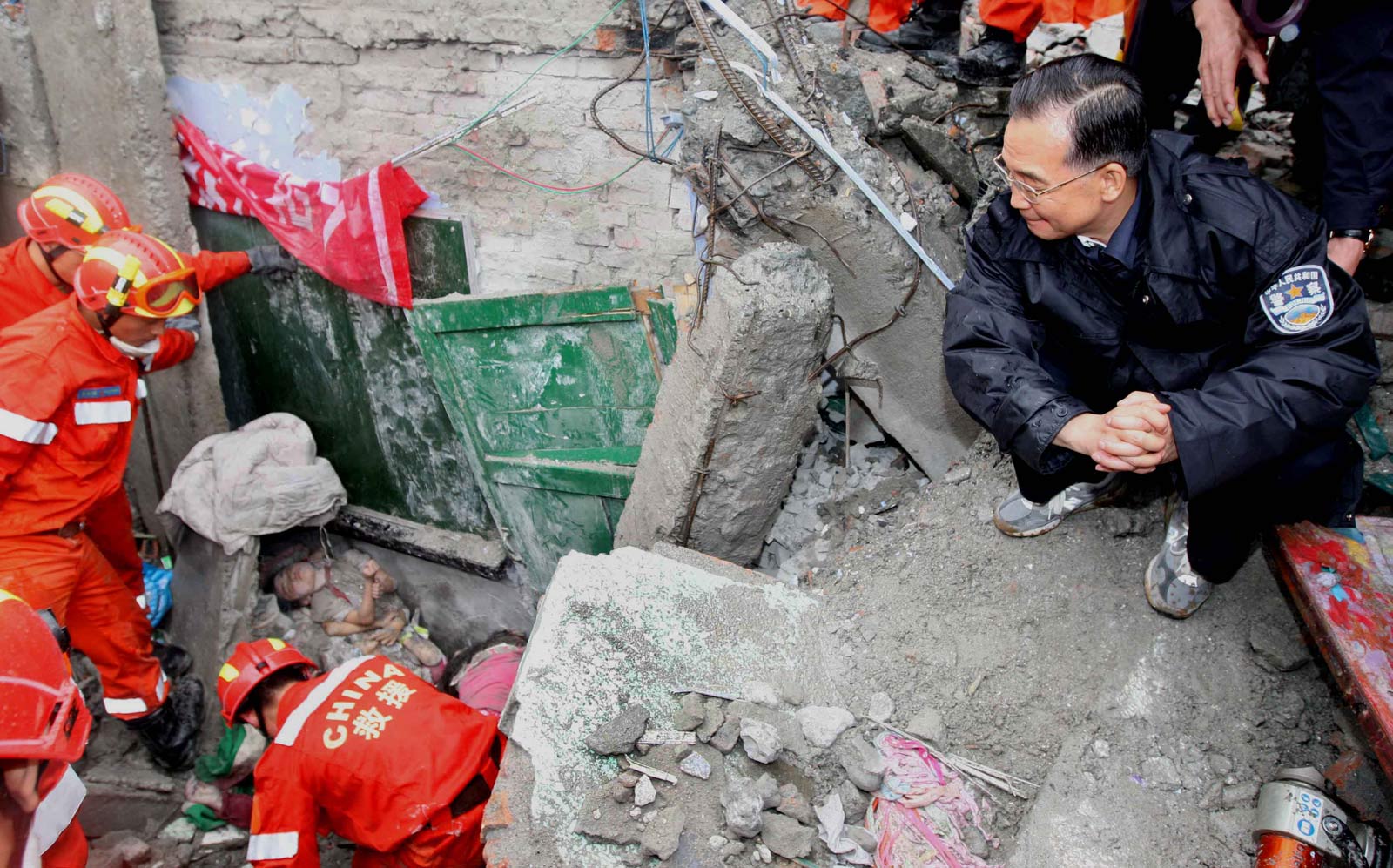
9/11 was an external event that allowed much, though not all, of America’s anger and grief to be directed outward. China’s earthquake is an internal event. There are no plausible outside forces to blame. The burning questions being asked now are about why a reported 7000 schools collapsed. These questions are given urgency by the pathetic and politically powerful photos (warning: not for the sensitive) of the bodies of primary school students huddled in wreckage. Interestingly, that image was effectively co-opted by Premier Wen Jiabao when he was photographed amid the wreckage, looking at the bodies of students (also not for the faint of heart). An American president would almost certainly not be allowed by his communications team to be photographed in such graphic circumstances.

So if this is China’s 9/11, where will the Chinese direct their anger and grief as shock begins to wear off? It occurs to me that the earthquake, a true national trauma, might have two possible effects on the current prevailing mood of prickly nationalism. Either it could feed into the nationalist sentiment, and possibly provide fresh impetus for it. Or it might make the nation take a breath and perhaps refocus its energies more constructively. With the Olympics less than three months off, I rather hope for the latter, but the reaction I saw on the square makes me wonder if the former is more likely. So does the degeneration of the nationwide charity drive into a competition in which job threats, Internet floggings and angry SMS campaigns are directed against individuals and companies, especially foreign ones, seen to have been slow or miserly in their contributions.

One pocket of a nationwide observance is hardly representative, and a poor basis on which to draw sweeping conclusions. A chant is just a chant. Extreme Internet comments are notvox populi. China is not America, and 5/12 was a in the end a very different event than 9/11. The comparison can be easily overblown. Nevertheless, I wonder what place the quake will occupy in the Chinese national consciousness as we slog the rest of the way through this troubled year.

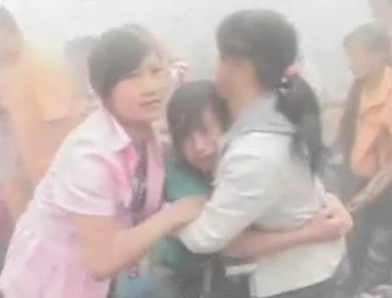
Shrouded in dust: China's 9/11?

Shrouded in dust: China’s 9/11?

Posted in Uncategorized | Tagged , , , | Comments Off on 5/12, 9/11 and three minutes on Monday afternoon

Tibet and the trouble with unassailable national myths

Outside of Young Frankenstein there isn’t really any such thing as a “good time” for rioting, but this might be an especially bad time for China to have a bout of punishing ethnic unrest. It hasn’t really been a banner start to the Olympic year so far, what with the worst storms anyone can remember, the Darfur activists on a tear, the bizarre Uighur terrorism story, and now this. Commentators are already linking this episode to China’s Olympic fortunes (see also the LA Times, Time, Asia Sentinel and Newsweek), and the French foreign minister has already been spotted talking about a partial boycott. Even Wen Jiabao has suggested that the riots were calculated to damage the games.

Things seem to have quietened down in the last couple of days, although that may simply be because reporting has been stifled. Certainly the flow of news has dwindled a bit, and many publications have shifted into context and analysis mode. But we can probably expect bits and pieces of information to dribble out over the next few weeks, as refugees leave Tibet and a few intrepid journalists break the cone of silence that that the Chinese government has dropped over the troubled areas. In the past few days many of our favorite local correspondents have made a run for the Tibet border, but blog posts, such as fromTim Johnson and Richard Spencer (and again here), suggest it’s tricky getting any reporting done.

The Foreign Correspondents Club of China has already petitioned the government for better access to the affected areas and circulated a list of incidents in which journalists and camera crews have been detained or hassled by the authorities. It would seem that Olympic pledges of greater openness were tested in the breach and found wanting. This, I suppose, shouldn’t surprise anyone. Old instincts die hard. The Chinese government has also reverted to its common tactic of belittling foreign coverage as intentionally biased. If this happens during the Olympics then, to borrow a line from Gerry Anderson, stand by for action.

Over the past few days, China’s communication strategy with regard to the Tibet riots has become clear. It has consisted roughly of the following:

  • Ban all international access so that Chinese media can monopolize images and on-site reporting
  • Cinch down on the Internet (here too) and international news sources so that messaging to domestic audiences can be tightly controlled
  • Demonize the Dalai Lama as the black hand behind the rioting in throwback, Cultural Revolution language, and drive the point home with images of rioting monks

These three are all true to type. But then it gets more interesting:

For a good overview of the Chinese approach to all of this, see Mark Magnier’s interesting article on China’s PR efforts around the Tibet riots. It includes this damning quote from Chinese blogger and journalist Michael Anti:

“The [Chinese] government is showing more confidence and learning more about spin,” said Michael Anti, a well-known Chinese blogger on a Nieman fellowship this year at Harvard. “They’ve learned more PR tactics from Western people. They see the way the White House and the Pentagon do it.”

In some ways China’s strategy has been effective. They’ve certainly done a good job back-footing the Dalai Lama, who made the mistake of not condemning the violence forcefully and immediately. Domestically it’s been gangbusters as usual. But the Chinese government shouldn’t be too proud of itself yet, because there remains one substantial problem: China has invested so much in its narrative of Tibetan development and growth that it is reluctant take any actions that undermine this story. This prevents them from communicating internationally in a way that foreign audiences will be receptive to, and it stores up serious ethnic problems for the future.

China’s prevailing narrative about Tibet is that China liberated it from feudal brutality and gave it all the wonders of development. The great mass of Tibetan people understands this and is duly grateful. This narrative has been thoroughly sold domestically, but it has never been widely accepted in the West.

While there are elements of truth to China’s version, China’s ability to sell it internationally has always been hampered by the government’s time-honed credibility gap with western audiences. This is exacerbated by the difficulty of getting independent points of view. Reporting from Tibet was heavily controlled even before the riots. Furthermore, International opinion is subject to an effective PR campaign run by Tibetan exile groups and the charismatic Dalai Lama. It’s safe to say that International audiences will never be entirely convinced by a Chinese state narrative that doesn’t even allow for the possibility that there might be genuine discontent in Tibet. China is much better at dictating ideas to a captive audience than at selling them to an open one.

Historically, it hasn’t really mattered to China’s government what International audiences think about Chinese domestic issues. But 2007 was the year in which China discovered the importance of International stakeholders. This began with the product quality crisis that erupted last summer, and it has gained strength over the Olympics in the past few months. The reality is that a global, economically integrated China that has invested hugely in hosting the world’s biggest sporting event is vulnerable to foreign public opinion. That’s why it stung so much when Steven Spielberg (who must be feeling pretty good about this right about now) withdrew from official participation in the Olympics. If it hadn’t stung, you’d have seen a lot less indignant Chinese press coverage about it.

If foreign stakeholders can boycott your products, screw up your outbound investment or trash the most glamorous event you’ve ever hosted, you need to develop some PR game. Unfortunately the mechanisms that have served China’s government so well over the years, a combination of explicit control over domestic media and pervasive state propaganda, don’t translate well to International audiences, and it has yet to learn a new approach. The need to defend the national narrative at all costs means that foreign media have to be kept away from Tibet, lest they reveal the cracks in the edifice. Heaven forbid that those inconsistencies make their way back to domestic audiences and undermine the national myth of Tibetan success and perhaps even government legitimacy. Tibetan integration –or suppression depending on your point of view– is part of Hu Jintao’s personal legacy as former Tibetan party chief and author of the crackdown on the 1989 demonstration. Unfortunately, nothing says, “We have terrible things to hide” to a foreign audience like detained or harassed journalists.

China’s growing international exposure aside, it must be tempting to wave away international concern as interference in China’s internal affairs. Unfortunately, another problem with defending the myth at all costs is that this approach seems calculated to inflame ethnic tensions rather than dispel them. Coverage of the riots suggests that much of the violence was Tibetans taking out their frustrations on Han who simply had the bad luck to be in Lhasa. That’s a shame, and the Chinese authorities are justified in seeking out and punishing those who have committed crimes against people and property. But the job of government is to ameliorate ethnic tensions within the country, not exacerbate them. Xinhua’s heavily spun coverage of the disturbances seems calculated to stoke outrage among the Han majority, and the Internet comment that has been allowed to stand echoes with that outrage, if not universally at least widely. Much of the Han comment reflects common colonial sentiment toward natives: Tibetans are lazy, ungrateful, intractable. Worrying signs for a country that disavows any colonial inclinations and preaches integration.

This is where the “cost” element of maintaining the myth at all costs really becomes clear. If the national narrative leaves no room for entertaining the notion that regular Tibetans might have legitimate grievances, then there is no hope of recourse for Tibetans and no alternative for non-Tibetan Chinese but to see the unrest as pure betrayal and thuggery. It becomes impossible to even acknowledge underlying problems in any constructive way. All that is left is ruthless crackdown and an ever-widening gulf between the two peoples.

Unfortunately, the more the Han majority sees Tibetans as ungrateful, violent dupes in the thrall of a sinister Dalai Lama, the harder any kind of real reconciliation will be. Mutual suspicion, hatred and racism-without-end loom. One wonders what will happen if Dalai Lama dies and there is still unrest in Tibet. Who will they blame then? There is a harder-line coterie of Tibetan exile leaders waiting in the wings, but none of them will fill the role of China’s “Goldstein” as well as the Dalai Lama does.

The best thing China can hope for now is that things stay quiet and the episode fades from view over the next few weeks. But that isn’t a long-term solution. In the end the situation is a tragedy not just because it was violent and ugly, but because it was a wasted opportunity. China could have introduced some transparency, allowed foreign reporters in, and started earning itself greater international credibility at a time when it desperately needs it. China could also have used this as an opportunity to move beyond its propagandistic approach to the problem of Tibetan integration, and to kindle a real national discussion on how to address the concerns of Tibetans in a way that might make integration a reality rather than a propaganda slogan. Done correctly, this need not have looked like succumbing to foreign pressure.

But that’s not how things are done here. That’s a shame, because no matter what wishful thinkers overseas want, Tibet will be a part of China for the foreseeable future. That will lead to continued problems. And as everyone knows, its hard to solve problems if you can’t admit to them.

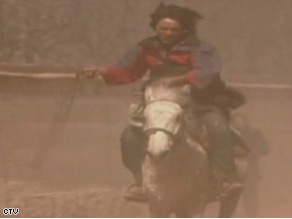
Horseman of the apocalypse.

Horseman of the apocalypse.

See also:

Posted in Uncategorized | Tagged , , , , , | Comments Off on Tibet and the trouble with unassailable national myths

The baby is coming next week, pinhead!

Although his wife may disagree, Imagethief believes very deeply that Homo sapiens should have a gestational period of 241 weeks. Forty weeks is simply not long enough for first-time parents to come to grips with the reality of having a child.

The funny thing is that thirty-nine weeks ago it seemed like plenty. Nine months of pregnancy felt like a school-year did back when I was in second grade: about ten minutes longer than eternity. But one of the curious but well-known side effects of getting older is that time compresses. When I was ten the idea of deferring anything for a year was essentially like postponing it forever, or longer. A year hence was simply too remote and exotic a concept to contemplate. Jeez, in a year we might have flying cars, domestic robots and little metal hats that let us read the minds of our alien pets. That was how far off a year was. It was 10% of my life.

When you’re forty, and you’re planning investments with a twenty year time horizon and buying insurance products calibrated in decades, a year is a rounding error. It’s 2.5% of my life, and when it gets to 1.25%, actuarial tables suggest I’ll be dead, or at least enfeebled. Today, planning something a year off is only one step above planning my shopping. I could go pick up some ice cream tonight. Or I could go get it next year. Whatever. I’ve learned the adult magic of deferred gratification. Or even infinitely postponed gratification, where you settle for the vague intention of buying or doing something but never actually do it.

Speaking of infinitely postponed, we got a later start on pregnancy than many of our old friends back home. It was a planned pregnancy that we’d attempted to engineer for two years. I use the term “engineer” with some deliberation. It took a little effort, and when you’re forty time may speed up but other things slow down. Still, when the good news came, the reality of the baby was a long way off. The doctor showed us some paperwork and charts and graphs, but they could have meant anything. Maybe we were having a baby. Or maybe interest rates were falling. It was hard to tell. Mrs. Imagethief looked more or less the same. She did have a bit of a glow, but in a Shanghai June one assumes that is sweat.

Despite many typical pregnancy experiences, the baby seemed a long way off until pretty recently. I believe that denial is an important part of managing the whole pregnancy process. For first time parents, it’s probably the one thing that enables you to cope with the reality of the responsibility you are about to assume. It’s not that we ignored the pregnancy. We were thrilled, after all, and we attacked the project with some gusto. We went to pre-natal appointments and (speaking of long investment horizons) paid for a birthing package. I read all the literature and prowled the candy-striped baby-name websites. They don’t really design them with dudes in mind or they would look more like ESPN.com. I also helped Mrs. Imagethief purchase a staggering array of baby paraphernalia representing the intellectual output of some of the finest engineers on the planet. Anyone who has studied a breast pump carefully will know what I am talking about.

Even our cohort of friends magically shifted. We didn’t mean for this to happen. We didn’t consciously seek it out. It just materialized, as if by some sort of alchemy. It helped that some of our good friends in China were pregnant a bit ahead of us. Those friends were like catalysts for a change that swept across our entire social group. The next thing we knew we were eating at “child friendly” restaurants and having dim sum with four strollers in the room and mothers queuing for breastfeeding space on the couch. It was just like I’d heard about: All our conversations were about pregnancy and parenthood and which strollers work best on Beijing’s crappy sidewalks. It was a bit like “Invasion of the Body Snatchers”, except warm and fuzzy and full of teddy bears rather than dark, spooky and McCarthyist.

Mrs. Imagethief did get big. When we went to Italy last October she was beginning to show a little roundness, but if she wore a jacket it disappeared. Now you could throw a bedspread over The Bump and it wouldn’t disappear. Daily life is all about The Bump: Which clothes go over it, how to manage trouser waists, and the strange and terrible things happening to her navel. The Bump makes it hard for her to turn over in bed or get up from the couch. It’s put her center of gravity about a foot in front of her feet. Mrs. Imagethief now moves like a slightly drunk woman carrying around a 30-inch tube television wrapped in foam. Awkwardness has become a way of life. Baby proofing be damned. We’ve been Bump proofing. I know this sounds a bit uncharitable, and still love her, Bump and all, but it’s quite a thing.

The other thing that changed recently is that we can actually feel the baby. First time fathers aren’t really prepared for what a presence the baby becomes even while it is still in utero. We all grow up hearing about “feeling the baby kick”, and we imagine some kind of delicate, birdlike peck. Ping! Could you feel the kick? That was true about two months ago. Now “kick” has become a polite euphemism for “full body aerobics” and feeling it isn’t an issue. When the kid moves you can see my wife’s shirt undulate. The kid sticks his feet and elbows out and her tummy ripples. It looks like someone has thrown a towel over the cat. Or, perhaps more accurately, over the baby.

All of this may have made the baby feel more imminent to my wife, but it was still not quite real to me. Sure her tummy moved but it could have been anything in there. Maybe ants, or bad dumplings. Who are you going to believe? Some ultrasound technician you just met? Or all those movies you saw as a kid where people incubate aliens inside their bodies?

I don’t feel bad about this. Most of my friends told me the baby wasn’t real for them either until they were actually holding it, at which point there wasn’t really any choice except to get a grip, in both senses of the phrase. I’ve been a conscientious husband during the pregnancy and the basic prep work is done. That’s pretty good for a habitual procrastinator like me. I was the kid who wrote all his papers at 3AM before they were due, a trick that got me through high school and college but wouldn’t have worked at all with the baby. Moss, have you done your homework? No? I’ll see you in detention for the next eighteen to twenty-one years!

But the time for denial is running out and I am coming to terms with the fact that I have baby who, by the book, is due on Monday. For perspective, that’s before my next weekly issue of The Economist arrives. The thing that brought it home was when one of my wife’s friends, who had a similar official due date, had her baby last weekend. Something about that threw the switch. On Friday my wife had lunch with her. On Sunday we got the joyous SMS, which provoked the following reaction in me: Good lord! If it can happen to them, it can happen to us!

Nine months ago I knew in the back of my head that this would happen sometime. But now, as the big day draws near, I’m switching from knowing it to believing it.

Note: Impending parenthood will likely affect Imagethief’s posting schedule. I have every intention of continuing to post, but you’ll understand if my priorities are rearranged for a while. Also, in case you are wondering, this post was reviewed and approved by Mrs. Imagethief prior to publication.

Posted in Uncategorized | Tagged , | Comments Off on The baby is coming next week, pinhead!

Let me tell ya about Edison Chen’s dirty photos

With the possible exception of Disney villains, Imagethief cannot think of a group of people that more richly deserve their miserable fates than Hong Kong celebrity Edison Chen and his cavalcade of cupcakes.

If I sound unsympathetic here, that is because I am unsympathetic. Really, how dumb do you need to be? On all sides? Girls, here’s a free piece of advice for you from your friendly neighborhood PR man: If you let a guy take digital nudie pix of you, sooner or later those pix are going to end up on the Internet. Not maybe. Not could be. Inevitably. The Internet is like a gravity well for nudity, and there is a 100 percent chance those pictures will end up there someday. Probably the week of your wedding.

And the guy might not even mean to do it. Edison Chen presumably didn’t mean to plaster Gillian Chung’s ass all over the Internet, thus ensuring that formerly semi-wholesome pop group Twins is now destined to be remembered forever as some kind of tawdry porn-o-rama. (This is the same Gillian Chung who was a spokeswoman for premarital chastity, by the way, illustrating once again a timeless lesson about the value of celebrities as role models.) I’m sure he thought he’d keep those snaps as his private treat. Or maybe share them with just a couple of close friends over beers.

But –and I say this with affection for my gender– dudes are stupid. We’re especially stupid when it comes to managing technology effectively. We like to portray ourselves as masters of technological realm, with amazing powers of digital wizardry. But a little knowledge is a dangerous thing and in reality we’re as screwed over by modern technology as your grandmother. Probably worse, because at least she doesn’t pretend to understand it. We’d rather die –or inflict crushing humiliation on our girlfriends– than admit weakness.

This is important, because only someone who is totally screwed over by modern technology would think to leave hundreds of pictures of himself banging eight different starlets sitting on an unencrypted laptop hardrive. Laptops get lost. Laptops get stolen. Laptops get filched off the back seat of your Lexus when no one is looking. Laptops fall out of overhead bins on airplanes and land on people’s heads, causing the porn to fall right out of them. Laptops break spontaneously, like Chihuahua dogs, and need to be sent in for repairs.

Edison Chen had a customized pink Macbook that broke. He took it in for repairs. I don’t know if you’ve ever had a computer repaired before, but certainly on the mainland many such repairs are handled by spotty young men who have never had sex and have no immediate prospects of having sex. A customized pink laptop might as well be stenciled, “raid me for porn”. If you didn’t know otherwise you’d probably think it belonged to a chick (or an incredibly flamboyant gay man, but odds favor a chick). And that’s pure temptation, because the kind of girl who would have a customized pink Macbook would probably also have vanity lingerie shots somewhere on the hard drive. You might as well hand a mirror with six lines of primo Andean nostril icing and a rolled up twenty to a Hollywood agent and say, “Dude, I’m going out to have my ass waxed. For the love of god, whatever you do, don’t snort this excellent coke!

For people who must indulge in personal porn, Imagethief offers two words: encrypted + files. It just ain’t that hard, even for troglodytes.

And the stakes are high. There’s no getting the porn genie back in the bottle. Even the Chinese government and their splendiferous Golden Shield (which, now that I think about it, really sounds like a condom brand) can’t keep smut under control. Rabbits on Viagra and Benzedrine have nothing on the speed with which anything having to do with female nudity replicates on the Internet. Like the herpes virus, it can be driven out of sight for a while, but it’s always still there, waiting to erupt painfully at the worst possible moment. So, as always, an ounce of prevention is worth is a pound of cure, especially when what you’re preventing is every newspaper in Hong Kong running a four page spread (and I don’t use that word lightly) of gynecologically explicit photographs of you.

Now, about the reaction to the photos. ESWN has posted an exhaustive chronicle of fifteen days of breathless (but certainly not breastless) Hong Kong media coverage of the scandal. Tianya is, I gather, now all Edison & Co., all the time. Nobody anywhere should be shocked. I come from the country that has documented the decline and fall of Britney Spears with a ruthless detail that would give Edward Gibbon the sweats, if he hadn’t died in 1794 when carrier pigeons were still all the rage in high speed communication. There is really nothing a society likes better than celebrities imploding. Especially if it’s imploding naked starlets.

Just say it out loud once, to get the taste of the words in your mouth: Imploding, naked starlets. Then tell me how any free media anywhere is going to resist. Now, imagine in particular the Hong Kong media, with its tradition of restraint, good taste, and sober, intellectual journalism. Now stop tut-tutting and go pick up the latest Oriental Sunday. You know you want to.

I suppose I would be slacking if I didn’t offer some PR advice to all of the affected parties. This should be taken lightly as I freely admit to being a corporate PR person with no experience as a celebrity publicist. No crisis I have ever worked on has involved public nudity (although I keep hoping. as long as it’s not my own public nudity).

The sad fact is that it’s going to be much easier on Edison than on Gillian, Cecilia, Bobo (oddly named for a girl, even in Hong Kong) and the other women. That’s because the universal double standard will unfortunately apply. Dudes who bed strings of starlets are swinging studs who will be admired by other men everywhere. Even if, inexplicably for straight guys, they have pink laptop computers. (Although it does occur to me now that I read this back that the entire episode has an air of “prove you are straight” overcompensation about it.) Edison needs only issue a public apology to the fans and affected girls and retire from the limelight for an appropriate spell of restorative contemplation before re-emerging a better man and, purely by accident you understand, using the momentum of the scandal to plug his latest project.

Unfortunately girls who allow themselves to be photographed in flagrante by their boyfriends and who are then unlucky enough to have those pictures sucked into the vortex of the Internet face a tougher path. Their public images will most likely not be enhanced, at least not in the circles that count for a mainstream career. Unless they’re Paris Hilton, who, in Imagethief’s book, is the exception that proves the rule. Remember, unless that camera was disguised as a riding crop or a tube of Astroglide, these weren’t sneak pix.

Apologies all around then, and perhaps a confession that the pictures were taken at “a difficult time” (it’s going to be funny how many of these girls were dating Edison at “a difficult time”). This can be followed by a spell in rehab, which is the modern equivalent of slinking away to join a convent without the shaven head or any of the other obnoxious religious rituals and the added bonus that it is temporary. After that we’ll see how it goes. Gillian probably survives. As for Bobo, well, it’s anyone’s guess.

So girls, next time the camera comes out in that moment of passion, remember the Internet porn gravity well, poor Bobo, and the fact that dudes are idiots. If a late-career resurrection is what you want, pose for a professional so you can reap the benefits of props, makeup and –most important– airbrushing. Otherwise, gently demure and preserve the element of mystery that is so critical to a woman’s public image. Nobody looks sexy photographed up close on a cheap digital camera under bedroom lighting with their lips wrapped around some guy’s, um, memory stick.

And if your boyfriend insists, kick him in the pills. It’ll be much harder for him to take a steady picture while he’s staggering around holding his crotch and you’ll have time to make a quick getaway.

See also:

  • John Kennedy’s piece on the police response to the scandal on Global Voices
  • The extensive Wikipedia page (B) on the scandal, which includes almost sixty references and an invaluable though slightly out-of-date chart of how many photos have been posted of each starlet (Cecilia Cheung led at press time). And to think some people say Wikipedia is a waste of time:

Updates:

  • I knew this would happen and I didn’t control for it, which perhaps I should have. You should see the Google strings that are turning up in my referrals now. Example:http://google.com/search?q=edison+chen+eating+out+gillian&hl=en&start=10&sa=n

    I don’t think that string is looking for a picture of the two of them at a restaurant.

  • Further proof of idiocy. This clown sold his computer on E-bay with his illegally videotaped k!ddie p*rn still on it. One assumes he secretly wanted the pain to end. I think we can all be happy he *didn’t* encrypt his hard drive.
Posted in Uncategorized | Tagged , , , , | Comments Off on Let me tell ya about Edison Chen’s dirty photos

Was the China corruption website collapse story “newsiness”?

The greatest contribution that comedian Stephen Colbert has made to modern society is the concept of “truthiness”. Reading from the Wikipedia definition, truthiness is:

…a satirical term to describe things that a person claims to know intuitively or “from the gut” without regard to evidence, logic, intellectual examination, or facts.

Miraculously, the entry goes on for another 3400 words on the concept of truthiness, proving not so much that truthiness is an important concept as that Wikipedia is balls-out for pop culture. Nevertheless, “truthiness” has transcended its comic-neologism origins to become a legitimate word, which says something about the zeitgeist.

Imagethief wishes that Colbert had similarly enshrined the concept of “newsiness”. Borrowing from the definition above, newsiness could be described as a satirical term to describe things that a person claims is important or newsworthy without regard to evidence, logic, intellectual examination or facts. It feels like news, whether it really is or not.

This is something that we flacks are familiar with. At our worst PR types trade in newsiness, packaging up bits of corporate dander and passing them off as significant. But we’re not exclusively to blame. Sometimes newsiness arises spontaneously in the form of a story that is less than meets the eye. Last week’s story concerning the collapse of the National Bureau of Corruption Prevention’s new website under apparently heavy traffic strikes me as an example of newsiness.

Foreign coverage of this story can be traced backed to a Beijing Youth Daily article, which I don’t have a link for, and a subsequent English-language Xinhua report that was deftlymassaged into final form by our own Chris O’Brien of Beijing Newspeak. The story was that the recently constituted National Bureau of Corruption Prevention, a relatively toothless body set up to “collect and analyze information” on corruption, launched a new website that included a guestbook function enabling members of the public to post semi-anonymous comments. However the website crashed within hours of launch due to a “large number of visitors”.

This fits very nicely into one of those social-issue memes that define much foreign news coverage of China, and that often take the form of “a nation struggling with [insert social issue here]“. Examples are a nation struggling with pollution; a nation struggling with censorship; a nation struggling with Internet addiction; and so on. The issues are set up via colorful or heartstring-yanking anectodes often involving stoic, salt-of-the-earth 老百姓 types recalling their woes, and rounded out with a mix of quotes from NGOs/overseas experts/local academics/old China hands and the kind of eye-popping statistics that China excels at generating and that make pretty much any problem here seem thoroughly intractable.

In fact, much good journalism is done this way and it works well for the home audience that reads one newspaper. But if, like Imagethief, you are a news junkie living in China and you read vast troughs of China coverage from a range of publications, it’s hard not not to notice the formula.

This system also promotes the dissemination of lightweight stories that simply fit into issues established by precedent. This particular story originated via the Xinhua article, which seems to have originated as a “why our website went down” disclosure formality. It plugged nicely into the “nation struggling with corruption” meme and was duly picked up by the foreign press, almost all of which cited the Xinhua article. The tone and detail of the foreign stories vary a bit, but looking at the headlines and ledes a clear mental picture emerges:

Reuters:
China anti-graft Web site felled by “too many hits”
BEIJING (Reuters) – A Chinese government Web site encouraging citizens to report corruption crashed on its first day under the weight of too many hits.

AFP:
China anti-graft website crashes under public complaints
BEIJING (AFP) — The website of China’s new anti-graft bureau crashed shortly after going online due to the huge volume of messages from the public complaining about rampant corruption, state media said Wednesday.

Telegraph:
China’s new anti-corruption website crashes
A Chinese government website set up for the public to complain about corruption crashed within a day of launching under the volume of cases reported.

The website was constructed by the National Bureau of Corruption Prevention to collect information on corrupt activities as part of an ongoing purge by the Beijing authorities.

Associated Press:
Anti-graft Web site swamped in China
BEIJING: A new Web site created by China’s anti-corruption bureau crashed after barely a day because too many visitors had tried to log on to register complaints, state media reported Wednesday.

Washington Post:
Chinese Assail Official Misconduct With Fervor
BEIJING, Dec. 19 — China’s new National Bureau of Corruption Prevention thought it would be a good idea to open a Web site for citizens to denounce crooked officials. The idea was so good that the site was immediately deluged this week by irate Chinese, overwhelming the system and causing several crashes during the first two days of operation.

So what did you see in your head? Imagethief saw an image of zillions of oppressed Chinese people desperately clicking on the NBCP’s web page. This is image was helped along by the recent, widely publicized woes of BOCOG’s Olympic ticket sales website, which really did crash under the fevered clicking of zillions of people. But unlike the Olympic ticketing stories, in which the actual traffic and transaction load on the site was reported, the only figure in any of the stories above is the number of pages of comments, ranging from 16 to “more than 20″. Only the AP story lists a specific number of comments: 250. An NBCP official was quoted in the Xinhua article as saying, “The number of visitors was very large and beyond our expectations.”

Well, yes, but what were your expectations?

Hoping to find more information, Imagethief took himself to the site for a first-hand look. As of last Friday there were still about 20 pages of comments, each with fifteen individual posts, for a total of about 300. Anyone who has spent time on a popular Chinese blog or in the forums knows that this is pretty small beer. For comparison, when CCTV 9 anchor Rui Chenggang condemned the Forbidden City Starbucks on his Sina blog just under a year ago, he got 450 comments in 24 hours, on his way to nearly 3000. Sam Flemming’s CIC, which monitors Chinese online buzz, tracked over 4 million posts on automobiles in the three-month period from April-June of this year (full report — PDF, registration required).

These are not entirely fair comparisons. The degree of freedom people feel to comment about corruption is not the same as they feel to comment on the Chery QQ or foreign coffee shops, and the overlap of corruption victims with Internet users is smaller than that of car aficionados. But it does introduce some perspective on what constitutes a “hot” online issue in China.

Corruption is a real issue here. The corruption website collapse story is neat enough to tie a Christmas bow around, and the foreign reports are all factually accurate, insofar as they essentially relay the Xinhua report. But what does this incident really say about Chinese society and the problem of corruption? There is a big difference between a site that was designed to support tens or hundreds of thousands of simultaneous visitors and was still overwhelmed by crushing demand, such as the Olympic ticketing site, and a small-potatoes site that fell over under moderate traffic or because it was designed, programmed or tested badly. Imagethief designed and developed e-commerce sites for many years and can assure readers that this a common problem. But “China anti-graft website collapses under public complaints”, to borrow one of the headlines above, is going to get many more people reading than, “China anti-graft website collapses because of poor programming”.

Fine. That’s the news business. Gotta get eyeballs on the page, and Imagethief, a subway commuter who reads on the way to the office, likes a punchy newspaper as much as the next guy. No harm in relaying a vacuous Xinhua story (sorry, Chris — not your fault), especially when it fits so neatly into an existing pigeonhole. It’s still “newsiness”, but if nothing else it can help keep our minds off of much more worrying things, like the ever dumber things American politicians are saying about China.

Posted in Uncategorized | Tagged , , , , , | Comments Off on Was the China corruption website collapse story “newsiness”?