Tag: Resident Alien

  • Fly the feces-free skies of China Southern

    Few things have provided more grist for Imagethief’s gripemill than Chinese airlines. A simple search of this website for various permutations of China+Airline+Travel will make that abundantly clear. In part this hostility is unfair. Chinese airlines are every bit as good as American carriers –although I have heaped scorn on those as well– and in some ways they are distinctly better. For instance, I would recommend Chinese carriers to anyone with a fetish for being waited upon by attractive Asian women as opposed to a fetish for being snarled at by hostile, matronly Americans. Not that no one has that particular fetish, its just that its somewhat more eccentric and self-destructive, like a fetish for self-mutilation, blender worship or Paris Hilton.

    And of course, Chinese carriers are every bit as successful as their American counterparts, which is to say they are losing money hand over fist. That’s why I was constipated to readin a Reuters news story (quoting Xinhua) about some of the money-saving steps recently suggested by China Southern Airlines:

    A Chinese airline has calculated that it takes a litre of fuel to flush the toilet at 30,000 feet and is urging passengers to go to the bathroom before they board.

    As Chinese airlines come under increasing pressure to cut fuel expenditures, China Southern’s latest strategy is to encourage passengers “to spend their pennies before boarding the aircraft”, Xinhua news agency reported on Thursday.

    “The energy used in one flush is enough for an economical car to run at least 10 kilometres,” Captain Liu Zhiyuan, who flies regularly between Hangzhou and Beijing, was quoted as saying.

    Citing a survey by the company’s logistics department, Liu said carrying one kilogram of items such as blankets and pillows by air for one hour uses 0.2 kg of fuel.

    “This means the blankets and pillows on board the aircraft eat up 60 tonnes of fuel every day. If each seat is loaded with three 450-gram magazines, another 60 tonnes will be consumed,” Liu explained.

    Well, having taken many flights on China Southern over the past few years, I can tell you that many passengers already consider flushing optional, so it’s debatable how much value such a program might have. I also think that the focus on flushing perhaps ignores the root of the problem, which is that according to this article, airplane toilets are some of the least energy efficient devices on the planet, on a part with M1-Abrams tanks and arc lights. Airplane manufacturers may want to get cracking on this (so to speak). After all, if my home toilet required a liter of kerosene for every flush, I’d just use half the kerosene to burn our daily household quota of excreta in our apartment building’s courtyard (everyone loves a bonfire) and sell the rest on the aviation fuel black market for cold, hard cashola.

    But as the article makes clear, cracking down (again, so to speak) on online flushing is really only part of the solution. The real triumph would be to encourage people not to carry any bodily wastes on board the airplane at all. In fact, I think the “pillows and magazines” in this article are really offered as a gentle metaphor for the collection of excreta sloshing around inside of each of us. After all, to the airline, the accumulated fecal matter fermenting in your bowel is just another form of carry-on luggage, and one that they have no control over. And nothing chafes an airline more than the thought that you might be gaming their system. Turds are just the beginning. Next thing you know people will be wrapping their duty free purchases in condoms and swallowing them to evade carry on limits.

    Let’s look at this scientifically. Doing some quick research, I note from a highly credible source, the movie Beverly Hills Cop, that the gut of the average American fifty-year-old contains about five pounds (2.25 kilos) of undigested red meat. Chinese are not Americans, but they are eating an increasing amount of red meat so let’s use American fifty-year-olds as proxies for the entire Chinese population and go with that number. It’s this spirit of daring scientific inquiry that led to such breakthroughs as cold fusion and Dr. Hang Woo-suk’s cloning program at Seoul National University. Going further I also note that China Southern is one of the airlines that has ordered A380s, which can carry up to 500 passengers. After performing some complex and rigorous calculations far beyond the reach of lesser cortexes, I discover that a single planeload may be hauling around up to 2500 pounds (1,136 kilos) of turds.

    Shocking. If the fuel consumption figures in the article above are accurate, that means that China Southern’s A380s could burn up to 227 extra liters of fuel an hour just dragging around surplus shit. On a twelve-hour long-haul to San Francisco that could mean almost 3000 extra liters of fuel consumed in the name of turd-haulage. Add on another three flushes (conservatively) per person on that same flight and you are looking at another 1500 liters of fuel consumed, for a total of 4500 kilos of fossil fuels –1.5% of the aircraft’stotal fuel capacity– flushed away in the name of airborne waste management. My god, people, haven’t you heard of global warming?

    Looked at this way, you can see that China Southern might be onto something. In fact, they might taking too conservative an approach to managing this situation. In the interest of safeguarding this planet that we all share, Imagethief proposes that, like hair gel and toothpaste in the US, human fecal matter be banned from all Chinese flights. Passengers should be required to consume a heavy dose of laxatives the day before flying and to purge thoroughly before boarding. Enema lounges could be installed in all Chinese airports, helping passengers to unburden themselves their ungreen load before boarding. I find a pre-flight high colonic highly refreshing myself, and imagine that it could become quite the fad. Naturally, pre-boarding security questions should be amended:

    • Did you pack your bags yourself?
    • Has anyone else handled your luggage since you packed it?
    • Did you have a nice, big shit this morning?

    With a few simple steps like this we can help China Southern to claw its way into profitability and reduce the global warming threat posed by air transportation. China could establish itself as environmental leader and revolutionize the entire approach to air travel. Dependency upon oil imports would also be reduced. Just think: if every airline in the world was to implement a program like this, we would live on greener, cleaner, more peaceful planet. Considering the benefits, an enema at a Chinese airport seems like a small price to pay.

    Note: Thanks to Gordon at The Horse’s Mouth for sending this article to me. Dude, when are you coming back to China? This country needs you.

    Related: Shanghai closed flights into and out of Pudong for several hours yesterday due to “air traffic volume”. Foreign flight crews ascribed the delays to military exercises. Anyone who travels in China regularly knows that the all-too-common flight delays and cancellations often get dubious official explanations, and the military’s fiat over Chinese airspace is widely and credibly blamed. In this case it seems likely. No one closes an airport to all traffic because of congestion. You might divert some traffic or delay some flights, but close the airport? The flagship airport at your glamourous international business city? The military explanation sounds a lot more credible in that case. Or some other similarly conspiratorial explanation. At any rate, you coudn’t get much more bush-league, especially considering the government’s usual appalling communication, which extends to what looks to me like a complete absence of any press coverage of the incident.
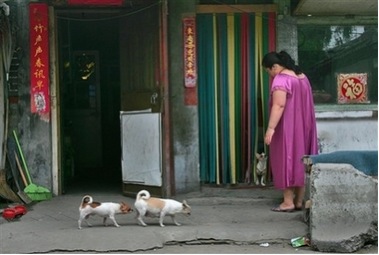
  • Just walking my pony, officer

    Imagethief has been watching with come concern the Beijing city government’s drive tocrack down on “stray dogs”. In the expansive interpretation of the authorities this means any unlicensed dog, any dog that contravenes the city’s 35cm height limit, or any dog that has the misfortune to be dog  >n+1 in the household, where n is any other dog that the owners like better.

    Mind you, this has zero personal implications for me. Being as I live in a two-bedroom apartment on the 17th floor and not, for instance, a ranch house on two wooded acres, I keep cats. It’s not that I don’t like dogs, it’s just that I’m not Parisian or Chinese and thus not compelled to keep an enormous dog in a tiny apartment that barely has room for me, Mrs. Imagethief, two ungrateful cats and some houseplants. Not only is space at a premium, but we also like to travel. The good thing about cats is they are similar to houseplants in many ways. They have about the same intelligence –although they barf more– and if well fed and watered they can be left on their own for a few days. If the cleaner drops by every now and then to make sure they are still fed and watered and no dried cat barf is bonding permanently with the carpet fibers, then all is good. If I could freeze-dry a dog temporarily while traveling, say in one of those 2001: A Space Odyssey-style tinsel-lined refrigerators, I might reconsider dog ownership in Beijing. But, you know, there’s always a chance the computer could turn evil and the dog might never wake up, in which case you’d have to dispose of an enormous, freeze-dried dog carcass. Although in a city where dog meat commands a premium, this might not be as hard as it sounds.

    The challenges or apartment dog ownership don’t seem to be stopping my neighbors, however, despite a lack of dog freeze-drying apparatus. Although they appear to be normal, law-abiding citizens, it turns out that a vast number of them are apparently trafficking in contraband dogs. How else to explain the profusion of manifestly illegal golden retrievers and the one rottweiler (yes, rottweiler) that are often being exercised in the courtyard. If there was a reward, I’d turn the lot of them in and pocket the cash.

    What has changed noticeably in the couple of weeks since the “strike hard at stray dogs” campaign began is that my neighbors have  become much more furtive about walking the larger dogs. Whereas before you could pretty much count on a gamboling retriever or two (retrievers love to gambol) on any weekend afternoon, people are now hustling their dogs out under cover of darkness and walking them in discreet loops near the walls where they are less visible. This is a particular challenge for my rottweiler-owning neighbors. It turns out that a rottweiler is a hard animal to smuggle, especially if it is hyperactively sociable and prone to mob anyone who gives it a glance. Might as well throw a saddle blanket over it and claim to be walking your pony. Your hell-pony with especially large, sharp teeth, that is.

    Truthfully, I think the dog campaign is misdirected. I can understand the licensing requirement, and even a drive to limit households to one dog. True, it cuts against the libertarian grain but, um, this is China. But I think the size thing is not on. After all, if a citizen wants to keep an inappropriately large wolf-beast in his miniscule shoebox of an apartment, that’s his problem. Well, and the dog’s, I guess. I don’t hear of many dog attacks in Beijing, and people don’t seem to be dropping dead of rabies in the city limits. I am far more likely to put a shoe in human feces deposited by one of the zillions ofkaidangku-wearing babies than I am in dog-shit. (Saw one child busy leaving a load on Tian’anmen Square during the National Day flag lowering ceremony. Surely crapping in the sight-line of the Great Helmsman has to break some kind of taboo. But the cops were too busy hustling away black-market ice-cream sellers to care.)

    Anyway, I think the whole dog campaign is misdirected. From a quality-of-life perspective Beijing would be a much more pleasant city if the authorities made 35cm the minimumheight requirement for dogs. Think of the many benefits: People would think twice before keeping more than one dog. Sure you can put a dozen chow-chows in a siheyuan, but try putting a dozen Rhodesian ridge-backs in and see how long the furniture stays in one piece. Also, large dogs often have a more pleasant temperament I find. At the end of a long day, as I stagger home after 12 hours in the PR salt mines, the last thing I need is Fufu the Pekingese following me through the courtyard going yapyapyapyapyapyapyap! Listen: I am an avowed animal lover. I dote on my idiotic cats and to this day I am awash with guilt for every mean-spirited thing I did to any animal, no matter how lowly, as a misguided youth. (Well, except for the Flintstones-sized Roachasauruses we used to get in my house in Singapore. I’d kill them all if I could.) But more than once I have been sorely tempted to draw back my right foot and go for distance and hang time, like Hall of Fame punter Ray Guy. Plus, the nice thing about large dogs is that if the apocalypse comes they can be trained to guard or hunt, or provide meat for days. Imagine the whole family fighting over a Chihuahua haunch. Embarrassing.

    But my influence over municipal policy is, alas, limited. Therefore it looks like all my neighbors will be walking their dogs under cover of night for some time to come. If I were them I might try draping the animals in camouflage nets to break up their outlines. Not only will that make them harder to spot, but any city management flunky who sees an enormous, shapeless, drooling green blob charging toward him will probably hightail it out of dodge and never come back.

    Barely a nibble.
    Barely a nibble.
  • Adventures in mucilage

    Every now and then, just when I think I’ve got this living in China thing totally handled, something spins out of control in a way that reminds me to maintain a little humility. On Friday that moment came when I went to bank to change a bunch of US dollars to Singapore dollars prior to wiring it back to my Singapore account. I took my service number and waited in a drone-like trance for it to come up at the one window that seemed to be actually turning over customers. Three windows were open, but two of them were stuck in all day perma-transactions. You know the ones. Your number is 8,902. The open window is now calling 8,887 and the granny at the counter to the left was served with number 14 –apparently earlier that month– and is still there hashing out the paperwork to wire 1000 RMB in plitchkas –or whatever the currency is– to Guineau Bissau where her grandson is studying muskrat husbandry. Someday, when her grandson is the muskrat king (麝鼠王 if you were wondering – I had to look it up) of all China, her investment will pay off handsomely.

    Muskrat husbandry in Guinea Bissau was sounding pretty good about the moment the teller gave me a quizzical look and said, “There are no US dollars in this account”. Yes, Imagethief had waited in line for half an hour with his wife’s passbook. At least she didn’t say, “You don’t look like Lee Yu Foong” (玉凤; it’s clearly a girl’s name) and put security on me with their sinister, candy-stripe electro-batons.

    But it got worse today when I went to the post office to mail my US tax return (late, I know, but I don’t owe so they don’t care) and some paperwork for my dive certification agency. At the counter where one buys postage, which is separate from the counter where one does everything else, I was told that I would have to insert my various envelopes into other envelopes that I would have to purchase. it seems that the Chinese postal service is intolerant of nonstandard envelopes, which is to say any non-Chinese envelope. No big deal; it was only 5 mao (six cents) for the envelopes, although it did leave me wondering as to the fate of two shockingly nonstandard envelopes I had mailed internationally the week before. We’ll find out, I guess.

    It turned out that neither Chinese envelope was big enough to accommodate the foreign envelope it was meant for. Both were close, but not quite there. I could have gone back to the counter and traded up to two larger envelopes, but at this point I was having second thoughts about sending my tax forms to Uncle Sam in a cryptically marked Chinese envelope. US tax envelopes use all manner of complex bar codes, stickers and machine-readable type to make sure they are routed to the clerk most likely to select you for auditing on the basis of some minor, personal quibble, like a wife with a Chinese name. Why interfere with that? So I decided to mail my tax forms from Singapore in two weeks. They’re already five months late, so two more weeks probably won’t make a big difference in the size of the stick that gets jammed up my ass. And Singapore’s postal service is both reliable and tolerant of registered mail using nonstandard envelopes.

    That left the larger envelope free for the dive paperwork. It just fit inside. I addressed the new envelope and took it up to the counter to send. As I was handing it to the clerk I noticed that I had forgot to seal it. And it was here that my entire errand unravelled.

    I should have just licked the envelope. Licked it and handed it to the clerk with a big, sweet grin. But, I thought, I don’t really want to lick this Chinese envelope, and I certainly don’t want to lick it and hand it back to this poor girl all damp with my drool and laowai tongue mites. Yes, I know this is a country where hocking a glistening, irridescent loogey is a crowd-pleasing national art form, but I’m American, dammit, and I keep my phlegm below the epiglottis except on the rarest of occasions.

    Seeing me looking for a moistened sponge or glue, the clerk directed me to a table by the wall. There was a grey washcloth in a dish, the sanitary status of which I daresay made my mouth look like the inside of a freshly used autoclave. Fortunately, the washcloth had dried out. There was also a little device for applying mucilage to envelopes. I swiped the flap of the envelope along one of the wheels of the mucilage machine and pressed it shut.

    Chinese mucilage does not stick. Not even a little. Whether this is because of deficient mucilage technology or in order to make it possible for the PSB to open envelopes without steaming them, I do not know. It’s tacky, but it doesn’t stick. I noticed a little slot in the machine that looked like it was for swiping the edge of a sealed envelope through. Perhaps, I thought, this heats the mucilage or applies even pressure, or magic postal pixie-dust, or whatever else is necessary to make the goddamn mucilage stick. So I swiped the envelope through it. Stupid, stupid, stupid. This applied another layer of mucilage to the outside of the envelope. I now had an unsealed envelope coated with tacky mucilage and fingers that looked like I had just crammed them up the nose of a three-year old.

    So I gave up. I figured I was only 5 mao down, and I simply wasn’t going to go through the whole process again. I’ll mail the works from Singapore.

    It is widely said that the Chinese think all Jews are smart. I may be the man who does more to undermine that remarkably durable impression than any other.

  • The kid

    The kid had staked out a patch of sidewalk and was working the steady stream of locals and foreigners passing through. The limits of his territory were the entrance to a restaurant popular with foreigners and that of a convenience store ten meters further up. He wore a stained blue t-shirt and ragged sweatpants with a scuffed seat that sagged from his rear end. His feet were bare. He was perhaps ten years old. Hard living had thinned his face, and it was hard to tell. He could have been two years older and desperately malnourished, or two years younger and a bit precocious.

    It was a good patch to work. The two businesses and the luxury hotel across the street ensured steady, well-monied traffic. But it was a hard job nonetheless. Most people were completely indifferent to the kid, and those who weren’t tended to be hostile, either scolding him or batting him away. A chinese man smacked him in the head. One large westerner mocked him, cupping his hands in the same alms-receiving gesture as the kid and pretending to beg back.

    Through it all the kid stayed remarkably cheery. He was a natural showman, sassing the people who ran him off the steps and bursting into histrionics in front of marks. When he wasn’t actually working a mark he had a perpetually bright smile on his face. He had perfected a positive mental attitude; a mighty feat for a ten year-old Beijing beggar with poor prospects. He was not going to be one of the new China’s winners. He was going to be a loser. It was inevitable. He probably couldn’t see his future, but I could take a guess at it. Juvenile crime, perhaps, as he eased into more aggressive teenage years. Maybe addiction, another victim of the river of heroin coming over the Burmese border at Ruili or in from Central Asia. If he was lucky he might end up a migrant laborer, drifting from city to city in search of work. If he was unlucky he would end up in jail, or in a quarry with a bullet in the back of his head. Or perhaps he would just go on to a career as a begger, another one of the shabby, hopeless men who stalk intersections and tourist hangouts. But he kept smiling. He could have been subject of a motivational poster on perseverance, adorning a conference room somewhere.

    The kid was energetic and fidgety and had a hard time sitting still. That wasn’t entirely his own fault. Every time he settled on the steps of the restaurant or the store an attendant would be out within moments to shoo him away. A woman from the store tried to engage him. Earlier she had scolded the kid, but now she wanted to talk. Perhaps telling him that he should find something more productive to do with his time. He chatted with her for four or five minutes before she went inside. When she came out again, it was with a switch to run him off the steps again. He had given the wrong answer.

    The kid wasn’t alone. His minder was a fat woman in clean clothes who sat across the street on a low stone wall in front of the hotel. She had a second young boy with her as well, about the same age, but he was the favored child. His clothes were clean and he didn’t have to beg. Instead, he sat with the woman, holding two empty plastic bottles. Occasionally, he would come over and give the kid some trouble. For a while the woman sent the kid across the street to work the front of an expensive ice cream parlor, but perhaps traffic was bad because he was soon back working the stretch of sidewalk between the restaurant and the convenience store.

    And the kid had some luck. Three people, all women, gave him cash. A few yuan, which the kid counted carefully before stuffing into the pocket of his sweats. Part of the kid’s repertoire was pointing at his mouth and asking for food, and one woman gave him a wrapped piece of something that looked like a slice of cake. But the kid didn’t get to eat it. The better dressed boy was across the street in moments, demanding the cake. The kid handed it over, possibly along with a smart-ass remark because he ended up taking a swift kick. The better-dressed boy took the cake across the street to the fat woman. She clearly got all the cake. It seemed likely that she was going to get the money too.

    There was another beggar working the same strip of sidewalk as the kid. A middle-aged woman in the standard beggar’s outfit: blue cotton coat, white towel wrapped around her head, shoulder bag, stick and white enamel cup. She had perfected the beggar’s misery-ridden shuffle but once, as she crossed the street, an approaching taxi forced her to break character and she hustled energetically out of the way. The begging woman didn’t compete with the kid. She was a practitioner of the “persistence” approach, shadowing a mark for fifty or a hundred meters tugging at the sleeve and shaking the few coins in the enamel cup. She would return to the space of sidewalk between the restaurant and store for a minute, but often follow marks to the end of the block or cross the street to work people in front of the hotel. The kid would stay put and focus on his small patch.

    The begging woman and the fat woman seemed to be friends. Once, the fat woman and the well-dressed boy crossed the street and the three of them gathered under a poplar tree for a congenial chat. How’s business? Who’s giving it up tonight? Is the kid pulling his weight? A couple of promising looking groups walked by during the conversation and the begging woman gave a couple of desultory shakes of her enamel cup, but it was clearly coffee break and her heart wasn’t in it. Meanwhile the kid hovered at the edge of the conversation, restless, nervous, and pointedly not invited into the little circle.

    After a few minutes the conversation broke up. The fat woman and well dressed boy returned to their perch in front of the hotel. The begging woman shadowed another group of foreigners. And the kid went back to miming hunger and clasping his hands in front of the groups leaving the restaurant and going into and out of the convenience store. Somehow, he was still smiling.

  • Infernalture

    Apartment prices are down and my lease is up, so Imagethief has been looking for a new, larger apartment to accommodate himself, Mrs. Imagethief, two whiny cats and the various junk that has accumulated in the past two years.

    I hate looking at apartments. The whole process is annoying and seedy, like buying a used car, if you were going to live in it. Of course, if you were buying a car at least the whole process would be over when you drove it off the lot (unless, of course, it was a lemon). With apartment rental, once you sign the lease you then have to deal with the brutal moving. I don’t know about you, but I find it impossible to move without losing at least one thing. Once it was the rice cooker (no big deal — it had bicycle shorts crammed into it, so whoever lifted it deserved what they got). Once it was my wife’s dive computer. This time, if I’m lucky, we’ll lose one of the cats.

    Rental agents in China are motley crew, and not all of them strike me as entirely together. One young man greeted me and my wife in a white T-shirt with the sleeves torn off (and wore the same shirt on two separate occasions), and then wondered why the security guard at Huamao gave him trouble at the door. Another explained to me at a certain complex that 160 square meter and 180 square meter apartments “cost the same because the 180 meter ones don’t rent, so the price has come down”. I didn’t have the heart to explain to him that this was both economically impossible, and not supported by the evidence of a real-estate ad listing different prices for 160 and 180 square meter apartments.

    But by far the worst aspect of renting an apartment in China is the furniture. In fact, I will extend this beyond China, since I have seennumerous apartments in Singapore and seen places belonging to Korean landlords, and make a sweeping statement: Asian landlords have, on average, the world’s most appalling taste in furnishings and fixtures. If there is a hell, it will have been furnished by an Asian landlord. And, just playing the odds, probably a Chinese one.

    What is it about buying an apartment in Asia that makes a person instantaneously lose all contact with good taste and common sense? The furniture I see in these apartments is beyond ugly, ranging from Logan’s Run-style 1970s retro-future abominations that would make orange shag carpet cringe in shame (in the future, all furniture will be inflatable leatherette!) to coccyx-shattering rosewood chinoiserie with all the inviting warmth of an ice chastity belt to faux Louis XIV rococo obscenities that could be lifted from Versailles, if Versailles was in Branson, Missouri and lined with neon.

    The other thing that really gets me is chandeliers. If wanted to live in a luxury hotel I’d live in a luxury hotel. I don’t want my apartment to feel like a luxury hotel. I certainly don’t want things that look like inverted, crystal pine trees hanging from the ceiling. These things are like the Chandeliers of Damocles. I’d be waiting for the whole jangly works to tear loose and land on my head as I’m working my way through my morning Grape Nuts. I don’t want to die with my face in a bowl of Grape Nuts and an enormous, crystal pine tree embedded in my skull. The morticians will make fun of my corpse and my family will refuse to take delivery of the remains. The hearse will make jingly crystal noises every time it goes over a speed bump. New-agers will come to worship at my grave. (“He didn’t die! He transcended space-time with the help of crystals in his skull!”) How humiliating. I’ll end up was one of the “odd news” bites in the China Daily: “Foreigner dies in blaze of glory!” It’ll be right above, “Two-headed goat in Shaanxi sings Donny & Marie classics!”

    I suppose chandeliers are better than the alternative, which is relentlessly cold fluorescent lighting that makes the inside of the apartment look like a meat locker. Notice how fluorescent light can make anyone look like a serial killer? Under incandescent or warm fluorescent light Mrs. Imagethief is a gorgeous woman with intoxicating, brown skin, lustrous hair and sparkling eyes. Under fluorescent light she looks like Norman Bates’ mother in Psycho. And, if you don’t recall, Norman Bates’ mother was dead. God knows what it must make me look like. Lurch from the Addams Family, perhaps. Or Dick Cheney.

    But who will notice the cheap lighting when there is a TV the size of a billboard? Yes, every apartment I look at has furniture that looks lifted from Peewee’s Playhouse, either hallucinatory chandeliers that would make Steve Wynn blanch or soul-destroying dimestore fluorescents and, for some reason, a brand-new flatscreen TV big enough burn your shadow into the wall behind you (but inevitably paired with a 200 kuai cheapie DVD player).

    Here’s an idea: Take the money you’ve spent on the forty-inch LCD television and plow it into some decent lighting and tolerable fucking furniture. There’s an Ikea in this town. I know; I’ve seen it. It’s the size of a small planet. It’s Ikea-World. It’s so big that there are probably people who have been lost inside since the day it opened, subsisting on Swedish meatballs that have rolled under the displays. I don’t like Ikea. In fact, in Singapore I was busy purging the Ikea furniture from my house. But it’s so big that, even if they’re catering to dire, nouveau riche tastes, they must have some furniture that, if not exactly nice, is at least bland and inoffensive. I’ll take a piece of furniture called “Kysblispinyx” or some other too-precious Nordic name if that’s what I have to endure in order to have a couch that supports my legs completely rather than suddenly folding down when I slide forward and slamming my face into the glass coffee table. Honestly, why not just have knives shoot out of the cushions?

    I know, I know. You’re thinking I should get an unfurnished place and buy my own furniture. I would, but I already had to sell one houseful of furniture when I moved to China. I don’t relish the idea of accumulating another raft of miscellaneous possessions that I’ll have to unload three or four years hence when I move back to Singapore. And, from what I’ve seen, the chances of my buying anything here that I’ll want to treasure for the rest of my life are slim.

    So I’m sucking it up. I’ll find a chandelier-free apartment with classy furniture in this town if it kills me. It can be the dankest, most cockroach-ridden, formaldehyde-infused shithole in Beijing as long as the furniture doesn’t give me cataracts. If I can’t manage that, I’ll just buy a used car and sleep in that.

    Note: Imagethief would like to tip his hat to his current landlord who, with the exception of the couch, did a reasonable job furnishing his apartment.

  • The trouble with English teachers

    AP ran an interesting article (via Peking Duck and Paper Tiger) on the perils of being an English teacher in China. I found it a fascinating read both because it strengthened my own reservations about the seedy Chinese black market for English teachers, and because it made me think about some of my prejudices as an expatriate in China. The article is worth a read in its entirety. An excerpt:

    For decades, Chinese made their way to the West, often illegally, to end up doing dangerous, low-paying jobs in sweatshop conditions. Now some foreigners drawn by China’s growth and hunger for English lessons are landing in the schoolhouse version of the sweatshop.

    In one case, an American ended up dead. Darren Russell, 35, from Calabasas, Calif., died under mysterious circumstances days after a dispute caused him to quit his teaching job in the southern city of Guangzhou. “I’m so scared. I need to get out of here,” Russell said in a message left on his father’s cell phone hours before his death in what Chinese authorities said was a traffic accident.

    As China opens up to the world, public and private English-language schools are proliferating. While most treat their foreign teachers decently, and wages can run to $1,000 plus board, lodging and even airfare home, complaints about bad experiences in fly-by-night operations are on the rise. The British Embassy in Beijing warns on its Web site about breaches of contracts, unpaid wages and broken promises. The U.S. Embassy says complaints have increased eightfold since 2004 to two a week on average.

    Though foreign teachers in South Korea, Japan and other countries have run into similar problems, the number of allegations in China is much higher because “the rule of law is still not firmly in place,” said a U.S. Embassy official who spoke on condition of anonymity.

    “A number of substandard English language teaching mills have sprung up, seeking to maximize profits while minimizing services,” the U.S. House of Representatives International Relations Committee said in a recent report on Russell’s case. These institutes have become virtual “‘sweatshops’ where young, often naive Americans are held as virtual indentured servants.”

    Well, indentured servitude might be laying it on a bit thick. I’d wager your average young American in a crappy English teaching job in China has rather more options open to them than, say, the undocumented Guatemalan picking Strawberries in Aptos for hour after backbreaking hour. Still, I don’t doubt that you could end up in a situation that was scary at best and dangerous at worst. Indeed, the article discusses the death of one foreign English teacher in murky circumstances.

    I’ve always been a bit contemptuous of the English teaching scene in China. Not because there is anything wrong in teaching English; it is good and noble work and many smart people dedicate their lives to it. Rather, my contempt has arisen because of the distinct atmosphere of sleaze that surrounds the industry here in China. Now I know that many English teachers read this blog (and some of you do fine blogs of your own), so bear with me before you start leaving angry comments or deleting me from your RSS reader. After you’ve finished you can still delete me if you want. Or leave the flame.

    It has always seemed to me that teaching in English was the job of last resort for people who wanted to spend an extended period of time here. Obviously, there are organizations here willing to take advantage of that situation. While I know people who have taught English here for many years and enjoyed it, I also know some that have had bad experiences and came away feeling exploited and angry. Not surprisingly, the rate of exploitation seems to be higher for those who enter into situations willing to play fast and loose with things like employment documentation. Really, that ought to be a warning. Remember kids: if someone asks you to surrender your passport or tells you not to worry about the paperwork, be extremely suspicious.

    The funny thing is that when I tell Chinese people I work in China, many of them ask if I am an English teacher. After reading the article above it occurred to me that I often react to that question badly. “No,” I’ll huff. “I’m not an English teacher.” Subtext: I have a realjob, you clown. I had, without meaning to, constructed in my mind a pecking order of resident foreigners in China, which went something like this:

    • Grizzled China hands who know everybody and senior diplomats
    • Business professionals (including myself), journalists, NGO people etc.
    • English teachers
    • Underage foreign students getting drunk at Babyface or Kai

    Note that English teachers were not at the bottom of this heap, although it was a thin layer between them and the cellar. Of course, being a professional spin-doctor is liable to attract scorn in its own right, so I probably have no business putting on airs. It’s not like ahyi on the train asked me if I was a professional man-bitch at a state prison (that always flatters me) or an arms smuggler or some such. I was even in the dreaded foreign student category briefly, although I was thirty-six when I arrived and had a hard time keeping up with the teenagers. But my mild insult at being asked if I am an English teacher is rooted in my prejudice toward the industry here in China rather than toward the act of teaching English itself. That makes it different from the mild insult I’d feel at being asked if I was a drunk, underage foreign student (although in that situation I might also be secretly pleased by my apparently youthful looks).

    Of course many of the people in the top two spaces on my little list above started their China careers as English teachers. A few even started them as drunk, underage foreign students, although most of them are old enough so that international hotel bars were the only places they could drink when they were students. So this is my confession that I have been too hard on China’s English teachers (that this blog is, after all, the confessions of an American spin doctor in China), scorning you for no fault of your own even as you labor in intolerable circumstances for meager coppers. I hereby apologize.

    Now quit fooling around and go get a real job.

  • Escalation

    Getting from point A to point B in Beijing, assuming point A and B aren’t right next to each other, is one of the daily adventures that makes life here so interesting. Aside from a certain hyper-linear approach to walking that can make the most casual stroll an exercise in ducking and weaving and the well-documented board-first/exit second approach to subways and elevators, there is also the near mystical ability of Chinese people to suddenly stop at choke points such as doorways. Hilarity ensues.

    Nowhere is this tendency more infuriating than at the tops and bottoms of escalators. I work in an office tower atop a glitzy supermall awash in escalators. My commute requires no less than three escalator rides from the subway station to the lift lobby. Without fail someone will be standing smack at the top of one of those escalators wondering whether to get breakfast from Dairy Queen or Bread Talk while angry people pile up behind. This is far more obnoxious than the local tendency to stand two-abreast and leave no lane for walking on the elevator. That’s obstructive but at least it’s not dangerous.

    I am most likely to be riding escalators when I am on my way to work or back home from work. Neither is a time when I am blessed with surplus patience, and the sight of a teenage couple parked on the elevator landing wondering which retail paradise or food-service outlet to avail themselves of makes me want to lower my shoulder and blow through them like Ronnie Lott.

    At this point I must digress and explain something of the phenomenon that was Ronnie Lott. If you didn’t grow up in San Francisco in the 1980s or are not huge American football fan, you probably have no idea who Ronnie Lott is. That’s a shame, because Ronnie was one of the most exciting professional athletes ever to grace a television near you. Ronnie was a free safety for the San Francisco Forty-Niners back when the  Niners were the most feared American football team in the league. Ronnie played three different positions well, but he made his career as a free safety. For those who don’t understand American football, I’ll explain. One of the ways you can advance the ball in football is by making a forward pass, literally throwing the ball down the field where, hopefully, someone on the same team will catch it.

    This can be surprisingly difficult, not least because there are usually several extremely large and freakishly fast defenders roaming around the “backfield” (the area where the ball is likely to be caught) waiting to dispense pain upon anyone who dares to try to catch a lofted ball. Free safeties are one of those defenders, and the best of them have an uncanny ability to tell how a play will unfold and to be in the right place to dispense that pain. For more than a decade, Ronnie Lott was the NFL’s chief backfield pain dispenser.

    Although smart, tough and fast, much of Ronnie’s effectiveness was psychological. A receiver –the guy trying to catch the ball– would be streaking down the field when a pass would head his way. Man, he was open and it was a perfect throw. He could smell the goal line already. He’d reach out his arms to pull in the pass, but just as his fingertips were brushing the pigskin BLAM! All 203 pounds of Ronnie would come blazing out of nowhere and lay into the poor schmoe’s unprotected, stretched-out ribs at a full-on sprint. Some dudes turned 360 degree somersaults in the air on taking hits like that from Ronnie. The football would go bouncing off down the field and a bunch of guys with polo shirts and black bags would run onto the field to administer smelling salts and ask the dazed receiver what day of the week it was.

    That’s when the psychological effect would take over. Ronnie would terrorize the backfield for a while, and then receivers would start to terrorize themselves. A receiver would be streaking down the field again, another perfect looking pass would float his way and, just as he was reaching for it, you would see the thought float through his head: Oh shit! Where’s Ronnie? He’d take his eye off the ball for a split second to find out where Ronnie was and miss the catch. And, as often as not, Ronnie was right there anyway, KAPOW!Ecstasy.

    That’s the effect I want to have on people who stop at the tops or bottoms of escalators. I want to lower my shoulder and set a few painful examples. I want the teenage guy and his spindly girlfriend blocking the landing to think, “Dairy Queen or Bread Talk? Oh shit! Where’s Will?” KABLAM! Only my natural restraint and lack of shoulder pads keeps me from living this fantasy. But someday that restraint will break.

    I used to also be much more annoyed by the behavior of Beijingers getting onto escalators as well as off of them. I don’t break stride when I walk onto an escalator and I expect other people to behave the same way. It’s easy enough to shift a few inches backward or forward if you feel the step splitting beneath your feet. Nevertheless, I see a lot of people here stopping at the foot of escalators and carefully and deliberately stepping onto them. But after careful observation I’ve noticed a number of western tourists doing the same thing, so it’s not just a Chinese thing. And, in fairness to the Chinese, the only person I’ve ever seen who utterly failed to manage an escalator was an Australian woman at the airport who appeared to have had a few too many mini-bottles of Johnnie Walker on her flight up from Sydney. She simply toppled over backward and would have been on her way to Beijing United with a “V” shaped groove across the back of her skull had she not fortunately landed on a large suitcase. It took a frantic effort by me and one of her friends to get her upright before we reached the landing. Perhaps the cautious, Chinese approach is sensible. Of course, escalators also have a somewhat shorter tradition here than they do in the west. An article in The Economist (subscription) from last December pointed out that even in the west…

    …[Escalators] were initially regarded as terrifying: when Harrods, a London department store, introduced its first escalator in 1898, smelling salts and brandy were provided to revive customers overcome by the experience.

    So I could understand when I once had to watch an attendant at the Blue Zoo, a Beijing aquarium, painstakingly explain the turnstile and escalators to a bunch of provincial tourists and then talk them through one at a time. After all, everybody has a first time. But what I can forgive in an elderly man from a semi-rural part of Anhui and what I can forgive in Beijing’s young, urban sophisticates are different. If you have an iPod, you should know better than to stop at the end of the escalator. Better keep your eyes open, because I’m out there somewhere, roaming the backfield of Oriental Plaza. CRUNCH!

    Note: In writing this post I had to use a proxy server to access the Pro Football Hall of Fame website in the USA. Come on, Nanny; the BBC, Wikipedia and Blogspot I can understand. But the Hall of Fame? That’s just wrong.

  • Imagethief and the hell of yurts – video companion

    Note: This video was originally presented as the companion to a long, written travelogue that is no longer posted. I reposted the video when I restored my archives because it’s much more fun than the long-winded written version. -WM

    It’s no Danwei TV, but here is Imagethief’s foray into video production. During our recent trip to Xinjiang, Mrs. Imagethief used her point-and-shoot digital camera to take about eighteen minutes of video, including several off-the-cuff stand-ups by Imagethief. We hadn’t originally intended to do anything with it except show it with our travelling companions, but after reviewing the raw footage it seemed like a waste not to share it. In a past life I used to do digital audio and video production and I’ve still got some of the tools. I’ve cut the video down to eight minutes, played with the sequence to give it some narrative coherence and added a voice over. The camera is a nifty little device, but because it’s the size of a pack of playing cards there is a bit of camera shake. Sorry about that. Nonetheless, I hope you find it entertaining, and I hope Imagethief’s singular wit survives the transition to video.

    You can also see it at YouTube. Unfortunately I don’t have a version of this video posted on a Chinese video sharing site.

  • A week in the life of a China flack

    Imagethief has recently had several e-mails from young foreigners in China who are interested in embarking upon a career in PR here. Why these students should choose such a career as opposed to, say, enlisting in the Navy as a boiler technician or applying for a research internship to the Congo is a mystery. But there is no arguing with the idealism and energy of youth.

    As a service to these eager youngsters, and anyone else with an interest, I thought I would diary a week (six days actually) in the life of a China flack. I hope the following chronology of glamour and high society will lure more talented young people (or burned out journalists) into the industry.

    Wednesday
    6:00 AM: Up early for the 8:40AM flight to Shanghai to work on new business proposal with a Shanghai colleague. Flight is uneventful. Get to Shanghai office at noon. Picked up by company driver and taken to office. Fishball noodles for lunch.

    1:00 PM: Before working on proposal, make RSVP calls to foreign media invited to attend a Shanghai roundtable event with a client’s senior global executive the following Monday. A Chiense media event is also planned. I am due back in Shanghai on Sunday for exec briefing and will stay through Monday for the event.

    2:00 PM: Within moments of finishing media calls and confirming foreign media, client’s China PR manager informs me that global office is considering canceling foreign media event. Don’t wish to do group media event for various reasons.

    Also learn that Publication That Shall Not Be Named has called client to complain they weren’t invited to event. In fact, they have been invited and one of their journalists is supposed to attend.

    While pondering how to rescue foreign media event I continue working on proposal with colleagues. Draft due following morning. Work until 2 AM with break for noodles for dinner.

    2:00 AM: Go to hotel and check in. Must fly to Guangzhou next morning. Have following dialogue with dimwit night reception clerk at hotel:

    Me: What time do I need to leave to get to Hongqiao Airport by 9:45 AM?
    Dimwit: It takes about a half hour to get there with no traffic.
    Me: How will the traffic be at that time?
    Dimwit: I think you should leave at 7 AM.
    Me: 7 AM? That seems early. I don’t have to be there until 9: 45AM. My flight is at 10:45.
    Dimwit: Oh. Then you don’t need to leave so early.
    Me: Ok. So what time do I need to leave to arrive at the airport at 9: 45AM?
    Dimwit: (Exasperated) I just told you it takes a half hour to get there.
    Me (in my head): Lissen, dickweed, I will come over this counter and smack the spikes right off your head. You said half an hour with no traffic. There’s gonna be traffic at 9 AM. You have rush hour in Shanghai, don’t you, pinhead? So what time should I fucking leave?
    Me (actually): Ok. Gimme my key.

    Clerk also informs me breakfast not included with my room. Will be 145 RMB. I go to room and crash.

    Thursday
    7:00 AM: Up early to catch 10:45AM flight to Guangzhou to conduct training for colleagues in Guangzhou office. In absence of information from hotel pinhead decide to leave at 8:45 AM.

    8:00 AM: check out and go to hotel café for breakfast. Line of thirty people waiting for tables stretches from entrance. Abandon breakfast. Get taxi to airport. During the ride, observe the following rules posted in the taxi:

    • Don’t defile the taxi inside and any signs of the taxi.
    • Schizophrenics or drunkards without a guardian are prohibited to take taxi
    • Don’t instigate the drive to violate the regulation of the passenger transport and traffic management
    • No spitting and dumping inside the taxi.
    • If making a complaint, offer concerned evidence.

    Seems reasonable.

    Ride takes exactly half an hour, just as advised by night clerk.  I think dark thoughts about strangling him.

    8:30 AM: Get surprisingly serviceable Western breakfast at Hongqiao Airport for 40 RMB.

    10:45 AM: Flight is uneventful. Short on sleep. Doze.

    1 PM: Arrive in Guangzhou. Picked up by company driver and taken to office building. Have never been to Guangzhou office.

    1:45 PM: Arrive at 70+ floor CITIC tower. Ask driver what floor it is on. “Never been,” he says. Realize he is not the company driver, just some guy they hired to pick me up.

    Stupidly, don’t have Guangzhou office phone number with me. Scan directory and spot every other PR and marketing firm in the country. Not mine. Begin to wonder if I am at correct building.

    1:55 PM: Call Beijing office and ask coordinator what floor our Guangzhou office is on. “Six,” she says. Also gives me Guangzhou office phone number. Scan directory again. No sixth floor listed. Check elevators. No elevator goes to sixth floor. Really begin to suspect I am at wrong building.

    2:00 PM: Call Guangzhou office and ask which floor they are on. “Sixty-eight,” they say. Ten minutes later, figure out CITIC tower elevator system and arrive on 68th floor. Find office.

    Receptionist orders Illy cappuccino for me. I kiss her feet and set up in spare office.

    2:15 PM: Check e-mail. Client has decided to cancel foreign media event in Shanghai. After some discussion with Client’s PR manager, decide to pitch exclusive to one publication instead of group event. Approach should allay global office’s concerns.

    2:30 PM: Make phone calls to two journalists considered appropriate for exclusive. One can’t make time. Another interested. Will check with editor next morning.

    3:00 PM: Conduct English writing training for Guangzhou office. Can’t say enough about team. Bright, enthusiastic and fun.

    Training over at 5PM.

    6:00 PM: Increasingly bad feelings about canceling on journalists already invited to client’s Shanghai media event and offering exclusive to another publication. Am giving foreign media relations training to Guangzhou team the next morning. Seems like classic media relations blunder case study in making. Don’t need that kind of irony.

    6:30 PM: Call client and recommend we treat all foreign media fairly and cancel foreign media activities completely. We will only do Chinese media event. Client agrees. Informs me that, as Chinese media only, my presence no longer required in Shanghai for Sunday executive briefing session or Monday event.

    I continue working.

    8:30 PM: Go to cheap Cantonese dinner with a colleague. Eat spicy Cantonese beef dish.

    9:30 PM
    : After dinner, catch taxi to Tian Lun hotel. Taxi takes me to Tian Long hotel. After correcting driver he tells me that Tian Lun is “100 meters” from CITIC building and berates me for duration of return drive. Makes me get out of taxi one block from Tian Lun hotel, presumably to prove point. God bless Guangzhou taxi drivers. Tian Lun actually about 500 meters from CITIC building. Have to admit, not far.

    9:50 PM: Check into Tian Lun. Get upgraded to palatial business-suite room. Collapse on bed and wallow in unspeakable luxury of largest hotel room I have ever occupied. Watch Spiderman II on HBO. Catch up on e-mails. Happy. Have good night’s sleep.

    Friday
    8:00 AM: Nice breakfast at hotel.

    9:30 AM: Client changes mind, requests my presence in Shanghai for Chinese media event after all. So much for Sunday.

    9:35 AM: Spicy Cantonese beef dish aggravates intestines. I run for bathroom at regular intervals.

    9:45 AM: Call and e-mail all journalists originally invited to foreign media event, including one still considering exclusive, and inform of cancellation. Grovel mightily in superb demonstration of foreign media relations skills.

    10:00 AM: Conduct foreign media relations training for Guangzhou colleagues. Still can’t say enough good about team there. Bright, enthusiastic and fun. And ask several very acute questions about media industry.

    12:30 PM: Intelligent questions delay end of training for half an hour. Running late. Gotta go to airport and catch flight back to Beijing. But Guangzhou director has already ordered dim sum for lunch at restaurant downstairs.

    12:45 PM: Go to lunch with director and set all-time dim-sum speed eating record. Also run for bathroom at regular intervals. Feel very rude. Seafood in tanks looks fresh and vigorous. Reminder of moribund state of Beijing seafood.

    1:30 PM: Late, late late! Catch taxi to airport. Driver mysteriously takes surface roads rather than expressway for half of journey, presumably in order to show me best of Guangzhou. Blood pressure soars. At far end driver palms road toll receipt.

    2:15 PM: Forty-five minutes to my flight. Long line. Sign at check in says, “If less than fifty minutes until your flight, check in at counter D8.” Go to counter D8. No one there. Go back to regular counter. Line has doubled in two minutes. Blood pressure soars again.

    2:30 PM: Successfully check in. Guangzhou airport is size of planet and my airplane parked on its furthest moon. Actually, second furthest. But, as there are 116 moons, not a big difference.

    2:45 PM: Reach airplane. To make Guangzhou residents on flight as comfortable as possible, climate controls are set for Guanghzhou conditions: hot and humid. Will be this way for entire flight.

    3:00 PM to 6:00 PM: On flight work on new business presentation to accompany proposal we did on Wednesday.

    6:00 PM: Arrive in Beijing on time. Home at 7PM. Have dinner with Mrs. Imagethief.

    8:30 PM: Publication That Shall Not Be Named (the one that called client before to complain about not being invited) calls client again to ask if event is still on. Client calls me to ask if I have informed all journalists that event is cancelled. I have.

    10:00 PM: Write blog post for CNET until midnight.

    Saturday
    Long, slow breakfast at home. Write two pieces for That’s Beijing. Take Mrs. Imagethief out on date.

    Sunday
    7:00 AM: Up early to catch 9:40 AM flight to Shanghai with Client. Flight leaves on time. Four-for-four with on-time flights. Not bad for China!

    10:00 AM: Check into Shanghai Salvo Hotel. Definitely not Tian Lun. Room is so small I have to step outside to change my mind. But aircon, Internet and CNN work, so it’s all good.

    12:00 PM: Note the following on a poster in the Salvo’s lobby:

    Fu Bar of the 31st floor has advanced projection and rounding sound equipments and professional mixologist. With finely arranging atmosphere you can enjoy the enthusiasm and galliardise in the football sport. Let night of world’s cup bubbles up along with air bubble of goblet.

    Contemplate accidental humor of a bar named “Fu Bar” (福吧).

    12:30 PM: Lunch with Client. Curry beef and lotus root.

    1:30 PM: Return to Salvo Hotel. Write posts for CNET and Shanghaiist.

    5:30 PM: Have briefing session for client’s visiting executive. Goes smoothly, although executive oddly reluctant to make eye contact.

    7:30 PM: An evening out in Shanghai:

    • A hamburger, quiche and two beers at Three on the Bund with a view of Pudong: 360 RMB.
    • An ice cream stick from a xiaomaibu a block off of Nanjing Rd: 2 RMB.
    • Two hours of Asiapundit’s company: Priceless.

    10:00 PM: Back to hotel. Crash.

    Monday
    7:00 AM: Up early for event.

    7:45 AM: Escort Chinese journalists from down-market Salvo to opulent fice star hotel for event. Contrast is startling. Wish I’d stayed at opulent hotel.

    8:30 AM: Publication That Shall Not Be Named calls me to ask if foreign media event is still on. With regrets, I inform them that it’s really cancelled.

    Presentations in morning go smoothly. Event room is small and simultaneous translation booth is insufficiently soundproof. Everyone in room can hear translator as well as speaker, even if not wearing headsets.

    During Q&A the wireless microphone goes out so translator can’t hear questions. Nobody wants to be the one to take one of the other mics from the panelists.

    One of my colleagues in charge of Chinese media relations doesn’t greet Chinese journalists coming in late and ensure that they have translation headsets etc. I have to prod.

    9:00 AM: After presentations we move to small room for roundtable Q&A with media. Client spokesperson gets head of steam in introductions. Translation is now consecutive. Have to gently remind spokesperson to stop every now and then so translator can keep up.

    Five-star hotel is opulent, but has shitty maintenance staff. They are repairing air ducts. Every two minutes noise like kettle drums rattles through our conference room. I tell my Chinese colleague to tell hotel staff we won’t pay for room. Banging subsides. But think it was actually for lunch break.

    Q&A goes well.

    10:30 AM: After event wrap, take taxi back to my company’s Shanghai office for meeting with Shanghai colleagues to rehearse for presentation to potential client that afternoon.

    12:00 PM: Lunch of sandwiches in conference room.

    2:00 PM: After rehearsal go to Pudong for presentation to potential client at St. Regis. Presentation goes well.

    4:20 PM: We have post-mortem discussion until 5:00 PM. I have 7:00 PM flight from Hongqiao. Gotta go. Don’t want to miss flight. Wife and I trying to have baby and today is “the” day for this month, according to sophisticated charts and graphs.

    5:00 PM: Colleagues and I pile into company car and head for Puxi. Colleagues want to be dropped at Nanjing Rd. West on way through town. Detour through traffic stretches drive interminably. Other thing stretching is bladder. Feeling effects of cappuccino, bottle of water and Diet Coke at presentation. No choice. Have to hold out until airport.

    5:45 PM: Drop off colleagues. Traffic continues to crawl. Bladder continues to stretch. Start having fantasies of relieving myself into water bottle, glove box, wherever. Kidneys begin to hurt. Begin to fear nephritis.

    5:55 PM: Finally get on Yan’an Elevated Road. Traffic improves dramatically. Bladder continues to expand. Imminent threat of catastrophic uro-nova.

    6:05 PM: On Yan’an road, spy a calico cat. It has wandered onto elevated road and is now trapped, a kilometer from the nearest exit. The cat is up on the concrete rail, wedged against the fiberglass that separates roads from nearby buildings, as far away from traffic as possible. How long has the cat been trapped there? It is probably hungry and thirsty. It has the shocked, shrunken-into itself look of an animal that has been scared for a long period of time. It is doomed. Only a matter of time before it breaks onto road and goes under the wheels of a vehicle. Saddened, due to fondness for cats. Personal troubles suddenly diminished by comparison.

    6:15 PM: Surprisingly, get to airport with forty-five minutes to spare. Fast check in (for those without baggage) is closed for first time in my experience. I ignore screaming bladder and go to normal check-in. Line moves fast. Get window seat, which I prefer.

    6:25 PM: Sprint for bathroom. Piss for centuries. I will never piss again.

    6:35 PM: Piss again.

    6:40 PM: Board airplane.

    9:00 PM: Taken off airplane due to delays caused by bad weather in Beijing.

    9:00 PM to 1:00 AM: Find power outlet in waiting room. Edit Xinjiang video on laptop. Watch Dave Chappel videos on laptop. Give thanks for laptop and habit of always keeping one or videos that I want to see on it. At 10:30 PM airport serves us a compensation meal. Could be worst meal I have ever eaten.

    Flights begin to be cancelled. No departures left on departure board. Begin to worry that I may be sleeping in airport.

    1:00 AM: Our flight is re-boarded.

    1:45 AM: Wheels-up.

    3:30 AM: Arrive Beijing. Sun starts to come up during taxi ride home.

    5:00 AM: Off to bed. Oh, magical sleep, bestow thy sweet kiss upon me.

    Tuesday
    9:00 AM: Up for conference call.

    And so on. As for getting pregnant, well, there’s always next month.

  • Coffee, tea or bleeding ears?

    With the exception of the Americans, who are in a league of their own for depersonalized airborne misery, the Chinese have done more than any other civilization to make flying as much like riding a bus as possible.

    Today’s flight, a zippy little transit between Shanghai and Guangzhou, shows how. The person sitting in front of me had his seat fully reclined and was snoring loudly while we were still on the taxiway. I briefly entertained thoughts of reaching over the top of his seat and smacking him hard on the top of the head, but I don’t know how the Chinese authorities react to cases of laowai air rage.

    But there is another thing that really drives home the bus-like nature of this flight: the in-flight movie. Anyone who has ever ridden a long-distance bus in Asia will be familiar with the bus-movie. Most Asian busses have a video screen mounted at the front of the aisle and a VCD player somewhere around the dashboard.  Moments after the journey begins the TV will be fired up and you’ll be gifted with the very latest in Hong Kong, Chinese or Bollywood output, depending upon which country you are in. (I recently got Bollywood dubbed in Mandarin on a ride between Urumqi and Turpan in west China, so the national rules aren’t ironclad.)

    Busses have loud diesel engines and appalling road noise, but don’t usually have headphones. Thus, the sound will be cranked loud enough to enable people sitting in the car behind you to hear the movie. Aside from reducing road safety, that will overdrive the already blown speakers and ensure that painful, unintelligible booming and gargling noises pummel your years for the duration of the drive. If god is against you—and if you’re taking the bus that’s a given—then the picture will suck too. So you’ll try to read, but that will prove nearly impossible under the aural assault, and eventually you’ll lapse into catatonia go psychotic depending upon your individual temperament.

    On many airplanes you can count upon having headphones available for the in-flight movie. But not on China Southern flight 3532 from Shanghai to Guangzhou. They’re showing some generic romantic comedy, all shrill female voices and goofy, galumphing men. The sound is being piped over the 737’s PA system. In true Asian bus style, it has been cranked to be audible over the sound of two jet engines, wind noise, and the nonstop rumble coming from the snore-a-holic in the seat in front of me. There is no escape.

    Oddly enough, taxis have a similar syndrome. In Beijing, most of them don’t have video screens (although, depressingly, a few do). However every taxi driver in Beijing seems to think that the first thing any foreigner wants to do once he is comfortable in the back seat is catch up on the latest radio xiangsheng act. If you’re traveling with a companion the driver will courteously turn the radio up extra loud to ensure that you can hear thexiangsheng over your conversation (it’s the only explanation I can think of).

    My Chinese isn’t good enough or fast enough to understand xiangsheng, but I can usually pick out some words and phrases. That means I get to spend my entire cab ride listening to something that sounds like this:

    甲:和谐是建立在团结的基础上的,my sister 对一个家庭、组织、团体和国家来说,如果不团结或者不够团结,自然也就难以达到和谐,生活于其间的人们也就不能感受到幸福。
    亿:由于社会中存在着困难人群,他们需要其他人的关怀和帮助,仁爱伦理要求人们在力所能及的情况下,给这些人以物质和精神上的支持 your sister?
    甲:又由于一个人在其人生旅途中难免会遇到这样那样的困难或窘境,my sister and a donkey 因而互助是对所有人都有益的道德行为。
    亿:为了实现友爱、安定、有序和公平的和谐社会,需要全体人民大力弘扬团结互助的优良美德 who’s donkey?
    甲:团结互助鼓励合作互利 my sister。有人认为,在市场经济条件下,追求个人利益就很难讲道德,只要能够获得个人利益,donkey 就可以不考虑手段是否正当 with a carrot。
    亿:社会上存在的损人利己现象,与这样的思想认识有密切的关系 with a donkey?
    甲:人与人的关系反映着一定的利益关系,虽然个人获得正当和合理的利益需求是不可剥夺的权利 vaseline,但是,这里存在着如何正确处理人与人利益关系的大问题‭ ‬fucking enormous carrot。
    亿:现代市场经济倡导竞争,your sister 但竞争不是一方完全得利,另一方完全受损,更不是用损人的方式来利己 bitch whore of all China。
    甲:Damn straight 真正的竞争应该是参与竞争的各方都获得其应得的利益 had to get a new donkey。

    That’s entertainment.

    Meanwhile, here I am on the plane, listening to an inescapable, donkey-free romantic comedy. The guys across the aisle are having a six-man party in a space designed for three people, and speaking loudly enough to compete with the movie. The man sitting behind me has just thoughtfully reached forward to close my window shade, in case the daylight is distracting me from my writing one must presume. What’s that I feel coming over me? Is it catatonia or psychosis? Check tomorrow’s Guangzhou newspapers to find the answer.