Tag: Resident Alien

  • The last king of Guanhu

    Continuing my exploration of the zaniest fixtures and furnishings in China, this weekend I looked at a lovely apartment in Greenlake Place (Guanhu) that was thoroughly trashed by this living room set:

    guanhu

    When I finally get around to overthrowing that small, African nation like I’ve been planning, this is the furniture I’ll want in my throne room (although perhaps re-upholstered in leopard or zebra skin). Until then, a bit too grand for my entirely modest ass. Oh, and whether I’m god-king of Botswana or not, that telephone will have to go.

  • Journey to the planet of the electro-squids

    It’s time to move.

    We’ve been in the same place for nearly three years. It’s been good, but Mrs. Imagethief’s business is growing, I’m spending some of my time working at home, and let’s not even get into the whole child-number-two discussion. The upshot is that we need a bigger place.

    I hate almost everything about moving. It’s disruptive. It’s a pain in the ass. It’s expensive (although less so in China than elsewhere). There is the great mystery as to whether you’re trading your current decent landlord (I’ve been lucky) for Empress Wu. There’s the great computational axis of price vs. commute vs. school vs. amenities vs. could our ayi get here? The only good things about moving are being able to slough off a layer of useless house-cruft — all that stuff at the backs of closets– and the feeling you get when you finally have the new place set up the way you want, before the cats have salted everything in summer cat hair and little, scattered pills of cat litter. I have many miles to go before I have my feet up on that particular ottoman of satisfaction.

    Until then, I must endure the great drudgery of plodding through empty apartments. The other day I had to reel in an agent who was about to take us to look at some places renting for RMB40,000 a month. Hold on there, tiger. I know you’re paid based on the rent, but if I could afford that kind of ticket my personal flunky would be taking the first look. Not me. Our budget is decent, but we’re still squarely in the making-some-compromises bracket. It says something about China that our current leading-candidate apartment had an unflushed toilet full of shit and yet our conclusion was still, say, not bad. In the US realtors tell you set out fresh cookies when people are coming to look at the apartment. In China you get a bog full of crap. But you also get new floor boards, so take the bad with the good, I guess.

    I don’t want to complain at length about all the miseries of hunting for an apartment in China. Well, strictly speaking, that’s not true. I do in fact want to complain about them and I have done so at length. But I also want to focus on just one thing that gets up my nose every time I tour apartments in China. It is not, despite what you might think, piles of human waste. It is the light fixtures.

    To gather all my complex feelings about this into just three words, what the f***?

    It’s true, many Chinese apartments have appalling furniture. My solution to that has been to buy my own furniture and look for unfurnished or partly-furnished places. I’m completely willing to have redundant crap dragged out of the apartment as a condition of rental. That couch that I wouldn’t sit on without wrapping my ass in saran-wrap and sunscreen? Adios, muchacho. But lights are built in. There is wiring, and screws and god knows what. And if I unplug this wire, this being China and all, there is a chance, however small, that all the stop-lights in the neighborhood will turn green at once or the neon sign on the restaurant across the road will spell out a dirty word and my visa will be canceled for gross disturbance of public order.

    None of which would matter if the light fixtures weren’t so consistently awful. I’m not talking some rarefied, well that’s a bit unsightly thing. I’m talking full-on psychotic awful, like having Damien Hirsch Hirst* as your interior decorator and coming home to find pickled sharks lined with halogen bulbs hanging from your ceiling at face level. I’m talking 1970s Disco Inferno throwback nasty that makes me think of lime green shag carpets and Ford Econoline vans with bubble windows and airbrushed paintings of topless space-vixens deflecting lightning bolts with Gibson “Flying V” electric guitars. If you’ve ever wanted to see what it would look like if the space-ship from the end of Close Encounters of the Third Kind landed in your living room, I’ve got the apartment for you. If you want to know what it would look like if Louis XVI had escaped the guillotine, sneaked out of France disguised as un ouvrier Chinois (quelle humiliation!) and wound up in a downtown three-bedroom in Beijing on a middle-class Chinese salary, I’ve got the apartment for you.

    What is this fascination with chandeliers? Listen: If you’ve got a stately pile in the countryside with forty acres (or, this being China, 240 mu) of grape vines and a grand hall with a thirty-foot ceiling that requires banquet illumination, then fine. Get a chandelier. I’m not saying it’s a good decision, but it’s at least technically defensible on some kind of inbred, blue-blood clause. But if you’ve just bought an urban pre-fab concrete box with eight-foot ceilings, a three-foot chandelier is simply not going to work unless you’re renting your apartment to Wee Man from the “Jackass” movies. Sooner or later, someone is winding up in the hospital having bits of Swarovski shrapnel irrigated out of their eyes. Plus, if you are renting your apartment to Wee Man, a stack of turds in the hall bathroom is likely to be the least of your problems when he moves out. Make sure you get the deposit in cash.

    Lights, dude. How hard can it be? It’s the illumination that counts, not the number of fronds on the fixture or getting it exactly the same shade of pink as Aphrodite’s hemorrhoids. A big factor in choosing our current apartment was that it had naked bulbs in the ceiling. All we had to do was hang shades on them. Less is more. Think minimal and simple. Especially –and I cannot stress this enough– if you want to rent to foreigners. We’re weak. Our eyes bleed if we see too much brass filigree at any one time. Easy test: if your light fixtures make my son either giggle or cry, I’m not renting your apartment, even if the fridge is colossal and the toilets just came out of an autoclave and the bathrooms smell like a strawberry muffin factory. It’s that simple. When I stagger home from work late and flick on the living room light, I don’t want my first reaction to be cardiac arrest. I don’t want to feel compelled to place a panicky phone call to SHADO.  I don’t want to crack my head into the goddamn thing when I stumble into the kitchen in the middle of the night for a biscuit. I don’t want to find freaking bats hanging from it.

    I don’t, in a word, want this:

    electro squid

    Now, really, is that too much to ask?

  • Imagethief and the lost apartment of Qin Shihuang

    Recently Imagethief and family went to Xi’an for a weekend. As everyone does, we went to see the terracotta warriors. That was fine, but the real highlight of the trip was the apartment we stayed in, which was decorated top-to-bottom in replica terracotta warriors and had a working Chinese-style guillotine. But, hey, it also had free Internet, a fridge full of very cheap beer, and was a five minute walk from the downtown ethnic Hui area, which has awesome food. At 500RMB a night, what wasn’t to like? A video tour of the apartment below. It was shot on a phone camera, so it’s not exactly Cinemascope, but it does include a guillotine demonstration!

    For those reading this on Facebook (which does not import the YouTube videos), the video is here. Photographs from the trip, including those in the video, are on Flickr here.

    The apartment was one of four owned and rented out by the day by a guy named Clarence Guo. Clarence used to be a taxi driver. After a few years shuttling tourists to and from the terracotta warriors he realized he could do better as a tour-guide and provider of what we shall call “themed lodging”, so he taught himself the history, wrote a book about the warriors, and bought and refurbished the apartments. We also hired him as our tour guide, which worked out pretty well although he’s clearly a bit burned out on the whole warrior thing after ten-odd years.

    I had only one complaint about the apartment. Despite having a toddler in tow, it was not the guillotine. It was that Clarence’s creative renovations left zero noise isolation between the apartments and there was an extremely loud family of Israeli tourists staying next door to us. But all in, it was a pretty good deal. E-mail me for Clarence’s phone numbe if you’re ever planning a trip to Xi’an and have no issues with guillotines or sleeping in a bedroom full of terracotta warriors, you can. More comments from customers on TripAdvisor.

    Update – China friendly version now online:

    China-friendly Tudou version now online since YouKu, my usual Chinese option, went into some kind of weird suck-fit and refused to let me upload — three times. Never happened before. For those not used to it, Tudou has a pre-roll ad and a heavily spangled presentation. You’ve been warned.

  • Poorly thought out adventures in commuting

    In the grip of my darkest and most bourgeois moments I actually considered buying a car and hiring a driver. So, it’s come to this… I thought, as I hovered over a digital map of Beijing. I have to get one of those Buick vans. No matter how I traced the route or arranged the useless layers of meta-data in Google Maps I had to face up to reality. My new office was in the sticks.

    More specifically, it was in Wangjing. North Wangjing, hard against the Fifth Ring Road. The Fifth is commonly accepted as the dividing line between the frothy, urban Beijing of Apple Stores and upscale dining and the great void of the Chinese hinterland where all is windswept grist for broody New York Times articles about how miserable the rest of the world has it. Well, and also Tongzhou. Never mind that when I moved to Beijing the Fourth Ring Road was that line.

    You can tell the office is in a neighborhood that didn’t exist three years ago. The building is as gorgeous and new as a space station and just as isolated from amenities and comforts. The nearest Starbucks is at least two kilometers away. In Beijing in 2010 more than two kilometers from Starbucks is the qualification for a rural hukou. I brought a French press to office.

    I am strong enough to confront my flaws (although weak enough wrap that confrontation in a layer of prickly humor). By the standards of my Chinese colleagues this is, I admit, jello-kneed schoolgirl bitching. Many of them live outside the Fifth and have commutes that sound lifted from the darker pages of Jack London novels, where people die freezing for want of a twist of jerky somewhere on the track from Fort Yukon to Unalakleet. Just substitute a bendy-bus for the dog sled. Against this, even the commute from Dawang Rd. to Wangjing is lower middle-distance at best, like one of those mid-range Olympic track races that is too long to be exciting but too short to be impressive and that nobody remembers who won.

    I, however, have been spoiled. For six years my distance from the office has ranged from a five minute walk to a five-stop straight shot on subway line 1. Even the latter is the Beijing commute equivalent of schlepping from the couch to the fridge during a commercial break for a half-full can of Duncan-Hines frosting and a Pabst Blue Ribbon.

    Although I toyed seriously with the idea of either buying a car or hiring a car and driver, in the end my socialist* pedigree won out. For my first day at the new job I decided to take public transport.

    Man, was that stupid.

    It looked good on the map, though. From my house I can take the line 1 subway one stop to Guomao. Then it’s a straight shot north on line 10 to the Shaoyaoju interchange and one more stop on line 13 to Wangjing West. From there a short bus ride. Simple!

    If you read the New York Times you probably scan the occasional Tom Friedman column where he hyperventilates about how fast the Chinese are building infrastructure for which Americans have lost the blueprints. Subways, for instance. The statistics for Beijing are magnificent: Thirty lines planned, totaling over 1000 kilometers of track. Everyone living within the Fourth Ring to be able to walk to a station in fifteen minutes. Sounds like The Future!

    Sure. It’s Logan’s Run. But with the subway system from The Warriors.

    There are two reasons for this. First, adding more lines and interchanges has certainly made the entire system more useful. But the number of people riding has gone up as something like a cubic function of the number of track kilometers. In the course of two years my old line 1 commute went from crowded but tolerable to needing to lubricate yourself with Astroglide and use a prybar to get on or off the train. Combined with the casual Chinese disdain for off first, on second it’s a miracle the platforms aren’t entirely covered with bits of scalp and shards of broken teeth.

    Second, the planners of the Beijing subway system haven’t really figured out the whole idea of the subway interchange. In Singapore, subway interchanges are designed such that trains that make the most natural connections pull up on opposite sides of the same platform. Walk thirty air-conditioned feet, get on the next train. Now that’s the future!

    But why build an actual subway interchange when you can just build a long, sweaty tunnel between stations in adjacent neighborhoods? Changing trains in Beijing is a little bit like changing airport terminals, right down to the surprising number of people dragging luggage. Add the rush hour crowds and idiotic security screening chokepoints and it’s almost (though not quite) as bad as checking in at JFK.

    It took me an hour to get from my house to Wangjing West station. When I finally staggered off the third train I was ready to bail on the bus and head for a taxi. Except that Wangjing West apparently serves as the informal transportation hub for the entire Wangjing new town, which means that at any given moment there are zero authorized taxis and about fifty black cabs. I don’t generally like taking black cabs, although I do it from time to time, so I reverted to the bus.

    Big mistake. Should have taken the black cab. Beijing subway platform minders are good at cramming an apparently limitless number of people onto a train, but they have nothing on the bus drivers. Beijing’s bus drivers have taken that skill and extended it into a rarefied art form of otherworldly magnificence. The driver of the bus I took used a combination of eye-watering verbal abuse, physical bullying and backyard-steel-furnace socialist will power to get people stacked three deep in the bus. Mine was the Very. Last. Stop.

    Except that I accidentally got off a stop early and had to walk the last kilometer. There isn’t much in Wangjing and they space out the bus stops like railroad towns. An hour and twenty minutes after leaving the house I got to the office, late and looking like I had been caught in a kitchen fire at a Bob’s Big Boy. I felt virtuous, but exhausted and dumber than a chicken on roofies. Some of my colleagues do this daily. In both directions. This, not the threat of cyberwar, is why America should be scared of China.

    So I’ve been taking the taxi. I did the math. Sure, it adds up, but it’s still way cheaper than a regular car and driver, let alone buying my own car. About 25% of the taxi cost is offset by my having to brew my own coffee (which says something about the magnitude of my coffee habit). And it gave me the gossamer thin rationalization I needed to justify my iPad (thus instantly cancelling out something like two year’s worth of coffee savings). A quiet half-hour each way alone with my electronic newspapers. Well, quiet except for the ubiquitous radio story teller who makes wet lightning-and-thunder noises with his mouth.

    I’ve come to terms with the cost. I’ve come to terms with my increased contribution to global warming. The only thing that really worries me is the feeling that a taxi-based commute in Beijing is actuarial equivalent of moving to Detroit and developing a habit for convenience store robbery. After all, few Beijing taxis have seatbelts and most are driven by people with the patience and deliberation of a fox terrier that has been whipped with car antennas. If you hear of a pileup on the fourth ring and a white man being whisked to hospital to have an iPad removed from his abdominal cavity that’ll be me. If you hear of a taxi driver being whisked to hospital with an iPad embedded in his skull and an angry white man being questioned by police, that will also be me.

    *by American standards.

    You can't get there from here.
    You can’t get there from here.
  • The zombie-slugging toy police car

    Imagethief’s son, Zachary, turned two this week. I’m amazed we made it. By this I mean I’m amazed that Mrs. Imagethief and I made it. If the boy’s engine room telegraph is stuck on “full-speed-ahead”, Mrs. Imagethief and I are on something more like “dead slow” or “all back one quarter”. It’s been a busy couple of years.

    My Chinese tutor, a wonderful woman who employs the spectacular pedagogical technique of making me translate articles from The Economist into Chinese and then debating me about the contents, was kind enough to give Zach a toy Chinese police car as his present. It was really kind of a fantasy police car, being as it was a BMW in police colors, but it was a big hit with the boy. It hit three of his sweet spots: “nee-nee nee-nee cars” (anything with lights, with the sound representing the siren); “zoom cars” (anything with a spoiler); and “gongan che“, which is not at at the top of his hierarchy –taxis occupy that spot– but which rate pretty high nevertheless.

    The car was electric, so my wife hunted up some batteries for it and we switched it on.

    That was a mistake. The “nee-nee nee-nee” was approximately as loud as a real police car. I almost smashed the thing on the spot, with my tutor watching (smashing a gift in front of the person who gives it to you is not well thought of in polite Chinese society). The cats are still traumatized. Zachary seriously re-thought his infatuation.

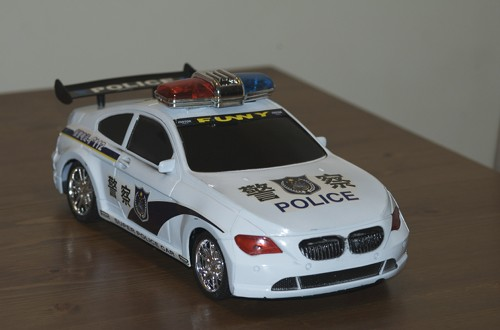
    In the end, I took the thing apart and removed the little drive wheels and motor, which kept the car from freewheeling, and cut the wires to the speaker so that the only electric component that still worked was the lights. This made the police car a much improved toy in almost all respects. While I was about my improvements I noticed something a little odd. Here is a photo of the car:

    police car

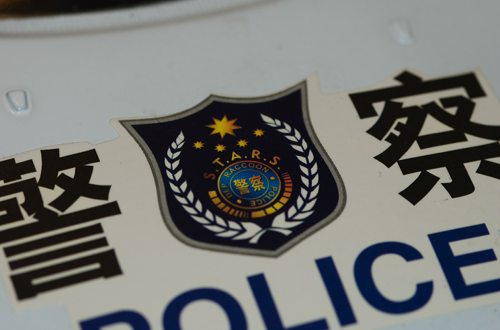
    All well and good, except for the BMW thing, but take a closer look at the police seal on the hood:

    Raccoon City

    I almost didn’t spot it. It says, “Raccoon Police Department”.

    At first I thought this was just your random Chinglish gibberish, which often finds a way onto toys. Zach has one front-end-loader that is spangled with the declaration, “Vigorously Super Power” (which I’m thinking of having tattooed on my ass for no good reason), and some small trucks that say, “Forbid Fireworks” on the gas tank and “Head Back” on the rear bumper.

    But the miracle of Google Images reveals that this is actually the badge of the Raccoon City police department, which is the police department of the zombie-infested city from the Resident Evil video-game and movie franchise. Pop culture bottom-feeders may remember the original movie (there have been about 80 of them now) as the one in which model-turned-actress Milla Jovovich loses her memory, gets naked and kicks the ass of everything that gets in her way. I’m not sure that’s the correct order, but I’m pretty sure all those things happened. Actually, I think all those things happen in almost every movie Milla Jovovich makes, which may be why the Academy continues to snub her. At any rate, here’s the Racoon City Police Department Logo:

    Patch

    This is from a site called, “Patchbug.” Yes, somewhere out there is a patch collector serious enough that he needs a replica of the Raccoon City Police Department uniform patch. It takes all kinds, I guess.

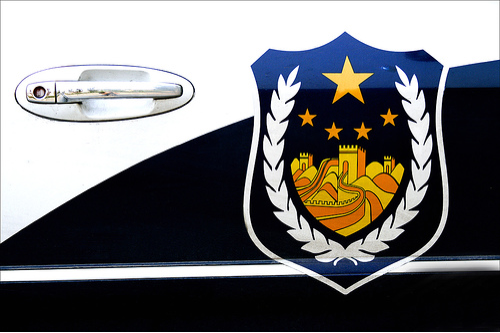
    What I find interesting is that the maker of this toy didn’t steal the Raccoon City patch wholesale, but kind of mashed it up with Chinese to come up with something uniquely ridiculous. For those who need reminding, the actual seal on Beijing police cars is an image of the Great Wall (as if it would be anything else):

    Beijing Police Seal

    So this is apparently a replica of the car of the Beijing Police Zombie Squad, which is apparently the best equipped squad in the Beijing police department. This makes sense: Only the best if you’re going to take on zombies.

    The car also has a line of Chinese over the rear windshield, “有困难找警察”, which would properly be translated as something like, “If you have difficulties, look for a cop,” but which was rendered in English on the car as the delightfully sinister, “Any trouble with you, call the police to help.” Presumably “trouble” in this context means turning into a zombie.

    Note: Actual police car emblem from Upton’s photostream.

  • How to ensure your reincarnation as a frog

    Having grown up in “Mediterranean” San Francisco and then lived in Singapore nearly a decade, winter is something of a novelty to me. This is still true even after six years in Beijing. I don’t much like the desiccating cold or walking around in a cloud of my own skin flakes like the human sno-globe, but I enjoy the occasional snowfalls and the frozen lakes. One of my favorite Beijing experiences was a morning champagne brunch followed by a slightly drunken careen across frozen Qianhai on one of those ice bicycles that have the twin advantages of high speed and a dangerous illusion of steerability. I was double riding with my then colleague, Dennis. I can’t remember which one of us was steering. I do remember that we were thought of as ruffians and idiots. The latter was certainly true, and it’s only through the intervention of some higher power that we didn’t end up drowning under the ice or impaled on one of those little ski-poles that the kids use to prod their slow-poke sled chairs along.

    Anyway, the point is, winter: Make the most of it. Now that my son is two and learning to appreciate idiotic behavior I look forward to further snowbound adventures. Although if he does anything like Dennis and I did, he will of course be grounded until global warming ensures that any further such hijinks become impractical.

    There is a dark side to these wondrous winter scenes, however. As comes the freezing, so, inevitably, must come the thaw. The thaw has the effect of releasing the animal corpses that have been entombed in the ice all winter. Usually this means fish, and there is nothing like a stroll past a thawing Beijing lake to dazzle you with a lesson in the variety and size of the fish living (or, more accurately, that had lived) in these unpromising sludge ponds. Furthermore, there is always the one currentless doldrum where all the disgorged corpses accumulate.

    I was reminded of this during a stroll around Tuanjiehu Park yesterday, my first visit to any of the frozen lakes this winter. Last year Zachary was really still a baby, and his public emergence in anything less than a crocheted NASA spacesuit was an invitation to admonishment from the aunties of Beijing. They are well-meaning, but deep inside they truly believe that foreigners are incompetent at raising children. After all, if we were better at it, there would be more of us. With Zachary much more in the “small boy” category this year, his emergence in inclement weather leads to less scolding and clucking.

    As always, the park was festive. There was a Chinese oom-pah band (exactly as euphonious as it sounds) leading a massive sing-along inside the front gate, and the usual collection of small singing groups, lone-wolf erhu-ists, and children gnawing on that culinary hallmark of the Chinese fairground, unnaturally-colored mystery meat on-a-stick. God bless Beijing. Summer or winter, people here know how to use a public park.

    The lake that is the dominant feature of Tuanjiehu park was still mostly frozen over. Most of it was slick and gorgeous and only mildly spoiled by a dusting of rubbish half frozen into the ice. But there was one spot, near the pleasure boat docks where in summer you can rent a leaky electric boat and spray cadmium-laced water at friends and family members, that had collected an entire fish market’s worth of moldering corpses. It is an image that will haunt me if ever we take Zach to the water-park on the island in the center of the lake.

    At least it was only fish, which you kind of expect even in an urban Beijing lake. Four or five years ago, at exactly this time of year, Imagethief went on a walk past Houhai and Qianhai with the former Asiapundit, Myrick. He was in town from Shanghai to cover the National People’s Congress for the wire service he was working for at the time, and had never really had a look around the city. One of my dominant memories of that walk is the surprising number of turtle corpses we spotted on the ice, recognizable even at a distance as lonely, black humps surrounded by crows.

    These turtles are not naturally occuring. Well, these are artificial lakes, so nothing in them is “naturally occurring”. But as far as I know, there is no year-round population of turtles in these lakes. Rather, many of them had been released into the lakes by Beijingers. The dead giveaway is that a number of them were still attached to little “turtle leashes” of string and sticks.

    There is a ritual in Chinese Buddhism –放生 or fangsheng– by which one can earn merit by releasing a captive animal. Merit earns you a more advantageous seat on the wheel of karma, and helps ensure your eventual reincarnation a further rung up the ladder toward nirvana rather than a further step down toward cockroach or lemur or whatever your idea of bad is. Forgive the loose explanation, I’m shaky on my Buddhism. But you get the idea.

    I see a lot of this ritual at Spring Festival (the Chinese New Year). This isn’t surprising. Spring Festival is heavy on themes of renewal and remembrance, and the temples do good business both in carnal temple fairs (see mystery meat on-a-stick, above) and in spiritual matters. The Chinese, as in so many spheres, have applied their commercial nous to the fangsheng ritual, and you can often buy birds for release at the fairs. The birds are trained to return to their keepers, which has the double advantage of enabling punters to feel meritorious while ensuring that the bird guy protects his capital stock. Everybody wins. Arguably even the bird, which is a good score in Beijing.

    The idea of fangsheng, however, is to save an animal that is facing imminent death. Under this definition, the captive bird on the temple fair fangsheng circuit may not completely qualify, and, depending upon how strictly you interpret the scriptures, your merit may vary. Sufficient for the relaxed devotee, but perhaps not for the more orthodox. Also, the temple fairs only run a week or so, and there’s never a bird-release guy around when you need one, and so on. Sometimes, a creative solution is called for. This turns out to be the pet-store (or, more often, animal market) or supermarket turtle. Turtles are cheap. Turtles are substantial enough to matter, karmicly speaking. Turtles don’t test your resolve, like freeing that cockroach you found behind the dumpling-skin flour might.

    So people buy and release turtles. Except, with Spring Festival actually falling in a Beijing mid-winter, they release turtles into icy lakes where they promptly freeze to death. The sun then warms their dark shells and the corpses slowly sink into the ice, visible only as dark humps that will be revealed again during the spring thaw. Imagethief is no religious expert, and will defer to someone who is, but to me this seems dubiously meritorious at best. Maybe the turtle moves up the karmic ladder (it starts at a low bar). You won’t.

    Turtles aren’t the only animal that catch a hard one during this season. Frogs draw a crappy lot in China at the best of times. In 2007 Imagethief lived in Shanghai in an apartment that backed onto the local wet market. The frog seller set up shop in front of our rear gate. The frog seller’s total shopfront consisted of a bucket of live frogs, hand-held scales, a pair of kitchen shears and some plastic bags. When someone wanted to buy some frogs, the frog seller would use the kitchen shears to decapitate the frogs, and then weigh and package the rest for the customers. Over the course of an afternoon, a tragic pile of frog heads would accumulate. In summer, this would rapidly become a tragic and smelly pile of frog heads. Imagethief used to keep frogs as pets, so this was always a little traumatic for me, like a pile of kitten heads might be to a more normal person.

    Market frogs don’t do any better in Beijing than in Shanghai, so saving a frog from the kitchen shears seems as though it could be both cheap and meritorious, a combination designed to excite the thrifty Buddhist. But this goes wrong in winter as well. Mrs. Imagethief was once going for a winter jog by the Tonghuihe canal, near our house, when she saw a family releasing frogs. The frogs got about one kick and then froze more or less instantaneously. You’d think people would catch on after the first couple of frogs, but as anyone who works in business or government knows, processes tend to take on a life of their own. These people released lots of frogs. They all froze.

    When the family left, some canal workmen who had been watching from nearby immediately scooped out the frozen frogs and took them home to cook. So, genius, how does the merit allocate on that one?

    My karma ran over my frogma.
    My karma ran over my frogma.
  • A few other people that China could helpfully quarantine

    Imagethief has been watching with some interest the resolution of the drama concerning the quarantining of Mexican passport holders, some of whom hadn’t even been to Mexico in recent months. Given that my own country, the United States, was only recently contemplating the building of a border wall specifically designed to keep Mexicans out even before the flu, it seems small of me to criticize China for this policy. Especially now that news has surfaced that four Americans and a bunch of Canadian students have joined the Mexicans already enjoying government-sponsored stays in luxurious, one-star accommodations.

    Fortunately, I am a small man. Charitably, the jury is still out on the epidemiological efficacy of quarantining the Mexicans. Uncharitably, it was a scattershot, poorly-thought-out bit of knee-jerk policy that did for Chinese-Mexican relations what the notorious P3 incident off of Hainan did for Chinese-US relations in 2002.

    There is something rather 19th century about the whole idea of “quarantine”, conjuring as it does visions of smallpox and death ships. Not that there aren’t situations in which quarantine is a perfectly reasonably option. Infectious diseases are simply the most obvious application. But if the Chinese authorities are going to get all quaranteeny, Imagethief is happy to suggest a few other groups of people that the government should consider holding in isolation, for the benefit of society at large:

    • Taxi drivers who piss and moan under their breath about the traffic. It’s Beijing. You’re a taxi driver. What were you expecting?
    • Sanlitun bar touts.
    • Those girls with blue-frosted eyelids at Oriental plaza who try to waylay me for the tea-house scam when all I want is a coffee from Starbucks.
    • People who walk slower than me and follow an unpredictable path that makes it hard for me to get around them, or who stand two abreast on escalators.
    • People who cram huge trolley bags onto the subway at rush hour.
    • Drivers at the back of a line of thirty cars who honk the instant the light turns green. In fact, all drivers.
    • People who tell me my son needs to wear more clothes. Or less clothes. Or offer any kind of unsolicited parental advice based on folk wisdom.
    • People who put smiley-face emoticons in otherwise unpleasant e-mails: “You’re being audited. :)
    • Anyone who sends me an SMS that begins, “本公司…”
    • The Bank of China.
    • Snarky foreign bloggers.

    All of them would benefit from a spell in isolation, if only as a precautionary measure.

    Addenda:

    • People who smoke in elevators or office-tower bathrooms
    • People who instant-message you from ten feet away.
  • Adventures in pyromania

    So CCTV burned down their own hotel. That has got to look bad in the yearly evaluation. However, here is what I am pretty sure didn’t happen: I am pretty sure that they didn’t torch their own building for the insurance money using the year’s second-biggest night of fireworks as convenient cover. This conclusion rests on no special powers of insight or criminological ability, only on my conviction poor planning and an abundance of colossal fireworks in a dense, urban area is explanation enough. I might concede sloppy construction-site management, bad safeguards and poor materials choice as a contributing factors, but that’s about it.

    I am, however,  sad. I have no particular attachment to the Mandarin Oriental tower (or much of the other graceless architectural wank that has sprung up in this town in the past five years), but I expect the fire will lead to new controls on fireworks in Beijing. As wise as that might be from a civil defense point of view, it would dilute one of the Beijing’s great spectacles: the Chinese New Year fireworks inferno.

    Fireworks reach a special part of me.That part is the twelve-year-old boy that still lives inside of me somewhere. He’s not gone, he’s just been gradually wrapped under three more decades of of maturity added over the years one thin coating at a time, like a pearl. But he’s still in there. And he still thinks fireworks are a hoot.

    Like many small boys, Imagethief went through an extended phase where fire was just about the coolest thing ever, with slot racers and jet airplanes close behind. A scientifically-inclined lad, I pursued a rigorous program of experimentation in which I tested the combustibility and incendiary characteristics of various household objects and substances. Those were good times.

    But not for my father. In those days I was living with him in a four-story Victorian in San Francisco’s Castro district that he’d bought in ’74 (for what would now seem like a preposterously small amount of money). 1890s redwood Victorians are notorious tinderboxes. Living in one is about the closest you can get to living in a house built from oil-soaked rags. When the 1906 earthquake struck, most of the damage was caused by the resulting fire ripping through hundreds of wood-frame Victorian houses. And that was when they were relatively new.

    So what I thought was good clean, educational fun, my father thought was borderline psychopathy. He may have had a point. Over the years I set my hands on fire with alcohol, singed my eyebrows with gasoline, melted one kitchen trash can, accumulated a ghoulish collection of blisters and retained my eyesight only through, pardon the expression, blind luck.

    In fairness, I had a local role model. Not neighborhood toughs lighting trash-can fires, but Walter, a friendly engineer who lived on our block and worked at Sutro Tower, the enormous, three-legged broadcasting antenna that dominates San Francisco from atop Twin Peaks. For many years in my family Sutro Tower was known as “Walt’s Tower”. In fact, I may have thought for some years that that was the official name.

    One year for the Fourth of July, which is when one lights fireworks in the United States, Walt put on a show for the neighborhood. He built a large aircraft carrier model out of cardboard, filled it full of small explosives and smoke charges wired to an electrical switch panel, and proceeded to recreate the Battle of Midway. The climactic explosion disintegrated the model and deafened the entire neighborhood. I can picture it with near perfect clarity to this day.

    I was also a budding film-maker with a super-8 camera. Suitably inspired, I soon launched an ambitious project to recreate every pyrotechnic effects shot from Star Wars, but at a level of spectacle that I felt George Lucas had lacked the balls and vision to achieve. My Millenium Falcon adventure playset? Blown up. My X-Wing fighter? Incinerated. My painstakingly built The Empire Strikes Back snowspeeder model? Scorched with flaming WD-40. And so on. What would be valuable collectables today became molten puddles and detonated fragments. I have no regrets.

    Fireworks (presumably including homebrew exploding aircraft carriers) were illegal to purchase in San Francisco, but could be bought legally a ten minute drive up Interstate 280 in Daly City. The stalls were almost always on the lots of car dealerships, as I recall. Perhaps because these were convenient spaces, or perhaps because you might feel the need to celebrate the purchase of a Dodge Dart with a little something extra. The stalls were plywood shacks that sold a changeless assortment of cheap-and-cheerful pyrotechnics including sparklers, ground flowers and fountain cones.

    You could buy the fireworks a la carte, but typically you picked up the biggest boxed assortment you could wheedle your parents into and prayed it didn’t burst into flames in the car. The only drawback was that the boxed sets also included some b-list stuff like Piccolo Petes (all sound, no flame) and those risible charcoal “snakes” that expanded magically from black pellets into, um, a pile of ash. We conducted some experiments trying to launch Piccolo Petes like rockets, but after one blew up on the pad we suspended the program.

    There were limits to what you could buy, however. For one thing, no bottle rockets. In fact, anything with a projectile component appeared verboten. I recall Roman Candles as being very hard to get. This seems pointless in retrospect since I have clear memories of engaging in totally legal model rocketry at about the same time, using much larger and potentially more destructive projectiles. This lesson that was etched in my mind for all time when (Star Wars again — this was the late ’70s after all) my classmate Andy Filler’s Estes X-Wing encountered guidance problems off the pad and nearly gave the entire Marin Country Day School class of 1981 a haircut. That was just one of several grand failures on our school model rocketry day.

    In practice, the projectile ban simply tempted inventive lads to test the strength of their throwing arms with pyrotechnics never meant to go airborne. It may be called a “ground flower”, but it makes a hell of an impressive sight when it ignites in mid-air. It also, like Andy Filler’s X-Wing, has erratic and unpredictable ballistic characteristics. One fourth of July I accidentally lofted one right into the middle of a bunch of beer-drinking adults. It was like dropping a rattlesnake into the hot tub. Liberty Street’s own Nolan Ryan and his flaming fastball were promptly benched.

    Firecrackers were also illegal to purchase, along with their larger cousins, cherry bombs and the dreaded M-80, a hand-vaporising bastard with military antecedents and sixty times the punch of a garden-variety firecracker. Thus, in an early brush with Chinese globalization, my experiments were heavily dependent upon the availability of black-market Chinese fireworks in San Francisco’s Chinatown. Even for a small boy it was easy to go down to China Town and buy bricks of 1280 firecrackers and packs of bottle rockets sold out of the backs of Datsun 280-Zs by skinny, dangerous looking Hongkie kids for not too much money.

    Those black market firecrackers were grist for many of my experiments. They also went off many times in my hand (which leaves you with a characterestic numbed burning sensation in your fingertips and a sheepish expression) and once right in my face (stunned amazement), so it’s probably a good thing we didn’t have access to anything bigger.

    If only I had known what real Chinese firepower was. Imagine the fiendish child that I was with access to real Chinese fireworks…

    To understand the gravity of that bit of conjecture, you need to understand the nature of fireworks that can be had at retail in China during the Spring Festival. As in Daly City the booths spring up seasonally, gaudy and colorful, their wares piled high alongside. And what wares! In China any drunk fool with a few hundred RMB can buy a colorful box the size of a beer keg that includes twelve or eighteen thudding mortar tubes that launch starbursts that would look good at the Pro Bowl. Imagine legalized, recreational white phosphorus. The first time some friends of mine set one of these off in China I thought the cops would come for us.

    And there is a kaleidoscope of options on down from there. When you read about a Chinese fireworks factory exploding (as they do), it’s not the fwisssh….phut! stuff that gets sent to America that does the damage. It’s the high-grade domestic product that levels the village and kills the livestock. I admit one must have different expectations for China. Nevertheless, having grown up in San Francisco, where fireworks are controlled, and then lived a decade in Singapore, where private fireworks are banned, it staggers me to this day what you can buy legally in China. I don’t even want to imagine what’s available on the local black market. Stand back and don your radiation goggles.

    So we get treated to quite a show during the fifteen days of lunar new year. Everybody and their maid buys piles of fireworks. On key days–new year’s eve, the lantern festival–there are queues at the stands. This being China, it’s imperative that your Golden Lotus Atomic Flower Detonator be bigger and more impressive than your neighbor’s Mighty Dragon Lucky Supernova. Or, if you can’t beat him on size, counter with volume and pepper him with a vast battery of the smaller stuff.

    All of this would be chaos enough if the Chinese set off their fireworks with any sort of rational planning as to safe areas, minimum distances from nearby structures and crowd control. And in fairness some of the bigger apartments maintain pretty sound operations, with barricades, fire extinguishers at the ready and people stationed on the roofs to watch for embers (an essential precaution apparently not adopted at the Mandarin Oriental).

    But in much of Beijing, and presumably in most other Chinese cities, that isn’t how it works. Many of the fireworks, possibly most of them, are detonated in the narrow warrens of old neighborhoods where sound is trapped, star-burst fragments ricochet off of windows and the general sense of bedlam is amplified far beyond the limits of common sense. Now that is good fun, and if you ever have the opportunity to wander through such a neighborhood at the height of fireworks season I heartily recommend you take it. The noise will feel like someone has painlessly run a large metal pole through your chest and is shaking it vigorously. (However it may also feel like someone has very painfully run knitting needles through your eardrums and is shaking them, too.) Heavy metal bands can only fantasize about this kind of sound and fury.

    Even in the large courtyard of our apartment, where fireworks are not permitted, the sound is powerful. A rolling tide of detonations that sloshes back and forth between the slab sides of the surrounding towers, the echo creating a distinct basso triplet.WHUMPWhumpwhump! One, two, three. Often I’ll just stand in the center of the courtyard and listen to that glorious sound. I’ve often wished I could record it in a way that would do it justice.

    One thing I’ve never witnessed in China is malicious use of fireworks. I’m sure it happens. People –teenagers especially– throw firecrackers at each other. They aim mortars through the superintendent’s window. They blow up small animals. That kind of behavior must be universal. Indeed, sombody scandalously blew up a popular cat at a university in Hebei recently. But I’ve never seen this kind of thing myself during the festivities in Beijing. It’s always been very family-oriented and congenial.

    I have, however, seen plenty of garden-variety recklessness and stupidity, reminding me of my own past as a garden-variety reckless youth with a fire fascination. Every year fires break out and the emergency rooms stand ready for the fingerless masses. A friend of mine once videotaped a guy accidentally blowing his hand apart. Not something you’ll put on YouTube for mom to see. Alcohol, carelessness and really large fireworks mix badly. The police plaster the town with safety advisories and guidelines in the weeks leading up to new year, and the period when fireworks are allowed in the city is rigidly controlled. But it’s crazy nevertheless.

    The rules for fireworks in Beijing have ebbed and flowed over the years. But I wonder if this week’s huge CCTV disaster, itself an apparent product of garden-variety recklessness at an institutional level, will mean another great ebbing. Will the city government finally decide that unfettered pyromania is inconsistent with the development of a dense metropolis of 15 million people? It wouldn’t surprise me.

    And that would probably be the sensible thing to do. The twelve-year-old boy inside me, the one who still runs to the window for the fireworks and wanders the besieged streets in glee, would be sad to see that happen. But, then, he’s never had to apologize for burning down a new hotel.

  • Illegal baby part 2: I fought the law (and the law won)

    Regular readers will recall that Imagethief became a father earlier this year. Having a child requires new parents to undertake many unfamiliar responsibilities. These include the obvious, such as the care and feeding of an infant, and some things that you really just don’t think much about in advance. Among those are the bureaucratic hoops that the parents of new children have to go through, especially in China.

    There were some things that I anticipated. In my mind I had a pretty clear idea of the set of bureaucratic steps we’d need to go through for Imagethief Jr., a.k.a. “Z”. 1) Apply for passports (Z is a dual citizen so there are two passports). 2) Apply for a visa. 3) Apply for a certificate of temporary residency. Simple. Easy. Logical.

    And missing  one critical step. I didn’t know that I’d have to actually register Z’s birth separately with the Chaoyang District police. After all, it wasn’t like I’d bought a weapon or imported an exotic car. It’s a baby, fer chrissake. The only things he’s a threat to are diapers, teething rusks and the thoroughly detonated sleeping habits of his parents.

    I discovered the police registration requirement for newborns by accident when we went to apply for Z’s visa. Mrs. Imagethief and I had waited a while to do this because we hadn’t applied for the passports right away. We were, as you might expect, a bit overwhelmed by the presence of a newborn and didn’t have any immediate plans to travel. When we finally got Z’s US passport, which was the one under which we intended to apply for his Chinese visa, he was about two-and-a-half months old.

    My company helpfully pulled together a letter and assorted business registration documents for me. We had Z’s Chinese birth certificate and shiny, new American RFID passport. For linguistic help I drafted my assistant from work to accompany us. Mrs. Imagethief, a Singaporean, speaks pretty competent Chinese –far better than Imagethief himself– but for bureaucratic situations a local can be useful.

    In fact we’d had some rumblings of possible trouble already. That same week a friend of ours had attempted to get a visa for her new baby, who was almost exactly the same age as Z. Informed by the Beijing Entry and Exit Authority that she had missed the critical registration step and could expect to pay a fine of several thousand RMB she had stormed out of the building in a rage. I, cocky in my  various successes wrestling with the Chinese bureaucracy, was optimistic that no such misfortune would befall us.

    Pride, as is widely known, goeth before the fall. My pride had goeth-ed and my fall was not far behind.

    At the Entry and Exit Authority we waited in the snaking queue for the better part of an hour before arriving at the counter. Around us swirled the usual motley collection of immigrants dealing with their visas: West African families; necktie wearing businesspeople with Chinese handlers; visa agents with fistfuls of other people’s passports and so on. Other than the tax authority, which I am pleased to have avoided having to visit in China, there is no clearer glimpse into the soul of a government than the waiting room of its immigration bureaucracy. You rapidly get a picture of whose life is made easy, whose is made difficult, and the average level of desperation inflicted on the gathered applicants, supplicants and itinerants.

    At the counter the uniformed young lady fiddling through our paperwork was quick to spot a problem.

    “How long have you had his passport?”

    “We just got it. It took a while to arrive.” This was kinda true. It took a while to arrive because we took a while to apply for it. Zach’s Singaporean passport had taken nearly three months from application to delivery, but the US passport had only taken a week.

    “Do you have a receipt that says when you picked up the passport?”

    “Uh, no.” This was true. The US government does not give you a dated receipt when you pick up the passport. Just the passport itself. I pointed out that that passport had an issue date in it that was within the prior two weeks.

    “No, I need a receipt. Can you get a receipt?”

    I weighed the likelihood of getting the US State Department to write me a letter saying exactly when they had given me the passport in anything less than a matter of weeks, decided the yardage was too far and elected to punt.

    “I don’t think so.”

    She promptly ran my punt back for the touchdown. “We can’t issue a visa now. Your baby is not properly registered with the police. You’ll have to register him and pay a fine.”

    “How much is the fine?”

    “Five thousand renminbi.”

    I didn’t see the relationship between the passport issue date and the missing police registration, but there it was. At this point I decided to unleash my masterful china-hand negotiating skills.

    “Isn’t there anything else I can do?”

    “No. Take him to the Chaoyang District police post on Ritan Donglu. Next!

    Damn. She knew how to negotiate. I had no choice but to make way for the extended West African family crowding up to my counter.

    Early the next day we were off to the Chaoyang District police post. I had expected a massive, bustling metropolitan police station out of American television fantasy. Cops banging out reports on IBM Selectrics; perps being hustled past; a crowd of prostitutes flirting with grizzled sergeants while waiting to be booked. This was exactly wrong. It was more like something out of rural Indonesia. There was a quiet front courtyard with a couple of idle police cars. Inside there was exactly one desk with one bored looking officer sitting at it. We were the only other people in sight, although there was one officer in another room that the guy at the desk shouted occasional questions at. Sultry May air had penetrated the lobby, completing the languid, tropical feel. On the wall behind us, watched by nobody in particular, an Olympic countdown clock ticked away the months, weeks, days, minutes and seconds (no picoseconds?) until 8/8/08.

    I’d rather expected a stern police haranguing, but to the officer on duty this was clearly just a trivial bit of paperwork in a long, uneventful and somewhat sweaty day. He asked me to tell him what happened, which I did with as much honesty and clarity as a PR man can muster. He took copious notes and, when I was done, explained the bottom line to me.

    “As a foreigner are legally required to report the birth of your baby to the police within thirty days. Your baby is seventy-seven days old. That means he has been illegal for forty-seven days.”

    Good heavens, I thought. I have an illegal baby! I never thought this was the kind of thing that would happen to me, a good Silicon Valley boy who’s sole scrap with the police was being ordered off of Santa Cruz’ Seabright Beach after official closing time.

    The next part, explained the officer, was important:

    “Did you break the law intentionally or were you ignorant of it?”

    So there it was. Are you a criminal or an idiot? Even I could see which way this one would cut, so I cast my lot with idiot.

    “I had no idea.”

    He grunted and finished the paperwork, which turned out to be my confession that I had accidentally but most definitely transgressed against the laws of the People’s Republic, was contrite, and agreed to accept such punishment as the authorities had decided to mete out, which in this case was five large. This was read back to me to make sure I understood my idiocy in complete detail, which I did. Anxious to transform my illegal baby into a legal baby, I signed. It was my first confession to anyone other than my parents. I did feel a new lightness washing over me as I unburdened myself of my sins, but it may have just been the lightness caused by the extraction of RMB 5,000 from my wallet.

    Or the psychological impact of imagining RMB 5,000 being removed from my wallet, since I didn’t actually pay at the the police station. Instead, I was told to present myself again at the Entry and Exit Authority the next day. A representative from the police would meet us there and we could pay the fine and complete the registration of our illegal baby.

    It seemed a little odd that the police would send somebody round to meet us and deal with this, but this is China and I’ve learned not to be surprised by bureaucratic eccentricities, such as the fact that the residency records of my neighborhood are apparently maintained on paper in a library’s worth of binders arranged by estate and danwei. Or the fact that although I live in the bustling, commercial heart of Beijing’s ever-extending central business district, our local paichusuo is on the other side of the Fourth Ring Road in a remote,down-at-the-heels neighborhood called Balizhuang that is being rapidly flattened to make way for god only knows what. It’s these sorts of things that remind me that the area I’m now living in was farmland and industrial estates just a decade ago.

    Of course the police didn’t send someone to meet us. We discovered this as we waited like idiots (fittingly, since I’d already officially confessed to being one) on the foreigner floor of the Entry and Exit Administration, scrutinizing every cop who came in to see if it was one of the two we had seen at the Chaoyang District police station. Following a half hour of gathering flies, some investigation revealed that there was a police desk on the floor that apparently existed for the sole purpose of paying fines. It was doing thumping business.

    We presented our confession and various chopped documents officially certifying our idiocy and tipped RMB 5,000 into the government coffers (possibly used to help pay for last week’s space launch), at which point we were once again duly authorized to stand in line and submit our visa application for Z. A week later we got his passport back with visa in place. We went straight off to the  to register him for his certificate of temporary residency, and I’m pleased to say he’s been fully legal ever since.

    Thinking back on this episode, it’s clear in retrospect that the attendants at the hospital where Z was born told me as we were checking out to register him with the police within thirty days. I had confused this fairly rigid, visa-oriented requirement with the certificate of temporary residency registration that foreigners need to complete with 24 hours when they arrive in China or move to a new address. Despite sounding very urgent, I’d always found the enforcement of temporary residency registration to be pretty squishy. I’d often been late –once in Shanghai by a staggering six months– and never got more than a lecture for my sins, if even that. But the baby requirement is different, and in the period leading up to the Olympics nothing about the enforcement of China’s immigration laws was squishy.

    Honestly, it’s a lot of bureaucracy for new fathers, who aren’t the most competent of creatures at the best of times. Z was born in a hospital where little English is spoken, so combined with the linguistic gulf it was a recipe for trouble. Maybe they should have simply tacked the fine onto my bill at the hospital and saved everyone the trouble.

    It also would have been nice if my company’s HR department had thought to warn me of the baby registration requirement, but apparently not too many of our foreign staff have had babies in Beijing and it’s simply not on the checklist. So if you’re a foreigner living in China and expecting a baby, remember you have thirty days to do the paperwork. True, the Olympics are over and things might be getting a bit squishy again, but RMB 5,000 pays for a lot of diapers, so why tempt fate?

    And though I offer a few weak excuses, in the end there is really nothing to blame but my own idiocy. I have a stamped confession to prove it.

    Previously:

    Illegal baby part 1: The strange case of the sluggish passport

  • E-Z steps to make your own Beijing air at home

    Imagethief realizes that he and much of the journalistic and blogging community have been doing a grave disservice to our readers who don’t live in Beijing. We beg your forgiveness. Living in Beijing is such an all-consuming experience that we sometimes forget there is a world beyond the fifth ring road. Although we are, of course, tangentially reminded of this world every time we go to our beloved import supermarkets, which thrive on the business of bringing us Doritos, Haagen Dazs and other nibblicious, western treats from beyond the Great Barrier.

    The disservice we have perpetrated is to groan on at length about Beijing’s shabby, noxious air while never giving you, the reader abroad, the chance to understand for yourself what we really mean. Beijing in August is not best experienced as some kind of abstract mental construct based on the fulminations of bloggers, or the moralizing of the mainstream media. It is a physical experience, and has to be experienced viscerally and immediately. After all, reading about a rock band simply isn’t the same as standing in the mosh pit in front of the stacks, with the thump of the bass separating the cartilage from your bones and slow-cooking the fluid in your eyes.

    Part of the reason why Imagethief thinks that first-hand experience is valuable is that it provides perspective when one reads the dissembling of official apologists who are doing their best to insist that the air is not really as bad as it looks, tastes or feels in our eyes. In fairness, it has been much better the last couple of days than it was the past week, thanks to a welcome breeze and a touch of rain. But the mandarins have passed much of the last few days demonstrating that they are either disconnected from reality as the rest of us understand it, or that they have a less than satisfactory understanding of the meaning of the word “good” as it is commonly employed in English.

    It is hard to know which of these two situations is correct. Imagethief suspects that faulty dictionaries may be the problem, since the word “moderate” is used in SEPA reports to describe air quality that Imagethief would label “hopelessly toxic”, “depressing” or “squalid”. Adjectival nuance can be tricky, especially in a language as eccentric and irregular as English.

    It may also be that the authorities are simply trying to be “hip with the times”, and have noted the tendency of English-speaking youth to use negative adjectives as endorsements, e.g. “sick*” (what we who went to high school in the ’80s used to call “cool”, “awesome” or, in the most rarefied of circumstances, “radical”). If this is the case, then the fault is ours and when the authorities say “good” they actually mean “screwed”. Athletes are overwhelmingly young, so this is perhaps a forgivable error in these Olympic times. If SEPA, or its ministerial successor, refers to one of our rare blue-sky days as “sick”, then this theory may gain credence.

    The shame of this situation is that Beijing is in many ways a great city. It’s interesting and fun enough that many of us live here despite the often crummy air, which is really saying something. And when, every now and then, the air is truly clear, Beijing verges on beautiful. Colors pop out. The hills are visible to the north and west. The gorgeous parks and temples beckon. These clear days cluster in the brief spring and autumn, when temperatures and winds are favorable (although spring also gets dust storms). By any standard, however, they are rare. An enveloping, noxious fug is far more typical.

    Which brings me back to the point. I want to help you, the reader abroad, understand exactly what we’re talking about when we refer to Beijing’s poor air quality. After long experimentation at Imagethief Laboratories SA, I am pleased to report that we have developed a method of simulating Beijing’s typical August atmosphere with nothing more than a few easily obtainable ingredients and a common household appliance.

    Here is what you will need:

    • A serving plate.
    • Large bowl that can be used to cover the serving plate.
    • A bucket of water.
    • A Yorkshire terrier, Pekingese or similar small dog (at a pinch, a dog pelt can be used, but a whole dog is more reliable). Important: If the dog is wearing a metallic collar or tags, remove them.
    • A packet of bad cigarettes. Ideally, Chinese Red Pagodas. But at a pinch, Gitanes or Parliaments will do.
    • A non-metallic ashtray.
    • A turd.
    • A microwave oven.

    Steps:

    • Soak the dog in the bucket until wet to the skin.
    • Place the wet dog on the serving plate with the turd and the ashtray.
    • Place three lit cigarettes in the ashtray.
    • Cover the serving plate and all ingredients with the bowl.
    • Microwave on “high” for sixty seconds.

    Congratulations. What’s under the bowl is a close recreation of typical August Beijing air. Use a fork or butter knife to carefully lift the edge of the bowl (it’s hot!) and have a sniff. Now you’ll have something to visualize (or “olfactorize”) when you read the inevitable thousands of stories still to come on Beijing’s Olympic air quality. If you’re daring, you may want to get a garden hose, have a few of the frat brothers over and challenge each other to do “hits” of Beijing. You may need more than one dog**.

    *Probably already hopelessly out of date.
    **Imagethief does not actually condone microwaving yappy dogs, although he does sometimes fantasize about it.