Imagethief was interested to read in today’s China Daily that China’s government is slapping a consumption tax on several items, including disposable chopsticks and luxury yachts. I think this is just and wise, and should be done. The reason why think so is that, according to the article, China mills 1.3 million cubic meters of wood a year into disposable chopsticks.
That is, to use a technical term favored by engineers, a whole shitload of wood. Imagethief would like to help you visualize exactly how much wood that is:
Picture a block of wood one meter on each side.
Now imagine 1.3 million of those.
As you can see, that amount of wood fair boggles the mind. The other thing that fair boggles the mind is exactly how many disposable chopsticks that adds up to. According to the article, that much wood yields 10 billion “boxes” of disposable chopsticks.
How many chopsticks is this? Let’s play the visualization game again. After reading this article, Imagethief ran to his office pantry where, no joke, he fished a used pair of disposable chopsticks out of the trash in order to measure them. Science marches ever onward, and discovery is not for the faint of heart. And our office doesn’t stock disposable chopsticks, so I had to use ones that somebody brought from the food court downstairs.
A quick bit of ruler work revealed that your average disposable chopstick is 19cm long. Now, I have no idea how many chopsticks are in a “box” as referred to by the article. My statistical woes are further compounded by the fact that the caption in this article and the body text provide completely different numbers for the number of cubic meters of wood consumed every year, and the number of resulting chopsticks. The caption says 2 million cubic meters and 15 billion pairs (not “boxes”) of chopsticks. It just goes to show what a black art statistics is in China, where, apparently, almost everything is simply made up. The caption is sourced to AP and the body text to Xinhua, so take that as you will.
Erring on the side of being conservative, we’ll go with the 1.3 million cubic meters from the Xinhua body text and we’ll read “10 billion boxes” as 10 billion pairs of chopsticks, or 20 billion individual chopsticks (which provides, by the way, a surprisingly low per-capita disposable chopstick usage of 7.7 pairs per year — Imagethief alone probably buries about a pair a week).
At any rate, if you were to line up 20 billion chopsticks nose to tail, your chain of chopsticks would stretch 380 billion centimeters or 3.8 million kilometers (you may wish to check my math). The distance from the earth to the moon is 384,403 kilometers (according to the Internet), which means that, using China’s annual production of disposable chopsticks, you could built a bridge from the earth to the moon nearly ten chopsticks wide (9.885 to be exact – this may be a universal constant of some kind).
Now you know how the Chinese space program is going to get people to the moon.
By any reckoning that’s a pile of chopsticks, which leads Imagethief to discard all notions of cultural relativism and offer the following advice to the Chinese people:
Get a fork.
Barring that, even given that the majority of China’s disposable chopsticks are exported to the moo goo gai pan joints of America, a consumption tax sure sounds like a good idea. From what I see around Beijing, there isn’t enough wood left in China to support more than about another ten-days worth of chopstick production.
And god knows how many luxury yachts you could build with that many chopsticks.
Imagethief is a strapping manly-man, and spends long hours in the gym perfecting his Adonis-like physique. Occasionally, however, his enthusiasm gets the better of him, and he tries to hoist a few kilos too many. This happened to me about a month ago as I was doing plate-rows. At the apex of my set, something in my steely, well-honed trapezoidal wentspang! and pain ricocheted down the length of my left arm.
I called a halt to the day’s strains, thinking that a week or so of recuperation was all that was necessary. Three weeks later, with phantom pains still coursing up and down my left arm and unable to sleep in either of the two positions that I am tolerant of, I finally dragged myself to my regular doctor in Singapore, where I was spending Chinese New Year.
After palpating me in various unsavory ways and making me bend my head into several unnatural positions, he rendered a verdict: a pinched nerve at the sixth cervical vertebrae. He said I could either pay $500 for an MRI, or, since there was no loss of strength (this, I gather, would have been bad), I could go on anti-inflammatories for a couple of weeks and see how things played out.
I selected the cheap, pharmaceutical option. Going for the MRI at that stage would have been far too large a concession of vulnerability. As an American man, I have a battleship-strong sense of denial when it comes to medical issues. In fact, it was an heroic effort of will (no pun intended) just to make it to the doctor in the first place. Like most American men, I won’t go see a doctor unless a bone or major internal organ is protruding through my skin. And even then it’s a toss-up. Is there a good ball game on?
I did, however, make one extra concession to medical adventure. I agreed to go see my wife’s Chinese doctor.
And this raises another American medical prejudice. Americans are raised to believe that all medicine is Star Trek. If a medical therapy doesn’t involve nitrogen-cooled electromagnets or a particle accelerator and flat-panel video screens, it’s stone-age witch-doctor crap not worth pursuing. This maximal approach to medicine explains why America’s health system is such a dysfunctional wreck. When even stubbed toes require PET scans, something has got to give. When I lived in America, what gave was my bank account, under the onslaught of my insurance premiums. Freelance writers part-timing as radio producers to avoid starvation get to pay their own way, insurance-wise. That leaves little left over for such wastrel’s luxuries as “food” and “rent”.
Thus, going to see the Chinese physician was something of a leap of faith for me. I had been to his clinic with my wife before. It looked like Gandalf’s office: dusty, leather-clad tomes, mysterious charts of the human body covered with meridian lines and Chinese script, and shelf after shelf of cryptically labeled, dark-brown potions in equally dark-brown jars. Not a Star Trek medical device or Physician’s Desk Reference in sight.
Although it was Singapore, the doctor (or, more accurately, daifu) didn’t speak any English. I explained my symptoms in laborious Mandarin, with my wife occasionally helping me through the tricky parts. Accuracy is important in medicine, and doubly so when using a language where a single tonal difference can change the coruscating imprecation “fuck your mother” into the merely perplexing “dry your horse”.
After listening patiently to my explanation, the doctor arrived at a prescription that involved neither a horse nor my mother. Rather, it involved a course of moxibustion, or “cupping”. I grant you that “cupping” sounds like something where a horse might be involved, but I assure you that this is not the case. You are, perhaps, thinking of a “crupper”, which the leather strap that runs beneath a saddled horse’s tail. If so, you are either an equestrian or a bondage freak and, either way, have ventured into territory beyond the scope of this post.
The daifu asked me to remove my shirt, and then rubbed a film of of lubricating lotion on my back. This was the pleasant part of the procedure. The only pleasant part. As soon as I was nicely greased, the daifu took a hollow glass globe the size of a baseball and dropped an alcohol-soaked cotton swab through the thick-lipped mouth. He lit the swab, which flared and burned out rapidly, and then clapped the open mouth of globe onto the skin of my back.
Anyone who has ever performed the collapsing gas-can experiment will be familiar with the principles behind what happened next. In this old, grade-school science experiment you light a little alcohol or other flammable liquid inside a metal container, then screw an airtight top onto it. As the air inside the sealed container cools, the pressure drops and the pitiless math of Boyle’s Law takes over. The sealed container is slowly crushed by outside air pressure. Now, if the container is rigid enough to withstand the pressure, but covered by a flexible membrane, it is the membrane that will distort in response to the decreasing pressure in the sealed vessel. In this case, the membrane was me. A golf-ball sized gobbet of Imagethief was quickly sucked into the glass cup. The suction was surprisingly strong, and I had brief thoughts of my skin rupturing and my left lung exploding into the glass cup. If that had happened, I would have asked for my $15 back.
As a technical scuba diver, Imagethief is well schooled the concept of barotrauma. This is injury resulting from a pressure differential, a common risk in scuba diving. To date, Imagethief has suffered only one serious barotrauma: a ruptured eardrum self-inflicted when I clapped a hand over my ear following the nearby detonation of an explosive by Indonesian dynamite fishermen. More common, and generally less serious, is something called a “squeeze”. This happens when a diver fails to equalize the pressure in some internal airspace, such as a sinus or middle ear, or an external one, such as the airspace in a diving mask. As the water pressure increases during descent, the growing differential forces –or “squeezes”– tissue and fluid into the area of low pressure. Generally you feel this –trust me; you feel it– and stop descending before you are seriously injured.
Never in my life did I think I would pay someone to inflict a painful squeeze upon me, but that’s what I was doing.
Anyone who has lived in China or Singapore will probably have, at one time or another, seen someone with a pattern of round, red welts on their back. These are the marks left by regular moxibustion cupping (I have photos here and here), in which the cups are placed upon specific points on the back, and left there. That kind of moxibustion is for pussies. My wife’s family daifu is renowned in Singapore for his expertise in a technique in which a single cup is slid over the affected area to draw out the “wind” that, from a Chinese medical point of view, is invariably the source of all ailments. My wife swears by this technique, and has had her own sports injuries treated in this way on a few occasions.
Her pain threshold must be higher than mine. I now have a pretty good idea of what an orange feels like as it is peeled. Grease or no grease, it felt like the skin was being torn from my back as the doctor slid the globe up my trapezoidal muscle and left to right along the delicate supraspinatus. It was one of the most painful procedures that I have ever been subjected to, and I’m a veteran of two root canals, eight dental extractions (four under local anesthetic), outpatient neurosurgery on my hand and a hernia operation. After the first course was complete, leaving me breathless and sweaty, the daifu asked my wife something in Mandarin. “He asks if you can stand a stronger treatment,” she translated. Macho posturing immediately suppressed all other instincts, including my instinct to flee screaming from the office. “No problem,” I wheezed, like a teenager who’s voice has just broken.
As the daifu began the second course, I tried to mentally transport myself to another location. Blissful green fields. A rowboat on a calm lake. A spectacular, icy glacier. It didn’t matter. Wherever I visualized myself, I was accompanied by a burly, sweating medieval torturer intent on scourging my back. There was nothing for it but to endure the treatment in the here and now. It was clear that the daifu subscribed to the “after I do this to you, the pain you were complaining about won’t seem so bad any more” school of medicine. “Look,” he said. “You can see where all the old, clotted blood is being drawn out of the injury.” Not surprising.
Centuries later it was all over. I gingerly pulled my shirt on over my abused, stinging back. “Any better?” asked my wife, sweetly.
It wasn’t enough for the daifu to strip all the skin from the upper-left side of my back. He had to send a reminder of my misery home with me, in the form of a jar of noxious, brown liquid medicine decanted from one of the hundreds of mysterious, cryptically labeled bottles in his office. I was instructed to take one good swig, three times daily. It was the nastiest substance I have ever ingested, a potent combination of bitterness and herbal pungency like a combination of slivovitz, crude oil and potpourri. It made me want to cry the way I did when my mother made me take liquid penicillin for strep throat when I was seven. I had to have a water chaser standing by every time I took it. I carried it onto the flight back so I wouldn’t miss a dose, and I’m mystified as to why the security inspectors didn’t catch it, confiscate it and fine me for trying to bring a dangerous liquid onto the airplane.
Now, nearly a week later, I can report some improvement in my symptoms. Of course, given that I have been on a combination of moxibustion, bizarre herbal tonic and old-fashioned, western anti-inflammatories, it’s hard to tell what’s responsible for the progress. Would I dare subject myself to another treatment of moxibustion? The daifu told me that, in an ideal world, I’d be able to come back for another treatment a week hence. Now that I am back in China that will be difficult, unless the daifu can refer me to a trusted colleague here. He did, however, suggest that I come in for a repeat session when I am next in Singapore.
Only time will tell if Imagethief has the nerve to steel himself for another pass. The wind may be bad, but between that and being skinned like a rabbit, I might just stick with wind.
I decided to try out a new hair place in my building this weekend. Back when I was in my glorious, long-haired hippy phase (’89 – ’99 roughly), I only had to worry about getting a haircut once every year and a half or so. Now that I’m 38 and keep my hair business-consultant short, I need to hit the barber every four or five weeks. My hair doesn’t grow out elegantly, and the transition to doofus-looking is shockingly fast. (The doofus phase lasted nearly two years when I grew my hair out. Some say it lasted the entire decade.) At this age, I’ve also reached the point in my life where advertisers and marketers have started to write me off. As I move into middle-age, I’ve developed what they call “brand loyalty”. When I find something I like, I tend to stick with it relentlessly. Unto death. The products I use today will, it seems, be the ones I take with me to the grave, decades hence. (When I am laid to rest, put a stick of “Gilette Cool Wave” deodorant on each eye so I won’t stink up the afterlife.) Thus, having found a decent hair place near my apartment in Beijing, I had some resistance to trying a switch. But in this situation, laziness trumped loyalty. The prospect of finding a good cut literally right below my apartment was too compelling to ignore.
When I first arrived in Beijing, and was living up in the Northwest, I used to get a 10 kuai cut from the barber at the BLCU gymnasium. It wasn’t elegant, but with hair as short as mine that’s not really a concern. Your worst cut grows out in about three weeks. Since moving downtown, I’ve gone to a flashier, unisex stylist at Soho/New Town, where I now pay 80 kuai a shot, recently raised from the 60 they used to charge for their entry-level, Chinese styliststs. Such is the price for moving into the fashionable area of town. Of course, all neighborhoods in Beijing have their supply of cheap’n’cheerful, local haircut parlors. But I am always a touch wary of the low-end because brothels notoriously masquerade as hair joints in many parts of Beijing. Frankly, I think blow-jobs and scissors mix badly. But maybe that’s just me; people looking for no-anaesthetic vasectomies may have a different take. Of course you can usually spot the hair brothels because they are visibly overstaffed with Rubenesque, provincial young women in far too much makeup who sit conspicuously close to the window or door and gaze at male passers-by with expressions that do not, in all honesty, suggest haircuts. Nevertheless, discretion is the better part of keeping your balls attached, so I normally select the more upmarket joints.
My long-haired phase aside, I’m a fan of simplicity when it comes to haircuts. Until moving to Beijing, it had almost always been a race to rock-bottom for me. Back when I was in college, but before I started growing my hair out, I used to get my trims for $6 from a guy called Capers who had a place down in the Seabright neighborhood of Santa Cruz. Capers had been cutting hair since being in the Navy in WWII or Korea, or one of those grand-adventure wars they used to have before the Aquarians ruined that idea for everybody with Vietnam. Apparently he’d had both ears blown off –must have been a combat barber– as he wore a pair of conspicuously prosthetic ears on a metal headband. Or perhaps he cut them off shaving, but that was too terrifying a prospect to contemplate. Capers gave one of the world’s great, power-assisted scalp massages with a device I’ve never seen anywhere else, but wouldn’t be surprised to stumble upon in a Beijing hair brothel. Twenty years later I still get tingly thinking about it. He lasted until my long-hair decade, during which I only had five or six trims, and so didn’t have any particular loyalty to hair joints, although I developed rigid tastes in conditioners and hair mousses. Those were dark times.
I was living in Singapore when heat, boredom, advancing age and the visible signs of a receding hairline made me realize the long hair had to go. I went to a place in Great World City called “Jantzen Hair Design” and told them to get rid of it all. All those years of long hair had made me surprisingly tolerant of places billing themselves as “hair design” or “stylists”. Like I said, those were dark times. Jantzen whacked the lot off and I spent the next day wandering around, feeling my scrubby scalp in delight like a dorm-rat on X. Out of inertia I took my shorn head back to Jantzen for several months until I realized the Malay barber in Holland Village, walking distance from my house, would give me the exact same haircut for one quarter the price. I stuck with those guys until I left Singapore.
The place downstairs in my apartment building is clearly “hair design”. At the low end they charge 98 kuai for a cut from a Korean stylist, 68 for a Chinese stylist. This graded pricing is a peculiarity of Beijing hair salons, where the operating assumption is that maximum style can never be achieved through the services of a Beijing native. Having walked many of Beijing’s malls, it is possible that there is a grain of truth in this assumption. But I think it’s mostly about playing to people’s infatuation with exotic imports. My previous hair place charged more for stylists from Hong Kong, while the Toni & Guy up the road at Sunshine 100 charges big bucks for the sophisticated caresses of a Canadian stylist (no doubt of Hongkie extraction).
The place had only been opened for a few days and customers were still in short supply, so I was descended upon by a well-coiffed mob the moment I entered and gently ushered upstairs into serene, white-paneled bliss. There the attendants locked my coat in a cabinet (for my protection), seated me on a luxuriously soft couch, and placed The Book on the coffee table before me. The Book was opened to reveal photograph after photograph of gorgeous, high-cheekboned, effeminate looking Asian men with spiky, frosted hair. Which gay, Korean popstar would I most like to resemble?
I have nothing against gay, Korean popstars (or straight but devastatingly androgynous ones, for that matter). But as a thirty-eight year old white man with broad shoulders, a generous nose and prominent brow line, no amount of hair engineering on earth is going to make me look like one. But they were game for a try. Everybody seemed a bit crestfallen when I said that I simply wanted my hair cut short, and a little longer on top was OK. I was seated in a spanking, new salon chair with not a strand of previously cut hair upon it, and a gorgeous, high-cheekboned, effeminate looking Chinese man (remember, I didn’t stump for a Korean) with spiky, frosted hair went to work on me. Meanwhile, two attendants hovered over the chair ready to do…anything that might be necessary. Or, almost anything. This was not, after all, a hair brothel. The only contribution that they made during the actual haircut was when one held a transparent shield over my face for thirty seconds while my bangs were being cut. If I hadn’t lowballed on the stylist, I’d have assumed they were sitting at the feet of the master. As it was, they were sitting at the feet of the discount.
At the end of the process was where we ran into communication difficulties. I have hair best described as “unruly”. As usual, there were two or three little sprigs on the top of my head that refused to lie flat. I said to the stylist, “I always have some that stand up. Use a little gel.” (Actually I used the English word for gel, I have to confess to not knowing the Chinese.) Naturally, this was perceived as “use some gel to make my hair stand up”. I had just issued an invitation to spike up my hair to a man who saw all unspiked hair as falling far short of its full, glorious potential. I realized what was happening when, after rubbing in some gel, Mr. Frosty started using his thumb and forefingers to roll tufts of my hair into spikes. I did a quick inventory of my Chinese vocabulary and realized rapidly that I did not have the words to politely say, “I’m sorry. You have misapprehended me. I do not wish to have my hair spiked. Just use gel to make it lie flat.” So, in the best Beijing fashion, I decided to roll with it. After all, it wasn’t like he was trying to give me a dye job. I’d have drawn the line at that.
Five minutes later I was looking smooth. Youthful and trendy. I went down to the counter to pay. There was an opening week 30% discount, so I only owed 47 kuai. Six bucks. Same as I paid Capers 20 years ago. And Capers worked without help (or ears). I love Beijing.
I took my stylish self back up to my apartment where my wife said, “You paid 50 kuai for bed hair?”
A current of dissolution runs through Beijing’s expatriate professional community. The city doesn’t have the loutish licentiousness of Hong Kong, the world-weary NGO clubbishness of Phnom Penh, or the dangerous-living frisson of Port Harcourt, or some other oil-drenched African hellhole. But, with limited entertainment options and a large population of foreigners paid more money than can reasonably be spent*, there is a certain inevitable drainage toward the underlit low spots where large pools of alcohol have collected.
Perhaps if Beijing was more family friendly and developed this would be less obvious. Or perhaps I simply run with a bad element. I am, after all, employed in an industry with a legendary, institutional fondness for adult beverages. I tend to hang out in a crowd rich in fellow flacks, journalists and Australians. If this isn’t courting danger and inebriation, I don’t know what is.
As befits someone with my godless inclinations, I went for a full-body wallow in the soft, white underbelly of expat Beijing this holiday weekend, resulting in a positively Roman display of indulgence and self-gratification that did superb justice to the pagan roots of Christmas, and no justice at all to the rather more ascetic spiritual aspects. The first stop was a catered dinner on Saturday evening, hosted by a couple who live in a villa in suburban, northeast Beijing.
The “villas” are to Beijing what suburban Connecticut is to New York, if only Connecticut was ringed with an apocalyptic wasteland dotted with the desolate shells of enormous, uncompleted residential developments. They’re places where wealthy people, often with families, attempt to escape the hurly-burly, in-your-face, gob-on-the-sidewalk lifestyle of downtown Beijing. In a city where the vast majority of people live in microscopic apartments, the villas really are absurdities; gated simulacra of American suburbs complete with wide sidewalks and picket fences. Fantasy re-creations of single-family, detached bliss. If you’re a foreign executive for an MNC who has just been rotated into Beijing for two years, and you have a large housing allowance, a car and driver, and no real desire to interact with the city, they’re the place to be. Many are near the airport, which increases the appeal for frequent fliers, and other people often seen getting the fuck out of Beijing.
The slightly contemptuous description above doesn’t describe all villa residents. One very good friend of mine, an old China hand who works at home, lives in a villa house because it provides ample space for his family and his business. He’s done his downtown time and doesn’t have much else to prove. And the couple who entertained us on Saturday night probably don’t fit into my angry, stereotype box either. A mixed English-Hongkie couple, both are fluent Mandarin speakers who don’t seem to have any need to insulate themselves from China. In fact, the house belongs to the woman’s grandmother. The two of them were fine hosts once we got past the man’s enthusiasm for a wicked, electronic party game that punished the slow or anxious with nasty electric shocks. I hate electric shocks, and took care not to lose. Our hosts laid on a catered spread that was, by my math, exactly twice as much food as could possibly be consumed by the eight of us who were there. The liquor and tobacco were scarcely dented. Dessert was an all-night love-affair with pancreatic suicide. I ate. I drank. I wept for the sheer joy of it.
For all my bitter, underprivileged sarcasm, there are certain advantages to villas. This place had a large kitchen, a roaring wood wire in an open fireplace, and a dining-room table that could comfortably seat ten. My dining room table seats four, and only if everybody exhales, we put the cat out and we don’t actually eat anything. Villas also have the advantages that houses everywhere have over apartments: you can play your music loud, and you can set off enormous, dodgy fireworks. We did both.
When I was young lad, I, as all young lads do, went through my pyromaniac phase. Living with my father in a 100 year old, dry-as-tinder redwood Victorian, this was a particularly fraught period in my life. In a series of episodes that an enterprising therapist could mine for book material, I blew up most of my toys and set the rest on fire, along with (at various times) my hands and eyebrows. While I usually laugh it off as just another bit of juvenile, male primate risk-courting (check it out, baby, I cheat fiery death!), looking back from the cusp of forty it now seems remarkable that I didn’t end up in a burn unit, jail or minus a couple of fingers.
In those days, fireworks –the feedstock of my reckless entertainment– were illegal in San Francisco. In the run-up to the Fourth of July (America’s holiday for independence and blowing shit up), you could drive down to Daly City, ten minutes to the south, and buy an assortment of decorously restrained sparklers, cones, Piccolo Petes, ground flowers and snakes. Or you could do what I often did and go down to Chinatown to buy black-market bricks of firecrackers sold out of the backs of cars by young Cantonese guys. If you were particularly daring, you could lay hands on cherry bombs, or even the infamous, hand-pulverizing “M-80″, reported to have the lethal kick of a quarter-stick of dynamite. Looking back on it, this may be the start of my love affair with Asia.
The biggest things you could get that had an aerial component were bottle rockets –enormous fun to shoot at friends and pets– and, of course, the legendary and poetically named Roman Candle, the firework that made “great balls of fire” more than just a Jerry Lee Lewis riff. Neither was capable of delivering significant explosive power onto your target, however. To get any more vigorous airborne, incendiary entertainment you either had to be into actual model rockets, which I briefly was (too much work), or into throwing ground-flowers just before they ignited. I was also, very briefly, into this before being scolded mightily by my father, who could visualize the clause in his insurance policy that said, “we will not pay for your house if your idiot son burns it down with fireworks”.
Of course, I now live in China, where any firework small enough to actually be thrown is for pussies. This was amply demonstrated outside my apartment last Chinese New Year, when I was treated several hours of nonstop detonations that gave already surreal Beijing something of a dangerous, Sarajevo atmosphere. By the sound of it, M-80s were about the light end of the scale, despite a nominal ban on fireworks inside the fourth ring road. Coming from years in Singapore, where it was considered quite the daring scene when the Prime Minister recently lit a single string of firecrackers for the television cameras (the first heard in Singapore in several years, mind you), this was a refreshing change. Glued to the window of my apartment, with the throaty booms washing over me in waves, the infantile pyromaniac, long suppressed by an adulthood replete with neckties and responsibilities, stirred restively within my breast.
That’s why I was propelled to Olympian heights of ecstasy at the sight of the climactic firework unveiled on Saturday night by our hosts. China, as we are often told, is the country that invented fireworks. To see the kinds of damp squibs we used to get in Daly City, the sanitized dregs of the Chinese fireworks industry, you could be forgiven for wondering how anyone could be killed in a “fireworks factory explosion”. Too see what we launched on Saturday night was to see that China was keeping the best for itself, and to understand exactly how a fireworks factory explosion could wipe out not only the people in the factory, but also the unfortunates in the next village up the road. It was a gaudily-wrapped cube the size of a filing cabinet, in which were enclosed sixteen cardboard mortars, each with a two-inch diameter. 600 kuai ($75) at your finer fireworks stalls, I was told. Surround with bricks and keep back fifty meters said the ominous instructions. It scarcely needed to add, “this side toward enemy”. A straw poll was held, and the fireworks were launched from the nearest convenient launch pad, the roof of the servants’ quarters.
Sixteen ear-shattering booms later we had been treated to a private, Christmas-eve fireworks display of monumental proportions, all the servants were awake, and every car alarm in the neighborhood was ringing. Stupendous, incandescent blossoms, twenty meters across. The lower fringes dusted the roof of the house itself. Oh, baby, where were you when I was hunting for the perfect bottle rocket, all those decades ago? The things you and I could have done together. I used to have to go to Candlestick Park (more recently 3Com Park and Monster Park thanks to the great American rejection of all traditions that aren’t evangelical Christian ones) and stand in the parking lot for this kind of display. Here anyone with a few bucks to spare can muster a Fourth of July fireworks exhibition that would be the pride of any stadium in America. I love China.
We got home at 3AM, deaf and stuffed, with just enough time to sleep-off our excess before trooping out to the Hyatt’s Christmas champagne brunch with a different group of friends. This was the point at which my Christmas actually descended from indulgence into obscenity. Hotel brunches are nothing more than dares; challenges to eat enough to make it pay. In a world where people are going hungry –in a country with an income per-capita of $1290; or just about 20 times the cost of one seat at this brunch– it’s the ragged threshold of karmic self-immolation, invariably followed by weeks of self-flagellating penance on the treadmill. Mrs Imagethief, the pro nutritionist, has actually diagrammed her attack for maximum value: cheeses, seafoods, meats and desserts. Stay off the breads, potatoes and noodles. Those are sucker plays; cheap filler to woo you away from the meaty, gold-plated nuggets that make the buffet worthwhile. You have to admire the dedication to gustatory suicide.
The Hyatt brunch is mediocre by international hotel brunch standards (I am a fan of the Ritz Carlton in Singapore – nice selection of food; unparalleled cheese plate; bright, airy space), but that didn’t stop us from working it until we were the last party in the restaurant and the wait-staff were shooting us nervous “please leave” looks. Only two of us coughed up the ruinous 488 kuai for free-flow champagne, and we had a solemn pact to make it pay. Between the pair of us, we managed to bury three bottles of Moet which, on top of the previous night’s festivity, all but ensured some kind of premature organ failure.
Drunk, waddling and incapable of speaking in anything other than belches and groans, we did the only logical thing. We staggered off to frozen Houhai where my friend, Dennis, and I rented one of the two-seat sled chairs that extended Chinese families make into sled caterpillars and pole along the ice at excruciatingly slow speeds. We did not move at excruciatingly slow speeds. We moved at recklessly fast speeds, taking turns mushing one-another along like demented, Yukon dogsled drivers crocked on shots of Jagermeister and driven half-mad by long, sunless, Arctic winters spent in the company of nothing but Alaskan huskies. You can’t steer a sled-chair in any meaningful way, and we must have scared the bejeezus out of any number of apple-cheeked, pigtailed young Chinese girls who will spend weeks thrashing under sweaty sheets dreaming of maniacal, unshaven Laowais careening toward them and screaming, “过一下儿!!! 过一下儿!!!” It’s only by some kind of Jimmy Stewart-style Christmas miracle that we didn’t sail through one of the flimsy barriers that surround the slushier sections of the lake, ride our hell-sled into the frigid darkness and end up drowning under the ice like rats.
Provenance smiles upon idiots. It was the best Christmas ever.
Imagethief wishes all readers a merry Christmas, happy Hanukkah, a pious Ramadan and a happy New Year. And, because this is a properly ecumenical site, happy holidays, too.
*Starving, idealistic English teachers are excepted from this generalization.
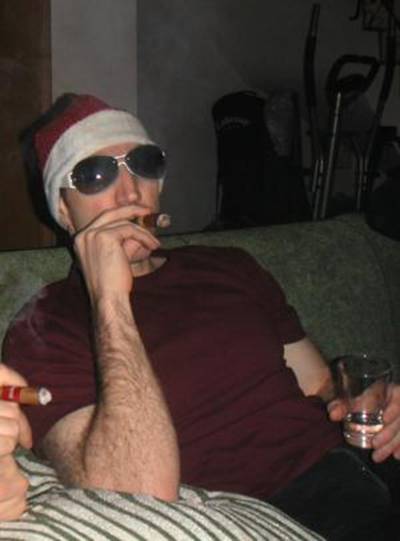
A dissolute Imagethief wallows in empty, carnal indulgence on Christmas eve with a fat smoke and Finnish vodka. Jackie O. shades hide eyes full of shame.
When you are asked to name the great, metropolitan cities of the world, you will naturally consider certain factors. It’s not always size that makes the difference. If it was, then Chongqing would be the capital of the planet, a role I think we can all agree that Chongqing, for all its charms, is not quite ready for. Sure, size has its place, but it’s the more abstract qualities that really elevate certain cities to greatness, and that probably influence your choices: political influence; rich history; culture; cuisine; cosmopolitan buzz; and so on.
Beijing has most of this –it’s working on the cosmopolitan buzz– but it conspicuously lacks the one other factor that defines many of the world’s other great metropolises: a giant monster attack.
I’ve been giving this a lot of thought lately (a sure sign that the holidays are leading to a work slowdown), and I’ve come to the conclusion that Beijing cannot be a great, global metropolis until it is attacked by its own giant monster. Thanks to the encyclopaedic reference information contained in two invaluable websites, Stomptokyo.com andGiantmonstermovies.com, I’ve been able to research some of the cities that have been on the receiving end of giant monsters. Sure, you all know that Tokyo has had a fifty yearkaiju infestation that has included Godzilla, Gamera and friends. New York got King Kong on multiple occasions plus, as a bonus, the Beast from 20,000 Fathoms (by the way, that’s 180,000 feet, or about six times deeper than the deepest part of the ocean). London was attacked by Gorgo. San Francisco got the five-armed octopus of It Came from Beneath the Sea. The list has also has some surprises, including some of Beijing’s key, regional rivals and a few cities you’d never expect:
Copenhagen was attacked by Reptilicus
Hong Kong was attacked by Mighty Peking Man in 1977, in an unintentional but apt metaphor for the city’s future
Rome’s Colosseum was destroyed by Ymir in 20 Million Miles to Earth
Los Angeles got Them
North Korea was attacked by Pulgasari, admittedly in ancient times
South Korea’s Seoul has had various monsters
Sweden got a monster, although it appears to have been confined to rural areas, in keeping with Scandinavian tidyness
Bangkok got Garuda
Even neutral Switzerland had a monster, although it was put there by Americans
Every tiny town in the American southwest had a Gila Monster, Mantis or giant Lepus at some point, thanks to the tireless efforts of Bert I. Gordon and his contemporaries.
As you would expect, Singapore is monster-proofed, although I think a romp by a giant merlion would do it a world of good.
But let’s get back to Beijing. Those who like to quibble might be tempted to remind us that Mothra appeared in Beijing in Destroy All Monsters, but I am inclined to disqualify that for a couple of reasons. First, that’s a Japanese monster, and, as such, more insulting than terrifying. And, second, the climactic battle didn’t take place in Beijing.
The problem for Beijing is, of course, that it has no skyline, and no easy monster access. If a monster was going to attack any mainland Chinese city, it would probably make a beeline (monsterline?) for Shanghai. Not only does it have the Huangpu River and the nearby Yangtze, which is more than big enough for your standard-guage kaiju, but it has the glittering Pudong skyline which has “ravage me” spelled out all over it in neon. If the Oriental Pearl Tower isn’t a secret Mysterian headquarters building just waiting to be scaled by something giant, scaly and radioactive, then I don’t know what is. And Jinmao Tower is a close number two.
But what would a monster in Beijing attack? CCTV Tower? That’s way out west. The Great Hall of the People or the National Museum? Those low-rise, Stalinist wedding-cake buildings just aren’t all that satisfying as monster-fodder. Guomao’s twin towers are step in the right direction, but after Jianwai Soho, there’s precious little else smashable in that neighborhood. I guess a monster could kind of work it’s way down Jianwai and Chang’an Jie like a buffet line, stopping every kilometer or so to work on whatever medium-grade skyscraper or smokestack was convenient, but it seems like kind of a chore. Why waste the effort when the concentrated banquet tables of Shanghai and Hong Kong are so much more convenient?
And that supposes that a monster could get to Beijing. But this may be easier to solve. Although we don’t have a major waterway nearby, it is conceivable that monster awakened by, say, the depletion of Beijing’s aquifer could arise from the bottom of Zhongnanhai, or perhaps tunnel up from underneath the Shougang plant (which would put it conveniently near the CCTV tower). I guess a monster could rise out of Tianjin harbor as well, and take Tianjin as a kind of hors’d’oeuvre on the way in, but it all seems very indirect. Plus any such monster could get misdirected and end up in Dalian, or, worse, Seoul (which has already had a monster, thank you very much).
So I think Beijing has a clear mandate. If there is a better centerpiece for a giant monster attack than the 2008 Olympics, I cannot think of what it might be. Forget terrorist attack, I’m thinking giant monster attack. I think Beijing has a responsibility, a duty, to construct a monster-worthy skyline prior to the Olympics (it’s certainly working on this), and then take advantage of the games themselves to trash it utterly.
Now that would be a spectacle worth staying for, and it would ensure Beijing’s entry into the pantheon of great World Cities far better than any measly athletic competition alone ever would.
A couple of days ago, Imagethief had lunch with four members of his team at a Chinese restaurant downstairs from our office. Choosing dishes was easy –I’ll eat almost anything– but, predictably, there was much debate about exactly how many dishes we should order. And, just as predictably, we ended up with twice as much food as we needed. This is the great conundrum of Chinese dining, and, indeed, most Asian-style dining.
In the US it’s simple. You decide what entree you want and you order it. The only complexity is whether or not you share appetizers with your friends, choosing the wine (it’s fiendishly easy embarrass yourself oenologically; in college I had a buddy who wrecked a date with a rich girl by breathing the white wine) and settling the bill. In the US, settling a split restaurant bill is the most mathematically challenging task you are ever likely to undertake unless you are a high-energy physicist. And if you’re a physicist, you’ll have purpose-written computer software to help you. There is no software for sorting out restaurant checks, and by the time you and your friends are done sorting out who had how many of what beverages, and which appetizers, and I didn’t drink any goddamned wine, someone always gets screwed. Bitter, trans-generational rivalries have started this way. The Hatfields and the McCoys? That started with a restaurant check. And that was just Arby’s; think how much worse it could have been.
Chinese dining trades the ordering simplicity and bill complexity for ordering complexity and bill simplicity. All the food goes into the middle, so you just divide the check by the number of people. Only miserly bastards will argue, “well, I had less of the duck tongue, so I shouldn’t pay so much”. You probably don’t hang out with people that anal, unless you are totally anal yourself. In which case, you probably live to dissect restaurant checks to two decimal places, so you’re wasting your time reading this. With even the beers being cheap in most Chinese restaurants, most of the time it’s not even worth adjusting for alcohol consumption. So the check is easy.
But the ordering, ah, now that’s hard. And it’s not just hard for the obvious linguistic reasons. Yes, you have to learn some food and cooking vocabulary, but that comes quickly if you don’t want to starve. And you do need to get past the Chinese infatuation with cryptic dish names. You’ll never know that “Buddha’s glistening five-taste jewels” is braised camel testicles with sea cucumber unless you ask. But what’s really difficult is figuring out how much you should order. How many dishes should go into the center of the table in order to ensure that your party is sufficiently fed, without causing cataclysmic waste?
Food is cheap in China, you argue, so why worry about cataclysmic waste? Well, guilt, for one reason. As a Jew, this is an inextricable part of my worldview. You can abandon kosher restrictions, but the guilt is bred in, like eye color and curly, brown hair. Remember all those years your mother told you that kids were starving in China, so you should shut up and eat the damned broccoli? That really comes back to haunt you when you’re actually in China, and you wander around some of the piss poor villages that begin on the far side of Beijing’s fifth ring road and stretch, more or less uninterrupted, all the way to Kyrgyzstan. And, really, who wants to see too much nice food thrown into the grime-blackened oil drums of the slop collectors? These are the poor souls who ply Beijing’s streets by tricycle and (illegally) xiao beng beng after dark, collecting restaurant leavings for the pig farms outside of town where they raise the pigs who will be, well, next week’s meals and, eventually, pig slop. It’s the Circle of Life, Beijing style. You won’t see Disney touching this one.
Also, of course, when there is a vast amount of food on the table in front of you, you’ll tend to eat it. Now this isn’t necessarily bad, but Beijing cuisine isn’t of the light and heart-healthy variety. It’s of the Exxon Valdez, billions of gallons of oil and salt mixing together variety. Too much at any one sitting will put you into a coma. Too many sittings will put you into a casket. A really big, reinforced casket. And China is short of wood, so this only compounds the guilt.
So this brings us to one of the truly great questions of our age. It’s right up there with, “is there an elegant, mathematical way to unify classical and quantum physical models?” or “who, in their right mind, thinks Paris Hilton is sexy?” That question is this: what is a truly rational ratio of Chinese dishes to people, assuming average people and an average restaurant? (I’ll assume that you’re smart enough to avoid one of those touristy “imperial” dives where they charge outrageous prices to serve you precious little niblets of bizarre organ meats that you could find being sold on sticks off the charcoal grill around the corner for a kuai a pop.)
Think about it. You and a friend go a Chinese restaurant for lunch. You probably could survive splitting one dish and rice, but you’ll get a meat (or tofu; equivalent for this exercise) and a vegetable. If you’re aggressive, you’ll get two meats and a vegetable because you feel that you need the variety to justify a Chinese restaurant. But this is a trap, and you’ve now over-ordered. With two people, one dish per person is appropriate. Add another person and you’ll definitely add another dish. Your still at one dish per person, following a classic “one-per-head” rule often applied by Chinese people. But with four people, what do you do? Four dishes for four people might be a lot. You could probably stick with three. Five people? You’ll want four dishes. Six? Dicey…four will instinctively seem too little to you, even though it’s probably correct. Six will definitely be too much. This is touch and go. Seven or eight people? Er, uh…
So you can see that lot of voodoo is coming to bear to here. And there is more complexity as well. When I say “dish” here, I am assuming one of the standards: a stir fried vegetable or a meat or tofu in sauce. But how do you account for the cold dishes, or veggies, which tend to be lighter? Or a duck, or even the mighty shuizhu yu, which are undoubtedly heavier? What about dumplings? Some places sell by the liang, some by orders of 10 or 12. Well, at this point you’re just guessing wildly, aren’t you?
Of course you could turn to the waitress for help because she, of course, has a totally disinterested perspective on what represents enough food for your party. This is a variation of the deadly trap in which you ask the waitress to recommend a dish. Yes, sometimes they’ll send you to a legitimate, hidden gem, but nine times out of ten the finger goes straight to the abalone and sharks fin XO supreme in tiger-penis broth at RMB888 a bowl. And, at a restaurant where a plate of yuxiang rousi costs 12 kuai, that can be a quite a shock to the system. In truth, I’ve never felt that Chinese waiters or waitresses were really aggressively pushing more food than was appropriate, but they’ll definitely err high. I can recall dozens of times where waiters and waitresses suggested we order just one more dish, and only one instance where we were told that we might want to take one thing off the list.
So, can this process be made easier? Can it be somehow defined in a way that will enable you to prove, mathematically, that you have ordered a correct amount of food? Who knows. But it’s Saturday morning, and I have nothing better to do, so I am going to try.
For simplicity, let’s assume that we want a system that sticks to the Chinese rule of one dish per head. So if you have five people, you want an aggregate score of five. But we also want a system that weights dishes correctly based on their gustatory impact. For instance, there is no way that your pai huang gua or bowl of white rice has the same impact as an oil-and-chili drenched mapo doufu. Now I don’t have time to sit here and individually weight every Beijing and provincial standard that you can order in this town, for Chrissake. But I can roughly categorize dishes in a way that, I hope, makes sense. So here is my proposed weighting system for types of Chinese dishes:
Underweighted dishes:
White rice: .25 in aggregate (assuming everyone orders a bowl – if less than half the party orders white rice, ignore)
Dumplings (shuijiao): .25 per liang of five or .5 for an order of 10 to 12
Dumplings (guotie): .5 per liang of five or 1 for an order of 10 to 12
Desserts: .5 (this is counterintuitive as Chinese desserts are unparalleled calorie bombs, but I’ve always subscribed to the “separate tank” theory of dessert consumption
Cooked green vegetables: .75 (that’s stir-fried or steamed green vegetables; di san xian,yuxiang qiezi, or anything in sauce counts as a full dish)
Standard weighted dishes:
Soups and noodles: 1 (soup is a trap; don’t assume that it’s lighter than other dishes)
Breads with meat (roubing, etc.): 1
Standards: 1 (most meats, poultry and fish; vegetables in sauce or gan bian style; and any cooked or sauced tofu; the vast majority of dishes)
Overweighted dishes:
Shuizhu yu or niu rou: 1.5 (I’m inclined to double weight it, but I’ll be generous)
Beijing roast duck: 2 per duck and, yes, a half-duck is 1 point (the duck is greasy and there are pancakes, plum sauce, etc.)
“Set piece” dishes: 2 (roast suckling pig, roast mutton leg, anything that serves as a centerpiece dish or that would be served at a wedding)
Hot pot: .75 per person (so if you have four people, it counts as a total of 3 points)
Intimidation dishes: 2 (bizarre organ meats; exotic animals; anything you are served by people trying to get a rise out of the laowai or that you serve to your “just arrived in China” friends to give them a taste of “the real thing”
So if you and five of your friends (six people total) are going out for dinner, you have an available score of six. Everyone has white rice, leaving you 4.5 available dishes. Two cold dishes leave you 3.5 remaining slots. Order two green vegetables and two standards, and it’s perfection. Or one standard, a duck and one more cold dish. Or, if this is a duck feast, six people qualifies for two ducks, a standard and two cold dishes. See how easy this is? For the sake of argument, I’ll even allow rounding.
Global modifiers: Global modifiers affect the overall score of a meal. Positive modifiers are added to your available score to allow the addition of extra dishes, negative modifiers subtract from the total allowed dishes. For example, if you have four people, and, thus, a total available score of four, a global modifier of +2 allows you order dishes totaling a score of 6. Conversely, a global modifier of -2 would allow you to order only two dishes. Some global modifiers apply to specific numbers of people, and so must be modified for party size. Simple, isn’t it?
Auspicious occasion (wedding, deal closure): +2 for every five people
All just arrived in China: +2 (gotta experiment)
All female party: -1 for each four people
All teenage girls: -3 for each four people
Lunch: -1
Rugby team: x2 available score
In Guangdong: -2
In Sichuan or Hunan: +1
Any restaurant with a floor show: -2
Any restaurant with a government tourism or China Famous Brand plaque: -2
Any restaurant at a provincial 办事区: +1
Beer and other liquors: no impact
There. Drop that all into Microsoft Excel or a handy, slide-rule style device and you’re good to go. I’ve tested it not at all and I have very little confidence that it will hold up under rigorous examination. But, in the end, it’s as good as anything else you’ve got to work with. Suggestions for other weightings or modifications can be submitted via the usual methods. The Nobel committee can contact me care of this website.
When I was back in the US recently I was often asked a deceptively simple question: “What is it like living Beijing?”
This is a trap. It’s a trap because no-one living in the United States wants to hear in any great detail what your experience of living in another country is like. Most Americans don’t actually believe in other countries, except for France, and then only because they don’t like it. I am sure that most of my friends think I am assimilated bodily into the Internet for eighteen months at a time, beaming in for the odd-week to attend barbecues and weddings.
I went through this indifference for years when I was living in Singapore and, despite China’s slightly higher marquee value, the situation is not much different now. It could just be that I am a crappy raconteur. But I think people really just want some short, pithy exclamation or mini-anecdote that encapsulates everything that is exotic and frightening about where you live, provides them with reassurance about their own lives, and doesn’t challenge them with too much history, culture, political analysis or other complexity. Something like, “Well, did you know that, in China, it’s acceptable to walk around without any pants on and that people rub noses to say hello?” (Although, ideally, something true.) Speak for longer than about three sentences on the topic of living abroad at your standard cocktail party and people’s eyes glaze over and their hands start fumbling for a liquor refill. There are, of course, occasional exceptions to this rule from people with a particular interest, but I feel this accurately describes most such situations.
So I’ve been confronted with the challenge finding a way to accurately sum up the experience of living in Beijing –to transmit the raw, visceral feel of it– without dwelling too deeply upon the nitty-gritty and nuance that washes right over people who’s conception of China is built entirely on takeaway moo goo gai pan and Crouching Tiger, Hidden Dragon. And I think I’ve hit on a solution.
Beijing is really about a mix of pleasure and pain accompanied by chronic, mild disorientation. I was reminded of this as I stepped out of my lovely, heated lobby this morning (pleasure) and the cold grabbed me by the collar and slapped me hard on both cheeks (pain). This was followed by my morning walk to the subway, amidst the smells of early-opening snack stalls (pleasure) and the open, neighborhood garbage tip (pain). A lovely Hunan meal (pleasure) is followed by the inevitable morning on the can working through an entire copy of The Economist (pain, but with a distraction). An autumn evening on the banks of Houhai (pleasure) is followed by the nasty taste of soot and pollution in one’s mouth the next morning (pain). The triumph of a successful conversation in Chinese (pleasure) is followed by the humiliation of failing utterly at some bit of communication that should be simple (pain). The pirate DVD you bought has a great picture (pleasure) but stops twenty minutes before the end of the movie (pain). You spy a lovely girl (pleasure); and she picks her nose (pain). And so on.
So I’ve come up with an interactive method that I feel will enable my friends and family in the US to better understand the world in which I live, without bogging them down in too much didacticism. It works like this:
If you want to know what it’s like to live in Beijing, get yourself four shots of vodka (technically it should be baijiu, but that’s hard to get in the US), a packet of cheap cigarettes, a ball-peen hammer and a slightly dirty but beautiful, exotic-looking girl dressed in unfashionable clothes. Now,
Drink all four shots of vodka.
Take a drag on one of the cigarettes.
Kiss the girl.
Hit yourself on the hand with ball-peen hammer, really hard.
Repeat.
I think that about sums it up.
Of course, being a completely masochistic Asiaphile, I love Beijing’s pleasure/pain duality. In a way, I guess that makes Beijing my nasty, whip-cracking mama, and me her decadent man-bitch. If you are low enough to want to think of it in such vulgar terms. Even now, a year-and-a-half later, my general complacency is often interrupted by moments of utter surprise that say, with knife-point keenness, “hey, asshole, you live in China”. I love that feeling. It was because I had long-since outgrown that feeling in Singapore that I came to China in the first place. I suppose when I no longer get that feeling here, it will be time to leave. But I think it will be a while. My cheeks still sting from the last slap.
Imagethief is in Shenzhen, supporting a Japanese client company at the Seventh Annual China High Technology Exposition, currently occupying a huge amount of space at one of Shenzhen’s two convention halls (our first taxi driver took us to the wrong convention center this morning). We’re also staying at one of two hotels with nearly identical names, which caused us some problems yesterday. Shenzhen is a confusing town.
It’s extra confusing when you’re drunk. After a hard day’s teeing up interviews for our client with the Chinese media, they invited us to a lavish dinner at the Beihai Fishing Village Restaurant. Like all Asian dinner parties, it was really an excuse to drink ruinously and publicly shame friends and colleagues. A free flow of lethal Chinese brandy and beer was arranged. Thankfully, delicate Japanese sensibilities (I presume) kept baijiu, China’s liver-and brain-dissolving white spirit, off the list.
Despite their often-reported political and cultural schisms, the Japanese and Chinese share one thing in common: they love social drinking. It’s the time when protocol hits the road and everyone becomes loudly friendly, until they pass out. This shared interest notwithstanding, I was interested to see a clear segregation of Japanese executives at one table (with one Japanese speaking Chinese manager) and Chinese and Imagethief at a second table (with two Japanese executives). Given that one Japanese executive at my table spoke both English and Chinese, it may have been simple linguistic segregation rather than some kind of spooky, racial arrangement.
The national table arrangements didn’t stop much cordial toasting back and forth. Yours truly was seated next to a young Chinese executive who spoke passable English and was both friendly and, apparently, interested in seeing exactly how much alcohol would go down an American’s throat before his head exploded.
I learned a valuable lesson tonight. These kinds of ganbei toast-o-ramas are not tests of your drinking abilities. They are tests of your wits. The contest is not who can drink the most or hold their liquor the best. The test is who can slyly cajole his friends and colleagues into drinking more than he does. It’s all about duplicity, challenges, evasions, filling the glasses of people in the bathrooms, and gentle belittlement to encourage people to risk alcohol poisoning.
Imagethief is a quick study. I rapidly sent my brandy glass away, as just having it in front of me was going to result in my painful and premature death. I also never let the waitress fill my beer glass more than halfway, and often stopped her at a third. That way I was never far from a gan bei (dry glass). I went over and toasted the other table as a group to pre-empt them coming over and toasting me one by one (the lone white boy is always a toast-magnet). Finally, I drank 1.5 liters of water during the evening, in addition to my liquor, as good hydration helps to mitigate both drunkenness and, especially, hangovers.
While I was employing these tactics I observed various other forms of duplicity, including toasting beer against brandy; diluting beer with water; toast deflection (finding someone more worthy of a toast than you – this often victimized the women) and, the coup de grace, one Japanese executive actually pretending to be passed out at the table. He somehow managed a miraculous recovery when it was time to walk to the bus.
I figure I earned a B- for my performance. I was called out for sending my brandy glass back after three shots, but managed to go toast-for-toast with my beers and sacrificed only a moderate amount of face. One Chinese executive who upbraided me for quaffing water was doing the same thing ten minutes later. I was never caught dumping or cutting liquor, and I never shied from a toast that was offered me. I am still sober enough to write this, and should be borderline functional tomorrow. Which, in PR, is par for the course.
But I’ll probably be sleeping in the bathroom tonight as I get rid of that liter and a half of water. Nothing in this world comes free.
Coda: It is now the next morning. There is nothing sadder than a bunch of hung-over executives slinking around an incredibly noisy and hot convention floor. That might be the definition of hell.
The Western stereotype of Chinese people, and Asians in general, is that they are inscrutable.
This is balls. They are as scrutable as anyone else. Thick face, black heart; Art of War; it all feeds the mythology. As one of my colleagues, an experienced China hand, has pointed out, the Chinese themselves and the consultants who make zillions brokering deals for foreigners in China are happy when Westerners see the Chinese as indomitable super-businessmen who cannot be beaten at the negotiating table.
But it turns out that what many people took for amazing business prowess was simple cultural ignorance, poor preparation and a shaky legal framework that could be exploited by those who knew the ropes. Anyone who thinks the Chinese aren’t emotive has never walked down a street in Beijing. And it turns out that there are plenty of situations in which Chinese people will reveal their inner character.
One of these situations is during a ping-pong match. This was demonstrated to me during our Autumn company outing yesterday, during which I was challenged to a game by Wendy (not her real name), one of the more recent arrivals to our company.
Wendy is one of those tiny, irrepressibly cheerful, twenty-something Chinese girls who chirps around the office like a pony-tailed swallow leaving a trail of sparkly effervescence and gossip in her wake. She radiates the kind of relentlessly happy mood that I had previously thought was limited to the hosts of Children’s television shows. But she revealed her inner character to me across that ping-pong table. In reality, Wendy is the The Merciless Serpent Lady.
The transformation began the moment I stood at the opposite end of the table to receive her first serve. Wendy’s smile remained, but her eyes narrowed dangerously and took on a steely glint as she evaluated me: 85 flat-footed kilos and clutching my paddle the way a three year old might clutch a large lollipop. I was dismissed as unworthy before the match had begun. Wendy, forty kilos dipped in concrete and rolled in chocolate sprinkles, went onto the balls of her feet, folded her paddle oddly behind her wrist, with the face parallel to the ground as though she was hiding it and planning to prestidigitate it mid-swing, turned from the hips so her left shoulder was facing me, and bounced the ball off the table.
From the moment the ball hit the table, things happened very fast but with stunning clarity, like they do in a car wreck, which is pretty much what I had. The ball floated up from the table. Wendy’s left hand extended out from her body, palm towards me like awuxia master. Her front shoulder dipped and she uncoiled from the hips. Halfway through the turn, the paddle flicked into being from behind her wrist, turning flat towards the ball. When she hit the ball, it ceased to be round and stretched out into an orange blur with a crack that sounded like the noise a housefly might make if it broke the sound barrier on the way from the window to your half-eaten Danish.
Newton’s second law of motion settled over my body like one of those lead aprons the dentist drapes you in just before he goes and stands behind a concrete wall in the next county while shooting your head full of X-rays so he can justify why he’s going to charge you $500 to drill into your skull. By a coincidence, a lead apron would have been useful to me as the ball drilled into my sternum and dropped to the floor. Wendy’s point.
And so it went. Wendy, flinty eyed and nimble, slid and shifted like an oiled cobra while I flailed like the Michelin Man on an Army obstacle course. The ball went past me. The ball went through me. The ball ricocheted off my paddle and went into the squash court, onto the foosball table, onto the pool table and into the sink on the far side of the cocktail bar. Final score: some astronomical number to one. I think it was a “face” point so I wouldn’t have to resign from the company. Doubtless that point was thrown to me to prevent inconveniencing the team rather than out of sympathy. During the process, Wendy’s outer personality of “bubbly office girl” was stripped away and I was treated to a glimpse of her real self. The resolve, the pitiless calculation, and the iron will to dominate at all costs. She still had the sparklies, though.
So I learned a valuable lesson. I’ll never go head-to-head with Wendy across a negotiating table. There is no mercy in her soul. And, when I want to appraise Chinese business partners in the future, I’ll skip the karaoke lounges, godawful banquets and all-night baijiubenders — the usual arsenal of Chinese character tests — and head for the ping-pong table.
This morning I received my first call from an expat “money manager” since moving to Beijing.
This is one of the great curses of being an American overseas. In fact, it afflicts all expatriates, but American’s get special treatment due to America’s distinction as the only developed country that taxes its citizens’ global income regardless of where they live.
One of the great joys of living in Asia is that telemarketing and door-to-door marketing are generally much less of a daily curse than they are in the US. Of course, unstable governments and lethal diseases are more of a curse, but on-balance its a good trade-off. When I lived in San Francisco barely a day when by when I wasn’t shooing some noble cause off of my doorstep. Widows, orphans, whales, trees, politicians and Jesus all got the door slammed in their face more than once. Jesus got it repeatedly, but only because the Jehova’s Witnesses seem to lack basic learning skills.
Similarly, you couldn’t sit down for a meal or a Night Court rerun without the phone ringing and an automated voice that sounded like a sexed up version of the nasal computer from Star Trek explaining why my friends would abandon me and my pets would die if I didn’t get an MBNA Visa card.
This kind of telemarketing didn’t happen in Singapore, where annoying people at home is prohibited by law (as is being nude inside your house while visible to people outside, a law that would have destroyed the very social fabric of my old SF neighborhood, the Castro, where I had a succession of nude-neighbors). In nine years I may have had two people to my front door and one phone call to my home.
What did happen, however, was endless phone calls to my work number from people representing impressively named “financial consultancies” pitching tax-sheltered, offshore investments based in the Isle of Man, Vanuatu, Lesotho, or some such other godforsaken tax haven. They followed a predictable pattern:
“Hello, I’m Rick Ramrod from First Global Financial Counselors AG. Is this a good time to talk?”
“Er, well, I’m just…”
“Mr. Moss. William. Can I call you William? Are you aware that, as an American, Uncle Sam will hunt you down ruthlessly anywhere on this planet and bleed you bone-dry despite your pathetic attempts cling to some meager fraction of your dismal earnings. Is that how you want to live? Is it?”
“Look, Mr. Ramrod, I…”
“Bill –can I call you Bill?”
“I prefer Wi…”
“Smashing. Bill, would you have a half-hour to meet with me to discuss tax-sheltered investments? I’m flying into Singapore from Bangkok next Tuesday. I only do this once every eighteen months, when the moon is full and the weaselbane blooms by night. It’s meet me or suffer a lifetime of privation ground beneath the heel of the tax police.”
“I really don’t…”
“Splendid! How is 4:30?”
And so on. After a while you get good at deflecting them. It’s not that tax-sheltered investments are a bad idea for expatriate Americans. In fact, they’re a pretty good idea. I’m sure if I had some money, I’d use them. But there are less-seedy ways to come by them than at the behest of a salesman from a Bangkok boiler-room.
Since moving to Beijing I had been blessedly free of the overtures of the investment weasels. But it seems I have been discovered. Somehow my name-card has floated into the right pair of oily hands, or I’ve ended up on The List of Beijing expats. So my little pocket of bliss is ended. Because more calls are certainly coming. If there is one thing you can be sure about telemarketers, it’s that they are like roaches. For the one you see, there thousands more hidden in the cupboard, eating your Nilla Wafers and shitting in the Nescafe.