I wrote an article about leading coronavirus comms for Intel during the first three months of 2020, when there was little information and lots of fear. We learned a lot of hard lessons. The introduction is below, and you can read the entire article on the IPRA website.
Will
Three months that changed everything A global company, a dangerous time and five hard-won lessons in risk communication
Imagining bad outcomes and envisioning and planning for worst-case scenarios is a requirement for my job. A mantra that I’ve repeated to my colleagues is that bad things happen to good people and one should prepare accordingly. But at the beginning of the covid-19 pandemic, I succumbed to conventional wisdom and told my team they’d be better off worrying about the seasonal flu and making sure they got their shots. Oops. A year later, they still gleefully –and deservedly– like to remind me of this failure of imagination.
In my defense, I’d experienced three pandemic near-misses. I lived in Singapore during the SARS outbreak of 2003 and in Beijing during alarm over bird flu and swine flu. SARS was the most frightening, but it petered out at 8,000 cases and fewer than 800 known fatalities. For those of us not directly impacted, its most visible legacy was the thermal cameras that lingered in airports all over Asia for years afterward.
SARS did leave another important legacy at Intel, one of the world’s biggest designers and manufacturers of semiconductors, with more than 110,000 employees around the world. At Intel, keeping our immense wafer fabrication and assembly/test facilities operating safely is everything. These facilities are spread across seven countries and four continents and without them there is no company. Safety culture is deeply ingrained at Intel, and the company has experienced global and site-level emergency operations teams that help to manage risk situations. After SARS, Intel created a “Pandemic Leadership Team” (PLT) that could coordinate a corporate response during disease outbreaks.
I’ve never been much for conspiracy theories. Not that I don’t like a touch of the fantastic in my daily life (I live in China, after all). But when you think about the sheer logistics involved in most of the major conspiracy theories things start to break down pretty quickly.
Consider that old favorite of the tinfoil hat brigade, that NASA faked the American moon landings, and think about what it would have required. It’s not just the fakery of the photographs and video, but also that everyone who worked on all the aspects of the fakery, from the astronauts to the guys who would have had to doctor the photos and fake the moon rocks and telemetry (depending upon whether you think mission control was in on it or not) would have had to keep their mouths shut. For going on 45 years. For six successful lunar landings involving eighteen astronauts, twelve of whom have allegedly walked on the moon. Not only does everyone who knows about the fraud have to keep his mouth shut, but everyone who has a public face has to keep his story aligned. Especially that attention-junkie Aldrin. It only takes one person to blow the lid off, intentionally or accidentally. Frankly, it’s just easier to go to the goddamned moon.
I’m not particularly interested in getting into a pissing match with conspiracy theorists (like thermonuclear war, it’s not “winnable” in the conventional sense of the word), so much as I am in setting up a problem. Coverups pose similar problems to conspiracies in that, like a big pile of sweaty dynamite, they are unstable by nature and easily detonated, sometimes by the tiniest of disturbances. That’s why they don’t tend to make good PR strategy.
Of course, by definition no one knows when a coverup succeeds. Small ones involving one or two people? Probably a fair number. Big ones involving lots of people and big stakes? Not so many, I’d guess. “Three may keep a secret if two of them are dead,” wrote Benjamin Franklin, perhaps optimistically. In most cases, the participants aren’t Navy Seals or the CIA or other kinds of people who are indoctrinated and trained into cultures of secrecy (and yet still sometimes blow it). We’re talking about just folks who are easily pressured by law enforcement, or who just get drunk on lychee martinis at Centro and shoot off their mouths. Sooner or later someone is going to slip up and the dynamite is going to blow.
Then everyone in serious trouble because, as the old truism goes, the coverup is worse than the crime. Technically, it’s more accurate to say that the coverup significantly aggravates the crime. Coverups turn mistakes into crimes and crimes into enormities. Think of the devastation inflicted on Penn State by the recently published Freeh inquiry, which was most damning for revealing the efforts taken to protect the institution over the victims. Or think of your own toddler, if you have one. If he uses a sharpie to draw all over the wallpaper, you’re angry. If he lies about it, well, then you’re disappointed. Anger is over in minutes. Disappointment leads to years of therapy and careers in bitter standup comedy.
A big pile of sweaty dynamite might be blowing up in the face of Chinese telecoms equipment company ZTE right now. The fuse was lit by a Reuters report back in March (blocked in China), which showed how ZTE was acting as a middleman for relaying restricted American technology to Iran for use in a national Internet monitoring system. The explosion may have started last week when the aptly named website The Smoking Gun reported that the FBI has launched a criminal investigation into the sale. The FBI has not confirmed the investigation, but The Smoking Gun has posted an affidavit that makes fun reading because it includes grubby details of the alleged covering-up. Much of it has the desperate, furtive feel of the third reel of an Abel Ferrara film (or, apropros of the lunar landing discussion above, a Peter Hyams film). You can feel the options narrowing as they talk through them. I don’t know how this situation will turn out, but I do know this: As bad as ZTE looked for shipping US surveillance gear to Iran, they look worse for the discussion of the coverup.
Two other thoughts about this case. First, the FBI case is apparently based on the deposition of a young, American lawyer who was in ZTE’s employ. I find myself reminded of something I heard from a relative who was once highly placed in the empire of a wealthy Hong Konger: White people don’t handle the money. One wonders how much trust ZTE will invest in its white people after this.
Second, the organization that should be most annoyed about this alleged coverup isn’t the US government, the FBI or Internet-freedom activists; it’s ZTE’s Chinese competitor and Shenzhen neighbor, Huawei. Huawei has been busting its assthrough an extensive lobbying and PR campaign to impress US politicians and regulators with its trustworthiness and thus extend its limited access to the huge American market. So far it has met with conspicuously limited success not least because US politicians stubbornly refuse to trust it due to its, well, Chineseness.
Huawei and ZTE are different companies, and illegal shipments to Iran aren’t spy-friendly backdoors in routers, but it will be very easy for American politicians and lobbyists to conflate the two Chinese companies and use this situation against Huawei as well. After all, they’re both giant, state-linked Chinese telecoms equipment companies. From an American political point of view, both carry all the reputation baggage that comes with the pedigree. They’re suspected –sometimes with a dose of hysteria– of being instruments of Chinese policy and possibly vectors for cyberwar attacks. If one is caught with an uncapped sharpie…well, the argument will be, you do the math.
Given the effort its expended over the last few years and the collateral damage it is likely to sustain if the investigation of ZTE’s alleged coverup gathers steam, perhaps Huawei should send its PR and Lobbying bill for the last few years to ZTE. And as for the rest of us? I’m sure we’re all very disappointed.
Note: this post originally published on the defunct group blog Rectified.name.
When I was young, lithe* and had elastic knees I studied the Japanese martial art Aikido. Aikido is interesting for a couple of reasons. First, despite what you saw in all those Steven Segal movies, it is very much bound with a philosophy of acting in defense only. Second, in keeping with that philosophy, much of Aikido is designed around using an attacker’s energy against him. The harder you swing, the more you give an Aikido master to work with.
The Vice-Minister of Environmental Protection swung hard two days ago when he called out the US Embassy for monitoring air quality and publishing the results through its well-known @BeijingAir Twitter feed. The Vice-Minister said:
“Some foreign embassies and consulates in China are monitoring air quality and publishing the results themselves. It is not in accordance with the Vienna Convention on Diplomatic Relations and the Vienna Convention on Consular Relations, as well as environmental protection regulations of China.”
For “some foreign embassies” you may read, “The Embassy of the United States of America,” which launched its Twitter feed back in 2008, that marvellous Olympic year when everything seemed possible.
The Chinese government first complained about @BeijingAir in 2009, so this isn’t a new issue. The latest demand seemed like a classic soft-power own-goal: a prickly and legalistic attack on a service many people, foreigners and locals alike, rely upon. Journalist James Fallows, who has written at length on China’s soft power challenges, summed it up: “The country is better than this.” But leave it to the US State Department, which runs the embassy, to take the Ministry’s mighty swing and apply a little soft-power Aikido:
[State Department spokesman Mark Toner] denied on Tuesday that publishing US air quality readings was in violation of the Vienna Convention as far as he was aware. He also said that Washington would have no problem if Chinese embassies wanted to start monitoring air quality in the US capital and sending out their own reports.
That’s a nice bit of work, not only rejecting the legal argument but also reinforcing the relative openness of American society by extending a reciprocal invitation to the Chinese. Naturally, the Chinese wasted no time in declining the invitation and reiterating their argument:
The Chinese government has no interest in monitoring and releasing air-quality readings for US cities, Foreign Ministry spokesman Liu Weimin said at the ministry’s regular news conference on Wednesday.
“Foreign embassies and consulates are not legally qualified to conduct environmental monitoring and release this sort of data in China, nor do they have the professional capacity and conditions to do so,” Liu said. “
There is a less charitable reading of the US comments, which could be interpreted as rubbing in the faces of the Chinese that the US is fully developed and has awesome air. (I have no idea what the air in DC is like, but it’s undoubtedly better than here.) But given the expressed interests of the Chinese people in better air and better information, Mr. Toner’s invitation seems ultimately an effective and graceful way to redirect the energy of the Ministry’s attack.
What’s the Ministry’s main beef here? Is it legalistic? The Ministry claims that US monitoring is illegal under the convention that governs the establishment of diplomatic missions. Is it the publication of the data? Is it the application of international standards to the categorization of the data? Is it all of the above? Despite my admiration for the State Department response, the Chinese government does have some legitimate complaints. The US Embassy has only one monitor for an immense city. The Chinese have improved and expanded their own monitoring, including publishing hourly readings of PM2.5 information (see the second tab). And it is unfair to expect China to achieve today the same level of quality that the US had to implement the Clean Air Act to achieve. That was a 27year process.
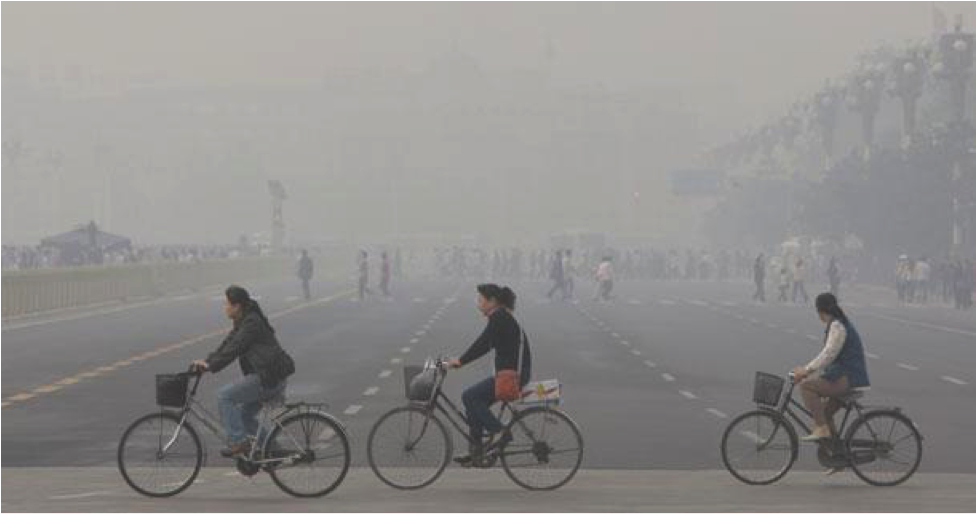
But air pollution in Beijing isn’t just bad, it’s Ben Hur chariot race epic. And it isn’t just pampered foreigners that care about the air, as a burst of Chinese outrage demonstrated last year. Despite a certain amount of desensitization, the air pollution issue in Beijing encroaches on two of the most sensitive areas of public communication: public health and your kids. For a public health risk communication program, trust and interpretation are critical. And they’re both at the heart of the reaction to @BeijingAir.
Trust is in short supply these days, as we’ve seen from the rumor campaigns, and anything that calls into question the level of trust invested in official government information is likely to be considered sensitive. I’d guess that the biggest thorn in the Ministry of Environmental Protection’s side is not just that the US government is tweeting its own air quality readings, but that its readings appear to be more trusted than MEP’s own. There have been several instances of divergence between the Chinese and US readings, and this is a country where data have a history of being suborned to politics, even in air quality. Every time the US results are conspicuously worse than the Chinese results, it’s a slap in the face.
Interpretation is what enables you to act on data. AQI numbers and “micrograms per cubic meter” are pretty abstract without some kind of framework for interpretation. The Chinese framework (bottom of the first tab) is conspicuously more liberal than the US one. The Chinese “acceptable” limit for micrograms per cubic meter of PM2.5 is up in territory that the US considers “unhealthy.” The Chinese AQI band for “moderately polluted” covers territory that any normal person considers awful. As for the bad days, the less said the better.
People will drive without seatbelts, drink themselves into the gutter and smoke a carton of Zhongnanhai Lights a day, and still get bent about the air quality. But air quality is an imposed risk, and people always react more forcefully to imposed risks than risks of choice. Especially when those risks are imposed on their children and aged parents. (At least air pollution isn’t exotic. You want to have a major crisis? Have an imposed exotic risk like a nuclear power plant disaster or pandemic.) In such situations, a conservative framework seems much more appropriate, but it is politically more dangerous because you spend more time with the needle in the outrage-generating red zone. It’s telling that although the Chinese government now reports hourly PM2.5 data there is no framework for interpreting it on the page. All you get is raw milligrams-per-cubic meter and an unexplained “limit” of .075 mg/m3 in the fine print at the bottom. Pretty binary. Meanwhile, @BeijingAir merrily tells you how you should feel about the air from hour to hour, using unfortunate words like “hazardous” when things get thick. And let us not forget the infamous and murky “crazy bad” episode.
Given that @BeijingAir is apparently both more trusted and painting a darker picture of the situation in Beijing, it seems likely that it will continue being a sore spot with the Chinese government. Maybe this is the real reason Twitter was blocked, although the rise of dozens of Chinese smartphone applications that relay proxied versions of the Twitter feed has rendered the block moot as far as @BeijingAir goes.
As for me, if I could pick one thing to change in Beijing, I’d fix the air quality. Beijing on a clear day is a genuinely nice city. The colors pop, the parks look beautiful and you can see a huge stretch of the mountains from my office. Also, I long ago gave up the martial arts for running, which I find similarly meditative and a lot less bruising. When I get up at 6AM the first thing I do is check the Chinese Android appthat relays the latest @BeijingAir information to my phone in a very easy-to-interpret graphical format (it has a handy homescreen widget, too!). The information has to be hourly, and it has to be accurate. I have very strict rules: If AQI is below 100, I run. If it’s between 100 and 150 it depends on how long my planned run is and how long since my last run (the less running I have been able to do and the shorter my planned run, the more liberal I am). If it’s above 150, I go to the gym and lift weights instead.
I go to the gym a lot more than I used to, and I run a lot less. This sucks for my running and peace of mind, but on the bright side, check out the shoulders on me.
Another moderate day!
*OK, I was never really “lithe.”
Note: Originally published on the defunct group blog Rectified.name.
A couple of weeks ago I gave a talk about PR in China to a journalism class at Beijing Foreign Studies University. In any student talk the Q&A is always the most fun, and this group was no exception. Among the many good questions asked was whether it was easier to do PR in China because, as I had discussed in my talk, the Chinese media is generally cozier with businesses than their Western counterparts.
Easier to get stories? Yes. Easier to achieve meaningful results with the public? No.
I was reminded of this question by the recent expulsion of hard-charging Al Jazeera English correspondent Melissa Chan, and subsequent closure of the AJE bureau in China after the Ministry of Foreign Affairs refused to accredit another AJE journalist. I didn’t know Melissa well, though I had met her, but I respected her reporting and willingness to insert herself into uncomfortable situations, and I was disappointed to see her go. Reporting on China will be impoverished a bit.
That, of course, was the point. The Chinese government has never been comfortable with an adversarial media, and Melissa’s reporting was, like that of much of the foreign press corps, pretty adversarial from their point of view. This discomfort is deeper than cursory annoyance at embarrassing foreign gadflies (although I presume that is part of it). It arises from one of the fundamental philosophies of Leninist political parties: the media are considered Party organs and, as with other Party organs, expected to serve the interests of the Party first and foremost. Media that don’t fit into that model are suspect by definition. You can see this philosophy expressed in the mechanisms of control that the Chinese government maintains over all domestic media, and in the government’s struggles to come to terms with the rise of social media that resist conformity with established power structures.
The Party’s model is rather different from the fundamental philosophy of Western media: that it should be the fourth estate, entrusted with challenging the business and government establishment in the interest of the people. You are welcome to argue about how effective Western media have been in this role in recent years, and there are plenty of exceptions, but as a founding principle the idea of the fourth estate is alive and well and inextricably bound up with our Western ideas of what the media should be (and with the value judgments we render on media that doesn’t conform to that principle). A functional, adversarial media is a necessary component of Western-style liberal democracy, unless you have total faith in politicians and institutions.
I am not going to comment further on the specifics of the Al Jazeera situation (some links to good articles below), but in light of the Chinese government’s recent struggle with rumors and trust issues, it’s worth reflecting on why an adversarial media is sometimes useful, even to the establishment. This is what I discussed with the students at Beiwai.
As a news junkie who still pays for several subscriptions, I’m most definitely a fan of adversarial media model (you could also call it an “independent media” model, but independence is only valuable in that enables an adversarial position). There is nothing like a fantastic piece of investigative reporting that rips the lid off of some secret or scandal or that illuminates the dark corners of business or politics. As long as it’s not my dark corner, that is.*
As a PR practitioner with a company reputation to defend, I’ve experienced firsthand the adversarial media model’s short-term ability to create sleepless nights and great puddles of cubicle sweat. But nevertheless, I still appreciate its value in the long-term. That’s because people are more likely to trust media that challenges me than one they know to be compliant with me, and I need media that the public trusts to get my message out, whether that message is a corporate one, a product review or whatever. If I have to do more work to get coverage in that kind of media, and tolerate some negative coverage as well, so be it.
In China, on average, relationships between businesses and the media tend to be closer and less adversarial than in the west. There is also a range of ethical problems, including poor separation of advertising and editorial, the “transportation claim” subsidy-in-disguise, and more. Together, these make it easier for companies to earn –or buy– good coverage in local media than it would be in many other markets. But they also mean that the public is relatively more skeptical of much of the coverage and turns to alternative voices for much of its information and insight, many of them on microblogs . The result is a devalued media that makes even our best earned coverage less useful and influential, and that makes it harder for me to manage misinformation and rumors about my company.
Sound familiar?
These are generalizations. There are excellent journalists and excellent media in China, and crappy ones in the west. But the overall gap in trust is real. The real sign of progress here will not be in the government showing more tolerance for confrontational Western media, but in its tolerating the emergence of a fully independent, professionalized and adversarial Chinese media. That change, when it happens, will be driven by Chinese journalists. In some ways, it’s already happening.
For those of us in the establishment, there is value in learning to deal with an adversarial media, and in being good at telling our stories and getting our messages across in media that are willing to challenge us, and that therefore lend credibility to the claims that survive their scrutiny. But if you’ve never had to deal with that kind of media, you haven’t developed the skills necessary to do so, and you rely on a tradition of control and management to get your message across, then you are in the realm of propaganda and will face the consequences in terms of diminished trust.
And if your situation is so precarious that there is no way to tell a positive story when engaging with adversarial media? Well, then, your problems are much bigger and deeper than PR skills. Or one uppity journalist.
* Just kidding. Naturally, I have no actual dark corners.
Apologies are an under-appreciated art. Most apologies crafted in the name of public relations sound intrinsically weaselly, often because the people making them are preoccupied with saving their prior reputation rather than getting past the mistake and rebuilding trust. I was reminded of this when I read Mike Daisey’sstatement following L’affaire Daisey, which I reckon I don’t need to further explain to this audience. (If you’ve just emerged from decades frozen in an ice cave, clickhere. Also, get a haircut. Styles have changed.)
Here is what Mr. Daisey wrote:
I apologized in this week’s episode to anyone who felt betrayed.
Did you see it? If not, I’ll explain in a moment.
Before I do, I should be clear: I’m not interested in a broader critique of Mr. Daisey’s work. That’s been done in so many other places that I’m too lazy to even go gather the links. Plus, I know it’s a rough gig in the performance artists. In 1974 Chris Burden crucified himself to a Volkswagen Beetle and had it driven around. So you can’t really have the same expectations of these people that you would of, say, your standard airline executive (much as you might want to crucify airline executives to moving vehicles).
But still, there it is, “…anyone who felt betrayed.” In four words, the two great sins of public apologies.
The first is the passive language. Now, I have no problems at all with passive voice in writing (or with starting sentences with conjunctions, or parentheticals, or many other things they told you were bad in your high school comp class). But that passive language is such a trope of public apologies that we pretty much take it for granted these days. It’s so common that Wikipedia has an entry on it. Vanity Fair, also citing Wikipedia, has a small collection of examples. ”We apologize if anyone was offended,” was even trotted out recently by Ben and Jerry’s Ice Cream in response to the (silly) Linsanity flavor scandal.
The second (and I must thank my partner in crime, Brendan O’Kane for this) is the use of the word “felt.” The passive voice subtly shunts responsibility onto the victim. The use of “felt” suggests that problem itself doesn’t even exist, and is merely some kind of unfortunate vapor or misunderstanding. You felt betrayed, but I didn’t actually betray you.
Lawyers may like apologies that don’t include a categorical admission of responsibility, but from a public communication point of view they come off as pro-forma, passive-aggressive dissembling that shifts at least some of the blame onto the injured parties. You can see how this works by replacing the standard corporate, public-conduct or ethno-gender-religious sensitivity malfeasance that people are usually apologizing for with something more heinous. I like to use a steamroller homicide, for no other reason than I appreciate the image of a maniac rampaging through town with a steamroller. Plus, as far as I know, no one has ever actually been murdered with a steamroller, so we should be safely in the land of the hypothetical (although the Internet will probably prove me wrong*).
So imagine you’re a contrite steamroller maniac attempting to rebuild your reputation. What do you say?
“I apologize for running over those people with a steamroller.”
Hell no. That’s way too direct and honest. It could be mistaken for assumption of responsibility, which might let the healing begin. We can’t have that.
Try this on instead:
“I apologize if anyone was run over by a steamroller.”
Do you see how this small change embeds whole new levels of denial and distance into that short statement? Seriously, how dumb were those people to get run over by a steamroller? The freaking thing only moves two miles an hour! I mean, head on a swivel, grandpa, this is the big city!!! But, you, know, sorry and all.
Or, even better,
“I apologize if anyone felt killed by a steamroller.”
Because they might not actually be dead. They might just feel that way. By mistake.
What the heck, let’s go for broke and dispense with the apology altogether. Some light regret is enough for the masses:
“I regret that due to this unfortunate situation anyone felt killed by a steamroller.”
Better yet, let’s disembody the regret, so we’re not sure who’s actually doing the regretting. Could be your auntie doing the regretting. You don’t have anything to regret. You’re not a culpable steamroller maniac leaving a twelve-foot-wide trail of blood and flattened personal accessories behind you. You’re just misunderstood:
“It is regrettable if, due to this unfortunate situation, anyone felt deprived of life by a steamroller.”
Now that…that is PR gold. A non apology for the ages. I almost weep reading it back.
I’m ridiculously late to this, as usual, but people keep asking me about the Burson-Facebook thing because of my years at Burson, so I thought I’d post the gist of the response I’ve been giving. If you’re not familiar with the story of Burson’s ill-fated project stirring up FUD about Google on behalf of Facebook, you can read about it here.
But first, some housekeeping. I worked for Burson-Marsteller for six years, all here in China. It was a great experience. Much of what I know about PR and virtually all of what I know about doing PR in China I learned at Burson. I still use Burson-Marsteller China as an agency, and hold the people there in the highest regard. All agencies make mistakes. No one in PR wants to damage the reputation of a client, or their own agency. When it happens, we try to learn from it.
I don’t know what the chain of events involved in the Burson-Facebook project was, and I don’t know any of the people involved. I have no inside track. But as an industry observer, and in the spirit of learning from the situation, here are four lessons to take from this episode:
If it will embarrass you to have a pitch go public, it’s a bad pitch
The art of selling stories or viewpoints to journalists, bloggers or the public is a pitch. In writing or verbally, a pitch should stand alone as something you’d be comfortable going public on its own. If a pitch doesn’t pass that test, and its public release would embarrass you, your agency or your client, it’s a bad pitch. Any pitch that doesn’t identify the interest behind it is by definition a bad pitch, because lack of disclosure in a pitch suggests that someone would be embarrassed to be connected with it. Rethink the strategy. Yes, this tars a whole branch of political PR based on anonymous leaks. So be it.
There’s nothing wrong with criticizing a rival…transparently
It’s silly to pretend that slamming competitors isn’t part of PR. In the industry it’s called “depositioning”, a sanitized word that suggests some lingering discomfort. Outside it might be called smearing or, for those in the tech industry, FUD (fear, uncertainty and doubt). So what’s the difference between a smear and a legit piece of competitive PR? Transparency, for one thing. There is nothing wrong with criticizing a rival (or a client’s rival) or pointing journalists at their shortcomings. But you’d better be prepared to stand behind your claims, and that means being well researched and transparent.
PR instincts and journalism instincts are not the same
PR agencies hire a lot of ex-journalists for their story instincts and their usefulness in media relations due to their contacts and credibility with other journalists (more on this below). But the fit isn’t always natural. Someone senior from a global agency other than Burson told me recently that they have about a ten percent long-term stick-rate from their senior journalist hires in the US. I’m not surprised.
One problem is that although they overlap, journalist instincts and PR instincts are not the same. Oversimplified, journalistic instincts emphasize spotting and piecing together stories while PR instincts often emphasize identifying and managing risks. We spend as many years and as much work developing our instincts as journalists spend developing theirs. Any crossover in either direction means a learning curve. The risk that should have been spotted in this particular case was that the backstory of the pitch –an anonymous client paying a major PR firm to slam Google on privacy– was more interesting than the pitch itself.
Set a thief to catch a thief
Despite the blurring of the line between mainstream media and blogging, journalists and bloggers are different. If you send a bad pitch to a mainstream journalist, generally it just dies (perhaps along with some of your credibility). If you send a bad pitch to a blogger, there’s every chance it’s going to published and ridiculed. Welcome to blogging. This isn’t 2003, and everyone should be up on this. I understand hiring mainstream journalists to pitch other mainstream journalists, but it seems to me that the PR industry has been slow to embrace using bloggers the same way. As a blogging PR person I don’t think bloggers are particularly more resistant to working in PR, but I definitely think they respond to PR differently than mainstream journalists. And that’s definitely true for tech bloggers.
Reports have been percolating for a couple of weeks that Facebook will partner with Chinese search engine Baidu to launch Facebook China, or something similar. Anyone who has followed the history of foreign Internet firms in China knows that this is fraught territory. Chinese competitors are well established, and while many successful Chinese Internet firms have foreign backing of some kind (even Baidu once claimed Google as an investor), marquee marriages between Chinese and Foreign Internet companies have often been troubled.
There are others better placed than me to speculate on the likely business fortunes of a Facebook China (cf. Epstein, Bishop), but what really interests me are the communication challenge and reputational consequences. Some glimpse of those possible consequences came in a Wall Street Journal article about Facebook’s lobbying efforts that ran yesterday. It included the following:
[Facebook] is talking with potential Chinese partners about entering the huge China market, where the government has been cracking down on dissidents. That crackdown has come in response to the uprisings shaking authoritarian Middle Eastern regimes, movements that have used U.S.-based social-media sites like Facebook and Twitter as organizing tools.
“Maybe we will block content in some countries, but not others,” Adam Conner, a Facebook lobbyist, told the Journal. “We are occasionally held in uncomfortable positions because now we’re allowing too much, maybe, free speech in countries that haven’t experienced it before,” he said.
Yowza! Better work on those talking points and come up with something that doesn’t sound quite so paternalistic. Read as generously as possible, this is one quote from what one presumes was a larger discussion on the issues of running transnational social networks in countries with different approaches to censorship and freedom of speech. Read less generously, it sounds like a lobbyist for Facebook arrogating to his client the responsibility to decide what constitutes an appropriate amount of free speech in any given country. Risky territory.
From a business point of view deciding an appropriate amount of free speech might be a practical necessity. From a public communication point of view it’s dangerous. Five years ago, when Facebook was still a plucky upstart too trivial to be noticed, Yahoo, Google, Cisco and Microsoft were hauled in front of a congressional hearing to testify on their activities in China and their willingness to accommodate governments with illiberal approaches to free speech. It was not a banner moment for the American Internet industry. “Moral pygmies!” declared Tom Lantos, the principal congressional antagonist. Much of the cast has changed and Tom Lantos has since died, but the issue remains sensitive. (Not all the cast has changed. Facebook’s current head of communication, Elliott Schrage, represented Google in the 2007 hearings.)
Facebook itself has not committed publicly to anything in China. They also haven’t yet committed any of the blunders that those four firms did (most notoriously Yahoo, with the Shi Tao affair). Finally, Facebook hasn’t made nobility a part of their brand in the way that Google conspicuously did in its early days, something that was used against Google in its China engagement. In fact, if anything Facebook is known for a kind of calculating amorality that may be useful in the ruthlessly sharp-elbowed Chinese Internet world.
But what’s important here is not how Facebook sees itself, but rather how people at large see it, and how activists and politicians think they can use it to drive their own agendas. Whether Facebook likes it or not, it has been publicly associated with recent events in the Middle East and is widely seen as a force for enabling dissidents and protestors whose causes resonate with western publics and politicians. See for example New York Timesstories here, here and here. Evgeny Morozov and Malcolm Gladwell might ridicule the notion of social media as democracy tools, but that won’t necessarily dispel a belief that was made clear in the 2007 hearings: American Internet firms should represent American values.
Companies’ decisions about China are revealing. Facebook’s decision on whether or not to formally enter China will be especially interesting. It will establish something fundamental about the identity of one of the two most powerful Internet companies on the planet. Is Facebook, as some have supposed, the great enabler of democracy? Or is it a company of business pragmatists willing to censor (or delegate censorship) in order to open a potentially lucrative market? The reality is probably more nuanced than either of those positions, but as far as public perception goes it will be difficult to have it both ways. How does one balance groups of stakeholders with completely incompatible views on what constitutes a responsible and conscientious Internet firm?
The nut of the problem is that, right or wrong, democracy activists, American politicians and the Chinese authorities all tend to see American Internet firms as standard bearers for western values. Facebook’s task is to convince the Chinese authorities otherwise while not making activists or western users in general feel betrayed. I can think of few more precarious communication challenges. The quote above is an unpromising start.
Update:
Obama hosted a town hall at Facebook HQ yesterday. Interesting. And likely to be noticed here in Beijing.
Apropos of today’s escalation of the Fukushima reactor disaster to “7″ (Chernobyl) on the international scale, there is something about the word “radiation” that bypasses rationality and whispers right to the lizard brain. Perhaps one or two other words have the same power to spook. “Pandemic” comes to mind. But that aside, there is little else I that has quite the same potency as “radiation.” Almost all the connotations are negative: Contamination; the atom bomb; fallout; nuclear waste disposal; dirty bombs; Godzilla; the ugly, yellow trefoil symbol. Even radiation’s positive connotations are negative. Nuclear medicine might save you…if you have cancer! And the New York Times has spent the past year running a series of stories about nuclear medicine gone horribly wrong. Radiation? Duck and cover.*
All this would seem to make any public communication about radiation hazards tricky. I can’t, however, speak from experience. Perhaps fortunately, Imagethief has never been called upon to participate in crisis communications involving radiation. Or nerve gas leaks or alien invasion or anything with quite the same pilo-erective zing. I’ve done food problems a couple of times. Also, years ago I helped an insurance industry association roll out a chain of inspection centers for mandatory post-collision inspections, which may actually be the closest I have ever come to being between a client and a torch-bearing mob. In terms of public sentiment, insurance and radiation aren’t actually all that different.
The challenge in a public safety communication situation is to find that delicate line between keeping people well informed and prepared for the worst, and going overboard and triggering a destructive panic. This isn’t a trivial thing. To get an idea of how easy it is for hysteria to blossom in the right circumstances, recall that at the height of the Japan nuclear issue there was a run on table salt (rumored to prevent radiation sickness) in Beijing, 2000 kilometers upwind of the Fukushima reactors.
What’s the worst that could happen?
The natural tendency in crisis communications is to undershoot and be tight-lipped. This happens for all kinds of reasons, of which avoidance of panic is perhaps the only noble one. The others include optimism or wishful thinking that the worst is over, poor communication planning, bad communication culture, and the general tendency to choose ass-coverage over ‘fessing up for any number of legal, reputational and personal reasons.
The problem with undershooting communication in an escalating crisis is that you wind up making a series of hopeful the-worst-is-over pronouncements, each of which is rapidly obliterated by events. TEPCO is a case study of this syndrome. So is BP from last year. Both companies wound up in a kind of reverse-Chicken-Little situation, where public trust evaporated and no one believed them anymore. In both situations, government wrested much of the public communication responsibility away. Getting publicly ejected from the drivers’ seat is not good for credibility.
If you were forced to choose between timidity and risk of panic, you might choose timidity as the lesser of two evils. But in public safety situations the rumors and misinformation that can drive hysteria are likely to thrive in the vacuum created by poor communication or lack of trust. The Beijing salt-run is illustrative. Ask yourself: strictly hypothetically speaking, how conducive would it be to public order to have an escalating radiation crisis being managed by an organization that no one believes?
This is the situation that TEPCO appears to have found itself in. A good analysis of their situation from a communication point of view can be found in PR trade The Holmes Report. Paul Holmes introduces consultant Peter Sandman’s useful “hazard vs. outrage” model of risk communication. Hazard is the actual danger to people. Outrage is the emotional reaction provoked. Varying ratios of hazard and outrage inform communication strategies in risk situations. The irony for TEPCO is that the actual hazard has to this point been pretty low. But the outrage factor is, if you’ll pardon the pun, nuclear. Holmes lists some of the key factors driving that outrage:
Coerced risk causes more outrage than voluntary risk, and the majority of people living close to nuclear plants did not volunteer to be exposed to the risk;
Industrial risk causes more outrage than natural risk, and nuclear is pretty obviously industrial;
Exotic risk causes more outrage than familiar risk, and most people are far less familiar with nuclear power than they are with oil and gas;
Memorable risk causes more outrage than unmemorable risk, and nuclear incidents—Three Mile Island, Chernobyl—are extremely memorable;
Dreaded risk causes more outrage than undreaded risk, and activist groups have been successful in creating and nurturing nuclear dread;
Catastrophic risk causes more outrage than chronic risk, which may be the biggest challenge, since nuclear incidents tend to be catastrophic, while fossil fuels do their damage primarily by creating chronic illnesses and environmental problems;
Risk controlled by others causes more outrage than risk controlled by individuals (which is why people fear air travel more than car travel), and nuclear power is completely beyond an individual’s control.
A longer and very interesting analysis of the Fukushima situation by Mr. Sandman himself can be found on his website. Mr. Sandman’s conclusion with regard to crisis communication is: Always err on the alarming side, until you are absolutely 100% certain the situation cannot get any worse. Else risk your credibility and thus your ability to respond. Communications professionals would also do well to read security expert Bruce Schneier’s writings about how people evaluate and respond to risks, which dovetails with many of Mr. Sandman’s points. I recommend Schneier’s book, Beyond Fear. It’s a few years old, but still relevant.
In TEPCO’s defense, the playbook for nuclear catastrophe communication in the midst of a general natural disaster is pretty thin. There are exactly zero precedents. Even absent the natural disaster component, there have been only three previous reactor accidents of any scope: Windscale, Three Mile Island and Chernobyl. Only Three Mile Island is really analogous to Fukushima, but the communication there was also blown, as Mr. Sandman points out. But it shouldn’t really matter whether there is a precedent or not. Nuclear power, which has always had a bigger outrage than hazard problem, really deserves over-preparation.
In his book The Big Short author Michael Lewis proposes that the people who made fortunes betting on the collapse of the American housing bubble shared the iconoclastic traits of both being able to envision the worst happening (the bubble collapsing) and, in the face of social pressure, to act on that vision. It struck me upon reading that book that being able to envision the worst happening and preparing for such an outcome is a really valuable skill for communications professionals. To come back to Chicken Little, it’s not that a PR person should run around screaming that the sky is falling, but a PR person –and indeed any member of a company’s crisis management team– should be able to pose the question, what would we do if the sky fell?
Even if –and this is important– even if others in the organization suggest that such a thing is unthinkable. After all, just because something is unthinkable doesn’t mean it won’t happen.
In part two: What the hell is an “apocalypse box” anyway?
Note:
*If you haven’t seen the “Bert the Turtle” public service announcement on how to survive an atomic attack, it’s well worth watching. A surreal mix of 1950′s cold war terror and sunny “you can survive” optimism with a Ward Cleaver voice-over that must be somewhere in Billy West’s stack of reference material. “It’s such a big explosion that it can…break windows all over town.” Indeed. It’s a YouTube link, so get your VPN ready. If it’s working.
Unless you live on Pluto and you’re just in town for the temple fairs you probably know the situation with Groupon and their notorious Tibet ad. From within the China echo chamber it can be tricky to calibrate your reaction to this kind of thing. Those of us who live here are prone to flinch at things that people living in America don’t give a damn about. But we often learn that flinch reaction the hard way, over years of doing business in China and wrestling the occasional PR crisis.
Groupon, it turns out, is trying to build a business in China. Their well-established irreverent sense of humor aside, you’d think they’d thus have some radar for the things that are likely to get them in trouble here. Media 101: In 2011, all media is global media. Culture 101: What plays in Chicago (where Groupon is from) may not play in Changchun, as it were. Think Tommy Lee Jones in the first Men in Black: “We in the FBI have no sense of humor that we are aware of.” Now replace him in your head with just about any Chinese government bureaucracy, and consider the direct and substantial influence that those bureaucracies have over the fortunes of businesses operating in China. And this doesn’t even get into the reaction of Groupon’s potential customers here. They do have a sense of humor, but not necessarily the same one as customers back home.
I’m not going to get into the details of how screwed Groupon may or may not be in China. For that, read posts from ChinaGeeks, Techrice or Shanghaiist. Suffice to say that most of us who live and work here in China think the Tibet ad increased the risks to any mainland China operation that Groupon launches.
The question that preoccupies me as a China PR man is, where was the PR team in all of this? One of the things I learned in my years at Burson-Marsteller was that a good PR person is one who can, among other things, look at business decisions being made and tell the management what those decisions will mean for the company’s reputation among all the audiences that matter. A good senior PR person will use a team and agencies to extend that ability beyond what any one person can cover, and be able to bring that information back to management at a level that can shape decisions. If a company is just using PR to pitch journalists and grind out press releases, then it is missing a big part of the point of a good PR team.
In the best of all possible worlds, Groupon would have had a senior PR person who was aware of the company’s China plans, was tied into what the marketing group was doing, and was smart enough to spot a risk and bring it to management ahead of time. Message: Run this ad if you want, but it will create real risks in China at exactly the wrong time. Maybe this happened. Maybe the company went ahead anyway, in which case they assumed those risks with their eyes open. Maybe it didn’t happen at all. In the end, they went to market with an ad that has real potential to damage their business ambitions.
The point here is not to change Groupon’s irreverent corporate personality, but to tune that personality so that it stays an asset as they grow into a global company. Startups often grow their businesses and ambitions faster than their PR capabilities. I have personal experience with this from before I was in PR, when I worked as a project manager and operations chief in a fast growing e-commerce company in Singapore in the late nineties. I thought the PR woman’s main contribution was to introduce bureaucracy and slow down things we had to do right now, and I was full of disdain for her and her work. Nothing like ten years on the opposite side of the tracks to broaden your perspective. I’ve often thought I should write her a letter to apologize for the former me. Come to think of it, some of my prior girlfriends could use similar letters. If any of you are reading this, I’m sorry.
I have no idea how Groupon runs its PR. I do know that Venturebeat offered them some pretty sound advice on PR late last year, and an industry blogger critiqued their response to the ads in the US. I also know that in the wake of the Tibet issue, they’ve expanded Fleischman-Hillard’s remit from Hong Kong to mainland China, which is better than nothing but a bit after the fact and in a galaxy far, far away from headquarters. If you’re entertaining multibillion dollar buyout offers from Google, planning a public listing, and hoping to expand your business in China, you’d better put some really strong PR people right at the center of management decision making. And if you’re going to try to build your business in China, you’d better have someone on the ground here in the mainland who knows what the company is up to and who has the phone number of the key decision makers in the US.
If Groupon wasn’t doing it before, now would be a good time to start.
Update: Word on the street (by which I mean Twitter) is that Groupon is also suing this lookalike site in China. Hope they have a China trademark registered.
The milk business in China just can’t seem to stay out of trouble.
A couple of months ago baby formula maker Synutra found itself the victim of allegationsthat its product was linked to early puberty in girls. Its shares ate a big one on the NASDAQ and the company spent much time defending itself furiously. So furiously, in fact, that I was moved to ding them on Twitter for a CEO quote blaming the situation on “certain parties in the media.” Don’t blame the media was the gist of my message.
As true as I still think that is in general, Synutra’s CEO may have had a point. Chinese media reported yesterday (and the China Daily relayed in English today) that executives from giant dairy company Mengniu and one of their PR firms, BossePR, have been detained on suspicion of stoking rumors against both Synutra and Mengniu’s chief rival, Yili. Mengniu is denying the allegations.
Who knows what really happened. As one analyst points out in the China Daily story, baby formula isn’t really a huge part of Mengniu’s business, so why go after Synutra? This is probably true at the board level. I find it hard to believe that the senior management of Mengniu were sitting around the conference table and came up with a plan to slander Synutra. It’s just a touch too Snidely Whiplash for me.
On the other hand, while the baby formula business may only be a small part of Mengniu’s business, I’m sure it’s damned important to whomever manages it at Mengniu (and is, presumably, judged on its success). There are two reasons why the allegations are at least plausible. First, as anyone living here knows, despite its brand images of purity and healthy, angelic children, the milk business in China is capable of complete sordidness. One need only read up on the now legendary melamine scandals of 2008 to be reminded of that. And there is more where that came from. In our family all the milk comes from one of the expensive organic farms near Beijing. It costs about triple what regular local milk costs, but when it’s your kid you err on the side of less melamine if you have the means. The milk industry in China is like the finance industry in the US now: Trust is so damaged that people are primed to believe the worst of just about any company, and it’s not hard to get the rumors flying.
The second factor is that using PR agencies and Internet firms to run sock-puppet campaigns attacking rivals is a time-honored tactic here. (BusinessWeek has written a bit about this here, although this story lumps some companies I respect together with some I don’t.) I’ve run into it in both the car and consumer electronics industries. It’s not always incendiary child health stuff like the Synutra allegations. Sometimes it’s just garden-variety griping about products. Even that can be extremely difficult to defend against. On the Internet, criticism is forever and anonymous rumors or allegations can take on a life of their own, at warp speed if they’re salacious or involve the health of children. And it’s generally pretty cheap to do, so the temptation to stoop to such tactics can be powerful, especially in a competitive consumer business.
I’m a fan of transparency online. When I was on the agency side my advice to clients was straightforward: Don’t astroturf, don’t sock puppet. The long-term benefits are small and the risks to reputation are high (as may be the legal risks). I expect that most international agencies would give similar advice and that most PR managers, especially at international firms operating in China, would agree. At least to your face.
Nevertheless, when push comes to shove, it seems some companies still take the easy path, and many agencies will do what they need to do to keep a client happy. Also, many large companies use a range of international and local agencies, often reporting to different managers facing different pressures and having different points of view about what constitutes ethical PR. A company without a clear policy or tight management of such things may find that not every department is equally scrupulous in its approach. I wonder if that’s what happened to Mengniu.
Note:
After this post was published I also appeared on Blue Ocean Network’s “Chinalogue” program along with Alistair Nicholas of AC Capital Consulting [Note – now of Weber Shandwick – WM] to discuss…PR slime! By which the producers of the show meant the recent Mengniu vs. Yili vs. Synutra PR sockpuppet slagfest. The heavy-breathing title of the segment aside, most of the show was a fairly sober discussion of PR ethics in general. The video is here.