Should Google have been in China? Did they make the right move in pulling out? Will this influence the Chinese government? What does it mean for foreign businesses in China? Are they evil or not? Who knows? Not me. And none of these questions are going to be answered in this post.
But stick with me, because that’s the point. The fact is that everyone and their goldfish has an opinion on Google’s fortunes in China, but few people actually know anything conclusive, so what we’re getting is a huge dose of punditry, analysis and opinioneering. This is the kind of thing that PR people live for, because what we’re witnessing first hand is the creation of a narrative. Or, rather, several narratives that serve different worldviews, audiences and points of view.
This is PR in action: The effort to influence perception and opinion with regard to an entity or event, generally with the objective of supporting some kind of end-state result (higher sales, a political victory, popular consensus, the launch of a war, etc.).
PR people are often accused of being liars. This is a shame, because a good PR person doesn’t lie or make up facts. I’d like to tell you this is because PR people are noble souls who want only the best for the planet and fuzzy puppies, but the real reason is that lying makes you vulnerable and doesn’t usually work very well (and, yes, it’s also wrong). Lies can often be proved false, and this can cause your position to unravel pretty quickly, often with devastating consequences. Even if you string the lie out long enough to achieve a stated objective, you’ll take damage on the backside if your story comes apart. See, for example, weapons of mass destruction and the Iraq war, which claimed the reputations and legacies of many people.
But PR people do often try to interpret the facts (or obscure them) in specific in selective ways. In the vernacular, we spin things. In fact, the very term “spin doctor” (sometimes credited to the novelist, Saul Bellow) refers to trying to define the interpretation of events or facts — to determine which way they “spin” in the public sphere.
PR people do this for a living. But we’re not the only ones who do it. Anyone with an agenda tries to interpret facts to create a narrative that serves that agenda, or that serves their world view. Often, dueling parties compete to establish the defining narrative of a situation or event. Consider how Democrats and Republicans competed to establish the narrative for health care reform in the interest of divergent political objectives. The media and public spheres of discussion are thus, often, noisy and squawky collections of competing narratives interpreted or distorted from the same basic set of facts in order to serve different agendas. Sometimes it takes a long time for a “definitive” narrative to emerge. Sometimes a definitive narrative never emerges, or different audiences arrive at divergent narratives because they’re exposed to different influences (anyone who looks at how Chinese and Western audiences fail to see eye-to-eye on many issues will be familiar with this).
This is essentially what has been happening with Google over the past few weeks, as people have competed to establish different narratives regarding its withdrawal from China. There has been a huge amount written and said about Google’s predicament and options in both the Chinese and Western media and blogospheres. At last count I had 27 articles bookmarked since the announcement that Google would shift it’s Chinese search operation to Hong Kong. And there were plenty that I didn’t bother to bookmark.
Well, that’s just too much damned stuff to analyze, and I am way too lazy to pore through it with a notebook and try to draw any meaningful conclusions about what it all means (hey, I don’t get paid for this). Also, my overwhelming impression is that there is so far roughly zero consensus on what it all means.
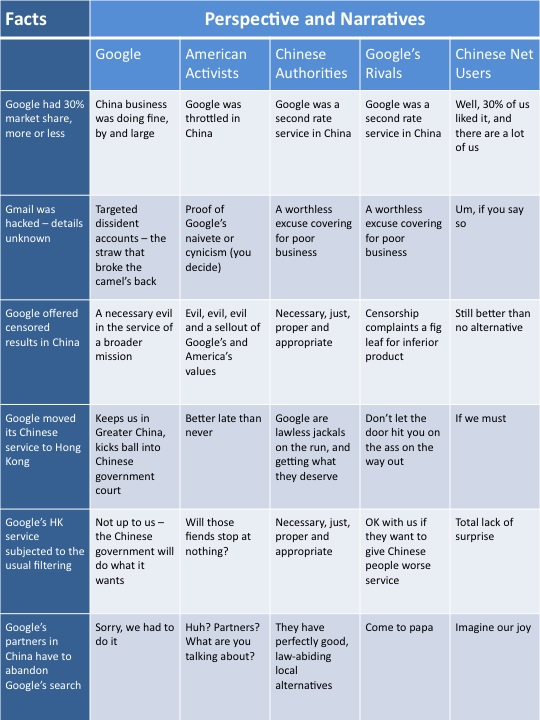
What I did do, however, was to put together a handy chart that shows the key known facts, and, based upon all the articles I’ve read, how each of the major interest groups that I observe is spinning or reacting to each of those facts. In each case, the vertical thread through the series of facts creates the skeleton of a narrative. And that’s what each of these parties –Google, its rivals, the Chinese government, the Western activist community– is trying to do: They’re each trying to control and define the narrative of Google’s situation in China to serve their own agendas. They are, in other words spinning. Here is what the result looks like:
I realize this is a vast oversimplification and there are no doubt various interests omitted, but this captures most of the main parties and facts. What’s not included here is any kind of conclusion of each narrative. In my opinion, the story is still unfolding and its too early for that. But we’ll see how things go over the next few weeks.
The other thing is that these narratives aren’t in equal competition. To use a possibly inappropriate military metaphor, there are different theaters of operation in which the stakeholder have varying levels of influence. So, in the US, Google and the activist (and analyst) community are the loudest voices. in China, the Chinese government has the tools to define the public narrative, and has been using them liberally, although there is some ferment in the margins (also here).
Eventually, there will be a canonical version of Google’s misadventures in China. or at least one canonical version in the West and one in China. These may not be the creation of a single group. One group might control interpretation of one element of the story, and one group control another. But for the moment, the fun is in watching the battle to own the story. Enjoy it while it lasts.
Finally, from a PR perspective, there is possibly one overarching lesson that can be drawn from this whole situation. I can’t take credit for this insight, it comes from Craig Adams, a colleague of mine. But it’s deceptively straightforward and I agree with it wholeheartedly. He said that if you have to sell out your basic principles to do business in China, that’s a pretty good sign you should reconsider your plans.
Other sources (just to prove I’ve done my homework):
Let’s say you’re a company selling some kind of product. Let’s say your product is –let’s just pick something at random here– laptop computers. Globally, this is a heavily commoditized category jammed with companies selling look-alike products with similar feature sets. In China, which has the usual big-time suspects plus a whole cloud of local also-rans, the situation is even more competitive. How do you stand out? How do you persuade students, young professionals and other consumers to buy your laptop, and not some brand-x laptop poseur laptop?
Well, in China the answer is often, “be cheapest!” But that’s not always the whole story. Often there is also some PR.
To that end, one thing you would often do is try to get your product into the hands of “influencers”, people who have the power to help lead public opinion in your target market, ideally in your favor. One way to approach this is the celebrity endorsement: I’ll send a cubic meter of 100RMB notes to your house if you wave my company’s product around, appear in some ads and show up at some of my events. And, hey, why not write a blog about it? This is generally legit and practiced everywhere. George Clooney and Omega watches, for instance, except he probably doesn’t get paid in RMB.
There is also the schwag approach, in which you give your product away to rich, famous and stylish types in the hope that they’ll be seen using it thus conferring glamor and sexiness upon it, hopefully without you having to write a colossal sponsorship check. This is why you hear about things like the absurd gift baskets at the Academy Awards. This also leads to the great commercial irony that rich people get more stuff for free than more deserving types, such as impoverished PR bloggers, and will no doubt be a contributing factor in the revolution when it finally comes.
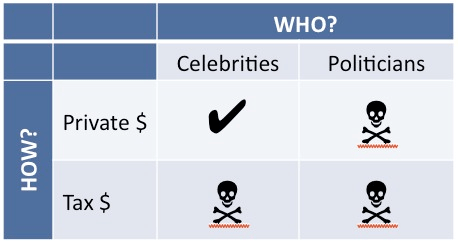
There are, however, some generally accepted rules about the schwag game. Two of those rules, involving who it’s OK to target and how schwag can be paid for, can be summed up in a diagram that looks like this:
By participating in a program to give free laptop computers to 2000 delegates to the Chinese People’s Political Consultative Congress (CPPCC), Lenovo appears to have landed squarely in the lower-right, or what I like to call the “PR deathtrap” quadrant. The CPPCC is a political body that nominally advises on and suggests policy and which convened this week in Beijing as part of the annual political “two meetings” festivities. The other meeting is that of National People’s Congress, which has the slightly heavier responsibility of endorsing actual policy (a cynic might say, “rubber stamping”, although the NPC has pushed back from time to time).
As China’s annual National People’s Congress opened yesterday, many news headlines pounced on Premier Wen Jiabao’s remarks toward the end of his NPC report (see tab 11), in a section on anti-corruption, about the need for leaders to report their personal assets. But in the margins, commentators railed against shady practices nearer at hand — more than 2,000 laptop computers given away to delegates at the public’s expense.
The laptop story bubbled up out of China’s social media sphere back on March 2, when Chinese Internet users noted an odd mini blog entry from Zhang Xiaomei (张晓梅), a delegate to the Chinese People’s Political Consultative Conference who is also the publisher of Beauty Fashion magazine.
Zhang’s entries were succinct, mostly mundane summaries of preparations and speeches ahead of the two meetings.
CPPCC Chairman Tao says: being a national delegate to the CPPCC is a glorious mission, and a post for political participation and discussion. Sichuan party secretary Liu Qibao (刘奇葆) says: last year was the toughest year, this year is the most complex.
But in one entry she wrote: “When delegates report [to the meeting] they each get a laptop computer. What is different from last year is that this year these don’t need to be returned after we’re done with them. This is much more practical.”
Yeah, it sure is, isnt it? Keeping stuff often is.
As China Media Project explains, the response both online and in mainstream media has been pretty negative, with accusations of corruption and speculation about the amount of tax dollars spent on the computers. It has also been pointed out that Lenovo executives account for a large share of the IT industry representation at the CPPCC.
So here is where it gets interesting, and perhaps where Lenovo put a foot wrong assuming they played some role in creating this program and weren’t just lucky beneficiaries. CPPCC delegates occupy a strange space in between celebrity and politician. Many of the delegates, such as Ms. Zhang, are in fact celebrities or notables from the business world. Most are not politicians or officials in their daily lives. As the Financial Times noted this week, the entire CPPCC is a bit theatrical, and its actual contribution to the legislative process is debatable at best. In previous years delegates had been loaned computers, so why not let them hold onto them this year? A relatively small change in the grand scheme of things.
But regardless of what you think about the CPPCC or the actual power of its delegates, in the context of the “two meetings” the delegates are acting as politicians. In an era when Chinese people are increasingly sensitized to corruption and willing to discuss it online and hold officials to account, giving laptops to 2,000 wealthy people operating in a political role looks risky at best. Perhaps in some years it doesn’t become a big deal, but this year it rubbed people the wrong way. It probably would have been best to stick to the loaner approach, even at the risk of some slightly inconvenienced delegates.
From Imagethief’s point of view the good news is that this issue became, well, an issue. That it escalated online and in the media is a headache for Lenovo and perhaps an embarrassment for some of the delegates (although that may be optimistic), but it’s a good thing for accountability and for China. The CPPCC may be largely symbolic, but at least it could be relatively clean and symbolic.
So what should Lenovo do? This situation is a long way from being out of control, so what they probably will do is hunker down and wait for the government to decide that discussion of this issue is no longer appropriate and then enjoy the ensuing silence. A more progressive option would be to announce that in subsequent years they’ll return to a policy of loaning delegates computers rather than giving them away. Better yet would be to cancel the whole thing and make delegates self sufficient for computing in future. I’m sure most CPPCC delegates –even the ethnic minority delegates– can afford a computer.
Or how about this: It’s awkward to inform delegates that, sorry, contrary to what they were originally told they do have to return the machines. But Lenovo could ask delegates who don’t need the computers after the meetings to voluntarily return them, and then publicly donate the returned machines to some worthy cause. Rural schools? Barefoot doctors? Impoverished bloggers? You name it. Plenty of options.
Note: Some in-situ links removed from the paragraphs quoted from China Media Project. It’s worth visiting their original post.
Disclosure: I do not work on any laptop computer accounts, however my agency does represent a competitor to Lenovo. The views expressed here are my own.
Update: David Bandurski of China Media Project left a comment in the original version of this post noting that, as of writing, criticism in the media was not directed at Lenovo specifically. At least, not yet.
Yes, it’s true. Those Chinese death-nerds are everywhere. They’re in your bank account. They’re in the Pentagon. They’re sending naked pictures of themselves to your daughter. And they’re completely invulnerable to all known countermeasures!
Or at least that’s the terrifying conclusion one might draw if one was to read a long article from the Washington Times with the chilling headline, “China blocks US from cyber warfare.” Now, the Washington Times and this journalist in particular have–how shall I put it?–a distinct point of view on China, and it’s perhaps just a tad darker than my own. But I find this story interesting less on its own (thin) merits and more because it represents the latest installment in what seems to be something of a fad in hair-raising stories on the Chinese cyber-security threat. My heavens, are we having a meme?
You may recall that this idea began rolling in its most recent incarnation with a report about Ghost Net, in which the link to the Chinese government was unclear but widely assumed. It gathered steam with a rather vague Wall Street Journal article about Chinese “spies” hacking into the US electricity grid. With this Washington Times article, which has been picked up by AFP and thus relayed to Yahoo and other portals, it’s reached something of a loony crescendo. You’d think bureaucracies in Washington were competing over turf and budgets and thus doing their best to dial up the general anxiety level in order to exert political leverage. Because, you know, what with the economy, two wars, the Taliban destabilizing Pakistan and Swine A/H1N1 flu we so desperately need one more thing to be afraid of.
The Washington Times article really is in a class all by itself, though. It focuses on the devastating implications of a “hardened” Chinese operating system that, to read this article, makes Chinese government computers essentially hack-proof. It is based largely on the testimony (PDF) of Mr. Kevin Coleman, one of nine witnesses speaking before the US-China Economic and Security Review Commission on April 30th. (The USCC makes periodic recommendations to congress on the national security implications of trade with China.) There is no one part of the article can single out for an excerpt, so I’ll instead give you a rundown of the highlights. The article features:
An IT security consultant (Mr. Coleman) who “advises the government on cybersecurity” telling us that the Chinese are outplaying us badly. Because what do you expect him to say? “It’s all good. I’m done here.”
Terrifying absolutes, such as this quote on the effect of China “hardening” it’s servers with this new operating system:
“This action also made our offensive cybercapabilities ineffective against them, given the cyberweapons were designed to be used against Linux, UNIX and Windows,” he said.
The suggestion that the revelation of this operating system is somehow an intelligence coup, on par with the cracking of Enigma:
The secure operating system was disclosed as computer hackers in China – some of them sponsored by the communist government and military – are engaged in aggressive attacks against the United States, said officials and experts who disclosed new details of what was described as a growing war in cyberspace.
Further vague but terrifying details designed to emphasize our inferiority:
Additionally, Mr. Coleman said, the Chinese have developed a secure microprocessor that, unlike U.S.-made chips, is known to be hardened against external access by a hacker or automated malicious software. “If you add a hardened microchip and a hardened operating system, that makes a really good solid platform for defending infrastructure [from external attack],” Mr. Coleman said.
Hopeless over-generalizations of dubious technical soundness:
U.S. operating system software, including Microsoft, used open-source and offshore code that makes it less secure and vulnerable to software “trap doors” that could allow access in wartime, he explained.
Quotable quotes:
“What’s so interesting from a strategic standpoint is that in the cyberarena, China is playing chess while we’re playing checkers,” he said.
The devastating revelation that the Chinese government is hiring hackers!
A third computer specialist, Alan Paller, told the Senate Committee on Homeland Security and Governmental Affairs on April 29 that China’s military in 2005 recruited Tan Dailin, a graduate student at Sichuan University, after he showed off his hacker skills at an annual contest.
Mr. Paller, a computer security specialist with the SANS Institute, said the Chinese military put the hacker through a 30-day, 16-hour-a-day workshop “where he learned to develop really high-end attacks and honed his skills.”
Meaningless statistics:
Mr. Coleman said one indication of the problem was identified by Solutionary, a computer security company that in March detected 128 “acts of cyberagression” per minute tied to Internet addresses in China.
“These acts should serve as a warning that clearly indicates just how far along China’s cyberintelligence collection capabilities are,” Mr. Coleman said.
Just plain goofyness:
Mr. [Joel] Brenner [national counterintelligence executive] said there are minimal concerns about a Chinese cyberattack to shut down U.S. banking networks because “they have too much money invested here.”
Well, thank god for that!
It’s hard to know where to start with this article, but perhaps I should begin by saying, of course the Chinese government is conducting cyber-espionage against the US. They’d be stupid not to. And of course they are concerned with securing their own critical systems against the United States’ equally inevitable cyber-espionage. Again, they’d be stupid not to. And certainly the US government needs to take information security seriously. And so do businesses. And so does your grandmother. Especially if she’s using Windows. All granted.
And it’s nice that various American government bureaucracies are having a pissing match about who should oversee American cyber-security at a government level (the end of the article hints at that a bit). I hope somebody wins someday. But, really, do we need to frame all of this in such Michael Bay terms? Let’s take a closer look at this super-secure operating system, “Kylin”. It’s hardly a secret, having been in the press since at least 2004. You can even download the ISO files, which suggests security somewhat shy of, say, the Manhattan Project. I’m thinking Langley may have a copy. A fairly sketchy DIY site promisingly called “Cheapest-computer-hardware-software.com” has the skinny (all Chinglish is sic):
The Kylin operating system focuses on high performance, reliability and security. The development program was first funded by the Chinese government sponsored R&D program during 2002. The operating system developed in a hierarchical model, in which, the kernel layer is based on Mach, the system service layer is based on FreeBSD and the desktop environment is similar to that of Windows. The operating system standards are similar to UNIX standards, and are highly compatible with Linux binaries.
***
The operating system was on development at the National University of Defense Technology. The operating system was designated as the document processing operating system. It can now turn China into super power in IT product development. The powerfulness, stronger security of the operating system may make Chinese people to replace the foreign operating systems. In China, Kylin was listed among the best 10 scientific and Technological Progresses News of Higher Learning Institutes during 2005.
***
The dominance of IT product by the foreigners in China will get reduced, once this operating system made popular among Chinese population. The security of data will be stronger, because, it is being developed by the Chinese government and people themselves.
So, the indestructible Chinese operating system is FreeBSD + Mach. Yes, that’s right, the operating system that frees them from foreign innovation and with which China will conquer the world is a less slick version of Mac OS X. Well, I hate to break that to the scare-mongers Washington, but we have that technology also. As for the secure microprocessor, I hope he’s not talking about Godson, the domestic chip project that languishes in the same commercial phantom zone as the domestic video disk project (EVD) and the domestic WiFi standard project (WAPI).
Why would I trust some half-assed and likely Chinese no-name site over the best and brightest of Washington DC? Well, for one reason, the language in the extract above rings absolutely true. Second, let’s just say I’m getting agenda sensitivity on this issue. Sure, it’s possible this is all part of some huge Chinese disinformation campaign and I’m just another useful idiot, talking down the crowbar that the Chinese state will someday use to pry open the secret folder where I keep the naughty photos of Mrs. Imagethief. Maybe there are two Kylins, and I’ve got the wrong one. Maybe Kylin + Godson is the shit, and I should trade in my MacBook Pro.
Or, just conceivably, people with their noses in the Washington trough are blowing smoke up my ass. Let’s face it, it wouldn’t be the first time.
Let’s all take a moment to appreciate the Global Times, the nationalist tabloid cousin to the staid People’s Daily, which has decided to get indignant about the new Guns’n’Roses album, “Chinese Democracy”. It’s not that the Chinese people don’t have some cause to be angry. After all, the title is somewhat provocative, and the title track itself makes mention of the dreaded FLG. It also includes the following verses, which are pretty much worth getting angry about simply on artistic grounds alone, regardless of nationality:
Cause it would take a lot more time than you
Have got for masturbation
Even with your iron fist
All they got to rule the nation
When all we got is precious time
All they got to fool the nation
When all I got is precious time
Yep, you’re on the artistic edge when you’re rhyming “masturbation” with “nation” in an oblique criticism of China’s political system. Or maybe you’re just on your second bottle of Wild Turkey and your sixth line of Bolivian fairy dandruff. Who knows? Either way, as a musical critique of China, it’s ways from the sly, ironic rage of Roger Waters’ “Watching TV” (which is itself a ways from Waters’ best work). And Waters played live in Shanghai not very long ago, although I doubt he played that particular song.
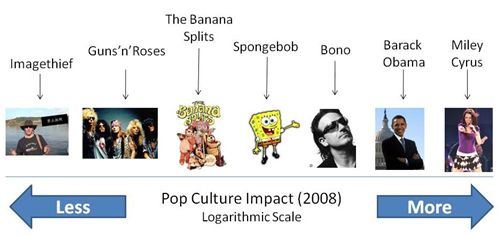
But Guns’n’Roses? Guns’n’Roses? The band singer that took so long to get this album out that the phrase “Chinese Democracy” is now, with perhaps unintentional aptness, a music industry euphemism for a project that never ends? My friends, if you’re getting worked up about this record then your yardstick for cultural relevance is perhaps in need of some recalibration. And fortunately for you, Imagethief can provide that recalibration. In terms of gross influence on society and popular consciousness, Imagethief rates Guns’n’Roses circa 2008 thusly:
Arguably, Miley Cyrus is also past it, and should be replaced by the cast of “Twilight”.
All pop acts, and most pop-culture in general, reflect a particular moment in time. There is no such thing as “timeless rock”, only formerly timely rock that has aged well. I say that as a bona-fide classic rock fan who learned to play bass by jamming over Hendrix records, Pink Floyd, Zep, The Stranglers, and other dinosaurs. Guns’n’Roses, for all their hostility and edginess, needs to be recognized for what they actually were: The last of the LA hair-metal bands. The final, angry stand of a cornered ’80s genre. “Appetite for Destruction” came out in 1987, but languished for a year before it gained real notice. By the time “Use Your Illusion” came out, in 1991, about the time I was launching my college radio career, the band still had some juice but in fact most rock fans and and the industry itself were already up in Seattle trying to figure out exactly exactly what a “Mudhoney” was.
Some rare bands and pop musicians endure, reinventing themselves to stay relevant. That’s why, although I don’t much like her music, I have fair respect for Madonna. She has accomplished the near impossible with almost twenty-five years of pop-music success and reasonably consistent relevance. (Although, note to Hollywood, please don’t let her approach either end of a movie camera ever again.) But most bands, even if they do successfully endure and reinvent themselves, have a peak when they hit maximum alignment with the zeitgeist. Even those that stay successful thereafter are usually living on borrowed time and aging fans, like a human body that deteriorates inexorably after the late teens no matter how healthy it is kept.
So let’s take that equation and add to it not releasing an album for seventeen years. Just how long has it been since the last Guns’n’Roses studio album? When it came out, Deng Xiaoping was still a year away from making his famous “Southern Tour”, the climax of the factional battles that resulted in China’s economic opening to the world. Going after them could be considered quixotic, if Don Quixote had tilted at pinwheels.
Thus, when the Global Times published the headline (via CNN), “American band releases album venomously attacking China”, lent credibility to Chinese net gossip that the album was a Western plot to “grasp and control the world using democracy as a pawn”, and wrote that the the record “turns its spear point on China,” they were committing a classic PR sin: Drawing attention to an unworthy critic.
Let’s illustrate this principle. Let’s say you’re Enormocorp, a gigantic, publicly listed conglomerate with its fingers in a myriad of businesses that span the globe. One day a small, pimply boy with his finger jammed up his nose walks up to you and says, “You suck!” What is the correct response?
The correct response is something along the lines of turning to your friend and saying, “Did you hear something?” It is not putting out a global press release on your non-suckyness, sending your CEO to do the Sunday talk shows to refute suck allegations and publishing white papers on all the anti-suckage measures that you are undertaking. Doing this is drawing attention to an unworthy critic, someone who’s ability to genuinely affect public perception is essentially nil. We call this “PRing the problem.” Global Times has PR’d the problem.
But I suppose it’s their job to do so. The angry rhetoric will play to readers and shift newspapers, which is the real job of any newspaper. So while it makes little sense from a national PR or defending-Chinese-ears point of view, it makes plenty of sense from a business point of view. As long as you don’t mind the cynicism of accepting that a legion of people who otherwise wouldn’t have bothered will probably stampede to Baidu to run MP3 searches for “Chinese Democracy” (or the Chinese nanny-defeating linguistic spoof thereof) as a result of the article.
Personally, Imagethief thinks the Foreign Ministry, which was quoted in the same CNN article, had it dead right when they were asked about the album:
“We don’t need to comment on that.”
Note: Imagethief owns “Appetite for Destruction” and considers it one of the great workout records of all time. He has not, however, listened to “Chinese Democracy” yet. Who knows? Maybe it rocks.
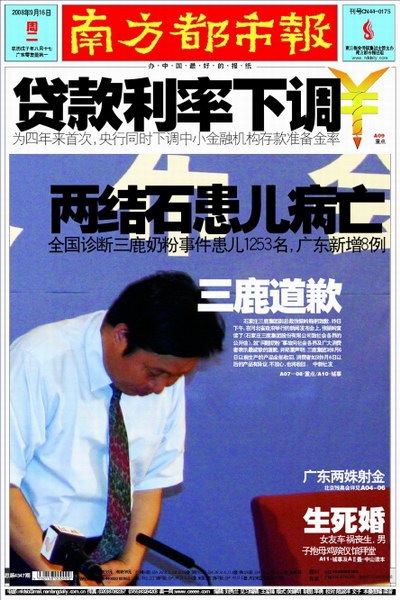
Like on the top-forty radio show Imagethief used to listen to as a thirteen-year old, the hits keep coming in the Sanlu milk powder crisis. Over the past thirty-six hours the situation has evolved from a company-specific Sanlu crisis to a nationwide dairy-industry crisis reminiscent of the glory days of last summer’s product quality crisis.
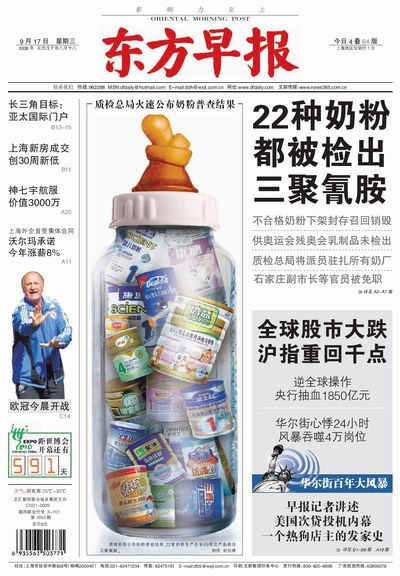
Here is the latest: Products from 175 dairy companies have been tested (中). Twenty-two of them tested positive. Sanlu is still the champ in terms of micrograms per kilo of product, but some other famous (and not-so-famous) brands are now implicated, including Mengniu and Yili. I bet Yang Liwei didn’t know about this when he decided to endorse Mengniu. But astronauts should be able to digest melamine, which anyway seems like kind of a futuristic substance. Imagethief used to have melamine coasters. No joke. Very “Jetsons”.
Also not a joke is that over 6000 children are now reported to have been affected and three are dead. The Internet is seething. Collars at the State Food and Drug Administration haven’t felt this tight since Zheng Xiaoyu was frogmarched away and shot for corruptionjust over a year ago.
So here are the PR implications:
Winner: Sanlu (sort of)
For Sanlu this is actually good news. All of a sudden what looked like their problem is a nationwide problem in which they are just one of many companies caught in the riptide. In PR we teach an interview technique called broadening. When confronted by an interviewer with a problem or challenge that cannot be refuted you respond by “broadening” the issue to include the rest of the industry, your rivals or whomever. It works like this:
Maria Bartiromo: Your stock price is down by 50% this month? Does your company suck?
You: Well, Maria, market conditions are tough and many companies in our industry have had similar declines but we are key message, key message, key message, yadda yadda yadda.
Sanlu doesn’t need to broaden the issue. It has broadened itself. This doesn’t make Sanlu’s problem go away. They’re still the worst affected, the most apparently negligent and most closely associated with the issue. In the past day or so, the chicken of accountability (a really big chicken in this case) has come home to roost and heads have justly started rolling. But misery loves company, especially in PR, and now the spotlight of attention has spread out a bit. It buys Sanlu some small breathing space at the trade-off of kindling a hotter but more diffuse groundswell of national anger.
Losers: Everyone else
While this broadening might be good news for Sanlu, it’s bad news for everyone else. Consumers have no idea which domestic manufacturers they can trust. Even ice cream bars (sob!) look suspect. Foreign manufacturers such as Nestle may benefit for a while, assuming resentment doesn’t turn on them later, which is possible. Also, Fonterra is now recalling its own Anmum branded milk in China. On top of its involvement in Sanlu, this may be wearing the foreign gloss a touch thin.
The Chinese dairy industry looks like a hopeless swamp incapable of quality control. Production and upstream wholesaling are completely fragmented and obviously subject to only the most featherlight of regulatory scrutiny or inspection regimes. The job of applying quality control nominally lies with the brands that sit between green fields and cow dung and supermarkets aisles and consumers, but they appear to have dropped the ball completely. Honestly: Twenty-two companies and 66 products? You’d sooner trust the Three Stooges with your dairy factory than this bunch of clowns.
The SFDA looks about as wired as it did in July, 2007. AQSIQ, which is separate from SFDA, is also scrambling. Regulatory involvement seems conspicuously after-the-fact in this situation. Sanlu was exempted from inspection because it was recognized to be such a fabulously well-run company. Lesson: No one should be exempted from inspection. More inspections for everyone, in fact, seems like part of the prescription for this situation.
And China in general reminds everyone else in the world of why they are just a touch suspicious of Chinese food products. There are apparently some export products involved in the current situation, although they are apparently exported primarily to the kind of no-hope client-states (think Myanmar) that are unlikely to make too many waves lest they have to start paving their own roads. But the rest of the world is watching.
As, incidentally, are the (ahem) China-based expatriate parents of small children. I am happier than ever that Imagethief Jr. is breast-fed. Mrs. Imagethief may be made of stern stuff, but it’s almost certainly not melamine.
Now what?
Aside from the fact that Imagethief will sadly never look at an Yili ice cream bar the same way again, what happens now?
Unfortunately, the whole situation has got much trickier. For individual companies PR issues can be managed because it is relatively easy to speak with a single voice. Situations that involve entire industries are trickier, because getting a bunch of competing companies to speak with a single voice about anything is like herding giant cats with tens of thousands of employees each. Cats that often want to blame each other. Try doing PR for an industry association someday and you’ll get a taste of this.
The cat-wrangling hat now passes to the Chinese government, which has just inherited the stage from Sanlu. The Chinese government needs to explain why there is a pervasive problem in the dairy industry and what it is doing to solve the situation. (It would be nice to talk about a plan for structural changes in the industry.) It needs to make sure that the dairy brands themselves are singing the same song with one voice arranged to church-choir perfection. It also needs to keep on letting consumers know which products are safe and which aren’t and ensure that people have enough real and timely information that gossip and suspicion don’t become the main drivers of the public response. It needs to vigorously punish offenders who have been sloppy and do its best to convince people that the companies, regulators and local governments are all entwined in one sloppy, corrupt ball. I know that executions will look tempting, but executions alone probably won’t solve the problem of restoring consumer confidence, so let’s think more creatively than that.
Importantly, if there are more melamine skeletons in the closet it is best that they come out soon rather than creep out over the coming weeks and months. The situation has already deteriorated. The sooner it moves into recovery phase the better. More bad news dribbling out over weeks and months will delay the start of the recovery and stoke the fires of suspicion and anger. This is one reason why it’s important to make sure people have enough real information to forestall the worst of the gossip and conspiracy theorizing. For that reason, AQSIQ’s public round of testing was a good thing, even if the news was bad.
But the whole process will be difficult. In yesterday’s post I mentioned all the entrenched and institutional problems that retard the development of public communication in China. Many of them also serve to slow the development of effective commercial enforcement. In a sense the larger challenge for China is not just to prove that it can clean up the dairy industry, but to prove that its commercial environment can evolve into something other than a cozy swamp where insiders get rich and outsiders get kidney stones.
But that’s been the challenge for a long time now.
Suppressing the news is not a PR solution Hop on over to ChinaSmack and read the new post “Kidney Stone Gate: Baidu denies censoring search results“, which cites a 21st Century Business Herald report on Baidu’s possible involvement in suppressing negative search results for Sanlu:
Soon after the Sanlu poisonous milk powder news came out, a copy of letter from the Teller public relations firm to the Sanlu Group began spreading on the internet. In the letter, Teller advised Sanlu to pay Baidu 3 million RMB to have Baidu manage search results containing negative news about Sanlu (supposedly not all news could be censored but most results coming from smaller websites could be deleted). When Baidu heard the rumors, they quickly denied working with Sanlu. A representative from Teller also said the letter was fake.
Sanlu Group logo: Sanlu is suspected of paying Baidu 3 million RMB to censor negative search results.On September 13th, “21st Century Economic Report” reported that Baidu admitted receiving a “Sanlu Public Relations Crisis Proposal” letter from a public relations firm, but Baidu could not confirm that it was the Teller firm.
There’s more in the post, including a partial translation of the 21st Century Business Herald article. Some evidence is presented in the story to support the allegation that Baidu was complicit, although Baidu denies it. The jury is still out.
However, the basic PR rule is this: Supressing bad news is almost never a viable PR solution. Bad news tends to leak. It tends to percolate through the pores. It tends to squirt around to wherever your grip is weakest, like the air inside a balloon animal. This is particularly true in the era of the Internet, regardless of what Baidu (or even the government) does.
Only an irresponsible PR agency proposes suppressing bad news as the core of a PR strategy. That’s not rebuilding or defending a reputation. That’s admitting you can’t help. But suppressing news is an old tradition here, handed down from the highest levels. It will be a long time before that kind of recommendation stops coming.
Baidu’s statement (中), also partially translated, includes the following:
Baidu’s most important value is to seek truth from facts. (百度价值观中最重要的一条就是实事求是)
One would hope so. But I recall that somebody else in Chinese history used to talk emptily about seeking truth from facts.
If you want to get people mad –I mean fired-up, torch-and-pitchfork enraged– screw with their pets or their babies. That’s what we’ve learned over the past year thanks to the unfortunate tendency of the plastic melamine to pop up in the strangest places, most recently in infant formula from Sanlu, a mighty Chinese dairy firm.
You would think that after last year’s long-running product quality fiasco people would have learned. Those of you who have brushed the last of the Olympic rings from your eyes will recall that the product quality crisis began with American pet food tainted with melamine thanks to contaminated ingredients from China. It then rippled into lead-tainted toys (repeatedly), antibiotic-laden fish and various other hysterias that collectively managed to knock Dream for Darfur (remember them?) off the front pages. Man, what a summer that was, especially for PR nerds. I get all misty just thinking back on it.
But there will be time for nostalgia later. I want to spend a moment on the word “crisis”, which I used in both the headline and the paragraph above. Like the phrase “mission critical”, beloved of jargon-head business types, “crisis” is a word that is often misused to describe any situation where a company is wrestling with a spot of PR trouble. Chinese nationalist youth are insulting our company on the Internet! We’ve got a crisis! No you don’t. You have an “issue.”
What’s the difference? An easy if somewhat oversimplified way to think of this is chronic and debilitating vs. acute and life threatening. Being morbidly obese with high blood-pressure and diabetes is an issue. But your doctor can prescribe a program that will over time mitigate it. Going into cardiac arrest is a crisis in which the options are immediate treatment or death. In corporate terms this means a situation so bad it threatens the reputation of the company in a way that could rapidly and substantially damage business or shareholder value. Crisis is life-and-limb, billions-of-dollars or fate-of-the-company territory. Cyanide in Tylenol, the Exxon Valdez, Singapore Airlines flight 006; those are crises. Lehman Brothers is was having a crisis (it is now over in the same way that the cardiac-arrest crisis will be over if you don’t get immediate treatment).
Apply the “life-and-limb” test and I think we can agree that Sanlu is having a crisis. Fonterra, their foreign part-owner to the tune of a significant 43%, is having an issue, although it could get worse. More on that below.
Here is the story so far. On September 11th, almost a week ago, initial reports emerged that an unusual outbreak of kidney stones in about sixty infants had been linked to tainted milk power. Naturally the first assumption was counterfeit product, as happened in the tragic Anhui milk powder episode of 2004 and in countless food scandals in China. Since then the story has spread, blob like, in a fashion that reeks heavily of a coverup unravelling. There are now over 1000 affected babies and two fatalities. Genuine Sanlu product has been revealed to be the culprit. There’ll be no palming it off on counterfeiters. A recall of over 8000 tons of product is under way. Sanlu apologized in a news conference yesterday. Heads are rolling, but only at a suitably low and distant level in the great chain of scamming and incompetence.
Deliciously (unless you’re a formula-fed baby), Sanlu and provincial authorities from Hebei, where Sanlu is based, allegedly knew about the problem possibly as far back as early this year, and at the very least in early August, well before the Olympics. We know this because Fonterra execs are now telling anyone who will listen that they told Sanlu and the Hebei authorities that there was a problem but got no action until they got the New Zealand government to tell the Chinese central government. So everyone involved knew the formula was dodgy except for parents merrily feeding it to their babies. The irony of this situation is that foreign involvement is often seen as an indicator of quality thanks to the well documented quality problems of domestic brands.
The New York Timeshas this quote from Gao Qiang, Vice-Minister of Health, which is solid gold by the leadenly unquotable standards of Chinese officials:
“This is a severe food safety accident.”
You think?
Now the conspiracy theories are boiling to the surface like worms after summer rain (we’ve had a lot of rain in Beijing recently, so this image is fresh in my head).
Some think leading Chinese search engine Baidu may have had an agreement with Sanlu to filter negative search results. I don’t really buy this one, but as a student of the Internet I find the supposition interesting. It says a lot about how people feel about the power of search engines as gateways for information. If it was true it would be really interesting. Note to search engines: The time to come clean about how you will and won’t help advertisers is now.
Others wonder if the story was suppressed because of the Olympics, and invoke the Central Propaganda Bureau’s alleged 21-point reporting guidance for the Olympic period. I find this one pretty credible, and it stokes my belief that in addition to bringing out some of the best about China the games also brought out some of the worst. The post linked to above, from China Digital Times, also has a translation of apparent Propaganda Bureau guidance on how to report the current situation, suggesting that the cogs of harmonization are already grinding through comment on this situation even if they’ve not yet clamped down on it completely.
And then there are claims that Sanlu not only knew about the issue but has also beenpaying off afflicted consumers to buy their silence. This one is also pretty credible, and goes along with established Chinese practice of privately arranged compensation for the families of people injured in industrial accidents and such, often in return for an agreement not to make waves. Coal mines are past masters of this tactic.
Uncoverup The PR rules for situations involving the endangerment of human life are simple: The company’s priority is to take all steps possible to mitigate danger, and communication should be centered around ensuring that the public is completely and rapidly informed in a way that minimizes the risk of injury or death. If you concede that the contaminated product is fait accompli and that some damage control will be necessary, then such an approach, funnily enough, often pays the best dividends in terms of repairing a damaged reputation. This is because it demonstrates clearly that the company prioritizes customers and human welfare over a grimy buck. In troubled times this a critical message to send, and it helps to remind customers of why they placed their trust in the company in the first place. See the Tylenol-cyanide crisis for the textbook example.
On this count, everybody involved in the current situation fails. They’ve prevaricated their way into disrepute. There were some shockingly basic steps ignored along the way. As of Sunday, for instance, when the formula recall was in full swing, there was nothing on Sanlu’s website to suggest anything odd was going on. No announcement. No recall information. No advisory to customers. Not hotline. No news since August 14th. Zilch. As of yesterday and into today their website has been unreachable.
This is not a surprise. It is perhaps unfair to judge Sanlu by my imperialist western standards of public communication given that the company is the product of an environment in which the relevant authorities have not always led by example. Sweeping scandal under the rug is a favorite institutional pastime here. Read up on SARS if you need a refresher on this, or the Songhua river benzene crisis, or the Xifeng county journalist scandal, and so on. But SARS was blown wide open, and if this was a cover-up it is now blown wide open too.
While acting vigorously in the interests of the public helps to repair reputational damage from a tainted or defective product and rebuild trust, covering it up compounds the problem. Remember when you broke the dining room window and then lied to your mom and said it was the dog? And she didn’t mind the window so much but was gravely disappointed about the lie? And you didn’t even have a dog? You learned an important lesson then (I hope). This is the same thing, only bigger and with the public instead of your mother. And no imaginary dog.
A blown cover-up demonstrates convincingly to the public that you don’t give a crap about them and that you were willing to let them (and their babies) twist in the wind to save your own hide. Now you have two problems instead of one: Your product is poisonous and your company is run by untrustworthy bastards as far as the public is concerned. The natural conclusion is that you now have at least twice as much work to do to repair your reputation, although Imagethief thinks that the repair work actually goes up as the square of the number of self-inflicted wounds, if not the cube (modern media being three-dimensional).
In addition to simply being ethical, coming clean is a good approach because it shortens the time-frame for bad news. Scandals often don’t bust all at once, but drag out over days or sometimes weeks as bad news bubbles to surface in bits and pieces. This can feel a like a very long time when you’re on the pointy end of bad press and public scorn, and can leave a very deep impression on the public. As noted above, the CEO of Sanlu has apologized, but once the story has gone this far it looks like an apology under duress. That simply doesn’t have the power of pre-emptive contrition. (Lawyers take note: I am not suggesting pre-emptively admitting liability.)
While it’s hard by definition to know how many cover-ups succeed, Imagethief expects that most are busted, especially when there is a large public impact. The old mob aphorism holds that two people can keep a secret if one of them is dead. If a lot of people know about your crisis, better for you that you resist the coverup temptation. Own-up and be seen to get cracking on solving the problem and helping the victims. Or hope that your crisis is so thermonuclear that it wipes out all witnesses and all evidence.
But exhorting transparency is almost certainly pissing into the wind. The problem here isn’t just one of the occasional irresponsible company. And it’s not a problem that one or two or a dozen PR agencies or crazy PR bloggers are going to solve. It’s a problem of endemic business and regulatory culture. There are several factors at work. First, the Chinese government doesn’t have a history of encouraging transparency. Second, the relationship between media and business is often too cozy for the good of anyone but media and business (this is especially true at the local level, which is why the government’s restrictions on all but national news organizations reporting outside of their home areas are so damaging). Third, the government still maintains explicit control over the media and to a degree the Internet, which means that stifling coverage by fiat consistently presents itself as a path of least resistance. Fourth, the government still maintains tight links with major businesses. Sanlu’s majority owner as near as I can determine is the Hebei provincial government, who’s PR philosophy is probably pretty old-school.
The Kiwi’s aren’t off the hook either
But what of Fonterra? They’re not a Chinese company. They come from a different media, PR and regulatory tradition. How has their performance been? From the Financial Times:
The Sanlu board, which has three Fonterra directors, was told of contamination on August 2 when a trade recall began, said Andrew Ferrier, Fonterra’s chief executive,yesterday. A public recall did not start until nearly six weeks later.
“[Fonterra] have been trying for weeks to get an official recall and the local authorities in China would not do it,” Helen Clark, New Zealand’s prime minister, said on television yesterday. “At a local level . . . I think the first inclination was to try and put a towel over it and deal with it without an official recall.”
***
Sanlu could not be reached for comment yesterday, but Mr Ferrier defended Fonterra’s role, saying “as a minority shareholder [the company] had to continue to push Sanlu. Sanlu had to work with their own government to follow the procedures that they were given.”
Not so good, I’d say.
Here’s the million-RMB question: Did Fonterra have a responsibility to go public in China based on what they knew? To someone not directly involved (such as me) it looks an awful lot like Fonterra sat on its hands despite knowing that customers were at risk, possibly to protect its business and relationships in China. Minority shareholder they may be, but 43% is a big minority and they have three board seats. Their reputation is hostage to the behavior of their partners and right now they look complicit in a sketchy situation.
I am sure it was hard decision considering the prickliness of Chinese authorities and regulators and the likely fallout of ratting on their Chinese partners (see Danone vs. Wahaha for an example of what can happen when sino-foreign business relationships disintegrate). But I wonder how their noisy stakeholders back home in New Zealand, who won’t care so much about the idiosyncrasies of the China market, will react. Several nasty questions present themselves. How bad would the problem have to be before Fonterra blew the whistle? Do they prioritize their China business over the safety of customers? Is China an appropriate market for them to be in under the circumstances? At times like this you’re happy to be a privately held cooperative.
Fonterra has no official statement on the situation that I can find as yet, although I’ve seen references to press releases. Private or not, I think they have some explaining to do.
Lessons from the great milk-powder fiasco of ’08
It has been heartening to see both the Chinese press and the Internet go to town on Sanlu, especially since they’re not my client. While I don’t envy them their PR miseries, the willingness of the Chinese press to take on big Chinese companies that do wrong by their customers is an important development for civil society. While the coverage will follow the Central Propaganda Department guidelines referred to above, the whack of big, negative headlines may still have a salutory effect on other companies. That’s as it should be. People trust brands. The tradeoff is that brands are accountable and the media is an important part of the mechanism for making them so.
It’s also interesting to see that even Chinese companies can have quality problems with their suppliers. At the height of the product quality crisis much was written about the importance for foreign companies of vetting and monitoring suppliers rigorously and continuously. It is reassuring in some small way to see that it’s not just foreign dupes who have trouble managing these problems. Local dupes can have them too. It is, on the other hand, a reminder of how much room for development there is in the Chinese commercial environment.
Finally, as bad as this situation is, it shows that there is an opportunity. Chinese companies do understand the value of a powerful brand and a good reputation. That’s a good first step, but more is needed. Many clearly also learn the value of communicating transparently and aggressively in crisis situations in order to defend the brand and reputation. Nobody wants a crisis, but the lessons learned this way can help prepare the best managed and most progressive of China’s big consumer goods companies to succeed internationally, where the old cozy approach won’t work as well.
An ancient and time-worn chestnut of China journalism is that the word for “crisis”–危机, or weiji–contains the characters for “danger” and “opportunity”, which is sorta-true-but-not-really. As a piece of popular wisdom, it has the unfortunate consequence of trivializing the concept of a crisis. Sure, “crisis” in the classic sense means an inflection point from which multiple outcomes, including perhaps opportunity, may arise. But in the colloquial PR sense it means a grave situation with unpleasant and possibly catastrophic consequences. Thus, Imagethief has always felt that it would be much more accurate if the Chinese word for crisis combined the characters for “shit” and “fan”. I’m sure that right about now executives from both Sanlu and Fonterra would agree.
Still, I’m an optimist by nature, and I do like to look for the upside. Let’s hope some lessons are learned.
A very interesting story from Peter Ford of the Christian Science Monitor on the systemic problems in China that have made situations like this so depressingly regular.H/T China Law Blog:
Some observers see a silver lining in the scandal. “One positive result is that people will become more aware of food safety,” says Ren Fazheng, a professor at China Agriculture University in Beijing. “Government and society will pay more attention to this issue … and more inspection agencies will use more methods, so the level of inspection will improve.”
Yet public opinion, even outrage, has limited impact, as evidenced by the stunted efforts by angry parents who lost children in the Sichuan earthquake in May to demand government accountability. While officials are still investigating why so many schools in the quake area collapsed, protests have been curtailed and media coverage on the issue banned.
Still, with Sanlu closed by government decree and its future in doubt, two men charged with crimes that can carry the death penalty, and a government investigation widening, “this serves as an extremely strong cautionary tale for the whole industry,” says Professor Yang.
“Lawsuits have not worked well in China, but the costs are escalating” for companies that cheat, he argues. “Producers realize now how precious their brand name is.”
Perhaps. But as long as some companies feel their brands can be protected through means other than sound ethics and transparency I’d suggest channelling the Gipper: Trust but verify.
Disclosures:
Imagethief once worked for Fonterra’s PR firm in Singapore. Fonterra was not my client.
The founder of Imagethief’s current employer advised Tylenol during their 1982 crisis. Imagethief was 15 at the time, and was too busy watching “Get Smart” reruns and not doing his homework to be involved.
Or so you would start to believe from the press reports over the last day. Some have dwelt upon the lip-synched singing of hyper-precious Lin Miaoke, the impossibly apple-cheeked munchkin girl who “sang” the laudatory and self-referentially titled “I sing for my motherland” without toppling over in shock at the thought of being watched live by 90,000 people and countless millions on live television. She must have been on ketamine, because I would have frozen like fudge in Fargo. And I generally have no problem with public speaking.
Morereportshavefocused on the somewhat more scandalous replacement of the “giant footprints” fireworks display with a computer-generated special effect.
Here is what Imagethief thinks of both of these revelations: So what?
I got news for you: Li Ning wasn’t really flying either. If they’d really wanted him to fly they would have shot him out of an air cannon in a flaming suit and he could have lit the torch as he sailed over it and out of the stadium into the Great Beyond of the Olympic Green.
Damn, forget Zhang Yimou. With ideas like that, I oughtta plan these events.
The Olympic opening ceremony may have represented many things, but “veracity” was not among them. I thought it was a pretty good show. But let’s face it: it packaged Chinese culture as vulgar burlesque and reduced the legendary 5000 years of history to arena-rock light show. The whole thing was one giant special effect from beginning to end. But I don’t care. I like vulgar burlesque and arena-rock light shows. This was my kinda show!
In fact, arguably Olympic Beijing, tarted up, hyper-sanitized, stripped of automobiles and resolutely micro-managed for two weeks, is something of a colossal special effect in and of itself. Among all this surely one digital process shot can be forgiven.
Even the Olympics themselves can be thought of the same way. Overmarketed, pompous, awash in idiotic pseudo-religious symbolism (remenber the “priestess”-infested torch lighting ceremony?), and rife with doping and age scandals, they’re certainly a yard or two from what most of us would consider “reality”. It’s well off the deep-end of showbiz, and showbiz is all about illusion. And I write all of this as someone who’s relatively excited about the games! But you have to be clear-eyed about these things.
The only grudge I hold about the footsteps is that it was a particularly cool idea. I even said, “That’s cool!” to Mrs. Imagethief while we were watching it on the immense TV that my landlord so graciously installed in my apartment. So, yes, I was fooled. My bad. But I was still entertained by the shot, which is more than can be said for the oxygen-destroying tedium of the totally un-retouched parade of national teams. If anything, I could have used a little less veracity there. (On that note, NBC denies editing the parade to make the US team come out later in the US broadcast. Imagethief suggests that the turgid pace of the parade simply made it seem like eternity before the US team came out.)
As for munchkin girl, of course she was lip synching. While we were watching her I turned to Mrs. Imagethief and said, “The munchkin is lip synching.” This doesn’t make me a genius. It simply makes me someone who grew up watching Superbowl halftime shows, the Grammy Awards, and other lip-synch classics.
In fact, on that note, and overlooking the two hour Grand March of Tedium and my various bitchy comments above, I give the opening ceremony pretty high marks. The first part was legitimately spectacular, and I enjoyed the finale as well. Yes, I think Zhang and the Gang could have done themselves a favor and left out the footprints if they didn’t think it would work. Or simply taken their chances on the helicopter chase. But I’m sure they were all biting their nails to quick during the entire four hour extravaganza already. Has anybody tracked sales of Tums (or the Chinese equivalent) in Beijing over the past month?
In fact, the soporific parade aside, the only other things I’d have voted to remove from the ceremony were the absurd hand-doves of peace, the goose-stepping soldiers and slow march of the Olympic flag around the entire circumference of the field in the statium. The soldiers kindled unpleasant associations for many foreigners, and the flag march simply came way too late in the show for such draggy self-indulgence.
But good marks on the whole. I’d say that the London 2012 crew (remember, there will be another Olympics after this one, assuming the sun doesn’t explode) has its work cut out for them. Imagethief has just one bit of advice for them: Keep it under two hours. At four hours, the Beijing ceremony was longer than the Oscars (speaking of fraudulent). Keep it short, leave ‘em wanting more. Everyone will love you for it. Or at least I will.
Outside of Young Frankenstein there isn’t really any such thing as a “good time” for rioting, but this might be an especially bad time for China to have a bout of punishing ethnic unrest. It hasn’t really been a banner start to the Olympic year so far, what with the worst storms anyone can remember, the Darfur activists on a tear, the bizarre Uighur terrorism story, and now this. Commentators are already linking this episode to China’s Olympic fortunes (see also the LA Times, Time, Asia Sentinel and Newsweek), and the French foreign minister has already been spotted talking about a partial boycott. Even Wen Jiabao has suggested that the riots were calculated to damage the games.
Things seem to have quietened down in the last couple of days, although that may simply be because reporting has been stifled. Certainly the flow of news has dwindled a bit, and many publications have shifted into context and analysis mode. But we can probably expect bits and pieces of information to dribble out over the next few weeks, as refugees leave Tibet and a few intrepid journalists break the cone of silence that that the Chinese government has dropped over the troubled areas. In the past few days many of our favorite local correspondents have made a run for the Tibet border, but blog posts, such as fromTim Johnson and Richard Spencer (and again here), suggest it’s tricky getting any reporting done.
The Foreign Correspondents Club of China has already petitioned the government for better access to the affected areas and circulated a list of incidents in which journalists and camera crews have been detained or hassled by the authorities. It would seem that Olympic pledges of greater openness were tested in the breach and found wanting. This, I suppose, shouldn’t surprise anyone. Old instincts die hard. The Chinese government has also reverted to its common tactic of belittling foreign coverage as intentionally biased. If this happens during the Olympics then, to borrow a line from Gerry Anderson, stand by for action.
Over the past few days, China’s communication strategy with regard to the Tibet riots has become clear. It has consisted roughly of the following:
Ban all international access so that Chinese media can monopolize images and on-site reporting
Demonize the Dalai Lama as the black hand behind the rioting in throwback, Cultural Revolution language, and drive the point home with images of rioting monks
These three are all true to type. But then it gets more interesting:
Give Chinese Internet users free reign to vent their rage at ungrateful Tibetans who have bitten the hand that is lifting them into development (see also this AFP storyquoting Danwei’s Jeremy Goldkorn and citing Mutant Palm’s work translating Chinese tweets, and John Kennedy’s Chinese Internet roundup at Global Voices)
For a good overview of the Chinese approach to all of this, see Mark Magnier’s interesting article on China’s PR efforts around the Tibet riots. It includes this damning quote from Chinese blogger and journalist Michael Anti:
“The [Chinese] government is showing more confidence and learning more about spin,” said Michael Anti, a well-known Chinese blogger on a Nieman fellowship this year at Harvard. “They’ve learned more PR tactics from Western people. They see the way the White House and the Pentagon do it.”
In some ways China’s strategy has been effective. They’ve certainly done a good job back-footing the Dalai Lama, who made the mistake of not condemning the violence forcefully and immediately. Domestically it’s been gangbusters as usual. But the Chinese government shouldn’t be too proud of itself yet, because there remains one substantial problem: China has invested so much in its narrative of Tibetan development and growth that it is reluctant take any actions that undermine this story. This prevents them from communicating internationally in a way that foreign audiences will be receptive to, and it stores up serious ethnic problems for the future.
China’s prevailing narrative about Tibet is that China liberated it from feudal brutality and gave it all the wonders of development. The great mass of Tibetan people understands this and is duly grateful. This narrative has been thoroughly sold domestically, but it has never been widely accepted in the West.
While there are elements of truth to China’s version, China’s ability to sell it internationally has always been hampered by the government’s time-honed credibility gap with western audiences. This is exacerbated by the difficulty of getting independent points of view. Reporting from Tibet was heavily controlled even before the riots. Furthermore, International opinion is subject to an effective PR campaign run by Tibetan exile groups and the charismatic Dalai Lama. It’s safe to say that International audiences will never be entirely convinced by a Chinese state narrative that doesn’t even allow for the possibility that there might be genuine discontent in Tibet. China is much better at dictating ideas to a captive audience than at selling them to an open one.
Historically, it hasn’t really mattered to China’s government what International audiences think about Chinese domestic issues. But 2007 was the year in which China discovered the importance of International stakeholders. This began with the product quality crisis that erupted last summer, and it has gained strength over the Olympics in the past few months. The reality is that a global, economically integrated China that has invested hugely in hosting the world’s biggest sporting event is vulnerable to foreign public opinion. That’s why it stung so much when Steven Spielberg (who must be feeling pretty good about this right about now) withdrew from official participation in the Olympics. If it hadn’t stung, you’d have seen a lot less indignant Chinese press coverage about it.
If foreign stakeholders can boycott your products, screw up your outbound investment or trash the most glamorous event you’ve ever hosted, you need to develop some PR game. Unfortunately the mechanisms that have served China’s government so well over the years, a combination of explicit control over domestic media and pervasive state propaganda, don’t translate well to International audiences, and it has yet to learn a new approach. The need to defend the national narrative at all costs means that foreign media have to be kept away from Tibet, lest they reveal the cracks in the edifice. Heaven forbid that those inconsistencies make their way back to domestic audiences and undermine the national myth of Tibetan success and perhaps even government legitimacy. Tibetan integration –or suppression depending on your point of view– is part of Hu Jintao’s personal legacy as former Tibetan party chief and author of the crackdown on the 1989 demonstration. Unfortunately, nothing says, “We have terrible things to hide” to a foreign audience like detained or harassed journalists.
China’s growing international exposure aside, it must be tempting to wave away international concern as interference in China’s internal affairs. Unfortunately, another problem with defending the myth at all costs is that this approach seems calculated to inflame ethnic tensions rather than dispel them. Coverage of the riots suggests that much of the violence was Tibetans taking out their frustrations on Han who simply had the bad luck to be in Lhasa. That’s a shame, and the Chinese authorities are justified in seeking out and punishing those who have committed crimes against people and property. But the job of government is to ameliorate ethnic tensions within the country, not exacerbate them. Xinhua’s heavily spun coverage of the disturbances seems calculated to stoke outrage among the Han majority, and the Internet comment that has been allowed to stand echoes with that outrage, if not universally at least widely. Much of the Han comment reflects common colonial sentiment toward natives: Tibetans are lazy, ungrateful, intractable. Worrying signs for a country that disavows any colonial inclinations and preaches integration.
This is where the “cost” element of maintaining the myth at all costs really becomes clear. If the national narrative leaves no room for entertaining the notion that regular Tibetans might have legitimate grievances, then there is no hope of recourse for Tibetans and no alternative for non-Tibetan Chinese but to see the unrest as pure betrayal and thuggery. It becomes impossible to even acknowledge underlying problems in any constructive way. All that is left is ruthless crackdown and an ever-widening gulf between the two peoples.
Unfortunately, the more the Han majority sees Tibetans as ungrateful, violent dupes in the thrall of a sinister Dalai Lama, the harder any kind of real reconciliation will be. Mutual suspicion, hatred and racism-without-end loom. One wonders what will happen if Dalai Lama dies and there is still unrest in Tibet. Who will they blame then? There is a harder-line coterie of Tibetan exile leaders waiting in the wings, but none of them will fill the role of China’s “Goldstein” as well as the Dalai Lama does.
The best thing China can hope for now is that things stay quiet and the episode fades from view over the next few weeks. But that isn’t a long-term solution. In the end the situation is a tragedy not just because it was violent and ugly, but because it was a wasted opportunity. China could have introduced some transparency, allowed foreign reporters in, and started earning itself greater international credibility at a time when it desperately needs it. China could also have used this as an opportunity to move beyond its propagandistic approach to the problem of Tibetan integration, and to kindle a real national discussion on how to address the concerns of Tibetans in a way that might make integration a reality rather than a propaganda slogan. Done correctly, this need not have looked like succumbing to foreign pressure.
But that’s not how things are done here. That’s a shame, because no matter what wishful thinkers overseas want, Tibet will be a part of China for the foreseeable future. That will lead to continued problems. And as everyone knows, its hard to solve problems if you can’t admit to them.
Horseman of the apocalypse.
See also:
ESWN’s roundup of coverage and blogs, which gets into some of the rumor-mongering and conspiracy theories floating around
Via ESWN, China Matters on the conflict (B) between the Dalai Lama and Tibetan Youth Congress president Tsewang Rigzin
The greatest contribution that comedian Stephen Colbert has made to modern society is the concept of “truthiness”. Reading from the Wikipedia definition, truthiness is:
…a satirical term to describe things that a person claims to know intuitively or “from the gut” without regard to evidence, logic, intellectual examination, or facts.
Miraculously, the entry goes on for another 3400 words on the concept of truthiness, proving not so much that truthiness is an important concept as that Wikipedia is balls-out for pop culture. Nevertheless, “truthiness” has transcended its comic-neologism origins to become a legitimate word, which says something about the zeitgeist.
Imagethief wishes that Colbert had similarly enshrined the concept of “newsiness”. Borrowing from the definition above, newsiness could be described as a satirical term to describe things that a person claims is important or newsworthy without regard to evidence, logic, intellectual examination or facts. It feels like news, whether it really is or not.
This is something that we flacks are familiar with. At our worst PR types trade in newsiness, packaging up bits of corporate dander and passing them off as significant. But we’re not exclusively to blame. Sometimes newsiness arises spontaneously in the form of a story that is less than meets the eye. Last week’s story concerning the collapse of the National Bureau of Corruption Prevention’s new website under apparently heavy traffic strikes me as an example of newsiness.
Foreign coverage of this story can be traced backed to a Beijing Youth Daily article, which I don’t have a link for, and a subsequent English-language Xinhua report that was deftlymassaged into final form by our own Chris O’Brien of Beijing Newspeak. The story was that the recently constituted National Bureau of Corruption Prevention, a relatively toothless body set up to “collect and analyze information” on corruption, launched a new website that included a guestbook function enabling members of the public to post semi-anonymous comments. However the website crashed within hours of launch due to a “large number of visitors”.
This fits very nicely into one of those social-issue memes that define much foreign news coverage of China, and that often take the form of “a nation struggling with [insert social issue here]“. Examples are a nation struggling with pollution; a nation struggling with censorship; a nation struggling with Internet addiction; and so on. The issues are set up via colorful or heartstring-yanking anectodes often involving stoic, salt-of-the-earth 老百姓 types recalling their woes, and rounded out with a mix of quotes from NGOs/overseas experts/local academics/old China hands and the kind of eye-popping statistics that China excels at generating and that make pretty much any problem here seem thoroughly intractable.
In fact, much good journalism is done this way and it works well for the home audience that reads one newspaper. But if, like Imagethief, you are a news junkie living in China and you read vast troughs of China coverage from a range of publications, it’s hard not not to notice the formula.
This system also promotes the dissemination of lightweight stories that simply fit into issues established by precedent. This particular story originated via the Xinhua article, which seems to have originated as a “why our website went down” disclosure formality. It plugged nicely into the “nation struggling with corruption” meme and was duly picked up by the foreign press, almost all of which cited the Xinhua article. The tone and detail of the foreign stories vary a bit, but looking at the headlines and ledes a clear mental picture emerges:
Reuters: China anti-graft Web site felled by “too many hits”
BEIJING (Reuters) – A Chinese government Web site encouraging citizens to report corruption crashed on its first day under the weight of too many hits.
AFP: China anti-graft website crashes under public complaints
BEIJING (AFP) — The website of China’s new anti-graft bureau crashed shortly after going online due to the huge volume of messages from the public complaining about rampant corruption, state media said Wednesday.
Telegraph: China’s new anti-corruption website crashes
A Chinese government website set up for the public to complain about corruption crashed within a day of launching under the volume of cases reported.
The website was constructed by the National Bureau of Corruption Prevention to collect information on corrupt activities as part of an ongoing purge by the Beijing authorities.
Associated Press: Anti-graft Web site swamped in China
BEIJING: A new Web site created by China’s anti-corruption bureau crashed after barely a day because too many visitors had tried to log on to register complaints, state media reported Wednesday.
Washington Post: Chinese Assail Official Misconduct With Fervor
BEIJING, Dec. 19 — China’s new National Bureau of Corruption Prevention thought it would be a good idea to open a Web site for citizens to denounce crooked officials. The idea was so good that the site was immediately deluged this week by irate Chinese, overwhelming the system and causing several crashes during the first two days of operation.
So what did you see in your head? Imagethief saw an image of zillions of oppressed Chinese people desperately clicking on the NBCP’s web page. This is image was helped along by the recent, widely publicized woes of BOCOG’s Olympic ticket sales website, which really did crash under the fevered clicking of zillions of people. But unlike the Olympic ticketing stories, in which the actual traffic and transaction load on the site was reported, the only figure in any of the stories above is the number of pages of comments, ranging from 16 to “more than 20″. Only the AP story lists a specific number of comments: 250. An NBCP official was quoted in the Xinhua article as saying, “The number of visitors was very large and beyond our expectations.”
Well, yes, but what were your expectations?
Hoping to find more information, Imagethief took himself to the site for a first-hand look. As of last Friday there were still about 20 pages of comments, each with fifteen individual posts, for a total of about 300. Anyone who has spent time on a popular Chinese blog or in the forums knows that this is pretty small beer. For comparison, when CCTV 9 anchor Rui Chenggang condemned the Forbidden City Starbucks on his Sina blog just under a year ago, he got 450 comments in 24 hours, on his way to nearly 3000. Sam Flemming’sCIC, which monitors Chinese online buzz, tracked over 4 million posts on automobiles in the three-month period from April-June of this year (full report — PDF, registration required).
These are not entirely fair comparisons. The degree of freedom people feel to comment about corruption is not the same as they feel to comment on the Chery QQ or foreign coffee shops, and the overlap of corruption victims with Internet users is smaller than that of car aficionados. But it does introduce some perspective on what constitutes a “hot” online issue in China.
Corruption is a real issue here. The corruption website collapse story is neat enough to tie a Christmas bow around, and the foreign reports are all factually accurate, insofar as they essentially relay the Xinhua report. But what does this incident really say about Chinese society and the problem of corruption? There is a big difference between a site that was designed to support tens or hundreds of thousands of simultaneous visitors and was still overwhelmed by crushing demand, such as the Olympic ticketing site, and a small-potatoes site that fell over under moderate traffic or because it was designed, programmed or tested badly. Imagethief designed and developed e-commerce sites for many years and can assure readers that this a common problem. But “China anti-graft website collapses under public complaints”, to borrow one of the headlines above, is going to get many more people reading than, “China anti-graft website collapses because of poor programming”.
Fine. That’s the news business. Gotta get eyeballs on the page, and Imagethief, a subway commuter who reads on the way to the office, likes a punchy newspaper as much as the next guy. No harm in relaying a vacuous Xinhua story (sorry, Chris — not your fault), especially when it fits so neatly into an existing pigeonhole. It’s still “newsiness”, but if nothing else it can help keep our minds off of much more worrying things, like the ever dumber things American politicians are saying about China.
Imagethief recently found himself huddled in a wintry hutong courtyard in conversation with two longtime Beijing-based foreign correspondents. During this discussion we came to the conclusion that the recent Yilishen ant-farming scandal is more or less the perfect China story. It brings together at a stroke all of the elements of the modern Chinese story. And surreal story it is.
If you’re not familiar with this incident (and you really should be), you can go read Mark O’Neill’s comprehensive article on Asia Sentinel, or any of severalotherstories which, collectively, have generated something of a bumper crop in pun headlines.
But if you’re pressed for time here is a synopsis: The Yilishen Tianxi Group, a Shenyang-based company, was manufacturing an allegedly aphrodisiac tonic made from ants, which are widely believed to have medicinal properties in traditional Chinese medicine. But rather than wrangle ants itself (nothing feels as good as bringing in a herd, I hear) Yilishen’s scheme was to sell would-be ant farming “investors” boxes of special medicinal ants at RMB10,000 for three. Along with the boxes came a promise that once the ants matured (read: died), about 14 months later, Yilishen would buy them back for RMB13,250. That’s a 30% guaranteed gain over 14 months which, while not quite pre-meltdown A-shares, kicks the ass of many a hedge fund.
Except that the Yilishen ant trade was a pyramid scheme, and it went spectacularly bust, leaving tens of thousands of Dongbei punters short RMB10,000 and long three boxes of worthless ants. Not exactly Warren Buffet. Outraged ant farmers from across Liaoning province rioted in Shenyang, the government imposed a news blackout and the wujingarmed police headed north to diligently maintain a harmonious sociey, which is hard under these circumstances.
You simply could not make it up. Ten Hollywood screenwriters locked in a closet with a kilo of blow, a brick of twenty dollar bills, your sister and a cigar-smoking chimpanzee in boxer shorts wouldn’t come up with this. Even if they weren’t on strike. Only China comes up with this. And not only does China alone come up with this, but the story also nicely draws together all the threads of the modern, Chinese narrative and ties them into a pretty bow. Just look at what this story offers:
Social Issues
The Dongbei is China’s rustbelt; a swathe of deep-frozen, fading industrial towns that were once the showpieces of Maoist industrial collectivization. While the cosmopolitan port city of Dalian has blossomed in China’s post-reform economy, much of the region has struggled to keep up with the go-go development of the two Deltas and the capital. Hence the “振兴东北老工业基地” (Revitalize Northeastern Industrial Base) campaign and those tragic stories of families’ life savings being sunk into ants and ant-aunties pooling the funds of their neighborhood taiqi group to go in on a few lucky boxes. Apparently about a million people bought into the ant-dream. Could ant farming be symbolic of the economic desperation of an entire region? Or might it just be a punt? Who cares, because there was also…
Sex
About 98 percent of Chinese medicines are aphrodisiacs. The average Chinese pharmacy is about half aphrodisiacs and half prophylactics with one or two boxes of nasty, herbal flu medicine just in case. The reason why rhinoceros and tigers have been hunted to near extinction is to make Chinese aphrodisiacs. Imagethief himself once appeared in a television commercial for a Chinese aphrodisiac. They’re that ubiquitous. You’d think the Chinese had never heard of p0rn. And what goes better with sex than…
Corruption
Yilishen Group turned out to be well connected throughout Liaoning provincial circles. This had apparently helped fuel its rise in the province, but also motivated embarrassed local officials to make the whole situation go away as soon as possible. That left bereft antherds with the usual channels of legal recourse available to the small-time victim under provincial Chinese jurisprudence: none. Therefore, the only alternative was…
Mass incidents
Ten thousand ant farmers rioted in a provincial capital. Imagethief asks you: What country other than China could cough up that lede? Mass incidents are the sine qua non of the modern Chinese scandal. In a rare and rapidly regretted moment of candor the authorities once admitted that there were 74,000 of them in 2004, up 28% on the year before (not quite as much as the pre-collapse return on ants, but still pretty good). No pressing social issue is complete without one. Chemical plant going up on your rice paddies? Shanty being expropriated for Olympic development? Local manufacturers turning your once limpid lake into a festering pool of PCBs and heavy metals? Two words: Mass incident! However, this may be the first one caused by…
Ants
Ants? Yes, Alice, ants. Imagethief tries to maintain a culturally sensitive respect for traditional Chinese medicine. Indeed, when I pinched a nerve in my shoulder two years ago I took traditional Chinese medicine and had a round of cupping (note to Americans: it’s not as dirty as it sounds). It worked, I believe, only because the medicine was so nauseatingly foul and the cupping so excruciatingly painful that I willed myself to recover so that I wouldn’t have to endure a second course of treatment.
But, really, an ant-based sex tonic? Hasn’t this ground been trodden before? The image of so many fevered, Chinese investors hunched over their RMB10,000 boxes of magical ants is both funny and desperately tragic. Unfortunately it was all a bit too much embarrassment for the Chinese authorities, so naturally…
The whole thing was harmonized
Mainstream coverage evaporated and the search term “Yilishen” went down the Chinese Internet memory hole once the authorities decided they’d had enough. Previously uploaded videos and blog posts dropped gnats in a frost. China’s pre-eminent citizen journalist, Zuola, a veteran of the Chongqing nailhouse and Xiamen PX stories, wasescorted out of Liaoning. To add insult to injury he was apparently made to pay for his own plane ticket. No word on whether he had to pay for the tickets of the goons who escorted him.
Imagethief has a friend from Shenyang who complained bitterly about the suppressed media coverage. “It’s not like we don’t all already know about it,” she said, admitting that her own parents had been among Yilishen’s legion of ant farmers. “It’s so…” she considered the English word she wanted to use…”insulting.”
Meanwhile, many of the Yilishen riot videos harmonized from Chinese video sharing sites have found their way onto YouTube. You can’t keep a good story (or a bitter ant tonic) down.
And that’s all there is to it
Imagethief in no way wishes to minimize the plight of Yilishen’s investors. RMB10,000 is a lot of money by any standards. My friend from Shenyang also explained that her parents neighbors had invested RMB60,000, and they knew people who had invested a whopping RMB1,000,000. Imagethief also doesn’t think that investors in Yilishen’s ants were stupid. Scams and pyramid schemes thrive everywhere. Successful ones are cleverly engineered to appealed to the society in which they operate. Yilishen was a well known brand that had been in business for several years and had a good reputation. Traditional remedies are still widely used and respected in China, and ants are part of the pharmacopoeia. Virility tonics are popular. Combine all of that with a cultural affinity for gambling and a get-rich-now zeitgeist and you have a China story for the times.
For sheer swoop and color it sure beats the rise and fall of China’s other great pyramid scheme, A-shares.