Tag: Business

  • Sanlu melamine milk powder crisis becomes a national issue

    Like on the top-forty radio show Imagethief used to listen to as a thirteen-year old, the hits keep coming in the Sanlu milk powder crisis. Over the past thirty-six hours the situation has evolved from a company-specific Sanlu crisis to a nationwide dairy-industry crisis reminiscent of the glory days of last summer’s product quality crisis.

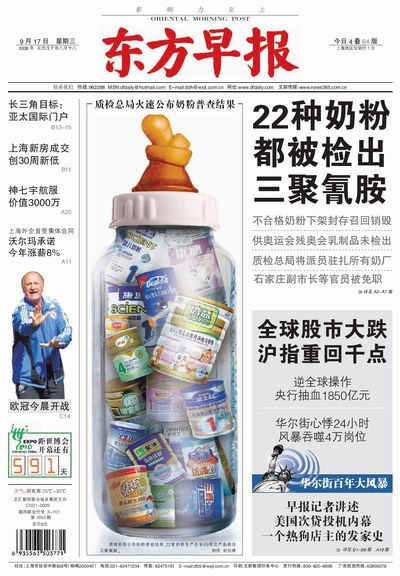
    Here is the latest: Products from 175 dairy companies have been tested (中). Twenty-two of them tested positive. Sanlu is still the champ in terms of micrograms per kilo of product, but some other famous (and not-so-famous) brands are now implicated, including Mengniu and Yili. I bet Yang Liwei didn’t know about this when he decided to endorse Mengniu. But astronauts should be able to digest melamine, which anyway seems like kind of a futuristic substance. Imagethief used to have melamine coasters. No joke. Very “Jetsons”.

    Also not a joke is that over 6000 children are now reported to have been affected and three are dead. The Internet is seething. Collars at the State Food and Drug Administration haven’t felt this tight since Zheng Xiaoyu was frogmarched away and shot for corruptionjust over a year ago.

    So here are the PR implications:

    Winner: Sanlu (sort of)
    For Sanlu this is actually good news. All of a sudden what looked like their problem is a nationwide problem in which they are just one of many companies caught in the riptide. In PR we teach an interview technique called broadening. When confronted by an interviewer with a problem or challenge that cannot be refuted you respond by “broadening” the issue to include the rest of the industry, your rivals or whomever. It works like this:

    Maria Bartiromo: Your stock price is down by 50% this month? Does your company suck?

    You: Well, Maria, market conditions are tough and many companies in our industry have had similar declines but we are key message, key message, key message, yadda yadda yadda.

    Sanlu doesn’t need to broaden the issue. It has broadened itself. This doesn’t make Sanlu’s problem go away. They’re still the worst affected, the most apparently negligent and most closely associated with the issue. In the past day or so, the chicken of accountability (a really big chicken in this case) has come home to roost and heads have justly started rolling. But misery loves company, especially in PR, and now the spotlight of attention has spread out a bit. It buys Sanlu some small breathing space at the trade-off of kindling a hotter but more diffuse groundswell of national anger.

    Losers: Everyone else
    While this broadening might be good news for Sanlu, it’s bad news for everyone else. Consumers have no idea which domestic manufacturers they can trust. Even ice cream bars (sob!) look suspect. Foreign manufacturers such as Nestle may benefit for a while, assuming resentment doesn’t turn on them later, which is possible. Also, Fonterra is now recalling its own Anmum branded milk in China. On top of its involvement in Sanlu, this may be wearing the foreign gloss a touch thin.

    The Chinese dairy industry looks like a hopeless swamp incapable of quality control. Production and upstream wholesaling are completely fragmented and obviously subject to only the most featherlight of regulatory scrutiny or inspection regimes. The job of applying quality control nominally lies with the brands that sit between green fields and cow dung and supermarkets aisles and consumers, but they appear to have dropped the ball completely. Honestly: Twenty-two companies and 66 products? You’d sooner trust the Three Stooges with your dairy factory than this bunch of clowns.

    The SFDA looks about as wired as it did in July, 2007. AQSIQ, which is separate from SFDA, is also scrambling. Regulatory involvement seems conspicuously after-the-fact in this situation. Sanlu was exempted from inspection because it was recognized to be such a fabulously well-run company. Lesson: No one should be exempted from inspection. More inspections for everyone, in fact, seems like part of the prescription for this situation.

    And China in general reminds everyone else in the world of why they are just a touch suspicious of Chinese food products. There are apparently some export products involved in the current situation, although they are apparently exported primarily to the kind of no-hope client-states (think Myanmar) that are unlikely to make too many waves lest they have to start paving their own roads. But the rest of the world is watching.

    As, incidentally, are the (ahem) China-based expatriate parents of small children. I am happier than ever that Imagethief Jr. is breast-fed. Mrs. Imagethief may be made of stern stuff, but it’s almost certainly not melamine.

    Now what?
    Aside from the fact that Imagethief will sadly never look at an Yili ice cream bar the same way again, what happens now?

    Unfortunately, the whole situation has got much trickier. For individual companies PR issues can be managed because it is relatively easy to speak with a single voice. Situations that involve entire industries are trickier, because getting a bunch of competing companies to speak with a single voice about anything is like herding giant cats with tens of thousands of employees each. Cats that often want to blame each other. Try doing PR for an industry association someday and you’ll get a taste of this.

    The cat-wrangling hat now passes to the Chinese government, which has just inherited the stage from Sanlu. The Chinese government needs to explain why there is a pervasive problem in the dairy industry and what it is doing to solve the situation. (It would be nice to talk about a plan for structural changes in the industry.) It needs to make sure that the dairy brands themselves are singing the same song with one voice arranged to church-choir perfection. It also needs to keep on letting consumers know which products are safe and which aren’t and ensure that people have enough real and timely information that gossip and suspicion don’t become the main drivers of the public response. It needs to vigorously punish offenders who have been sloppy and do its best to convince people that the companies, regulators and local governments are all entwined in one sloppy, corrupt ball. I know that executions will look tempting, but executions alone probably won’t solve the problem of restoring consumer confidence, so let’s think more creatively than that.

    Importantly, if there are more melamine skeletons in the closet it is best that they come out soon rather than creep out over the coming weeks and months. The situation has already deteriorated. The sooner it moves into recovery phase the better. More bad news dribbling out over weeks and months will delay the start of the recovery and stoke the fires of suspicion and anger. This is one reason why it’s important to make sure people have enough real information to forestall the worst of the gossip and conspiracy theorizing. For that reason, AQSIQ’s public round of testing was a good thing, even if the news was bad.

    But the whole process will be difficult. In yesterday’s post I mentioned all the entrenched and institutional problems that retard the development of public communication in China. Many of them also serve to slow the development of effective commercial enforcement. In a sense the larger challenge for China is not just to prove that it can clean up the dairy industry, but to prove that its commercial environment can evolve into something other than a cozy swamp where insiders get rich and outsiders get kidney stones.

    But that’s been the challenge for a long time now.

    Suppressing the news is not a PR solution
    Hop on over to ChinaSmack and read the new post “Kidney Stone Gate: Baidu denies censoring search results“, which cites a 21st Century Business Herald report on Baidu’s possible involvement in suppressing negative search results for Sanlu:

    Soon after the Sanlu poisonous milk powder news came out, a copy of letter from the Teller public relations firm to the Sanlu Group began spreading on the internet. In the letter, Teller advised Sanlu to pay Baidu 3 million RMB to have Baidu manage search results containing negative news about Sanlu (supposedly not all news could be censored but most results coming from smaller websites could be deleted). When Baidu heard the rumors, they quickly denied working with Sanlu. A representative from Teller also said the letter was fake.

    Sanlu Group logo: Sanlu is suspected of paying Baidu 3 million RMB to censor negative search results.On September 13th, “21st Century Economic Report” reported that Baidu admitted receiving a “Sanlu Public Relations Crisis Proposal” letter from a public relations firm, but Baidu could not confirm that it was the Teller firm.

    There’s more in the post, including a partial translation of the 21st Century Business Herald article. Some evidence is presented in the story to support the allegation that Baidu was complicit, although Baidu denies it. The jury is still out.

    However, the basic PR rule is this: Supressing bad news is almost never a viable PR solution. Bad news tends to leak. It tends to percolate through the pores. It tends to squirt around to wherever your grip is weakest, like the air inside a balloon animal. This is particularly true in the era of the Internet, regardless of what Baidu (or even the government) does.

    Only an irresponsible PR agency proposes suppressing bad news as the core of a PR strategy. That’s not rebuilding or defending a reputation. That’s admitting you can’t help. But suppressing news is an old tradition here, handed down from the highest levels. It will be a long time before that kind of recommendation stops coming.

    Baidu’s statement (中), also partially translated, includes the following:

    Baidu’s most important value is to seek truth from facts. (百度价值观中最重要的一条就是实事求是)

    One would hope so. But I recall that somebody else in Chinese history used to talk emptily about seeking truth from facts.

    oriental-morning-post-sanlu

    See also:

  • Melamine in Sanlu milk powder? Now that’s a crisis!

    If you want to get people mad –I mean fired-up, torch-and-pitchfork enraged– screw with their pets or their babies. That’s what we’ve learned over the past year thanks to the unfortunate tendency of the plastic melamine to pop up in the strangest places, most recently in infant formula from Sanlu, a mighty Chinese dairy firm.

    You would think that after last year’s long-running product quality fiasco people would have learned. Those of you who have brushed the last of the Olympic rings from your eyes will recall that the product quality crisis began with American pet food tainted with melamine thanks to contaminated ingredients from China. It then rippled into lead-tainted toys (repeatedly), antibiotic-laden fish and various other hysterias that collectively managed to knock Dream for Darfur (remember them?) off the front pages. Man, what a summer that was, especially for PR nerds. I get all misty just thinking back on it.

    But there will be time for nostalgia later. I want to spend a moment on the word “crisis”, which I used in both the headline and the paragraph above. Like the phrase “mission critical”, beloved of jargon-head business types, “crisis” is a word that is often misused to describe any situation where a company is wrestling with a spot of PR trouble. Chinese nationalist youth are insulting our company on the Internet! We’ve got a crisis! No you don’t. You have an “issue.”

    What’s the difference? An easy if somewhat oversimplified way to think of this is chronic and debilitating vs. acute and life threatening. Being morbidly obese with high blood-pressure and diabetes is an issue. But your doctor can prescribe a program that will over time mitigate it. Going into cardiac arrest is a crisis in which the options are immediate treatment or death. In corporate terms this means a situation so bad it threatens the reputation of the company in a way that could rapidly and substantially damage business or shareholder value. Crisis is life-and-limb, billions-of-dollars or fate-of-the-company territory. Cyanide in Tylenol, the Exxon Valdez, Singapore Airlines flight 006; those are crises. Lehman Brothers is was having a crisis (it is now over in the same way that the cardiac-arrest crisis will be over if you don’t get immediate treatment).

    Apply the “life-and-limb” test and I think we can agree that Sanlu is having a crisis. Fonterra, their foreign part-owner to the tune of a significant 43%, is having an issue, although it could get worse. More on that below.

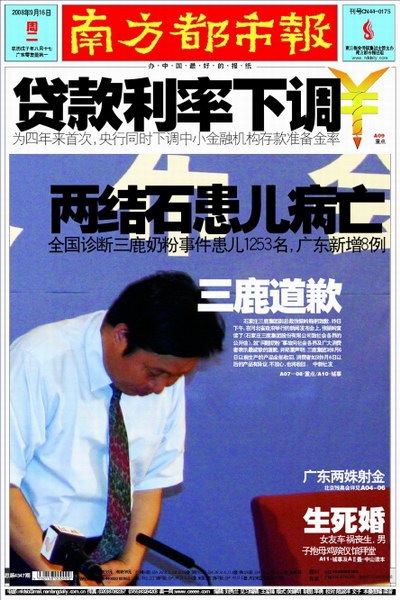
    Here is the story so far. On September 11th, almost a week ago, initial reports emerged that an unusual outbreak of kidney stones in about sixty infants had been linked to tainted milk power. Naturally the first assumption was counterfeit product, as happened in the tragic Anhui milk powder episode of 2004 and in countless food scandals in China. Since then the story has spread, blob like, in a fashion that reeks heavily of a coverup unravelling. There are now over 1000 affected babies and two fatalities. Genuine Sanlu product has been revealed to be the culprit. There’ll be no palming it off on counterfeiters. A recall of over 8000 tons of product is under way. Sanlu apologized in a news conference yesterday. Heads are rolling, but only at a suitably low and distant level in the great chain of scamming and incompetence.

    Deliciously (unless you’re a formula-fed baby), Sanlu and provincial authorities from Hebei, where Sanlu is based, allegedly knew about the problem possibly as far back as early this year, and at the very least in early August, well before the Olympics. We know this because Fonterra execs are now telling anyone who will listen that they told Sanlu and the Hebei authorities that there was a problem but got no action until they got the New Zealand government to tell the Chinese central government. So everyone involved knew the formula was dodgy except for parents merrily feeding it to their babies. The irony of this situation is that foreign involvement is often seen as an indicator of quality thanks to the well documented quality problems of domestic brands.

    The New York Times has this quote from Gao Qiang, Vice-Minister of Health, which is solid gold by the leadenly unquotable standards of Chinese officials:

    “This is a severe food safety accident.”

    You think?

    Now the conspiracy theories are boiling to the surface like worms after summer rain (we’ve had a lot of rain in Beijing recently, so this image is fresh in my head).

    Some think leading Chinese search engine Baidu may have had an agreement with Sanlu to filter negative search results. I don’t really buy this one, but as a student of the Internet I find the supposition interesting. It says a lot about how people feel about the power of search engines as gateways for information. If it was true it would be really interesting. Note to search engines: The time to come clean about how you will and won’t help advertisers is now.

    Others wonder if the story was suppressed because of the Olympics, and invoke the Central Propaganda Bureau’s alleged 21-point reporting guidance for the Olympic period. I find this one pretty credible, and it stokes my belief that in addition to bringing out some of the best about China the games also brought out some of the worst. The post linked to above, from China Digital Times, also has a translation of apparent Propaganda Bureau guidance on how to report the current situation, suggesting that the cogs of harmonization are already grinding through comment on this situation even if they’ve not yet clamped down on it completely.

    And then there are claims that Sanlu not only knew about the issue but has also beenpaying off afflicted consumers to buy their silence. This one is also pretty credible, and goes along with established Chinese practice of privately arranged compensation for the families of people injured in industrial accidents and such, often in return for an agreement not to make waves. Coal mines are past masters of this tactic.

    Uncoverup
    The PR rules for situations involving the endangerment of human life are simple: The company’s priority is to take all steps possible to mitigate danger, and communication should be centered around ensuring that the public is completely and rapidly informed in a way that minimizes the risk of injury or death. If you concede that the contaminated product is fait accompli and that some damage control will be necessary, then such an approach, funnily enough, often pays the best dividends in terms of repairing a damaged reputation. This is because it demonstrates clearly that the company prioritizes customers and human welfare over a grimy buck. In troubled times this a critical message to send, and it helps to remind customers of why they placed their trust in the company in the first place. See the Tylenol-cyanide crisis for the textbook example.

    On this count, everybody involved in the current situation fails. They’ve prevaricated their way into disrepute. There were some shockingly basic steps ignored along the way. As of Sunday, for instance, when the formula recall was in full swing, there was nothing on Sanlu’s website to suggest anything odd was going on. No announcement. No recall information. No advisory to customers. Not hotline. No news since August 14th. Zilch. As of yesterday and into today their website has been unreachable.

    This is not a surprise. It is perhaps unfair to judge Sanlu by my imperialist western standards of public communication given that the company is the product of an environment in which the relevant authorities have not always led by example. Sweeping scandal under the rug is a favorite institutional pastime here. Read up on SARS if you need a refresher on this, or the Songhua river benzene crisis, or the Xifeng county journalist scandal, and so on. But SARS was blown wide open, and if this was a cover-up it is now blown wide open too.

    While acting vigorously in the interests of the public helps to repair reputational damage from a tainted or defective product and rebuild trust, covering it up compounds the problem. Remember when you broke the dining room window and then lied to your mom and said it was the dog? And she didn’t mind the window so much but was gravely disappointed about the lie? And you didn’t even have a dog? You learned an important lesson then (I hope). This is the same thing, only bigger and with the public instead of your mother. And no imaginary dog.

    A blown cover-up demonstrates convincingly to the public that you don’t give a crap about them and that you were willing to let them (and their babies) twist in the wind to save your own hide. Now you have two problems instead of one: Your product is poisonous and your company is run by untrustworthy bastards as far as the public is concerned. The natural conclusion is that you now have at least twice as much work to do to repair your reputation, although Imagethief thinks that the repair work actually goes up as the square of the number of self-inflicted wounds, if not the cube (modern media being three-dimensional).

    In addition to simply being ethical, coming clean is a good approach because it shortens the time-frame for bad news. Scandals often don’t bust all at once, but drag out over days or sometimes weeks as bad news bubbles to surface in bits and pieces. This can feel a like a very long time when you’re on the pointy end of bad press and public scorn, and can leave a very deep impression on the public. As noted above, the CEO of Sanlu has apologized, but once the story has gone this far it looks like an apology under duress. That simply doesn’t have the power of pre-emptive contrition. (Lawyers take note: I am not suggesting pre-emptively admitting liability.)

    While it’s hard by definition to know how many cover-ups succeed, Imagethief expects that most are busted, especially when there is a large public impact. The old mob aphorism holds that two people can keep a secret if one of them is dead. If a lot of people know about your crisis, better for you that you resist the coverup temptation. Own-up and be seen to get cracking on solving the problem and helping the victims. Or hope that your crisis is so thermonuclear that it wipes out all witnesses and all evidence.

    But exhorting transparency is almost certainly pissing into the wind. The problem here isn’t just one of the occasional irresponsible company. And it’s not a problem that one or two or a dozen PR agencies or crazy PR bloggers are going to solve. It’s a problem of endemic business and regulatory culture. There are several factors at work. First, the Chinese government doesn’t have a history of encouraging transparency. Second, the relationship between media and business is often too cozy for the good of anyone but media and business (this is especially true at the local level, which is why the government’s restrictions on all but national news organizations reporting outside of their home areas are so damaging). Third, the government still maintains explicit control over the media and to a degree the Internet, which means that stifling coverage by fiat consistently presents itself as a path of least resistance. Fourth, the government still maintains tight links with major businesses. Sanlu’s majority owner as near as I can determine is the Hebei provincial government, who’s PR philosophy is probably pretty old-school.

    The Kiwi’s aren’t off the hook either
    But what of Fonterra? They’re not a Chinese company. They come from a different media, PR and regulatory tradition. How has their performance been? From the Financial Times:

    The Sanlu board, which has three Fonterra directors, was told of contamination on August 2 when a trade recall began, said Andrew Ferrier, Fonterra’s chief executive,yesterday. A public recall did not start until nearly six weeks later.

    “[Fonterra] have been trying for weeks to get an official recall and the local authorities in China would not do it,” Helen Clark, New Zealand’s prime minister, said on television yesterday. “At a local level . . . I think the first inclination was to try and put a towel over it and deal with it without an official recall.”

    ***

    Sanlu could not be reached for comment yesterday, but Mr Ferrier defended Fonterra’s role, saying “as a minority shareholder [the company] had to continue to push Sanlu. Sanlu had to work with their own government to follow the procedures that they were given.”

    Not so good, I’d say.

    Here’s the million-RMB question: Did Fonterra have a responsibility to go public in China based on what they knew? To someone not directly involved (such as me) it looks an awful lot like Fonterra sat on its hands despite knowing that customers were at risk, possibly to protect its business and relationships in China. Minority shareholder they may be, but 43% is a big minority and they have three board seats. Their reputation is hostage to the behavior of their partners and right now they look complicit in a sketchy situation.

    I am sure it was hard decision considering the prickliness of Chinese authorities and regulators and the likely fallout of ratting on their Chinese partners (see Danone vs. Wahaha for an example of what can happen when sino-foreign business relationships disintegrate). But I wonder how their noisy stakeholders back home in New Zealand, who won’t care so much about the idiosyncrasies of the China market, will react. Several nasty questions present themselves. How bad would the problem have to be before Fonterra blew the whistle? Do they prioritize their China business over the safety of customers? Is China an appropriate market for them to be in under the circumstances? At times like this you’re happy to be a privately held cooperative.

    Fonterra has no official statement on the situation that I can find as yet, although I’ve seen references to press releases. Private or not, I think they have some explaining to do.

    Lessons from the great milk-powder fiasco of ’08
    It has been heartening to see both the Chinese press and the Internet go to town on Sanlu, especially since they’re not my client. While I don’t envy them their PR miseries, the willingness of the Chinese press to take on big Chinese companies that do wrong by their customers is an important development for civil society. While the coverage will follow the Central Propaganda Department guidelines referred to above, the whack of big, negative headlines may still have a salutory effect on other companies. That’s as it should be. People trust brands. The tradeoff is that brands are accountable and the media is an important part of the mechanism for making them so.

    It’s also interesting to see that even Chinese companies can have quality problems with their suppliers. At the height of the product quality crisis much was written about the importance for foreign companies of vetting and monitoring suppliers rigorously and continuously. It is reassuring in some small way to see that it’s not just foreign dupes who have trouble managing these problems. Local dupes can have them too. It is, on the other hand, a reminder of how much room for development there is in the Chinese commercial environment.

    Finally, as bad as this situation is, it shows that there is an opportunity. Chinese companies do understand the value of a powerful brand and a good reputation. That’s a good first step, but more is needed. Many clearly also learn the value of communicating transparently and aggressively in crisis situations in order to defend the brand and reputation. Nobody wants a crisis, but the lessons learned this way can help prepare the best managed and most progressive of China’s big consumer goods companies to succeed internationally, where the old cozy approach won’t work as well.

    An ancient and time-worn chestnut of China journalism is that the word for “crisis”–危机, or weiji–contains the characters for “danger” and “opportunity”, which is sorta-true-but-not-really. As a piece of popular wisdom, it has the unfortunate consequence of trivializing the concept of a crisis. Sure, “crisis” in the classic sense means an inflection point from which multiple outcomes, including perhaps opportunity, may arise. But in the colloquial PR sense it means a grave situation with unpleasant and possibly catastrophic consequences. Thus, Imagethief has always felt that it would be much more accurate if the Chinese word for crisis combined the characters for “shit” and “fan”. I’m sure that right about now executives from both Sanlu and Fonterra would agree.

    Still, I’m an optimist by nature, and I do like to look for the upside. Let’s hope some lessons are learned.

    See also:

    Some observers see a silver lining in the scandal. “One positive result is that people will become more aware of food safety,” says Ren Fazheng, a professor at China Agriculture University in Beijing. “Government and society will pay more attention to this issue … and more inspection agencies will use more methods, so the level of inspection will improve.”

    Yet public opinion, even outrage, has limited impact, as evidenced by the stunted efforts by angry parents who lost children in the Sichuan earthquake in May to demand government accountability. While officials are still investigating why so many schools in the quake area collapsed, protests have been curtailed and media coverage on the issue banned.

    Still, with Sanlu closed by government decree and its future in doubt, two men charged with crimes that can carry the death penalty, and a government investigation widening, “this serves as an extremely strong cautionary tale for the whole industry,” says Professor Yang.

    “Lawsuits have not worked well in China, but the costs are escalating” for companies that cheat, he argues. “Producers realize now how precious their brand name is.”

    Perhaps. But as long as some companies feel their brands can be protected through means other than sound ethics and transparency I’d suggest channelling the Gipper: Trust but verify.

    Disclosures:

    Imagethief once worked for Fonterra’s PR firm in Singapore. Fonterra was not my client.

    The founder of Imagethief’s current employer advised Tylenol during their 1982 crisis. Imagethief was 15 at the time, and was too busy watching “Get Smart” reruns and not doing his homework to be involved.

    We’re very, very sorry we were caught.
    We’re very, very sorry we were caught.
  • China problems create rewards (and disasters) for PR risk takers

    Note: This was originally two posts, published within a few days of each other.

    Part 1: China problems create rewards for PR risk takers (July 30, 2007)

    All PR has an element of risk to it. That’s one of the things that separates it from advertising. Ultimately, much as we might like to be able to control the press, we can’t. Any time we agree to an interview, or put an executive together with a journalist or reach out to a blogger there is a degree of uncertainly. The wrong thing said, a spot of bad luck, or someone simply having a bad day can turn what should have been good coverage bad.

    Risk is part of the PR bargain. We surrender final control over the message in return for the credibility that third party coverage can create and advertising cannot. We’re in the business of getting other people to say nice things about our clients. But other people continue to have minds of their own despite the best efforts of me, my dark brethren and the entire television industry.

    Much of PR is the art of managing communication risk. We look for journalists and publications that offer the right mix of favorable attitude and credibility. We coach executives to give interviews and speak publicly. We prepare briefings and talking points, trying strike the balance between preserving the liveliness that makes a discussion interesting and preparing for the curveballs that can derail a discussion. We develop crisis manuals so that less is left to chance in the heat of a corporate disaster.

    As is true in so many other aspects of life, larger risks are often the price of larger rewards. I can always do a softball interview in a small-circulation industry trade. Or I can try to get something in the Wall Street Journal, with a correspondent who will ask much tougher questions. I risk a less positive article or no article at all for much wider and more credible coverage. Willingness to assume a calculated risk can often be the key to a big payoff.

    I detected such a calculated risk last week when I came across a New York Times article on how the American toy company Mattel quality-controls the products it has manufactured in China. Written by Dave Barboza, who has been omnipresent on this issue, and the US-based Louise Story, the article is based largely upon a visit by Barboza to Mattel’s facilities in Shenzhen.

    The article drags up some bad memories from Mattel’s past in Asia, but it is largely positive. It sets Mattel up as an example of how to manage overseas manufacturing, dwelling at length on what the company has learned from its experiences and what distinguishes it as a leader today:

    [In] 1997, Mattel took a significant step to improve its image and working conditions. The company hired S. Prakash Sethi, a professor at Baruch College, part of the City University of New York, who had an international reputation as a critic of worker mistreatment.

    Mr. Sethi would make unannounced visits to Mattel’s factories and vendors’ plants. He insisted that he would only monitor Mattel if the toy maker let him post his reports publicly and uncensored.

    Mattel agreed.

    Ten years later, Mr. Sethi says Mattel, unlike most companies operating abroad, still gives him 100 percent independence in his reports, which are often critical. “Mattel is the gold standard,” he said.

    Today, industry analysts tend to mention Mattel’s commitment to worker conditions in the same breath as its commitment to product safety.

    “Mattel talks about this with a passion, and it is not just lip service,” said Sean McGowan, managing director and toy industry analyst at Wedbush Morgan Securities.

    That’s a nice boost for Mattel’s reputation in a way that no advertisement will ever buy.

    What makes this article interesting is that the topic of quality control in China was one that many companies wanted to stay away from. In response to a request from a journalist a couple of weeks ago I tried to find a client that would speak about how it ensures quality in Chinese supply chains. No one wanted to go on the record. Even an industry association told me it was too radioactive to touch. Companies didn’t want to remind the public back home that they manufactured in China, even if they were doing so to show how thorough their quality control was. They all judged the risk too high.

    Mattel, however, took the risk, based presumably on confidence in their QC systems and processes. They thought they had a good story to tell and they found a way to tell it to a journalist who was interested. That’s the essence of good PR, and to my eye it has paid off nicely for them. In fact, in the article Barboza and Story take pains to point out the companies that did not cooperate:

    Mattel was one of only two major toy makers that agreed to allow a reporter for The New York Times to visit one of its factories in China — or even to put an executive on the phone to discuss the issue of Chinese product safety. Hasbro, LeapFrog and Zizzle — the maker of Pirates of the Caribbean toys, among others — all declined requests.

    Lego does not manufacture in China, but it declined a request to visit factories elsewhere. Aside from Mattel, only MEGA Brands of Canada said it would permit a visit.

    Those paragraphs make Mattel look like a well-managed company with nothing to hide. By contrast, Mattel’s reticent competitors come off looking insecure by comparison even though they may simply have been being cautious.

    I wonder whether Mattel simply spotted the opportunity when they took a call from theTimes, or if they actively pitched the story. If the latter, they earn an extra measure of respect from me.

    I suppose this story could back to haunt Mattel if they have a China-based problem in the next few months. But that seems unlikely –or at least an acceptable risk– and in the meantime they’ve earned themselves good coverage out of a situation that many other companies simply hoped would blow over.

    Note: Mattel is not Imagethief’s client. Nor are any of the other companies named.

    Related:
    Dan Harris has also remarked on this article in China Law Blog, from a slightly different perspective.

    Part 2: …And sometimes they blow up in the faces of PR risk takers (August 2, 2007)

    A few days ago I wrote a post [above] about how Mattel appeared to have seized the opportunity to generate some good PR for itself out of the China product situation. I framed it as a PR risk vs. reward equation, and thought that Mattel had done a very good job of bolstering its reputation by taking the risk of inviting journalists to tour its facilities in China.

    The problem with those risks is that they are so darn risky. At the end of my post I wrote:

    I suppose this story could back to haunt Mattel if they have a China-based problem in the next few months. But that seems unlikely –or at least an acceptable risk– and in the meantime they’ve earned themselves good coverage out of a situation that many other companies simply hoped would blow over.

    I was wrong. It was not unlikely. It was, in a perfect illustration of Murphy’s Law (or Sod’s Law if you are anglicized), inevitable. The news broke this morning that Mattel is recalling nearly a million toys for problems with lead-based paint. It was first reported by AP, but one of the two journalists who wrote the story I commented on last week has written it upmore extensively for the New York Times:

    On July 18, Mattel took a reporter for The New York Times on a tour of a factory in Guanyao, China, and of Mattel’s toy safety lab in Shenzhen. At that time, Mattel executives say, it was unclear whether Mattel was facing a widespread lead paint problem, or if the European case was an anomaly.

    Last Thursday, the same day this newspaper ran an article on the subject of preventing safety violations in Chinese factories that focused on Mattel, the company’s executives say they received conclusive data that convinced them to recall the 83 products. Then, the company contacted retailers who stocked the toys.

    “This is a vendor plant with whom we’ve worked for 15 years; this isn’t somebody that just started making toys for us,” Robert Eckert, the chief executive of Mattel, said in an interview. “They understand our regulations, they understand our program, and something went wrong. That hurts.”

    Boy, does it ever.

    What does this mean for Mattel? They seem to be doing a pretty good job of handling the recall, and they have a history of managing this kind of situation fairly well. But the timing is disastrous and the episode will undo the reputational boost they got from the story last week. Furthermore, they now face the extra scrutiny that will come from having showcased (the PR man in me hesitates to use the phrase “boasted about”) their quality control mechanisms in such detail. If you’re so good, why didn’t you catch this?

    One of my regular commenters, a lawyer, pointed out:

    [You] raise a good point about what happens if a problem occurs in the future, e.g. a product liability claim based on their China-made toys.  Having established for broad public view their set of standards, the potential for deviation from those standards could form the basis for negligence issues.

    I wonder whether Mattel had internal communication issues. Last week’s article was apparently in development for about a week, before being published on the 26th. Today’s article notes that Mattel received information of the problems on same day that the report ran. Now that’s bad timing, and, if this was a surprising result from routine testing, perhaps just colossally bad luck. But if anyone in Mattel suspected problems or knew before the article ran –or, especially, before the journalists were invited to tour Mattel’s facilities–  that the results might be problematic, then Mattel had an internal communication breakdown that might have substantially affected their PR decision making. All this is simply speculation on my part, and should be taken as such.

    PR people should take calculated risks, and I still admire Mattel’s decision to work with the Times journalists for last week’s story. I think it was gutsy and had until now yielded good results. But PR people also need to do their own due-diligence on these kinds of risks. What test results do we have pending? Are there any known issues that might break in the next few weeks? What’s my level of confidence? Mattel’s PR squad may well have done this and more, but I’m still happy I’m not the person explaining the decision making to Mattel’s senior management this week.

    I’ll be interested to see how Mattel handles communication around the recall. I also hope that companies don’t take the wrong lesson from this and become even more cautious in communicating about their China QC and sourcing. In general I still think there is a lot to be gained from showing consumers what you do to protect them, even if the systems aren’t perfect.

  • How to work with interpreters

    I spend a lot of time working with interpreters, which can be trying. Interpretation is one of those things that it seems no one is ever entirely happy with. Someone always feels like some essential point or nuance didn’t make it through. This is occasionally true. But we work with some pretty skilled interpreters and most of the time the results are good.

    A client once asked me to provide some hints on working with interpreters. I often put a paragraph or so on this into briefing books, especially for foreign execs that haven’t worked with interpreters before, but I had never really thought systematically about it. Considering how crucial interpretation is to our work, it was overdue. A lot of this is common sense, as you will see, but I did receive some valuable feedback. I am indebted to several interpreters, translators (a different art altogether) and blog commenters who shared their thoughts with me as I developed this.

    Here are my guidelines for working with interpreters:

    Give the interpreter the time and materials they need to prepare

    Every company and industry has its own specialized set of language, terms and even jargon. Interpreters may not necessarily be familiar with this before working with your company. Make sure that interpreters are given a selection of printed materials in both languages that they can study prior to any event. The more specific these materials are to the substance of your speech or discussion the better. Technical materials can be especially important. Where possible, give them complete text of speeches and press announcements in advance. Even if you advise them to translate as actually delivered, the materials will help them prepare and provide the best possible translation.

    It is also a good idea to meet with interpreters for a few minutes prior to an event so they can get an idea of your spokesperson’s accent and rhythms of speech and ask any questions they may have.

    Find two or three interpreters you like and stick with them where possible

    Once an interpreter is used to your company, style and language, it will be much easier for them to prepare for subsequent events and deliver solid results, especially if you deal in highly specialized topics or terminology. Where possible, groom a pool of two or three interpreters over time so you have multiple options handy.

    Understand the differences between consecutive and simultaneous interpretation

    There are two kinds of interpretation, consecutive and simultaneous. Consecutive interpretation is where you say something and then wait while an interpreter nearby repeats it. Simultaneous interpretation (“UN-style”) is where you say something and it is translated simultaneously by an interpreter in a soundproof booth, who can be heard over headsets worn by audience members.

    Both consecutive and simultaneous interpretation are commonly used in China. Both have the same demands for preparation and familiarity. Simultaneous interpretation is more expensive, technically demanding and often a little less accurate (no do-overs, clarifications or correction). It does, however, preserve the flow of a speech or presentation since a speaker need not wait for interpretation to catch up. Consecutive interpretation is cheaper, more flexible and forgiving. It does require speakers to pace themselves, however.

    In general consecutive translation is used for smaller or more intimate events or where budget or technical constraints make simultaneous interpretation impractical. It is also often a better choice when translation has to be particularly accurate. Simultaneous interpretation is generally better for large events and mixed audiences where interpretation has to go in both directions, and where time constraints make consecutive interpretation impractical. It is also the only choice when something needs to be translated into multiple languages for an audience.

    Budget for time when using consecutive interpretation

    A forty-minute speaking slot with consecutive interpretation leaves time for roughly a twenty-minute speech. A twenty-minute Q&A with consecutive interpretation is really a ten-minute Q&A. And so on. Plan accordingly, especially when deciding how much time to allow for media or audience questions.

    When dealing with consecutive interpretation, mind your pacing

    Enthusiastic executives sometimes forget about the interpretation and ramble on. Stay mindful of the interpreter and keep each statement to a paragraph or a few sentences. Pacing is helpful for the interpreter, but a good interpreter can stay with you for a surprisingly long time and still often deliver a solid interpretation. An audience, however, will tune out very rapidly listening to something they don’t understand for too long.

    There is no hard and fast rule for how often to break. A greeting can be interpreted after one sentence. A complex chain of thought might go on for one or two minutes. Look for subject or pace changes as natural breaking points, and discuss with your interpreter beforehand if necessary. Don’t err too far on the side of caution and speak one sentence at a time. An interpreter will often require a few sentences for context in order to provide an accurate interpretation. While pacing for interpretation can feel like it disrupts the flow of a speech or presentation, spokespeople rapidly get used to it.

    If you are working from a prepared text, mark potential break points in advance. While a good interpreter can follow natural speech comfortably, make sure your pace stays measured. If you are delivering particularly technical or complex messages, ensure that you give the interpreter a little extra space to work with.

    It may not be a good idea to have someone from inside your company interpret

    Good interpreters are trained and experienced. Interpreting well requires more than simply knowing both languages; it also requires a systematic approach to note taking, capturing key points and preserving the essence of meaning in statements and idioms that may not cross cultures. Also, while someone from inside your company may know your terminology well, they may either forget they are interpreting or introduce their own biases into interpretation (both of which I have seen happen).

    There may be times when it makes sense to have an employee or PR consultant translate, if a professional is not available, if there are extreme confidentiality issues that can not be adequately addressed with outside personnel, or in informal situations such as a dinner where the discussion is casual or brief. But most of the time a professional interpreter is the best choice.

    Don’t be surprised if the interpretation isn’t exact

    Interpretation is an inexact science, especially as it is a “live” process. An interpreter at an event, who can see facial expressions and sense the atmosphere of an event, might interpret differently than a translator working from a written transcript of the event. Fast speakers may also find that details get filtered out in favor of key points.

    Good interpretation carries the facts and essential tone of a speaker’s message. It may not capture specific phrases or even the exact arrangement of ideas. This can be due to the demands of different languages, the need to work around cultural issues, or the fundamental limitations of the interpretation process. Warn spokespeople who may see their speeches or Q&A back-translated into English that what they are reading has been translated twice, and may not exactly reflect what they said.

    Although interpretation is inexact, it should be accurate and consistent. Don’t work with interpreters that are error prone or introduce their own biases or ideas into interpretation. But also do what you can to make the interpreter successful.

    Don’t daisy-chain interpreters

    People sometimes want to do this when they can’t find the interpreter they need in China. If they can’t find a Korean-to-English interpreter here, they consider using a Korean-to-Mandarin interpreter and then a Mandarin-to-English interpreter. In this situation you’d be better off flying somebody in from Korea. It will be worth the money. Your event will be an order of magnitude less awkward and your interpretation more accurate. Don’t play “telephone” when your reputation is on the line.

    Never assume an audience doesn’t speak your language just because you’re using an interpreter

    Many Chinese people, especially in professional circles, understand some English. They may understand it much better than they can speak it. Even when working with an interpreter, assume the audience understands you. Have a local staff member vet your English speech or presentation for cultural appropriateness beforehand, and don’t assume an interpreter will correct problems. Don’t discuss confidential or irrelevant information in front of the audience and assume that language will protect you.

    Review interpretation after an event and see what problems need to be addressed next time

    After working with an interpreter, sit down with your local team and the interpreters as well if possible and review the delivery for any problems or pitfalls that should be addressed in future. Go over the transcript if you have one. If local staff members complain about interpretation, make them be specific about their complaints. Complaining about interpreters is a favorite sport since the quality of interpretation is a rather subjective thing. Learn to differentiate real problems –issues of substance or accuracy– from disagreements over style or word-choice.

    Blaming the interpreter is not an acceptable PR defense…

    …unless you want to accuse your own PR staff or agency of incompetence in the process. A well-prepared interpreter should not cause you PR problems. If you are dealing with sensitive information, such as financial or crisis situations, pre-event preparation should be appropriately thorough and your own Chinese-speaking staff should monitor interpretation for accuracy during the event and intervene if clarification is necessary.

    For more advice see the International Association of Conference Interpreters’ (AIIC) guidelines at http://www.aiic.net/ViewPage.cfm/page29.htm. These are oriented toward simultaneous interpretation, but have some broadly applicable points. It includes such helpful hints as a reminder not to test microphones by tapping on them or blowing into them when simultaneous interpreters are listening to the audio feed over headphones.

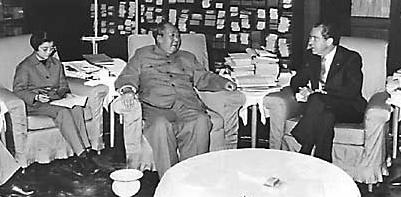
    The Chairman would like to ask you about "Laugh In".
    The Chairman would like to ask you about “Laugh In”.
  • How to turn one terrible scandal into two

    Note: This includes two posts originally published on back-to-back days.

    Part 1: How to turn one terrible scandal into two

    Imagethief loves watching companies hang themselves. Unless they are his clients, in which case he has fits watching them hang themselves because it means sleepless nights in the glow of the computer eating greasy dinners out of Styrofoam boxes.

    Fortunately for me, China Railway 12th Bureau Group Company is not one of my clients. For one thing, if they were, I’d advise them to change their name. I had to look at the original article twice to transcribe it. I’m sorry, but if you’re not a law firm you have no business having five nouns in your company name.

    More importantly, they have just committed one of the great PR sins: the busted coverup. From AP, via BusinessWeek:

    Police have detained 10 people in charge of building a new subway line for the 2008 Beijing Olympics after one of the project’s tunnels collapsed, trapping six workers, state media said Friday.

    ***

    Construction company China Railway 12th Bureau Group Co., was suspected of trying to cover up the accident and delaying rescue efforts that might have saved lives, Xinhua said.

    Police have detained 10 people including the project supervisor and the tunnel’s designers, Xinhua said. It did not give their names or say if they had been formally charged with any crime.

    Xinhua said the construction company sealed the site immediately after the accident, confiscated employees’ mobile phones and ordered people not to talk to police or media.

    The company did not report the accident to city authorities until eight hours after it occurred, it said, citing unidentified Beijing officials.

    You would think that after the great Songhua River disaster of ’05 people would have learned their lessons about this. But it’s hard to overcome those olde fashioned instincts, and probably even harder when you are working on a marquee project that is part of Beijing’s pre-Olympic rectification program.

    By definition, no one really knows how many successful coverups there are. However, I’d bet there really aren’t many. It all comes down to the old adage that two people can keep a secret if one them gets a lead tattoo. I am not sure any peer-reviewed scholarly work has been done in this area, but I am convinced that as the number of people involved in a coverup goes up, the risk of it being blown increases far more than in linear fashion. I betting that risk increases as at least the square of the number of people involved.

    So you can confiscate all the mobile phones you want, and you can order people not to talk, but sooner or later somebody will. And probably sooner. And even if they don’t, people –family members and friends for instance– tend to notice a lot of sudden deaths.

    Now China Railway 12th Bureau Group Co. (or CR12BGC as I like to think of it) has two crises on its hands: the possibly negligent deaths of twelve workers, plus a mass arrest of its executives and supervisors. Instead of looking negligent, they now look negligent, sleazy and criminal. Congratulations! It’s not easy to self-destruct that dramatically without being discovered trafficking in kiddie pr*n. Good luck explaining all this to the press.

    Unless the government bans all coverage of the situation. This is China, after all, and the rules remain a little different. I realize also that CR12BGC is probably not the most progressive company when it comes to communication. But despite the high level of government intervention, China now has a scrappy, modern media that loves a good scandal. The sooner Chinese companies learn how to deal with this, the better things will go for them.

    We PR people are widely unloved. There is some justification for this. As an industry we have a history of taking on unsavory clients and disagreeable jobs. But its also unfair in some ways. In crisis situations we spend a lot of time giving variations on the following straightforward advice to our clients:

    1. Don’t lie.
    2. Be mindful of your legal risk and prudent in communication, but don’t try to hide or distort the facts of what actually happened.
    3. Don’t lie. (Again.)

    Writ large or small, successful crisis communication is about clearly explaining your side of what happened and being publicly seen to take all practical steps to address the crisis and assist the people affected. You can’t bring back the dead, but you can take care of the living, understand what went wrong, visibly cooperate with authorities and demonstrate a commitment to learning from mistakes. It might not do anything about your legal liability, but it will help your reputation and generally costs less in the long run than the alternatives. And if you do get prosecuted, a constructive approach looks a lot better in court than an attempted cover up.

    Plus its hard to work a crisis when all your spokespeople are in jail.

    Gasp! It's the China Railway 12th Bureau Group Co.!
    Gasp! It’s the China Railway 12th Bureau Group Co.!

    Part 2: Beijing subway collapse: Whose crisis is it?

    Following up on yesterday’s post about the Beijing subway collapse, I saw an interesting article (subscription) by Mei Fong in yesterday’s Wall Street Journal, Asia. (I try to get that right ever since one of their journalists explained to our staff in Beijing that it’s not the “Asian Wall Street Journal” any more, and that we had better get with the times.)

    Because of its galvanizing effect on everyone with a China agenda, the Beijing Olympics has been described within my industry as “issues rich”. This is PR code for “shitstorm waiting to happen”, and is the kind of thing that usually leaves PR men cackling to themselves and planning expensive purchases. (Or, at my pay grade, grocery shopping.)

    Among the many China issues that people get in a twist about is migrant laborers. There are by the government’s own estimates 115 million of them. For perspective, that’s less than 10% of the population of China, but more than 35% of the population of the United States. And I’m not sure the government is counting everyone.

    A lot of these migrant workers are currently in Beijing, slaving away on extremely high-profile, deadline-sensitive projects that are part of the city’s pre-Olympic renovation. People have noticed this. Mei writes:

    [Beijing’s] haste to meet its construction deadlines has resulted in round-the-clock work for the armies of often poorly paid, badly equipped migrant workers who build most of these projects. Some work shifts that can last as long as 24 hours.

    The relatively poor working conditions of migrant workers has come under greater media scrutiny in recent months, causing international labor groups — many already critical of China’s poor human-rights record — to put greater pressure on the International Olympic Committee to improve the situation.

    IOC spokeswoman Giselle Davies said in an email that “our understanding is that all efforts have been made both in terms of safety — specifically putting precaution first, and also in terms of transparent management.”

    Does the IOC really believe that? Even if it doesn’t, is there anything else it could say without admitting culpability and precipitating its own crisis? How about:

    “The IOC is aware of the widespread exploitation of Chinese migrant laborers, the mistreatment they commonly suffer and the appalling and unsafe conditions they endure. We sympathize completely. But we also believe that during the pomp of the opening ceremony, amidst the pageantry, grandeur and fireworks, no one will be thinking about a few bones in the foundations.”

    Maybe not. OK, what Ms. Davies says isn’t as bad as my idiot scenario above. Note the weasel words, though: “Our understanding is…” That phrase is the IOC’s absolution. It transfers responsibility onto BOCOG and the Chinese government. They told us everything is OK. But for credibility it depends upon you and me believing that the chain of honest communication and transparency from labor contractors to construction subcontractors to primary contractors to the municipal government and BOCOG is intact. Do you really believe that? Of the Chinese construction industry? And if you don’t, then should the IOC?

    I realize I am dissecting one partial statement out of context here. But that’s what the public will see, so that’s what will inform people’s opinions.

    As for BOCOG, it has duelling priorities:

    Priority 1) Have a glamorous and untarnished Olympic Games that mark China’s emergence on the International stage.

    Priority 2) Get the goddamn thing done in time and on budget.

    So which priority will win, and whose reputations will get trashed in the process?

    493 days, 6 hours, 51 minutes and 17 seconds to go as of this posting.

    Gasp! It's BOCOG and the IOC!
    Gasp! It’s BOCOG and the IOC!
  • Fly the feces-free skies of China Southern

    Few things have provided more grist for Imagethief’s gripemill than Chinese airlines. A simple search of this website for various permutations of China+Airline+Travel will make that abundantly clear. In part this hostility is unfair. Chinese airlines are every bit as good as American carriers –although I have heaped scorn on those as well– and in some ways they are distinctly better. For instance, I would recommend Chinese carriers to anyone with a fetish for being waited upon by attractive Asian women as opposed to a fetish for being snarled at by hostile, matronly Americans. Not that no one has that particular fetish, its just that its somewhat more eccentric and self-destructive, like a fetish for self-mutilation, blender worship or Paris Hilton.

    And of course, Chinese carriers are every bit as successful as their American counterparts, which is to say they are losing money hand over fist. That’s why I was constipated to readin a Reuters news story (quoting Xinhua) about some of the money-saving steps recently suggested by China Southern Airlines:

    A Chinese airline has calculated that it takes a litre of fuel to flush the toilet at 30,000 feet and is urging passengers to go to the bathroom before they board.

    As Chinese airlines come under increasing pressure to cut fuel expenditures, China Southern’s latest strategy is to encourage passengers “to spend their pennies before boarding the aircraft”, Xinhua news agency reported on Thursday.

    “The energy used in one flush is enough for an economical car to run at least 10 kilometres,” Captain Liu Zhiyuan, who flies regularly between Hangzhou and Beijing, was quoted as saying.

    Citing a survey by the company’s logistics department, Liu said carrying one kilogram of items such as blankets and pillows by air for one hour uses 0.2 kg of fuel.

    “This means the blankets and pillows on board the aircraft eat up 60 tonnes of fuel every day. If each seat is loaded with three 450-gram magazines, another 60 tonnes will be consumed,” Liu explained.

    Well, having taken many flights on China Southern over the past few years, I can tell you that many passengers already consider flushing optional, so it’s debatable how much value such a program might have. I also think that the focus on flushing perhaps ignores the root of the problem, which is that according to this article, airplane toilets are some of the least energy efficient devices on the planet, on a part with M1-Abrams tanks and arc lights. Airplane manufacturers may want to get cracking on this (so to speak). After all, if my home toilet required a liter of kerosene for every flush, I’d just use half the kerosene to burn our daily household quota of excreta in our apartment building’s courtyard (everyone loves a bonfire) and sell the rest on the aviation fuel black market for cold, hard cashola.

    But as the article makes clear, cracking down (again, so to speak) on online flushing is really only part of the solution. The real triumph would be to encourage people not to carry any bodily wastes on board the airplane at all. In fact, I think the “pillows and magazines” in this article are really offered as a gentle metaphor for the collection of excreta sloshing around inside of each of us. After all, to the airline, the accumulated fecal matter fermenting in your bowel is just another form of carry-on luggage, and one that they have no control over. And nothing chafes an airline more than the thought that you might be gaming their system. Turds are just the beginning. Next thing you know people will be wrapping their duty free purchases in condoms and swallowing them to evade carry on limits.

    Let’s look at this scientifically. Doing some quick research, I note from a highly credible source, the movie Beverly Hills Cop, that the gut of the average American fifty-year-old contains about five pounds (2.25 kilos) of undigested red meat. Chinese are not Americans, but they are eating an increasing amount of red meat so let’s use American fifty-year-olds as proxies for the entire Chinese population and go with that number. It’s this spirit of daring scientific inquiry that led to such breakthroughs as cold fusion and Dr. Hang Woo-suk’s cloning program at Seoul National University. Going further I also note that China Southern is one of the airlines that has ordered A380s, which can carry up to 500 passengers. After performing some complex and rigorous calculations far beyond the reach of lesser cortexes, I discover that a single planeload may be hauling around up to 2500 pounds (1,136 kilos) of turds.

    Shocking. If the fuel consumption figures in the article above are accurate, that means that China Southern’s A380s could burn up to 227 extra liters of fuel an hour just dragging around surplus shit. On a twelve-hour long-haul to San Francisco that could mean almost 3000 extra liters of fuel consumed in the name of turd-haulage. Add on another three flushes (conservatively) per person on that same flight and you are looking at another 1500 liters of fuel consumed, for a total of 4500 kilos of fossil fuels –1.5% of the aircraft’stotal fuel capacity– flushed away in the name of airborne waste management. My god, people, haven’t you heard of global warming?

    Looked at this way, you can see that China Southern might be onto something. In fact, they might taking too conservative an approach to managing this situation. In the interest of safeguarding this planet that we all share, Imagethief proposes that, like hair gel and toothpaste in the US, human fecal matter be banned from all Chinese flights. Passengers should be required to consume a heavy dose of laxatives the day before flying and to purge thoroughly before boarding. Enema lounges could be installed in all Chinese airports, helping passengers to unburden themselves their ungreen load before boarding. I find a pre-flight high colonic highly refreshing myself, and imagine that it could become quite the fad. Naturally, pre-boarding security questions should be amended:

    • Did you pack your bags yourself?
    • Has anyone else handled your luggage since you packed it?
    • Did you have a nice, big shit this morning?

    With a few simple steps like this we can help China Southern to claw its way into profitability and reduce the global warming threat posed by air transportation. China could establish itself as environmental leader and revolutionize the entire approach to air travel. Dependency upon oil imports would also be reduced. Just think: if every airline in the world was to implement a program like this, we would live on greener, cleaner, more peaceful planet. Considering the benefits, an enema at a Chinese airport seems like a small price to pay.

    Note: Thanks to Gordon at The Horse’s Mouth for sending this article to me. Dude, when are you coming back to China? This country needs you.

    Related: Shanghai closed flights into and out of Pudong for several hours yesterday due to “air traffic volume”. Foreign flight crews ascribed the delays to military exercises. Anyone who travels in China regularly knows that the all-too-common flight delays and cancellations often get dubious official explanations, and the military’s fiat over Chinese airspace is widely and credibly blamed. In this case it seems likely. No one closes an airport to all traffic because of congestion. You might divert some traffic or delay some flights, but close the airport? The flagship airport at your glamourous international business city? The military explanation sounds a lot more credible in that case. Or some other similarly conspiratorial explanation. At any rate, you coudn’t get much more bush-league, especially considering the government’s usual appalling communication, which extends to what looks to me like a complete absence of any press coverage of the incident.

  • Foxconn shoots themselves, Apple in foot

    Note: This post consolidates three original posts on this topic that were published on consecutive days. It was also cross-posted on my CNET blog, published in 2006 and 2007.

    Part One: Foxconn shoots themselves, Apple in foot

    You may recall Foxconn, AKA Honhai Precision Manufacturing, as the company at the center of a recent PR crisis for Apple Computer, when a British newspaper published reports that they were mistreating the workforce responsible for assembling luscious (and expensive) iPods. In the last few days Apple, ever image conscious, got round to publishing their own report on the situation, and it has largely faded from the public consciousness.

    But Apple isn’t the only company that was left scrambling to protect its reputation in the wake of the scandal. Foxconn too felt hard-done by, and is taking steps to assert itself. Unfortunately, rather than take constructive steps to reassure the international companies who’s own brands are propped on Foxconn’s labor practices, Foxconn has instead decided to make an example of two Chinese journalists. This looks like a move that has the potential for mighty backlash.

    China’s English Language Shanghai Daily broke the story in the mainstream. Here it is reprinted by Xinhua:

    BEIJING, Aug. 29 (Xinhua) – A Chinese court has frozen the personal assets of a reporter and an editor at a Shanghai newspaper after Apple iPod manufacturer Foxconn sued the pair for 30 million yuan (US$3.77 million) for allegedly damaging its reputation over reports of substandard work conditions.

    Foxconn’s subsidiary in Shenzhen reportedly petitioned the city’s Intermediate People’s Court on July 10 to freeze the property of Wang You, a reporter for China Business News, and Weng Bao, an editor at the newspaper. The locked-up assets include apartments, a car and bank accounts.

    The company also filed a lawsuit against the journalists, seeking 20 million yuan from Wang and 10 million yuan from Weng. The case is the biggest of its kind on the Chinese mainland in terms of the size of the compensation claim.

    I am not the only one who sees Foxconn’s response as being perhaps a bit disproportionate. Sentiment seems to be gathering that the lawsuit is a blatant press intimidation tactic rather than a dispassionate seeking of legal redress. Two excellent English language China blogs have taken Foxconn to task. Non Violent Resistance writes, in a post scathingly titled “FoxConn is not dumb, but downright vicious“:

    Words in the Chinese press circles are, that FoxConn, therefore Hon Hai, had deliberately picked the two journalists from China Business News to sue in a painstaking plot to harrass and intimidate media outlets and journalists. After all, China Business News was not the only newspaper that doggedly followed the iPod sweatshop story. It seems that FoxConn, before launching the much criticized lawsuit, had also considered targeting 21st Century Economic Herald, another popular business newspaper who had similarly covered the story. But FoxConn’s lawyers, after much investigation, found out that the 21st Century reporters who were involved in reporting the story had solid, formal employment contracts with the paper — therefore, unlikely to be held as legitimate defendants in a court.

    Roland Soong, of EastSouthWestNorth, writes:

    If I can make this case very simple.  This is not a question of whether the First Financial Reporter was right or wrong in his reports.  Either way, FoxConn is entitled to file a civil libel suit against the newspaper, which employs that reporter and his editor.  But since when does a civil libel suit involve freezing the assets of the reporter and the editor, including their bank savings accounts, stock holdings, homes and automobiles, to the tune of 10 million RMB for the editor and 20 million RMB for the reproter?  As the reporter noted, this amount is many more times than that which he can ever expect to make in his lifetime.  By comparison, how would the western media react if a prominent American newscaster such as Katie Couric were sued by a large corporation and have all her personal assets frozen for the duration of the legal proceedings?  The Chinese media workers are of the opinion that if this case were allowed to go through, it will be the end of any coverage of the doings of large corporations.

    More good information from Roland here.

    I can see the thought forming in your head. Dude, it’s China. Press intimidation? So what else is new? But it isn’t quite that simple. Yes, the press in China doesn’t operate with the same freedom that is does in the west, especially when it comes to political reporting. But what the government can get away with in the name of social harmony and what a Taiwanese corporation –even a connected one– can get away with are not the same.

    So what might the PR implications be? Well, the story is now being picked up by various foreign media, including specialized voices such as China CSR, and wire services like AFX,AFP (here on the International Herald Tribune) and Reuters, whose headline suggests that, despite what Non Violent Resistance fears, the newspaper will vigorously defend its journalists. Reuters has actually bothered to get out and do some reportage, and their story includes a quote from one of the sued journalists and a quote lifted from a party-managed Chinese newspaper’s editorial, and written apparently without irony:

    “(The case) has sent a dangerous signal to society, and means legal procedures could be used to suppress freedom of speech,” said an editorial in the official China Youth Daily.

    How about that. If China Youth Daily is complaining that you’re infringing freedom of speech, you have a problem. But journalists –even at official news organizations– will look after their own. Superb China media blog Danwei thinks the story has all the right ingredients to keep titillating western editors (and I agree). The China blogosphere is also gathering heat. Yesterday mega-portal Sina, smelling a juicy story, set up a blog for the two journalists, and the posts are attracting lots of comments and lots of readers. The momentum may not last, but its got off to a good start. The net result is that Foxconn is committing one of the great PR sins by busily making itself look worse than the people it is angry at ever did. And there is no damage worse than self-inflicted damage, which suggests stupidity.
    So if you’re Apple what do you think of this? Remember, this incident is descended from an Apple-related story, and MacWorld UK has also picked up the lawsuit story, so it’s creeping close to Apple’s own brand. The whole thing has now gone beyond simple libel lawsuit and in just 48 hours has spiraled into something nasty with a real whiff of media intimidation about it. Reputation damaging questions are also being asked about Foxconn’s relationship with the Shenzhen government and courts. Chinese press isrubbishing the case. Well, if I’m Apple (or their PR guy), the last thing I need is for the contract manufacturer who just gave me a mighty PR headache to give me another mighty PR headache just ten days after I’ve put the last one to bed (Apple’s report was released August 17). Despite their own recent, poorly thought out lawsuits, media intimidation is not something that resonates well with Apple’s cerebral, trendy brand. If I was Apple I’d be gently suggesting that Foxconn back off if they want to keep my business.

    But, hey, that’s just me, and I’m a nice guy who likes reporters, even though I do bug them with pitch calls from time to time.

    Part two: What was Foxconn thinking?

    Originally published August 30, 2006.

    Every now and then, Roland [Soong, of EastSouthNorthWest] dangles a PR question in front of me and, like a shark rising predictably to the bait, I pretty much always go for it. In yesterday’s post [above] about Foxconn’s fit of PR self destruction, Roland asked in a comment:

    What is the matter with FoxConn? Why is this “no comment” thing? Keeping their fingers crossed and hoping that it will all go away? Can you guess what is going on?

    Well, I am happy to guess. But I’d like to remind all readers that this is nothing more than speculation, innuendo and hypothesis. Of course, that’s never stopped me before.

    From a PR point of view, there are a few things going on here: the original foreign and Chinese newspaper reports about Foxconn’s labor practices, the subsequent lawsuit filed against two Chinese journalists, and the current (entirely predictable) coverage explosion over the lawsuit and refusal of Foxconn to comment. This would be a complex situation for any company to manage from a PR point of view. But it’s going to be even harder for Foxconn. I am going to make a sweeping generalization here: Chinese companies (including Taiwanese ones – please keep your “one China” screeds to yourself) by and large don’t “get” PR. As an old China hand friend of mine said, “They don’t understand PR. They understand face.” Well, just like face can get you into a fistfight that never needed to happen, it can also get you into a PR disaster that never needed to happen. But I think the Foxconn situation runs deeper than simple face.

    Putting the problems of Chinese companies with PR somewhat more scientifically, many of them are just learning what PR is and how to use it. As a Taiwanese company and contract manufacturer, Foxconn evolved in a somewhat more developed media market than mainland companies. It has also been around for more than thirty years, although its internationalization in earnest started in 1993. But as a contract manufacturer –and not, say, a consumer brand– Foxconn may also think that it is insulated from certain kinds of PR problems. This may have been true once, but today, when the bloom is off the outsourcing and contract manufacturing rose, and MNCs are under increasing scrutiny for the behavior of their partners, this is not the case. That lesson should have been made painfully apparent in the original Apple scandal of a couple months ago.

    But there is another complexity operating here: this isn’t just a PR crisis (yes, its an official crisis now). It’s a legal PR crisis. And legal situations are always particularly difficult. With all due respect to my good friends at China Law Blog (who may wish to comment upon some of the legal aspects of this case), lawyers and PR people often rub along poorly. A sound legal approach and a sound PR approach to a given situation do not always agree. I am perhaps nursing a bit of resentment here. Put a CEO, a head of PR and a general counsel in a lifeboat together and maroon them at sea until they begin to starve and see who gets eaten first. Nine times out of ten the CEO and general counsel will eat the PR guy. The CEO’s calculation may be that he’ll need a lawyer to keep him out of jail for cannibalism. Personally, I think that’s misguided. After all, who’s going to do a better job of explaining cannibalism to the public and protecting his reputation?

    My personal issues aside, the upshot is that legal decisions are often considered to trump PR decisions, and are thus taken without regard for the PR consequences. This is especially true in companies with an unsophisticated approach to PR, but it can happen to anyone. In China we see this with things like IPR lawsuits by MNCs against local companies, which make perfect legal sense but can sometimes have PR consequences far more damaging than the actual infringement. But somehow legal problems are considered “real” while PR is considered, well, just PR. So it’s possible that even if someone within Foxconn explained to the management that suing journalists directly was a stupendously bad idea PR-wise, it’s possible that they were simply dismissed as a touchy-feely PR type without the spine to face up to hard-boiled business issues.

    To which that PR person, if he exists, should be saying who’s laughing now, dumbass? Of course, now this poor flack is busy trying to deal with the PR crisis upon which he will probably be judged, so he has no time to gloat. It’s a hard life in the spin doctors.

    So that brings us to the “‘no comment’ thing” mentioned by Roland. Regardless of whether PR people were consulted prior to the lawsuit or not, it’s pretty standard practice for companies to refuse to comment on pending or ongoing litigation. Doing so can often create further legal problems, anger judges, etc. Unfortunately, this can also evolve into a sort of programmed, knee jerk response that is automatically given even in situations where companies really ought to comment. Personally, I think this is a situation that increasingly merits comment. Furthermore, my advice to clients is that you always return a journalist’s phone call, even if it’s just to tell them that you can’t comment, and even if you expect to get roasted for that. It’s a basic courtesy and “could not comment” or even “refused to comment” generally looks better in print than “could not be reached for comment” or “did not return phone calls”, both of which make it sound like you’re hiding and amplify the appearance of guilt. Next to the image of you cowering in a smoke-filled crisis room while unanswered phones ring away, the blandest of holding statements can seem like pure gold. In this case, Foxconn is apparently not returning any calls, so, true or not, they look like they’re hiding. It also makes it hard to know if they’re playing the “don’t comment on litigation” card or if they’re just being obtuse. I’m betting on obtuse.

    Ultimately the question of motivation looms here. Is Foxconn motivated by a sincere desire to address a slight to its reputation by seeking legal redress? Or is it seeking to intimidate the Chinese press as a way of buying future insurance against bad coverage? If it is taking the first course it has committed some serious PR mistakes. It is almost always a bad idea for corporations (or governments) to sue individuals who were working on behalf of an organization, such as a newspaper. For examples, see Apple’s lawsuits against leakers and the RIAA lawsuits against file sharers, both of which were PR disasters even if they were legally sound. Suing an organization looks like seeking redress. Suing an individual looks like petty vindictiveness. David v. Goliath. It’s not that difficult an equation. (Mind you, I am speaking strictly from a PR point of view, not a legal one.) Foxconn has sued the journalists rather than their newspaper. Not only that, it has sued them for far more money than either of them is ever likely to possess, and has had their assets frozen. This not only looks petty and vindictive, it also looks sleazy since they have somehow managed to engineer a presumption of guilt and, without the benefit of a judgment, inflict considerable misery on…a journalist and an editor. And we all know how much Chinese journalists are paid. So if Foxconn was seeking to address a slight to its reputation, it has failed monumentally and is now doing even more damage to its reputation.

    On the other hand, if Foxconn was seeking to intimidate journalists…it has also failed monumentally since the Chinese (and International press and, um, bloggers) are now going crazy.  Nice work guys. It’s Miller time.

    In addition to the China PR problem, Foxconn is also entering into extremely risky territory with regards to its foreign customers, like Apple. Anyone who has followed the recent problems of US Internet and technology companies in China knows that freedom of speech issues are weeping dynamite for foreign companies doing business in China. The last thing a company like Apple needs is a contract manufacturer being accused of media intimidation in China. Imagine:

    “Hey Apple! Your contract manufacturer was just accused of horsewhipping underage girls for sixteen hours a day and now they’re trying to intimidate Chinese journalists into silence on the issue. What’s your comment? How do you feel about the freedom of Chinese media to report on these kinds of issues?”

    Despite my advice above, I’m thinking Apple doesn’t return that phone call. Or if they do, they give a non-answer about how this is an issue for the Chinese courts to settle, Apple has taken great pains to blah blah blah noise noise noise. Apple, you will recall, has had its own problems with the media, and may not want to attract charges of hypocrisy. They will also, somewhat justifiably, want to get All The Facts first.

    But that’s tough for them, because this is their PR problem too and, as I wrote yesterday, if I’m Apple I’m on the phone to Foxconn right now telling them to drop the suit, save face by announcing that their point has been made and suck it up. Better yet, Apple should set a further example for MNCs using contract manufacturing in China and come out with a statement vigorously defending the right of the Chinese press to look into the practices of MNCs and contract manufacturers in China. Apple sells jack here and has essentially no market to lose in China, and can always shift its manufacturing to Vietnam or wherever, so why not retake some of the high ground it lost over the original scandal? What’s Foxconn going to do? They’re Apple’s vendor, and there are plenty of business-hungry contract manufacturers in line behind it.

    And this situation has begun to touch Apple. RSF is already on the case, with an open letter to Steve Jobs.

    But what if the journalists actually did libel Foxconn?

    Interesting question. But from a PR point of view (not a legal one, mind you) now irrelevant. The public opinion and reputational battles have already been lost. A legal victory would be Pyrrhic at best. Foxconn absolutely has a right to defend its reputation in the courts and to respond vigorously when libeled. But legal action in defense of reputation must be considered, planned and executed with an eye on further reputational consequences (this is where PR people and lawyers often diverge). And that is something that Foxconn did not do. Furthermore, Chinese journalists will, if anything, probably be motivated to scrutinize Foxconn even more closely from now on.

    So if I were Foxconn’s PR person what would I now advise them? Presumably after I got done berating them for not talking to me before they launched the lawsuit?

    Drop the lawsuit. It’s too late to salvage this one. Drop it, make a face saving announcement and let it go. And if you must pursue the lawsuit, admit that you were “overzealous”, have the court unfreeze the journalists assets and allow them to go on with their lives pending a judgment. And reduce the damages sought to something symbolic. Remember, this is PR advice, not legal advice. I have no idea how possible any of this would be in Chinese courts. But, at first glance, Foxconn’s relationship with the Shenzhen courts looks pretty cozy, so it shouldn’t be too hard.

    And, really, stop making life difficult for your customers. You don’t need a PR man to tell you that’s a crappy way to do business.

    Notes:

    • iSuppli analyst Adam Pick recently wrote a story hailing Foxconn’s success. Among the factors he noted, “making the most of the China advantage”. It scarcely needs be remarked that one can take “the China advantage” a bit too far if not careful.
    • I should note, by way of full disclosure, that I am not a litigation support expert. That’s a specialized PR field, like financial communications, best practiced by people with a good understanding of the legal environment in which they operate. So my observations are those of a PR generalist. Litigation support experts are welcome to comment.

    Updates:

    • Danwei with some more interesting background and opinions from Chinese media.
    • Sina’s tech news page (not the journalist blog) devoted to the situation, including a handy timeline graphic (Chinese).
    • One of my bosses, a very experienced Chinese PR professional, thinks that Foxconn will be forced to withdraw the litigation. He even thinks it is possible their chairman may have to apologise. We’ll see.
    • Roland’s excellent follow up on the PR war between Foxconn and the journalists includes translations of some of Weng Bao’s blogs (the sued editor). Roland also makes an excellent point that I should have, and which is key to how Foxconn needs to think about this PR battle. From a public communication point of view this PR war is assymetrical. Foxconn is an enormous, faceless corporation speaking in corporatese. The journalists are identifiable human beings able to muster emotion and personal sympathy and use press freedom (in an acceptable local context) as a rallying cry. That means that even if they are guilty, they have the upper hand in the PR battle. Foxconn needs to consider that in all of the their PR strategizing if they are to have hope of looking like anything other than relentless bullies. (Hint: get some real people front and center.) As I wrote above, whether or not libel was committed is now essentially irrelevant. Foxconn can win but still lose if they are not careful.
    • I hear that CCTV 2′s “Dialogue” program is planning a special segment on the affair.

    Part Three: All’s well that ends in retreat

    Originally published on August 31, 2006.

    According to ESWN Foxconn has reduced the damages requested to 1 yuan. Roland is citing a very brief Netease report, and I am not sure how authoritative it is. But if it is true, then it means that Foxconn has taken one of the possible paths I outlined yesterday: reduce the damages to a symbolic level but proceed with the lawsuit. Apple also interceded in the dispute, as I suggested they should. I’d like to claim credit for remote PR genius but, a) it’s not genius, it’s common sense; b) Foxconn and Apple are probably not reading this blog and c) we’ll see how things play out for Foxconn in the Chinese press over the next few days.

    Just as interesting as the Foxconn scandal itself is a sideline discussion that has broken out over the newsworthiness of the story with regard to western audiences. Roland was originally disappointed with slow uptake of the story by Western media. Do read his post above, which offers his point of view on this and lists many of the foreign news sources that eventually did carry the story. Then be sure (especially if you’re a China PR pro) to read this post from Richard Spencer, bureau chief of UK newspaper the Telegraph. Richard keeps one of the best journalist blogs in China and he explains very clearly what news value this story has and doesn’t have with regard to his (middle-England) readers. I should send this post to my clients when they ask why I don’t pitch their China business stories to general-interest Western media like the Telegraph, as opposed to specialist business media such as The Wall Street Journal, Financial Times and Business Week.

    I’m a technology PR man so I think in terms of brand and reputation with regards to technology companies. I wrote the story for my CNET Asia blog, but then I have a specific China technology mandate, no editing to speak of, and write for an Asian readership specifically interested in technology. More generally, I tend to judge a story this way: “If I was that company’s PR man, would I be worried?” For me this story had potential legs overseas for one reason: Apple. Apple is a hot brand that just navigated a China PR scandal involving Foxconn. With an Apple press story as the origination of the of the lawsuit this is potentially interesting to foreign audiences and thus a PR risk for them. If was Apple’s PR man, I would have been worried.

    I see that a lot of the overseas coverage was fairly narrow. Some of it is in journalist blogs (as in Barron’s and the San Francisco Chronicle) and much of it in specialist technology news (Slashdot, VNUNet, MacWorld) interested specifically in the Apple connection. I put “Apple” in my own CNET headline. Most of what might considered mainstream coverage with a broad impact is either from the wire services –which covered the story widely– or business media (The Wall Street Journal, Financial Times), many of which ran the wire coverage. That’s understandable; Foxconn is a large, listed company and a major supplier to many enormous, Western technology firms, so there are business implications.

    So it was a story outside of China, but a particular kind of story. It’s interesting what crosses borders and why. When I do internal training in foreign media relations for my company I spend some time on what different kinds of foreign media consider an interesting “China story”. It always raises some eyebrows among my local colleagues.

    A closing thought. I love my summer PR scandals. Last year: the Songhua River. This year Foxconn. Gotta love those crazy August days.

    Disclosure: I am not Apple’s PR man.

    Update: Xinhua has run a story on Foxconn’s claim reduction:

    Foxconn said it lowered the compensation claim so that the public could focus on the fact that “the untrue reports had damaged the reputation of our company,” and not just on the 30 million yuan compensation claim, Sina reported, citing company spokesman Edmund Ding.

    Damn straight. And the newspaper reports aren’t the only thing damaging Foxconn’s reputation now, and it’s a little late to refocus the public’s attention. Next they think they have been libeled, they can sue the newspaper. Then, if they win, the newspaper can discipline the reporters and it won’t be their problem. Hard lessons learned. Note that I have no opinion on whether the journalists did libel Foxconn or not. That’s something for an (ahem) impartial  court to work out.

  • The trouble with English teachers

    AP ran an interesting article (via Peking Duck and Paper Tiger) on the perils of being an English teacher in China. I found it a fascinating read both because it strengthened my own reservations about the seedy Chinese black market for English teachers, and because it made me think about some of my prejudices as an expatriate in China. The article is worth a read in its entirety. An excerpt:

    For decades, Chinese made their way to the West, often illegally, to end up doing dangerous, low-paying jobs in sweatshop conditions. Now some foreigners drawn by China’s growth and hunger for English lessons are landing in the schoolhouse version of the sweatshop.

    In one case, an American ended up dead. Darren Russell, 35, from Calabasas, Calif., died under mysterious circumstances days after a dispute caused him to quit his teaching job in the southern city of Guangzhou. “I’m so scared. I need to get out of here,” Russell said in a message left on his father’s cell phone hours before his death in what Chinese authorities said was a traffic accident.

    As China opens up to the world, public and private English-language schools are proliferating. While most treat their foreign teachers decently, and wages can run to $1,000 plus board, lodging and even airfare home, complaints about bad experiences in fly-by-night operations are on the rise. The British Embassy in Beijing warns on its Web site about breaches of contracts, unpaid wages and broken promises. The U.S. Embassy says complaints have increased eightfold since 2004 to two a week on average.

    Though foreign teachers in South Korea, Japan and other countries have run into similar problems, the number of allegations in China is much higher because “the rule of law is still not firmly in place,” said a U.S. Embassy official who spoke on condition of anonymity.

    “A number of substandard English language teaching mills have sprung up, seeking to maximize profits while minimizing services,” the U.S. House of Representatives International Relations Committee said in a recent report on Russell’s case. These institutes have become virtual “‘sweatshops’ where young, often naive Americans are held as virtual indentured servants.”

    Well, indentured servitude might be laying it on a bit thick. I’d wager your average young American in a crappy English teaching job in China has rather more options open to them than, say, the undocumented Guatemalan picking Strawberries in Aptos for hour after backbreaking hour. Still, I don’t doubt that you could end up in a situation that was scary at best and dangerous at worst. Indeed, the article discusses the death of one foreign English teacher in murky circumstances.

    I’ve always been a bit contemptuous of the English teaching scene in China. Not because there is anything wrong in teaching English; it is good and noble work and many smart people dedicate their lives to it. Rather, my contempt has arisen because of the distinct atmosphere of sleaze that surrounds the industry here in China. Now I know that many English teachers read this blog (and some of you do fine blogs of your own), so bear with me before you start leaving angry comments or deleting me from your RSS reader. After you’ve finished you can still delete me if you want. Or leave the flame.

    It has always seemed to me that teaching in English was the job of last resort for people who wanted to spend an extended period of time here. Obviously, there are organizations here willing to take advantage of that situation. While I know people who have taught English here for many years and enjoyed it, I also know some that have had bad experiences and came away feeling exploited and angry. Not surprisingly, the rate of exploitation seems to be higher for those who enter into situations willing to play fast and loose with things like employment documentation. Really, that ought to be a warning. Remember kids: if someone asks you to surrender your passport or tells you not to worry about the paperwork, be extremely suspicious.

    The funny thing is that when I tell Chinese people I work in China, many of them ask if I am an English teacher. After reading the article above it occurred to me that I often react to that question badly. “No,” I’ll huff. “I’m not an English teacher.” Subtext: I have a realjob, you clown. I had, without meaning to, constructed in my mind a pecking order of resident foreigners in China, which went something like this:

    • Grizzled China hands who know everybody and senior diplomats
    • Business professionals (including myself), journalists, NGO people etc.
    • English teachers
    • Underage foreign students getting drunk at Babyface or Kai

    Note that English teachers were not at the bottom of this heap, although it was a thin layer between them and the cellar. Of course, being a professional spin-doctor is liable to attract scorn in its own right, so I probably have no business putting on airs. It’s not like ahyi on the train asked me if I was a professional man-bitch at a state prison (that always flatters me) or an arms smuggler or some such. I was even in the dreaded foreign student category briefly, although I was thirty-six when I arrived and had a hard time keeping up with the teenagers. But my mild insult at being asked if I am an English teacher is rooted in my prejudice toward the industry here in China rather than toward the act of teaching English itself. That makes it different from the mild insult I’d feel at being asked if I was a drunk, underage foreign student (although in that situation I might also be secretly pleased by my apparently youthful looks).

    Of course many of the people in the top two spaces on my little list above started their China careers as English teachers. A few even started them as drunk, underage foreign students, although most of them are old enough so that international hotel bars were the only places they could drink when they were students. So this is my confession that I have been too hard on China’s English teachers (that this blog is, after all, the confessions of an American spin doctor in China), scorning you for no fault of your own even as you labor in intolerable circumstances for meager coppers. I hereby apologize.

    Now quit fooling around and go get a real job.

  • Electro-sphere and other photo-opps

    I know what I am good at and what I am not good at. For example, I consider myself a pretty good writer and PR strategist. Both of those convictions are regularly reinforced by the fact that I get invited to write professionally and I continue to be employed in the PR industry. On the other hand, I am pure ass-monkey when it comes to dreaming up creative PR “tactics” such as events, stunts and location campaigns. My creativity just doesn’t manifest itself in that way, no matter how hard I try. In Singapore I once famously presided over a brainstorm where the best idea to emerge was firing the local MD of a multinational technology company out of an enormous cannon, an idea that I think owed more to a great deal of overwork and suppressed resentment than any creative inspiration. I had a vision of him sailing through the air trailing smoke and tattered clothing while yelling, “you’re fiiirrrred!” in my direction. I did not include this idea in my recommendations to the client.

    Among the various things that I am bad at dreaming up is photo opportunities. This is largely because I despise staged photo opportunities and all they stand for. If PR is sometimes guilty of creating fake news (although in our defense, we also often create real news), it is regularly guilty of creating fake news photography. And it’s not just corporate PR that is guilty of this. Think of every photo you’ve ever seen of two wooden diplomats standing side by side, clasping hands and forcing smiles as flash guns sizzle. Do I need to see a photo of Condi Rice and Ehud Olmert shaking hands to drive home the point that, yes, they actually met? Probably not. They met. I believe you.

    Whenever we have a launch event for a client –be it a product launch, new facility or even a partnership announcement– there always has to be a photo opp. I can understand this; a photo can help to sell a story and some publications that won’t run a full story might still run a photo and caption, which can be just as good for us. Still, it often ends up being pure torture for me. A favorite technique of mine is to palm the entire responsibility for the photo opp off on the event management company, which is often better at dreaming such stuff up anyway. Still, that doesn’t always make for a complete escape. I once went through a week of pure hell with one MNC in China, going back and forth on an acceptable photo opp for a leadership transition announcement. The idea had been proposed by the event company, but it was we who had to haggle every conceivable detail of coloring, placement and final design with the client. The final result was, I have to admit, not bad. But I nearly committed suicide getting there. I also worked on an event where a bunch of executives had to assemble a large, block-like puzzle device to symbolize various components fitting together in harmony. Trust me, you never want your photo-opp to involve too many guys in suits bending over.

    The brutal reality is that 90% of photo opps are completely uncreative. I have long since lost track of the number of ribbon-cuttings, ground-breakings and laying of hands on plasma spheres I have attended or –worse– had a role in orchestrating. The plasma sphere, or light ball, is a local favorite. Many launches or announcements, such as new partnerships, are abstract. You’re not launching the A380 or a new sports car. There is nothing physical to unveil, just an idea. But clients still want a “moment” that can both symbolize the launch and provide a photo opp. An orb-shaped light or one of those plasma spheres is a common dodge. At the appropriate moment, all the executives on stage put a hand on the orb, which lights up. Simultaneously a backdrop or plaque or obelisk or some such totem is unveiled or dramatically lit. A fanfare swells to fill the hall. Flashbulbs pop. PR consultants exhale with relief. Everybody goes home safe to their spouses, pets and children.

    Of course, it’s all dull as shit and, in the end, profoundly meaningless. And the photos that result, while they sometimes get run by content-starved news organizations, are generally not the kind of thing to make a photo editor snap upright in his chair and get on the phone to the page-one editor. The impression on most readers is probably similarly null and void, beyond making sure the client’s logo –always part of the design– drifts past their eyeballs yet one more time in the grand river of noisy clutter that is modern media.

    So, as agreed all around, I am an ass-monkey when it comes to dreaming up photo opps that are creative and practical. But I am pretty decent at dreaming up photo opps that are thoroughly impractical but entertaining. There are so many things that I desperately want to make happen the moment all those executives lay their hands on the plasma ball. Here, for your edification, are the ones I most wish I could stage:

    • Instead of a plasma ball or harmless light ball, I’d like to have all the executives lay their hands on the sphere of a Van de Graf generator, making all their hair stand on end and their clothing bunch up. For extra fun, we could ground them simultaneously.
    • At the moment they all touch the ball I’d like to drop upon them an enormous, trapezoidal weight with “20 Tons” stenciled on the side. As a Wile E. Coyote variation, I’d also consider dropping a grand piano acceptable.
    • At the moment of launch I’d like to open a trap door that plunges all the executives into a well-lit tank of ravenous saltwater crocodiles. Tiger sharks –a la Thunderball– also acceptable. Whichever is handy.
    • At the moment of launch, I’d like the curtain behind to executives to rise on a topless revue in the style of the Moulin Rouge. We could serve absinthe to all the attendees to sell in the effect.
    • At the moment of launch a squad of professional dominatrixes with riding crops would rush onto the stage and thoroughly spank all the attending executives.
    • Variation: At the moment of launch a high school football squad would rush onto the stage, give everyone wedgies and then upend them into nearby trash cans filled with cafeteria refuse. I’ve seen this happen, so I know how dramatic the effect can be.
    • At the moment of launch, the curtain at the back of the stage would drop to reveal…Marilyn Manson, live in concert! (No one has the budget for this, which is a pity. I think several multinational brands could benefit by closer association with Marilyn Manson, although whether he would benefit is debatable.)
    • At the moment of launch, lasers, animatronics, rear projection and cleverly designed scrims could be used to present the effect of all of the attending executives being rapturously assumed bodily into heaven. After all, from the speeches you’d think that was what about to happen.
    • At the moment of launch the presiding PR consultant is fired out of a cannon (it’s only fair).
    • And, for that special Chinese flavor, at the moment of launch I’d like cages to drop open, releasing twenty rabid pandas onto the stage. No one would ever forget that.

    I realize that many of the suggestions above might be interpreted as displaying a degree of hostility toward my clients. I assure you that nothing could be further from the truth. Most of my clients are genuinely very nice people to work for, and I want only the best for them. But if you want to make an impression in this over-mediated world, you need to be prepared to go out on a limb. Plus, I grew up watching violent cartoons (per my Wile E. Coyote reference above) and suffer the lingering psychological effects. But look at the upside. A few events like this and not only will I be able to throw the 车马费 overboard, but I figure I’ll be able to start charging the press to attend.

  • What if Yahoo abandoned China?

    If you grew up in the US reading Marvel Comics, like Imagethief, you may remember the old What If? series. In What If? the fates of Marvel superheroes were projected into alternate realities. It made for some pretty good stories as the conventions attached to characters you knew and loved were overturned. I had one issue where Conan the Barbarian was stranded in the 20th century, became leader of a street gang, kicked Captain America’s ass and was ultimately invited to join the Avengers. The classic What if the Hulk had Bruce Banner’s brain? made it into the Best of Marvel Comics anthology. It’s fun to play those kind of conjecture games, knowing that at the end of the day you’ll snap back to reality (or your regular monthly subscription) and everything will be just how you left it.

    I thought it might be fun to play this game with Yahoo, which has paid the worst price in terms of PR and brand damage for its association with China. Yahoo has been repeatedly vilified for its conduct in China, taking it on the chin from New York Times columnistNicholas Kristof (via Peking Duck), power-blogger and Global Voices supremo Rebecca MacKinnon in one of her angriest posts ever, and others. Much of Yahoo’s trouble has stemmed from their implication not only in filtering and censoring their China results, but also in turning over information from e-mail accounts belong to Chinese journalists to the Chinese authorities.

    Like all the major Internet companies who have been caught in this scandal –Google and Microsoft included– Yahoo’s response has been wholly inadequate to the challenge. All of the American companies involved have concentrated on legal defenses and studiously ignored the question of values. That is a mistake that their critics, such as Reporters Sans Frontiers (RSF), are not making. Just last week, RSF administered another slapping with the following announcement (proxy link), based upon a modest research project:

    Yahoo! clear worst offender in censorship tests on search engines

    Reporters Without Borders said it found Yahoo! to be the clear worst offender in censorship tests the organisation carried out on Chinese versions of Internet search engines Yahoo!, Google, MSN as well as their local competitor Baidu.

    The testing threw up significant variations in the level of filtering. While yahoo.cn censors results as strictly as baidu.cn, search engines google.cn and the beta version of msn.cn let through more information from sources that are not authorized by the authorities.

    ***

    The press freedom organisation is particularly shocked by the scale of censorship on yahoo.cn. first because the search results on “subversive” key words are 97% pro-Beijing. It is therefore censoring more than its Chinese competitor Baidu.

    The accompanying spreadsheet can be downloaded from RSF here.

    As a PR practitioner, Imagethief is well acquainted with the PR research study, and RSF is nothing if not masterful at PR. Media love a good study, especially if it smacks of statistical authenticity and touches nicely on a controversial topic. In fact, last week’s issue of the PR industry weekly “The Holmes Report” devoted itself to a condemnation of PR studies, due to the alarming number of shoddy studies and the ease with which statistical illiteracy can be taken advantage of. Naturally, RSF’s study, cursory though it was, has been widely reported upon in the mainstream media, along with RSF’s sharp messages. Wired News carried the following money quotes from Julien Pain, RSF’s “Internet Freedom desk chief”:

    “We simply found out that Yahoo was even worse than its local competitors,” [said Pain]. “Google.cn is censored, but it’s far less than what Yahoo does.”

    ***

    “Yahoo has absolutely no respect for freedom of information,” Pain said.

    Ouch. In fact, that’s probably not true. The guys at Yahoo probably have a lot of respect for freedom of information, and they’re probably wondering how they, a bunch of well-meaning California nerds and one ex-Hollywood mogul, got themselves into this situation and how they can get themselves out of it with minimal damage . However they’re not communicating any of that doubt to the media, who have been resolutely stonewalled in their attempts to secure comment on this report from Yahoo. A scan of Yahoo’s press releases and media information shows no acknowledgment that this report exists at all. For a company that is all about new media, they seem pretty blind to the consequences that not engaging with their plugged-in audience about this issue may have on them. Have a look at the 1300 link cloud for Yahoo+China on Yahoo-owned Delicious.

    Just because the study is cursory and shallow doesn’t necessarily mean it is wrong. Rebecca MacKinnon has done a long and interesting post examining RSF’s results and attempting, with some success, to replicate them. She supports RSF’s overall conclusions, and makes an important point which strikes at the justification that the US Internet companies and even I have wielded in support of their continued presence in China:

    This issue of who is responsible for the loss of service problem, however, does not detract from RSF’s clear and in my view correct point, which is that the Chinese user is probably no better off with Yahoo! being in China than if it ceased operating there.

    If Yahoo! is going to keep on like this, they might as well just change the name of their Chinese service to that of their Chinese partner Alibaba,which now runs Yahoo! China anyway. Then at least they’d be a bit more honest with Chinese users about what they really are.

    More seriously though, the biggest concern is that according to my sources in the industry, Google and MSN are feeling a lot of pressure from Chinese authorities to be just like Yahoo! China. Employees of certain competitors do not hesitate to tattle on Google and MSN in order to gain competitive advantage. So the point is this: Unless companies band together and push back against Chinese government censorship pressure, it’s going to become a very rapid race to the bottom.

    The emphasis above is mine. As compelling as Rebecca’s point is, there is a weakness in suggesting that the main competitive benefit that overseas search engines offer Chinese users is access to controversial information censored by the Chinese government. That is counter to how the vast majority of Chinese surfers will use these services. It also assumes that the search engines are equal in all other respects which, as any user of search engines knows, is simply not the case. A Chinese user who is researching a completely mundane topic may still find that Google’s Chinese service or Yahoo China provides more relevant results than Baidu or Sohu or another Chinese search engine. So far, US Internet companies have been scrupulous in not suggesting that their prime benefit to Chinese users is access to controversial material, a move that would likely be poorly received by the Chinese government. But nor have they done a good job of articulating what benefits theydo bring to Chinese users. Combined with their failure to adequately address the moral conundrum of operating in China –as opposed to the legal conundrum, which has been beaten to death– they have left a nifty vacuum for for their detractors to fill. They do not, nor have they ever, controlled this debate.

    That aside, Rebecca is bang-on in suggesting that Yahoo China might be more honest if they changed their name to Alibaba Search. This cuts to the heart of Yahoo’s problem in China: it doesn’t actually own or control Yahoo China. Rather, it owns 40% of Chinese Internet company Alibaba, which it bought as part of a deal widely interpreted as paying Alibaba to take the failing Yahoo China portal off their hands. Right now that is looking like the worst billion dollars they ever spent.

    Let’s be clear: Alibaba is not evil. It’s a perfectly fine Chinese technology company run by a flamboyant Chinese entrepreneur, Jack Ma. The company does nothing sinister (at least, not that I am aware of). It simply operates the way it has to as a Chinese company subject to Chinese laws. Although it is now based in Hong Kong, it was founded in Hangzhou, Mr. Ma is Chinese and its pedigree remains thoroughly Chinese. Although some aspects of the business are international, including the English language version of its namesake trading portal, most of its services are China oriented and most of its success comes from China.

    The original Yahoo press release announcing the deal with Alibaba makes heartbreaking reading in retrospect. So much optimism. It also suggests why Yahoo Corp will continue to have problems with Yahoo China. Yahoo Corp owns 40% of Alibaba, with 35% voting rights (a minority, it scarce needs be pointed out). Yahoo holds one of four board seats, against two from Alibaba and one from Softbank. Essentially, they’ve surrendered management of their brand in China to an organization over which they have little control, and which has, in turn, little stake in what happens to the Yahoo brand everywhere else in the world. Yahoo China is a bit player in the China portal scene to begin with, and –taking my colleagues as a sample– your average Chinese Internet user is completely inured to outrage over Internet censorship, which is seen as an essentially normal part of government function and a minor inconvenience to be dealt with as best as possible. (This also raises the interesting question of how the role of journalists is perceived in Chinese society, and how that perception differs from the the Western “fourth estate” role that is at the core of RSF’s mission and assumptions. But that’s a topic for another time. For the record, I’m a fan of the “fourth estate” approach.)

    As for Mr. Ma’s personal stake in Yahoo’s PR problems, an acquaintance of mine, a seasoned Chinese PR pro with long experience in the China technology industry, summed up the situation thus: “Jack Ma’s baby is Alibaba. He doesn’t give a shit about Yahoo’s problems in the United States.” It’s hard to know how true that is without being able to peer into Jack Ma’s skull (a privilege I’ve not been afforded), but it’s certainly believable.  But what’s definitely true is that the average western Internet user doesn’t know or care about the ownership and control structure of Yahoo China. For them, as for RSF, the Yahoo brand is monolithic. Yahoo’s transgressions in China are Yahoo’s troubles globally.

    So what is Yahoo to do?

    What if?
    Last week I had lunch with another China PR pro from a competing company. As you do in these situations, when the Diet Coke begin to flow and tongues loosen, we got onto the topic of US Internet companies’ travails in China. We talked a bit about Sergei Brin’srecent woolgathering about whether Google had made the right decision in going with Google.cn. In the course of the discussion my dining companion suggested that Google ought to follow through on Brin’s statement, close Google.cn and tell American and European audiences that it had been a mistake to compromise their principles to enter China. A retreat, yes, but one that might boost their brand significantly overseas at the debatable cost of the business opportunity for them in China. (Like all other US Internet brands in China, Google does not lead its segment. eBay, Yahoo China and MSN China are similarly second best or also-rans in their respective spaces.)

    Let’s transplant that discussion to Yahoo. What if Yahoo simply kissed-off China? I am not a financial expert, I’m a spin doctor, so take all the following with a grain of salt. Yahoo would have to divest themselves completely of their stake in Alibaba, or announce their intentions to do so within the limits of their contractual obligations. Alibaba isn’t publicly traded, so this would mean finding a private equity buyer or buyers willing to spend probably less than what Yahoo paid to take the stake off their hands (they’d smell a distressed sale) . Alibaba already returned Yahoo’s capital to shareholders, so, although Mr. Ma may be the largest shareholder and, thus, the largest beneficiary of that distribution, Alibaba itself might not be able to buy the stake back unless they took on debt to do it. Yahoo’s ability to sell on their Alibaba stake might also be subject to the approval of Alibaba’s majority shareholders, which could complicate things. But an announcement of intent could be the first step.

    Part of the deal would have to be that Alibaba drop the “Yahoo” brand name from the China portal. Since, despite its struggles in the China market, there is perceived value to the Yahoo name they would probably be able to wring some extra concessions from Yahoo. Forget for a moment that Yahoo essentially paid Alibaba to take over Yahoo China — that wouldn’t matter any more. Yes, Yahoo would pay to get in and pay to get out. That’s price of not seeing this coming. Yahoo would officially withdraw from China and close their China rep office, if they still have one. They would maintain Yahoo Hong Kong and a simplified Chinese site hosted offshore and carrying the full contents of Yahoo’s index. If the Chinese government chooses to block it, so be it.

    Yahoo’s management –by which I mean the founders and the CEO– would also have to publicly explain their decision in terms of values, and what role they see for Yahoo in society. They would also have to review their operating policies in less visible cases of censorship around the world (although a quick glance at the map shows few other Yahoo locations likely to be as problematic as China). It would be a hard climb-down, but necessary.

    As part of this, they could create and publicize a clear manifesto of what conditions Yahoo will operate and offer its services under, and what position it takes with regard to Internet censorship. Ideally, these would be clear and uncompromising. I notice that there is nothing of the sort on Yahoo’s “core values” statement.

    What would Yahoo lose? 40% of Alibaba at the cost of a few hundred million. Not chump change, but probably not lethal for a company that has bought Flickr, Delicious and such in in the past year and that had nearly four billion in the bank at the end of Q1. They’d also say goodbye to a China market in which, let’s face it, they were destined to be a bit player for some time to come. Possibly forever.

    What would they gain? An end to these brand-scarring attacks from RSF and other NGOs, a chance to climb back on the moral high horse and to claim to have set an example for other Internet firms. A chance to remind everyone, under the banner of the Yahoo brand, of what is best about the Internet and what it can bring to people. A chance to show that there are limits to the compromises they are willing to make. A chance to take back control of this issue and make Yahoo the visible advocate for an uncensored Internet. So, what is their brand worth to them?

    As further mental exercise, imagine if all the US Internet companies operating in China did the same thing. It would be a shocking public rebuke to a Chinese government that is increasingly image conscious in the run up to their 2008 coming-out party. It would be a reminder that if China really wants to be an enduring International business power, it will have to think about what global integration means in terms of access to information. The Chinese government would not, of course, be expected to make any accommodation for the moral qualms of troublesome foreign Internet firms. But as the Internet becomes an increasingly important tool for doing business it would have to ponder the level of inconvenience it is willing to foist on international businesses that are used to doing business in China much as they would in any other country. (One other thing that my lunch companion and I discussed was the theoretical possibility of Google setting up a paid “premium” service for business customers in China, operating from a separate, private URL and providing full, uncensored access to Google’s services. Think of it as the poor man’s Factiva.)

    Back to reality
    Nothing on the scale of what I have suggested will ever happen. Time to put the comics away and come back to reality. We live in a world of compromise, and businesses are master compromisers. That’s one reason why PR people are seldom out of work. Any company that did what I suggested above could expect to find itself banned from China for the foreseeable future. In Microsoft’s case, this might extend to their bread-and-butter software sales, which are looking up in China after several dismal years. The China market still glitters too much for Internet firms to write it off, and most are willing to bend their principles in the name of grabbing a handful of that glitter.

    But one firm that has found itself back-footed for months, and which has increasingly little to lose and much to gain, might still consider it.

    Disclaimers
    Imagethief does not service any American Internet firms that operate in China.

    Imagethief has generally been a supporter of US Internet firms entering China, even considering the compromises they have to make. His oft-stated belief is that it is better for them to be here than not, and that more choice is always good. On the other hand, he is not averse to reviewing that stand from time to time.