Tag: Business

  • Good News! The Press is Out to Get You

    A couple of weeks ago I gave a talk about PR in China to a journalism class at Beijing Foreign Studies University. In any student talk the Q&A is always the most fun, and this group was no exception. Among the many good questions asked was whether it was easier to do PR in China because, as I had discussed in my talk, the Chinese media is generally cozier with businesses than their Western counterparts.

    Easier to get stories? Yes. Easier to achieve meaningful results with the public? No.

    I was reminded of this question by the recent expulsion of hard-charging Al Jazeera English correspondent Melissa Chan, and subsequent closure of the AJE bureau in China after the Ministry of Foreign Affairs refused to accredit another AJE journalist. I didn’t know Melissa well, though I had met her, but I respected her reporting and willingness to insert herself into uncomfortable situations, and I was disappointed to see her go. Reporting on China will be impoverished a bit.

    That, of course, was the point. The Chinese government has never been comfortable with an adversarial media, and Melissa’s reporting was, like that of much of the foreign press corps, pretty adversarial from their point of view. This discomfort is deeper than cursory annoyance at embarrassing foreign gadflies (although I presume that is part of it). It arises from one of the fundamental philosophies of Leninist political parties: the media are considered Party organs and, as with other Party organs, expected to serve the interests of the Party first and foremost. Media that don’t fit into that model are suspect by definition. You can see this philosophy expressed in the mechanisms of control that the Chinese government maintains over all domestic media, and in the government’s struggles to come to terms with the rise of social media that resist conformity with established power structures.

    The Party’s model is rather different from the fundamental philosophy of Western media: that it should be the fourth estate, entrusted with challenging the business and government establishment in the interest of the people. You are welcome to argue about how effective Western media have been in this role in recent years, and there are plenty of exceptions, but as a founding principle the idea of the fourth estate is alive and well and inextricably bound up with our Western ideas of what the media should be (and with the value judgments we render on media that doesn’t conform to that principle). A functional, adversarial media is a necessary component of Western-style liberal democracy, unless you have total faith in politicians and institutions.

    I am not going to comment further on the specifics of the Al Jazeera situation (some links to good articles below), but in light of the Chinese government’s recent struggle with rumors and trust issues, it’s worth reflecting on why an adversarial media is sometimes useful, even to the establishment. This is what I discussed with the students at Beiwai.

    As a news junkie who still pays for several subscriptions, I’m most definitely a fan of adversarial media model (you could also call it an “independent media” model, but independence is only valuable in that enables an adversarial position). There is nothing like a fantastic piece of investigative reporting that rips the lid off of some secret or scandal or that illuminates the dark corners of business or politics. As long as it’s not my dark corner, that is.*

    As a PR practitioner with a company reputation to defend, I’ve experienced firsthand the adversarial media model’s short-term ability to create sleepless nights and great puddles of cubicle sweat. But nevertheless, I still appreciate its value in the long-term. That’s because people are more likely to trust media that challenges me than one they know to be compliant with me, and I need media that the public trusts to get my message out, whether that message is a corporate one, a product review or whatever. If I have to do more work to get coverage in that kind of media, and tolerate some negative coverage as well, so be it.

    In China, on average, relationships between businesses and the media tend to be closer and less adversarial than in the west. There is also a range of ethical problems, including poor separation of advertising and editorial, the “transportation claim” subsidy-in-disguise, and more. Together, these make it easier for companies to earn –or buy– good coverage in local media than it would be in many other markets. But they also mean that the public is relatively more skeptical of much of the coverage and turns to alternative voices for much of its information and insight, many of them on microblogs . The result is a devalued media that makes even our best earned coverage less useful and influential, and that makes it harder for me to manage misinformation and rumors about my company.

    Sound familiar?

    These are generalizations. There are excellent journalists and excellent media in China, and crappy ones in the west. But the overall gap in trust is real. The real sign of progress here will not be in the government showing more tolerance for confrontational Western media, but in its tolerating the emergence of a fully independent, professionalized and adversarial Chinese media. That change, when it happens, will be driven by Chinese journalists. In some ways, it’s already happening.

    For those of us in the establishment, there is value in learning to deal with an adversarial media, and in being good at telling our stories and getting our messages across in media that are willing to challenge us, and that therefore lend credibility to the claims that survive their scrutiny. But if you’ve never had to deal with that kind of media, you haven’t developed the skills necessary to do so, and you rely on a tradition of control and management to get your message across, then you are in the realm of propaganda and will face the consequences in terms of diminished trust.

    And if your situation is so precarious that there is no way to tell a positive story when engaging with adversarial media? Well, then, your problems are much bigger and deeper than PR skills. Or one uppity journalist.

    * Just kidding. Naturally, I have no actual dark corners.

    See also:

    On the Al Jazeera situation:

    On the difficulty of reporting in China:

    Note: This post originally published on the defunct group blog Rectified.name.
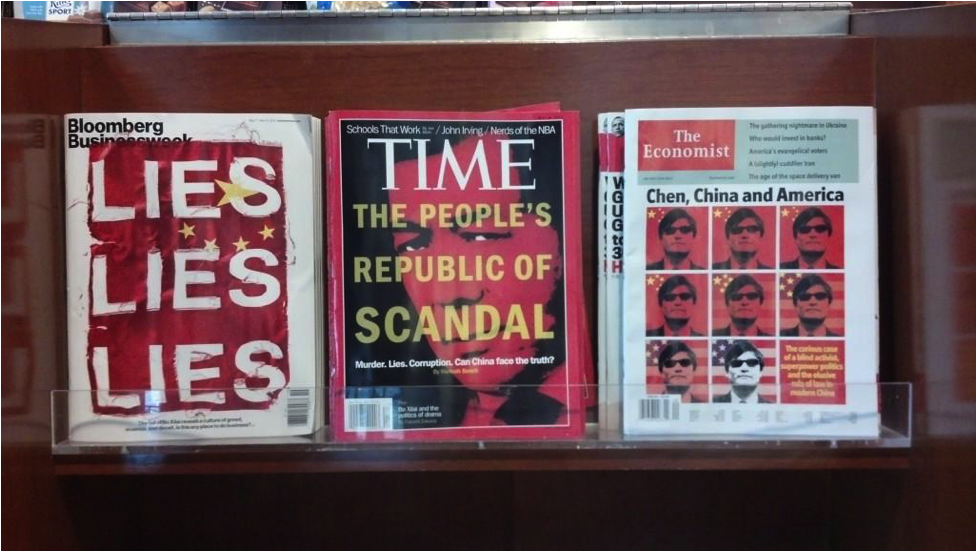
    Good news? A magazine stand at SFO's international terminal on Monday.
    Good news? A magazine stand at SFO’s international terminal on Monday.
  • Four lessons from the Burson-Facebook fiasco

    I’m ridiculously late to this, as usual, but people keep asking me about the Burson-Facebook thing because of my years at Burson, so I thought I’d post the gist of the response I’ve been giving. If you’re not familiar with the story of Burson’s ill-fated project stirring up FUD about Google on behalf of Facebook, you can read about it here.

    But first, some housekeeping. I worked for Burson-Marsteller for six years, all here in China. It was a great experience. Much of what I know about PR and virtually all of what I know about doing PR in China I learned at Burson. I still use Burson-Marsteller China as an agency, and hold the people there in the highest regard. All agencies make mistakes. No one in PR wants to damage the reputation of a client, or their own agency. When it happens, we try to learn from it.

    I don’t know what the chain of events involved in the Burson-Facebook project was, and I don’t know any of the people involved. I have no inside track. But as an industry observer, and in the spirit of learning from the situation, here are four lessons to take from this episode:

    If it will embarrass you to have a pitch go public, it’s a bad pitch

    The art of selling stories or viewpoints to journalists, bloggers or the public is a pitch. In writing or verbally, a pitch should stand alone as something you’d be comfortable going public on its own. If a pitch doesn’t pass that test, and its public release would embarrass you, your agency or your client, it’s a bad pitch. Any pitch that doesn’t identify the interest behind it is by definition a bad pitch, because lack of disclosure in a pitch suggests that someone would be embarrassed to be connected with it.  Rethink the strategy. Yes, this tars a whole branch of political PR based on anonymous leaks. So be it.

    There’s nothing wrong with criticizing a rival…transparently

    It’s silly to pretend that slamming competitors isn’t part of PR. In the industry it’s called “depositioning”, a sanitized word that suggests some lingering discomfort. Outside it might be called smearing or, for those in the tech industry, FUD (fear, uncertainty and doubt). So what’s the difference between a smear and a legit piece of competitive PR? Transparency, for one thing. There is nothing wrong with criticizing a rival (or a client’s rival) or pointing journalists at their shortcomings. But you’d better be prepared to stand behind your claims, and that means being well researched and transparent.

    PR instincts and journalism instincts are not the same

    PR agencies hire a lot of ex-journalists for their story instincts and their usefulness in media relations due to their contacts and credibility with other journalists (more on this below). But the fit isn’t always natural. Someone senior from a global agency other than Burson told me recently that they have about a ten percent long-term stick-rate from their senior journalist hires in the US. I’m not surprised.

    One problem is that although they overlap, journalist instincts and PR instincts are not the same. Oversimplified, journalistic instincts emphasize spotting and piecing together stories while PR instincts often emphasize identifying and managing risks. We spend as many years and as much work developing our instincts as journalists spend developing theirs. Any crossover in either direction means a learning curve. The risk that should have been spotted in this particular case was that the backstory of the pitch –an anonymous client paying a major PR firm to slam Google on privacy– was more interesting than the pitch itself.

    Set a thief to catch a thief

    Despite the blurring of the line between mainstream media and blogging, journalists and bloggers are different. If you send a bad pitch to a mainstream journalist, generally it just dies (perhaps along with some of your credibility). If you send a bad pitch to a blogger, there’s every chance it’s going to published and ridiculed. Welcome to blogging. This isn’t 2003, and everyone should be up on this. I understand hiring mainstream journalists to pitch other mainstream journalists, but it seems to me that the PR industry has been slow to embrace using bloggers the same way. As a blogging PR person I don’t think bloggers are particularly more resistant to working in PR, but I definitely think they respond to PR differently than mainstream journalists. And that’s definitely true for tech bloggers.

    Thoughts? Feel free to argue with me.

    See also:

    Lou Hoffman’s “Ishmael’s Corner”: More to the Facebook PR campaign against Google story

  • China and the nature of Facebook

    Reports have been percolating for a couple of weeks that Facebook will partner with Chinese search engine Baidu to launch Facebook China, or something similar. Anyone who has followed the history of foreign Internet firms in China knows that this is fraught territory. Chinese competitors are well established, and while many successful Chinese Internet firms have foreign backing of some kind (even Baidu once claimed Google as an investor), marquee marriages between Chinese and Foreign Internet companies have often been troubled.

    There are others better placed than me to speculate on the likely business fortunes of a Facebook China (cf. Epstein, Bishop), but what really interests me are the communication challenge and reputational consequences. Some glimpse of those possible consequences came in a Wall Street Journal article about Facebook’s lobbying efforts that ran yesterday. It included the following:

    [Facebook] is talking with potential Chinese partners about entering the huge China market, where the government has been cracking down on dissidents. That crackdown has come in response to the uprisings shaking authoritarian Middle Eastern regimes, movements that have used U.S.-based social-media sites like Facebook and Twitter as organizing tools.

    “Maybe we will block content in some countries, but not others,” Adam Conner, a Facebook lobbyist, told the Journal. “We are occasionally held in uncomfortable positions because now we’re allowing too much, maybe, free speech in countries that haven’t experienced it before,” he said.

    Yowza! Better work on those talking points and come up with something that doesn’t sound quite so paternalistic. Read as generously as possible, this is one quote from what one presumes was a larger discussion on the issues of running transnational social networks in countries with different approaches to censorship and freedom of speech. Read less generously, it sounds like a lobbyist for Facebook arrogating to his client the responsibility to decide what constitutes an appropriate amount of free speech in any given country. Risky territory.

    From a business point of view deciding an appropriate amount of free speech might be a practical necessity. From a public communication point of view it’s dangerous. Five years ago, when Facebook was still a plucky upstart too trivial to be noticed, Yahoo, Google, Cisco and Microsoft were hauled in front of a congressional hearing to testify on their activities in China and their willingness to accommodate governments with illiberal approaches to free speech. It was not a banner moment for the American Internet industry. “Moral pygmies!” declared Tom Lantos, the principal congressional antagonist. Much of the cast has changed and Tom Lantos has since died, but the issue remains sensitive. (Not all the cast has changed. Facebook’s current head of communication, Elliott Schrage, represented Google in the 2007 hearings.)

    Facebook itself has not committed publicly to anything in China. They also haven’t yet committed any of the blunders that those four firms did (most notoriously Yahoo, with the Shi Tao affair). Finally, Facebook hasn’t made nobility a part of their brand in the way that Google conspicuously did in its early days, something that was used against Google in its China engagement. In fact, if anything Facebook is known for a kind of calculating amorality that may be useful in the ruthlessly sharp-elbowed Chinese Internet world.

    But what’s important here is not how Facebook sees itself, but rather how people at large see it, and how activists and politicians think they can use it to drive their own agendas. Whether Facebook likes it or not, it has been publicly associated with recent events in the Middle East and is widely seen as a force for enabling dissidents and protestors whose causes resonate with western publics and politicians. See for example New York Timesstories here, here and here. Evgeny Morozov and Malcolm Gladwell might ridicule the notion of social media as democracy tools, but that won’t necessarily dispel a belief that was made clear in the 2007 hearings: American Internet firms should represent American values.

    Companies’ decisions about China are revealing. Facebook’s decision on whether or not to formally enter China will be especially interesting. It will establish something fundamental about the identity of one of the two most powerful Internet companies on the planet. Is Facebook, as some have supposed, the great enabler of democracy? Or is it a company of business pragmatists willing to censor (or delegate censorship) in order to open a potentially lucrative market? The reality is probably more nuanced than either of those positions, but as far as public perception goes it will be difficult to have it both ways. How does one balance groups of stakeholders with completely incompatible views on what constitutes a responsible and conscientious Internet firm?

    The nut of the problem is that, right or wrong, democracy activists, American politicians and the Chinese authorities all tend to see American Internet firms as standard bearers for western values. Facebook’s task is to convince the Chinese authorities otherwise while not making activists or western users in general feel betrayed. I can think of few more precarious communication challenges. The quote above is an unpromising start.

    Update:

    Obama hosted a town hall at Facebook HQ yesterday. Interesting. And likely to be noticed here in Beijing.

    See also:

  • Could better PR have prevented Groupon’s China gaffe?

    Unless you live on Pluto and you’re just in town for the temple fairs you probably know the situation with Groupon and their notorious Tibet ad. From within the China echo chamber it can be tricky to calibrate your reaction to this kind of thing. Those of us who live here are prone to flinch at things that people living in America don’t give a damn about. But we often learn that flinch reaction the hard way, over years of doing business in China and wrestling the occasional PR crisis.

    Groupon, it turns out, is trying to build a business in China. Their well-established irreverent sense of humor aside, you’d think they’d thus have some radar for the things that are likely to get them in trouble here. Media 101: In 2011, all media is global media. Culture 101: What plays in Chicago (where Groupon is from) may not play in Changchun, as it were. Think Tommy Lee Jones in the first Men in Black: “We in the FBI have no sense of humor that we are aware of.” Now replace him in your head with just about any Chinese government bureaucracy, and consider the direct and substantial influence that those bureaucracies have over the fortunes of businesses operating in China. And this doesn’t even get into the reaction of Groupon’s potential customers here. They do have a sense of humor, but not necessarily the same one as customers back home.

    I’m not going to get into the details of how screwed Groupon may or may not be in China. For that, read posts from ChinaGeeks, Techrice or Shanghaiist. Suffice to say that most of us who live and work here in China think the Tibet ad increased the risks to any mainland China operation that Groupon launches.

    The question that preoccupies me as a China PR man is, where was the PR team in all of this? One of the things I learned in my years at Burson-Marsteller was that a good PR person is one who can, among other things, look at business decisions being made and tell the management what those decisions will mean for the company’s reputation among all the audiences that matter. A good senior PR person will use a team and agencies to extend that ability beyond what any one person can cover, and be able to bring that information back to management at a level that can shape decisions. If a company is just using PR to pitch journalists and grind out press releases, then it is missing a big part of the point of a good PR team.

    In the best of all possible worlds, Groupon would have had a senior PR person who was aware of the company’s China plans, was tied into what the marketing group was doing, and was smart enough to spot a risk and bring it to management ahead of time. Message: Run this ad if you want, but it will create real risks in China at exactly the wrong time. Maybe this happened. Maybe the company went ahead anyway, in which case they assumed those risks with their eyes open. Maybe it didn’t happen at all. In the end, they went to market with an ad that has real potential to damage their business ambitions.

    The point here is not to change Groupon’s irreverent corporate personality, but to tune that personality so that it stays an asset as they grow into a global company. Startups often grow their businesses and ambitions faster than their PR capabilities. I have personal experience with this from before I was in PR, when I worked as a project manager and operations chief in a fast growing e-commerce company in Singapore in the late nineties. I thought the PR woman’s main contribution was to introduce bureaucracy and slow down things we had to do right now, and I was full of disdain for her and her work. Nothing like ten years on the opposite side of the tracks to broaden your perspective. I’ve often thought I should write her a letter to apologize for the former me. Come to think of it, some of my prior girlfriends could use similar letters. If any of you are reading this, I’m sorry.

    I have no idea how Groupon runs its PR. I do know that Venturebeat offered them some pretty sound advice on PR late last year, and an industry blogger critiqued their response to the ads in the US. I also know that in the wake of the Tibet issue, they’ve expanded Fleischman-Hillard’s remit from Hong Kong to mainland China, which is better than nothing but a bit after the fact and in a galaxy far, far away from headquarters. If you’re entertaining multibillion dollar buyout offers from Google, planning a public listing, and hoping to expand your business in China, you’d better put some really strong PR people right at the center of management decision making. And if you’re going to try to build your business in China, you’d better have someone on the ground here in the mainland who knows what the company is up to and who has the phone number of the key decision makers in the US.

    If Groupon wasn’t doing it before, now would be a good time to start.

    Update: Word on the street (by which I mean Twitter) is that Groupon is also suing this lookalike site in China. Hope they have a China trademark registered.

  • And you thought the milk business was so wholesome…

    The milk business in China just can’t seem to stay out of trouble.

    A couple of months ago baby formula maker Synutra found itself the victim of allegationsthat its product was linked to early puberty in girls. Its shares ate a big one on the NASDAQ and the company spent much time defending itself furiously. So furiously, in fact, that I was moved to ding them on Twitter for a CEO quote blaming the situation on “certain parties in the media.” Don’t blame the media was the gist of my message.

    As true as I still think that is in general, Synutra’s CEO may have had a point. Chinese media reported yesterday (and the China Daily relayed in English today) that executives from giant dairy company Mengniu and one of their PR firms, BossePR, have been detained on suspicion of stoking rumors against both Synutra and Mengniu’s chief rival, Yili. Mengniu is denying the allegations.

    Who knows what really happened. As one analyst points out in the China Daily story, baby formula isn’t really a huge part of Mengniu’s business, so why go after Synutra? This is probably true at the board level. I find it hard to believe that the senior management of Mengniu were sitting around the conference table and came up with a plan to slander Synutra. It’s just a touch too Snidely Whiplash for me.

    On the other hand, while the baby formula business may only be a small part of Mengniu’s business, I’m sure it’s damned important to whomever manages it at Mengniu (and is, presumably, judged on its success). There are two reasons why the allegations are at least plausible. First, as anyone living here knows, despite its brand images of purity and healthy, angelic children, the milk business in China is capable of complete sordidness. One need only read up on the now legendary melamine scandals of 2008 to be reminded of that. And there is more where that came from. In our family all the milk comes from one of the expensive organic farms near Beijing. It costs about triple what regular local milk costs, but when it’s your kid you err on the side of less melamine if you have the means. The milk industry in China is like the finance industry in the US now: Trust is so damaged that people are primed to believe the worst of just about any company, and it’s not hard to get the rumors flying.

    The second factor is that using PR agencies and Internet firms to run sock-puppet campaigns attacking rivals is a time-honored tactic here. (BusinessWeek has written a bit about this here, although this story lumps some companies I respect together with some I don’t.) I’ve run into it in both the car and consumer electronics industries. It’s not always incendiary child health stuff like the Synutra allegations. Sometimes it’s just garden-variety griping about products. Even that can be extremely difficult to defend against. On the Internet, criticism is forever and anonymous rumors or allegations can take on a life of their own, at warp speed if they’re salacious or involve the health of children. And it’s generally pretty cheap to do, so the temptation to stoop to such tactics can be powerful, especially in a competitive consumer business.

    I’m a fan of transparency online. When I was on the agency side my advice to clients was straightforward: Don’t astroturf, don’t sock puppet. The long-term benefits are small and the risks to reputation are high (as may be the legal risks). I expect that most international agencies would give similar advice and that most PR managers, especially at international firms operating in China, would agree. At least to your face.

    Nevertheless, when push comes to shove, it seems some companies still take the easy path, and many agencies will do what they need to do to keep a client happy. Also, many large companies use a range of international and local agencies, often reporting to different managers facing different pressures and having different points of view about what constitutes ethical PR. A company without a clear policy or tight management of such things may find that not every department is equally scrupulous in its approach. I wonder if that’s what happened to Mengniu.

    Note:

    After this post was published I also appeared on Blue Ocean Network’s “Chinalogue” program along with Alistair Nicholas of AC Capital Consulting [Note – now of Weber Shandwick – WM] to discuss…PR slime! By which the producers of the show meant the recent Mengniu vs. Yili vs. Synutra PR sockpuppet slagfest. The heavy-breathing title of the segment aside, most of the show was a fairly sober discussion of PR ethics in general. The video is here.

    See also:

  • A handy cheat sheet for interpreting the Google China story

    Should Google have been in China? Did they make the right move in pulling out? Will this influence the Chinese government? What does it mean for foreign businesses in China? Are they evil or not? Who knows? Not me. And none of these questions are going to be answered in this post.

    But stick with me, because that’s the point. The fact is that everyone and their goldfish has an opinion on Google’s fortunes in China, but few people actually know anything conclusive, so what we’re getting is a huge dose of punditry, analysis and opinioneering. This is the kind of thing that PR people live for, because what we’re witnessing first hand is the creation of a narrative. Or, rather, several narratives that serve different worldviews, audiences and points of view.

    This is PR in action: The effort to influence perception and opinion with regard to an entity or event, generally with the objective of supporting some kind of end-state result (higher sales, a political victory, popular consensus, the launch of a war, etc.).

    PR people are often accused of being liars. This is a shame, because a good PR person doesn’t lie or make up facts. I’d like to tell you this is because PR people are noble souls who want only the best for the planet and fuzzy puppies, but the real reason is that lying makes you vulnerable and doesn’t usually work very well (and, yes, it’s also wrong). Lies can often be proved false, and this can cause your position to unravel pretty quickly, often with devastating consequences. Even if you string the lie out long enough to achieve a stated objective, you’ll take damage on the backside if your story comes apart. See, for example, weapons of mass destruction and the Iraq war, which claimed the reputations and legacies of many people.

    But PR people do often try to interpret the facts (or obscure them) in specific in selective ways. In the vernacular, we spin things. In fact, the very term “spin doctor” (sometimes credited to the novelist, Saul Bellow) refers to trying to define the interpretation of events or facts — to determine which way they “spin” in the public sphere.

    PR people do this for a living. But we’re not the only ones who do it. Anyone with an agenda tries to interpret facts to create a narrative that serves that agenda, or that serves their world view. Often, dueling parties compete to establish the defining narrative of a situation or event. Consider how Democrats and Republicans competed to establish the narrative for health care reform in the interest of divergent political objectives. The media and public spheres of discussion are thus, often, noisy and squawky collections of competing narratives interpreted or distorted from the same basic set of facts in order to serve different agendas. Sometimes it takes a long time for a “definitive” narrative to emerge. Sometimes a definitive narrative never emerges, or different audiences arrive at divergent narratives because they’re exposed to different influences (anyone who looks at how Chinese and Western audiences fail to see eye-to-eye on many issues will be familiar with this).

    This is essentially what has been happening with Google over the past few weeks, as people have competed to establish different narratives regarding its withdrawal from China. There has been a huge amount written and said about Google’s predicament and options in both the Chinese and Western media and blogospheres. At last count I had 27 articles bookmarked since the announcement that Google would shift it’s Chinese search operation to Hong Kong. And there were plenty that I didn’t bother to bookmark.

    Well, that’s just too much damned stuff to analyze, and I am way too lazy to pore through it with a notebook and try to draw any meaningful conclusions about what it all means (hey, I don’t get paid for this). Also, my overwhelming impression is that there is so far roughly zero consensus on what it all means.

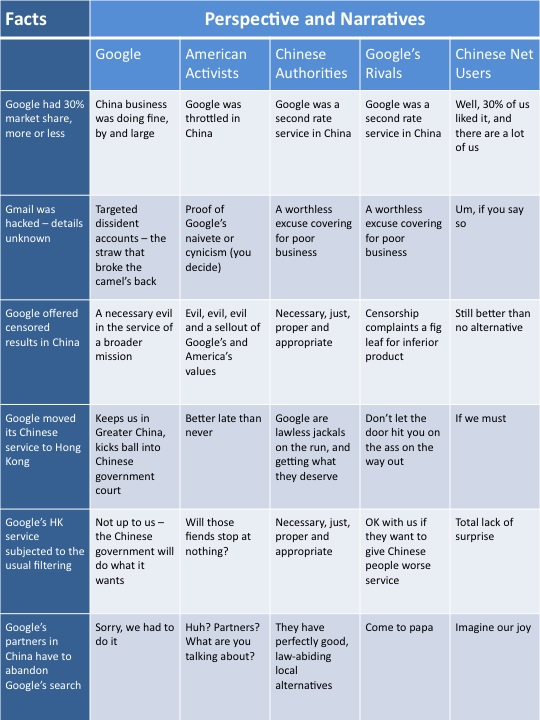
    What I did do, however, was to put together a handy chart that shows the key known facts, and, based upon all the articles I’ve read, how each of the major interest groups that I observe is spinning or reacting to each of those facts. In each case, the vertical thread through the series of facts creates the skeleton of a narrative. And that’s what each of these parties –Google, its rivals, the Chinese government, the Western activist community– is trying to do: They’re each trying to control and define the narrative of Google’s situation in China to serve their own agendas. They are, in other words spinning. Here is what the result looks like:

    google cheat sheet

    I realize this is a vast oversimplification and there are no doubt various interests omitted, but this captures most of the main parties and facts. What’s not included here is any kind of conclusion of each narrative. In my opinion, the story is still unfolding and its too early for that. But we’ll see how things go over the next few weeks.

    The other thing is that these narratives aren’t in equal competition. To use a possibly inappropriate military metaphor, there are different theaters of operation in which the stakeholder have varying levels of influence. So, in the US, Google and the activist (and analyst) community are the loudest voices. in China, the Chinese government has the tools to define the public narrative, and has been using them liberally, although there is some ferment in the margins (also here).

    Eventually, there will be a canonical version of Google’s misadventures in China. or at least one canonical version in the West and one in China. These may not be the creation of a single group. One group might control interpretation of one element of the story, and one group control another. But for the moment, the fun is in watching the battle to own the story. Enjoy it while it lasts.

    Finally, from a PR perspective, there is possibly one overarching lesson that can be drawn from this whole situation. I can’t take credit for this insight, it comes from Craig Adams, a colleague of mine. But it’s deceptively straightforward and I agree with it wholeheartedly. He said that if you have to sell out your basic principles to do business in China, that’s a pretty good sign you should reconsider your plans.

    Other sources (just to prove I’ve done my homework):

  • Is Wal-Mart’s eco-consciousness in China more than PR?

    Sunday is shopping day in the Imagethief household, so this morning Mrs. Imagethief, Zachary and I bundled ourselves up and headed out to Wal-Mart.

    Before you gasp in a fit of effete surprise, let me explain. As a card-carrying Bay Area intellectual snob, my pedigree is more Whole Foods than Wal-Mart, even if Whole Foods is basically just Wal Mart for Prius-driving gourmets (well, and my mom). But in my neighborhood in Beijing  walking-distance supermarket options are limited to the eye-wateringly expensive import-barn in the basement of Shin Kong Place (RMB35 for four kiwi fruits? Sure!); the fast-declining Bonjour, in the basement of the equally fast-declining Sunshine 100 (like Carrefour without the lingering veneer of French-ness and, in winter, heated like hell’s supermarket); and the Wal-Mart at Wanda Plaza.

    OK, we have a Jingkelong, too, but it’s not much use if your shopping needs extend beyond soft drinks, instant noodles and strawberry-flavored UHT milk. Once upon a time we had a Jenny Lou, but Jenny apparently decided our neighborhood was for losers and moved down to the accursed Jianwai Soho instead. So Wal-Mart it is. Plus, they deliver, which is essential when your shopping needs include kitty litter for two.

    With Wal-Mart fresh in my head, and fresh kitty litter in my guest bathroom (for the cats, not for the guests, although there have been some parties…), I was therefore interested to see a Washington Post article covering in mostly positive terms Wal-Mart’s efforts to get its Chinese Suppliers to improve their environmental and labor standards (part of a special report called, “The Climate Agenda.”):

    As a result [of Wal-Mart’s urging, Hong Kong-based soap and cosmetic manufacturer] Lutex has been paying attention to more efficient light bulbs, better ventilation and less packaging. It switched from Styrofoam to recycled paper and saved enough Styrofoam to cover four football fields. And Lutex, which has been here since 1991, says it treats four tons of wastewater that it used to dump into the municipal sewage line. That water was supposed to be treated by the city, but like three-quarters or more of China’s wastewater, it almost certainly wasn’t.

    “We heard that in the future, to become a Wal-Mart supplier, you have to be an environmentally friendly company,” [CEO Benny] Fung said. “So we switched some of our products and the way we produced them.”

    Wal-Mart has more than 10,000 suppliers in China. In addition, about a million farmers supply produce to the company’s 281 stores in China. If Wal-Mart were a sovereign nation, it would be China’s fifth- or sixth-largest export market. So the company hopes that small measures taken by all suppliers start to add up. Its 200 biggest suppliers in China have already trimmed 5 percent of their energy use.

    ***

    In October 2008, Wal-Mart held a conference in Beijing for a thousand of its biggest suppliers to urge them to pay attention not only to price but also to “sustainability,” which has become a touchstone for many companies.

    “For those who may still be on the sidelines, I want to be direct,” Wal-Mart chief executive Lee Scott said sternly. “Meeting social and environmental standards is not optional. I firmly believe that a company that cheats on overtime and on the age of its labor, that dumps its scraps and its chemicals in our rivers, that does not pay its taxes or honor its contracts will ultimately cheat on the quality of its products. And cheating on the quality of products is the same as cheating on customers. We will not tolerate that at Wal-Mart.”

    Well, if he says so.

    My first reaction to this story was, “What a PR score!” Cynical me wasn’t really prepared to consider if there might actually be something to this. But might there be real business motivations for moves that seem antithetical to a company with a mission to drive costs to the absolute lowest level?

    One possible answer to that question can be found in a post at the well-known “Naked Capitalism” economics blog. Yves Smith suggests three factors that could motivate Wal-Mart to put real effort into pressuring its Chinese suppliers to improve. They are:

    • Creating an “insurance policy” against possible American trade restrictions that might be based upon setting minimum environmental and labor standards.
    • An effort to differentiate itself in the Chinese market by demonstrating attention to food quality standards and environmental issues.
    • A move to appease evangelical Christians who increasingly see earth-stewardship as part of their religious duty.

    In fact, two out of those three things (see if you can spot which two) are still essentially public relations. Personally, I have a hard time believing the third is anything close to being a sufficient motivation for a serious revamp of Wal-Mart’s Chinese supplier relationships, but, then, I live a long way from the American heartland and am thus not well attuned to its priorities.

    The second point seems plausible, but as a regular Wal-Mart China shopper I can attest that Chinese shoppers seem perfectly enthusiastic about Wal-Mart already. Wal-Mart also does a brisk trade in allegedly organic Chinese produce (we buy it, but I’m really not sure how far to trust the “organic” claims). At any rate, as an approach it sure couldn’t hurt, unless it starts leading to significant job losses at Wal-Mart suppliers in China, in which case, all bets are off.

    Ultimately, although the impact is in China, I still see this as primarily a move to influence the customers and activists back home in the US who have the greatest ability to influence Wal-Mart’s business. China environmental and labor issues are important in China, of course, but arguably not as important as they are in the US. (Next up for trouble: Apple? Don’t miss the bizarre fanboy comments.)

    As for me, I’ll take a pass on the live soft-shelled turtles (where are the PETA people?), but the produce section isn’t bad and you can’t beat a fuzzy car-seat cover that carries the inscription, “Space cat who dreams of happiness!” If only I had a car.

    Space cat who dreams of happiness.
    Space cat who dreams of happiness.
  • Google detonates the China corporate communications script

    Imagethief stumbled blearily to his computer this morning expecting a relaxed scan of the news but found the Chinese Twittersphere ablaze with the news of Google’s bombshell blog post, which went up in the middle of the night early this morning our time. Titled “A new approach to China”, the post, by Google’s Senior Vice President for Corporate Development and Chief Legal Officer, David Drummond, was essentially a public threat to withdraw from China. As such, it was as direct a challenge to the Chinese authorities as I have ever seen in a piece of public corporate communication.

    The first half of the post discusses alleged hacking attempts on Google, apparently with the aims of both recovering Google source code and accessing the Gmail accounts of dissidents. But the second half of the post is more interesting. The money grafs below (emphasis mine):

    We launched Google.cn in January 2006 in the belief that the benefits of increased access to information for people in China and a more open Internet outweighed our discomfort in agreeing to censor some results. At the time we made clear that “we will carefully monitor conditions in China, including new laws and other restrictions on our services. If we determine that we are unable to achieve the objectives outlined we will not hesitate to reconsider our approach to China.”

    These attacks and the surveillance they have uncovered–combined with the attempts over the past year to further limit free speech on the web–have led us to conclude that we should review the feasibility of our business operations in China. We have decided we are no longer willing to continue censoring our results on Google.cn, and so over the next few weeks we will be discussing with the Chinese government the basis on which we could operate an unfiltered search engine within the law, if at all. We recognize that this may well mean having to shut down Google.cn, and potentially our offices in China.

    No doubt a great deal has transpired behind the scenes in the lead up to this announcement. To save time, here’s what I don’t know:

    • Whether this is linked to rumors of Google’s possible withdrawal from China and staff exodus that circulated several weeks ago.
    • The relative weights of the hacking issue, censorship issue and Google’s business struggles in China in leading the company to make this statement.
    • What, if any, discussions Google had with Chinese authorities prior to making this statement (they speak of discussions “over the next few weeks”), or whether there are actually continuing negotiations.
    • Whether recent blocks of Google Docs and Google Groups in China contributed to this decision.
    • Whether Google would have done this if their business in China was stronger. China contributes a minuscule portion of Google’s revenue.
    • What will actually happen to Google’s business in China in the long run.

    Here is what I do know:

    Google has taken the China corporate communications playbook, wrapped it in oily rags, doused it in gasoline and dropped a lit match on it. In China, foreign companies tend to be deferential to the authorities to the point of obsequiousness, in a way that you would almost certainly never encounter in the United States or Europe. Scan any foreign company’s China press releases and count the number of times you see the phrase, “commitment to China”. Demonstrating “alignment with the Chinese government’s agenda” is an accepted tenet of corporate positioning and corporate social responsibility work in China. This is testament to the degree of direct power that the Chinese authorities wield over the fortunes of foreign businesses in China. Even when foreign companies are in dispute with the Chinese government they tend to offer criticism obliquely as long as they have a business stake or operations in the country. Note, for example, the scrupulous diplomacy of Rio Tinto’s communications concerning the detention of its employees last summer, a far more serious situation than anything Google has encountered (although also with far more money at stake).

    In this situation Google has undertaken a bet-the-farm confrontational communications approach in China. They will not have made this decision lightly. Dressed up in the polite language above is what is essentially an ultimatum: Allow us to present uncensored search results to our Chinese users or we’ll walk. The Chinese government is not likely to cave to an ultimatum from a foreign company, no matter how decorously delivered. As Richard Waters of the FT has pointed out, the language does leave some wiggle room for further negotiation. However, Imagethief cannot imagine a circumstance in which the Chinese government will give Google free reign, especially in the current, highly restrictive climate for Internet services. Barring some surprising developments, the clock would therefore appear to be ticking for Google.cn, if not Google’s overall operations in China. It will be very interesting to see how this plays out.

    Would Google continue with an office in China if there was no Google.cn site? They could still conduct R&D here, for instance. But Google’s R&D operations in China have been troubled (remember the Sogou IME scandal?) and if the security issues are taken at face value continuing operations here in the absence of a local business to support might simply be extra risk. Consider how many China R&D operations are “PR&D”, designed to demonstrate that essential “commitment to China” in support of a revenue-generating business in China. It’s not that real R&D doesn’t happen here, but how many companies do high-level, primary R&D in China in the absence of an on-shore business and supporting government relations program? And could Google attract talent to a pariah operation? Distraught Chinese netizens are already laying flowers at Google’s China headquarters.

    The Wall Street Journal’s story (sub) on the unfolding situation makes some interesting points (emphasis again mine):

    The common assumption, however, is that no matter how onerous the limitations and challenges faced by foreign companies in China, the market is too big and important to walk away from.

    That calculation has forced a number of foreign firms to accept conditions in China that they might not tolerate elsewhere. The country has 338 million Internet users as of June, more than any other country.

    Google would be the most high-profile Western company in recent years to draw a line under the kind of compromises it is prepared to make and walk away from China.

    It would be an extremely rare case of a foreign company taking a stand on human rights, and placing that issue over commercial considerations. A number of foreign companies exited China after the Chinese army crushed student protesters around Tiananmen Square in 1989. But they mostly came back in the following years.

    A Google withdrawal would also be an implicit rejection of the argument made by many technology companies that their presence in China overall helps expand access to information for Chinese citizens, despite censorship.

    That’s the very last line in the story, but I found it one of the most interesting. If you followed the original justifications offered by many American Internet companies for launching businesses in China, or the congressional hearings on the matter in 2006, you will recall that the argument that even a censored presence in China improved access to information for Chinese Internet users was central. If Google repudiates that argument it will put pressure on other American Internet firms currently toeing the regulatory line in China, especially Microsoft, and weaken one of their core public arguments for a continued presence in China. Then again, it may also represent an opportunity for them. After all, “Google” doesn’t phoneticize well in Chinese, as the flap over the “谷歌” branddemonstrated. But “Bing” works quite nicely indeed.

    This only the latest chapter –albeit potentially a critical one– in the very interesting story of Google in China. Someone needs to write the book. Anyone want to step forward for that?

    See also:

    • Rebecca MacKinnon’s roundup of responses.
    • James Fallows’ analysis on how this development fits into a broader picture of increasingly tense economic relationships for China.
    • Sarah Lacy in TechCrunch, citing tweets from both Bill Bishop (@niubi — now also blogging again at Digicha) and Marc van der Chijs (@chijs).
    • Brief US State Department statement.
    • CNBC interview with David Drummond (Video – also embedded below): “We’re not saying one way or the other whether the attacks were state sponsored…” Note also the silly use of the word, “cyberterrorists” by the interviewer.
    • Brief, relatively straightforward report from the People’s Daily online (Chinese).
    • Chinese telecoms analyst Xiang Ligang calls it “psychological warfare”, doesn’t think Google will pull the trigger, and doesn’t think it will be a cataclysm if they do (if I read it correctly – Chinese).

    Updates:

    “In a world in which we are so used to public relations massaging of messages, this stands out as a direct declaration. It’s amazing,” said Jonathan Zittrain, professor of Internet law at Harvard Law School and co-director of Harvard’s Berkman Center for Internet & Society.

    The fallout will be interesting. I can’t recall a single case of a major international company with operations in China taking a stand like this. As someone who agreed with Google’s reasoning when it entered China, I also support this move. If it cannot operate here in accordance with its global standards, it should leave. I have given up on getting my own website unblocked by the government and am resigned to the fact that it’s only accessible to people who are outside China or know the technical tricks to get over the Great Firewall.

    I’d rather be outside the wall and free than inside it with the icy hand of the censor around my throat.

    • Wired’s “Threat Level” blog on some of the considerations within Google (via @kaiserkuo).
    • Full disclosure: Imagethief is a supporter of foreign Internet services operating in China. Elaboration in this comment, below, in response to a point from a reader.
    • Isaac Mao’s open letter to Google (English), via Harvard’s “Difficult Problems in Cyberlaw” blog.
    • Xinhua English report on the statement: “‘It is still hard to say whether Google will quit China or not. Nobody knows,’ the official said.”
    • Gady Epstein’s column on Forbes.com: “Dreams of Internet openness in China appear to be a fantasy.” Indeed.
    • Evgeny Morozov punctures the feelgood balloon at Foreign Policy: “If…you believe that [Google] did the right thing in China by offering their limited service (rather than no service at all), I don’t see how this move could make you feel good…”

    http://plus.cnbc.com/rssvideosearch/action/player/id/1383977803/code/cnbcplayershare

  • Paul Midler’s “Poorly Made in China”: Mischief, mayhem, soap

    As a general rule, Imagethief dislikes business books, especially instructional ones. I find them tedious and most of them age faster than caviar on a car dashboard. There are, however, exceptions. Most of these are either books based on journalistic reporting of business events, such as, say, Kurt Eichenwald’s “Conspiracy of Fools”, or on personal narratives of business conducted in extremis. Tim Clissold’s “Mr. China”, to this day the definitive “doing business in China” narrative and probably on the shelves of many Imagethief readers, is the defining example of the latter.

    One of the magnificent things about China is that it seems to provide a bottomless well of business-in-extremis stories. Like many PR pros, I followed with some interest the great product quality scandals of 2007 and 2008, not least because it has a direct bearing on my work when companies discover that something they manufacture in China is [choose one] toxic/sharp/disintegrating/radioactive/manufactured by child slaves. (That list could be extended, but you get the point.) I was thus pleased when a copy of Paul Midler’s “Poorly Made in China” landed on my desk some months ago. However, it went into the long queue on my nightstand and didn’t actually get read for some months until after I received it. Considering my recently ended blog hiatus, this was perhaps for the best.

    In fact, despite my interest in the topic, I was a little reluctant at first to get stuck into Mr. Midler’s book. From the subtitle, “An insider’s account of the tactics behind China’s production game,” and somewhat staid cover art I was expecting something didactic, in the style of the business books I tend not to like. Do not, as the old adage goes, judge a book by its cover. I was pleasantly surprised to find that “Poorly Made in China” is in fact a well told personal narrative of Mr. Midler’s own experiences helping foreign companies to arrange manufacturing relationships in South China. Once opened, I found it entertaining and enlightening (a rare combination also recently attained by Jonathan Fenby’s “Penguin History of Modern China”, one of the books ahead of Mr. Midler’s in my queue, which I recommend to all China expats not already versed in modern Chinese history).

    Most of the story concerns Mr. Midler’s work with an American client manufacturing personal care products (e.g. soaps and shampoos) in China. What could go wrong with soap, you ask? Plenty, it turns out, and the story revolves around the struggle of Mr. Midler and his client to maintain quality standards (of the product, the packaging, the factory sanitation — you name it) in the teeth of entrenched Chinese business habits that seem to give rise to corner-cutting at every imaginable opportunity and a few unimaginable ones. From this main thread Mr. Midler branches off into other interesting stories and illustrations.

    “So what?” you may be saying to yourself. Chinese manufacturers cut corners at every opportunity. What else is new? Even my Singaporean mother-in-law knows this. “Keep a hand on your wallet,” she warned me when I announced my intention to move myself and her daughter to China six years ago. Needless to say, my personal experience here has been much more positive than she expected, but much of the mainstream reporting on the product quality crises of the last couple of years took a similarly one-dimensional China-as-villain tone.

    With that in mind, the value of Mr. Midler’s book is two-fold. First, Mr. Midler tells his story as someone who, despite all the frustrations and adventures, seems to never have lost his basic affection for China. He never falls back on the trope of villainy. “Sister”, the owner of the Chinese soap factory that figures in much of the book, is presented not as a criminal or predator, but as someone trying very hard to succeed in a particular business context. This leads to the second, and main value of “Poorly Made in China”: Mr. Midler does an excellent job of explaining in a readable way that context of Chinese business, and the social, cultural, and economic forces that have shaped the practices of people like Sister. He explains how western buyers and Chinese businesses have created a delicate and sometimes dangerous symbiosis in an environment of ruthless competition, price pressure and complex webs of relationships. The book is critical, but not judgmental, which I found refreshing.

    Even if you’re not in manufacturing or dealing with the consequences of manufacturing problems (as we PR people sometimes do), you may find the book interesting as a study in the forces that have shaped Chines business over thirty years of turbocharged economic growth. Many of these forces that have shaped Chinese manufacturers may be at work in your industry as well. They’re certainly at work in mine. Against this reality, efforts such as the following, while admirable for the move toward international public communication, seem modest indeed.

    http://v.blog.sohu.com/fo/v4/3844191

    Disclaimer: The publisher and author provided Imagethief with a complementary review copy of “Poorly Made in China”. Make of that what you will. Imagethief gladly accepts review copies, but cannot guarantee that he will read or like books furnished.

    Note: Title of this post with apologies to the marketing team for the film “Fight Club”.

  • Coke, Huiyuan and the audiences that matter

    Nothing as timely as the blogs, I tell you. As everyone on the planet now knows, the Coke-Huiyuan deal has fallen through. It retrospect, it wasn’t particularly surprising. It broke new ground in size, and public sentiment was never behind the deal. David Wolf and Dan Harris have both written good posts about this, and I recommend taking the time to check out both.

    I have been trying to find finely-parsed and academic way of stating a basic truth, and it hasn’t worked out. So here it is in plain language: If you’re a large foreign firm taking over a Chinese firm, prepare to be flogged in public. And prepare for it before you announce your acquisition.

    Here is a basic PR lesson to go along with that: Part of selling any acquisition is convincing stakeholders of the value that the acquisition will bring in terms that make sense to them. That last part is the detail that often gets lost. In a perfect capitalist world (if you don’t see that as oxymoronic) it would be easy to explain the value of an acquisition to the key stakeholders on all sides of the deal. “Dollars” and a business case would do the trick.

    However the real world is messy, not every stakeholder is interested in the share price premium, and I think we can all agree that China is a long way from being a perfect capitalist world. Some of its complexities are nicely captured in a summary of the unwritten rules guiding foreign acquisitions assembled by Dan and Steve at China Law Blog and included in the post linked above:

    Foreigners are permitted to purchase large, state-owned enterprises that suffer from financial difficulty, provided the foreign investor agrees to restructure the purchased company.

    Foreigners are permitted to purchase non-majority interests in strong, successful Chinese companies, but only if there is some added benefit, such as transfer of technology, advanced management or access to foreign markets.

    Foreigners are not permitted to purchase a majority interest in a large and financially successful Chinese company. Even smaller companies are off the table if they are financially sound and work in a core technology field or have created a strong or historically important brand.

    I’m a PR man, so I am compelled by some mystical force to reduce these rules to something I can work with: Perception. When you understand how you are perceived by different audiences, you can begin to figure how to communicate and act in way that will reinforce those perceptions if they are good, or change them if they are bad. So here is what China Law Blog’s rules say to me about how foreign companies and foreign acquisitions are perceived in China:

    • The government and a loud and influential slice of the grass roots automatically perceives the motives of foreign companies as suspect
    • The state perceives foreign acquisitions of Chinese companies as value-destroying by default, even if they’re good for shareholders, therefore it perceives value differently than shareholders do
    • A foreign acquisition can be perceived to add value if there is explicit upside with regard to national priorities

    This lays out the difficult communication challenge for any company in Coke’s position. Note the really small role of “what’s good for shareholders” in the above. Therefore, in communicating about a major planned acquisition in China, and knowing that both government and popular backlash are likely, leading with shareholder value might not be the ideal approach. But here is Coke’s statement of September 3rd (it’s the same inChinese):

    “This acquisition will deliver value to our shareholders and provide a unique opportunity to strengthen our business in China, especially since the juice segment is so dynamic and fast growing in China. It is also further evidence of our deep commitment to China and to providing Chinese consumers with the beverage choices that meet their needs,” Mr Kent said.

    If successful with the offers, the Company will use its expertise as a global beverage company to further develop the Huiyuan brand to address the evolving needs of consumers. There are anticipated synergies that will drive operational efficiencies, particularly in the Huiyuan business’ production footprint and in Coca-Cola’s distribution and raw material purchasing capabilities.

    When I read that, here is the order of priorities I see in the messaging:

    1. Coke shareholders
    2. Coke’s business in China
    3. Chinese consumers
    4. Huiyuan’s success

    That’s a perfectly good set of messages for Coke’s investors and stakeholders back home. But I might reverse that list if I was writing this for Chinese audiences. I also see a message on how Coke’s global experience will benefit Huiyuan. Viewed one way, that seems wonderful and constructive. Viewed through a nationalist looking-glass, which is how many foreign acquisitions are seen, it could seem paternalistic.

    This statement was just the initial announcement and one slice of all the communication that took place, and by most measures it is fine (although “commitment to China” messages are such a pro-forma recitation as to have become essentially meaningless). But it’s an interesting glimpse into the formula that often guides MNC communication in these situations.

    Huiyuan didn’t post a statement of their own on the day the deal was announced, but two days later they published on their site a congratulatory note from the government of Wanrong county, where they are headquartered. This is also formulaic, but in a locally relevant way. The fact that it’s a local government statement — a third-party endorsement — is a bit of communication in itself. The first two paragraphs are congratulations and a recap of Huiyuan’s history. The last paragraph reads (in loose translation):

    The successful merger of Coca Cola, the world’s largest beverage company, with Huiyuan Group will inevitably foster a win-win situation and create more excellent social and economic benefits. We will create an excellent environment for the development of business creativity and promote the common progress of both sides.

    There’s plenty of pro-forma recitation in this statement as well, but it’s recitation that speaks directly to local priorities. Coke’s statement, on the other hand, reads like a communique primarily to Coke’s shareholders, who were probably the one stakeholder group that was on-board with the plan from the beginning.

    But other stakeholder groups were driving the outcome. Just a day or so before the deal was spiked a further glimpse into the process was afforded by a Reuters article optimistically titled, “Coke expected to get OK for China Huiyuan deal“. The lede is interesting, because it ties Coke’s prospects for success directly to a fortuitously-timed package of new China investments announced earlier this month:

    Chinese authorities are expected to grant a conditional approval soon to Coca-Cola Co (KO.N) for its $2.5 billion purchase of Huiyuan Juice after the world’s largest soft drinks maker pledged to invest another $2 billion in China over the next three years.

    But the telling stuff is further down in the article:

    Beijing’s influential Caijing magazine reported last month the MOC held a closed-door hearing on December 26 to seek advice and hear from Huiyuan’s domestic rivals and drinks industry groups.

    Some participants objected to the deal, citing protection of Huiyuan as a national brand as well as concerns about Coca-Cola’s growing monopoly power in China’s soft drink markets where small local juice makers may be hurt.

    ***

    Lawyers and bankers close to the process say the political pressures on the government over this deal have been significant.

    While Beijing wants to signal that China is open to foreign investment, it does not want to be seen as easily surrendering national interests and brands, said the sources.

    ***

    “Beijing decided to give the deal a serious and tough review after it saw growing concerns and objections from Huiyuan’s local rivals and some pro-nationalism marketwatchers,” said [an anonymous source].

    Again, it’s not the individual statements themselves that are important, but more the overall approaches and priorities they suggest. In the end, only Coke and Huiyan know exactly what steps they took to communicate about the deal to the public and to regulators and other people in the government with an interest in the outcome. Coke has been doing business globally since forever and in China since 1979, and I have no doubt they worked multiple channels very hard. But they still seemed surprised by the backlash.

    A friend of Imagethief’s who follows these things reports that Coke PR people at a recent conference had the point of view that they were acting within the law, and that China’s netizens thus had nothing to complain about (this is second-hand, so take it as such). This might be true at a strictly rational level. But rationality is relative, especially in matters of national pride. And, as any parent knows, not having anything to complain about has never stopped anyone from complaining.

    If I boil all of the above down into one rule for such situations, this is what ends up stuck to the bottom of the pot: Foreign companies making significant acquisitions in China should assume that the default starting communications position is “in trouble”, and plan appropriately. In fairness, Chinese companies making major acquisitions in the US should probably make the same assumption. In his post linked above, David Wolf writes:

    Any acquisition of a local firm by a foreign company demands a communications effort directed at both the general public and the policy making elite that makes a logical, intelligent, and sensitive case for the purchase. The bigger the buy, the better you need to be at the communications.

    So true. And this was the biggest buy of all, so far.

    See also:

    And several posts from the Wall Street Journal’s “China Journal” blog, which followed the deal closely:

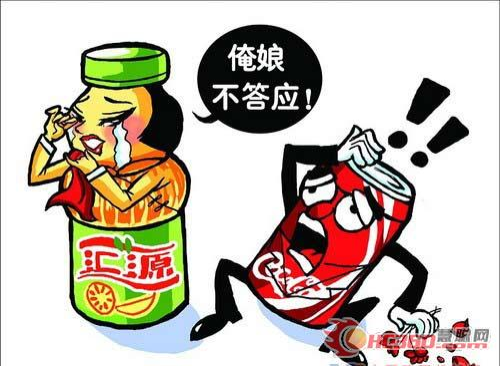
    "Mother doesn't consent."
    “Mother doesn’t consent.”