Cards on the table, I’m a fan of the administrative state. Societies are large and complex, and a little technocratic competence goes a long way in ensuring the availability of public goods and infrastructure. But there are some areas where the administrative state struggles. Sex, for one.
Like China, my adopted home of Singapore advocated for limited birthrates during the 1970s “population bomb” panic, when it was widely agreed we were destined to devour each other like starving jackals. Singapore realized its demographic error in the 1980s, as its birthrate plummeted, and went through policy whiplash. When I arrived, in 1995, there was an advertising campaign encouraging young couples to have larger families. I recall lots of slow-motion video and gauzy photos of attractive young couples with cherubic babies, and an omnipresent theme song. Alas, it was too early to be immortalized on the Internet, but there is evidence of later campaigns.
I’ve never been much for conspiracy theories. Not that I don’t like a touch of the fantastic in my daily life (I live in China, after all). But when you think about the sheer logistics involved in most of the major conspiracy theories things start to break down pretty quickly.
Consider that old favorite of the tinfoil hat brigade, that NASA faked the American moon landings, and think about what it would have required. It’s not just the fakery of the photographs and video, but also that everyone who worked on all the aspects of the fakery, from the astronauts to the guys who would have had to doctor the photos and fake the moon rocks and telemetry (depending upon whether you think mission control was in on it or not) would have had to keep their mouths shut. For going on 45 years. For six successful lunar landings involving eighteen astronauts, twelve of whom have allegedly walked on the moon. Not only does everyone who knows about the fraud have to keep his mouth shut, but everyone who has a public face has to keep his story aligned. Especially that attention-junkie Aldrin. It only takes one person to blow the lid off, intentionally or accidentally. Frankly, it’s just easier to go to the goddamned moon.
I’m not particularly interested in getting into a pissing match with conspiracy theorists (like thermonuclear war, it’s not “winnable” in the conventional sense of the word), so much as I am in setting up a problem. Coverups pose similar problems to conspiracies in that, like a big pile of sweaty dynamite, they are unstable by nature and easily detonated, sometimes by the tiniest of disturbances. That’s why they don’t tend to make good PR strategy.
Of course, by definition no one knows when a coverup succeeds. Small ones involving one or two people? Probably a fair number. Big ones involving lots of people and big stakes? Not so many, I’d guess. “Three may keep a secret if two of them are dead,” wrote Benjamin Franklin, perhaps optimistically. In most cases, the participants aren’t Navy Seals or the CIA or other kinds of people who are indoctrinated and trained into cultures of secrecy (and yet still sometimes blow it). We’re talking about just folks who are easily pressured by law enforcement, or who just get drunk on lychee martinis at Centro and shoot off their mouths. Sooner or later someone is going to slip up and the dynamite is going to blow.
Then everyone in serious trouble because, as the old truism goes, the coverup is worse than the crime. Technically, it’s more accurate to say that the coverup significantly aggravates the crime. Coverups turn mistakes into crimes and crimes into enormities. Think of the devastation inflicted on Penn State by the recently published Freeh inquiry, which was most damning for revealing the efforts taken to protect the institution over the victims. Or think of your own toddler, if you have one. If he uses a sharpie to draw all over the wallpaper, you’re angry. If he lies about it, well, then you’re disappointed. Anger is over in minutes. Disappointment leads to years of therapy and careers in bitter standup comedy.
A big pile of sweaty dynamite might be blowing up in the face of Chinese telecoms equipment company ZTE right now. The fuse was lit by a Reuters report back in March (blocked in China), which showed how ZTE was acting as a middleman for relaying restricted American technology to Iran for use in a national Internet monitoring system. The explosion may have started last week when the aptly named website The Smoking Gun reported that the FBI has launched a criminal investigation into the sale. The FBI has not confirmed the investigation, but The Smoking Gun has posted an affidavit that makes fun reading because it includes grubby details of the alleged covering-up. Much of it has the desperate, furtive feel of the third reel of an Abel Ferrara film (or, apropros of the lunar landing discussion above, a Peter Hyams film). You can feel the options narrowing as they talk through them. I don’t know how this situation will turn out, but I do know this: As bad as ZTE looked for shipping US surveillance gear to Iran, they look worse for the discussion of the coverup.
Two other thoughts about this case. First, the FBI case is apparently based on the deposition of a young, American lawyer who was in ZTE’s employ. I find myself reminded of something I heard from a relative who was once highly placed in the empire of a wealthy Hong Konger: White people don’t handle the money. One wonders how much trust ZTE will invest in its white people after this.
Second, the organization that should be most annoyed about this alleged coverup isn’t the US government, the FBI or Internet-freedom activists; it’s ZTE’s Chinese competitor and Shenzhen neighbor, Huawei. Huawei has been busting its assthrough an extensive lobbying and PR campaign to impress US politicians and regulators with its trustworthiness and thus extend its limited access to the huge American market. So far it has met with conspicuously limited success not least because US politicians stubbornly refuse to trust it due to its, well, Chineseness.
Huawei and ZTE are different companies, and illegal shipments to Iran aren’t spy-friendly backdoors in routers, but it will be very easy for American politicians and lobbyists to conflate the two Chinese companies and use this situation against Huawei as well. After all, they’re both giant, state-linked Chinese telecoms equipment companies. From an American political point of view, both carry all the reputation baggage that comes with the pedigree. They’re suspected –sometimes with a dose of hysteria– of being instruments of Chinese policy and possibly vectors for cyberwar attacks. If one is caught with an uncapped sharpie…well, the argument will be, you do the math.
Given the effort its expended over the last few years and the collateral damage it is likely to sustain if the investigation of ZTE’s alleged coverup gathers steam, perhaps Huawei should send its PR and Lobbying bill for the last few years to ZTE. And as for the rest of us? I’m sure we’re all very disappointed.
Note: this post originally published on the defunct group blog Rectified.name.
I’ve been watching a lot of Godzilla movies recently. This isn’t some kind of weird Cable TV accident, like stumbling onto “Barbarella, Queen of the Galaxy” at 2AM when you have a microwave burrito in one hand and a vodka cranberry in the other, and thus, tragically, no ability to change channels. It’s on purpose. I’ve loved Godzilla ever since I discovered him on the afternoon sci-fi serials as a small boy. They spoke directly to the primitive part of the small-boy brain stem that wants desperately to rampage through a model city with a flame thrower. That part sometimes survives into adulthood.
I’m mostly nostalgic for the “classic” Godzilla movies, from the 1954 original up to about the late 70′s, when I was in my tweens. I haven’t seen many of the modern films from the 80’s, 90’s and naughties, and the 1998 Matthew Broderick Hollywood obscenity is history’s second most flagrant case of pissing indifferently on a beloved piece of popular culture, after the new Star Wars movies. To this day I can’t watch “Ferris Bueller’s Day Off” without weeping.
Back in the early 90’s I had a well-worn VHS tape of the Americanized version of the 1954 original, “Godzilla: King of the Monsters,” in which the Japanese footage is intercut with shots of “journalist” Raymond Burr calling the destruction from nonspecific locations like a sportscaster: Godzilla has just incinerated Yokohama. Three and two with the bases loaded. Looks like the Japan Self Defense Forces are going to make a change on the mound… But, with an eye on my own son’s cultural indoctrination, I figured it was time to refresh the collection and to finally see Ishiro Honda’s original, Burr-free version of the first movie. It turns out that Amazon sells most of the classic Godzilla oeuvre at knockdown prices. I ordered eight DVDs and I’ve been watching them about one a week for the last couple of months.
Godzilla movies are still good fun. The joy of watching grown men in rubber suits going all WWF on fabulously intricate model cities never goes away. But watching the movies as an adult is a very different experience than it was when I was young. First, they are, as you’d expect, spectacularly cheesy in virtually all respects: set design, special effects, writing, acting, you name it. In the age of “Avatar” there’s something charming about the pre-digital, in-camera crudeness of the latex, cycloramas, piano wire, little model tanks, and such. It’s a dated look that invokes the 60′s and 70′s like Ray Harryhausen’s stop-motion creatures invoke the 50′s.
The series also evolves quickly. The 1954 original was released less than a decade after the Second World War and the same year that Japan experienced radioactive rain from American nuclear tests in the Pacific. Fittingly, it is a moody metaphor for nuclear annihilation and human powerlessness. But the geniuses at Toho figured out approximately instantaneously that the future was in monster-on-monster action. By the second movie, 1955’s “Gozilla Raids Again,” Godzilla is fighting a giant, spiky turtle. The pattern is thus set for the next fifty years.
Godzilla himself rapidly goes from truly sinister to googly-eyed and almost huggable, as though Cookie Monster suddenly grew 400 feet and traded chocolate chips for infrastructure. As Godzilla moves into hero status he’s replaced as villain-in-chief by a motley assortment of other monsters, evil property developers, gangsters, robots, and disco aliens featuring some of the most awesome space-couture since Sean Connery wore a red bikini for “Zardoz.”
Nobody seemed to care much about this curious transition in Godzilla’s motivations. I guess it was a bit like sports free agency in the US. When Deion Sanders was an Atlanta Falcon, he was a gigawatt hate-magnet that sucked bile out of my pores and toward the Georgia Dome. But when he came to the Forty Niners and started running punts back for us I would have airmailed him my sister, if I’d had one. Of course, just as Deion slid back into villain status when he moved on to the hated Dallas Cowboys, Godzilla himself was reborn as a menace in his modern filmography, but that’s outside the scope of this essay.
The other thing that struck me upon watching the movies was that there is no way in hell that similar ones could have been made in China, or would be now.
As I wrote in 2005, no city has ascended the Olympian heights of popular culture until it has been ravaged by a giant monster. Tokyo is clearly way out in front in this regard. It’s taken for granted that monsters are drawn to Tokyo like frat boys to Jaeger shots. Monsters have also afflicted New York, London, San Francisco, Seoul, Paris, Rome, Los Angeles and even Bangkok (look it up). But as far as I can tell, Beijing has been blissfully free of giant monsters. Mothra was reported to be attacking Beijing in “Destroy All Monsters,” but it was never shown on screen, so it doesn’t count. Neither does “Mighty Peking Man,” which was made by the Shaw Brothers while Hong Kong was still British and, despite the name, had no action in Peking (the Chinese name was “Gorilla King”).
Why hasn’t there been a Chinese giant-monster film with a Chinese giant monster? While armies, police forces and parliaments have crumbled before Godzilla and his brethren, there is one bureaucracy that is apparently entirely impervious to giant monsters: the State Administration for Radio, Film and Television. SARFT has apparently erected a monster-proof shield around Beijing and indeed around all Chinese cities. This is not because giant monsters are particularly scary, obscene or conducive to social unrest. It is because they are politically unacceptable.
To understand why China never had a giant monster phase you have to understand something about SARFT itself. SARFT administers all of the state-owned media organizations in China and it sets the guidelines for broadcast and film censorship, ensuring that morals, political ideology and good taste are upheld. It takes the latter mission very seriously, as anyone who watches television or goes to the movies in China knows. This mandate includes approving the screenplays for all films to be produced in China, as well as approving films for distribution and exhibition.
I’m not aware of any official list of SARFT’s decisions, which is too bad because I’m sure it would be fun and educational. You can, however, get an idea of what rings their bell by reviewing their decisions concerning domestic television shows over the last few years and referring to this handy list of foreign films that have been banned or edited for Chinese release. Some recent edits are especially illustrative: removing scenes of ethnic Chinese “space aliens” from “Men in Black III”; culling Chow Yun Fat’s Chinese pirate from “Pirates of the Caribbean III”; garbling references to Shanghai in “Transformers II”; and so on (maybe they just don’t like sequels). Similarly, you can get a pretty good idea of what passes muster simply by going to the cineplex, or, god help you, channel surfing. A few generalizations:
The police are incorruptible
The People’s Liberation Army is heroic and, ultimately, invincible
The modern government is composed of benevolent technocrats who want the best for you
No one in China ever gets away with any kind of wrongdoing in the long term
There are no superstitions (or they end badly)
No one has any sex, though chaste kissing and longing gazes are OK
All of history is either dudes with swords and ponytails, famous PLA victories, or the Monkey King (whoever can combine all three without breaking the “no time travel” restriction will do well)
Everyone is ultimately happy, and doesn’t complain about news, politics, housing, infrastructure, inflation, rural migrants, pollution or the poor state of television
Chinese people are not “space aliens”
So what does this have to do with giant monsters? Everything. Think about what Japan’s giant monsters perpetrated. They stomped every famous Japanese landmark. They crushed ageless castles and temples. They smashed the Diet (possibly while it was in session). They nested in Tokyo Tower. They repeatedly incinerated the capital. They dug huge, nasty burrows into the flanks of sacred Mount Fuji.
Japanese monsters also rendered the Japan Self Defense Forces totally impotent. Is there a movie in which the JSDF doesn’t get its ass handed to it on a radioactive plate? Actually, that’s a trick question. In 1955’s “Godzilla Raids Again,” the second in the series, the JSDF has its one and only significant triumph against Godzilla, using fighter planes to bury him in ice (at least until the third movie). But rival monster Anguirus had already done the heavy lifting. Otherwise, it’s a total wash. In the first Godzilla movie, the government and army are completely trampled and Godzilla is ultimately vanquished by an iconoclastic, reclusive scientist so tortured by the weapon he has created that he commits suicide rather than entrust the government with it. Not exactly the communist hero archetype (except maybe for the suicide part, a la Dong Cunrui).
By the mid 1970’s the JSDF has traded F-86 Sabres for laser tanks (laser tanks!) and rocket ships, but it’s still getting owned by every monster that heaves itself out of Tokyo bay. In fact, the main job of humans in most of the movies is to flee in panic, be appalled by the destruction or supply Raymond Burr-style color commentary:Look! It’s a flying saucer! Is it? I didn’t know. Oh no! It’s Godzilla! Really? I hadn’t noticed.
Now envision a Chinese monster movie that goes by the classic Godzilla formula. Something scaly and awful emerges from, let’s say, Miyun reservoir, where it has been awakened by decades of polluted agricultural runoff. It follows the Jingmi Road down to the capital, pausing only to snack on the new Expo Center and T3 (we can hope). In Beijing it proceeds to stomp the Forbidden City, trash Zhongnanhai, incincerate the Great Hall of the People and leave nasty footprints all over Tian’anmen Square despite the best efforts of the PLA. It is only defeated when an iconoclastic rebel unveils a weapon so powerful that he tragically kills himself to ensure it doesn’t fall into the Party’s hands.
Who here thinks SARFT greenlights that one?
That’s what I thought. If SARFT had approved a Chinese giant monster movie, it would have gone something like this:
Reel one: The Chinese people are peacefully minding their domestic affairs and improving their lives under the guidance of the Party.
Reel two: The Japanese (can’t use the Americans – the Japanese and Koreans have gone there already) do something horrible that creates a monster that emerges from the Bohai Bay, skips Tianjin like every other tourist, and heads straight for Beijing.
Reel three: The PLA uses domestically innovated technology and socialism to kick its ass before it can damage any historic sites, Party monuments or Famous National Brands. Ba yi, motherfucker!
I think even Zhang Yimou would have spotted that as a loser.
It’s too bad that giant monster films have never got traction in China. Giant monsters are wonderfully flexible metaphors for modern ills like atomic technology, pollution, industrialization and disagreeable political systems. Even the North Koreans saw the political angle when they created Pulgasari as a metaphor for capitalism and had him attack Kaeson. They couldn’t bear to have him rampage through Pyongyang –that’s just going too far– but they found someplace to put him, thus returning the cinematic favor of the communist space melons from “Invasion of the Body Snatchers.” Surely there must be some appropriate metaphorical deployment of giant monsters with Chinese characteristics. Corruption? Runaway Maoism? Runaway capitalism? Soviet revisionism? The dairy industry? And think of the soft-power angle! Where have you gone, Han Sanping? A nation turns its lonely eyes to you!
But alas, even with the monster-bait of Guomao Tower 3, Yintai, the new CCTV Center, the Egg and the Bird’s Nest it seems we’re destined to be monsterless in Beijing. That’s a shame. Like political cartoons, tolerance of the cinematic destruction of treasured symbols is a sign of political and cultural maturity and confidence. If you can watch a rubber-suit monster smash a tiny representation of your society and not worry that it will somehow erode faith in the actual society, then you’ve taken an important step. And you’ve done a wonderful thing for every small boy in your country.
When I was young, lithe* and had elastic knees I studied the Japanese martial art Aikido. Aikido is interesting for a couple of reasons. First, despite what you saw in all those Steven Segal movies, it is very much bound with a philosophy of acting in defense only. Second, in keeping with that philosophy, much of Aikido is designed around using an attacker’s energy against him. The harder you swing, the more you give an Aikido master to work with.
The Vice-Minister of Environmental Protection swung hard two days ago when he called out the US Embassy for monitoring air quality and publishing the results through its well-known @BeijingAir Twitter feed. The Vice-Minister said:
“Some foreign embassies and consulates in China are monitoring air quality and publishing the results themselves. It is not in accordance with the Vienna Convention on Diplomatic Relations and the Vienna Convention on Consular Relations, as well as environmental protection regulations of China.”
For “some foreign embassies” you may read, “The Embassy of the United States of America,” which launched its Twitter feed back in 2008, that marvellous Olympic year when everything seemed possible.
The Chinese government first complained about @BeijingAir in 2009, so this isn’t a new issue. The latest demand seemed like a classic soft-power own-goal: a prickly and legalistic attack on a service many people, foreigners and locals alike, rely upon. Journalist James Fallows, who has written at length on China’s soft power challenges, summed it up: “The country is better than this.” But leave it to the US State Department, which runs the embassy, to take the Ministry’s mighty swing and apply a little soft-power Aikido:
[State Department spokesman Mark Toner] denied on Tuesday that publishing US air quality readings was in violation of the Vienna Convention as far as he was aware. He also said that Washington would have no problem if Chinese embassies wanted to start monitoring air quality in the US capital and sending out their own reports.
That’s a nice bit of work, not only rejecting the legal argument but also reinforcing the relative openness of American society by extending a reciprocal invitation to the Chinese. Naturally, the Chinese wasted no time in declining the invitation and reiterating their argument:
The Chinese government has no interest in monitoring and releasing air-quality readings for US cities, Foreign Ministry spokesman Liu Weimin said at the ministry’s regular news conference on Wednesday.
“Foreign embassies and consulates are not legally qualified to conduct environmental monitoring and release this sort of data in China, nor do they have the professional capacity and conditions to do so,” Liu said. “
There is a less charitable reading of the US comments, which could be interpreted as rubbing in the faces of the Chinese that the US is fully developed and has awesome air. (I have no idea what the air in DC is like, but it’s undoubtedly better than here.) But given the expressed interests of the Chinese people in better air and better information, Mr. Toner’s invitation seems ultimately an effective and graceful way to redirect the energy of the Ministry’s attack.
What’s the Ministry’s main beef here? Is it legalistic? The Ministry claims that US monitoring is illegal under the convention that governs the establishment of diplomatic missions. Is it the publication of the data? Is it the application of international standards to the categorization of the data? Is it all of the above? Despite my admiration for the State Department response, the Chinese government does have some legitimate complaints. The US Embassy has only one monitor for an immense city. The Chinese have improved and expanded their own monitoring, including publishing hourly readings of PM2.5 information (see the second tab). And it is unfair to expect China to achieve today the same level of quality that the US had to implement the Clean Air Act to achieve. That was a 27year process.
But air pollution in Beijing isn’t just bad, it’s Ben Hur chariot race epic. And it isn’t just pampered foreigners that care about the air, as a burst of Chinese outrage demonstrated last year. Despite a certain amount of desensitization, the air pollution issue in Beijing encroaches on two of the most sensitive areas of public communication: public health and your kids. For a public health risk communication program, trust and interpretation are critical. And they’re both at the heart of the reaction to @BeijingAir.
Trust is in short supply these days, as we’ve seen from the rumor campaigns, and anything that calls into question the level of trust invested in official government information is likely to be considered sensitive. I’d guess that the biggest thorn in the Ministry of Environmental Protection’s side is not just that the US government is tweeting its own air quality readings, but that its readings appear to be more trusted than MEP’s own. There have been several instances of divergence between the Chinese and US readings, and this is a country where data have a history of being suborned to politics, even in air quality. Every time the US results are conspicuously worse than the Chinese results, it’s a slap in the face.
Interpretation is what enables you to act on data. AQI numbers and “micrograms per cubic meter” are pretty abstract without some kind of framework for interpretation. The Chinese framework (bottom of the first tab) is conspicuously more liberal than the US one. The Chinese “acceptable” limit for micrograms per cubic meter of PM2.5 is up in territory that the US considers “unhealthy.” The Chinese AQI band for “moderately polluted” covers territory that any normal person considers awful. As for the bad days, the less said the better.
People will drive without seatbelts, drink themselves into the gutter and smoke a carton of Zhongnanhai Lights a day, and still get bent about the air quality. But air quality is an imposed risk, and people always react more forcefully to imposed risks than risks of choice. Especially when those risks are imposed on their children and aged parents. (At least air pollution isn’t exotic. You want to have a major crisis? Have an imposed exotic risk like a nuclear power plant disaster or pandemic.) In such situations, a conservative framework seems much more appropriate, but it is politically more dangerous because you spend more time with the needle in the outrage-generating red zone. It’s telling that although the Chinese government now reports hourly PM2.5 data there is no framework for interpreting it on the page. All you get is raw milligrams-per-cubic meter and an unexplained “limit” of .075 mg/m3 in the fine print at the bottom. Pretty binary. Meanwhile, @BeijingAir merrily tells you how you should feel about the air from hour to hour, using unfortunate words like “hazardous” when things get thick. And let us not forget the infamous and murky “crazy bad” episode.
Given that @BeijingAir is apparently both more trusted and painting a darker picture of the situation in Beijing, it seems likely that it will continue being a sore spot with the Chinese government. Maybe this is the real reason Twitter was blocked, although the rise of dozens of Chinese smartphone applications that relay proxied versions of the Twitter feed has rendered the block moot as far as @BeijingAir goes.
As for me, if I could pick one thing to change in Beijing, I’d fix the air quality. Beijing on a clear day is a genuinely nice city. The colors pop, the parks look beautiful and you can see a huge stretch of the mountains from my office. Also, I long ago gave up the martial arts for running, which I find similarly meditative and a lot less bruising. When I get up at 6AM the first thing I do is check the Chinese Android appthat relays the latest @BeijingAir information to my phone in a very easy-to-interpret graphical format (it has a handy homescreen widget, too!). The information has to be hourly, and it has to be accurate. I have very strict rules: If AQI is below 100, I run. If it’s between 100 and 150 it depends on how long my planned run is and how long since my last run (the less running I have been able to do and the shorter my planned run, the more liberal I am). If it’s above 150, I go to the gym and lift weights instead.
I go to the gym a lot more than I used to, and I run a lot less. This sucks for my running and peace of mind, but on the bright side, check out the shoulders on me.
Another moderate day!
*OK, I was never really “lithe.”
Note: Originally published on the defunct group blog Rectified.name.
A couple of weeks ago I gave a talk about PR in China to a journalism class at Beijing Foreign Studies University. In any student talk the Q&A is always the most fun, and this group was no exception. Among the many good questions asked was whether it was easier to do PR in China because, as I had discussed in my talk, the Chinese media is generally cozier with businesses than their Western counterparts.
Easier to get stories? Yes. Easier to achieve meaningful results with the public? No.
I was reminded of this question by the recent expulsion of hard-charging Al Jazeera English correspondent Melissa Chan, and subsequent closure of the AJE bureau in China after the Ministry of Foreign Affairs refused to accredit another AJE journalist. I didn’t know Melissa well, though I had met her, but I respected her reporting and willingness to insert herself into uncomfortable situations, and I was disappointed to see her go. Reporting on China will be impoverished a bit.
That, of course, was the point. The Chinese government has never been comfortable with an adversarial media, and Melissa’s reporting was, like that of much of the foreign press corps, pretty adversarial from their point of view. This discomfort is deeper than cursory annoyance at embarrassing foreign gadflies (although I presume that is part of it). It arises from one of the fundamental philosophies of Leninist political parties: the media are considered Party organs and, as with other Party organs, expected to serve the interests of the Party first and foremost. Media that don’t fit into that model are suspect by definition. You can see this philosophy expressed in the mechanisms of control that the Chinese government maintains over all domestic media, and in the government’s struggles to come to terms with the rise of social media that resist conformity with established power structures.
The Party’s model is rather different from the fundamental philosophy of Western media: that it should be the fourth estate, entrusted with challenging the business and government establishment in the interest of the people. You are welcome to argue about how effective Western media have been in this role in recent years, and there are plenty of exceptions, but as a founding principle the idea of the fourth estate is alive and well and inextricably bound up with our Western ideas of what the media should be (and with the value judgments we render on media that doesn’t conform to that principle). A functional, adversarial media is a necessary component of Western-style liberal democracy, unless you have total faith in politicians and institutions.
I am not going to comment further on the specifics of the Al Jazeera situation (some links to good articles below), but in light of the Chinese government’s recent struggle with rumors and trust issues, it’s worth reflecting on why an adversarial media is sometimes useful, even to the establishment. This is what I discussed with the students at Beiwai.
As a news junkie who still pays for several subscriptions, I’m most definitely a fan of adversarial media model (you could also call it an “independent media” model, but independence is only valuable in that enables an adversarial position). There is nothing like a fantastic piece of investigative reporting that rips the lid off of some secret or scandal or that illuminates the dark corners of business or politics. As long as it’s not my dark corner, that is.*
As a PR practitioner with a company reputation to defend, I’ve experienced firsthand the adversarial media model’s short-term ability to create sleepless nights and great puddles of cubicle sweat. But nevertheless, I still appreciate its value in the long-term. That’s because people are more likely to trust media that challenges me than one they know to be compliant with me, and I need media that the public trusts to get my message out, whether that message is a corporate one, a product review or whatever. If I have to do more work to get coverage in that kind of media, and tolerate some negative coverage as well, so be it.
In China, on average, relationships between businesses and the media tend to be closer and less adversarial than in the west. There is also a range of ethical problems, including poor separation of advertising and editorial, the “transportation claim” subsidy-in-disguise, and more. Together, these make it easier for companies to earn –or buy– good coverage in local media than it would be in many other markets. But they also mean that the public is relatively more skeptical of much of the coverage and turns to alternative voices for much of its information and insight, many of them on microblogs . The result is a devalued media that makes even our best earned coverage less useful and influential, and that makes it harder for me to manage misinformation and rumors about my company.
Sound familiar?
These are generalizations. There are excellent journalists and excellent media in China, and crappy ones in the west. But the overall gap in trust is real. The real sign of progress here will not be in the government showing more tolerance for confrontational Western media, but in its tolerating the emergence of a fully independent, professionalized and adversarial Chinese media. That change, when it happens, will be driven by Chinese journalists. In some ways, it’s already happening.
For those of us in the establishment, there is value in learning to deal with an adversarial media, and in being good at telling our stories and getting our messages across in media that are willing to challenge us, and that therefore lend credibility to the claims that survive their scrutiny. But if you’ve never had to deal with that kind of media, you haven’t developed the skills necessary to do so, and you rely on a tradition of control and management to get your message across, then you are in the realm of propaganda and will face the consequences in terms of diminished trust.
And if your situation is so precarious that there is no way to tell a positive story when engaging with adversarial media? Well, then, your problems are much bigger and deeper than PR skills. Or one uppity journalist.
* Just kidding. Naturally, I have no actual dark corners.
So, Facebook bought Instagram for a billion bucks. Awesome for those guys. I, alas, did not get rich in either of the Internet startups I participated in. But you can’t put a price on experience, right?
Deep sigh.
Anyway, Instagram is freely accessible here in China, at least for the moment, and apparently has a small but growing user base. It’s been limited to a certain slice of the China market by being an iOS-only app until last week. It may get picked up more now that it’s on Android as well, especially given Android’s whomping share of the smartphone market in China.
Because Instagram is accessible from China there has been some speculation that it might provide a back-door into the market for Facebook. Well, color me embarrassed, because when I looked at how Facebook might get into China a couple of weeks ago, one scenario I didn’t explore was Facebook buying another, unblocked western social network.
Instagram certainly functions as a posting back-door to both Facebook and Twitter. Instagram posts route to Facebook, Twitter and other social networks through Instagram’s unblocked servers (actually, Amazon’s cloud servers for the moment). There are similar middleman workarounds for posting on blocked social networks, such as Ping.fm, but none come close to providing full access to Twitter or Facebook. And, from what I can see, neither does Instagram. That’s important.
The question that wins you the brand new car is: Will Instagram now be blocked in China? The reason why you don’t have the car yet is that the answer is complicated. China doesn’t block all foreign social networks. It does block the established, heavy-hitting, horizontal sites like Facebook, Twitter and Google Plus. But many vertical social networks and newer sites are unblocked. I can get on LinkedIn, Quora, Path,Flickr and Pinterest just fine, without a VPN (your mileage may vary). I can even get on MySpace.
I cannot read the minds of the bureaucrats who decide what gets blocked and what doesn’t, and if I could I’d probably be in a position to be less wistful about the fates of the startups I joined. But there do seem to be a few key factors in determining who stays safely outside the firewall. These include size, perceived influence, how closely the network has been associated with political movements, power to function as tool of mass organization, and whether or not the network has been explicitly associated with content or activities that the Chinese government considers sensitive. On all three counts, I’d rate Facebook and Twitter considerably higher than the rest of the pack. As for Google Plus, I trust this audience doesn’t needmuch explanation.
So, what happens with Instagram now that it is part of planet Facebook?
It depends. Assuming people don’t suddenly start posting pictures that annoy the Chinese government, maybe nothing. At the moment, Instagram seems pretty harmless, and its one-way posting features to other social networks don’t look like a big red flag. Posts to Chinese social networks like Sina Weibo essentially outsource the content monitoring and censorship. Of course, Twitter once looked pretty harmless. In 2007 I even wrote a short article mocking its triviality, possibly betraying the lack of vision responsible for my current un-billionaire status. Twitter has been blocked for a while now. So much for harmless. The fact that Instagram is essentially mobile only has also probably helped keep it under the radar.
But if Instagram is integrated more tightly into Facebook’s core service and stops looking and feeling like an independent platform, then the risks go up fast. Everything hinges on where Facebook sees the value in Instagram, and whether or not it pulls Instagram into the mothership. The more integrated Instagram is, the more powerful it is as “back door into China” for Facebook, but the more likely it is to be blocked. And if Instagram is suddenly used to post a lot of pictures of a sensitive event in China, it might not even matter if Facebook doesn’t change a thing.
Meanwhile, local photo-sharing clones have been blossoming for a while. Early enthusiasm for foreign social networks in China does not reliably translate into long-term success, while mainstream success in China often does translate into closer scrutiny. Instagram may indeed be a back door into China for Facebook, but if it wants to stay open, it might have to stay a rather small door indeed.
As you have undoubtedly heard by now, Facebook CEO Mark Zuckerberg and his girlfriend* were spotted in Shanghai on Wednesday. This has lead to a completelypredictableroundofspeculation as to whether this signals some new development in Facebook + China. This sort of navel gazing takes off whenever Zuck comes to China, or looks in the direction of China, or gets lunch at P.F. Chang’s, or whatever. And why not? Facebook is the biggest social network in the world. China has the biggest population of Internet users in the world. Facebook is going public soon. Zuck is learning Chinese, etc. So a Zuck sighting in China is, to invoke the memory of Arsenio Hall, one of the things that make you go, hmm…
Despite all of that, leave to our friends at the excellent Tech in Asia blog to have the most sensible take, “Zuckerberg is in China…Who cares?” Indeed.
Obviously, we don’t know a thing about Facebook’s designs on China. But to make sense of the speculation it’s helpful to consider the actual scenarios by which Facebook or Twitter or indeed any foreign social network might enter China, and to look at how different stakeholder groups will react to the possible scenarios. This is different than analyzing business strategy or financial implications, but ultimately it’s all connected.
At the risk of oversimplifying, there are four major scenarios that we can envision: extending the mothership service to China; developing a separate “splinter” service for China under the original brand (this could be disconnected from the main service, or just enforce dramatically different policies); buying an existing Chinese social network; and doing nothing. Obviously, they’re not all immediately practical. Facebook is blocked in China, which makes extending the mothership difficult. There are also intermediate possibilities that blend aspects of these scenarios, but that’s a deep rabbit hole to go down. Along with these scenarios there are five major stakeholder groups, not including Facebook themselves: the Chinese government; Chinese Internet users (potential customers); Western activists and governments; investors; and the Western public (aka Facebook’s current users).
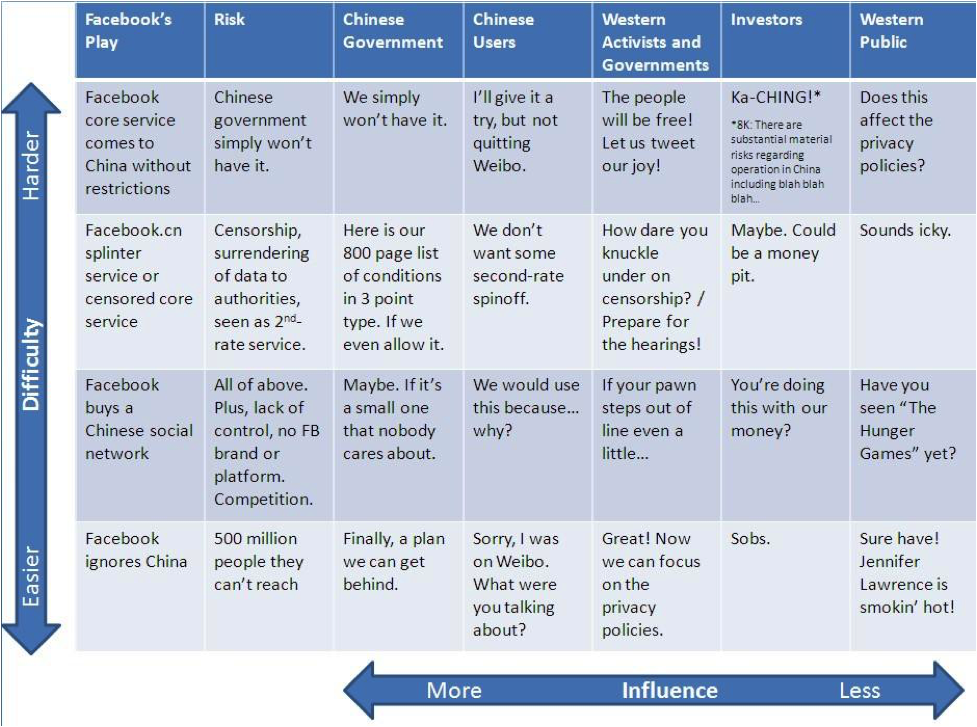
The easiest way to look at all these moving parts is to simply throw the whole thing in a table that considers for each scenario the risks and how each of the stakeholder groups is likely to react (click the table for a larger, EZ-reading version):
Admittedly this format throws a lot of nuance overboard, but nevertheless there’s a clear three-way conflict that emerges. The approaches that are more acceptable to the Chinese authorities are both riskier with regards to Western activists and regulators and, importantly, less relevant to Chinese users. The approaches that are most relevant to Chinese users and have the highest potential return to the business are unacceptable to the Chinese government. Ultimately the Chinese government calls the shots.
The basic math is that to even have a chance of operating here Facebook would have to apply the mandated censorship policies either just to users of its core service in China or to a spinoff service that is kept separate from the core service. It would also have to be prepared to surrender Chinese user information to the authorities if requested. That will raise eyebrows as Facebook knows a ton about its users by design.
The risks of these approaches are clear to anyone who has studied the history of Yahoo in China and followed the congressional grilling of US Internet firms operating in China back in 2006. That was the stone age of social networking (Rupert Murdoch bought MySpace, Facebook turned 2, Twitter was hatched), and the political atmosphere around such things has not become any less sensitive since then. If anything, the messianic aura that clings to social networks and of which Chinese authorities have always been so distrustful has been exacerbated by last year’s political events in the Middle East. And let’s not forget recent events here in China and the leadership transition later this year.
There are ways to create distance between the core Facebook brand and service and the Chinese government’s likely requirements, but those ways don’t eliminate political risk at home, and they all make the service less appealing to Chinese users. These same users are already being wooed away from traditional social networks by microblogs and have a colorful history of rejecting foreign online services as irrelevant even when they’ve been allowed to operate here without restriction. Remember MySpace China? Me neither, and a friend of mine helped launch it. Owning a local social network would provide a layer of insulation from the risk of Western backlash, but at the expense of sacrificing much of the point of entering China.
None of this predicts whether Facebook will enter China, or how they might attempt such a thing. They’re probably playing a very long game. Whatever path they choose, it won’t be easy, either in China or at home. Bear that in mind next time Zuck is spotted in China and the tongues start wagging.
*Note to editors: Can we get over the fact that Zuck’s girlfriend is Chinese American? Everyone is compelled to point this out, but net impact on the Facebook-in-China story is zero-point-zero.
Note: This post was originally published on the defunct group blog Rectified.name.
To listen to people moan about the fact that China has sixty “Confucius Centers” in the US to America’s zilch-nada in China you’d think the Chinese were wrapping up hearts and minds around the planet while America gets relegated to the public diplomacy junk-heap alongside the usual despotic malcontents. While I’ll concede that China has an advantage in being able to roll out cultural centers in the US while smothering our own poorly funded efforts in red tape, I’m inclined to see that imbalance as the result of the tolerance and openness that have been part of America’s strength for the last 234 years. Give or take.
Readers in America: When was the last time any of you went to a Confucius Center? I thought so. How about watched a Chinese television program or a Chinese movie that wasn’t directed by Zhang Yimou or Chen Kaige? See any Chinese brands last time you walked down the street? Ever had an American tell you they think Hu Jintao is super cool? Driven a Chinese car lately? Right. Whereas here, people feast on American pop culture (especially TV and movies), the street corners are a plague of American fast food labels and Buick is an aspirational brand. Leaving aside your opinions as to the value of McDonalds and Starbucks as ambassadors of American values, let’s not get all hysterical about the Confucius Centers or wallow in insecurity about America’s cultural influence until poor American refugees start seeking a better life in Fujian.
In fact, China’s government is well aware of its soft-power deficit with regard to the US (see also this article on Danwei), and has been investing in building up its capabilities. International news is one of the key areas of investment, thus the revamping and expansion of China’s foreign-language media organizations. This has included a refresh of the venerable China Daily, the launch of the surprisingly interesting English edition of theGlobal Times, the revamping of CCTV’s English language station, and more. Most recently, the Wall Street Journal has an interesting story about Xinhua’s plans to roll out an international television news service:
China’s state news agency announced the launch of a global English-language television channel, part of a broader international push by the country’s government media aimed at countering the dominance of Western news outlets and conveying a Chinese perspective on events.
Xinhua news agency said trial broadcasts of the new 24-hour TV service, called China Network Corp., or CNC, will start Saturday, and the station will be fully operational July 1. CNC will be available by satellite, cable systems, the Internet and cellphones, Xinhua said, and will carry a range of programming on news, business and lifestyle issues.
“CNC will offer an alternative source of information for a global audience and aims to promote peace and development by interpreting the world in a global perspective,” Xinhua quoted its president, Li Congjun, as saying at a launch ceremony Friday.
Well, maybe.
I fully understand and even support the motivation behind this. China is a globally important country and has a right to be represented in international media. And as American news media continues its slow-motion implosion, you’d think this would be a good time for them to make their move. Nevertheless, I have a history of rolling my eyes at Chinese efforts to improve their international media efforts. This is not because I am some kind of cynical bastard (although that might also be true) or because I doubt China’s technical competence (I do not). It is because I feel that the natural control-freak inclinations of the Chinese government toward media essentially preclude any ability to develop a news organization with real, international credibility.
The objective–the real objective–is important. If the goal is simply to further disseminate the usual propaganda, then fine, they can do whatever they want. They’ll all feel good about themselves. But no one will watch.
If, on the other hand, the goal is to develop an international media organization that can compete with what’s already offered in English and offer a legitimately different but respectable perspective, then they’ll need to break their traditional mold a bit. Al Jazeera is perhaps the model here. It emerged from a country and region not known for a liberal approach to media and established itself as a serious and credible news organization largely on the back of its Iraq and Afghan war coverage. It did so while still presenting a point of view that was a clear alternative to most western media. They were helped along by some good journalism and slick packaging.
I don’t want to overwork the comparison. For one thing, Al Jazeera has had its problems (including serious personnel issues at their English service a couple of years ago). China certainly has the resources to try something similar to Al Jazeera, but it has some very different political and institutional factors to wrestle with than Qatar did. Also, the world isn’t necessarily screaming for an Asian alternative. Remember, Singapore has already tried the international TV news stunt with Channel News Asia, and it has had only modest international success at best. Even Al Jazeera kind of limped along for several years until it found its purpose and voice after 9/11 and the Afghanistan and Iraq wars. One hesitates to imagine a Chinese news organization blossoming in the heat of such a controversial international incident.
So with all that in mind, here are a few things I think China should do if it is really serious about launching a successful international television news network.
Base it in Hong Kong Let’s face it, as wonderful as Beijing is, nobody is going to take a Beijing-headquartered international news organization seriously. By my thorough calculations, credibility will increase by the square of the distance from Zhongnanhai. This will be especially true if your parent organization is formally a branch of the Central Publicity Department, as Xinhua is. Technically that probably makes Lima or Buenos Aires the best option, but since those might be impractical, how about Hong Kong? Hong Kong is an established media hub with a veneer of press freedom that will be important in helping a new network to establish itself. It’s visa situation will be easier for pundits and professionals, especially the foreigners (see the next point). And, hey, it’s still China, right? Beijing has no trouble calling the shots in Legco, so it could probably manage a Hong Kong-based media organization without too much headache.
Hire pros to do it Al Jazeera raided the BBC Arabic service when it started, and then raided the BBC again when it started its English service. China should do something similar. There are a lot of good, unemployed journalists around these days, including TV journalists. Avoid the second-stringers and discount talent and hire some heavy hitters for the editing and mainstream talent. Go for some recognizable brand-names. This will be hard because most such people won’t want to work in a Chinese news organization. Basing it in Hong Kong will help, but people will have to believe it will be doing serious journalism.
Also, make sure the production values are competitive with the best out there. No college broadcasting, please.
Cover China for real This is another area where the Al Jazeera comparison breaks down. Al Jazeera was able to concede limits to its ability to cover its patron’s country, Qatar. Fortunately for them, nobody outside Qatar much cares what happens there, and there are plenty of sexier, more powerful and weirder places in the Gulf, let alone the broader middle East.
This won’t work for China, however. China is pretty much story number one out of Asia these days. How a Chinese international news network covers China will be a key part of how it is evaluated by audiences. The real test will come when, inevitably, such an organization has to cover a serious disaster or bout of civil unrest in China. What plays domestically will not play internationally, especially when people are comparing the coverage to other international media organizations. With all due respect to the Chinese people, who have been poorly served by foreign media on more than one occasion, most people outside of China–even non-Westerners–don’t spend their time grumbling about how crappy and one-sided coverage of China is. So don’t waste too much energy tilting at that particular windmill.
I’m not sure how China could manage this. It might have to credential its own news organization’s China journalists as foreign media. Now wouldn’t that be something.
Less scolding, more seduction
We understand that this operation is there to present China’s point of view, but a little bit of nuance is called for. Sometimes, the organization is going to have to cover the Dalai Lama, or Rebiyah Kadeer, Taiwan’s DPP, or other people the Chinese government finds distasteful. The moment the announcers start slipping into hostile language about black elements, jackals (jackals always get a bad rap), splittist criminals, etc. it’s all over. By all means, be more sympathetic to the Chinese government point of view, but do without with the theatrical, throwback language that alienates foreigners and reminds people that the propaganda mission always comes first. Find articulate, polished spokespeople to present the Chinese government point of view and let them, rather than the journalists or newsreaders, present the government’s points.
Don’t forget the rest of the world It shouldn’t be all China, all the time. Global news organizations report on, yes, the globe. If the big news of the day is from somewhere outside of China, let’s make sure we don’t lead with what the Standing Committee did today, in protocol order, and doesn’t Uncle Wen look nice with the bouquet those schoolgirls gave him. That means opening a lot of bureaus and sending hardcore journalists to interesting places. With many western media organizations in retreat, there are plenty of parts of the globe that could and should be covered better, and where China might get better access than Western media organizations. Africa and Central Asia come to mind. China has the resources and can do this if it wants to.
Or it could all be a fantasy. I’d be interested to see China come up with something polished, interesting and watchable. There have certainly been signs of life from corners of the Chinese English-language media in the last few years. But given the history, especially in the heavily state-managed regime of television, it’s hard to be optimistic.
Let’s say you’re a company selling some kind of product. Let’s say your product is –let’s just pick something at random here– laptop computers. Globally, this is a heavily commoditized category jammed with companies selling look-alike products with similar feature sets. In China, which has the usual big-time suspects plus a whole cloud of local also-rans, the situation is even more competitive. How do you stand out? How do you persuade students, young professionals and other consumers to buy your laptop, and not some brand-x laptop poseur laptop?
Well, in China the answer is often, “be cheapest!” But that’s not always the whole story. Often there is also some PR.
To that end, one thing you would often do is try to get your product into the hands of “influencers”, people who have the power to help lead public opinion in your target market, ideally in your favor. One way to approach this is the celebrity endorsement: I’ll send a cubic meter of 100RMB notes to your house if you wave my company’s product around, appear in some ads and show up at some of my events. And, hey, why not write a blog about it? This is generally legit and practiced everywhere. George Clooney and Omega watches, for instance, except he probably doesn’t get paid in RMB.
There is also the schwag approach, in which you give your product away to rich, famous and stylish types in the hope that they’ll be seen using it thus conferring glamor and sexiness upon it, hopefully without you having to write a colossal sponsorship check. This is why you hear about things like the absurd gift baskets at the Academy Awards. This also leads to the great commercial irony that rich people get more stuff for free than more deserving types, such as impoverished PR bloggers, and will no doubt be a contributing factor in the revolution when it finally comes.
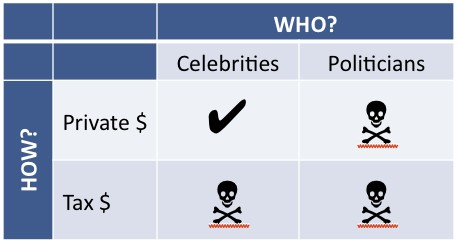
There are, however, some generally accepted rules about the schwag game. Two of those rules, involving who it’s OK to target and how schwag can be paid for, can be summed up in a diagram that looks like this:
By participating in a program to give free laptop computers to 2000 delegates to the Chinese People’s Political Consultative Congress (CPPCC), Lenovo appears to have landed squarely in the lower-right, or what I like to call the “PR deathtrap” quadrant. The CPPCC is a political body that nominally advises on and suggests policy and which convened this week in Beijing as part of the annual political “two meetings” festivities. The other meeting is that of National People’s Congress, which has the slightly heavier responsibility of endorsing actual policy (a cynic might say, “rubber stamping”, although the NPC has pushed back from time to time).
As China’s annual National People’s Congress opened yesterday, many news headlines pounced on Premier Wen Jiabao’s remarks toward the end of his NPC report (see tab 11), in a section on anti-corruption, about the need for leaders to report their personal assets. But in the margins, commentators railed against shady practices nearer at hand — more than 2,000 laptop computers given away to delegates at the public’s expense.
The laptop story bubbled up out of China’s social media sphere back on March 2, when Chinese Internet users noted an odd mini blog entry from Zhang Xiaomei (张晓梅), a delegate to the Chinese People’s Political Consultative Conference who is also the publisher of Beauty Fashion magazine.
Zhang’s entries were succinct, mostly mundane summaries of preparations and speeches ahead of the two meetings.
CPPCC Chairman Tao says: being a national delegate to the CPPCC is a glorious mission, and a post for political participation and discussion. Sichuan party secretary Liu Qibao (刘奇葆) says: last year was the toughest year, this year is the most complex.
But in one entry she wrote: “When delegates report [to the meeting] they each get a laptop computer. What is different from last year is that this year these don’t need to be returned after we’re done with them. This is much more practical.”
Yeah, it sure is, isnt it? Keeping stuff often is.
As China Media Project explains, the response both online and in mainstream media has been pretty negative, with accusations of corruption and speculation about the amount of tax dollars spent on the computers. It has also been pointed out that Lenovo executives account for a large share of the IT industry representation at the CPPCC.
So here is where it gets interesting, and perhaps where Lenovo put a foot wrong assuming they played some role in creating this program and weren’t just lucky beneficiaries. CPPCC delegates occupy a strange space in between celebrity and politician. Many of the delegates, such as Ms. Zhang, are in fact celebrities or notables from the business world. Most are not politicians or officials in their daily lives. As the Financial Times noted this week, the entire CPPCC is a bit theatrical, and its actual contribution to the legislative process is debatable at best. In previous years delegates had been loaned computers, so why not let them hold onto them this year? A relatively small change in the grand scheme of things.
But regardless of what you think about the CPPCC or the actual power of its delegates, in the context of the “two meetings” the delegates are acting as politicians. In an era when Chinese people are increasingly sensitized to corruption and willing to discuss it online and hold officials to account, giving laptops to 2,000 wealthy people operating in a political role looks risky at best. Perhaps in some years it doesn’t become a big deal, but this year it rubbed people the wrong way. It probably would have been best to stick to the loaner approach, even at the risk of some slightly inconvenienced delegates.
From Imagethief’s point of view the good news is that this issue became, well, an issue. That it escalated online and in the media is a headache for Lenovo and perhaps an embarrassment for some of the delegates (although that may be optimistic), but it’s a good thing for accountability and for China. The CPPCC may be largely symbolic, but at least it could be relatively clean and symbolic.
So what should Lenovo do? This situation is a long way from being out of control, so what they probably will do is hunker down and wait for the government to decide that discussion of this issue is no longer appropriate and then enjoy the ensuing silence. A more progressive option would be to announce that in subsequent years they’ll return to a policy of loaning delegates computers rather than giving them away. Better yet would be to cancel the whole thing and make delegates self sufficient for computing in future. I’m sure most CPPCC delegates –even the ethnic minority delegates– can afford a computer.
Or how about this: It’s awkward to inform delegates that, sorry, contrary to what they were originally told they do have to return the machines. But Lenovo could ask delegates who don’t need the computers after the meetings to voluntarily return them, and then publicly donate the returned machines to some worthy cause. Rural schools? Barefoot doctors? Impoverished bloggers? You name it. Plenty of options.
Note: Some in-situ links removed from the paragraphs quoted from China Media Project. It’s worth visiting their original post.
Disclosure: I do not work on any laptop computer accounts, however my agency does represent a competitor to Lenovo. The views expressed here are my own.
Update: David Bandurski of China Media Project left a comment in the original version of this post noting that, as of writing, criticism in the media was not directed at Lenovo specifically. At least, not yet.
Imagethief stumbled blearily to his computer this morning expecting a relaxed scan of the news but found the Chinese Twittersphere ablaze with the news of Google’s bombshell blog post, which went up in the middle of the night early this morning our time. Titled “A new approach to China”, the post, by Google’s Senior Vice President for Corporate Development and Chief Legal Officer, David Drummond, was essentially a public threat to withdraw from China. As such, it was as direct a challenge to the Chinese authorities as I have ever seen in a piece of public corporate communication.
The first half of the post discusses alleged hacking attempts on Google, apparently with the aims of both recovering Google source code and accessing the Gmail accounts of dissidents. But the second half of the post is more interesting. The money grafs below (emphasis mine):
We launched Google.cn in January 2006 in the belief that the benefits of increased access to information for people in China and a more open Internet outweighed our discomfort in agreeing to censor some results. At the time we made clear that “we will carefully monitor conditions in China, including new laws and other restrictions on our services. If we determine that we are unable to achieve the objectives outlined we will not hesitate to reconsider our approach to China.”
These attacks and the surveillance they have uncovered–combined with the attempts over the past year to further limit free speech on the web–have led us to conclude that we should review the feasibility of our business operations in China. We have decided we are no longer willing to continue censoring our results on Google.cn, and so over the next few weeks we will be discussing with the Chinese government the basis on which we could operate an unfiltered search engine within the law, if at all. We recognize that this may well mean having to shut down Google.cn, and potentially our offices in China.
No doubt a great deal has transpired behind the scenes in the lead up to this announcement. To save time, here’s what I don’t know:
Whether this is linked to rumors of Google’s possible withdrawal from China and staff exodus that circulated several weeks ago.
The relative weights of the hacking issue, censorship issue and Google’s business struggles in China in leading the company to make this statement.
What, if any, discussions Google had with Chinese authorities prior to making this statement (they speak of discussions “over the next few weeks”), or whether there are actually continuing negotiations.
Whether recent blocks of Google Docs and Google Groups in China contributed to this decision.
Whether Google would have done this if their business in China was stronger. China contributes a minuscule portion of Google’s revenue.
What will actually happen to Google’s business in China in the long run.
Here is what I do know:
Google has taken the China corporate communications playbook, wrapped it in oily rags, doused it in gasoline and dropped a lit match on it. In China, foreign companies tend to be deferential to the authorities to the point of obsequiousness, in a way that you would almost certainly never encounter in the United States or Europe. Scan any foreign company’s China press releases and count the number of times you see the phrase, “commitment to China”. Demonstrating “alignment with the Chinese government’s agenda” is an accepted tenet of corporate positioning and corporate social responsibility work in China. This is testament to the degree of direct power that the Chinese authorities wield over the fortunes of foreign businesses in China. Even when foreign companies are in dispute with the Chinese government they tend to offer criticism obliquely as long as they have a business stake or operations in the country. Note, for example, the scrupulous diplomacy of Rio Tinto’s communications concerning the detention of its employees last summer, a far more serious situation than anything Google has encountered (although also with far more money at stake).
In this situation Google has undertaken a bet-the-farm confrontational communications approach in China. They will not have made this decision lightly. Dressed up in the polite language above is what is essentially an ultimatum: Allow us to present uncensored search results to our Chinese users or we’ll walk. The Chinese government is not likely to cave to an ultimatum from a foreign company, no matter how decorously delivered. As Richard Waters of the FThas pointed out, the language does leave some wiggle room for further negotiation. However, Imagethief cannot imagine a circumstance in which the Chinese government will give Google free reign, especially in the current, highly restrictive climate for Internet services. Barring some surprising developments, the clock would therefore appear to be ticking for Google.cn, if not Google’s overall operations in China. It will be very interesting to see how this plays out.
Would Google continue with an office in China if there was no Google.cn site? They could still conduct R&D here, for instance. But Google’s R&D operations in China have been troubled (remember the Sogou IME scandal?) and if the security issues are taken at face value continuing operations here in the absence of a local business to support might simply be extra risk. Consider how many China R&D operations are “PR&D”, designed to demonstrate that essential “commitment to China” in support of a revenue-generating business in China. It’s not that real R&D doesn’t happen here, but how many companies do high-level, primary R&D in China in the absence of an on-shore business and supporting government relations program? And could Google attract talent to a pariah operation? Distraught Chinese netizens are already laying flowers at Google’s China headquarters.
The Wall Street Journal’s story (sub) on the unfolding situation makes some interesting points (emphasis again mine):
The common assumption, however, is that no matter how onerous the limitations and challenges faced by foreign companies in China, the market is too big and important to walk away from.
That calculation has forced a number of foreign firms to accept conditions in China that they might not tolerate elsewhere. The country has 338 million Internet users as of June, more than any other country.
Google would be the most high-profile Western company in recent years to draw a line under the kind of compromises it is prepared to make and walk away from China.
It would be an extremely rare case of a foreign company taking a stand on human rights, and placing that issue over commercial considerations. A number of foreign companies exited China after the Chinese army crushed student protesters around Tiananmen Square in 1989. But they mostly came back in the following years.
A Google withdrawal would also be an implicit rejection of the argument made by many technology companies that their presence in China overall helps expand access to information for Chinese citizens, despite censorship.
That’s the very last line in the story, but I found it one of the most interesting. If you followed the original justifications offered by many American Internet companies for launching businesses in China, or the congressional hearings on the matter in 2006, you will recall that the argument that even a censored presence in China improved access to information for Chinese Internet users was central. If Google repudiates that argument it will put pressure on other American Internet firms currently toeing the regulatory line in China, especially Microsoft, and weaken one of their core public arguments for a continued presence in China. Then again, it may also represent an opportunity for them. After all, “Google” doesn’t phoneticize well in Chinese, as the flap over the “谷歌” branddemonstrated. But “Bing” works quite nicely indeed.
This only the latest chapter –albeit potentially a critical one– in the very interesting story of Google in China. Someone needs to write the book. Anyone want to step forward for that?
CNBC interview with David Drummond (Video – also embedded below): “We’re not saying one way or the other whether the attacks were state sponsored…” Note also the silly use of the word, “cyberterrorists” by the interviewer.
Brief, relatively straightforward report from the People’s Daily online (Chinese).
Chinese telecoms analyst Xiang Ligang calls it “psychological warfare”, doesn’t think Google will pull the trigger, and doesn’t think it will be a cataclysm if they do (if I read it correctly – Chinese).
“In a world in which we are so used to public relations massaging of messages, this stands out as a direct declaration. It’s amazing,” said Jonathan Zittrain, professor of Internet law at Harvard Law School and co-director of Harvard’s Berkman Center for Internet & Society.
The fallout will be interesting. I can’t recall a single case of a major international company with operations in China taking a stand like this. As someone who agreed with Google’s reasoning when it entered China, I also support this move. If it cannot operate here in accordance with its global standards, it should leave. I have given up on getting my own website unblocked by the government and am resigned to the fact that it’s only accessible to people who are outside China or know the technical tricks to get over the Great Firewall.
I’d rather be outside the wall and free than inside it with the icy hand of the censor around my throat.
Full disclosure: Imagethief is a supporter of foreign Internet services operating in China. Elaboration in this comment, below, in response to a point from a reader.
Xinhua English report on the statement: “‘It is still hard to say whether Google will quit China or not. Nobody knows,’ the official said.”
Gady Epstein’s column on Forbes.com: “Dreams of Internet openness in China appear to be a fantasy.” Indeed.
Evgeny Morozov punctures the feelgood balloon at Foreign Policy: “If…you believe that [Google] did the right thing in China by offering their limited service (rather than no service at all), I don’t see how this move could make you feel good…”