Tag: China

  • Imagethief and the man-eating otter of Changbaishan

    I’ve posted to YouTube a video of the trip I took to Changhbaishan last summer with Mrs. Imagethief and my father. It took me the better part of a year to get around to editing it, but here it is. Changbaishan is the rugged mountain range that divides northeast China from the Korean peninsula. There is a “nature reserve” a few hours drive outside of the town of Yanji, and that’s where we went. It’s a beatiful area, but also a major tourism waystation. As always, we had a pretty good time.


    This was shot on Mrs. Imagethief’s point-and-shoot digital camera, which also has a video function. I did a few make-it-up-as-I-go standups and cut those together with other footage mostly taken by Mrs. Imagethief and some of my photographs. There was a lot of a wind noise, so I’ve subtitled a couple of spots it might otherwise be hard to make out what is being said. It’s a hair under ten minutes. Enjoy.

  • Bang! China shoots its own Olympic PR in the foot

    Imagethief, who has bid for something on the order of RMB12,000 worth of Olympic tickets, is trying resolutely to remain optimistic about the Games. Unfortunately, it’s proving harder as time goes by. Tomorrow marks the one-year-remaining milestone. This should be an opportunity for Beijing to highlight progress, turn the excitement crank, and demonstrate that has the patience and forbearance that will be necessary for a successful Olympics. However yesterday brought an important test of China’s patience and forbearance, and China failed it.

    The problem is that while tomorrow’s milestone date is a legitimate time for celebration and anticipation, it was inevitably also going to be a perfect date for a dry-run by the many activist groups that want to appropriate the Olympics for their own agendas or score points against China. Sure enough, that is what has happened. Reporters Sans Frontieres,Human Rights Watch, the Committee to Protect Journalists and Amnesty International all chose this week to release announcements or hold protests.

    Of these, the RSF protest yesterday was most provocative. Activists wearing T-shirts and carrying signs that portrayed the Olympic rings as handcuffs staged a demonstration on a highway bridge near BOCOG’s headquarters. To add an extra measure of discomfort for Beijing, IOC Chairman Jacques Rogge happens to be in China right now.

    Unfortunately, reports say that foreign correspondents covering the protest were detained by police for one or two hours afterward and “roughed up”. From the AP coverage:

    [Uniformed] and plainclothes police physically restrained reporters coming down from the pedestrian bridge, pushing and pulling them, seizing IDs and refusing to allow them to leave the scene. Reporters were detained in a parking lot directly opposite the Olympics office tower, facing the Beijing 2008 logo and Olympic rings on the outside of the building.

    Journalists were allowed to leave after about two hours, with no explanation from police about why they were detained.

    A woman in the spokesman’s office of the Foreign Ministry said she did not know about the case and would look into it. Liu Wei from the information office of the Beijing Olympics Organizing Committee said she was not aware of the situation and had no comment.

    If that isn’t playing right into RSF’s hands I honestly don’t know what is. I found the reports somewhat confusing and had to dig around to get a clear idea if the journalists detained on site were protest participants or locally credentialed reporters covering the event. But it appears to be the latter. RSF’s own release suggests much the same.

    The best thing for Beijing to do under these circumstances would have been to err on the side of tolerance and allow the protest to proceed under supervision. Credit is earned slowly, painfully and in tiny increments while setbacks come in great, heaving leaps, and activists can win the PR battle by baiting the Chinese authorities into overreacting. Detaining journalists on the scene, under any circumstances, was asking for trouble.

    The result is not only that the protest is probably getting more coverage than it would have otherwise, but that the tone is distinctly nastier from Beijing’s point of view. Coming on the heels of last week’s widely covered FCCC survey and at the same time as all the other reports listed above, it looks very bad and reinforces people’s fears of what might go wrong during the Games themselves.

    The PR rule of thumb operating here is that response to an issue can become the issue if it is handled badly. That is a rule that Beijing needs to stay mindful of. Unfortunately, it seems likely that not all of China’s bureaucracies will be on the same page about this. It is entirely possible that BOCOG and the Public Security Bureau will have different opinions on how these kinds of situations should be handled. This might be someplace where the IOC could provide a little visible leadership, but they have stayed silent until now.

    Fair or not, China will be judged differently than other countries that host the Olympic Games. Now matter how glamorous the venues, how exciting the games, or how successful China’s athletes, the Games will be judged in large part based upon how gracefully Beijing can manage the inevitable protests. That is the price China pays for hosting the Games in a political environment that disdains many of the freedoms that the Games’ primary audiences abroad take for granted. The Financial Times‘ Beijing Bureau Chief, Richard McGregor puts it nicely:

    Over more than a decade Beijing has gradually defused pressure over its human rights record. Through remorseless diplomacy and skilful use of its growing economic clout, it has sidelined western complaints about human rights and marginalised the non-governmental lobbies that seek to promote them.

    The Olympics, however, are offering China’s critics a moment in the sun, and they have grabbed it eagerly.

    McClatchy’s Tim Johnson also captures the risk Beijing faces nicely:

    Because of China’s history of quashing revolt, any protest has the potential to become an iconic image, like the moment when U.S. athletes Tommie Smith and John Carlos raised their fists in a “black power” salute at the 1968 games in Mexico City.

    That’s an important thought to bear in mind. It will be interesting to look back a year and a month from now and see what the iconic image of the Games is. I sincerely hope it will be a moment of athletic triumph or a moment of Olympic splendor in one of those magnificent venues.

    After all, the Olympics are a magnificent opportunity for China. An opportunity not only to showcase the country’s development and rightful place on the international stage, but also to explore a more constructive way of engaging with the activists and NGOs that, for better or for worse, will be interested in China for decades to come.

    But the heavier a hand that Beijing takes in dealing with dissent and protests before and during the games, the higher the chance that the iconic image of Beijing 2008 will be something that dispels the goodwill the Olympics could create and reduces those opportunities to dust.

  • China problems create rewards (and disasters) for PR risk takers

    Note: This was originally two posts, published within a few days of each other.

    Part 1: China problems create rewards for PR risk takers (July 30, 2007)

    All PR has an element of risk to it. That’s one of the things that separates it from advertising. Ultimately, much as we might like to be able to control the press, we can’t. Any time we agree to an interview, or put an executive together with a journalist or reach out to a blogger there is a degree of uncertainly. The wrong thing said, a spot of bad luck, or someone simply having a bad day can turn what should have been good coverage bad.

    Risk is part of the PR bargain. We surrender final control over the message in return for the credibility that third party coverage can create and advertising cannot. We’re in the business of getting other people to say nice things about our clients. But other people continue to have minds of their own despite the best efforts of me, my dark brethren and the entire television industry.

    Much of PR is the art of managing communication risk. We look for journalists and publications that offer the right mix of favorable attitude and credibility. We coach executives to give interviews and speak publicly. We prepare briefings and talking points, trying strike the balance between preserving the liveliness that makes a discussion interesting and preparing for the curveballs that can derail a discussion. We develop crisis manuals so that less is left to chance in the heat of a corporate disaster.

    As is true in so many other aspects of life, larger risks are often the price of larger rewards. I can always do a softball interview in a small-circulation industry trade. Or I can try to get something in the Wall Street Journal, with a correspondent who will ask much tougher questions. I risk a less positive article or no article at all for much wider and more credible coverage. Willingness to assume a calculated risk can often be the key to a big payoff.

    I detected such a calculated risk last week when I came across a New York Times article on how the American toy company Mattel quality-controls the products it has manufactured in China. Written by Dave Barboza, who has been omnipresent on this issue, and the US-based Louise Story, the article is based largely upon a visit by Barboza to Mattel’s facilities in Shenzhen.

    The article drags up some bad memories from Mattel’s past in Asia, but it is largely positive. It sets Mattel up as an example of how to manage overseas manufacturing, dwelling at length on what the company has learned from its experiences and what distinguishes it as a leader today:

    [In] 1997, Mattel took a significant step to improve its image and working conditions. The company hired S. Prakash Sethi, a professor at Baruch College, part of the City University of New York, who had an international reputation as a critic of worker mistreatment.

    Mr. Sethi would make unannounced visits to Mattel’s factories and vendors’ plants. He insisted that he would only monitor Mattel if the toy maker let him post his reports publicly and uncensored.

    Mattel agreed.

    Ten years later, Mr. Sethi says Mattel, unlike most companies operating abroad, still gives him 100 percent independence in his reports, which are often critical. “Mattel is the gold standard,” he said.

    Today, industry analysts tend to mention Mattel’s commitment to worker conditions in the same breath as its commitment to product safety.

    “Mattel talks about this with a passion, and it is not just lip service,” said Sean McGowan, managing director and toy industry analyst at Wedbush Morgan Securities.

    That’s a nice boost for Mattel’s reputation in a way that no advertisement will ever buy.

    What makes this article interesting is that the topic of quality control in China was one that many companies wanted to stay away from. In response to a request from a journalist a couple of weeks ago I tried to find a client that would speak about how it ensures quality in Chinese supply chains. No one wanted to go on the record. Even an industry association told me it was too radioactive to touch. Companies didn’t want to remind the public back home that they manufactured in China, even if they were doing so to show how thorough their quality control was. They all judged the risk too high.

    Mattel, however, took the risk, based presumably on confidence in their QC systems and processes. They thought they had a good story to tell and they found a way to tell it to a journalist who was interested. That’s the essence of good PR, and to my eye it has paid off nicely for them. In fact, in the article Barboza and Story take pains to point out the companies that did not cooperate:

    Mattel was one of only two major toy makers that agreed to allow a reporter for The New York Times to visit one of its factories in China — or even to put an executive on the phone to discuss the issue of Chinese product safety. Hasbro, LeapFrog and Zizzle — the maker of Pirates of the Caribbean toys, among others — all declined requests.

    Lego does not manufacture in China, but it declined a request to visit factories elsewhere. Aside from Mattel, only MEGA Brands of Canada said it would permit a visit.

    Those paragraphs make Mattel look like a well-managed company with nothing to hide. By contrast, Mattel’s reticent competitors come off looking insecure by comparison even though they may simply have been being cautious.

    I wonder whether Mattel simply spotted the opportunity when they took a call from theTimes, or if they actively pitched the story. If the latter, they earn an extra measure of respect from me.

    I suppose this story could back to haunt Mattel if they have a China-based problem in the next few months. But that seems unlikely –or at least an acceptable risk– and in the meantime they’ve earned themselves good coverage out of a situation that many other companies simply hoped would blow over.

    Note: Mattel is not Imagethief’s client. Nor are any of the other companies named.

    Related:
    Dan Harris has also remarked on this article in China Law Blog, from a slightly different perspective.

    Part 2: …And sometimes they blow up in the faces of PR risk takers (August 2, 2007)

    A few days ago I wrote a post [above] about how Mattel appeared to have seized the opportunity to generate some good PR for itself out of the China product situation. I framed it as a PR risk vs. reward equation, and thought that Mattel had done a very good job of bolstering its reputation by taking the risk of inviting journalists to tour its facilities in China.

    The problem with those risks is that they are so darn risky. At the end of my post I wrote:

    I suppose this story could back to haunt Mattel if they have a China-based problem in the next few months. But that seems unlikely –or at least an acceptable risk– and in the meantime they’ve earned themselves good coverage out of a situation that many other companies simply hoped would blow over.

    I was wrong. It was not unlikely. It was, in a perfect illustration of Murphy’s Law (or Sod’s Law if you are anglicized), inevitable. The news broke this morning that Mattel is recalling nearly a million toys for problems with lead-based paint. It was first reported by AP, but one of the two journalists who wrote the story I commented on last week has written it upmore extensively for the New York Times:

    On July 18, Mattel took a reporter for The New York Times on a tour of a factory in Guanyao, China, and of Mattel’s toy safety lab in Shenzhen. At that time, Mattel executives say, it was unclear whether Mattel was facing a widespread lead paint problem, or if the European case was an anomaly.

    Last Thursday, the same day this newspaper ran an article on the subject of preventing safety violations in Chinese factories that focused on Mattel, the company’s executives say they received conclusive data that convinced them to recall the 83 products. Then, the company contacted retailers who stocked the toys.

    “This is a vendor plant with whom we’ve worked for 15 years; this isn’t somebody that just started making toys for us,” Robert Eckert, the chief executive of Mattel, said in an interview. “They understand our regulations, they understand our program, and something went wrong. That hurts.”

    Boy, does it ever.

    What does this mean for Mattel? They seem to be doing a pretty good job of handling the recall, and they have a history of managing this kind of situation fairly well. But the timing is disastrous and the episode will undo the reputational boost they got from the story last week. Furthermore, they now face the extra scrutiny that will come from having showcased (the PR man in me hesitates to use the phrase “boasted about”) their quality control mechanisms in such detail. If you’re so good, why didn’t you catch this?

    One of my regular commenters, a lawyer, pointed out:

    [You] raise a good point about what happens if a problem occurs in the future, e.g. a product liability claim based on their China-made toys.  Having established for broad public view their set of standards, the potential for deviation from those standards could form the basis for negligence issues.

    I wonder whether Mattel had internal communication issues. Last week’s article was apparently in development for about a week, before being published on the 26th. Today’s article notes that Mattel received information of the problems on same day that the report ran. Now that’s bad timing, and, if this was a surprising result from routine testing, perhaps just colossally bad luck. But if anyone in Mattel suspected problems or knew before the article ran –or, especially, before the journalists were invited to tour Mattel’s facilities–  that the results might be problematic, then Mattel had an internal communication breakdown that might have substantially affected their PR decision making. All this is simply speculation on my part, and should be taken as such.

    PR people should take calculated risks, and I still admire Mattel’s decision to work with the Times journalists for last week’s story. I think it was gutsy and had until now yielded good results. But PR people also need to do their own due-diligence on these kinds of risks. What test results do we have pending? Are there any known issues that might break in the next few weeks? What’s my level of confidence? Mattel’s PR squad may well have done this and more, but I’m still happy I’m not the person explaining the decision making to Mattel’s senior management this week.

    I’ll be interested to see how Mattel handles communication around the recall. I also hope that companies don’t take the wrong lesson from this and become even more cautious in communicating about their China QC and sourcing. In general I still think there is a lot to be gained from showing consumers what you do to protect them, even if the systems aren’t perfect.

  • Bullet in the head: Marquee executions and public communication

    As has been widely reported, the Chinese government has got round to making an official example of Zheng Xiaoyu, the disgraced former head of the State Food and Drug Administration who became the poster-boy for China’s rippling food and drug scandals. In their eagerness to send a message, they got round to it quite quickly; from sentencing to execution in about six weeks. American capital punishment supporters can only dream of being able to dispatch ne’er-do-wells with such efficiency. Zheng’s story is nicely recapped in a New York Times article by David Barboza.

    Everyone who comes to China or learns Chinese rapidly becomes acquainted with one of China’s entry-level proverbs, “killing a chicken to scare the monkeys”, meaning to make an example of someone. It’s a phrase that has been thrown around a lot with regard to this case. To Imagethief’s mind, China has probably killed the wrong chicken.

    Executions have a long tradition as public communication. That’s why, historically, executions have either been public or very well publicized. Look what we do to murderers/ robbers/ adulterers/ royalists/ deserters/ partisans/ corrupt mandarins/ spin doctors, etc. It could happen to you, so stay in line. Whether or not executions are effective as a deterrent is debatable (and widely debated). But that they are used as communication is indisputable.

    Imagethief is not a fan of the death penalty. I feel that it is often applied in my own country more as vengeance and social catharsis than justice, with substantial class and racial biases. I am also not convinced of its value as a deterrent. You can always tell which governments are really serious about using death as a tool of policy because they are the ones that skip the public communication element and simply disappear people. Word of mouth does the rest. If you really want to keep the public on its toes, that seems to be the way to do it.

    However I must concede that the public communication value of executions extends beyond deterrence. For example, a death penalty can be employed as a demonstration of government resolve or as proof of piety. Looked at that way, you might reword the hoary Chinese idiom into “killing a chicken to demonstrate institutional resolve to the monkeys,” but that doesn’t reduce elegantly to four characters.

    So was Zheng Xiaoyu’s execution supposed to be a deterrent or a demonstration of resolve? Looking at the (somewhat spotty) English translation of the People’s Daily editorial hailing the execution, perhaps a little of both:

    Death penalty handed to Zheng Xiaoyu has fully proven the will and desire of the people across China, eloquently showed the spirit of the fairness and justice of legal sanction as well as the firm resolve of the Party and the state. For corrupt officials, no matter whoever he is, what a high position he occupies and how deep he has hid himself, probes into the cases he is involved will be carried out resolutely and thoroughly, but no indulgence or soft hand will be granted to him.

    Death penalty handed to Zheng Xiaoyu indicates that laws are stipulated in explicit terms, penalty is meted out in strict compliance with his crimes, and punishments commensurate with his duty.

    ***

    As part of the effort to cope with corruption, no “extraordinary and special” Party members are allowed to stay aloof the laws and no corrupted elements permitted to have any place to hide themselves. Whoever daring to commit outrages and run amuck in defiance of state laws will be subjected to severe punishment of the Party disciplines and the state laws.

    Imagethief also particularly likes one throwback line in which conjures up the best of Maoist-style righteous, nationalist rhetoric:

    A few individual Party officials, prompted by interests and money, nevertheless, have gone crazy to the defiance of laws, and Zheng and his ilk belong to such jackals from the same lair.

    “Jackals from the same lair” is a slightly more advanced Chinese saying meaning roughly, “cut from the same nasty cloth”, and has been used before in Chinese government communication to describe people such as Richard Nixon and Hubert Humphrey, Indian reactionaries and British imperialists, and, as a variation on the same idea but with a shuffling of enemies, Soviet revisionists and US imperialists. It’s nice to see the People’s Daily reaching for some trusty, old tools.

    The question then remains, was Zheng’s execution effective as public communication? This depends who the audience was. If the audience was other senior cadres, possibly, but with qualifications. If the audience was the public, I think not.

    The problem with using punishment as a deterrent, besides having to communicate it, is that the threat needs to be credible and proximate. People need to believe that it if they transgress, punishment is likely to befall them. I’m not a criminologist or lawyer, I’m a communication expert, so I’ll stick to looking at this in terms of the beliefs that might exist and the messages that might be communicated and received around such situations.

    What makes the threat of punishment real to someone? I would suggest that a potential criminal has to believe three things: That the likelihood of being caught is high enough to factor into their calculations; that if caught the punishment will be enforced; and that the punishment itself will hurt.

    A lot of legislation and police work is bound with communication campaigns to ensure that the right people are convinced of these three things. For example, my own state of California produced the memorably titled and widely publicized “Three Strikes and You’re Out” law, whereby a third felony conviction is an automatic life sentence. (It was widely applied, too, and helped to clog up our jails to the delight of the California prison lobby.)

    Assuming a rational and intelligent actor (an immense assumption, I realize — after all, the world is rife with crimes of passion and moronic criminals) these three risk factors will be weighed against potential rewards in a decision as to whether or not to misbehave. So an authority that wants to encourage good behavior ought to communicate credibly on all three fronts (assuming that counting on people’s essential goodness is, ahem, sometimes not enough). You will be caught. You will be punished. And it’s gonna hurt. If any one of those three things isn’t believed, your communication is probably ineffective. This is true at any scale. It’s why governments advertise that they execute people (or even just fine them) and why your mom told you that she had eyes in the back of her head and that you’d lose your allowance if you fought with your little brother and that she was serious. And probably busted you once or twice just to prove it.

    Making a public spectacle of a punishment, say by widely publicizing it in the media, is part of this process. The problem is that when an occasional person is conspicuously made an example of, people are apt to discount the message. It was political. He was unlucky. He didn’t have good enough connections. He was stupid. He was a much bigger fish than I was. All of these rationalizations are ways that potential misbehavers might distance themselves from the person being made an example of, diminishing that sense of the likelihood of being caught.

    If you don’t think you’ll get caught, the other two factors –the likelihood and severity of punishment– are irrelevant. All that stands between you and tainted lucre is, well, your conscience. Furthermore, it’s easier to distance yourself from someone who is unlike you. That’s why Zheng’s execution might be a reasonably strong message to senior cadres and civil servants, and a fair demonstration of party resolve, but why it probably doesn’t mean much cadres out in the provinces or to the guy making counterfeit drugs in the suburbs of Bengbu. (This idea of identification works in reverse as well, and it’s why you use role models to advertise to people.)

    So if the occasional, high profile punishment is ineffective, what might work?

    Let’s start with an assumption: People have to believe that the institutions responsible for the processes of identifying transgressors and dispensing punishment cannot be easily short-circuited. This doesn’t mean that you need western-style rule of law for punishment to be effective, but it does mean you need to demonstrate consistency. The Taliban were ferociously effective based on the simple expedient of consistently shooting or beating to death anyone they thought wasn’t toeing their line. It was repulsive and barbarous, but it worked.

    China probably aspires to a less arbitrary process than the Taliban had, even if it sometimes doesn’t look that way. But this is where endemic corruption causes problems because it short-circuits the institutions and processes by which lawbreakers are identified and punished, rendering them terribly inconsistent. In the absence of consistent proof, communication is reduced to noise. Ultimately, it’s not enough just to say it. You need to do it regularly or people stop listening. The most effective PR, remember, is based on actual deeds.

    But you can’t line up everyone against the wall and shoot them (unless you’re the Taliban). So what should China do?

    What would be effective in the long term is to launch and visibly communicate a nationwide campaign of much tougher enforcement against garden variety businesses and businessmen who cut corners, make unsafe products or skirt the rules, and against local and provincial regulators and cadres who are found to be corrupt. If garden variety misbehavers believe there is a real chance they’ll get a painful fine or jail sentence, that their businesses will be closed or that they’ll be successfully sued, then they might reconsider the percentages. If they don’t believe that, they won’t care whose head gets rolled in Beijing.

    It won’t be the distant threat of execution that does the trick, but the immediate threat of a routine inspection. Beijing shouldn’t avoid punishing corrupt senior officials, but hearing that the guy up the street got raided despite being the cousin of the head of the local PSB will be much more effective than a distant guillotining in the capital. Many such examples –by which I mean thousands– would provide the basis for a much more broadly effective communication campaign.

    To China’s credit, the government is trying to do this. Recent announcements thathundreds of businesses have been closed for safety violations are a start. But ultimately it becomes a question of scale and that’s where the problems seem insurmountable. Without root-and-branch reform of its institutions, and there are eight involved in food alone, it may simply be impractical for China to enforce this kind of program at any meaningful scale. In that case, there is little alternative for the government to continue to rely on “showcase” prosecutions to make its case, ineffective though they are.

    This is also where government control of media and public expression exert a cost. If you can’t build credibility from the top down, an alternative might be to aid communication from the bottom up. Grass-roots anger from Chinese people who are the victims of many of China’s quality problems and scams could be a powerful thing. So could a less fettered media, free to range across the country and peer more deeply into dank corners. But the media is prone to many of the same problems as government institutions, compounded by regulations that make it difficult to report on issues that the government finds sensitive.

    Charitably, Zhen Xiaoyu’s execution shows the government’s resolve to attack its institutional problems as starting point for better enforcement at all levels. Less charitably, it will sail over the heads of the small-time crooks and entrenched powers responsible for so many of China’s problems and doom Mr. Zheng to being just one more in a line of long-forgotten high-profile examples.

    See also:

  • We’re Hu Jintao’s Lonely Hearts Club Band

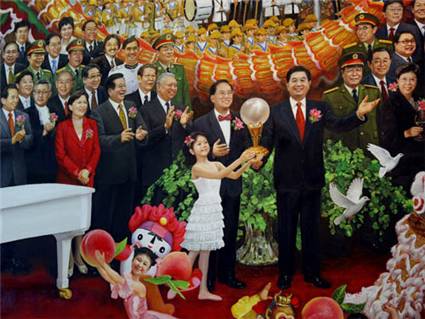
    Imagethief was interested to see on the front of the Saturday South China Morning Post a segment of a painting that has just been unveiled in Hong Kong to commemorate the tenth anniversary of the 1997 hand-over of sovereignty. This is no ordinary canvas, mind you. It’s essentially a mural, seven meters by three, with the likenesses of Chinese President Hu Jintao and 500 of Hong Kong’s great and good. Here is the segment that was printed in the paper:

    Hu-Jintao-HK-Painting

    Painted by artist Liu Yuyi, who came to Hong Kong from the mainland in 1991, painting is apparently meant to be inclusive in representing Hong Kong’s political plurality. Nevertheless, there does seem to be something of a pecking order. The (as ever, subscription-only) Post reports:

    [Liu] said he included people of different political views.

    Near the edge of the painting stand such figures as Cardinal Joseph Zen Ze-kiun, former chief secretary Anson Chan Fang On-sang and Civic Party legislator Alan Leong Kah-kit.

    Tycoons Li Ka-shing and Stanley Ho Hung-sun were among the closest to the state leaders in the canvas.

    Some key members of the Democratic Alliance for the Betterment and Progress of Hong Kong and the Liberal Party were also close to the action. Liu, who has lived in Hong Kong since 1991, said he had not yet decided whether to auction the painting, although some interested buyers had contacted him in recent days. “I may just give it to the state,” he said. “And I don’t rule out the possibility of giving it to the Hong Kong government.”

    One wonders where they would put it. Featuring President Hu as prominently as it does, one also wonders if perhaps it might need to be updated in future anniversaries, as the face of China’s leadership inevitably changes.

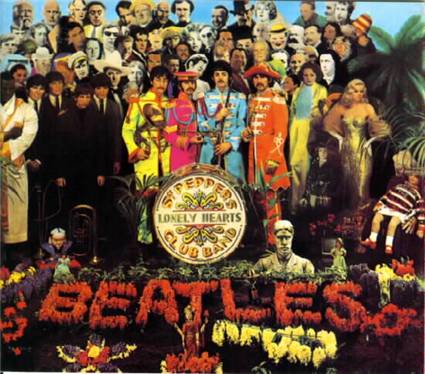
    In addition to the placement pecking-order of Hong Kong personalities, two things about the painting struck Imagethief as particularly interesting. First, in composition and palette it resembles a certain famous album cover:

    sgt-pepper

    In fact, my colleague Alex, upon spotting the photograph, said, “Hey, it reminds me of Sgt. Pepper!” I am not sure this is the effect Liu was going for. (There’s even a drum partially visible at the very top of the painting.) If you ask me, psychedelic Olympic mascot “Huanhuan”, visible in Liu’s painting, would have fit right in on the Sgt. Pepper cover.

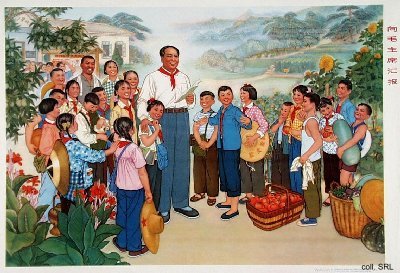
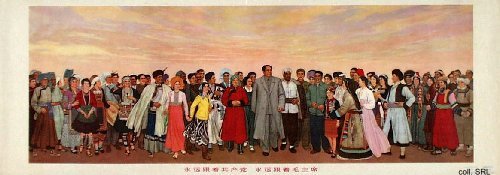
    Somewhat more disturbingly, the painting is highly suggestive of Maoist propaganda posters, especially the ones where the Great Helmsman is surrounded by hundreds of cheerful, energetic and well-fed looking Chinese people representing various ethnicities and acceptable segments of proletarian society. For example:

    mzd13

    Or perhaps this:

    mzd15

    If you’re having trouble reading the tiny caption on this second poster, I believe it says, “The ever victorious Chairman Mao gets by with a little help from his friends.”*

    Look at Hu in the painting above again. In the segment I can see, he is the only person who’s body is completely unobstructed. He has the greatest amount of negative space around him. His hand is upraised in beneficence. He’s surrounded by positive symbols; doves of peace, a pearl of harmony (according to the artist — don’t know if that’s accepted symbolism), and peaches of longevity (which are accepted symbolism). He’s conspicuously taller than Donald Tsang (which may be literally true). Intentionally or not, it’s a case study in cult-of-personality iconography. The only difference is that instead of being surrounded by an idealized version of the common people he’s surrounded by an ordered version of Hong Kong’s power elite.

    I leave it to the people of Hong Kong to decide what that means to them. But if Liu does bestow the painting upon the people of Hong Kong, I’ll be interested to hear where they hang it.

    Notes:

    *It actually says “Follow the communist party forever, follow Chairman Mao forever”, but I like my caption better.

  • China’s food crisis PR strategy: Blame everyone else

    A few weeks into China’s rippling food quality crisis a PR strategy is coming into view. It’s a classic one: blame everyone else. Unfortunately, it’s not likely to be all that effective because of two things. First, China does actually have long-standing problems with food and drug quality. Second, China’s poor history of transparency makes it hard for them to dispel suspicion (a problem that also dogs their disease-related communication).

    The recent affair began with the discovery that vegetable protein shipped from China to the USA and used in pet food had been contaminated with melamine, a plastic that can make the overall protein level appear higher. Melamine also destroys the kidneys of cats, as it happens, so the contamination was discovered.

    In classic fashion, China’s initial response was to deny everything. As a crisis PR strategy this sucked. Nothing makes you look sillier and less credible than retracting a categorical denial made in haste. It taints every following communication. In fact it wasn’t entirely China’s fault. Initially AQSIQ, China’s quality monitor, wasn’t looking for melamine, but another suspected contaminant. But obscure mitigating technical factors don’t tend to play well in the court of public opinion, or excuse prudence. In the face of further disclosure, the Chinese government’s subsequent choices were to appear dissembling or incompetent.

    Every country has its fair share of food quality problems. In my native USA E. coli bacterial contaminations are something of a national sport, and I can remember plenty of food poisoning scandals. Eric Schlosser’s book, Fast Food Nation, makes fine reading if you are interested in the topic. The FDA conveniently puts its “refusal reports” –the reports of imports rejected– online. If you want to be horrified, read the Mexican list. Food contamination is not an exclusively Chinese problem.

    China’s government has grabbed onto this idea as part of its defense. It has been helped by some recent developments, including the rejection of a shipment of Evian for alleged bacterial taint (a case that stokes the fire of another China PR issue, Danone’s legal war with Wahaha — see this interesting post from China Law Blog) and the discovery of Melamine in some US-manufactured animal feed ingredients. Li Yuanping, director general of the government’s Import and Export Food Safety Bureau, also pointed out that China has in the past rejected US products due to Salmonella contamination, and asserted that China’s record on food exports is slightly better than the United States. Li offered up some winning quotes:

    “Ninety-nine percent is a relatively high percentage of suitable goods,” Li Yuanping, director general of the government’s Import and Export Food Safety Bureau, said at a news conference. “Facts speak more loudly than anything. . . . From what I have told you, you can see China has a very sound system that can guarantee the safety of food exported abroad.”

    ***

    “No food-inspection system is foolproof,” he said. “It’s like an airplane. Flying is said to be the safest way to travel, but sometimes you have plane crashes.”

    Bad choice of words in Imagethief’s opinion. You think an airline would communicate that way? But I haven’t been hired to advise the Chinese government.

    Graceless rhetoric aside, Li might actually be right. But perception is everything. Frank Luntz, a conservative pollster, wrote a pretty good book about public communication called Words that Work in which he relentlessly drove home a key point: It isn’t what you say, it’s what people hear (in fact, that’s the subtitle). You say “99% are good”. Americans in bathed in relentless media coverage will hear, “1% might kill you”. Roll the dice and move your mice.

    Like a premature categorical denial, “everyone else sucks too” is considered a weak strategy around our office. You think China’s national ambition is to suck only as hard as everyone else? I think they want to be better. More importantly, as far as the audience is concerned we’re not talking about everyone else. We’re talking about export-driven China, which has a great deal at stake in overseas perceptions of its food quality. In international trade, food and drug safety issues get entangled with every other hot button issue. And in the US right now China is second possibly only to Iraq as the hottest of hot-button countries.

    To illustrate, let’s look at that Mexican example above. America simply doesn’t have as big an axe to grind about Mexican imports (except for immigrants) as it does about Chinese ones. Mexico isn’t the emerging strategic rival. Mexico doesn’t hold a trillion dollars worth of American debt. You don’t hear about America’s trade deficit with Mexico (about a quarter the size of the one with China in 2006). By and large, Mexico doesn’t threaten American agriculture so much as it props it up with cheap labor.

    You get the idea.

    Agenda hockey

    Following the great melamine scandal of ’07 a few other China-linked disasters have emerged into public view. In early May the New York Times ran a lengthy investigative report on tainted cough syrup in Panama killing people. The cause was toxic, cheap ethylene glycol from China sold as harmless but more expensive glycerine and used in the manufacturing. The ethylene glycol has been getting around, apparently, as it has also found its way into Chinese toothpaste (proxy link) exported to Panama, the Dominican Republic, Costa Rica (and, for good measure, smuggled into Nicaragua) and, it has been discovered, the United States.

    As far back as mid-May, Dave Barboza of the New York Times and International Herald Tribune was writing about China’s “credibility problem” surrounding food exports. The situation has not improved since then. Barboza points out that a thirty-billion dollar a year export business it at risk. And that’s where the agendas come into play. The Washington Post, among others, has run op-ed columns editorializing about Chinese food imports in pretty strong terms. Here’s a recent lede:

    And what is madame’s dining preference this evening? Scallops coated with putrefying bacteria? Or mushrooms laced with illegal pesticides?

    These delicacies and more were among the hundred-plus foods from China that our Food and Drug Administration detained at U.S. ports last month, Rick Weiss reported in Sunday’s Post. Detained and sent back to the importers, who ofttimes sent them back to us again.

    Yuck. The Rick Weiss story linked to in that op-ed piece is headlined “Tainted Chinese imports common”. That’ll stick in people’s heads.

    China is busy trying to persuade the United States to allow imports of Chinese frozen chicken, among other things. What stories do you think American chicken farming companies are busy reminding Congress of right now? The Boston Globe, which is not much of a China cheerleader (they regularly run op-ed pieces on China and Darfur and have played a big role in the “Genocide Olympics” campaign), was running gross-out stories on Chinese chicken farming way back in early May, before this whole episode even kicked into high gear. More recently, the American press has been reminding everyone that their vitamins all come from China. That story was by McClatchy’s Tim Johnson, who also wrote an interesting post about this on his blog. Check it out to see some interesting public reaction.

    So the picture that is emerging is of a food and drug supervision apparatus that is hopelessly broken and that has been for some time. This will be no surprise to anyone who lives in China, where food scandals fall from the skies like the Shanghai plum rains. But it’s making waves overseas now, with enormous business implications. You might think that a serious, soul-searching look at the state of domestic regulation and enforcement, vigorously communicated, would be China’s solution.

    You would be wrong.

    The blame game

    China certainly takes the situation seriously. In fact, seriously enough that English-language state media in China, in the form of the China Daily, excoriated China’s regulators for their crappy communication (here reported on by the AP). That is significant. In fact, suggesting something of an editorial slant, the China Daily also went so far as to publish a Wall Street Journal story titled “China confronts crisis over food safety” in its entirety on the China Daily website, with attribution and an external link.

    The popular Southern Metropolis Daily also ran a column by journalist and blogger Lian Yue, translated by Danwei, that linked the food safety problem to broader problems in China. I don’t know if similar commentaries ran elsewhere in Chinese language media. Anyone who has seen anything should post a comment.

    But the official response from the government, represented largely by AQSIQ, has been essentially to blame anyone and anything but the system.

    In the case of the Panamanian cough syrup, the deputy head of AQSIQ blamed Panamanian traders, an account disputed elsewhere. In the case of the tainted toothpaste, China is accusing the American FDA of sensationalizing the situation. In that same story the head of AQSIQ’s food safety division accused the foreign media of the same thing, describing their reporting on the scandals, in an exquisite choice of words, as “wanton”.

    The charge of media sensationalism may be justified to a degree, but blaming the media is almost never an effective PR strategy. It carries an inescapable whiff of Scooby-Doo, as in, “I would have got away with too, if wasn’t those meddling kid reporters!”

    Finally, the Chinese government is blaming its former drug chief, Zheng Xiaoyu, for the entire situation (interestingly, a Google search for his name this morning causes Nanny to issue the deadly “server reset” message). The unlinkable South China Morning Post drove the point home with a headline last Friday that read, “Corrupt drug chief blamed for scandals.” AQSIQ and the State Food and Drug Administration (SFDA) double-teamed on this one:

    SFDA spokeswoman Yan Jiangying said the agency should not be blamed for Zheng’s mistakes. “I want to highlight that we should not dismiss the entire drug supervisions system because of a single person, Zheng Xiaoyu, and we should not extend the mistakes made by a single person, Zheng Xiaoyu, to the mistakes of the entire system,” she said.

    So its Zheng Xiaoyu’s fault if you had any trouble reading between the lines. And people say the Chinese are cryptic.

    When China rolls somebody’s head over a scandal it’s not always a metaphor. To show how serious it is about that accusation, Beijing has sentenced the hapless Zheng to death. It has been a long fall for the man who was tasked with cleaning up in the wake of the awful Anhui baby formula scandal of 2004.

    Killing the wrong chicken

    Let’s go back to Frank Luntz’ point about it not being what you say but what people hear. Executions have a proud tradition as public communication. China thinks that the message that they are sending  with Zheng’s sentence is, “We are goddamn serious about this.” Imagethief is willing to bet that the signal received by overseas audiences will be, “We are so thoroughly corrupt that we had to execute our former top drug regulator.” The question going through heads overseas will be, “Well, whom haven’t they caught yet?”

    Executing a mandarin probably won’t have any effect at all on the small processors and exporters who seem to be responsible for most of the problems. Zheng is too far removed from them. Unless small companies feel the weight of enforcement landing squarely on their own shoulders, with an attendant shift in the overall risk/reward equation, their behavior won’t change.

    The lingering question is whether a combination of endemic corruption and industry fragmentation render the problem unsolvable. An Imagethief commenter named Jim recently made a good point. He wrote:

    Processing millions of tons of food, through millions of workers in tens of thousands of large and small companies, with high cost-cutting motivations, from millions of farms through thousands of transportation companies to millions of sellers to tens of millions of buyers, is hard.

    Yes, it is. But I’m an optimist and China needs to show that it is serious about regulating that very process and enforcing vigorously if they want to get past this episode. And they need to clearly communicate exactly what they are doing to both domestic and overseas audiences. Good crisis PR isn’t about bluffing your way past a real problem, it’s about explaining what you are doing to solve it. No one will expect China’s food problems to be fixed quickly, but people can be pretty forgiving in the face of some contrition and obvious effort.

    The other option is to keep pointing fingers elsewhere. That might save face and keep people at home happy, but it won’t influence overseas audiences who will keep hearing in the most visceral terms possible how broken China’s regulatory system is. Doors will slam on Chinese imports. Overseas manufacturers conscious of their own brands will look elsewhere for ingredients. And the Chinese government will look foolish and self destructive when the next scandal boils out of the bowels of a broken system.

  • Stupidvator

    One of the fine things about moving to a new city is that you always encounter something you’ve never seen before. In Shanghai I experienced the thriving majesty of the Huangpu river, the early-morning army of huishou men and women that prowl the city with bells made of pot lids, the glittering towers of Pudong (better from a distance), and the shady intimacy of the French Concession. Less charmingly, I also experienced the most annoying elevator ever made.

    I’ve been riding elevators for many years and I like to claim a fair mastery of their use. I am not mystified by their operation, don’t think they are magic, and am pretty sure that I am not being teleported when I use one. When an elevator door closes on a car packed with people and opens to emptiness, I don’t assume the passengers have been disintegrated or dumped into a pool of crocodiles (although from time to time I have wished for that). Rather, I assume they have debarked conveniently upon the floors of their choosing. Yep, elevators and I are old and trusted friends.

    Until now. In Shanghai I stumbled upon a type of elevator I had never seen before. An elevator that rewrites fundamentals of how one summons and uses an elevator. An elevator that shifts not only people, but paradigms of elevator operation.

    It also lives in my apartment building and annoys me no end.

    The difference is deceptively simple. Instead of a call button on the outside and an array of floor selection buttons on the inside, our elevator has a single calculator-style keypad on the outside. The keypad serves two elevator shafts. To summon an elevator one presses the button or buttons for the desired floor. I live on the seventh floor, so I press “7″. If I lived on the 19th floor (I can but dream) I would press “1″ then “9″. The LCD panel acknowledges my input and flashes an arrow to show which shaft I should wait by. If I enter an invalid floor number like 968 (don’t think I haven’t tried), I get a demure “?” in return.

    When the elevator arrives, an LED panel inside the inner door frame shows which floors the car will be stopping so you can verify that you have in fact waited by the correct shaft as directed.

    Simple, no?

    No. This is a perfect example of taking an elegant, robust, time-tested system and over-engineering it into finicky obnoxiousness. Thank you, Schindler Elevator Corp, for gifting this upon the world.

    First of all, no elevator should need an A4-sized plaque of directions explaining how to use it, but that’s what our elevator has. Apparently it confuses enough old people and children that the instructions were necessary. Perhaps people were just piling up in the lobby. I can explain normal elevator usage in four bullet points, just in case I happen to run into a Shipibo tribal elder in the lobby of a building:

    1. Press the call button
    2. When the elevator arrives, step inside
    3. Press the button for the desired floor
    4. When you arrive at the desired floor, as indicated by the display, get out

    But this elevator needs illustrations and arrows to make clear its method of operation.

    Imagethief presumes the select-floor-first method of elevator operation is supposed to speed things up. If everyone waiting for an elevator has selected a floor already, a mighty electronic brain somewhere in the bowels of the building can super-compute an elevator routing solution of maximum efficiency. But our buildings supercomputing brain must have blown a tube because our elevators take forever to show up. I think, freed from the simple linear order of normal elevator operation, the brain gets hung up on some kind of neurosis. Sure I could get the kids in the lobby now, but that auntie on twelve is only going two floors…What do I do? Confronted with this strategic calculation, it elects to punt. It’s just one more example of how much a single bad algorithm can fuck up your day.

    And there are some other disadvantages to the system.

    First, let’s say you’re running for a normal elevator. As long as you make it through the door, you’re home free. You can press the button for your desired floor at leisure. You can even set down your groceries to do it. But with our elevator that doesn’t work. You’ve got to get your floor entered before you step on, which means speedy key work before the doors close, or jamming a hand in to open the doors and then entering the floor outside while everyone else waits. Trust me, when you’re all flustered from your run and have ten pounds of cat litter hanging from one wrist and thirty eggs from the other, a fast floor-entry isn’t as easy as it seems.

    This situation is aggravated if there are several people scrambling because each person has to enter his or her floor outside as well. Unlike a traditional elevator where as many people can press buttons as can simultaneously get their grubby little fingers near the panel, this system is strictly one-at-a-time. We have more than twenty floors, so at peak period this can take a while. Queue up.

    Of course, when you’re in a hurry you sometimes sacrifice some accuracy. Thus when going down I have entered “11″ or “12″ instead of “1″ on a couple of occasions. Tough luck. I’m committed. And if you step inside the car before you notice, there is no bailout option. You can’t press the button for the next floor along and make a graceful exit. It’s the round-trip.

    Furthermore, I have been conditioned for the past 39 years to press a floor button after I get on the elevator. I just can’t shake this habit. After I step into my building’s elevator I have to suppress the desire to jam my index finger into the bare, stainless steel repeatedly. People in my building already think I am wierd enough and anything more is likely to scare them. I suppose I could stab the “close door” button, but I have already conditioned myself to avoid that because nothing annoys me more than passengers who want to “drive” the elevator, and spend their time working the “open door” and “close door” buttons repeatedly.

    There is also a social aspect to the process as well. We all get in; we all enter our floors; and we all enjoy the cameraderie of the elevator. Everybody knows who is going where. None of this cryptic skulking by the panel outside.

    This is all just one more sign that I am getting old and increasingly reject newfangled “conveniences” that disrupt my entrenched habits. You say “iPod”. I say radioactive brain-scrambler. So be it. I welcome crankiness, and you can expect more of it as I confront my inevitable 40th birthday and propulsion into actual adulthood (I’ve been procrastinating it successfully so far).

    In that spirit I’d like to go beyond criticizing my apartment’s elevators and say that I reject the idea of electronic controls for elevators completely. I’ve had it with blinking lights and fabulous electro-conductive buttons with ethereal, blue lighting like the elevators at my office (they light up for nothing; don’t even look at the button for a floor you don’t want to stop on). I want my elevators controlled by a person. And not one of those sullen girls who operate the elevators in old apartment buildings in Beijing. They can’t be bothered to look up from their books, and they knock off at midnight forcing you to walk down ungodly flights of stairs on your way home from late-night beer-swilling sessions with Chinese friends. I want no part of that. I want my elevator operated by a height-impaired man named “Rudy” who wears a velvet waistcoat and a fez and who salutes when I enter the car. This is China; shouldn’t be too hard to arrange.

    And as long as I am complaining, what is it with bathroom icons in bars? I’ve been seeing a lot of “pipes” and “high-heeled shoes” to indicate men’s and ladies’ rooms these days. This is totally unsatisfactory. What are you supposed to do if you’re a pipe-smoking woman? Or a drag queen in heels? What about if you are pipe-smoking drag queen? You might simply give up in confused frustration and take a leak in the hallway. I don’t know about you, but stumbling across a pipe-smoking drag queen taking a leak in the hallway throws me off my game. And I grew up in San Francisco’s Castro district in the seventies. Let’s not encourage it in Xintiandi.

  • I say “tomato”, you say “massacre”, let’s call the whole thing off

    It is a truism of public relations and communication that he who controls the language with which an issue is defined controls the debate. If you can attach your terminology to a situation, you have leverage over public opinion. Don’t like the inheritance tax? Label it a “death tax”. Is that guy with the AK-47 a gunman or a freedom fighter? Is the person with the explosive vest a martyr or a terrorist? Which label works for you? Did that politician lie or misspeak? War or police action? “Dead-enders”, insurgency or civil war? If you can assign the language you can frame the discussion.

    The power of language is especially apparent when words are emotionally charged. There is a reason why there are grinding political conflicts about when and how to apply the word “genocide”. The word demands action and commitment. The obtuse language of diplomacy has essentially developed to allow governments to escape commitment when it is inconvenient. You can debate and prevaricate about “internal displacement”, “human rights” and even “ethnic cleansing”. Once something is accepted in popular discourse as “genocide” the debate is over. Act or be complicit.

    “Massacre” is a similarly charged word. The dictionary definition is: “The unnecessary, indiscriminate killing of a large number of human beings or animals, as in barbarous warfare or persecution or for revenge or plunder”. Indiscriminate killing. Barbarous. These are the things that “massacre” evokes. It is a word to describe a deed of evil.

    That’s why Imagethief has followed with some interest the controversy generated by Ma Lik, Chairman of Democratic Alliance for the Betterment and Progress of Hong Kong (DAB), one of Hong Kong’s political parties. The DAB is often described as “pro-Beijing”, and with his recent comment, Ma has left little doubt. Last Wednesday’s South China Morning Post* reported on Ma Lik’s statments on the front page, under the headline, “Fury at DAB chief’s Tiananmen tirade”. The lede said it all:

    Hong Kong will not be ready for universal sufferage until around 2022 because the people lack national identity and many still believe there was a massacre in Tiananmen Square in 1989, the leader of the main pro-Beijing party said yesterday.

    ***

    [Ma] said one example to show Hong Kong society was not mature was people’s belief that pro-democracy advocates were “massacred” in Tiananmen Square in 1989.

    The quotation marks are theirs. It is the word “massacre” itself that is in contention, as became clear when the story got to the quotes:

    “We should not say the Communist Party massacred people on June 4. I never said that nobody was killed, but it was not a massacre,” Mr. Ma told a media gathering less than three weeks before the 18th anniversary of the bloody crackdown on protesting students. “A massacre would mean the Communist Party intentionally killed people with machine guns indiscriminately.”

    Indeed. See the definition above. In addition to Ma’s own comments, the interesting thing in the paragraph above is the use of the word “crackdown” by the newspaper to describe the incident. Newspapers are, of course, wary of making emotional judgments about events, and language like “massacre” does render judgment. That’s why when you Google Tiananmen + crackdown you get a lot of newspaper articles. “Crackdown” has become an accepted, non-judgmental way of defining what happened on that late spring day in 1989.Google Tiananmen + massacre and you get plenty of returns, but fewer newspaper pieces. (You get a lot of CNN online articles, however.)

    For the sake of comparison, the dictionary defines “crackdown” as, “the severe or stern enforcement of regulations, laws, etc., as to root out abuses or correct a problem” or, slightly more forcefully, as, “an act or example of forceful regulation, repression, or restraint”. So we get as far as repression.

    Massacre or crackdown? You decide.

    I wasn’t there, but I’ll inject something judgmental into this piece. It’s part of journalist John Pomfret’s first-hand account of the events of that day from his excellent book,Chinese Lessons:

    The soldiers began to fire live ammunition low into the crowd, hitting people in the stomach and legs. The night, balmy with a calm breeze, crackled with automatic gunfire. People fled in all directions. Some returned, rocks in hand. Armored personnel carriers rolled onto the bridge and began cutting the busses aside, cutting a path into the inner city.

    I was petrified. Because I had never heard live gunfire before, it took me a few minutes to realize that I, too, could get shot. I was standing about one hundred feet north of the intersection. A crowd surrounded me and began yelling: “They are shooting us! They are shooting us! They are shooting the people!” I saw in their eyes a wild insistence. “You must report this to the world,” yelled one man. Then  the bullets zinged in our direction. I found what I took to be relative safety by lying flat on thw asphalt, pinne dup against a curb. Others ran. I remember thinking they must be crazy. As I lay on the ground with my cheek against the roadbed, I saw several demonstrators fall. The armored personnel carriers had done their work, ramming a channel through the burning busses. Then came the troop trucks, fifty of them rolling through the cumpled roadblock. Random gunfire killed a housekeeper on the fourteenth floor of one building. Another woman was wounded as she looked out of an eighth-floor window.

    So is it a massacre? These are the kinds of things we foreigners have to go on when we assign words to events like what happened in Tiananmen Square or elsewhere in Beijing on that day. (In the passage above Pomfret is writing about Muxidi Bridge, to the west of Tiananmen. Pomfret himself uses “crackdown”.)

    Citing the above won’t satisfy Ma Lik. Part of his complaint is that he feels that the events of 1989 are being defined by foreigners. Or so I interpret from this quote:

    “The government should say what actually happened on June 4… It is not something that teachers can teach whatever they want about. Are saying [what happened] should be decided by gweilos?

    The ellipsis and brackets are the Post’s.

    In fact Ma Lik is doing two things. One is an extremely clumsy but otherwise garden-variety political language control maneuver. He is attempting to define the language used to describe the events of June 4th 1989 in order to serve a particular political agenda. He may also believe what he is saying whole-heartedly. Attempts to manipulate language are not necessarily cynical or dishonest, although they certainly can be.

    But there is a second, and to my mind spookier, part of his statements that I have not seen remarked upon much in initial or follow-up coverage. It is hinted it at in that last quote. This is that Ma Lik wants not only to redefine the language that is used to describe the Tiananmen Square events, but that he wants to institutionalize that redefinition as a pre-requisite for universal suffrage in Hong Kong. According to the Post,

    [Ma] said local students had not received proper “national education” since the handover and many still “care nothing” about the mainland.

    And later,

    Mr Ma, who is not known as an outspoken, hard-core leftist, said universal suffrage could not be introduced before the public adopted “heart-felt” patriotism.

    In other words, “you’re not mature enough to be trusted with democracy”. This old saw, played to various melodies, is a favorite of undemocratic regimes across Asia.

    Ma has climbed down a bit from his initial statements. A follow-up Post story (paywall) reports:

    Mr Ma, who left for Guangzhou after speaking on the radio programme, said he was only trying to call for more rational and balanced views towards the incident. “I think what is most important is to find out the whole truth.”

    He also said it was not his intention to ask the Hong Kong government to issue a definitive guideline to schools on how the crackdown should be taught. He only thought teachers should not “teach whatever they wanted”.

    I don’t think any reasonable person would disagree with that. No one thinks teachers should have an unfettered reach to teach whatever they want. That’s why we have standards and curricula. In the US, school curricula, especially with regard to things like evolution, are the subject of vigorous, noisy debate. That is as it should be. The difference is that in the US no one who didn’t want to be labeled a crank would argue that a doctrinal viewpoint across society is a pre-requisite for a successful democracy.

    That’s the thing about democracy; by it’s very nature it accepts that people will have different viewpoints, different beliefs and different opinions about important events and topics. They will use different language to describe the same thing. They will fight compete vigorously with each other to define the political environment in the language of their choosing, in order to reflect their beliefs and politics. That’s the contest of ideas that is fundamental to healthy  democracy. It is the essence of democracy.

    If Ma wants to suggest that what happened in Tiananmen wasn’t a massacre that should be his right in a democracy or any society that allows freedom of speech. After all, you can’t have a true democracy without freedom of political speech, even if that sometimes yields ideas that are distasteful to some. To suggest, however, that homogeneous belief is a prerequisite for democracy is not only to utterly miss the point of democracy, it is also, sadly, to render the very idea irrelevant.

    See also:

    ESWN: Ma Lik’s comments on June 4th.

    *Sorry, I don’t have a link for this article. The South China Morning Post not only has an all-consuming paywall, but it also has the single worst search engine and archiving system of any online newspaper I have ever dealt with.

  • Did the “Genocide Olympics” influence China?

    Propaganda and censorship are two sides of the same coin. Both share the same goal: to enable an individual or organization to shape consensus in a group. They often work together. Censorship eliminates competing ideas, creating a void in which propaganda can be more effective. Having a coup? Seize the transmitters and studios so you control the message. It’s a time-honored strategy. Propaganda and censorship are related in another way. They both work cumulatively, over time. It’s not usually the “magic bullet” that drives consensus so much as the patient steering of discourse over time via many channels.

    But propaganda and censorship do have one difference. I wrote recently that the most powerful censorship is what you don’t see. That’s not always the case with propaganda. Brilliant propaganda can certainly be subtle. Think of manufactured word-of-mouth campaigns that cultivate something that feels like a grass-roots public groundswell. But brilliant propaganda can also be right in your face. There was nothing subtle about the 1934 Nazi Party rallies, but they were brilliant propaganda, as was Leni Reifenstahl’s film of the rallies, Triumph of the Will. That was propaganda as sensory overload and religious experience. And it was devastating in cultivating the Nazi mythology.

    The 1936 Olympiad was also propaganda, designed to showcase the grandeur of the Third Reich and the physical superiority of Hitler’s Aryan race. Like the 1934 rallies it was also filmed by Leni Reifenstahl. There was a problem with the Olympiad, however. It was hijacked by Jesse Owens, the black American sprinter who won four gold medals and undermined the messages that Hitler wanted to send to the world. Owens was a powerful, visual symbol and he himself became the lynchpin of a public mythology.

    Now it’s China’s turn. China is not Nazi Germany, but the 2008 Olympic Games is as symbolically important to China as the 1936 Games was to Hitler, if not more so. It is a monumental affair staggering under symbolic baggage, and it will be, once again, propaganda as a religious experience. Like the 1936 Olympiad, however, it is also vulnerable to being hijacked. Jesse Owens didn’t mean to undermine Hitler’s message. He just wanted to win. But that didn’t change his impact.

    China won’t have it so lucky. The Olympics is more than a sporting competition. It’s a global platform that makes a seductive lever for anyone with an agenda that they want to propel into the public consciousness. The modern Olympics has always been seen as an opportunity to make political statements. Hence Owens in 1936, Tommie Smith’s and John Carlos’ “black power” salute in Mexico City in 1968, the Black September hostage drama in 1972 in Munich (Germany star-crossed again), and the reciprocating Russian and American boycotts of 1980 and 1984. China’s Olympic games isn’t even the first time an authoritarian Asian nation has used the Olympics to debut on the global stage. That honor goes to Korea, for the Seoul games in 1988, when Korea was at the tail end of its authoritarian regime. You can even make a case that Japan beat Korea to the punch in 1964 when its summer games served as the stage for Japan’s symbolic postwar rehabilitation less than twenty years after the end of WWII.

    If all of this makes you feel a little grimy, remember that the modern Olympics exists specifically as a propaganda vehicle (and here I include marketing as a kind of propaganda). The IOC may call it a “movement”, evoking images of grass roots participation and noble sporting ideals, but that is propaganda itself, designed to draw a graceful fig leaf over the reality that the Olympics is a vast business venture –reportedly US$4 billion in revenue over its previous quadrennial cycle– driven by sponsorships and advertising. Sponsors take the messaging opportunity seriously, as well they should considering what they invest.

    China, hungry to be seen anew as a great power, had its own agenda in mind with the Olympics. Unfortunately for China, all the debate and controversy that swirls around its human rights, environmental and geopolitical issues is being dragged along in the Olympic slipstream. People have China axes to grind, and that beautiful Olympic fulcrum is too enticing to pass up. The 2008 Olympics was politicized from the moment it was awarded to Beijing, and will be more contentious than any games in modern memory. That’s a big deal considering the Olympics’ propaganda-splattered pedigree. In the PR industry we refer to the 2008 Olympics as “issues rich”, which is a polite way of saying, “watch this space for crisis”.

    That’s why “the genocide Olympics” is such a brilliant piece of propaganda. It is as un-subtle as you can get, and it looks like being effective.

    The phrase has emerged into the popular consciousness thanks to a campaign by actress and activist Mia Farrow and her son Ronan, most recently in an op-ed piece (also here) published in the Wall Street Journal and Boston Globe (and possibly elsewhere) in late March. Mia Farrow is just one of a constellation of people and groups with a China issue. In fact, Ms. Farrow’s real problem is with the Sudanese government’s sponsorship of widespread destruction and killing in the Darfur region. But China’s support for the Sudanese government and its investment in Sudan make it a convenient pressure point, and the Olympics provide that all-important leverage. The editorial says:

    [There] is now one thing that China may hold more dear than their unfettered access to Sudanese oil: their successful staging of the 2008 Summer Olympics. That desire may provide a lone point of leverage with a country that has otherwise been impervious to all criticism.

    Whether that opportunity goes unexploited lies in the hands of the high-profile supporters of these Olympic Games. Corporate sponsors like Johnson & Johnson, Coca-Cola, General Electric and McDonalds, and key collaborators like Mr. Spielberg, should be put on notice. For there is another slogan afoot, one that is fast becoming viral amongst advocacy groups; rather than “One World, One Dream,” people are beginning to speak of the coming “Genocide Olympics.”

    Does Mr. Spielberg really want to go down in history as the Leni Riefenstahl of the Beijing Games? Do the various television sponsors around the world want to share in that shame? Because they will. Unless, of course, all of them add their singularly well-positioned voices to the growing calls for Chinese action to end the slaughter in Darfur.

    The Farrows don’t take immediate credit for “the genocide Olympics”, and in fact the phrase has been circulating since at least last December, when the Washington Post ran an editorial by that title. The Boston Globe, extends a degree of credit to a Smith University professor named Eric Reeves who advocated the Olympic-China-Darfur link on their own op-ed page, three days after the Post piece ran. A week after Reeve’s piece, theGlobe ran another editorial that cited Reeves and did use the phrase “genocide Olympics”. (The Globe has been banging the drum very hard, and it launched the phrase again in a new editorial from May 8th, here republished in the International Herald Tribune.) The phrase also had a bout of publicity in March thanks to the Farrows, and has been resurrected in the past week or so thanks to the efforts of US politicians, including long-time China critic Tom Lantos and others:

    “We don’t want these Olympics to go down in the history books as the genocide Olympics,” said Lantos, chairman of the House of Representatives committee on foreign affairs.

    ***

    “It is outrageous that China is using the very symbol of international unity and brotherhood to further grind down the Tibetans and the Taiwanese who simply want to live their lives without interference from Beijing,” Lantos said.

    Two things are making this a successful campaign.

    First, the campaigners have a brilliant slogan. The genocide Olympics. It sticks in the head and it conjures up the worst possible set of associations. It fits on a T-shirt (which you can order), and it is evocative and emotive at a visceral level.

    Second, in a classic PR strategy, the advocates have marshaled what we in the biz call “a chorus of voices”. One angry person heaving around an incendiary phrase does not necessarily make for PR disaster. An expanding group of celebrities, politicians, activists and editorial writers heaving that phrase around does. Over time they will imprint “the genocide Olympics” on the public consciousness. (Mr. Reeves writes more about the campaign here.)

    The Farrows did something else brilliant. They appropriated an intensely powerful advocate in Steven Spielberg, who is advising the Beijing Olympic Committee, and they did it in the most audacious fashion possible. The Farrows compared the Jewish film director and Shoah (Holocaust) Foundation founder to Hitler’s own cinematic propagandist, Leni Riefenstahl. The drew a direct and highly visual line from 2008 to 1936, right through Mr. Spielberg’s chest, and turbocharged the genocide concept. Mr. Spielberg obliged by apparently personally lobbying China to take tougher action on Sudan.

    So is it all working?

    This is debatable. China is notoriously impervious to outside pressure. But China doesn’t necessarily need to be directly persuaded. If the “genocide Olympics” idea gains enough currency, major sponsors and other national governments will start to become queasy. If the activists can pressure Visa, McDonalds, Coca Cola, GE, Samsung et. al. (Lenovo is probably a write-off) then they’ll pressure Beijing and the IOC in turn. And the sponsors, who depend upon the image of the Olympics, control the money that is the life-blood of the “movement”.

    Despite its tradition of hard-headedness, China last week appointed a special envoy dedicated to the Darfur crisis. Earlier, shortly after the Farrows and Mr. Spielberg ratcheted up the pressure, China dispatched a “senior official”, Mr. Zhai Jun, to Sudan to push the Sudanese government to accept a UN peacekeeping force in Darfur. On April 12, the New York Times reported on Zhai in an article titled “Darfur collides with Olympics and China yields”. (Behind the Times paywall but can be read on Ms. Farrow’s website.) The article suggested a direct link between the campaign and the mission. Lest you think China is getting soft, however, Mr. Zhai is quoted in the article describing boycott advocates as, “either ignorant or ill natured”.

    Perhaps the link isn’t as direct as it seems. Last week I had coffee with an experienced China journalist who said he felt the article was reaching in linking the campaign directly to Zhai’s visit, and that China had already been in motion on Darfur. Indeed, the article itself says:

    During closed-door diplomatic meetings, Chinese officials have said they do not want any of their Darfur overtures linked to the Olympics, American and European officials said.

    In an e-mail message on Thursday, a spokesman for the Chinese Embassy in Washington warned anew against such a linkage. “If someone wants to pin Olympic Games and Darfur issue together to raise his/her fame, he/she is playing a futile trick,” the spokesman, Chu Maoming, wrote.

    But the Chinese would say that. After all, if they admit having been pressured once, the floodgates will open. Darfur is only one of the agendas swirling around the Olympics, and other interested parties will be watching to see to what extent the Olympics can be used to pressure Beijing.

    In another discussion I had last week, the regional managing director for one of my company’s cross-town rivals wondered aloud to me if China is ready for a “multi-stakeholder world”. That’s a PR flack’s way of wondering if the Chinese can gracefully juggle the pressures that will accumulate from governments, activists, Olympic sponsors, celebrities and everyone else who has one of those China axes to grind. Not every pressure campaign will have the in-your-face impact of “the genocide Olympics”, but more are certainly on the way. I think the success or failure of the Olympics will be determined not by the campaigns themselves, but by the grace and sensitivity with which China can respond to them. Angry rhetoric aside, if there is any sincerity to them them then China’s recent moves with regard to Sudan are promising.

    Unfortunately, it will be hard for China to shed its authoritarian and reactionary instincts. Just this week the country responded to a recent Tibet-oriented protest on the slopes of Mount Everest by cracking down on individual tourism to Tibet. That self-destructive move will generate exactly the kind of negative publicity that will remind the world of all of China’s faults, and ensure that the shadows continue to linger over 2008.

  • Asian media vows to make western media cry

    Imagethief was tickled to read today in Xinhua an article from the Boao Forum for Asia, an annual Chinese talking shop, on how Asian media will rise up to challenge western media juggernauts. It seems that Asians take umbrage that they are 96.2% of the world’s population and yet produce only 0.3% of its international media. Or something like that.

    The article makes many serious points:

    “The world is not flat actually,” Liu Jiang, deputy editor-in-chief of Xinhua News Agency, said at the annual conference of the Boao Forum for Asia (BFA), which was held over the weekend in the south China town of Boao.

    “The world is in reality a slop [sic] on which information flows downward from developed countries to developing countries and regions,” Liu said.

    “The World Is Flat” by the New York Times columnist Thomas Friedman has been frequently quoted to prove an alleged “magic power” of globalization by Bill Gates and other lecturers at the conference.

    The book figures out ten driving forces to grind the world flat, in each of which media play an important role.

    “Developed contrives, which have one seventh of the world population, have dominated two thirds of the total information flow,” Liu said. “However, globalization does not balance a horizontal world when it is grinding the world.”

    “Why do Asian media always yield to Western culture?” Felix Soh, deputy editor-in-chief of The Straits Times headquartered in Singapore, questioned in his speech at the sub-forum discussing globalization and the media.

    Imagethief has lived in Asia for over a decade and is a fan of Asia and things Asian. So he will try to address Mr. Soh’s question as delicately and constructively as possible.

    It’s because on average Asian media suck. Especially news media.

    Now this is not an entirely categorical statement. There are fine Asian newspapers and magazines, and, heaven knows, gifted Asian filmmakers and writers. But in general –and I am truly sorry for purely selfish reasons that this is the case– Asian commercial media is a desperate wasteland that teeters perpetually on the precarious knife-edge of irredeemability.

    Mr. Soh himself heads up one of the blazing test cases for the failed potential of Asian media. Imagethief needs to tread carefully here because he is really good friends with several Straits Times journalists, and they are hardworking, smart, talented people. But friends are honest with each other, so here it is: the Straits Times took the last train to dullsville and fell asleep in its seat and missed the stop. I know. I subscribed for years.

    The tragedy of this –the great, majestic, swooping tragedy– is that if any country was going to produce a credible pan-Asian newspaper it would be Singapore. It’s in the right place, it’s got the right people, and it speaks the right languages. It really is a regional hub. But it will never happen.

    I blame government. Governments, by and large, should not involve themselves in media. But Asia’s governments cannot, for the life of them, keep their grubby mitts off the media. And damned if they don’t have a near mystical talent for boiling the life out of it.

    I realize you can argue both aspects of the government involvement equation. The government-run chartered [see note below -WM] BBC, for its troubles, is one of the world’s great news gathering organizations. Too little government supervision of media and you get dangerously irresponsible or corrupt media.

    But too much government involvement and you get soul-destroying headlines like…well, just for fun, let’s see what the top story on the Straits Times website is right now:

    Need for S’pore to focus on sustainable construction: Grace Fu

    THERE is a scope to reduce the stockpile release price for granite from May onwards, Minister of State for National Development Grace Fu said.

    Gadzooks! And for good measure here’s the number two headline:

    Extraordinary govt, talent keep S’pore ahead, says MM (MM= Minister Mentor Lee Kuan Yew)

    Good gosh, two government headlines in a row. And this is typical. Back in Singapore we used to joke about what the above-the-fold government headline of the day would be.

    Arguably, this is what is important to Singaporeans (although this kind of stuff drives my Singaporean wife up the wall, but she married me so she’s probably deranged). And I realize it’s unfair to dump so much on the Straits Times. But if the editor is going to ask rhetorical questions about the subservience of Asian media, perhaps he should look close to home for the answer.

    This story is rewritten across the region. As long as Asian governments manage their news, censor their films, and interfere explicitly in culture then their newspapers will be treated as propaganda, their most talented artists will flee overseas and their people will wolf-down tawdry but lively foreign culture.

    So my recommendation for the governments of Asia is this: if you want a louder voice in the world, if you’re tired of being walked all over by imperialist western media, if you think you are being misrepresented on the global stage, then back the hell off. Set your own media free. It will probably rise to the challenge, and, I suspect, do it better without you breathing over its shoulder.

    But that’s a pipe dream. Here’s the end of that article:

    High level forums and meetings have been raised by media groups from China and members of Association of Southeast Asian Nations (ASEAN). An agreement of cooperation on communication signed by members of the Non-aligned Movement at Kuala Lumpur in 2005 has shown the developing countries’ strong willing to speak louder in the world.

    Delegates of Asian media attending the BFA conference reached the consensus that Asian media should shoulder a responsibility for broadcasting “a harmonious Asia” with “a harmonious Asian image” and provide a value of “harmonious region” to tell the world a real Asia.

    A “harmonious Asia”? Oh dear. Pass me the Financial Times.

    Note: I do give a tip of the hat to Singapore’s Chinese language daily, Lianhe Zaobao, which is popular in China.

    Update: Charlie (in comments below) [comments no longer available – WM] and another reader (by e-mail) have pointed out the important distinction between publicly funded media, such as BBC or NPR in the US, and state-managed media. I should have made that distinction clearer in the text. The BBC is, thus, probably used incorrectly as a positive example above. Unfortunately that kind of bottoms out the list of exceptions to thegovernment involvement = bad rule.