Tag: Whatever

  • The kid

    The kid had staked out a patch of sidewalk and was working the steady stream of locals and foreigners passing through. The limits of his territory were the entrance to a restaurant popular with foreigners and that of a convenience store ten meters further up. He wore a stained blue t-shirt and ragged sweatpants with a scuffed seat that sagged from his rear end. His feet were bare. He was perhaps ten years old. Hard living had thinned his face, and it was hard to tell. He could have been two years older and desperately malnourished, or two years younger and a bit precocious.

    It was a good patch to work. The two businesses and the luxury hotel across the street ensured steady, well-monied traffic. But it was a hard job nonetheless. Most people were completely indifferent to the kid, and those who weren’t tended to be hostile, either scolding him or batting him away. A chinese man smacked him in the head. One large westerner mocked him, cupping his hands in the same alms-receiving gesture as the kid and pretending to beg back.

    Through it all the kid stayed remarkably cheery. He was a natural showman, sassing the people who ran him off the steps and bursting into histrionics in front of marks. When he wasn’t actually working a mark he had a perpetually bright smile on his face. He had perfected a positive mental attitude; a mighty feat for a ten year-old Beijing beggar with poor prospects. He was not going to be one of the new China’s winners. He was going to be a loser. It was inevitable. He probably couldn’t see his future, but I could take a guess at it. Juvenile crime, perhaps, as he eased into more aggressive teenage years. Maybe addiction, another victim of the river of heroin coming over the Burmese border at Ruili or in from Central Asia. If he was lucky he might end up a migrant laborer, drifting from city to city in search of work. If he was unlucky he would end up in jail, or in a quarry with a bullet in the back of his head. Or perhaps he would just go on to a career as a begger, another one of the shabby, hopeless men who stalk intersections and tourist hangouts. But he kept smiling. He could have been subject of a motivational poster on perseverance, adorning a conference room somewhere.

    The kid was energetic and fidgety and had a hard time sitting still. That wasn’t entirely his own fault. Every time he settled on the steps of the restaurant or the store an attendant would be out within moments to shoo him away. A woman from the store tried to engage him. Earlier she had scolded the kid, but now she wanted to talk. Perhaps telling him that he should find something more productive to do with his time. He chatted with her for four or five minutes before she went inside. When she came out again, it was with a switch to run him off the steps again. He had given the wrong answer.

    The kid wasn’t alone. His minder was a fat woman in clean clothes who sat across the street on a low stone wall in front of the hotel. She had a second young boy with her as well, about the same age, but he was the favored child. His clothes were clean and he didn’t have to beg. Instead, he sat with the woman, holding two empty plastic bottles. Occasionally, he would come over and give the kid some trouble. For a while the woman sent the kid across the street to work the front of an expensive ice cream parlor, but perhaps traffic was bad because he was soon back working the stretch of sidewalk between the restaurant and the convenience store.

    And the kid had some luck. Three people, all women, gave him cash. A few yuan, which the kid counted carefully before stuffing into the pocket of his sweats. Part of the kid’s repertoire was pointing at his mouth and asking for food, and one woman gave him a wrapped piece of something that looked like a slice of cake. But the kid didn’t get to eat it. The better dressed boy was across the street in moments, demanding the cake. The kid handed it over, possibly along with a smart-ass remark because he ended up taking a swift kick. The better-dressed boy took the cake across the street to the fat woman. She clearly got all the cake. It seemed likely that she was going to get the money too.

    There was another beggar working the same strip of sidewalk as the kid. A middle-aged woman in the standard beggar’s outfit: blue cotton coat, white towel wrapped around her head, shoulder bag, stick and white enamel cup. She had perfected the beggar’s misery-ridden shuffle but once, as she crossed the street, an approaching taxi forced her to break character and she hustled energetically out of the way. The begging woman didn’t compete with the kid. She was a practitioner of the “persistence” approach, shadowing a mark for fifty or a hundred meters tugging at the sleeve and shaking the few coins in the enamel cup. She would return to the space of sidewalk between the restaurant and store for a minute, but often follow marks to the end of the block or cross the street to work people in front of the hotel. The kid would stay put and focus on his small patch.

    The begging woman and the fat woman seemed to be friends. Once, the fat woman and the well-dressed boy crossed the street and the three of them gathered under a poplar tree for a congenial chat. How’s business? Who’s giving it up tonight? Is the kid pulling his weight? A couple of promising looking groups walked by during the conversation and the begging woman gave a couple of desultory shakes of her enamel cup, but it was clearly coffee break and her heart wasn’t in it. Meanwhile the kid hovered at the edge of the conversation, restless, nervous, and pointedly not invited into the little circle.

    After a few minutes the conversation broke up. The fat woman and well dressed boy returned to their perch in front of the hotel. The begging woman shadowed another group of foreigners. And the kid went back to miming hunger and clasping his hands in front of the groups leaving the restaurant and going into and out of the convenience store. Somehow, he was still smiling.

  • Escalation

    Getting from point A to point B in Beijing, assuming point A and B aren’t right next to each other, is one of the daily adventures that makes life here so interesting. Aside from a certain hyper-linear approach to walking that can make the most casual stroll an exercise in ducking and weaving and the well-documented board-first/exit second approach to subways and elevators, there is also the near mystical ability of Chinese people to suddenly stop at choke points such as doorways. Hilarity ensues.

    Nowhere is this tendency more infuriating than at the tops and bottoms of escalators. I work in an office tower atop a glitzy supermall awash in escalators. My commute requires no less than three escalator rides from the subway station to the lift lobby. Without fail someone will be standing smack at the top of one of those escalators wondering whether to get breakfast from Dairy Queen or Bread Talk while angry people pile up behind. This is far more obnoxious than the local tendency to stand two-abreast and leave no lane for walking on the elevator. That’s obstructive but at least it’s not dangerous.

    I am most likely to be riding escalators when I am on my way to work or back home from work. Neither is a time when I am blessed with surplus patience, and the sight of a teenage couple parked on the elevator landing wondering which retail paradise or food-service outlet to avail themselves of makes me want to lower my shoulder and blow through them like Ronnie Lott.

    At this point I must digress and explain something of the phenomenon that was Ronnie Lott. If you didn’t grow up in San Francisco in the 1980s or are not huge American football fan, you probably have no idea who Ronnie Lott is. That’s a shame, because Ronnie was one of the most exciting professional athletes ever to grace a television near you. Ronnie was a free safety for the San Francisco Forty-Niners back when the  Niners were the most feared American football team in the league. Ronnie played three different positions well, but he made his career as a free safety. For those who don’t understand American football, I’ll explain. One of the ways you can advance the ball in football is by making a forward pass, literally throwing the ball down the field where, hopefully, someone on the same team will catch it.

    This can be surprisingly difficult, not least because there are usually several extremely large and freakishly fast defenders roaming around the “backfield” (the area where the ball is likely to be caught) waiting to dispense pain upon anyone who dares to try to catch a lofted ball. Free safeties are one of those defenders, and the best of them have an uncanny ability to tell how a play will unfold and to be in the right place to dispense that pain. For more than a decade, Ronnie Lott was the NFL’s chief backfield pain dispenser.

    Although smart, tough and fast, much of Ronnie’s effectiveness was psychological. A receiver –the guy trying to catch the ball– would be streaking down the field when a pass would head his way. Man, he was open and it was a perfect throw. He could smell the goal line already. He’d reach out his arms to pull in the pass, but just as his fingertips were brushing the pigskin BLAM! All 203 pounds of Ronnie would come blazing out of nowhere and lay into the poor schmoe’s unprotected, stretched-out ribs at a full-on sprint. Some dudes turned 360 degree somersaults in the air on taking hits like that from Ronnie. The football would go bouncing off down the field and a bunch of guys with polo shirts and black bags would run onto the field to administer smelling salts and ask the dazed receiver what day of the week it was.

    That’s when the psychological effect would take over. Ronnie would terrorize the backfield for a while, and then receivers would start to terrorize themselves. A receiver would be streaking down the field again, another perfect looking pass would float his way and, just as he was reaching for it, you would see the thought float through his head: Oh shit! Where’s Ronnie? He’d take his eye off the ball for a split second to find out where Ronnie was and miss the catch. And, as often as not, Ronnie was right there anyway, KAPOW!Ecstasy.

    That’s the effect I want to have on people who stop at the tops or bottoms of escalators. I want to lower my shoulder and set a few painful examples. I want the teenage guy and his spindly girlfriend blocking the landing to think, “Dairy Queen or Bread Talk? Oh shit! Where’s Will?” KABLAM! Only my natural restraint and lack of shoulder pads keeps me from living this fantasy. But someday that restraint will break.

    I used to also be much more annoyed by the behavior of Beijingers getting onto escalators as well as off of them. I don’t break stride when I walk onto an escalator and I expect other people to behave the same way. It’s easy enough to shift a few inches backward or forward if you feel the step splitting beneath your feet. Nevertheless, I see a lot of people here stopping at the foot of escalators and carefully and deliberately stepping onto them. But after careful observation I’ve noticed a number of western tourists doing the same thing, so it’s not just a Chinese thing. And, in fairness to the Chinese, the only person I’ve ever seen who utterly failed to manage an escalator was an Australian woman at the airport who appeared to have had a few too many mini-bottles of Johnnie Walker on her flight up from Sydney. She simply toppled over backward and would have been on her way to Beijing United with a “V” shaped groove across the back of her skull had she not fortunately landed on a large suitcase. It took a frantic effort by me and one of her friends to get her upright before we reached the landing. Perhaps the cautious, Chinese approach is sensible. Of course, escalators also have a somewhat shorter tradition here than they do in the west. An article in The Economist (subscription) from last December pointed out that even in the west…

    …[Escalators] were initially regarded as terrifying: when Harrods, a London department store, introduced its first escalator in 1898, smelling salts and brandy were provided to revive customers overcome by the experience.

    So I could understand when I once had to watch an attendant at the Blue Zoo, a Beijing aquarium, painstakingly explain the turnstile and escalators to a bunch of provincial tourists and then talk them through one at a time. After all, everybody has a first time. But what I can forgive in an elderly man from a semi-rural part of Anhui and what I can forgive in Beijing’s young, urban sophisticates are different. If you have an iPod, you should know better than to stop at the end of the escalator. Better keep your eyes open, because I’m out there somewhere, roaming the backfield of Oriental Plaza. CRUNCH!

    Note: In writing this post I had to use a proxy server to access the Pro Football Hall of Fame website in the USA. Come on, Nanny; the BBC, Wikipedia and Blogspot I can understand. But the Hall of Fame? That’s just wrong.

  • A week in the life of a China flack

    Imagethief has recently had several e-mails from young foreigners in China who are interested in embarking upon a career in PR here. Why these students should choose such a career as opposed to, say, enlisting in the Navy as a boiler technician or applying for a research internship to the Congo is a mystery. But there is no arguing with the idealism and energy of youth.

    As a service to these eager youngsters, and anyone else with an interest, I thought I would diary a week (six days actually) in the life of a China flack. I hope the following chronology of glamour and high society will lure more talented young people (or burned out journalists) into the industry.

    Wednesday
    6:00 AM: Up early for the 8:40AM flight to Shanghai to work on new business proposal with a Shanghai colleague. Flight is uneventful. Get to Shanghai office at noon. Picked up by company driver and taken to office. Fishball noodles for lunch.

    1:00 PM: Before working on proposal, make RSVP calls to foreign media invited to attend a Shanghai roundtable event with a client’s senior global executive the following Monday. A Chiense media event is also planned. I am due back in Shanghai on Sunday for exec briefing and will stay through Monday for the event.

    2:00 PM: Within moments of finishing media calls and confirming foreign media, client’s China PR manager informs me that global office is considering canceling foreign media event. Don’t wish to do group media event for various reasons.

    Also learn that Publication That Shall Not Be Named has called client to complain they weren’t invited to event. In fact, they have been invited and one of their journalists is supposed to attend.

    While pondering how to rescue foreign media event I continue working on proposal with colleagues. Draft due following morning. Work until 2 AM with break for noodles for dinner.

    2:00 AM: Go to hotel and check in. Must fly to Guangzhou next morning. Have following dialogue with dimwit night reception clerk at hotel:

    Me: What time do I need to leave to get to Hongqiao Airport by 9:45 AM?
    Dimwit: It takes about a half hour to get there with no traffic.
    Me: How will the traffic be at that time?
    Dimwit: I think you should leave at 7 AM.
    Me: 7 AM? That seems early. I don’t have to be there until 9: 45AM. My flight is at 10:45.
    Dimwit: Oh. Then you don’t need to leave so early.
    Me: Ok. So what time do I need to leave to arrive at the airport at 9: 45AM?
    Dimwit: (Exasperated) I just told you it takes a half hour to get there.
    Me (in my head): Lissen, dickweed, I will come over this counter and smack the spikes right off your head. You said half an hour with no traffic. There’s gonna be traffic at 9 AM. You have rush hour in Shanghai, don’t you, pinhead? So what time should I fucking leave?
    Me (actually): Ok. Gimme my key.

    Clerk also informs me breakfast not included with my room. Will be 145 RMB. I go to room and crash.

    Thursday
    7:00 AM: Up early to catch 10:45AM flight to Guangzhou to conduct training for colleagues in Guangzhou office. In absence of information from hotel pinhead decide to leave at 8:45 AM.

    8:00 AM: check out and go to hotel café for breakfast. Line of thirty people waiting for tables stretches from entrance. Abandon breakfast. Get taxi to airport. During the ride, observe the following rules posted in the taxi:

    • Don’t defile the taxi inside and any signs of the taxi.
    • Schizophrenics or drunkards without a guardian are prohibited to take taxi
    • Don’t instigate the drive to violate the regulation of the passenger transport and traffic management
    • No spitting and dumping inside the taxi.
    • If making a complaint, offer concerned evidence.

    Seems reasonable.

    Ride takes exactly half an hour, just as advised by night clerk.  I think dark thoughts about strangling him.

    8:30 AM: Get surprisingly serviceable Western breakfast at Hongqiao Airport for 40 RMB.

    10:45 AM: Flight is uneventful. Short on sleep. Doze.

    1 PM: Arrive in Guangzhou. Picked up by company driver and taken to office building. Have never been to Guangzhou office.

    1:45 PM: Arrive at 70+ floor CITIC tower. Ask driver what floor it is on. “Never been,” he says. Realize he is not the company driver, just some guy they hired to pick me up.

    Stupidly, don’t have Guangzhou office phone number with me. Scan directory and spot every other PR and marketing firm in the country. Not mine. Begin to wonder if I am at correct building.

    1:55 PM: Call Beijing office and ask coordinator what floor our Guangzhou office is on. “Six,” she says. Also gives me Guangzhou office phone number. Scan directory again. No sixth floor listed. Check elevators. No elevator goes to sixth floor. Really begin to suspect I am at wrong building.

    2:00 PM: Call Guangzhou office and ask which floor they are on. “Sixty-eight,” they say. Ten minutes later, figure out CITIC tower elevator system and arrive on 68th floor. Find office.

    Receptionist orders Illy cappuccino for me. I kiss her feet and set up in spare office.

    2:15 PM: Check e-mail. Client has decided to cancel foreign media event in Shanghai. After some discussion with Client’s PR manager, decide to pitch exclusive to one publication instead of group event. Approach should allay global office’s concerns.

    2:30 PM: Make phone calls to two journalists considered appropriate for exclusive. One can’t make time. Another interested. Will check with editor next morning.

    3:00 PM: Conduct English writing training for Guangzhou office. Can’t say enough about team. Bright, enthusiastic and fun.

    Training over at 5PM.

    6:00 PM: Increasingly bad feelings about canceling on journalists already invited to client’s Shanghai media event and offering exclusive to another publication. Am giving foreign media relations training to Guangzhou team the next morning. Seems like classic media relations blunder case study in making. Don’t need that kind of irony.

    6:30 PM: Call client and recommend we treat all foreign media fairly and cancel foreign media activities completely. We will only do Chinese media event. Client agrees. Informs me that, as Chinese media only, my presence no longer required in Shanghai for Sunday executive briefing session or Monday event.

    I continue working.

    8:30 PM: Go to cheap Cantonese dinner with a colleague. Eat spicy Cantonese beef dish.

    9:30 PM
    : After dinner, catch taxi to Tian Lun hotel. Taxi takes me to Tian Long hotel. After correcting driver he tells me that Tian Lun is “100 meters” from CITIC building and berates me for duration of return drive. Makes me get out of taxi one block from Tian Lun hotel, presumably to prove point. God bless Guangzhou taxi drivers. Tian Lun actually about 500 meters from CITIC building. Have to admit, not far.

    9:50 PM: Check into Tian Lun. Get upgraded to palatial business-suite room. Collapse on bed and wallow in unspeakable luxury of largest hotel room I have ever occupied. Watch Spiderman II on HBO. Catch up on e-mails. Happy. Have good night’s sleep.

    Friday
    8:00 AM: Nice breakfast at hotel.

    9:30 AM: Client changes mind, requests my presence in Shanghai for Chinese media event after all. So much for Sunday.

    9:35 AM: Spicy Cantonese beef dish aggravates intestines. I run for bathroom at regular intervals.

    9:45 AM: Call and e-mail all journalists originally invited to foreign media event, including one still considering exclusive, and inform of cancellation. Grovel mightily in superb demonstration of foreign media relations skills.

    10:00 AM: Conduct foreign media relations training for Guangzhou colleagues. Still can’t say enough good about team there. Bright, enthusiastic and fun. And ask several very acute questions about media industry.

    12:30 PM: Intelligent questions delay end of training for half an hour. Running late. Gotta go to airport and catch flight back to Beijing. But Guangzhou director has already ordered dim sum for lunch at restaurant downstairs.

    12:45 PM: Go to lunch with director and set all-time dim-sum speed eating record. Also run for bathroom at regular intervals. Feel very rude. Seafood in tanks looks fresh and vigorous. Reminder of moribund state of Beijing seafood.

    1:30 PM: Late, late late! Catch taxi to airport. Driver mysteriously takes surface roads rather than expressway for half of journey, presumably in order to show me best of Guangzhou. Blood pressure soars. At far end driver palms road toll receipt.

    2:15 PM: Forty-five minutes to my flight. Long line. Sign at check in says, “If less than fifty minutes until your flight, check in at counter D8.” Go to counter D8. No one there. Go back to regular counter. Line has doubled in two minutes. Blood pressure soars again.

    2:30 PM: Successfully check in. Guangzhou airport is size of planet and my airplane parked on its furthest moon. Actually, second furthest. But, as there are 116 moons, not a big difference.

    2:45 PM: Reach airplane. To make Guangzhou residents on flight as comfortable as possible, climate controls are set for Guanghzhou conditions: hot and humid. Will be this way for entire flight.

    3:00 PM to 6:00 PM: On flight work on new business presentation to accompany proposal we did on Wednesday.

    6:00 PM: Arrive in Beijing on time. Home at 7PM. Have dinner with Mrs. Imagethief.

    8:30 PM: Publication That Shall Not Be Named (the one that called client before to complain about not being invited) calls client again to ask if event is still on. Client calls me to ask if I have informed all journalists that event is cancelled. I have.

    10:00 PM: Write blog post for CNET until midnight.

    Saturday
    Long, slow breakfast at home. Write two pieces for That’s Beijing. Take Mrs. Imagethief out on date.

    Sunday
    7:00 AM: Up early to catch 9:40 AM flight to Shanghai with Client. Flight leaves on time. Four-for-four with on-time flights. Not bad for China!

    10:00 AM: Check into Shanghai Salvo Hotel. Definitely not Tian Lun. Room is so small I have to step outside to change my mind. But aircon, Internet and CNN work, so it’s all good.

    12:00 PM: Note the following on a poster in the Salvo’s lobby:

    Fu Bar of the 31st floor has advanced projection and rounding sound equipments and professional mixologist. With finely arranging atmosphere you can enjoy the enthusiasm and galliardise in the football sport. Let night of world’s cup bubbles up along with air bubble of goblet.

    Contemplate accidental humor of a bar named “Fu Bar” (福吧).

    12:30 PM: Lunch with Client. Curry beef and lotus root.

    1:30 PM: Return to Salvo Hotel. Write posts for CNET and Shanghaiist.

    5:30 PM: Have briefing session for client’s visiting executive. Goes smoothly, although executive oddly reluctant to make eye contact.

    7:30 PM: An evening out in Shanghai:

    • A hamburger, quiche and two beers at Three on the Bund with a view of Pudong: 360 RMB.
    • An ice cream stick from a xiaomaibu a block off of Nanjing Rd: 2 RMB.
    • Two hours of Asiapundit’s company: Priceless.

    10:00 PM: Back to hotel. Crash.

    Monday
    7:00 AM: Up early for event.

    7:45 AM: Escort Chinese journalists from down-market Salvo to opulent fice star hotel for event. Contrast is startling. Wish I’d stayed at opulent hotel.

    8:30 AM: Publication That Shall Not Be Named calls me to ask if foreign media event is still on. With regrets, I inform them that it’s really cancelled.

    Presentations in morning go smoothly. Event room is small and simultaneous translation booth is insufficiently soundproof. Everyone in room can hear translator as well as speaker, even if not wearing headsets.

    During Q&A the wireless microphone goes out so translator can’t hear questions. Nobody wants to be the one to take one of the other mics from the panelists.

    One of my colleagues in charge of Chinese media relations doesn’t greet Chinese journalists coming in late and ensure that they have translation headsets etc. I have to prod.

    9:00 AM: After presentations we move to small room for roundtable Q&A with media. Client spokesperson gets head of steam in introductions. Translation is now consecutive. Have to gently remind spokesperson to stop every now and then so translator can keep up.

    Five-star hotel is opulent, but has shitty maintenance staff. They are repairing air ducts. Every two minutes noise like kettle drums rattles through our conference room. I tell my Chinese colleague to tell hotel staff we won’t pay for room. Banging subsides. But think it was actually for lunch break.

    Q&A goes well.

    10:30 AM: After event wrap, take taxi back to my company’s Shanghai office for meeting with Shanghai colleagues to rehearse for presentation to potential client that afternoon.

    12:00 PM: Lunch of sandwiches in conference room.

    2:00 PM: After rehearsal go to Pudong for presentation to potential client at St. Regis. Presentation goes well.

    4:20 PM: We have post-mortem discussion until 5:00 PM. I have 7:00 PM flight from Hongqiao. Gotta go. Don’t want to miss flight. Wife and I trying to have baby and today is “the” day for this month, according to sophisticated charts and graphs.

    5:00 PM: Colleagues and I pile into company car and head for Puxi. Colleagues want to be dropped at Nanjing Rd. West on way through town. Detour through traffic stretches drive interminably. Other thing stretching is bladder. Feeling effects of cappuccino, bottle of water and Diet Coke at presentation. No choice. Have to hold out until airport.

    5:45 PM: Drop off colleagues. Traffic continues to crawl. Bladder continues to stretch. Start having fantasies of relieving myself into water bottle, glove box, wherever. Kidneys begin to hurt. Begin to fear nephritis.

    5:55 PM: Finally get on Yan’an Elevated Road. Traffic improves dramatically. Bladder continues to expand. Imminent threat of catastrophic uro-nova.

    6:05 PM: On Yan’an road, spy a calico cat. It has wandered onto elevated road and is now trapped, a kilometer from the nearest exit. The cat is up on the concrete rail, wedged against the fiberglass that separates roads from nearby buildings, as far away from traffic as possible. How long has the cat been trapped there? It is probably hungry and thirsty. It has the shocked, shrunken-into itself look of an animal that has been scared for a long period of time. It is doomed. Only a matter of time before it breaks onto road and goes under the wheels of a vehicle. Saddened, due to fondness for cats. Personal troubles suddenly diminished by comparison.

    6:15 PM: Surprisingly, get to airport with forty-five minutes to spare. Fast check in (for those without baggage) is closed for first time in my experience. I ignore screaming bladder and go to normal check-in. Line moves fast. Get window seat, which I prefer.

    6:25 PM: Sprint for bathroom. Piss for centuries. I will never piss again.

    6:35 PM: Piss again.

    6:40 PM: Board airplane.

    9:00 PM: Taken off airplane due to delays caused by bad weather in Beijing.

    9:00 PM to 1:00 AM: Find power outlet in waiting room. Edit Xinjiang video on laptop. Watch Dave Chappel videos on laptop. Give thanks for laptop and habit of always keeping one or videos that I want to see on it. At 10:30 PM airport serves us a compensation meal. Could be worst meal I have ever eaten.

    Flights begin to be cancelled. No departures left on departure board. Begin to worry that I may be sleeping in airport.

    1:00 AM: Our flight is re-boarded.

    1:45 AM: Wheels-up.

    3:30 AM: Arrive Beijing. Sun starts to come up during taxi ride home.

    5:00 AM: Off to bed. Oh, magical sleep, bestow thy sweet kiss upon me.

    Tuesday
    9:00 AM: Up for conference call.

    And so on. As for getting pregnant, well, there’s always next month.

  • By chopstick to the moon

    Imagethief was interested to read in today’s China Daily that China’s government is slapping a consumption tax on several items, including disposable chopsticks and luxury yachts. I think this is just and wise, and should be done. The reason why  think so is that, according to the article, China mills 1.3 million cubic meters of wood a year into disposable chopsticks.

    That is, to use a technical term favored by engineers, a whole shitload of wood. Imagethief would like to help you visualize exactly how much wood that is:

    • Picture a block of wood one meter on each side.
    • Now imagine 1.3 million of those.

    As you can see, that amount of wood fair boggles the mind. The other thing that fair boggles the mind is exactly how many disposable chopsticks that adds up to. According to the article, that much wood yields 10 billion “boxes” of disposable chopsticks.

    How many chopsticks is this? Let’s play the visualization game again. After reading this article, Imagethief ran to his office pantry where, no joke, he fished a used pair of disposable chopsticks out of the trash in order to measure them. Science marches ever onward, and discovery is not for the faint of heart. And our office doesn’t stock disposable chopsticks, so I had to use ones that somebody brought from the food court downstairs.

    A quick bit of ruler work revealed that your average disposable chopstick is 19cm long. Now, I have no idea how many chopsticks are in a “box” as referred to by the article. My statistical woes are further compounded by the fact that the caption in this article and the body text provide completely different numbers for the number of cubic meters of wood consumed every year, and the number of resulting chopsticks. The caption says 2 million cubic meters and 15 billion pairs (not “boxes”) of chopsticks. It just goes to show what a black art statistics is in China, where, apparently, almost everything is simply made up. The caption is sourced to AP and the body text to Xinhua, so take that as you will.

    Erring on the side of being conservative, we’ll go with the 1.3 million cubic meters from the Xinhua body text and we’ll read “10 billion boxes” as 10 billion pairs of chopsticks, or 20 billion individual chopsticks (which provides, by the way, a surprisingly low per-capita disposable chopstick usage of 7.7 pairs per year — Imagethief alone probably buries about a pair a week).

    At any rate, if you were to line up 20 billion chopsticks nose to tail, your chain of chopsticks would stretch 380 billion centimeters or 3.8 million kilometers (you may wish to check my math). The distance from the earth to the moon is 384,403 kilometers (according to the Internet), which means that, using China’s annual production of disposable chopsticks, you could built a bridge from the earth to the moon nearly ten chopsticks wide (9.885 to be exact – this may be a universal constant of some kind).

    Now you know how the Chinese space program is going to get people to the moon.

    By any reckoning that’s a pile of chopsticks, which leads Imagethief to discard all notions of cultural relativism and offer the following advice to the Chinese people:

    Get a fork.

    Barring that, even given that the majority of China’s disposable chopsticks are exported to the moo goo gai pan joints of America, a consumption tax sure sounds like a good idea. From what I see around Beijing, there isn’t enough wood left in China to support more than about another ten-days worth of chopstick production.

    And god knows how many luxury yachts you could build with that many chopsticks.

  • Decadent Beijing suburbanites give me da bomb

    A current of dissolution runs through Beijing’s expatriate professional community. The city doesn’t have the loutish licentiousness of Hong Kong, the world-weary NGO clubbishness of Phnom Penh, or the dangerous-living frisson of Port Harcourt, or some other oil-drenched African hellhole.  But, with limited entertainment options and a large population of foreigners paid more money than can reasonably be spent*, there is a certain inevitable drainage toward the underlit low spots where large pools of alcohol have collected.

    Perhaps if Beijing was more family friendly and developed this would be less obvious. Or perhaps I simply run with a bad element. I am, after all, employed in an industry with a legendary, institutional fondness for adult beverages. I tend to hang out in a crowd rich in fellow flacks, journalists and Australians. If this isn’t courting danger and inebriation, I don’t know what is.

    As befits someone with my godless inclinations, I went for a full-body wallow in the soft, white underbelly of expat Beijing this holiday weekend, resulting in a positively Roman display of indulgence and self-gratification that did superb justice to the pagan roots of Christmas, and no justice at all to the rather more ascetic spiritual aspects. The first stop was a catered dinner on Saturday evening, hosted by a couple who live in a villa in suburban, northeast Beijing.

    The “villas” are to Beijing what suburban Connecticut is to New York, if only Connecticut was ringed with an apocalyptic wasteland dotted with the desolate shells of enormous, uncompleted residential developments. They’re places where wealthy people, often with families, attempt to escape the hurly-burly, in-your-face, gob-on-the-sidewalk lifestyle of downtown Beijing. In a city where the vast majority of people live in microscopic apartments, the villas really are absurdities; gated simulacra of American suburbs complete with wide sidewalks and picket fences. Fantasy re-creations of single-family, detached bliss. If you’re a foreign executive for an MNC who has just been rotated into Beijing for two years, and you have a large housing allowance, a car and driver, and no real desire to interact with the city, they’re the place to be. Many are near the airport, which increases the appeal for frequent fliers, and other people often seen getting the fuck out of Beijing.

    The slightly contemptuous description above doesn’t describe all villa residents. One very good friend of mine, an old China hand who works at home, lives in a villa house because it provides ample space for his family and his business. He’s done his downtown time and doesn’t have much else to prove. And the couple who entertained us on Saturday night probably don’t fit into my angry, stereotype box either. A mixed English-Hongkie couple, both are fluent Mandarin speakers who don’t seem to have any need to insulate themselves from China. In fact, the house belongs to the woman’s grandmother. The two of them were fine hosts once we got past the man’s enthusiasm for a wicked, electronic party game that punished the slow or anxious with nasty electric shocks. I hate electric shocks, and took care not to lose. Our hosts laid on a catered spread that was, by my math, exactly twice as much food as could possibly be consumed by the eight of us who were there. The liquor and tobacco were scarcely dented. Dessert was an all-night love-affair with pancreatic suicide. I ate. I drank. I wept for the sheer joy of it.

    For all my bitter, underprivileged sarcasm, there are certain advantages to villas. This place had a large kitchen, a roaring wood wire in an open fireplace, and a dining-room table that could comfortably seat ten. My dining room table seats four, and only if everybody exhales, we put the cat out and we don’t actually eat anything. Villas also have the advantages that houses everywhere have over apartments: you can play your music loud, and you can set off enormous, dodgy fireworks. We did both.

    When I was young lad, I, as all young lads do, went through my pyromaniac phase. Living with my father in a 100 year old, dry-as-tinder redwood Victorian, this was a particularly fraught period in my life. In a series of episodes that an enterprising therapist could mine for book material, I blew up most of my toys and set the rest on fire, along with (at various times) my hands and eyebrows. While I usually laugh it off as just another bit of juvenile, male primate risk-courting (check it out, baby, I cheat fiery death!), looking back from the cusp of forty it now seems remarkable that I didn’t end up in a burn unit, jail or minus a couple of fingers.

    In those days, fireworks –the feedstock of my reckless entertainment– were illegal in San Francisco. In the run-up to the Fourth of July (America’s holiday for independence and blowing shit up), you could drive down to Daly City, ten minutes to the south, and buy an assortment of decorously restrained sparklers, cones, Piccolo Petes, ground flowers and snakes. Or you could do what I often did and go down to Chinatown to buy black-market bricks of firecrackers sold out of the backs of cars by young Cantonese guys. If you were particularly daring, you could lay hands on cherry bombs, or even the infamous, hand-pulverizing “M-80″, reported to have the lethal kick of a quarter-stick of dynamite. Looking back on it, this may be the start of my love affair with Asia.

    The biggest things you could get that had an aerial component were bottle rockets –enormous fun to shoot at friends and pets– and, of course, the legendary and poetically named Roman Candle, the firework that made “great balls of fire” more than just a Jerry Lee Lewis riff. Neither was capable of delivering significant explosive power onto your target, however. To get any more vigorous airborne, incendiary entertainment you either had to be into actual model rockets, which I briefly was (too much work), or into throwing ground-flowers just before they ignited. I was also, very briefly, into this before being scolded mightily by my father, who could visualize the clause in his insurance policy that said, “we will not pay for your house if your idiot son burns it down with fireworks”.

    Of course, I now live in China, where any firework small enough to actually be thrown is for pussies. This was amply demonstrated outside my apartment last Chinese New Year, when I was treated several hours of nonstop detonations that gave already surreal Beijing something of a dangerous, Sarajevo atmosphere. By the sound of it, M-80s were about the light end of the scale, despite a nominal ban on fireworks inside the fourth ring road. Coming from years in Singapore, where it was considered quite the daring scene when the Prime Minister recently lit a single string of firecrackers for the television cameras (the first heard in Singapore in several years, mind you), this was a refreshing change. Glued to the window of my apartment, with the throaty booms washing over me in waves, the infantile pyromaniac, long suppressed by an adulthood replete with neckties and responsibilities, stirred restively within my breast.

    That’s why I was propelled to Olympian heights of ecstasy at the sight of the climactic firework unveiled on Saturday night by our hosts. China, as we are often told, is the country that invented fireworks. To see the kinds of damp squibs we used to get in Daly City, the sanitized dregs of the Chinese fireworks industry, you could be forgiven for wondering how anyone could be killed in a “fireworks factory explosion”. Too see what we launched on Saturday night was to see that China was keeping the best for itself, and to understand exactly how a fireworks factory explosion could wipe out not only the people in the factory, but also the unfortunates in the next village up the road. It was a gaudily-wrapped cube the size of a filing cabinet, in which were enclosed sixteen cardboard mortars, each with a two-inch diameter. 600 kuai ($75) at your finer fireworks stalls, I was told. Surround with bricks and keep back fifty meters said the ominous instructions. It scarcely needed to add, “this side toward enemy”.  A straw poll was held, and the fireworks were launched from the nearest convenient launch pad, the roof of the servants’ quarters.

    Sixteen ear-shattering booms later we had been treated to a private, Christmas-eve fireworks display of monumental proportions, all the servants were awake, and every car alarm in the neighborhood was ringing. Stupendous, incandescent blossoms, twenty meters across. The lower fringes dusted the roof of the house itself. Oh, baby, where were you when I was hunting for the perfect bottle rocket, all those decades ago? The things you and I could have done together. I used to have to go to Candlestick Park (more recently 3Com Park and Monster Park thanks to the great American rejection of all traditions that aren’t evangelical Christian ones) and stand in the parking lot for this kind of display. Here anyone with a few bucks to spare can muster a Fourth of July fireworks exhibition that would be the pride of any stadium in America. I love China.

    We got home at 3AM, deaf and stuffed, with just enough time to sleep-off our excess before trooping out to the Hyatt’s Christmas champagne brunch with a different group of friends. This was the point at which my Christmas actually descended from indulgence into obscenity. Hotel brunches are nothing more than dares; challenges to eat enough to make it pay. In a world where people are going hungry –in a country with an income per-capita of $1290; or just about 20 times the cost of one seat at this brunch– it’s the ragged threshold of karmic self-immolation, invariably followed by weeks of self-flagellating penance on the treadmill. Mrs Imagethief, the pro nutritionist, has actually diagrammed her attack for maximum value: cheeses, seafoods, meats and desserts. Stay off the breads, potatoes and noodles. Those are sucker plays; cheap filler to woo you away from the meaty, gold-plated nuggets that make the buffet worthwhile. You have to admire the dedication to gustatory suicide.

    The Hyatt brunch is mediocre by international hotel brunch standards (I am a fan of the Ritz Carlton in Singapore – nice selection of food; unparalleled cheese plate; bright, airy space), but that didn’t stop us from working it until we were the last party in the restaurant and the wait-staff were shooting us nervous “please leave” looks. Only two of us coughed up the ruinous 488 kuai for free-flow champagne, and we had a solemn pact to make it pay. Between the pair of us, we managed to bury three bottles of Moet which, on top of the previous night’s festivity, all but ensured some kind of premature organ failure.

    Drunk, waddling and incapable of speaking in anything other than belches and groans, we did the only logical thing. We staggered off to frozen Houhai where my friend, Dennis, and I rented one of the two-seat sled chairs that extended Chinese families make into sled caterpillars and pole along the ice at excruciatingly slow speeds. We did not move at excruciatingly slow speeds. We moved at recklessly fast speeds, taking turns mushing one-another along like demented, Yukon dogsled drivers crocked on shots of Jagermeister and driven half-mad by long, sunless, Arctic winters spent in the company of nothing but Alaskan huskies. You can’t steer a sled-chair in any meaningful way, and we must have scared the bejeezus out of any number of apple-cheeked, pigtailed young Chinese girls who will spend weeks thrashing under sweaty sheets dreaming of maniacal, unshaven Laowais  careening toward them and screaming, “过一下儿!!! 过一下儿!!!” It’s only by some kind of Jimmy Stewart-style Christmas miracle that we didn’t sail through one of the flimsy barriers that surround the slushier sections of the lake, ride our hell-sled into the frigid darkness and end up drowning under the ice like rats.

    Provenance smiles upon idiots. It was the best Christmas ever.

    Imagethief wishes all readers a merry Christmas, happy Hanukkah, a pious Ramadan and a happy New Year. And, because this is a properly ecumenical site, happy holidays, too.

    *Starving, idealistic English teachers are excepted from this generalization.

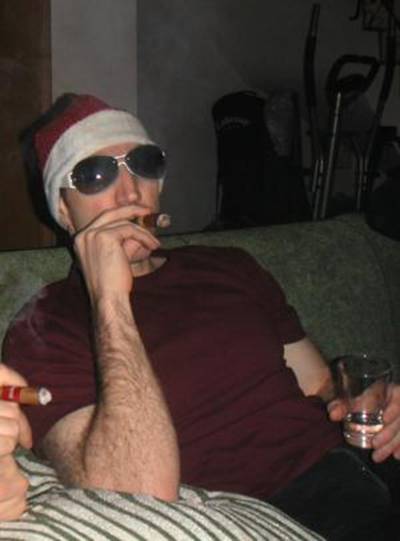
    A dissolute Imagethief wallows in empty, carnal indulgence on Christmas eve with a fat smoke and Finnish vodka. Jackie O. shades hide eyes full of shame.
    A dissolute Imagethief wallows in empty, carnal indulgence on Christmas eve with a fat smoke and Finnish vodka. Jackie O. shades hide eyes full of shame.
  • Beijing needs a giant monster attack

    When you are asked to name the great, metropolitan cities of the world, you will naturally consider certain factors. It’s not always size that makes the difference. If it was, then Chongqing would be the capital of the planet, a role I think we can all agree that Chongqing, for all its charms, is not quite ready for. Sure, size has its place, but it’s the more abstract qualities that really elevate certain cities to greatness, and that probably influence your choices: political influence; rich history; culture; cuisine; cosmopolitan buzz; and so on.

    Beijing has most of this –it’s working on the cosmopolitan buzz– but it conspicuously lacks the one other factor that defines many of the world’s other great metropolises: a giant monster attack.

    I’ve been giving this a lot of thought lately (a sure sign that the holidays are leading to a work slowdown), and I’ve come to the conclusion that Beijing cannot be a great, global metropolis until it is attacked by its own giant monster. Thanks to the encyclopaedic reference information contained in two invaluable websites, Stomptokyo.com andGiantmonstermovies.com, I’ve been able to research some of the cities that have been on the receiving end of giant monsters. Sure, you all know that Tokyo has had a fifty yearkaiju infestation that has included Godzilla, Gamera and friends. New York got King Kong on multiple occasions plus, as a bonus, the Beast from 20,000 Fathoms (by the way, that’s 180,000 feet, or about six times deeper than the deepest part of the ocean). London was attacked by Gorgo. San Francisco got the five-armed octopus of It Came from Beneath the Sea. The list has also has some surprises, including some of Beijing’s key, regional rivals and a few cities you’d never expect:

    • Copenhagen was attacked by Reptilicus
    • Hong Kong was attacked by Mighty Peking Man in 1977, in an unintentional but apt metaphor for the city’s future
    • Rome’s Colosseum was destroyed by Ymir in 20 Million Miles to Earth
    • Los Angeles got Them
    • North Korea was attacked by Pulgasari, admittedly in ancient times
    • South Korea’s Seoul has had various monsters
    • Sweden got a monster, although it appears to have been confined to rural areas, in keeping with Scandinavian tidyness
    • Bangkok got Garuda
    • Even neutral Switzerland had a monster, although it was put there by Americans
    • Every tiny town in  the American southwest had a Gila Monster, Mantis or giant Lepus at some point, thanks to the tireless efforts of Bert I. Gordon and his contemporaries.

    As you would expect, Singapore is monster-proofed, although I think a romp by a giant merlion would do it a world of good.

    But let’s get back to Beijing. Those who like to quibble might be tempted to remind us that Mothra appeared in Beijing in Destroy All Monsters, but I am inclined to disqualify that for a couple of reasons. First, that’s a Japanese monster, and, as such, more insulting than terrifying. And, second, the climactic battle didn’t take place in Beijing.

    The problem for Beijing is, of course, that it has no skyline, and no easy monster access. If a monster was going to attack any mainland Chinese city, it would probably make a beeline (monsterline?) for Shanghai. Not only does it have the Huangpu River and the nearby Yangtze, which is more than big enough for your standard-guage kaiju, but it has the glittering Pudong skyline which has “ravage me” spelled out all over it in neon. If the Oriental Pearl Tower isn’t a secret Mysterian headquarters building just waiting to be scaled by something giant, scaly and radioactive, then I don’t know what is. And Jinmao Tower is a close number two.

    But what would a monster in Beijing attack? CCTV Tower? That’s way out west. The Great Hall of the People or the National Museum? Those low-rise, Stalinist wedding-cake buildings just aren’t all that satisfying as monster-fodder. Guomao’s twin towers are step in the right direction, but after Jianwai Soho, there’s precious little else smashable in that neighborhood. I guess a monster could kind of work it’s way down Jianwai and Chang’an Jie like a buffet line, stopping every kilometer or so to work on whatever medium-grade skyscraper or smokestack was convenient, but it seems like kind of a chore. Why waste the effort when the concentrated banquet tables of Shanghai and Hong Kong are so much more convenient?

    And that supposes that a monster could get to Beijing. But this may be easier to solve. Although we don’t have a major waterway nearby, it is conceivable that monster awakened by, say, the depletion of Beijing’s aquifer could arise from the bottom of Zhongnanhai, or perhaps tunnel up from underneath the Shougang plant (which would put it conveniently near the CCTV tower). I guess a monster could rise out of Tianjin harbor as well, and take Tianjin as a kind of hors’d’oeuvre on the way in, but it all seems very indirect. Plus any such monster could get misdirected and end up in Dalian, or, worse, Seoul (which has already had a monster, thank you very much).

    So I think Beijing has a clear mandate. If there is a better centerpiece for a giant monster attack than the 2008 Olympics, I cannot think of what it might be. Forget terrorist attack, I’m thinking giant monster attack. I think Beijing has a responsibility, a duty, to construct a monster-worthy skyline prior to the Olympics (it’s certainly working on this), and then take advantage of the games themselves to trash it utterly.

    Now that would be a spectacle worth staying for, and it would ensure Beijing’s entry into the pantheon of great World Cities far better than any measly athletic competition alone ever would.